
Last Updated: June 25, 2026
Thank you for visiting! By the way… any links on this page that lead to products on Amazon and other stores/partners are affiliate links Aquarium Store Depot earns a commission if you make a purchase.
Table of Contents
- What Care Guides Get Wrong
- The Reality of Keeping Pristella Tetra
- Key Takeaways
- Species Overview
- Classification
- Origin & Natural Habitat
- Appearance & Identification
- Average Size & Lifespan
- Care Guide
- Is It Right for You?
- Tank Mates
- Food & Diet
- Breeding & Reproduction
- Common Health Issues
- Common Mistakes to Avoid
- Where to Buy
- Frequently Asked Questions
- What It Is Actually Like Living With Pristella Tetra
- Species Comparison
- Closing Thoughts
- Recommended Video
- References
The pristella tetra is the closest thing to a bulletproof community fish. It handles hard water, soft water, brackish conditions, and temperature swings that would stress most tetras. If you cannot keep a pristella alive, the problem is not the fish. It is your tank.
If pristella tetras are dying in your tank, the problem is not the fish. Fix your setup.
ASD Difficulty Rating
Beginner | 3/10
Pristella tetras are the most adaptable tetra in the hobby. They handle soft water, hard water, slightly brackish conditions, a wide pH range, and temperatures that would stress most species. They eat virtually anything, show no aggression, and are compatible with almost every peaceful community fish. The only real requirement: dark substrate and a school of 8 or more. Get those two things right and you have a near-bulletproof fish.
Expert Take (Mark Valderrama, AquariumStoreDepot)
At the stores I managed, pristella tetras were the fish customers walked past without a second look. The pale, transparent body on a white-gravel display tank is genuinely uninspiring – I’ve had customers tell me the fish looked sick. But I had one display corner set up the right way: black sand, driftwood, floating plants, soft light. I would point customers at that tank and tell them to watch. The same species. Completely different fish. The transparency becomes a feature. The fin banding pops. The school moves together and the light catches the bodies in shifting patterns. I started calling them my “setup test fish” – more than any other tetra, how a pristella looks tells you immediately whether a tank is built correctly. Dark substrate, right lighting, proper school size: they are one of the most elegant tetras available. Get any of those wrong: they disappear.
Hard Rule: Dark substrate and a school of 8 minimum. Miss either one and you’ve missed the species.
Light substrate washes out the transparency and makes the fin banding invisible. Small groups school loosely, display poorly, and become stressed. These two requirements are not preferences – they are the conditions under which this fish exists as the species it actually is. A school of twelve pristellas on black sand under moderate lighting is a genuinely striking display. Six pristellas on white gravel is a tank that looks like something is wrong with the fish.
The Reality of Keeping Pristella Tetra
The transparency is the feature, not a limitation. in my experience, keepers dismiss the pristella because it looks “see-through.” That transparency is what makes it unique. The internal organs are slightly visible, the light passes through the body in interesting ways, and the banded fins stand out against the clear body. It is subtle beauty at its best.
They handle brackish water. Very few tetras tolerate any salinity. The pristella is one of the rare exceptions, making it compatible with mild brackish setups. This versatility is almost never highlighted in standard care guides.
Dark substrate is essential. On white or light gravel, pristella tetras become nearly invisible. On black sand or dark substrate, the fin bands pop dramatically and the transparent body catches light beautifully. This single choice determines whether the fish looks stunning or forgettable.
Biggest Mistake New Owners Make
Keeping them on light-colored substrate where they disappear visually. The entire appeal of this species depends on contrast. Dark background, dark substrate, moderate lighting. Get this wrong and you have invisible fish.
Key Takeaways
- Minimum tank size is 15 gallons (57 liters) for a school of 6, but 20+ gallons with 10 fish is ideal
- Extremely peaceful. One of the safest tetras for community tanks, including with shrimp
- Omnivore. Accepts flake, frozen, and live foods without fuss
- Great beginner fish. Tolerates a wide range of water conditions
- Translucent body reveals internal skeleton and organs. Hence the “X-ray” nickname
Species Overview
| Field | Details |
|---|---|
| Scientific Name | Pristella maxillaris |
| Common Names | Pristella Tetra, X-Ray Tetra, Water Goldfinch, Golden Pristella |
| Family | Acestrorhamphidae |
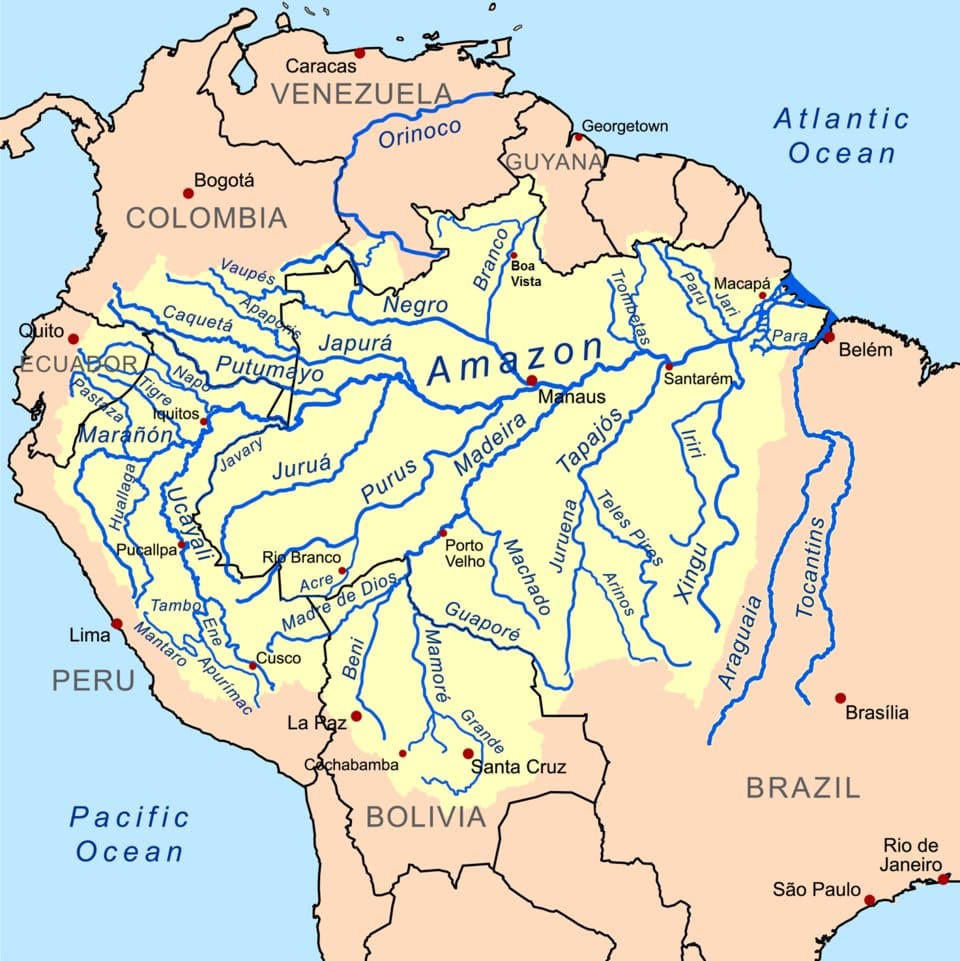
| Origin | Amazon, Orinoco, and coastal rivers of Venezuela, Guyana, Suriname, French Guiana, and northern Brazil |
| Care Level | Easy |
| Temperament | Peaceful |
| Diet | Omnivore |
| Tank Level | Mid |
| Maximum Size | 1.8 inches (4.5 cm) |
| Minimum Tank Size | 15 gallons (57 liters) |
| Temperature | 72–82°F (22–28°C) |
| pH | 6.0–7.5 |
| Hardness | 2–20 dGH |
| Lifespan | 4–5 years in captivity |
| Breeding | Egg scatterer |
| Breeding Difficulty | Moderate |
| Compatibility | Community |
| OK for Planted Tanks? | Yes |
Classification
| Taxonomic Level | Classification |
|---|---|
| Order | Characiformes |
| Family | Acestrorhamphidae (reclassified from Characidae, Melo et al. 2024) |
| Subfamily | Pristellinae |
| Genus | Pristella |
| Species | P. Maxillaris (Ulrey, 1894) |
Pristella is a monotypic genus. Meaning P. Maxillaris is the only species in it. The genus name comes from the Greek pristis, meaning “saw,” referring to the serrated upper jaw. Despite its wide distribution across northern South America, no additional species have been described, which is unusual for such a broadly distributed fish.
Note on reclassification: In 2024, a major phylogenomic study (Melo et al.) reorganized the traditional family Characidae into multiple families. Pristella was moved into the newly erected family Acestrorhamphidae under the subfamily Pristellinae. Which is actually named after this genus. Older references will still list this species under Characidae.
Origin & Natural Habitat
The pristella tetra has one of the broadest natural distributions of any popular aquarium tetra. It ranges across the Amazon basin, the Orinoco drainage, and coastal river systems from Venezuela through Guyana, Suriname, and French Guiana into northern Brazil. That’s a massive geographic range for such a small fish, and it speaks to how adaptable this species is.
In the wild, pristellas show an interesting seasonal migration pattern. During the dry season, they stick to clearwater streams and tributaries. When the rains come and the savannahs flood, they move out into the inundated grasslands where they spawn among submerged vegetation. This seasonal flooding behavior is common among South American tetras but is especially well-documented in pristellas.
Their natural habitat includes calm, densely vegetated swamps and slow-moving streams. The water ranges from clear to tea-stained with tannins, over sandy or muddy substrates with abundant leaf litter and aquatic plant cover. Some populations occur in slightly brackish coastal waters, which is unusual for a tetra and further demonstrates their exceptional adaptability.

Appearance & Identification
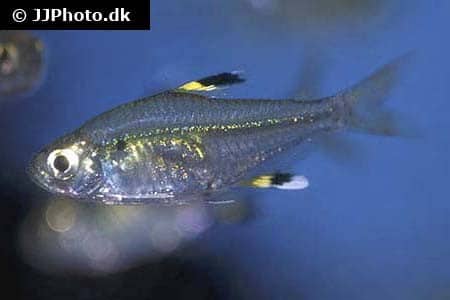
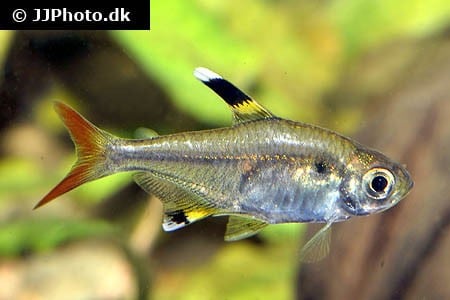
The pristella tetra’s most striking feature is its translucent body. You can literally see the backbone and internal organs through the skin, which is how it earned the “X-ray tetra” nickname. The body has a silvery-gold base with a subtle iridescent sheen that shifts between gold and silver depending on the lighting angle.
The fins are where the real visual interest lies. The dorsal and anal fins display a distinctive banded pattern of yellow at the base, a bold black stripe in the middle, and a white tip. This tricolor pattern is unique among commonly kept tetras and makes pristellas immediately identifiable. The caudal fin is slightly forked with a pinkish-red tinge. A small, round humeral spot sits just behind the gill cover. About the size of the fish’s pupil.
There’s a popular selectively bred “golden” or albino variety that has a warm golden-peach body with red eyes while retaining the distinctive fin banding pattern. It requires identical care to the wild-type form.
Male vs. Female
Sexing pristellas is straightforward once they’re mature. Females are noticeably larger and stockier than males, with a fuller, rounder belly. Especially when carrying eggs. Males are slimmer with a more streamlined profile. There are no significant color differences between the sexes, so body shape is your primary indicator.
Average Size & Lifespan
Adult pristella tetras reach about 1.6–1.8 inches (4–4.5 cm) in total length. They’re a small species, comparable in size to neon tetras and glowlights, making them well suited for tanks in the 15–30 gallon (57–114 liter) range.
Lifespan is typically 4 to 5 years in captivity with proper care. In my experience, hobbyists report them lasting longer in ideal conditions, but that 4–5 year window is a realistic expectation. As with most tetras, stable water quality and a varied diet are the keys to maximizing their lifespan.
Care Guide
Tank Size
A 15-gallon tank works as a minimum for a school of 6 pristella tetras, but a 20-gallon long is the sweet spot. Like most schooling tetras, they look and behave best in groups of 10 or more, and that requires a bit more room. Pristellas are active mid-level swimmers, so horizontal swimming space matters more than tank height.
Water Parameters
| Parameter | Ideal Range |
|---|---|
| Temperature | 72–82°F (22–28°C) |
| pH | 6.0–7.5 |
| Hardness | 2–15 dGH |
| KH | 2–10 dKH |
Pristellas are remarkably adaptable when it comes to water chemistry. Their enormous natural range. From the Amazon to coastal Guyana. Means they’ve evolved to handle everything from soft, acidic blackwater to slightly brackish coastal conditions. In the aquarium, they’ll do well in most typical tap water as long as it’s not extreme in either direction.
They show their best coloration in slightly soft, acidic water with some tannin staining. Adding driftwood or Indian almond leaves to the tank naturally creates these conditions while giving the translucent body that extra “glow” against the darker water.
Filtration & Water Flow
Gentle to moderate flow works best. Pristellas come from calm waters in the wild, so they don’t appreciate being buffeted by strong currents. A hang-on-back filter or sponge filter provides adequate filtration without creating excessive flow. For larger tanks, a canister filter with a spray bar to diffuse the output is ideal. Aim for 4–5 times tank volume turnover per hour.
Weekly water changes of 20–25% will keep conditions stable. Pristellas are forgiving, but consistent maintenance always pays off in better color and longer life.
Lighting
Moderate lighting is ideal. Pristellas look best under subdued conditions where their translucent body and fin markings can really stand out against a darker backdrop. Under harsh, bright lights they can look washed out. Floating plants like Amazon frogbit or salvinia are a great way to create dappled shade that mimics their natural habitat while still supporting your planted tank.
Plants & Decorations
Planted tanks are where pristellas truly shine. They’re completely plant-safe. No nibbling, no digging. Java fern, Anubias, Cryptocoryne species, and stem plants like Rotala and Hygrophila all work beautifully. Dense planting along the back and sides with open swimming space in the center creates the ideal layout.
Driftwood is highly recommended. It releases tannins that slightly stain the water, which brings out the pristella’s transparency and fin colors beautifully. Leaf litter from Indian almond or oak leaves adds to the natural look and provides beneficial tannins while giving the fish surfaces to pick microfauna from.
Substrate
A dark substrate makes the biggest visual difference with pristellas. Their translucent body practically glows against a dark background, and the yellow-black-white fin banding pops dramatically. Fine dark sand or a dark planted substrate is the way to go. On light-colored gravel, pristellas look pale and unremarkable. It’s one of those fish where substrate choice makes or breaks the visual impact.
Is the Pristella Tetra Right for You?
Honest assessment before you buy. The pristella tetra is one of the most setup-dependent fish in the hobby – in the right tank it is spectacular, in the wrong tank it is invisible.
Good fit if:
- You can provide dark substrate – black sand or dark planted substrate is where this species actually lives up to its potential
- You want a school of 10+ for confident, synchronized behavior and the full visual impact of their transparency
- You have a 15–20 gallon or larger community tank with peaceful tank mates – this is one of the safest tetras for mixed community setups
- You want a tetra compatible with bettas – pristellas are not fin nippers and are one of the few tetras that genuinely work in a betta community tank
- You have hard water or alkaline conditions – pristellas’ exceptional adaptability, including mild brackish tolerance, makes them the right tetra choice when most species are off the table
- You appreciate the slow-reveal beauty of transparency and tricolor fin banding over flashy, high-saturation color
Think twice if:
- You have light-colored gravel or substrate you are not willing to change – on white or beige substrate, pristellas are genuinely unimpressive and you will be disappointed
- You want a bold, flashy schooler with high-contrast color – try glowlight tetras or cardinal tetras if you want instant visual impact
- You want to keep fewer than 6 fish – a small group drifts loosely and shows almost none of the synchronized schooling behavior that makes this species interesting
Tank Mates
Best Tank Mates
Pristella tetras are among the most peaceful tetras you can keep. They won’t nip fins, they won’t bully smaller fish, and they won’t outcompete timid tank mates for food. This makes them compatible with an exceptionally wide range of species:
- Corydoras catfish. Classic bottom-dwelling companions that complement pristellas perfectly
- Neon tetras. Similar size and temperament, beautiful visual contrast
- Glowlight tetras. Another peaceful tetra that pairs well both visually and behaviorally
- Harlequin rasboras. Equally gentle mid-level schoolers
- Dwarf gouramis. A colorful centerpiece that pristellas won’t bother
- Otocinclus catfish. Peaceful algae eaters that thrive in the same conditions
- Cherry shrimp. Pristellas are one of the safest tetras to keep with adult shrimp
- Pencilfish. Gentle, slender fish from overlapping natural habitat
- Apistogramma dwarf cichlids. Great for a South American biotope pairing
- Kuhli loaches. Peaceful bottom dwellers that add interest to the lower tank zone
Tank Mates to Avoid
- Large cichlids. Anything big enough to view a pristella as food
- Tiger barbs. Too boisterous and nippy for the gentle pristella
- Red tail sharks. Territorial and prone to chasing small tetras
- Aggressive or very active species. Pristellas are peaceful to a fault and will be outcompeted by aggressive tank mates at feeding time
Food & Diet
In the wild, pristella tetras are micropredators that feed on small invertebrates, worms, insects, and tiny crustaceans. In the aquarium, they’re completely unfussy eaters that accept everything from flake food to live prey.
A quality flake food or micro pellet makes a good daily staple. Supplement 2–3 times per week with frozen or live foods like daphnia, brine shrimp, bloodworms, and cyclops. These protein-rich foods bring out the best fin coloration and keep the fish in optimal health.
Feeding frequency: Once or twice daily, only what they can eat in about 2 minutes. Small stomachs mean small portions.
Pro tip: Pristellas feed in the mid-water column and are gentle, non-aggressive feeders. If you’re keeping them with faster or more assertive species, make sure food is distributed across the tank so the pristellas get their fair share. They won’t fight for food.
Breeding & Reproduction
Pristella tetras are bred in the home aquarium, though raising the fry takes more effort than getting the adults to spawn. They’re a solid intermediate-level breeding project for hobbyists who have some experience with egg scatterers.
Breeding Difficulty
Moderate. The spawning itself is easy to trigger, but the fry are tiny and require careful feeding through the first few weeks. The biggest challenge is keeping them fed with appropriately sized food during the critical early growth period.
Spawning Tank Setup
Set up a separate breeding tank. An 18 × 10 × 10 inch (roughly 8 gallons / 30 liters) tank works well. Keep the lighting dim and add fine-leaved plants like Java moss or spawning mops for the fish to scatter eggs into. A gentle sponge filter is all the filtration you need. Cover the sides of the tank to reduce light. Both eggs and fry are light-sensitive.
Water Conditions for Breeding
Breeding conditions differ from regular care parameters. Aim for soft, acidic water. pH 5.5–6.5, hardness of 1–5 dGH, and a temperature around 78–82°F (26–28°C). Using RO water or peat-filtered water helps achieve these conditions. The softer, more acidic water mimics the flooded savannah conditions where pristellas spawn in the wild.
Conditioning & Spawning
Condition the breeding group on a diet rich in live foods. Daphnia and brine shrimp are ideal. You can spawn them in pairs or small groups. Separate males and females for about a week before pairing, or use a tank divider. When females are visibly plump and males are displaying their brightest fin colors, introduce them to the spawning tank. Spawning typically occurs the following morning. A healthy female can produce 300 to 400 eggs per spawn. That’s a solid yield for such a small fish.
Egg & Fry Care
Remove the adults immediately after spawning. They will eat their own eggs without hesitation. Eggs hatch in 24–36 hours, and the fry become free-swimming 3–4 days later. Keep the tank dark during this period. Feed infusoria or liquid fry food for the first few days, then transition to microworms and freshly hatched baby brine shrimp as the fry grow large enough to take them.
Virtually all pristella tetras in the trade are commercially bred. Most stock comes from farms in Eastern Europe and Asia. Wild-caught specimens are uncommon in retail.
Common Health Issues
Pristella tetras are hardy fish that rarely encounter serious health problems when kept in well-maintained tanks. Here are the main concerns to watch for:
Ich (White Spot Disease)
The most common ailment across all freshwater fish. Pristellas can pick up ich when stressed, typically after introduction to a new tank or after a sudden temperature change. The small white spots are easy to identify on the translucent body. Raise the temperature gradually to 82°F (28°C) and treat with a standard ich medication.
Neon Tetra Disease (NTD)
Like all tetras, pristellas are susceptible to neon tetra disease caused by the microsporidian parasite Pleistophora hyphessobryconis. Symptoms include pale patches, loss of color, lethargy, and eventually a curved spine. There’s no cure. Infected fish should be removed immediately to prevent spreading to the rest of the school.
General Prevention
Quarantine all new fish for at least two weeks before adding them to your display tank. Maintain stable water parameters and keep up with your regular water change schedule. The translucent body of pristellas actually makes it easier to spot early signs of disease. Any internal discoloration or unusual patches are visible sooner than they would be on an opaque fish.
Common Mistakes to Avoid
- Light-colored substrate. On white or beige gravel, pristellas look ghost-like and unimpressive. A dark substrate transforms them from invisible to eye-catching. This is the single biggest mistake people make with this species.
- Bright, harsh lighting. Subdued lighting with floating plants brings out their best qualities. Under intense light, they look washed out and hide more.
- Keeping too few. Groups under 6 result in stressed, shy fish. Get at least 6, ideally 10+. In a proper school, they become confident and display natural behavior that’s genuinely enjoyable to watch.
- Pairing with aggressive feeders. Pristellas are gentle eaters that won’t compete for food. If your tank has aggressive feeders, make sure food reaches all areas of the tank.
Where to Buy
Pristella tetras are widely available at most local fish stores and chain pet retailers. They’re a common, affordable species usually priced at $2–4 per fish, with discounts often available on schools of 6 or more. The golden/albino variant may command a slightly higher price.
For better quality stock, check Flip Aquatics or Dan’s Fish. Online specialty retailers will carry healthier, better-acclimated fish that show superior coloration compared to mass-market chain store stock.
Frequently Asked Questions
How many pristella tetras should be kept together?
A minimum of 6, but 10 or more is strongly recommended. Pristella tetras are shoaling fish that become stressed and shy in small numbers. In larger groups, they school actively and display much more confident, natural behavior.
What size tank does a pristella tetra need?
A 15-gallon tank is the minimum for a small school of 6. A 20-gallon long is the sweet spot for a proper school of 10+, providing enough horizontal swimming space for natural schooling behavior.
Are pristella tetras good for beginners?
Yes. Pristellas are an excellent beginner fish. They’re very hardy, tolerate a wide range of water conditions, accept any food, and are completely peaceful. They’re often recommended alongside glowlight tetras as ideal starter tetras.
Can pristella tetras live with bettas?
Yes. Pristella tetras are one of the safest tetra choices for a betta tank. They are not fin nippers and won’t harass a long-finned betta. Use at least a 20-gallon tank with plenty of plants, and as always, monitor the betta’s temperament since individual personalities vary.
How long do pristella tetras live?
Pristella tetras typically live 4 to 5 years in a well-maintained aquarium. With optimal care. Stable water quality, varied diet, and a stress-free environment. Some individuals may live slightly longer.
Why is my pristella tetra see-through?
That’s completely normal. It’s actually the species’ most distinctive trait. The transparent body that allows you to see the skeleton and organs is why they’re called “X-ray tetras.” It’s not a sign of illness. In fact, this transparency makes it easier to spot health issues early since internal problems become visible sooner.
What is the difference between a pristella tetra and a golden pristella tetra?
The golden pristella is a selectively bred albino variety of the same species. It has a warm golden-peach body with red eyes instead of the wild-type’s silver-translucent body with dark eyes. The distinctive yellow-black-white fin banding pattern is retained. Care requirements are identical for both forms.
What It Is Actually Like Living With Pristella Tetras
What the care parameters don’t capture.
The first time you see them on black sand is when you understand the species. Put a school of twelve pristella tetras in a tank with dark substrate, driftwood, and moderate lighting – the kind with some floating plants diffusing the surface light – and the transparent body stops being a “see-through” curiosity and becomes an actual visual feature. Light passes through the school from multiple angles at once. The yellow-black-white fin banding appears vivid and high-contrast against the dark backdrop. The school moves with an unhurried synchrony that is genuinely elegant. There is nothing in the hobby quite like it. Put those same fish in a white-gravel tank under bright light and you have pale, unimpressive fish that look like they need to be quarantined. The species does not change. The setting does.
School size changes the whole experience. Six pristellas drift loosely, school casually, and make a modest impression. Twelve pristellas move as a coordinated unit. The transparency compounds – when the bodies overlap slightly in motion, the layered light-passing effect becomes something you actually stop to watch. This is the fish that rewards going bigger on school size more than almost any other tetra. Eight is the minimum; twelve or more is where the display becomes genuinely striking.
They enhance the tank without demanding it. Pristella tetras do not compete for attention the way a centerpiece fish does. They add movement and layered visual texture to the mid-column while making everything around them look more intentional. A planted tank with a small centerpiece and a school of pristellas moving through it looks like a deliberate aquascape. They are excellent as a supporting school because they never overwhelm – they elevate.
The brackish tolerance changes who can keep them. Most tetras are off the table in hard, alkaline municipal water unless you invest in RO filtration. Pristellas are not. Their adaptability – including genuine mild brackish tolerance – opens this species to a category of aquarist that normally cannot keep soft-water tetras. If your tap water is hard and you’ve been told tetras won’t work, pristella tetras are almost certainly the exception.
How the Pristella Tetra Compares to Similar Species
Pristella Tetra vs. Lemon Tetra
Both are subtly colored, transparency-based tetras that look best on dark substrates with moderate lighting. The Lemon Tetra has warmer yellow-gold body tones and a distinctive red eye; the Pristella has more defined tricolor fin banding and a cleaner full-body transparency. Both are hardy and peaceful and actually complement each other well in a mixed school – different enough to distinguish at a glance, similar enough in temperament and habitat to be completely cohesive. Choose the Lemon Tetra if you want warmer solid-body coloration with the red eye as a focal detail. Choose the Pristella Tetra if you want the most distinctive fin banding pattern in the tetra group, the full X-ray transparency, and the broader water parameter tolerance – including the brackish option for hard-water setups.
Pristella Tetra vs. Head and Tail Light Tetra
Both are classic underrated tetras with light-based visual features that depend on setup to look their best. The Head and Tail Light Tetra has copper-gold spots at the eye and tail base; the Pristella has the tricolor banded fins and full-body transparency. The HTL’s spots are a point-of-detail feature; the Pristella’s transparency is a whole-body feature that scales with school size. Choose the Head and Tail Light Tetra if you want the copper spot accent and a slightly more actively energetic schooler that is marginally easier to find at standard retail. Choose the Pristella Tetra if you want the more complete transparency display, the tricolor fin banding, and the significantly wider water parameter tolerance including mild brackish.
Closing Thoughts
The pristella tetra is one of those fish that rewards the hobbyist who takes the time to set up the tank properly. Give them a dark substrate, some driftwood, and subdued lighting, and you’ll have a school of living crystal that catches the eye every time you walk past the tank. They’re peaceful, hardy, affordable, and genuinely beautiful when displayed correctly.
If you’re looking for other peaceful tetras to school alongside your pristellas, check out our care guides for glowlight tetras, cardinal tetras, and ember tetras.
Have you kept pristella tetras? I’d love to hear about your setup. Drop a comment below!
Recommended Video
Check out our tetra tier list video where we rank the most popular tetras in the hobby, including the pristella tetra:
References
- Pristella maxillaris Profile. Seriously Fish
- Pristella maxillaris (Ulrey, 1894). FishBase
- Pristella Tetra Care Guide. Practical Fishkeeping
- Pristella maxillaris. The Aquarium Wiki
- About the Author
- Latest Posts

I’m Mark Valderrama, founder of Aquarium Store Depot and a fishkeeper with over 25 years of hands-on experience. I started in the hobby at age 11, worked at local fish stores, and have kept freshwater tanks, ponds, and reef tanks ever since. I’ve been featured in two best-selling aquarium books on Amazon and built this site to share practical, experience-based fish keeping knowledge.
Leave a Reply