
Last Updated: June 25, 2026
Thank you for visiting! By the way… any links on this page that lead to products on Amazon and other stores/partners are affiliate links Aquarium Store Depot earns a commission if you make a purchase.
Table of Contents
- Key Takeaways
- Species Overview
- Classification
- Origin & Natural Habitat
- Appearance & Identification
- Average Size & Lifespan
- What People Get Wrong
- Reality of Keeping
- Care Guide
- Tank Mates
- Food & Diet
- Breeding & Reproduction
- Common Health Issues
- Common Mistakes to Avoid
- Should You Get This Fish?
- Where to Buy
- Comparison: Malawi Hawk vs. Similar Species
- FAQ
- Closing Thoughts
- Recommended Video
- References
True to its name, the Malawi Hawk hunts like a bird of prey. Aristochromis christyi is one of Lake Malawi’s most specialized predators, a fish that literally tilts onto its side and descends on prey from above, diving at an angle like a raptor striking from the sky. There’s no other freshwater fish that hunts quite like this, and watching it happen in an aquarium is genuinely unforgettable.
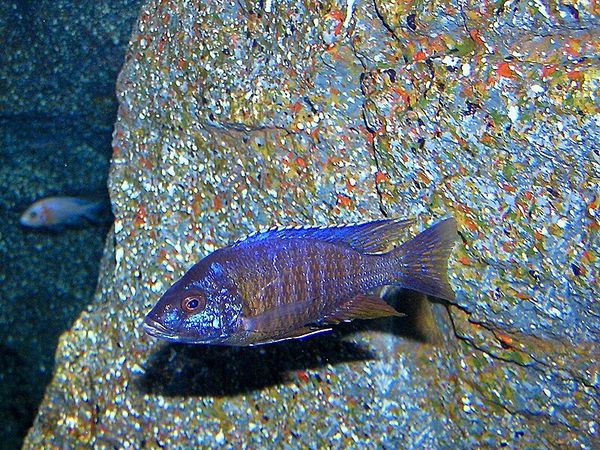
The Malawi Hawk is also one of the largest cichlids in the lake, reaching 12 inches (30 cm) in captivity. Males in breeding dress develop a striking blue-green body with vivid orange-red ventral fins. This is a fish with real physical presence, the kind that makes people stop and ask questions when they walk past your tank.
Most fish inhabit your tank. The Malawi Hawk owns it.
This is an advanced species. It needs serious infrastructure, carefully chosen companions, and a keeper who understands what it means to manage a large predatory cichlid. But for the right keeper, the Malawi Hawk delivers a fishkeeping experience that few other freshwater fish can match.
ASD Difficulty Rating: Advanced
The Malawi Hawk is not a beginner species by any measure. It requires 125+ gallons minimum, heavy-duty filtration, careful tank mate selection, and an understanding of predatory cichlid management. Experienced Malawi keepers who already have large tank infrastructure and have kept other large Hap species are the target audience. This is a commitment measured in 10–15 years and hundreds of gallons of water.
Key Takeaways
- Unique hawk-like hunting behavior, Tilts onto its side and dives on prey from above; no other Malawi cichlid hunts this way
- One of Lake Malawi’s largest cichlids, Males reach 12 inches (30 cm); females 8–9 inches (20–23 cm)
- 125-gallon minimum, 6-foot tank required, Not a suggestion; a physical necessity for a fish this size that spooks easily
- True piscivore, Eats other fish; anything that fits in its mouth is prey; mbuna are not safe companions
- Spooks easily, Startled fish sprint into glass; long sightlines and a calm environment are essential
- Monotypic genus, Aristochromis has only one species; there’s nothing else quite like this fish in the lake or in the hobby
- 10–15 year lifespan, This is a long-term relationship; plan for it before you buy
Species Overview
| Common Name | Malawi Hawk, Hawk Cichlid |
| Scientific Name | Aristochromis christyi |
| Family | Cichlidae |
| Origin | Lake Malawi, East Africa (lake-wide distribution) |
| Care Level | Advanced |
| Temperament | Predatory / Piscivore |
| Diet | Carnivore, dedicated piscivore |
| Tank Level | All levels, open-water hunter |
| Max Size | 12 inches (30 cm) male; 8–9 inches (20–23 cm) female |
| Min Tank Size | 125 gallons (473 liters), 6-foot tank required |
| Temperature | 76–82°F (24–28°C) |
| pH | 7.8–8.6 |
| Hardness | 10–20 dGH |
| Lifespan | 10–15 years |
Classification
| Order | Cichliformes |
| Family | Cichlidae |
| Subfamily | Pseudocrenilabrinae |
| Genus | Aristochromis |
| Species | A. christyi Trewavas, 1935 |
Aristochromis is a monotypic genus, the Malawi Hawk is its only species. The genus name combines the Greek aristos (best, superior) and chromis (a type of fish), reflecting its status as a top predator among the lake’s cichlid assemblages. The species epithet christyi honors C.H. Christy, a British naturalist who collected specimens in East Africa in the early 20th century. Trewavas formally described the species in 1935, and the taxonomic placement has remained stable, no reclassifications since the original description.
Origin & Natural Habitat
Aristochromis christyi is endemic to Lake Malawi in East Africa and occurs at low abundance throughout the entire lake, one of few Malawi cichlids with no apparent geographic color variation. This lake-wide uniformity is unusual for the cichlid assemblages of Malawi, where most species show significant regional variation across different reef systems.
The Malawi Hawk inhabits rocky shorelines near the surface, hunting in open water adjacent to reef structures. It’s an active hunter rather than an ambush predator, it patrols the water column, locates prey (typically small mbuna or other cichlids near rocky outcrops), and executes its signature attack: tilting sideways, monitoring the target with one eye, slowly drifting downward, then striking from above at a diagonal angle. The behavior mimics the hunting dive of a hawk closely enough that early researchers named the fish for it.
In the wild, this hunting strategy makes the Malawi Hawk one of the lake’s apex piscivores, a specialist that occupies a predatory niche no other Malawi cichlid fills in quite the same way.
Appearance & Identification
The Malawi Hawk has the physical profile of a predator: long, streamlined body, large pronounced head, and a sizeable mouth capable of taking surprisingly large prey. The overall proportions are different from typical cichlids, the head seems slightly oversized relative to the body, a feature that’s immediately recognizable once you know what you’re looking at.
Males in full breeding dress are genuinely striking. The body is blue-green with vivid orange-red ventral fins, a color combination that photographs beautifully and commands attention in person. Dominant males lose most of their dark barring, leaving a clean, saturated blue-green body that makes the orange fins stand out even more. Subdominant males and females show more muted coloration, with the characteristic diagonal black flank stripe on females providing a reliable identification feature.
Male vs. Female
Sexing mature Malawi Hawks is straightforward, the color difference between sexes is dramatic, and the female’s diagonal flank stripe is unmistakable once you know what to look for.
| Feature | Male | Female |
|---|---|---|
| Body Color | Blue-green with orange-red ventral fins | Brown-gray with diagonal black flank stripe |
| Size | Up to 12 inches (30 cm) | Up to 8–9 inches (20–23 cm) |
| Barring | Faded or absent in dominant males | May show faint vertical barring alongside diagonal stripe |
| Egg Spots | Present on anal fin | Absent or very faint |
| Head | Larger, more pronounced profile | Proportionally smaller |
Average Size & Lifespan
Males reach 12 inches (30 cm) in captivity, that’s a substantial fish with real physical mass, not just length. Females are smaller but still impressive at 8–9 inches (20–23 cm). This is one of the larger Hap species regularly kept in the hobby, and tank sizing must be planned around their adult dimensions from the moment of purchase, not adjusted later.
Malawi Hawks live 10–15 years with proper care. That longevity, combined with the infrastructure requirements, means this is a serious long-term commitment. A juvenile Hawk you buy today could be with you well into the next decade. Plan accordingly, both for the tank and for what happens if circumstances change.
What People Get Wrong
The Malawi Hawk is not a cichlid that eats a lot, it’s a cichlid that eats other fish. That distinction matters. The Hawk is a dedicated piscivore whose entire hunting strategy is built around catching and consuming live prey. In an aquarium, anything that fits in its mouth is a candidate. And its mouth is larger than most people expect, a 12-inch Hawk can take down a 5-inch mbuna without difficulty. The rule isn’t “small fish are at risk.” The rule is “anything under 6 inches is at risk, and even that assumes the Hawk is well-fed.”
The second mistake is the tank size rationalization. People buy a juvenile Hawk at 3 inches, put it in a 75-gallon, and tell themselves they’ll upgrade when it gets bigger. They don’t. The fish grows. The tank stays the same. A large, active open-water predator in a short tank panics easily, hits the glass during sprints, injures its snout, and develops chronic stress. The injuries become infected. The fish that could have lived 15 years in the right setup dies at 3 or 4. The 125-gallon minimum is not aspirational, it’s the minimum viable enclosure for an adult specimen.
Third mistake: treating skittishness as a personality quirk rather than a management requirement. A startled Malawi Hawk doesn’t hide, it sprints. Fast. A fish this large, moving at full speed, hits aquarium glass with enough force to cause permanent snout damage. Avoid placing the tank in high-foot-traffic locations, never tap the glass, and don’t make sudden movements near the tank. This isn’t optional behavior modification, it’s injury prevention.
Reality of Keeping
The hunting behavior is the daily spectacle. Watching a full-grown male tilt sideways and drift down toward prey, slowly, methodically, with one eye locked on the target, is unlike anything else in freshwater fishkeeping. When the strike comes, it’s fast and decisive. Experienced cichlid keepers who see it for the first time are often visibly surprised.
But the reality of daily ownership is that this fish defines everything about the tank. The 6-foot minimum isn’t just about swimming room, it’s about creating the long sightlines the fish needs to feel secure and hunt effectively. The aquascaping choices are constrained by those sightlines: open center, structures along the back and sides only. The filtration requirements are serious, a large piscivore eating meaty foods produces significant waste, and hard alkaline water degrades fast without heavy biological filtration and regular large water changes.
The tank mates are chosen relative to the Hawk, not alongside it. Every other fish in the setup is selected based on whether it can coexist with a 12-inch predator. Most of the Lake Malawi species people think about first, mbuna, smaller Peacocks, medium Haps, are off the table. The companions are large Haps, Synodontis catfish, and similarly sized predatory species that can hold their own and won’t fit in the Hawk’s mouth.
If that level of infrastructure and commitment is something you can genuinely provide, the Malawi Hawk rewards it with a fishkeeping experience that’s genuinely difficult to replicate with any other species.
Care Guide
Tank Size
125 gallons (473 liters) is the minimum, and the tank must be at least 6 feet long. This is not a recommendation that can be scaled down. An active, open-water predator reaching 12 inches needs both the volume and the horizontal length to move naturally and feel secure. For a breeding group (1 male, 3+ females) or a community of large Haps alongside the Hawk, push into the 150–200 gallon range. More space is always better with this species.
Water Parameters
| Temperature | 76–82°F (24–28°C) |
| pH | 7.8–8.6 |
| General Hardness (dGH) | 10–20 dGH |
| Carbonate Hardness (dKH) | 10–15 dKH |
| Ammonia | 0 ppm |
| Nitrite | 0 ppm |
| Nitrate | <20 ppm |
Standard Lake Malawi chemistry. The critical element is water quality maintenance, not just hitting the right pH and temperature. Large piscivores eating high-protein foods produce significant waste, nitrates climb fast in a Hawk tank without diligent maintenance. Target 50% water changes every two weeks minimum. Use aragonite sand or crushed coral substrate for pH buffering.
Filtration & Water Flow
Heavy-duty filtration is non-negotiable. A large external canister or sump system rated for at minimum 2x your tank volume. The Malawi Hawk is a messy eater of protein-rich foods, the biological load is substantially higher than an equivalent volume of herbivorous cichlids. Supplement mechanical filtration with strong biological media. Add powerhead circulation to prevent dead spots. Good surface agitation for oxygenation matters too.
Lighting
Standard LED lighting at moderate intensity works well. Malawi Hawks have no specialized lighting requirements, but avoid sudden dramatic lighting changes, going from dark to bright instantly can trigger a panic sprint. Use a timer-controlled gradual ramp-up if available. Keep the photoperiod to 8–10 hours. Under appropriate warm-toned lighting, the blue-green and orange-red male coloration is particularly striking.
Plants & Decorations
Open swimming space takes priority over everything else. The Malawi Hawk is an open-water hunter that needs clear sightlines from end to end of the tank. Place rock structures along the back and sides for visual definition and shelter spots, but keep the central and front zones wide open. Don’t overcrowd with rockwork, dense hardscape creates collision hazards when a frightened Hawk sprints. A few well-placed structures are sufficient; elaborate aquascaping is counterproductive with this species.
Substrate
Sandy substrate is recommended. Males dig shallow spawning pits during breeding, so a sand-based substrate accommodates natural reproductive behavior. Aragonite or pool filter sand both work. Keep the sand layer relatively shallow in the open areas, the focus is on giving the fish room to move, not elaborate substrate features.
Tank Mates
Expert Take (Mark Valderrama, AquariumStoreDepot)
At the stores I managed, Malawi Hawks were always kept behind the counter or in a dedicated predator display. They weren’t impulse buys, we’d only sell them after a conversation about tank size. A full-grown male in a proper 200-gallon setup with a few large Haps is one of the most impressive displays I’ve seen in the freshwater hobby. But I’ve also seen what happens when someone buys a juvenile and puts it in a 75-gallon: the fish spooks, hits the glass repeatedly, damages its snout, and develops secondary infections within months. The tank size conversation was non-negotiable. It still should be.
Best Tank Mates
Only large, robust fish should share space with a Malawi Hawk. The operative question for every potential tank mate is: “Can it fit in the Hawk’s mouth?” If there’s any ambiguity, the answer is treat it as a yes.
- Blue Dolphin (Cyrtocara moorii), Large, peaceful sand-sifter; occupies a different niche and grows large enough to be safe
- Malawi Eye-Biter (Dimidiochromis compressiceps), Another large predatory Hap; similar temperament and compatible setup requirements
- Venustus (Nimbochromis venustus), Large predatory Hap, similar size range, compatible temperament
- Fossorochromis rostratus, Large, robust sand-dwelling Hap; occupies the bottom zone effectively
- Adult Peacock cichlids, Fully grown males (5+ inches) are generally safe, but only with careful monitoring
- Large Synodontis catfish, Bottom-dwelling catfish that stay below the Hawk’s primary hunting zone; ideal companions
Tank Mates to Avoid
- All mbuna, The Malawi Hawk’s natural prey; no mbuna species is safe regardless of size
- Small Haps and Peacocks, Anything under 5–6 inches is at risk of predation
- Slender or elongated fish, Easier to swallow than deep-bodied species of equivalent length
- Juvenile fish of any species, Always grow tank mates to adult size before introducing alongside a Hawk
- Relentlessly aggressive species, Hawks spook easily; constant harassment from dominant tank mates creates chronic stress and injury risk
Food & Diet
The Malawi Hawk is a dedicated piscivore. In the wild it lives exclusively on other fish, and in captivity the diet must be weighted heavily toward protein-rich, meaty foods. Quality carnivore pellets can form part of the diet once the fish accepts them, but many Hawks are initially reluctant to take dry food, particularly wild-caught specimens.
The most reliable foods are frozen prawns, krill, mussel, cockle, lancefish, and chunks of fish fillet. These substantial, meaty items satisfy the Hawk’s predatory drive and provide the nutrition needed for a fish this size. Some keepers offer occasional live prey (goldfish, feeder guppies) for enrichment, but be aware of the disease transfer risk, quarantine any live food source before use.
Feed adults 1–2 meals per day and only what they consume within a few minutes. Uneaten protein in alkaline water degrades water quality rapidly. Two feedings per day with occasional live food treats also helps condition females for breeding.
Hard Rule: 125 gallons and 6-foot tank length, before you buy, not eventually.
The single most common Malawi Hawk welfare failure is purchasing a juvenile and planning to “upgrade the tank later.” It does not happen reliably, and in the meantime the fish suffers in an undersized enclosure. A large predator in a short tank panics, sprints into glass, injures its snout, and develops secondary infections. Get the infrastructure right first. The fish waits for no one’s upgrade timeline.
Breeding & Reproduction
Malawi Hawks are polygamous maternal mouthbrooders. Breeding in captivity is achievable but requires patience, this species doesn’t spawn on a predictable schedule, and getting females into breeding condition takes more effort than with most Malawi cichlids.
Breeding Difficulty
Moderate to Difficult. The tank setup requirements alone (125+ gallons) create barriers. Once established in appropriate infrastructure, spawning can occur naturally, but conditioning females requires consistent high-quality feeding and time. Brood sizes are small, 15 to 50 fry, reflecting the large egg size.
Spawning Tank Setup
Maintain a harem of 1 male to at least 3 females. Sand substrate for spawning pit construction is essential, males dig shallow pits and display over them during courtship. Provide adequate cover so females can retreat from the male’s attention between spawning attempts; a male in breeding condition will pursue females persistently, and females that can’t escape become stressed and stop feeding.
Conditioning & Spawning
Before spawning, the male develops his most intense blue-green coloration and displays over his pit. Two feedings per day with occasional live food treats helps bring females into condition. Spawning follows the standard Malawi mouthbrooder pattern: the pair circles over the pit, the female lays eggs and picks them up in her buccal cavity, and then collects milt from the male’s egg spots to fertilize them internally.
Egg & Fry Care
Females hold for 3–4 weeks without eating. Minimize disturbance during this period, stress can cause premature spitting or egg-eating. Brood size is typically 15–50 fry, reflecting the large egg size. Released fry are large and accept baby brine shrimp, microworms, and finely crushed carnivore pellets immediately. Raise fry separately from adults for best survival rates.
Common Health Issues
Malawi Bloat
Despite being piscivores rather than herbivores, Malawi Hawks are susceptible to Malawi Bloat, particularly when overfed, when water quality declines, or when food quality is poor. Symptoms include abdominal swelling, white or stringy feces, loss of appetite, and labored breathing. Onset to death can occur within 48–72 hours. Treat immediately with Metronidazole (250mg per 10 gallons, every other day for three treatments) in a hospital tank. Prevention is the only reliable strategy: maintain strict water quality and measured feeding portions.
Stress-Related Injuries
The most Hawk-specific health risk. Because this species spooks easily, panic sprints cause snout damage from glass collisions, scale loss from contact with rockwork, and general abrasions. Prevention is entirely about setup and environment: long clear sightlines, tank positioned away from high-foot-traffic areas, no tapping on glass, gradual lighting changes. Secondary bacterial infections from injuries are common when wounds occur in fish with compromised immune systems, keep water quality pristine to minimize this risk.
Hole-in-the-Head Disease (HITH)
Large cichlids, particularly those kept in less than ideal conditions, are susceptible to HITH, which presents as pitted lesions on the head and lateral line. Contributing factors include poor water quality, vitamin deficiencies in the diet, and possibly activated carbon overuse. Improving diet variety with vitamin-rich frozen foods and stepping up water change frequency typically halts and reverses early-stage HITH.
Common Mistakes to Avoid
- Undersized tank, A 12-inch open-water predator in a 75-gallon is not manageable; it’s a welfare problem that ends in injury or early death
- Housing with mbuna or small fish, Mbuna are the Malawi Hawk’s natural prey; there are no exceptions to this rule
- Cluttered aquascape, Dense rockwork creates collision obstacles for a fast, easily startled fish; keep the center and front completely open
- Tapping on the glass or sudden movements, A startled Hawk sprints hard enough to injure itself; approach the tank calmly and train anyone who interacts with it to do the same
- Underestimating filtration requirements, Large piscivore, high-protein diet, heavy bioload, cut-rate filtration results in rapid water quality decline
- Skipping large water changes, Nitrates climb fast in a Hawk tank; biweekly 50% changes are realistic, not excessive
- Expecting quick breeding results, Conditioning females takes consistent effort; set realistic expectations and don’t rush the process
Should You Get This Fish?
The Malawi Hawk is the right fish for a specific, experienced keeper with specific infrastructure. It’s not a species for casual cichlid hobbyists, and it’s not one where “I’ll figure it out” works as a plan.
Good fit if:
- You already have or are specifically building 125+ gallon / 6-foot infrastructure
- You’ve kept other large Hap species and understand predatory cichlid management
- You want a centerpiece fish that commands the room and generates real conversation
- You find the hawk-style hunting behavior genuinely fascinating and want to observe it long-term
- You’re committed to a 10–15 year relationship with a large, infrastructure-intensive fish
Avoid if:
- Your tank is under 125 gallons or under 6 feet long, even temporarily
- You currently keep or plan to keep mbuna or small cichlids in the same setup
- You can’t maintain heavy filtration and biweekly large water changes
- You’re new to African cichlids and looking for a starter Hap
- You can’t tolerate a fish with a 15-year potential lifespan
Where to Buy
Malawi Hawks are uncommon in the general aquarium trade, most LFS don’t carry them. Most specimens sold are commercially bred rather than wild-caught. Expect to pay $15–$30 for juveniles, with larger or confirmed-male specimens commanding more. For reliable sourcing:
- Flip Aquatics, Carries a range of large Malawi Hap species including predatory Haps
- Dan’s Fish, Good source for Malawi Hawks and other large Hap species
Buy a group of 5–6 juveniles and grow them out together. This gives you the best chance of establishing a proper breeding group. As males color up, keep one dominant male and rehome the subordinates, multiple males in the same tank will eventually conflict.
Comparison: Malawi Hawk vs. Similar Species
If you’re considering large predatory Haps for a 125+ gallon Lake Malawi setup, here’s how the Malawi Hawk compares to the alternatives:
Malawi Hawk vs. Venustus (Nimbochromis venustus)
The Venustus is the most widely available large predatory Hap and the more beginner-friendly of the two. Both reach similar sizes (Venustus males top at 10 inches vs. Hawk’s 12 inches), both require 125+ gallon setups, and both are piscivores. The Venustus has a distinctive giraffe-pattern body with a vivid yellow-blue head on dominant males, a bold, visible coloration pattern. The Hawk’s hunting behavior is more dramatic and unique, but the Venustus is easier to source and slightly less demanding. Choose Venustus if you want a large predatory Hap that’s more readily available and slightly more forgiving. Choose Malawi Hawk if the unique hunting behavior is the specific attraction and you’re prepared for a slightly more demanding species.
Malawi Hawk vs. Malawi Eye-Biter (Dimidiochromis compressiceps)
The Eye-Biter is a fascinating lateral predator in its own right, it hunts by approaching prey side-on and striking at the eyes. Both are specialized hunters with unique predatory strategies, and both are advanced-keeper species with large tank requirements. The Eye-Biter grows similarly large and is similarly piscivorous. These two species can be co-housed in a sufficiently large tank (150+ gallons) since they occupy slightly different hunting strategies and zones. Choose Eye-Biter if you want a slender, laterally hunting predator with a different visual impact. Choose Malawi Hawk if the diving hawk attack behavior is specifically what you’re after. Or keep both in a 200-gallon display, they’re compatible and create a genuinely impressive predator tank.
Malawi Hawk vs. Blue Dolphin (Cyrtocara moorii)
A completely different personality in a similar size package. The Blue Dolphin is peaceful, sand-sifting, and non-predatory, it’s actually one of the better tank mates for the Malawi Hawk, not a replacement for it. Both need large tanks and Lake Malawi chemistry. Choose Blue Dolphin if you want a large, peaceful centerpiece Hap that can share space with other non-aggressive species. Choose Malawi Hawk if you want a predatory species that defines the tank’s hierarchy and behavior. Consider keeping both together in a 200-gallon setup.
FAQ
Do Malawi Hawks really hunt like hawks?
Yes, and it’s one of the most remarkable hunting behaviors in any freshwater fish. The Malawi Hawk tilts onto its side, monitors its target with one eye while slowly drifting downward, then lunges from above at a diagonal angle, exactly like a raptor striking from height. No other Lake Malawi cichlid hunts this way. If you haven’t seen it in person, videos don’t fully capture it.
How big do Malawi Hawks get?
Males reach up to 12 inches (30 cm); females up to 8–9 inches (20–23 cm). This is one of the larger cichlids regularly kept in the hobby. Don’t underestimate their growth potential, juveniles grow steadily and reach adult dimensions faster than many keepers anticipate.
Are Malawi Hawks aggressive?
They’re predatory rather than conventionally aggressive. They don’t chase and harass tank mates the way mbuna do, they eat fish that fit in their mouth. With appropriately sized companions (6+ inches, robust body shape), they’re relatively manageable. Males become more assertive during breeding season and can be hard on unreceptive females.
Can Malawi Hawks live with Peacock cichlids?
Only with fully grown adults, male Peacocks at 5+ inches are generally safe from predation, but females and juveniles are at risk. Many experienced keepers prefer to keep Malawi Hawks exclusively with other large Haps to eliminate the risk entirely. Monitor any mixed Peacock/Hawk setup carefully, especially when the Hawk is in breeding condition.
Why does my Malawi Hawk tilt on its side?
If the fish tilts onto its side and slowly drifts downward while actively scanning the tank, it’s exhibiting natural hunting behavior, positioning itself for a hawk-style strike. This is completely normal and one of the most fascinating things about keeping this species. If the fish is lying on its side on the bottom, appears lethargic, and is unresponsive, that’s illness, check water parameters and temperature immediately.
Is the Malawi Hawk hard to breed?
Moderate to difficult by Malawi cichlid standards. Getting females into breeding condition requires consistent high-quality feeding and time. Brood sizes are small (15–50 fry) due to large egg size. The biggest challenges are providing adequate space (125+ gallons), managing male aggression toward unreceptive females, and having the patience the species demands. It’s not impossible, but it doesn’t happen on a predictable schedule.
Closing Thoughts
The Malawi Hawk is a fish that makes you understand why people dedicate entire rooms to large cichlid setups. That hawk-style hunting behavior is something you have to see to appreciate, there’s nothing else like it in the freshwater hobby. Combined with impressive size, striking adult coloration, and the distinction of being the sole member of its genus, Aristochromis christyi is a genuine prize for the prepared advanced keeper.
The requirements are significant, 125+ gallons, heavy filtration, careful tank mate selection, and an awareness of their spooky nature. But this is one of those species where getting the setup right pays dividends for a decade or more. In a hobby full of fish that are interesting to look at, the Malawi Hawk is interesting to watch. That’s a different thing entirely.
This article is part of our Lake Malawi Cichlid Species Directory: Complete A-Z Care Guide List. Visit the hub page to explore care guides for all 28 Lake Malawi cichlid species we cover.
Recommended Video
References
- Trewavas, E. (1935). A synopsis of the cichlid fishes of Lake Nyasa. Annals and Magazine of Natural History, 16, 65–118.
- Seriously Fish. (n.d.). Aristochromis christyi. https://www.seriouslyfish.com/species/aristochromis-christyi/
- FishBase. (n.d.). Aristochromis christyi Trewavas, 1935. https://www.fishbase.se/summary/Aristochromis-christyi.html
- Konings, A. (2016). Malawi Cichlids in Their Natural Habitat (5th ed.). Cichlid Press.
- About the Author
- Latest Posts

I’m Mark Valderrama, founder of Aquarium Store Depot and a fishkeeper with over 25 years of hands-on experience. I started in the hobby at age 11, worked at local fish stores, and have kept freshwater tanks, ponds, and reef tanks ever since. I’ve been featured in two best-selling aquarium books on Amazon and built this site to share practical, experience-based fish keeping knowledge.
Leave a Reply