
Last Updated: June 25, 2026
Thank you for visiting! By the way… any links on this page that lead to products on Amazon and other stores/partners are affiliate links Aquarium Store Depot earns a commission if you make a purchase.
Table of Contents
- Key Takeaways
- Species Overview
- Classification
- Origin & Natural Habitat
- Appearance & Identification
- Average Size & Lifespan
- Care Guide
- Tank Mates
- Food & Diet
- Breeding & Reproduction
- Common Health Issues
- Common Mistakes to Avoid
- Where to Buy
- Frequently Asked Questions
- Closing Thoughts
- Recommended Video
- References
- What Most Care Guides Get Wrong
- Is the Strawberry Rasbora Right for You?
- Species Comparison
The strawberry rasbora is one of those fish that makes you do a double take. At barely over half an inch long, it’s one of the smallest aquarium fish you can buy, and yet it packs a surprising amount of color into that tiny body. These miniature rasboras from the peat swamps of southern Thailand have been gaining serious traction in the nano tank hobby, and for good reason.
But here’s the thing, keeping strawberry rasboras isn’t quite as simple as dropping them into any community tank. Their extremely small size and preference for soft, acidic water mean they need a more specialized setup than your average beginner fish. In my 25+ years in the hobby, I’ve seen too many people lose these little guys because they treated them like just another rasbora. They’re not. Get the group size, the water, and the tank size right – or skip this fish.
What Most Care Guides Get Wrong About Strawberry Rasbora
The most common mistake with Strawberry Rasboras is keeping them in groups that are too small. These fish genuinely need eight to twelve to show natural schooling behavior. In my experience working with rasboras at the stores I managed, small groups of three or four spend all their time hiding.
Key Takeaways
- One of the smallest aquarium fish: maxes out at just 0.6 inches (1.5 cm), making it a true micro fish
- Requires very soft, acidic water: pH 4.0-6.5, which rules out most standard community setups
- Best kept in a species-only nano tank: a 5-gallon minimum, but 10 gallons gives you much more room to work with
- Peaceful but extremely delicate: tank mate options are very limited due to size
- Not a beginner fish: demands stable water chemistry and carefully managed conditions

Species Overview
| Field | Details |
|---|---|
| Scientific Name | Boraras naevus |
| Common Names | Strawberry Rasbora |
| Family | Danionidae |
| Origin | Southern Thailand (peat swamp forests) |
| Care Level | Moderate to Advanced |
| Temperament | Peaceful |
| Diet | Omnivore (micro foods) |
| Tank Level | Mid |
| Maximum Size | 0.6 inches (1.5 cm) |
| Minimum Tank Size | 5 gallons (19 liters) |
| Temperature | 68-79°F (20-26°C) |
| pH | 4.0-6.5 |
| Hardness | 1-5 dGH |
| Lifespan | 3-5 years in captivity |
| Breeding | Egg scatterer |
| Breeding Difficulty | Moderate to Difficult |
| Compatibility | Species-only or carefully selected nano tank mates |
| OK for Planted Tanks? | Yes |
Classification
| Taxonomic Level | Classification |
|---|---|
| Order | Cypriniformes |
| Family | Danionidae |
| Subfamily | Rasborinae |
| Genus | Boraras |
| Species | B. naevus (Conway & Kottelat, 2011) |
The genus Boraras is a small group of miniature cyprinids containing only six described species, all native to Southeast Asia. The genus name is an anagram of Rasbora, the genus these fish were originally assigned to. All Boraras species are among the smallest freshwater fish in the world, and they share a preference for soft, acidic blackwater habitats.
The species name “naevus” comes from the Latin word for “blemish” or “birthmark,” referring to the prominent dark spot on the body that is a key identifying feature. Boraras naevus was formally described relatively recently in 2011 by Conway and Kottelat, making it one of the newest additions to the genus.
Origin & Natural Habitat
The strawberry rasbora is found exclusively in southern Thailand, specifically in the provinces around the Malay Peninsula region. Their native habitat is peat swamp forests, a type of environment that’s becoming increasingly rare due to agricultural development and deforestation across Southeast Asia.
These peat swamps are unlike anything most aquarists picture when they think of a fish’s natural home. The water is extremely shallow, often just a few inches deep, and stained a deep brown or black from the massive amounts of decomposing leaf litter and organic material on the forest floor. Sunlight barely penetrates the canopy above, keeping the water dimly lit and cool relative to other tropical habitats.
The water chemistry in these swamps is extreme by aquarium standards. We’re talking a pH that can drop below 4.0, that’s roughly as acidic as orange juice. Mineral content is virtually nonexistent, with general hardness often at or near zero. The substrate is a thick mat of fallen leaves, peat, and decaying plant material. There’s very little aquatic vegetation growing in the water itself, but the structure from roots, branches, and leaf litter is dense.
Understanding this habitat is crucial to keeping strawberry rasboras successfully. These aren’t fish that evolved in clean, neutral water with lots of current. They come from still, tannin-rich blackwater conditions that most fishkeepers would consider extreme.
Appearance & Identification
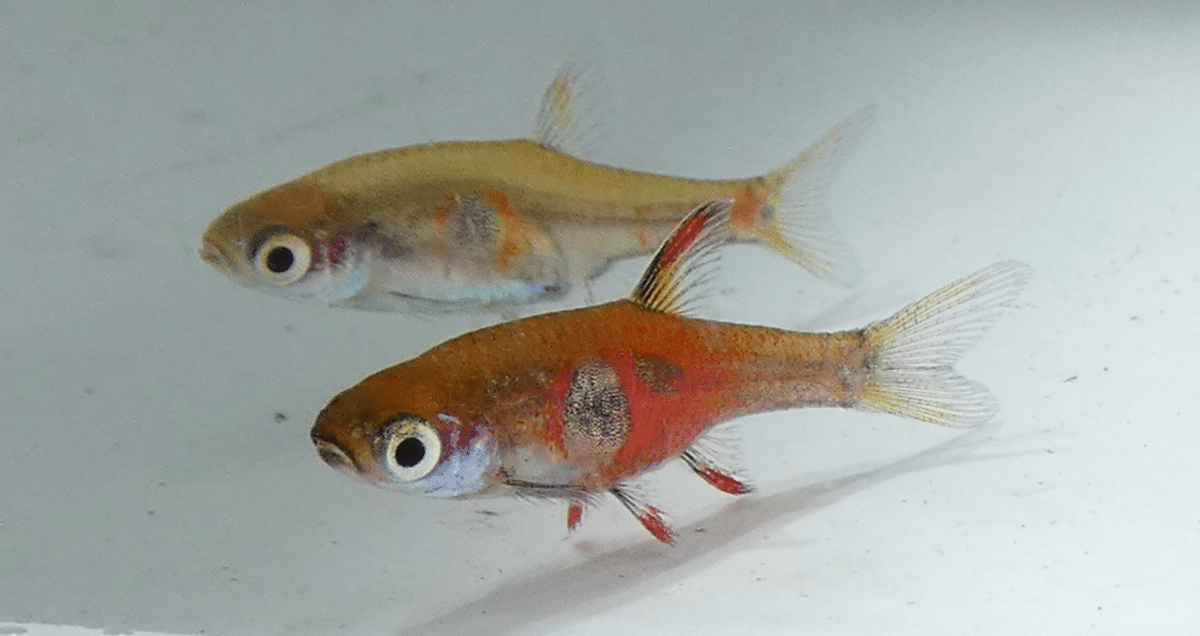
Despite being almost impossibly small, the strawberry rasbora is a genuinely attractive fish. The base body color ranges from a warm reddish-orange to a deep strawberry pink, which, naturally, is where the common name comes from. The intensity of this color varies depending on the fish’s condition, diet, and water quality, but a healthy specimen in good water is surprisingly vibrant for something half an inch long.
The most distinctive feature is the dark blotch or spot on the middle of the body, which is the “naevus” (blemish) the species is named for. This spot is typically oval-shaped and quite prominent relative to the fish’s tiny size. There may also be a smaller dark spot near the base of the tail fin. The overall body shape is slender and somewhat elongated for a cyprinid.
The fins are mostly transparent with a slight reddish tint, especially the caudal (tail) fin. Under the right conditions, soft, acidic water with tannins and subdued lighting, the red-orange coloration deepens significantly, and the fish practically glow against a dark background.
It’s worth noting that strawberry rasboras can look quite different depending on their environment. In hard, alkaline water under bright lights, they’ll appear pale and washed out. Put them in the blackwater conditions they evolved in, and it’s like looking at a completely different fish.
Male vs. Female
Sexing strawberry rasboras is tricky given their minuscule size, but there are a few differences you can spot in mature specimens. Females tend to be slightly rounder in the belly, particularly when carrying eggs, and may appear marginally larger overall. Males are slimmer with a slightly more intense red-orange coloration, especially during courtship. These differences are subtle, though, you’ll often need a magnifying glass and good lighting to tell them apart with any confidence.
Average Size & Lifespan
The strawberry rasbora maxes out at around 0.6 inches (1.5 cm) in total length. To put that in perspective, a fully grown adult is barely larger than a grain of rice. This makes it one of the smallest freshwater aquarium fish available in the hobby, only a handful of species are comparably tiny.
Despite their almost unbelievably small size, strawberry rasboras can live 3 to 5 years with proper care. That’s a respectable lifespan for a fish this small. The key to reaching the upper end of that range is maintaining the stable, soft, acidic water conditions they need and providing a stress-free environment without oversized or aggressive tank mates.
Strawberry rasboras (Boraras naevus) are a tiny micro species reaching about 0.8 inches (2 cm). They require mature, well-planted nano tanks and gentle filtration – not suitable for beginners with less than 6 months of experience.
Care Guide
Tank Size
A 5-gallon (19-liter) tank is the minimum for a small group of strawberry rasboras, but I’d recommend starting with a 10-gallon (38-liter) tank if you can. Here’s why: the bigger challenge with these fish isn’t swimming space, it’s water stability. A 5-gallon tank is extremely sensitive to parameter swings, and strawberry rasboras need rock-solid water chemistry. A 10-gallon tank gives you a much larger margin for error, and the extra water volume makes it easier to maintain those low pH and hardness levels consistently.
Keep at least 8-10 individuals. Even though they’re tiny, they’re a shoaling species that feels much more secure in larger groups. In a school of fewer than 6, they’ll spend most of their time hiding and you’ll barely see them.
Water Parameters
| Parameter | Ideal Range |
|---|---|
| Temperature | 68-79°F (20-26°C) |
| pH | 4.0-6.5 |
| Hardness | 1-5 dGH |
| KH | 0-2 dKH |
This is where strawberry rasboras get demanding. That pH range of 4.0-6.5 is not a typo, these fish genuinely come from some of the most acidic freshwater habitats on the planet. Most community tank setups run a pH of 7.0 or higher, which is well outside what strawberry rasboras can tolerate long-term.
To achieve these conditions, you’ll likely need to use RO (reverse osmosis) water or very soft tap water remineralized to minimal levels. Indian almond leaves, peat moss, alder cones, and driftwood all help lower pH naturally while releasing beneficial tannins. Some keepers use peat filtration or commercially available blackwater extracts to maintain the acidic conditions these fish require.
Temperature-wise, they actually prefer slightly cooler water than many tropical fish. A range of 72-76°F (22-24°C) is ideal for everyday keeping. They can handle warmer temperatures up to 79°F (26°C), but they seem most active and colorful in the lower to middle part of their range.
Filtration & Water Flow
Very gentle filtration is essential. Remember, these fish come from nearly still peat swamps, any significant current will exhaust them and cause chronic stress. A small sponge filter is the gold standard here. It provides biological filtration, creates minimal flow, and is safe for both adults and any fry that might appear.
If you’re using a hang-on-back or internal filter, baffle the output significantly. These are half-inch fish, even moderate flow will push them around. Water changes should be small and frequent. Aim for 10-15% weekly, using pre-conditioned water that matches the tank’s temperature and chemistry as closely as possible. Large water changes with parameter swings are one of the fastest ways to lose strawberry rasboras.
Lighting
Dim lighting is strongly preferred. In the wild, the dense canopy above peat swamp forests blocks most sunlight, and the tannin-stained water absorbs whatever light does get through. Strawberry rasboras are most comfortable and show their best colors under subdued lighting conditions.
Floating plants are your best friend here. Salvinia, Amazon frogbit, dwarf water lettuce, or red root floaters all do a great job of diffusing overhead light while adding a natural feel. If you’re running a planted tank, use low-light species that don’t require intense illumination, this keeps both the plants and the fish happy.
Plants & Decorations
Dense planting is highly recommended. Java moss, Cryptocoryne species (which thrive in acidic water), Java fern, and Bucephalandra all work well in the low-pH conditions strawberry rasboras need. Create plenty of hiding spots with dense plant clusters, but leave some open swimming space in the center or front of the tank.
Driftwood is practically mandatory. It provides structure, releases tannins that help maintain acidity, and creates the type of natural cover these fish feel secure around. Go heavy on the botanicals, dried Indian almond leaves (catappa leaves), alder cones, and seed pods on the substrate replicate their natural peat swamp habitat beautifully. As a bonus, decomposing leaves support colonies of microorganisms that strawberry rasboras will graze on throughout the day.
Substrate
A dark, fine-grained substrate works best. Dark sand or an active planted tank substrate (which can help buffer pH lower) are both good choices. The dark background makes the reddish-orange coloration of the fish pop dramatically. Avoid anything sharp or coarse, these are incredibly delicate fish with tiny mouths that may pick at the substrate surface.
A layer of dried leaves over the substrate adds another layer of authenticity and function. The leaves provide cover, tint the water, and become a feeding ground for the microfauna that strawberry rasboras snack on between meals.
Tank Mates
Best Tank Mates
Let me be direct here: a species-only tank is the safest and easiest approach for strawberry rasboras. At 0.6 inches (1.5 cm), these fish are small enough to be eaten by almost anything with a mouth big enough to fit them. Even “peaceful” community fish like neon tetras can be a threat to something this tiny.
That said, if you want to add some diversity, here are the only tank mates I’d consider:
- Other Boraras species: chili rasboras (B. brigittae), least rasboras (B. urophthalmoides), and exclamation point rasboras (B. urophthalmoides) are similar in size and share the same water requirements
- Small Corydoras species: pygmy corydoras (Corydoras pygmaeus) and dwarf corydoras (C. hastatus) are gentle enough and stay small
- Otocinclus catfish: peaceful algae eaters that ignore tiny fish entirely
- Small shrimp: neocaridina shrimp (cherry shrimp) or caridina shrimp (crystal reds, if your water is soft enough, which it likely will be)
- Small snails: nerite snails, ramshorn snails, and Malaysian trumpet snails are all safe choices
Tank Mates to Avoid
- Most tetras: even small species like neon tetras are large enough to bully or eat strawberry rasboras
- Bettas: too large and too likely to view them as food
- Any cichlid: even dwarf cichlids like Apistogramma will happily snack on fish this small
- Barbs of any size: too active, too large, and too nippy
- Larger rasboras: harlequin rasboras and similar species are giants by comparison
- Gouramis: even small species like sparkling gouramis may prey on them
- Any fast-moving or aggressive species: strawberry rasboras will be outcompeted for food and stressed constantly
Food & Diet
Feeding strawberry rasboras requires some adjustment from how you’d feed most aquarium fish. Their mouths are extraordinarily small, we’re talking about a fish that’s barely half an inch long. Standard flake food is simply too large for them to eat unless it’s been crushed into a fine powder.
The best staple foods are micro-sized options: micro pellets designed for nano fish, finely crushed high-quality flake food, or powdered foods like Hikari First Bites. These should be small enough for their tiny mouths to handle.
Where strawberry rasboras really shine is with live and frozen micro foods. Vinegar eels, microworms, Walter worms, Grindal worms, baby brine shrimp (BBS), cyclops, and daphnia nauplii are all excellent choices. Live foods trigger a strong feeding response and help bring out the best coloration. If you can culture your own live foods, you’ll see a noticeable difference in how vibrant and active these fish become.
Feeding frequency: Feed small amounts once or twice daily. Only offer what they can consume in about a minute. Overfeeding in a small nano tank fouls the water rapidly, and deteriorating water quality is one of the biggest threats to these sensitive fish.
Pro tip: A well-established tank with plenty of leaf litter and botanicals will develop biofilm and microfauna colonies that strawberry rasboras graze on throughout the day. This supplemental natural food source is one of the reasons a mature, heavily planted tank works so much better for these fish than a newly set up one.
Is the Strawberry Rasbora Right for You?
Before you add a Strawberry Rasbora to your tank, here is an honest assessment of what you’re signing up for. I’d rather you know exactly what to expect now than find out the hard way after you’ve already bought one.
- Experience level: Strawberry Rasboras are best suited for intermediate to advanced keepers. They have specific requirements that can overwhelm beginners.
- Tank size commitment: You’ll need at least 10 gallons, though bigger is always better. Make sure you have room for the tank before buying.
- Tank mate planning: Strawberry Rasboras can be territorial, so plan your community carefully. Not every fish will work as a tank mate.
- Maintenance demands: Expect regular water testing and consistent water changes. Strawberry Rasboras are sensitive to parameter fluctuations.
- Cost to keep: Strawberry Rasboras are reasonably affordable. Standard equipment and quality food cover most needs.
- Time investment: Beyond daily feeding and weekly maintenance, regular observation is the best way to catch health issues early.
- Long-term commitment: With proper care, Strawberry Rasboras can live up to 5 years. Make sure you’re ready for years of consistent care.
Breeding & Reproduction
Strawberry rasboras are egg scatterers, and while breeding them is possible in captivity, it requires some patience and attention to detail.
Breeding Difficulty
Moderate to difficult. They’ll spawn readily enough in the right conditions, but raising the fry is where the real challenge lies. The eggs and fry are microscopic, and the adults will eat both eggs and fry if given the opportunity.
Spawning Tank Setup
A small breeding tank of 2.5-5 gallons (10-19 liters) works well. Fill the bottom with clumps of Java moss or fine-leaved plants like Taxiphyllum species, which give the eggs somewhere to land where the adults can’t easily reach them. Keep the tank dimly lit, both eggs and fry are very light-sensitive.
A bare-bottom tank with a mesh divider works as an alternative. The mesh should be fine enough to let eggs fall through but prevent adults from reaching them below.
Water Conditions for Breeding
The breeding tank water should match their preferred acidic conditions closely. Aim for a pH of 5.0-6.0, temperature around 76-79°F (24-26°C), and near-zero hardness. Use RO water with peat filtration or Indian almond leaf extract to achieve these parameters. An air-powered sponge filter set to the gentlest possible flow is all the filtration you need.
Conditioning & Spawning
Condition breeding pairs or small groups with plenty of live foods, baby brine shrimp, microworms, and daphnia nauplii are ideal. When females are visibly plump with eggs, introduce a conditioned pair or a small group (2-3 males, 2-3 females) into the spawning tank. Spawning typically occurs in the morning. Boraras species tend to scatter small numbers of eggs among plants over several days rather than producing a single large spawn event.
Egg & Fry Care
Remove the adults after spawning is observed, as they will eat any eggs and fry they find. Eggs are extremely small and may take 24-48 hours to hatch. The fry are absolutely minuscule, you’ll need a magnifying glass to even see them in the first few days.
Feed the fry infusoria, paramecium, or commercially available liquid fry food for the first 1-2 weeks. Once they’re large enough (which takes a while given the tiny starting size), graduate to vinegar eels, microworms, and eventually freshly hatched baby brine shrimp. Growth is slow, don’t expect them to reach adult size for several months. Keep the rearing tank dim and maintain pristine water quality with very gentle, frequent water changes.
Common Health Issues
Strawberry rasboras are generally healthy fish when kept in proper conditions, but their tiny size makes them fragile when things go wrong. Problems tend to escalate quickly in small bodies.
pH Shock & Osmotic Stress
This is the number one killer of strawberry rasboras. Because they require such extreme water conditions (very low pH, near-zero hardness), any sudden shift in water chemistry can be fatal. Moving them from soft, acidic water to harder, more alkaline conditions, or vice versa, causes osmotic stress that these tiny fish simply can’t recover from. Always acclimate new arrivals extremely slowly, using drip acclimation over 1-2 hours minimum.
Ich (White Spot Disease)
Strawberry rasboras can contract ich, especially during the stress of transport and acclimation to a new tank. The white spots are visible even on such a small fish. Treatment requires caution, these are sensitive fish, so use half-dose medications or, better yet, raise the temperature gradually to 82°F (28°C) and add a small amount of aquarium salt (if the low pH allows it). Some keepers prefer heat treatment alone for Boraras species.
Internal Parasites
Wild-caught strawberry rasboras may carry internal parasites. Symptoms include a sunken belly, lethargy, and loss of color despite good water conditions. Quarantining new arrivals for at least two weeks is essential. Treat suspected cases with food soaked in an anti-parasitic medication, using the smallest effective dose.
General Prevention
Prevention is everything with strawberry rasboras. Quarantine all new fish, maintain stable water parameters (stability matters even more than hitting exact numbers), and avoid overfeeding. Indian almond leaves and other botanicals in the tank release mild antifungal and antibacterial compounds that help keep these fish healthy naturally. The tannin-rich water they prefer is actually mildly antimicrobial, another reason to embrace the blackwater approach.
Common Mistakes to Avoid
- Putting them in a standard community tank: This is the most common mistake by far. Strawberry rasboras are not community fish. They’re too small, too fragile, and need water chemistry that most community fish can’t tolerate. A species-only nano setup or a tank with only the smallest, gentlest tank mates is the way to go.
- Ignoring water chemistry: You cannot keep these fish in hard, alkaline tap water and expect them to survive long-term. They need soft, acidic conditions. If your tap water is hard, you’ll need RO water or another method to bring the parameters in line.
- Keeping too few: A group of 3-4 strawberry rasboras will be shy, stressed, and constantly hiding. Get at least 8-10 to see natural shoaling behavior and confident, colorful fish.
- Large water changes with mismatched parameters: A 50% water change in a nano tank with water that’s even slightly different in pH or temperature can be catastrophic. Stick to small, frequent changes with pre-conditioned, matched water.
- Feeding standard-sized food: Regular flake food is too large. You need micro-sized foods or finely crushed alternatives. Live micro foods are the gold standard.
- New tank syndrome: Setting up a brand new tank and immediately adding strawberry rasboras is a recipe for disaster. These fish do much better in mature, established tanks with stable biology and natural biofilm to graze on.
Where to Buy
Strawberry rasboras are not as widely available as some of the more common Boraras species like chili rasboras, but they do appear in the hobby through specialty retailers and online sellers. You’re unlikely to find them at big box pet stores, this is a fish you’ll need to source from dedicated aquarium shops or order online.
I recommend checking Flip Aquatics and Dan’s Fish for availability. Both specialize in quality freshwater fish and are reliable sources for nano species like Boraras. When ordering, be aware that shipping tiny, sensitive fish in extreme temperatures (summer heat or winter cold) carries additional risk. Time your orders for mild weather when possible, and opt for overnight or express shipping.
Expect to pay a bit more per fish than you would for common rasboras, typically $4-8 per fish depending on the source and availability. Buy a group of 8-10 at once rather than adding them one or two at a time.
Frequently Asked Questions
How many strawberry rasboras should be kept together?
A minimum of 8-10 is recommended, though more is always better. Strawberry rasboras are a shoaling species that become visibly stressed, shy, and pale in small groups. In a proper school of 10+, they feel secure, display bolder colors, and engage in fascinating natural behaviors including sparring displays between males.
What size tank does a strawberry rasbora need?
A 5-gallon (19-liter) tank is the minimum, but a 10-gallon (38-liter) tank is strongly preferred. The extra water volume provides much better parameter stability, which is critical for a species that requires very specific and extreme water chemistry. The larger tank also gives you room for a school of 10+ without overcrowding.
Are strawberry rasboras good for beginners?
No, not really. While they’re peaceful and don’t require a large tank, their need for very soft, acidic water (pH 4.0-6.5) and their extreme sensitivity to parameter changes make them a poor choice for someone new to the hobby. They’re best suited for intermediate to advanced keepers who are comfortable working with RO water, botanicals, and maintaining stable nano tank conditions.
Can strawberry rasboras live with shrimp?
Yes, adult neocaridina (cherry) shrimp are safe with strawberry rasboras. The fish are too small to eat adult shrimp, and both species are peaceful. If your water is very soft and acidic, caridina shrimp like crystal reds may actually be a better match since they prefer similar conditions. Baby shrimp (shrimplets) are likely safe too, given how small the rasboras’ mouths are.
What’s the difference between strawberry rasboras and chili rasboras?
Both are Boraras species of similar size, but they’re distinct species with different markings. Chili rasboras (Boraras brigittae) have a dark lateral stripe running along the body with a red stripe above it, while strawberry rasboras (Boraras naevus) have a prominent dark spot (blotch) on the body rather than a stripe. Chili rasboras are from Borneo, while strawberry rasboras are from southern Thailand. Care requirements are similar for both species.
Do strawberry rasboras need a heater?
It depends on your room temperature. Strawberry rasboras tolerate a temperature range of 68-79°F (20-26°C), which is cooler than many tropical fish. If your home stays consistently above 68°F (20°C), you may not need a heater. However, a small adjustable heater set to the low-to-mid 70s provides stability and prevents dangerous overnight temperature drops, especially in a small nano tank that loses heat quickly.
Why are my strawberry rasboras hiding all the time?
The most common causes are too few fish in the group, inadequate cover, or overly bright lighting. Strawberry rasboras need a school of at least 8-10 to feel secure. Make sure the tank has plenty of plants, floating plants to dim the light, and botanical cover like leaves and driftwood. Also check for aggressive tank mates, even a single fish that’s too large or active can keep the entire school in hiding.
How the Strawberry Rasbora Compares to Similar Species
If you’re considering a Strawberry Rasbora, you’ve probably also looked at the Chili Rasbora. Both fill similar roles, but the differences matter when planning your tank. The Strawberry Rasbora has its own distinct personality and care needs. In my experience, the choice often comes down to the specific community you’re building and whether your water parameters favor one over the other.
The Dwarf Rasbora is worth considering as well. While the Strawberry Rasbora and the Dwarf Rasbora share some overlap in care, they bring different energy to a tank. If you have the space, keeping both in separate setups gives you a great chance to compare their behavior firsthand.
Expert Take (Mark Valderrama, AquariumStoreDepot)
After 25 years in the hobby and time managing fish stores, the strawberry rasbora is one of those species I always recommend to hobbyists ready to move beyond the basics. Strawberry rasboras (Boraras naevus) are a tiny micro species reaching about 0.8 inches (2 cm). They require mature, well-planted nano tanks and gentle filtration – not suitable for beginners with less than 6 months of experience. Strawberry rasboras require a mature, cycled tank. At their tiny size, even minor ammonia spikes or pH swings that hardy fish would tolerate will kill them within 24 hours.
Closing Thoughts
The strawberry rasbora is a specialist fish for a specialist setup, and that’s part of what makes it so rewarding. Building a blackwater nano tank around these micro fish is a genuinely different experience from maintaining a standard community aquarium. When you get the conditions right and see a school of 10+ strawberry rasboras swimming through tannin-stained water over a carpet of leaf litter, glowing that deep strawberry red, it’s something special.
They’re not for everyone, and they’re definitely not a fish you should impulse-buy without doing your homework first. But if you’re willing to put in the effort to create the acidic, soft-water environment they need, strawberry rasboras will reward you with a school that glows. That’s not an exaggeration – a group of 12 in the right water, over dark substrate, under dim lighting, is one of the best things you can do with a 10-gallon.
If you’re interested in other nano rasbora species, check out our Rasboras & Danios species directory for more care guides on Boraras and other small rasbora species.
Recommended Video
Check out our rasbora species video for an overview of some of the best rasboras in the hobby, including the strawberry rasbora:
References
- Boraras naevus Profile – Seriously Fish
- Boraras naevus (Conway & Kottelat, 2011) – FishBase
- Boraras: The World’s Tiniest Aquarium Fish – Practical Fishkeeping
- Boraras naevus – The Aquarium Wiki
- About the Author
- Latest Posts

I’m Mark Valderrama, founder of Aquarium Store Depot and a fishkeeper with over 25 years of hands-on experience. I started in the hobby at age 11, worked at local fish stores, and have kept freshwater tanks, ponds, and reef tanks ever since. I’ve been featured in two best-selling aquarium books on Amazon and built this site to share practical, experience-based fish keeping knowledge.
Leave a Reply