
Last Updated: June 25, 2026
Thank you for visiting! By the way… any links on this page that lead to products on Amazon and other stores/partners are affiliate links Aquarium Store Depot earns a commission if you make a purchase.
Table of Contents
- What Care Guides Get Wrong
- Key Takeaways
- Species Overview
- Classification
- Origin & Natural Habitat
- Appearance & Identification
- Average Size & Lifespan
- Care Guide
- Is It Right for You?
- Tank Mates
- Food & Diet
- Breeding & Reproduction
- Common Health Issues
- Common Mistakes to Avoid
- Where to Buy
- Frequently Asked Questions
- Species Comparison
- Closing Thoughts
- Recommended Video
- References
The exclamation point rasbora is one of those nano fish that earns its name in the best possible way. Take a close look at Boraras urophthalmoides and you’ll see a bold dark lateral stripe that ends in a distinct round spot near the base of the tail — it looks exactly like an exclamation point (!). It’s one of the most clever common names in the hobby, and once you see it, you can’t unsee it.
What Most Care Guides Get Wrong About the Exclamation Point Rasbora
The Exclamation Point Rasbora is one of the tiniest fish in the hobby, and people consistently underestimate just how small it is. We are talking about an adult that barely reaches 0.8 inches. The misconception is that it will be visible and impactful in a standard community tank. It will not. In a 55-gallon tank with larger fish, you will never see them. These fish need a dedicated nano setup where they are the feature species, not an afterthought. The other mistake is filtration. standard HOB filters can literally suck them up.
What really sets this species apart from other Boraras is availability. The exclamation point rasbora is the most widely available species in the genus, and for good reason — it has a much broader natural range than its cousins, spanning Thailand, Vietnam, and Cambodia rather than being restricted to a single river system or island. That wider distribution means more collection points and more consistent supply in the trade. If you’ve been wanting to try a Boraras species but couldn’t find chili rasboras or dwarf rasboras at your local shop, there’s a good chance you’ll have better luck with this one.
In my 25+ years in the hobby, I’ve watched the nano fishkeeping movement grow from a niche curiosity into one of the most popular areas of the freshwater side. The exclamation point rasbora is a big part of that story — a tiny, peaceful, beautifully marked fish that thrives in planted nano tanks and looks incredible in groups. Let’s get into everything you need to know to keep them well.
Key Takeaways
- Tiny but striking — maxes out at just 0.8 inches (2 cm), with a distinctive dark stripe and spot pattern that resembles an exclamation point
- The most widely available Boraras species thanks to a broader natural range across Thailand, Vietnam, and Cambodia
- Thrives in soft, acidic water with a pH of 5.0 to 7.0 and hardness of 1 to 8 dGH — more flexible than some other Boraras species
- Peaceful nano schooling fish that should be kept in groups of at least 8 to 10 for best color and natural behavior
- Perfect for planted nano tanks as small as 5 gallons (19 liters) — dark substrate and tannin-stained water really make the colors pop
- Egg scatterer that can breed in well-maintained tanks, though raising the tiny fry takes patience and very small first foods
Species Overview
| Field | Details |
|---|---|
| Scientific Name | Boraras urophthalmoides (Kottelat, 1991) |
| Common Names | Exclamation Point Rasbora, Least Rasbora, Sparrow Rasbora |
| Family | Danionidae |
| Origin | Southeast Asia (Thailand, Vietnam, Cambodia) |
| Care Level | Easy |
| Temperament | Peaceful |
| Diet | Omnivore (micropredator) |
| Tank Level | Middle |
| Maximum Size | 0.8 inches (2 cm) |
| Minimum Tank Size | 5 gallons (19 liters) |
| Temperature | 73 to 82°F (23 to 28°C) |
| pH | 5.0 to 7.0 |
| Hardness | 1 to 8 dGH |
| Lifespan | 3 to 5 years |
| Breeding | Egg scatterer |
| Breeding Difficulty | Moderate |
| Compatibility | Nano community |
| OK for Planted Tanks? | Yes — ideal choice |
Classification
| Taxonomic Level | Classification |
|---|---|
| Order | Cypriniformes |
| Family | Danionidae (formerly placed in Cyprinidae) |
| Subfamily | Rasborinae |
| Genus | Boraras |
| Species | B. urophthalmoides (Kottelat, 1991) |
The exclamation point rasbora was described by Maurice Kottelat in 1991 as Rasbora urophthalmoides. When Kottelat established the genus Boraras in 1993 to accommodate miniature rasbora-like cyprinids, this species was transferred into the new genus along with several other micro-sized relatives. The genus name Boraras is an anagram of Rasbora, a clever taxonomic nod to the close relationship between these tiny fish and their larger cousins.
The species name urophthalmoides comes from the Greek “uro” (tail), “ophthalmos” (eye), and “oides” (resembling) — a reference to the prominent eye-like spot near the tail. Currently, the genus Boraras contains six recognized species, all of which stay well under 1 inch (2.5 cm). Other popular species in the genus include the chili rasbora (B. brigittae), dwarf rasbora (B. maculatus), and phoenix rasbora (B. merah). Like all rasboras, this species was historically classified under Cyprinidae but has been reclassified into Danionidae based on molecular phylogenetic studies.
Origin & Natural Habitat
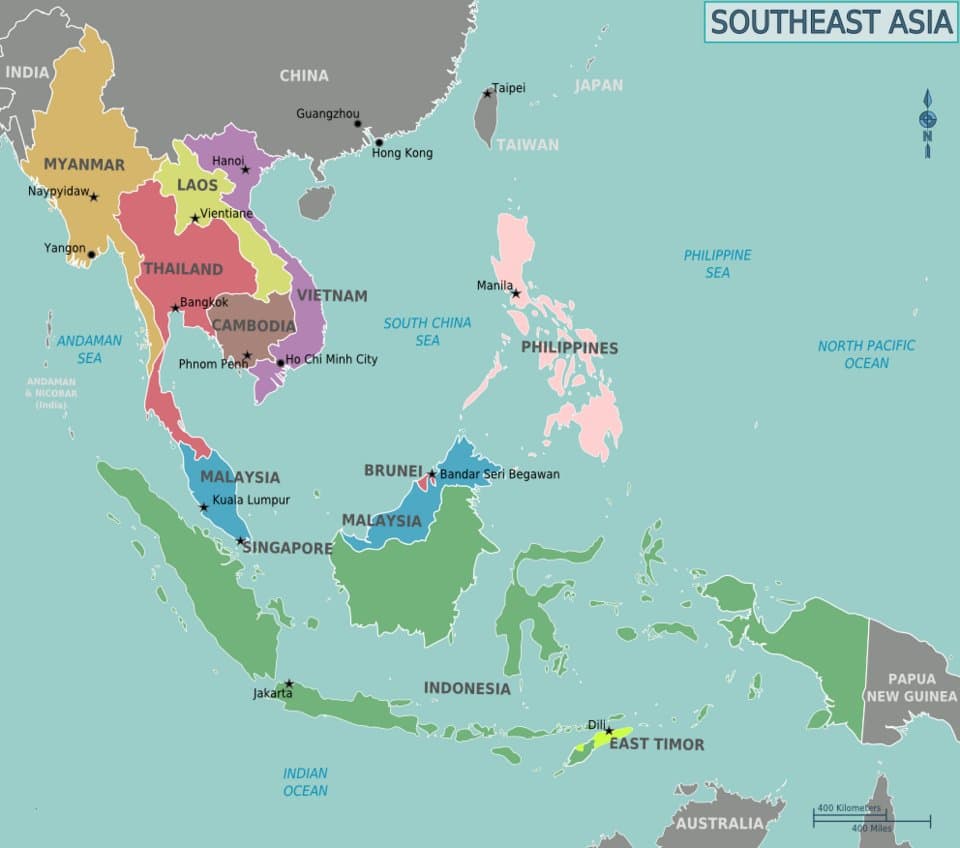
The exclamation point rasbora has one of the widest natural ranges in the Boraras genus. While most of its relatives are confined to the Malay Peninsula or individual Indonesian islands, B. urophthalmoides is found across mainland Southeast Asia — specifically in Thailand (including the Mekong basin), Vietnam, and Cambodia. This broader distribution is a big part of why this species is the most consistently available Boraras in the aquarium trade.
In the wild, these fish inhabit slow-moving or still waters associated with floodplains, rice paddies, peat swamps, and shallow forest streams. The water is typically shallow, warm, and soft with an acidic to neutral pH. Many of these habitats have a substrate of mud, decomposing leaf litter, and organic debris, which stains the water a characteristic tea-brown color from released tannins and humic acids. Vegetation — both submerged aquatic plants and overhanging terrestrial plants — provides shade and cover.
Water movement in these habitats is typically minimal or nonexistent, especially during the dry season when the fish may be confined to shallow pools and ditches. The exclamation point rasbora shares its habitat with other small cyprinids, gouramis, and various invertebrates. The rice paddy connection is particularly interesting — these fish have adapted to a seasonal environment where water levels fluctuate dramatically, and they can thrive in surprisingly shallow water as long as it stays warm and clean.
Understanding this natural environment is key to replicating it in the aquarium. Slow flow, warm temperatures, soft acidic water, dense planting, and leaf litter all mimic the conditions where these fish evolved and bring out their best colors and behavior.
Appearance & Identification
The exclamation point rasbora is a tiny, slender-bodied fish with a translucent to golden-tan base color that can range from pale amber to a warm reddish-orange depending on condition, water chemistry, and diet. In well-maintained soft water with tannins, the overall coloration becomes warmer and more vibrant.
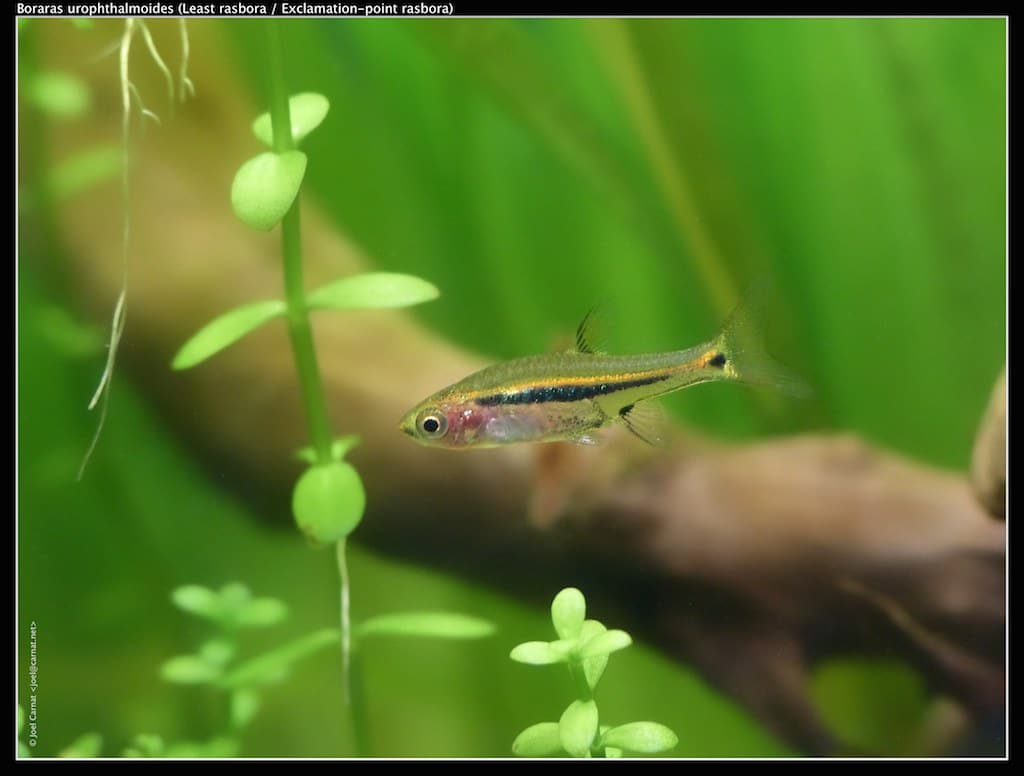
The feature that gives this species its unforgettable common name is the dark lateral marking. A prominent dark stripe runs along the midline of the body, tapering as it moves toward the tail and terminating in a bold, round dark spot at the base of the caudal fin. Together, the stripe and spot create a shape that looks remarkably like an exclamation point — it’s one of the most distinctive field marks of any nano fish. There is also typically a smaller dark marking near the base of the anal fin.
The fins are mostly transparent, sometimes with a faint yellowish or reddish tinge. The body has a slight iridescent sheen under certain lighting conditions, and the eye is proportionally large with a dark pupil and a thin golden iris. While not as intensely red as the chili rasbora, the exclamation point rasbora has a subtle beauty that really comes into its own in a densely planted tank with dark substrate and subdued lighting.
Telling Boraras Species Apart
Mislabeling among Boraras species is common in the trade, so knowing what to look for matters. Here’s how to distinguish the exclamation point rasbora from its closest relatives:
- Exclamation point rasbora (B. urophthalmoides) — dark lateral stripe ending in a round caudal spot (the “exclamation point” pattern); body is golden-tan to amber
- Chili rasbora (B. brigittae) — intense red body with a dark lateral stripe but no distinct round caudal spot; the stripe is bordered by bright red pigment
- Dwarf rasbora (B. maculatus) — ruby-red body with three separate dark blotches (mid-body, anal fin base, caudal peduncle) rather than a continuous stripe
- Phoenix rasbora (B. merah) — reddish body with a dark lateral blotch (not a stripe) flanked by red or orange; often confused with B. brigittae
- Strawberry rasbora (B. naevus) — single large dark blotch on mid-body; generally less intensely colored than other Boraras
- Micro rasbora (B. micros) — very small with a dark blotch and reduced lateral stripe; the least commonly seen species in the trade
Male vs. Female
Sexing exclamation point rasboras takes a careful eye, but it’s doable once you know what to look for. Females tend to be slightly larger and rounder-bodied than males, especially when carrying eggs — a gravid female will have a noticeably plumper belly. Males are generally slimmer and may display slightly more intense coloration, particularly along the lateral stripe and around the fins. During spawning condition, males can develop a deeper amber or reddish tone. The differences are subtle, though, and you’ll usually need a group of adults in good condition to compare side by side.
Average Size & Lifespan
The exclamation point rasbora is a true micro fish. Adults max out at about 0.8 inches (2 cm) in total length, with most specimens in home aquariums reaching around 0.6 to 0.7 inches (1.5 to 1.8 cm). They’re one of the smallest fish you can keep in an aquarium, and first-time owners are often surprised by just how tiny they really are in person.
With proper care — stable water parameters, good diet, low stress — exclamation point rasboras can live 3 to 5 years in captivity. That’s a solid lifespan for such a small fish. The key to longevity is consistency. These fish don’t handle big swings in temperature or water chemistry well, and keeping their environment stable goes a long way toward a full, healthy lifespan.
Exclamation point rasboras (Boraras urophthalmoides) are among the smallest aquarium fish available at under 1 inch (2.5 cm). They need soft acidic water, established tanks, and species-appropriate tank mates.
Care Guide
Tank Size
A 5-gallon (19-liter) tank is the minimum for a small school of exclamation point rasboras. These are tiny fish that don’t need a lot of swimming room, but they do need to be kept in groups — and a 5-gallon gives you enough space for a school of 8 to 10 comfortably. If you want a larger group of 15 or more (which really shows off their natural schooling behavior), bump up to a 10-gallon (38-liter) tank.
Nano tanks in the 5 to 10-gallon range are honestly ideal for this species. In a big community tank, these micro fish tend to get lost and can feel threatened by larger tank mates. A dedicated nano setup lets you really appreciate their subtle beauty and natural behavior up close.
Water Parameters
| Parameter | Ideal Range |
|---|---|
| Temperature | 73 to 82°F (23 to 28°C) |
| pH | 5.0 to 7.0 |
| Hardness | 1 to 8 dGH |
| KH | 1 to 6 dKH |
The exclamation point rasbora prefers soft, acidic water, though it’s a bit more tolerant than some of its Boraras relatives. That 1 to 8 dGH range gives you more flexibility than, say, the dwarf rasbora which really wants ultra-soft water. That said, these fish will look their absolute best and show their strongest coloration in the lower end of these ranges — soft water around 1 to 4 dGH with a pH of 5.5 to 6.5 is the sweet spot.
Captive-bred specimens (which make up most of the supply in the trade) tend to be more adaptable to moderate water conditions than wild-caught fish. Even so, avoid hard, alkaline water if you can. Stability is more important than hitting a perfect number — pick a target within the range and keep it consistent. Weekly water changes of 20 to 25% with matched temperature and chemistry will keep things stable.
Filtration & Water Flow
A gentle sponge filter is the go-to choice for exclamation point rasboras. These fish come from still or barely moving water in the wild, so strong current from a hang-on-back or canister filter is too much for them. A sponge filter powered by a small air pump provides the perfect combination of biological filtration and gentle water movement without blasting these tiny fish around the tank.
If you prefer a small HOB filter, baffle the outflow with a sponge or pre-filter to reduce current. The fish should be able to swim comfortably without constantly fighting against flow. Water changes of 20 to 25% weekly are recommended — use a slow siphon or airline tubing to avoid accidentally sucking up these tiny fish during maintenance.
Lighting
Subdued to moderate lighting works best. In the wild, exclamation point rasboras live in shaded habitats with heavy canopy cover, and they naturally feel more comfortable and display better color under dimmer conditions. If you’re running a planted tank that needs moderate light for plant growth, use floating plants like Amazon frogbit, salvinia, or red root floaters to create shaded areas where the fish can retreat.
Under bright, unshaded lighting, these fish tend to wash out and may stay hidden. Tannin-stained water from Indian almond leaves or driftwood also helps diffuse light naturally and creates a more comfortable environment that encourages bolder behavior.
Plants & Decorations
A heavily planted tank is the way to go with this species. Dense clusters of fine-leaved plants like Java moss, Christmas moss, Cryptocoryne species, and Rotala rotundifolia provide cover and make the fish feel secure. Floating plants are a must for the shading benefits mentioned above.
Driftwood and Indian almond leaves are excellent additions — they release tannins that soften the water, lower pH slightly, and stain the water a natural tea-brown color that mimics the fish’s wild habitat. Leaf litter (dried Indian almond leaves, oak leaves, or catappa bark) on the substrate adds a natural touch and also provides microorganism growth that the fish will pick at between feedings. Leave some open swimming space in the middle or front of the tank so you can actually watch the school move together.
Substrate
Dark substrate is strongly recommended. A fine, dark sand or aqua soil makes the exclamation point rasbora’s coloration pop dramatically compared to light-colored gravel. Beyond aesthetics, dark substrate also helps reduce light reflected from the bottom of the tank, which keeps the fish calmer and more willing to swim in the open. Active substrates like ADA Amazonia or Fluval Stratum have the added benefit of naturally buffering pH downward, which is a nice bonus for soft-water species like this one.
Is the Exclamation Point Rasbora Right for You?
Before you buy, run through this honest checklist. The Exclamation Point Rasbora is a great fish for the right keeper, but it is not for everyone.
- You have a dedicated nano tank (5-10 gallons) where tiny fish are the stars
- You can use sponge filtration or intake guards. standard filters will eat these fish
- You want one of the smallest fish in the freshwater hobby
- You can keep a group of 12+ for visible schooling behavior
- Your tank has no fish large enough to eat a 0.8-inch adult
- You enjoy the challenge and reward of keeping micro species
Tank Mates
The exclamation point rasbora is a peaceful, non-aggressive nano fish that should only be housed with other small, gentle species. At 0.8 inches (2 cm) max, anything with a mouth big enough to eat them is a threat. The best communities pair them with other micro fish and small invertebrates that share similar water requirements.
Best Tank Mates
- Chili rasboras — same genus, same care requirements, stunning mixed school of Boraras
- Dwarf rasboras — another Boraras species that shares identical water preferences
- Pygmy corydoras — tiny, peaceful bottom dwellers that won’t compete for space
- Habrosus corydoras — another micro cory that stays small and sticks to the bottom
- Otocinclus catfish — gentle algae eaters that ignore nano fish entirely
- Ember tetras — similar size, peaceful temperament, and preference for soft water
- Celestial pearl danios — small, peaceful, and visually complementary
- Neocaridina shrimp (cherry shrimp) — excellent tank mates that add color and help clean up
- Amano shrimp — peaceful algae eaters, though much larger than the fish
- Malaysian trumpet snails — help aerate substrate and clean up uneaten food
- Nerite snails — excellent algae grazers that won’t bother any fish
Tank Mates to Avoid
- Angelfish — way too large and will absolutely eat exclamation point rasboras
- Bettas — can be aggressive and the rasboras may become targets, especially in smaller tanks
- Tiger barbs — fin nippers that are far too active and boisterous for tiny Boraras
- Gourami species (except sparkling gouramis) — most are too large and may prey on or stress nano fish
- Cichlids — even small cichlids like rams can be territorial enough to harass or eat these micro fish
- Large catfish — anything that could fit a rasbora in its mouth is a no-go
Food & Diet
The exclamation point rasbora is an omnivore with a strong micropredator streak — in the wild, it feeds primarily on tiny invertebrates, insect larvae, zooplankton, and other microscopic organisms. In the aquarium, the key thing to remember is that this fish has a very small mouth. Standard-sized flakes and pellets are too big. You need to either crush them into a fine powder or use foods specifically designed for micro fish.
A good staple diet includes crushed high-quality flakes or micro pellets like Hikari Micro Pellets. Supplement regularly with frozen foods — baby brine shrimp, cyclops, and daphnia are excellent choices that provide variety and enhance coloration. Live foods like vinegar eels, microworms, and live baby brine shrimp are absolute favorites and make great conditioning food if you’re looking to breed them.
Feed small amounts 2 to 3 times daily rather than one big feeding. These tiny fish have fast metabolisms and do better with frequent small meals. Only offer what the school can consume in about 2 minutes per feeding. Overfeeding is easy to do with nano fish because the food-to-fish size ratio is so different from what most hobbyists are used to.
Breeding & Reproduction
Breeding Difficulty
Moderate. Exclamation point rasboras will spawn in a well-maintained aquarium without much intervention, but successfully raising the fry is the real challenge. The eggs and fry are extremely tiny, and the adults will eat their own eggs and young if given the chance. Deliberate breeding requires some planning and a dedicated setup.
Spawning Tank Setup
Set up a small breeding tank of 2.5 to 5 gallons (10 to 19 liters) with very gentle filtration — a small air-driven sponge filter turned down low is ideal. Fill the bottom with dense clumps of Java moss, spawning mops, or other fine-leaved plants that give the eggs somewhere to fall where the adults can’t easily reach them. Some breeders use a layer of glass marbles or mesh on the bottom to let eggs drop through to safety.
Keep lighting dim or cover the sides of the tank. These fish naturally spawn in shaded, heavily vegetated areas, and subdued conditions help encourage spawning behavior.
Water Conditions for Breeding
Breeding pairs or groups do best in slightly warmer, softer, and more acidic water than normal care parameters:
- Temperature: 78 to 82°F (26 to 28°C)
- pH: 5.0 to 6.0
- Hardness: 1 to 3 dGH
Using RO water or very soft water mixed with a small amount of tap water works well. Adding Indian almond leaves or peat extract to the breeding tank helps lower pH naturally and adds beneficial tannins. The slight shift toward warmer, softer, more acidic conditions signals to the fish that conditions are right for spawning.
Conditioning & Spawning
Condition a small group (2 to 3 pairs) with frequent feedings of live and frozen foods — baby brine shrimp, daphnia, and microworms are all excellent. After a week or two of conditioning, well-fed females will become noticeably plumper with eggs, and males will display more intensely.
Spawning typically happens in the early morning hours. The fish scatter small, non-adhesive eggs among fine-leaved plants or let them fall to the substrate. A female may release anywhere from 10 to 30 eggs per spawning event. Spawning can be easy to miss because the fish are so small and the behavior is subtle — you may not realize spawning has occurred until you spot tiny fry clinging to the glass a few days later.
Egg & Fry Care
Remove the adults after spawning or rely on the dense plant cover and marbles to protect the eggs. The adults will eat any eggs and fry they can find. Eggs typically hatch in 24 to 48 hours depending on temperature. The fry are absolutely minuscule and will remain attached to plants or glass, absorbing their yolk sac for the first 2 to 3 days.
Once free-swimming, the fry need extremely small first foods. Infusoria, paramecium cultures, or commercially available liquid fry food are essential for the first week or two. After that, you can transition to vinegar eels, microworms, and eventually newly hatched baby brine shrimp as the fry grow. Keep the water very clean with small, frequent water changes using matched parameters. Fry are light-sensitive in the early stages, so keep the breeding tank dimly lit.
In heavily planted, well-established tanks with lots of microorganism growth, some fry may survive without intervention — but deliberate breeding with a dedicated setup will give you much better results. Most exclamation point rasboras in the trade are wild-caught, so captive breeding is a worthwhile endeavor that helps reduce pressure on wild populations.
Common Health Issues
Ich (White Spot Disease)
Ich is the most common disease you’ll encounter with any freshwater fish, and exclamation point rasboras are no exception. Look for small white spots on the body and fins, along with flashing (rubbing against objects) and clamped fins. Treat with a gradual temperature increase to 82 to 84°F (28 to 29°C) combined with a half-dose ich medication — these are small, delicate fish and full-strength treatments can be harsh on them. Prevention is the best approach: quarantine new fish and plants before adding them to your display tank.
Bacterial Infections
Poor water quality is the primary driver of bacterial infections in nano fish. Fin rot, mouth fungus, and general bacterial infections can set in quickly when ammonia, nitrite, or nitrate levels spike — and in a small tank, parameters can deteriorate fast. Regular water changes, proper filtration, and avoiding overcrowding are your best defenses. If you spot red streaks, frayed fins, or cotton-like growths, isolate affected fish and treat with an appropriate antibiotic.
Internal Parasites
Wild-caught exclamation point rasboras can sometimes carry internal parasites that cause weight loss, hollow belly, and faded coloration despite regular feeding. If newly purchased fish seem to eat but never gain weight, internal parasites may be the culprit. A medicated food containing praziquantel or levamisole can help. Quarantining all new arrivals for 2 to 4 weeks before adding them to your main tank is the single best prevention measure.
Common Mistakes to Avoid
- Keeping too few — a group of 3 or 4 will be stressed and hide constantly. These are schooling fish that need at least 8, and 10 to 15 is better. A proper school is more confident, more active, and shows significantly better coloration.
- Using food that’s too large — standard flakes and pellets won’t work. Crush everything into a fine powder or use micro-sized foods. If the food doesn’t fit in their mouth, they simply won’t eat it, and it’ll just rot and foul the water.
- Too much current — powerful filters blast these tiny fish around the tank. A gentle sponge filter is all you need. If you notice your rasboras constantly hiding or struggling to swim, the flow is too strong.
- Skipping the quarantine — since many exclamation point rasboras are wild-caught, they can carry parasites or diseases. Always quarantine new arrivals for 2 to 4 weeks before adding them to an established tank.
Where to Buy
The exclamation point rasbora is the most widely available Boraras species, which is great news if you’ve had trouble finding other members of the genus. You’ll occasionally find them at well-stocked local fish stores, but online retailers are your most reliable bet for healthy specimens.
Flip Aquatics is a great source for nano fish and often carries Boraras species. Dan’s Fish is another excellent option with a solid reputation for quality freshwater fish. Both ship live fish directly to your door.
Expect to pay around $3 to $5 per fish, depending on the source and whether they’re wild-caught or captive-bred. Since you need a group of at least 8 to 10, budget for picking up the whole school at once — it’s better for the fish and usually more cost-effective with shipping.
Frequently Asked Questions
How many exclamation point rasboras should be kept together?
A minimum of 8 is recommended, but 10 to 15 is ideal. Like all Boraras species, these are schooling fish that feel more secure, display better color, and exhibit more natural behavior in larger groups. A school of 3 or 4 will be stressed, pale, and spend most of their time hiding.
What size tank does an exclamation point rasbora need?
A 5-gallon (19-liter) tank is the minimum for a small school. For a larger group of 15 or more, a 10-gallon (38-liter) tank is more appropriate. These are true nano fish that don’t need large tanks, but they do need enough space for a proper school with room for plants and decorations.
Are exclamation point rasboras easy to care for?
Yes, they’re one of the easier Boraras species to keep. They’re more tolerant of moderate water conditions than some of their relatives, and their care requirements are straightforward — soft-ish water, gentle filtration, small foods, and a planted tank. The main things to watch are using appropriately small food and keeping the water stable.
Can exclamation point rasboras live with shrimp?
Absolutely. Cherry shrimp, Amano shrimp, and other dwarf shrimp are some of the best tank mates for this species. The rasboras are too small to bother adult shrimp, and they share the same preference for planted tanks with gentle filtration. The only caveat is that newborn shrimplets may occasionally be eaten, but in a well-planted tank, enough will survive to sustain the colony.
Why is my exclamation point rasbora losing color?
The most common reasons for color loss are stress, hard or alkaline water, bright lighting, and poor diet. Check your water parameters first — these fish color up best in soft, acidic water. Make sure the lighting isn’t too harsh (add floating plants for shade) and that you’re feeding appropriately sized, varied foods. A dark substrate also makes a big difference in how vivid the colors appear.
Can exclamation point rasboras live with bettas?
It’s generally not recommended. While some peaceful bettas might coexist with them, the risk isn’t worth it. Bettas can be unpredictable, and exclamation point rasboras are tiny enough to be harassed or even eaten. If you want to try it, you’d need at least a 10-gallon planted tank with plenty of cover, but there are better tank mate options for both species.
How long do exclamation point rasboras live?
With proper care, exclamation point rasboras live 3 to 5 years in captivity. Stable water conditions, a varied diet, low stress, and keeping them in a proper school all contribute to a longer, healthier lifespan. Sudden parameter swings and poor water quality are the biggest lifespan-shortening factors.
How the Exclamation Point Rasbora Compares to Similar Species
Exclamation Point Rasbora vs. Phoenix Rasbora
The Phoenix Rasbora is slightly larger and much more colorful. If you want maximum visual impact in a nano tank, the Phoenix Rasbora is the better choice. The Exclamation Point Rasbora is for the keeper who appreciates tiny, delicate fish and wants something truly micro.
Exclamation Point Rasbora vs. Neon Green Rasbora
The Neon Green Rasbora is slightly larger and easier to see in a tank. The Exclamation Point Rasbora is the more extreme nano species. Both need stable conditions and groups. For most nano keepers, the Neon Green Rasbora is more practical.
Expert Take (Mark Valderrama, AquariumStoreDepot)
After 25 years in the hobby and time managing fish stores, the exclamation point rasbora is one of those species I always recommend to hobbyists ready to move beyond the basics. Exclamation point rasboras (Boraras urophthalmoides) are among the smallest aquarium fish available at under 1 inch (2.5 cm). They need soft acidic water, established tanks, and species-appropriate tank mates. Exclamation point rasboras belong in a species-specific or carefully managed nano setup. Any tank mate that fits them in its mouth – including small tetras – is a threat to these micro fish.
Closing Thoughts
The exclamation point rasbora is one of the best entry points into the world of Boraras nano fish. It’s the most widely available species in the genus, it’s slightly more tolerant of water conditions than some of its relatives, and that exclamation point marking is genuinely one of the coolest patterns in the nano fish world. Set up a planted 5 or 10-gallon tank with dark substrate, soft water, some Indian almond leaves, and a school of 10 to 15 of these little guys — you’ll have a setup that rivals tanks ten times its size for visual impact.
If you’re exploring other rasbora and danio species, check out our care guides for the dwarf rasbora, chili rasbora, and emerald dwarf rasbora. Have you kept exclamation point rasboras? Share your experience in the comments below!
Recommended Video
Check out our rasbora video for more on these amazing nano fish, including the exclamation point rasbora:
References
- Boraras urophthalmoides (Kottelat, 1991) — FishBase
- Boraras urophthalmoides Profile — Seriously Fish
- Exclamation Point Rasbora — Practical Fishkeeping
- Kottelat, M. (1993). “Diagnoses of two new genera and three new species of small fishes from Thailand.” — Ichthyological Exploration of Freshwaters, 4(4): 313-320.
- About the Author
- Latest Posts

I’m Mark Valderrama, founder of Aquarium Store Depot and a fishkeeper with over 25 years of hands-on experience. I started in the hobby at age 11, worked at local fish stores, and have kept freshwater tanks, ponds, and reef tanks ever since. I’ve been featured in two best-selling aquarium books on Amazon and built this site to share practical, experience-based fish keeping knowledge.
Leave a Reply