
Last Updated: June 25, 2026
Thank you for visiting! By the way… any links on this page that lead to products on Amazon and other stores/partners are affiliate links Aquarium Store Depot earns a commission if you make a purchase.
Table of Contents
- What Care Guides Get Wrong
- Key Takeaways
- Species Overview
- Classification
- Origin & Natural Habitat
- Appearance & Identification
- Average Size & Lifespan
- Care Guide
- Is It Right for You?
- Tank Mates
- Food & Diet
- Breeding & Reproduction
- Common Health Issues
- Common Mistakes to Avoid
- Where to Buy
- Frequently Asked Questions
- Species Comparison
- Closing Thoughts
- Recommended Video
- References
The brilliant rasbora is one of those fish that’s been quietly available in the hobby for decades, but it never quite got the spotlight it deserves. It’s overshadowed by flashier species like the harlequin rasbora or the chili rasbora, yet if you’ve ever seen a school of these in a well-maintained planted tank, you know they hold their own. That bold black lateral stripe paired with the bright red-orange tail is a look that’s simple, clean, and genuinely attractive.
What Most Care Guides Get Wrong About the Brilliant Rasbora
The Brilliant Rasbora is a classic case of a fish that is brilliant in name but only occasionally brilliant in practice. The misconception is that it always looks shiny and metallic. In reality, the iridescence is angle-dependent and lighting-dependent. Under direct LED light, it can look almost plain. With side lighting and a dark background, it genuinely sparkles. The other mistake is keeping them in tanks that are too small. This is a moderately sized rasbora (3-4 inches) that needs swimming room and a proper school.
What makes the brilliant rasbora stand out among rasboras is its size and toughness. At up to 2 inches (5 cm), it’s one of the larger true Rasbora species, which gives it more presence in a community tank than the smaller micro rasboras that dominate the hobby right now. It’s also incredibly hardy and tolerant of a wide range of water conditions, making it an excellent choice for beginners and experienced hobbyists alike. Let me walk you through everything you need to know about keeping this underrated fish.
Key Takeaways
- Minimum tank size is 15 gallons (57 liters) for a school of 6, but a 20-gallon long with 10+ fish really shows off their schooling behavior
- Extremely hardy and adaptable — tolerates pH from 6.0 to 8.0 and a wide hardness range, making it forgiving for beginners
- Peaceful schooling fish — safe with virtually any community tank mate that won’t eat them
- Omnivore — eagerly accepts flakes, pellets, and frozen foods with no fuss
- Also known as the Blackline Rasbora or Red-tailed Rasbora — named for the distinctive black lateral stripe and colorful caudal fin

Species Overview
| Field | Details |
|---|---|
| Scientific Name | Rasbora borapetensis |
| Common Names | Brilliant Rasbora, Blackline Rasbora, Red-tailed Rasbora |
| Family | Danionidae |
| Origin | Thailand, Laos, Cambodia, Malaysia |
| Care Level | Easy |
| Temperament | Peaceful |
| Diet | Omnivore |
| Tank Level | Mid |
| Maximum Size | 2 inches (5 cm) |
| Minimum Tank Size | 15 gallons (57 liters) |
| Temperature | 72–79°F (22–26°C) |
| pH | 6.0–8.0 |
| Hardness | 2–15 dGH |
| Lifespan | 3–5 years in captivity |
| Breeding | Egg scatterer |
| Breeding Difficulty | Moderate |
| Compatibility | Community |
| OK for Planted Tanks? | Yes |
Classification
| Taxonomic Level | Classification |
|---|---|
| Order | Cypriniformes |
| Family | Danionidae |
| Subfamily | Rasborinae |
| Genus | Rasbora |
| Species | R. borapetensis (Smith, 1934) |
The genus Rasbora is one of the largest cyprinid genera, containing dozens of species distributed across Southeast Asia. Unlike many of the smaller “rasboras” that have been reclassified into genera like Trigonostigma, Boraras, and Sundadanio over the years, the brilliant rasbora remains a true Rasbora in the traditional sense.
The species was first described by Hugh McCormick Smith in 1934 from specimens collected in Bung Borapet — a large freshwater swamp lake in Nakhon Sawan Province, Thailand. That’s where the species name borapetensis comes from. It’s a member of the family Danionidae (previously grouped under Cyprinidae in older references), which also includes danios and many other small cyprinids popular in the aquarium hobby.
Origin & Natural Habitat
The brilliant rasbora is native to mainland Southeast Asia, with a range that covers Thailand, Laos, Cambodia, and peninsular Malaysia. It’s most commonly associated with the Mekong and Chao Phraya river basins in Thailand, but populations are found across a broad geographic area.
In the wild, these fish inhabit slow-moving streams, marshes, ponds, and flooded fields. They’re often found in relatively shallow, still or gently flowing water with plenty of aquatic vegetation. Unlike many popular rasbora species that come from blackwater forest streams, the brilliant rasbora tends to occupy more open habitats — rice paddies, irrigation canals, and the margins of larger water bodies. These environments often have neutral to slightly alkaline water, which explains why this species is so adaptable to a wide range of pH levels in captivity.
The substrate in their natural habitat is typically muddy or silty, and vegetation ranges from dense aquatic plants to sparse emergent grasses depending on the season. Southeast Asian freshwater habitats are often subject to significant seasonal changes in water level and flow, so the brilliant rasbora has evolved to handle fluctuating conditions — a trait that translates directly into hardiness in the home aquarium.
Most brilliant rasboras sold in the trade are either wild-caught from Thailand or commercially bred in Asian fish farms. Unlike some rasbora species that are difficult to breed commercially, R. borapetensis breeds readily in captivity.
Appearance & Identification
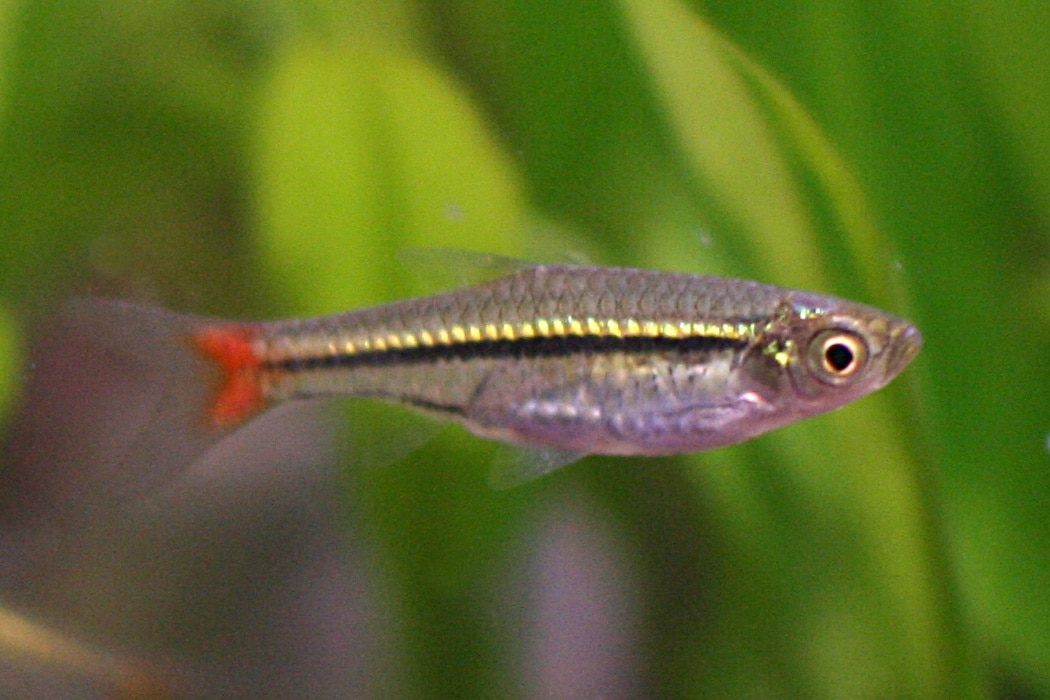
The brilliant rasbora has a sleek, elongated body shape that’s more streamlined than many of the deeper-bodied rasbora species. The base coloration is a silvery-olive tone across the upper body, fading to a lighter silver-white on the belly. But what really defines this fish visually are two key features: the bold black lateral stripe and the bright red-orange tail.
The black stripe runs along the entire length of the body from the tip of the snout to the base of the caudal fin. It’s clean, well-defined, and immediately catches the eye — this is where the “Blackline Rasbora” common name comes from. Just above this dark stripe, you’ll often notice a thin gold or iridescent line that adds a subtle shimmer, especially when the light catches it at the right angle.
The caudal (tail) fin is where this fish really earns the “brilliant” and “red-tailed” parts of its common names. The base of the tail displays a vivid patch of red, orange, or golden-yellow coloring that contrasts sharply with the black stripe. In healthy, well-kept specimens, this color can be quite intense. The dorsal fin also shows a faint reddish tinge at its base. All other fins are mostly transparent.
Overall, it’s a clean and elegant look. Not as flashy as a neon tetra or a celestial pearl danio, but there’s a classic simplicity to the brilliant rasbora that grows on you. A tight school of 10 or more moving through a planted tank is genuinely striking.
Male vs. Female
Sexing brilliant rasboras isn’t especially difficult once the fish are mature. Females tend to be slightly larger and noticeably fuller-bodied, particularly when carrying eggs — they develop a rounder belly profile that’s easy to spot from above. Males are slimmer and more streamlined, and they often display slightly more intense coloration in the tail fin. The differences are subtle in younger fish but become more apparent as they reach full size.
Average Size & Lifespan
Brilliant rasboras reach a maximum size of about 2 inches (5 cm) in total length, making them one of the larger species in the genus Rasbora commonly kept in aquariums. This extra size compared to micro rasboras like Boraras species gives them more visual presence in a community setup and makes them less vulnerable to predation by slightly larger tank mates.
In captivity, expect a lifespan of 3 to 5 years with proper care. Consistent water quality, a varied diet, and a stress-free environment with enough schooling companions all contribute to reaching the upper end of that range. As with most small cyprinids, genetic quality matters too — buying from reputable sellers tends to result in healthier, longer-lived fish.
Brilliant rasboras (Rasbora einthovenii) are a medium-sized schooling species with a clean, streamlined profile. They are peaceful, adaptable, and suitable for community tanks from 20 gallons.
Care Guide
Tank Size
A 15-gallon (57-liter) tank is the minimum for a small school of 6 brilliant rasboras, but I’d strongly suggest going with a 20-gallon long if your space and budget allow it. These are active swimmers that appreciate horizontal swimming room, and a longer tank lets a school of 10 or more display natural schooling behavior that’s simply not possible in a smaller footprint.
Because they spend most of their time in the middle water column, a tank with more length and width matters more than height. The 20-gallon long format is ideal — it gives them plenty of room to cruise back and forth while still being manageable for most fishkeepers.
Water Parameters
| Parameter | Ideal Range |
|---|---|
| Temperature | 72–79°F (22–26°C) |
| pH | 6.0–8.0 |
| Hardness | 2–15 dGH |
| KH | 1–10 dKH |
One of the biggest selling points of the brilliant rasbora is its flexibility with water chemistry. That pH range of 6.0 to 8.0 is genuinely broad — you don’t need to chase soft, acidic conditions to keep this fish happy. If your tap water comes out at 7.5 with moderate hardness, the brilliant rasbora will do just fine without any adjustments. That’s a real advantage over species like chocolate gouramis or certain wild-caught rasboras that demand specific water chemistry.
Temperature-wise, they prefer the lower to mid-70s, which is slightly cooler than many tropical fish. This actually makes them a good match for species like white cloud mountain minnows or certain danios that prefer temperatures below 80°F (27°C). As always, stability matters more than hitting a perfect number — keep your parameters consistent and avoid sudden swings.
Filtration & Water Flow
Brilliant rasboras come from slow-moving to still water, so gentle filtration is the way to go. A sponge filter works well for smaller setups and is the safest option if you have fry in the tank. For larger aquariums, a hang-on-back filter or canister filter with a spray bar to diffuse the output will keep things clean without creating too much current.
Weekly water changes of 20–25% are a good baseline. These are relatively low-bioload fish, but regular maintenance keeps nitrates in check and ensures stable conditions. If you’re running a heavily planted tank, the plants will help with nutrient uptake, but that doesn’t replace consistent water changes.
Lighting
The brilliant rasbora isn’t particularly demanding when it comes to lighting. They look good under moderate lighting, which conveniently lines up with what most planted tanks run. Unlike some species that wash out under bright lights, brilliant rasboras maintain their coloring reasonably well across different lighting levels.
That said, they do tend to show more confidence and natural behavior when there are some shaded areas in the tank. Floating plants create dappled light patterns that give the fish zones to retreat to when they want a break from brighter areas. The contrast of light and shadow also makes the black lateral stripe and red tail pop a bit more visually.
Plants & Decorations
A planted tank is the ideal setup for brilliant rasboras. They come from vegetated habitats in the wild, and live plants provide the security and visual barriers that help them feel at home. Java fern, Vallisneria, Cryptocoryne species, and stem plants like Rotala or Hygrophila all work well. Dense planting along the back and sides with open swimming space in the center is a layout that looks great and functions perfectly for this species.
Driftwood and smooth rocks add structure and create natural-looking boundaries in the aquascape. If you want to go for a Southeast Asian biotope look, combine driftwood, Java fern, and a sandy substrate — it’s simple but effective. Indian almond leaves or other dried botanicals can be added for a more natural aesthetic and the mild tannin release, though this species doesn’t require blackwater conditions.
Substrate
Brilliant rasboras aren’t picky about substrate since they spend their time in the mid-water column rather than near the bottom. Fine sand or a quality planted tank substrate both work well. A darker substrate tends to bring out the best coloration in most fish, and the brilliant rasbora is no exception — the black stripe and red tail look sharper against a dark background than over bright white gravel.
If you’re going for a natural biotope look, fine sand or a sand-and-gravel mix mimics the muddy and silty substrates of their native Southeast Asian habitats.
Is the Brilliant Rasbora Right for You?
Before you buy, run through this honest checklist. The Brilliant Rasbora is a great fish for the right keeper, but it is not for everyone.
- You have a 30-gallon or larger tank for a school of 3-4 inch rasboras
- You enjoy iridescent fish that catch the light from different angles
- You can keep a group of 6-8+ for proper schooling
- Your tank has side lighting or angled lighting that shows off iridescence
- You want a peaceful, hardy species for a mid-sized community
- You appreciate a classic rasbora that looks much better in person than in photos
Tank Mates
The brilliant rasbora is a genuinely peaceful fish that gets along with just about anything that won’t try to eat it. Their slightly larger size compared to micro rasboras makes them compatible with a wider range of community fish.
Best Tank Mates
- Corydoras catfish — peaceful bottom dwellers that complement mid-level rasboras perfectly
- Harlequin rasboras — a natural pairing, similar temperament and overlapping native range
- Ember tetras — small, peaceful, and the warm orange tones pair nicely with the brilliant rasbora’s red tail
- Kuhli loaches — gentle bottom dwellers that add activity to the lower tank level
- Cherry barbs — another peaceful Southeast Asian species that works well in the same conditions
- Dwarf gouramis — a colorful centerpiece fish that won’t bother rasboras
- Otocinclus catfish — non-threatening algae eaters perfect for community setups
- Neon and cardinal tetras — the blue tones contrast beautifully with the rasbora’s warm reds
- Cherry shrimp — brilliant rasboras are generally safe with adult shrimp, though very small shrimplets may occasionally be at risk
- White cloud mountain minnows — another hardy, cooler-water species that overlaps well in temperature preference
Tank Mates to Avoid
- Large cichlids — any fish big enough to see a 2-inch rasbora as a snack
- Tiger barbs — too nippy and boisterous for peaceful rasboras
- Angelfish — they may eat brilliant rasboras as they grow larger
- Red tail sharks — territorial and prone to chasing small schooling fish
- Aggressive or highly territorial species — anything that will stress out or outcompete the rasboras for food
Food & Diet
Brilliant rasboras are easy-going omnivores that accept pretty much anything you offer. In the wild, they feed on small insects, worms, crustaceans, and plant matter. In the aquarium, they’ll eagerly take flake food, micro pellets, and freeze-dried options as a daily staple.
To keep them in peak color and health, supplement their base diet with frozen or live foods a few times per week. Daphnia, brine shrimp, bloodworms, and cyclops are all great choices. You’ll notice the red-orange coloring in the tail becomes more vivid when they’re getting a varied, high-quality diet — color-enhancing foods with carotenoids make a real difference.
Feeding frequency: Once or twice daily, in small amounts they can consume within 2–3 minutes. These are active fish, but they have small mouths and stomachs — small, frequent meals are better than one large feeding.
Tip: Brilliant rasboras prefer to eat in the middle water column. Slow-sinking foods or flakes that stay suspended briefly work best. If you’re keeping them with bottom feeders like corydoras, the cories will clean up anything that makes it to the substrate.
Breeding & Reproduction
Brilliant rasboras are egg scatterers that can be bred in captivity, though they require a bit more effort to spawn consistently compared to some of the easier danio species.
Breeding Difficulty
Moderate. They’re not the hardest cyprinid to breed, but they do need specific conditions to trigger spawning, and the eggs and fry require attention. If you’ve bred other egg-scattering cyprinids or tetras, you should be able to manage this species.
Spawning Tank Setup
Set up a separate breeding tank of 10–15 gallons (38–57 liters). Line the bottom with clumps of fine-leaved plants like Java moss or spawning mops — these give the eggs somewhere to settle and provide some protection from the adults. Alternatively, use a mesh or grid on the bottom that allows eggs to fall through while keeping the parents from reaching them. Like most egg scatterers, brilliant rasboras will readily eat their own eggs if they can get to them.
Keep the lighting dim in the breeding tank. A small air-powered sponge filter provides gentle filtration without creating too much current or risking the eggs.
Water Conditions for Breeding
To trigger spawning, aim for soft to moderately soft water with a pH of 6.0–6.5 and hardness around 2–6 dGH. Raise the temperature slightly to 77–79°F (25–26°C). Using RO water mixed with a bit of tap water to hit the target parameters works well. A slight temperature increase combined with a water change can sometimes trigger spawning behavior.
Conditioning & Spawning
Condition breeding pairs or small groups separately for 1–2 weeks before spawning attempts. Feed heavily with high-quality live and frozen foods — daphnia, brine shrimp, and bloodworms are ideal. When females look visibly plump with eggs and males are showing intensified colors, introduce a pair or a small group (2 males to 3 females works well) to the breeding tank in the evening. Spawning typically occurs in the early morning hours.
During spawning, the male will chase and display to the female, and the pair will scatter adhesive eggs among the plants or over the substrate. A healthy female can produce several dozen eggs per spawn.
Egg & Fry Care
Remove the adults immediately after spawning is complete — they will consume every egg they can find. Eggs typically hatch within 24–48 hours depending on temperature. The fry will absorb their yolk sac over the next 2–3 days and become free-swimming shortly after.
Feed free-swimming fry with infusoria or commercial liquid fry food for the first several days. Once they’ve grown a bit, transition to microworms and freshly hatched baby brine shrimp (BBS). Keep the tank clean with small, frequent water changes — fry are sensitive to water quality deterioration. Growth is steady, and young fish should begin showing adult coloration within a few months.
Common Health Issues
Brilliant rasboras are a hardy species overall, but like any aquarium fish, they’re susceptible to a few common diseases. Good husbandry prevents most problems.
Ich (White Spot Disease)
The most common ailment for any tropical fish, and brilliant rasboras are no exception. Ich usually appears after temperature fluctuations, stress from shipping, or introduction to a new tank. Look for small white spots on the body and fins, along with flashing (rubbing against surfaces). Raise the temperature gradually to 82°F (28°C) and treat with a standard ich medication. Brilliant rasboras generally handle treatment well.
Fin Rot
Fin rot is almost always a water quality issue. Ragged, fraying, or discolored fin edges are the telltale signs. Improve water quality with more frequent water changes, and treat with an antibacterial medication if the condition doesn’t improve on its own. Caught early, fin rot is usually easy to reverse.
Columnaris
Columnaris (sometimes mistaken for a fungal infection) appears as white or grayish patches on the body or mouth. It’s bacterial and can spread quickly in stressed or overcrowded tanks. Treat promptly with an appropriate antibiotic, and isolate affected fish if possible.
General Prevention
The best medicine is prevention. Quarantine all new fish for at least two weeks before adding them to your display tank. Maintain stable water parameters, keep up with your water change schedule, and avoid overstocking. Brilliant rasboras are tough fish, but they’re not immune to the basics — good water quality is the foundation of fish health.
Common Mistakes to Avoid
- Keeping too few — Brilliant rasboras are schooling fish. Groups under 6 lead to stressed, skittish fish that spend most of their time hiding. Get at least 6, and aim for 10+ if your tank size allows. A proper school behaves completely differently from a few lonely individuals.
- Too much current — These fish come from slow-moving or still water. A powerful filter output blasting through the tank will stress them out and exhaust them. Diffuse your filter output or use a sponge filter for best results.
- Skipping quarantine — Because they’re often available as wild-caught or farm-raised imports, quarantining new brilliant rasboras for 2 weeks is especially important. It gives you time to spot any diseases before they reach your main tank.
- Pairing with aggressive tank mates — They’re peaceful fish that won’t compete well for food or territory against aggressive species. Stick with other community-friendly fish.
- Ignoring the temperature range — Brilliant rasboras prefer slightly cooler conditions (72–79°F) than many tropical species. Keeping them at the upper end of typical tropical temperatures (82°F+) long-term can shorten their lifespan.
Where to Buy
Brilliant rasboras are occasionally available at well-stocked local fish stores, but they’re not as commonly carried as harlequin rasboras or some of the more popular species. You may need to ask your LFS to special order them, or shop online for a more reliable supply.
For quality stock shipped directly to your door, I recommend checking Flip Aquatics and Dan’s Fish. Both are reputable online sellers that carry healthy, well-acclimated freshwater fish and ship safely. Buying from a dedicated fish seller rather than a big box chain typically means healthier fish with less stress from the supply chain.
Pricing is generally reasonable — expect to pay around $3–5 per fish, with discounts often available when purchasing a full school. Given how hardy and long-lived they are, brilliant rasboras are excellent value.
Frequently Asked Questions
How many brilliant rasboras should I keep together?
A minimum of 6, but 10 or more is ideal. Brilliant rasboras are a true schooling species that feel safest and display the best behavior in larger groups. In small numbers, they become shy and stressed, spending most of their time hiding rather than swimming in the open.
Are brilliant rasboras good for beginners?
Yes, they’re an excellent beginner fish. Their wide tolerance for pH (6.0–8.0) and hardness (2–15 dGH) means they’ll adapt to most tap water without the need for special adjustments. They’re hardy, peaceful, easy to feed, and forgiving of the minor mistakes new fishkeepers often make. Just make sure your tank is fully cycled before adding them.
Can brilliant rasboras live with bettas?
In most cases, yes. Brilliant rasboras are peaceful and not known as fin nippers, which makes them a safer choice for a betta community than many tetras or barbs. Use at least a 20-gallon tank with plenty of plants and hiding spots, and always monitor the betta’s temperament — some individual bettas are more aggressive than others regardless of tank mates.
What’s the difference between brilliant rasboras and harlequin rasboras?
They’re completely different species. Harlequin rasboras (Trigonostigma heteromorpha) are deeper-bodied with a distinctive black triangular patch and coppery-orange coloring. Brilliant rasboras (Rasbora borapetensis) are more streamlined with a black lateral stripe and red-orange tail. Harlequins are also in a different genus — they were reclassified out of Rasbora years ago. Both are great community fish and actually make excellent tank mates together.
Do brilliant rasboras need a heater?
In most homes, yes. While they tolerate temperatures as low as 72°F (22°C), which is close to room temperature in some climates, a heater ensures stability and prevents dangerous nighttime temperature drops. A consistent temperature within their preferred range is more important than the exact number.
Why is my brilliant rasbora’s color fading?
Faded color in brilliant rasboras is usually caused by stress, poor water quality, a monotonous diet, or keeping too few together. Check your water parameters, make sure you have a proper school of 6+, and supplement their diet with frozen foods like brine shrimp and daphnia. A darker substrate and some planted cover can also help bring out their best coloring.
How long do brilliant rasboras live?
With proper care, brilliant rasboras typically live 3 to 5 years in a home aquarium. Consistent water quality, a varied diet, and a low-stress environment with enough schooling companions all help them reach the upper end of that range.
How the Brilliant Rasbora Compares to Similar Species
Brilliant Rasbora vs. Scissortail Rasbora
Both are medium-sized rasboras that need schools and swimming room. The Scissortail Rasbora is more active and has the signature forked tail movement, while the Brilliant Rasbora has better body iridescence. Both are peaceful and hardy. The Scissortail Rasbora is more commonly available.
Brilliant Rasbora vs. Phoenix Rasbora
These are completely different fish for completely different setups. The Phoenix Rasbora is a tiny nano species; the Brilliant Rasbora is a mid-sized schooler. They cannot really be compared as alternatives. choose based on your tank size and goals.
Expert Take (Mark Valderrama, AquariumStoreDepot)
After 25 years in the hobby and time managing fish stores, the brilliant rasbora is one of those species I always recommend to hobbyists ready to move beyond the basics. Brilliant rasboras (Rasbora einthovenii) are a medium-sized schooling species with a clean, streamlined profile. They are peaceful, adaptable, and suitable for community tanks from 20 gallons. Keep brilliant rasboras in groups of 8 or more. Smaller groups school loosely and spend more time hiding than displaying – the full schooling behavior only emerges in groups of 8+.
Closing Thoughts
The brilliant rasbora is one of those classic community fish that deserves more attention than it gets. It’s hardy, adaptable, peaceful, and genuinely attractive in a planted setup — what more could you ask for? In a hobby that’s increasingly focused on nano fish and rare imports, there’s something refreshing about a species that just works without any drama.
If you’re building a Southeast Asian community tank or just want a reliable schooling fish that won’t give you headaches, the brilliant rasbora belongs on your shortlist. Give them a proper school, decent water quality, and a tank with some plants and open swimming space, and they’ll reward you with years of trouble-free enjoyment.
Looking for more rasbora and danio species to consider? Check out our complete rasboras and danios guide for profiles on dozens of species.
Recommended Video
Check out this video to learn more about rasboras and which species are best for your tank:
References
- Rasbora borapetensis Profile — Seriously Fish
- Rasbora borapetensis (Smith, 1934) — FishBase
- Brilliant Rasbora — Practical Fishkeeping
- Rasbora borapetensis — The Aquarium Wiki
- About the Author
- Latest Posts

I’m Mark Valderrama, founder of Aquarium Store Depot and a fishkeeper with over 25 years of hands-on experience. I started in the hobby at age 11, worked at local fish stores, and have kept freshwater tanks, ponds, and reef tanks ever since. I’ve been featured in two best-selling aquarium books on Amazon and built this site to share practical, experience-based fish keeping knowledge.
Leave a Reply