AquariumStoreDepot

Tag: Freshwater

  • Congo Tetra – A Complete Care Guide

    Congo Tetra – A Complete Care Guide

    Every single time when you try to convince yourself to start out as an aquarist, you are always held back by hesitation. You know that there are uncountable fish species in the aquarium line. But, you don’t know which fish will be ideal for a first-time aquarist like you.

    Don’t worry, Congo tetra has the capacity to comply with your needs and demands. This freshwater fish knows exactly how to stand out. Their low-maintenance leads you directly to diversify your range of aquarium fish completely trouble-free!

    Because they are peaceful and beautiful, aquarists on any awareness stage can house them.

    In this guide, we’ll go over their care requirements, history, natural habitat conditions, and pretty much everything you need to know.

    Key Takeaways

    • Congo Tetras are larger schooling tetras that do great in medium sized tanks
    • They are safe around plants
    • They live up to 5 years and grow up to 4 inches

    Species Overview

    Scientific NamePhenacogrammus Interruptus
    Common NamesCango Tetra
    FamilyAlestidae
    OriginCango River in Zaire, Central Africa
    DietOmnivore
    Care LevelEasy
    ActivityActive
    Lifespan3 to 5 years
    TemperamentPeaceful
    Tank LevelMiddle to top
    Minimum Tank Size20 – 30 gallons
    Temperature Range73° F to 82° F
    Water Hardness3 to 18 KH
    pH Range6.0 to 7.5
    Filtration/Water FlowModerate to fast
    Water TypeFreshwater
    BreedingEgg layer
    Difficulty to BreedModerate
    CompatibilityCommunity tanks
    OK, for Planted Tanks?Yes

    What Is A Congo Tetra?

    Congo Tetra, scientifically known as Phenacogrammus Interruptus, is a freshwater fish species. They are part of the Alestidae family from the order Characiformes.

    Congo tetras are professional representatives of peace, grace, and beauty. With originating from a certain point of the ocean world, they are now an important part of aquariums all around the world.

    Apart from these visible characteristics, they are largely capable of morphing themselves according to the need of the hour.

    As a beginner or seasoned aquarist, adding Congo Tetras to your tank will be worth the time that you devote to their maintenance.

    Origin and Habitat

    A Congo Tetra was first sighted in 1949 in the Congo River Basin in Zaire, Africa. They got their name from the Belgian-British zoologist George Albert Boulenger.

    Because of being tough to breed, they couldn’t mark their existence in the aquarium world until the 1970s.

    For a healthy survival in the wild, Congo Tetras hunt down live insects and prefer living in moderate to fast freshwater currents.

    Appearance

    A Congo Tetra looks absolutely stunning because of its unique and striking color combination and elegant fins. While fish keepers all around the world admire them due to their calm turn of mind, their colorful bodies help them stand out perfectly, too.

    Congo-Tetra

    Congo Tetras feature a beautiful spectrum throughout their bodies. While their heads and bellies are covered in blue, a red shade laced with a golden touch dominates the middle part.

    Their long and flat bodies look considerably smaller than compared to their beautiful extended fins.

    A Congo Tetra composes long fins with subtle transparency visible on their fins. And these fins are yet another reason linked directly to their fame and admiration, with the sporty tail fin serving as a prominent characteristic.

    Apart from mixed body coloration, you can see a stripe stretched along their midsections. The band starts from their heads and ends at the tails. Since they have long and translucent fins, Congo Tetras are irresistible to watch while swimming.

    There is also a visible shimmer on their bodies. The hue that you see depends on the lighting. Because they have a range of colors, the hue can appear bright mauve, or ocean colored apart from blue.

    Even though Congo Tetras are slightly big in comparison with other tetras, they look compressed because of the large midsection.

    It is easy to discern males and females. Phenacogrammus Interruptus are sexually dimorphic and therefore have visible gender differences.

    As with most fish, the male Congo Tetra fish present vibrant body coloration and colossal size. The females are plumper, especially when they are ready to breed.

    Other than being taller and vibrant, the male Conga Tetras have larger dorsal fins. These fins give a feathery appearance that looks more beautiful in the water.

    You can also see a violet shade on the fins of males with a beautiful white edging, with their tail fin present along the vertical medial line.

    Aside from these beautiful physical characteristics, their dark black and red outlined eyes play an important part in adding up to their beauty even further.

    Lifespan

    While their average lifespan is between 3 to 5 years, reforming their water conditions can help you support them to live longer and healthier. A Congo Tetra does well with a range of foods, but a well-rounded diet is necessary.

    Their ideal water temperature is around 73° to 82° F, with a slightly higher pH level.

    Stick around till the end because we will go over all the details, including water conditions and dietary requirements step by step.

    Average Size

    A Congo Tetra is at least 4 inches long. That’s their average adult fish size, however, they can stretch themselves up to 4.2 inches easily in the wild.

    if you have farm-bred Congo Tetras, then growing over 3 or 3.5 inches is pretty hard for them.

    As compared to other types of tetras, Phenacogrammus Interruptus are bigger and grow to their full length in a brief span of time.

    Care Guide

    When it comes to starting out as a beginner aquarist and finding a suitable fish, Congo Tetras fit the bill for many requirements.

    There are several reasons they are always on the forefront of mind to consider housing in a freshwater aquarium. One prime example is their easy-to-manage care requirements, easy Congo Tetra diet, and overall demands.

    In their natural habitat, the fish is pretty skillful to go with fast water currents and enjoy swimming in low water currents simultaneously. It mainly depends on the situation.

    In the wild, they love hunting down live insects to sustain themselves. Unlike other fish that are susceptible to aggressive or territorial behavior, Congo Tetras are completely peaceful and schooling fish.

    If you thoroughly understand their water conditions and dietary requirements, they can easily stand firmly against the common fish diseases and live longer.

    Here are some essential things to consider before having a Congo Tetra.

    Aquarium Setup

    While thinking about the Congo Tetra tank setup, being well up on their preferred tank conditions is essential.

    In the wild, you can find Congo Tetras in the Congo River, Africa. They live in groups in streams, marshes, pools, and tributaries.

    Congo Tetras prefer slightly higher pH levels with large vegetation surrounding them. This calm fish can tolerate subtle water changes, but it’s highly recommended to gauge water parameters as per their needs.

    Even though they populate areas where the vegetation is tall, mimicking the exact condition, can disturb their free moving.

    Phenacogrammus Interruptus live in the upper sections of water, travelling rarely to the bottom. And as because they are active, you need to secure their tank with a lid to avoid any mishaps.

    Tank Size

    The ideal Congo tetra tank size should be at least 30 gallons. While some people go under the recommended tank size, I would urge you to get a 30-gallon tank to boost tourism within.

    Congo Tetras that are not farm-bred can grow up to 4.2 inches, with the captive-bred at least 3.5 inches long. A schooling fish of this adult fish size will never be happy with smaller tanks.

    Even if you overlook their size, think about the decorative items and plants you will introduce to their tanks. Smaller tanks will be filled up with that, leaving little space for the fish. However, a 30-gallon tank can easily house fish and other stuff that you put in it.

    Water Parameters

    Before housing Phenacogrammus Interruptus, you need to understand what Phenacogrammus Interruptus prefer. Because that has a straight connection with their well-being and is an essential part of proper Congo Tetra care.

    The water of the Congo river is slightly acidic, with a water temperature ranging between 73° F to 82° f. Their preferred acidic levels shift between 6.0 to 7.5, with water hardness between 3 to 18 KH.

    Filtration and Aeration

    As much as other factors involved in their overall maintenance are important, so are filtration and aeration. To keep the ecosystem of their freshwater aquarium intact, you need a solid filtering system.

    The excellent recommendations can be a standard canister system or a carbon filtering system. These strong filtration systems will keep the waste levels low and overall water quality up to the mark.

    Lighting

    Exposure to bright lighting can significantly disturb their day-to-day activity. Congo Tetras spend most of their time hiding in caves and around plants and neglecting eating and swimming if the lighting is too bright.

    Dim light will bring out their proper coloration and motivate them to swim around hassle-free.

    Place their freshwater aquarium in a place that is dimly lit. Since monitoring them is important and in subdued light, you can’t do that, use LED bulbs.

    Aquatic Plants and Decorations

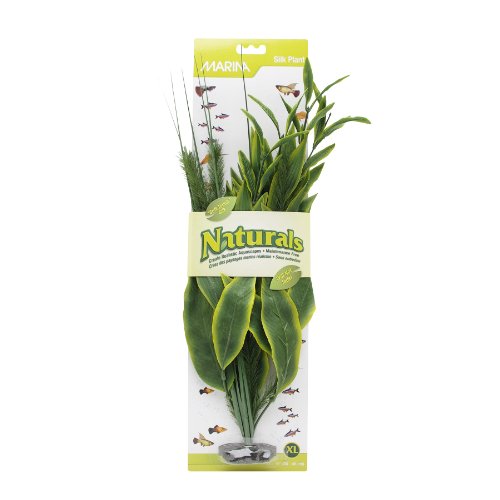
    Your Congo Tetra is a very adaptable fish, but it will not compromise on plants. Plants are not only necessary to make your aquarium beautiful, but they are important to keep oxygen levels up.

    While floating aquarium plants will make them feel at home, you are likely to overfill the tank.

    To avoid this, try out these live plants:

    Place these plants at a distance so your fish can easily swim around. Another reason you shouldn’t put the plants closely is the inability to see them due to the density of vegetation.

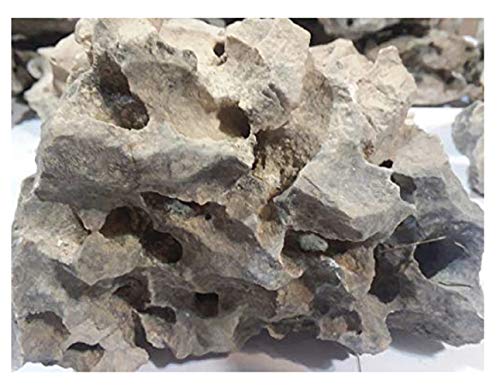
    Your Congo Tetra will use these plants to hide while threatened or when the light is beyond their tolerance. So, make sure you have an adequate amount of them in the tank. Also, introduce caves and aquarium rocks as another hideout option for them.

    Tank Maintenance

    When the water tank contains so many plants and a group of fish, maintaining it becomes a bit tough.

    But, don’t worry! Here are some very easy steps that you can follow to keep your aquarium tank clean and new.

    How to clean the tank of Congo Tetras?

    1. Start with cleaning the aquarium walls with mild soap.
    2. Weed out the waste plant material and plant new aquarium plants occasionally.
    3. Use lukewarm water to clean the manufactured caves.
    4. Add fresh water to the tank every now and again to avoid excessive algae growth.

    Substrate

    Congo Tetras stay at the middle and top water levels. But a substrate that resembles their natural habitat, River Congo, will be absolutely recommended.

    Since Phenacogrammus Interruptus prefer darker water environments, a dark gravel, sand, or silt substrate will be ideal. You don’t have to add too many rocks because the primary focus should always be on fresh plants.

    Community Tank Mates

    A larger group of aquarists prefer housing Congo Tetras because of their calm nature. As a beginner aquarist, handling any aggressive fish will be really hard. Hence, your chances of having a peaceful fish-keeping journey will be ruined.

    A Congo Tetra does well with a range of fish species. They are already schooling fish, which means surviving alone is impossible for them.

    But, before I give you a list of tank mates, you should know that the male Congo Tetras are delicate. Any fin-nipper will most probably hunt down their fins, resulting in a serious injury.

    Congo Tetra tank mates should align with their size and nature. Here’s a list of some community tank mates to consider:

    1. Rainbow fish
    2. Neon Tetras
    3. Swordtail Fish
    4. Mollies
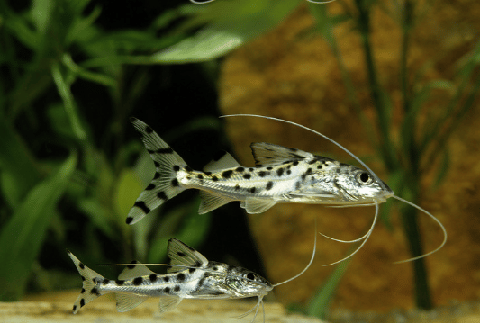
    5. Corydoras
    6. Ember Tetras
    7. Barbs
    8. Elephant Nose Fish
    9. Dwarf Cichlids
    10. Rummy Nose Tetras
    11. Celestial Pearl Danio
    12. Platy Fish
    13. Chili Rasbora

    Poor Tank Mates

    Avoid housing them with any aggressive fish or fin-nipper.

    1. Bucktooth Tetra
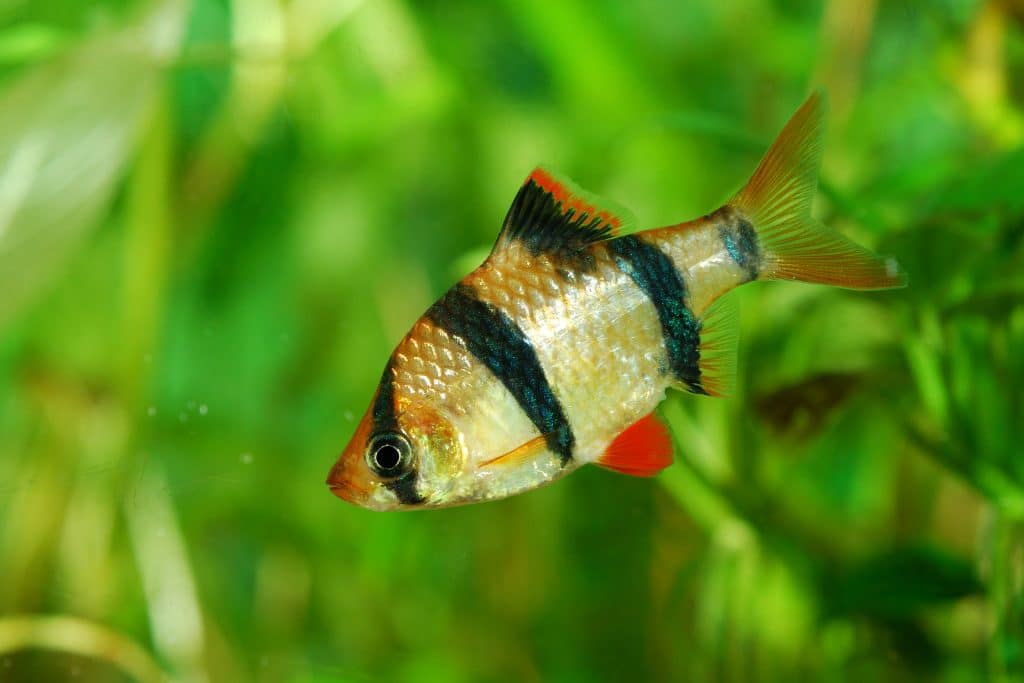
    2. Tiger Barb
    3. Flowerhorn Cichlid
    4. Wolf Cichlid
    5. Oscar Fish
    6. Jaguar Cichlid

    Breeding Congo Tetras

    Breeding Congo Tetras is pretty simple as long as you follow this proper Congo Tetra Guide. It might look complicated to a beginner since no experience gives way to agitation. But it’s easy and interesting.

    While many aquarists prefer farm-bred Phenacogrammus Interruptus, you can easily map out all things for proper Congo Tetra breeding in your home aquarium (video source).

    To commence the breeding season, get a 20–gallon separate breeding tank for your male Congo Tetra and female Congo Tetra. Place peat moss at the bottom of the tank and keep the temperature up to 77° F. Also, scale down the lighting if you want to prompt them to breed.

    Apart from peat moss, you can introduce breeding mops and plants throughout the tank as a safety measure.

    While you are working in all these areas, improving water quality is also important. The best way to do this is to introduce peat moss to the breeding tank and wait for at least 3 days. For filtration, I recommend a small air-powered sponge filter to manage the water aeration and flow.

    Once you are satisfied with the overall water quality, separate the intended pair from the rest of the group to add to the breeding tank.

    But before you allow them to pair off, keep track of their diet for a span of 2 weeks.

    Your Congo Tetras will start spawning the next day of getting in a breeding tank. The male will perform a mesmerizing dance around the female before traveling down to the base of the tank together.

    The female will then appear swollen with eggs. They can lay almost 500 eggs in a single spawning round, which can be tough to handle. The peat moss will catch the eggs safely where the eggs can lie scattered until they hatch.

    Once the female is done laying eggs, separate the pair from the eggs. Because Congo Tetras can eat their own eggs.

    Keep the lights subdued because the eggs are super sensitive to strong lighting. The healthy eggs will appear transparent and they require a week to hatch. You can expect them to take another week to become large fry and begin swimming.

    Feed the little fry infusoria for a few days, then shift to other foods. To condition them to develop properly, you can start feeding the newly hatched fry baby brine shrimp, lightly crushed flake food, and rotifers.  

    Pro Tip: To identify infected eggs, look for fungal growth and transparency.

    Congo Tetra Food and Diet

    Aside from being social and peaceful, they are easy to handle because of their undemanding dietary needs. Congo Tetras are omnivores, which means they sustain themselves on blood worms and insects in the wild.

    While insect larvae and blood worms are the base of their diet, eating algae and plant matter is also pretty normal.

    You can feed them insect larvae, brine shrimp, flake foods, bloodworms, tubifex, and daphnia in your aquarium. Adding vegetables to their diet will also be good since vegetables are good for providing vitamins. They are quite active fish. So, feed them at intervals to make sure they are fed well. Prepare foods like high-quality fish flake food and pellet food work well as staples. Fluval bug bites are a great option.

    My Pick
    Fluval Bug Bites – Tropical Formula

    Fluval bug bites tropical fish is an excellent staple food for most tropical fish. Made of black solider fly larvae

    Buy On Amazon Buy On Petco

    As a beginner, this is another plus point for you. Because you don’t really have to make any special variations in their diet due to their humble nature.

    But while feeding them, make sure the food doesn’t sink to the bottom of the tank. Moreover, feed them food that is small-sized to prompt better digestion and overall health.

    Usually, your Congo Tetra will finish its food within 3 minutes. But in case they are exceeding this time frame, pay attention to their daily activities and behavior.

    Pro Tip: Nipping at the plant edges is a clear indication that your fish is not getting enough food to stay full. As soon as you notice that, change their timings to ensure they are getting enough food.

    Common Health Problems

    Congo Tetras are strong fish and do not fall prey to any specific common fish diseases. However, like other fish, they are prone to some common fish ailments caused by unclean water.

    In the wild, the water naturally gets clean. But in your aquarium, you need to replicate that condition. This is to ensure that your fish is breathing in a safe aquarium environment free from the waste they produce.

    Here are some common diseases with symptoms.

    Ich

    Ich is a very common fish disease caused by the protozoan Ichthyophthirius multifiliis.

    The symptoms are:

    1. White dots on fins, gills, and other body parts
    2. Rubbing the body against rough edges

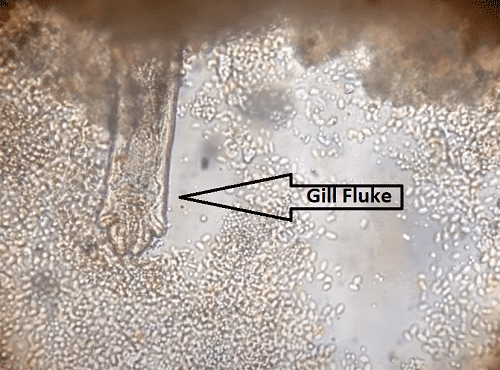
    Flukes

    This is another common fish disease caused by parasites.

    The symptoms are:

    1. Red spots on the body, especially on the gills
    2. Difficulty in breathing
    3. A large amount of mucus

    Products like Prazipro are great for treating this disease.

    FAQs

    How many Congo Tetras can I put in a 30-gallon tank?

    A 30-gallon tank is fine for 2-3 Congo Tetras. but if you have other fish in the tank or 5-6 Congo Tetras together, having a 55-gallon tank is highly recommended.

    How big do Congo Tetras get?

    The average Congo Tetra size is 4.2 inches in the wild. But fish that are farm-bred do not grow this big. They are usually around 3 to 3.5 inches long.

    Are Congo Tetras hard to keep?

    No. Congo Tetras are hugely popular because of their calm nature and the ability to get along with a range of freshwater fish. Their peaceful disposition allows you to have a safe, happy, and outstanding fish-keeping journey as a beginner.

    How many Congo Tetras should be kept together?

    Congo Tetras are schooling fish that need tank mates to stay active and healthy. Normally, a group of 6 Congo Tetras is perfect to house together. But for that, you need a bigger tank.

    Are Congo Tetras fin nippers?

    Congo tetras are not fin nippers. In fact, they are prone to fin-nipping fish because of their delicate fins. Especially with male Phenacogrammus Interruptus, you have to be really careful with who is with them in the tank.

    How long does it take for Congo Tetras to mature?

    Congo Tetras grow really fast as compared to other fish species. It takes a fry Congo Tetra 3 months to reach 2 inches and almost 6 months to become 3 inches long.

    Closing Thoughts

    If you’re looking for a beautiful and peaceful fish to add to your community tank or planted aquarium, the Congo Tetra is a great option. These fish are social and thrive when kept in groups, so make sure you have plenty of room in your tank for them! Thanks for reading – we hope you enjoyed this post. Have you kept Congo Tetras before? Let us know your experience in the comments below!


    📘 Want to learn more? This article is part of our complete Freshwater Fish Guide — your ultimate resource for freshwater species, care tips, tank setup, and more.

  • Nerite Snails – A complete Care Guide

    Nerite Snails – A complete Care Guide

    If you are looking for a reliable algae eater, Nerite Snails are one of the best choices for an aquarium. They are easy to care for, don’t breed in freshwater aquariums, and won’t tear up your live plants. Today, we will discuss their origins, go over types, their diet, and how to keep them happy and healthy. So if you’re thinking about adding some nerite snails to your tank, read on! You won’t regret it!

    Key Takeaways

    • Nerite snails are excellent algae eaters
    • They will not overpopulate a tank as they require brackish water to successfully breed
    • They come in a variety of types and are generally hardy for a snail
    • They will not harm your plants

    Species Overview

    Scientific NameNeritina spp
    Common NamesNerite snails, nerites
    FamilyNeritidae
    OriginCoastal regions of the Atlantic, Indian, and Pacific Oceans
    DietHerbivore
    Care LevelEasy
    ActivityLow
    Lifespan1-10 years
    TemperamentPeaceful
    Tank LevelAll
    Minimum Tank Size5 gallons
    Temperature Range65-85° F
    Water Hardness10-25 KH
    pH Range6 to 8
    Filtration/Water FlowSlow to moderate
    Water TypeFreshwater
    BreedingEgg layer
    Difficulty to BreedDifficult
    CompatibilityCommunity tanks
    OK, for Planted Tanks?Yes

    Introduction

    Nerite snails are an anomaly in the aquarium hobby. They are one of the few species that can be kept in entirely freshwater or saltwater conditions as well as mixed salinities in between. Nerites are also one of the best algae-eating species of snail available, making them one of the most popular–and one of the more expensive–types of aquarium snail.

    This article will focus only on freshwater nerite snails and their care requirements.

    How Long Do They Live?

    In general, nerite snails will live for at least one year in the freshwater aquarium. Under ideal conditions, they have been known to live for a decade. How long nerite snails live varies a lot. And hobbyists aren’t necessarily paying attention to how long their snails live.

    Nerite snails are generally hardy, but they can be sensitive to ammonia and nitrite in the water column, which means that they need a more established setup.

    Are They Good For Your Freshwater Tank?

    A nerite snail is one of the best additions you can make to your freshwater aquarium, especially a planted aquarium! These snails have a serious appetite for algae.

    Nerite snails are proficient algae eaters. They will eat most species of algae, but are most efficient at cleaning up soft types, like hair algae, green spot algae, and green slime algae. They use their modified tongue, called a radula, covered in tiny teeth that help scrape away microflora.

    As we’ll see, nerite snails are largely herbivores. They won’t necessarily clean detritus from fish and other organisms in the tank, but they’ll keep plant surfaces and the sides of the aquarium algae-free.

    How To Identify

    Snails can be hard to tell apart. And the problem is that not all snails are created equally.

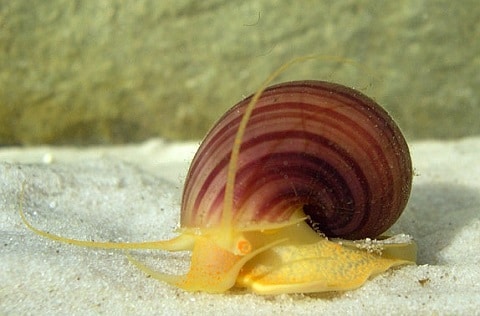
    Nerite Snail in Aquarium

    Some snails clean algae better while others take care of detritus and even other snails. Freshwater snails can also be expensive, so you definitely want to take the time to understand what the species of snail you want looks like.

    Nerite snails are a larger species of snail. There are many species of aquarium snail that belong to the Neritina genus, each with its own identifying characteristics.

    No matter the species though, nerite snails grow to be about 1-2 inches on average. These snails have an unbalanced appearance to them, with a rounded shell that tilts into a whorl on the right side. The body of the snail ranges in color from tan to dark brown. Unlike other snails, the body of the snail is usually concealed completely under the shell even when moving.

    Unfortunately, there is no way to tell a male nerite snail apart from a female. Another big difference from other snails is that nerite snails are not hermaphrodites. This, in addition to their need for brackish water conditions, makes breeding nerite snails very difficult for the average hobbyist.

    Origin and Habitat

    Nerite snails have a wide distribution. Most species originate from the coastal waters of Africa but a few are found in the Caribbean or on the margins of the Pacific Ocean. Nerite snails are intertidal and regularly move between the nearby ocean and freshwater rivers and inlets; it is believed that they prefer brackish water conditions most of all.

    This crossover between ecosystems leaves nerite snails with a large assortment of foods to eat. They will regularly be seen munching away at algae on rocks and other structures but will travel across the open sandbed as they grow and reproduce.

    Care

    In the aquarium, nerite snails are relatively hardy. They aren’t as hardy as something like the bladder snail (Physella acuta) that can survive polluted waters, but nerites can definitely withstand some beginner’s mistakes. Nerite snails are most sensitive to changes in ammonia and nitrite.

    Otherwise, nerite snails are easy to care for in the freshwater aquarium. If there are enough algae to graze on, they will live for a relatively long time.

    Tank Size

    Freshwater snails are often limited in tank size due to their high reproductive rates. Nerite snails do not breed in freshwater, so they are one of the better choices for smaller aquariums.

    The general rule for nerite snails is 1 snail for every 5 gallons of water; this means that 1 snail will comfortably fit in a 5-gallon betta tank or other planted aquarium. For larger tanks, the number of nerite snails will be limited by bioload. As these snails don’t reproduce in freshwater, there is no way to unknowingly overstock them as long as there is adequate biological filtration.

    Aquarium Setup

    Nerite snails can be kept in most freshwater tank setups. They excel in planted aquariums with lots of natural algae and microflora that they can graze on, but they’re also suitable for unplanted tanks as long as their dietary needs are met.

    Nerite snails aren’t shy, but they’re mostly nocturnal. In fact, nerite snails can sleep for days at a time, only becoming active in short spurts. This means that they prefer to stay somewhere hidden to stay out of reach of predators. Driftwood, plants, rocks, and other aquarium structures can make perfect nooks and crannies for your snail to rest.

    Because they’re nocturnal, nerite snails will also prefer dim lighting. The aquarium light may be dimmed or floating live plants and other large plant species may be used to create pockets of shade and refuge throughout the aquarium.

    Nerite snails are also intertidal, which means that they regularly move between the water and moist, but not submersed, surfaces. It is not unusual to find a nerite snail at or above the waterline of the tank. They often find their way into the filter and might even crawl onto the outside of the glass. Because of this, it’s strongly recommended to use a fitted aquarium cover.

    Water Parameters

    Nerite snails need 0 ppm ammonia and 0 ppm nitrite. Any traces of ammonia or nitrite could prove to be deadly to your snails. Like other invertebrates, they also cannot tolerate copper.

    Otherwise, these freshwater snails do not need specific water parameters. They are largely tropical species that need a warm water temperature. With proper acclimation, they can be kept at slightly cooler or warmer temperatures. Freshwater nerite snails also prefer a near-neutral water pH between 6.5-8.0 but can adapt to more acidic conditions.

    Preferred water parameters largely depend on the conditions the snails are originally being kept. Remember, these are brackish water snails that can tolerate higher salinities and subsequent higher pH levels. Brackish water salinity measures at about 1.005 to 1.010 while full saltwater is 1.023 to 1.025.

    Like other snails, nerite snails grow with their shells. They use calcium and other minerals available in the water column to continue growing and maintaining their shells. While these minerals are usually readily available with good source water, they may need to be supplemented every now and then through their diet or with calcium blocks.

    An injured or nutrient-deficient nerite snail may have noticeable white scrapes and scratches across its shell. These injuries will continue to progress if calcium isn’t made available for repairs.

    Filtration and Aeration

    Even though nerite snails only grow to be about an inch or two, they can still create a significant amount of bioload that can affect the efficiency of the filtration being used. That being said, they have also been successfully kept in Walstad-method aquariums that rely solely on the biological filtration provided by live plants and bacteria without any additional equipment.

    If the overall bioload of the aquarium is on the higher side, then it could be beneficial to add aeration for better oxygenation and gas exchange.

    Lighting

    Remember, nerite snails are nocturnal and have an interesting sleep cycle. Lighting intensity doesn’t matter too much, but these snails definitely need a discernible night and day cycle to keep a semi-regular sleep cycle.

    Aquatic Plants and Decorations

    Nerite snails absolutely love aquatic plants and decorations! But they’re not entirely necessary for the success of the snail.

    Nerite snails eat algae that grow on the surfaces of the tank. That means the more surfaces available, the more food your snail has to choose from. They are unlikely to eat healthy live aquarium plants but will help consume any rotting stems or leaves.

    Community Tank Mates

    As a larger type of snail, nerite snails are among the best community tank snail species. These snails tend to keep to themselves and won’t disrupt other peaceful species.

    This makes nerite snails completely compatible with:

    In most cases, betta fish can be kept with nerite snails. The problem is that nerite snails can fall off the glass, occasionally landing on their back with their body exposed (yes! these snails can flip themselves back over). A curious or hungry betta may pick at the snail while it’s vulnerable, like other larger and more aggressive fish species.

    How Many Should Be Kept Together?

    As mentioned before, 1 nerite snail should be kept per every 5 gallons of water. However, you do not need to worry about your snails rapidly reproducing and overpopulating the tank, which leads to less likelihood of adding too many snails. Still, these are larger snails that can produce significant waste in bigger groups and should not be overstocked.

    Food and Diet

    Nerite snails will feed themselves as long as there is enough algae available in the tank.

    There is little need to offer your snails anything additional to eat, though some hobbyists like to feed algae wafers and blanched vegetables, like cucumbers and lettuce; providing fresh vegetables from time to time can help introduce minerals and nutrients that can’t be obtained otherwise.

    In the same way, calcium blocks may be added for healthy shells.

    Breeding

    Breeding nerite snails are extremely difficult for the average hobbyist. This is because it takes several fish tank setups to be successful. In the wild, nerite snails move between freshwater and saltwater. They are most often observed in brackish conditions for reproductive purposes.

    Hobbyists seem to have the most breeding success when acclimating or keeping nerite snails in brackish water. When ready, a male and female will breed. The female will lay eggs in a safe area, usually on the aquarium glass or under a leaf. The nerite snail eggs will hatch after some time into larvae that later develop into recognizable, baby snails.

    Nerite snails will not breed in the freshwater aquarium. Female nerite snails may lay their eggs around the aquarium, but they will not hatch. Take this as an indication that your snail is happy and healthy.

    Do They Reproduce Asexually?

    Many freshwater snails reproduce asexually. Nerite snails are fully sexual, though. This means that both a male and a female are needed to reproduce. This can make breeding these snails even more difficult as there are no observable physical differences between the two sexes. Hobbyists need to use large groups of snails to increase the chances of a male and female meeting and breeding.

    4 Types

    There are many species of nerite snail, though only a few have made their way into the aquarium hobby. Luckily, there aren’t any big differences between the different types of nerite snails, so you can trust that your aquarium will always get cleaned!

    This includes zebra horned nerite snails, zebra nerite snails, tiger nerite snails, and black racer nerite snails.

    1. Horned

    • Adult Size: 0.5 inches
    • Color Pattern: Black and yellow spiral
    • Unique Traits: Small spikes that outline the whorl

    The zebra horned nerite snail (Clithon corona/diadema), also known as the zebra thorned nerite snail, is one of the most interesting-looking snails out of all freshwater snail species!

    These are tiny snails, usually staying under an inch at full size. Zebra horned nerite snails have beautiful alternating black and yellow stripes, which can help bring a pop of color to the bottom of the fish tank. Their most interesting feature is the tiny spikes that outline the whorl of the shell. These are most likely used in defense against aggressive fish and invertebrates.

    2. Zebra

    • Adult Size: 1 to 1.5 inches
    • Color Pattern: Yellow and black/brown
    • Unique Traits: Alternating black and yellow zebra pattern

    The zebra nerite snail (Vittina natalensis) is probably the most recognizable species of nerite in the aquarium hobby. These snails are large with very smooth shells. Zebra nerite snails are mostly known for the unique pattern on their shells.

    The color of the zebra nerite shell can vary from light yellow to warm orange. Every snail will have a zebra-like pattern with alternating black and yellow stripes that meet at the center of the whorl. Though inexpensive, these snails can bring a clean and expensive aesthetic to freshwater tanks.

    3. Tiger

    • Adult Size: 1 to 1.5 inches
    • Color Pattern: Yellow or orange with black patterning
    • Unique Traits: Simple, uniform black spot patterning

    Often sold alongside related zebra nerite snails, the tiger nerite snail (Neritina semiconca) has a beautiful natural appearance. These snails can vary in color intensity, from light yellows to dark browns. They are most easily identifiable by the flake-shaped black specks that run across the front of the shell and onto the whorl.

    4. Black Racer

    • Adult Size: 1 to 1.5 inches
    • Color Pattern: Black Appearance
    • Unique Traits: Dark ebony base color with lighter striations

    Not the most popular, the black racer nerite snail (often categorized as Neritina pulligera) is actually one of the most common nerite snail species to come across at local fish stores. These snails are plain in color under poor lighting and appear as dark brown or black shells. However, under the right light, this species of nerite snail can become a spectacle with dark greens and browns with lighter colors (video source).

    Compared to the other nerite snail species on this list, the black racer nerite snail tends to grow to a larger adult size.

    Final Thoughts

    There are many types of nerite snails to choose from. Each one has its own colorful appeal, but they are all excellent algae eaters that will help keep freshwater tanks clean without disrupting any other the tank inhabitants.

    One of the best aspects of the nerite snail is that they can’t reproduce in pure freshwater. However, they can still carry a high bio load so it’s important to not overstock a tank.


    📘 Want to learn more? This article is part of our complete Freshwater Fish Guide — your ultimate resource for freshwater species, care tips, tank setup, and more.

  • Honey Gourami – A Complete Care Guide

    Honey Gourami – A Complete Care Guide

    As a beginner, finding a fish that has a peaceful disposition and easy care requirements is almost like an enterprise. You don’t know which species, to begin with. And what would you do if you selected the wrong one?

    Don’t worry! Honey Gourami got you covered. It is a freshwater fish species that allows you to diversify your attention. Because they do well with a number of fish, you can easily monitor them and their tank mates.

    Apart from this, they are popular for their labyrinth organ. They might not be as famous as other gouramis, but make a solid replacement for fish keepers who don’t want to house Betta fish.

    Read on to get an in-depth review of Honey Gourami so you can finally venture out as a first-time aquarist.

    An Overview of Honey Gourami

    Scientific NameTrichogaster chuna
    Common NamesSunset Honey Gourami, Red Flame Gourami, Red Honey Gourami, Honey Dwarf Gourami, Sunset Gourami
    FamilyOsphronemidae
    OriginIndia, Bangladesh, Nepal
    DietOmnivore
    Care LevelEasy
    ActivityActive
    Lifespan5 to 8 years
    TemperamentPeaceful
    Tank LevelMiddle to Top
    Minimum Tank Size10 gallons
    Temperature Range74° F to 82° F
    Water Hardness4 to 15 KH
    pH Range6 to 8
    Filtration/Water FlowLow to moderate
    Water TypeFreshwater
    BreedingEgg layer
    Difficulty to BreedEasy
    CompatibilityCommunity tanks
    OK, for Planted Tanks?Yes

    What is Honey Gourami?

    Honey Gourami, scientifically identified as Trichogaster chuna, is part of the Osphronemidae family from order Anabantiformes.

    They are tropical fish known for their deferential behavior, colorful body, and labyrinth organ. This organ helps them breathe dry air and survive in areas where the water is low oxygenated. In aquarium trades or even in the wild, coming across a fish like Honey Gourami is pretty rare.

    They enjoy freshwaters and prefer sticking to the middle to upper levels of water. Blending in with other fish species isn’t their thing, they like being solo. They accumulate themselves once they feel nothing would threaten their peace and freedom of swimming around.

    Origin and Habitat

    They originate from the regions of India, Bangladesh, and Nepal. They were first sighted in 1822 by Francis Buchanan, also known as Francis Hamilton.

    The male and female Honey Gourami were mistaken for two different species initially. But with study and close inspection, Francis Buchanan identified them as male and female fish from the same species.

    In their natural habitats, you can find thick vegetation throughout and poor water quality. They are naturally intimate with slow-moving water with moderate pH levels and warm water temperatures.

    Appearance

    Due to some similarities between a Dwarf Gourami and a Honey Gourami, they are often confused. Before planning to buy your intended fish, it is better to understand their appearance differences.

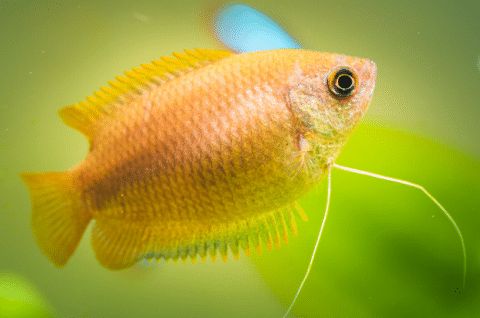
    Honey Gourami in Fish Tank

    A Honey Gourami features golden-yellow, clay-orange, red, and honey shades. Some of them look silver, gray, and brown, which are mostly female Honey Gouramis. There’s a cool brown-colored band starting from around the eyes and ending at the caudal peduncle.

    A Honey Gourami is small, reaching up to only 2.5 inches. While most of them are this size, a few of them were recorded stretching themselves up to 3 inches.

    They have 7 fins on them, including a pair of small pectoral fins, a dorsal and anal fin, and a caudal fin. You can also see thread-like pelvic fins attached right below their bodies.

    The dorsal fin begins from around the forehead, running down towards the caudal fin. Then there is the anal fin that travels side by side with the dorsal fin on the ventral area. Honey Gouramis have tiny pectoral fins attached to their bodies, with a beautiful and long threadlike fin right below that.

    The simplest way to tell apart the difference between the male Honey Gourami and the female Honey Gourami is by looking at their coloration, fins, and sizes.

    As with most fish species, the males display brighter shades than the females. The females have silver-colored bodies to pale yellow body coloration. The males, however, are bright yellow or orange.

    Almost all males change their color to a brighter shade as growing up or during breeding. Whereas in females, you don’t see any color alterations as compared to males. Apart from this, males have prominent fins, while females get rounded anal and dorsal fins. And the males are also slightly bigger than the females.

    But both sexes appear thin from the sides and look large from the middle of their bodies. Also, they have white abdomens, which turn dark in and around the breeding season.

    The Difference Between with a Dwarf Gourami

    Because of bad identification, you can often find a Dwarf Gourami labeled and sold as a Honey Gourami in fish stores. Though there are a few similarities between them, one can easily tell them apart.

    Dwarf Gourami in Aquarium

    Honey Gouramis have narrow bodies and they have smaller dorsal and anal fins. A Dwarf Gourami is 4 inches on average, while Honey Gouramis are only 2 inches, making them the smallest fish of their group.

    Another major difference is their body coloring. A Honey Gourami looks solid yellow, orange, red, or honey-colored. And a Dwarf Gourami looks red or blue and is paler. Other than that, Honey Gouramis have eyes closer to their mouths and Dwarf Gouramis don’t.

    Lifespan

    A Honey Gourami lives up to 8 years in captivity. In the wild, due to various reasons, they can’t keep predators and health problems at bay. And this results in shortened lifespans.

    To improve the overall quality of life, gauging the right water parameters, as well as preventing them from taking stress, is important.

    They thrive in freshwater with a temperature ranging from 74 to 82 F. But, there’s more to their basic requirements that we will discuss in more depth.

    Average Size

    The Honey Gourami is the shortest member of its family. Their maximum size is only 2.5 inches and, in some rare cases, 3 inches.

    Like other freshwater fish, they take almost 2 years to reach their full size. The males are slightly larger than females – almost about an inch.

    Care

    As a novice, the hardest part is to go make water conditions ideal, the aquarium setup, dietary requirements, and finding compatible tank mates for the fish. Any shortcoming in fulfilling any of this can be dangerous for your fish.

    Aside from giving a spectrum touch to your aquariums, a Honey Gourami can also withstand slight water condition changes. So instead of fussing over intricate details, you can actually think about starting your journey right away.

    In your aquarium, you can replicate natural conditions and provide your Honey Gourami with a solid home. They thrive in warm water temperatures, ranging from 74° F to 82° F.

    Because this hardy fish moves in groups, a larger aquarium is necessary for this active fish. Honey Gouramis are familiar with living around thick vegetation, so introduce thick plants to your tank.

    Since Honey Gourami appreciates social gatherings and hardly shows any aggression, handling it becomes completely trouble-free for beginners. But, under certain circumstances, the male Honey Gourami is likely to become aggressive to its tank mates and females around.

    Unlike other more sensitive freshwater fish, they are not susceptible to serious diseases. But neglect in managing them properly can be dangerous. Here are some essential things to consider before housing a Honey Gourami.

    Aquarium Setup

    The fish Honey Gourami hails from South Asia where the water tends to be slow-moving and warm.

    In South Asia, specifically in India, Bangladesh, and Nepal, they inhabit rivers, lakes, and ditches and can also be found throughout flooded areas.

    The waters of these fields are slightly acidic and moderate to high in hardness. Also, there are thick plants that work to provide them with shade and hiding spots.

    Honey Gouramis flourish in a stress-free environment. So, try to mimic their natural habitat as closely as possible to stem the flow of anxiety.

    Gouramis do their best solo or in pairs. If you pair them, make sure you give than a larger tank to curb aggression.

    Because Honey Gouramis are active and prefer spending their time exploring their surroundings, jumping out of the aquarium is likely. To ensure their safety, keep a tight lid on the tank.

    Tank Size

    Since they are quite small, you don’t need to arrange enormous tanks for them. However, they are social fish and do not enjoy living alone. If you want to house only a pair of them, then a 15-gallon tank is ideal. But if want a group of 6 Honey Gouramis living together, go for a 30-gallon tank.

    Water Parameters

    Their ability to put up with subtle water changes is worth mentioning. But, they do need properly measured water parameters to thrive. Remember that they come from South India where the streams, rivers, and pond waters are usually warm.

    While going over the water conditions, do not heat up the aquarium too much. It should be above 74° F and below 82° F, with water hardness between 4 to 15 KH. The pH levels should be around 6.0 to 8.0. And that’s ideal for them. Make sure ammonia and nitrite levels stay at 0. Keep your nitrates reasonable with under 30PPM being ideal.

    Filtration/Aeration

    Another key factor that leads up to the overall health maintenance of your Honey Gourami is filtration. Since the fish is small, it doesn’t produce a lot of waste. However, in groups and in planted tanks, there is more waste production to consider that would make a higher quality filter more appropriate.

    I recommend using a strong filtration system to keep the water quality up to the mark. You can use a sponge filter or a hang-on-back filter to strain the water thoroughly. Also, regular weekly water changes (usually 20-50% depending on the bio-load) will keep your aquarium in a healthy condition.

    Editor’s Choice
    Hagen AquaClear

    The Best Aquarium Power Filter

    The worlds best selling and most reliable power filter on the market. Unchanged for years because it’s so reliable and versatile

    Buy On Amazon Click For Best Price

    Honey Gouramis can’t withstand strong water currents. So, make sure any filtration system that you are using doesn’t disturb the water flow.

    Lighting

    You don’t need any artificial lighting for your Honey Gourami. A moderate amount of natural lighting is enough for the fish and plants.

    But to keep a check on their day-to-day activity, you can use Led lights that are not too bright. Bright lights can disturb them and force them to hide in caves or under thick aquarium plants.

    Aquatic Plants and Decoration

    With staying mostly on the top areas of tanks, a Honey Gourami hardly travels down to the bottom. Therefore, live floating plants are ideal for them.

    In the wild, a Honey Gourami uses thick leafy plants as a shelter. And since you want to make them feel at home, I recommend considering live aquarium plants for their tanks.

    Unlike other fish species, you will never see your Honey Gourami attacking a plant. They might nip at the plants, but only because of curiosity.

    They need plants to use as a hideout. Also, they build their bubble nests into plants, so make sure they have a good amount of floating plants in the tank.

    Even though a Honey Gourami uses its labyrinth organ to breathe air if there is not enough of oxygen, other fish prone to low oxygen levels can’t do that.

    Apart from filtering their water using strong filtering systems, live plants can help filter our excess nutrients like nitrates from their tanks.

    In their natural habitat, Honey Gouramis travel to the surface areas of water to draw breath. While setting up their tank, don’t cover the surface completely with plants.

    Some great recommendations for underwater and floating plants are:

    Pro Tip: Avoid using too many plants and manufactured caves. This will result in preventing you from keeping a check on them.

    Tank Maintenance

    Cleaning the tank of your honey Gourami is totally hassle-free. These small fish feature so many irresistible characteristics that make you fall in love with them.

    Because the fish prefers to live in a thickly planted aquarium in groups, cleaning their tank is more than necessary. Here are some simple steps to get you started.

    How to clean the tank?

    1. Start off with cleaning the walls with an algae scrapper.
    2. Trim the plants occasionally and take out the clippings.
    3. Clean decor and plants with a soft toothbrush.
    4. Skim surface of the substrate if sand is used and gravel vac if gravel is used. Avoid uprooting plants
    Pro Tip: During the breeding season, make sure you don't damage your Honey Gourami's bubble nest while cleaning the plants.

    Substrate

    Creating a substrate that mimics their natural environment is as essential as other things. While they adhere to the middle and surface levels, you still need a good substrate for this labyrinth fish.

    Layer the base of the tank using fine grains of the substrate. You can use both sand and gravel to create the base. In the wild, you can find plenty of rocks, plants, and driftwoods. Keep that in mind while creating their substrate.

    Keep the substrate at least 2 inches deep. And make sure underwater plants or decorative items are firmly fixed on it.

    Pro tip: A dirty substrate can make the aquarium cloudy. So, clean it beforehand to avoid any issues.

    Community Tank Mates

    Honey Gouramis are shy and need considerable time to blend in with their tank mates. They are peaceful fish and can easily get along with a good range of fish species.

    But since they are reserved, pay great attention to the species you will house them with. Their ideal tank mates should not be fin nippers. Also, they are quite small, so choose a fish that can can’t fit them in their mouths.

    They are social and humble but can act aggressively, especially males. If the amount of food that you are putting in isn’t enough, you will see the males hostile towards their mates. So it is good to focus on these areas.

    Here’s a list of some great tank mates for your Honey Gourami.

    1. Rosy Barb
    2. Dwarf Barb
    3. Cherry Barb
    4. Sparkling Gourami
    5. Cory Catfish
    6. Zebra Danio
    7. Celestial Pearl Danio
    8. Kuhli Loach
    9. Oto Catfish
    10. Ember Tetra
    11. Rabbit Snail
    12. Mystery Snail

    Poor Tank Mates

    As much as they are good at grouping up with different fish, they are small and thus an easy target for these fish species.

    1. Cichlids
    2. Red tail Sharks
    3. Rainbow Sharks
    4. Paradise Fish
    5. Betta Fish
    6. Tiger Barbs

    Breeding

    Breeding Honey Gouramis is pretty simple and intriguing. In this guide up till now, I have walked you through their origin to their aquarium setup. And now comes the most important part.

    Unlike the complex details of Betta fish breeding, the breeding requirements of the Honey Gourami are fairly simple for a beginner. Honey Gouramis are sexually dimorphic, which means there are visible differences between a male and a female. Here is a video above by Todor Vankov that shows the cycle.

    But before we get started, make sure males and females are equal in amount. If there are too many males, they will start fighting one another to win over the limited females.

    Purchase a separate breeding tank for them. A 10-gallon water tank is ideal. While setting up their breeding tank, keep the water 6 to 7 inches high.

    Then, heat up the water up to 84° F. You can either use a heater for that or go for a towel to cover the surface. Keep the acidic level at 7.0 with the water hardness around 8 KH.

    Apart from gauging the water conditions, feed them a good-round diet.

    Also, introduce thick vegetation to the breeding tank throughout. Males will use them to build a bubble nest.

    Before spawning, the males become more vibrant and develop a deep black or light brown stripe. The stripe is apparent from their heads to the end. You can also see its throat turning deep blue, which is a clear spawning indication.

    Before approaching a female, the male will build a bubble nest. Once the fish is done, it will start swimming around the female until she is convinced to follow him to the bubble nest.

    At the time of spawning, the male will hold the female to prompt spawning. Once the female swells with eggs, it will start laying eggs in water. The male will instantly catch the eggs with his mouth to lay in the bubble nest.

    After they are done spawning, separate the female. Even though Honey Gouramis are not aggressive fish, males tend to show hostility towards the mothers. They are possessive and don’t appreciate anyone around the eggs.

    Female Honey Gourami can lay up to 300 eggs in different spawning rounds. The male monitors them and fertilizes the honey gourami eggs, which takes 2 to 4 days.

    The fry will start swimming after 2-3 days and it is good to remove the male at this point. Because the babies are puny, they need to be looked after properly. Once the larvae is hatched, they will use their yolk sacs for a couple of days.

    Start feeding them infusoria and liquid fry food after a week or two. Once they are bigger and stronger, give them access to baby brine shrimps.

    If you want to ensure a solid growth of the labyrinth organ, I recommend covering the aquarium surface with plastic wrap. This will increase humidity, leading to proper labyrinth organ growth in babies.

    Food and Diet

    In the wild, they are fed on a variety of diets. Even though they are omnivorous fish, you can call them carnivorous fish, too. Because they can consume both plants and protein-filled foods.

    Honey Gouramis love to see variations in their diet. So, making them happy while keeping honey gouramis healthy at the same time holds great value.

    To boost their longevity, give them a mixed diet of vegetables and meat. Some great recommendations for vegetables are vegetable tablets, plant material, lettuce, and cucumber. While trimming the plants, you can offer them that, too. This will help you prevent them from attacking the plants.

    But meaty foods remain the core diet, so don’t skip that. You can give them bloodworms, white worms, mosquito larvae, flakes, pellets, and brine shrimp. Fluval bug bites are a great staple and will enhance their color.

    My Pick
    Fluval Bug Bites – Tropical Formula

    Fluval bug bites tropical fish is an excellent staple food for most tropical fish. Made of black solider fly larvae

    Buy On Amazon Buy On Petco

    While baby brine shrimp is the primary source of protein for baby honey gouramis, you can you large brine shrimps for adults.

    As compared to other fish, they are shy. Other fish who are fed on the same diet can easily eat off their share, leaving them starving. While feeding the fish separately is almost impossible, you can make changes to their timings.

    Lastly, feed them twice or thrice a day, and notice that they finish the food odd within 3 minutes.

    Common Health Problems

    They can withstand environmental changes, but their labyrinth organ is sensitive to drastic temperature shifts.

    An unclean water tank can lead to a bacterial infection called fin rot. There are other diseases too that they are prone to. To keep these ailments at bay, keep the tank clean and manage the diet as recommended.

    Fin Rot

    They are susceptible to fin rot, a common disease caused by unclean water.

    The symptoms are:

    1. Black, while or brown spots on fins or other body parts.
    2. Inflammed skin
    3. Lethargy
    4. Loss of appetite

    Ich

    This is a common fish disease. Honey Gouramis are resilient, but other fish suffering from ich can easily affect them.

    The symptoms are:

    1. White spots on the body
    2. Scraping the body against the aquarium surface

    Velvet Disease

    Velvet disease primarily occurs due to the presence of parasitic dinoflagellates.

    The symptoms are:

    1. Scratching against rough objects or surfaces
    2. Loss of appetite
    3. Loss of color
    4. Clamped fins

    These ailments can be avoided if you maintain water quality and keep overall health preservation. Velvet spreads rapidly and, in case your honey gourami is affected, isolate it from other fish.

    FAQs

    Are they fin nippers?

    No. Honey Gouramis are not fin nippers. Actually, they are vulnerable to get their fins nipped if you house them with barbs or neon tetras.

    Can they live with Dwarf gourami?

    Dwarf Gourami and Honey Gourami do well together. But Honey Gouramis are small as compared to Dwarf Gouramis, so it is better to house the latter with their same species.

    How many should be kept together?

    Honey Gouramis can be kept in groups and solo. They are considered one of the most peaceful Gourami breeds.

    Can they live in a 5-gallon tank?

    The minimum water requirement of a honey Gourami is 10 gallons. A 5-gallon tank is too small to allow it to enjoy free swimming. Besides, Honey Gouramis don’t lead a solitary life, and keeping them in this small tank is impossible.

    Are Honey Gouramis Dwarfs?

    Because of their small size, they are often referred to as dwarf gourami. And because of this, people often confuse them with their cousin, which is Dwarf Gourami.

    Are they peaceful?

    They are very peaceful fish that do well with a number of fish species. As a beginner, this gives you excellent motivation to start your fish-keeping journey with them.

    Closing Thoughts

    If you’re looking for a peaceful, colorful fish to add to your community tank or planted aquarium, the honey gourami might be perfect for you. These little guys are social and get along well with other fish, making them an ideal choice for those who want a lively tank without any drama. Have you kept honey gouramis before? Let us know your experience in the comments!


    📘 Want to learn more? This article is part of our complete Freshwater Fish Guide — your ultimate resource for freshwater species, care tips, tank setup, and more.

  • 15 Popular Types of Rainbow Fish (With Pictures!)

    15 Popular Types of Rainbow Fish (With Pictures!)

    By bringing a rich diversity of colors to your freshwater community aquarium, Rainbow Fish know how to grab your attention and be the best companion to their community tank mates.

    Rainbow fish are perfectly conflict-free, lively, and easy to handle. So, it doesn’t matter which stage of experience you are on as an aquarist, care for them can be totally undemanding.

    But, do you know how many types of Rainbow Fish are out there and what are the care requirements of each? Don’t worry if you don’t!

    In this article, I will walk you through a detailed guide that will definitely help you form a solid understanding of their dietary requirements, water conditions, and pretty much everything related to this peaceful fish.

    An Overview of the Rainbow Fish

    Scientific NameMelanotaenia Spp
    Common NamesRainbow Fish, Rainbowfish
    FamilyMelanotaeniidae
    OriginIndonesia, Eastern Australia, Northern Australia, North Carolina
    DietOmnivore
    Care LevelEasy to Moderate
    ActivityActive
    Lifespan5 to 8 years
    TemperamentPeaceful
    Tank LevelTop
    Minimum Tank Size30 gallons
    Temperature Range74° F to 80° F
    Water Hardness10 to 20 KH
    pH Range6.5 – 8.0
    Filtration/Water FlowModerate to Fast
    Water TypeFreshwater
    BreedingEgg Layer
    Difficulty to BreedEasy
    CompatibilityCommunity tanks
    OK, for Planted Tanks?Yes

    What is Rainbow Fish?

    Rainbow Fish, scientifically known as Melanotaenia, is a part of the Melanotaeniidae family. They love to travel through moderate to strong water currents and prefer living in heavily planted aquariums.

    Rainbow-Fish-in-Aquarium

    Their peaceful temperament, coupled with their ability to get along with other freshwater fish species, makes them ideal for community tanks.

    Experienced aquarists all around the world seek them out. And beginners who are reluctant to take a further step in their fish-keeping journey should definitely give this freshwater fish a try.

    Origin and Habitat

    Rainbow Fish are native to Australia and Indonesia. They were first sighted in 1903 by a British ichthyologist called Charles Regan Tata. Ever since their discovery, many ichthyologists from different parts of the world have been successful in bringing other Rainbow Fish species to notice.

    Their natural habitats are scattered across different regions of Australia and Indonesia. Including the Raja Ampat Islands, Cendrawasih Bay, New Guinea, and other parts of Northern and Eastern Australia.

    Because of originating from different international points, their water condition requirements don’t always match.

    Appearance

    In the aquarium trade, Rainbow Fish are popular because of their multi-colored bodies.

    Their body coloring gives them a mesmerizing appearance. While they come in different shapes and sizes and have contrasting water conditions, they are pretty good at scaling up the beauty of your fish tank.

    Some types of rainbowfish species stretch themselves up to 4.7 inches, while the other species of rainbowfish can go as big as 7.2 inches. Their body size generally depends on their type. So, you can’t really form an exclusive idea about their actual sizes.

    Rainbow fish have large eyes and elongated premaxillary teeth. They have a pair of top fins, sitting at a little distance from each other, and a pelvic and anal fin. And in most types of rainbowfish, the anal fin appears red.

    They have spiny dorsal, anal, and pelvic fins. These spines help them prevent falling prey to any mishap in the wild. The first of the dorsal fins has almost 6 spines on it, while the second has up to 22. And the anal spine comprises almost 30 spines.

    You can see their pelvic fin attached to their rose-colored abdomens with a vulnerable sheet of skin that travels the length of their deep-seated ray.

    As compared to an adult rainbow Fish, a juvenile rainbow fish has somewhat dim top fins. However, the coloration of the fins becomes vivid once it grows up.

    The difference between a male and a female rainbow fish is the deepness of body coloring. The males are dazzling while the females come in duller body shades. Apart from this, females are plumper, while males are slender and have pointed fins.

    15 Different Types

    Here are some of the most famous rainbow fish types to consider adding to your community fish tanks. Check out the video below from our Official YouTube Channel for a visual treat. If you like our content, be sure to subscribe!

    1. Threadfin

    • Scientific Name: Iriatherina werneri
    • Adult Size: 2 inches
    • Color Pattern: Silver bodies with black and red spots on fins
    • Unique Traits: Strands projecting from dorsal fins in males

    Among other rainbowfish species, the Threadfin rainbowfish stand out pretty well. Their small-scale bodies with red tints on their fins add up to their uniqueness and aquarium beauty. They are the smallest species in their group you will ever come across.

    To differentiate between a male Threadfin Rainbowfish and a female Threadfin Rainbowfish, look at their anal and dorsal fins. The males have filaments sticking out from their anal and dorsal fins, while the females completely lack them.

    Pro Tip: Male Threadfin rainbowfish are prone to any fin-nipper fish. So, be really careful while choosing their tank mates.

    2. Banded

    • Scientific Name: Melanotaenia trifasciata
    • Adult Size: 5 to 6 inches
    • Color Pattern: Silver bodies with multi-colored stripes
    • Unique Traits: Thick stripe running the length of the body

    Familiar to the freshwaters of Northern Australia, Banded rainbowfish now dominate the community tanks with their captivating appearance (video from Imperial Tropicals).

    Banded rainbowfish have wide body frames with a thick red/golden yellow stripe traveling lengthwise down their bodies. They are peaceful and love to swim through soft-moving waters.

    3. Murray River

    Murray River
    • Scientific Name: Melanotaenia fluviatilis
    • Adult Size: 4 to 4.5 inches
    • Color Pattern: silver-green bodies with a golden-brown outline
    • Unique Traits: Silver bodies

    Murray River rainbowfish, also known as Australian rainbowfish are native habitats of the rivers of South-eastern Australia. The beautiful color pattern of this Australian rainbow fish makes it mesmerizing and ideal for freshwater tanks.

    The Australian rainbowfish has yellow fins which sometimes give reddish or orangish hues. The male fish has gleaming stripes on its back that look more prominent during the spawning season.

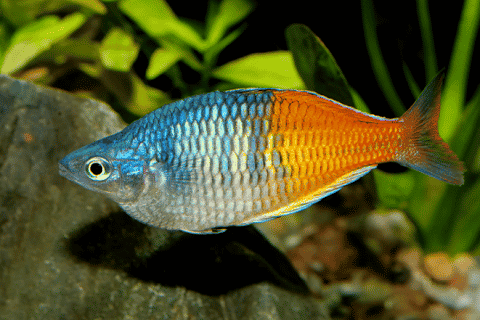
    4. Boesemani

    Boesemani-Fish
    • Scientific Name: Melanotaenia boesemani
    • Adult Size: 4 to 5 inches
    • Color Pattern: Blue and golden yellow
    • Unique Traits: Dual-colored body

    With their two-toned wide bodies and deferential nature, The Boesemani rainbowfish is famous in the aquarium trade for the right reasons!

    Boesemani rainbowfish are large and thrive in groups in big water tanks. Coming from the regions of Indonesia, the Boesemani rainbow fish prefers warm water temperatures and high pH levels.

    5. Red Irian

    Red-Irian-Fish
    • Scientific Name: Glossolepis incisus
    • Adult Size: 6 inches
    • Color Pattern: Red with yellow hues
    • Unique Traits: Bright body color

    Native to New Guinea, the Red Irian rainbowfish is now a favorite fish of aquarists. Their dietary requirements are the same as most tropical fish and they are quite relaxed around their tank mates.

    The Red Irian rainbowfish is 6 inches in length, which makes it pretty big. The male fish look vibrant but loses its spark when the female is not around.

    6. Desert

    • Scientific Name: Melanotaenia splendida tatei
    • Adult Size: 4 inches
    • Color Pattern: Silver and white body with green tinted fins
    • Unique Traits: Beautiful-pigmented fins

    Desert rainbowfish are hard to find in the aquarium trade (video source). Even though they can easily adapt to different water conditions, desert rainbowfish don’t leave their freshwater habitats.

    A desert rainbowfish comes in 3 different shades, ranging from silver to bluish-green. Usually, the females have silver-colored bodies with translucent fins. However, the male desert rainbowfish have purple-tinted fins and hues of cyan visible throughout their bodies.

    7. Red

    • Scientific Name: Glossolepis incises
    • Adult Size: 6 inches
    • Color Pattern: Red and brown
    • Unique Traits: Red body

    Red rainbowfish or Salmon Red rainbowfish (video source) originate from Indonesia and actively take part in increasing the beauty standard of aquariums around the world. They are beginner-friendlyand have trouble-free care needs overall.

    While male Red rainbowfish are red, the females look brown and so do baby red rainbowfish.

    Red Rainbowfish float in warm temperatures and can adjust themselves to changing water conditions.

    8. Lake Tebera

    Lake-Tebera-fish
    • Scientific Name: Melanotaenia herbertaxelrodi
    • Adult Size: 4 inches
    • Color Pattern: Yellow body with a thick black band
    • Unique Traits: Thick dark stripe

    You can say that Lake Tebera rainbowfish and Lake Kutubo rainbowfish are townsfolk. Because both species are native to New Guinea.

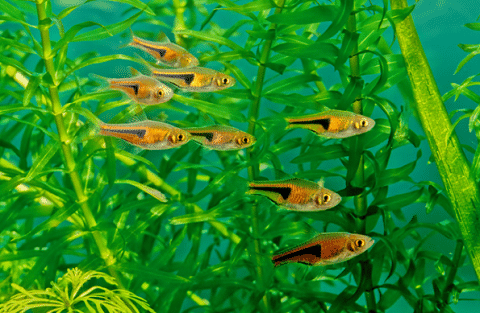
    Lake Tebera rainbowfish look bright yellow with a dark stripe that runs along the middle of their sides.

    9. Celebes

    Celebes-Fish
    • Scientific Name: Marosatherina ladigesi
    • Adult Size: 3 inches
    • Color Pattern: Transparent body with a yellow/dark/cobalt band
    • Unique Traits: Projected strands

    Celebes rainbowfish and Threadfine rainbowfish almost look alike. The Celebes rainbowfish has strands sticking out from the dorsal fins that look yellowish-golden.

    10. Madagascar

    • Scientific Name: Bedotia madagascariensis
    • Adult Size: Around 6 inches
    • Color Pattern: Silver bodies with flaxen-colored hues
    • Unique Traits:

    They got their name from their native hometown, which is Madagascar (video source). Madagascar rainbowfish have silver bodies mixed with pale yellow hues.

    Madagascar rainbowfish are not good at tolerating shifting water conditions. They are used to soft water with low pH levels.

    11. Lake Wanam

    • Scientific Name: Glossolepis wanamensis
    • Adult Size: 4 inches
    • Color Pattern:
    • Unique Traits: Long transparent dorsal fin

    Lake Wanam rainbowfish look spectacular (video source). They have charming bodies, which are 4 inches in length. They can withstand slightly different water conditions. But drastic changes in water parameters can put their health in danger.

    The male and female Lake Wanam rainbowfish own long and transparent dorsal fins. But you can’t really identify them due to weak information on the subject.

    Though the waters of their native home haven’t changed, Lake Wana rainbowfish are virtually going extinct. And therefore, unlike with other fish, running across them is nearly impossible. They are critically endangered species, and maybe that is the reason we can’t find them too often in the aquarium trade.

    12. Neon

    • Scientific Name: Melanotaenia praecox
    • Adult Size: 2 to 2.5 inches
    • Color Pattern: Shimmering blue with red/orange fins
    • Unique Traits: Shimmery body coloring

    The Neon rainbowfish or Dwarf Neon rainbowfish, is famous for its sparkling neon blue body color with red and orange fins. Their bodies are wide and they love big tanks to enjoy roaming around.

    The easy way to identify a male and a female Neon rainbowfish is to look at their body size. The males have larger bodies while the females have slimmer. Another difference is their slightly contrasting fins. Male Neon rainbowfish have red fins, while the females have orange-tinted fins.

    13. Lake Kutubu

    Lake-Kutubu-Fish
    • Scientific Name: Melanotaenia lacustris
    • Adult Size: 5 inches
    • Color Pattern: Cobalt blue, silver, turquoise colored bodies
    • Unique Traits: Ability to change body color

    Lake Kutubu rainbowfish can easily disguise themselves by changing their color. They are the natural inhabitants of Lake Kutubu in New Guinea.

    Similar to other species of rainbowfish, the male lake Kutubu rainbowfish has vibrant body shades. They look dazzling blue and have yellow abdomens while the female fish have somber body coloring.

    Compared to an adult Lake Kutubu rainbowfish, babies have slimmer bodies.

    14. The Axelrod

    • Scientific Name: Chilatherina axelrodi
    • Adult Size: 4 inches
    • Color pattern: Light blue and silver base color
    • Unique Traits: Black stripes

    The Axelrod Rainbowfish (video source), also known as Axelrodi rainbow fish, originates from Papua, New Guinea. This fish is named after the famous tropical fish expert Herbert Axelrod,

    The Axelrod Rainbow fish prefer waters that are soft and fresh, resembling their hometown Yungkiri Stream of Papua New Guinea.

    They have light silvery bodies, with the males having dark yellow spots on their fins. They also have various small-sized stripes scattered across their bodies.

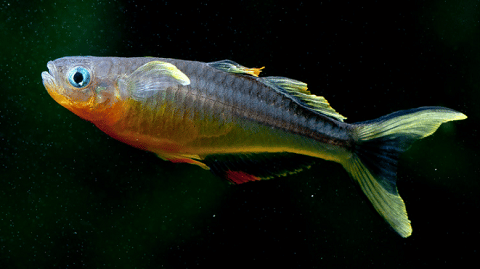
    15. Forktail

    Forktail-Fish
    • Scientific Name: Pseudomugil furcatus
    • Adult Size: 2.5 inches
    • Color Pattern: Silver and yellow body with black stripes
    • Unique Traits: Forked tail

    The Forktail rainbow fish is another small freshwater tank fish that looks yellow. They are native to the river called Kwagira of Papua, New Guinea. They have blue eyes and silver-colored bodies, with the males displaying a bright yellow color while spawning.

    Also, the females look paler and don’t have sharp dorsal and pectoral fins like the males. But they have yellow fins and outlined bottom and top bodies, giving them a unique characteristic.

    Lifespan

    The lifespan of rainbow fish varies. Some species live up to 8 years, while others can die as young as 3 in the wild.

    Because of hailing from different Indonesian and Australian regions, keeping the fish healthy is important. Especially if they are placed with a different fish species. Some fish can tolerate deviations in water parameters. But the same water conditions can be nearly fatal for others.

    The average water temperature ranges from 74° F to 80° F with pH levels between 6.5 to 8.0

    Average Size

    The average size of rainbow fish spans between 2 inches to 7.1 inches. You will find some fish sold at a very young age when their size is under-developing. They take at least 2 years to reach their full length.

    Care

    This amazing fish is ideal for non-professionals and pros. Replicating their native wild water conditions is also easy, given you have a solid basic understanding.

    Almost all types of rainbow fish stay active and explore their surroundings. They are schooling fish and need to be put in a tank with at least 6-7 fish from their species.

    Some fish prefer low pH levels, whereas others thrive in slightly high acidic waters. Therefore, before you carry out your plan of keeping them together, make sure they can coexist.

    Aquarium Setup

    Though some of these fish are good at tolerating shifting water parameters, others are sensitive to changes. To keep your fish healthy and away from stress, try mimicking their natural water conditions in your aquarium.

    Almost all rainbowfish species thrive in freshwater. Some are accustomed to higher acidic levels, while some prefer lower pH conditioned waters.

    In their native hometown, you can find dense plants surrounding them. These plants work as a shield and shade them.

    Also, rainbowfish are surface feeders that spend most of their time exploring the surface. While feeding them, make sure the food doesn’t sink to the bottom of the tank.

    To ensure their safety, keep a tight lid on the tank. Because they are large, energetic, stay on the surface, and can leap out of the tank pretty easily.

    Tank Size

    The minimum tank size is 30 gallons of water. Rainbow fish are schooling fish that need large swimming space to move around with their mates. 55 gallons and up would be preferable if you are looking to school a number of Rainbow fish.

    If there are different species in the tank, you will need to add more water to your aquarium. So, it doesn’t really matter whether you own the smallest rainbowfish species or the largest ones, give them enough space to move.

    Water Parameters

    Right regulations of water are too important for most rainbowfish species to flourish. As said above, some fish of this species can easily withstand slightly different temperatures, pH levels, and water hardness. But a fish like Lake Wanam cannot.

    Fish like Madagascar rainbow fish, Boesemani rainbowfish, and Red rainbow fish can adjust themselves to altered water conditions. So, if you are someone who slacks their work, go for these resilient fish.

    Keep the water temperature between 74° F to 80° F, water hardness 10 to 20 KH, and pH levels 6.5 to 8.0.

    Filtration and Aeration

    Fish in groups produce a lot of waste that pollutes the water and damages the water quality. Therefore, installing a strong water filtration system is recommended.

    To keep the water quality intact, you can go for the canister filtration system. Also, it should create strong currents to make the fish feel at home.

    Lighting

    Make your aquarium dimly lit and add lots of floating plants to it. Rainbowfish love shaded areas and floating plants can give them that.

    To see them displaying their colors, you can use color-enhancing light bulbs.

    Aquatic Plants And Decorations

    A well-planted aquarium is ideal for your rainbowfish. In their natural habitats, the fish live in areas that have dense plants. These plants comfort them and are useful for the fish as a refuge. Introduce caves, thick vegetation, and other hiding spots all throughout the aquarium. Aquarium driftwood and aquascaping rocks are great choices for setting up a nature scape or natural setting.

    For plants, you can try hardy plants like:

    And don’t worry! These fish won’t ruin them.

    Tank Maintenance

    The best way to clean the tank is to keep changing the water up to 25%. Because low-quality water can damage the beauty of the tank. Always monitor your test levels with quality test kits.

    Substrate

    The dark substrate will bring out their beautiful coloration and unique patterns on the body. Even though you can use rocks that will work as hidden spots, avoid using jaggy rocks while making their substrate. For planted tanks, a planted tank substrate would be considered ideal for the benefit of your plants. You can top dress a substrate in decorative sand to build pathways.

    Community Tankmates

    Living in a school of at least 6 is one of their fundamental needs. They appreciate social gatherings and need to be put with their own kind.

    You can house and care for different types of rainbowfish completely hassle-free, as long as the species are the same or similar in size. They don’t act aggressively. And because they are surface-feeding fish, they won’t trouble fish staying at the bottom of the tank.

    Here’s a list of some most compatible tank mates for your rainbowfish.

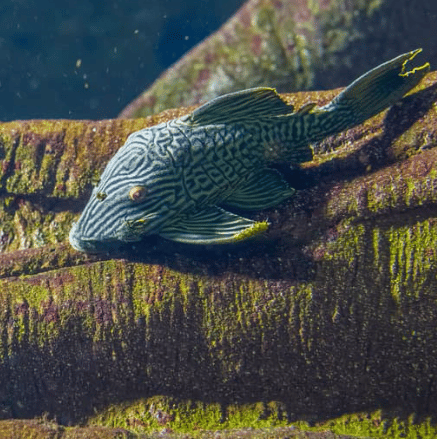
    1. Plecos
    2. Tetras
    3. Angelfish
    4. Danios
    5. Corydoras catfish
    6. Barbs
    7. Platies
    8. Swordtails
    9. Mollies
    10. African Butterfly Fish

    Poor Tank Mates

    1. Bettas
    2. Cichlids

    Breeding

    Rainbowfish are egg layers and easy to breed. They don’t need separate breeding tanks, but a separate aquarium hobby is good for the safety of the fry.

    Crossbreeding can result in discolored and diminutive fry. So, it’s better to form a pair of the same species.

    Their breeding season starts once they are put on a protein-based diet, with gradual increases in water temperature. Near spawning, the males become vivid in coloration and speed up their swimming around the females. And some of them grow a prominent lateral stripe. And the females become plumper when they are ready to spawn.

    Food and Diet

    They go well with almost everything you put in their tank. You can feed them insect larvae, frozen foods, brine shrimp, mosquito larvae, and zooplankton.

    You can also give them live foods such as glassworms, bloodworms, and daphnia only once or twice a day.

    Pro tip: A rainbowfish takes 3 minutes to eat up its food. So, before feeding again, wait at least 3 minutes.

    FAQs

    Can I keep two together?

    Have at least 6 of them together in your tank. 2 fish usually isn’t enough to fulfill their social needs. They enjoy the company of their own kind.

    What kind of fish are they?

    They are friendly, social, and freshwater fish species. Due to their size, they are best for medium to large-sized aquariums.

    How fast do they grow?

    They take at least 2 years to reach their full length. They generally are considered a moderate-growing fish.

    Closing Thoughts

    Rainbowfish are a great choice for any aquarium, but they really shine in larger tanks. These fish are colorful, social, and peaceful, making them a joy to watch. Have you kept rainbowfish before? Let us know your experience in the comments!


    📘 Want to learn more? This article is part of our complete Freshwater Fish Guide — your ultimate resource for freshwater species, care tips, tank setup, and more.

  • How Long Can Fish Live In A Bag – The Quick (and Detailed) Answer

    How Long Can Fish Live In A Bag – The Quick (and Detailed) Answer

    Are you wondering how long your fish can live in a bag? If so, you’re not alone. While the answer may seem simple enough, there is more to it than meets the eye. In this post, we’ll take a closer look at exactly how long fish can live in a sealed bag and what you can do to make sure they stay healthy during that time. So, whether you’re getting ready to move your fish or just want to know more about the shipping and transporting process, keep reading for everything you need to know!

    Transporting Fish

    There is no fancy way to transport fish. Whether you’re a hobbyist or distributor, you’ve most likely received a fish, invertebrate, or plant in a plastic bag filled with water. There must be a better way to transport fish, right?

    As with anything in the aquarium hobby, stability is key to making the transportation of fish and invertebrates as easy and stress-free as possible. But the truth is that this process has been nearly perfected and largely results in success.

    How Long Can Fish Live In A Bag? (The Quick Answer)

    Fish in Transport bags

    Surprisingly, shipping fish and invertebrates in plastic bags is quite a reliable method that has been used for decades. On average, fish can survive for 6-9 hours in a sealed plastic bag as long as other conditions are met. It is strongly encouraged to only keep fish in a bag for a few hours at most, though.

    For overnight shipments from online retailers, fish are prepared to spend at least 24 hours in these conditions by maximizing oxygen and stabilizing temperature. Retailers have perfected these methods so much so that fish can often spend up to a couple of days in transit.

    This is in comparison to corals and plants that can withstand even several days or more in a plastic delivery bag when packaged correctly. Unfortunately, other invertebrates do not have such a big window.

    Many fish keepers are usually pleasantly surprised that their fish arrive alive even when there has been a delay in delivery. Sometimes though, even an early package can cause dead or damaged fish or invertebrates due to unstable conditions or poor shipment preparation.

    Fish Transportation Factors

    Hundreds of fish are moved and delivered daily. If they can travel across oceans then your fish can definitely make it home safely from your local pet store. However, it can still be very stressful for freshwater and saltwater fish to make the move from the pet store to the home aquarium.

    Here are some of the factors that will affect how your fish does during the trip and just how long you have before you need to release your fish.

    Temperature

    Temperature is the biggest problem when it comes to keeping fish alive during transportation. Whether it’s for just a couple of hours or it’s for a several-day delivery, the temperature can cause multiple fish and invertebrates to die during the process.

    The problem is that tropical fish don’t stop being tropical just because they need to be transported. Most of these fish species need to be kept at a constant water temperature between 72-82° F. Any deviation from this or out-of-range value can cause the fish to die; it should also be noted that hotter water will hold less oxygen than colder water, which can become problematic in places that experience seasonal changes.

    Contrary to popular belief though, tropical fish should be shipped at the lowest temperature possible. A lower temperature will slow down metabolic processes, which helps preserve oxygen and water quality.

    The simple fix to varying temperatures is using extended release heat or ice packs. These packs are usually good for a couple of days and will help maintain water temperature as long as the fish bag or box is also properly insulated; it is very common for fish to be transported in styrofoam with plenty of padding.

    If you’re transporting fish over a short period of time, then an insulated container, like a cooler, may be used to help stabilize and maintain temperatures. In the colder months, it may be worthwhile using a heat pack for extra insulation or simply running the heat in the car. In the warmer months, air conditioning should help keep the water temperature down.

    Some pet stores may even deny shipment if temperatures are extreme because of this.

    Oxygen

    The second problem when it comes to transporting fish is maintaining oxygen levels. Whenever a freshwater or saltwater fish is put into a sealed container, it has the possibility of suffocating due to decreased levels of oxygen and increased levels of carbon dioxide.

    As mentioned before, oxygen is affected by water temperature: warmer water holds less oxygen while cooler water holds more oxygen. Ideally, the plastic bag should remain at tropical temperatures with enough oxygen for the shipment.

    Oxygen can be difficult to regulate as fish bags are a closed environment. Oxygen is being used by the fish while carbon dioxide is being released back into the water. With no new source of oxygen, the available oxygen can be depleted. Furthermore, carbon dioxide contributes to forming weak acids in the water which lowers water pH.

    No matter how you pack your fish, air will always be limited. However, there are a few ways to ensure that your fish have just enough oxygen to make it through their trip.

    1. Use large bags with fewer fish. A bigger bag means more oxygen, especially if you don’t fill up the bag with as many fish. However, this can be heavy and wasteful, making it difficult to ship.
    2. Test water parameters. This might seem like a simple hack, but knowing the parameters of the aquarium water before sending fish out from it can make the move that much safer and easier. Water quality should be near perfect and fish should be healthy and ready for a stressful few days.
    3. Fill the bag with 1/3 water and 2/3 oxygen. This will give a good balance between water and air for gas exchange. Some hobbyists choose to fill their fish bags with pure oxygen, though this isn’t usually necessary for the average hobbyist or aquarium retailer.

    For longer, but not overnight, shipments, some hobbyists may choose to bring a battery-operated air pump with them. This facilitates gas exchange, moving in new oxygen into the water and exporting used carbon dioxide. To make this work efficiently, the system must be open, meaning that new air can be diffused at the surface of the water.

    Ammonia 

    Ammonia can quickly kill fish and invertebrates that are stuck in sealed containers. Ammonia is created as a result of metabolic processes as well as fish waste and can become toxic at relatively low concentrations. In a full aquarium setup, ammonia is usually quickly processed and neutralized by beneficial bacteria.

    There is no way to stop ammonia from accumulating in a fish bag entirely. However, there are a few ways to lessen how much of these toxic chemicals enter the water during transport.

    The best way to stop ammonia from entering the water is by limiting feeding in the days before the shipment. It is recommended to not feed fish at least 72 hours in advance. This will lead to fewer metabolic processes and decreased levels of ammonia being released; the lowered temperature will also help slow the remaining metabolic processes to lessen ammonia export even more.

    Another method for safe shipment is using an ammonia neutralizer. This should detoxify ammonia and nitrite for short periods of time. These products can be difficult to dose correctly and are oftentimes unnecessary.

    How To Ship A Fish

    Whether you’re sending a freshwater or saltwater fish to another hobbyist or purchasing your first coral online, you might be wondering how the process works. Each hobbyist and fish store has his or her own method, but here is a general breakdown for shipping fish, corals, and plants. The video below by Michael’s Fish Room explains how to ship freshwater fish. We will go further in the paragraphs below.

    Shipping Fish

    Fish are the most time-sensitive in this process. They need large amounts of oxygen, produce a lot of waste, and can get trapped in the corners of a closed container.

    A fish bag can be small, medium, or large. Most fish are packaged in small groups or individually depending on the fish species. These bags are often placed together in an insulated styrofoam container with heating pads. It is important that the fish bags stay upright as fish can get caught in the corners.

    Live fish shipping is usually overnight or over 2 days. Any more time than this can become dangerous for the fish.

    Shipment Containers

    The most popular shipment container for fish is a plastic bag in a foam box. Most hobbyists use ice coolers or other temperature-regulated containers for local pickup.

    Some retailers have started using a new technology called a breather bag. These bags are designed to allow gas exchange through a semi-permeable surface; both oxygen and carbon dioxide can freely move in and out of the bag.

    Breather Bags

    A new way of transporting fish. Allows oxygen and CO2 to move freely. Commercial sellers can purchase Kordon brand bags from their local wholesaler

    Buy On Amazon

    In most cases, breather bags are not necessary and fish will survive just fine without the extra gas exchange. However, these bags can be good for longer trips and more expensive fish.

    It is very common for hobbyists to trade fish, corals, and plants in a ziplock bag. Though ziplock bags are safe enough for fast deliveries, these bags are difficult to fill and don’t provide much leftover room for oxygen. Speaking from experience, they are also very prone to leakage!

    Shipping Corals

    Believe it or not, corals aren’t as sensitive as fish when it comes to shipping. Corals can live in a bag without light for a couple of days without any damage; they might just take a couple of days to open back up in the new tank.

    Pet stores like to use plastic containers, like urine cups, as a way to hold the frag in place for shipping corals. This greatly reduces the likelihood of the coral rolling around in the container, potentially causing damage; soft corals, like zoanthids, are regularly shipped in a regular plastic bag. A great example of a seller shipping corals is FishOfHex. I’ve known him over the years. Travis is one of the good and honest sellers in the industry. Give him a shot if you are looking for quality frags.

    While corals aren’t likely to die due to lack of oxygen or high levels of ammonia, they are very sensitive to changes in temperature. Because of this, fish stores monitor the weather very closely and provide plenty of insulation.

    Most corals are shipped overnight, though they can safely be transported over the course of 2-3 days.

    Shipping Plants

    Shipping plants is the easiest process, though freshwater species are still slightly sensitive to extreme temperatures.

    Plants can survive in closed containers for longer than is needed for a successful trip. A plant cutting is placed into a plastic bag and given some water, usually through an absorptive sponge around the roots; there is no need to keep the plant submerged in water for transport. Little additional packaging is needed, though a heat or ice pack is added depending on the climate.

    Plants can be successfully shipped over the course of 4-7 days. Of course, it is better to receive the plants as soon as possible, but hardier species can definitely live much longer than this without any problems.

    How To Acclimate A Shipped Fish

    Once your fish arrives, you need to know how to make the transfer to your tank seamless. Acclimating new fish that have been stressed for a few days is a little more involved than simply taking a fish home from the pet store. This is because of ammonia.

    When fish are shipped, pH drops due to carbon dioxide entering the system. Eventually, ammonia becomes a less toxic form, called ammonium, at a certain pH level. Fish are able to live in these ammonium conditions longer than they are in water with high concentrations of ammonia.

    However, once the bag is opened upon delivery, the carbon dioxide is allowed to escape and the pH rises again, and ammonia quickly spikes. In these moments, the fish can be killed!

    For a long time, it was believed that letting fish slowly drip acclimate to the tank water for several hours was the best acclimation practice. We now understand that it’s best to get these shipped fish into the tank immediately. Don’t forget that shipped fish can also carry diseases and should not be placed directly into the main aquarium upon arrival!

    Instead, the bag should be floated at the surface of the aquarium water until temperatures match. The fish may then be placed into a quarantine system for at least 2 weeks to observe for signs of illness. Make sure that none of the water that came in the bag enters your aquarium’s system.

    Shipped corals may be temperature acclimated, dipped to remove pests, and then added immediately to the aquarium. It’s best to place coral frags on the substrate or on a frag rack in order to monitor health and to understand the coral’s preferences for lighting and flow in the aquarium. Some hobbyists do prefer to quarantine corals. I’m a fan of QT’ing corals, but I know most hobbyists aren’t.

    Plants may also be added directly to the aquarium once treated for pests. If you purchase a tissue culture plant, they are disease and pest free. Tissue culture are the best plants to buy for peace of mind.

    Many online fish retailers have a dead on arrival (DOA) guarantee which states that aquatic pets that arrive near death or are already dead can be returned for store credit or a full refund. A time limit is often given for this window and the container must be unopened. The DOA may be denied if the weather did not allow for safe delivery, though every retailer is different.

    Final Thoughts

    The past few years have caused many hobbyists to turn to online stores for saltwater and freshwater fish, corals, and plants. Online stores usually have a bigger selection and lower prices, but the thought of sending something live in the mail can make some hobbyists nervous.

    Luckily, with the right packaging and timely delivery, fish survive being shipped just fine.

  • Planted Aquarium Fish – 15 To Try (With Pictures!)

    Planted Aquarium Fish – 15 To Try (With Pictures!)

    Looking for fish that work great with planted, but won’t tear them to pieces? If so, this is the post for you. I’ll go over 15 of the most popular planted aquarium fish in the hobby and also go over basic requirements for planted tanks. Let’s go ahead and dive in!

    Introduction to Planted Aquariums

    A coral reef tank setup might be the dream aquarium for some aquarium keepers, but a planted freshwater tank can be just as biodiverse and colorful. With so many species of live plants available in the aquarium hobby, a beautiful array of beginner, intermediate, and expert level options allow for unique ecosystems to enter the home.

    Not only are planted tanks full of life, but they also provide many benefits to fish and invertebrates.

    Water Quality

    One of the most significant benefits of adding live plants to the freshwater aquarium is improved water quality. Aquarium plants are natural biofilters that take up nutrients that fish and invertebrates produce. They also perform photosynthesis which converts the carbon dioxide produced by the tank’s inhabitants into useable oxygen.

    The main nutrients and compounds found in the aquarium are ammonia, nitrite, nitrate, and phosphate. In low concentrations, ammonia and nitrite are deadly to fish. In high concentrations, nitrate can also become toxic but, more annoyingly, cause nuisance algae to grow. Plants compete with algae. When they are thriving, they act as a from of natural algae control.

    Most plants rely on major nutrients, like nitrogen, phosphate, and potassium for essential growth and functioning. As a result, the plants are able to use the available ammonia, nitrite, nitrate, and phosphate in the aquarium that would otherwise need to be converted by beneficial bacteria or exported through water changes.

    In order to grow, plants also perform photosynthesis. This is when carbon dioxide and water are converted into food (glucose) and oxygen when light is available. Both fish and invertebrates rely on dissolved oxygen being available in the water column to breathe. To keep oxygen levels up in an unplanted tank, surface agitation and water circulation become crucial.

    However, in a densely planted aquarium, dissolved oxygen will readily enter the water column through photosynthesis. In especially still and well-lit aquariums, this process can sometimes be visualized in a process known as ‘pearling’. This is when small air bubbles leak out of the plant and into the water.

    In all, live plants create greater stability in water parameters and introduce much-needed oxygen into the water column. Some basic beginner plants to include would be:

    Tank Cycling

    Hobbyists have figured out how to take advantage of live plants being a natural and effective nutrient export. When setting up a newly planted tank, many experienced hobbyists opt to add plants as soon as possible to create a phenomenon known as a ghost cycle.

    A ghost cycle is a form of fishless cycle. It is when the nitrogen cycle happens in the aquarium without being detectable. This happens when available levels of ammonia and nitrite are used and converted so quickly that water parameter tests fail to identify a typical tank cycle with extreme fluctuations. This is due to live plants using and processing those nutrients, cycling the tank in the process.

    It should be noted that beneficial bacteria also arrive on live plants, which can help speed up the cycling process as well.

    Ghost cycling an aquarium can be difficult. It can be difficult to gauge how many plants are needed to keep ammonia and nitrite levels at a minimum before water parameters become too toxic. Live plants also need to be fed nutrients during this time in order for them to keep growing.

    All of this, in addition to not being able to accurately test how many nutrients are being moved throughout the system, can leave some tanks not fully cycled.

    Natural Protection

    Many of the freshwater fish available in the aquarium hobby originate from densely-planted rivers and lakes. These fish rely on these ecosystems for food, protection, and breeding. Though most aquarium fish have been bred in captivity, their instinct to rely on live plants has not been bred out.

    What Is Aquascaping?

    At its core, aquascaping is using substrate, rocks, driftwood, live plants, and other aquarium decorations for practical and aesthetical purposes. This can mean having a few brightly colored structures here and there or recreating the natural environment of the fish with a variety of endemic species.

    Editor’s Choice
    Manzanita Driftwood

    Editor’s Choice

    Manzanita offers it all. Great shape, low tannins, quick to water log and reasonably priced. It’s the ultimate driftwood!

    Click For Best Price Click For Branch Pieces

    Over the past few years, aquascaping has been pushed to its limits. These natural tools are used to recreate mini ecosystems inside of these systems or to cultivate rare species in bonsai tree formations.

    Food

    As mentioned before, live plants bring in a plethora of microflora and fauna. Plants are home to a large variety of algae and invertebrates, such as copepods, which make up the bottom of the food web.

    Many aquarium fish are omnivores and rely on plants for a balanced diet. This can cause some fish, like goldfish, to munch on leaves and uproot plants. If given the proper diet though, most fish will leave wanted live plants alone.

    Are Planted Tanks Better For Fish?

    Planted tanks aren’t necessarily better for fish, but the addition of live plants makes the overall stability and living conditions of the system easier to maintain. An aquarium without live plants may require more time and effort to maintain, though live plant aquariums also come with their own set of demands.

    Can Planted Tanks Have More Fish?

    In general, planted tanks can comfortably fit more fish than an unplanted tank depending on how many plants are in the aquarium; the number of plants must match the bioload of the tank.

    That being said, a planted tank should not be overstocked. Plants should be able to keep up with processing a heavier bioload than an unplanted tank, but this does not necessarily mean that the tank can be stocked with 20 extra fish.

    As always, consider the demands of your fish, the nutrients being imported via feeding, and how nutrients move through the tank.

    Do Planted Tanks Need Fish?

    No, a planted tank does not need fish to run successfully but it can be difficult to keep up with nutrient demands otherwise.

    Many hobbyists need to dose fertilizers in addition to the waste created by fish to keep their plants satisfied. Fish can be eliminated from this equation and can be replaced by more fertilizers, but this can be difficult to dose and expensive in the long run. At the very least, most hobbyists stock their planted tanks with snails or shrimp to help control algae and replenish some nutrients.

    15 Of The Best

    Many of the aquarium fish available originate from planted environments where they rely on vegetation for protection, food, and structure. In the aquarium, these same fish use plants for the same reasons.

    Here are some of the best-planted aquarium fish options for tanks of all sizes! For each fish species, I’ll list out the following important information for each:

    • Scientific name
    • Difficulty
    • Temperament
    • Adult size
    • Minimum tank size
    • Origin
    • Diet
    • pH
    • Temperature
    • Difficulty to breed

    Check out the video below from our YouTube channel. Subscribe if you love our content, as we create videos weekly. We go into more detail in the blog post below!

    1. Cory Catfish

    Albino Cory Catfish
    • Scientific Name: Corydoras sp.
    • Difficulty Level: Easy to moderate
    • Temperament: Peaceful
    • Adult Size: 1-4 inches
    • Minimum Tank Size: 10 gallons
    • Origin: South America
    • Diet: Omnivore
    • pH: 6.0-8.0
    • Temperature: 72-79° F
    • Planted Tank Suitability? Yes
    • Difficulty to breed: Moderate

    Look at the bottom of any planted aquarium and you’re likely to see a school of cory catfish scuttling their way across the sand substrate. These schooling fish excel in a planted aquarium where they can dig around the substrate, eating detritus and other leftover food.

    While cories are peaceful fish that like to explore, they can also be shy. During these times, you may see your foreground plants moving as your fish stay in the coverage of the vegetation.

    2. Neon Tetra

    • Scientific Name: Paracheirodon innesi
    • Difficulty Level: Easy
    • Temperament: Peaceful
    • Adult Size: 1.0-1.5 inches
    • Minimum Tank Size: 10 gallons
    • Origin: Amazon basin
    • Diet: Omnivore
    • pH: 5.0-7.0
    • Temperature: 72–78 °F
    • Planted Tank Suitability? Yes
    • Difficulty to breed: Moderate to difficult

    Neon tetras are a staple of the freshwater aquarium hobby. Something about their simple colors against a dense backdrop of dark green has won the hearts of aquarium keepers at all levels.

    Generally considered a beginner fish, a school of neon tetras can bring additional color to the planted aquarium without any worry that these schooling fish will eat or disrupt the plants. While considered a small and skittish fish, neon tetras will happily and boldly swim in front of an exceptional aquascape.

    3. Cardinal Tetra

    • Scientific Name: Paracheirodon axelrodi
    • Difficulty Level: Moderate
    • Temperament: Peaceful
    • Adult Size: 1.0-1.5 inches
    • Minimum Tank Size: 10 gallons
    • Origin: Orinoco and Negro Rivers
    • Diet: Omnivore
    • pH: 5.5-7.5
    • Temperature: 72–82 °F
    • Planted Tank Suitability? Yes
    • Difficulty to breed: Difficult

    The cardinal tetra is nearly identical to neon tetras but requires slightly more preferred water conditions. This makes them especially favorable for planted aquariums that have greater stability and water quality.

    Cardinal tetras are usually preferred over neon tetras due to their brighter colorations and slightly stockier build.

    4. Harlequin Rasbora

    • Scientific Name: Trigonostigma heteromorpha
    • Difficulty Level: Easy
    • Temperament: Peaceful
    • Adult Size: 2 inches
    • Minimum Tank Size: 10 gallons
    • Origin: Southeast Asia
    • Diet: Omnivore
    • pH: 6.0-6.5
    • Temperature: 72-78° F
    • Planted Tank Suitability? Yes
    • Difficulty to breed: Difficult

    The harlequin rasbora isn’t seen in many aquariums despite its simple coloration and unique body shape. Harlequin rasboras do just as well in planted aquariums as they do in regular setups, but can bring an accent of color to other more colorful featured fish.

    5. Chili Rasbora

    • Scientific Name: Boraras brigittae
    • Difficulty Level: Moderate
    • Temperament: Peaceful
    • Adult Size: 1 inch
    • Minimum Tank Size: 5 gallons
    • Origin: Southern Borneo, Indonesia
    • Diet: Omnivore
    • pH: 4.0-7.0
    • Temperature: 68-82° F
    • Planted Tank Suitability? Yes
    • Difficulty to breed: Easy

    Chili rasboras, also known as mosquito rasboras, are one of the smallest fish in the aquarium hobby and also one of the most expensive (video source). These fish are extremely popular for a nano-planted aquascape but relatively difficult to keep due to their size and need for more perfect water parameters. They are also very prone to jumping out of the aquarium, making a hood or other cover crucial for their survival.

    Otherwise, these small fish are fascinating to watch school at the top layer of a nano tank. Once comfortable, they will readily spawn.

    6. Betta Fish

    WYSIWYG Available!
    Betta Fish

    Use Coupon Code ASDFISH at Checkout

    Betta Fish are one of the most beautiful varieties of freshwater fish available in the hobby. Easy to care for with plenty of varieties!

    Buy Premium Varieties Buy On Petco Online
    • Scientific Name: Betta splendens
    • Difficulty Level: Easy
    • Temperament: Aggressive
    • Adult Size: 2.5 inches
    • Minimum Tank Size: 5 gallons
    • Origin: Southeast Asia
    • Diet: Omnivore
    • pH: 6.5-8.0
    • Temperature: 78-82° F
    • Planted Tank Suitability? Yes
    • Difficulty to breed: Moderate

    For a long time, betta fish have been wrongly kept in small bowls of uncycled water without any filtration. When in reality, betta fish come from heavily planted ecosystems where they mingle in the vegetation.

    Betta fish are another great nano option for small planted tanks, bringing extreme color to a small space. However, betta fish are aggressive fish to their own kind and those that look like them, which means that they are limited in tank mates.

    7. White Cloud Minnows

    • Scientific Name: Tanichthys albonubes
    • Difficulty Level: Easy
    • Temperament: Peaceful
    • Adult Size: 1.5 inches
    • Minimum Tank Size:
    • Origin: China and Vietnam
    • Diet: Omnivore
    • pH: 6.5-7.5
    • Temperature: 64-72° F
    • Planted Tank Suitability? Yes
    • Difficulty to breed: Easy

    White cloud minnows may be plain in color but they make up for it in activity level. These schooling fish love to swim at the top of the community fish tanks and will dart back and forth under a cover of floating aquarium plants.

    White cloud minnows can bring a unique experience to the freshwater planted aquarium due to being a coldwater species. This can open up many different plant options to hobbyists who might be tired of keeping the typical tropical species.

    8. Endler’s Livebearer

    • Scientific Name: Poecilia wingei
    • Difficulty Level: Easy
    • Temperament: Peaceful
    • Adult Size: 1 inch
    • Minimum Tank Size: 1o gallons
    • Origin: Venezuela
    • Diet: Omnivore
    • pH: 5.5-8.0
    • Temperature: 64-82° F
    • Planted Tank Suitability? Yes
    • Difficulty to breed: Easy

    If guppies are the perfect starting fish for beginner tanks then Endler’s livebearers are the best starting fish for planted tanks. Endler’s livebearers are considered to be glorified guppies. Closely related, these two fish have almost the exact same care requirements.

    Endler’s livebearers are considered to have more interesting shapes and patterns that can quickly fill a planted aquascape. By this, we mean that you need to be careful of their rapid reproductive rates!

    9. Cherry Barbs

    • Scientific Name: Puntius titteya
    • Difficulty Level: Easy to moderate
    • Temperament: Peaceful
    • Adult Size: 2 inches
    • Minimum Tank Size: 25 gallons
    • Origin: Sri Lanka
    • Diet: Omnivore
    • pH: 7.2 – 7.5
    • Temperature: 72-82° F
    • Planted Tank Suitability? Yes
    • Difficulty to breed: Easy

    Cherry barbs are one of the most popular fish for planted aquariums and are rarely seen in a regular setup. These bright orange fish aren’t necessarily difficult to keep, but they much prefer having a natural setup with stable water conditions.

    Even in the planted aquarium, cherry barbs can be shy so it’s important to keep them in appropriately-sized schools. They are very peaceful and great additions for community tanks.

    10. Rummynose Tetra

    • Scientific Name: Hemigrammus rhodostomus
    • Difficulty Level: Moderate
    • Temperament: Peaceful
    • Adult Size: 1.5 inches
    • Minimum Tank Size: 20 gallons
    • Origin: South America
    • Diet: Omnivore
    • pH: 6.5-7.0
    • Temperature: 75-84° F
    • Planted Tank Suitability? Yes
    • Difficulty to breed: Moderate

    The rummynose tetra is a peaceful fish that can bring tons of activity to the middle and top layers of the aquarium. These fish are simple in coloration but adored for their signature red bodies.

    While a smaller fish, rummynoses can be a great addition to a tank that features bigger, slower-moving species.

    11. Siamese Algae Eater

    • Scientific Name: Crossocheilus siamensis
    • Difficulty Level: Moderate
    • Temperament: Peaceful
    • Adult Size: 6 inches
    • Minimum Tank Size: 30 gallons
    • Origin: India, Indonesia, Thailand
    • Diet: Omnivore
    • pH: 6.5-7.0
    • Temperature: 75-79° F
    • Planted Tank Suitability? Yes
    • Difficulty to breed: Extremely difficult

    Siamese algae eaters are a widely available and popular addition to the planted freshwater aquarium. However, they can grow to large sizes and need to be kept in groups, making them more demanding than some of the other fish on this list.

    Despite their tank size requirements, siamese algae eaters are very efficient at safely removing algae from aquarium plants, including the dreaded black beard species.

    12. Black Neon Tetra

    • Scientific Name: Hyphessobrycon herbertaxelrodi
    • Difficulty Level: Easy
    • Temperament: Peaceful
    • Adult Size: 1.5 inches
    • Minimum Tank Size: 10 gallons
    • Origin: South America
    • Diet: Omnivore
    • pH: 5.5-7.0
    • Temperature: 72-77° F
    • Planted Tank Suitability? Yes
    • Difficulty to breed: Easy to moderate

    The black neon tetra is a less popular type of schooling fish due to the popular demand for neon tetras. However, a school of black neon tetras can create a beautiful contrast with other fish in the aquarium against a dark green backdrop.

    In general, black neon tetras are a little easier to breed than neon tetras.

    13. Celestial Pearl Danio

    • Scientific Name: Danio margaritatus
    • Difficulty Level: Moderate
    • Temperament: Peaceful
    • Adult Size: 1.5 inches
    • Minimum Tank Size: 10 gallons
    • Origin: Myanmar/Southeast Asia
    • Diet: Omnivore
    • pH: 6.5 to 7.5
    • Temperature: 72-76° F
    • Planted Tank Suitability? Yes
    • Difficulty to breed: Easy

    Celestial pearl danios are beautiful fish that bring a very natural addition to the freshwater aquarium with their trout-like appearance. These schooling fish are very small and tend to be shy and should always be kept in groups.

    Tanks should be set up keeping the celestial pearl danio in mind. They will need plenty of plants and driftwood to feel comfortable at all times.

    14. Dwarf cichlids

    Blue Ram Cichlid in Planted Tank
    • Scientific Name: Apistogramma spp., Mikrogeophagus spp.
    • Difficulty Level: Easy to difficult
    • Temperament: Semi-aggressive
    • Adult Size: <5 inches
    • Minimum Tank Size: 10 gallons
    • Origin: South America
    • Diet: Omnivore
    • pH: 6.0-8.0
    • Temperature: 72-82° F
    • Planted Tank Suitability? Yes
    • Difficulty to breed: Easy

    Dwarf cichlids make the perfect feature fish for a planted aquarium. These fish bring incredible colors to the aquarium that small fish lack. Species of dwarf cichlid are especially popular among hobbyists looking to breed freshwater fish as they exhibit unique spawning characteristics and readily breed once comfortable.

    15. Otocinclus

    • Scientific Name: Otocinclus spp.
    • Difficulty Level: Moderate to difficult
    • Temperament: Peaceful
    • Adult Size: 2-4 inches
    • Minimum Tank Size: 20 gallons
    • Origin: South America
    • Diet: Herbivore
    • pH: 6.8-7.5
    • Temperature: 74-79°F
    • Planted Tank Suitability? Yes
    • Difficulty to breed: Difficult

    In theory, the otocinclus is the perfect schooling fish for the planted aquarium. These smaller fish are small, friendly, and incredibly efficient at cleaning algae. The problem is that otos rely on the natural algae that are already available in the aquarium to survive and should only be kept in mature setups.

    Another problem with otocinclus catfish is that they are difficult to breed in captivity. This means that almost all individuals available in the aquarium hobby are wild-caught, which can make the transition from the wild to the home aquarium difficult.

    Other Fish To Consider

    These fish didn’t make the top of the list as they have more advanced requirements. However, they also make great additions.

    Final Thoughts

    Planted tanks might seem difficult at first, but they offer many benefits to fish and invertebrates. Many of the aquascaping fish recommended for these tanks are small and colorful, though a few featured species are larger and can fill up empty space.

    Just make sure that a species is 100% plant-friendly or you will end up with nibbled-on leaves!


    📘 Want to learn more? This article is part of our complete Freshwater Fish Guide — your ultimate resource for freshwater species, care tips, tank setup, and more.


    🌿 Want to learn more? This article is part of our complete Planted Tank & Aquascaping Guide — your ultimate resource for aquarium plants, aquascaping styles, substrates, and more.

  • Black Neon Tetra (A Complete Care Guide)

    Black Neon Tetra (A Complete Care Guide)

    Are you looking for enhancing the beauty of your tank? Or do you want a peaceful fish species to go ahead on with your fish-keeping journey? In either case, Black Neon Tetra is ideal for the role.

    The perfection Black Neon Tetras bring to your aquariums with their beautiful body coloring and peaceful nature help them stand out in the community tank. And it’s totally undeniable!

    With a small, dark neon body, paired with rapid body movements, the Black Neon Tetra will always have an edge over other freshwater aquarium fish.

    They may not be as hugely popular in the aquarium trade as other Tetra species. But, they comfortably get on with their daily activities and manifest pleasant personality traits in community tanks. And their hassle-free dietary requirements are another plus point.

    In this article, from basic care requirements to things understood only by experienced fish-keepers, you will get to know everything about the Black Neon Tetra. And along the way, I will give you some pro tips to help you have a better understanding of this freshwater fish species.

    An Overview of Black Neon Tetras

    Scientific NameHyphessobrycon herbertaxelrodi
    Common NamesBlack Tetra, Neon Black, Neon Tetra (when wrongly identified)
    FamilyCharacidae
    OriginParaguay Basin, Southern Brazil
    DietOmnivore
    Care LevelEasy
    ActivityActive
    LifespanUp to 5 years
    TemperamentPeaceful
    Tank LevelTop to mid-dweller
    Minimum Tank Size20 gallons
    Temperature Range71° F to 82° F
    Water Hardness6 KH
    pH Range5.5 to 7.5
    Filtration/Water FlowLow to moderate
    Water TypeFreshwater
    BreedingEgg layer
    Difficulty to BreedEasy
    CompatibilityCommunity tanks
    OK, for Planted Tanks?Yes

    What are Black Neon Tetras?

    Black Neon Tetras, scientifically recognized as Hyphessobrycon herbertaxelrodi, are part of the Characidae family from the order Characiformes.

    In the aquarium trade, their generic names are Black Neon Tetra, Neon Black, or Black Tetra. Regardless of which name of Black Neon tetras you use, they know how to make their way around.

    Black Neon Tetra

    In the wild, the Black Neon tetras sustain themselves on brine shrimp, algae, and bloodworms and prefer traveling through middle and upper levels of water.

    Origin and Habitat

    Originating from the basins, small rivers, and flooded forests of Brazil and Bolivia, Black Neon Tetras are now housed in aquariums across the world. They were first sighted in 1936 by the American Ichthyologist George Sprague Myers. Ever since their classification, they have never failed to amaze aquarists.

    The streams of their natural habitat are stained brown because of tannins or decaying plant matter. In their natural habitat, Black Neon Tetras prefer warmer levels of water, ranging from 70° to 82° F. And stick to small rivers and inlets where, in some localities, you can find dense plants.

    The water current of their natural habitat is low-to-moderate and slightly acidic, with a pH level ranging from 5.5 to 7.5.

    Appearance

    These small, little Black Neon Tetras give a much more beautiful touch to your tank water with their overall body coloring than other tropical fish.

    They got their name after their base body color and neon stripes. From the pair of these two bars, the first one is a white stripe that looks shimmery, followed by a thick black stripe.

    The foot color of their bodies is velvety black and on top of the base color are two strikingly beautiful-colored bands. These stripes run horizontally from their gill cover to the end of their tail fin. Apart from being beginner-friendly, they seize the attention of aquarists with their physical appearance.

    Black Neons in Planted Tank

    Compared to the small size of the Black Neon Tetra, its transparent fins, including caudal, dorsal, and pelvic pin appear somewhat larger.

    The Black neon tetra has a rounded mouth and rounded head and looks sleek in appearance. Female Tetras, however, look fuller from their bottoms and their underbellies look more prominent while being pregnant.

    Differentiating a male Black Neon Tetra from a female Black Neon Tetra is almost impossible. They are so small and you can’t see any other apparent sign of gender difference other than knowing the female is larger.

    Lifespan

    The average lifespan of a Black Neon Tetra is around 5 years in captivity. In their natural habitat, adhering to health and fitness is hard. Therefore, some of them only make it up to a few months.

    You can replicate those conditions in the tank. For a healthy lifestyle, give them a good-round diet and a peaceful environment.

    The Black Neon Tetra is a hardy fish and can survive uneven water parameters and non-ideal water quality. But, failing at meeting their basic needs can put them through stress and cause fatal diseases.

    Average Size

    The size they get is around an inch. Some of these fish can grow a maximum size of 1.5 inches in aquariums. In the wild, they can stretch themselves up to 2 and a half inches, but this size is usually not attained for captive-bred fish to reach.

    Care

    There are no special care requirements for a Black Neon Tetra. They are very easy-going, suitable for community aquariums, and eat pretty much everything you put in their tank. From flakes, bloodworms, and brine shrimp to frozen-dried food, these beautiful fish prefer a variety of easy-to-get foods to consume.

    As long as you understand their natural behavior, needs, and things essential for them to thrive, you will have a good time handling them.

    Black Neon Tetras prefer streaming in moderate water currents. The water does not have to be crystal-clear because they live in brown-stained water that is above 70° F and below 82° F in the wild.

    Have at least a 20-gallon tank for Dark Neon Tetras. They might look too small for the tank, but they are schooling fish and live in groups of 6 to 10. Larger tanks will allow them to demonstrate their best natural behavior.

    Also, a large tank, ideally a Biotope aquarium, can give them enough swimming space to enjoy their me-time and still conduct group gatherings.

    Black Neon Tetras sustain themselves on crustaceans, algae, and insect larvae in their natural environment.

    They are schooling fish and very amiable, and living alone can easily stress them out. So, keep at least half a dozen of them together, which is actually the bare minimum.

    Black Neon Tetras stay active throughout the day and take rest during the night. And it’s very unlikely for them to show signs of aggression or hostility. They prioritize healthy company over solitude and love extending their company with their community tank mates.

    Like other fish, Black Neon Tetras are also susceptible to some common diseases. But don’t worry!

    Here are some really important things to consider before adding a Black Neon Tetra to your aquarium and how you can avoid unpleasant events in the best way possible.

    Aquarium Setup

    The key to pleasing your Black neon tetra is to replicate their natural environment as closely as possible.

    In the wild, Black Neon Tetras live in small creeks and shallow streams full of plants. These plants provide them shade under where they can rest all through the night. And during the day, they hurtle through acidic water and look around for food.

    Black Neon Tetras hardly travel down to the bottom and spend most of their time remaining in the upper levels.

    The type of water Black Neon Tetras live in contains decomposed plant matter, which gives way to tannin. The tannin then makes the water brown and highly acidic.

    Even if their natural water conditions are not well regulated, try replacing them with something more convenient while constructing their habitat.

    Tank Size

    To ensure that your Black Neon Tetra is living a quality life, tank size is as important as any other factor involved in their fitness.

    Black Neon Tetras live in groups. So technically, they need larger tanks to swing around at their own pace.

    The minimum tank size is 20 gallons for a Black Neon Tetra, but the number can go up to 40 gallons if there are other community tank mates with them.

    Pro tip: Black Neon Tetras are pros at jumping out of the tank. To ensure their safety and stop them from displaying their jumping skills, secure the tank with a lid.

    Water Parameters

    Contrary to what most people believe, the water in their native homes is not clean or transparent. Instead, it is tea-colored, high in pH levels, and filled with decaying plant matter.

    While creating their aquarium, gauging the right parameters is important to keep your Black Neon Tetra healthy. They prefer swimming in moderate water currents. So, make sure the current is not too low or too high.

    The water temperature should be between 70°F to 82°F degrees, with the water hardness around 6Kh. Black Neon Tetras in their habitat survive disturbed acidity levels. To keep these problems away from intruding on your fish, keep the water parameters similar to what they are naturally intimate with.

    Pro Tip: A Black Neon Tetra that is newly introduced to the aquarium can have a hard time adapting to the environment. It's better to keep checking on them every now and again and see how they progress through the first days.

    Filtration and Aeration

    Filtering out the water frequently is another important factor that leads up to their overall physical fitness.

    Even though Black Neon Tetras are tiny and don’t produce too much waste, the cumulative waste of 6 to 7 tetras is enough to pollute the water. If you don’t weed out the waste material on time, your Black Neon Tetras will end up with high ammonia and nitrate levels.

    Once a week, strain out at least 25% of water and add fresh water to their tanks. Also, purchase a strong filtration system like a hang-on-back filter or a canister filter.

    Editor’s Choice
    Hagen AquaClear

    The Best Aquarium Power Filter

    The worlds best selling and most reliable power filter on the market. Unchanged for years because it’s so reliable and versatile

    Buy On Amazon Click For Best Price
    Pro Tip: Keep at least 60% 75% water in your tank while cleaning out the dirt or waste. Drastic changes in water can be fatal for your fish.

    Lighting

    Black Neon Tetras don’t expose themselves to luminous lighting. In fact, Neon Tetra eggs are extremely sensitive to brightness. Also, in the dull light, their bands look more prominent.

    So, try to keep the aquarium’s light of your Black Neon Tetras subdued. You can use low LED light to make the tank dimly lit. But make sure the aquarium is not completely deprived of natural lighting because it keeps the plants healthy.

    Aquatic Plants and Decorations

    As with most Tetras, filling your tank with dense live plants is crucial to making Black Neon Tetras feel at home. The regions they call home contain rotting plants, driftwoods, and twisted roots.

    Despite their preference for staying close to the surface of their tank, they still explore their surroundings.

    They conduct their family gatherings, do food hunting and keep themselves floating around during the morning hours. To recharge their energy, they travel to the bottom levels at night. Adding caves to the tank will allow them to do that.

    Some great recommendations for live plants are Java Moss, Brazilian pennywort (one of the best floating plants), Amazon sword, Cabomba, Vallisneria, Cryptocoryne wendti, Anubias nana, and Ludwigia repens.

    Not only these plants will add up to your aquarium beauty, but they will also keep the water oxygenated and free from ammonia.

    Pro Tip: Place plants in the tank at a fine distance from one another so the fish can easily roam around and explore.

    Tank Maintenance

    You don’t need to fuss over cleaning their tanks. It’s easier than you think. Here are some really easy tips to get you started.

    How to clean their tank

    1. Start cleaning off debris from the substrate using a gravel vac if the substrate is larger. Skim the surface if you use sand.
    2. Rub the wall sides of the tank with a soft brush. Use a scraper for the rest of the glass
    3. Clean the plants and other decorative items. Use a soft brush for plants and decor

    Substrate

    Layer the bottom of their tank with dark sand substrate. Introduce plants to the foot of their habitat to give them a homely taste. Leaves, similar to their role in the wild, will make the water brown and increase the pH levels. Change the leaves from time to time and place twisted roots on the sub-substrate, too.

    Community Tank Mates

    As I mentioned earlier, Black Neon Tetras can easily get along with a variety of fish species. They love being around fish from their tetra species, but you can also pair them up with other fish.

    Except for certain situations, they never display aggression or other behavior issues while being with other fish species. But avoid placing them with aggressive fish or any large fish that can turn them into its meal.

    Here’s a list of some compatible tank mates from their own species, Tetras.

    1. Small Freshwater Catfish
    2. Chili Rasbora
    3. Dwarf Gourami
    4. Harlequin Rasbora
    5. Celestial Pearl Danio
    6. Honey Gourami
    7. Rummy Nose Tetra
    8. Sparkling Gourami
    9. Freshwater Aquarium Nails
    10. Neon Tetra

    Poor tank mates

    Housing your little Neon Tetra with any large or aggressive fish is not certainly a good option. The temperament Black Neon Tetras has is quite pleasant, but not every fish can will align with their nature.

    Here are some incompatible tank mates:

    1. Freshwater Sharks
    2. Most Cichlids
    3. Large aggressive fish
    4. Nippy fish like Tiger barbs

    Breeding

    Preparing the groundwork to breed them is pretty simple if the water hardness, acidic conditions, and temperature are gauged accurately. The overall water parameters, a diet composed of live foods, and keeping the tank dim are enough to trigger them to breed (video source).

    Other Tetras and Black Neon Tetras are alike in spawning. They need open water to release their eggs and milt.

    To encourage the spawning season, prepare a separate breeding tank for the male Neon Tetras and the female Neon Tetras. After setting up their breeding tank, cover the surface with a towel or something else suitable for the purpose and raise the temperature. The temperature should be around 79° F to 80° F.

    Feeding them live foods, as well as paying attention to other factors important for activating the spawning conditions, holds great importance.

    As discussed earlier in the article, the females look fatten from their abdomens, which shows they are pregnant. The only difference between a pregnant female and a non-pregnant fish is the fulness of their abdomens. The former looks more pronounced from the belly.

    You don’t need to have a large spawning tank for them to breed. A 5 to 10-gallon tank is enough for the breeding pair.

    Black Neon Tetras are egg layers. In the separate tank, the female needs a spawning site for fry to attach. If you don’t have one, you can create it with fine-leaved plants. As an alternative to fine-leaved plants, get a synthetic analog that is easier to clean.

    Also, cover the surface with something to protect the eggs from falling. You will also need to protect them from their parents because of their poor parenting instincts.

    The mother fish will lay hundreds of eggs and will attach them to the substrate. Within 20 to 30 hours, the eggs will hatch.

    Now comes the baby Neon Tetras. Until they are large enough to eat, they will survive on their egg sac. After that, feed them baby brine shrimp and keep them in a different tank until they grow large enough to further grow among the adult Tetras.

    Food and Diet

    They are pretty good with almost everything you put in their tank. In the wild, they sustain themselves on small crustaceans, filamentous algae, and invertebrates.

    In the aquarium, feeding Black Neon Tetras is quite easy. You can give them brine shrimps, very fine fry food, mosquito larvae, or frozen bloodworms.

    To keep your fish healthy, adding some vitamins like Vita Chem into their diet will positively affect their overall growth and activity.

    My Pick
    Vita Chem

    One of the best nutritional supplements you can use for freshwater fish. Works great with pellet and fried dried foods.

    Buy On Amazon Buy On Chewy

    Common Health Problems

    Like other tropical fish, Black Neon Tetras are also susceptible to common health problems. They are hardy and can put up with rough conditions, but here are some pathological conditions you might see them fighting with.

    Ich

    Most fish species get infected with Ich due to stress. Larger fish in the tank or not having a home-resembling environment can stress out your Black Neon Tetra.

    The symptoms are:

    1. Loss of appetite
    2. White spots on the gills or other body parts
    3. Abnormal hiding behavior

    Dropsy

    This is another common health problem in tropical fish species.

    Symptoms include:

    1. Loss of appetite
    2. Lethargy
    3. Swelling of stomach
    4. Unusual floating at the top

    Neon Tetra Disease

    Your fish is likely to get infected by a disease called Neon tetra Disease. This disease was first found in Neon Tetras. Fish suffering from Ich are more prone to this ailment.

    Symptoms are:

    1. Cysts
    2. Difficulty to swim
    3. Segregation from tank mates
    4. Curving of the spine

    From the first two ailments, Neon Tetras can easily get cured, but there’s no cure for Neon Tetra Disease. To stop it from spreading, separate the infected fish from the healthy ones.

    FAQs

    How many should be together?

    Keep at least 6 of them together so they don’t feel alone or stressed.

    Do they need a heater?

    They don’t usually need a heater if your home stays within 2 degrees if their desired range, but they do come in handy when trying to spawn them.

    Is my fish pregnant?

    The swollen belly of your fish is a visible sign of pregnancy. If you noticed it, then yes.

    Are thy good tank mates?

    They are the best tank mates you can add to other tropical fish. They are generally peaceful, will get along with most fish, and aren’t a danger to eating most fish and inverts.

    Closing Thoughts

    Neon tetras are a great choice for any tank, but they can be particularly beneficial in planted and community tanks. They are hardy fish that will add color and activity to your tank without disrupting the peace. Have you ever kept black neons before? Let us know your experience in the comments!


    📘 Want to learn more? This article is part of our complete Freshwater Fish Guide — your ultimate resource for freshwater species, care tips, tank setup, and more.

  • Cardinal Tetra – A Complete Care Guide

    Cardinal Tetra – A Complete Care Guide

    Cardinal Tetra is a popular freshwater fish adored by fish-keepers for its easygoing nature. They are colorful, tropical fish that are often misunderstood as Neon Tetra and Green Neon Tetra. The scientific name of Cardinal Tetra is Paracheirodon Axelrodi, which is a tribute to one of the greatest fish experts of all times—Herbert R. Axelrod.

    There’s much more to explore about this beautiful fish that will take you by surprise. Therefore, stick with me for a beautiful fish experience.

    Species Overview

    Scientific NameParacheirodon axelrodi
    Common NamesCardinal Tetra, large neon tetra, red neon, roter neon.
    FamilyCharacidae
    OriginAmazon rivers, particularly, Brazil, Colombia, and Venezuela
    DietOmnivore
    Care LevelIntermediate
    ActivityActive
    Lifespan4 to 5 years
    TemperamentPeaceful
    Tank LevelTop to mid-dweller
    Minimum Tank Size20 gallons
    Temperature Range73 to 81 degrees F (23 to 27 degrees C)
    Water HardnessUp to 4 dGH
    pH Range4.6 to 6.2
    Filtration/Water FlowLow to moderate
    Water TypeFreshwater
    BreedingEgg layer
    Difficulty to BreedIntermediate
    CompatibilityCommunity tanks
    OK, for Planted Tanks?Yes

    What is a Cardinal Tetra?

    Cardinal tetra is one of the most popular freshwater fish that is excellent for community tanks. They are highly active, social fish with a peaceful nature. They are small fish with slim, slender bodies ideal for a small tank.

    Though easy to care for, these species are not easy to breed in captivity. Therefore the chances of breeding cardinal tetras successfully are very thin.

    Origin and Habitat

    In their natural habitat, cardinal tetra comes from South America, especially the Amazon river. Needless to say, these schooling fish are tropical fish that prefer warm water temperature and soft acidic water. They mostly inhabit the slow-moving waters in Venezuela, Brazil, and Colombia.

    Appearance

    The Cardinal tetra is a beautiful, vibrant, colorful fish with a reddish brown coloration extending from the mouth, eyes, and tails, covering most of the lower body. Right above this reddish brown line lies a greenish-blue stripe that divides the body. The dorsal and anal fin of Cardinal tetra possess no color, and the body showcases red stripes, longer than the red neon tetra. These longer red stripes are the distinguishing factor between the Cardinal tetra and red neon tetras.

    Cardinal Tetra Fish

    From the mouth and eye to the tail runs a reddish-brown coloration covering most of the lower body. Above that runs a green fluorescent band. The dorsal and anal fins have no color. The male is less thick in the body than the female. This species is not easy to breed. Suitable pairs are picked by observation and kept apart feeding with live food to get them ready.

    There is a small, silver area along the ventral surface of the Cardinal tetra with the lower body; bright red. In fact, the name, Cardinal Tetra is derived from this bright red color that resembles the red robes of the Cardinals.

    Average Size

    The Cardinal tetra is a small freshwater aquarium fish that grows up to 2 inches in length. They occupy the middle level of the tank mostly, thus, remain happy with other fish that are bottom or surface-dwelling.

    Lifespan

    In their natural habitat, the life expectancy of a Cardinal tetra is very short, i.e., about a year. However, in captivity, they are known to live for around five years or longer, if their requirements are met.

    Care

    Cardinal tetras are hardy and very easy to care for beginners. However, bear in mind that minor negligence can cause potential damage to your beloved finned friends.

    Therefore, it’s recommended to follow this care guide to raise healthy and happy Cardinal tetra in an aquarium.

    Here’s a summary of what needs to be followed to care for your Cardinal tetra.

    1. Keep them with other fish that are similar or smaller in size to avoid stress and other illnesses.
    2. Always aim to provide slightly acidic and very soft water in your aquarium tank.
    3. Keep the aquarium clean and hygienic and feed them more live foods than commercial food.
    4. Fill your tank with big-leafed plants to help them scatter their eggs while breeding.

    Aquarium Setup

    The Cardinal tetra is a small tropical fish that need ample room to swim despite its small size. Also, they don’t appreciate cramped living conditions in a tank. Thus, I recommend setting up a tank that is longer rather than taller, such as the wall-mounted aquarium lines.

    Cardinal Tetra

    Also, they are middle dwellers, peaceful, schooling fish. Thus, I suggest keeping them with companions that are bottom-dwelling or surface dwelling.

    Tank Size

    As mentioned above, despite their small size, Cardinal tetras love free swimming space. Therefore, I suggest a tank size of no less than 10 gallons to accommodate only one or two of them. However, if you’re getting a shoal of Cardinal tetra species or other tetra species with a group of six or more which is recommended, it’s crucial to go for a tank size as big as 20 gallons.

    Water Parameters

    In the wild, the water is soft and slightly acidic. And to keep cardinal tetras happy, you should also aim for acidic water.

    The ideal pH range for Cardinal tetra is around 4.6 to 6.2. The cardinal tetra is known to tolerate a pH level of up to 7.4. However, it is recommended to keep it below 6.

    The ideal water temperature for your Cardinal tetra tank is around 73°F to 81°F, thus, replicating the water parameters of their natural environment. Besides, the carbonate and bicarbonate levels in your aquarium tank should be around 2 to 6 KH. Also, the water hardness should exceed 4 dGH.

    Filtration and Aeration

    Sure, cardinal tetras are small freshwater fish, but they are vulnerable to the toxic elements in the water. For example, nitrates and nitrites. Therefore, setting up a good filtration system is crucial.

    Since cardinal tetras are schooling fish, experts advise keeping them in groups. However, many novice aquarists when keeping them in groups underestimate the power of a filter. As a result, uneaten food, fecal matter, and other debris accumulate in the tank and release harmful toxins such as Ammonia. Thus, installing a high-quality filter that adds oxygen and a little movement in the water is highly recommended.

    Nonetheless, some aquarists skip the filter and add many live plants in the aquarium that consume Ammonia and keep the tank oxygenated and less polluted. However, if you’re a complete novice, I don’t suggest skipping the filter as it will lower the maintenance of your tank and keep your fish healthy and happy for long periods. Also, you won’t have to change the water regularly.

    Best Aquarium Filter for this type of Fish

    You can install canister filters. However, they are not within the budget of some hobbyists. A more budget-friendly option would be to purchase a hang-on back filter like a Hagen Aquaclear. You might want to consider putting on a sponge on the intake of the filter so as to not have these tiny fish sucked up by it.

    Editor’s Choice
    Hagen AquaClear

    The Best Aquarium Power Filter

    The worlds best selling and most reliable power filter on the market. Unchanged for years because it’s so reliable and versatile

    Buy On Amazon Click For Best Price

    Lighting

    In their natural habitat, the cardinal tetras come from warm, slow-moving water with densely vegetated areas. Therefore, the sunlight is usually filtered by plants.

    Thus, I recommend setting up your aquarium lighting to low or moderate levels and adding lots of floating or rooted plants to filter the light.

    Aquatic Plants and Decorations

    If you plan on breeding cardinal tetra, I cannot emphasize the importance of aquatic plants enough. Plants provide your Cardinal tetras with a hiding space with an open swimming space. I suggest keeping floating plants in the aquarium that provides hiding places for your cardinal tetras.

    Substrate

    Cardinal tetras are at their best in an environment that mimics their habitat. Thus, going for a muddy substrate or sandy is your perfect bet. If you have a planted tank, you should consider a planted tank substrate in order to support the growth of your plants.

    Community Tank Mates

    Cardinal tetra is a shoaling fish that lives in shallow rivers and prefers to live in a group of at least 6 fish in a 20-gallon tank. However, if you have more room, cardinal tetras would warmly welcome their tank mates. The ideal tank mates for cardinal tetras are:

    1. Neon tetra
    2. Green neon tetras
    3. Ember tetras
    4. Black skirt
    5. Emperor tetras
    6. Zebra Danios
    7. Chili Rasbora
    8. Dwarf Gouramis
    9. Guppies
    10. Hatchetfish
    11. Mollies
    12. Angelfish
    13. Small catfish
    14. Otocinclus
    15. Loaches
    16. Dwarf shrimps
    17. Snails

    I suggest avoiding any aggressive and large fish (Goldfish, aggressive cichlids, etc) that would lead to unnecessary stress to your cardinal tetras.

    Breeding

    Well, breeding cardinal tetras can be a daunting task. You need to follow the water chemistry of Amazon and its subsidiary rivers as close as possible to attain successful breeding. Here is a video below for those who want a visual reference.

    For example, the tank water should have low mineral content with slightly acidic water, clean, and soft. The water temperature should be around 73°F to 81°F. Even though cardinal tetras are easy to care for and somewhat low maintenance, however, when it comes to breeding, the situation changes completely. 

    In the wild, the water is loaded with natural vegetation that forms a shield for direct sunlight. Thus, in such an environment, cardinal tetras spawn in large numbers. They lay eggs in large numbers. When the eggs hatch, the new fish is protected by nature and have enough food and places to hide.

    However, in captivity, the breeding process depends on many factors, such as water hardness and other water parameters. When the requirements are not met, the adult cardinal tetras face difficulty in spawning and hence breeding.

    Requirements for a Separate breeding tank

    Even if you provide cardinal tetras with the ideal water conditions, they have a habit of eating their own eggs. Thus, to avoid all these problems and overcome the difficulties in the breeding process of cardinal tetras, here are some suggestions.

    1. Set up a separate breeding tank when the male tetras and female tetras are ready for spawning
    2. In the breeding tank, place the female cardinal tetras in the morning and male tetras in the evening
    3. Keep the water parameters optimal and the tank clean. Filter the tank regularly and remove debris, uneaten food, and other particles.
    4. Feed cardinal tetras nutritious food to boost their immunity. Increase the proportion of live foods such as brine shrimp and small crustaceans.
    5. Maintain the water temperature slightly higher than the normal temperature. 
    6. Monitor the eggs carefully after spawning. The eggs of cardinal tetras are extremely photosensitive. Therefore, keep them in the dark
    7. Remove the adult cardinal tetras from the tank right after the eggs are laid to protect the eggs from their own parents
    8. The fry usually comes out within 24 hours. Keep your tank dimly lit as they are sensitive to light for the first week
    9. Feed cardinal tetras fry liquid food. After 2 to 3 days, start feeding them baby brine shrimp and sifted Daphnia
    10. The fry of cardinal tetras grow slowly and become adults after 10 weeks
    11. Keep the temperature within the recommended range and the tank clean. The color of cardinal tetras fades away if the water conditions are not favorable

    The breeding process becomes easy as a breeze if you take care of the water conditions and hygiene of the tank.

    Food and Diet

    The best thing about raising cardinal tetras is effortless feeding. They are omnivores and opportunistic feeders that even eat plant matter. Thus, you can feed them anything. Dried or flakes food, live and frozen foods with meaty snacks. I don’t recommend feeding them live food regularly as they will refuse flaked or dry food, which is not acceptable. Dry food is loaded with vitamins and is much cheaper and more accessible than live or frozen food. Also, you can avoid many diseases that come with infected live foods.

    Great For Nano Fish
    Xtreme Aquatic Foods Nano

    Xtreme Aquatics Nano formula is specially designed for smaller fish and contained a well balance mix of raw ingredients. It is a great staple food for your nano fish.

    Buy On Amazon

    Thus, I suggest keeping their base diet around 75% on dry food and occasional live or frozen foods as treats. Some meaty treats include Bloodworms, brine shrimp, fly larvae, insect eggs, as well as water fleas like Moinia and Daphnia.

    How often should I feed them?

    You should feed your tetras at least twice a day with enough food that they can consume in around 2 minutes. The food that remains in the water after 3 minutes should be instantly removed to maintain tank conditions and avoid fish overfeeding.

    Common Health Problems and Diseases

    Like other fish, cardinal tetras are also susceptible to certain fish diseases and infections. They can also get neon tetra disease.

    Disease

    The Neon tetra disease is caused by harmful parasites that spread like a wildfire and are fatal to the fish. When the fish suffers from neon tetra diseases, it is recommended to remove it as soon as possible from the tank and quarantine it as this disease is highly contagious.

    Gill Flukes

    This disease is also caused by the parasites in which the gills of cardinal tetras serve as a host for fluke and provide it with the nutrition to grow and multiply in big numbers. The common symptoms of gill flukes are:

    1. Rubbing the body on the bottom or sides of the tank
    2. Rapid, abnormal gill movement
    3. Lethargy

    Fin Rot

    Fin rot disease is caused by harmful toxins such as nitrates, which leads to the loss of tissue from fins, tail, or even the body of cardinal tetras. Therefore, strive to maintain the water conditions of your tank with a proper filtration system and weekly or biweekly water changes. The symptoms of fin rot include:

    1. Damaged gills
    2. Ulcers on the body
    3. Loss of color
    4. Loss of appetite

    Differences Between Male and Female

    They both grow around 2 inches in length. However, the females are rounder than their male counterparts. Also, the male tetras have a small hook present on their anal fins while females lack it.

    Where To Buy

    You can purchase Cardinal Tetras at most local fish stores. You can also purchase them through online retailers, where they will happily ship your fish overnight. If you are going to try an online shop, I highly suggest trying Flip Aquatics. Rob and his team do a fantastic job taking care of their livestock. You can use promo code ASDFLIPPROMO for a discount!

    FAQs

    Are they aggressive?

    No, cardinal tetras are small peaceful tetras, schooling fish that can easily live in community aquariums.

    Which is better cardinal or Neon Tetra?

    Both the tetras have their own distinctive properties. If you’re low on budget and have a smaller tank, then go for Neon Tetras. However, if budget is not a problem and you want vibrant addition to your aquariums, then cardinal tetras are your go-to option.

    What is the difference between Neon Tetra and cardinal tetra?

    When it comes to appearance, neon tetra and cardinal tetra are almost identical. However, cardinal tetras are one inch longer than Neon tetras.

    Also, neon tetras are easier to care for than cardinal tetras with a less demanding nature and for breeding purposes, neon tetra doesn’t pose any challenge. However, cardinal tetras are difficult to breed in captivity. Either way, they both are an excellent addition to home aquariums.

    Are they a freshwater fish?

    Yes, Cardinal tetras are freshwater fish that comes from South America, originating from the Orinoco River to the Rio Negro tributary of the Amazon River.

    Are cardinal and neon tetras the same?

    No, Cardinal tetras and Neon tetras are two different species from the same family. However, they look similar and are often misunderstood by novice fish keepers. Cardinal tetras have strips that go across their entire bodies while neon tetras’ red stripes only go halfway.

    How big of a tank do thry need?

    Despite their small size, these fish need ample swimming space to thrive in an aquarium. Thus, a tank of around 10 gallons is a bare minimum for one or two species. But if you’re keeping a group of six or more, I recommend getting a 20 gallons tank or more. 

    Are they Hardy?

    Moderately, yes. Cardinal tetras are easy to care for as long as their water requirements are met. However, as compared to neon tetras, they are pretty high maintenance. 

    Final Thoughts

    Cardinal tetras are exquisite freshwater aquarium fish that add vibrancy and elegance to your home aquarium. However, difficult to breed, they are pretty easy to care for and opportunistic feeders that feed on almost everything.

    I recommend quarantining your fish before adding them into your home aquariums since they are usually being sold in the aquarium trade as wild-caught fish. This would prevent the spread of diseases and illnesses.


    📘 Want to learn more? This article is part of our complete Freshwater Fish Guide — your ultimate resource for freshwater species, care tips, tank setup, and more.

  • Cherry Shrimp Tank Mates – 12 Best (And 5 To Avoid!)

    Cherry Shrimp Tank Mates – 12 Best (And 5 To Avoid!)

    Cherry shrimp (Neocaridina davidi) make fun and fascinating pets that look amazing, especially in a planted aquarium. The problem many aquarists face is that these tiny crustaceans are so difficult to find tank mates for. It seems like just about every fish out there wants to eat these peaceful inverts!

    Well, I understand your concerns and that’s why I’ve put together this list of 12 awesome (and safe!) cherry shrimp tank mates. I’ll also run you through their basic care needs so you can start your cherry shrimp community tank with confidence.

    Let’s dive right in!

    Cherry Shrimp Care – The Basics

    Cherry shrimp are very small, delicate creatures that are pretty much at the bottom of the aquarium food chain. The foundation of any good cherry shrimp community tank is providing the perfect conditions for your dwarf shrimp to thrive and even breed.

    Let’s take a look at some basic facts about cherry shrimp.

    • Scientific name: Neocaridina davidi
    • Origin: China
    • Adult size: 1-1.6 inches
    • Minimum take size: 2 gallons
    • Care level: Easy
    • Die: Omnivorous
    • Temperature: 65-84°F, with about 73°F being ideal
    • pH: 6.5-8
    • GH: 4-8 dGH
    • KH: 3-15 dKH

    Choosing Tank Mates For Cherry Shrimp – What You Need To Know

    Keeping cherry shrimp with just about any fish is risky. A lot depends on the personality of the fish and even the layout of your tank. Here are some important factors to consider:

    Size

    There is a simple rule that all experienced fish keepers know, don’t put small fish together with anything big enough to swallow them whole. The same rule applies to dwarf shrimp of course, but it’s not always that simple.

    Cherry Shrimp

    Small size cherry shrimp and babies will be vulnerable to almost all aquarium fish. Some small fish will also pick at the shrimp, so they don’t necessarily need to be able to swallow them whole to do serious damage. The safest bet is to go for small tank mates with very small mouths.

    Temperament

    Some fish are more aggressive than others. Silvertip tetras, for example, tend to be very nippy fish and they can pick at your shrimp even if they aren’t going to eat them. Bettas and gouramis can also be aggressive towards shrimp in the same way.

    Competition

    Shrimp are very small creatures and they can be easily outcompeted for food sources by larger, faster fish. Even slow-moving tank mates can outcompete shrimp if their numbers are high enough. Bladder snails and ramshorn snails, for example, can multiply pretty quickly in the right conditions!

    Baby Safety

    Female shrimp keep their eggs safely under their tails instead of laying them in the tank. When the eggs hatch, however, the tiny shrimplets are highly vulnerable to even the smallest fish in freshwater aquariums.

    Keeping baby shrimp (shrimplets) safe from tank mates can be very difficult. If you plan on breeding your shrimp and getting the best survival rate, a shrimp-only tank is going to be your best bet!

    Baby shrimp can survive to adulthood in a community tank, however, the secret is to provide the kind of cover for them to hide and stay safe. Live plants like Java moss that provide plenty of hiding spots are the best options.

    Have A Backup Plan!

    The number one most important piece of advice when setting up any community aquarium is to have a plan B. A small quarantine tank that holds a few gallons is ideal for moving any troublemakers away from your cherry shrimp and other fish.

    All you need is a hood, a small filter, and a heater to complete this setup which can also be used for quarantining new fish, breeding projects, or treating sick livestock.

    Best Tank Mates

    Now that you know a little more about the basics of red cherry shrimp tank setup and care, I’m sure you can’t wait to find cherry shrimp friends!

    Let’s take a look at some of the best tank mates for cherry shrimp. I’ll list out the following important information for each tank mate:

    • Scientific name
    • Origin
    • Adult size
    • Minimum tank size
    • Care level
    • Diet
    • Temperature
    • pH

    Take note of these stats because you’ll need to keep both your cherry shrimp and their tank mates happy. Check out the video above from our YouTube channel. We go into more detail in our blog post below.

    Let’s get started!

    1. Amano Shrimp

    • Scientific name: Caridina japonica
    • Compatibility: High
    • Origin: Japan
    • Adult size: 2 inches
    • Minimum tank size: 10 gallons
    • Care level: Easy
    • Diet: Omnivore
    • Temperature: 60-80°F
    • pH: 6-7.6

    Have you ever thought about keeping other shrimp species with your cherry shrimp? Amano shrimp are a great choice because they are super peaceful and they do great in similar water parameters.

    Amano shrimp are algae eaters which means they need a well-established tank to stay fed. It’s best to add these guys a few months after setting up the tank.

    Amano shrimp are not the only other shrimp species that you can keep with cherry shrimp. Ghost shrimp and vampire shrimp are also great options. Just be sure to avoid crystal shrimp because they prefer different water conditions.

    2. Thai Mico Crabs

    • Scientific name: Limnopilos naiyanetr
    • Compatibility: High
    • Origin: Thailand
    • Adult size: 0.5 inches
    • Minimum tank size: 2 gallons
    • Care level: Moderate
    • Diet: Omnivorous
    • Temperature: 72-82°F
    • pH: 6.5-8

    Dwarf shrimp are not the only awesome crustaceans that you can keep in your tank. Thai micro crabs (video source) are really interesting creatures that you can keep in the same tank with your cherry shrimp.

    Thai micro crabs are tiny and shy, but you’ll be happy to watch these little whitish or blueish crabs hanging out in your freshwater aquarium.

    3. Aquarium Snails

    • Scientific name: Varied
    • Compatibility: High
    • Origin: Varied
    • Adult size: 1-2 inches
    • Minimum tank size: 5 gallons
    • Care level: Easy
    • Diet: Omnivorous
    • Temperature: 65-82°F
    • pH: 6.5-8.5

    Almost all freshwater snails go great with shrimp. Snails are great for eating algae and keeping your tank clean too, and they’re really easy to maintain.

    Choose your snail species carefully though, some aquarium snails breed out of control. I recommend nerite snails because they look amazing and they can’t breed in your cherry shrimp tank.

    4. Otocinclus Catfish

    Otocinclus Catfish in Planted Tank
    • Scientific name: Otocinclus spp.
    • Compatibility: High
    • Origin: South America
    • Adult size: 2 inches
    • Minimum tank size: 10 gallons
    • Care level: Easy
    • Diet: Algae
    • Temperature: 74-79°F
    • pH: 6-7.5

    Otocinclus catfish are probably the safest fish species that you can keep with cherry shrimp. These nano sucker fish are specialized algae eaters so they’re perfectly safe, even with baby cherry shrimp!

    These fish do an amazing job of keeping aquariums clean too, just make sure to add them to mature aquariums so they’ll have enough food to eat.

    5. Neon Tetra

    Neon Tetra
    • Scientific name: Paracheirodon innesi
    • Compatibility: High
    • Origin: South America
    • Adult size: 0.8-1.2 inches
    • Minimum tank size: 10 gallons
    • Care level: Easy
    • Diet: Omnivore
    • Temperature: 70-77 °F
    • pH: 6-7

    Neon tetras are very peaceful fish with very small mouths. These nano fish are a safe bet with adult cherry shrimp but they will eat baby shrimp if they get the chance, so make sure you provide plenty of cover like Java moss. These brightly colored fish look great with blue velvet shrimp.

    6. Ember Tetra

    Ember Tetra School
    • Scientific name: Hyphessobrycon amandae
    • Compatibility: High
    • Origin: Brazil
    • Adult size: 0.75 inches
    • Minimum tank size: 10 gallons
    • Care level: Easy
    • Diet: Carnivore
    • Temperature: 72-77°F
    • pH: 5-7

    The ember tetra is a very small fish that can make a great tank mate with cherry shrimp. Their bright colors match perfectly with fire red cherry shrimp and other red breeds like the sakura cherry shrimp.

    These fish are super peaceful so they will get along with any other tank mates of a similar size. Ember tetras, like neon tetras, are schooling fish so pick up a group of at least 6.

    7. Chili Rasbora

    What Does A Chili Rasbora Look Like
    • Scientific name: Boraras brigittae
    • Compatibility: High
    • Origin: Borneo
    • Adult size: 0.75 inches
    • Minimum tank size: 5 gallons
    • Care level: Easy
    • Diet: Carnivore
    • Temperature: 68-82°F
    • pH: 4-7

    Chili rasboras are awesome nano fish that can live peacefully with cherry shrimp. They are beautiful little red fish with great black markings. These schooling fish are truly tiny, so they pose no threat to your adult cherry shrimp.

    Chili rasboras prefer slightly acidic water so they are going to work best if your pH is between 6.5 and 7. Keep a group of 6 or more of these fish in a heavily planted tank for an awesome nano aquarium.

    8. Corydoras Catfish

    Corydoras trilineatus
    • Scientific name: Corydoras spp.
    • Compatibility: High
    • Origin: South America
    • Adult size: 1-4 inches
    • Minimum tank size: 10-30 gallons
    • Care level: Easy
    • Diet: Omnivore
    • Temperature: 74-80°F
    • pH: 7-8

    Corydoras catfish are another great tank mate for cherry shrimp. The safest cory catfish are going to be the pygmy cory (C. pygmaeus) and dwarf cory (C. hastatus).

    These tiny fish are not bottom dwellers like the larger species and tend to hang out in the open water column. Just be sure to buy a nice big school so they can swim around together in the midwater of your tank.

    9. Endler’s Livebearer

    Endler's Livebearer
    • Scientific name: Poecilia wingei
    • Compatibility: High
    • Origin: Venezuela
    • Adult size: 1 inch
    • Minimum tank size: 10 gallons
    • Care level: Easy
    • Diet: Omnivore
    • Temperature: 64-82°F
    • pH: 5.5-8

    Endler’s livebearers are similar to guppies but don’t grow quite as large. These awesome colorful fish are very easy to care for and they won’t bother adult shrimp.

    Endler’s livebearers breed quickly if you keep males and females in the same tank, however, so be ready to find homes for lots of baby fish! The males are smaller and more colorful than the females so you could keep only males if you want to avoid breeding. They will be pretty territorial though, so keep a nice big group of 6 or more to spread out any conflict.

    10. Pencil Fish

    Pencilfish
    • Scientific name: Nannostomus spp.
    • Compatability: Moderate
    • Origin: South America
    • Adult size: 1.5 – 2 inches
    • Minimum tank size: 10 gallons
    • Care level: Moderate
    • Diet: Carnivorous
    • Temperature: 72-82°F
    • pH: 6-7.4

    Pencil fish can also make great tank mates for cherry shrimp. These interesting schooling fish from South America have tiny mouths and they also swim towards the surface of the tank, keeping them out of contact with your cherry shrimp.

    There are many great pencil fish species to choose from in the aquarium hobby. Beckford’s pencil fish (N. beckfordi) is a great option because they are pretty easy to find and care for.

    11. Clown Killifish

    Pseudepiplatys annulatus
    • Scientific name: Epiplatys annulatus
    • Compatability: Moderate
    • Origin: West Africa
    • Adult size: 1.25 inches
    • Minimum tank size: 10 gallons
    • Care level: Moderate
    • Diet: Carnivore
    • Temperature: 68-79°F
    • pH: 4-7

    Clown killifish make interesting tank mates for cherry shrimp. These tiny fish tend to hang out at the top of the tank while the cherry shrimp are foraging down below on the substrate, so they usually stay out of each other’s way.

    Clown killifish are predators, so they will feed on baby shrimp. Keeping these tank mates together would be safest in a heavily planted tank with loads of cover. You should always have a solid backup plan, however, especially if you keep higher-graded shrimp.

    12. Kuhli Loach

    Kuhli Loach in Aquarium
    • Scientific name: Pangio kuhlii/ semicincta
    • Origin: Southeast Asia
    • Adult size: 3-4 inches
    • Minimum tank size: 15 gallons
    • Care level: Easy
    • Diet: Carnivore
    • Temperature: 70-79°F
    • pH: 3.5-7

    Kuhli loaches are one of my favorite nano bottom dwellers. These strange fish have beautiful markings and they’re really peaceful too. They do a great job of cleaning up leftover food at the bottom of the tank, but they are pretty shy during the daytime, so they’re not the best display fish.

    Tank Mates To Avoid

    Unfortunately, the list of fish that you can’t keep with shrimp is much longer than the list of fish that you can. Of course, you should avoid any large or predatory fish, but some popular aquarium fish should also be avoided.

    Here are 5 popular types of fish that don’t go well with cherry shrimps.

    1. Goldfish

    Goldfish love to snack on red cherry shrimp. It is possible to keep them together but only if you don’t mind losing shrimp to your goldfish.

    Goldfish Mouth

    Common goldfish and other fast swimming breeds like comets are a definite no-no, but slow-moving fancy goldfish might not eat all of your cherry shrimps.

    2. Cichlids

    Cichlids are definitely not safe tank mates for cherry shrimp. Even the species that don’t eat invertebrates can be aggressive and kill your red cherry shrimp.

    3. Rainbowfish

    Rainbowfish have been known to make pretty short work of even adult shrimps. This is one fish you should definitely keep out of your cherry shrimp tank!

    4. Betta Fish

    Some betta fish don’t seem to care about sharing a tank with cherry shrimp. Others will absolutely decimate your shrimp colony in no time at all!

    Red Betta Fish

    This is one pairing that is best to avoid. If you must try it, a slow-moving betta with large fins is going to be your safest bet.

    5. Dwarf Cichlids

    You probably weren’t surprised to learn that larger cichlids are not peaceful tank mates for cherry shrimp. Unfortunately, the smallest species like rams and apistos will also peck at your cherry shrimp.

    Community Tank Setup

    Read this section to learn how to create an awesome cherry shrimp community tank.

    Introducing Tank Mates

    It is best to introduce your cherry shrimp long before you add their tank mates. This will give them a chance to settle in and get comfortable in the aquarium. If all goes well, they might even start breeding, which could make up for any losses from hungry tank mates.

    Tank Size

    Cherry shrimp can be kept in tanks as small as 2 gallons, but if you’re looking to set up a community tank, I would suggest looking at a 10 to 15-gallon tank at a minimum. This will allow you to keep a nice school of something like neon tetras, a few nerite snails, and maybe even a few kuhli loaches if you have good filtration.

    The absolute minimum tank size for a community tank with fish would be a 5-gallon setup with a small school of chili rasboras and some red cherry shrimp.

    Heating & Filtration

    You’re going to need a small heater to keep your water temperature stable in the cherry shrimp’s preferred range. Take care to choose a heater model that matches your tank size and use a thermometer to easily monitor the water temperature in your aquarium.

    Some people have managed to keep shrimp without a filter, but this is a bad idea if you ask me, especially if you are going to be keeping fish with your shrimp. A sponge filter, an air pump, and some tubing are all you will need in most cases.

    For larger community tanks, you can also look at a hang-on back or canister filter. Just make sure you cover your filter’s water intake to prevent any curious shrimp from getting sucked in.

    Maintenance & Testing

    Cherry shrimp require excellent water quality with zero ammonia and nitrite levels. Keeping your cherry shrimp (and their tank mates) healthy in the long run is going to require regular maintenance and water testing.

    A test kit is very important for monitoring changes in your water chemistry over time. In fact, you’ll need to test your water before you even add your cherry shrimp to confirm that your water parameters are good for them.

    Pick up a test kit that can measure the following parameters:

    Perform a partial water change when your nitrate levels reach about 20 ppm. They can go a little over this for short periods but it will start getting dangerous for your pets.

    Nitrate levels will increase at about the same rate every week if you have the same number of shrimps and livestock, and provide the same amount of food. With regular testing, you can work out the ideal maintenance schedule for your aquarium.

    Substrate & Decorations

    Red cherry shrimp can be kept over pretty much any aquarium-safe substrate for freshwater tanks. Gravel or sand make great choices for lightly planted tanks but a complete aquarium soil would be a better choice for a heavily planted aquascape.

    Any ornament or decoration that is designed for aquarium use will provide a great place for cherry shrimp to hide and forage. Natural materials like driftwood and lava rock work great too.

    Great For Shrimp Tanks!
    Cholla Wood

    Cholla is best known for being an excellent wood for pet shrimp

    Buy On Amazon Click For Best Price

    Live Plants For Your Freshwater Shrimp Tank

    Live plants and cherry shrimp are a perfect combination. Plants provide the shrimp with excellent foraging grounds, as well as cover for the baby shrimp to hide in.

    Both female and male cherry shrimp molt about once a month. The hiding spots provided by the plants will also keep them safe as their shell hardens.

    Plants also oxygenate the water and improve water quality for your shrimp and their tank mates by soaking up excess nitrates. Live plants also look amazing, and they’re great fun to grow too! Java moss is the go-to plant for shrimp keepers but dwarf hair grass is also a great option.

    The following other plant species make great choices for cherry shrimp community tanks:

    Feeding & Diet

    Cherry shrimp will happily munch on uneaten food, but you should also provide them with a well-balanced diet of blanched vegetables and shrimp pellets. There are some excellent shrimp food products on the market like Dennerle’s Shrimp King Food that really enhances their colors.

    Do not overfeed your fish and shrimps as this can lead to dangerous ammonia spikes. Remember, uneaten fish food and algae already provide a proportion of the food your cherry shrimps need.

    Where To Buy Tank Mates

    Most of the tank mates in this article can be found pretty easily by visiting your local fish store. Some of the less common species like Thai micro crabs will be much easier to find online, however. You can also buy them directly at the link below!

    Beginner Friendly
    Cherry Shrimp

    Great red color and very hardy. Cherry shrimp are the best beginner shrimp for shrimp tanks

    Click For Best Price Buy In Bulk

    FAQs

    What fish can I put with my shrimp?

    Most tropical aquarium fish cannot be trusted with cherry shrimp. There are some great tank mates for red cherry shrimp that fish keepers all over the world have kept with success, however. Small tank mates like neon tetras, chili rasboras, and dwarf cory catfish all make great tank mates.

    How many should be together?

    You should keep at least 10 cherry shrimp together in your shrimp tank. These tiny crustaceans prefer to hang out together in big groups in nature. Keeping a group of at least then will make your cherry shrimp feel more comfortable, and also improve their chance of breeding and growing a healthy colony.

    What fish will not eat them?

    The safest fish you can put in with your cherry shrimp is the otocinclus catfish. They are one of the only fully shrimp-safe tank mates for cherry shrimps.

    Final Thoughts

    Putting together a shrimp-safe community aquarium can be pretty nerve-wracking, but by choosing one or more of the awesome tank mates on this list you should have very little to worry about! Remember to have a backup plan in case anything goes wrong and consider growing some fine plants like java moss to give the baby shrimp a safe place to hide.

    What is your favorite tank mate for cherry shrimps? Let us know in the comments below!


    📘 Want to learn more? This article is part of our complete Freshwater Fish Guide — your ultimate resource for freshwater species, care tips, tank setup, and more.

  • Siamese Algae Eater (A Complete Care Guide)

    Siamese Algae Eater (A Complete Care Guide)

    With a diverse range of variables of algae eating fish introduced to aquariums, choosing a fish that actually fits the role is hard. As someone new to fish-keeping, you will most likely come across algae-related problems such as excessive algae growth. But, don’t worry! Siamese algae eaters have your back.

    Famous for their ability to stop algae from intruding on your fish tank, Siamese algae eaters are ideal for adding to your home aquariums. Aside from their tank cleaning abilities, some of their defining characteristics include their calm and friendly nature. Their personality traits make them a peaceful fish species.

    Whether you put them with other fish or allow them to keep the freshwater community tank to themselves, handling them is totally hassle-free. Especially, if you are a beginner aquarist.

    To get a detailed overview of Siamese algae eaters, stick around till the end of the article.

    An Overview of Siamese Algae Eater

    Scientific NameCrossocheilus oblongus or Crossocheilus siamensis
    Common NamesSiamese Algae Eater, True Siamese Algae Eater
    FamilyCyprinidae
    OriginBasins of Chao Pharya, Mekong and Malay Peninsula, Southeast Asia
    DietOmnivore
    Care LevelEasy
    ActivityActive
    Lifespan10 years
    TemperamentPeaceful
    Tank LevelBottom Dweller
    Minimum Tank Size20 gallons
    Temperature Range75° F to 80° F
    Water Hardness2 to 20 KH
    pH Range6.5 – 8.0
    Filtration/Water FlowLow to moderate
    Water TypeFreshwater
    BreedingEgg layer
    Difficulty to BreedDifficult
    CompatibilityCommunity tanks
    OK, for Planted Tanks?Yes

    What are Siamese Algae Eaters?

    Siamese algae eaters, also known as Crossocheilus oblongus or Crossocheilus siamensis, are part of the Cyprinidae family from the order Cypriniformes.

    They are bottom-dwellers and have sucker mouths that help them stick to soft surfaces in strong water currents. This common freshwater fish can do wonders to your tank and are easy to deal with, even if they share their tank with other fish.

    Experienced aquarists know their worth and understand how suitable they are for the cleaning role. Native to the small rivers and tributaries of Southeast Asia, they are now bred across the world.

    And, they proudly hold the title of cleaning down aquariums by consuming all the nuisance algae.

    Origin and Habitat

    Siamese algae eaters were first sighted in 1823 by natural historians Heinrich Kuhl and Johan Conrad van Hasselt. Their native hometown is Southeast Asia, where you can find them all through Thailand, Chao Phraya, Mekong, Malaysia, and Malay Peninsula.

    They live in the rapid waters of the rivers and tributaries of these regions and sometimes appear in flooded forests. The pH level of these flooded areas is low, and the water is hard.

    Appearance

    A Siamese algae eater is often confused with Siamese Flying Fox because they have some slight physical characteristics in common. However, having a clear perception of their bodily differences may help with the identification.

    Siamese Algae Eater

    A Siamese algae eater has lemon, bronze, tan, silver, or pale gray body coloring. They can scale their bodies up to 6 inches and have an aerodynamic body shape. But more often than not, they are sold out before they reach the metamorphose phase.

    Their torsional body shape helps them to swim through fast water currents, and they almost look like a shark, except for the fact that their bodies are small and they’re not aggressive fish.

    A Siamese algae eater has a somewhat upturned snout and a ventrally oriented mouth. Having a sucker mouth serves as a tool using which a Siamese algae eater can stick to smooth surfaces and go with the tide in the wild.

    Siamese algae eaters have two small barbels (a whisker-like organ) on their upper lips. These barbels function as detectors and help them mark the presence of tiny prey scampering around the substrate. The barbels present on their upper lips also help them notice any changes in water pressure or any chemical alterations.

    Different from other freshwater fish, Siamese algae eaters don’t have a swim bladder. To stay afloat, they have to keep moving in the water. This is probably why you will always find your fish super active in your water tank.

    A Siamese algae eater has 6 translucent fins setting out from different locations with its triangle fin the most prominent. The true Siamese algae eater has a pair of pectoral fins, sitting right below the gills, and a pelvic fin on the abdomen, followed by the anal fin that is located between the pelvic fin. And it has a caudal fin at the end of the tail.

    Siamese algae eaters have small bodies with a black stripe that runs lengthwise down their bodies, starting from the head and ending at the tail. The black stripe on their bodies offers them protection from predators in the wild and can go dim against the water background.

    Sometimes the black stripe on your Siamese algae eater can appear differently when being looked at from a different angle. It might look uneven or slightly rough, but that’s totally fine.

    Different Types

    Most of the time, it’s really hard to identify types of Siamese algae eaters because they almost look alike. In the aquariums, you might end up buying a different type than what you were actually looking for.

    Here are some common types of Siamese algae eaters.

    Crossocheilus langei: 

    Crossocheilus Langei, popular with their more general name, Red Algae Eater. It’s a geek when it comes to cleaning algae off your freshwater tank. One of the easiest ways to identify this type of Siamese algae eater is by looking at their barbels.

    Red algae eaters have the longest barbels among other algae eaters of their species and they come in the russet shade. Their abdomens are lighter, and they have a dark streak that runs from their heads to their tails.  

    Crossocheilus siamensis:

    As compared to other fish of this species, the True Siamese Algae Eater is the hardest to find. Crossocheilus siamensis has a silver body with a deep black stripe running from its head to tail. The True Siamese algae eater’s snouts are more pointed and it has a sharp-cornered upper lip.

    Crossocheilus oblongus:

    This type of Siamese algae eater has a typical-sized body in shades of yellow and brown. The snout is a bit upturned and they have a straight upper lip.

    Crossocheilus atrilime:

    Crossochelius artilime comes in yellow or bronze shades and consumes moss in larger amounts.

    Even though this freshwater specie is also a type of Siamese algae eater who is famous for eating algae, Crossochelius atrilime is more inclined towards gobbling down the moss.

    Crossocheilus reticulatus:

    Siamese algae eater has another type called Crossochelius Reticulatus or Reticulated Siamese algae eater. This type has brown, yellow, or strong silver color variations, and they lack black stripes on their bodies.

    The Difference between a True Siamese Algae Eater and Flying Fox Siamese or Chinese algae eaters

    When looking for a Siamese algae eater, you can easily end up buying a Siamese Flying Fox algae eater or a Chinese algae eater. Sometimes, identifying a False Siamese algae eater is hard, too. This usually happens due primarily to the lack of knowledge on the subject that is either from your side or from the store’s side.

    What Does A Chinese Algae Eater Eat

    The most noticeable difference between a Siamese algae eater and a flying fox is their fins. Siamese algae eaters have transparent fins, whereas the flying fox has a black bottom and top fins with orange-yellow tints. As for the Chinese algae eater, the stripe on its body is rather craggy.

    Another way to work out which fish species you are looking for is by checking for flaps. A Flying Fox has flaps in the corners of its mouth but Siamese algae eaters don’t. Unlike Siamese algae eaters, the black stripe on a Siamese Flying Fox is smoother.

    The difference between a Chinese algae eater and a True Siamese algae eater is their growth and behavior. A Chinese algae eater or a Gyrinocheilus aymonieri is quite an aggressive fish. It grows larger than a True Siamese and is poor for home aquariums.

    Lifespan

    A Siamese algae eater can live up to 10 years in captivity. When in the wild, the chances of their survival for this long period are too low. So, taking care of their diet, aquarium environment, and other key factors is important.

    They flourish in freshwater with a temperature ranging from 75° F to 80° F. We will discuss their natural habitat, diet, and other things related to their longevity in more depth in the further parts of the article.

    Average Size

    The average size of a Siamese algae eater is 6 inches. They take almost 2 years to reach their full length.

    Most fishmongers sell them when they are around 2 and a half inches. One type of Siamese algae eater, called Crossocheilus atrilime, is shorter than other types by about an inch.

    Care

    Handling a Siamese algae eater is totally hassle-free. Their calm, friendly and social nature allows you to have a better aquarium and fish-keeping experience, which you are less likely to have with other fish.

    If there’s a list about the benefits of having a Siamese in your tank, then their nature is on the second, if not on the first. This makes them one of the ideal aquarium fish you can have in your community fish aquarium.

    Siamese algae eaters thrive in a water temperature that should be above 75° F and below 80° F.

    In the wild, they are mostly fed on algae and keep themselves constantly in motion. This, as a result, makes them active fish that need a good-sized aquarium.

    They are very less likely to show hostility towards their tank mates. Their chances of going sick are low, too.

    However, under certain conditions, your Siamese might show some sickness symptoms. And, to keep these problems at bay, here are some essential things you need to consider before having this algae eater.

    Aquarium Setup

    The best way to make them feel at home is to set up their aquarium similar to their native residence.

    Siamese algae eaters have a natural closeness with rivers and streams of Southeast Asia, where the water is slightly acidic with a low current.

    Under the surface, you can find different plants, rocks, and branches where they love wandering around and sometimes hiding. So, while constructing their habitat, make sure they have everything that can make them feel at home.

    While they are bottom-dwellers and spend most of their time at the base of the tank, they are quick. That means it is likely that you see them leaping out of the tank and harming themselves. To ensure their safety, keep a lid on the tank or have a hook to avoid any mishap.

    Tank Size

    The minimum tank requirement for a Siamese algae eater is 20 gallons. You can increase the water amount if you’re going to school with different fish together. For example, add 10 gallons of water per fish.

    The Siamese algae eater enjoys swimming around. It might not be into exploring stuff too much, but it stays active and has to remain afloat, and a bigger community fish tank allows it to do that freely.

    Also, schooling active fish species with fish species that prefer staying inactive needs a good-sized aquarium. A larger tank will reduce the chances of your Siamese running into their tank mates and disturbing them.

    Pro Tip: Avoid housing them in a spherical aquarium. Typically, this type of aquarium is too small and can put them through cramped conditions and different health issues.

    Water Parameters

    Setting the correct water parameters is more than necessary for their health and well-being. Even though they can survive slightly different water conditions, they still need to be in a freshwater aquarium with water hardness, pH level, and water temperature gauged accurately.

    The tropical rivers and streams they are familiar with are acidic and low to moderate flowing. Keep the water temperature above 75° F and below 80° F and water hardness between 2 to 20 KH. The pH level should be 6.5 to 8.0.

    Higher levels of disturbed pH can be risky for your freshwater fish.

    Filtration and Aeration

    Siamese algae eaters produce a lot of waste and therefore they need a strong filtration system. To keep their health problems at bay, they need well-filtrated and fresh water with higher oxygen levels to thrive.

    I recommend having a good hang-on-back system or a canister filtration system to filter the water thoroughly. But, make sure whatever type of system you go for, it doesn’t create very strong water currents or waves.

    Lighting

    You don’t need any artificial lighting for your freshwater fish tank. Actually, sharp lights can disturb their day-to-day activity.

    If they are exposed to bright lights, you might notice them taking refuge in caves or other hiding spots set in the aquarium from the lights.

    Aquatic Plants and Decoration

    Siamese algae eaters spend most of their time at the base of their tank and hardly travel to the surface. They love hiding spots where they can relax and scavenge for food on the surface. Like other fish, these algae eaters also need some personal space and some time off from their tank mates.

    The best way to meet their natural requirements is to decorate your aquarium with dense plants along with creating caves for them.

    Plants will keep the water oxygenated and also work as a shelter, and so will the manufactured caves.

    Pro Tip: Siamese algae eaters can damage your plants while hunting for food if they are not fed as per their needs. To prevent this from happening, provide them with a good-round diet.

    Tank Maintenance

    Keeping the fish tank clean is easier than you think, especially when true Siamese algae eaters are involved.

    Siamese algae eaters are popular for swallowing down algae, which results in clean plants and fish tanks. But you can still improve their quality of life by following these simple tank cleaning tips.

    How to clean the tank?

    1. Start cleaning off your fish tank by scrubbing the walls with an algae scrapper.
    2. This is a freshwater species, so make sure that there are no toxic ingredients in any soap used. also avoid any thing that is rusted out.
    3. After buffing out all the decorative items and aquarium walls, add some fresh water into the tank.

    Substrate

    Being a bottom-feeding fish, a Siamese algae eater spends most of the time on the ground of the fish tank. Staying at the bottom of the tank and searching for food on the surface can damage their bodies. Their abdomens and frail barbels are most likely to get scratched.

    You can prepare a substrate that aligns with the softness of their bodies.

    Create the base of the tank with soft sand or smooth aquatic soil. Mix smooth pebbles with it and avoid using any hard rocks or other jaggy material.

    Community Tank Mates

    Aside from its algae-eating ability, a Siamese eater is an ideal fish to add to the tank because of its nature.

    Siamese algae eaters are hardly aggressive and never territorial. They appreciate the company of other fish, act friendly, and love being social. Since they are bottom-dwelling fish, you should focus on what else is with them down there.

    Keeping them in groups is completely stress-free. Actually, when you school multiple Siamese algae eaters together, they work as a team and enjoy one another’s company. Not all of them have to be the same species, so you can add other animals who are also algae eaters.

    Here’s a list of some great tank mates for your algae eater.

    1. Bristlenose Plecos
    2. Corydoras
    3. Loaches
    4. Tetras
    5. Minnows
    6. Mollies
    7. Danios
    8. Platys
    9. Rosaline Torpedo
    10. Guppies
    11. Gold
    12. Friendly Barbs
    13. Cherry Shrimp
    14. Amano Shrimp
    15. Ghost Shrimp
    16. Nerite Snails

    Poor Tank Mates

    Don’t house your algae eater with any large, aggressive, or high territorial fish.

    Here are some incompatible tank mates:

    1. Gouramis
    2. Cichlids
    3. Tiger Barbs

    Breeding

    It’s almost impossible to breed Siamese algae eaters in your aquarium. They are sold in the aquarium trade at an early age. Since the required knowledge on the subject is insufficient.

    Another core reason is telling their species apart (video source). They look alike, and many pet store owners have little to no knowledge about their different species. And you can’t really identify them until they are 3 years old.

    Interbreeding is possible through artificial means, but a common aquarist can’t do it.

    According to some reports, they are bred in fish farms using artificial hormones. These hormones are used to induce spawning and no aquarist can know what methods or hormone therapies do the work.

    In the wild, conditions leading them to mate are also unknown. We just know that they travel to the driest part of the streams or rivers to lay their eggs.

    So, you can’t replicate those conditions in your aquarium. Like other freshwater fish, slight alterations in water temperature and pH levels might help, but to what extent no one knows yet.

    To identify male and female Siamese algae eaters, look at their overall size.

    A female Siamese algae eater has a larger abdomen as compared to the male Siamese algae eaters who have somewhat slim bodies. There’s an overall 30% difference in their body size.

    Food and Diet

    To boost their longevity and improve their overall health and activity, feeding them a balanced diet is mandatory. While in the wild, their diet is fixated on algae, plants, and biofilm, they also consume dead fish or other meaty foods that they come across in their habitat.

    Their favorite food is algae, and that’s why they are the most popular freshwater fish in the aquarium trade. But, this is not the only food that they need to survive.

    To fend off health issues, they need a mixed diet of protein, fresh vegetables including dead fish, insect larvae, algae wafers, and live plants.

    Overfeeding can be an issue because they eat up everything you put in your tank. So, it’s better to feed them a protein-based diet once or twice a week. These aquarium species lack a swim bladder, which means they can easily fall prey to bladder-related problems. To protect them from this, monitor how much they eat.

    Some great recommendations for a protein-based diet are bloodworms, brine shrimp, Daphnia eggs, and mosquito larvae. They are bottom-feeding fish, so all the food that you give them should sink into the tank.

    You can give them spirulina sinking pellet foods, which are specially made for bottom-dwellers. They can also eat Fish flakes, spinach, broccoli, cucumbers, sinking algae wafers, and live or frozen bloodworms and brine shrimp. You might also see them eating bugs or annoying worms.

    Great For Bottom Feeders!
    Hikari Algae Wafers

    Algae wafers are a great way to directly feed your bottom feeding fish. They are especially effective for larger fish like plecos

    Buy On Amazon Buy On Petco

    Most of the time, fish keepers notice them pouncing on aquarium plants. The easiest way to protect your plants is to get them stakes or leaves.

    Common Health Problems

    Most fish of this species are healthy fish, and they hardly deal with health issues. Still, they might come across some of these common health issues. Some of these diseases happen because of poor tank conditions or overfeeding.

    Ich

    They are susceptible to Ich, a common disease in fish caused by protozoa.

    The symptoms are:

    1. Rubbing their bodies on different surface spots in the tank
    2. White spots on body and gills

    Bacterial Infections

    A bacterial infection happens as a result of some injury. This schooling fish species are very active and might jump out of your tank and injure themselves in the attempt. Antibotics are used to remedy the condition.

    1. Cloudy eyes
    2. Tattered fins
    3. Body patches
    4. Open sores on the body and mouth

    Where to Buy

    These fish can be found at most local fish stores. However, if you want to go the online route, I would highly recommend purchasing them from Rob at Flipaquatics. His facility and care are top-notch. Use promo code ASDFLIPPROMO for an extra discount at checkout!

    FAQs

    Do They Eat Algae?

    This is probably one of the most important questions. The answer is yes. They eat hair algae or black beard algae and are great at solving any algae problem. Eating black hair algae is one of the hardest tasks to perform, but Red algae eaters can easily do it away.

    How Many Can Fit In A 10-gallon tank?

    The most straightforward answer is zero. You can’t keep them in a 10-gallon tank, which is too small for their size and other requirements. Keep them in a tank that is at least 20 gallons.

    Are They Schooling Fish?

    Yes. You can easily put them in a group of 5 or 6. They are not aggressive, but actually super-friendly, calm-tempered, and social.

    Can They Live Alone?

    Although this fish species enjoys being around other freshwater fish, you can still keep one in your tank. But it’s better to school at least 6 of them together.

    What Is The Lifespan Their Lifespan?

    Their average lifespan is 10 years, but in some rare cases, they have lived more than that.

    Do they attack other fish?

    They are friendly and are easy to get along with other fish. To avoid any behavior conflicts, don’t school them with aggressive or semi-aggressive fish.

    What Type of Algae Do They Eat?

    In their native home, they get several forms of algae. It can be green algae and black beard algae. They help with algae control and make your tanks tidy.

    Closing Thoughts

    So, if you’re looking for an algae eater that will do well in a community tank and grow to a manageable size, the Siamese algae eater is a great option. Have you kept one of these fish before? Let us know in the comments below!


    📘 Want to learn more? This article is part of our complete Freshwater Fish Guide — your ultimate resource for freshwater species, care tips, tank setup, and more.


    🌿 Want to learn more? This article is part of our complete Planted Tank & Aquascaping Guide — your ultimate resource for aquarium plants, aquascaping styles, substrates, and more.

  • Fin Rot – How To Prevent (And Treat)

    Fin Rot – How To Prevent (And Treat)

    Fin rot is a common disease of bettas and other freshwater aquarium fish. This condition causes discolored, damaged, or jagged fins, and can even end in death. Fortunately, you can beat fin rot and return your fish to perfect health with the right knowledge and treatment plan.

    This article teaches you everything you need to know about this condition, as well as how to treat it, and how to prevent it from coming back. We’ll focus mostly on betta fish fin rot, but the same information applies to pretty much all other freshwater fish.

    Let’s get started!

    What You Need To Know (The Facts)

    NameFin rot, tail rot, betta fin rot, fin melt
    Common TreatmentsAquarium salt, antibiotic medications, antifungal medications
    CauseBacterial infections (e.g. Pseudomonas fluorescent) or fungal infections caused by stress from poor water quality, low water temperatures, injury, etc.
    Common SymptomsDiscolored, rotting fins and tails that can become frayed, develop holes, or rot away completely.

    What Is Fin Rot?

    Fin rot is a common condition of betta fish and other fresh and saltwater species that can be deadly if left untreated. It is usually a secondary condition, which means it develops as a result of another problem like stress or injury.

    This disease is very common in betta fish, but it can affect many different species, especially fish with long fins. Fin rot can be caused by a bacterial infection, a fungal infection, or both.

    Diagnosing fin rot can be tricky in the early stages, but as it progresses, the symptoms become quite noticeable. Here’s what to look out for in affected fish:

    Betta with Fin Rot

    Symptoms

    • Mild fin rot – Color changes on the betta’s fins can be seen. The fin tips and outer edges of the infected fins and tail often turn whitish as the infection takes hold.
    • Moderate fin rot – The edges of the damaged fins and tail begin to rot away. Major fin damage begins, creating ragged, uneven edges and slightly ripped fins.
    • Severe fin rot – The fish fins can become badly torn and even develop holes. As the fin rot symptoms progress, your fish will begin to lose their appetite and become inactive.
    • Advanced fin rot – Fins can be lost completely as the disease progresses.
    • Extreme fin rot – The infection can spread to the fish’s body in very severe fin rot cases, causing body rot. Fin regrowth may not be possible once this stage is reached.

    Which Fish Are Affected?

    Any aquarium fish can be affected by fin rot infections, but some species are more vulnerable than others. The following fish are especially susceptible to fin rot:

    Preventing It In Freshwater Fish

    The good news about fin rot is that it is very preventable. This disease does not usually affect healthy fish out of the blue so you can definitely prevent it by maintaining a healthy aquarium.

    We’ll get into some more details later in the article but let’s start by listing the most important things you can do to keep your fish healthy:

    • Cycle your aquarium before adding fish
    • Make sure you have (and use) a filter, heater, water conditioner, and aquarium test kit
    • Keep your tank clean
    • Use only aquarium-safe substrate and decorations
    • Feed your fish a healthy diet
    • Research the needs of your fish
    • Choose the right tank mates and avoid overstocking

    Treating mild fin rot is often very successful, but prevention is always the best option. Let’s take a closer look at the key steps for preventing fin rot in betta fish and other species.

    1. Choose Healthy Fish

    Fin rot often starts before you bring a betta fish home. This is especially true for betta fish that are kept in cups without heating and filtration. These fish really need a larger tank of at least 2.5 gallons (preferably 5 gallons +) to stay healthy. If you can’t purchase a fish from a good fish store, consider purchasing from an online store.

    1. Keep The Water Warm

    Temperature is very important for maintaining a healthy immune system. Many new fish owners make the mistake of keeping betta fish in unheated aquariums, and this can really suppress their immune systems.

    Make sure you have an aquarium heater set to the right temperature and use a thermometer to verify its performance.

    1. Provide The Right Water Parameters

    Stress is a major cause of fin rot in betta fish and other fish species. Some fish have quite specific needs and will be easily stressed in the wrong water parameters. Use your water test kit to measure your pH and hardness before buying your first fish.

    1. Maintain High Water Quality

    The harmful bacteria that cause fin rot might occur naturally in your aquarium, but that doesn’t mean all your fish will get sick. Stress and poor health allow the infection to take hold. Fin rot often happens when fish are under stress and kept in poor conditions.

    Poor water quality is usually the result of a lack of maintenance, overstocked tanks, and uneaten fish food that is left to spoil.

    You’ll need good filtration to keep the water in your tank clean and prevent fin rot. Regular maintenance is equally important, however, so use your aquarium water test kit regularly and perform a partial water change every one to two weeks.

    Your water parameters should read:

    • Ammonia: Zero parts per million
    • Nitrites: Zero parts per million
    • Nitrates: Less than 40 parts per million (ideally less than 20 ppm)
    1. Choose The Right Tank Mates

    Fin nipping and fighting can also cause stress and injury that often results in fin rot. Choosing compatible tank mates is really important, so always research a fish carefully before adding it to your community tank.

    The following fish are notorious fin nippers:

    • Tiger barbs
    • Dwarf puffers – like pea puffers
    • Silvertip tetras

    The type of tank mates you keep is important, but you should also be careful not to keep too many fish in your aquarium. Overcrowding can cause fighting and poor water quality. If you are overstocked, you might need to split your fish up into two aquariums or move them all into a bigger tank.

    1. Avoid Sharp Decorations

    Fin rot can sometimes be a simple trauma that looks like an infection, but it is mostly caused by bacteria, fungus, or a combination of both.

    Fish with long, flowing fins are very susceptible to injuries caused by sharp objects. Fish tank decorations and artificial plants often have sharp edges, so be sure to inspect them carefully and file down any sharp points or edges before adding them to your tank. Manufacturers like Marina make great silk plant products that won’t harm your fish’s fins.

    Great For Delicate Fins!
    Marina Naturals Plants

    Silk plants that are designed to be gentle on fish with fancy fins like Bettas and Fancy Goldfish

    Buy On Amazon
    1. Avoid Overfeeding

    Overfeeding fish can cause direct health issues like obesity, or negatively affect your water quality as uneaten fish spoils on the substrate. Feed your fish only as much fish food as they can finish in a minute or so and be sure to remove any leftovers.

    How To Treat On Fish (How To Cure)

    Prevention may be the best way to deal with fin rot, but what do you do if your fish is already infected? Fin rot is a condition that gets worse and worse so it’s important to treat it as soon as possible. Fortunately, treating fin rot is quite easy in its early stages.

    Read on to learn how to cure fin rot on your fish.

    Before Treatment

    Before starting with chemical treatments, I always recommend removing the cause of stress. Remember, fin rot is usually a secondary infection, which means something has weakened the fish and made it vulnerable.

    Here’s a quick checklist to help you find any possible causes:

    1. Are your fish fighting? Observe your fish to see if there’s any fin-nipping or bullying going on. The offending fish might need to be moved to a separate tank.
    2. Are your water parameters correct for your fish? Use your test kit to check your nitrate, nitrite, ammonia, and pH levels.
    3. Is your water flow too strong? A strong water current will make weak swimmers like betta fish tired and stressed.
    4. Is your water temperature correct? Use a thermometer to check that the aquarium water is warm enough for your fish.
    5. Do any of your ornaments have sharp edges? Run your fingers over your decorations. If they feel sharp, you’ll need to sand them down or remove them from the tank.

    Hopefully, after going through these questions you will have found your cause and be able to take the necessary steps to correct the problem.

    Start With A Water Change

    A large water change (up to 80%) and thorough tank cleanup are the first steps in treating fin rot, so go ahead and prepare some fresh water and add some water conditioner to make it safe. Bring this water up to the same temperature as your tank to avoid stressing the fish.

    Use your gravel vacuum to suck up as much waste as you can from the substrate while removing old water. This is the perfect time to clean off the surfaces of the glass, hardscape, and decorations in your tank. After changing the water, you should have brought your nitrate levels right down and have a clean and healthy aquarium.

    You can treat your fish in your main tank if you have just a single betta fish or if more than one of your fish is affected. Using a quarantine tank to treat your fish can be the most effective way of treating fin rot, however.

    You can easily treat your sick fish without the disturbance of the other tank mates this way, and you don’t risk harming aquatic plants and inverts like snails if you treat your betta fish with aquarium salt.

    Read on to learn how to set up an inexpensive quarantine tank to treat fin rot.

    Setting Up A Hospital Tank

    A separate small fish tank or separate container is a very important tool for treating sick fish and quarantining new fish before adding them to your community tank. You can put together a hospital tank very cheaply.

    Here’s what you’ll need:

    You can use a normal tank or any fish-safe container that holds between 5 and 20 gallons, depending on the size of the fish you keep. You won’t need any lighting or substrate, but a small sponge filter, a heater, and a hood will be necessary. An ornament or a soft plastic plant will complete the setup.

    Which Medication To Use

    There are many medications that can be used to treat fin rot. Let’s take a quick look at some of the recommended products and what they are used for:

    General Medications

    Cure-all medications like API General Cure are very useful treatments for curing fin rot. It does not target fin rot directly but rather cures the fish of primary infections that may be weakening their immune system and causing an infection on the fish’s fins.

    This medication can be used in combination with other general treatments like aquarium salt or more targeted treatments like antibiotics.

    Antibiotics

    The actual infection that causes fin rot symptoms is either bacterial or fungal in nature. You can target bacterial fin rot directly by using an antibiotic like Mardel Marycn.

    The active antibiotic in this medication is known as erythromycin, but you can also use antibiotics that contain tetracycline/doxycycline or furan. These medications should be used in a hospital tank.

    Antifungal treatments

    An antifungal medication like Ich-X can be very effective for treating fungal fin rot. This is a great product to keep on hand because it works really well for treating other common fish diseases like ich.

    How To Use Aquarium Medications

    It is generally best to follow the dosage and usage instructions supplied by the manufacturer. They have tested their products extensively and calculated the ideal dosages for you. Some aquarists have had great success by changing doses and combining medications, however.

    Some experienced fishkeepers, for example, recommend a combination of API general cure and a 0.3% aquarium salt dose. Another popular method is to combine doses of antibiotics and antifungal treatments to target whatever type of fin rot the fish may have.

    Remember to remove any activated carbon/charcoal filtration media before dosing. This medium absorbs chemical medications before they can get to work on the bad bacteria and fungi that make your fish sick.

    Treatment With Aquarium Salts

    It is possible to treat fin rot without medications by using aquarium salt. The downside to this fin rot treatment is that aquarium salt can harm live plants. This can be avoided by treating your betta fish (or other fish) in a quarantine tank.

    Aquarium salt is not quite the same as regular table salt, so make sure you get your salt from a fish-keeping store, rather than the kitchen. Add one-half to one teaspoon of aquarium salt per gallon of water in your aquarium.

    It is best to dissolve the salt in aquarium water before adding it to your tank. Continue this treatment for a few days while performing daily water changes. You’ll need to add more salt each time you change the water to maintain the right concentration, but be careful not to add too much as this can kill your fish.

    Frequently Asked Questions

    Can fish survive this?

    Fish can survive fin rot and make a full recovery. If the condition progresses onto the fish’s body, however, it may be too late. Treating fin rot before it becomes severe is the best course of action.

    Can this heal itself?

    Fin rot can heal itself if the cause of stress is removed and the fish’s immune system is able to recover. Fish will often make a full recovery after simply making a water change, cleaning their tank, reducing stress, or increasing the aquarium water temperature. Treating your fish is a safer option, however.

    What is the main cause?

    The main cause of fin rot is stress. Poor water quality, physical injuries from fighting or sharp decorations, and cold water temperatures are common causes of stress that can trigger fin rot symptoms.

    How long does it take to heal?

    Fin rot can improve in just days with the right treatment. Recovery time will depend on how severe the damage is, however. Fin regrowth can take several weeks in advanced cases.

    Can betta fish recover?

    Betta fish fin rot is something that they can definitely overcome. Start by addressing the cause of the stress, and use the appropriate medications to treat this common condition before it becomes too advanced.

    Is it contagious?

    Fin rot is contagious in the sense that the same stressors can result in multiple fish developing the condition at the same time. The bacteria and fungus that cause the symptoms are usually present all the time, but they can multiply in aquariums with poor water quality.

    Resources

    • Enany, M. E., et al. “Bacterial causes of fin rot in some fresh water fishes.” Proc. 6th Int. Symp. on tilapia in Aquaculture. Manila, Philippines, Sept. 20041.
    • Khan, Hamid. “Study in diseases of fish: Fin-rot—A bacterial disease of fins of fish.” Proceedings/Indian Academy of Sciences. Vol. 10. No. 6. Springer India, 1939.
    • Pungkachonboon, Temdoung, K. Tajima, and Ong ard Lawhavinit. “GC analysis of Mycobacterium sp. isolated from siamese fighting fish (Betta splendens Regan).” Seminar on Fisheries 1991. Bangkok (Thailand). 16-18 Sep 1991.. 1991.

    Final Thoughts

    Betta fin rot and body rot can be very serious conditions for betta fish and other fish in freshwater aquariums. Fortunately, this is one fish disease that can be treated successfully at home. Remember to tackle this problem by figuring out the source, rather than just treating the infection, that way you can get rid of fin rot and make sure it doesn’t come back!

    Have you treated betta fish fin rot in your aquarium? Let us know how you won the fight in the comments below!

  • Bristlenose Pleco – A Complete Care Guide

    Bristlenose Pleco – A Complete Care Guide

    Bristlenose Pleco, also known as Bushy nose Pleco, or Bushy Nose Catfish is a freshwater algae eater species of the Pleco family that was first seen in the Amazon Basin, South America.

    Whether you’re an intermediate-level fish-keeper or a total beginner, Bristlenose Catfish is easy to take care of and an excellent addition to your aquarium. They are calm, quirky, active, fun-loving, and one of the most famous catfish around.

    If you’re planning on adding them to your aquarium, I’ll walk you through everything you need to know about them in this article.

    An Overview of Bristlenose Pleco

    Scientific NameAncistrus Cirrhosus
    Common NamesBushynose, Bushynose Catfish, Bristlenose pleco, Bristlenose Catfish
    FamilyLoricariidae
    OriginAmazon River Basin, Rapid-flowing Tributaries, South America
    DietHerbivore
    Care RequirementsEasy
    ActivityVery Active
    Lifespan5 – 12 years
    TemperamentPeaceful
    Tank LevelBottom Dweller
    Minimum Tank Size20 30 gallons
    Water Temperature Range73°F to 80°F
    Water Hardness2 to 20  KH
    pH Range5.7 to 7.5
    Filtration/Water FlowModerate to strong
    Water TypeFreshwater
    BreedingEgg Layer
    Difficulty to BreedDifficult
    CompatibilityCommunity tanks
    OK, for Planted Tanks?Yes

    What Are Bristlenose Plecos?

    Bristlenose Plecos is part of the Loricariidae family of order Siluriformes. They were discovered in 1836 in the vast river basins and tributaries of the Amazon River in South America. But they are also found in Panama and throughout other South American regions.

    Ever since their classification in 1836, Bristlenose Plecos have become hugely popular throughout the world. And by the early 20th century, they were introduced to aquarium life. They are bottom dwellers and have rounded and down-turned mouths that help them keep themselves adhered to hard surfaces in the rapid current.

    Origin and Habitat

    They are the natural inhabitants of the extensive river basins and floodplains of Amazon, South America, where the water is a bit acidic and soft. Bristlenose Plecos can live through moderate water temperatures, ranging from 73°F to 80°F, which is temperate and cozy.

    They are cold-resistant, but leaving them in water that’s below 60°F will put them through different diseases.

    Appearance

    Bristlenose Plecos are tropical and hardy fish with small bodies which are covered with white or yellow spots. Unlike a traditional Pleco which grows up to 20 inches, they can grow a maximal size of 5 inches. Their size helps them stand out from the other catfish and makes them one of the smallest catfish around the world.

    Bristle Nose Pleco

    They are generally in black, mottled brown, gray, olive, and albino shades. However, some of them have strong color variations, ranging from orange, red, and lemon to albino gold.

    Compared to a normal Pleco, they have wider and somewhat shorter heads. They have fleshy tentacles that project from their heads and their bodies are covered with bony plates which function as a shield against predators in the wild. A newborn Bushynose Pleco takes 2 months to become hardy and almost 6 months to develop tentacles.

    Bristles are present in almost all Bristlenose Plecos, but they are more apparent in male Bristlenose Plecos. They almost look like aliens with their bristles. The males have longer bristles and their tentacles protrude from their heads. While in the female Plecos, the tentacles stick out from their snouts and are low.

    Aside from this, the males have eversible odontodes (dermal teeth) and whiskers and spikes on the fins, whereas the females have underdeveloped or absent odontodes.

    Bristlenose Plecos have their mouths at the bottom of their bodies and have elongated lips. The location of their mouths helps them stick to solid surfaces if the water current is too swift.  

    Having a pair of pectoral fins, a pair of abdominal fins, and a larger dorsal fin add to their beauty and uniqueness. In a common Bushynose Pleco, fins and tails are shorter and fan-like. However, the Long-finned Pleco has longer fins.

    Some Bristlenose Plecos have darker backs and lighter abdomens and they can easily blend in the environment by changing their colors. When stressed or ill, they change their color to a duller shade.

    Different Types

    There are five types of Bristlenose Plecos fish, and each of them has got defining features.

    Albino

    Their capability to recognize food in a low visual range and their pliability in accepting the diversity of aquariums make this variation interesting. Albino Bristlenose Pleco is named after its color, which is albino.

    The light yellow color of its body makes it distinguishable among other Bristlenose Plecos. Other than that, they can easily fold themselves on the shore and rock, taking advantage of their body coloring.

    Super Red

    The reason this variation of Bristlenose Plecos has this name is the coloring of its body. It is similar to how Albino Bristlenose Pleco got its name. Super Red Bristlenose Pleco looks navel-orange or rose-colored and sometimes glowing red. So, no matter with which fish you put it in your aquarium, it will still stand out from the rest.

    Long-fin Bristlenose Pleco

    This variation is quite popular because of its beautiful long fins, and that’s why we call it long-fin Bristlenose Pleco. While moving, Long-fin Bristlenose Pleco is delightful to watch. It moves its long and flowing fins in a swaying motion when swimming around, which almost gives a hypnotic trance.

    Starlight

    With their small black body full of white spots scattered across it, this type of Bristlenose Plecos can easily augment the beauty of your aquarium. Starlight Bristlenose Plecos have a prominent white seam on their dorsal fin and tail, which makes them even more beautiful.

    Calico

    Calico Bristlenose Pleco and Super Red Bristlenose Pleco almost look alike. This type of freshwater species has burnt-orange and marble patterned bodies, making them lavish and undeniably an excellent addition to your tank.

    Lifespan

    The life expectancy of a captivated Bristlenose Pleco is around 5 to 12 years if they are properly looked after. As they flourish in water tempered below 80°F and above 70°F, they can easily live up to 12 years. In some cases, they lived as long as 15 years.

    Average Size

    The average size of a Bristlenose Pleco is 5 inches. A common Pleco can usually grow 3 to 5 inches in the first year of its birth. The process of the growth then slows up, and it takes them almost 5 years to reach the maximum length, which is 25 inches.

    Bristlenose Catfish Care

    One of the key reasons why they are beginner-friendly is hidden in the fact that their maintenance is trouble-free, and Bristlenose Pleco Care allows you to understand how freshwater catfish are looked after. If the temperature of the aquarium is moderate and their basic needs are met, you don’t have to fuss over your Bristlenose Pleco’s care.

    Another plus point is their resilience against uncommon health issues. It is true that like any other living being, they too encounter some health problems, but they tend not to have any major issues.

    Still, there are some really important things you need to consider before having a Bristlenose Pleco.

    Aquarium Setup

    Amazon River Basins is the first home to Bristlenose Plecos, and the water temperature of this region is moderate and fresh. To keep their health intact, try giving them an environment where there’s plenty of oxygen, fresh water, and live aquarium plants.

    They can camouflage in an unfamiliar environment. But, you can still set up an aquarium with replicated conditions they encounter in the wild. Bristlenose Plecos live at the bottom of the rivers, so keep that in mind while constructing their habitat.

    Don’t put anything in your aquarium that prevents them from swinging around. Also, they are bottom-feeding fish, so whenever you feed your Pleco, the food should sink into the tank.

    Tank Size

    You should have an aquarium size with a minimum of 30 gallons for them. The number can go up if there’s going to be other tank makes in your aquarium.

    This freshwater catfish prefers leading a solitary life, but it can tolerate other Plecos if the tank has plenty of space. After all, the bigger the tank, the more freedom they have to roam around.

    Water Parameters

    The Brislenose Pleco have an innate familiarity with fast-flowing, soft, moderate temperature, and freshwater. Despite their ability to survive in slightly different water temperatures, you should still consider setting the right parameters.

    An adult Bristlenose Pleco can easily deal with fluctuated water conditions as compared to a newborn that will get unwell if the water parameters are off-balance.

    The recommended water temperature for a Bristlenose Pleco ranges from 73° F to 80° F. And, the acidity should be around 5.7 to 7.5 pH. Also, make sure the water hardness is above 2 KH and below 20 KH. If the water parameters are against what they are intimate with, this freshwater species (adult or younger) can become sedentary and stressed.

    Pro Tip: Bristlenose Plecos are good at indicating dissolved levels of oxygen. They are facultative air breathers, which means they can absorb atmospheric oxygen in times of need. Otherwise, they use their gills for this purpose.

    You may notice your Pleco coming to the surface for a quick splashing gulp and then returning to the bottom. If you see this happening several times per hour, it may be because the oxygen levels have dropped.

    Filtration and Aeration

    Another core reason Bristlenose Pleocs are my favorite is their algae-eating abilities. They are nocturnal, but they still produce a lot of waste. The best way to keep the mess down is using a strong filtration system.

    They consume a lot of food, which naturally results in producing heaps of waste. I recommend using a canister filter or a hang-on back filter for keeping the tank clean, given they are 300 gph at least.

    You can also install an air pump powered bubbler in your aquarium to boost oxygenation, but it’s not necessary. I would highly recommend you have an under-gravel water system as it does wonders to this freshwater species and keeps the water oxygenated.

    Lighting

    You don’t need to install artificial lighting in your aquarium as they are more active during the night and prefer staying at the bottom of the tank throughout the day.

    But, if you still want to make the tank lighted, you can go for LED lights as they are cost-efficient and easy to use. These Led lights can be programmed and you can set timers and make sure that they go off during the night for them to breed. This artificial lighting will also assist you with monitoring how your freshwater fish is doing.

    Aquatic Plants and Decoration   

    Bristlenose Plecos come from rivers of the Amazon where the water is fresh, and the current is moderate to fast. They enjoy dwellings at the bottom, so you should build their natural habitat by paying close attention to these details.

    Also, they love hiding places and scavenging for food among plants and decorations that you put in the tank, so keep that in mind while making their habitat.

    Apart from giving these freshwater fish caves to hide, you should also decorate your aquarium with live plants, rocks, and driftwood. Some great suggestions for plants can be Amazon Sword, Wisteria, and Java Fern. You can also consider having Java Moss and Anubias in your community tank. (Make sure there’s enough natural lighting for the plants to stay healthy).

    Bristlnose Plecos are nocturnal who roam around at night and take rest during the day, using these manufactured hiding spots. These hiding places also play an important part during the breeding season, which we will discuss later on.

    Pro Tip: Make sure whatever décor you use for Bristlenose Plecos aquariums is strongly secured. You would certainly not like to cause any hindrance to their day-to-day activity by using decorative items which are not firmly fixed.

    Tank Maintenance:

    A neat, well-decorated, and large tank can be a suitable replacement for your Pleco’s natural dwelling. No matter how hardy this freshwater species is, try imitating their natural environment as strictly and hard as possible. So, they don’t miss their natural dwelling.

    Although they are well-liked for their tank cleaning capacity, you still need a powerful filter to do away with debris and other impurities. Chemicals like nitrates can build up in your aquarium over time and can make the water cloudy.

    But, whenever you clean your fish tank, do not empty it out of all the water because this will probably remove the necessary bacteria, helpful in keeping the nitrogen cycle set.

    This freshwater fish consumes a good-round diet and as a result, there’s a lot of debris to clean. A canister filter or a hang-on-back filter with at least 300 gph can easily filter any impurity out of it.

    How to clean the tank?

    You can easily clean your Pleco’s tank following these tips.

    1. Clean the sides first by unplugging the filter and heater (if there is any heater).
    2. After the sides are cleaned, begin cleaning the gravel using a siphon so all the dirt is
    cleaned out.
    3. Use the siphon to throw away the dirty water.

    Pro Tips:

    1. Use a plastic scraper to clean the walls of your fish tank if they are made of acrylic.
    2. Keep at least 50% water in the tank so the beneficial bacteria doesn’t get wiped out.
    3. Make sure there’s no chlorine in the freshwater. You can do this through a conditioning treatment.

    Substrate

    Bristlenose Plecos spend most of their time at the bottom. So, it’s highly recommended to pay close attention to the substrate.

    Bristlenose Plecos love exploring substrate. Therefore, an ideal substrate would be at least 3 inches deep. The deepness of the substrate would also give place to deep-rooted plants. For this, you can use a clay-based substrate that is better with gravel and dirt. You can also go for soft sand because your pleco will flow through the substrate to find food.

    Community Tank Mates

    Bristlenose Plecos are not aggressive, they are actually peaceful community tank inhabitants. Putting them with other species isn’t a problem, they can easily get along with a tank mate.

    Even if your Pleco is the only one in the aquarium, there’s nothing to worry about. They can lead a solitary life, without depending on others to give them company.

    Here’s a list of several great tank mates for your Bristenose Plecos.

    Poor Tank Mates

    You should not put your Pleco with any large or aggressive fish.

    Here are some incompatible tank mates for Bristlenose Plecos:

    1. Pufferfish
    2. Aggressive or large cichlid
    3. Tiger Barbs
    4. Larger or aggressive plecos

    Make sure there’s enough room for multiple Plecos to live together and ample caves for them to hide in. This way, they wouldn’t act territorial or extraterritorial towards each other. And even if they do, you don’t need to fuss over it because they don’t have sharp teeth.

    Breeding

    If you’re just starting out as an aquarist, then this is the ideal species you can begin with.

    For breeding Bristlenose Plecos, you only need to have a basic understanding of their natural breeding pattern and what food you should add to their diet more often.

    A Bristlenose Pleco hits sexual maturity around 6 months, and to boost their chances of breeding, lower the temperature (not too much). Also, this should not disturb pH levels as any sudden and drastic change can be lethal for your pleco.

    I recommend adding fresh water to the tank and replacing the old water up to 50% and keeping the parameters modified. The sudden inflow of water will give your male and female Bristlenose Plecos an impression of the rainy season floods they are naturally familiar with.

    During the breeding season, the male plecos become highly territorial and do their best to win over the females. They will flare their bristles and perform a stunning dance around a female pleco they want to mate with. Then, it’s time for the female Bristlenose Pleco fish to become receptive to their attention, which leads them to mate.

    Once the plecos have linked up, the male pleco will construct a nest where the female pleco can lay her eggs. The spawning usually occurs after 4-5 days, and the female pleco can lay 20 eggs to 200 eggs. While the other fish species will eat the fry, bristlenose plecos are very protective of their eggs.

    One of the best parts about breeding them is that you don’t have to buy a separate breeding tank for breeding this aquarium fish.

    Pro Tip: To know how many eggs are infected, you can check out their color. The infected eggs turn downy and non-transparent, while the sterilized eggs are glassy orange or yellow. Male plecos are great at looking after the eggs. They would even start overlooking their diet for almost 10 days until the eggs hatch. Once the baby plecos are strong enough to survive on their own, the male pleco would leave them.
    Another Tip: Add protein to their diet because it is another important factor in their breeding.

    Food and Diet

    A good-round vegetarian diet along with protein can improve your pleco’s health and longevity. They love algae, so you can give them algae wafers. While in their native home, they get a variety of food, and mainly are algae eaters. You can still give them different blanched vegetables like peas, zucchini, cucumbers, carrots, and spinach. Even though 95% of their diet comprises vegetables, feeding them protein-based food like bloodworms is also important.

    These suckermouth catfish are bottom-dwellers, so you should look for sinking fish food pellets and spirulina wafers especially made for bottom-feeding fish. In their natural habitat, they mostly survive on plant-based stuff and therefore might stick themselves to plants to eat algae and hunt for tiny insect larvae.

    Great For Bottom Feeders!
    Hikari Algae Wafers

    Algae wafers are a great way to directly feed your bottom feeding fish. They are especially effective for larger fish like plecos

    Buy On Amazon Buy On Petco

    Feeding bristlenose plecos a good diet is important, and so is keeping track. Feed them only once or twice a day. Give them a mixed diet of vegetables, algae wafers, brine shrimp, or shrimp eggs. The small bodies of plecos are full of dull tones but with beautiful color patterns. If you notice a duller shade, it’s a sign that your pleco is not getting a healthy diet.

    Common Health Problems

    Unlike other fish, they don’t fall prey to any major health issues. However, a poor diet, dirty tank, and stress might make your bristlenose plecos susceptible.

    Here are some common health problems your pleco might come across.

    Ich

    This disease is mainly caused by poor water tank conditions.
    The symptoms are:

    1. Small white spots on the fins
    2. Small white spots on the body

    Changing tank water and heating it up may help.

    Dropsy and Fin Rot

    Dropsy and Fin Rot are bacterial diseases that happen due to malnutrition and unhygienic water conditions. The symptoms are:

    1. Bloating and loss of coloration
    2. loss of appetite
    3. discoloration and melting of fins

    The possible treatment is focusing on their diet and using clean water.

    Where To Buy

    These Plecos can be found at various local fish stores across the country as they are readily available. However, not all fish stores are created equally. If you want to the online vendor route, I highly recommend shopping with my friend Rob at Flipaquatics. The care he gives his livestock is top-notch. Use promo code ASDFLIPPROMO for an extra discount at checkout!

    FAQs

    How many should be kept together?

    The ideal number is 1 to 5. Bristlenose pleco size is 5 inches, so have a large tank to keep them together.

    Are they friendly?

    Bristlenose plecos are hardly aggressive. They are friendly, active, and super calm. Beginners can easily handle them if there are other fish in the aquarium, given that you don’t have aggressive species in the tank.

    How long does it take for them to reach full size?

    To reach its full size, which is 5 inches, it takes a bristlenose pleco around 2 years.

    Are they OK alone?

    A bristlenose pleco has the capacity of living happily alone, which is a good thing. Especially, if you’re new to fish keeping, starting from a single bristlenose pleco would be a good start.

    How long do they live in captivity?

    The average lifespan of a bristlenose pleco is 5 years. If you provide them with a good diet and a healthy environment, they can live up to 12 years in captivity.

    Do they Clean your tank?

    Yeah, they do. They are actually famous for their tank-cleaning abilities.

    Closing Thoughts

    If you’re looking for a great pleco to add to your tank, the bristlenose is a great option. They are peaceful fish that will not bother most other fish and they eat algae so you don’t have to worry about them competing with other inhabitants of your tank for food. Have you kept bristlenoses before? Let us know your experience in the comments!


    📘 Want to learn more? This article is part of our complete Freshwater Fish Guide — your ultimate resource for freshwater species, care tips, tank setup, and more.