
Last Updated: June 25, 2026
Thank you for visiting! By the way… any links on this page that lead to products on Amazon and other stores/partners are affiliate links Aquarium Store Depot earns a commission if you make a purchase.
Table of Contents
- What Most Care Guides Get Wrong
- The Reality of Keeping Yellow Congo Tetra
- Key Takeaways
- Species Overview
- Classification
- Origin & Natural Habitat
- Appearance & Identification
- Average Size & Lifespan
- Care Guide
- Is This Fish Right for You?
- What People Get Wrong
- Tank Mates
- Food & Diet
- Breeding & Reproduction
- Common Health Issues
- Common Mistakes to Avoid
- Where to Buy
- Frequently Asked Questions
- What It Is Actually Like Living With Yellow Congo Tetra
- How It Compares to Similar Species
- Closing Thoughts
- Recommended Video
- References
The yellow Congo tetra is a large, active African tetra that needs a 40-gallon minimum and a school of 6+. Males develop flowing fin extensions and intense yellow coloration, but only in tanks large enough for them to grow out properly. This is not a fish for small tanks. Period.
Yellow Congo tetras in a small tank never color up. The tank size is not negotiable.
The Reality of Keeping Yellow Congo Tetra
Group size is not a suggestion. The minimum school size for yellow congo tetra is not just a guideline. In small groups, these fish lose color, become stressed, and display abnormal behavior. A proper group of 6 to 8+ is where you start to see natural schooling behavior, full color expression, and the confidence that makes them worth keeping.
Tank mate selection requires thought. The yellow congo tetra is not aggressive in the traditional sense, but it is assertive enough to cause problems with the wrong companions. Slow-moving, long-finned species are targets. Fast, short-finned fish of similar size are fine. Plan your community around this reality.
Hardy does not mean indestructible. The yellow congo tetra tolerates a range of conditions, but it still needs basic care. Ammonia spikes, dramatic temperature swings, and neglected water changes will catch up to even the toughest species. The difference is margin of error, not immunity.
Store appearance is not home appearance. Fish in store tanks are stressed, crowded, and under inappropriate lighting. The yellow congo tetra almost always looks better in a properly set up home aquarium than it does at the store. Dark substrate, live plants, and appropriate lighting bring out colors and behaviors you will never see in a retail environment.
Biggest Mistake New Owners Make
Keeping them with fish small enough to eat. This is a predator. It will eat anything it can fit in its mouth. If you stock smaller fish with a yellow congo tetra, you are feeding it expensive live food.
Yellow Congo tetras are a striking display fish that bring something genuinely different to a large community tank. They need space and proper group size — 30 gallons minimum, 8 or more fish — but in the right setup they deliver spectacular color and active, confident schooling behavior. A great choice for the intermediate hobbyist ready to step up from standard community tetras.
Key Takeaways
- Stunning iridescent coloration with blue-purple sheen on the body and yellow-tipped caudal fins
- Active schooling fish that does best in groups of 8 or more in a 30-gallon minimum tank
- Less commonly available than the standard Congo Tetra, so sourcing may take some patience
- Moderate care level with slightly soft, acidic to neutral water preferred
- Peaceful community fish that pairs well with other mid-sized, non-aggressive species
Species Overview
| Field | Details |
|---|---|
| Scientific Name | Alestopetersius caudalis |
| Common Names | Yellow Congo Tetra, Yellow-Tailed Congo Tetra |
| Family | Alestidae |
| Origin | Congo River basin, Democratic Republic of Congo |
| Care Level | Moderate |
| Temperament | Peaceful, active schooling fish |
| Diet | Omnivore |
| Tank Level | Mid to Top |
| Maximum Size | 2.8 inches (7 cm) |
| Minimum Tank Size | 30 gallons (114 liters) |
| Temperature | 73-82°F (23-28°C) |
| pH | 6.0-7.5 |
| Hardness | 3-15 dGH |
| Lifespan | 3-5 years in captivity |
| Breeding | Egg scatterer |
| Breeding Difficulty | Difficult (rarely bred in captivity) |
| Compatibility | Community (with similarly sized peaceful fish) |
| OK for Planted Tanks? | Yes |
Classification
| Taxonomic Level | Classification |
|---|---|
| Order | Characiformes |
| Family | Alestidae |
| Genus | Alestopetersius |
| Species | A. Caudalis (Boulenger, 1899) |
Yellow Congo tetras are a striking display fish that need space, a proper school, and stable water conditions. They’re not difficult to keep for intermediate hobbyists, but they’re not suited to small tanks or inconsistent water chemistry.
This species was first described by George Albert Boulenger in 1899. The genus Alestopetersius sits within the family Alestidae, which contains all of the African tetras. This is an entirely separate lineage from the South American Characidae family, so the Yellow Congo Tetra was not affected by the 2024 Melo et al. Phylogenomic revision that reorganized many South American characins.
The most well-known member of Alestidae is the Congo Tetra (Phenacogrammus interruptus), which belongs to a different genus. While the two species share similar care requirements and both hail from the Congo basin, the Yellow Congo Tetra is a distinct species in a separate genus.
Origin & Natural Habitat
The Yellow Congo Tetra is native to the Congo River basin in the Democratic Republic of Congo in Central Africa. The Congo basin is one of the most biologically diverse freshwater systems on Earth, second only to the Amazon in terms of water volume. It harbors hundreds of unique fish species, many of which have yet to be thoroughly studied.
In the wild, Yellow Congo Tetras inhabit slow to moderately flowing tributaries, streams, and forested waterways within the Congo system. These waters are soft and slightly acidic, often stained with tannins from decaying vegetation on the forest floor. The substrate is typically sandy or silty, with fallen branches, leaf litter, and submerged roots providing cover and foraging grounds.
They’re schooling fish in nature, found in groups in mid-water where they feed on insects, small invertebrates, and organic matter that drifts through the current. The dappled light filtering through the forest canopy is what brings out the iridescent quality of their scales, something worth keeping in mind when designing your tank lighting.
Appearance & Identification
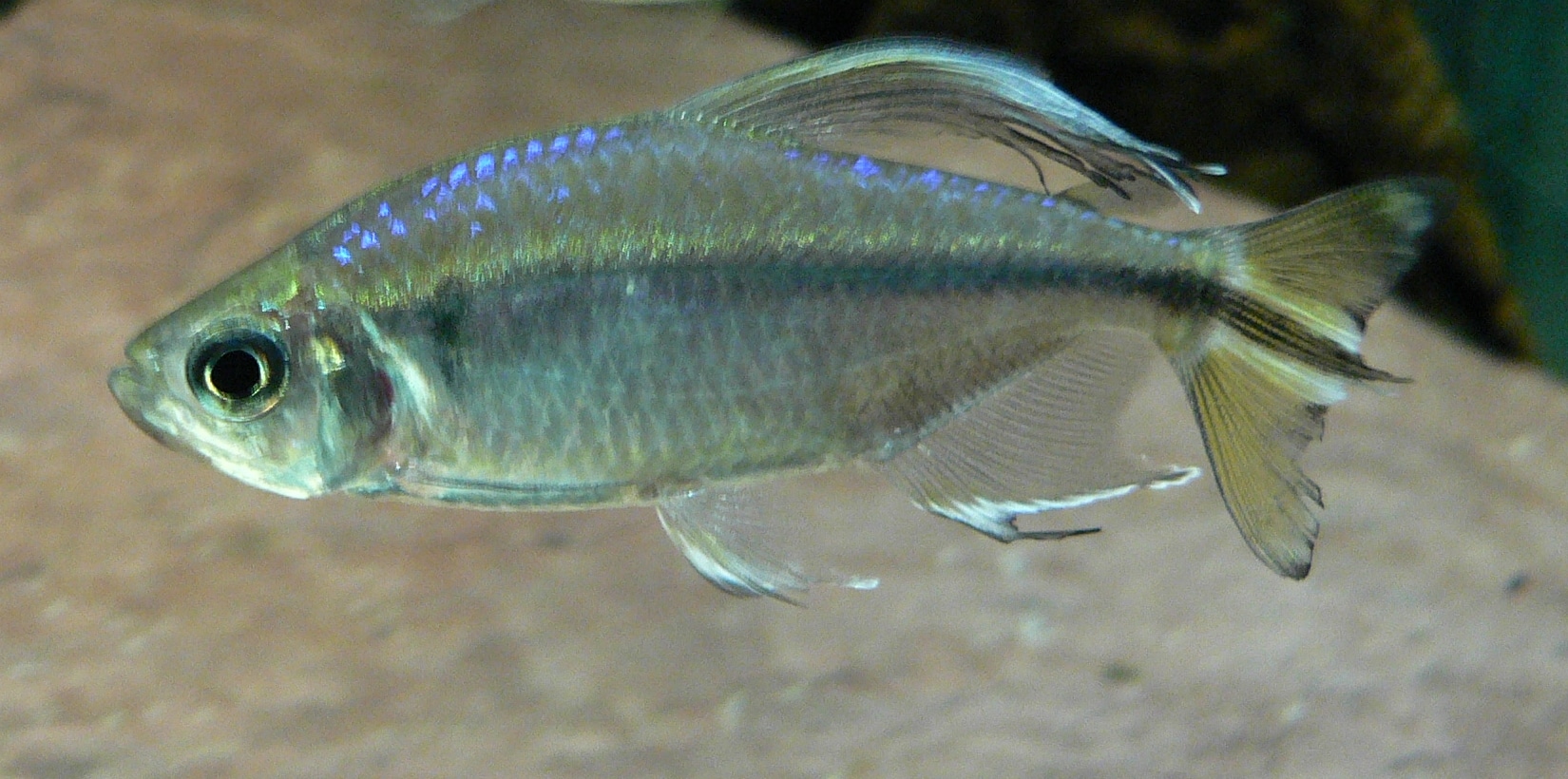
The Yellow Congo Tetra is a medium-sized, laterally compressed tetra with a sleek body shape typical of active swimmers. The base body color is a translucent silver-gold, but what makes this species stand out is the iridescent blue to purple sheen that develops along the upper half of the body, particularly in mature males. Under good lighting, this iridescence shifts and shimmers as the fish moves, creating a striking visual effect.
The hallmark feature is the yellow coloration on the tips of the caudal (tail) fin, which is where both the common name and the species name (caudalis, referring to the tail) come from. The fins also show hints of pale yellow or gold depending on the individual and its condition. The overall impression is of a refined, elegant fish that rewards good care with better color.
Male vs. Female
Males are the showpieces. They develop stronger iridescent blue-purple coloration along the upper body and flanks, and their fins are longer and more developed. The yellow caudal fin markings are more vivid in males, and they may develop slightly elongated fin rays.
Females are slightly smaller and fuller-bodied, especially when carrying eggs. Their coloration is more subdued, with less of the iridescent sheen and more muted fin colors. Distinguishing the sexes is easiest in mature fish, as juveniles will look quite similar regardless of sex.
Average Size & Lifespan
Yellow Congo Tetras reach a maximum size of about 2.8 inches (7 cm) in total length. Most individuals in aquariums will settle in around 2 to 2.5 inches. While not a large fish, they’re bigger than many of the small South American tetras hobbyists are used to, and their active swimming style makes them feel larger in the tank than their measurements might suggest.
With proper care, expect a lifespan of 3 to 5 years. Clean water, a varied diet, and a stress-free environment all contribute to reaching the upper end of that range. As with most tetras, they’ll show their best color and vitality when kept in a stable, well-maintained setup.
Care Guide
Tank Size
A 30-gallon tank is the minimum for a school of Yellow Congo Tetras. These are active mid-water swimmers that need horizontal swimming space to be comfortable and show natural behavior. For a larger group of 10 or more, or if you’re keeping them in a community setup, a 40-gallon or larger tank is the better choice.
A longer tank footprint is more important than height. A standard 30-gallon long (36 x 12 x 16 inches) gives them more room to cruise back and forth than a tall tank with the same volume.
Water Parameters
| Parameter | Ideal Range |
|---|---|
| Temperature | 73-82°F (23-28°C) |
| pH | 6.0-7.5 |
| General Hardness | 3-15 dGH |
| KH | 2-8 dKH |
| Ammonia / Nitrite | 0 ppm |
| Nitrate | Below 25 ppm |
Yellow Congo Tetras prefer soft to moderately hard, slightly acidic to neutral water. They’re reasonably adaptable, but they’ll show the best coloration in slightly acidic conditions (pH 6.2-6.8) with softer water. If your tap water is very hard or alkaline, you need to consider blending with RO water to bring things into range.
Consistency matters more than hitting an exact number. Weekly water changes of 25 to 30 percent keep parameters stable and water quality high. These fish come from well-oxygenated, relatively clean waterways, so don’t let maintenance slide.
Tank Setup
Aim for a setup that provides both open swimming space and planted refuges. Plant the sides and background with species like Vallisneria, Java fern, Anubias, and floating plants to create shaded areas. Leave the center and front open for the school to swim freely.
Driftwood and smooth rocks help replicate the natural streambed environment and give the tank visual depth. Adding dried leaf litter (Indian almond leaves or oak leaves) releases tannins that soften the water slightly and tint it a natural amber color. This mimics their native habitat and can really bring out the iridescent coloration.
A sandy or fine gravel substrate works best. Moderate water flow from the filter is appreciated, as these fish come from flowing water environments. Subdued to moderate lighting shows off their iridescence better than harsh, bright light.
A tight-fitting lid is a must. Like most African tetras, Yellow Congos are capable jumpers and will find any gap in your tank cover.
Is the Yellow Congo Tetra Right for You?
Yellow Congo tetras are statement fish that demand a proper setup. Here’s who should be keeping them:
- You have a 40-gallon or larger tank. These fish need real space to develop properly
- You want a tetra with presence and finnage that rivals some cichlids
- You prefer warmer tank setups in the 78-80°F range
- You’re looking for a showpiece schooling fish that works as a centerpiece species
- You can commit to a group of at least 6-8 for proper social dynamics
- These aren’t the right pick if you have a heavily planted nano tank. They need open swimming lanes
What People Get Wrong
Yellow Congo tetras are related to the standard Congo tetra but are less commonly available and frequently underestimated on tank size. Because they’re labeled “tetra,” people assume a 10 or 15-gallon works fine. It doesn’t. These are active, open-water schooling fish that need room to move. A 30-gallon minimum is not a suggestion.
Water quality from the Congo River basin is soft and slightly acidic — not the neutral, hard tap water in most homes. Yellow Congo tetras can adapt to moderate conditions, but their best color comes out in softer water with a pH closer to 6.5. If the fish look dull, water chemistry is the first variable to examine.
Males compete for display position in the school, which requires space to establish hierarchy without damage. In small tanks, aggression and fin damage can become a problem. In a properly sized tank with enough fish, this competition becomes a visual display rather than a problem.
Tank Mates
Yellow Congo Tetras are peaceful, active fish that fit well into a community with other similarly tempered species. They occupy the mid to upper water column and generally ignore fish that keep to different levels.
Good Tank Mates
- Congo Tetras (excellent pairing, similar origin and care needs)
- Other African tetras (long-finned African tetra, Niger tetra)
- Larger peaceful South American tetras (bleeding hearts, diamonds, black phantoms)
- Rainbowfish
- Corydoras catfish
- Bristlenose and rubber lip plecos
- Peaceful dwarf cichlids (kribensis, rams)
- Gouramis (pearl, honey)
- Synodontis catfish
Tank Mates to Avoid
- Aggressive or territorial cichlids
- Fin nippers like tiger barbs or serpae tetras
- Very small fish that may be outcompeted at feeding time (neon tetras, ember tetras)
- Large predatory fish
- Slow, long-finned species (bettas, fancy guppies) that may be stressed by the active swimming
Food & Diet
Yellow Congo Tetras are omnivores with a healthy appetite. In the wild, they feed on small insects, invertebrates, and organic matter. In the aquarium, they’re not picky and will accept a wide variety of foods.
- Staple: High-quality flake food or small pellets
- Frozen foods: Bloodworms, brine shrimp, daphnia, mysis shrimp
- Live foods: Brine shrimp, daphnia, small insects, blackworms
- Vegetable matter: Spirulina flakes, blanched zucchini or spinach
A varied diet is important for bringing out the best coloration. Regular offerings of live or frozen foods make a noticeable difference in how vibrant the iridescent sheen looks. Feed two to three times daily in small amounts the school can consume within a couple of minutes. These fish are mid-water feeders, so slow-sinking pellets or flakes that drift through the water column work well.
Breeding & Reproduction
Yellow Congo Tetras are egg scatterers, but they’re rarely bred in captivity. Most specimens available in the hobby are wild-caught from the Congo basin. This is one of the reasons they is harder to source and more expensive than commonly bred species.
Breeding Difficulty
Difficult. Successful captive breeding reports for Alestopetersius caudalis are uncommon. Like many African tetras, they do require specific conditions that are hard to replicate consistently in home aquariums.
Spawning Tank Setup
- Breeding tank: 20 to 30 gallons, separate from the main display
- Decor: Fine-leaved plants or spawning mops over a mesh or marbles to protect scattered eggs
- Filtration: Gentle sponge filter to avoid sucking up eggs or fry
- Lighting: Subdued, with morning light exposure to help trigger spawning
Water Conditions for Breeding
- Temperature: 77-80°F (25-27°C)
- pH: 6.0-6.5
- Hardness: Very soft, 2-5 dGH
- Use peat-filtered or RO water to achieve soft, acidic conditions
Conditioning & Spawning
Condition breeding pairs or small groups with a protein-rich diet of live and frozen foods for at least two weeks before attempting to spawn. Males in breeding condition display intensified iridescent coloration and become more active in their courtship behavior.
Spawning, when it occurs, typically happens in the morning. The female scatters eggs among plants or over the substrate, and the male fertilizes them. Like most egg-scattering tetras, the parents offer no parental care and will eat the eggs given the opportunity. Remove adults promptly after spawning.
Egg & Fry Care
Eggs typically hatch within 24 to 48 hours depending on temperature. Keep the breeding tank dim during this period, as eggs and newly hatched fry are sensitive to light. Fry become free-swimming within 4 to 5 days of hatching.
Feed first foods like infusoria or liquid fry food, transitioning to baby brine shrimp (Artemia nauplii) once they’re large enough to take it. Growth is slow, and maintaining excellent water quality is critical during the fry stage. Small, frequent water changes with aged, matched water help keep conditions stable.
Common Health Issues
Ich (White Spot Disease)
Ich is the most common issue, especially after shipping or during acclimation to a new tank. Symptoms include small white spots on the body and fins, flashing against objects, and clamped fins. Raise the temperature gradually to 82-84°F and treat with a quality ich medication. Quarantining new fish for 2 to 4 weeks before adding them to your display tank prevents most outbreaks.
Stress-Related Issues
Yellow Congo Tetras are more sensitive to stress than some hardier tetras. Being kept in groups that are too small, housed in cramped tanks, or exposed to aggressive tank mates can lead to chronic stress. This weakens the immune system and makes them susceptible to bacterial and fungal infections. Faded coloration and hiding behavior are early warning signs.
Fin Rot
Usually a secondary issue caused by poor water quality or fin damage from tank mates. The edges of the fins appear ragged, discolored, or eroded. Improving water quality with more frequent water changes is often enough to resolve mild cases. Severe infections require antibiotic treatment.
Velvet Disease
Less common than ich but worth knowing about. Velvet causes a fine, dust-like golden or rust-colored coating on the body. Fish may clamp their fins, breathe rapidly, and scratch against surfaces. Treat with copper-based medications in a quarantine tank.
Common Mistakes to Avoid
- Keeping too few: Yellow Congo Tetras need a group of at least 8 to feel secure and display natural schooling behavior. A pair or trio will be stressed and hide constantly.
- Tank too small: These are active swimmers. A 30-gallon is the minimum. Don’t try to keep them in a 10 or 20 gallon, even temporarily.
- Skipping quarantine: Since most Yellow Congo Tetras are wild-caught, quarantining new arrivals is especially important. Two to four weeks in a separate tank lets you spot health issues before they spread.
- Water too hard or alkaline: While they can tolerate a range, very hard or alkaline water will dull their coloration and stress them over time. Aim for soft to moderately hard conditions.
- No lid: They jump. An open-top tank or one with gaps in the cover will eventually lose fish.
- Pairing with fin nippers: The fins of Yellow Congo Tetras can be targeted by nippy species. Choose tank mates carefully.
Where to Buy
Yellow Congo Tetras are not as widely available as common Congo Tetras, so you need to check specialty retailers and order online. They’re sometimes listed under the name Yellow-Tailed Congo Tetra or by their scientific name Alestopetersius caudalis. Since most are wild-caught, availability is seasonal depending on import schedules. Check these trusted sources:
When buying online, look for sellers that guarantee live arrival and provide clear photos of the actual fish being shipped. Ask about the condition and size of the fish before purchasing, especially for wild-caught specimens.
Frequently Asked Questions
What’s the difference between Yellow Congo Tetras and regular Congo Tetras?
They’re different species in different genera. The regular Congo Tetra (Phenacogrammus interruptus) is larger (up to 3.5 inches), has rainbow iridescence across the body, and males develop elongated, flowing tail fin extensions. The Yellow Congo Tetra (Alestopetersius caudalis) is smaller (2.8 inches), features a blue-purple iridescent sheen with distinctive yellow caudal fin tips, and lacks the dramatic fin extensions. Both are from the Congo basin and have similar care requirements, but they’re separate species that look quite different in person.
How many Yellow Congo Tetras should I keep together?
A minimum of 8 is recommended. Like most schooling tetras, they feel more secure and show better coloration in larger groups. In a school of 8 or more, you’ll see more natural behavior, less hiding, and males will display their best iridescent colors as they compete for attention.
Are Yellow Congo Tetras hard to keep?
They’re rated as moderate care level. They’re not as bulletproof as something like a black skirt tetra, but they’re not particularly demanding either. The main considerations are providing soft to moderately hard water, keeping them in a large enough school, and maintaining good water quality. If you have experience keeping other tetras, you should have no trouble with this species.
Can Yellow Congo Tetras live with Congo Tetras?
Yes, this is actually an excellent combination. Both species are African tetras from the Alestidae family with overlapping water parameter preferences and peaceful temperaments. They occupy similar areas of the tank but are different enough in appearance to create visual variety. A mixed school of both species in a 55-gallon or larger tank makes for a fantastic Congo basin biotope display.
Can you breed Yellow Congo Tetras in a home aquarium?
It’s possible but difficult. Successful breeding reports are uncommon, and most fish in the hobby are wild-caught. If you want to attempt it, you’ll need a dedicated breeding tank with very soft, acidic water (pH 6.0-6.5, 2-5 dGH), fine-leaved plants, and well-conditioned breeding stock. Don’t be discouraged if it doesn’t work on the first try.
Do Yellow Congo Tetras jump?
Yes. Like most African tetras, they’re capable jumpers. A tight-fitting lid with no gaps is essential. This is especially important during the first few days after adding them to a new tank, when they’re most stressed and likely to jump.
What It Is Actually Like Living With Yellow Congo Tetra
In a proper school, yellow congo tetra display natural movement patterns that are genuinely engaging to watch. The fish interact with each other, establish subtle hierarchies, and move through the tank with purpose.
They spend most of their time near the surface, which fills a level of the tank that many other species ignore. This makes them excellent complements to mid-water and bottom-dwelling fish.
Feeding time is when their personality comes out. Feeding time is also a useful health check with this species. Yellow Congos that are slow to come forward or hanging near the bottom during feeding are often the first sign that nitrates are creeping up — they are noticeably more reactive to water quality changes than standard Congo Tetras, and appetite is usually one of the first things that changes.
Their color and behavior improve over time as they settle into a stable environment. Fish that have been in the same tank for months look noticeably better than recently added stock.
They coexist peacefully with virtually every other appropriately-sized community fish. This compatibility makes tank planning straightforward.
How the Yellow Congo Tetra Compares to Similar Species
Yellow Congo Tetra vs. Congo Tetra
The standard Congo tetra is the obvious point of comparison, and honestly, both are spectacular fish. Regular Congos lean more toward iridescent blues and greens with rainbow flanks, while yellow Congos deliver warm golden-yellow tones. Care requirements are nearly identical, but I find yellow Congos slightly more demanding about water quality. They do show stress sooner when nitrates creep up. Regular Congos are also easier to source and typically less expensive. If you can only pick one, it comes down to color preference, but having kept both, the yellow variety will get more attention from visitors. Check out our Congo Tetra care guide for more details.
Yellow Congo Tetra vs. Long-finned African Tetra
The long-finned African tetra is another African characin with flowing fins, but it stays somewhat smaller and has a more subdued color palette. Yellow Congos are the flashier choice with more vibrant coloration. Long-finned Africans are a bit more adaptable to different water conditions and work in slightly smaller tanks. If you’re looking for an African tetra that works in a 30-gallon setup, the long-finned African tetra is more practical. For a 40+ gallon showpiece tank, yellow Congos steal the show. Check out our Long-finned African Tetra care guide for more details.
Closing Thoughts
The Yellow Congo Tetra is one of those species that deserves more recognition in the hobby. The combination of iridescent blue-purple body coloration and yellow-tipped tail fins is genuinely distinctive, and a school of them cruising through a well-planted tank is a sight that’s hard to beat. They’re peaceful, reasonably hardy, and work well in a community setup with other mid-sized fish.
The biggest challenge is simply finding them for sale. They’re not a fish you’ll see at every local fish store, so be prepared to order online or wait for them to show up at a specialty retailer. But if you can get your hands on a group of 8 or more and give them the right conditions, they’ll reward you with color and activity that rivals any tetra in the hobby. For anyone looking to branch out from the usual South American species, the Yellow Congo Tetra is an outstanding choice.
Recommended Video
Check out our tetra tier list video where we rank the most popular tetras in the hobby, including the Yellow Congo Tetra:
References
- Froese, R. And D. Pauly, Eds. FishBase. Alestopetersius caudalis. Accessed 2025.
- SeriouslyFish. Alestopetersius caudalis species profile. Accessed 2025.
- Boulenger, G. A. (1899). Description of a new genus of characinoid fishes from the Congo. Annals and Magazine of Natural History, Series 7, 4(23): 348-349.
- About the Author
- Latest Posts

I’m Mark Valderrama, founder of Aquarium Store Depot and a fishkeeper with over 25 years of hands-on experience. I started in the hobby at age 11, worked at local fish stores, and have kept freshwater tanks, ponds, and reef tanks ever since. I’ve been featured in two best-selling aquarium books on Amazon and built this site to share practical, experience-based fish keeping knowledge.
Leave a Reply