Last Updated: March 26, 2026
Thank you for visiting! By the way… any links on this page that lead to products on Amazon and other stores/partners are affiliate links Aquarium Store Depot earns a commission if you make a purchase.
Table of Contents
- What Most Care Guides Get Wrong About Emerald Crab
- Species Overview
- Classification
- Where Do Emerald Crabs Come From?
- What Are They Compatible With?
- What Do They Eat?
- Will They Really Rid My Tank of Hair/Bubble Algae?
- Is My Pet Dead?
- How Many Should I Get For My Tank?
- FAQs
- Any Other Questions? Leave Us A Comment Below!
- Is the Emerald Crab Right for You?
- How the Emerald Crab Compares to Similar Species
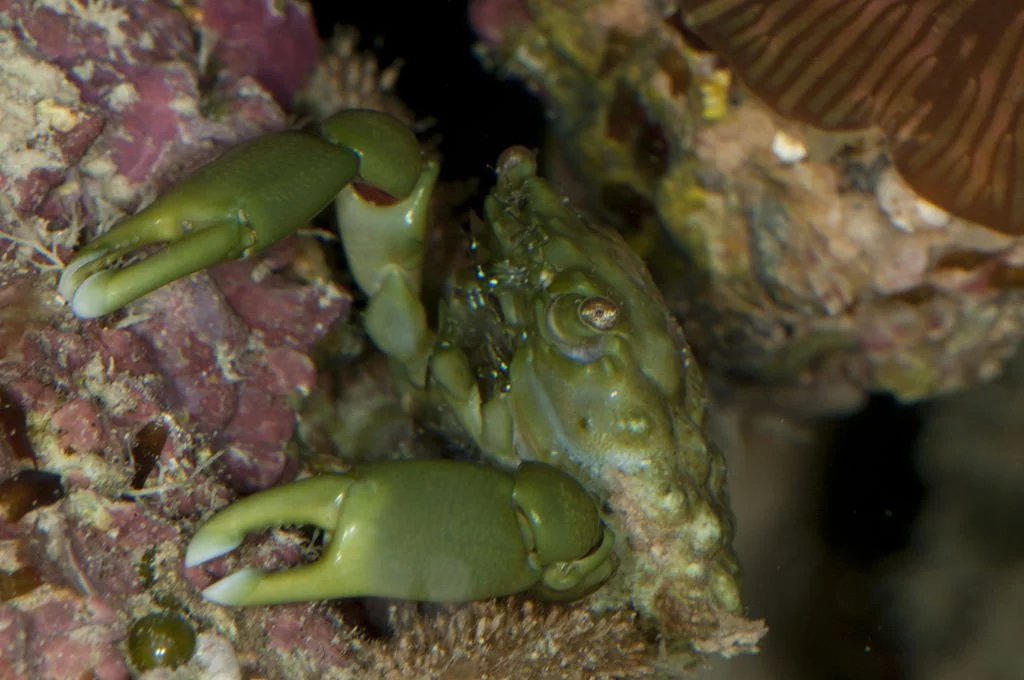
Emerald crabs are one of my go-to recommendations for reef keepers dealing with bubble algae. They’re one of the few cleanup crew members that will actually go after valonia and related species rather than ignore it. I’ve kept them in my 125-gallon reef and they earn their spot. That said, like any crab, they come with caveats you should know before adding them to a mature reef.
An emerald crab with bubble algae to eat is reef-safe. An emerald crab without it is reef-risky.
The emerald crab is one of the most underrated members of the saltwater cleanup crew. And one of the best solutions for bubble algae (Valonia) that most other cleanup members won’t touch. After 25 years in the saltwater hobby and maintaining a reef tank, I’ve used emerald crabs to handle Valonia outbreaks that would otherwise require manual removal. They’re hardy, widely available, and reef-safe. One honest note from experience: large, well-fed emerald crabs are mostly benign, but very large, underfed individuals can become opportunistic and have been known to bother small corals or disturb sleeping fish. Keep them fed and keep population in check. Everything you need to know is in this guide.
As we saw in our previous post, the Emerald Crab was rated the #1 algae eater in a saltwater aquarium. I wanted to dive in deeper in this post about this crab and why this crab is a great addition to your saltwater tank. I’m going to break this post down Q A style for simplicity:
What Most Care Guides Get Wrong About Emerald Crab
Most care guides treat the emerald crab as a simple cleanup crew addition. Just toss one in and it handles your algae. In my experience, that oversimplification leads to problems. These invertebrates have specific dietary needs beyond just algae, and they can become aggressive toward corals and other invertebrates if underfed. Water quality requirements are also stricter than most guides suggest. Copper-based medications are lethal, and even small parameter swings can cause stress. In my 25+ years in the hobby, I’ve learned that success with invertebrates comes from understanding their actual needs, not just their utility.
Species Overview
| Scientific Name | Mithraculus sculptus |
| Common Names | Emerald Crab, Green Crab, Mithraculus Crab |
| Family | Majidae |
| Origin | Caribbean and Gulf of Mexico |
| Diet | Omnivore |
| Care Level | Easy |
| Temperaturement | Semi-aggressive |
| Minimum Tank Size | 20 Gallons |
| Max Size | 1.5. 2 inches |
| Temperature Range | 76. 82 degrees F |
| pH Range | 8.0. 8.4 |
| Salinity | 1.025 or 35 PPT |
| Reef Safe | Yes |
| Available As Tank Bred | No |
| Filtration/Water Flow | Moderate |
| Water Type | Saltwater |
| Breeding | Egg-layer |
| Difficulty to Breed | Difficult to breed |
| Compatibility | Species-only tank or community tank |
Classification
| Phylum | Arthropoda |
| Class | Malacostraca |
| Order | Decapoda |
| Family | Majidae |
| Genus | Mithraculus |
| Species | M. Sculptus (Lamarck, 1818) |
Where Do Emerald Crabs Come From?
Emerald crabs hail from the Caribbean Sea to the Gulf of Mexico1. They are nocturnal and will hide in caves and rock during most of the day. While primarily a scavenger of uneaten food, it is well known in aquariums to eat algae.
What Are They Compatible With?
Emerald crabs are compatible with just about every fish or invert you can place in the tank., as long as you food sources (waste, algae,and food from an established tank), they should not bother any fish, inverts, or coral in the tank. If they are starving, they may go after snails, smaller fish, and even polyps. As long as the crab is well-fed, they shouldn’t pose a threat to the other inhabitants in the tank. I have seen of them eating other animals, it was due to lack of food, poor water quality (which lead to drying inverts and fish), or overstocking.
In a mature tank, normally what we need to look out for are fish that might actually try to eat them. Avoid placing them with predatory fish such as hawkfish, triggers, puffers that are known for preying on them.
Bubble algae is mainly the algae it is known for eating and they end up on a reefer’s shopping list the first time they have a bubble algae outbreak and they are recommended on a forum or Facebook group.
Is the Emerald Crab Right for You?
Before you add a emerald crab to your tank, it’s worth asking whether this species actually fits your setup and your goals. Here’s a quick breakdown to help you decide.
This species is a good fit if:
- Your tank is fully cycled and stable. Invertebrates are more sensitive to water quality swings than most fish.
- You’re not using copper-based medications. Copper is lethal to most invertebrates.
- You can provide the specific diet this species needs. Not all inverts eat the same things.
- Your tank mates won’t harass or eat it. Many fish see invertebrates as food.
- You’re comfortable with drip acclimation. Inverts need slower transitions than fish.
- Your water parameters are within range and, more importantly, consistent.
If most of those points line up with your setup, the emerald crab is worth serious consideration. If several don’t, it’s better to choose a species that matches your tank now rather than trying to make it work.
What Do They Eat?
Crabs are scavengers and omnivorous. They will happily eat leftover meaty food and clear nuisance algae like bubble algae in the aquarium. You may want to consider supplemental feed if the emerald crab is new to your tank or you do not have enough algae for it to eat in the tank. Dried nori and and pellet foods are good choices for feeding. Nori, in particular is quite a show as you can hand feed it to them and they go nuts when feeding off it.
Will They Really Rid My Tank of Hair/Bubble Algae?
Yes and no actually. Yes, they will eat bubble & hair algae, but if your tank is infested with a large outbreak you should not rely on an emerald crab being able to remove all of it. You should consider manually removing what you can, reducing nutrients, and then having the emerald crab control and eliminate the leftover. You should also purchase from a store that can attest to the fact that they will eat bubble algae. There are some on-line stores that will guarantee this.
Is My Pet Dead?
This is a common question for newbies when their crab molts for the first time. Like shrimps, these emerald crabs will shed their exoskeleton as they grow leaving behind a what looks like a dead crab. Often times, the emerald crab will appear back out of hiding after a few days.sometimes a week. Either way, it is best to remove the molt or suspected dead tank as you see it to prevent any nutrient build up.
How Many Should I Get For My Tank?
They do not get too large – maxing out around 2 1/2″ and you will only need one or two in a tank. The general guidance has been one emerald tank for every 30 gallons, but this will depend on your rockwork setup and abundance of food in the tank. Overpopulating emerald crabs could lead to aggression among the crabs.
How the Emerald Crab Compares to Similar Species
Choosing between similar species is tricky. Here’s how the emerald crab stacks up against some common alternatives.
Emerald Crab vs. Peppermint Shrimp: Both are popular cleanup crew members, but they tackle different problems. The emerald crab is your go-to for bubble algae, while peppermint shrimp target aiptasia. Emerald crabs are more robust and can handle themselves with fish, but they’re also more likely to nip at coral if they get hungry. Peppermint shrimp are more delicate but less likely to cause collateral damage. In my experience, both have a place in a well-planned reef tank, but they’re not interchangeable.
FAQs
Are they Aggressive?
Yes, they is aggressive. However, the aggression is from the male. Emerald crabs get a really bad rap in the saltwater aquarium hobby because of aggressive males. If you know how to select a female crab, you should have less issues with them over the males.
Will They Consume Corals?
, an Emerald Crab will not consume corals. They will eat dead or dying matter, which is why they is mistaken for eating corals. They are merely eating a coral that is already damaged or dead.
Do They Eat Diatoms?
There have been reports from reef keepers that Emerald Crabs do in fact eat diatoms. They are a good member of a clean up crew when it comes to diatoms!
Any Other Questions? Leave Us A Comment Below!
What experiences have you had with this crab? Please leave your comments below or any questions you have.
- About the Author
- Latest Posts

I’m Mark Valderrama, founder of Aquarium Store Depot and a fishkeeper with over 25 years of hands-on experience. I started in the hobby at age 11, worked at local fish stores, and have kept freshwater tanks, ponds, and reef tanks ever since. I’ve been featured in two best-selling aquarium books on Amazon and built this site to share practical, experience-based fish keeping knowledge.


Leave a Reply to David Wilbur Cancel reply