
Last Updated: June 25, 2026
Thank you for visiting! By the way… any links on this page that lead to products on Amazon and other stores/partners are affiliate links Aquarium Store Depot earns a commission if you make a purchase.
Table of Contents
- What Most Care Guides Get Wrong
- The Reality of Keeping Glass Bloodfin Tetra
- Key Takeaways
- Species Overview
- Classification
- Origin & Natural Habitat
- Appearance & Identification
- Average Size & Lifespan
- Care Guide
- Is This Fish Right for You?
- What People Get Wrong
- Tank Mates
- Food & Diet
- Breeding & Reproduction
- Common Health Issues
- Common Mistakes to Avoid
- Where to Buy
- Frequently Asked Questions
- What It Is Actually Like Living With Glass Bloodfin Tetra
- How It Compares to Similar Species
- Closing Thoughts
- Recommended Video
- References
The glass bloodfin tetra is a delicate, transparent fish that needs pristine water quality to survive. Ammonia spikes that larger tetras shrug off will kill glass bloodfins overnight. This is a fish for established, well-maintained tanks only.
Glass bloodfin tetras do not give second chances. One ammonia spike and they are gone.
The Reality of Keeping Glass Bloodfin Tetra
Group size is not a suggestion. The minimum school size for glass bloodfin tetra is not just a guideline. In small groups, these fish lose color, become stressed, and display abnormal behavior. A proper group of 6 to 8+ is where you start to see natural schooling behavior, full color expression, and the confidence that makes them worth keeping.
Tank mate selection requires thought. The glass bloodfin tetra is not aggressive in the traditional sense, but it is assertive enough to cause problems with the wrong companions. Slow-moving, long-finned species are targets. Fast, short-finned fish of similar size are fine. Plan your community around this reality.
Hardy does not mean indestructible. The glass bloodfin tetra tolerates a range of conditions, but it still needs basic care. Ammonia spikes, dramatic temperature swings, and neglected water changes will catch up to even the toughest species. The difference is margin of error, not immunity.
Store appearance is not home appearance. Fish in store tanks are stressed, crowded, and under inappropriate lighting. The glass bloodfin tetra almost always looks better in a properly set up home aquarium than it does at the store. Dark substrate, live plants, and appropriate lighting bring out colors and behaviors you will never see in a retail environment.
Biggest Mistake New Owners Make
Keeping them in groups that are too small. A group of 4 or 5 glass bloodfin tetras does not produce schooling behavior — it produces a stressed cluster of darting fish. Start with a minimum of 8, and aim for 10 or more if the tank size allows.
The glass bloodfin tetra is one of the most active, fast-moving schooling tetras available. A large school of these fish in a planted tank moves with an energy that few other species match. They are underappreciated partly because they are often confused with regular bloodfin tetras, but they are a distinctly different fish with their own visual appeal.
Key Takeaways
- Strikingly transparent body with a vivid red caudal fin that creates an eye-catching contrast
- Exceptionally long-lived for a tetra – can reach 10 years with proper care, far outlasting most similar species
- Hardy and beginner-friendly – tolerates a wide range of water conditions and is very forgiving of minor mistakes
- Active upper-level swimmer – needs a tight-fitting lid because they are known jumpers
- Keep in groups of 8+ for the best schooling behavior and to see their natural social dynamics

Species Overview
| Field | Details |
|---|---|
| Scientific Name | Prionobrama filigera |
| Common Names | Glass Bloodfin Tetra, Glass Bloodfin, Translucent Bloodfin |
| Family | Characidae |
| Origin | Amazon River basin (Brazil, Peru, Bolivia, Colombia, Ecuador) |
| Care Level | Easy |
| Temperament | Peaceful |
| Diet | Omnivore |
| Tank Level | Mid to Top |
| Maximum Size | 2.5 inches (6 cm) |
| Minimum Tank Size | 20 gallons (75 liters) |
| Temperature | 72-82°F (22-28°C) |
| pH | 6.0-7.5 |
| Hardness | 2-12 dGH |
| Lifespan | 5-10 years in captivity |
| Breeding | Egg scatterer |
| Breeding Difficulty | Moderate |
| Compatibility | Community |
| OK for Planted Tanks? | Yes |
Classification
| Rank | Name |
|---|---|
| Kingdom | Animalia |
| Phylum | Chordata |
| Class | Actinopterygii |
| Order | Characiformes |
| Family | Characidae |
| Subfamily | Aphyocharacinae |
| Genus | Prionobrama |
| Species | P. Filigera |
Glass bloodfin tetras are hardy, active, and adaptable. They are a solid choice for beginner and intermediate community tanks and are more tolerant of water conditions than their elegant appearance suggests.
Prionobrama filigera was described by Cope in 1870. The genus name comes from the Greek “prion” (saw) and “brama” (referring to a bream-like shape), while “filigera” means “thread-bearing,” likely referring to the elongated rays of the anal fin. The species belongs to the subfamily Aphyocharacinae within Characidae, which it shares with the regular bloodfin tetra (Aphyocharax anisitsi). Following the 2024 phylogenomic revision by Melo et al, Aphyocharacinae remains within the family Characidae.
Origin & Natural Habitat
Glass bloodfin tetras have one of the widest distributions of any small tetra. They’re found across the Amazon River basin in Brazil, Peru, Bolivia, Colombia, and Ecuador. Unlike many tetras that are confined to specific tributary systems, glass bloodfins turn up in rivers and streams throughout the broader Amazon drainage.
In the wild, they avoid the main river channels and prefer smaller creeks, tributaries, and flooded forest areas where the current is gentler. The water is warm, soft, and slightly acidic, often stained with tannins from decaying vegetation. They’re typically found in the upper water layers, often near the surface among floating plants and overhanging vegetation. This surface-dwelling tendency is important to understand when setting up their aquarium.

Appearance & Identification
The glass bloodfin tetra’s defining feature is its remarkable transparency. The body is elongated and laterally compressed, with skin so translucent that you can clearly see the skeleton, swim bladder, and internal organs. Under the right lighting, the scales pick up a subtle silvery-blue iridescence that shimmers as the fish moves, but the overall impression is of a fish made from living glass.
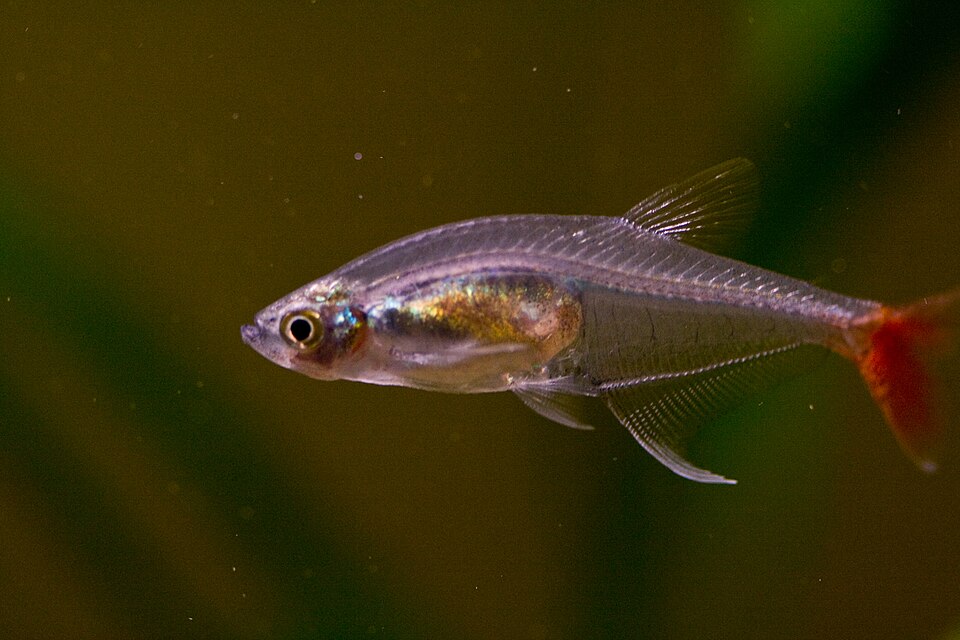
The caudal fin is where the color is. Both lobes of the tail carry a deep red pigment that stands out dramatically against the clear body. This red coloration extends slightly onto the caudal peduncle. The anal fin is also noteworthy, being quite long and extending much further back than in most tetras. In males, the front edge of the anal fin develops a hooked appearance, which is one of the easiest ways to sex the fish.
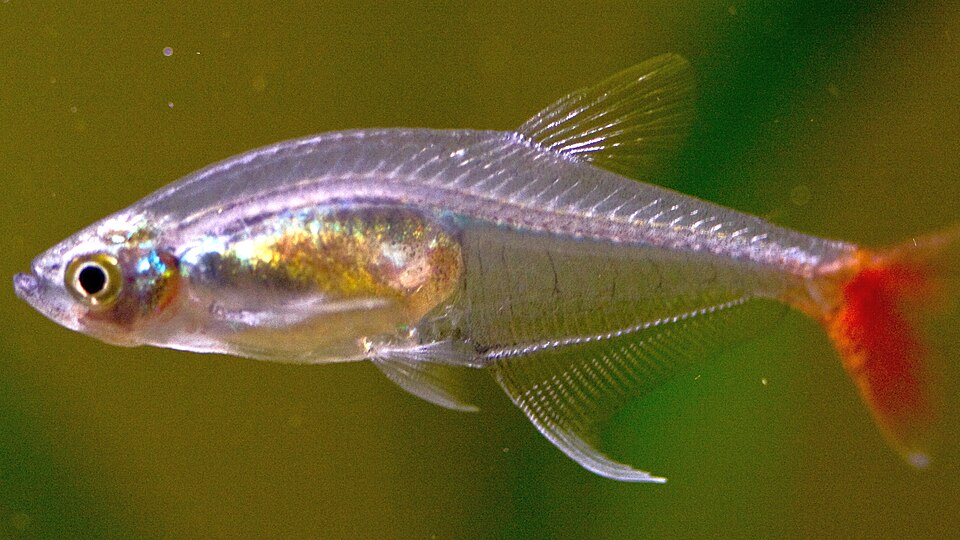
Males are typically slimmer than females and often display a dark marking on the anal fin. Females have a fuller body, especially when carrying eggs, and lack the hooked anal fin edge. Both sexes show the same transparent body and red tail coloration.
Average Size & Lifespan
Glass bloodfin tetras reach about 2.5 inches (6 cm) at full maturity, making them slightly larger than many popular community tetras. They’re longer and more slender than neons or cardinals, with a streamlined body built for active swimming.
The lifespan is where this species really stands out. Under good conditions, glass bloodfins regularly live 5 to 8 years, with some reports of individuals reaching 10 years. That’s remarkable for a small tetra and means you’re making a longer commitment than with many comparable species. Consistent water quality and a varied diet are the biggest contributors to longevity.
Care Guide
Tank Size
A 20-gallon tank is the minimum for a school of glass bloodfin tetras. These are active, fast-swimming fish that use horizontal space extensively, so a longer tank is preferred over a taller one. A 30 or 40-gallon long tank gives a group of 8-12 plenty of room to cruise and display their natural schooling behavior.
Water Parameters
- Temperature: 72-82°F (22-28°C)
- pH: 6.0-7.5
- General Hardness (GH): 2-12 dGH
- Carbonate Hardness (KH): 1-8 dKH
Glass bloodfins are notably adaptable when it comes to water chemistry. They handle a wider range of parameters than many tetras, which is part of what makes them so beginner-friendly. While they prefer soft, slightly acidic water, tank-bred specimens adapt well to moderate hardness and neutral pH. The broad temperature tolerance is also a plus, making them suitable for both heated tropical tanks and cooler room-temperature setups in warmer climates.
Tank Setup
The most important thing with glass bloodfins is a tight-fitting lid. These fish jump. It’s not a maybe, it’s a when. Any gap large enough for them to fit through becomes an escape route, especially during the first few days in a new tank or if they get startled. Make sure every opening is covered, including gaps around filter intakes and airline tubing.
For the tank itself, provide plenty of open swimming space in the upper and middle areas. Plant the background and sides with tall-growing species, and add some floating plants for partial shade. A dark substrate helps showcase their transparent bodies. Driftwood and leaf litter on the bottom add natural aesthetics and release beneficial tannins. The overall setup should balance open water for swimming with planted areas for security.
Filtration & Maintenance
A sponge filter or HOB filter with adjustable flow works well. Glass bloodfins prefer gentle to moderate water movement. Strong currents make them uncomfortable since their natural habitat consists of calm tributaries and creeks. Weekly water changes of 20-25% will keep conditions stable. While they’re hardy, they still respond poorly to ammonia and nitrite, so make sure the tank is fully cycled before adding them.
Is the Glass Bloodfin Tetra Right for You?
Glass bloodfin tetras offer a unique transparent aesthetic for attentive keepers. Here’s who should consider them:
- You’re fascinated by transparent fish. Glass bloodfins let you see their internal anatomy
- You maintain stable, consistent water parameters without wild swings
- You want a tighter-schooling species than regular bloodfin tetras
- You have moderate lighting. Harsh overhead light makes them look washed out
- You appreciate subtle beauty that reveals itself over time
- Skip these if you want vivid coloration. Their appeal is translucency, not color
What People Get Wrong
The most common confusion is between glass bloodfin tetras and regular bloodfin tetras (Aphyocharax anisitsi). They look similar at a glance but are different species with different behavioral profiles. Glass bloodfin tetras are faster-moving and more active than regular bloodfin tetras, and they show more of the translucent glass-like body that gives them their name.
Second mistake: keeping too few. A group of 4 or 5 glass bloodfin tetras does not produce schooling behavior — it produces a stressed cluster of darting fish. A group of 10 or more schools tightly and creates a visual effect that is far more impressive than the individual fish would suggest.
Third: underestimating their hardiness. Glass bloodfin tetras tolerate a wide range of water conditions and temperatures. They are genuinely easy to keep alive, which means beginners sometimes overlook them for more colorful but demanding species. The combination of hardiness and active schooling behavior makes them one of the best-value tetras available.
Tank Mates
Glass bloodfin tetras are genuinely peaceful community fish. They don’t nip fins, they don’t bully, and they mind their own business in the upper water layers. This makes them compatible with a wide range of tank mates, including some surprisingly large ones.
Good Tank Mates
- Other peaceful tetras – cardinal tetras, neon tetras, ember tetras, rummy nose tetras
- Corydoras catfish – perfect bottom-dwelling companions that stay out of the way
- Otocinclus – peaceful algae eaters that share similar water preferences
- Dwarf cichlids – Apistogramma, rams, and similar species
- Discus and angelfish – in suitably large tanks, glass bloodfins coexist well with these larger cichlids
- Hatchetfish – fellow surface dwellers that share the upper water column peacefully
- Small peaceful barbs – cherry barbs, gold barbs
- Dwarf gouramis – calm mid-level companions
Tank Mates to Avoid
- Aggressive cichlids – anything territorial will stress them
- Large fish – their transparent bodies don’t offer much intimidation factor
- Very nippy species – their elongated anal fin is a target for fin nippers
Food & Diet
Glass bloodfin tetras are easy to feed and not picky at all. A quality flake or micro pellet as the daily staple works perfectly. Supplement regularly with frozen or live foods like brine shrimp, daphnia, bloodworms, and white mosquito larvae. These protein-rich additions help maintain the red coloration in the tail and keep the fish in top condition.
They feed primarily in the upper and middle water levels. Their mouths are upturned slightly, which makes them well-suited to taking food from the surface. Feed small amounts two to three times daily. Being active swimmers, they burn through calories quickly and benefit from frequent feedings over single large ones.
Breeding & Reproduction
Breeding glass bloodfin tetras is achievable but requires some preparation. Set up a dedicated spawning tank (10-15 gallons) with very soft, acidic water (pH 6.0-6.5, GH 1-5) at a temperature around 80-84°F. Keep the lighting dim and add fine-leaved plants or spawning mops for egg deposition. A bare bottom or a layer of marbles helps protect eggs from being eaten.
Condition breeding pairs with plenty of live and frozen foods for a week or two. When ready to spawn, the female scatters eggs among the plants while the male fertilizes them. Remove the adults immediately after spawning to prevent egg predation. The eggs are light-sensitive, so keep the breeding tank dark or heavily shaded.
Eggs typically hatch within 24-36 hours, and the fry become free-swimming around day 3-4. Feed infusoria or liquid fry food initially, graduating to baby brine shrimp as the fry grow. The young fish develop their transparent body relatively early, though the red tail coloration fills in gradually over the first few months.
Common Health Issues
Glass bloodfin tetras are among the hardier tetras, but they’re not immune to common freshwater diseases. Ich is the most frequent issue, usually appearing after temperature drops or stressful events. The transparent body actually makes disease diagnosis easier than in many fish since you often see internal problems that would be hidden in opaque species.
Bacterial infections and fin rot can occur in tanks with poor water quality. The elongated anal fin is particularly susceptible to fin rot, so watch for any fraying or discoloration at the edges. Internal parasites will sometimes be spotted through the transparent body wall, appearing as unusual dark masses or stringy white feces.
Prevention through good water quality, quarantine of new fish, and varied nutrition covers most health concerns. Their hardiness and longevity mean that a healthy glass bloodfin maintained in clean water rarely develops problems.
Common Mistakes to Avoid
- No lid on the tank. Glass bloodfins are jumpers. This is the number one cause of lost fish. A tight-fitting lid with no gaps is essential.
- Strong water current. They come from calm tributaries and dislike strong flow. Dial back the filter output or use a spray bar to diffuse it.
- Keeping too few. A group of 3-4 won’t school properly and will seem nervous and skittish. Start with at least 8 for confident, natural behavior.
- Bright lighting without cover. While they’re not as light-sensitive as some tetras, they do look better and act more confidently with some floating plant cover.
- Underestimating their lifespan. These fish can live a decade. Make sure you’re ready for the commitment before purchasing.
Where to Buy
Glass bloodfin tetras are moderately available in the hobby. They’re not as common as neon or cardinal tetras, but specialty shops and online retailers usually stock them. Try Flip Aquatics or Dan’s Fish for tank-bred specimens. Prices typically range from $3-5 per fish, often with discounts for larger groups.
When buying, look for active fish that are swimming confidently in the upper levels of the tank. The body should be clear and transparent (cloudiness can indicate disease), and the red caudal fin should be vivid. Avoid any fish from tanks with sick-looking inhabitants.
Frequently Asked Questions
What’s the difference between a glass bloodfin tetra and a regular bloodfin tetra?
They’re related but different species. The regular bloodfin tetra (Aphyocharax anisitsi) has a more opaque, silvery body with red on the fins. The glass bloodfin (Prionobrama filigera) is much more transparent with red concentrated primarily on the caudal fin. Glass bloodfins also have a notably longer anal fin and are slightly larger.
Do glass bloodfin tetras jump?
Yes, frequently. They are one of the more jump-prone tetra species. A tight-fitting lid is absolutely essential. They’re especially likely to jump when first introduced to a new tank, during water changes, or if startled by sudden movements or sounds.
How long do glass bloodfin tetras live?
With proper care, they commonly live 5-8 years, with some reaching 10 years. This is significantly longer than most small tetras like neons (3-5 years) or cardinals (4-5 years). Consistent water quality and varied nutrition are the biggest factors in achieving a long lifespan.
Can you see the organs inside a glass bloodfin tetra?
Yes, that’s one of their most distinctive features. Their body is so transparent that you can clearly see the spine, swim bladder, and digestive organs. This transparency actually serves as a health indicator too, since internal problems (like parasites) are often visible through the body wall before external symptoms appear.
Are glass bloodfin tetras good for beginners?
Yes, they’re excellent beginner fish. They’re hardy, tolerate a wide range of water conditions, are peaceful, and easy to feed. The only caveat is that they need a secure lid because of their jumping tendency. Beyond that, they’re one of the more forgiving tetras available.
What It Is Actually Like Living With Glass Bloodfin Tetra
In a proper school, glass bloodfin tetra display natural movement patterns that are genuinely engaging to watch. The fish interact with each other, establish subtle hierarchies, and move through the tank with purpose.
They spend most of their time near the surface, which fills a level of the tank that many other species ignore. This makes them excellent complements to mid-water and bottom-dwelling fish.
Feeding time is when their personality comes out. They learn your routine quickly and will anticipate feeding before you even open the lid.
Their color and behavior improve over time as they settle into a stable environment. Fish that have been in the same tank for months look noticeably better than recently added stock.
They coexist peacefully with virtually every other appropriately-sized community fish. This compatibility makes tank planning straightforward.
How the Glass Bloodfin Tetra Compares to Similar Species
Glass Bloodfin Tetra vs. Bloodfin Tetra
Regular bloodfin tetras are significantly hardier and easier to keep. They’re one of the toughest tetras in the hobby, while glass bloodfins are middling in terms of resilience. Bloodfins also have stronger red fin coloration and are more active swimmers. The glass variety trades robustness for transparency. You can literally see their spine and organs. If you want a bloodfin-type tetra for a beginner setup, go with the regular variety. Glass bloodfins are for established tanks where their unique appearance is appreciated. Check out our Bloodfin Tetra care guide for more details.
Glass Bloodfin Tetra vs. Pristella Tetra
Pristella tetras also have a semi-transparent body and are sometimes called “x-ray tetras.” Both species offer that see-through quality, but pristellas are hardier and more widely available. Pristellas also add distinct yellow and black fin markings that give them more visual pop. Glass bloodfins are more uniformly transparent with subtle red fin accents. For a beginner who wants a see-through tetra, pristellas win. For someone who’s already kept pristellas and wants a more refined version of that aesthetic, glass bloodfins are the upgrade. Check out our Pristella Tetra care guide for more details.
Closing Thoughts
The glass bloodfin tetra is one of those fish that gets better the longer you keep it. Not just because it can live a decade, but because a settled, confident school in a well-designed tank is genuinely captivating. The transparency creates an almost ethereal quality, and watching a group of 10+ cruise through the upper water column with those red tails flashing is a sight that never gets old. They’re hardy, peaceful, and stunning in a way that few other tetras can match. If you’re looking for something a little different from the usual tetra lineup, the glass bloodfin deserves serious consideration.
Recommended Video
Check out our Tetra Tier List video where we rank different tetra species and discuss their pros and cons for the home aquarium.
References
- Cope, E.D. (1870). Contribution to the ichthyology of the Marañon. Proceedings of the American Philosophical Society, 11, 559-570.
- Melo, B.F, Ota, R.P, et al. (2024). Phylogenomics of Characidae, a hyper-diverse Neotropical freshwater fish lineage, with a phylogenetic classification including four families. Zoological Journal of the Linnean Society, 202(1).
- Froese, R. And D. Pauly, Editors. (2024). Prionobrama filigera. FishBase. fishbase.se
- Seriously Fish. Prionobrama filigera – Glass Bloodfin Tetra. seriouslyfish.com
- About the Author
- Latest Posts

I’m Mark Valderrama, founder of Aquarium Store Depot and a fishkeeper with over 25 years of hands-on experience. I started in the hobby at age 11, worked at local fish stores, and have kept freshwater tanks, ponds, and reef tanks ever since. I’ve been featured in two best-selling aquarium books on Amazon and built this site to share practical, experience-based fish keeping knowledge.
Leave a Reply