
Last Updated: June 25, 2026
Thank you for visiting! By the way… any links on this page that lead to products on Amazon and other stores/partners are affiliate links Aquarium Store Depot earns a commission if you make a purchase.
Table of Contents
- What Care Guides Get Wrong
- The Reality of Keeping Greenstripe Barb
- Key Takeaways
- Species Overview
- Classification
- Origin & Natural Habitat
- Appearance & Identification
- Average Size & Lifespan
- Care Guide
- Is It Right for You?
- Tank Mates
- Food & Diet
- Breeding & Reproduction
- Common Health Issues
- Common Mistakes to Avoid
- Where to Buy
- Frequently Asked Questions
- Species Comparison
- Closing Thoughts
- Recommended Video
- References
The greenstripe barb is a small, peaceful species that adds a subtle shimmer of green to planted tanks without demanding attention. It stays under 3 inches, schools nicely in groups of six or more, and causes zero problems in community setups. It is not flashy, but in the right lighting with a dark substrate, the green stripe catches light in a way that makes the whole tank feel more polished.
This guide covers the simple but specific care this species needs, because the greenstripe barb is the fish you add when you want color that blends in rather than stands out. Not every fish needs to be loud.
In a planted tank with dark substrate and good lighting, the greenstripe barb is quietly one of the prettiest fish in the setup.
The rarest color in freshwater fish is green. And this barb actually has it.
The Reality of Keeping Greenstripe Barb
The greenstripe barb is a small, uncommon species with an iridescent green lateral stripe that shows under certain lighting conditions. At under 2 inches, it is a nano-appropriate barb.
The green stripe is not always visible. It shows best under subdued lighting at specific angles, making it a fish that reveals itself gradually rather than showing everything immediately.
Hardy and peaceful, it fits nano community setups without any complications.
Biggest Mistake New Owners Make
Keeping it under intense lighting that washes out the green iridescence. The greenstripe barb’s defining feature is an angle-dependent optical effect that disappears under overhead LEDs at full power. Moderate, indirect lighting brings out the stripe.
Greenstripe barbs are a small, peaceful barb species suitable for community tanks from 20 gallons. Their distinctive green lateral stripe makes them an attractive addition to planted setups.
Expert Take (Mark Valderrama, AquariumStoreDepot)
The greenstripe barb is a lighting puzzle. Get the angle right and the iridescent stripe glows green against the body. Get it wrong and you have a plain little barb. A group of eight in a nano tank with indirect lighting and dark substrate reveals the green when they school past a light source. It is a fish that rewards observation.
Key Takeaways
- Subtle but genuinely attractive with a distinctive green-gold lateral stripe and a bold black spot at the tail base that looks sharp in a planted tank
- One of the true Puntius species that hasn’t been reclassified into a newer genus, making it taxonomically notable among small Asian barbs
- Peaceful and easy to keep in groups of at least 6, making them ideal for community setups with similarly sized, peaceful species
- Prefers cooler water between 68 and 77°F (20 and 25°C), which gives you flexibility in stocking and can even work in unheated tanks in warmer climates
- A 15-gallon tank is the minimum for a small school, though a 20-gallon or larger lets them really stretch out and show natural behavior
- Native to Sri Lanka and India’s Western Ghats, where they inhabit streams and rivers with moderate flow and plenty of vegetation
Species Overview
| Field | Details |
|---|---|
| Scientific Name | Puntius vittatus Day, 1865 |
| Common Names | Greenstripe Barb |
| Family | Cyprinidae |
| Origin | Sri Lanka, India (Western Ghats) |
| Care Level | Easy |
| Temperament | Peaceful |
| Diet | Omnivore |
| Tank Level | Middle |
| Maximum Size | 2 inches (5 cm) |
| Minimum Tank Size | 15 gallons (57 liters) |
| Temperature | 68 to 77°F (20 to 25°C) |
| pH | 6.0 to 7.5 |
| Hardness | 5 to 15 dGH |
| Lifespan | 3 to 5 years |
| Breeding | Egg scatterer |
| Breeding Difficulty | Moderate |
| Compatibility | Community |
| OK for Planted Tanks? | Yes |
Classification
| Taxonomic Level | Classification |
|---|---|
| Order | Cypriniformes |
| Family | Cyprinidae |
| Subfamily | Barbinae |
| Genus | Puntius |
| Species | P. Vittatus Day, 1865 |
The Greenstripe Barb was originally described by Francis Day in 1865. What makes it taxonomically interesting is that it has stayed right where it was first placed. Over the past couple of decades, the old catch-all genus Puntius has been broken up extensively, with researchers carving out Pethia, Dawkinsia, Sahyadria, Haludaria, and others. Through all of that reshuffling, P. Vittatus has remained a valid member of Puntius sensu stricto, the restricted, properly defined version of the genus. That’s a distinction worth noting if you pay attention to taxonomy.
Origin & Natural Habitat
The Greenstripe Barb is native to Sri Lanka and the Western Ghats of peninsular India. In Sri Lanka, it’s found in lowland and mid-elevation streams and rivers across the wet and intermediate zones. In India, its range extends along the Western Ghats in Kerala, Karnataka, and Goa.
In the wild, these barbs occupy slow-to-moderately flowing streams and rivers with sandy or gravel substrates. They will congregate in quieter stretches and pools among aquatic plants and marginal vegetation, in water that’s typically clear to slightly tannin-stained.
The water in these habitats is soft to moderately hard and slightly acidic to neutral. Temperatures stay on the cooler side compared to many tropical lowland habitats, which is important to remember when setting up their aquarium. They don’t need or want the warm conditions that many tropical fish require.
Appearance & Identification
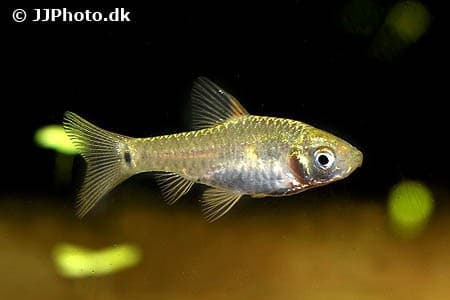
The Greenstripe Barb is a small, slender-bodied fish that reaches about 2 inches (5 cm) in total length. Compared to some of the deeper-bodied barbs like Black Rubys or Rosy Barbs, this species has a more streamlined profile that gives it a clean, athletic look in the water.
The defining feature is the lateral stripe that runs along the midline of the body from behind the gill cover to the base of the tail. This stripe has a distinctive green-gold iridescence that really only shows itself when the fish is settled, healthy, and under the right lighting. In suboptimal conditions or under harsh lights, it can fade to a dull olive or pale line, which is why so many people overlook this species in store tanks.
At the base of the caudal fin, there’s a distinct black spot that serves as another reliable identification marker. The rest of the body is a warm olive to yellowish-silver, with clear to slightly yellowish fins. The overall impression is one of understated elegance rather than flashy color.
Male vs. Female
Males are slightly slimmer and more streamlined, with more vivid coloring overall. The green-gold lateral stripe is typically more pronounced in males, especially during breeding condition. Females are rounder and deeper-bodied, particularly when carrying eggs, with a more muted, uniform olive-silver body color. The size difference is minor, so body shape is the most reliable indicator.
Average Size & Lifespan
Greenstripe Barbs max out at around 2 inches (5 cm) in aquarium conditions, placing them on the smaller side of the barb family. Don’t let the modest size fool you though. In a proper school, a group of these fish has plenty of presence and keeps the mid-level of the tank active and interesting.
With good care, you can expect a Greenstripe Barb to live 3 to 5 years in captivity. Consistent water quality, a varied diet, and stable conditions are the main factors that push them toward the upper end of that range. Stress from poor conditions, temperature swings, or being kept in groups that are too small will shorten their lifespan noticeably.
Care Guide
Tank Size
A 15-gallon tank (57 liters) is the minimum for a school of Greenstripe Barbs. They’re active little swimmers that appreciate horizontal swimming space, so a standard rectangular tank works better than a tall, narrow one. For a community setup with other species, stepping up to a 20-gallon (76 liters) or 30-gallon (114 liters) is a smart move. More space means less competition for territory, better water stability, and more room for everyone to coexist peacefully.
Water Parameters
| Parameter | Recommended Range |
|---|---|
| Temperature | 68 to 77°F (20 to 25°C) |
| pH | 6.0 to 7.5 |
| Hardness (dGH) | 5 to 15 |
| Ammonia / Nitrite | 0 ppm |
| Nitrate | Below 20 ppm |
The most important thing to understand about Greenstripe Barbs is their temperature range. At 68 to 77°F (20 to 25°C), they’re on the cooler end of the tropical spectrum. This is actually a significant advantage because it opens up compatibility with subtropical species that many warmer-water fish can’t live with. If your home stays around 70 to 74°F naturally, you may not even need a heater, which simplifies the setup considerably.
These barbs are fairly adaptable when it comes to pH and hardness, tolerating a wider range than many Sri Lankan species. That said, they will look their best in moderately soft, slightly acidic water that approximates their wild conditions. Regular weekly water changes of 25 to 30% will keep the water fresh and the parameters stable.
Filtration & Water Flow
A reliable hang-on-back filter or small canister filter rated for your tank size is all you need. Aim for a turnover rate of about 4 to 5 times the tank volume per hour. Greenstripe Barbs come from streams and rivers, so they’re comfortable with a gentle to moderate current. You don’t need powerheads or heavy flow, but a bit of water movement keeps them active. Good biological filtration is essential, as they’re sensitive to ammonia and nitrite spikes like all cyprinids.
Lighting
Moderate lighting works best. These fish come from habitats with dappled light filtering through overhanging vegetation, and that green-gold stripe really pops under natural or warm-toned aquarium lighting. If you’re running a planted tank with higher light, floating plants will help diffuse the intensity. They won’t hide all day under bright lights, but they’ll be noticeably more relaxed and colorful with some shade available.
Plants & Decorations
A planted tank is the best way to bring out the Greenstripe Barb’s personality and color. Java fern, Anubias, Cryptocorynes, and Vallisneria are all excellent, low-maintenance options that thrive in the same moderate lighting and cooler temperatures these barbs enjoy. Driftwood and smooth river stones add structure, while Indian almond leaf or dried oak leaf provide beneficial tannins. Floating plants like Amazon frogbit or salvinia create the dappled lighting that showcases the iridescent stripe along their flanks.
Substrate
A dark, fine-grained substrate works best for Greenstripe Barbs. Dark sand or fine gravel brings out the subtle coloring of these fish far better than white or light-colored substrates, which will wash everything out. In the wild, they live over sandy and gravelly stream beds, so either sand or smooth gravel is a natural and practical choice. If you’re running a planted tank, an active planted substrate like Fluval Stratum or UNS Controsoil works perfectly.
Is the Greenstripe Barb Right for You?
Before you buy, run through this honest checklist. The Greenstripe Barb is a great fish for the right keeper, but it is not for everyone.
- You want a small, peaceful barb with subtle green iridescence
- You have a planted tank with moderate lighting and dark substrate
- You can keep a group of 8+ in a 15-gallon or larger tank
- You enjoy collecting less common species
- Your tank has other small, peaceful community fish
- You appreciate fish that look dramatically better in a well-designed tank
Tank Mates
Greenstripe Barbs are excellent community fish that mind their own business and almost never cause problems. The main consideration when choosing tank mates is temperature compatibility, since these barbs prefer cooler water in the 68 to 77°F (20 to 25°C) range. Pair them with species that share that preference.
Best Tank Mates
- Other peaceful barbs (Cherry Barbs, Gold Barbs, Black Ruby Barbs)
- Danios (Zebra Danios, Pearl Danios, Celestial Pearl Danios)
- White Cloud Mountain Minnows (excellent temperature match)
- Small tetras (Ember Tetras, Pristella Tetras, Glowlight Tetras)
- Rasboras (Harlequin Rasboras, Lambchop Rasboras)
- Corydoras catfish (Bronze Corys, Peppered Corys, Panda Corys)
- Loaches (Kuhli Loaches, Hillstream Loaches)
- Peaceful gouramis (Honey Gouramis, Sparkling Gouramis)
- Livebearers (Platies, Endler’s Livebearers)
- Bottom-dwellers (Otocinclus, Bristlenose Plecos)
Tank Mates to Avoid
- Large, aggressive cichlids (Oscars, Jack Dempseys, Green Terrors) that would view them as food
- Nippy or aggressive barbs in small groups (Tiger Barbs kept in inadequate numbers can harass them)
- Fish requiring very warm water (Discus, German Blue Rams, Cardinal Tetras) since their temperature preferences don’t overlap well
- Large predatory fish that could swallow a 2-inch barb
- Highly territorial species that dominate the middle water column and stress out schooling fish
Food & Diet
Greenstripe Barbs are unfussy omnivores. In the wild, they feed on a mix of small invertebrates, algae, plant matter, and organic detritus, so they’re naturally inclined to eat just about anything you offer. This is one of those species where feeding really isn’t something you need to overthink.
A good quality flake food or micro-pellet should form the staple of their diet. Choose a formula that includes both animal protein and plant-based ingredients, since these barbs benefit from vegetable matter in their food. Bug Bites, Hikari Micro Pellets, and quality spirulina-enriched flakes are all solid daily options.
Supplement regularly with frozen or live foods like daphnia, bloodworms, brine shrimp, and mosquito larvae. These high-protein treats enhance coloring and support breeding conditioning. Blanched vegetables like zucchini or spinach make a nice occasional addition. Feed small amounts two to three times daily rather than one large feeding, as they do better with frequent, measured meals.
Breeding & Reproduction
Greenstripe Barbs are egg scatterers with no parental care, following the same general breeding pattern as most small barb species. While they’re not the most commonly bred barb in the hobby, they’re certainly achievable for anyone with some experience setting up spawning tanks.
Breeding Difficulty
Moderate. They’re not as easy to spawn as Cherry Barbs or Black Ruby Barbs, but they’re far from difficult if you provide the right conditions and properly condition the breeding stock.
Spawning Tank Setup
Set up a dedicated breeding tank of about 10 gallons with shallow water, around 6 to 8 inches (15 to 20 cm) deep. Cover the bottom with java moss, spawning mops, or a layer of marbles to protect eggs from the adults. Keep the lighting dim with floating plants for cover, and use a mature sponge filter for gentle filtration.
Water Conditions for Breeding
Slightly soft, acidic water will trigger spawning in this species. Aim for a pH of 6.0 to 6.5, temperature around 74 to 77°F (23 to 25°C), and hardness of 5 to 8 dGH. A slight temperature increase from their normal range, combined with soft water and good nutrition, usually encourages spawning behavior.
Conditioning & Spawning
Condition your breeding group, ideally one male to two females, with high-quality live and frozen foods for one to two weeks. Bloodworms, daphnia, and brine shrimp are excellent conditioning foods. Introduce them to the breeding tank in the evening, as spawning typically occurs in the early morning. The female scatters adhesive eggs among the plants, and the male fertilizes them as they’re released. A successful spawn can produce 100 to 200 eggs.
Egg & Fry Care
Remove the adults as soon as spawning is complete, because they will absolutely eat any eggs they can find. The eggs are small and semi-adhesive, typically sticking to plant leaves, moss, or falling into gaps in the substrate. They hatch in approximately 24 to 48 hours depending on temperature.
Once the fry become free-swimming, about 24 hours after hatching, begin feeding infusoria or liquid fry food. After the first week, transition to freshly hatched baby brine shrimp. As they grow, introduce finely crushed flake food and micro-worms. Keep the water pristine with small, frequent water changes.
Common Health Issues
Greenstripe Barbs are hardy fish that don’t suffer from any species-specific diseases. Most health problems they encounter are the same issues that affect freshwater fish in general, and they’re almost always tied to poor water quality, stress, or unstable conditions. Here are the most common issues to watch for.
Ich (White Spot Disease)
Ich shows up as tiny white spots across the body and fins, and affected fish will scratch against objects. Outbreaks are almost always triggered by stress, particularly sudden temperature drops or poor water quality. Treatment involves gradually raising the temperature to around 82°F (28°C) and using a commercial ich medication. Since Greenstripe Barbs prefer cooler water, the temperature increase alone is effective.
Fin Rot
Ragged, fraying, or deteriorating fins are typically caused by bacterial infection, which is almost always a secondary problem triggered by poor water conditions. Mild cases often resolve on their own once water quality improves through regular changes and proper filtration. More advanced cases need antibiotic treatment. Prevention is straightforward: keep up with your maintenance schedule and don’t let waste accumulate.
Columnaris
Columnaris appears as white or grayish patches on the body, fins, or mouth. Often mistaken for a fungal infection, it’s actually caused by Flavobacterium columnare and will show up in tanks with poor water quality or overcrowding. Treatment involves antibacterial medications and addressing the underlying water quality issues.
Stress-Related Color Fading
Not a disease, but the most common complaint people have about this species. If your fish look washed out, check your group size, lighting intensity, substrate color, and overall water conditions. A healthy Greenstripe Barb in a well-set-up tank looks dramatically different from a stressed one in a bare retail setup.
Common Mistakes to Avoid
- Keeping too few. Greenstripe Barbs are schooling fish that need a group of at least 6 to feel secure. In smaller groups, they become skittish, hide constantly, and never develop their full coloring. Aim for 8 or more if you have the tank space.
- Water too warm. Setting the heater to 80°F or above because they’re “tropical” is a common mistake. These are subtropical fish that prefer temperatures in the upper 60s to mid 70s°F. Prolonged warmth above 77°F (25°C) stresses them and shortens their lifespan.
- Judging them in the store. Greenstripe Barbs are notorious for looking completely unremarkable in bare dealer tanks. Don’t write them off based on their store appearance. Their subtle beauty only emerges once they’re settled into a proper setup with plants, dark substrate, and good company.
- Bright lighting with no cover. Harsh, bright lighting makes these fish feel exposed and washes out the iridescence in their lateral stripe. Floating plants or dense vegetation that creates shaded zones makes a significant difference in their comfort and appearance.
- Light-colored substrate. A white or pale gravel substrate is one of the fastest ways to ensure your Greenstripe Barbs look dull and unremarkable. Dark substrate brings out the green-gold stripe and warm body tones.
- Ignoring the plant-based food. These are natural omnivores that need plant matter in their diet. An exclusively protein-based feeding regimen doesn’t meet their nutritional needs. Include spirulina-based foods and let them graze on natural algae growth.
Where to Buy
Greenstripe Barbs aren’t as commonly stocked as Cherry Barbs or Tiger Barbs, so you may not find them at every local fish store. Specialty retailers and online sellers are usually your best bet for healthy, correctly identified specimens.
For well-cared-for fish shipped to your door, I recommend checking these trusted online retailers:
Both are reputable sellers who take good care of their livestock and ship responsibly. Availability of less common species like the Greenstripe Barb can vary, so check their sites regularly or sign up for stock notifications if they offer them.
Frequently Asked Questions
How many Greenstripe Barbs should I keep together?
A minimum of 6 is necessary, but 8 to 10 is even better. Larger groups distribute any minor chasing behavior, reduce individual stress, and bring out bolder, more natural behavior. You’ll also see males display more confidently when they have competition within the school.
Are Greenstripe Barbs good for beginners?
Absolutely. They’re hardy, adaptable, peaceful, and forgiving of minor mistakes. As long as the tank is cycled, the water is clean, and they’re kept in a proper school, beginners shouldn’t have any trouble with this species. Their care requirements are straightforward and they don’t demand anything unusual.
Can Greenstripe Barbs live without a heater?
Yes, in many cases. Their preferred range starts at 68°F (20°C), which is normal room temperature in many homes. If your space stays in the high 60s to mid 70s°F, no heater is needed. In cooler climates, a low-wattage heater set to around 70°F (21°C) provides a safe buffer.
Do Greenstripe Barbs nip fins?
No. This is a genuinely peaceful barb that doesn’t exhibit the fin-nipping behavior that gives some other barbs a bad reputation. They’re safe with long-finned species, though always check temperature compatibility first.
What’s the difference between Greenstripe Barbs and other small Puntius species?
The green-gold lateral stripe and prominent black caudal spot are the key identifiers. Taxonomically, P. Vittatus remains one of the few species still validly in Puntius in the strict sense, while most relatives have been reclassified. Visually, it’s more subtly colored, relying on iridescent flash rather than bold pigmentation.
Can Greenstripe Barbs live with shrimp?
Adult Cherry Shrimp and Amano Shrimp are safe with Greenstripe Barbs. However, like virtually all small fish, they’ll snack on baby shrimp if they find them. Provide dense moss and hiding spots if you’re breeding shrimp in the same tank.
Why does my Greenstripe Barb’s stripe look dull?
The green-gold iridescence is structural color that depends on light angle and the fish’s condition. Check your lighting (warm, moderate light shows it best), substrate color (dark substrates help), water quality, and stress levels. A settled fish in a planted tank with dark substrate will display noticeably more iridescence.
How the Greenstripe Barb Compares to Similar Species
Greenstripe Barb vs. Striped Barb
Very similar in size and care needs, but the Greenstripe Barb has the green iridescent stripe that sets it apart. The Striped Barb is more commonly available. Both are excellent community fish. Choose the Greenstripe if you want something slightly more unusual.
Greenstripe Barb vs. Golden Dwarf Barb
The Golden Dwarf Barb is smaller and better suited to nano tanks. The Greenstripe Barb is a bit larger and needs slightly more space. Both have subtle, attractive coloring that rewards a good setup. The Golden Dwarf Barb is easier to find in stores.
What It Is Actually Like Living With Greenstripe Barb
The green stripe appears and disappears as the fish moves through different light angles. It is like a secret that the tank shares with anyone willing to sit and watch.
They school quietly and consistently, adding subtle motion to nano tanks without dominating the visual space.
Finding them for sale is the hardest part. Once you have them, keeping them is straightforward.
Closing Thoughts
The greenstripe barb only shows its color under the right light. Get the angle wrong and you paid for a plain silver fish.
The Greenstripe Barb isn’t going to be the fish that makes people stop in their tracks and ask what it is. But for hobbyists who appreciate the quieter side of fishkeeping, Puntius vittatus is a genuinely satisfying fish to keep. That green-gold flash along the flank, the clean black spot at the tail, the active but peaceful schooling behavior, it all adds up to something greater than its individual parts.
They’re hardy, adaptable, and they play well with just about anything their size. For anyone building a subtropical community tank or looking for a peaceful schooling barb without the behavioral drama, the Greenstripe Barb is well worth considering. Set them up right and they’ll reward you with that subtle shimmer that only comes from a fish that’s truly comfortable in its home.
Recommended Video
References
- Froese, R. And D. Pauly, Editors. FishBase. Puntius vittatus Day, 1865. https://www.fishbase.se/summary/Puntius-vittatus.html
- Seriously Fish. Puntius vittatus. Greenstripe Barb. https://www.seriouslyfish.com/species/puntius-vittatus/
- Pethiyagoda, R., Meegaskumbura, M., & Maduwage, K. (2012). A synopsis of the South Asian fishes referred to Puntius. Ichthyological Exploration of Freshwaters, 23(1), 69-95.
- The Aquarium Wiki. Puntius vittatus. https://www.theaquariumwiki.com/wiki/Puntius_vittatus
- About the Author
- Latest Posts

I’m Mark Valderrama, founder of Aquarium Store Depot and a fishkeeper with over 25 years of hands-on experience. I started in the hobby at age 11, worked at local fish stores, and have kept freshwater tanks, ponds, and reef tanks ever since. I’ve been featured in two best-selling aquarium books on Amazon and built this site to share practical, experience-based fish keeping knowledge.
Leave a Reply