
Last Updated: June 25, 2026
Thank you for visiting! By the way… any links on this page that lead to products on Amazon and other stores/partners are affiliate links Aquarium Store Depot earns a commission if you make a purchase.
Table of Contents
- What Care Guides Get Wrong
- The Reality of Keeping Lizard Loach
- Key Takeaways
- Species Overview
- Classification
- Origin & Natural Habitat
- Appearance & Identification
- Average Size & Lifespan
- Care Guide
- Is It Right for You?
- Tank Mates
- Food & Diet
- Breeding & Reproduction
- Common Health Issues
- Common Mistakes to Avoid
- Where to Buy
- Frequently Asked Questions
- Species Comparison
- Closing Thoughts
- Recommended Video
- References
The lizard loach is a rare, elongated bottom dweller built for fast-flowing streams. It is not a common pet store find, and the care information available online ranges from sparse to wrong. It needs high flow, cool to moderate temperatures, and a tank designed around current rather than decoration. Treat it like a standard tropical loach and it will not last.
For keepers who specialize in rheophilic species, the lizard loach is a genuinely interesting addition. Its body shape, behavior, and flow requirements set it apart from every other loach in the hobby. This guide covers what actually works for this species, because the lizard loach is the kind of fish only dedicated oddball keepers seek out.
If you have never set up a high-flow tank before, the lizard loach will force you to learn.
The Reality of Keeping Lizard Loach
The lizard loach is a large, elongated species that reaches 6 to 8 inches and needs strong current and high oxygen levels. It is a rheophilic species adapted to fast-flowing streams, and a standard community tank with gentle filtration does not meet its environmental needs.
This is not a common species in the hobby, and availability is sporadic. When you find them, they are typically wild-caught and require careful acclimation and quarantine before introducing to an established tank.
The elongated body and active swimming behavior require a tank with length. A 55-gallon long or larger is the minimum. Height is less important than horizontal swimming space for this species.
Biggest Mistake New Owners Make
Putting them in a standard community tank with gentle flow. The lizard loach needs current. Without it, the fish becomes lethargic, stressed, and susceptible to disease. A powerhead aimed along the length of the tank is the minimum for adequate flow.
Expert Take
The lizard loach is a specialist species for keepers who enjoy river-biotope setups. A 55-gallon long with a powerhead, smooth rocks, sand substrate, and temperatures in the mid-70s creates the fast-flowing environment this fish needs. It is not for everyone, but for keepers who appreciate rheophilic species, the lizard loach’s elongated body and active swimming behavior is compelling.
Key Takeaways
- Strong water flow is non-negotiable. Lizard loaches need 10 to 15x tank volume turnover per hour to replicate their natural riverine habitat
- Cool to moderate temperatures in the 68 to 75°F (20 to 24°C) range, making them unsuitable for most tropical community setups
- Keep in groups of 6 or more in a minimum 30-gallon (114 liter) tank with a footprint of at least 36 inches (91 cm) long
- Biofilm grazers first and foremost. They need mature tanks with established algae and biofilm on rocks and hardscape
- Breeding has not been documented in home aquariums, so all specimens in the hobby are wild-caught
Species Overview
| Field | Details |
|---|---|
| Scientific Name | Homaloptera orthogoniata |
| Common Names | Lizard Loach, Saddleback Hillstream Loach, Saddle-back Loach, Red Lizard Loach |
| Family | Balitoridae |
| Origin | Borneo (Malaysian Sarawak and Indonesian Kalimantan) |
| Care Level | Moderate to Advanced |
| Temperament | Peaceful |
| Diet | Primarily herbivore (biofilm/algae grazer) |
| Tank Level | Bottom |
| Maximum Size | 4 to 5 inches (10 to 13 cm) |
| Minimum Tank Size | 30 gallons (114 liters) |
| Temperature | 68 to 75°F (20 to 24°C) |
| pH | 6.0 to 7.5 |
| Hardness | 2 to 10 dGH |
| Lifespan | 8 to 10 years |
| Breeding | Egg layer (not bred in captivity) |
| Breeding Difficulty | Not achieved in home aquariums |
| Compatibility | Hillstream/rheophilic community |
| OK for Planted Tanks? | Yes (rheophilic plants only) |
Classification
| Taxonomic Level | Classification |
|---|---|
| Order | Cypriniformes |
| Family | Balitoridae (River loaches) |
| Subfamily | Homalopterinae |
| Genus | Homaloptera (van Hasselt, 1823) |
| Species | H. Orthogoniata (Vaillant, 1902) |
The genus Homaloptera has been through significant taxonomic revision over the years. It was originally a large catch-all group, but Randall and Page reorganized it in 2015, moving many species into other genera like Homalopteroides and Pseudohomaloptera. After that revision, Homaloptera was narrowed down to just six recognized species, with H. Orthogoniata being one of them.
The common name “lizard loach” is used loosely across the hobby for several Homaloptera species, so always confirm the scientific name when purchasing. The names “saddleback hillstream loach” and “red lizard loach” are also commonly used for this species in the trade.
Origin & Natural Habitat
The lizard loach is endemic to the island of Borneo in Southeast Asia. While earlier literature suggested a broader distribution across Indochina, more recent research has confined H. Orthogoniata to Bornean river systems. In Malaysian Borneo (Sarawak), it’s been documented in the Baram, Tatau, and Rajang river basins. On the Indonesian side (Kalimantan), it’s found in the Sambas, Kapuas, and Mahakam drainages.
In the wild, these loaches inhabit fast-flowing, shallow stretches of forested streams where the water runs over rocky substrates, boulders, gravel, and bedrock. The water is typically clear to tannin-stained, well-oxygenated, and relatively cool by tropical standards. Think of shallow riffles where sunlight hits the rocks and promotes a layer of biofilm and algae. That’s where you’ll find lizard loaches grazing and clinging to surfaces with their specialized pelvic and pectoral fins.
The streams they inhabit will have a substrate of smooth rocks and pebbles with scattered woody debris. Aquatic plants may be present but are not a dominant feature. The key environmental factors are consistent flow, high dissolved oxygen, and clean water with minimal organic pollution. Understanding this habitat is critical, because replicating it is the single most important factor in keeping these fish successfully.

Appearance & Identification
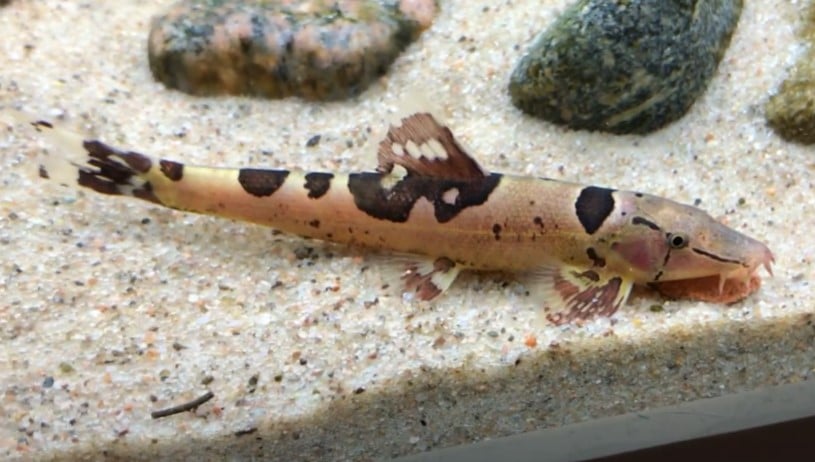
The lizard loach has an elongated, dorsoventrally flattened body that immediately sets it apart from most other aquarium fish. The overall shape is streamlined and low-profile, designed to reduce drag in fast-moving water. The pectoral and pelvic fins are broad and positioned horizontally, allowing the fish to anchor itself firmly to rocks and other hard surfaces. Much like a gecko clinging to a wall.
The body coloration is typically tan to olive-brown with three distinctive dark, saddle-shaped markings along the dorsal surface. The first saddle sits just behind the head, the second covers the base of the dorsal fin, and the third falls between the dorsal fin and the tail. The base of the caudal fin is dark brown. This saddle pattern is the defining visual characteristic that separates H. Orthogoniata from other Homaloptera species.
Some specimens in the trade appear with warmer reddish-brown tones, which is where the “red lizard loach” trade name comes from. Coloration can vary depending on the specific collection point, diet, and stress level. Well-settled specimens in a mature tank with plenty of biofilm to graze on generally show their best color.
Male vs. Female
| Feature | Male | Female |
|---|---|---|
| Body Shape | Slightly slimmer and more streamlined | Slightly larger and fuller-bodied, especially when mature |
| Size | Is slightly smaller | Is slightly larger overall |
| Belly Profile | Flatter underside when viewed from above | Rounder belly, especially when carrying eggs |
Sexing lizard loaches is genuinely difficult. The differences listed above are subtle and really only apparent in mature, well-conditioned specimens. Don’t expect to reliably sex juveniles or newly imported fish. If you’re buying a group of six or more, you’ll likely end up with a mix of both sexes by chance.
Average Size & Lifespan
Lizard loaches reach a maximum size of around 4 to 5 inches (10 to 13 cm) in standard length. Most aquarium specimens settle in the 3.5 to 4 inch (9 to 10 cm) range, as reaching full size requires optimal conditions and a mature diet heavy in biofilm. Growth is steady but not fast. Expect it to take 18 to 24 months to reach adult size.
With proper care. Clean, well-oxygenated water, appropriate flow, and a good diet. Lizard loaches can live 8 to 10 years in captivity. That’s a solid lifespan for a loach, but it requires consistency. These fish are sensitive to deteriorating water quality, so long-term success depends on staying on top of maintenance. Neglect the water changes or let the filter output drop, and you’ll likely see a much shorter lifespan.
Care Guide
This is not a beginner fish. The lizard loach has specific requirements around water flow, oxygen levels, and temperature that set it apart from most tropical species. If you’ve successfully kept other hillstream loaches or set up a river-tank style aquarium, you’ll feel right at home. If this is your first time working with rheophilic species, be prepared to set up your tank differently than you normally would.
Tank Size
A minimum of 30 gallons (114 liters) is recommended for a group of lizard loaches, but the footprint matters more than total volume. You want a tank that’s at least 36 inches (91 cm) long to provide enough horizontal space for grazing territory. A standard 40-gallon breeder with its wide footprint is an even better choice.
Since these fish need to be kept in groups of 6 or more, a larger tank also helps distribute territorial behavior. Each loach will stake out its own section of rock or hardscape to graze on, and cramped quarters can lead to stress even though they’re not aggressive fish.
Water Parameters
| Parameter | Ideal Range |
|---|---|
| Temperature | 68 to 75°F (20 to 24°C) |
| pH | 6.0 to 7.5 |
| General Hardness (GH) | 2 to 10 dGH |
| Carbonate Hardness (KH) | 2 to 8 dKH |
| Ammonia | 0 ppm |
| Nitrite | 0 ppm |
| Nitrate | Less than 20 ppm |
The temperature range is the first thing most people get wrong. Lizard loaches prefer cooler water than the typical 78°F (26°C) that most tropical tanks run at. Keeping them at temperatures above 75°F (24°C) for extended periods can stress them and reduce their lifespan. If your home stays warm year-round, you need a chiller or at the very least a cooling fan setup.
Water quality needs to be pristine. These fish come from clean, fast-moving streams, and they have very little tolerance for elevated ammonia, nitrite, or nitrate levels. Weekly water changes of 25 to 30% are the minimum. Many successful keepers do 30 to 50% changes to keep nitrates well below 20 ppm.
Filtration & Water Flow
This is where the lizard loach setup diverges most sharply from a standard aquarium. You need strong water flow. 10 to 15 times the tank volume per hour in turnover rate. For a 30-gallon tank, that means 300 to 450 gallons per hour of combined filtration and powerhead output.
A canister filter rated well above your tank size is a good starting point, and many keepers add a wavemaker or powerhead to create directional flow across the rockwork. The goal is to create areas of strong current where the loaches can position themselves and graze, while still providing some calmer zones behind rocks where they can rest.
Surface agitation is equally important. High oxygen saturation is essential for these fish, so don’t worry about losing CO2 from surface movement. If you’re running a hillstream setup, oxygen always takes priority over carbon dioxide injection.
Lighting
Moderate to moderately bright lighting works best. You want enough light to promote biofilm and algae growth on rocks and hardscape, since that’s the lizard loach’s primary food source. A standard LED fixture on an 8 to 10 hour photoperiod usually strikes the right balance. Enough to grow a healthy film of aufwuchs without causing nuisance algae problems.
If you’re not seeing any biofilm growth on your rocks, bump up the light intensity or duration slightly. If you’re getting excessive hair algae or green water, dial it back. The sweet spot depends on your specific setup, but the biofilm layer on your rocks is a good visual indicator.
Plants & Decorations
Think rocks first, plants second. The lizard loach’s natural habitat is dominated by boulders, smooth stones, and gravel with relatively little vegetation. Build your hardscape with a variety of smooth, rounded rocks of different sizes to create surfaces for grazing and crevices for hiding.
For plants, stick to species that can handle strong current and don’t need to be rooted in substrate. Java fern (Microsorum pteropus), Anubias species, and aquatic mosses like Java moss or Christmas moss are all excellent choices. Attach them to rocks and driftwood so they won’t get uprooted by the flow. Avoid delicate stem plants that will get battered by the current.
Driftwood can be included for variety and to provide additional attachment points for epiphytic plants. Just make sure it doesn’t block flow patterns or create dead spots where debris accumulates.
Substrate
A mix of smooth gravel and larger river pebbles works well and closely mimics the natural habitat. Sand can be used in calmer areas of the tank, but in high-flow zones it will get blown around. Many keepers use a combination. Heavier gravel or pebbles in the main flow areas and sand in the quieter corners.
Avoid sharp-edged substrates. While lizard loaches don’t dig through substrate the way corydoras do, they do rest on the bottom and move across it regularly. Rough or jagged gravel can cause abrasions on their undersides.
Is the Lizard Loach Right for You?
Before you buy, run through this honest checklist. The Lizard Loach is a great fish for the right keeper, but it is not for everyone.
- You can provide a tank with strong water flow and high oxygen levels
- You have at least a 30-gallon long tank for this active, elongated species
- You appreciate unusual body shapes and natural hillstream behavior
- Your substrate is smooth gravel or sand. Nothing sharp
- You can offer a varied diet of live and frozen foods alongside sinking pellets
- You want a loach species that most fishkeepers have never seen
Tank Mates
Choosing tank mates for the lizard loach means selecting fish that thrive in the same conditions. Cool temperatures, strong flow, and pristine water quality. This immediately rules out most of the typical tropical community fish that prefer warm, calm water. The good news is that there’s a solid selection of rheophilic species that make great companions.
Best Tank Mates
- Other hillstream loaches (Sewellia, Gastromyzon, Pseudogastromyzon). Similar environmental needs and peaceful temperament
- White Cloud Mountain minnows. Thrive in cooler water and appreciate moderate to strong flow
- Danios (zebra danios, pearl danios, celestial pearl danios). Active, cool-water tolerant schooling fish
- Devario species. Robust, rheophilic cyprinids that love current
- Barbs (cherry barbs, gold barbs). Peaceful species that tolerate cooler temperatures
- Rasboras (scissortail rasboras, harlequin rasboras). Peaceful and handle moderate flow well
- Small loaches (kuhli loaches, dwarf chain loaches). Peaceful bottom dwellers that stay out of the way
- Gobies (stiphodon gobies, rhinogobius). Share similar habitat preferences and feeding habits
Tank Mates to Avoid
- Discus, angelfish, and rams. Need warm, calm water that’s incompatible with lizard loach requirements
- Bettas. Cannot handle strong flow and prefer still water
- Large cichlids. Aggressive and territorial, will stress or injure lizard loaches
- Slow-moving fancy goldfish. Temperature overlap exists but the flow requirements and body types are mismatched
- Dwarf shrimp. Small shrimp may be eaten, and the strong flow makes life difficult for most shrimp species
- Plecos (larger species). Can be territorial over grazing surfaces and may outcompete lizard loaches for biofilm
Food & Diet
In the wild, lizard loaches are specialized grazers. Their diet consists primarily of biofilm, algae, tiny crustaceans, and insect larvae found on rock surfaces. This feeding strategy should inform how you approach nutrition in the aquarium. Biofilm and aufwuchs should be the foundation of their diet, not just an occasional supplement.
A mature tank with well-established biofilm on rocks is essential. New, sterile tanks simply don’t have enough natural food to sustain these fish. If you’re setting up a new aquarium for lizard loaches, let it run for at least 4 to 6 weeks before adding them so biofilm has time to develop on all those rock surfaces.
Supplement the natural grazing with:
- Algae wafers. High-quality sinking wafers are the most readily accepted prepared food
- Blanched vegetables. Zucchini, cucumber, and spinach placed on the bottom
- Frozen foods. Bloodworms, daphnia, brine shrimp, and mysis shrimp provide important protein
- Sinking pellets. Small, high-quality pellets with a plant-based formula
- Repashy gel foods. Soilent Green and similar biofilm-replacement formulas smeared on rocks work exceptionally well
Feed in the evening when these fish are most active. Drop food near their established grazing areas rather than scattering it across the tank, so it doesn’t get swept away by the current before they find it.
Breeding & Reproduction
Let’s be straightforward here. Breeding lizard loaches in home aquariums has not been documented. All specimens currently available in the hobby are wild-caught imports from Borneo. This is one of those species where breeding remains a genuine frontier for the hobby.
Breeding Difficulty
Not yet achieved in captivity. The combination of specialized habitat requirements, difficulty sexing individuals, and the likely need for seasonal environmental triggers makes this an extremely challenging prospect.
Spawning Tank Setup
While no proven setup exists, a dedicated breeding attempt would logically focus on replicating the natural habitat as closely as possible. A long, shallow tank with very strong flow, a substrate of smooth river rocks and pebbles, and highly oxygenated water at the cooler end of their range (68°F / 20°C) would be a reasonable starting point.
Water Conditions for Breeding
In Borneo, the streams these fish inhabit experience seasonal fluctuations in water level, temperature, and chemistry due to monsoon rains. It’s plausible that a temperature drop combined with a significant water change using softer, slightly cooler water could simulate the onset of the rainy season and trigger spawning behavior. This approach has worked with other rheophilic species, though it hasn’t been confirmed with Homaloptera.
Conditioning & Spawning
A well-conditioned group fed heavily on frozen foods and allowed to graze on abundant biofilm would be the logical first step. Keeping a larger group of 8 to 10 individuals increases the chances of having both sexes represented and may encourage natural spawning behavior through social interaction.
Egg & Fry Care
Since spawning hasn’t been observed in captivity, specific egg and fry care protocols don’t exist. Based on related species, eggs would likely be deposited on rock surfaces in areas of moderate flow. Fry would presumably feed on microorganisms and biofilm, similar to the adults. If you manage to observe spawning, documenting and sharing your findings with the hobbyist community would be a significant contribution.
Common Health Issues
Skinny Disease (Wasting)
This is the number one killer of newly imported lizard loaches. Wild-caught fish often arrive underfed and stressed from shipping, and if there isn’t enough biofilm in the tank to sustain them, they gradually waste away. The fix is preventive. Only add lizard loaches to a mature tank with established biofilm, and supplement with algae wafers and frozen foods from day one. If you notice a fish looking thin with a concave belly profile, increase feeding frequency and variety immediately.
Oxygen Deprivation
Because these fish evolved in oxygen-saturated rushing water, they’re among the first to show distress when dissolved oxygen levels drop. Symptoms include lethargy, gasping at the surface, and loss of their characteristic rock-clinging behavior. Ensure strong surface agitation, adequate flow, and avoid overstocking. Summer heat waves can be particularly dangerous as warmer water holds less dissolved oxygen.
Ich (White Spot Disease)
Like most loaches, lizard loaches are scaleless and sensitive to ich. They’re also more vulnerable to medications containing copper and malachite green. If ich appears, raise the temperature slightly (to around 78°F / 26°C. But no higher) and use half-dose treatments specifically formulated for scaleless fish. Salt treatment at 1 tablespoon per 5 gallons is another option, though some keepers avoid salt with hillstream species.
Bacterial Infections
Poor water quality is the primary driver of bacterial infections in lizard loaches. Red streaks on the fins, cloudy eyes, or patches of discolored skin are warning signs. The best treatment is prevention through consistent water changes and maintaining strong flow and oxygenation. If infections do appear, broad-spectrum antibacterial treatments safe for scaleless fish can be used in a hospital tank.
Common Mistakes to Avoid
- Adding them to a new tank. A brand-new aquarium without established biofilm is a death sentence for these fish. Let the tank mature for at least a month before introducing lizard loaches.
- Keeping them in warm water. Running the tank at standard tropical temperatures (78 to 80°F / 26 to 27°C) will stress them over time and shorten their lifespan significantly.
- Insufficient water flow. A standard hang-on-back filter doesn’t cut it. You need serious flow from a canister filter, powerheads, or both.
- Keeping them alone or in small groups. These are social fish that should be kept in groups of at least 6. A single lizard loach will be shy, stressed, and rarely seen.
- Relying only on prepared foods. Algae wafers and pellets are supplements, not substitutes for the biofilm and aufwuchs that should form the core of their diet.
- Mixing with incompatible species. Pairing them with warm-water, slow-current fish means compromising conditions for one group or the other. Build a tank around the loach’s needs, not the other way around.
Where to Buy
Lizard loaches aren’t always easy to find since they’re wild-caught and imports can be sporadic. Your best bet is to check specialty online retailers who regularly stock unusual loaches and hillstream species. Two sources I recommend:
- Flip Aquatics. Regularly stocks unusual and hard-to-find freshwater species, including hillstream loaches and other specialty fish.
- Dan’s Fish. Another excellent source for uncommon freshwater species with a reputation for healthy, well-acclimated livestock.
When shopping locally, check with stores that specialize in freshwater fish rather than general pet shops. Lizard loaches will show up in specialty stores that focus on oddball or Asian biotope species. Ask your local fish store if they can special order them through their importers. Many stores are happy to do this if you’re willing to commit to the purchase.
Before buying, look for alert, active fish that are clinging to surfaces. Avoid specimens with sunken bellies, clamped fins, or visible skin damage. Healthy lizard loaches should be firmly attached to rocks or glass and actively grazing.
Frequently Asked Questions
Are lizard loaches good for beginners?
No. Lizard loaches have specialized requirements for water flow, temperature, and diet that make them a poor choice for someone new to the hobby. They do best in the hands of experienced keepers who understand hillstream aquarium setups. If you’re interested in loaches but are newer to fishkeeping, start with kuhli loaches or yo-yo loaches, which are far more forgiving.
How many lizard loaches should be kept together?
A minimum of 6 is recommended. In a larger tank, groups of 8 to 10 are even better. They’re social fish that display more natural behavior, including grazing activity and social interactions, when kept in appropriately sized groups. A solitary lizard loach will spend most of its time hiding.
Do lizard loaches eat algae?
Yes, but calling them “algae eaters” is a bit misleading. They’re biofilm grazers. They feed on the complex layer of microorganisms, algae, and organic material that grows on hard surfaces. They won’t clean your tank of nuisance algae the way a bristlenose pleco might. Think of them as biofilm specialists rather than dedicated algae cleaners.
Can lizard loaches live with shrimp?
Larger shrimp like Amano shrimp can coexist with lizard loaches since they’re too big to be eaten. However, small dwarf shrimp (cherry shrimp, crystal red shrimp) may be at risk, particularly juveniles. The strong flow required by lizard loaches is also not ideal for most ornamental shrimp species, which prefer calmer water.
Why is my lizard loach not eating?
The most common reason is stress from inadequate flow, warm water, or a lack of biofilm in the tank. Newly imported fish also take several days to settle in before they start grazing visibly. Make sure conditions are right, offer a variety of foods including algae wafers and frozen bloodworms, and give them time. If the fish has a visibly sunken belly, increase feeding urgency with high-protein frozen foods placed near its favorite resting spot.
Can lizard loaches live in a planted tank?
Yes, but it needs to be the right kind of planted tank. Delicate stem plants and carpet plants won’t survive the strong flow these loaches require. Stick to hardy, rheophilic plants like java fern, Anubias, and aquatic mosses attached to rocks and driftwood. These plants handle current well and complement the natural rocky biotope aesthetic.
How the Lizard Loach Compares to Similar Species
Lizard Loach vs. Horseface Loach
Both are elongated loaches, but they could not be more different. The Horseface Loach buries in sand in calm water; the Lizard Loach cruises through strong currents. The Horseface Loach is more widely available and easier to keep in a standard setup. The Lizard Loach needs a hillstream-style environment.
Lizard Loach vs. Zodiac Loach
Both come from hillstream habitats and need cool, flowing water. The Zodiac Loach is more territorial and has bolder markings, while the Lizard Loach has a more elongated body and different swimming style. Both are good choices for a subtropical high-flow tank.
What It Is Actually Like Living With Lizard Loach
Watching a lizard loach navigate strong current is like watching a snake swim through rapids. The elongated body undulates with the flow, using minimal energy to maintain position. In weak current, it looks awkward. In strong current, it looks natural.
They are most active at dawn and dusk, when they emerge from rocky hiding spots to forage in the open. During peak daylight, they will shelter behind rocks and driftwood, making dim lighting or a dawn-dusk light cycle the best approach for visibility.
The lizard loach is a conversation starter. Its unusual body shape prompts questions from anyone who sees it. Most people cannot identify it as a loach on first glance, which makes it a unique addition to a specialized setup.
Closing Thoughts
The lizard loach is one of those fish that rewards you for doing things differently. It pushes you to think beyond the standard tropical community tank and build something that feels genuinely wild. A slice of a Bornean forest stream right in your living room. The setup takes more planning and effort than a typical aquarium, but watching these reptile-like fish anchor themselves to rocks and methodically graze through current is worth every bit of it.
If you’re ready to commit to the flow, the cooler temperatures, and the patience needed to maintain a biofilm-rich environment, the lizard loach will give you years of fascinating behavior to observe. Just remember: get the water movement right, keep the tank mature, and always buy them in a group. Do those three things, and you’re set up for success with one of the hobby’s most underappreciated oddball species.
This guide is part of our Loaches: Complete Species Directory. Visit the hub page to explore care guides for all popular loach species.
Recommended Video
Check out our video covering loach species, including the lizard loach:
References
- Seriously Fish. “Homaloptera orthogoniata. Saddle-back Loach.” seriouslyfish.com
- Froese, R. And D. Pauly (Eds.). FishBase. “Homaloptera orthogoniata.” fishbase.se
- Randall, Z.S. And Page, L.M. (2015). “On the paraphyly of Homaloptera (Teleostei: Balitoridae) and description of a new genus of hillstream loaches from the Western Ghats of India.” Zootaxa, 3926(1), 57-86.
- The Aquarium Wiki. “Homaloptera orthogoniata.” theaquariumwiki.com
- Loaches Online. “Homaloptera orthogoniata.” loaches.com
- About the Author
- Latest Posts

I’m Mark Valderrama, founder of Aquarium Store Depot and a fishkeeper with over 25 years of hands-on experience. I started in the hobby at age 11, worked at local fish stores, and have kept freshwater tanks, ponds, and reef tanks ever since. I’ve been featured in two best-selling aquarium books on Amazon and built this site to share practical, experience-based fish keeping knowledge.
Leave a Reply