
Last Updated: June 25, 2026
Thank you for visiting! By the way… any links on this page that lead to products on Amazon and other stores/partners are affiliate links Aquarium Store Depot earns a commission if you make a purchase.
Table of Contents
- Key Takeaways
- Species Overview
- Classification
- Origin & Natural Habitat
- Appearance & Identification
- Average Size & Lifespan
- What People Get Wrong
- Reality of Keeping
- Care Guide
- Tank Mates
- Food & Diet
- Breeding & Reproduction
- Common Health Issues
- Common Mistakes to Avoid
- Should You Get This Fish?
- Where to Buy
- Comparison: Red-Bellied Piranha vs. Similar Species
- FAQ
- Closing Thoughts
- Recommended Video
- References
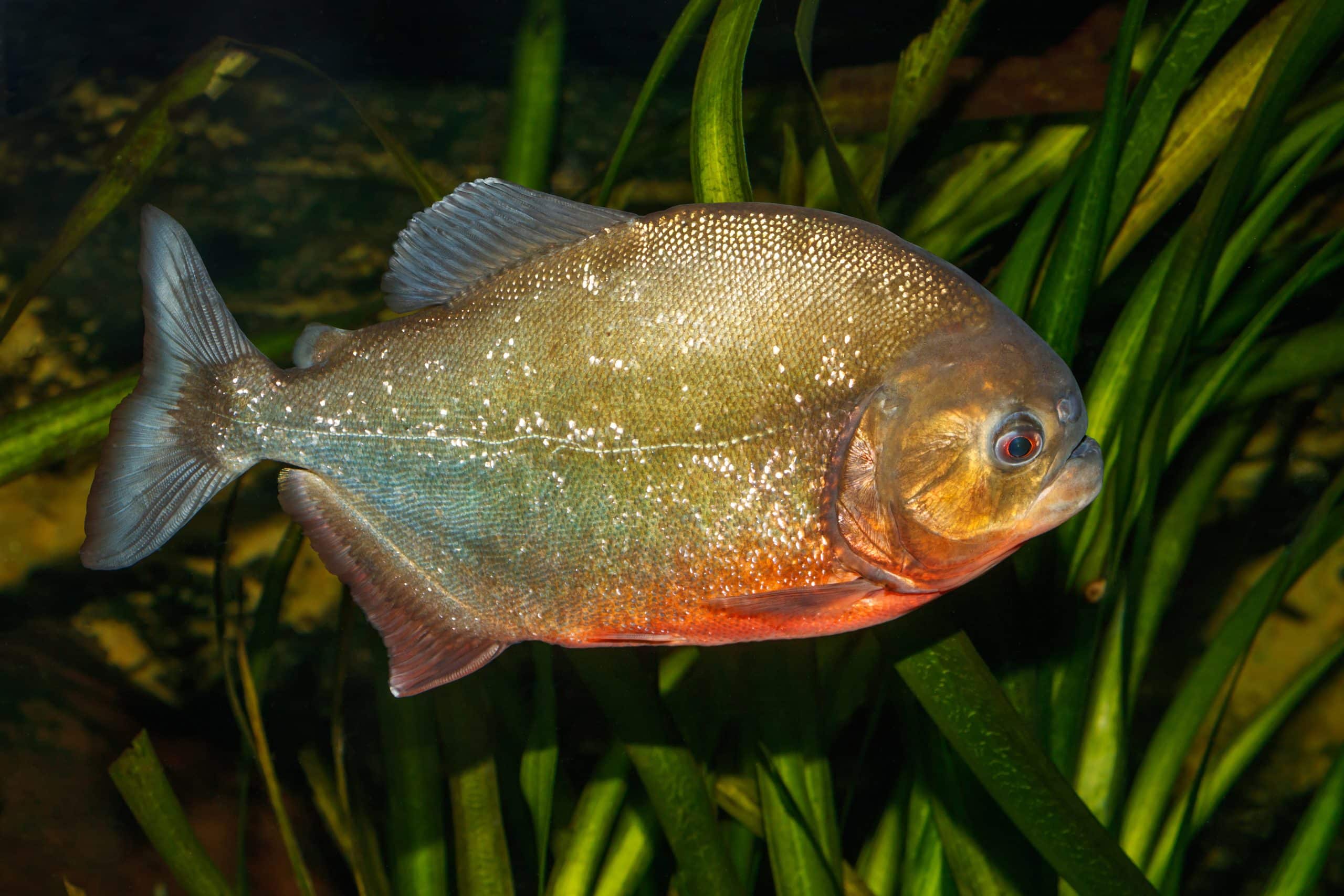
The red-bellied piranha will eat anything it can catch. Plan accordingly, or lose your stock. Hollywood made them famous. Reality made them nervous, skittish fish that need a massive tank, heavy filtration, and a keeper who understands that feeding time is the only moment they look like the movies.
The “killer fish” that hides behind the filter when you walk into the room.
That’s the most important thing to understand about keeping Pygocentrus nattereri. The reputation is real in the sense that these are genuine predators with serrated teeth and explosive feeding behavior. But the daily reality is the opposite of what the movies show: nervous, pack-oriented fish that need stability, cover, and a keeper who respects their physiology rather than trying to provoke the Hollywood version of them.
Keep that in mind throughout this guide. The piranha that kills your stock is the one kept in the wrong setup. The piranha in the right setup is one of the most fascinating long-term fish in the freshwater hobby.
ASD Difficulty Rating
Moderate to Advanced | 7/10
Red-bellied piranhas are not beginner fish. They require a minimum 100-gallon tank for a proper group, heavy-duty filtration, careful feeding practices, and legal clearance in your jurisdiction. Their 10–20 year lifespan and substantial ongoing care requirements make this a long-term infrastructure commitment. Intermediate to advanced keepers with large tank experience are the target audience.
Key Takeaways
- Surprisingly skittish, Not the movie monster; nervous, pack-dependent fish that hide when stressed
- Group requirement, Keep 4–6 minimum; solo piranhas are chronically stressed and display unnatural behavior
- 100-gallon minimum for a proper group, 75 gallons is the absolute floor; 125+ gallons is the realistic target
- Check legality first, Banned in multiple U.S. states including California, Texas, New York, and others; verify before purchasing
- Feeding time is an event, Explosive, coordinated feeding behavior is genuinely impressive; but it’s controlled ferocity, not random aggression
- 10–20 year lifespan, This is a multi-decade commitment; plan accordingly before buying
Species Overview
| Common Name | Red-Bellied Piranha, Red Piranha, Natterer’s Piranha |
| Scientific Name | Pygocentrus nattereri |
| Family | Serrasalmidae |
| Origin | Amazon, Orinoco, Paraguay-Paraná, and Essequibo basins, South America |
| Care Level | Moderate to Advanced |
| Temperament | Semi-aggressive schooling predator |
| Diet | Carnivore / omnivore, opportunistic piscivore |
| Tank Level | Mid to Bottom |
| Max Size | 13 inches (33 cm) |
| Min Tank Size | 100 gallons (379 liters) for a group of 4–6 |
| Temperature | 75–82°F (24–28°C) |
| pH | 5.5–7.5 |
| Hardness | 2–15 dGH |
| Lifespan | 10–20 years in captivity |
Classification
| Order | Characiformes |
| Family | Serrasalmidae |
| Subfamily | Serrasalminae |
| Genus | Pygocentrus |
| Species | P. nattereri Kner, 1858 |
Described by Rudolf Kner in 1858 and named for Johann Natterer, an Austrian naturalist who spent 18 years collecting specimens in Brazil. The family Serrasalmidae is distinct from Characidae, it includes piranhas, silver dollars, and pacus as a family in its own right, not a subfamily of the broader characins. Some older references list this species under the synonym Serrasalmus nattereri, but Pygocentrus nattereri is the current accepted name and has been stable since Kner’s original description.
Origin & Natural Habitat
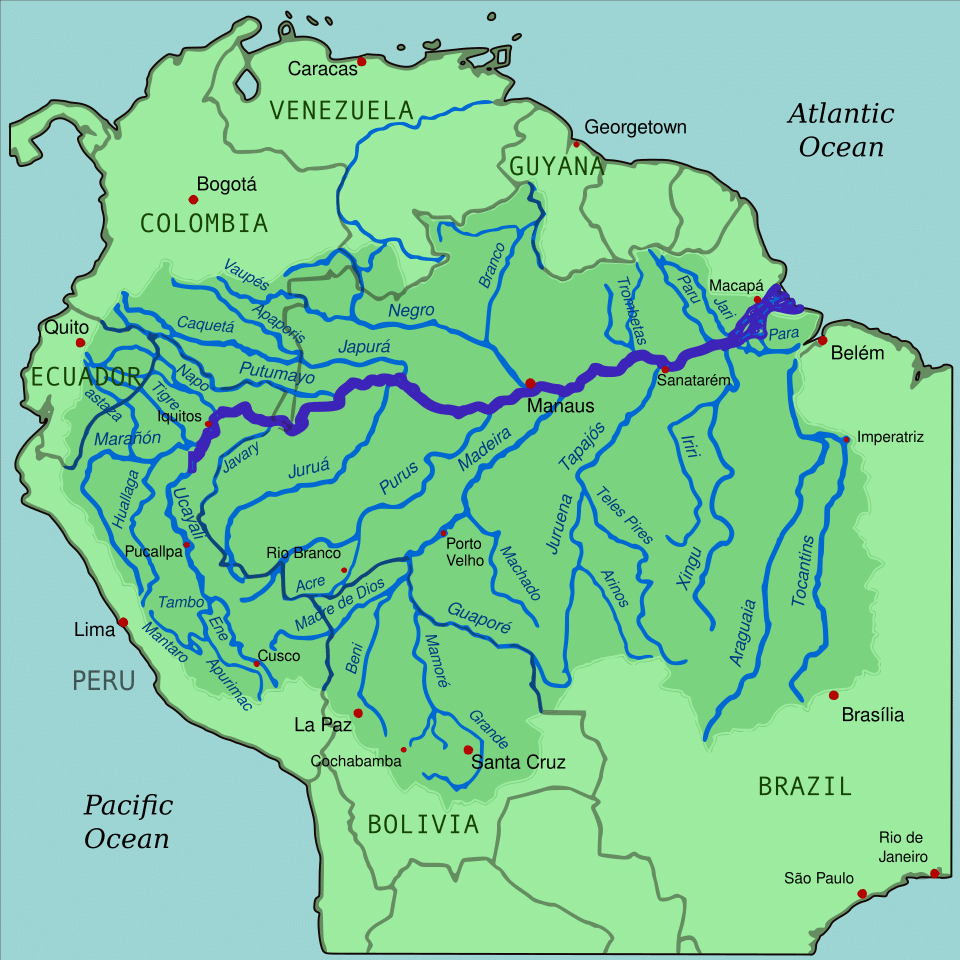
The red-bellied piranha has one of the widest distributions of any piranha species. It’s found across multiple major river systems in South America: the Amazon, Orinoco, Paraguay-Paraná, and Essequibo basins. This range spans Brazil, Venezuela, Colombia, Peru, Bolivia, Argentina, Paraguay, Uruguay, and the Guianas.
They inhabit rivers, tributaries, floodplain lakes, and flooded forests, typically slower-moving waters with adequate cover including submerged vegetation, fallen trees, and overhanging banks. During the wet season, they move into seasonally flooded forest areas to exploit abundant food sources. They’re most concentrated in warm, tannin-stained blackwater environments in the wild, though they adapt to a wide pH range in captivity.
Despite their reputation, red-bellied piranhas serve as both predators and scavengers in their native ecosystem, cleaning waterways by consuming dead and dying animals and acting as prey for caimans, river dolphins, larger fish, and wading birds. They are ecologically important, not the apex killers of pop culture imagination.
Appearance & Identification
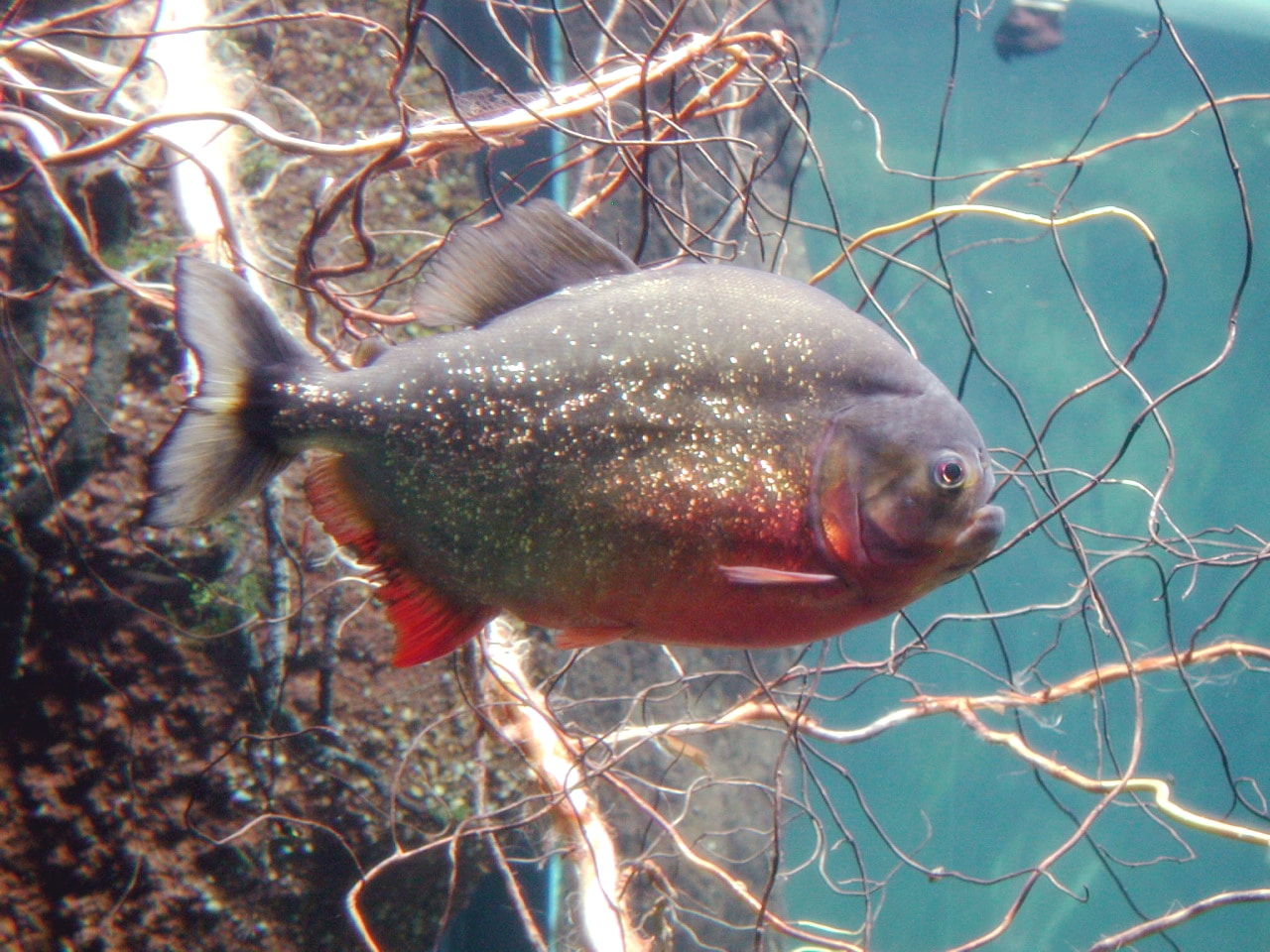
The red-bellied piranha is a deep-bodied, laterally compressed fish with a powerful, stocky build. The body is silvery with dark spots scattered across the upper flanks. The most distinctive feature is the vivid red-orange coloring on the belly, throat, and anal fin, this intensifies with age and good nutrition. Under proper aquarium lighting, the contrast between the silver flanks and the red-orange underside is genuinely striking.
The head is blunt with a pronounced lower jaw that juts forward slightly, the classic underbite of a fish designed to bite and shear. The teeth are triangular, razor-sharp, and interlocking, arranged in a single row in each jaw and replaced throughout the fish’s life. The overall silhouette is unmistakable: compact, powerful, with a disproportionately large head relative to body size.
Juveniles are silvery with prominent dark spots and subdued red coloring. As they mature, the red intensifies and the body darkens. Sexual dimorphism is subtle, females appear slightly rounder when viewed from above, particularly when gravid, but there are no reliable external differences in coloration or finnage at other times.
Male vs. Female
Sexing red-bellied piranhas is difficult outside of spawning season. The most reliable indicator is body roundness, females carrying eggs are noticeably fuller when viewed from above. Most keepers find it easiest to purchase a group of 5–6 juveniles and let natural pairing occur as they mature, rather than attempting to select specific sexes.
Average Size & Lifespan
Red-bellied piranhas reach a maximum of 13 inches (33 cm) in the wild, though most aquarium specimens stabilize at 8–10 inches (20–25 cm). They grow quickly in the first two years and then more slowly as they mature. The tank size requirement is based on adult dimensions, not the juvenile size at purchase.
With proper care, expect 10–20 years. Some specimens have been reported to exceed 25 years. Before you purchase piranhas, sit with that number: you may be responsible for these fish well into the next decade. Infrastructure plans, living situations, and circumstances change, make sure the 20-year scenario is one you can accommodate.
What People Get Wrong
Piranhas in a home aquarium are not killers. They are nervous wrecks. The tank needs to be built around their anxiety, not their reputation. First-time piranha keepers are almost universally surprised by how shy their fish are, hiding behind driftwood, flinching at hands near the glass, taking weeks to settle into a regular routine. The feeding frenzy behavior from documentaries exists, but it’s triggered by specific conditions (large groups, competition, food scarcity cues), it doesn’t describe daily life in a home aquarium.
The second thing most people get wrong is the diet. Red-bellied piranhas are opportunistic omnivores in the wild, not exclusive meat eaters. They eat fish, invertebrates, insects, fruits, seeds, and plant material. In captivity, keepers who feed only live fish or beef heart create nutritional deficiencies and health problems. The diet needs variety, shellfish, frozen fish fillets, and quality carnivore pellets form the most practical and nutritionally complete foundation.
The third mistake is the group size math. People buy two or three piranhas thinking “that’s a group.” It isn’t. A group of fewer than 4 means aggression concentrates on specific individuals, one fish gets bullied continuously, and the dynamics never settle. Four is the functional minimum. Five or six is better. The tank size requirement scales accordingly.
Reality of Keeping
They are surprisingly shy. Most first-time piranha keepers are shocked by how nervous their fish are. Red-bellied piranhas in a home aquarium hide behind driftwood, flinch at hands near the glass, and take weeks to settle into a routine. They’re pack animals, a group of 4 to 6 is what makes them feel secure enough to show natural behavior. Less than that and you get stressed, hiding fish that never look like what you expected.
Feeding time is where they come alive, and it’s genuinely something to see. A group of well-conditioned piranhas responding to feeding cues, moving to the front of the tank, positioning, then the sudden coordinated strike at food, is unlike anything in freshwater fishkeeping. It happens fast, it’s controlled, and it never gets old. That’s the version of piranha behavior that makes keepers passionate about the species.
The rest of the day is driftwood, dim lighting, and slow patrols. These are not hyperactive fish. Between feedings they’re calm, methodical, and genuinely enjoyable to watch if you find predatory fish behavior interesting. Over time you notice personality differences between individuals, some are bold, some are cautious, some establish dominance early and keep it. There’s more going on in a piranha tank than most keepers expect when they start.
Filtration is the ongoing management challenge. Piranhas are messy eaters that tear food apart and scatter debris around the tank. The protein load from a primarily carnivorous diet demands serious biological filtration capacity. A standard community tank filter will not cut it, plan for at least double what you’d use for other fish of similar size, with mechanical filtration you can clean easily and frequently.
Care Guide
Tank Size
A 100-gallon tank (379 liters) is the realistic minimum for a group of 4–6 red-bellied piranhas. The often-cited 75-gallon minimum is technically possible for a small group of juveniles but becomes inadequate for adults. These are large, socially complex fish that establish hierarchies and need enough space for that hierarchy to function without constant conflict. For a comfortable adult group, push toward 125 gallons (473 liters) or larger. More volume also dilutes the heavy bioload these fish produce.
The tank should be at least 48 inches long, ideally 60–72 inches. Piranhas are not fast open-water swimmers the way predatory cichlids are, but they need lateral space to school and establish positions without constant friction.
Water Parameters
| Temperature | 75–82°F (24–28°C) |
| pH | 5.5–7.5 |
| General Hardness (dGH) | 2–15 dGH |
| Carbonate Hardness (dKH) | 2–8 dKH |
| Ammonia | 0 ppm |
| Nitrite | 0 ppm |
| Nitrate | <30 ppm |
Red-bellied piranhas are adaptable to a wide pH range, but their South American origins make slightly acidic to neutral water (pH 6.0–7.0) the most comfortable zone. Stability matters more than hitting a precise value, avoid swings. Weekly 25–30% water changes are the minimum; many experienced piranha keepers do larger changes (40–50%) to manage the nitrate load from their high-protein diet.
Filtration & Water Flow
Heavy filtration is non-negotiable. A large canister filter combined with additional mechanical filtration is the standard approach, many experienced piranha keepers run two filters simultaneously for redundancy and capacity. The protein load from a primarily carnivorous diet with frequent meaty foods is substantial. Size your filtration at a minimum of 3–4x your tank volume in flow rate, with strong biological media. A gravel vacuum at every water change is essential for removing the food debris that accumulates on the substrate after feeding.
Lighting
Moderate to dim lighting. Piranhas are nervous fish that feel more secure with subdued lighting. Bright, bare tanks increase their stress levels and keep them hiding. A photoperiod of 8–10 hours with warm-toned, lower-intensity LEDs creates the best environment. If you add floating plants or surface cover to diffuse light further, the fish will be noticeably calmer and more active.
Plants & Decorations
Piranhas appreciate, and need, cover and visual barriers. Substantial driftwood structures, large rock formations, and ample hiding spots are not optional; they’re what allow these nervous fish to feel secure enough to behave naturally. Without adequate cover, they stay cornered and stressed.
Live plants are largely impractical. Piranhas will shred or uproot most species. Anubias attached to driftwood can survive since it’s not rooted in substrate and is a tough plant, but treat most plants as expendable. Hardy artificial plants or the driftwood-and-rock approach is more reliable long-term.
Substrate
Dark sand or large gravel both work. Dark substrate helps reduce stress and brings out the red belly coloration more vividly against the lighter body. A dark background on the tank accomplishes the same effect. Avoid bright white or very light substrates, they increase anxiety and wash out the fish’s coloration.
Tank Mates
Expert Take (Mark Valderrama, AquariumStoreDepot)
After 25+ years in the hobby and years managing fish stores, the consistent pattern with piranha keepers is that the ones who succeed long-term build species-only setups and stop trying to push the tank mate question. Every “but what if I add X?” experiment eventually ends the same way. Piranhas are pack predators. Other fish in the tank are either potential prey or chronic stress sources. The group dynamic within a piranha school, the social hierarchy, the feeding behavior, the way they respond to you, is genuinely fascinating on its own. You don’t need to add other species to make a piranha tank interesting. You need the piranhas to feel safe enough to show you who they really are.
Sometimes Compatible (with Caution)
- Large, armored catfish, Common plecos, large Synodontis species. Fast enough to avoid trouble, heavily armored, occupy the bottom zone. Even then, watch carefully, a stressed piranha group at feeding time is unpredictable
- Large silver dollars (Metynnis spp.), Closely related family (Serrasalmidae), similar natural range, fast swimmers. Often kept successfully together. Silver dollars at 4+ inches are generally safe with adult piranhas
Tank Mates to Avoid
- Any fish small enough to be eaten, which is most fish
- Slow-moving or long-finned species, fin damage is inevitable
- Other aggressive predatory fish that trigger stress responses in the group
- Small catfish or bottom dwellers, these become meals
- Any juvenile fish, adults will target juveniles regardless of species
Hard Rule: Species-only setup. No exceptions worth the risk.
There is no reliable list of “safe” tank mates for red-bellied piranhas. There are fish that survive longer than others, large plecos, silver dollars, large fast Synodontis, but survival is not the same as safety. Any fish added to a piranha tank is on borrowed time. Build the piranha setup for piranhas. The social dynamics within the group are compelling enough on their own.
Food & Diet
In the wild, red-bellied piranhas are opportunistic omnivores, not the exclusive meat-eaters of pop culture. Their diet includes fish (live and dead), insects, crustaceans, worms, fruits, seeds, and plant material. They’re as much scavengers as they are predators. In captivity, variety is the key to long-term health.
The most practical and nutritionally complete approach:
- Staple: Raw shrimp (shell-on), fish fillet (tilapia, smelt, herring), mussels, these are the protein foundation
- Supplementary: Earthworms, crickets, mealworms, adds variety and feeding stimulation
- Pellets: High-quality carnivore pellets, many piranhas accept these readily and they provide consistent nutrition
- Occasional: Frozen silversides, whole raw fish (gutted)
Never feed mammal meat (beef heart, chicken) as a regular staple. The saturated fats in warm-blooded animal tissue are not processed effectively by fish and accumulate in the liver over time, causing fatty liver disease. Occasional small amounts are acceptable, but fish and shellfish are the foundation.
Feed adults every other day or three times per week. Juveniles need daily feeding. Remove all uneaten food within 30 minutes, in a piranha tank, decaying protein degrades water quality fast. Feeding tongs are your best friend, and always knowing where your fish are before reaching into the tank is a practice you develop quickly.
Breeding & Reproduction
Red-bellied piranhas breed in captivity more often than most keepers expect, they’re substrate spawners that deposit eggs in a pit or depression. The challenge isn’t triggering spawning; it’s managing what comes after.
Breeding Difficulty
Moderate. Spawning itself happens naturally in established groups. The difficulty lies in providing adequate space (100+ gallons), managing significantly increased parental aggression during nesting, and deciding what to do with potentially thousands of fry.
Spawning Behavior
A breeding pair darkens in coloration and becomes territorial. The male digs a shallow nest pit in the substrate. The female deposits several thousand eggs which are fertilized externally by the male. Both parents guard the nest aggressively, significantly more aggressive than usual, which creates real risk for other fish in the tank and for the keeper during maintenance. During nesting, be especially cautious when working in or around the tank.
Slightly warmer water (80–82°F / 27–28°C) and large water changes can trigger spawning in established groups. Increased feeding frequency in the weeks leading up to breeding also helps condition both sexes.
Egg & Fry Care
Eggs hatch in 2–3 days. Fry become free-swimming within a week and accept baby brine shrimp and finely crushed flakes immediately. Growth is rapid with adequate feeding. Consider carefully before encouraging breeding, several thousand piranha fry is a serious logistical commitment, and rehoming them is not simple given the legal restrictions on piranha sales in many jurisdictions.
Common Health Issues
Ich (White Spot Disease)
Can occur after temperature drops or when new fish are introduced without quarantine. Watch for white salt-grain spots on body and fins, flashing behavior, clamped fins. Raise temperature gradually to 82°F (28°C) and treat with an ich-appropriate medication. Piranhas respond well when caught early.
Bite Wounds from Intra-Group Aggression
Normal in piranha groups, occasional nipping is part of establishing and maintaining hierarchy. Minor wounds heal quickly in clean, well-maintained water. Serious wounds require isolation of the injured fish in a hospital tank and treatment for secondary bacterial infection. Keeping the group at 5+ individuals distributes aggression and reduces the likelihood of serious injury to any one fish.
Hole-in-the-Head Disease (HITH)
Develops in piranhas kept with consistently high nitrates and poor diet variety. Presents as pitted lesions on the head and lateral line. Preventable with regular large water changes and a varied diet that includes vitamin-rich frozen foods. Early-stage HITH typically reverses when water quality and nutrition improve.
Fatty Liver Disease
Caused by excessive feeding of mammal meat (beef heart, chicken) or chronic overfeeding. Symptoms include lethargy, loss of appetite, and pale coloration. Prevention is straightforward: base the diet on fish and shellfish, limit mammal-based proteins, and avoid overfeeding. Once established, fatty liver disease is difficult to reverse.
Common Mistakes to Avoid
- Tank too small, A group of 4–6 adult piranhas in a 75-gallon is inadequate; 100–125 gallons is the realistic target
- Keeping one alone or in a pair, Solo piranhas are stressed and hide constantly; two piranhas often means one bullied fish; 4+ is the minimum for stable group dynamics
- Feeding mammal meat as a staple, Fish and shellfish are the foundation; beef heart and chicken are occasional treats, not regular food
- Reaching into the tank carelessly, Always know where your fish are before your hands enter the water; feeding tongs during feeding time; significant caution during breeding periods
- Not checking legality first, Piranhas are banned in multiple U.S. states (California, Texas, New York, and others); verify before purchasing
- Underestimating the lifespan commitment, A 20-year-old piranha has lived through significant life events; plan for the full duration before you buy
- Trying to force tank mate success, The species-only approach is not a limitation; it’s the setup that produces the best piranha behavior and the least heartbreak
Should You Get This Fish?
The red-bellied piranha is a genuinely rewarding long-term fish for the right keeper, but the commitment is real, and the “right keeper” is not everyone.
Good fit if:
- You already have or can build 100–125 gallon infrastructure with heavy-duty filtration
- You’ve researched legality and piranhas are legal in your jurisdiction
- You’re an intermediate to advanced keeper comfortable with large predatory fish management
- You find pack predator behavior and social dynamics genuinely interesting to observe long-term
- You’re committed to a 10–20 year relationship with a species that has ongoing large-tank requirements
- You understand and accept species-only is the safest setup
Think twice if:
- Piranhas are illegal in your state or country
- Your current tank is under 100 gallons
- You want a fish that can coexist with a community, piranhas are predators, full stop
- You’re attracted by the feeding frenzy reputation and expect that behavior daily, the reality is mostly nervous, shy fish between feedings
- You can’t commit to the filtration, maintenance, and feeding schedule a large predatory fish demands
- You’re new to fishkeeping, start with something that gives you more margin for error
Where to Buy
Red-bellied piranhas are available from specialty fish stores and online retailers, though availability varies significantly by location due to legal restrictions. Always verify that piranha ownership is legal in your area before purchasing, and before ordering online, confirm that shipping to your state is permitted. For reliable sourcing:
- Flip Aquatics, Reputable online source for specialty freshwater fish including predatory species
- Dan’s Fish, Trusted source for a range of freshwater species
Buy a group of 5–6 juveniles rather than a smaller number of adults. Juveniles acclimate to each other and establish hierarchy more smoothly than adults introduced to an existing group. The price is affordable ($5–$15 per fish at most), so starting with the right group size is not a financial barrier.
How the Red-Bellied Piranha Compares to Similar Species
If you are deciding between large South American predatory fish or exploring the Serrasalmidae family, here is how the red-bellied piranha compares on what actually matters for ownership.
Red-Bellied Piranha vs. Silver Dollar Fish (Metynnis argenteus): Choose the Silver Dollar Fish if you want a large, active schooling fish from the same South American river systems that is peaceful, community-compatible, and herbivorous. Silver dollars grow to 5 to 6 inches, school beautifully in 75-gallon setups, and do not require species-only housing or jurisdictional clearance. Choose the Red-Bellied Piranha if you want the pack predator social dynamics and explosive feeding behavior – the keeping experience is fundamentally different. These are close relatives with opposite personalities.
Red-Bellied Piranha vs. Oscar (Astronotus ocellatus): Choose the Oscar if you want a South American predatory fish with strong individual personality, keeper recognition, and the ability to keep in pairs or groups with care. The Oscar is a territorial cichlid with personality-rich behavior – it interacts with its keeper in a way piranhas rarely do. Choose the Red-Bellied Piranha if you want pack predator social dynamics and feeding behavior rather than individual interaction. Both need 100-gallon-plus tanks and heavy filtration, but Oscar keeping and piranha keeping are genuinely different hobbies despite similar infrastructure requirements.
Red-Bellied Piranha vs. Pacu (Colossoma macropomum): Choose the Red-Bellied Piranha in nearly every scenario for home keeping. Pacus are plant-eating giants that exceed 3 feet in length and are only appropriate for public aquariums or massive custom setups. Red-bellied piranhas top out at 13 inches and are manageable in 125-gallon home systems. Do not buy a pacu thinking it will stay small – it will not, and the results are a welfare problem and a rehoming crisis.
FAQ
Are piranhas legal to keep as pets?
It depends entirely on your location. Piranhas are illegal in several U.S. states including California, Texas, New York, Georgia, and others. They’re also restricted in parts of Canada, Australia, and many other countries. Check your specific state and local laws before purchasing, and confirm before ordering online that shipping is permitted to your location. Penalties for illegal possession are real and can be significant.
Are red-bellied piranhas dangerous to humans?
They can deliver a serious bite if mishandled, accidental bites during tank maintenance do happen. In captivity, they’re far more likely to flee than attack a human. Use feeding tongs during feeding, always know where your fish are before reaching into the tank, and exercise extra caution during breeding periods when parental aggression peaks. Treat them with respect and they rarely cause problems.
How many piranhas should I keep?
Minimum 4, ideally 5–6. Groups of fewer than 4 concentrate aggression on specific individuals and create chronic stress in the bullied fish. Larger groups distribute aggression more evenly and produce more stable, naturally behaving schools. Odd numbers (5, 7) are sometimes recommended to prevent pairing dynamics that leave one fish consistently targeted.
Can piranhas be kept with other fish?
Large armored catfish (common plecos) and large silver dollars have been kept successfully with piranhas by experienced keepers, but the risk of losing tank mates is always present. Species-only is the safest, most reliable approach. The piranha group’s social dynamics are compelling enough that you don’t need additional species to make the tank interesting.
Do piranhas really form feeding frenzies?
Yes, but not the way movies portray it. Feeding frenzy behavior occurs in large groups responding to distressed prey, typically in conditions of food competition. In a home aquarium, feeding time is fast and coordinated, but it’s not random violence. A well-kept piranha group responds to feeding cues, positions, and strikes in a controlled way that’s genuinely impressive without being chaotic or unpredictable.
How long do red-bellied piranhas live?
10–20 years in captivity with proper care, with some specimens exceeding 25 years. This is one of the most significant considerations before purchasing piranhas. A 20-year commitment to a 125-gallon species-only tank is a meaningful lifestyle decision, plan for the full duration, not just the current situation.
Closing Thoughts
Want an easy community fish? This is not it. Want a species that rewards dedicated, long-term care with genuinely unique behavior? The red-bellied piranha delivers, if you put in the work.
The red-bellied piranha is not the monster that pop culture made it. It’s also not a casual pet. It’s a large, long-lived pack predator that needs serious space, serious filtration, and a keeper who respects the full scope of its requirements. The reward for getting it right is a fishkeeping experience that’s difficult to replicate with any other species: complex social behavior, explosive feeding moments, striking coloration, and the daily fascination of watching a genuine predator navigate its world. Just check your local laws first, and make sure you’re ready for the 20-year version of this relationship, not just the first excited weeks.
The red-bellied piranha is part of our complete Tetra & Characin Species Directory. Visit the hub page to explore care guides for dozens of characin species we cover.
Recommended Video
References
- Kner, R. (1858). Zur Familie der Characinen. Denkschriften der Kaiserlichen Akademie der Wissenschaften, Mathematisch-Naturwissenschaftliche Klasse, 14, 1–32.
- Froese, R. & Pauly, D. (Eds.). FishBase. Pygocentrus nattereri. https://www.fishbase.se/summary/Pygocentrus-nattereri.html. Accessed 2026.
- Seriously Fish. Pygocentrus nattereri species profile. https://www.seriouslyfish.com/species/pygocentrus-nattereri/. Accessed 2026.
- Machado-Allison, A. (1993). Los peces del llano de Venezuela: un ensayo sobre su historia natural. Universidad Central de Venezuela.
- About the Author
- Latest Posts

I’m Mark Valderrama, founder of Aquarium Store Depot and a fishkeeper with over 25 years of hands-on experience. I started in the hobby at age 11, worked at local fish stores, and have kept freshwater tanks, ponds, and reef tanks ever since. I’ve been featured in two best-selling aquarium books on Amazon and built this site to share practical, experience-based fish keeping knowledge.
Leave a Reply