Nyos skimmers have developed a loyal following in the reef community, and after evaluating them alongside the more established brands, I can see why. The needle wheel design and build quality stand out immediately. I approach every equipment review the same way I’ve approached gear for 25 years in this hobby. what does it actually do in a real tank, and is it worth what you’re paying?
Looking for the very best Protein Skimmer available for your saltwater aquarium today? If so, you have come to the right place. Today, I go in-depth with a Nyos Skimmer review!
As you may have read in my Best Protein Skimmer round up article, Protein skimmers have become a staple piece of equipment for many reef tanks. It all started with the Berlin method that became popular when I started up reefing back in the early 90s. Everyone swears by their protein skimmer, and we can see why with so many successful reef tanks running them. So what makes the Nyos Quantum so unique? Let’s find out shall we?
My reviews are fairly structured. I’m going to be reviewing the following with the categories with this protein skimmer line:
The Nyos skimmer prides itself by it’s extreme performance. This is a result of the massive amount of air and water it drives through it’s skimming chamber. This is achieved by their Nyos Twister technology. The twister is an additional blade that is added to the usual bubble plate you will see in most protein skimmers. This blade gives the bubbles an additional cycle within the bubble vortex. What this does is create additional contact time for the air bubbles in the water column.
A protein skimmer lives and dies off the contact time. The more contact time the better for a skimmer. This is why recirculating skimmers are popular at the high-end of the hobby. Nyos achieves a recirculating effect all within a small footprint.
The next feature to speak of is the quiet operation of the skimmer. I’ve worked with skimmers that do a great job, but are very loud. Given that the Nyos is a premium level skimmer, I would expect it to be dead quiet. I purchase a skimmer like this for the performance and it’s silent operation. Not only is it one of the quietest skimmers on the market, it is also energy efficient even without using a DC pump!
The pump is built off what Nyos calls the Nyos Hybrid Wheel. This is a specialty designed impeller that combines the advantages of a needle wheel and lattice wheel. It is an AC pump, which I personally love because I know AC pumps are generally more reliable than DC pumps. The pump is placed in a clear view reactor. This is a clear impeller cover that lets you see the function of the skimmer. This allows you to visually inspect the protein skimmer to see if there are any obstructions that need to be cleaned out. The pump will operation best in a water level of 8 – 10 inches on all Quantum models
Craftsmanship
The Nyos has nothing cheap built into it. When you pull it out of the box, the first thing you will notice is the weight of skimmer. There are no cheap plastic and thick high quality acrylic. It comes with titanium screws so you do not have to worry about your screws rusting out. Below is a image of the Nyos Twister blade.
Image Courtesy of Marine Depot
The Nyos is built to be compact and does not use externally mounted or large bulky pumps. This not only allows it to fit in smaller aquarium sumps, but also makes it quiet and easy to maintain. The Nyos skimmer is designed and built in Germany. There is are no corners cut with its design and it shows not only in its parts, but its looks. It looks cool just sitting in your sump. For those of you who like to make aesthetically pleasing sump setups, this skimmer is a great additions for its looks and it’s performance.
Ease Of Use (Installation)
The Nyos built to be plug in play. In my experience, this is the quickest skimmer to break in among all the skimmers I have worked with. Many lower end skimmers will take several weeks to break in until they start performing the way they should. The Nyos gets off running. They usually break in after a day or so.
They are built to be simple to use. It has two adjustment values for the air intake and the chamber level. The collection cup is also generous in size and goes a while before needing to be replaced. The cup comes off easily by twisting off.
While the instruction manual does not have pictures illustrating install, EcoTech Marine does provide a video showing how to assemble and install the skimmer. I have supplied the video below for your reference so you can view it when you purchase it.
Value For Money
The Nyos Skimmer from first look seems like a very expensive skimmer. When you look at the quality of construction and features that this skimmer has, you can see how it stands out from many of the its competitors in the marketplace. A Nyos has been known to be too good at its job and has to be dialed back in order to control nutrient levels. This to me is a hallmark for a skimmer. A good unit should be able to run on its own without added equipment.
A quality skimmer should be able to run with just this unit and the biological filtration coming from the rock in the aquarium and the micro fauna that is breeding in the refugium. The Nyos can achieve this balance in a heavily stocked tank without missing a beat.
Models
The Nyos Quantum comes in 4 different models that can handle from 40 gallons all the way up to 1000 gallons. The 160 is the most popular of the entire lineup.
Model
Nyos Quantum 120
Nyos Quantum 160
Nyos Quantum 220
Nyos Quantum 300
Picture
Price
$$$
$$$$
$$$$$
$$$$$$
Gallon Recommendation
40-125 Gallons
100 – 250 Gallons
125 – 500 Gallons
250-1000 Gallons
Air Max (Liters Per Hour)
500 l/h
1500 l/h
2200 l/h
2200 l/h
Power Consumption
8 Watts
18 Watts
22 Watts
2 x 22 Watts
Dimensions (LxWxH) in Inches
5.91 x 8.27 x 18.31
7.29 x 9.85 x 20.87
12.2 x 9.25 x 23.8
13.4 x 16.4 x 26
Water Level
8-10 “
8 – 10″
8 – 10″
8 – 10″
Link
Product Support
Nyos Skimmers are distributed in the US by EcoTech Marine. EcoTech marine is well known in the reefing hobby for producing high-end equipment and having excellent customer server. EcoTech marine provides the support for Nyos. They are typically fast to respond to phone or email inquires.
The main downfall with the Nyos protein skimmers are their warranty. You only get a 1 year warranty. This is disappointing given the Germany quality engineering and the fact that the pump runs of AC power. However, looking at other brands like Reef Octopus and Deltec, you will see similar short warranty periods. The longest warranty I’ve seen for a distributed protein skimmer has been Simplicity which offers a 3 year warranty.
The Nyos website it linked back to Germany or something, but they’re actually distributed in the USA by Ecotech Marine. Most people already know Ecotech’s reputation for being a well-established exceptional company. They respond to inquiries extremely fast via both phone and email.
One issue we ran into when it came to contacting them was we were informed that during some warranty issues a credit card actually gets held to ensure everything runs smoothly. The next was for price point. The prices on them for a skimmer with a 1-year warranty we think is a little high. But, there is room for a slight margin of error. When we called the company we got 5 different answers. 3 people told us that the warranty in the USA is only 1-year, but 2-years in the UK and Germany. 2 people told us the warranty is 2-years no matter where the skimmer is sold.
Either way, no one seemed to really know. They should be ranked #1, but we couldn’t seem to get solid answers about how long the warranty actually is or how the warranty issues are actually handled. The only thing for sure when it comes to Nyos skimmers is they perform exceptionally well and are backed by one of the best companies in the USA.
Price
The price for this skimmer may seem very high at first. We have to compare apples to apples though. The Nyos is one of the few German made skimmers out on the market. A fair comparison would be to compare these to the Daltec and Bubble King brands of the hobby. A bubble king is typically going to be 50% more expensive than the Nyos while the Daltecs are going to be slightly more expensive, but less feature rich.
Compared to an equivalent German made protein skimmer they actually are an economical option. Knowing that however, the Nyos does not perform economically. It is an elite performing protein skimmer with stellar support from their EcoTech distributor.
Closing Thoughts
The Nyos Quantum skimmer represents the best of the best when it comes to protein skimmers. It is the best mix of simple to operation and elite performance. The German engineer and quality really make this skimmer stand out for all others on the market. With EcoTech backing support for US distribution, you have great customer service behind the product. If you are looking for the absolute best skimmer on the market today, the Nyos my choice for any top-end reef setup.
You can see the ratings below from me and my editor’s choice badge that these skimmers receive. Since I’m open to all reviews, you can leave your own reviews below. I’m all about being an unfiltered source of reviews for our reefing community. If you have any questions, please leave them in the comments below. Thanks for reading!
🔧 Want to learn more? This article is part of our complete Aquarium Equipment & Gear Guide. your ultimate resource for filters, heaters, lights, pumps, tanks, and more.
The original Gyre wavemaker was a genuine innovation when it launched. the crossflow design eliminated dead spots in a way that traditional powerheads just can’t, and I thought the first-gen IceCap Gyre was one of the best values in reef flow equipment at the time. The 2K and 4K second-generation models pushed performance further, but also pushed the price. I don’t accept sponsorships, so here’s my honest take on whether the upgrade is worth it and how the Gyre 2K stacks up against the competition for reef tanks in the 100. 200 gallon range.
The 1st generation of IceCap’s Gyres was in my opinion the best value in aquarium wavemakers on the market. Today, I look at IceCap’s latest Gyre 2K and 4K 2nd generation models and see if they still continue to deliver value.
My reviews are fairly structured. I’m going to be reviewing the following with the categories with these kits:
The IceCap 2K Gyre has a number of improvement over the last generation 1K models. The output has been upgraded to 2,000 gallons per hour and it now can be controlled via wifi.
The new wifi app is called CoralVue Hydros. It’s the same mobile app that is used on the Hydros WaveEngine controller. The new app also you to program the Gyre on your phone using presents and triggers. Modes are always available like a feed mode that shuts down the pump. Below is a screenshot of the app. It is a simple to use app that CoralVue has a number of videos available that explain how to use the app.
One observation with the WiFi is that it only runs off 2.4 ghz. It does not run off the modern 5 ghz band. Make sure you have a router that runs 2.4 and 5 ghz bands. Most wifi routers do have dual bands so it’s likely not going to be an issue for most users.
The new controller that runs the Gyre 2K and 4K can actually run up to two pumps. This is an improvement to the prior generation model that had to have a controller for each pump. You can even run two pumps off a single power supply. This reduces clutter in your aquarium cabinet. It’s an added plus feature with this newest generation.
The design of the 2nd generation Gyres look similar to the prior models, with exception to the impeller blades. In the prior models, they were black. In the 2K and 4K models they are a orange color. IceCap does include black impellers that you can switch out though. I would encourage you to switch to the black ones as the orange ones can look odd in the tank when the pump isn’t running. The magnet can work on aquariums up to 1/2″ thick in glass.
IceCap Gyre Craftsmanship
The craftsmanship on the IceCap Gyre is solid just like the last generation. It’s licensed technology from MaxSpect. Maxspect was the original designer of the Gyre technology. It is a cheaper version of the MaxSpect gyre, but I don’t feel any significant cost cutting measures were taken. The impeller design is simple and easy to take apart.
Thepower outlet comes from the top. The Gyre, like all other Wavemakers not named EcoTech has the power outlet on the wet side of the aquarium. Since Gyres are places near the top of an aquarium, I don’t feel it takes away from the look of the tank. It some display tanks, it may blends into the backgrounds and look like part of the return.
Ease Of Use (Installation)
This is where the IceCap Gyre really stands out. CoralVue has done a stellar job of producing video content on how to setup and use the Gyre. I’m going to list them all here so you have a quick guide when you purchase the unit.
Installation and Operation
This video will walk you through the Gyre parts and the setup to install in your aquarium
Pump Controller Setup
This video walks you through the install setup of the Hydros mobile app
Controller Configuration
This video walks you through flow configurations available off the Hydros app and how to program your Gyre.
https://youtu.be/WExf_POvVt4
Value For Money
There are three comparisons I need to make on the Gyre. The first is comparing it to the MaxSpec XF Gyres. The IceCap 2K and 4K Gyres are superior value in comparison to the MaxSpect. In my opinion, there isn’t much to justify the additional price tag of the XF. This is specifically true now with the CoralVue Hydros app.
The next comparision is against the high end wavemakers on the market. Comparing to the EcoTech MP, the IceCap Gyre 2K and 4K are a superior value. A IceCap 2K Gyre can easily power a 3 foot long tank with no dead spots. The equivalent setup for an MP would require two units. This makes a Gyre a much cheaper alternative for a wavemaker in a reef tank
The last comparison is against the prior IceCap 1K and 3K models. There has been a significant price increase over the 1K and 3K due to the controller. The 1K Gyre used to be an incredible value. It’s a shame that the 2K model has a much higher price tag. However, the controller is a significant improvement and if you run a tank that needs to run 2 gyres like a 6 foot long tank, The IceCap will be a great value for you.
Models
Below are the available IceCap Gyre models available today. The 2K will work for up to 3 foot long tanks. The 4K is a more powerful version that is recommended for higher flow demand environments such as an SPS tank.
Model
IceCap Gyre 2K
IceCap Gyre 4K
Picture
Price
$$
$$$
Gallon Recommendation
20 – 90+ Gallons
25 – 150+ Gallons
Gallons Per Hour (Max)
2,000
4,000
Gallons Per Hour (Min)
739
1,286
Power Consumption
8-25 Watts
13-45 Watts
Dimensions (LxWxH) in Inches
8.78 x 2.83 x 1.5
12 x 3.15 x 1.7
Tank Thickness
Up to 1/2″ thick
Up to 5/8″ thick
Link
Product Support
IceCap is sold by CoralVue. They have been a manufacture of OEM parts for major years in the industry and are the exclusive distributor or brands such as IceCap. One thing that really stands out with CoralVue is their customer support. They go the extra mile to reach out to you and are regularly involved in hobbyist forums. As you also saw, they have been getting into video content more which has been helpful in understanding how to use the products you purchase.
The cons with Gyres in general are their warranties. You only get a 1 year warranty on them. That is a vast different from the old AC wave makers that would offer multi-year warranties. I still feel they serve great value even with their shorter warranty.
Price
Price is the biggest change with this newest generation Gyre from IceCap. The prior generation was a bargain at the price it was sold at. This new generation has had a significant price increasedue to the wifi enabled controller. While it can be more expensive for a tank that only requires one Gyre, the price becomes more reasonable when you are running 2 or me Gyres. This is because the controller can operate 2 gyres so you can save a good bit of money just buying the pump only for the 2nd Gyre.
While overall it is more expensive than the last generation, it is still cheaper than the higher end wavemakers on the market. I feel it’s still a great value for reef tank owners looking for a wavemaker that is set and forget and not complicated to use.
Closing Thoughts
The IceCap Gyre 2K and 4K are great value for what they offer to a reef tank owner. It is one of the more comprehensive wavemaker solutions that won’t break the bank. The new wifi feature on the controller is a great update from the prior generation and worth the added cost. CoralVue as a distributor has a solid reputation for customer service. I feel that you cannot go wrong with a CoralVue distributed product. This is an excellent wavemaker overall.
You can see the ratings below from me and my best value badge that these series of aquariums receive. Since I’m open to all reviews, you can leave your own reviews below. This provides the community with an unfiltered source of reviews. If you have any questions, please leave them in the comments below. Thanks for reading!
Waterbox aquariums have become a serious competitor in the all-in-one reef tank market, and after spending time evaluating them, I understand the appeal. The cabinetry, the rimless glass quality, and the integrated filtration compartment are all clearly designed by people who actually keep reef tanks. I approach every review the same way. no sponsorships, no paid placements, just an honest look at whether the product is worth your money.
Looking for a reef ready system that that delivers on quality and simplicity? If so, you have come to the right place as today I do a comprehensive Waterbox Aquarium Review. Waterbox has taken it to Red Sea with highly quality reef ready systems that are approachable even for a beginner saltwater aquarium owner. As you may have read in my Best Rimless Tank round up article, the Waterbox Aquariums systems are a great way to get started in the saltwater hobby.
They got my best value award for having such great features at a fair price, however, I didn’t have the space in the article to talk about their entire line and go in depth on all their features. This post, I will dive in so you can see what makes WaterBox Aquariums stand out so much in an industry I feel at times can be seen as overly complex to beginners.
The WaterBox tanks are loaded with features. It’s more than just a box of glass.
GlassConstruction
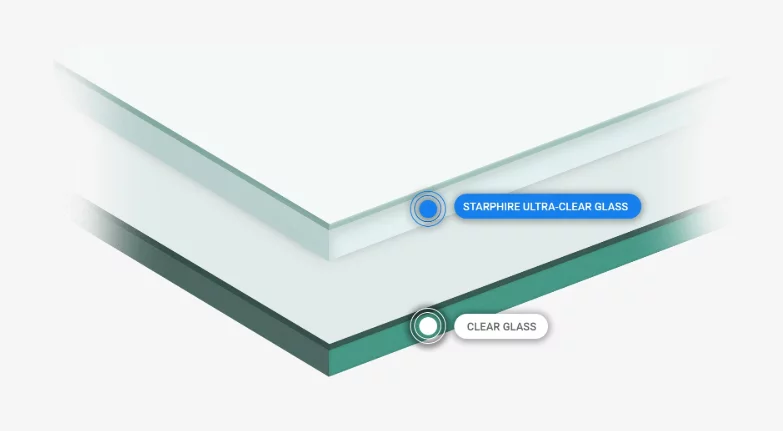
The WaterBox Aquarium is built to be a run to run system. It starts off with the aquarium itself which is made of Ultra Clear Starphire glass. This glass is made of low iron. Due to the low iron make up, it has better clarity than a traditional glass tank. It’s clarity rivals an acrylic tank – the gold standard of clarity when it comes to aquariums. Ultra Clear Starphire really comes into it’s own when you are looking at larger tanks. Given that most of the tanks that WaterBox sells are going to be over 100 gallons, Starphire makes a lot of sense for those looking for high quality display tanks.
The entire construction of the glass is put together with straight edged black silicon. The edges are put together with a straight-edging technique that not only gives the aquarium great strength, but a clean look. There are budget rimless tanks that will show poor quality seems where you still see the silicone stick out. Waterbox’s silicone technique is top notch and clean.
Overflow System and Plumbing
Now let’s talk about the overflow system. Waterbox uses a full glass overflow. This is very different than other reef ready systems that use an acrylic overflow. An acrylic overflow have serious drawback in that they scratch over time. The glass overflow has etched teeth and are far easier to clean off than an acylic overflow. What I always loved about glass is you can just take a blade to it to pull off coralline algae. It’s more difficult with acrylic. Your best bet with acrylic is a credit card or a special plastic scrapper. I always felt the glass scrapers were superior.
The overflow system takes use to the plumbing work. This is where Waterbox shines. They use a manifold system with hard colored PVC plumbing. They also come with quick disconnect unions and a gate valve. The drains are a bean animal style1 – the current industry best practice. You can see a video below from the manufacturer that goes over the plumbing system. There wasn’t a plumbing system like this when Waterbox came to the scene. It is still the main feature that wins me over with them.
Sump
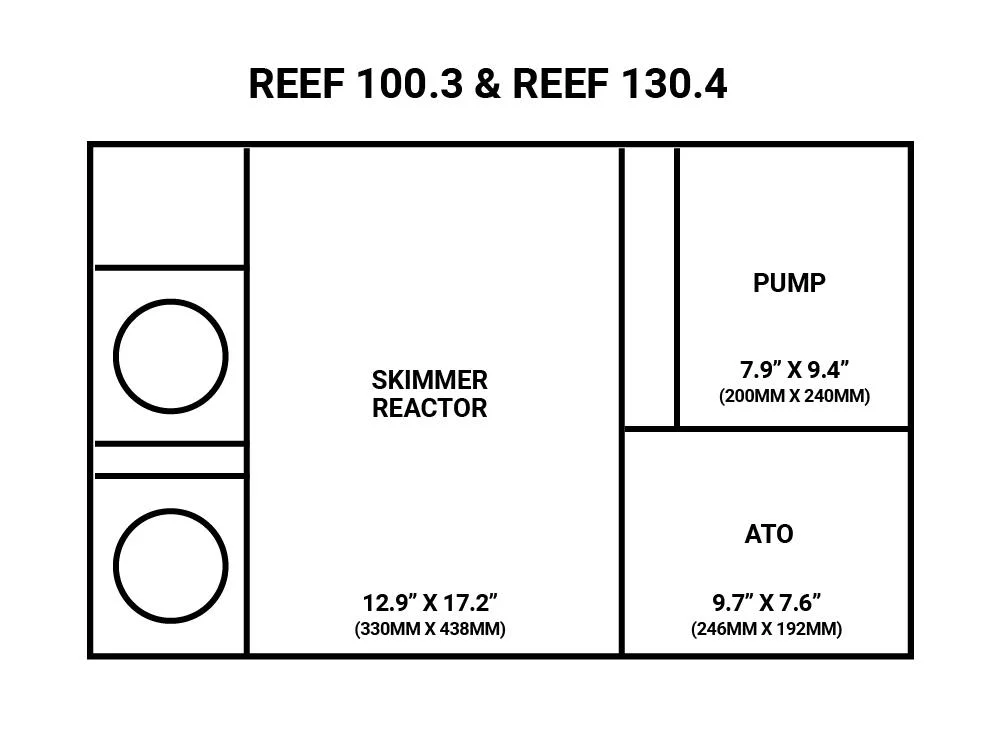
These are the best sumps included in a ready to run aquarium system that I have seen. It’s a rimless glass sump that has it clean separate chambers. The sump below is the Reef 130.4 Sump.
You can see this is a true mult-stage sump with a sock chamber, skimmer reactor, pump and ATO section. The ATO section is a great feature. While the Reef models only have a skimmer chamber, the larger Reef Pro models have a skimmer and refugium section. I love the rimless design as there are no braces in the way. The skimmer reactor chamber is also very generous, allowing for oversized skimmers.
Cabinets
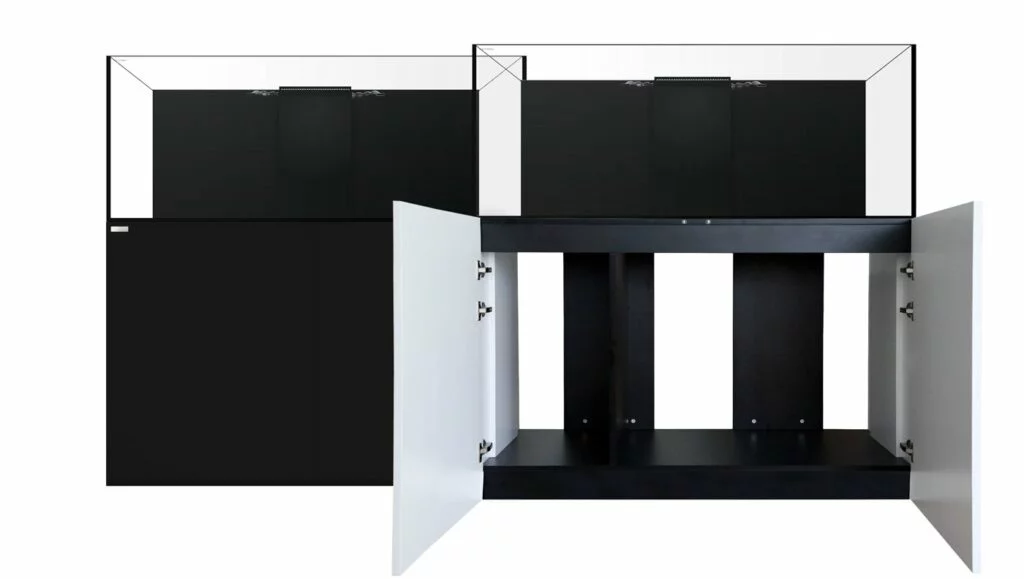
The Waterbox cabinets for the Reef, Pro and Peninsula series are made of hardwood and are heavy duty UV coated. This is a step above the standard MDF that you will see from budget cabinet manufacturers – and much better than what you would you would purchase at a typical pet store. They are available in either black or white finishes. Personally, I’m partial to the white finish.
Another great touch are the soft close doors. The hinges are PVC coated. This is another great feature by Waterbox as standard hinges are known for rusting out over time. The doors operate via push open which means you don’t need to have door handles installed. I like this touch as well. It makes the cabinet look clean and modern.
The cabinet is designed with a brace off center. This is down so you have full access to the tank without an annoying middle brace in the way of everything. You will see the same feature on their larger 5 and 6 foot tanks. I like this touch and on the larger systems it really allows you to be creature and design a control command center.
WaterBox Craftsmanship
I love the engineering though and fit and finish of these systems. The plumbing is colored and no gluing is required. The overflow is professional designed. The manifold system makes your system future proof. The cabinets are excellent. And that’s all without mentioning the aquarium itself which is well put together.
Value For The Money
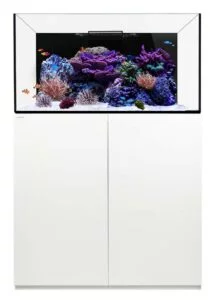
Waterbox Aqariums seem expensive at first, but you have to take into account what you are getting. They are also available in a number of sizes folks of all budget prices and purchase them. Let’s talk about their main series of models, the Reef Series.
Reef Series
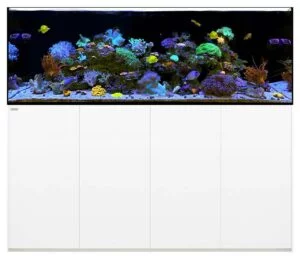
The reef series offers a full reef ready system with a bean animal overflow and drain, manifold, cabinet, and sump. Waterbox aquariums are easy to understands with their models. The first number is a rounded up total volume of the system. The number after the period is the length of the tank. An an example, the Reef 130.4 would be 130 gallons of total volume and 4 feet long. Below are all the reef aquarium series models:
Model
Reef 70.2
Reef 100.3
Reef 130.4
Reef Pro 180.5
Reef Pro 220.6
Picture
Price
$$
$$$
$$$
$$$$
$$$$$
Dimensions (LxWxH)
24″ x 24″ x 58″
36″ x 24″ x 58″
48″ x 24″ x 58″
60″ x 25″ x 60″
72″ x 25″ x 60″
Aquarium Volume(Gallons)
47.2
71.7
96.3
140.7
167
Sump Volume(Gallons)
22
25.4
30.6
45.3
37.1
ATO Reservoir Volume(Gallons)
3.6
4.7
5.5
5.8
17.2
Total System Volume
69.1
97.2
126.9
180.8
221.3
Link
Peninsula Series
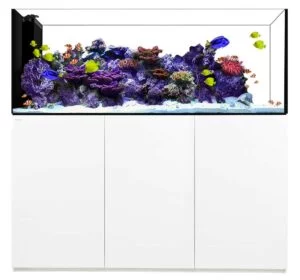
The peninsula are the top of the line models for Waterbox. These have the overflow on the left side of the tank giving you a full 3 sided view of the display tank. All sumps have an optional fuge baffle you can install for a true 3 stage sump. Below on the Peninsula models available:
Model
Peninsula 6025
Peninsula 7225
Picture
Price
$$$$$
$$$$$$
Dimensions (LxWxH)
60″ x 25″ x 60″
72″ x 24″ x 60″
Aquarium Volume(Gallons)
140.7
168.9
Sump Volume(Gallons)
41.8
41.8
ATO Reservoir Volume(Gallons)
5.8
18.7
Total System Volume
183
228
Link
Ease of Use
Waterbox Aquariums are very easy to put together. Below is an excerpt from their instruction manual. They label all their parts and take you through each step in detail. The cabinet includes leveling feet included and the hinges can be adjusted.
The cabinet construction is probably the most difficult piece of the set to put together. If you ever put together a piece of furniture from IKEA together, this will be no different for you.
The plumbing system would be the next area of the install. Waterbox posts a great video walking you through the plumbing system and the entire install. It’s much easier to see the video and for me to type it all up in the post. Check out the video for the walk through when you go instal the plumbing.
Product Support
The Waterbox team fully supports their product with excellent customer support and instruction videos to guide you along the way. They also have been getting into content discussing best practices in aquarium keeping.
The aquariums are backed by a 2 year warranty. For a set compared to Red Sea, this is better. However, from the old school manufacturers like Aqueon or brands you can only purchase from a local fish store like Planet – this is a subpar warranty. I understand that Waterbox is putting a warranty on the entire set. I just feel their customers would feel a bit more reassured if the aquariums came with a 3 or even 5 year warranty instead of 2.
Price
Price is a sensitive topic when it comes to ready to run aquariums. Many buyers are initially shocked at the stick price because they seem very expensive from the on set. Let’s talk about what you are getting and go from there. These aquariums come with:
A rimless low iron glass tank
Colored plumbing section with unions, gate valve, and manifold assembly
A rimless 3 stage sump with ATO chamber
Bean animal overflow system
Stylish modern cabinet that is UV coated
Colored background
Waterboxs often get unfairly compared to the classic DIY cheap pet store rimmed tank build. Let’s think about what we would need to do to build a system like this:
Purchase a Rimless tank
Paint it
Drill it
Get an external bean-animal style overflow
Purchase all the colored plumbing, unions, gate values, etc
Cut and glue all our piping together — and pray it doesn’t leak when you test it
Build a cabinet of similar quality and paint
Build a DIY custom sump or purchase a sump
Most people will go with a standard rimmed tank to save money, which won’t look as nice as a Waterbox. With all the labor involved and research to build a DIY setup, you can see the value in these tanks. At the end of the day, the price difference is not that material when comparing making a build of similar quality and look.
So my assessment is they seem expensive, but not as expensive as you think when you factor in the time, research, and money involved in building your own setup of similar quality.
Closing Thoughts
Waterbox Aquariums have great value for what they offer. It would be challenging to build a similar quality aquarium setup without DIY knowledge and even then the amount of labor and time involved many not be worth for some. Waterbox offers a ready to go product that is of superior quality. You can see the ratings below from me and my best value badge that these series of aquariums receive. Since I’m open to all reviews, you can leave your own reviews below. This provides the community with an unfiltered source of reviews. If you have any questions, please leave them in the comments below. Thanks for reading!
Half Off Ponds is one of those brands that comes up regularly when pond keepers are shopping for kits and pond supplies on a budget. I approach every vendor review the same way after 25 years in this hobby. what’s the actual product quality, how does customer service hold up when something goes wrong, and is the value proposition real? Here’s my honest assessment.
Half Off Ponds is one of those brands that comes up regularly when pond keepers are looking to get more value out of their setup. I don’t take sponsorships or affiliate money from equipment brands, so when I review something like this I’m only looking at one thing: does it actually deliver for the pond keeper? Pond kits are appealing because they bundle everything you need into one purchase, and Half Off Ponds has built a reputation around competitive pricing on complete setups. Here’s my honest breakdown of what they offer and whether it’s worth your money.
As you may have read in my Best Pond Kit round up article, a pond kit is a efficient and cost-effective way of creating a great outdoor pond or koi pond. Half Ponds became the clear winner in the round up post, however, I didn’t have the space in the article to go really in depth about what makes these pond kits are so stellar.
My reviews are fairly structured. I’m going to be reviewing the following with the categories with these kits:
Half Off Ponds offers high quality pond kits and water feature sets at incredible prices. All their pond kits are a complete package, focused on getting you all the essential components necessary to have a high quality pond. These components would be:
Pond Skimmer
Pond Pump
Waterfall Spillway
Pond Liner
Underlayment
Vinyl Tubing
Patriot Pond Lighting
Black Pond Foam
Beneficial Bacteria
Each one of these components have been carefully selected by the Half Off team. They do not skip out on quality by using generic or imported brands. Many of the kits they sell come with name brand like Savio and they also use their own private label components. The private label components are comparable in quality.
Their pond kits come with EPDM liners that offer a lifetime warranty. They offer EPDM or PVC liners. The PVC liners are about .40 cents less per square feet. You only get a 5 year warranty with the lifeguard liners. You get a lifetime warranty by purchasing their EPDM liner kits. I would recommend you pay extra for the EPDM. No one wants to be repairing a pond liner. They should last a lifetime and they can be a pain to repair.
Craftsmanship
A good way to measure craftsmanship is to see what the brand offers in terms of warranty. Half Off Ponds offers a lifetime warranty on their pond liners, a 25 year warranty on their tubing, a 5 year warranty on their waterfall, 5 year warranty on their pond skimmer, and 2 years on their pond and lighting. Overall, that’s pretty solid and you have one source of contact for their warranty claims.
The EPDM liner is a 45mm pond liner. This liner is the same brand (Anjon), that is installed in 1000’s of water features worldwide. It resists UV deterioration and is virtually indestructible by the natural elements of mildew, rot, and freeze damage.
The major components of the kits, namely the skimmer box and waterfall feature are made in the USA. The EDPM liner, Anjon is a family owned Company based in Missouri. There is a lot of home grown feel in these kits, something that is rare to see in a value priced pond kit. The Half Off team did an amazing job putting these components together in a single package.
Ease Of Use (Installation)
This is the biggest knock on these kits and it’s not entirely their fault. Pond kits in general require labor to be installed and the install process can be an art form to pull off an amazing water feature. There are some YouTube videos online that will give you an overview on how to install these kits, but resources a bit limited and there are not many videos out there on installing these specific kits. There are a lot of inspiring videos and photos on their instagram account though.
My recommendation is to watch a few videos to see what you are getting yourself into and if you feel that you need professional help, look into it. You save a lot getting a kit from Half Off. Find a friend who know how to dig and make a level ditch or hire some professional help if needed. I also know I do get contractors from time to time visiting my site to scope out pond kits for their projects. These pond kits the best value for completing a job and maximizing your project profits. They are easy to install in the hands of a professional and the install is a repeatable and trainable process.
Pond Kit Value For Money
Value for the money is off the charts with these pond kits. They have a great combo of quality brands, high quality components, and solid customer support. Their selection of sizes and price ranges are amazing.
Models – For All Budgets and Projects!
Below is a list of all the Half Off Ponds models and sizes. I’m only listing the models with EPDM liners as I do not recommend PVC liners for a pond install. As you can see from the chart below, Half Off makes kits from 350 gallons all the way up to 80,000 gallons.
Feature
Compact
Small
Medium
Large
X-Large
Mega
Picture
Price
$
$$
$$$
$$$$
$$$$$
$$$$$$
Models
1200, 2000
3000
4000
5200
6100
10000
Gallons
350 – 2,000
350 – 2,000
1,400 – 7,500
1,900 – 6,700
2,800 – 11,000
8,000 – 80,000
Link
Product Support
Of all the pond kits sellers, Half Off has the best customer support. This is because they cater to DIYers versus other companies like Aquascape that prefer a network of contractors and professionals to support their product. Because Half Off Ponds knows that they work with consumers directly they are happy to work with you on support. They are also easily reached as their phone number is right on their manufacture website. The only complaint I’ve heard about this Company was regarding install, which I stated earlier is not entirely their fault
Price
There is not a pond kit on the market that matches the mix of quality components and price that Half Off Ponds offers. You may find cheaper because they skip out on components or they use poor quality liners. I haven’t found anything similar at better prices. These are by far the best value priced water feature kits on the market today!
Closing Thoughts
These are the best pond kit for the money you can buy today. Great components, great support, and great prices. You can see the ratings below from me and my editor’s choice badge that the Half Off Ponds brand of kits earns. Since I’m open to all reviews, you can leave your own reviews below. This provides the community with an unfiltered source of reviews. If you have any questions, please leave them in the comments below. Thanks for reading!
Planted tank lighting is one of those areas where the wrong choice sets you back months of growth and algae frustration. I’ve evaluated a lot of LED fixtures over the years for planted setups, and Twinstar has carved out a strong reputation in the high-end segment. particularly for tanks that need both excellent PAR and a natural spectrum. Here’s my in-depth look at whether it lives up to that reputation.
Looking for the very best planted tank LED available for your aquarium today? If so, you have come to the right place. Today, I go in-depth and do a Twinstar LED review. I’ll go through what’s new, their features, and what makes them so superior compared to all other planted tank led systems on the market.
As you may have read in my Best Planted Tank LED round up article, LEDs have become the technology to use for growing plants. The energy efficiently and programmability of the units have created easy to use lights. Twinstar’s focus on their lights is performance and aesthics. What you will see in this review is that not all LED are created equal. Twinstar nails full spectrum and spread like no other planted LED maker on the market. among the various players out there.
My reviews are fairly structured. I’m going to be reviewing the following with Twinstar LED light series:
The Twinstar prides itself as the a true full spectrum aquarium light system. When it comes to assessing the fit of an LED fixture for aquarium usages we look at the following factors
PAR Strength (Intensity)
Spectrum
Spread
PAR1 strength is something that many LED fixture will easily meet. LEDs in general are very intense so this isn’t the sole metric we should focus on in assessing a planted tank LED. However, it is something that is readily available from Twinstar. Below are the values of the 600E series. The PAR values below here are good enough to light up the vast majority of plants in a planted aquarium.
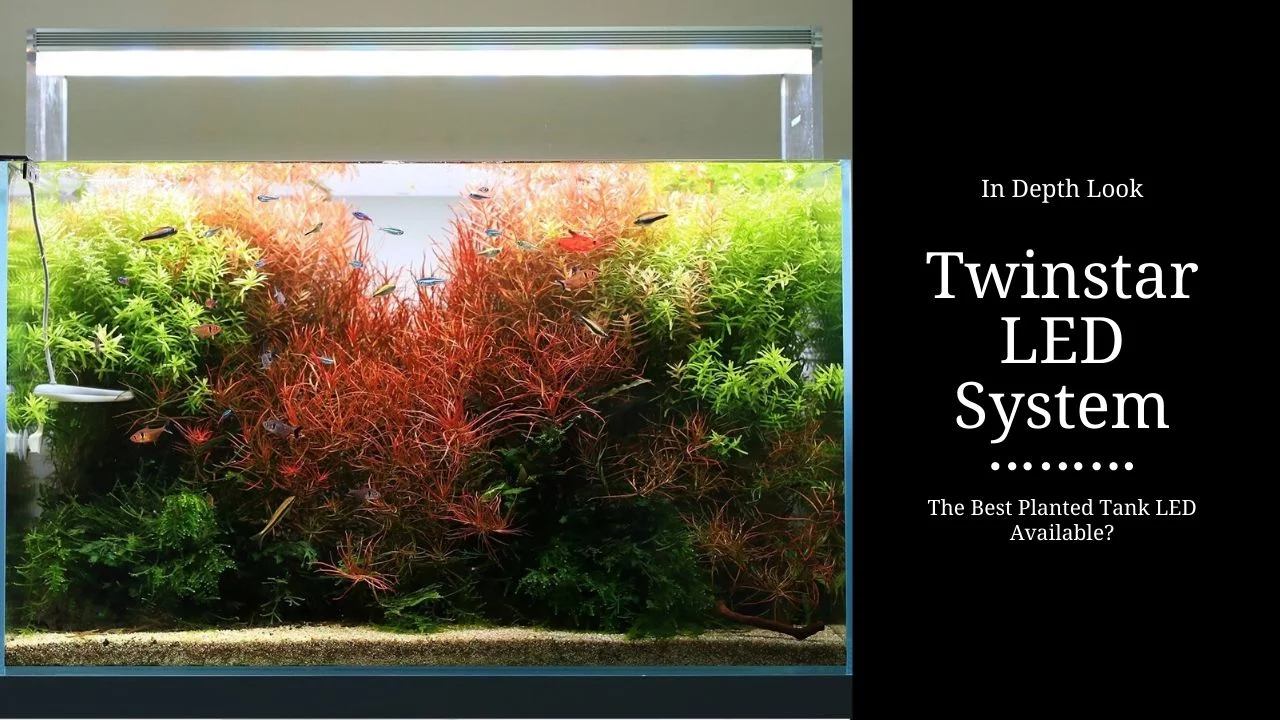
Having a true full spectrum is the big difference factor between a cheap light and a high quality light. Very few LEDs on the market can really bring out the reds of red plants. The benchmark for planted tank LEDs are the ADA Solar RGBs. The problem is the Solar RGB is not only hard to find, but also very expensive. The Twinstar LED light is considered a copy of the ADA Solar RGB spectrum. It’s the gold standard in planted LEDs, without the extreme price of the ADA. The Twinstar LED light also does not have fans, which make them excellent for quiet rooms
Let’s talk about another factor in these lights. These lights come with a diffuser built in. Look at the photo below. You can see the diffuser in action. A diffuser is a must in the planted tank world. If you are growing an aquascape of mostly tall plants like a Dutch Aquascape, shadowing becomes a major deal. The diffuser eliminates the problem. You won’t see this feature in many planted tank LEDs and I’m puzzled why it’s excluded is many other fixtures on the market.
The Twinstar is feature heavy on the core function of the light – PAR, full spectrum, and spread. Regarding controllability that’s where this fixture falls short. There is no fancy controller or app that runs on wifi and you can’t mess with the spectrum through a tuner. I rather like it that way. It makes it simple to use and less prone to electronic failure.
Craftsmanship
Twinstar’s craftsmanship is top notch. The thing I love about this light is there are no fans. That makes the light ideal for quiet rooms. The light is not made in China, and it shows. It’s sleek smooth, and looks very clean presented on a tank. They can either come in aluminum brackets or acrylic ones. I personally prefer the acrylic bracket
Ease of Use
This is by far one of the easiest planted tank LEDs for advanced hobbyists. The light comes with brackets that hold up the light at the ideal height for proper spread and PAR output. Because the LED is designed for the best full spectrum not the highest PAR, it is not necessary to use a PAR meter to adjust the intensity. It’s a plug and play system. All you need is a mechanical timer or smart timer. It’s completely dummy proof. Excellent marks overall by Twinstar!
Value For Money
The Twinstar LED family of lights actually come in multiple flavors that fit every budget and need. Twinstar has a model for all budgets starting from their budget friendly CA series to their premium S series. Their most popular model is the E series. The E series can handle the vast majority of planted tank needs and grow plants efficiency. I would say their E and S series have the most value of all their models. The CA series will have other competitors that may be a better value.
Models For Everyone!
Below is a table showing the main Twinstar LED light models
Feature
Twinstar CA
Twinstar E
Twinstar S
Picture
Price
$
$$
$$$
Output
Low-Light
Mid to High Light
All
Models
300C , 600C
300E, 360E, 450E, 600E, 900E
600S, 900S
BucePlant Link
Amazon Link
Product Support
Product support scores the lowest in my review. Twinstar as a whole doesn’t have much in the way of product support. They have a few videos and their distributor sites are not very helpful. The main source of support you will find is from hobby forums and other aquascapers who use the light to get success. That’s a big difference compared to say Fluval that actually does a number of videos and support behind them.
One way to migrate the lack of support is to purchase the fixture from a high quality seller like BucePlant. Buce has been around for a number of years and their know planted tanks well. Their customer service is excellent and I would prefer to purchase the fixture there over Amazon for that very reason!
Regarding warranty, Twinstar offers a 2 year warranty on all their lights. That is higher than most lower quality aquarium light makers that offer only 1 year, but lower than the 3 year warranty offered by Fluval. I have not heard of many Twinstar lights failing prematurely however. Many last for years due to their simple electronics design.
Price
For many of you looking at this point, the Twinstar will likely be the most expensive light fixture you are researching. There are more expensive units like the Kessil and ADA out there, but most will be comparing these to Fluval, Finnex, and cheap aquarium light alternatives on Amazon. The Twinstar offers the best spectrum and design of all these brands and models. From a spectrum and spread prospective, it’s not even close.
Closing Thoughts
This is the best planted tank LED on the market you can buy today. Best full spectrum, best spread, best value for money. You can see the ratings below from me and my editor’s choice badge that Twinstar earns. Since I’m open to all reviews, you can leave your own reviews below. This provides the community with an unfiltered source of reviews. If you have any questions, please leave them in the comments below. Thanks for reading!
The EcoTech Radion sits at the top of the reef LED market, and it earns that position. I run a 125-gallon reef and I’ve watched the LED lighting space evolve considerably. the gap between a premium fixture like the Radion and mid-tier alternatives has narrowed over the years, but EcoTech still leads in spectrum tuning, app integration, and long-term reliability. The honest conversation for most reefers isn’t “is the Radion G5 good?”. it clearly is. It’s whether your coral goals and tank size justify the price over capable competitors. Here’s my full breakdown to help you decide.
As you may have read in my Best Reef LED round up article. LEDs are the it technology when it comes to coral growing. They have become the tech toys of our hobby and also have become very energy efficient over time. LEDs can be tricky however, as too many features can overwhelm a newcomer and the spectrum of the LED are not created equal among the various players out there.
EcoTech has prided themselves with spending the R&D time and listening to the hardcore Reef community about what is wanted from a proper Reef LED. This new G5 answers a lot of the asks our community has been wanting. Let’s dive in and see what’s new and what means this newest generation the best ever!
My reviews are fairly structured. I’m going to be reviewing the following with this Radion G5:
The EcoTech Radion G5 is a huge improvement over the Generation 4. It starts with the HEI lenses that are the most sophisticated lens design available in the industry for LEDs. The new design cluster and optices cuts hot-spot PAR by 30% while also providing a 35% increase in total PAR output from the prior generation. This means you get a better spread and higher output then ever before.
The new generation 5s come in either a Pro version or a Blue version. For this product review, I’m going to concentrate on the Blue version. The reason why is because I feel that the Blue version is the way to go. Anyone who runs a hardcore reef tank knows the value of blues when it comes to coral growth. The blue version is also designed on the EcoTech’s well known AB+ spectrum setting. The model is completely optimized for this spectrum. This makes the new generation 5 the most plug and play friendly Radion ever. Below are the array outlines of the XR15 and XR 30 models for both the Blue and Pro models.
Just look at that array and see the difference between this LED and many others out there. The number of blues on the Blue model are amazing. What you end up is getting a spectrum that is very close to the gold standard ATI Blue Plus.
The generation 5 has 8 controllable channels. Aside from the new array and lens, the other major difference with the Radion Gen 5 is the new Mobius app. The App makes things so much easier to manage and it comes with the package. You no longer need Reeflink in order to connect your light to your phone. The spectrum and intensity is easily adjusted through the mobile app
The Mobius app also has a user friendly timer setting that allows you to set your light timing and your ramp up and down times. I love the ease of use for this app. I know some of our more hardcore reefers want more out of the app. I’m all about simplicity. EcoTech is really listening to the reef community by making everything so accessible for this Generation 5 model.
Did I mention that the Mobius app has the AB+ as a template within the app? This makes it super easy to set up your Radion to the most popular setting that the reefing community uses.
The blue model makes things so easy for the reef community. I love the new features, the app, and the ease of setup with the new blue model. Excellent job EcoTech!
Craftsmanship
The newest generation design is sleek and modern. It’s what we come to expect with the EcoTech Radion lights. Below is a photo of the external overview of the Radion G5
Regarding the mount options, unfortunately the mounting options from the prior generation can’t be used on the G5 Radion. However, the new design actually gives you more options to hang the unit from a DIY perspective. The mounting arm is raised more than the prior generation, which means you can mount your unit on a rail.
It’s a great design and well engineered. There isn’t much out there in the market today that comes close to the craftsmanship and aesthetics of the Radion. The coolness factor of these lights cannot be denied.
Ease Of Use
The ease of of use of the EcoTech Radion G5 has been vastly improved over the last generation. With the Blue model, all you will need to do is tune down the intensity of the unit in order to get the PAR down to where you need it for your specific corals. The Mobius app makes this so easy compared to last generations. Below is the Mobius program overview video from EcoTech. By looking over this video, you should have what you need to get it started. This is the easiest to setup Radion I’ve ever worked with.
There is a fairly easy way to setup your Radion. Here is a quick guide. I would recommend that you rent a PAR meter from your local hobby club or an LFS so that you can ensure you have the proper PAR levels
Set height to 8″ for the best distribution of PAR
Set all channels on the Blue model to 100% and only adjust intensity for PAR
Photo period – 9 hour peak photo period with 30 minute ramp up and ramp down for a total of 10 hours total
LPS PAR Range – 75-150
SPS PAR Range – 200-350
Value For Money
Many retailers will recommend that you use a single XR30 for a 24 x 24 tank space. If you are using an XR30 for a 24 x 24 space, I would say your value for the Money definitely diminishes for this light. However, I firmly believe you can achieve ideal coverage for a 24 x 24 space, still get your ideal PAR coverage, and get way better value for your money by going with a single XR 15.
How is this possible? It is possible with the new Radion G5 diffusers. I would recommend that you purchase a single XR15 and the G5 Diffuser. This will achieve full coverage of the space and PAR spread for the vast majority of tank setups. Below is a video that discusses the new diffuser.
I actually think the diffuser should come with every G5 light. It was a neccessary item with the last generation for those with SPS tanks. With the new lenses, EcoTech claims that you do not need the diffuser to achieve proper PAR spread. The reason why I recommend it is so you can save money and go with a single XR15 instead of purchasing an XR30. If you are running an all out Acro tank, I would just recommend getting XR15s and mounting it to a hybrid fixture over the XR30.
Product Support
The main selling point for me when it comes to EcoTech is the large amount of reefers who use the Radion LEDs. It’s very easy to get advice on proper spectrum settings. This was a major deal with the prior generation models before AB+ became mainstream.
The biggest issue that always bothered me about EcoTech was their warranty. You only get a 1 year warranty with their LEDs. While this is pretty standard when it comes to lights (Giesemann and GHL are the only high end lighting manufacturer where you will see warranties beyond a year), I just expect if you going to spend the amount of money for this light that you get longer than a one year warranty.
Price
This is an expensive light. There is no way around it. It is one of the most expensive reef LEDs on the market and you truly get what you pay for with this Generation 5 model.
I will also point out that the Kessil 360X is more expensive that than the XR15 – and the XR15 is a superior light in my opinion when it comes to performance for coral growth. The XR15 is marginally more expensive than the Hydra 32 and Red Sea 90. The Hydra used to have a huge advantage with their smartphone app, but EcoTech has gained a ton of ground with the new Mobius app.
I do not feel that this generation of Radions are overpriced anymore. I felt that way with the G2, G3, and even the G4. The G5 has really changed my opinion. As other manufacturers come out with newer models, they pushed their prices up while EcoTech kept their prices with this newest generation. Good on EcoTech, and this light is worth every dollar.
Closing Thoughts
This is the best Reef LED light you can buy today. The newest generation is such a gigantic improvement over the G4. It raises the benchmark for all other LEDs on the market. With competitors looking to mimic what EcoTech does, their prices continue to go up which increases the value of the EcoTech Radion even more.
You can see the ratings below from me. The G5 Radion gets my editor’s choice rating and is now the light of choice for my high end setups. Since I’m open to all reviews, you can leave your own reviews below. This provides the community with an unfiltered source of reviews. If you have any questions, please leave them in the comments below. Thanks for reading!
The return pump is the heart of any sump-based system. it determines flow rate, heat input, noise level, and reliability for everything downstream. I’ve run various return pumps on my 125-gallon reef over the years, and the Sicce Syncra SDC caught my attention because of its DC motor and controller. Here’s my in-depth take on whether it delivers for serious reef setups.
Looking for the very best Aquarium Return Pump available for your tank today? Well, this is the very post you have been looking for as the Sicce Syncra SDC has solved may of the issues that have plagued DC pumps since they were first introduced in the hobby.
As you may have read in my Best Aquarium Return Pump round up article. DC pumps are cursed with multiple issues. The main thing are the failure points and the quality control of the manufacturing. So what happens when we combine one of the most reliable and high quality Italian manufacturers in our industry and DC pump technology? It sounds like a dream combination doesn’t it? It sounds like Sicce may have solved the very issue that has frustrated most us with DC pumps since they were released – reliability!
As a reminder for my viewers, this post will contain affiliate links. An affiliate link means I may earn advertising or referral fees if you make a purchase through my link. I’ve had the pleasure of working with some great partners in the industry and highly recommended working with these links as they happily help hobbyists and content creators support their work. With that disclose away let’s get started! Let’s find out what makes The Sicce Syncra SDC stand out from the crowd!
My Sicce Syncra SDC Review will be fairly structured. I’m going to be reviewing the following for this product:
I’ll start off by giving a quick disclaimer. I’m absolutely unashamedly bias to Sicce pumps. In the 15+ years I have been involved with this hobby, I have been very loyal to them. They have never done me wrong. This DC return pump is an absolute dream. Let’s discuss the crazy amount of features included with this pump:
You may have seen these features in other DC pumps, the main difference here is that Sicce delivers all if this with a FREE controller app that runs on your smartphone. There is no additional accessory to purchase (calling you out EcoTech), The app can actually run multiple Sicce pumps. In fact, it will run any Sicce related product that has wifi enabled. This is an amazing feature that Sicce has added. It’s simply the best in the industry that I have seen from an return pump.
The Syncra SDC is offered in 3 models all built with energy efficiency in mind. The pump meets the needs of advanced recirculating applications and are equipped with integrated intelligence systems.
Craftsmanship
Italian design and manufacturing. That’s the best way to start this section of the review. It’s not a secret in our industry that German and Italian engineering are highly valued. They are known for their quality, effectiveness, and reliability. With the large number of Chinese manufactured DC pumps these days, something that has the original high quality of the Germans and Italians is increasingly rare. It’s one of the biggest things I’ve been with the DC transition as many AC pumps are still made with German and Italian manufacturing and engineering.
The Syncra SDC is no exception. It is 100% designed and produced in Italy. The design if the pump is no frill and functional based. I actually prefer this over the cool looking DC pumps I have seen with blue and red colors. I just want the pump to work for ages. I could care less about the fancy colors of something I only see when I pop open my cabinet.
The biggest proof of craftsmenship by Sicce is their offer of a 5 year warranty. That blows away EVERY competitor on the market at it’s price point. It’s not even close. Ecotech and CoralVue can’t even sniff a 5 year warranty on their pumps. There are only two groups of competitors that will come close to a 5 year warranty. That would be going with an AC return pump or moving up to Abyzz DC pumps that have 10 year warranties. The Abyzz pump however is 3 times the price!
Ease Of Use
The Syncra SDC install is similiar with any DC pump out there that will involve plumbing.I won’t really cover that here since that is a whole separate discussion. However, what I will talk about how easy to use and install their Contrall App is. The video below walks you through the process. I found the install process pretty painless and the fact that you can get notifications on your phone is pretty amazing given this is all included in your purchase of the return pump.
Value for Money
The Sicce Syncra SDC is no doubt an expensive DC return pump. However, let’s talk about the value. It’s priced at the levels of a EcoTech and VarioS. This puts it at the higher end of the market. It is also the only pump that offers a 5 year warranty. If I’m going to invest over $200 on a return pump – I better get a long-term warranty. I’ve heard too many stories of EcoTech pumps failing prematurely.
I’m old school in that I believe a return pump is a purchase and forgot about it for the next 10 years. Sicce is the ONLY DC return pump in this price range that offers this assurance. As such, it’s the only DC pump I recommend for high end builds. It is the one DC pump that truly combines the energy efficiency of DC pumps with the reliability of AC pumps.
Product Support
Given Sicce is headquartered in Italy, they can be sometimes hard to reach. However, in my experience their customer support is responsive, just not in your desired timezone. I do like their registration process and there are plenty of videos online they provide that show how to operate their products. When you register your product, you create a registered customer login where you can login your tickets and get support. It’s a rather easy to use portal.
Price
The biggest con in this product review. They are one of the more expensive DC Pumps on the market. They also have the best reputation for their durability. There prices are more expensive then the Reef Octopus Varios, but on Par with EcoTechs. Given the superior warranty and durability history with Sicce products in general, I feel they are priced competitively. For those at lower budgets, you can’t do wrong with a traditional Sicce AC pump.
Closing Thoughts
The SDC Pumps are available in various sizes. The models are shown below:
Model
Watts
GPH
SDC 6.0
10 – 40 Watts
530 – 1430 GPH
SDC 7.0
20 – 65 Watts
800 – 1900 GPH
SDC 9.0
30 – 90 Watts
800 – 2500 GPH
There is a model for all aquariums. This is the best Aquarium DC Return Pump on the market today without a doubt. Well deserving of my Editor’s Choice badge. You can see the ratings below from me. As I’m open to all reviews, you can leave your own in the comments section and discuss your experience with this return pump. If you have any questions, please leave them in the comments below. Thanks for reading!
A quality CO2 regulator is one of the most important investments in a planted tank. it determines whether your CO2 injection is stable, consistent, and safe for your fish. I’ve tested several regulators over the years and the CO2Art Pro-Elite stands out for specific reasons I’ll break down here. This is my honest review after hands-on use.
Looking for the very best CO2 regulator available for planted tanks today? Well you are in a treat today as I review the CO2 Art Pro-Elite Series CO2 Regulator. I had the pleasure of taking to the CO2Art people about their product and got the full scope on their latest CO2 regulator. If you are a serious aquascaper, or looking to be one, this is the product review for you!
As a reminder for my viewers, this post will contain affiliate links. An affiliate link means I may earn advertising or referral fees if you make a purchase through my link. With that disclose away let’s get started! Let’s find out what makes CO2Art’s regulator stand out from the crowd!
My reviews are fairly structured. I’m going to be reviewing the following for this product:
This is a world class CO2 regulator. It is designed for aquarium safety and precision. The unit can handle systems from nano systems all the way up to 1000 gallons. It is a dual stage regulator. This next gen model now comes with a fully customized solenoid block with a high precision needle value and bubble counter. The System is powered via DC with a power adapter that accepts universal voltage from 100V – 240V. It’s a nice plus from CO2 that they will offer you the plugs for your country and it is a product that is available in both the UK and US.
Having a dual stage regulator is a great idea for planted tanks because it allows you to directly control the consistently of the pressure of the CO2 system. This is a huge advantage compared to single gauge systems that will run into issues with pressure consistency as the CO2 tank empties. The gauges are very easy to read and the brand dial are nice features they have added to this new generation model. The prior generator had plainer looking gauges and the dial looked more standard like what you would see on a CO2 regulator at a bar.
The bubble counter and the needle valve on this regulator are top notch. The needle valve is extremely precise. It doesn’t take a ton of them to bed down. It is fast and accurate from the start!
Craftsmanship
Let’s talk about the craftsmenship of CO2 products and why they are amazing buys. They are top German quality, reliability built regulators. These are not your budget build short-term warranty regulators that you will find on Amazon. CO2Art backs up this top of the line model with a 10 year warranty. The stainless steel finish is great and the power adapter does a good job of getting too hot in your aquarium cabinet. Nothing in this regulator package looks cheap. No corners were cut with this regulator. Amazing work by the CO2Art team.
Ease Of Use (Installation)
Installing the CO2Art Pro Series is fairly simple with the YouTube videos that CO2 Art suppliers on their YouTube channel and with their offer of tech support to their customers. They have no problems getting on on customer support ticket to walk you through the process.
If you are lost on the install – CO2Art offers their instruction manual online here.
Value For the Money
The price for these units are not cheap. This top of the line model is up there with similar top end models. What makes their value stand out though is the warranty and customer support behind the product. There is also a wonderful combo package that CO2Art offers that gets you everything you need. This to me makes this Regulator the best value on the market.
This package comes with the following:
Pro Series CO2Art Regulator
Aluminum Aquarium CO2 bubble Counter
CO2 Art Inline Diffusor
Aquarium CO2 Drop Checker
CO2 Resistant Tubing
All of these comes together at an excellent price price and backed by a 10 year warranty. Want a better discount? Try my discount code ASD10%Off at checkout.
Legendary Customer Support
The biggest differentiating standpoint from CO2Art and every other CO2 regulator seller is their customer support. The customer support is top notch and CO2 offers lifetime technical support for all their customers. The CO2Art team patiently answers all your questions and concerns about install and setup. They will also happily ship this product to multiple countries – US, Canada, UK, Signapore, etc the CO2 will ship internationally. The support team offers you a support portal with online instructions, articles and FAQS. I love their support and they have always been there for me to answer any questions I had.
Price
This is the biggest knock on the Pro-Elite Series CO2 Regulator. It is premium priced and may be too expensive for some. CO2Art does offer a more budget friendly version in the Pro-Series Model. You can also purchase the product off Klarna’s pay later program, which will break up the purchase in 4 installments.
Closing Thoughts
This is the best CO2 Regulator you can buy today. It has it all. The features, the quality, the customer service, and warranty. You can see the ratings below from me. The product gets my editor’s choice rating. Since I’m open to all reviews, you can leave your own reviews below. This provides the community with an unfiltered source of reviews. If you have any questions, please leave them in the comments below. Thanks for reading!
I’m really frustrated and tired of the news about Chloroquine Phosphate. There is so much bad information about Chloroquine Phosphate it has gotten to the point where it’s affecting my business. I’ve been in the marine fish keeping industry for over 20 years. I’ve used this substance on marine fish in quarantine for ages. I’ve been quietly speaking its praises to my fellow hobby club and group members. It’s been my secret weapon for years in battling the most deadly marine fish diseases over the years.
It is a sad day for me today. Today, I had to take down my Choloroquine Phosphate product from my store. I can no longer sell it, and it all started with a generic announcement that became a bad news story. I tried to dispense with the myth that it was a cure for COVID. I was even on the news to talk about it. I was verbally abused by prospective customers through live chat and the phone because I refused to sell the product to them after they openly admitted to me that they were planning to use it for human consumption. I was threatened 3 times by my merchant provider to take off my product from my store or face losing my merchant account and getting my site completely shut down.
Today enough is enough, the product is getting de-listed. But I’m not simply going away. I redirected my old product to this page to educate folks on what Choloquine Phosphate REALLYis, why it’s an amazing product FOR FISH, and my story as to why I ultimately ended up pulling it from my store. So sit down, relax, and enjoy my story. It’s going to be a doozy!
What Is It?
Chloroquine Phosphate, is an antiprotozoal drug used by marine and aquarium hobbyists to treat fish suffering from Cryptocaryon (Marine Ich), Marine Velvet, Brooke, and Uroema.
Chloroquine Phosphate is so well regarded in the marine hobby that it was covered by Advanced Aquarist as a wonder drug. It became the drug of choice for many public aquariums including the Georgia Aquarium. It has been widely used by hobbyists in the early days of the marine aquarium hobby and used in the aquaculture industry since the 70s and 80s.
It is typically unavailable to the majority of the reefing community due to it normally being available through a Veterinarian via a prescription. As you can imagine, it can be very difficult to obtain a prescription for this wonderful medication as there are not many fish vets available who know about the medication or would be willing to prescribe it.
How I Got Started With It
I started the reefing hobby in the late 90s and was a member of the local aquarium club in my area at the time. I was introduced to the process of quarantining marine fish after having several issues with Marine Velvet. Chloroquine Phosphate became an amazing medication. The biggest advantage to it versus copper was that it would work with zero ramp up. This was a huge development because Marine Velvet and Brooke work very quickly against a marine fish. Within 24-48 hours, most fish will die from getting overwhelmed from these diseases.
Chloroquine Phosphate was simply amazing. I never lost a battle with Marine Velvet using this medication. Back then, it was easy to obtain this medication without a prescription because there was this amazing product from Aquatronics called Marex. Marex had just enough pure Cholorquine Phosphate to be effective and also was inexpensive. It was also available without a vet’s prescription. It was my go to until Aquatronics went out of business in the early 2000s.
I have been a promoter of this medication for many years, so much that I have a blog post on how to quarantine fish that details how to use the product. You can see my video below.
How I Got Started With Selling
After Aquatonics went out of business, I was frustrated on how I couldn’t get this medication. The vets around me had no clue what I was talking about and I was hearing more and more that vets weren’t prescribing it anymore. You had to go to a vet who either specialized in marine fish or koi ponds to get the medication. There simply weren’t that many vets around who specialized in fish. So where could I get this medication so I could have a chance against the deadly 3 (Marine Velvet, Brooke, Uroema)?
This is when I found out about Fish Pharmacies. They sold medications to public aquariums and aquaculture facilities who needed the medication to cure their livestock. I was amazed that I could get this medication from them, but the amount they sell you in bulk was quite a lot. You would have to purchase a kilogram at a time while most marine fish keepers would maybe need 50-100 grams max in their medication drawers to get what they need.
I had my stash of Cholorquine Phosphate for my incoming fish for my reef tank. I heard so much on the reefing forums of people racking their brains trying to fight off Marine Velvet with Seachem Copper. It was sad to see so many people fail. Copper is tricky to use while Cholorquine was a one-time medication then you just replace with more medication as you change water. Super easy!
As I heard more and more about people losing fish to marine velvet, I started to sell Cholorquine Phosphate on this site. I had a certificate of analysis showing 99.9% purity of the product. I was the only seller on the web that had such a certificate at the time.
As the availability of Cholorquine Phosphate became more scarce, I started to obtain the medication through labs that would sell to universities. Since I had a commercial license, I was able to procure the product. I was rocking and rolling selling to customers who were saving marine fish life everyday with this wonder fish medication. It was really rewarding getting the emails thanking me for selling them the medication.
COVID-19 And “Chloroquine”
COVID-19 has been a mess for everyone. My own business was affected not just with the general downturn of the economy, but the affect on prices on livestock in the marine hobby. Price for fish and corals skyrocketed 2 -3 x times their usual price as imports closed up and supply became restricted. My fish medication product also became part of the news cycle when the President of the US announced that the U.S. Food and Drug Administration (FDA) had approved the use of hydroxychloroquine against COVID-19.
Unfortunately, the President and most of the media shortened the name of the drug to Chloroquine. In came all the new articles talking about Chloroquine and how it would aid in the fight against COVID-19. Search results exploded for everything Chloroquine. Everyone wanted their hands on it.
It became very easy to confuse the abbreviation Chloroquine with Chloroquine Phosphate. The price of this well loved fish medication exploded overnight. Once an affordable medication, Chloroquine Phosphate was all of a sudden selling for over $400 for only 10 grams. People wanted to use it for human consumption.
At @Storyful, we found an interesting phenomenon: sales of a version of chloroquine phosphate used in fish tanks – yes, fish tanks – have skyrocketed in recent weeks. Jars of the drug not intended for human consumption have gone from $10 to over $400 or higher this month. pic.twitter.com/vAe5dzwUBa
I started getting messaged on my live chat from people asking me if they could use this medication on humans. I told them that it is a fish medication and it is not for human consumption. I got several angry messages in my live chat when I refused to sell them batches of the medication as they openly said they were going to use it on loved ones affected by the virus.
My Interview With NBC News
This was starting to get crazy. I was contacted by a BBC journalist who wanted to talk about the product I sold in my store. They had told me that a man had died ingesting this medication in Arizona. I was horrified and concerned for the public health. I was also cringing when I read the article and it mentioned that the product was a fish tank cleaner (it’s a medication not a fish tank cleaner). They asked me if I was interested in being interviewed on TV about my experience. I was happy to do so. I wanted to dispel the myths about this medication. I spent about 2 hours in meetings with BBC and then my interview was displayed on NBC News.
I felt much better getting the word out. I had chosen to place the medication product as out of stock in my store when I first heard of the FDA announcement. I had a feeling that it would get confused. I was planning to keep it out of stock until this COVID-19 mess was behind us. I wasn’t ready about what was going to happen next…
Shopify Threatens To Shut Down My Store
A couple of weeks passed since my interview with NBC. I was getting ramped up on some new content I was writing and went to check my email. I got a notice from Shopify that my product was removed from my store. The product was marked as high risk due to it being related to the Coronavirus. They sent me a notice stating that there was a risk that I was price gouging and had to provide proof that this wasn’t the case. They wanted to me to provide proof of my historical price of the product and also prove that a major retailer sold the product near the price I sold mine for. I was surprised that my store was threatened to be shut down thinking I was price gouging. I never increased my prices and had positive reviews for my product. I explained myself to Shopify and got everything lifted.
A few days later after my product went offline, it was pulled again for the same reason. I responded to the risk department with all my past communication. I took it further and gave them the interview link to my talk with NBCNews. They apologized and I was listed again. I was told all was good after that.
Shopify Labels My Product As A Pharmaceutical
A few weeks past. My site was getting a curiously high amount of traffic since my interview. Likely due to folks landing on my product page and seeing my product in the search results. Things were looking pretty good for me. I was having a great month despite the lockdown orders and my biggest challenge was supply chain restrictions. I woke up one morning and received another letter from Shopify.
This letter was a bit different. I was having my payments held because Shopify’s risk department had labeled my product a Pharmaceutical. Looking at the terms of service, the fish medication product I sold was being placed under regulated or illegal products or services. This labeled my product as no different than cannabis dispensaries, tobacco sales, age restricted goods or services, weapons, etc. I was floored.
I tried to explain the situation to the risk department. They said my best course of action would be to find another merchant supplier who would be willing to work with my product. This put me in a tough spot. I had my payments withheld during this time and no merchant services provider that was referred to me was answering emails or picking up the phone due to staff reductions related to COVID-19. I was a rock in a hard place.
Since I couldn’t get anyone on the phone and there was risk that this could happen again, I decided to remove my product permanently from my store. I felt bad for my past customers who came to rely on this product to save their sick fish. There wasn’t much else I could do.
What It Isn’t
Now that you know the story and why I won’t relist my product. Let’s talk about what Choloroquine Phosphate isn’t.
It Is Not Fish Tank Cleaner
I have no idea where the news got this information from. It is not used to clean fish tanks. While it does have anti-algae properties, its primary purpose is as a antiprotozoal medication. I said this in my talks with BBC, but for some reason it never showed up in the news article or the interview.
It Is Not A Medication for COVID-19
It was hydroxychloroquine that was approved by the U.S. Food and Drug Administration. They are two completely different drugs. Cholorquine Phosphate is used for humans to treat malaria. The brand name for the drug is called Aralen. Is not the same thing that I sold. My product was the substance in it’s purest form. The drug designed for humans is not pure Choloroquine Phosphate. This is likely why that poor man in Arizona died ingesting it. He had likely overdosed on the drug.
The Food and Drug Administration (FDA) Warns Against Using It
On March 27, 2020, the FDA sent an public health letter to stakeholders warning to not use use Chloroquine Phosphate intended for fish as treatment for COVID-19 in humans. The FDA closed the letter with the following:
People should not take any form of chloroquine unless it has been prescribed by a licensed public health care provider and is obtained through a legitimate source.
You can find the full letter here. Amazingly enough, the letter itself did not receive much news coverage.
What It Is
Let’s talk about what this medication is for fish. It is
Superior to and more gentle on fish than copper
A 10 Gram bottle treats 250 gallons at a 40mg/gallon dosage
Chloroquine Phophate (CP) is the drug of choice for diseases like Ich (Cryptocaryon irritans), Marine Velvet Disease (Amyloodinium), Brooklynella hostilis, & Uronema marinum
One time medication – only replace medication in the event of a water change
Chloroquine Phosphate acts as an algaecide eliminating algae in the quarantine tank.
How to Use It On Fish
Since my product got taken down, I’m going to use the how to use instructions that were on my product page for anyone who attempts to use this on their fish.
For Quarantine (Prophylactic) Treatment – Typical dosage for quarantine is 40mg/Gallon
When dosing Chloroquine Phosphate, treat water with a pre-dissolved solution using a cup of tank water
For Ich – 30 day active treatment
For Velvet – 14 day active treatment
For active infection – up to 60mg/gallon
For Uroema – up to 80mg/gallon
Highly recommended that you use a digital scale to measure your dosage to ensure accuracy
Keep medication in a cool, dark, and dry pace. Chloroquine Phosphate is heat and light sensitive
If a water change is performed, Chloroquine Phosphate will need to be re-dosed for the amount of water changed. You do not need to dose Chloroquine for top off water.
Additional Warnings about Using It On Fish
Here are the additional notes and warnings that were on my product page that I’m displaying for anyone looking into this medication.
NOT RECOMMENDED FOR PIPEFISH, PUPPERS, LIONFISH, SEAHORSES, WRASSES, ANTHIAS, & BLUE HIPPO TANGS!
Not reef safe – Chloroquine Phosphate is meant to be used in a quarantine for prophylactic treatment or in a hospital tank for active infections.
No one ships Chloroquine Phosphate next day If you have an infected fish and you need treatment now I highly recommended going to your LFS and obtaining Copper. Most of the diseases Chloroquine phosphate treats are extremely deadly and can kill a fish overnight
Closing Thoughts
I’m sad to no longer offering this life saving treatment for what I call the deadly 3 marine fish diseases. Hopefully COVID-19 gets past us sooner than later and we can all return to normal. I hope clinical trials go well with the vaccine being developed. Maybe we will see Chloroquine Phosphate offered again as a treatment for marine fish diseases in the future. Right now, the supply chain is on hold due to concerns that people will use it for human consumption. Stay safe. My thoughts are with you all. We will all come out of this stronger. Take care and thank you for reading.
📘 Want to learn more? This article is part of our complete Saltwater Fish & Reef Guide. your ultimate resource for marine fish, coral care, reef setup, and more.
A dedicated shrimp tank is different from a fish tank in almost every way. No copper-based medications. No aggressive tankmates. No sudden parameter swings.
A shrimp tank is not a fish tank with shrimp in it. Build it for the shrimp or watch them die.
Freshwater Shrimp tanks are getting very popular these days. Shrimp with their small size, active nature, and appealing personality has increased in popularity, especially with nano or smaller tanks. Shrimp tanks have some special considerations though to be successful. They is intimating at first because they is more delicate than fish and require a bit more planning than first.
That is not to say they are difficult to keep. In fact, most shrimp are relatively easy to keep, they just require proper planning. That’s what this article is for – to get you on the right track. In this article, I will discuss everything you need to know to get started right.
Key Takeaways
A sponge filter is the go-to for most shrimp tank keepers
If you are going the planted tank route, you must ensure your substrate and fertilizers do not contain copper as it could kill your shrimp
TDS meters are beneficial to determine if your source water is okay. Consider RO or RODI + mineralizing if your TDS is too high
Tank mates are tricky as many fish will prey on shrimp. If they don’t prey on the adult shrimp, they will likely eat the baby shrimp
Freshwater Shrimp Tank Equipment – Getting The Proper Equipment
Below is a video from our YouTube Channel all about how to setup a freshwater shrimp tank. We go over more details in our blog post below. If you like our content, be sure to subscribe.
The first step is figuring out what we need exactly to get started. Let’s start with the biggest consideration – the tank itself.
Tank Size
Bigger is better and more stable. Although shrimp can technically survive in a very small aquarium, the water is prone to fluctuations in parameters and temperatures. This can lead to premature death of shrimp. Shrimp do not like a lot of parameter fluctuations in their tank. In addition, healthy freshwater shrimp will actively breed, meaning you want a bigger tank to support the offspring.
There is also a drawback with going too big. Too big with how small the shrimp are will make your aquarium look underwhelming. Due to this, I would recommend not going larger than 40 gallons with 20 – 29 gallons being an ideal sweet spot to start. A 2 foot long tank will be the cheapest overall to setup.
If you are looking for a cheap used tank, you will need to do some extra diligence when shopping around. Any used tank that has been treated with copper is going to be a major problem with freshwater shrimp. Copper will leech from the silicon seems in a used aquarium and will kill off new additions to your tank. It is critical that you purchase a used tank that has never been treated with copper to ensure long-term success.
Freshwater Shrimp filtration gets a little more complicated with shrimp as you have to account for shrimp fry then the general small nature of Shrimp. A filter can easily suck up shrimp babies and even adults. It is easy to modify your filters to prevent this though., shrimps tanks go with one of the following:
We do not consider Canister Filters with freshwater shrimp. It’s just overkill for this application. Internal filters could work, but the sponge filter is just a great choice to use if you are going internal. If you are going with a Hang On Back Filter, you can’t go wrong with an Hagen Aquaclear Filter.
Sponge Filter – Cheap, easy, and not dangerous to shrimp out of the box. Many shrimp breeders use these in their tanks because they are so easy to use and they work!
Hang On Back (HOB) Filter – Also known as power filters. These are excellent choices, but you have to modify your intake to prevent any accidents. I would suggest you place a sponge pre-filter on your intake in order to prevent any losses.
Heating
An Aquarium Heater is a controversial subject among shrimp keepers, especially those who keep Neocaridina Shrimp, which can live in cooler water. Ideally, you will want your freshwater shrimp in water temperatures of 70 – 79 degrees Fahrenheit though many breeders will say that a heater is not exactly needed with Neocardina shrimp as long as your area does not get too cold during the winter. For heaters, I would recommend Eheim Jagers.
Substrate
With Aquarium Substrate, we have to consider either going with an inert or active substrate. An inert substrate will not affect our water parameters, but will require more supplementation to maintain plants. An active substrate is more suited for shrimp that need softer water, like Caridina shrimp. You will also have more success with active substrate growing rooted plants as nutrients will be available through the substrate. If you are going with an active substrate, consider going with ADA Aquasoil or Fluval Stratum, which is designed for freshwater shrimp.
If we are looking at shrimp that like KH, like Neocaridina shrimp, you may want to consider an inert substrate. I would recommend CaribSea EcoComplete if you are looking for an inert substrate.
If you go with an active soil, keep in mind that your cycle time will be longer. Active soil will produce a lot of ammonia when new and freshwater shrimp are very sensitive to ammonia spikes. Be patient with your cycle and introduce your shrimp when parameters have stabilized.
If you are going with an active substrate, you can consider carpet plants like Monte Carlo. Duckweed and Rotalas do a very good job at protecting your shrimp from high nitrate spikes as they tend to explode in growth when nutrients are high. Also stay on top of your pruning and leaf clean up to prevent decaying matter build up in your aquarium.
Lighting
Freshwater Shrimp and lighting is pretty simple. You can use any decent Planted Tank LED system and you should be able to house the main plants listed. For the best features, I would recommend the Serene RGB Pro LED light if it’s in your budget.
Ammonia, Nitrite are very important to measure when you get started with your tank. As you tank matures, you will mostly worry about your nitrate levels. PH, GH, and KH need to be regularly tested in order to ensure they stay stable with your desired shrimp.
TDS is a new parameter to test when it comes to shrimp keeping. TDS is a measure of total dissolved solids in water. Too much TDS can affect the health of your shrimp and some shrimp are so sensitive, it is more ideal to use water from an RODI System and then re-materialize the water with a supplement like Shrimp Mineral. Below is a chart that lists out the range of TDS levels for specific types of shrimp:
TDS Meters are readily available online and do a great job at getting accurate readings for you. Make sure when you are testing for TDS, that you test your other parameters as well. Everything affects TDS so just measuring TDA alone is not sufficient! Check out our posts on Aquarium Test Kits for more recommendations on test kits. For KH and HG tests, an API Test Kit should work for most shrimp keepers.
Parameters for Neocaridina are as follows:
pH: 6.5 – 7.5
KH: 1-4
GH: 6-8
TDS – 80-200
Water Temp: 65 – 73 F
Parameters for Caridina shrimp are as follows:
pH: 6.2 – 6.6
KH: 2-6
GH: 4-8
TDS: 80-100
Water Temp: 70 – 73 F
Keep in mind these are general guidelines. Caridina and their bee varieties can have various ideal parameters so you will want to do your research accordingly!
How To Set Up
I’m going to borrow a video from my good friend Aaron from Aaron’s Aquatics. This video shows an example setup and the start up process. Aquascaping for Shrimp Tanks are best using the Iwagumi styleaquascape. This is because the large rocks create mountain that are still smooth for shrimp to venture around on. Cholla wood is also great to use for shrimp. Aaron’s video also has a few other recommendations like Catappa Leaves.
Species – Choosing The Right Ones
So you heard me earlier in this post talk about Neocaridina and Caridina shrimp. I’m going to focus on these two types of shrimp in this post.
Neocaridina shrimp are going to be hardier than Cardina shrimp. They are a hardwater species and like KH, which means them best for an inert substrate. If the Neocardina shrimp, the Cherry Shrimp is the most beginner friendly and has the most variety.
Cherry Shrimp have grades that are easy to follow with Red Cherry being the lowest grade and Painted Fire Red being the highest. Their grades are as follows:
Cherry
Sakura
Fire Red
Painted Fire Red
Each grade is more rare and more expensive than the other. Cherry shrimp will breed and grow quickly.
Other examples include Yellow, Blue Dream, and Green. All come from the Neocardina Davidi species. You can get multiple colors, but be aware that over time they will cross bred and you will have hybrids. A variety only tank is more ideal to keep consistent colors.
Caridina shrimp are a soft water, more delicate species of shrimp. They tend to be imported from other countries making them larger when shipped and more prone to die off for a variety of reasons that I will explain later. Caradia shrimp and bring in some exotic colors and adapt better to active soils like ADA Aquasoil because they prefer softer water and tend to fit better in a professional level planted tank because the plants one will go for will demand softer water. Caradina shrimp are highly sensitive to parameter fluctuations and the reason why shrimp tend to get labeled as hard to keep in our industry. One common Caradina shrimp is an Amano shrimp.
There is another type of shrimp that is available called Sulawesi shrimp. These are exotic shrimp that imported. They have high mortality rates when shipping and are an advanced care shrimp to keep.
Here is a simple chart below on Neocardina and Caradina shrimp varieties:
When purchasing freshwater aquarium shrimp, sourcing becomes a major component in your success. With shrimp, you have two sources, importing shrimp and homebred shrimp.
Importing shrimp is what you will find at your local fish stores. If you haven’t seen my Quarantine post, you may not be familiar with the sourcing cycle of imported livestock in our hobby. It is below for your reference:
Imported livestock in general are going to go through multiple distributions to get to your home. This increases stress and the likelihood for diseases. Imported shrimp will also be larger in size, meaning they will have a harder time adapting to captivity. It is common for imported shrimp to experience die off when shipping (picture reference from the University of Florida).
Homebred shrimp on the other hand are going to be hardier in general. They are used being in captivity and tend to be less prone to diseases. Homebred shrimp can also have issues as well if your breeder is not experienced or they are only a generation or two removed from being imported. In general, it’s going to be better to get your shrimp homebred from a local breeder in your area as they will use the similar source water as you (e.g. – tap water). Check your local aquarium societies and social media groups for sources of homebred shrimp.
For those who do not have a local breeder available, I would highly recommend Buceplant. They sell a variety of Neocardina shrimp that would all be excellent choices for your shrimp tank.
Pests – Dealing With Them
Freshwater aquarium shrimp have pests that we need to deal with. Most will come from freshwater plants we purchase. The main pests are:
Planaria is a type of flatworm that will attack and eat shrimp. You can use a Planaria Trap or a No Planaria medication to eradicate the problem.
Hydra is a small aquatic vertebrae. They will sting and poison your shrimp killing them. They can also be treated with No Planaria medication.
Scuds are especially dangerous for newborn shrimp. It is another hitchhiker from live plants. Manual removal is best for these. The reproduce very fast. Another option is to use Bettas or Killifish as they they will happily eat the scuds. Betta are a wildcard for shrimp tanks. Some people go the nuclear route, remove as many shrimp as they can, drop the Betta in and let it eat all the scuds over time. Once the scuds have been eaten the Betta is removed and the shrimp is reintroduced.
Dragonfly Nymphs are nasty predators. They will kill and eat your shrimp and will hunt non-stop. Manual removal is your best bet. There are other options you can do, but they will harm your shrimp.
The best way to deal with pests is prevention though. Consider dipping your plants in a bleach solution (19 parts water to 1 parts bleach) and rising with Primeconditioned water before introducing them into your aquarium or consider quarantining your live plant additions. See the video below from LifeWithPets on how to do a bleach dip for your live plants:
Compatible Tank Mates
You may not be interested in shrimp only tanks, so this list of fish will help with picking ones that will work with your shrimp. One thing you will need to keep in mind is if you add fish, it is going to be very likely that the shrimp babies will get eaten so don’t expect to breed shrimp with fish. There are very few fish that will not eat a baby shrimp if given a chance. You can increase your chances of success by choosing a larger species of shrimp like an Amano. Here is a limited selection of small fish that may work in a shrimp tank:
You need a mix of natural and prepared food to be successful with shrimp tanks. The main natural food we are looking to have available is biofilm. Biofilm is the structure bacteria build to support themselves and grow on surfaces. Shrimp will eat this in the aquarium. Biofilm can grow on your sponger filter, leave litter, mosses, and rocks. The more surface you have available the better for your shrimp. You can also provide “permanent food” like Cholla Wood.
The next is prepared food. Powered Shrimp Baby Food by GlasGarten is a great choice to sustain shrimp babies. For adult shrimp, commercial shrimp food is available for purchase and will do the trick.
It is also a good idea to use a Feeding Tray when feeding your shrimp. This will prevent excess food getting lost in your substrate and keeping the rest of your aquarium clean from food debris. It’s also a nice way to observe your fish.
Tank Maintenance
Shrimp in general are more prone to parameter changes than fish. Staying on top of maintenance is a big deal with shrimp tanks. Many shrimp tanks are also smaller tanks, which make them more susceptible to parameter changes.
Water Quality
Shrimp are sensitive to ammonia, nitrite, and higher levels of nitrate. Weekly water changes are especially important with shrimp tanks. Another factor to consider with shrimp tanks is water top off. When water evaporates, parameters can change. Evaporation just pulls out water, but leaves your trace minerals in. You will want to added pure replacement water. This would be something like RODI water or distilled water to replace your evaporated water. You can use an Auto Top Of System to make things easier.
Shrimp Tank Maintenance Tasks
Additional tasks aside from water changes and top off water would be once a month filter cleaning. Make sure when you clean your filter media that you use your pulled tank water and squeeze the foam or sponges. This will clean out the debris, but will maintain the bacterial colonies in the media. Sponges should last a very long time and shouldn’t need to be replaced. Don’t replace a sponge unless you absolutely have to, and be very careful if you do because of the bacterial colony loss. It’s better to seed a sponge beforehand if you have to replace a sponge.
Another key thing to note about shrimp tank is you need to be very careful when you put your hands in your aquarium. Shrimp are very sensitive to toxins. Detergents, chemicals on plants, flea treatments from pets, flea shampoo, and cleaners are prone a risk for your shrimp. Always make sure you wash your hands before putting your hands in your tank. Reef Safe Soap is your friend and a recommended purchase if you are going to handle a shrimp tank.
Problems – Why They Die
There a number of challenges one can come across with a Shrimp Tank. I’ll try to cover several of them in this post.
Parameter Swings
Shrimp are sensitive to water parameter swings. Having proper tests kits and a TDS meter are you friend. Get in the habit of regularly testing your water on a weekly basis.
Uncycled Tanks
Shrimp are very sensitive to ammonia in the aquarium and with their prolific breeding, they can add on to your bioload overtime. If you are using active substrate like ADA Aquasoil, keep in mind that the substrate will generate ammonia when it is first introduced. You will want to give an active soil like this a good two months before introducing shrimp.
Molting Issues
A common aliment in beginner shrimp tanks. This indicates a lack of iodine in the tank. Most staple food and powered food will serve this function. Fertilizer that is made for shrimp tanks will also include iodine to help support the shrimp’s molting process. Additional items to add if needed would be montmorillonite material powder that you can readily purchase online.
Too Many Males
If you have a shrimp tank with too many males to females, this will present a problem to your population. Males in abundance will overwhelm, stress out, and harass females to the point of death. If you are seeing your females are dropping fast, consider removing a portion of your male population to balance out your numbers. I have provide examples of a female and male shrimp to show you the visual differences. The male is longer while the female has an expanded abdomen section.
Aquarium Heaters
Heater failure is pretty common in our hobby. A failed heater can lead to many shrimp deaths. Heaters will fail on the on position, which will overheat your tank. Consider an Aquarium Heater Controller to prevent a catastrophic event.
Pests
As we mentioned earlier, pests are a major problem in shrimp tanks. Consider using a bleach dip to prevent nuisance pests in your tank.
Toxins
Toxins – especially copper are especially deadly to shrimp. Make sure if you are using fertilizer that your fertilizer is shrimp safe meaning that there isn’t copper in the mix or purchase a fertilizer specially designed for shrimp. Check our our Aquarium Plant Fertilizer post for recommended products.
Poor Source Water
Let’s talk about your source water. In general for freshwater tanks, you is okay using tap water that is treated with a Dechlorinator. If you are going to keep harder to keep shrimp like Caridina shrimp, you will probably need to go with better source water.
Shrimp are very sensitive to copper levels and high nurtients, things that is present in tap water. You will want to look at your city’s water reports to see what is in your water. RODI water is 99% pure H20 for your aquarium and ideal for sensitive species of shrimp. If you use tap water with Caridina shrimp, it’s possible to get quick die off of your shrimp. If you are using RODI water, you will need to remineralize the water when making water changes. You will want to use a remineralizer supplement in order to get the proper elements in your water changes so your shrimp can stay health.
Having baby shrimp dying in large numbers can indicate an inadequate source of biofilm for the babies. Focus on building this up in your tank with more rocks, mosses, leave litter, and consider using powdered food to keep them fed.
Life Span
Shrimp don’t actually live very long. Most shrimp will live 6-12 months in an aquarium, but they breed a lot. This is also why having a single variety of shrimp is a big deal because generations pass quickly and within a couple of years you will have hybrid shrimps in your tank from the new generations.
Closing Thoughts
Freshwater shrimp tanks are loaded with personality and if bigger shrimp are selected, they is manageable for a beginner. Shrimp tanks are a niche in our hobby with challenge levels for everyone and it is really exciting to have an actively breeding tank.
They can really be a lot of fun to keep and with their smaller sizes, your wallet will thank you versus going for a much larger tank :). If you have any questions, please leave a comment below. Thank you for reading.
Let me be straight with you: no fish tank truly cleans itself. That’s marketing language. What “self-cleaning” actually means in practice is that certain tank designs minimize manual maintenance through better filtration, bottom-draining systems, or biological setups that handle waste more efficiently than a standard aquarium. After testing dozens of tanks over 25 years, I’ve found some genuinely reduce the time you spend on upkeep. and some are just all-in-one tanks dressed up with clever branding. The ones worth your money share a few traits: solid filtration for their volume, easy water change access, and build quality that holds up. Water changes are still non-negotiable. no tank eliminates them. but the right design can cut your maintenance time significantly. Here are 7 that actually deliver.
Are you wanting to keep a fish tank, but don’t want to deal with the hassle of cleaning it? Do you want a low-maintenance aquarium? Perhaps you want to try out aquaponics and grow vegetables with your aquarium? If any 3 questions peak your interest, than purchasing a self cleaning fish tank for you is the answer.
That’s what this post is all about today. Finding self-cleaning tanks that are easy to use and maintain.
What Makes A Good Self Cleaning Fish Tank (My Criteria)
When selecting determining the best self-cleaning fish tank on the market we looked at the following factors:
It is easy to use and setup?
Can you grow vegetables with it?
Is the price reasonable?
It is really low maintenance or is it just a gimmick?
So now the moment you have been waiting for! Below is the list of the best self-cleaning fish tanks on the market today. I put the preferred choices at the top for ease of selection for you. There will be affiliate links below. An affiliate link means I may earn advertising or referral fees if you make a purchase through my link.
With that disclosure out of the way, let’s get into the reviews!
I absolutely love the concept behind the Aquasprouts Garden kit. It is completely nature focused. The goal of the kit is to have the the plants and vegetables grow and take in the nutrients from the inhabitants in the tank. At 10 gallons in capacity, this not only gives you enough space to grow a sizable amount of vegetables, but also house a good amount of fish. In my opinion, this is the best aquarium kit to introduce yourself to aquaponics and is a poster child for a self-cleaning fish tank.
It is based off a custom-molded garden bed that fits over a 10 gallon tank. The kit also comes with a light bar where you can mount a grow light to grow your plants. I love how the bar can be extended to accommodate taller plants. The light bar allows you to place this aquarium where you want. You will not have to worry about getting enough natural light with this kit.
The water pump that comes with the kit pushes water up to the grow bed, which feed up to the clay pebble grow filter media. The dirty water with fish waste provides nutrients to your plants. The grow bed then drains down to your aquarium providing clean water that is aerated from the surface agitation.
The company mission for AquaSprouts is very heart warming. Founded by Jack Ikard, his original goal was to grow organic food in an urban environment. They were established in Austin, Texas. They are a home grown company. Their award winning AquaSprouts kit has been featured in The New Year Times, Good Housekeeping, and Wired.
This is a true self-sustaining aquarium and is low maintenance. This is the best kit on the market. There are many imitators, but this is the original. If you want to get involved in Aquaponic or just have a self cleaning aquarium, this is the aquarium kit to buy.
The only drawback with this kit is the price. It is a well made and created and manufactured in the US. You get what you pay for with this tank kit.
If the price of the Aquasprouts garden steers you away or if you are looking mostly a tank that cleans itself, this is a great alternative. This Tank by Back To Roots is a good blend of Aquaponics and a self-cleaning fish tank.
The aquarium kit comes with everything you need to get started and will go plants year round. Weighing in at 3 gallons, it is large enough to host a small pet fish. It functions like the Aquaspourts is that the fish waste from the aquarium feeds the plants above.
This tank like the AquaSprouts is also made in the USA. As a certified B Corporation, they have dedicated their mission to have the highest standards of social and environmental impact.There mission is to reconnect family and kids to where food comes and experience the joys of growing food themselves. The makers of the product have a solid social following and the founders have featured on Forbes, NowThis, and even received The Champion of Change Award from President Obama. Below is a video from the founders explaining their product.
This is a great product at a great value. The only downfall is the size. It is isn’t designed for large vegetables, but it is more user friendly and cheaper than the Aquasprouts. It also does not come with a light stand, so you will need to place this near a window or get a clip on light source for it.
The biOrb Aquariums by OASE are a aquariums that are built for simplicity. If you read my Best Canister Filter review blog, you know that I’m a big fan of OASE. Their filtration units are the best of the best and they have the same commitment with this aquarium.
I’m not a fan of fish bowls myself, but this aquarium is the exception. This aquarium is small and simple. It has everything you need to get started – lighting, pump, filtration and solid instructions. At 4 gallons, it is just the right size to house some quality nano tank fish, including Bettas.
The filtration is air driven and works a lot like the old school under gravel filters. The difference is that there are filter cartridges in the bottom of the intake.
What you get here is a filter that is designed like a professionally built commercial pond. The filtration unit pulls in dirty water to the bottom and filters out clean water from the top. It’s a genius design and makes this simple and self cleaning.
The biOrb has the potential to be self cleaning with modification. You can grow low light plants in this kit. In fact, there is a great video by charlieflyte who nailed it. Check out his video of his biOrb.
It is cheaper than the Aquasprouts and Back to Roots kit and is perfect for you if you just want an aquarium. For the quality that you get from OASE, the price cannot be beat. It is well deserving of my budget option badge.
Pros
Big for a fish bowl
Complete filtration
Built for simplicity
Cons
Not true self cleaning
Won’t grow vegetables
4. EcoLife Aquaponics Indoor Garden System – Biggest Aquaponics Kit On The Market
The EcoLife Aquaponics Indoor Garden System is the heavylist on this list. This is an aquaponics kit that supports a 20 gallon aquarium. You can grow plenty of vegetables with this kit and keep a good amount of fish. This is the only tank on self cleaning tank that can support a goldfish due to its size. Others can, but goldfish get large so over time they would outgrow the tank. They also tend to be hard on a tank’s bioload.
This kit includes the LED light fixture to grow vegetables. I really like this. It takes away a lot of the guess work. The LED light is also a natural spectrum versus a glow light spectrum. This compliments your home better versus having that weird red grow led light shining above your aquarium.
This is the most expensive aquarium kit on the list by a long-shot. It’s a bit too expensive for me to put this as my top choice. It is a great choice if it is within your budget.
Looking for something bigger than the biOrb Classic? The biOrb flow is a step up in size and functionality. At 8 gallons in size, it is a a great potential first time aquarium. It is built off the same principals as the Classic with a filter than pulls from the bottom and pushes out to the top.
This aquarium is made of acrylic instead of glass. Acrylic makes this aquarium super durable, lightweight, and clear. The best benefit from acrylic is the clarity. Even a low iron aquarium has less clarity than acrylic. This also explains the price for this aquarium. it’s more expensive then similar sized aquariums.
It won’t grow vegetables like the aquaponic kits, but for a fish keeping focused aquarium, the concept is great. It is a simple to use aquarium.
Pros
Size
Complete filtration
Built for simplicity
Cons
Expensive
Not true self cleaning
Won’t grow vegetables
6. EcoQubeC Aquarium – The Kickstarter Project With Potential
The EcoQubehas a ton of potential. My favorite part of this aquarium is the filtration box located in the back of the aquarium. This houses the intake and 3 stage filtration unit away from the rest of the tank. This give this aquarium one of the cleanest presentations among all the others in the list. The light that comes with it is adequate to grow vegetables.
Now let’s get to what I do not like with this product. The grow area will only hold one plant. This really limits what you can grow and do with it. The tank is only 1 gallon in size, which theoretically is inappropriate for most fish. I’m always a bit annoyed when I see Betta fish advertised in these products knowing that long-term a tank this size is not healthy for them.
Lastly, it’s not readily available. It’s still a kick starter project. Perhaps over time as it improved I can rank it higher on the list. I really love the concept and they are still improving the product. If they can get the product to a 3 or 5 gallon aquarium, then I can see it’s potentially fully realized.
As Seen On TV My Fun Fish Tank is a straight to the point concept — Namely, how to make an aquarium that truly cleans itself. It accomplishes this by sucking out dirty water with gravity when you add new water in. What happen is dirty water gets sucked out as your new water gets added in. This is as easy as it gets for a self-cleaning fish tank.
The price on this product is rock bottom. It’s easily the cheapest self-cleaning fish tank on this list, it is also the smallest. The concept is amazing and I know it sells like hotcakes online.
My biggest gripe is that it’s too small for fish. At only 1/2 a gallon in capacity, I couldn’t recommend this tank to anyone for keeping fish. This makes the list because the price is so attractive and I wanted to keep it on here so I can talk about how it’s too small for fish.
I would probably put a ghost shrimp in here at most. It’s a novelty item and I would expect to upgrade to something more in the future. If it was a 3 gallon tank that removed fish waste like it does on the infomercial, I feel the concept would be amazing and would have the potential to bounce the biOrb out of the top of budget option list.
Pros
Cheap!
Truly self cleaning
Simple to use
Cons
Too small for fish
Cleaning system has issues clogging
More novelty than function
My Recommendation
The best self-cleaning fish tank in my opinion is the Aquasprouts Garden kit. It has the ideal size at 10 gallons, it will grow plenty of vegetables, and the decision is mean to be true self cleaning with nature doing all the work for you.
The Back To Roots garden is the best value on this list. It is cheaper than the Aquasprouts and still big enough to achieve the self-cleaning goal and will grow simple vegetables.
The BiOrb is a great budget option. It nails self cleaning with its bottom up filtration approach and can become fully self cleaning with the right plant setup.
Who Should Buy One?
They should work for practically anyone, but I feel they fit best for the following people:
If you dislike the cleaning an aquarium
If you do not have time to clean or feel like it’s a tedious job
You want to give the tank to a child
The last option is what I feel puts you in the best category to purchase a tank like the ones on the list. If you have a child, they can learn a lot from having an aquarium and if you are growing vegetables from it, it is a great family activity and learning activity.
Frequently Asked Questions
Below are usual questions I get from readers. I’ll do my best to add more as people ask. Let a comment below in the post if you have further questions.
Another Alternative
Another alternative to self cleaning fish tanks is creating a low light planted tank where the plants soak up the nutrients and your fish load is on the lighter end. This is a techique that has been popularized by a few YouTuber influencers.
There is actually a local fish store that has successful run without water changes for years. Cory at Aquarium Co-Op interviewed them on his YouTube channel. Check it out below:
Admittingly, a no water change freshwater tank is something I have little experience. I have achieved a successful reef tank with no water changes overtime. The main hurdle you run into with freshwater systems is the need to fertilization if you are aquascaping. Running no water changes is more of a natural style that conflicts with many aquascapers. Nevertheless, it is achievable and something you can look into if you want a self cleaning fish tank that runs off nature. The video gives you a lot of food for thought :).
Closing Thoughts
Self cleaning fish tanks are a new concept in our hobby. I really like the approaches I’m seeing from manufacturers. Some want to tackle it with aquaponics and others want to build an easy to use system. I feel that big approaches are great and one approach will fit your wants. If you have any questions, please let a comment below. Thanks for reading. Until next time
Aquarium Hobbyist Clubs and Societies: The Complete Directory
Table of Contents
Local aquarium hobbyist clubs and societies are one of the most underrated resources in this hobby, and I say that after 25+ years of keeping fish. The knowledge inside a good local club. from breeders who’ve been at it for decades, to members willing to share cuttings, fry, or equipment at cost. is genuinely hard to find anywhere else. I’ve made some of my best hobby connections through club events and auctions. If you haven’t looked into your local club yet, I strongly encourage it. Below is a comprehensive list of aquarium hobbyist clubs and societies organized by region to help you find one near you.
Aquarium hobbyist clubs and societies can provide incredible learning experiences with the vast number of hobbyist veterans willing to help you out. Many are closer to you can you think. We encourage anyone who keeps freshwater or saltwater aquariums to join an aquarium club. They can provide many learning opportunities, mentorships, and a great way to make new friends. The tank tours alone are worth stopping by!
Since many of these clubs do not market themselves, Aquarium Store Depot has provided a list so that you can find the closest one to you. There are aquarium clubs popping up throughout the States all the time so if you have one that we have not listed, please e-mail us at info@aquariumstoredepot.com or contact us and we will get the list updated:
One underappreciated benefit of joining local clubs is access to a mentorship network. Most experienced hobbyists in these groups are genuinely happy to answer questions, do tank visits, or help troubleshoot a problem. You also get early access to members-only auctions, where locally bred fish, home-grown plants, and coral frags often go for a fraction of what you’d pay online. For beginners especially, this community knowledge base shortens the learning curve dramatically and makes the hobby far more enjoyable from day one.
What to Expect From Aquarium Hobbyist Clubs
Most aquarium hobbyist clubs operate on a simple model: members pay a small annual fee to fund events, speakers, and a shared library of books and equipment. Monthly meetings typically include a program segment (a speaker or demonstration), a Q&A, and an auction where members bring in frags, fry, cuttings, or equipment to sell or trade. This is one of the best ways to get rare or locally bred species that you’d never find at a big box store.
Freshwater aquarium hobbyist clubs tend to focus on planted tanks, cichlids, bettas, native fish, and general community fish. Marine and reef aquarium hobbyist clubs (often called reef clubs or SCMAS) center on coral propagation, SPS and LPS care, equipment reviews, and tank tours. Many clubs now have hybrid memberships that welcome both freshwater and saltwater hobbyists.
Whether you’re new to the hobby or decades in, aquarium hobbyist clubs and societies remain one of the most underrated resources in fishkeeping. Most aquarium hobbyist clubs host monthly meetings, livestock auctions, and equipment swaps where you can find rare species at a fraction of retail prices. Many aquarium hobbyist clubs also maintain active online communities if in-person attendance isn’t possible. If you’ve been considering joining, this grand list of aquarium hobbyist clubs and societies is a great place to start.
Join local aquarium hobbyist clubs to meet fellow fishkeepers.