

Thank you for visiting! By the way… any links on this page that lead to products on Amazon and other stores/partners are affiliate links Aquarium Store Depot earns a commission if you make a purchase.
Table of Contents
- Why Chili Rasboras Do Not Look Good in Most Tanks
- What Most Care Guides Get Wrong About Chili Rasbora
- Expert Take
- Species Overview
- Classification
- Origins and Habitat
- What Do They Look Like?
- How Big Are They?
- How Long Do They Live?
- Temperament And Activity Level
- What Are Good Tank Mates?
- What Do They Eat?
- Setting Up Your Fish Tank
- Water Quality
- Aquarium Maintenance
- Breeding
- Where To Buy
- FAQs
- Is the Chili Rasbora Right for You?
- What It Is Actually Like Keeping Chili Rasboras
- How the Chili Rasbora Compares to Similar Species
- Final Thoughts
Chili rasboras are one of the most beautiful nano fish you can keep. But in the wrong setup, they disappear completely and never show their true color. I have seen people buy a school of 12, add them to a bright, bare tank, and wonder why they never see them. The fish are there. They are just hiding, stressed, and washed out. Build the right tank and chili rasboras are breathtaking. Skip the setup work and you have invisible fish you paid premium prices for.
Do not add chili rasboras to a tank that has been running for less than three months. They need mature water. Period.
Why Chili Rasboras Do Not Look Good in Most Tanks
Most people who buy chili rasboras never see the fish at their best. The problem is almost always the setup, not the fish.
Too few fish. Keep fewer than 10 and they hide constantly. Their confidence comes from numbers. A school of 6 looks terrible. A school of 15 transforms the tank.
Too much light. Bright lighting washes out their red. They look best under moderate or diffused light with a dark substrate underneath.
Not enough plants. Without dense planting they have nowhere to feel safe. They retreat to corners and you never see their natural swimming behavior.
Wrong tank mates. Anything bigger than 2 inches makes them nervous. They need dedicated nano setups or very carefully chosen companions.
Chili rasboras do not stand out. They come alive when the tank is built around them.
What Most Care Guides Get Wrong About Chili Rasbora
The most common mistake I see with chili rasboras is keeping too few. Guides will say “minimum 6” and leave it at that. In reality, these fish behave completely differently in a proper group of 8 to 10 or more. Keeping just 3 or 4 often leads to stress, hiding, and fin nipping that wouldn’t happen in a larger school. Another thing most guides miss is how much lighting and decor affect this species. Chili Rasboras look washed out under bright white LEDs on a light substrate. Dim the lights, add some tannins, use a dark background, and you’ll see colors you didn’t know they had. I’ve also noticed that many care sheets recommend overly broad water parameters. Yes, chili rasboras are adaptable. But “adaptable” doesn’t mean they’ll thrive in just anything. In my experience, keeping them closer to their natural soft, slightly acidic conditions brings out the best color and longevity.
Expert Take
Never keep chili rasboras in groups smaller than 10. The commonly recommended minimum of 6 is not enough. In my experience, 10 is where they start acting like chili rasboras instead of acting like scared fish hiding behind a filter.
Species Overview
| Scientific Name | Boraras brigittae |
| Common Names | Chili rasbora, Mosquito rasbora |
| Family | Cyprinidae |
| Origin | Borneo, Southeast Asia |
| Diet | Carnivorous |
| Care Level | Moderate |
| Activity | Active |
| Lifespan | up to 8 years |
| Temperament | Peaceful |
| Tank Level | Midwater |
| Minimum Tank Size | 5 gallons (10G recommended!) |
| Temperature Range | 70 ° to 82 °F |
| Water Hardness | 3 to 12 dkH |
| pH Range | 4 to 7 |
| Filtration/Water Flow | Low |
| Water Type | Freshwater |
| Breeding | Egg layer |
| Difficulty to Breed | Moderate |
| Compatibility | Community tanks |
| OK, for Planted Tanks? | Yes |
Classification
| Kingdom | Animalia |
| Phylum | Chordata |
| Class | Actinopterygii |
| Order | Cypriniformes |
| Family | Cyprinidae |
| Genus | Boraras |
| Species | B. Brigittae (Vogt, 1978) |
Origins and Habitat
Chili rasboras are native to Borneo in Southeast Asia. Their natural habitat consists of pools in blackwater streams with extremely soft, and quite acidic water.
The water is often full of aquatic and floating plants and partially shaded by the forest trees above. Plenty of leaf litter accumulates in the water and stains it a dark color, creating quite a dim environment.
The chili rasbora (Boraras brigittae) is the most popular of a few closely related Boraras species. If the word ‘boraras’ sounds a little fishy, that’s because it’s an anagram of the word r-a-s-b-o-r-a. Who says fish scientists aren’t fun?
What Do They Look Like?
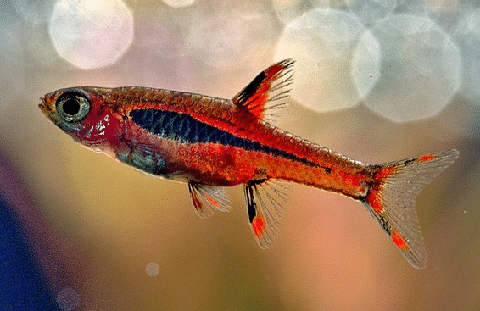
The chili rasbora (Boraras brigittae) is a tiny nano fish with bold looks. The first impression when seeing this species is a very small, reddish fish with bold markings and huge eyes.
The males have deeper color but are smaller and more slender than the females, which also have rounder bellies. Dominant male chili rasboras become especially colorful, turning a deep red shade.
There is a characteristic black stripe on the sides of the fish’s body which can shine blueish green in good light. Just above this black stripe, you’ll notice a bright red or orange line.
Another stand-out feature is the red patch on the fish’s gill plate. This makes these nano schooling fish look like they have rosy cheeks!
To top it off, chili rasboras have great-looking fins. The base of their tail, and their dorsal and anal fins also have black and orange spots and markings.
How Big Are They?
If you thought something like a neon tetra or a guppy was small, just wait until you meet the chili rasbora! Chili rasboras are one of the smallest fish in the hobby, maxing out at less than an inch in total length.
In fact, a full-grown adult will only reach about 0.8 inches with good care. The male chili rasbora is slightly smaller and slimmer in build than the female.
How Long Do They Live?
Chili rasboras have a surprisingly long lifespan for such a small fish. In the right conditions, these hardy fish can live for up to 8 years!
To keep your fish living longer, make sure you provide them with a healthy and varied diet, a comfortable tank setup, and perform regular maintenance to keep your water quality pristine.
Temperament And Activity Level
The chili rasbora is a pretty outgoing and confident little fish if kept in the right kind of tank setup. With larger fish as tank mates, however, chili rasboras are timid.
They spend most of their time up around the middle and top levels of the aquarium, but they show up just about anywhere too. The chili rasbora is known as a schooling fish and they are very social, although they do not always group tightly.
Chili rasboras are very peaceful fish, so you don’t need to worry about them picking on any other fish in a community tank.
What Are Good Tank Mates?
The chili rasbora is a tiny fish, which can make choosing suitable tank mates a little challenging. Many fish keepers prefer to keep chili rasboras in species-only aquariums because they work so great in schools in nano tanks.
These fish will get along with most other peaceful fish, however, as long as they are not big enough to eat your rasboras.
Read on to learn more about the best (and worst) tank mates for chili rasboras.
Best Tank Mates
The best tank mates for chili rasboras are other peaceful nano fish. Let’s take a look at some of the best tank mates for these amazing fish:
- Harlequin rasbora
- Otocinclus catfish
- Pygmy corydoras
- Rams
- Dwarf pencilfish
- Betta fish
- Sparkling gourami
- Zebra danios
Least Compatible Fish
Chili rasboras are so small that many of the most popular tropical aquarium fish will likely swallow them whole. As a general rule, avoid keeping them, with anything over about 2.5 inches long.
You’ll also want to avoid any predatory fish, aggressive fin-nippers, and boisterous species that could outcompete them for food.
Here are a few common aquarium fish that will not make good tank mates for chili rasboras:
- Cichlids, except for rams
- Most catfish
- Angelfish
- Goldfish
- Golden wonder killifish
- Tiger barbs
- Oscars
Inverts
The chili rasbora is one of the safest fish to keep with dwarf shrimp. That being said, they are micro-predators so they will feed on tiny baby shrimp that have just hatched. If you plan on breeding your shrimp, a shrimp-only setup would be wiser.
Here are some shrimp that you can keep with the chili rasbora:
You can also keep snails with your chili rasboras. Snails do a terrific job of keeping an aquarium clean, but some species can really multiply fast. Nerite snails are a great choice because they look amazing, eliminate algae, and best of all, they won’t breed in your fish tank!
What Do They Eat?
The Chili rasbora is a micro predator that feeds on tiny insects and bugs. The name mosquito rasbora is probably a good clue as to what these tiny fish love to feed on in nature.
Think small when looking for food for these fish. They will do great on a diet of fish flakes and nano pellets, but supplementing with live/frozen foods will bring out the best condition and color in these nano fish. A good micro pellet formula is Xtreme Aquatics Foods Nano.

Xtreme Aquatic Foods Nano
Xtreme Aquatics Nano formula is specially designed for smaller fish and contained a well balance mix of raw ingredients. It is a great staple food for your nano fish.
Let’s take a look at some of the types of food you can feed the chili rasbora:
Prepared Foods
- Crushed flakes
- Micro pellets
Live & Frozen Foods
- Daphnia
- Tubifex
- Chopped bloodworms
- White worms
- Micro worms
- Mosquito larvae
- Baby brine shrimp
How Much And How Often To Feed Your Fish
Chili rasboras need to be fed regularly, at least once a day. It is better to feed these tiny fish small amounts two or three times a day, however.
The chili rasbora is often kept in nano tanks as small as 5 gallons, but this makes overfeeding especially dangerous. A bunch of uneaten food in such a small volume of water can cause dangerous ammonia spikes.
So how do you know how much to feed your fish?
When you go to feed your chili rasboras, watch them eat- they should finish all the food in just a minute or two. Feeding them this amount 2 or 3 times a day is a great way to keep your fish well-fed, without creating too much waste.
Setting Up Your Fish Tank
The chili rasbora (Boraras brigittae) is right at home in a nano tank. They do best in a planted tank with a dark substrate and low water flow. Chili rasboras love live plants, and floating types are a great choice.
Read on to learn more about how to set up a great chili rasbora tank!
Tank Size
The chili rasbora is one of the smallest freshwater fish in the aquarium trade, so they make a great choice for fish keepers who don’t have a lot of space.
A small group of these nano fish can thrive in tanks as small as 5 gallons. This would be the minimum tank size, however, and if you’re new to fish keeping, I’d recommend a larger tank like a 10 or 15-gallon.

Serene Aquarium
The perfect first time aquascaper tank. Comes with dragonstone rock. Just add filtration and plants!
Remember, the smaller an aquarium, the faster things can go wrong, so go slightly bigger to be on the safe side. A ten-gallon tank, for example, will be easier to maintain and allow you to keep an awesome little school of about 20 of these fish quite safely.
Plants
Chili rasboras do really well in a planted aquarium. Not only will your fish feel more at home between the leaves and roots, but live plants also have a number of great benefits when it comes to maintaining the high water quality these fish need.
If you’re not already a planted tank enthusiast, consider picking up some common and easy to grow species like:
These aquarium plants don’t need much maintenance and they won’t take over your tank too fast. Down the road you can look at improving your lighting, picking up some aquascaping tools, and investing in a CO2 injection system. I must warn you though, that the planted aquarium hobby can be addictive!
Go ahead and browse through some of the great plant care articles on this website to learn more about specific species and their care.
Substrate
Chili rasboras look (and feel) their best when kept over a dark substrate. You can use a fine gravel or sand substrate as long as it is well rinsed and aquarium safe. If you plan on setting up a heavily planted tank, an aquarium soil would be a great option.
Decor
Chili rasboras like plenty of structure in their environment where they can hide out from predators. Fine driftwood like spider wood is great because it mimics the tangled roots and branches these fish are used to in their natural habitat.

Spiderwood
Best Value
A budget priced and easy to use driftwood. A great beginner aquarium decoration
Water Quality
The chili rasbora is actually really adaptable to a wide range of parameters, but they do require good water quality. They should never be added to an uncycled aquarium or kept in a tank with unstable or poor water quality. Consider doing a fishless cycle to make sure you start on the right foot.
Filtration
Filtration is vital because the chili rasbora requires, stable, high-quality water with zero nitrites and ammonia. This means your aquarium needs to be cycled before you introduce your fish.
If you’re not sure how to cycle a new aquarium, go ahead and check out my article on aquarium cycling to learn everything you need to know about this vital step!
The type of filter you choose is not that important as long as it is a good size for your tank. The most important factor to consider is that chili rasboras are tiny and they will get blown around in a strong current. They can also be sucked into strong filter intakes, so you might want to choose a model that has a prefilter sponge.
Water Parameters
The chili rasbora prefers a water temperature anywhere between 70°F and 82°F, with something around the middle of this range probably being ideal. Use a heater to keep the temperature stable in your tank.
These fish prefer soft water that is slightly acidic. Aim for the following parameters:
- pH: 4-7
- GH: 1-2
- KH: 3-12dKH
The chili rasbora needs really good water quality in order to thrive. Your water test results should always read zero ammonia, zero nitrite, and less than 20 ppm nitrates.
Aquarium Maintenance
Regular aquarium maintenance is the only way to keep nano tanks clean and safe for your fish. Performing a partial water change of 20-30% per week is a good way to keep nitrate levels in a safe range.
Be sure to remove any dead or dying plant matter, and suck up the dirt and waste that accumulates on your substrate with a gravel vacuum. If necessary, you can also rinse out your filter sponge media in the water you have just taken out of the tank. Remember to look after those precious beneficial bacteria!
Your tap water probably contains chemicals like chlorine or chloramine that are added to keep the water safe for human use. Unfortunately, these chemicals are toxic to fish, so make sure you use a water conditioner to neutralize the harmful effects.
Testing
The only way to know for sure if your maintenance schedule is appropriate is to test your aquarium water. Get yourself a test kit that can measure the following parameters:
- Ammonia
- Nitrite
- Nitrate
- pH
- GH
- KH
Test kits are really easy (and fun) to use. They work either by adding a drop of solution to some aquarium water in a test tube or by simply dipping a strip into your tank. All you need to do next is watch for the solution or strip to change color, and compare the results with the provided chart.
You should test your aquarium water before introducing your fish. This way you will know what your pH and water hardness are out of the tap.
If your tap water pH and hardness are too high, you need to use rainwater or RO water in your tank. Avoid using distilled water that is not remineralized.
Breeding
Breeding rasboras at home is a fun hobby that anyone can do with the right knowledge. Building up a big school can be a slow process, however, because these tiny fish only lay a few eggs at a time. Here is a wonderful video above by Mark’s Aquatics that goes into great detail. I have a few summary points below. Here’s what you need to know:
Sexing
Before you can breed these fish, you’ll need to make sure you have both males and females. The female chili rasbora grows a little larger than the males and will also have a rounder belly. Dominant male chili rasboras will turn a bright and deep shade of red.
How They Breed
The chili rasbora is an egg-scattering fish that doesn’t show any parental care. This means they won’t look after their eggs or fry. If your fish are happy in their tank and in good condition, they will start breeding on their own and you might even spot some babies after a while.
If you want to breed this species in a more controlled way, you’re going to want to set up a separate breeding tank. The breeding tank only needs to hold 3 gallons or so, and a small sponge filter will work great for aerating the water and maintaining water quality.
Conditioning And Breeding Your Fish
Start by feeding your fish high-quality foods like micro worms and brine shrimp for a few days to bring them into peak condition.
Next, add some well-conditioned adults to your breeding tank and if they are happy, the female chili rasbora should lay eggs after a day or so. Remove the breeding fish and the eggs will start to hatch after about 2 days.
Raising Fry
Chili rasbora fry need to be fed from their second day after hatching. Feed them infusoria. The fry are very small after hatching, so wait at least a week before doing a water change to avoid sucking them up by accident.
Health & Disease
The chili rasbora is known to be hardy fish, but like any species, they are susceptible to various health problems. Read on to learn how to evaluate your fish’s health, and which problems to look out for.
Evaluating Your Their Health
Whether you’re picking out fish down at your local fish store, or just keeping an eye on the health of your pets at home, knowing what to look out for is really important. Healthy chili rasboras are:
- Active
- Colorful
- Able to swim right side up, without floating or sinking
Unhealthy chili rasboras can show the following warning signs:
- Rapid breathing
- Floating, sinking, or swimming upside down
- Flashing and rubbing their sides on the substrate
- White spots on the body
- Bulging eyes
- White stringy feces
- Bloating
Common Health Issues And Treatment
Aquarium fish can get sick for a number of reasons. The most common causes are infections from fungi, bacteria, viruses, and parasites. They can also suffer from physical injuries of course.
Infections can come in with new fish or plants, so it’s important to quarantine before adding them to your tank. Fish that are comfortable in their environment have a much smaller chance of getting sick than fish that are under stress, so always look for the root cause when any fish gets ill.
Here are some possible health issues (and their treatment) that your chili rasboras could develop:
- Ich. Treat with medication or salt
- Columnaris- Treat with antibiotics, medication, or salt
- Fin rot. Treat with antibiotics or salt
- Pop-eye- Treat with Epsom salts
Whenever you are unsure, check my post about fish diseases and consult a veterinarian for more advice. A best practice is to quarantine your fish prior to putting them into a display tank. It’s more common with saltwater tanks, but it is also done in freshwater tanks, especially planted aquariums.
Where To Buy
Chili rasboras are popular fish that are available from many local pet and fish stores. There are a few very similar-looking species in the hobby though, so make sure you’re getting genuine chili/mosquito rasboras.
If you can’t find any chili rasboras locally, or just prefer the convenience of online shopping, these fish are available from a number of trusted online retailers.
FAQs
How many should be kept together?
The chili rasbora is a social schooling fish that should always be kept in groups. A minimum number of 6 or so is recommended, but 20 or more would be much better.
Are they hardy?
The chili rasbora is adaptable to a wide range of water parameters but they do require excellent water quality. They are very small fish, so it is best to acclimate them slowly when introducing them to your tank.
How big do they get?
The chili rasbora is a truly tiny species. They reach a maximum size of about 0.8 inches, but they is as small as 0.25 inches when you buy them!
What fish can live with them?
The chili rasbora can live with other freshwater fish in a community tank. Compatible tank mates include peaceful fish like otocinclus catfish, pygmy corydoras, and other fish that stay small. Avoid larger fish that could eat your chili rasboras or outcompete them for food.
Can they live alone?
Chili rasboras should never be kept alone because they are naturally social schooling fish. It is best to keep them in a nice big school, the bigger the better!
Do they need plants?
Chili rasboras don’t necessarily need plants to survive but they will be much happier in a heavily planted tank because this is similar to their natural habitat.
Is the Chili Rasbora Right for You?
Before you add a chili rasbora to your tank, it’s worth asking whether this species actually fits your setup and your goals. Here’s a quick breakdown to help you decide.
This species is a good fit if:
- You have a mature, cycled tank that has been running for at least three months.
- You are willing to keep a school of at least 10. Fewer than that and they hide.
- You have a planted nano tank with moderate or dim lighting and dark substrate.
- You are not planning to keep them with anything larger than 2 inches.
- You are comfortable feeding micro foods like crushed flake, micro pellets, or live baby brine shrimp.
- You enjoy slow payoff. The best color takes weeks to develop in the right conditions.
- You can commit to stable water parameters. These fish do not tolerate swings.
If most of those points line up with your setup, the chili rasbora is worth serious consideration. If several do not, choose a species that matches your tank now rather than trying to force it.
What It Is Actually Like Keeping Chili Rasboras
You will not see them at first. For the first week they hide in plants and you will wonder if they are still alive. This is normal. Give them time.
The color builds slowly. They do not look like the photos on day one. In mature, tannin-stained water with dim lighting, the red deepens over weeks. In clean, bright water, they stay pale.
They school tighter when they feel safe. A stressed group scatters. A confident group moves together in a way that makes the entire tank look alive. That only happens in the right conditions.
Feeding is a challenge. They have tiny mouths. Standard flake food is too big. You need crushed flake, micro pellets, or live baby brine shrimp. If you are not feeding them properly, they are slowly starving.
How the Chili Rasbora Compares to Similar Species
Chili Rasbora vs Ember Tetra
Want a subtle, refined aquascape fish that rewards patience and perfect conditions? Chili rasbora. Want a visible, forgiving nano fish that shows color from day one without any special setup? Ember tetra. If you are not willing to build the tank around the fish, get the ember tetra. It will look better in a generic setup every single time.
The chili rasbora occupies a specific niche in the aquarium hobby. The most common question people ask is whether they should choose the chili rasbora or something similar that is more widely available. The answer comes down to three things: tank size, water parameters, and what other fish you are keeping. If your setup matches what the chili rasbora needs, nothing else compares. If not, there are alternatives worth exploring.
Final Thoughts
Chili rasboras in a bright, bare tank are pale ghosts. In a blackwater nano with leaf litter and dim light, they turn into the most intense red nano fish in the hobby.
Chili rasboras (Boraras brigittae) are one of the smallest tropical fish in the hobby. These stunning little fish are the perfect choice for fishkeepers who want a large number of fish but don’t have much room. Follow the tips in this guide to set up a great tank for your chili rasboras, and keep them happy and healthy.
Do you keep chili rasboras in your fish room? Tell us about your nano setup in the comments below!
This article is part of our Rasbora Species Directory. Visit the hub page to explore all species care guides.
Recommended Video
Check out our rasbora video where we cover the most popular rasboras in the hobby:
This guide is part of our Rasboras & Danios: Complete Species Directory. Visit the hub page to explore care guides for all popular rasbora and danio species.
- About the Author
- Latest Posts

I’m thrilled that you found Aquarium Store Depot! Here you’ll find information on fish, aquariums, and all things aquatics related. I’m a hobbyist (being doing this since I was 11) and here to help other hobbyists thrive with their aquariums! I adhere to a high quality Editorial Process and Review products with real life field usage and practical analysis.

Leave a Reply to Alex L. Cancel reply