
Last Updated: June 25, 2026
Thank you for visiting! By the way… any links on this page that lead to products on Amazon and other stores/partners are affiliate links Aquarium Store Depot earns a commission if you make a purchase.
Table of Contents
- What Most Care Guides Get Wrong
- The Reality of Keeping Gold Tetra
- Key Takeaways
- Species Overview
- Classification
- Origin & Natural Habitat
- Appearance & Identification
- Average Size & Lifespan
- Care Guide
- Is This Fish Right for You?
- What People Get Wrong
- Tank Mates
- Food & Diet
- Breeding & Reproduction
- Common Health Issues
- Common Mistakes to Avoid
- Where to Buy
- Frequently Asked Questions
- What It Is Actually Like Living With Gold Tetra
- How It Compares to Similar Species
- Closing Thoughts
- Recommended Video
- References
The gold tetra gets its metallic sheen from a parasite it picks up in the wild. That is not a joke. The gold coloration comes from guanine crystals deposited under the skin by a trematode parasite. Tank-bred specimens lack the gold color entirely. If you want the real thing, you need wild-caught fish, and they need soft, acidic water.
The gold tetra’s famous color comes from a parasite. Tank-bred ones are just silver.
The Reality of Keeping Gold Tetra
Group size is not a suggestion. The minimum school size for gold tetra is not just a guideline. In small groups, these fish lose color, become stressed, and display abnormal behavior. A proper group of 6 to 8+ is where you start to see natural schooling behavior, full color expression, and the confidence that makes them worth keeping.
Tank mate selection requires thought. The gold tetra is not aggressive in the traditional sense, but it is assertive enough to cause problems with the wrong companions. Slow-moving, long-finned species are targets. Fast, short-finned fish of similar size are fine. Plan your community around this reality.
Hardy does not mean indestructible. The gold tetra tolerates a range of conditions, but it still needs basic care. Ammonia spikes, dramatic temperature swings, and neglected water changes will catch up to even the toughest species. The difference is margin of error, not immunity.
Store appearance is not home appearance. Fish in store tanks are stressed, crowded, and under inappropriate lighting. The gold tetra almost always looks better in a properly set up home aquarium than it does at the store. Dark substrate, live plants, and appropriate lighting bring out colors and behaviors you will never see in a retail environment.
Biggest Mistake New Owners Make
Keeping them in groups too small to school. In a group of 4 or fewer, gold tetras stay pale, hide constantly, and show none of the active schooling behavior that makes this species worth keeping. The metallic sheen only shows up when the fish feel secure, and they only feel secure in numbers.
The gold tetra’s metallic sheen comes from a natural guanine deposit in the skin — a real adaptation, not a tank-bred color morph. In a planted tank, the iridescent gold coloring shifts subtly with the light in a way that catches the eye. They are peaceful, hardy, and consistently undervalued in the hobby.
Key Takeaways
- The gold color comes from a harmless parasite that triggers guanine crystal deposits under the skin – wild-caught fish are gold, tank-bred are more silver
- One of the few tetras that tolerates mildly brackish water – unusual and makes it versatile
- Hardy and peaceful – an excellent community fish for most setups
- Keep in groups of 8-10+ for natural schooling behavior and confidence
- 20-gallon minimum with soft, slightly acidic water for optimal health
Species Overview
| Field | Details |
|---|---|
| Scientific Name | Hemigrammus rodwayi |
| Common Names | Gold Tetra, Golden Tetra, Rodway’s Tetra |
| Family | Acestrorhamphidae |
| Origin | Guyana, Suriname, French Guiana, and Amazon basin |
| Care Level | Easy |
| Temperament | Peaceful |
| Diet | Omnivore |
| Tank Level | Mid |
| Maximum Size | 2.2 inches (5.5 cm) |
| Minimum Tank Size | 20 gallons (75 liters) |
| Temperature | 75-82°F (24-28°C) |
| pH | 5.5-7.0 |
| Hardness | 1-12 dGH |
| Lifespan | 3-4 years in captivity |
| Breeding | Egg scatterer |
| Breeding Difficulty | Moderate |
| Compatibility | Community |
| OK for Planted Tanks? | Yes |
Classification
| Taxonomic Level | Classification |
|---|---|
| Order | Characiformes |
| Family | Acestrorhamphidae (reclassified from Characidae, Melo et al. 2024) |
| Subfamily | Pristellinae |
| Genus | Hemigrammus |
| Species | H. Rodwayi (Durbin, 1909) |
Gold tetras are peaceful, hardy community fish. Captive-bred specimens show less gold than wild fish but are easier to keep and more adaptable to typical aquarium water.
The gold tetra was described by Marion Durbin in 1909 and named after James Rodway, an English botanist and historian who lived in British Guiana. The genus name Hemigrammus comes from Greek – “hemi” (half) and “gramma” (letter or signal), referring to markings on the body.
Interestingly, the gold-colored form was once described as a separate species, Hemigrammus armstrongi. It took researchers a while to realize that the “gold” fish and the “silver” fish were the same species – the difference was simply the presence or absence of the trematode parasite.
Note on reclassification: The 2024 phylogenomic study by Melo et al. Moved the gold tetra from the old family Characidae into the new family Acestrorhamphidae, placed within the subfamily Pristellinae alongside other Hemigrammus species like the glowlight tetra and head-and-tail-light tetra.
Origin & Natural Habitat
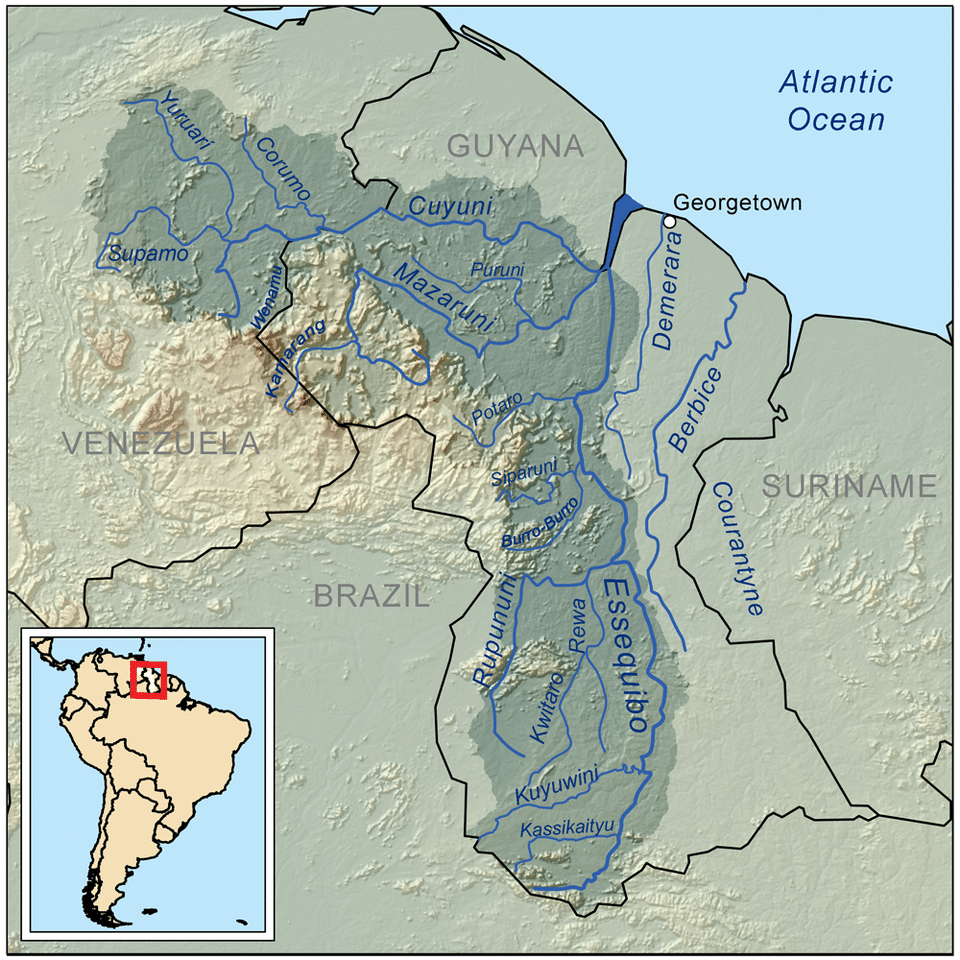
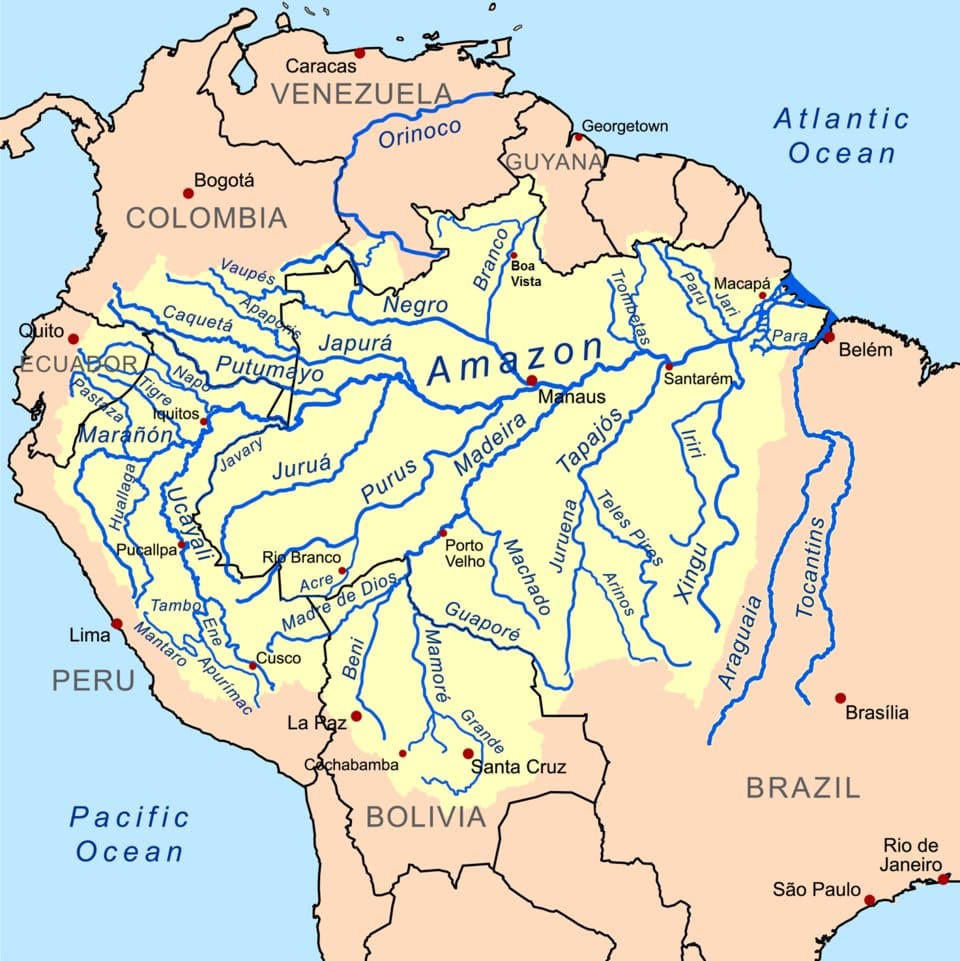
The gold tetra has a broad range across northeastern South America, found in Guyana, Suriname, French Guiana, and parts of the Amazon River basin in Brazil and Peru. They’re particularly abundant in coastal creeks and floodplain environments.
In the wild, gold tetras inhabit slow-moving rivers, tributaries, and floodplain lakes with soft, acidic water. Substrates are typically sandy with abundant leaf litter and submerged wood. Vegetation and overhanging plants provide shade and cover. One unusual aspect of their habitat is that they’re sometimes found in mildly brackish coastal waters – a rare trait among tetras.
The parasite that produces the golden coloration is found in certain wild habitats, which is why only wild-caught fish from specific areas display the distinctive gold sheen.
Appearance & Identification
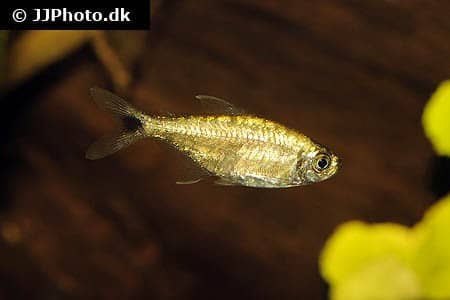
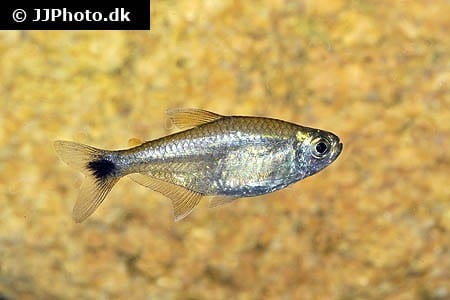
The gold tetra has a moderately deep, laterally compressed body that’s typical of the Hemigrammus genus. What makes the appearance fascinating is that it varies dramatically depending on the fish’s origin:
Wild-caught specimens display a stunning metallic gold to brass coloration that covers the entire body. This gold sheen is caused by guanine crystal deposits triggered by a harmless trematode parasite (see the backstory above). The effect is genuinely striking – these fish look like they’ve been dipped in liquid gold.
Tank-bred specimens are more silvery-grey with a subtle golden undertone but lack the dramatic metallic gold of their wild-caught counterparts. They’re still attractive fish, just not as visually dramatic.
Both forms show a reddish-orange spot on the caudal peduncle (base of the tail) and may display hints of red in the fins. The eyes often have a red upper portion.
Male vs. Female
- Body shape – Females are rounder and deeper-bodied, especially when carrying eggs. Males are slimmer.
- Coloration – Males may show slightly more intense coloring, but the difference is subtle.
- Size – Males and females are similar in size, with females sometimes slightly larger.
Average Size & Lifespan
Gold tetras reach about 2 to 2.2 inches (5-5.5 cm), making them one of the larger Hemigrammus species. They’re bigger than glowlight tetras and about the same size as head-and-tail-light tetras.
With proper care, expect a lifespan of 3 to 4 years. Stable water conditions and a varied diet go a long way toward reaching the upper end of that range.
Care Guide
Tank Size
A 20-gallon tank is the recommended minimum for a group of 8-10 gold tetras. They’re active mid-level swimmers that appreciate some horizontal swimming space. A 30-gallon long or larger is ideal for a community setup.
Water Parameters
| Parameter | Ideal Range |
|---|---|
| Temperature | 75-82°F (24-28°C) |
| pH | 5.5-7.0 |
| Hardness | 1-12 dGH |
| KH | 1-8 dKH |
Gold tetras prefer soft, slightly acidic water but are adaptable to moderately hard conditions as well – particularly the tank-bred specimens. One unique trait is their tolerance of mildly brackish water, which is unusual for a tetra. While this doesn’t mean you should add salt to their tank, it does speak to their overall hardiness and adaptability compared to most tetras.
Indian almond leaves and driftwood create ideal soft, tannin-stained conditions that complement the gold coloration nicely.
Filtration & Water Flow
Moderate filtration with gentle to moderate flow works well. Standard hang-on-back or canister filters turning over 4-5 times the tank volume per hour are fine. Weekly water changes of 20-25% keep things clean.
Lighting
Moderate lighting works best. The metallic gold coloration catches light beautifully under standard planted tank lighting. Floating plants provide natural shade that helps the fish feel secure without killing the visual effect of the gold sheen.
Plants & Decorations
A biotope-style setup with sand substrate, driftwood, and dried leaf litter recreates their natural habitat and looks fantastic. Live plants like Java fern, Anubias, Cryptocoryne, and Vallisneria provide structure and cover. A dark substrate makes the gold coloration pop, while a natural leaf-litter bed adds authenticity to the setup.
Is the Gold Tetra Right for You?
Gold tetras are one of the most visually unique tetras available, but they need consistent care to look their best. Here’s who should keep them:
- You want a fish with genuinely unique metallic coloring that’s unlike anything else in the hobby
- You maintain good water quality with regular water changes. Their gold color depends on it
- You feed a varied, high-quality diet. Nutrition directly affects their metallic sheen
- You have a dark substrate and moderate lighting to make their gold really pop
- You want something unusual that creates a completely different look from typical neon-colored tetras
- Not the best pick if you will skip water changes. Their signature gold fades with neglect
What People Get Wrong
The most common misconception is assuming the gold coloration is a tank-bred selective breeding trait or a dye. It is neither. Wild gold tetras (Hemigrammus rodwayi) develop a guanine deposit on the scales as a response to a specific parasitic infection — Pleistophora hyphessobryconis. The guanine forms a reflective shield over the parasite. Captive-bred fish raised without that specific environmental trigger often show significantly less gold for this reason.
Second mistake: dismissing them as a plain community fish because captive specimens look less spectacular than wild-caught ones. In the right tank — planted, warm lighting, dark substrate, proper group size — even captive-bred gold tetras show a subtle, shifting metallic sheen that stands out. They reward good tank design.
Third: keeping too few. Under 6, gold tetras stay pale, hide frequently, and show none of the active schooling behavior that displays the coloring. A proper group of 10 or more produces the shimmering schooling effect this species is known for.
Tank Mates
Best Tank Mates
- Other peaceful tetras (cardinal tetras, neon tetras, glowlight tetras)
- Corydoras catfish – ideal bottom-dwelling companions
- Pencilfish – gentle, from similar habitats
- Dwarf cichlids (Apistogramma, rams) – great biotope pairing
- Otocinclus – small, peaceful algae eaters
- Hatchetfish – surface dwellers that fill a different zone
- Small rasboras – similarly peaceful schooling fish
- Bristlenose plecos – peaceful, low-maintenance tank mates
Tank Mates to Avoid
- Large aggressive fish – anything that could eat or bully them
- Fin nippers – will stress them out
- High-energy, boisterous species – gold tetras are relatively calm and can be outcompeted at feeding time
Food & Diet
Gold tetras are omnivorous and easy to feed. They accept dried flakes and granules without issue. Supplement regularly with live or frozen daphnia, baby brine shrimp, bloodworms, and mosquito larvae for the best health and coloration. A varied diet helps maintain whatever gold or metallic sheen the fish has.
Feeding tip: Feed small portions once or twice daily. Gold tetras are moderate feeders that do well with standard community feeding schedules. Make sure food reaches mid-water where they prefer to feed.
Breeding & Reproduction
Gold tetras are egg scatterers that is bred in captivity with the right conditions.
Spawning Tank Setup
Set up a separate 10-gallon breeding tank with dim lighting and fine-leaved plants or spawning mops. Water should be very soft and acidic – pH 5.5-6.5, hardness under 5 dGH, temperature 80-84°F. A mesh layer on the bottom prevents egg predation.
Conditioning & Spawning
Condition pairs or a small group with plenty of live foods for 1-2 weeks. Spawning is done as pair spawning or group spawning. Eggs are scattered among plants or the spawning mop. Remove adults immediately after spawning.
Egg & Fry Care
Eggs hatch in 24-36 hours. Fry become free-swimming 3-4 days later. Feed infusoria initially, then graduate to microworms and baby brine shrimp. Keep lighting dim during the early stages. Note that captive-bred fry will not develop the gold coloration since the trematode parasite is absent in aquarium environments.
Common Health Issues
Gold tetras are hardy, though they is slightly more prone to skin issues than some other tetras:
Ich (White Spot Disease)
The standard tetra ailment, triggered by temperature fluctuations or stress. Gradually raise temperature to 82°F and treat with standard ich medication.
Skin Infections
Gold tetras is slightly more prone to bacterial skin infections, especially wild-caught specimens with the trematode. This is rarely serious but is worth watching for. Use smooth decorations and soft substrates to prevent skin abrasions that leads to infection.
General Prevention
Quarantine new fish for 2-3 weeks. Maintain stable water parameters and consistent water changes. A varied diet supports a strong immune system. Use smooth, non-abrasive decorations since these fish is sensitive to skin injuries.
Common Mistakes to Avoid
- Expecting gold from tank-bred fish – The most common disappointment. Tank-bred gold tetras are silvery-grey, not gold. The gold coloration only occurs in wild-caught fish infected with a specific harmless trematode. If you want the gold color, specifically seek out wild-caught specimens.
- Keeping too few – Gold tetras are timid fish that need the security of numbers. A group of 3-4 will hide constantly. Keep 8-10 or more for confident, visible schooling behavior.
- Rough decorations – Sharp rocks and rough decorations can scratch their skin, potentially leading to infections. Use smooth wood, rounded stones, and soft substrates.
- Species confusion – Some fish sold as “gold tetras” may actually be Hyphessobrycon saizi, a slimmer species that’s sometimes mixed in shipments. True H. Rodwayi has a deeper body.
- Hard, alkaline water – While they’re adaptable, gold tetras look and do their best in soft, slightly acidic conditions.
Where to Buy
Gold tetras are moderately available at local fish stores and online retailers. Pricing typically runs $3-5 per fish. If you specifically want the metallic gold wild-caught specimens, you need to shop around and ask retailers whether their stock is wild-caught or tank-bred.
For quality stock with live arrival guarantees, check Flip Aquatics and Dan’s Fish. Both retailers carry gold tetras.
Frequently Asked Questions
Why is my gold tetra silver instead of gold?
Your fish is likely tank-bred. The gold coloration in wild specimens is caused by a harmless trematode parasite that triggers guanine crystal deposits under the skin. Tank-bred fish never encounter this parasite, so they remain silvery-grey with at most a subtle golden undertone. The parasite does not harm the fish and cannot infect other species in your tank.
Is the gold tetra parasite dangerous?
No. The trematode metacercariae that cause the gold coloration are completely harmless in an aquarium setting. In the wild, the parasite’s life cycle requires a bird as the next host – since there are no predatory birds in your tank, the cycle can’t complete and the parasite just sits harmlessly under the skin creating that beautiful gold sheen. Wild-caught gold tetras may be slightly more susceptible to skin infections, but the parasite itself causes no problems.
Can gold tetras live in brackish water?
Yes, to a degree. Gold tetras are one of the few tetra species that can tolerate mildly brackish conditions in the wild, as they’re sometimes found in coastal creek habitats. This doesn’t mean you should add salt to your tank, but it does speak to their overall hardiness and adaptability compared to most tetras.
How many gold tetras should I keep?
A minimum of 8, with 10 or more being ideal. Gold tetras are on the timid side and need the security of a proper school to feel confident enough to swim in the open. Small groups will hide behind decorations and you’ll rarely see them.
What It Is Actually Like Living With Gold Tetra
In a proper school, gold tetra display natural movement patterns that are genuinely engaging to watch. The fish interact with each other, establish subtle hierarchies, and move through the tank with purpose.
They spend most of their time near the surface, which fills a level of the tank that many other species ignore. This makes them excellent complements to mid-water and bottom-dwelling fish.
Feeding time is when their personality comes out. They learn your routine quickly and will anticipate feeding before you even open the lid.
Their color and behavior improve over time as they settle into a stable environment. Fish that have been in the same tank for months look noticeably better than recently added stock.
They coexist peacefully with virtually every other appropriately-sized community fish. This compatibility makes tank planning straightforward.
How the Gold Tetra Compares to Similar Species
Gold Tetra vs. Lemon Tetra
Lemon tetras offer warm yellow tones but through pigmentation rather than the gold tetra’s metallic guanine deposits. This means lemon tetras maintain their color more consistently across different conditions, while gold tetras can fade if care lapses. Lemon tetras are also slightly hardier and more forgiving overall. Both are excellent choices for adding warm tones to a community tank. If you want reliable, consistent color, go with lemon tetras. If you want that jaw-dropping metallic shine that makes people do a double-take, gold tetras are unmatched. Check out our Lemon Tetra care guide for more details.
Gold Tetra vs. Silver Tetra
Silver tetras share that metallic quality but in a cooler, mirror-like tone versus the gold tetra’s warm sheen. Both look best under specific lighting conditions with dark substrates. Silver tetras are slightly hardier and grow larger. They’re the more robust choice. Gold tetras are smaller and more delicate but offer a warmer, more unusual coloration. Keeping both species together in a large planted tank creates a stunning warm-and-cool metallic contrast. Check out our Silver Tetra care guide for more details.
Closing Thoughts
The gold tetra is one of the most scientifically interesting fish in the freshwater hobby. The fact that its signature look is created by a parasite manipulating its host to become more visible to predators is the kind of story that makes biology endlessly fascinating. And the result is genuinely beautiful – a school of wild-caught gold tetras glowing like brass in a blackwater setup is a sight that stops people in their tracks.
Even if you end up with the more subdued tank-bred form, the gold tetra is still a hardy, peaceful, and attractive community fish. They pair well with glowlight tetras and head-and-tail-light tetras for a Hemigrammus species tank, or alongside cardinal tetras for a colorful South American community.
Recommended Video
Check out our tetra tier list video where we rank the most popular tetras in the hobby:
References
- Hemigrammus rodwayi Profile – Seriously Fish
- Hemigrammus rodwayi (Durbin, 1909) – FishBase
- Hemigrammus rodwayi – Wikipedia
- Phylogenomics of Characidae – Melo et al, 2024
- About the Author
- Latest Posts

I’m Mark Valderrama, founder of Aquarium Store Depot and a fishkeeper with over 25 years of hands-on experience. I started in the hobby at age 11, worked at local fish stores, and have kept freshwater tanks, ponds, and reef tanks ever since. I’ve been featured in two best-selling aquarium books on Amazon and built this site to share practical, experience-based fish keeping knowledge.
Leave a Reply