Tag: Freshwater

  • How to Treat Ich in Aquarium Fish: What Actually Works (From 25 Years of Experience)

    How to Treat Ich in Aquarium Fish: What Actually Works (From 25 Years of Experience)

    Ich is probably the disease every hobbyist runs into eventually. I certainly have. Those small white spots look alarming, but the important thing to understand is that ich has a life cycle, and treatment only works during the free-swimming stage, not when parasites are already attached to your fish. That’s why timing matters so much. I’ve used both heat treatment and medication (Ich-X is my go-to) over the years, and both work when applied correctly. This guide covers how to identify it early, how to treat it effectively, and. more importantly. how to avoid bringing it into your tank in the first place.

    What You Need To Know (The Facts)

    NameIchthyophthirius multifiliis
    Common TreatmentsIch medication such as Ich X, Salt, Heat treatment
    CausesProtozoan external parasite
    Common Symptomssmall white spots on the fish’s skin and fins, rapid breathing, fish scratching and flashing against objects, drooping fins, clenched fins, surface breathing

    What Is Ich (Ichthyophthirius multifiliis)

    Ich is a common parasite that affects all freshwater fish. This type of parasite is known as a protozoan (single-celled organism) and it can be found in both wild and captive fish. The parasite is surprisingly large, measuring up to a millimeter in length. Ich can multiply very quickly, and without treatment, it tends to result in fish deaths.

    Ich is visible on infected fish as small white ‘spots’ on the fish’s skin and fins. These white spots can multiply rapidly, and unfortunately, the disease is quite advanced by the time these spots become visible. The spots tend to stand out more clearly on darker species and can be pretty difficult to detect on white fish.

    Sometimes these white spots will not be visible at all if the parasite is only feeding on the gills of the fish. In such cases, you will notice that the gills become swollen and pale. Infected fish can show other symptoms too, such as fish rubbing against the gravel, losing body condition, or they may stop eating.

    The Ich Life Cycle

    Understanding the life cycle of ich is really important because it is only treatable in certain stages. The life cycle of the ich parasite is temperature-dependent, and it runs through the different stages faster in warmer water. In a heated tropical tank, for example, the parasite can complete the whole cycle in under a week.

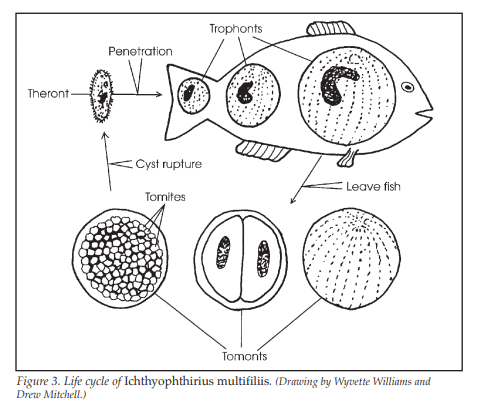
    Let’s take a look at the 3 stages of the ich lifecycle1:

    Freshwater Ich Cycle
    Image from University of Kentucky Drawing by Wyvette Williams and Drew Mitchell

    Stage 1- Trophont

    This is the parasitic stage where ich is visible and most easily detected. At this stage, the parasite is attached to your fish and feeding. It attaches itself to healthy fish by burrowing through their epithelium to feed on the surrounding tissue.

    During the trophont stage, ich is visible as small white spots (raised lesions) on the fins and skin. Sometimes ich is confined to the gills of the fish, in which case you will not be able to see any white spots.

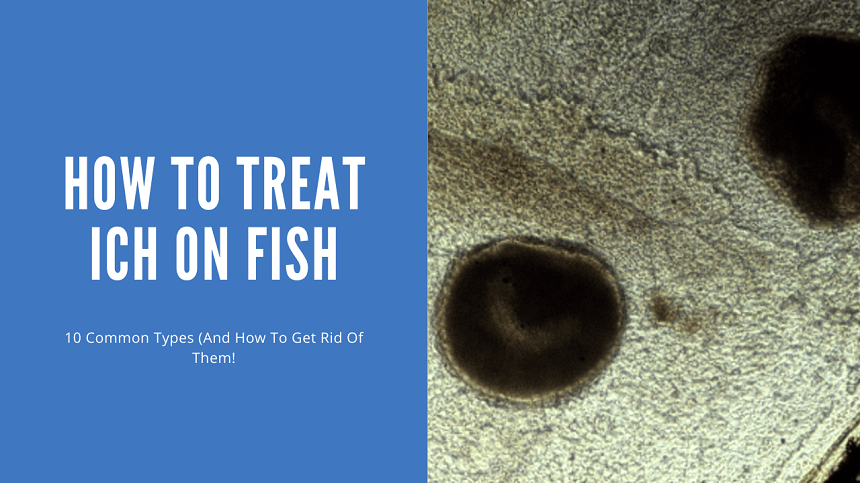
    Freshwater Ich

    The parasite is protected by the slime coat on the fish’s body so unfortunately, it is not treatable with medications during this stage.

    Stage 2- Tomont

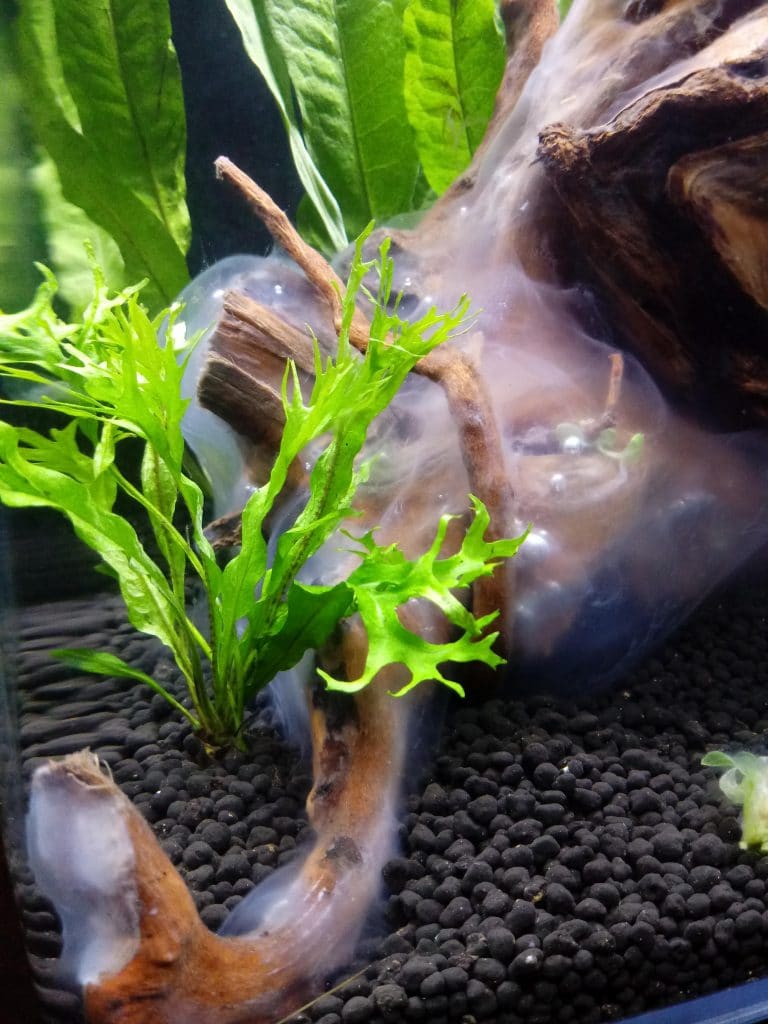
    The tomont is the reproductive stage of ich protozoa. The trophont stops feeding and leaves the host fish when it is mature. At this stage, the tomont protects itself by encasing itself in a sticky, protective capsule.

    The protected tomont settles on the substrate or other surface within the aquarium and multiplies within its protective covering. The tomont starts as a single organism, but multiplies into 100-1000 new parasites during this stage!

    Unfortunately, the parasites are still not treatable in the tomont stage because they are protected within a cyst.

    Stage 3- Theront

    Depending on the water temperature, the third stage can begin within just a day or take as long as several weeks. In this stage, the theronts leave the protective cyst and swim free in the water to look for a new host fish to feed on.

    They must find a host within 2 to 3 days or they will die. At this stage, the parasite is not protected and can be treated with the appropriate ich medications. The parasite will progress into the trophont stage if the free-swimming theront succeeds in attaching itself to a freshwater fish.

    Preventing White Spot Disease In Freshwater Fish

    Now that you know how to treat freshwater ich, let’s take a look at how to prevent it from attacking your fish tank. Remember, prevention is always better than cure!

    In this section, we’ll take a look at 6 effective strategies to prevent ich in freshwater fish. These strategies are also useful for preventing several other problems in freshwater aquariums.

    Let’s get started!

    1. Start Early

    Ich gets into aquariums on infected fish, live plants, and any other materials that have been in an infected tank, including the water. You can minimize the risk by setting up a planted aquarium a week or more before adding the first fish. This is an important practice anyway to allow your tank to cycle.

    By starting early, any ich parasites present on the plants will die because they will not be able to find a host fish in time. Another great way to avoid parasites on live plants is to purchase only tissue culture plants. These plants are parasite free and grown in labs.

    2. Buy Smart

    Take a good look at all the fish on display at your local fish store. Do any of them show signs of disease or ich? You can save yourself some trouble down the road by selecting healthy fish from the start.

    Online shopping has become easier and more accessible to people all over the world, but it makes inspecting the fish a little tricky. Fortunately, trusted online retailers have built a name for themselves by taking great care of their livestock so you don’t need to worry.

    Sometimes fish can look perfectly healthy when you first get them but develop symptoms after a few days in your care. That’s why this next step is so important!

    3. Quarantine

    The most important thing you can do to prevent ich in your aquarium is to quarantine new fish and plants. In cooler water, Ich usually shows up on new fish after 1 to 3 weeks, so go ahead and quarantine your fish for 4 weeks before introducing them to your main tank.

    Ich tends to become apparent much faster in water temperatures between 75ยฐF and 83ยฐF so a week or so is usually sufficient to rule out ich in tropical species. Ich is not the only common aquarium disease, however, and some conditions take longer to show up. Ich is also difficult to detect in cases where it is confined to the gills, so a quarantine period of a month is a safer bet.

    Treatment is easier if you notice any signs of ich or other illness in your fish during the quarantine period. You can simply treat the fish in the quarantine tank and avoid treating your whole display tank.

    Ich is not only present on fish of course. The free-swimming theront stage can be introduced in aquarium water, and the sticky tomont stage can be spread on plants, ornaments, or other items from infected aquariums. Avoid adding any water from another tank directly into your aquarium and leave ornaments and hardscape from other tanks to dry out for a few days before cleaning them thoroughly.

    If you want to learn more about quarantine, check out my quarantine post. While the post is marine fish-focused, the same process applies. Freshwater fish are typically not pre-treated though. Usually, observation can work in freshwater tanks because the vast majority of freshwater fish are tank bred now and diseases aren’t as deadly compared to marine tanks.

    4. Stick To Aquarium-Safe Products

    Avoid introducing any wild collected rocks, gravel, driftwood, or other materials from ponds or other natural water sources. These environments can carry ich and all sorts of other parasites and unwanted organisms.

    5. Water Quality

    Keeping a clean tank is very important because fish in aquariums with poor water quality will be stressed and have a weakened immune system. This makes them even weaker against fish diseases like ich. Even fish that have been successfully treated for ich will be far more susceptible to secondary infections in low-quality water.

    Running a quality aquarium filter that is big enough for your tank and performing regular aquarium maintenance and partial water changes are vital for maintaining high water quality. You will also need to test your water regularly for the presence of ammonia, nitrite, and elevated nitrate levels.

    Avoid overstocking your aquarium with too many fish since ich can spread rapidly in overcrowded fish tanks. Too many fish and too much fish food are also common causes of poor water quality.

    6. Prevent Stress

    Poor quality water and detectable ammonia levels are not the only cause of stress and a compromised immune system. The following other factors will also put your tank inhabitants at higher risk:

    • Improper diet
    • Incorrect water parameters
    • Incorrect tank temperature
    • Too much or too little water flow

    How To Treat and How To Cure

    Now that you know more about ich, its life cycle, and how to prevent it, you’re ready to learn how to treat this common aquarium fish disease.

    White spot disease is not something that will go away on its own, so starting treatment is very important as soon as you notice an ich outbreak. This parasite can multiply rapidly in an infected tank, and unfortunately, you can lose all of your fish if you don’t take the right steps.

    Some fish seem to be more resistant to ich than others, but all fish can be affected. Some species, like clown loaches, are particularly prone to attack by this parasite.

    Let’s jump right into the best ways to treat freshwater ich.

    Which Medication To Use

    The Ichthyophthirius multifiliis parasite is sensitive to the following chemicals in its free-swimming theront stage:

    • Malachite green
    • Methylene blue
    • Copper sulfate
    • Formalin
    • Potassium permanganate

    There are a number of ich medications on the market today, but one product that has proven itself in the industry is Ich-X from Hikari. Ich-X contains a combination of effective chemicals in a safer but highly effective dose that will not harm sensitive fish or scaleless fish. If you can get your hands on a bottle, I would highly recommend this product!

    How To Use Ich X

    Let’s take a look at how to use Ich-X to treat ich in your freshwater aquarium.

    Dosage

    Ich x should be added to your aquarium at a dose of 5 ml per 10 gallons of aquarium water. The dosage is very important, so do your best to calculate the actual volume of water in your aquarium excluding substrate, ornaments, and other objects that take up space.

    This should be repeated every 8-24 hours continuously for at least 3 days after the last signs of ich are visible on your fish.

    Treatment is most effective if you can move all of your fish into a quarantine tank. This ensures that any theronts that emerge in your main tank will die off within about 3 days in tropical temperatures because they will not find a host to continue their life cycle.

    By moving your fish into a quarantine tank, and following the recommended dosage, you can treat your fish in the shortest possible time.

    Timing

    Treating ich is only possible while the parasite is in its free-swimming theront stage, so a single dose of medication will not solve the problem. Repeat doses are very important, and the length of time between doses will vary depending on the water temperature.

    In the warm water of tropical aquariums, the ich life cycle is much faster and you can treat ich with once-daily treatments for 3-5 days.

    Treatment of coldwater fish takes much longer because the parasite spends more time in the tomont stage. In cold water, you should space the treatments out to one dose every 3-5 days. A total of 5 doses will be necessary, so treatment time will take 15-25 days in total.

    You can speed up the treatment of ich by increasing the water temperature in your tank. This speeds up the life cycle of the ich parasite. In a tropical aquarium, increasing the water temperature to the lower 80s is usually safe for most fish but this method is not suitable for goldfish and other coldwater species.

    Filtration

    You can leave your filter on while administering Ich-X, but be sure to remove any activated carbon media from your filter. This is important because activated carbon will absorb the medication and potentially make it less effective.

    Water Changes

    It takes a little work but you will need to perform a 30% water change just before each dose. Be sure to remove as much organic material and waste from the aquarium as possible with your gravel vacuum. This will help to remove as many tomonts from the tank as possible before they can enter the water column in search of a new host.

    Safety

    Malachite green is a toxic chemical, so safety is very important for both your aquarium fish and yourself. Take precautions to keep this product away from your eyes and skin. The product is also not safe for live plants.

    Aquarium Salt & Non-Chemical Treatments

    It is possible to treat ich without any chemicals by changing the water temperature in the tank. This method can be very stressful for fish and plants, however, and should never be used on coldwater fish species.

    To use this method, slowly increase your water temperature to 90ยฐF and keep it there for 24 hours. Next, turn down the heater to 70ยฐF and maintain this temperature for 48 hours. By repeating this process, the ich should be killed off after 2 weeks or so.

    A UV sterilizer can be useful for controlling parasites, as well as other disease-causing organisms in your aquarium. UV sterilizers will not necessarily kill all the ich in your tank but they will help to manage the problem by killing the free-swimming theronts in the water column.

    Treatment with aquarium salt (not table salt) also works but this can be risky because some fish and aquarium plants are sensitive to salt.

    Frequently Asked Questions

    How do I get rid of ick in my fish tank?

    The best way to kill ich in most aquariums is to use an ich treatment product like Ich-X. The treatment will take several days with the correct dosages and dosage rates.

    What is the best treatment for ick?

    There are several treatments that have been used to cure ich in freshwater fish. These involve changes in temperature and chemicals like salt, malachite green, copper sulfate, and formaldehyde. Aquarium products like Ich-X have been formulated to provide safe and effective treatment.

    Will ick go away on its own?

    Unfortunately, ick does not go away on its own. It can also spread to other fish in the same tank as the disease progresses, so it’s vital to act as soon as you detect this very common disease.

    Can a fish survive ick?

    Most fish with a healthy immune system can survive ich if it is treated in time. It has been suggested that fish that have survived ich are less susceptible to future outbreaks because they develop an immune response.

    How did my fish get ick?

    Your fish may have had ich before you got it or it may have been infected by new fish. Adding water, live plants, gravel, or any other object from other aquariums can also introduce freshwater fish ich.

    How do you get rid of ick on fish?

    Unfortunately, the ich parasite cannot be treated directly while it is visible on your fish. It will only be present on your fish for a few days before beginning the next stage of its life cycle.

    Once ich enters the free-swimming stage, it will be sensitive to chemical treatments with products like Ich-X, salt, temperature changes, or a combination of these treatments.

    References

    • Francis-Floyd, R., Pouder, D., & Yanong, R. Ichthyophthirius Multifiliis (White Spot) Infections In Fish. University of Florida, 2018
    • Xu, D. Preventing Ich. Tropical Fish Hobbyist Magazine. 2014
    • Dickerson, Harry W., and D. L. Dawe. “Ichthyophthirius multifiliis and Cryptocaryon irritans (phylum Ciliophora).”ย Fish diseases and disordersย 1 (2006): 116-153.
    • Dickerson, Harry W., P. T. K. Woo, and K. Buchmann. “Ichthyophthirius multifiliis.”ย Fish Parasites: Pathobiology and Protection, ed. PTK Woo (Wallingford: CABI)ย (2011): 55-72.

    Final Thoughts

    White spot disease can be devastating in the home aquarium. The good news is that treating ich is possible with the right knowledge, medications, and techniques. The most important thing you can do is to get started right away and treat ich as soon as you notice it.

    Have you cured ich in your aquarium? Tell us about your experiences in the comments below!

    References

  • 10 Types of Aquarium Algae: How to Identify and Eliminate Each One

    10 Types of Aquarium Algae: How to Identify and Eliminate Each One

    Every aquarium has algae. the question is which type and how much. After 25 years of keeping tanks, I’ve learned that algae is usually a symptom, not the disease itself. Green spot algae tells me my phosphates are low. A hair algae explosion usually means too much light or too little CO2 relative to nutrients. Black brush algae is the one I hate most. it’s a nightmare to remove and often signals inconsistent CO2 or flow issues. Identifying the type correctly is the first step, because different algae have very different causes and solutions. Here are the 10 most common types you’ll encounter and what each one is telling you.

    What Is Algae?

    Algae are simple plants that do not have stems, roots, or flowers. They do not have leaves, but they also photosynthesize just like more advanced plants do.

    Some of the algae that grow in aquariums are not actually true algae, but rather photosynthetic bacteria. Algae is interesting, and sometimes even beautiful, but it is usually unwelcome in our fish tanks!

    Continue reading to learn more about this common aquarium villain.

    Understanding It’s Role

    One thing to note is while we call it a villain as a hobbyist, algae serves a beneficial role in the wild. Algae is a nutrient absorber. The more nutrients available, the more it will grow. This fuel needed to grow is light and ammonia. Light is coming from your fixture, and ammonia is coming from your livestock. If you have a ton of light set up – such as with a professional aquascape, you will tend to create more algae to start than those with low light plants in the beginning.

    Algae grows when there are nutrients available. Algae growth can be outcompete with plants or limited by proper water sources as other sources like nitrates and phosphates can contribute to the overgrowth1

    Where Does It Come From?

    Many types of algae are microscopic single-celled life forms, so they can easily find their way into aquariums from the air. Another common way for algae to enter aquariums is in the water that live fish are transported in, or on live plants. As you can tell, keeping algae out of an aquarium is not easy!

    Keeping a hood over your tank, quarantining your livestock, and buying tissue culture plants are good strategies for minimizing the number of algae that comes into your aquarium.

    11 Reasons Why You Have Overgrowth

    This is a question that has caused much debate in the aquarium hobby.

    What is Aquarium Algae

    Aquariums are like tiny ecosystems. There are incredibly complex processes at work in our tanks involving chemical, and biological processes. We don’t fully understand all the causes of algae growth, but we do know enough to manage algae quite effectively.

    Algae is present in pretty much every aquarium, but what makes it grow out of control in some tanks? Let’s take a look at some of the most important causes:

    1. Inadequate Equipment

    While some advanced aquarists are able to maintain beautiful planted tanks with limited equipment, this usually ends in failure for most of us. Aquarium hardware can get expensive, but you definitely get what you pay for, so always invest in the best that you can afford.

    Let’s take a closer look:

    Poor Filtration

    The role of your aquarium filter is not to physically get rid of algae, but rather to keep the nitrogen cycle running.

    This process is known as biological filtration and it involves some very helpful types of bacteria that form colonies in the media of aquarium filters. The more media you have, and the finer its texture at a microscopic level, the more beneficial bacteria you can maintain.

    You should always buy the best quality filter that you can afford. A small internal power filter is perfectly adequate for small low-tech, fish-only aquariums, but for heavily planted tanks, a good quality canister filter is going to be a better bet.

    2. Poor water circulation

    ‘Dead spots’ can develop if your filter is not producing enough water flow to keep all of the water in your aquarium moving. Fish waste and other organic waste tend to accumulate in these areas, creating perfect conditions for algae to grow.

    You can install a small powerhead, or even an airstone to create a gentle water flow throughout your aquarium. For tank tanks or for setups like African cichlid tanks that prefer more flow, an aquarium wave maker could make more sense.

    3. Lighting

    Algae are photosynthetic organisms, which means they need light in order to grow, just like plants. The more light you have, the faster algae will grow, especially if you don’t have healthy aquatic plants to compete with them.

    Aquariums without live plants should not have strong lighting, and your fish tank should never be exposed to direct sunlight.

    4. Carbon Dioxide (CO2) Levels

    Providing increased CO2 levels is very important for maximizing plant growth and health. Just pumping CO2 into the tank is not really enough, however. It’s very important that the amount of this gas available to the plants stays stable and consistent at a safe level. You can encourage algae growth by having too much or too little CO2 levels.

    5. Unhealthy plants

    Aquarium plants and algae are in competition in our aquariums. A heavily planted aquarium full of healthy, growing plants will naturally suppress the growth of algae.

    This happens because plants and algae both use light, CO2, and nutrients to grow. If you’re providing these to your plants, but they aren’t growing, you can bet the algae will be happy to take advantage!

    6. Aquarium water parameters

    Since we know that unhealthy plants are like an invitation for algae, it’s important to make sure your aquarium water parameters are suitable for the plant species you are growing. This could apply to pH or water hardness for example.

    Healthy growing plants need an adequate supply of nutrients to maintain good growth. Keep a regular dosing schedule and make sure to use aquarium fertilizers that provide all of the essential micro and macronutrients that your plants need.

    7. Water Source

    At the same time, high phosphates or silicates in your source water can also throw your system out of wack to the point where nuisance algae blooms are a problem. A good solution is to invest in an RO system. For those who need absolute pristine water for keeping fish like Discus, a RODI unit would be a solid investment. You should consider getting a water quality report from your city to determine the levels of your water and consider a TDS meter.

    8. Temperature

    Aquarium algae tend to grow faster in aquariums that have higher water temperatures. This could be because dead plant tissues and other waste break down faster in warm water, providing increased ammonia levels.

    This makes fish like Betta fish more difficult to keep in community tanks because of their temperature requirements. In general, coldwater fish tanks will have less rampant algae if all other factors are equal.

    9. Aquarium Maintenance

    Falling behind on your regular aquarium maintenance is one of the biggest causes of algae population growth.

    Regular partial water changes are one of the best ways to limit algal growth. By changing the water, you are reducing the amount of nitrates, phosphates, and silicates in the water. You should also be sucking up physical waste particles from the substrate while performing a water change.

    10. Overfeeding fish

    Overfeeding is a very common, and often very serious problem for beginner fishkeepers. As uneaten fish food decays, it can release more ammonia than your beneficial bacteria can convert. This can cause rapid algal growth. Feed your fish only as much food as they can eat in a minute or two. Also, consider investing in higher quality food as budget food has been known to cause cloudy water.

    11. Decaying plants

    Decaying plant matter like dead leaves is just as bad as excess fish food and other organic waste. Trim your plants regularly and be sure to remove all of the trimmings from the tank.

    10 Different Types

    Now that you know more about what algae is, how it gets into your tank, and what causes it to grow, it’s time to learn about some of the most common algae types. Through my over 25 years of experience with both freshwater and saltwater aquariums as well as running local fish stores, I’ve seen it all. From dinos (which aren’t algae, but often called as such), to hair algae.

    My goal here is to talk about the most common and how to deal with them. There are so many different types of aquarium algae out there that getting an accurate identification of what’s growing in your tank can be very difficult. There are some types of algae that are often seen in freshwater aquariums, however, and the following ten types are very common and my Youtube should help as well to follow along below.

    Compare these types of algae with what you see in your tank, and take note of the causes and possible treatments for each type.

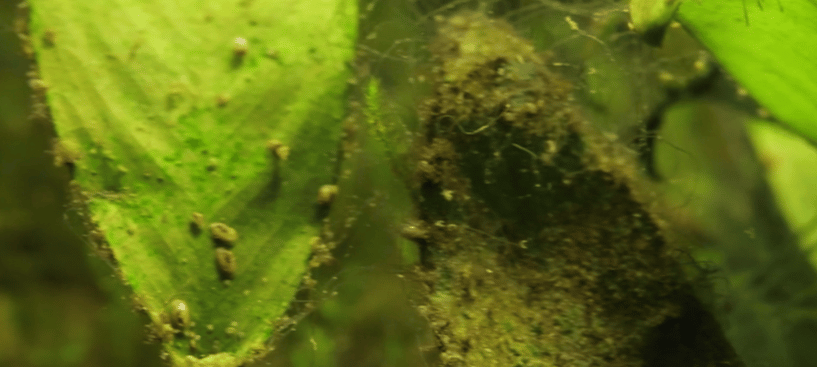
    1. Brown Diatom

    • Causes: high ammonia, low lighting, low CO2, high silicates
    • Chemical treatment: Tetra AlgeaControl, use a UV sterilizer, use RO water if your source tap water contains silicates
    • Brown diatom algae eaters: Otocinclus catfish, bristle nose pleco, nerite snails, Amano shrimp

    Brown diatom algae is a common and pretty harmless type of aquarium algae. This type of brown algae often grows in new aquariums and goes away in time without any treatment.

    Brown diatom algae thrive in water with high silicate levels, so if this type of brown algae becomes an ongoing issue, you might need to use reverse osmosis water.

    2. Green Beard

    Green Beard Algae
    • Causes: Photoperiod is too long, low CO2 levels, Low nitrates
    • Chemical treatment: Hydrogen peroxide treatment, liquid carbon like flourish excel
    • Green beard algae eaters: Rosy barbs, Mollies, Amano shrimp

    Green beard algae look similar to green fuzz algae but grow longer and denser. This form of green algae can become a problem when you have too much light, not enough CO2, or a nutrient imbalance in your planted aquarium.

    3. Black Beard (BBA)

    BBA on Plant
    • Causes: High water flow, fluctuating CO2 levels
    • Chemical treatment: Hydrogen peroxide treatment, Apt Fix, liquid carbon like flourish excel
    • Black beard algae eaters: Florida flagfish, Siamese algae eaters, Rosy barb

    Black beard algae (AKA black brush algae) is probably the most feared algae form in the aquarium hobby. It actually looks kind of cool, but this stuff is really tough and is not easy to get rid of.

    These algae grow attached to hardscape, substrate, equipment, and even the leaves of slow-growing plants like Anubias. Most algae eaters avoid BBA, but some fish like Siamese algae eaters and Florida flagfish can be helpful.

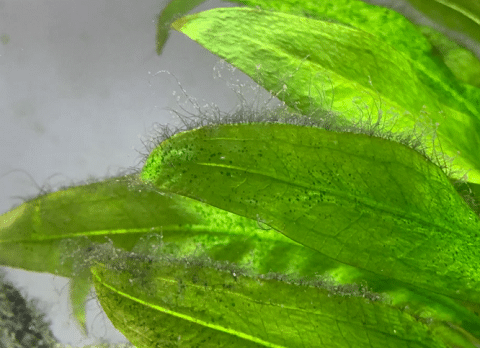
    4. Hair

    Hair Algae in Aquarium
    • Causes: Nutrient imbalances, unhealthy plant growth
    • Chemical treatment: Apt Fix, Tetra AlgeaControl
    • Hair algae eaters: Amano shrimp, ramshorn snails, otocinclus catfish

    Hair algae are short filamentous algae that can grow on live plants. If you find this type of green algae growing on live plants in a mature aquarium, it’s a good sign that the plants are not in good health or not being fertilized correctly.

    You can remove a lot of hair algae manually, but beware, it holds on tight!

    5. Green Spot (GSA)

    Green Spot Algae
    • Causes: phosphate deficiency
    • Chemical treatment: Hydrogen peroxide
    • Green spot algae eaters: Nerite snails, bristlenose pleco, otocinclus catfish

    Green spot algae are common and harmless algae that appear as small dark green spots on the aquarium glass or on slow-growing plant leaves. Green spot algae are pretty tough, and not many animals will eat them, but zebra nerite snails can be helpful.

    6. Blue-Green (BGA)

    Blue Green Algae
    • Causes: Low-nitrate levels
    • Chemical treatment: Antibiotics
    • Blue-green algae eaters: Ramshorn snail

    Blue-green algae are actually not algae at all. This slimy growth form is actually a form of bacteria known as cyanobacteria.

    Blue-green algae are pretty easy to remove, but they will grow back if you do not figure out the cause of their growth. Blue-green algae can be harmful, and unfortunately, most algae eaters will not eat them.

    7. Green Water

    • Causes: Too much light, nutrient imbalance, lack of maintenance
    • Chemical treatment: Use a UV filter
    • Green water algae eaters: None

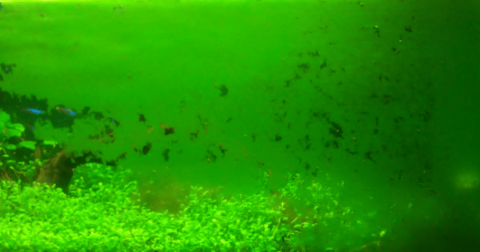
    Green water (video reference) is caused by a bloom of microscopic algae known as phytoplankton in the water column. The easiest way to get rid of green aquarium water algae is to use a UV light filter or by blacking out the lights for a few days.

    Green aquarium water algae are not harmful to your fish, but if you let them get out of control, they can block out light to your aquatic plants.

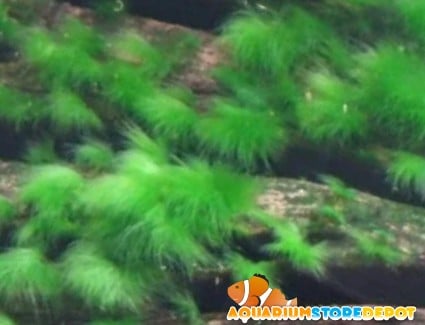
    8. Green Fuzz

    • Causes: Lack of CO2, nutrient imbalance
    • Chemical treatment: Apt Fix
    • Green fuzz algae eaters: Rosy barbs, Mollies, Amano shrimp, cherry shrimp

    Green fuzz is also known as Oedogonium algae. It is a form of filamentous green algae that tends to grow on unhealthy plants. The best way to get rid of green fuzz algae is to provide your aquatic plants with adequate stable CO2 levels and balanced nutrients. The video above by Rachel O’Leary shows green fuzz algae growing in an aquarium for decor purposes.

    9. Green Dust (GDA)

    Green Dust Algae
    • Causes: Nutrient imbalance, too much light, lack of plants
    • Chemical treatment: APT Fix
    • Green dust algae eaters: Bristlenose pleco, otocinclus catfish, nerite snails

    Green dust algae is a form of fine algae that settles on the glass and other surfaces inside your aquarium. This green algae does not attach itself firmly and can simply be wiped off without much effort.

    Unfortunately, this will not solve a green dust algae problem but rather causes it to settle elsewhere.

    10. Staghorn

    Staghorn Algae
    • Causes: Ammonia spike, weak plant growth
    • Chemical treatment: APT Fix
    • Staghorn algae eaters: Siamese algae eaters

    Staghorn algae grow in tough, grayish clumps that look quite similar to black beard algae. Staghorn algae tend to grow on the edges of plant leaves, and they can be pretty tough to get rid of!

    Performing regular aquarium maintenance, dosing your aquarium plants, and trimming back old plant growth are all good ways of controlling pesky staghorn algae.

    Other Issues

    The ten common algae types in this list aren’t the only problems to watch out for. There are also some other non-algae-related growths that pop up in aquariums from time to time.

    Let’s take a quick look at what they are, what causes them, and how to treat them.

    Cloudy Water

    Cloudy Water in an Aquarium

    Cloudy water is something that many new aquarium owners will experience. This is not algae but rather beneficial bacteria colonizing your aquarium.

    They do not need any form of treatment and will clear up soon enough. If this occurs in a mature aquarium, however, it could be an indication of an increase in nutrients in the tank.

    Cloudy water can also be caused by adding dusty new substrate to your aquarium, or by stirring up sediments during a water change.

    White Fungus

    Biofilm In Aquariums

    If you’ve recently added new driftwood to your aquarium, there’s a good chance that a white moldy substance will begin to grow on its surface.

    This is absolutely nothing to worry about and will clear up on its own in a week or two. Many aquarium fish will happily feed on this growth, but you can always scrub it off if you want it gone sooner.

    Brown Water

    Tannins

    Brown water is another common complaint that goes hand in hand with new driftwood. Tannins leaching out of the driftwood stain the water, almost like a teabag. This can take weeks and several water changes to clear up, but it is harmless for your fish.

    Boiling new driftwood and changing the water several times before adding new driftwood to your aquarium can speed up the process.

    Treatment Options

    Prevention is always better than cure when it comes to algae, but there are some effective ways of treating this common problem. Let’s take a look at some of the best treatment options for algae in freshwater aquariums.

    Chemical Treatments

    There are some very effective chemical algae treatments available in the aquarium hobby. Some useful chemical treatments like bleach and hydrogen peroxide can even be found at your local drug store or supermarket.

    Here is a list of aquarium products that can be helpful for controlling Aquarium algae:

    • API Algaefix: Many algae types
    • Apt Fix: Black beard algae, filamentous algae like hair algae
    • Green Water Labs Algae Control: Most Algae types
    • Seachem Flourish Excel: Black Beard Algae

    As with any chemical product, it’s really important to follow doses carefully, and always use caution. This is especially important if you keep live animals in your aquarium.

    Biological Treatments (Natural Algae Eaters)

    Algae eaters are my favorite method of algae control, but they are not the final solution. Remember, prevention is better than cure, and algae eaters definitely fall into the ‘cure’ category.

    That being said, algae eaters can be incredibly effective at controlling algae growth, and they are fascinating and awesome creatures in their own right too! There are many amazing freshwater algae eaters in the hobby, but here are a few of the best types:

    Physical Removal

    Physical removal can be hard work, but it is a highly effective method of reducing the amount of algae and improving the look of your tank. An algae scraper, an old credit card, a sponge, and your fingers are all great for this task.

    Unfortunately, physical removal is not going to solve the root cause of your algae growth, so you can usually expect the algae to grow back pretty fast.

    Blackouts

    Blackouts are another simple (but more time-consuming) method for decreasing algae in aquariums. The concept is simple, starve the algae of light and it will die. This technique works because your plants can survive for a few days without light but the algae really suffer.

    Unfortunately, this technique will result in some leggy plant growth and it can take a few days for your plants to recover from the shock.

    Note a blackout is total darkness. This is often best achieved by blocking out the glass with cardboard and covering the top of the aquarium. A black should last around 4-5 days. Your fish will survive not eating. They will typically go dormant during this time period.

    Troubleshooting

    Now that you know more about ten types of algae and the most common causes for their growth, let’s look at a useful thought process to help you solve algae problems before they get out of hand!

    Remember, you need to identify the root cause of algae problems to make sure they don’t just keep coming back.

    Go through this list to figure out where the problem might lie:

    Light

    • Do you have good-quality aquarium lights with the correct spectrum for plant growth?
    • Are your lights running on a timer for 6 to 8 hours per day?
    • Is your tank exposed to any direct natural sunlight? Remember to avoid direct sunlight
    • If you use T5 lights when was the light time you changed your lights?

    Filtration

    • Do you have a good quality filter, with a large volume of quality filtration media?
    • Is your tank cycled?
    • Have you recently replaced your filter media or done anything that could have harmed the beneficial bacteria in your filter media?

    Carbon Dioxide

    • Do you have a CO2 injection system?
    • Is it calibrated to maintain CO2 levels at 20-30ppm for the full period that your aquarium lights are on?
    • Do you have good water circulation to spread the CO2 evenly in the water column?

    Fertilizing

    • Are you fertilizing your plants regularly? Remember that some aquatic plants need water column fertilizers and some need a source of nutrients at their roots.
    • Are you using fertilizers that provide the complete spectrum of macro and micronutrients that plants need?

    Water temperature & Parameters

    • Is your water too warm?
    • Are your water parameters in the correct range for the types of plants you are growing?

    Maintenance

    • Are you performing regular water changes and using your water test kit to monitor ammonia, nitrite, and nitrate levels?
    • Are you overfeeding your fish?
    • Do you have too many fish?
    • Are you removing all dead or dying plant parts, and using your gravel vacuum to keep the substrate clean?

    Algae Eaters

    • Do you have any algae eaters in your tank?
    • Do they eat the kind of algae you are having problems with?

    FAQS

    What type is growing in my fish tank?

    There is a huge variety of algae species that grow in fish tanks. There is a good chance that the algae growing in your aquarium could be one of the ten types covered in this article, so run through the list and see if you can find a match.

    Does this mean my tank is cycled?

    Algae can occur in both cycled and uncycled aquariums. The best way to determine when your tank is cycled is to measure the ammonia, nitrite, and nitrate levels with your aquarium water test kit. You know your tank is cycled when your water reads zero parts ammonia and nitrite, but tests positive for nitrate.

    What do they look like in a freshwater tank?

    Algae can take all sorts of forms in fish tanks. It can be a variety of colors, including green, black, and brown algae.

    It can grow as green slime, fine hair-like strands, spots, or even be quite tough and fibrous like staghorn algae. Some algae grow in the water column and can even make your water turn green.

    How do you get rid of it in a fish tank?

    The best way to get rid of algae is to figure out why it is growing in the first place, and then make the necessary adjustments.

    As a quick fix, you can treat algae with algae removing chemicals, introduce algae eaters, or simply get rid of as much as you can by hand.

    Is it harmful to a fish tank?

    Most types of algae are not harmful in aquariums and fish tanks. Algae are a natural part of freshwater ecosystems, but to be fair, they don’t look very attractive in our aquariums.

    Blue-green algae is one type of algae that can be toxic, and algae can block out light to aquarium plants if left to grow out of control, so in some cases, they can be harmful.

    Is the green type harmful to fish?

    Green algae is usually not harmful to fish. In fact, many fish species eat algae. It could be dangerous to your fish if it is left to fill up your tank and block up your filter, however.

    Is green the variety good for a fish tank?

    Green algae is not bad for your fish tank, it just doesn’t look too great. If it is not growing out of control and affecting your plants, it could be seen as a healthy part of your aquarium.

    What is the fastest way to get rid of it in a fish tank?

    A fast way to get rid of algae is a combination of manually removing as much as you can, and using a chemical treatment to kill off the rest. After that, you should perform a water change and consider adding some algae eating snails, shrimp, or fish species.

    Final Thoughts

    Algae are a really common headache in both freshwater and marine aquariums. Don’t lose hope if you’re struggling with algae, this is a fight you can definitely win with the right knowledge, equipment, and action plan!

    Have you ever had an algae problem in your aquarium? Tell us about your experiences in the comments below!


    ๐ŸŒฟ Want to learn more? This article is part of our complete Planted Tank & Aquascaping Guide. your ultimate resource for aquarium plants, aquascaping styles, substrates, and more.

  • Rummy Nose Tetra: Complete Care Guide (And Why Their Color Tells You Everything)

    Rummy Nose Tetra: Complete Care Guide (And Why Their Color Tells You Everything)

    Table of Contents

    The rummy nose tetra is a living water quality meter. Bright red nose means your tank is dialed in. Pale nose means something is wrong. There is no fish in the hobby that gives you faster, more honest feedback about your water conditions.

    The rummy nose tetra does not lie. Its nose tells you exactly how good or bad your water is.

    What Most Care Guides Get Wrong About Rummy Nose Tetra

    The most common mistake I see with rummy nose tetras is keeping too few. Guides will say “minimum 6” and leave it at that. In reality, these fish behave completely differently in a proper group of 8 to 10 or more. Keeping just 3 or 4 often leads to stress, hiding, and fin nipping that wouldn’t happen in a larger school. Another thing most guides miss is how much lighting and decor affect this species. Rummy Nose Tetras look washed out under bright white LEDs on a light substrate. Dim the lights, add some tannins, use a dark background, and you’ll see colors you didn’t know they had. I’ve also noticed that many care sheets recommend overly broad water parameters. Yes, rummy nose tetras are adaptable. But “adaptable” doesn’t mean they’ll thrive in just anything. In my experience, keeping them closer to their natural soft, slightly acidic conditions brings out the best color and longevity.

    The Reality of Keeping Rummy Nose Tetra

    The red nose tells you everything. A vibrant crimson nose means your water is clean, your parameters are stable, and the fish is healthy. A faded, pale nose means something is wrong. PH swing, ammonia spike, stress from aggressive tank mates, temperature fluctuation. This is the most honest fish in the hobby because it cannot hide how it feels.

    They need more space than most tetras. Rummy nose tetras are active swimmers that need room to school properly. A 20-gallon is the absolute floor for a small group, but 30 gallons or more is where you see the real schooling behavior. In cramped tanks they cluster in a corner and the schooling breaks down.

    Acclimation is critical. Rummy nose tetras are more sensitive during the first 48 hours after purchase than almost any other common tetra. Drip acclimate them slowly. Many losses happen because keepers rush the acclimation process.

    Biggest Mistake New Owners Make

    Adding them to a new or unstable tank. They are not a cycling fish. They need mature, dialed-in water from day one. The red nose disappears within hours of a parameter swing, and if it stays faded, the fish is stressed and heading toward trouble.

    Species Overview

    Scientific Name Hemigrammus bleheri (also referred to as H. Rhodostomus)
    Common Names Firehead Tetra, Red Nose Tetra, and Brilliant Rummy Nose Tetra
    Family Characidae
    Origin South America
    Diet Omnivore
    Care Requirements Easy
    Activity Active
    Lifespan 5. 6 years
    Temperament Peaceful
    Tank Level Top and middle level
    Minimum Tank Size 10 gallons
    Water Temperature Range 75ยฐ – 85ยฐ F
    Water Hardness 2. 6 dKH
    pH Range 6.2 – 7.0 (slightly acidic)
    Filtration/Water Flow Slow to Moderate
    Water Type Freshwater
    Breeding Egg Layer
    Difficulty to Breed Challenging in captivity
    Compatibility Community tanks
    OK, for Planted Tanks? Yes

    Classification

    Kingdom Animalia
    Phylum Chordata
    Class Actinopterygii
    Order Characiformes
    Family Characidae
    Genus Hemigrammus
    Species H. Rhodostomus (Ahl, 1924)

    What Are Rummy Nose Tetras?

    Rummy nose tetras are popular freshwater fish species, originating from South America. They are particularly found in Rio Negro in Brazil and Rio Vaupes in Columbia. These freshwater aquatic species go by many names, including Fire head tetra, Red nose tetra, and Brilliant rummy nose. They are peaceful fish that are active and playful with their computable tank mates. Hence, make the best aquarium species in the community tank.

    Origin and Habitat

    In the wild, rummy nose tetras live in the tropical and subtropical regions of South America, especially in the rainforest rivers and streams, such as Rio Negro and Rio Meta river basins or Petitella Georgia from the Upper Amazon basin in Peru, Rio Purus, Rio Negro, and Rio Madeira river basins.

    However, nowadays, most rummy nose tetras are captive-bred. The captive-bred species are farmed in South East Asia and Europe and sourced throughout the globe successfully.

    Appearance

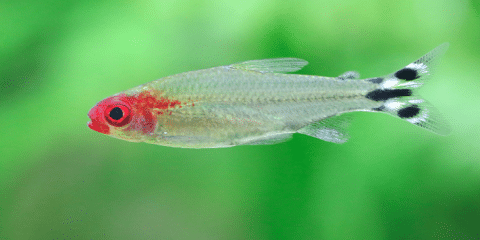
    The startling difference between other freshwater fish and Rummy nose tetras is their red head that leaves your visitors awestruck.

    Rummy Nose Tetra

    The body of rummy nose tetras is torpedo-shaped with sheer silver color accentuated with a grayish-green hue. The caudal fin in rummy nose tetra is patterned with black and white horizontal stripes with colorless lobe tips. There is a very thin, indistinguishable black line that runs forward base to base- from the caudal fin towards the dorsal fin.

    The deep fiery color in the rummy nose tetra is limited to the head region only, and the vibrancy of colors on your rummy nose tetras speaks volumes of the tank’s water quality, diet, and overall health of the fish.

    Types

    Rummy nose tetras are divided into three distinct very similar tetra species.

    The True Species: Hemigrammus rhodostomus

    The Hemigrammus Rhodostomus are the true rummy nose tetras that are often sold as the common rummy nose tetra or the “brilliant nose tetra”. However, you can easily distinguish the following by these factors:

    • The amount of red coloration on the head is a little lighter than H. Bleheri.
    • The dark blotch is absent at the bottom.
    • The line that extends laterally from the central caudal fin is narrower in the true rummy nose tetra.

    The Brilliant  or The Common: Hemigrammus bleheri

    The most popular species of the rummy nose tetra are H. Bleheri. Commercial breeders also produce a golden variant of the rummy nose tetra by selectively breeding, which is available for sale from time to time.

    • The red coloration on the fish’s head extends into the fish’s body, beyond the gill covers.
    • The presence of a dark blotch at the top of the caudal peduncle.
    • The line that extends laterally from the central fin into the fish’s body is almost invisible.

    The false Kind Petitella georgiae

    The false rummy nose tetras is distinguished by the other two types on the basis of:

    • Bright redhead
    • The black horizontal line extends to the middle rays of the caudal peduncle.
    • Presence of diagonal black bars in each caudal-fin lobe, divided by white bands

    Therefore, this species of rummy nose tetra is often labeled as the black-finned rummy nose.

    Average Size and Lifespan

    Rummy nose tetras are small freshwater fish. They grow no longer than two inches in length with a life expectancy of around six years with proper maintenance and care.

    Care Guide

    Rummy noses are popular schooling fish that are considered easy for beginners. However, if you don’t take care of them or maintain their water quality, things can get worse. Therefore, be vigilant in raising a rummy nose, because they take poor water conditions and other parameters very seriously.

    Also, rummy noses are much appreciated by the aquarium keepers as they are very active and very reasonable in many pet stores.

    The Rummy Nose Tetra is a hardy fish when well taken care of that will live for almost a decade ranging from five to eight years. These tiny fish grow up to anywhere from one and a half inches to two and a half inches.

    Aquarium Setup

    In their natural habitat, the rummy nose tetra occupies the middle and top water column with a preference for slow-moving waters. However, they have usually seen feeding and swimming in the middle and bottom as well.

    Rummy nose tetras stay happy in a spacious tank where they could swim freely with lots of hiding places and plants.

    Tank Size

    While they can qualify for a nano tank given their size, they are not the best nano fish. The minimum tank size for rummy noses should be no less than 20 gallonsIt is observed that these fish occupies the middle and top levels of the tank, but oftentimes they is seen swimming and feeding in the middle and bottom levels. In captivity, experts suggest keeping them in schools of six or moreThese fish species are particularly small, which means around five of these fish easily fit in ten gallons, meaning you can fit 25 rummy noses in a 30-gallon tank.

    Water Parameters

    Rummy nose tetras admire warm water temperature so much. So, they should always be kept in water temperatures around 75 to 85 degrees Fahrenheit – with 78 being the most ideal temperature Also, they prefer slightly acidic to neutral water with recommended pH levels of 6.2 to 7. Any changes in the water chemistry of the tetra tank and temperature would adversely affect these tetras. Therefore, be sure to maintain optimal conditions to raise a happy and healthy tetra.

    Filtration and Aeration

    Rummy noses take their tank condition very seriously. The slightest inconvenience, for example, the traces of ammonia, nitrite, nitrates, and other toxins can shorten their lifespan and activity levels. Therefore, to provide a healthy ecosystem, it is suggested to use a robust filter such as HOB or canister filters to keep your fish tank free of toxins.

    For larger aquariums of around 40 gallons or more, I suggest using airstones to increase aeration and water oxygenation, or you can install multiple filters 

    Lighting

    Like most fish, rummy nose tetras do not enjoy bright lightsTherefore, if you have a well-planted tank, I suggest using dim light or adjustable L.E.D lights to subtly light your aquarium for plant material.

    To darken the tank more, you can get tall floating plants and driftwood and rocks, providing cozy, shady areas for your fish.

    Aquatic Plants and Decorations

    The number one rule to keep your tetras happy as a daisy is to mimic their natural habitat and see them thriving more than ever. 

    Since these fish species are top- to middle-dwelling, I recommend you get plants that reach such water columns to provide a sense of protection. Also, rummy tetras loathe bright lights. So, to give them ample shade, add floating plants and rooted plants for them to hide and burrow for shade if needed. You can add as much plant material as you want because rummy tetras are not destructive toward aquatic plants. 

    For tank decorations, a piece of driftwood and a pile of rocks provide much space to hide and rest. But be sure to not overwhelm the tank with plants and other decorations because rummy noses enjoy a lot of swimming room. Low light plants are recommended for these types of tetras.

    Substrate

    Many tetra keepers use a dark substrate to make their radiant rummy noses and out from the crowd. But you can use any high-quality fine sandy substrate or pebble substrate at the bottom of your tank.

    Tank Maintenance

    No matter how many high-quality filters you use, rummy noses are very sensitive to toxins and poor water conditions. Therefore, you should to do weekly water changes without stressing them much. Also, it is advised to change your filter media every 3 weeks. If you’re planning to breed rummy nose tetra, make sure to test the water quality daily as mild exposure to minerals such as Calcium and other toxins can cause sterility in these tetras.

    Community Tank Mates

    The good news is rummy noses are a schooling and peaceful fish. Thus, they will mix with other schooling fish, just make sure you have at least 6 to form a group.

    The most suitable tank mates in a rummy nose tetra tank are:

    1. Danios of all types
    2. Corydoras Catfish
    3. Barbs
    4. Harlequin Rasboras
    5. Lemon Tetras
    6. Black widow tetras
    7. Cardinal tetras
    8. Peppered catfish
    9. Siamese fighting fish

    And all other peaceful, small fish. Mostly dwarf shrimps go well with rummy nose tetras. However, the adult fish might end up eating dwarf shrimp and their fry. Therefore, always opt for tank mates equal to the size of the rummy nose tetra.

    Incompatible Tank Mates

    The incompatible tank mates are most of the cichlids and other large or aggressive fish that may bully or harm your rummy noses.

    Breeding

    Breeding rummy nose tetras is a challenging task, especially in captivity because a minor increase in the calcium levels causes sterility in these fish.

    To breed rummy noses successfully, you need to provide them with soft water with a pH of around 6.5. Also, the levels of Calcium should be close to none in the breeding tank and the temperature range should be around 84 degrees Fahrenheit with low lighting.

    Rummy noses are egg layers and they lay their eggs on the fine-leaved plants such as java moss. These fish lay only a few eggs at one time, that too, at night time. I suggest removing the parents into another tank because they may eat eggs. 

    After three to four days, the eggs hatch, which are vulnerable to fungus. You can use an anti-fungal medication to avoid this problem. If the medication is not available, you can use natural items like Indian Almond Leaves as their tannic acid is helpful in preventing fungal infections. Check out this video by Bo The Tetra Breeder below for a timelapse of the fry’s development.

    How do you raise the Fry?

    The baby rummy noses are slow growers among all the popular freshwater fish. Many fish experts make them eat infusoria for at least three weeks before feeding them anything else. The fish fry is very vulnerable to fatal diseases, thus, the quality of tank water should be maintained properly.

    It takes around six months for the rummy nose’s baby to munch on adult fish food such as Daphnia.

    Food and Diet

    Since these fish are omnivorous. They thrive well on a varied diet rich in protein. You can easily feed them premium-quality flake food, pellets, frozen foods, freeze-dried foods, bloodworms, blackworms, and much more.

    In the wild, they munch on plant debris and insect larvae. But in captivity, they have a variety of food to feed on such as brine shrimp, fish eggs, green vegetables including, cabbage, lettuce, cucumber, etc, and commercial food as well.

    However, don’t forget to add flake food as the base because good flake food will provide nutrients and are easy to feed for these small fish.

    How Often Should You Feed Rummy nose?

    You can feed these species twice daily. But make sure they finish the food within 2 minutes to prevent food decay and a murky tank.

    Rummy noses are sensitive to nutritional deficiencies. Therefore, feeding them with high-quality flake food with lots of protein content is crucial along with occasional treats given on a weekly basis.

    Common Health Problems and Diseases

    The best part about rummy noses is they hardly get sick and catch diseases if you provide them with excellent water conditions.

    However, there are some common health problems and diseases observed in the rummy noses such as:

    Dropsy

    In this condition, the fluid builds up inside the body of a fish. This is due to bacterial infections, liver dysfunction, or parasitic infections. Either way, proper diagnosis is recommended.

    Ich or White spot Disease

    The Ich disease is a common health problem in most tropical fish. The signs of these diseases are the presence of small white spots on the body and gills, scraping of the body against sharp, hard objects in the aquarium, loss of appetite, and abnormal hiding or lethargic behavior.

    Differences Between Male and Female

    The visual differences between the male and female rummy nose species are close to none. However, when the female is full of eggs, the body looks fuller and much more rounder than the male.

    Where to get the best quality from?

    Since you’ve researched everything about the rummy nose tetras, it’s time to get your hands on this great fish.

    You can easily purchase these beautiful fish from online fish stores or in-store from the local breeders. Either way, the cost of rummy nose tetra is very as affordable as low $4 for a single fish, and $25 for a group of six to keep in your home aquarium.

    Where to Buy

    These tetra fish are easy to find at fish stores. While easy to find, not every fish store is reputable. If you want to go with an online option, I would highly recommend Flip Aquatics. Rob and his team value the care they put into their aquatic animals. It is in my mind, the best place to purchase nano fish and shrimp from. You can use promo code ASDFLIPPROMO at check out for a discount!

    FAQs

    Is the Rummy Nose Tetra Right for You?

    Before you add a rummy nose tetra to your tank, it’s worth asking whether this species actually fits your setup and your goals. Here’s a quick breakdown to help you decide.

    This species is a good fit if:

    • You have a large enough tank to manage territories. Cramped conditions amplify aggression.
    • You’re comfortable managing aggression through stocking ratios, line of sight breaks, and tank layout.
    • You can commit to regular water changes. These fish produce more waste than many smaller species.
    • You’re not planning a peaceful community tank. Rummy Nose Tetras need tank mates that can hold their own.
    • You enjoy watching active, interactive fish. Cichlids have personality that smaller species simply don’t match.
    • You have backup plans. Sometimes a particular fish just doesn’t work out, and you need a way to rehome it.
    • You’re feeding a varied, high-quality diet. Color and health depend on nutrition.

    If most of those points line up with your setup, the rummy nose tetra is worth serious consideration. If several don’t, it’s better to choose a species that matches your tank now rather than trying to make it work.

    What It Is Actually Like Living With Rummy Nose Tetra

    Watching a healthy school of rummy nose tetras is genuinely mesmerizing. They move as a single unit, changing direction simultaneously like they share one brain. No other tetra does this consistently.

    They are creatures of routine. They school in the same patterns, occupy the same areas, and react to feeding time with choreographed precision.

    The red nose is addictive to monitor. You will find yourself glancing at the tank throughout the day just to check the color intensity. It becomes your instant read on tank health.

    They pair beautifully with calm, well-planted setups. Heavy plant cover along the back with open swimming space in front gives them room to school while feeling secure.

    How the Rummy Nose Tetra Compares to Similar Species

    Choosing between similar species is tricky. Here’s how the rummy nose tetra stacks up against some common alternatives.

    Rummy Nose Tetra vs. False Rummy Nose Tetra: Both species occupy a similar niche in community tanks, but they differ in temperament, coloration, and ideal water conditions. The rummy nose tetra is a solid choice for hobbyists who want reliable schooling behavior and easy care, while the false rummy nose tetra brings a slightly different look and energy to the tank. In my experience, the deciding factor usually comes down to which aesthetic you prefer and what other species are already in the tank. Check out our False Rummy Nose Tetra care guide for a detailed breakdown.

    Rummy Nose Tetra vs. Cardinal Tetra: Both species occupy a similar niche in community tanks, but they differ in temperament, coloration, and ideal water conditions. The rummy nose tetra is a solid choice for hobbyists who want reliable schooling behavior and easy care, while the cardinal tetra brings a slightly different look and energy to the tank. In my experience, the deciding factor usually comes down to which aesthetic you prefer and what other species are already in the tank. Check out our Cardinal Tetra care guide for a detailed breakdown.

    Final Thoughts

    The rummy nose tetra is a beautiful addition to your community aquarium. The most crucial part of raising a happy and healthy rummy nose tetra is to provide them with ample free swimming space and a well-balanced, nutritious diet. Besides, they are a very hardy fish with a lifespan of around six years, if taken good care of. 

    Check out our tetra tier list video where we rank the most popular tetras in the hobby, including the rummy nose tetra:


    ๐ŸŸ This article is part of our Tetras: Complete A-Z Species Directory. Your guide to every tetra species in the hobby.

    This article is part of our Tetra Species Directory. Visit the hub page to explore all species care guides.

  • Betta Fish Laying on Bottom of Tank: 12 Reasons Why (And What To Do)

    Betta Fish Laying on Bottom of Tank: 12 Reasons Why (And What To Do)

    A betta lying on the bottom of the tank is one of those things that immediately gets your attention. and in my experience, it can mean several very different things depending on the fish and the context. I’ve seen bettas do this because they were sick, but I’ve also seen perfectly healthy bettas rest on leaves or the substrate. This guide walks through the 12 most common reasons and how to tell them apart quickly.

    A betta laying on the bottom of the tank is one of those things that sends new keepers into a panic. and sometimes that panic is warranted, but not always. Bettas rest. They’ll sit on plant leaves, wedge themselves into a corner, or park on the substrate, especially during lights-out or after a big meal. I’ve kept bettas long enough to know the difference between a fish that’s just resting and one that’s actually in trouble. The key is looking at the full picture: is the betta responsive when you approach the tank? Is its color normal? Is it breathing rapidly? Those questions matter more than the position. This guide walks through all 12 possible reasons, so you can diagnose the actual cause rather than guessing.

    Introduction To Betta Keeping

    No matter what kind of fish you have, you never want to see it laying on its side at the bottom of the tank. This behavior is usually a telltale sign that something is wrong in the aquarium whether it be illness and disease, poor water quality, or stressful tank mates. Prolonged laying on the substrate can eventually cause secondary infections to form due to new scrapes and scratches as well as torn fins; betta fish especially are prone to developing fin rot.

    Unfortunately, seeing a betta laying on the bottom of a tank is a common sight in commercial pet stores. This can fool beginner hobbyists into thinking that it’s the natural behavior of their fish when they bring it home. This, in addition to the general misinformation surrounding betta fish, leads to many unnecessary fish deaths.

    This is not normal betta fish behavior and your betta fish should never be laying on the bottom of the aquarium. But how can you make sure to keep your betta fish happy and healthy?

    Aquarium Size

    It’s a common misconception that betta fish don’t need a lot of space. While this is mostly true, they definitely flourish when given the space to thrive.

    Betta fish are commonly kept in 1-gallon betta tanks that haven’t undergone the nitrogen cycle. Sadly, beginner hobbyists are often left wondering what happened to their fish. In general, betta fish need at least a 5 gallon, fully-cycled, and heated aquarium.

    Editor’s Choice!
    Fluval Spec V

    The Best Betta Fish Tank

    Best filtration, best light, perfect size and with everything you need to get started. It was made for Bettas!

    Buy On Petco Buy on Amazon

    From there, hobbyists may add live aquarium plants and appropriate tank mates while keeping up water quality and keeping the betta enriched. Of course, hobbyists have been successful in keeping these beautiful fish in smaller setups, but this is only recommended for more experienced betta keepers.

    Water Parameters

    In addition to an appropriately sized tank, betta fish also need a fully-cycled and heated aquarium. Many times, these fish are thrown into an uncycled tank where they are left to succumb to ammonia poisoning or another water quality problem. With some patience, keeping water parameters right for betta fish is easy.

    Betta fish need 0 ppm ammonia, 0 ppm nitrite, and minimal nitrate at all times. As we’ll see, excess levels of these parameters can quickly cause the betta’s health to deteriorate, which can lead to death in some cases.

    Betta fish originate from very acidic conditions in Southeast Asia with pH levels under 7.0. Many of the fish available at local pet stores today have been bred in the aquarium industry and have adapted to a relatively neutral pH between 6.0-8.0, though stability is key.

    These fish are also a tropical species and need an aquarium heater to keep the water temperature between 78-80ยฐ F. Too many hobbyists try keeping these hardy fish at ambient room temperature and find themselves with a stressed-out betta due to fluctuating water temperatures.

    Aquarium Mates

    Yes, it’s possible to keep other fish with your betta fish. However, this will largely depend on the personality of the individual fish.

    Some betta fish might not tolerate other fish or invertebrates in their aquarium at all. Others may accept some but not others. And then there are those few lucky hobbyists that have a betta fish that accepts any and all new tank additions, though betta fish may also change their mind at any given moment.

    Still, there are several tried and true species that have made perfect betta fish tank mates. These include:

    If keeping female betta fish, it may also be possible to start a betta fish sorority tank, though this setup is usually considered more advanced.

    Why Are They Laying On Bottom Of Aquarium (12 Reasons Why)

    There is only one instance when it is normal for your betta fish to be laying on the ground and that is when it is sleeping. Otherwise, there is probably a problem with tank or water quality or you’re dealing with an illness. Check out the video below from our YouTube channel. We will go in more detail in the blog post below.

    Here’s how to identify the problem and what to do to get your betta fish feeling better.

    1. Sleeping Fish

    Yes! A betta sleeps. Though it’s not in the same way other animals do.

    Instead, fish will have a brief sleep cycle where they enter the REM stage throughout the night1. This can make for some interesting behavior in an animal that doesn’t have the ability to lay down. Many new hobbyists might worry that their betta is sick due to abnormal behavior once the lights go out, but usually, it’s just your betta trying to get some shut-eye.

    Here’s how to tell that your fish is sleeping.

    Usually, fish have a preferred spot to rest once the lights turn off. In a planted aquarium, this might mean a favorite leaf or spot behind a decoration (like a betta hammock or betta log). They will then lightly float near the object, sometimes in weird orientations. It might even appear like they stop swimming altogether and almost slip off the item.

    Editor’s Choice
    Zoo Med Floating Log

    The floating log is an excellent environmental enhancer for your Betta fish. Offers a place to hide and rest at the top of their tank. Contains a feeding hole for ease of use

    Buy On Amazon Buy On Petco

    Other bettas might enjoy laying on the substrate. This is simply a preference, but it can definitely be concerning when you see your fish at the bottom of the tank starting to fall sideways.

    If this happens every night, it’s normal. Fish are weird sleepers. However, if this starts happening during the day or you notice abrasions or ripped fins starting to form, then this can become a more serious issue.

    2. Older Fish

    Just like you and me, betta fish get weaker as they age.

    They might not be able to swim in a straight line from the top of the aquarium to the bottom of the tank, and might find themselves resting on a leaf or aquarium equipment. If your betta fish is especially exhausted, it may even take a quick break at the bottom of the tank.

    Unfortunately, all bettas age. Continue to monitor your fish for cuts and scrapes and give your fish the best days possible!

    3. Ammonia Poisoning

    If your betta fish isn’t sleeping and isn’t old, then there is more than likely something wrong with the tank or with water conditions. One of the leading causes of betta fish laying on the bottom of the tank is ammonia poisoning.

    Ammonia is a natural compound in the aquarium; fish and invertebrates constantly create waste that is then processed by beneficial bacteria populations. The highest that ammonia levels should ever go is when the tank is cycling. It should remain close to 0.0 ppm at all other times.

    But what happens if you add too many fish or you accidentally feed too much at one time? You may experience a mini-cycle where ammonia levels increase, causing an imbalance in bacteria populations.

    Unfortunately, ammonia is a deadly chemical. Any significant amount of ammonia in the aquarium will cause injury to the external and internal organs of fish and invertebrates. Eventually, their gills are burned and they are unable to breathe.

    This side effect can lead your fish to gasp for air at the bottom of the tank. At this stage, it’s pretty late for your fish. However, water changes, water conditioners, and ammonia-reducing filter media may help bring down the ammonia levels just in time.

    4. Nitrate Poisoning

    If you experience a mini-cycle, then it’s likely you’ll get a large influx of nitrates as well.

    When ammonia enters the aquarium water, it is converted from ammonia, into nitrite, and finally into nitrate. Unlike the others, nitrates can only be quickly removed from the aquarium with a water change. This is why it’s recommended to do a near-100% water change after a betta tank has finished cycling.

    Luckily, nitrate poisoning only occurs when there are very high levels of nitrate in the aquarium water. By the time nitrates accumulate enough in the betta fish tank to cause nitrate poisoning, it’s likely that your betta fish will have died from a prior cause. However, nitrate poisoning is a real possibility after cycling the aquarium.

    Nitrate poisoning will quickly lead to poor health in your betta. One of the more severe symptoms is if the betta fish lays on the bottom of the tank.

    To make sure your betta fish never experiences nitrate poisoning, regularly perform water changes and test water parameters.

    5. Swim Bladder Disorder

    The swim bladder is responsible for regulating a fish’s buoyancy in the water column. Symptoms of a swim bladder disorder include difficulty maintaining an upright position, bloatedness, curved back, and sinking or floating to the top of the water.

    Swim bladder problems aren’t entirely understood, though they’re believed to be a secondary symptom of a more major problem (such as vertical death hang), like water quality or another illness. One of the ways betta might also be affected is by taking in too much oxygen while they eat food at the surface of the water.

    The main treatments for swim bladder disorder are increasing water quality through water changes, changing diets, and possible medication.

    6. Small Aquarium

    Another reason you might find your betta fish laying on the bottom of the tank is due to a small aquarium. Betta fish are notorious for being kept in poor conditions due to being a beginner’s fish. Not only does an overly small aquarium stress out betta fish, but less water volume can lead to fluctuating water parameters.

    Betta fish require a 5-gallon, fully-cycled aquarium; some hobbyists have success keeping these fish in smaller setups, but 5 gallons is usually the bare minimum recommended. This gives the fish enough space to freely swim while providing an interactive environment to keep your fish from getting bored.

    A bigger aquarium also means that water parameters aren’t affected as quickly or as much should a problem arise in the system, which leads to a more healthy betta overall.

    However, a small aquarium can lead to poor water quality and a bored betta left laying on the bottom of its tank.

    7. Temperature

    One of those affected water parameters could be water temperature.

    Betta fish are very hardy fish in all regards but they’re a tropical fish that needs a constant water temperature between 78-80ยฐ F. Unfortunately, these fish are often kept in unheated aquariums with fluctuating temperatures due to misinformation surrounding correct betta care.

    Betta fish always need an aquarium heater for temperature stability as incorrect or fluctuating water temperatures can cause the fish to go into shock. The inability of your betta fish to physiologically adjust to its environment can quickly lead to a lethargic and dying betta.

    8. Wrong pH

    Possibly even worse than a wrong water temperature is a wrong pH.

    In the wild, betta fish live in slightly acidic water conditions due to tannins that enter the water column when organics start to break down. Since they’ve been bred in the freshwater aquarium for a long time, most betta fish are able to adapt to a more neutral pH, near 7.0. Most aquarium keepers keep their betta tank pH between 6.0-8.0.

    The problem is that pH is measured on a logarithmic scale that makes differences in numbers an exponential change; what might seem like a slight change in pH is actually much greater than it might read.

    That being said, it’s normal for aquariums to experience changes in pH throughout the day, especially in a well-planted tank where there are varying levels of photosynthesis and respiration. However, if pH changes more than 0.5 a day, this can become stressful and even deadly for the betta fish.

    9. Filtration Issues

    In addition to a heater, betta fish also usually require a filter that is properly sized for a betta tank. Finding a properly fitting betta fish filter can be difficult. It needs to be rated for at least 5 gallons but can’t be so strong that it pushes your fish across the tank.

    This is a common problem for betta keepers: a good quality filter that has too much water flow. As a result, betta fish can be pushed around and injured and left struggling to recover at the bottom of the tank.

    Filters that don’t provide enough surface area for adequate beneficial bacteria populations to grow can also lead to poor water quality which can greatly affect bettas.

    The solution to both these problems is using an aquarium filter that can keep up with the bioload of the system by modifying or baffling the water flow. Some hobbyists even turn to a sponge filter instead of a hang on the back system so that flow isn’t as overwhelming.

    10. Poor Diet

    In the wild, betta fish have a wide assortment of plants, algae, insects, and detritus to choose from to eat. While this can surely be replicated in the aquarium setting, a high-quality fish flake or pellet can usually meet the nutritional needs that bettas need to thrive.

    However, a low-quality food, or one that is meant for other species, may not fulfill all the vitamins and nutrients your fish requires to perform regular tasks, such as swimming. Irregular feedings and lack of feeding can also cause fish to become weak and malnourished.

    Many low-quality betta fish foods have fillers in them that add no nutritional value. This can lead to indigestion problems, such as constipation.

    11. Lack of Interaction

    Betta Fish Interacting with Reflection

    As mentioned before, bettas can become bored in their environments, especially in a very small tank where there isn’t much to do.

    Though betta fish are solitary fish, they require enrichment. A bored betta may sink to the bottom of the tank, waiting for something new to enter its home.

    Even though fish aren’t the most intelligent animals, they still appreciate being visited by their owners every day. They will develop a routine and schedule around when hobbyists feed the tank or perform tank maintenance; just watch how your betta fish reacts the next time you go near its tank!

    Betta fish do not need to be constantly entertained and small additions, like invertebrate tank mates, live feedings, or the addition of live plants, can give your betta fish just enough change in their environment so they don’t become bored.

    12. Poor Tank Mates

    At the same time, you don’t want to add tank mates that will cause your fish to become stressed out from being overactive. Larger, aggressive fish may even chase your betta and exhaust it, leading them to get injured and lay on the substrate.

    There are plenty of betta fish tank mate options that have proven to be successful, but many pairings are not; success will also greatly depend on the personality and behavior of the individual betta fish as not all may be as welcoming as other fish.

    Final Thoughts

    Betta fish are very hardy fish, but unfortunately, a sick betta fish can succumb to a variety of water parameter problems and illnesses relatively fast. If you find your betta fish laying at the bottom of the tank then check water parameters immediately and check for signs of disease.

    If there are no signs of a problem with either, then your fish might just be sleeping or getting older!


    ๐Ÿ“˜ Want to learn more? This article is part of our complete Betta Fish Guide. your ultimate resource for betta care, types, tank setup, feeding, tank mates, and more.

    References

  • 12 Easiest Fish to Take Care Of: My Top Picks for Beginners After 25 Years

    12 Easiest Fish to Take Care Of: My Top Picks for Beginners After 25 Years

    After 25 years in the hobby, I’ve introduced a lot of people to fishkeeping. and the fish you start with makes a huge difference in whether you stick with it. Easy fish don’t mean fish that thrive in neglect. They mean fish that forgive the inevitable beginner mistakes: a temperature swing, a slightly delayed water change, a new tank that isn’t perfectly cycled. The 12 fish on this list are the ones I’d actually recommend to someone starting out. hardy, adaptable, and interesting enough that you won’t outgrow them once you have more experience.

    12 Simple Species To Take Care Of

    Now that you know more about the benefits of keeping low-maintenance fish, it’s time to dive straight in and meet 12 awesome fish species you can keep!

    Check out this video below from our YouTube channel. We go over more detail in the blog post below.

    Each species profile includes a list of important facts, so take note of the following:

    • Scientific name
    • Temperament
    • Origin
    • Size
    • Minimum Tank Size
    • Diet
    • pH
    • Temperature
    • Difficulty to breed

    1. Betta

    WYSIWYG Available!
    Betta Fish

    Use Coupon Code ASDFISH at Checkout

    Betta Fish are one of the most beautiful varieties of freshwater fish available in the hobby. Easy to care for with plenty of varieties!

    Buy Premium Varieties Buy On Petco Online
    • Scientific name: Betta splendens
    • Temperament: Aggressive
    • Origin: Southeast Asia
    • Size: 2.5 inches
    • Minimum Tank Size: 5 gallons
    • Diet: Feed granules, pellets, flakes, brine shrimp & blood worms
    • pH: 6.5-7.5
    • Temperature: 75-82ยฐF
    • Difficulty to breed: Moderate

    The good old betta fish is a great species to start our list with. Betta fish are also called Siamese fighting fish because if you keep more than one male in the same tank, you can expect a war!

    These colorful fish make great beginners fish because they don’t need a large fish tank and they’re really fun to keep. Betta fish can be kept with other community fish, but many beginners prefer to keep one of these beautiful tropical fish in its own tank.

    2. White Cloud Minnows

    • Scientific name: Tanichthys albonubes
    • Temperament: Peaceful
    • Origin: China
    • Size: 1.5 inches
    • Minimum Tank Size: 10 gallons
    • Diet: Feed granules, pellets, flakes
    • pH: 6-8.5
    • Temperature: 58-72ยฐF
    • Difficulty to breed: Moderate

    The peaceful white cloud minnow is not actually a tropical fish. This means they don’t necessarily need a heater unless your home is really, really cold. These cold-water fish have great colors and they’re very peaceful, making them awesome fish species for beginners!

    White cloud minnows don’t need a big tank, and they get along great with other fish. Just remember that these fish like it a little cooler than many other fish.

    3. Danios

    Leopard Danio in Planted Tank
    • Scientific name: Brachydanio rerio etc.
    • Temperament: Peaceful
    • Origin: Asia
    • Size: 1.5-5 inches
    • Minimum Tank Size: 15-30 gallons
    • Diet: Feed pellets, granules, flakes, and live/frozen foods
    • pH: 6-8
    • Temperature: 65-77ยฐF
    • Difficulty to breed: Moderate

    There are loads of beautiful danio species in the aquarium trade, and many of them are perfect beginner fish! Zebra danios are a great example, and they’re usually very easy to find.

    These active little fish also come in spotted (leopard) and long-finned forms. Zebra danios are really peaceful and super hardy fish, but give them a nice big tank because they do prefer plenty of room to swim.

    4. Endler’s Livebearer

    • Scientific name: Poecilia wingei
    • Temperament: Peaceful
    • Origin: South America
    • Size: 1.5 inches
    • Minimum Tank Size: 10 gallons
    • Diet: Feed granules, pellets, flakes
    • pH: 7-8.5
    • Temperature: 75-86ยฐF
    • Difficulty to breed: Easy

    The Endler’s livebearer is similar to a regular guppy, but they stay even smaller. These fish are super easy to care for, and they have amazing colors too!

    These very small fish are called livebearers because the females give birth to live baby fish instead of laying eggs. They are one of the easiest fish to breed, but if you prefer not to have loads of tiny fish in your tank, go ahead and pick up just males, or just females. If you want to go larger, you can try platys or molly fish.

    5. Kuhli Loach

    • Scientific name: Pangio semicincta
    • Temperament: Peaceful
    • Origin: Southeast Asia
    • Size: 3.5-4 inches
    • Minimum Tank Size: 15 gallons
    • Diet: feed sinking tablets and frozen foods
    • pH: 3.5-7
    • Temperature: 70-79ยฐF
    • Difficulty to breed: Advanced

    Kuhli loaches are super hardy and super easy to care for. They prefer to come out after dark, and they’re pretty shy, so I wouldn’t recommend these guys if you’re only looking for only one species.

    For a community tank, however, kuhli loaches are great because they are always willing to pick up any scraps of uneaten food and help keep your aquarium clean.

    6. Bristle Nose Pleco

    • Scientific name: Ancistrus spp.
    • Temperament: Peaceful
    • Origin: South America
    • Size: 5 inches
    • Minimum Tank Size: 30 gallons
    • Diet: Feed sinking tablets, algae wafers, and plant material
    • pH: 6.5-7.4
    • Temperature: 70-78ยฐF
    • Difficulty to breed: Moderate

    The bristle nose pleco is a really cool-looking bottom-dweller fish that is very easy to keep. These small fish are also known as the bushy nose pleco because males develop strange bushy growths on their faces.

    Bristle nose plecos are suckerfish, and they love eating algae off driftwood and the glass walls of the aquarium. There are both the regular and albino varieties available.

    7. Harlequin Rasbora

    • Scientific name: Trigonostigma heteromorpha
    • Temperament: Peaceful
    • Origin: Southeast Asia
    • Size: 1.25-1.75 inches
    • Minimum Tank Size: 15 gallons
    • Diet: Feed granules, flakes, and frozen/live foods
    • pH: 5-7.5
    • Temperature: 70-82ยฐF
    • Difficulty to breed: Moderate

    The harlequin rasbora is a really good beginner fish. These reddish schooling fish have great triangular markings on their sides, just like the shape of a pork chop!

    Harlequin rasboras are very easy fish to keep, and they love to have live plants in their tanks. They get along really well with other fish species too, but they should not be kept with more aggressive fish.

    8. Albino Corydoras Catfish

    Albino Cory Catfish
    • Scientific name: Corydoras spp.
    • Temperament: Peaceful
    • Origin: South America
    • Size: 2-3 inches
    • Minimum Tank Size: 15-30 gallons
    • Diet: Feed pellets, tablets, and live/frozen foods
    • pH: 7-8
    • Temperature: 74-80ยฐF
    • Difficulty to breed: Advanced

    Cory catfish are some of the best beginner fish in the hobby, and albinos are especially cool. These brightly colored little catfish are always easy to find, and they are very hardy. These neat little bottom feeders get along with all other peaceful fish, and they love picking up scraps at the bottom of the tank.

    Like siamese fighting fish, cory fish breathe atmospheric air, so don’t be surprised to see them shoot up to the surface to take a breath every now and then!

    9. Cherry Barbs

    • Scientific name: Puntius titteya
    • Temperament: Peaceful
    • Origin: Sri Lanka, Asia
    • Size: 1.5-2 inches
    • Minimum Tank Size: 15 gallons
    • Diet: Feed granules, pellets, or flakes. Include some plant matter and live/frozen food
    • pH: 6-8
    • Temperature: 68-81ยฐF
    • Difficulty to breed: Moderate

    Cherry barbs don’t quite live up to the bad reputation of some of the other barb species. These peaceful and interesting schooling fish are great for beginners because they are very low maintenance and thrive in a wide range of temperatures and water parameters. Cherry barbs are a great-looking fish species too, and the males are especially colorful fish.

    10. Red Eye Tetra

    Red Monk Tetra
    • Scientific name: Moenkhausia sanctaefilomenae
    • Temperament: Peaceful
    • Origin: South America
    • Size: 2.8 inches
    • Minimum Tank Size: 20 gallons
    • Diet: Feed granules, pellets, or flakes. Include some plant matter and live/frozen food
    • pH: 6-8
    • Temperature: 72-79ยฐF
    • Difficulty to breed: Moderate

    The good old red monk or red-eye tetra is a very underrated freshwater fish that is perfect for beginner fish keepers. They grow a little larger than other common species like the neon tetra, so set them up with a nice big tank and plenty of swimming space.

    Red monk tetras are very peaceful, hardy, and active fish. They are social creatures too, so it’s important to keep them in a school of at least 6 of their own species.

    11. Siamese Algae Eater

    • Scientific name: Crossocheilus oblongus
    • Temperament: Peaceful
    • Origin: Southeast Asia
    • Size: 6 inches
    • Minimum Tank Size: 20 gallons
    • Diet: Algae
    • pH: 6.5-8
    • Temperature: 75-79ยฐF
    • Difficulty to breed: Advanced

    Siamese algae eaters are pretty large but very peaceful fish. They are amazing for keeping your tank clean because they love to eat algae. These tropical fish might not be very colorful, but they have a cool body shape, almost like a shark!

    12. Black Neon Tetra

    • Scientific name: Hyphessobrycon herbertaxelrodi
    • Temperament: Peaceful
    • Origin: Brazil
    • Size: 1.5 inches
    • Minimum Tank Size: 15 gallons
    • Diet: Feed granules, flakes, and live/frozen foods
    • pH: 5-7.5
    • Temperature: 68-82ยฐF
    • Difficulty to breed: Moderate

    Black neon tetras are super hardy freshwater aquarium fish that are the perfect fish for beginners! They are completely peaceful tetras and get along really well with other species and tank mates.

    Black neon tetras are naturally schooling fish, so make sure you pick up a group of at least 6 to really enjoy their natural behaviors.

    Varieties To Avoid

    Now that you know 12 of the best freshwater fish for a new aquarium owner, let’s take a minute to look at a few species to avoid. Now, these are all great fish, but they are a little better suited to more experienced fish keepers.

    1. Goldfish

    Goldfish

    Many people think goldfish are for beginners, but this isn’t actually true. These fish come in loads of fancy goldfish varieties, but they are all the same species as regular goldfish.

    Goldfish are coldwater fish so they definitely won’t be at home in your standard tropical community tanks. Goldfish also grow larger than many people think. At up to 6 inches, goldfishes produce a lot of waste, oh and they love to eat your live plants too!

    2. Cichlids

    <a href=Green Terror Cichlid in Aquarium” class=”wp-image-545177″/>

    Cichlids tend to be aggressive and territorial fish. The African cichlids can be very aggressive and they usually need hard, alkaline water to be healthy. Large South American cichlids like oscar fish need loads of space, and they can be very aggressive too.

    Some species, like angelfish, are pretty easy to keep, but as a general rule, cichlids should be avoided if you’re just starting out.

    3. Freshwater Sharks

    How Does A Bala Shark Look Like

    Freshwater sharks, like bala sharks, are another popular group of tropical fish that are not great for beginners. These fish aren’t actually true sharks, but they have a very similar shape.

    Freshwater sharks can get really big, and some of them tend to get a bit mean towards other fish.

    Why Choose Easy Fish?

    When you’re starting out, it’s best to choose the easiest fish to take care of. Here’s why:

    Your Enjoyment

    Keeping fish should be fun! Keeping low-maintenance fish allows you to spend more time enjoying your pets.

    Even easy fish need good care and regular maintenance, of course, but fish keeping shouldn’t feel like too much hard work, especially if you’re just getting started.

    Time And Budget

    You probably don’t have the time to be caring for your fish for hours every day. Costs can also add up pretty quickly when you start getting into the more advanced fish species.

    So do yourself a favor and start out with a manageable aquarium with easy fish. You’ll enjoy the hobby so much more. Besides, you can always set up more tanks in the future!

    The Health And Well Being Of Your Pets

    Easy fish are much safer for beginner fish keepers because they are less likely to get sick. Of course, you want your pets to live long and healthy lives, so set yourself (and your fish) up for success with some easy and hardy beginner fish.

    What Makes Some Fish Easy?

    Why are some fish easier to keep than others? They’re all fish, right? Well, not quite…

    Some species of fish are just much easier to keep than others! Let’s take a look at why:

    Tank Size

    Smaller fish aren’t necessarily easier to keep than big ones. Small aquariums can be a lot easier to set up and maintain, however. A massive aquarium is a very heavy thing, that needs careful planning to set up safely. Water is heavy, and performing water changes and keeping a large tank clean can be quite a lot of work.

    This doesn’t mean you should go out and get a tiny aquarium, however. Very small tanks are difficult to manage too because the water parameters can swing so quickly. A tank of 20 to 30 gallons is a great size to start out with.

    Water Quality

    Easy fish are a little more forgiving when it comes to changes in water quality. If you’re just starting out, there’s a good chance you’ll make a mistake here and there. Easy fish are more likely to survive mistakes, but of course, you should always strive to keep your water quality as high as possible.

    Parameters

    Some fish need very specific water parameters to stay healthy. Maintaining these parameters can be tough. The easiest fish to take care of are adaptable to a wider range of conditions and parameters.

    Diet

    Some fish need really specific diets. Providing them with the fish food they need can be expensive, or take a lot of planning and effort. Fish that are easy to feed are much easier to keep.

    Temperament

    Peaceful fish are so much easier and less stressful to keep than aggressive species. Nobody wants their pets to fight and hurt each other, so choosing peaceful fish definitely makes for easier fish keeping.

    Caring for Freshwater Varieties – A Crash Course

    Keeping a beautiful fish tank full of healthy aquarium fish takes some careful research and solid planning. In this section, I’ll give you some good general information and tips about setting up your first fish tank.

    Let’s get started!

    Aquarium Set-Up Checklist

    Before you can buy your first freshwater fish, you’re going to need to set up a great freshwater tank where they can live. These are the basic components of any fish tank setup:

    Aquarium (with hood)

    You’ll need to put your tank on a strong and perfectly level surface. A stand or cabinet is best for larger tanks.

    Filter

    This is really important for keeping your water clean and healthy. Buy a model that is rated to your tank size or larger.

    Heater

    This is very important for keeping your water temperature safe for tropical fish species. You’ll need a heater that matches your fish tank size, and be sure to adjust it to the perfect temperature for your fish.

    Lighting

    Your fish need a regular day/night cycle, but your tank should never be exposed to direct sunlight. Fluorescent or LED lamps with a timer are ideal.

    Substrate

    This is the aquarium-safe gravel or sand at the bottom of the tank. Fish tend to prefer darker colors, but you can choose the color that you like best!

    Additional Items

    Once you have put together a basic fish tank, you’re almost ready to go! There are a hundred and one other things that are used in aquariums, but you probably won’t need them yet. Nevertheless, there are still a few really important items that you’ll need to keep your fish healthy and your aquarium looking great.

    Make sure you have all of the items on this list to get started in the right way!

    Decorations

    Decorations make empty fish tanks come to life! Fish love them too because they create hiding places and structures that the fish can swim around. Choose driftwood, natural stone, and a few cool ornaments to create a beautiful aquarium.

    Water test kit

    Test kits allow you to measure important water parameters like pH and nitrates that you can’t see or feel. This is very important for keeping your fish safe and healthy.

    Water conditioner

    Tap water usually contains harmful chemicals like chlorine. Water conditioner neutralizes these chemicals and makes the water safe for freshwater fish. A solution like Seachem AI Prime works great!

    Gravel vacuum and algae scraper

    These two tools make keeping your substrate and glass clean much easier! You can use your gravel vacuum to suck up waste while you remove water for your regular water changes. An algae scraper helps you to remove stubborn algae without scratching your aquarium glass.

    Thermometer

    Use your thermometer for measuring the water temperature in your aquarium. It will also come in handy when preparing new water for a partial water change.

    Weekly Maintenance And Care Schedule- Your To-do List!

    Keeping your fish healthy and your tank looking great takes a little work. Here’s what you’ll need to do:

    • Before bringing your fish home, make sure to cycle your tank to get the water ready. You’re going to need a little patience because this can take days or even weeks to do. It will all be worth it when you introduce your new fish into their awesome new home!
    • Once your fish are settled in, you’ll need to test the water regularly to keep an eye on nitrate levels in the tank. It’s time to do a water change when the levels get over about 20 ppm (parts per million).
    • Water changes might need to be done every week, every second week, or only once a month. It all depends on your fish and tank setup.
    • Change out about 15-30% of your aquarium water when necessary. Use conditioned water that is the same temperature as your aquarium.
    • Make sure to suck up all the waste at the bottom of your tank with your gravel vacuum. You can also clean your glass if necessary.

    Feeding Your Tropical Companions

    Your fish need a healthy, balanced diet to live a full life and look their best. Most fish do great on a regular diet of dried foods. The most common types of prepared foods are:

    • Fish flakes
    • Granules
    • Pellets
    • Wafers
    • Sinking tablets
    • Gel foods
    • Freeze-dried food
    • Frozen Food

    Providing your fish with frozen or cultured live foods once a week or so will keep them in great condition, and they’ll love it too! These are the best options:

    • Brine shrimp
    • Blood worms

    Overfeeding is a very common mistake, and it can make your aquarium water unsafe and even make your fish sick. You can feed your fish once a day, or provide small amounts of food two or three times a day.

    To be safe, only feed your fish as much food as they can completely finish in a few minutes. That way, nothing goes to waste!

    Where To Buy For Beginners

    You can find most, if not all of the great fish on this list at most fish stores and pet stores. Chat to the sales people at the store to learn more about how they care for their fish and what food they provide.

    If your local pet store doesn’t have what you’re looking for, you can always order your favorite fish online. Buying from a trusted online source couldn’t be easier, and your fish and aquarium supplies will be delivered safely to your door!

    FAQs

    What is the most low-maintenance?

    The kuhli loach is probably the most low-maintenance aquarium fish in the hobby. These peaceful freshwater fish are happy to eat any leftovers that fall to the bottom of the tank, and they live for a long time. You may not even see them when you buy them as they will bury in the substrate and are nocturnal. It’s as out of sight out of mind as you get!

    What is the most simple type to keep in a tank?

    Black neon tetras are one of the easiest fish to take care of. They are very peaceful fish that get along great with other fish in a community tank. They are not fussy about their diet, and they are hardy fish too.

    What is a good first type for a child?

    The betta fish is the perfect first fish for a child. These interesting fish look great and make really wonderful pet fish. The best thing about these small fish is that they can be kept in fish tanks as small as 5 gallons.

    What is the hardiest pet fish?

    Zebra danios are one of the hardiest freshwater fish in the aquarium hobby. These low-maintenance fish for beginners are very easy to care for, although they should be given plenty of swimming space to keep them happy and healthy.

    Final Thoughts

    Choosing the right freshwater aquarium fish when starting out can make all the difference. Fortunately, many amazing exotic species are easy to care for. Choose from this list of fish for beginners to start your very own amazing freshwater aquarium!

    Which is your favorite easy freshwater aquarium fish? Let us know in the comments below! And check out our videos on our YouTube channel as we build our video library up!


    ๐Ÿ“˜ Want to learn more? This article is part of our complete Freshwater Fish Guide. your ultimate resource for freshwater species, care tips, tank setup, and more.

  • 8 Types of Oscar Fish: Varieties, Care Requirements, and What to Expect

    8 Types of Oscar Fish: Varieties, Care Requirements, and What to Expect

    Oscar fish are one of those species I always hesitate to recommend to new hobbyists. not because they’re difficult to keep, but because people seriously underestimate how large they get and how much waste they produce. I’ve seen too many oscars end up in tanks that are way too small. When you set them up correctly though, they’re one of the most interactive, personality-driven fish you can keep in freshwater. This guide covers all 8 types and what you need to make them thrive.

    Oscar fish are one of the most rewarding freshwater fish you can keep. and one of the most commonly mistreated. I’ve seen it countless times: someone buys a cute 3-inch oscar at the store and doesn’t realize it’s going to hit 12 to 14 inches and need at least a 75-gallon tank by itself. Oscars are also genuinely intelligent. they recognize their owners, beg for food, and have distinct personalities. That interactivity is exactly what makes them so popular. But they’re messy, aggressive toward smaller fish, and demand serious filtration. If you go in prepared, they’re incredible. Here are 8 types of oscar worth knowing about.

    Introduction to Oscar Fish

    Oscar fish are a longtime favorite in the aquarium hobby and one of the most popular freshwater fish period. These fish are big, colorful, and full of personality. So much so that they have been nicknamed the aquarium puppy or river dog by some due to their extremely playful behavior.

    Like other popular freshwater fish, the oscar fish has been subjected to improper care by beginner and inexperienced hobbyists. Many first-time oscar owners are not aware of their true size and just how quickly they will outgrow a tank. If given the right care, these fish can fill a larger tank all on their own.

    The most popular type of oscar fish is the traditional orange and brown combination of the tiger oscar, but there are many varieties available for the more adventurous hobbyist.

    Oscar Fish Care Requirements

    Oscar fish are not impulse buys. They require long-term planning in regards to tank size, tank mates, and diet. Unfortunately, these fish are commonly sold as juveniles when they’re only a couple of inches big, tricking unknowing hobbyists about their true care requirements.

    The truth is that Oscars are monster fish that not many hobbyists have the ability to care for. However, if you’re willing to give a very large tank to one single fish, then the oscar fish might be the best choice.

    Their Natural Habitat

    Oscar fish are scientifically known as Astronotus ocellatus. They are a type of cichlid though they’re not as aggressive as some of their closest relatives.

    Instead, these gentle giants scour the basin of the Amazon River basin in South America for whatever can fit in their mouths. They have been documented in most countries throughout South America, but have known established populations in the United States as well as Singapore.

    These ecosystems are heavily forested with a silt substrate. They prefer slow-moving rivers and tributaries with various structures, like tree limbs, where they can hide and claim territory. Oscars can be found living solitary lives or in small groups.

    Tank Requirements

    In terms of fishkeeping, oscar fish are just another type of South American fish from blackwater conditions. However, their mature size is what makes them difficult to keep.

    Most oscar fish will surpass 1 foot in length at their mature size. In the store, they’re usually sold while they’re still small, which makes more hobbyists willing to buy them; this is a mistake as they’re put into a holding tank that they’ll grow out of with a promised upgrade in the near future. Most times, they’ve never actually given a bigger tank after that and the fish needs to be rehomed.

    The bare minimum tank size for any type of oscar fish is 75 gallons. A 125 gallon tank is even better to allow for more swimming space and more controllable water parameters.

    This tank should be given a powerful filter to keep up with the messy habits of oscar fish. Additional flow is not needed and lighting can remain dim. They prefer a sandy bottom and will enjoy rummaging through it for additional food to eat; this also means that live plants are not safe from being uprooted!

    Otherwise, oscar fish tank setup is simple. Add some rocks and driftwood for shelter and your oscar will thrive.

    What Is The Biggest Type?

    We mentioned before that oscars are monster fish and can easily surpass a foot at adult size. But how big can they actually get and are the different types of oscar fish different sizes?

    The biggest that oscar fish can get to be in captivity is about 18 inches and several pounds. It is rare for them to get any bigger than this, though they can keep growing over their 20 year lifespan.

    Most types of tiger oscar that were derived from Astronotus ocellatus have the ability to reach these monstrous sizes. Some breeders have made short-bodied varieties that may stay slightly smaller, though.

    Temperament

    If oscar fish are known for one thing, it’s their personalities. These fish are full of life and will let you know when they don’t like something in their tank.

    It is important to understand that Oscars are not aggressive fish, though most hobbyists refer to them as aggressive. Yes, they will defend their territories and chase after problematic tank mates, but they won’t attack other fish without a reason. Instead, they are labeled as being aggressive due to their appetite which makes them eat almost everything in sight.

    Oscars are slow-moving fish. They will usually be seen floating in the water column, occasionally moving around to search for food. That being said, they enjoy having plenty of swimming room for when they get quick bursts of energy.

    At the same time, these fish can be quite temperamental. If something is added to the tank that they don’t like, they will become less active and might even try to uproot whatever the new addition is. Even then, they are likely to uproot decorations with no intent.

    Lastly, oscar fish love their owners. They will recognize the person that feeds them and may eat directly out of their hand.

    Tank Mates

    Due to tank size and waste management, most hobbyists don’t keep their oscars with other fish, especially not in a community tank. If space isn’t a problem, then there are a few tank mate options that can go with most types of oscar fish.

    The goal is to get a fish that is too large to be eaten. Some hobbyist feel getting small, fast, schooling fish that can escape your oscar in a large tank are worth it. The logic here is that they can be easily replaced. Going with small fast fish is an approach I wouldn’t recommend.

    One of the best oscar fish pairings is with the severum cichlid (Heros severus). This is because these fish share similar tank and water conditions. Severums are also big enough to hold their own against a full-grown oscar.

    Other possible oscar tank mates include:

    Diet

    Oscars may be the least picky of all eaters; oscar fish eat anything that fits inside their mouths, and we mean anything.

    Oscar fish are primarily carnivores, meaning they prefer a diet that consists of meaty foods. From there, the possibilities are nearly endless for food options.

    These beautiful fish will enjoy a variety of live, frozen, and freeze-dried foods such as:

    • Worms (bloodworms, ,blackworms, earthworms, Tubifex worms)
    • Shrimp (full raw shrimp, brine shrimp)
    • Mollusks (clams, scallops, mussels)
    • Insects (insect larvae, crickets, mealworms)

    To help keep costs down, oscar fish may be given high-quality cichlid flakes or pellets; pellets may be preferred as some oscars may refuse to come to the surface to eat. Most local pet stores also carry specific oscar fish food.

    These large fish will eat as much food as they’re given, which can lead to water quality issues and a lazy fish if overindulged. Eventually, your fish will greet you at the top of the tank waiting to be fed.

    Top 8 Types to Choose From

    The most common oscar variety to see is the tiger oscar fish. But did you know there are several other types of oscar fish with incredible colors and patterns?

    Some of these include the blue oscar fish, black oscar fish, and veil tail oscar fish. Some of these varieties may be harder to find than others, though they all generally share the same care requirements.

    1. Tiger

    Tiger Oscar Fish
    • Adult Size: 1 foot
    • Color Pattern: Orange/red marble on black/brown body
    • Unique Traits: Dorsal fin eyespot

    The tiger oscar fish, also known as the marble cichlid or the velvet cichlid, is the original variation of Astronotus ocellatus. These fish are very common to find in aquarium stores and can be identified by their red and orange marble patterning on their dark body; they will also have a bright, unique eyespot beneath the dorsal fin near the tail.

    There is no difference between male and female oscars at any time besides breeding periods. They can successfully be kept in pairs in the aquarium as long as the tank size is adequate.

    2. Albino

    Albino Oscar Fish
    • Adult Size: 1 foot
    • Color Pattern: Light pink shading on platinum white body
    • Unique Traits: Pink/red eyes

    Albino oscars are a natural albino variety of the tiger oscar fish, Astronotus ocellatus. As an albino fish, these oscars have a genetic disorder that causes reduced production of melanin. This results in a platinum white fish with possible lighter pink shading and no marbling.

    However, there are not many true albino oscar fish available; albinism is relatively rare and these fish are in high demand. Because of this, many oscars that are sold as albino are actually lutino.

    At first glance, a lutino oscar fish will look albino. The main difference is that lutino oscar fish have marbled, orange patterning while albino oscar fish can have red or pink shading. When in doubt, check the eye color to distinguish between these two very similar-looking fish!

    3. Blue

    • Adult Size: 1 foot
    • Color Pattern: Contrasting shades of blue with some orange marble patterning
    • Unique Traits: Intensity of blue varies between individuals

    The blue oscar fish (picture source) is extremely rare to find in the aquarium hobby. This is a selectively bred fish that isn’t widely available, leaving it to be on display in only the best of the best aquariums.

    These fish have beautiful, intricate shading where some scales are darker and more intense blue than others. This, paired with the contrast created by the orange marbling, can create a dazzling display unlike any other fish.

    While blue oscar fish have been compared to other intensely colored cichlids, like the electric blue acara (Andinoacara pulcher), there is a depth that has yet to be recreated in another species.

    4. Black

    • Adult Size: 1 foot
    • Color Pattern: Dark body with shaded bands
    • Unique Traits: Light colored belly

    Instead of going vibrant, breeders chose to bring out the best of the dark aspects that oscar fish have to offer. The tiger oscar is a naturally dark fish, but hobbyists took it one step further with the black oscar (video source).

    The black oscar fish is largely a selectively bred fish that has been designed to bring out the intensity of the browns, blacks, and greys that these fish have to offer. As a result, the bodies of these oscar fish are a uniform shade of grey with overlaying darker, marbled bands. The stomach is usually lighter and some orange or red patterning may also be present.

    It should be noted that some tiger oscar fish are naturally darker than others. A black oscar fish will generally lack the intense marbling that comes with the original variation of this fish.

    5. Veil Tail

    • Adult Size: 1 foot
    • Color Pattern: Orange/red marble on black/brown body (tiger oscar variation)
    • Unique Traits: Elongated fins

    The veil tail oscar fish (video source) is a very beautified fish. These fish have been bred to express extra-long finnage, much like veil tail betta fish. These extended tails are almost threadlike and carry the signature black and orange color combination from regular tiger Oscars.

    Though veil tail oscar fish have regular coloration, their patterns have also been exaggerated. Oranges have been intensified and might appear as more organized lines than random blotches across the side of the fish.

    It should be noted that these fins are especially susceptible to being nibbled on by other fish in the tank. Extra-long fins may also become too heavy for your oscar fish to carry, leading them to regularly rest on the substrate and other surfaces around the aquarium.

    6. Red

    • Adult Size: 1 foot
    • Color Pattern: Orange/red body with minimal blacks/greys
    • Unique Traits: Fiery red body

    The red oscar (video source) is the exact opposite of the black oscar. Instead of the dark colors of the tiger oscar being enhanced, the reds and oranges have been maxed out.

    Red oscar fish have almost entirely red-orange bodies; there are no remnants of the regular marbled patterning and the majority of the fish is a fiery color. The only parts that usually remain black or grey are the face and fins.

    In general, an oscar fish with a higher degree of red is more desirable than one with less. This is one of the most attainable varieties of oscar fish in the hobby, though quality will vary along with the price.

    There are many other types of red oscar, including the chili red oscar fish and albino super red tiger oscar fish. These types will vary in intensity and presence of red; some of the highest quality red varieties will present as a uniform red body.

    7. Lemon

    • Adult Size: 1 foot
    • Color Pattern: Light yellow on creamy white body
    • Unique Traits: Yellow coloration

    Named for obvious reasons, the lemon oscar fish (video source) can be a bright yellow color! However, most lemon oscars are actually creamy white with some hints of yellow; only the highest quality lemon oscars will be bright yellow. Although this coloring might seem difficult to achieve, their popularity has made them largely available.

    Yellow is not a very common color to see in predatory freshwater fish, so a lemon oscar fish can instantly become the center of attention for any display. It can also be easy to confuse the lemon oscar with albino or lutino varieties if yellow coloration is minimal.

    8. Lutino

    Albino Oscar
    • Adult Size: 1 foot
    • Color Pattern: Light orange marbling on platinum white body
    • Unique Traits: Orange eyes

    Often confused with the albino oscar fish, lutino oscars are not truly albino. Instead, these aquarium fish have a near platinum white body with orange or yellow marbled patterning. This is in contrast to true albino oscar fish that lack patterning entirely.

    Another main difference between the albino and lutino oscar fish is eye color. Lutino oscars will have orange or dark red eyes while albino fish will have very light pink eyes. Unfortunately, lutino oscars are often sold as albino fish, which can make identification difficult.

    How Many Types Are There?

    Thanks to the aquarium hobby, there are many different types of oscar fish readily available to most enthusiasts. Scientifically, there are only two species within the Astronotus genus, including Astronotus ocellatus.

    Oscars come in a large selection of colors though there is definitely room to expand. Because they require so much space to breed, their true potential remains to be seen.

    Final Thoughts

    Oscar fish are very hardy fish. Unfortunately, their massive size and tank mate limitations are often unknown to beginner hobbyists looking to purchase a small fish.

    Given the right tank size though, there are several types of oscar fish to choose from, all with very similar care requirements but with very different appearances!


    ๐Ÿ“˜ Want to learn more? This article is part of our complete Freshwater Fish Guide. your ultimate resource for freshwater species, care tips, tank setup, and more.

  • Swordtail Fish Care: Complete Guide (Including the Platy Hybrid Fact Most People Miss)

    Swordtail Fish Care: Complete Guide (Including the Platy Hybrid Fact Most People Miss)

    Swordtails are jumpers. If your tank does not have a lid, you will lose fish. They are also more aggressive than most livebearer guides mention, especially males competing for females.

    One male to three females minimum. Break that ratio and you will see aggression.

    One male to three females minimum. Break that ratio and you will see aggression.

    The biggest challenge with Swordtail Fish is not keeping them alive. It is managing how fast they multiply.

    The Swordtail Fish breeds constantly and lives 3 to 5 years. You need a plan for fry before you buy your first pair, or your tank will be overrun within months.

    Livebearers teach you more about population management than any textbook ever will.

    Table of Contents

    Swordtails are one of the classic beginner livebearers. Hardy, colorful, and genuinely interesting to watch. The males develop that distinctive elongated lower tail fin that gives the fish its name, and it’s one of those features that looks better in person than in photos. Like platies and guppies, they’re undemanding and adapt well to a range of conditions, which makes them great for community setups. One thing worth knowing: swordtails and platies are closely related and can actually interbreed, so if you keep both you may end up with hybrids. Males can also be aggressive toward each other, so a ratio of one male to two or three females keeps the peace. Here’s everything you need to keep them well.

    Swordtails breed faster than most keepers expect. One pair becomes thirty in months. If you do not have a plan for fry, they will make one for you.

    What Most Care Guides Get Wrong About Swordtail Fish

    The most common mistake I see with swordtail fishs is keeping too few. Guides will say “minimum 6” and leave it at that. In reality, these fish behave completely differently in a proper group of 8 to 10 or more. Keeping just 3 or 4 often leads to stress, hiding, and fin nipping that wouldn’t happen in a larger school. Another thing most guides miss is how much lighting and decor affect this species. Swordtail Fishs look washed out under bright white LEDs on a light substrate. Dim the lights, add some tannins, use a dark background, and you’ll see colors you didn’t know they had. I’ve also noticed that many care sheets recommend overly broad water parameters. Yes, swordtail fishs are adaptable. But “adaptable” doesn’t mean they’ll thrive in just anything. In my experience, keeping them closer to their natural soft, slightly acidic conditions brings out the best color and longevity.

    The Reality of Keeping Swordtail Fish

    Breeding is not optional. It is automatic. If you have males and females, you will have fry within weeks. Most new owners are not prepared for the population explosion. You need a plan, whether that is a grow-out tank, selling to a local store, or keeping predators that naturally control numbers.

    Water hardness matters more than people realize. Livebearers come from hard, alkaline water. Keeping them in soft, acidic conditions leads to chronic health problems, fin clamping, and shortened lifespans. If your tap water is soft, livebearers are not ideal unless you buffer the water.

    Male aggression is constant. Males chase females relentlessly. Without a ratio of at least two females per male, the females get stressed, stop eating, and weaken. Overcrowding males does not solve this. It makes it worse.

    Biggest Mistake New Owners Make

    Buying one male and one female thinking it will be manageable. Within three months you have 30 to 50 fish in a tank designed for 10. Always plan for breeding output before you buy your first pair.

    Expert Take

    If you are keeping livebearers, you are a breeder whether you planned to be or not. Accept it early and have a plan for the fry. That single decision prevents 90% of livebearer problems.

    A Brief Overview Of The Swordtail Fish

    Scientific Name Xiphophorus hellerii
    Common Names Specific names depend on coloration; widely referred to as swordtail fish
    Family Poeciliidae
    Origin North America and Central America
    Diet Omnivore
    Care Level Easy
    Activity Peaceful
    Lifespan 3. 5 years
    Temperament Peaceful
    Tank Level All levels
    Minimum Tank Size 20 gallons
    Temperature Range 64 ยฐ to 82 ยฐF
    Water Hardness 1. 12 dKH
    pH Range 7.0. 8.2
    Filtration/Water Flow Moderate to high
    Water Type Freshwater
    Breeding Livebearer
    Difficulty to Breed Easy
    Compatibility Community tanks
    OK, for Planted Tanks? Yes

    Classification

    Taxonomic Rank Classification
    Common Name Swordtail Fish
    Scientific Name Xiphophorus hellerii
    Order Cyprinodontiformes
    Family Poeciliidae
    Genus Xiphophorus
    Species X. Hellerii

    Swordtail Fish Origins and Habitat

    Swordtails are one of the most easily recognizable freshwater fish in the entire aquarium hobby. The swordtail fish have been bred to display all colors and pattern variations while still maintaining their status as being one of the easiest species to keep in the freshwater aquarium. These aquarium fish didn’t start out like this, though.

    Instead, swordtails originate from North and Central America, specifically from Veracruz in Mexico to northwestern Honduras. There, they are found in a variety of ecosystems with varying altitudes, turbidities, depths, water flows, and even salinities. Most often, they are found in relatively shallow systems with dense vegetation. Adults are likely to be in areas of high flow while juveniles will stick towards the margins where conditions are calmer.

    Unfortunately, swordtail fish have entered the waterways of many nonnative continents and countries. They are largely found throughout portions of South America, Africa, and Australia where their invasive populations harm native species1. Most of these populations have been established through aquarium releases.

    Originally, these freshwater species were known as green swordtail fish due to their natural green bodies and red accents. Through the years, these swordtail fish were very carefully bred for color and pattern combinations which eventually led to the overwhelming array of choices available today.

    As we’ll see though, colors aren’t the only thing that has changed about the swordtail fish.

    How Long Do Swordtails Live?

    Swordtails can live a surprisingly long time. On average, the swordtail fish is expected to live 3-5 years in good water and tank conditions.

    For experienced keepers, this is a problem.

    Swordtails, like other livebearing species, are prolific breeders. Anytime there is a male and female swordtail fish present in the tank, there are likely to be baby swordtails. Adding a swordtail to an aquarium can potentially limit hobbyists in their future livestock additions due to reproduction rates and overstocking.

    What Do They Look Like?

    Swordtail Fish in Planted Tank

    Swordtails are very recognizable due to their famous feature: their tail that resembles a sword!

    On average, swordtail fish grow to be about 5 inches, though they can measure up to 6 inches and can become quite plump. They have a wide, torpedo-shaped body and round stomach. They are unique in that their dorsal fin is higher than other tropical freshwater fish and the bottom ray of their caudal fin extends well past the rest of their tail.

    This extension makes sexing swordtail fish easy. Males have this feature while females do not; females have a rounded caudal fin with no other special markings and resemble a platyfish (Xiphophorus maculatus). Males are also more colorful and smaller than their female counterparts.

    The most common color for swordtails to come in is red; the whole body will be red with a noticeable darker mid-lateral line, especially on the males. The fin extension may also be a different color from the rest of the body or have different colored margins depending on the variety of fish.

    Swordtail Varieties

    Once originally known as the green swordtail, beautiful though plain in color, these aquarium fish have been selectively bred to display almost every color and every pattern combination, mostly consisting of reds, yellows, and oranges.

    It should be noted that swordtails have successfully been hybridized with other species within the Xiphophorus genus, making the possibilities endless.

    Here are some of the most common colors to come across as well as the most designer swordtail varieties available:

    Red swordtail. The red swordtail fish is the most common variation to come across. Both males and females are uniform in color, though males may have a black margin to their tail fin extension.

    Red wag swordtail. The red wag swordtail is a normal swordtail but with black fins. All other features and requirements are the same as the regular red swordtail.

    Pineapple swordtail. The swordtail fish with the best name, these swordtails have a red back with a pale yellow body and white belly. They may have slightly shorter fin extensions than other varieties, which is a favorable combination along with their colors.

    Red lyretail swordtail. These swordtail fish are named after the instrument as both males and females have a u-shaped tail fin. The body is light orange/red while the dorsal and tail fins are black.

    Hi fin lyretail swordtail. An even more accentuated version of the red lyretail swordtail, the hi fin attribute comes from the extremely elongated dorsal fin which is almost as long as their tails; females do not have such exaggerated features. Colors include red, orange, and yellow. Because of their extreme features, hi fin lyretail swordtails need at least a 30-gallon tank and very carefully chosen tank mates that won’t nip at fins.

    Are They A Type Of Molly Fish?

    Mollies, platies, swordtails. They all kind of look the same and have similar care requirements, but what makes them different?

    Swordtails are not a type of molly or platy, even though they are all closely related. Looking at the scientific categorization of these freshwater species, swordtails are Xiphophorus hellerii, mollies are Poecilia latipinna, and platies are Xiphophorus maculatus.

    As we can see, mollies are in a different scientific genus altogether. However, swordtails are in the same genus, Xiphophorus, as platies and are very closely related. Though there are slight variations between these two species–namely, the absence of the elongated tail fin in platies–there is a larger difference in geographic distribution.

    The Xiphophorus genus is split into three phylogeographic clades based on origin. Platies are native to eastern Mexico and Central America. Northern swordtails are found in very specific regions of northeastern Mexico. Southern swordtails, like the ones listed in this article, originate from southern Mexico and northern Central America.

    Care – Temperament and Activity Level

    Swordtail fish are a favorite among beginner hobbyists due to their flashy and active behavior. These fish will quickly fill up empty space in the upper and middle portions of the tank, only venturing to the bottom for food.

    While great additions to the community tank, swordtails is slightly aggressive towards each other, specifically from male to male. As we’ll see, it’s recommended to keep a very high male-to-female ratio to keep males from becoming aggressive to one another. Males may also become aggressive to similar-looking fish of other species.

    Otherwise, these active fish will provide constant movement to the aquarium display. When they’re not looking for food to pick off of plants and decorations, they’ll be looking to mate.

    What Are Good Tank Mates for Swordtails?

    Swordtails are compatible with most freshwater fish. They are big enough to tolerate larger, slightly more aggressive species while bringing out the best in smaller, schooling types.

    The most important thing to consider when choosing swordtail fish tank mates is fin nipping. These fish have beautiful fins that you don’t want to see get shredded or infected with fin rot!

    Here are some of the best tank mates for swordtails:

    Remember that swordtail fish are capable of hybridizing with platies. While this isn’t necessarily wrong to allow happen, hybridization can lead to some genetic mutations and loss of color lineages.

    It should also be noted that keeping swordtails with other prolific livebearers, like platies or guppies, can quickly lead to overpopulation if not controlled.

    How Many Swordtails Should Be Kept Together?

    Contrary to popular belief, swordtail fish are not a schooling species. They like to be in group settings but won’t actively follow around the other swordtails in the tank for protection.

    That being said, swordtail fish do best when kept in groups of 4 to 6. At least two or three females should be kept for every one male. Hobbyists have had success keeping only one male swordtail fish in a tank–which is the preferred setting if wanting to avoid any chances of reproduction–but they will thrive in a social community setting.

    Since male and female fish are so easy to tell apart, I recommend you skip a male addition altogether. However, there is the chance for females to already be pregnant before adding them to your tank.

    Can Bettas and Swordtails Live Together?

    Another great beginner fish is the Betta (Betta splendens). These fish are nowhere near as active as the swordtail fish but males are especially colorful with bold personalities. So much so that betta fish are notorious fighting fish that could easily injure a swordtail if paired together.

    Because of this, bettas should not be attempted to live with swordtails. These two fish are not compatible tank mates as swordtails are overly active and can become fin nippers. This could stress out your betta and lead to infection.

    What Do They Eat?

    Swordtail fish are omnivores and will gladly eat whatever they are given. They will love foraging for food on live plants and other decorations, but will readily accept an assortment of live, frozen, and freeze-dried foods, like bloodworms, brine shrimp, and mosquito larvae.

    To maintain their color, a high-quality tropical fish flake food or pellet should be offered daily; quality flake food is slightly more preferred as they stay at the water’s surface longer. Swordtail fish may also be given algae pellets or flakes as well as blanched vegetables from time to time.

    Best Tropical Fish Flake Food


    Cobalt Aquatics Tropical Flake

    Best Tropical Fish Flake Food

    Cobalt offers a premium level flake food with probiotics. A color enhancing formula that works great for all tropical fish


    Buy On Amazon


    Buy On Chewy

    What Plants Do They Eat?

    While foraging for food on live plants, swordtail fish have been known to accidentally–or purposely–eat some leaves.

    Swordtails are great algae eaters and will help keep plants free from pests. However, they are so efficient that they might not be able to tell algae apart from a desired live plant. This behavior is deterred by feeding more often or adding less desired plants that are meant to be eaten.

    Setting Up Your Tank

    Swordtails are very hardy fish and can live in a variety of aquarium setups. Like any fish, swordtail fish need to be kept in a fully cycled aquarium with stable water parameters. Swordtail fish is slightly messier than other freshwater fish so it’s important that the mechanical and biological filtration systems are ready to handle the bioload.

    Swordtail fish look especially great in a densely planted aquarium on a dark substrate. They will need an aquarium hood to prevent them from jumping out.

    Tank Size

    Swordtail fish are one of the more demanding beginner species when it comes to tank size. These fish are relatively big, active, and need to be kept in small groups. They can also create a lot of bioload for so few fish.

    To help bolster the biological filtration system and to give your swordtail fish enough space to swim, a 20 gallon long tank is recommended. A long tank will give much more space for your fish to swim than a tall tank. Even bigger tanks will allow for a much larger selection of fish to choose from.

    Filtration

    To keep up with bioload, the filter should be rated for at least 2x the size of the aquarium. In regards to swordtail fish, it’s pretty difficult to give too much filtration.

    If you remember, these fish live in areas of high flow in their natural habitat. Though most swordtails in the aquarium hobby have adapted to living in community tanks with minimal flow, swordtail fish can surely survive a tank set up with a high water current.

    Editor’s Choice


    Hagen AquaClear

    The Best Aquarium Power Filter

    The worlds best selling and most reliable power filter on the market. Unchanged for years because it’s so reliable and versatile


    Buy On Amazon


    Click For Best Price

    This water flow is created with filters, powerheads, and wavemakers. Just remember that other community fish might not be able to handle such high water currents as well as your swordtail fish.

    Water Parameters

    Swordtail fish are very forgiving of incorrect water parameters, but that doesn’t mean that you shouldn’t strive to give them the best. Like any other fish, swordtails will succumb to sudden fluctuations in water parameters.

    Swordtails is kept in a cooler water temperature, though stability is key. A changing water temperature can quickly cause fish to go into shock, so a heater for temperature regulation is strongly recommended. It is also advised to keep swordtail fish in tropical water temperatures in order to have the most choices when it comes to possible tank mates.

    Otherwise, swordtail fish need a neutral pH level with limited nitrates.

    Breeding

    Breeding swordtail fish is straightforward and a matter of when rather than if. Swordtails are livebearing fish which means that they will give birth to live young.

    First, get a good mix of female and male swordtails. Experienced keepers choose to remove their mating pairs from the main tank display into a specific breeding tank, though this isn’t entirely necessary.

    Once ready, males will chase after females and the two fish will mate. Over the next few weeks, the female will grow plumper in appearance until she’s ready to give birth. When she’s ready, she will birth anywhere from 50-200 live fry. Not to mention that females can give birth once every month or so!

    The fry will be immediately independent and susceptible to being eaten by the parents and other fish; this isn’t a concern as the brood is so large and reproduction can happen so often.

    To increase the chances of fry surviving, they should be placed in their own tank or given plenty of coverage in the form of live plants. Small foods, like baby brine shrimp, will need to be offered until they are ready to accept larger foods.

    Is the Swordtail Fish Right for You?

    Before you add a swordtail fish to your tank, it’s worth asking whether this species actually fits your setup and your goals. Here’s a quick breakdown to help you decide.

    This species is a good fit if:

    • You have a large enough tank to manage territories. Cramped conditions amplify aggression.
    • You’re comfortable managing aggression through stocking ratios, line of sight breaks, and tank layout.
    • You can commit to regular water changes. These fish produce more waste than many smaller species.
    • You’re not planning a peaceful community tank. Swordtail Fishs need tank mates that can hold their own.
    • You enjoy watching active, interactive fish. Cichlids have personality that smaller species simply don’t match.
    • You have backup plans. Sometimes a particular fish just doesn’t work out, and you need a way to rehome it.
    • You’re feeding a varied, high-quality diet. Color and health depend on nutrition.

    If most of those points line up with your setup, the swordtail fish is worth serious consideration. If several don’t, it’s better to choose a species that matches your tank now rather than trying to make it work.

    How the Swordtail Fish Compares to Similar Species

    Want color and activity without breeding headaches? Get all males. Want a self-sustaining colony? Get a proper male-to-female ratio and a grow-out tank.

    Choosing between similar species is tricky. Here’s how the swordtail fish stacks up against some common alternatives.

    The swordtail fish occupies a specific niche in the aquarium hobby, and direct comparisons really depend on what you’re looking for. In my experience, the most common question people ask is whether they should choose the swordtail fish or something similar that’s more widely available. The answer comes down to three things: tank size, water parameters, and what other fish you’re keeping. If your setup matches what the swordtail fish needs, it’s hard to beat. If not, there are alternatives worth exploring.

    Final Thoughts

    Swordtail fish are a popular addition to beginner hobbyist’s fish tanks. These swordtail fish are big, active, and easy to care for but do require some special attention when it comes to water flow and keeping males together.

    Otherwise, these peaceful fish are fun and easy to breed, allowing hobbyists to make their own designer swordtail varieties along the way!


  • Betta Tank Mates: My 15 Best Picks (And 4 I’d Never Risk)

    Betta Tank Mates: My 15 Best Picks (And 4 I’d Never Risk)

    Betta tank mates are something I get asked about constantly. and my answer is always: it depends on the individual betta. I’ve kept bettas with peaceful community fish successfully, and I’ve had bettas that would go after anything that moved. After 25+ years keeping them, I’ve developed a pretty good sense of which species work and which ones are just asking for trouble. These 15 picks are the ones I’d actually try in a betta community setup.

    Bettas get a reputation for being impossible to keep with other fish. and honestly, that reputation isn’t entirely wrong. I’ve seen bettas that would destroy anything you put in the tank, and I’ve seen others that coexist peacefully in a fully stocked community. The key is knowing which tank mates reduce the risk and which ones almost always end badly. After years of keeping bettas and fielding questions from hobbyists, I’ve settled on 15 species that consistently work, along with 4 that I’d avoid regardless of what someone at the fish store tells you.

    Choosing Betta Fish Mates. What You Need To Know

    Many fishkeepers start out with a single male betta in a nano tank as their first aquarium. Fishkeeping is such a fascinating hobby that those keepers soon start looking for new fish to add to their betta tank.

    But wait, aren’t betta fish really aggressive? Bettas live peacefully with many other fish in their natural habitat and in home aquariums, the trick is just to know which fish to avoid!

    Bettas have earned their reputation for being highly aggressive and territorial towards other bettas. In fact, male bettas were kept for fighting with other male bettas as a sport, and this is why betta fish are also called Siamese fighting fish.

    So let’s start by reminding everyone that only one male betta fish can be kept in a small fish tank.

    There are many factors that determine what makes a good tank mate for your betta, so lets’ run through the most important things to consider.

    Water Parameters and Aquarium Size

    Betta fish are usually kept in small aquariums. While these fish can be kept in tanks as small as 5 gallons, it’s really important to remember that many other fish species need a lot more room. For example, some aquarium fish that grow to just half the size of a betta fish need 15 gallons or more to be comfortable!

    After factoring in the size of your fish tank, the next step is to compare the water parameters that each fish prefers. Most fish have slightly different preferences so it’s really important to have some overlap with the needs of the other tank mates.

    These are the most important water parameters to consider:

    In regards to water temperature, Betta fish prefer a temperature around 78 degrees. This will restrict some of the fish you will want to keep like coldwater fish.

    Temperament

    With the mean reputation of the betta fish, your first thought might be to find fish that the betta can’t harm. The fact is that bettas can get bullied too, and with such long, beautiful fins, many bettas are weak swimmers that are vulnerable to fin nippers. Your goal is to select mates that aren’t going to bully or be bullied by your betta.

    Male vs Female

    Male bettas should not be kept with female bettas in the same aquarium. In fact, only one male betta should be kept in any community tank, unless it’s really large.

    Female bettas can still be aggressive towards other bettas, but they are not as bad as males. In fact, many experienced fish keepers are able to keep a few female bettas together in the same tank. This type of setup is known as a betta sorority tank.

    Picking female betta tank mates can actually be a little easier than for male bettas because females do not have such huge fins and are less likely to be bullied by fin nippers.

    Size

    Fish size is one of the first factors to consider when choosing betta fish mates. Avoid keeping your betta with any fish that are large enough to swallow it whole. Bettas stay pretty small, so there aren’t many fish species that they will eat.

    Competition

    Some fish species aren’t very competitive when it comes to food. It’s important that both your betta and its tank mates get access to enough food at mealtimes. Watch your fish carefully to see that no one is going hungry.

    15 of the Best Companions

    Now that you know how to pick tank mates for your betta, you could use the thought process to choose from the many tropical fish available in the hobby. This requires careful research, so to make your life easier, I’ve chosen 15 amazing and proven tank mates for betta fish. For those who prefer a visual reference. I have supplied a video from my YouTube channel. If you like videos like this, be sure to subscribe!

    Pay attention to the following facts to help you choose the best tank mates for your betta community tanks!

    • Scientific Name
    • Adult Size
    • Minimum tank size
    • Compatibility
    • Care Level
    • Water Temperature
    • Diet
    • Origin
    • Swimming Level

    1. Corydoras Catfish

    Corydoras trilineatus
    • Scientific Name: Corydoras spp.
    • Adult Size: 1-4 inches
    • Minimum tank size: 20 gallons (depending on species)
    • Compatibility: High, very safe choice
    • Care Level: Easy
    • Water Temperature: 72-82ยฐF
    • Diet: Omnivore
    • Origin: South America
    • Swimming Level: Bottom

    Cory catfish get along with pretty much any other small tropical fish. These social bottomfeeders make some of the best tank mates for bettas because they are really peaceful and do a great job of keeping the substrate clean.

    There are loads of different types of cory catfish in the hobby, and just about any of them will work as a betta tank mate. Just be sure to pick up a school of at least 6, that way you’ll get to see the gang school around in your tank. Cory catfish come in different sizes, so make sure you research the adult size of any species before bringing them home.

    2. Platys

    Platy Fish
    • Scientific Name: Xiphophorus maculatus
    • Adult Size: 2-3 inches
    • Minimum tank size: 15 gallons
    • Compatibility: Medium, should not be kept in acidic water
    • Care Level: Easy
    • Water Temperature: 68-79ยฐF
    • Diet: Omnivore
    • Origin: Central America
    • Swimming Level: All levels

    Platy fish are colorful little livebearers that could make great mates for siamese fighting fish. These peaceful fish come in a huge range of colors, and they are really easy to care for so they are a great choice for beginners.

    Platy fish can live in a pretty wide range of pH levels, but they do prefer neutral to alkaline water conditions.

    3. Harlequin Rasbora

    Rasboras
    • Scientific Name: Trigonostigma heteromorpha
    • Adult Size: 2 inches
    • Minimum tank size: 15 gallons
    • Compatibility: High
    • Care Level: Easy
    • Water Temperature: 72-77ยฐF
    • Diet: Omnivore
    • Origin: Southeast Asia
    • Swimming Level: Middle

    Harlequin rasboras are easy to recognize by the distinctive black triangle on their sides. The rest of their body is golden orange, which makes these little fish really stand out in an aquarium. Harlequin rasboras are a great choice for a planted betta tank.

    4. Cardinal Tetra

    Cardinal Tetra Fish
    • Scientific Name: Paracheirodon axelrodi
    • Adult Size: 1.5 inches
    • Minimum tank size: 15 gallons
    • Compatibility: High
    • Care Level: Moderate
    • Water Temperature: 73-84ยฐF
    • Diet: Omnivore
    • Origin: Venezuela & Brazil
    • Swimming Level: Middle, top

    Cardinal tetras are one of the most brightly colored fish in the aquarium hobby. These nano schooling fish can make amazing tank companions if kept in schools of 6 or more.

    Cardinal tetras grow a little larger and are a little more difficult to care for than the more common neon tetras.

    5. Neon Tetra

    Neon Tetra
    • Scientific Name: Paracheirodon innesi
    • Adult Size: o.8-1.2 inches
    • Minimum tank size: 10 gallons
    • Compatibility: High
    • Care Level: Easy
    • Water Temperature: 70-77ยฐF
    • Diet: Omnivore
    • Origin: South America
    • Swimming Level: Middle

    The classic neon tetra is just as well known as the betta, but did you know they make great mates for the tank? That’s right, a school of neon tetras will add amazing color and activity to your betta fish tank. The most important thing to remember is that neon tetras need to be kept in a school to be comfortable.

    6. Ember Tetras

    Ember Tetra
    • Scientific Name: Hyphessobrycon amandae
    • Adult Size: 0.75 inches
    • Minimum tank size: 10 gallons
    • Compatibility: High
    • Care Level: Easy
    • Water Temperature: 72-77ยฐF
    • Diet: Carnivore
    • Origin: Brazil
    • Swimming Level: Middle

    Ember tetras are another awesome schooling fish that can live with bettas. These tiny fish have an amazing bright orange color that can make any fish tank look amazing.

    If you want to brighten up your betta tank, consider picking up a school of 6 or more of these peaceful tetras!

    7. Rummy Nose Tetra

    Rummy Nose Tetra
    • Scientific Name: Petitella spp.
    • Adult Size: 2 inches
    • Minimum tank size: 20 gallons
    • Compatibility: High
    • Care Level: Moderate
    • Water Temperature: 74-79ยฐF
    • Diet: Omnivore
    • Origin: Brazil & Peru
    • Swimming Level: Middle

    Rummy nose tetras are beautiful schooling fish that make suitable companions for both male and female bettas. These distinctive fish have red faces and bold black and white tails.

    Rummynose tetras need higher water quality and a larger tank than some other fish, so they are a better choice for more experienced fish keepers.

    8. Molly Fish

    How Do Molly Fish Look Like
    • Scientific Name: Poecilia latipinna, P. spenops, P. velifera
    • Adult Size: 5 inches
    • Minimum tank size: 15 gallons
    • Compatibility: Medium, requires hard water
    • Care Level: Moderate
    • Water Temperature: 72-82ยฐF
    • Diet: Omnivore
    • Origin: North & South America
    • Swimming Level: Middle

    Molly fish are medium-sized livebearers that come in all sorts of shapes and sizes and colors. These peaceful fish species make awesome tank mates, but only if you have naturally hard water.

    Molly fish (like platyfish, and guppies) are livebearers. This means they give birth to live young. If you have a male and a female livebearer in the same tank, they can multiply pretty fast. The adult fish (and your betta) will eat these fry, but if you’d prefer your fish to not breed, choose just males or females.

    9. Endler’s Livebearers

    Endler's Livebearer
    • Scientific Name: Poecilia wingei
    • Adult Size: 1 inch
    • Minimum tank size: 10 gallons
    • Compatibility: Medium, prefers hard water
    • Care Level: Easy
    • Water Temperature: 64-82ยฐF
    • Diet: Omnivore
    • Origin: Venezuela
    • Swimming Level: All levels

    Endler’s livebearers are one of the best choices if you want tank companions for your betta but don’t have a lot of room. Endler’s livebearers stay really small and can be kept in as little as a 10-gallon tank. These fun little fish are super peaceful, and really colorful too!

    10. Honey Gourami

    Honey Gourami in Fish Tank
    • Scientific Name: Trichogaster chuna
    • Adult Size: 2 inches
    • Minimum tank size: 20 gallons
    • Compatibility: Medium, chance of conflict in small tanks
    • Care Level: Easy
    • Water Temperature: 72-80ยฐF
    • Diet: Carnivore
    • Origin: India, Bangladesh, Nepal
    • Swimming Level: All levels

    The honey gourami is a wonderful community fish that is very peaceful. They are easy to care for and have great colors too. Honey gouramis get along great with betta fish provided they all have enough room.

    As a side note, avoid larger gouramis. Honey gouramis are considered passive. Other types can be risky!

    11. Chili Rasbora

    What Does A Chili Rasbora Look Like
    • Scientific Name: Boraras brigittae
    • Adult Size: 0.75 inches
    • Minimum tank size: 5 gallons
    • Compatibility: High, great for nano tanks
    • Care Level: Moderate
    • Water Temperature: 70-82ยฐF
    • Diet: Carnivore
    • Origin: Borneo
    • Swimming Level: Midwater

    If you keep your betta in a nano tank of 5 gallons or so, companions can be pretty tough to find. The chili rasbora is a tiny species that feels right at home in a small tank, and these fish can live happily with one betta fish in a small tank.

    These schooling fish should always be kept in groups, or they will tend to be very shy. A betta fish and a school of chili rasboras in a heavily planted nano tank makes for a great display!

    12. Otocinclus

    Otocinclus Catfish in Planted Tank
    • Scientific Name: Otocinclus spp.
    • Adult Size: 2 inches
    • Minimum tank size: 10 gallons
    • Compatibility: High, great clean-up crew
    • Care Level: Moderate
    • Water Temperature: 74-79ยฐF
    • Diet: Algae
    • Origin: South America
    • Swimming Level: All levels

    Otocinclus catfish are one of the best betta tank mates. They grow to just 2 inches or so, but they have a big appetite for algae! These fascinating suckerfish are the perfect algae eaters for mature aquariums.

    These fish should not be added to very small, new aquariums because there just won’t be enough food for them. You also want to actually feed them as they tend to do their job well, then starve from not having enough food!

    Otos are probably the most peaceful aquarium fish in the entire hobby, so there’s no chance of them harming your betta fish.

    13. Bristle Nose Pleco

    Bristle Nose Pleco
    • Scientific Name: Ancistrus spp.
    • Adult Size: 5 inches
    • Minimum tank size: 15 gallons
    • Compatibility: High
    • Care Level: Moderate
    • Water Temperature: 70-78ยฐF
    • Diet: Herbivore
    • Origin: South America
    • Swimming Level: Bottom

    Bristlenose plecos are great betta fish mates that stay pretty small and do a great job of keeping the bottom of your tank clean. These odd-looking catfish love to graze on driftwood, and they also need some hiding spaces where they can hang out and relax.

    Bristle nose plecos are really strange-looking fish, but they won’t bother your betta fish. Like bettas, you should keep just one fish of this kind in the tank to avoid fighting.

    14. Kuhli Loach

    Kuhli Loach in Aquarium
    • Scientific Name: Pangio semicincta
    • Adult Size: 4 inches
    • Minimum tank size: 15 gallons
    • Compatibility: High, no risk of conflict
    • Care Level: Easy
    • Water Temperature: 70-79ยฐF
    • Diet: Omnivore
    • Origin: Southeast Asia
    • Swimming Level: Bottom

    Kuhli loaches are great little fish. They’re really peaceful, look amazing, and are great for cleaning up uneaten food from the bottom of the tank.

    These eel-like fish will get along great with your betta fish! The only downside to kuhli loaches is that they are a little shy, and tend to spend a lot of time hiding out in the substrate and under decorations or hardscape.

    15. Bamboo Shrimp

    Bamboo Shrimp on Driftwood
    • Scientific Name: Atyopsis Mollucensis
    • Adult Size: 2 inches
    • Minimum tank size: 20 gallons
    • Compatibility: High
    • Care Level: Moderate
    • Water Temperature: 68-77ยฐF
    • Diet: Filter feeder
    • Origin: Southeast Asia
    • Swimming Level: Bottom dweller

    Unfortunately, bettas love to snack on small shrimp species like cherry and crystal shrimp. There is one shrimp that does great with bettas, however, the bamboo shrimp! These fascinating filter feeders are too big for your betta to bother or eat, so they make great male and female betta tank companions.

    Fish To Avoid

    There are many great tank mates for betta fish out there, but there are also a few to steer clear of! Let’s take a look at some betta fish companions you’ll want to avoid.

    1. Tiger Barbs

    Tiger Barb Fish

    Tiger barbs might be beautiful, but they tend to be a little too boisterous to make good mates for bettas. These colorful fish also have a reputation for fin-nipping, which is why they can be such a threat to the male betta with its long, flowing fins. This is one barb fish you should definitely keep out of your betta tank!

    2. Cichlids

    Most cichlid species will not make good mates for your betta. These fish tend to be pretty territorial, and the larger species can be very predatory too. There are some cichlids like rams that could make potential tank companions for bettas but even they would be risky.

    3. Angelfish

    Angelfish are a really beautiful tropical fish species. They are happy in the same water conditions as your betta too, so what’s the problem?

    Unfortunately, bettas and angelfish have been known to fight. It could be because they have similar body shapes. To be on the safe side, avoid keeping angelfish as betta tank companions.

    4. Goldfish

    Goldfish are coldwater fish that need a water temperature of 65-72ยฐF to really thrive. Bettas like it much warmer at 76-81ยฐF, so the problem with these two tank mates is pretty obvious!

    5. Nippy Tetras

    While many tetras can make great betta fish tank mates, some of them just don’t play along. Avoid the following tetra species:

    Fish Community Aquarium Setup

    As you can see, there are loads of awesome betta fish mates to choose from. Before bringing any of these fish homes, however, you’re going to need to make sure your tank setup is ready for them.

    Read this section to learn more about setting up a great betta community.

    Introducing Companions

    Each betta fish has his or her own personality, so it’s really important to have a ‘plan-B’ in case your fish aren’t getting along. A small aquarium that you can use as a hospital tank is the ideal backup plan.

    You should also use this tank to quarantine the new fish for about two weeks before you add tank mates to your display tank. Adding some hiding spaces and live plants will also help to break up the line of sight and let your fish get away from any conflict.

    The cleanup crew

    Believe it or not, there are some aquarium animals that can be really helpful in keeping your aquarium clean.

    Here are some examples of clean-up crew animals:

    While all these animals will help to keep your tank clean by feeding on algae, cleaning the substrate, or eating up leftover food, it’s important to never let them go hungry. Remember to feed your clean-up crew a healthy diet in addition to the food they will scavenge in the tank.

    Aquarium Size

    Many fish keepers keep their betta fish in a five-gallon tank or even less. The fact is that adding more tank mates to such a small tank can be risky. There are options, however, and you could look at adding some small fish like chili rasboras.

    If you really want to set up a great community betta tank and add more tank mates, look at upgrading your tank to a 15 or 20-gallon. These are still small tanks but they open up your options to pretty much all of the great betta fish mates on my list.

    Heating

    Betta fish are tropical fish, and so are all the other fish in this article. Unless you live in a tropical climate, that means you’re going to need a good quality aquarium heater to keep the water temperature in a comfortable range. Your heater is adjustable, so make sure you dial it to the right temperature.

    Bettas prefer a temperature of between 76-81ยฐF. If you were to add a school of neon tetras (70-77ยฐF) and a bristle nose pleco (70-78ยฐF) for example, you would need to set your thermometer to about 77ยฐF to keep everyone happy.

    Filtration

    Quality filtration and maintenance are what keep your fish healthy and your tank looking great. These are two things you just can’t go without!

    Picking out the right aquarium filter can be a little intimidating with all the different makes and models available in the hobby, so let’s take a look at a few options:

    • The most cost-effective option would be a sponge filter and air pump combination. These work great in small tanks but they do take up a bit of room in the aquarium. Make sure you pick up a decent air pump too because some models can be pretty noisy.
    • Internal power filters and hang-on back filters are ideal mid-range filters for a community betta tank. They don’t take up too much room, they’re affordable, and they’re really easy to set up. Here’s an important tip: choose a model with an adjustable flow rate and pay attention to the current it creates, remember, betta males aren’t strong swimmers!
    • A small canister filter comes in at a higher price than the other options but has some great benefits. These filters are housed externally, so they are not visible when looking at the aquarium. This style also holds a high volume of filtration media, and you can customize this media to suit your needs.

    Maintenance & Testing

    Having a great clean-up crew and high-quality filtration will help to keep your betta community tank clean and healthy, but you’ll still need to roll up your sleeves and perform regular tank maintenance.

    If you don’t already have a kit, go ahead and pick up a water test kit. These are super important for monitoring your water quality. You’ll want to be able to measure the following parameters:

    • pH
    • Hardness
    • Ammonia
    • Nitrite
    • Nitrate

    It’s very important to know what your pH and water hardness are before planning any aquarium, although there are some things you can do to change them if really necessary.

    Ammonia, nitrite, and nitrate, on the other hand, are nitrogen compounds that increase and decrease naturally in fish tanks. If you measure any ammonia or nitrite, your tank has not completely cycled and is not yet ready for a betta fish or any other tank companions.

    Nitrate levels naturally rise over time as more fish waste and uneaten food are processed by the beneficial bacteria in your filter. This nitrogen compound is less harmful to your fish and can be allowed to increase to 20 ppm or a little more before you’ll need to perform a water change.

    Live Plants

    Live plants can turn an average fish tank into an amazing natural underwater world. Aquarium plants also have all sorts of benefits for your fish and even help to keep your water quality high, reducing the amount of maintenance you need to do.

    Start with a few easy plants like Java ferns, marimo moss balls, and Anubis if you’re new to growing live plants. These plants don’t need specialized lighting and require very little maintenance.

    Great Beginner Plant
    Anubias Nana

    Hardy, forgiving and easy to grow. The Anubias Nana is your ticket to the incredible hobby that is aquascaping!

    Click For Best Price Buy Tissue Culture

    Substrate & Decorations

    Substrate and decorations mostly come down to your personal preference, but there are a few important tips that I can share:

    • Make sure everything you put into your tank is aquarium-safe and designed for fish tank use.
    • Wash your substrate carefully before adding it to your tank.
    • Most fish feel more comfortable over a darker substrate.
    • Bettas love caves and leaf hammocks where they can hang out. Other fish like bristlenose plecos also love hiding spaces, so make sure to provide each tank mate with a comfortable environment.
    • Avoid ornaments and other objects with sharp edges that can tear the flowing fins of the male betta.

    Fish Companions

    The great thing about the betta fish tank mates in this list is that they are common and easy to find at most local pet stores. Buying online is a better option if you don’t have a decent fish store nearby, or just prefer the convenience of having the fish delivered safely to your door.
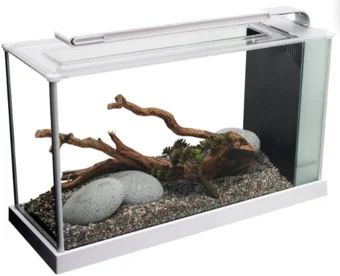
    Do The Fish Need Companions?

    Betta fish do not need to live with other fish. Your betta won’t get lonely, but it might get bored if kept in a very small and empty fish tank.

    What Fish Can They Live With?

    There are many excellent betta fish mates in the aquarium hobby. Certain mates work better than others in a community tank, however. Some of the best tank mates for betta fish include peaceful fish like corydoras and otocinclus catfish, as well other brightly colored fish like ember tetras and rummy nose tetras.

    Can Male And female Live Together?

    A male betta should not be kept with female bettas in the same tank. Unfortunately, this can lead to serious fighting and even death. Male and female bettas should only be brought together to breed.

    Can Guppies Live With Them?

    Guppies can live with bettas in a community tank. Guppies prefer higher pH water, however, so they can make ideal mates for betta fish as long as the water pH is neutral or slightly higher. Fancy tail males are also prone to get picked by a male Betta

    Final Thoughts

    Choosing the best mates for your betta fish can be pretty stressful, especially with the aggressive reputation of these awesome fish. Fortunately, betta fish can get along really well with loads of different fish in carefully planned community tanks. The 15 species in this list are some of the best betta tank mates in the hobby, so you can add them to your community tank with confidence!

    Do you love betta fish? Tell us about your favorite tank mates for betta fish in the comments below!


    ๐Ÿ“˜ Want to learn more? This article is part of our complete Betta Fish Guide. your ultimate resource for betta care, types, tank setup, feeding, tank mates, and more.

  • How to Lower pH in Your Aquarium: 7 Methods That Actually Work

    How to Lower pH in Your Aquarium: 7 Methods That Actually Work

    Lowering pH is something I’ve had to do in my own tanks over the years. particularly when keeping fish that prefer soft, acidic water like discus, cardinal tetras, or South American cichlids. The tricky part is that most tap water in the US runs alkaline, so you’re working against your source water. Some methods work reliably; others are inconsistent and can cause more problems than they solve. Here are the 7 that I’ve found actually work.

    pH is one of those water parameters that beginners learn about early but often misunderstand. The number itself matters less than stability. fish adapt to a wide range of pH values as long as conditions are consistent. Where I see problems is when people try to chase a target pH and end up with wild swings that stress or kill their fish. That said, if you’re keeping soft-water species like discus, rams, or wild-caught cardinal tetras, lowering pH genuinely matters. After 25 years managing both freshwater and reef tanks, here are the 7 methods I’d actually use. and the ones I’d approach with caution.

    What Is pH?

    pH is one of the most important parameters in the fish tank setting as well as in regular water quality analysis. The pH of water directly impacts which species and aquatic life can live in any given ecosystem. An overview of the pH is supplied below by MooMooMath and Science.

    For example, tropical freshwater tetra fish are found in waters with low pH while African cichlids need high pH. But what is pH and why are pH levels so important in the aquarium setting?

    Measuring pH

    In order to understand why pH is so important, it’s necessary to understand how it is measured.

    pH is the logarithmic scale of how acidic or basic a solution is on a scale from 0.0 to 14.0. A neutral pH falls directly between these two values at 7.0 with values under this being acidic and values over this being basic, sometimes referred to as being alkaline.

    As a logarithmic scale, changes in pH levels are exponentially greater than they might initially seem. As a result, rapid or sudden fluctuations in the pH of water can prove to be deadly for many aquatic species.

    That being said, pH naturally fluctuates throughout the day due to natural phenomena.

    What Affects Water?

    There are many natural factors that influence the pH of water, especially seawater. Though these factors in nature donโ€™t have as large of an effect in a small and contained fish tank setting, the theory behind them has been applied to aquarium equipment and media to make adjusting pH easier for fishkeeping enthusiasts.

    First, weโ€™ll understand what influences pH in natural ecosystems.

    Carbon Dioxide

    Carbon dioxide is one of the main influencers of pH levels in freshwater, saltwater, and brackish water systems. In short, the more carbon dioxide that is present in the water, the lower the pH drops.

    Carbon dioxide is largely available in the atmosphere as a gas. When carbon dioxide combines with seawater through surface agitation, carbonic acid (H2CO3) forms which later breaks into hydrogen ions and bicarbonate ions. These hydrogen ions directly lower pH, causing the water to become more acidic.

    As water travels, this change in ocean pH eventually starts to influence the pH in freshwater ecosystems as well. An even greater influence over freshwater pH comes from dissolved organic carbon in the form of decomposition and respiration.

    Decomposition And Respiration

    Freshwater lakes, streams, and ponds are fed by rainwater as well as runoff from the surrounding ground and tributaries.

    Along this path, plants, animals, pollutants, and other contaminants fall into the water and are carried along and eventually deposited. If these objects are organic and start to decompose, then pH will be affected.

    During the process of decomposition, carbon dioxide is released. This creates a direct source of hydrogen ions that cause pH to drop.

    Another direct input of carbon dioxide is respiration, which is very similar to decomposition though nothing needs to die to start the process. Instead, respiration is the opposite of photosynthesis: sugar (glucose) and oxygen are processed into carbon dioxide, water, and energy.

    Most organisms perform respiration within the freshwater aquarium setting, including fish, invertebrates, and plants. Believe it or not, plants only photosynthesize when there is light present while respiration happens continuously throughout the day and night; respiration only becomes more apparent at night due to increased carbon dioxide levels and subsequent changes in pH. It is because of respiration that the pH in your aquarium fluctuates throughout the day.

    At the same time, freshwater fish and invertebrates are constantly breathing through respiration and introducing new carbon dioxide into the system. As a result, an overstocked fish tank can lead to depleted oxygen levels and a low pH.

    Tannins

    Along the same line as decomposition are tannins. Tannins are an astringent compound found naturally in many terrestrial and aquatic ecosystems in a variety of plants and trees. In the fish tank keeping hobby, tannins are most notably known for composing blackwater systems where the water is stained dark brown and is chemically soft and acidic.

    Tannin compounds are incredibly beneficial to these ecosystems and hobbyists have taken advantage of these benefits in their own freshwater fish tanks. Many species of plants and trees contain tannins in their bark and leaves to naturally fight off bacterial and fungal infections. Once these organics start to decompose in water, tannins enter the system, providing bolstered immunity to fish and invertebrates.

    Some of these compounds are made up of tannic acid, which is the weak acid responsible for altering the pH. Once this acid enters the water, the pH level will begin to fall.

    Levels In Your Aquarium

    Most freshwater aquariums sit around an average pH of 7.0. Most fish can tolerate a range of 6.5 – 7.5, though this will vary with species. As mentioned before, most tropical species, like tetras, will prefer more acidic water chemistry. On the other hand, African cichlids are known for loving high pH levels above 8.0.

    In general, tap water, distilled, and reverse osmosis will have a neutral pH that is appropriate for keeping most fish. However, if the pH level of the source water is not correct, then there can be some serious problems.

    Why Is It So High In Your Aquarium?

    There are many factors that affect water chemistry, but understanding the pH levels of your aquarium water is necessary for long-term success. High pH levels are most likely due to poor source water or aquarium substrate and tank decorations.

    The pH of source water is determined by where that water was collected. If tap water is used for the fish tank, then the hobbyist must make sure that pH levels are appropriate for fish tank usage; some local reservoirs are naturally more acidic or alkaline than others and subject to change.

    Some fish tank decorations and substrates can also increase pH levels, like aragonite sand. For the most part, this is more of a concern for saltwater enthusiasts, though cichlid owners will also need to understand how the substrate they choose influences the pH level.

    Great For African Cichlids
    Carib Sea Aragamax Sand

    Boosts pH

    Aragamax is great for African setups as it keeps pH and hardness levels stable

    Buy On Amazon Click For Best Price

    It should also be noted that pH will rise and fall more often if the carbonate hardness (KH) level, a buffer to pH, is incorrect. A more accurate KH will result in a more stable pH.

    How Long Does It Take To Lower In The Tank?

    pH is a quick parameter to change in the fish tank setting as long as conditions are right. All-day long, pH is rising and falling depending on photosynthesis and respiration rates. This fluctuation can be as great as a 0.5 difference at times and is perfectly normal.

    However, pH will only change as much as the carbonate hardness agrees. Anything greater or quicker than a gradual 0.5 change in pH level can prove to be fatal to fish and invertebrates.

    In general, pH should be slowly altered 0.25 at a time with continued observation.

    Can Rocks Lower It In The Aquarium?

    Most rocks will not cause pH levels to rise or fall in the freshwater aquarium. However, rocks that contain limestone will have a sure effect on your water pH. Limestone is mainly composed of calcium carbonate, which is naturally basic and will cause pH levels to rise.

    To test whether or not your rocks contain limestone, simply drop some vinegar onto them. If the rock contains limestone, then the vinegar will bubble and fizzle.

    Does Gravel Affect It?

    In the same way, limestone gravel can start to affect pH as well. However, most freshwater gravels and substrates will not influence pH if they are for aquarium use, though some may temporarily raise or lower pH levels after being initially added.

    If keeping cichlids that like hard, basic water, then most hobbyists choose to use a crushed coral substrate. Crushed coral is similar to limestone as it contains calcium carbonate, which will then raise the pH level.

    How To Lower It in the Tank – 7 Ways

    Lowering pH can be tricky. Remember, this is a logarithmic value and any slight change can prove to be too much for fish and invertebrates to handle at once.

    If attempting to alter pH, then plenty of time needs to be given for livestock to acclimate to new conditions. It is also important to note that pH levels will not change unless KH is within the appropriate range.

    When the tank is ready, pH can be lowered through several methods. We have a video below from our YouTube channel you can check out. We go into more detail in the blog post below. If you like our content, be sure to subscribe as we post new videos every week!

    1. Aquarium Driftwood

    When setting up a freshwater aquarium, you will more than likely add driftwood for decoration and structure. In short, driftwood is any type of wood that has washed up on the shore of a beach, lake, pond, or river. Due to wind and wave action, these pieces of wood are eroded and brittle.

    Aquarium enthusiasts have perfected the art of aquascaping with driftwood, using popular varieties like mopani, spider, and manzanita wood. However, driftwood adds much more to the aquarium than just aquascaping.

    Editor’s Choice
    Manzanita Driftwood

    Editor’s Choice

    Manzanita offers it all. Great shape, low tannins, quick to water log and reasonably priced. It’s the ultimate driftwood!

    Click For Best Price Click For Branch Pieces

    Remember that most trees contain tannins and tannic acid; driftwood is no different and most varieties will leak tannins into the aquarium water. This results in dark water, lowered pH, and increased immunity for fish and invertebrates. Thus goes to reason that the more driftwood that releases tannic acid, the more that the pH will drop.

    This is true, though can be hard to control and the buffering property eventually runs out. Luckily, unwanted effects from tannins can be reversed by using activated carbon in a filter bag.

    2. Indian Almond Leaves

    Indian almond leaves, sometimes abbreviated as IAL, are another great addition to the freshwater aquarium and are especially popular among betta fish keepers!

    These dried leaves come from a type of tree, Terminalia catappa. Similar to driftwood, Indian almond leaves contain tannins that are released into the aquarium water when they start to decompose.

    In addition to the health benefits and decrease in pH level that Indian almond leaves provide, they also provide great coverage on the bottom of the tank as leaf litter. Many species (like betta fish) will enjoy foraging for food and hiding in a thick leaf litter substrate, though not all hobbyists will enjoy the tannin-stained tank water that comes along with it. Again, the effects of tannins can be reversed by using activated carbon packets in the filtration system.

    While Indian almond leaves are some of the most abundant types of dried leaf available, other botanicals may be used for the same effects. These leaves will need to be replaced every three months or so as they will completely disintegrate.

    3. Peat Moss

    Peat moss is a regular addition to home gardens but is one of the best ways to lower pH levels without adding anything directly to the fish tank display.

    Peat moss largely refers to the Sphagnum genus, which is a group of mosses commonly found growing around bog ecosystems. Like driftwood and Indian almond leaves, peat moss works to lower the pH level in the tank by releasing tannins. However, using peat moss is much more controllable than the former options.

    One of the benefits of using peat moss in the fish tank is that it can be measured for exact dosage. Many hobbyists choose to put a bag of peat moss in their filter, though some incorporate it directly into their substrates. Another option is to prepare new peat moss-treated tank water beforehand.

    It should be noted that there is some discussion about the sustainability of harvesting peat moss in both horticulture and the aquarium industry due to its importance in nature.

    4. Using CO2 Injection

    CO2 injection is the same idea as atmospheric carbon dioxide entering an ocean or lake, just at a much smaller and controlled scale: increasing carbon dioxide subsequently increases the number of hydrogen ions in the tank water, lowering pH.

    This is a great method to lower the pH in fish tanks, especially ones with aquatic plants, due to the control that comes with dosing carbon dioxide. However, CO2 injections can be costly over time and require additional equipment that some hobbyists might not be able to fit into their setups.

    5. Changing Your Water

    If you have a large bioload in your fish tank and don’t keep up with regular maintenance, then pH may begin to fall over time. This is due to the idea of respiration and decomposition where organics are being broken down, releasing carbon dioxide and acidifying the water. In the same ways, water changes will also help remove carbon dioxide from the water and introduce new oxygen instead which will lower pH.

    For these same reasons, it is recommended to perform regular water changes when using a new substrate in order to keep pH levels stable.

    6. Replace Your Source Water

    Changing your source for aquarium water is probably the best and most long-lasting solution to reaching the desired pH level. Many freshwater aquariums rely on tap water for convenience and mineral addition. However, tap water can have varying pH levels day to day depending on the variables affecting the source water.

    For the most control over aquarium pH and general water quality, it’s recommended to use and remineralize reverse osmosis water to the hobbyist’s liking. This also gives much greater control over fertilizing and plant growth.

    7. Use Chemical Solutions

    Chemical solutions should be the last resort for any aquarium problem. pH is especially sensitive.

    Chemical solutions can be difficult to dose, expensive, and most importantly, don’t fix the origin of the problem; as soon as the chemicals are stopped dosing, then pH levels will return to where they were over time.

    API pH Proper

    API offers a pH proper series for various pH targets. This will allow you to set your pH to the desired level for your fish

    Buy On Amazon Buy On Chewy

    That being said, there are plenty of aquarium-proven neutralizers, reducers, and buffers to accurately increase or decrease both pH and KH.

    Conclusion

    pH is a complicated water parameter that can be influenced by many chemical and biological factors. Most fish and invertebrates are highly sensitive to large and sudden changes in pH levels, even though pH naturally rises and falls throughout the day.

    If you’re struggling with high acidity or need to get into the perfect pH range for cichlids, then there are a few methods to gently get pH to the levels you need.


    ๐ŸŸ Want to learn more? This article is part of our complete Aquarium Care Guide. your ultimate resource for water chemistry, maintenance, feeding, disease prevention, and everything you need for a healthy tank.

    References

  • 15 Best Blue Freshwater Fish: My Picks After 25 Years in the Hobby

    15 Best Blue Freshwater Fish: My Picks After 25 Years in the Hobby

    Blue freshwater fish are genuinely hard to find. and I say that as someone who’s been searching for them for 25+ years. True blue coloration in freshwater is rare compared to saltwater, so when I see a fish that genuinely delivers on it, I take notice. These are my top picks after years of keeping and observing them in my own tanks, ranked by how reliably they display that blue color in home aquarium conditions.

    Blue is genuinely one of the harder colors to find in freshwater fish. it’s more common in saltwater, which is part of what makes a well-chosen blue freshwater species stand out in a tank. After 25 years in both freshwater and reef keeping, I’ve learned that “blue” can mean a lot of things depending on the fish, the lighting, and even the mood of the animal. Some blues are electric and vivid; others are subtle and iridescent. This list covers 15 of the best options across different tank sizes and care levels, so there’s something here whether you’re running a community tank or a species-only setup.

    15 Best Blue Freshwater Fish Species

    Choosing the right aquarium fish involves some careful thought. It’s really important to know how big they grow, how much space they need, and whether they will be happy in the kind of water you have.

    To make choosing the perfect bluefish easier, I’ve included the following important stats for each species:

    • Scientific Name
    • Difficulty Level
    • Adult Size
    • Temperament
    • Origin
    • Minimum Tank Size
    • Temperature
    • Diet
    • pH
    • Difficulty to breed
    • Planted tank suitability

    Now you’re ready to meet some awesome bluefish! Check out our video above from our YouTube Channel. We go over more details in the blog post below. If you like our content, be sure to subscribe. We post new videos every week!

    1. Betta fish/ Siamese fighting fish

    WYSIWYG Available!
    Betta Fish

    Use Coupon Code ASDFISH at Checkout

    Betta Fish are one of the most beautiful varieties of freshwater fish available in the hobby. Easy to care for with plenty of varieties!

    Buy Premium Varieties Buy On Petco Online
    • Scientific Name: Betta splendens
    • Difficulty Level: Moderate
    • Adult Size: 2.5 inches
    • Minimum Tank Size: 5 gallons
    • Temperature: 75-82ยฐF
    • pH: 6.5-7.5
    • Temperament: Aggressive
    • Origin: Southeast Asia
    • Diet: Carnivore
    • Difficulty to breed: Moderate
    • Planted tank suitability: Yes

    Betta fish are one of the best blue fish for fishkeepers who want to keep a nano aquarium. Of course, not all bettas are blue, so you’ll need to shop around for a specimen that suits your taste. These pretty fish come in a huge variety of different fin shapes, and can be found in solid blue, or combinations of colors that include everything from turquoise to deep blue!

    Blue Betta Fish

    It’s usually best to keep betta fish on their own. Male bettas are very aggressive fish and will fight and kill other male bettas. Female bettas are less aggressive than males but it can still be risky to keep more than one in the same aquarium.

    You can keep a betta fish with tank mates in larger tanks. You just have to be careful about what you add as the betta can prey on small inverts and will be nipped by overactive fish.

    2. Fancy Guppies

    • Scientific Name: Poecilia reticulata
    • Difficulty Level: Easy
    • Adult Size: 1.5-2.5 inches
    • Minimum Tank Size: 10 gallons
    • Temperature: 64-82ยฐF
    • pH: 7-8.5
    • Temperament: Peaceful
    • Origin: Northeastern South America
    • Diet: Omnivorous
    • Difficulty to breed: Easy
    • Planted tank suitability: Yes

    Guppies are another hugely popular aquarium fish that come in a range of patterns and colors-including blue! These aquarium fish come in many different shades of blue, including sky and royal blue.

    Guppies are peaceful community fish that get along great with other fish. The fancy guppy is a very hardy fish that is easy to care for and will thrive in just about any freshwater tank setup with hard water.

    3. Blue Gourami

    Blue Gourami Fish
    • Scientific Name: Trichopodus trichopterus
    • Difficulty Level: Easy
    • Adult Size: 5 inches
    • Minimum Tank Size: 20 gallons
    • Temperature: 75-86ยฐF
    • pH: 5.5-8.5
    • Temperament: Semi-aggressive
    • Origin: Southeast Asia
    • Diet: Omnivorous
    • Difficulty to breed: Moderate
    • Planted tank suitability: Yes

    The blue gourami is also known as the three spot gourami. This hardy and easy to care for species is great for fishkeepers who want medium-sized blue aquarium fish.

    This gourami species comes in a few different breeds, and not all of them are blue. The best options are the wild 3 spotted form, or even better, the opaline form if you want a really great centerpiece fish.

    4. German Blue Rams

    Blue Ram Cichlid in Planted Tank
    • Scientific Name: Mikrogeophagus ramirezi
    • Difficulty Level: Moderate/advanced
    • Adult Size: 1.5 inches
    • Minimum Tank Size: 15 gallons
    • Temperature: 80-86ยฐF
    • pH: 4-7
    • Temperament: Peaceful
    • Origin: Venezuela, Colombia
    • Diet: Omnivorous
    • Difficulty to breed: Moderate
    • Planted tank suitability: Yes

    The German blue ram is one of my favorite blue fish species. If you’re looking for amazing color, the ‘electric blue’ breed will really impress you!

    These gorgeous little cichlids are super peaceful fish and stay very small, unlike most other South American cichlids. Unfortunately, the German blue ram is not great for beginners because they need perfect water quality to stay healthy.

    5. Blue Peacock Cichlid

    Blue Peacock Cichlid
    • Scientific Name: Aulonocara nyassae
    • Difficulty Level: Moderate
    • Adult Size: 7 inches
    • Minimum Tank Size: 55 gallons
    • Temperature: 76-82ยฐF
    • pH: 7.8-8.6
    • Temperament: Semi-aggressive
    • Origin: Lake Malawi, Africa
    • Diet: Carnivorous
    • Difficulty to breed: Moderate
    • Planted tank suitability: Yes

    The blue peacock cichlid is an awesome blue fish from Lake Malawi in Africa. Like most other African cichlids, these fish need high pH water to thrive. These fish are classified as semi-aggressive and become pretty aggressive when breeding, a time when they are their most colorful!

    It is best to keep the blue peacock cichlid fish in a group of 1 male and 3 or 4 females to prevent fighting. They are not your typical community fish, and the best tank mates for these fish are other peacock cichlids.

    6. Blue Zebra Cichlid

    Blue Zebra Cichlid
    • Scientific Name: Maylandia callainos/ Metriaclima callainos
    • Difficulty Level: Moderate
    • Adult Size: 6 inches
    • Minimum Tank Size: 50 gallons
    • Temperature: 76-82ยฐF
    • pH: 7.8-8.6
    • Temperament: Semi-aggressive
    • Origin: Lake Malawi, Africa
    • Diet: Herbivore
    • Difficulty to breed: Moderate
    • Planted tank suitability: Possible

    The cobalt blue zebra cichlid is an mbuna cichlid. These fish are known for being quite aggressive if not kept with the right tankmates. It is best to keep one male with 3 or 4 females to limit aggression.

    These fish are not suitable for most community aquariums, but they can be amazing in mbuna aquariums with other species of African cichlids.

    7. Electric Blue Johanni

    Electric Blue Johanni Fish
    • Scientific Name: Melanochromis johannii
    • Difficulty Level: Moderate
    • Adult Size: 4-5 inches
    • Minimum Tank Size: 40 gallons
    • Temperature: 73-81ยฐF
    • pH: 7.6-8.8
    • Temperament: Semi-aggressive
    • Origin: Lake Malawi, Africa
    • Diet: Omnivore
    • Difficulty to breed: Moderate
    • Planted tank suitability: Possible

    The electric blue johanni is a great little African cichlid with vibrant blue colors. It is only the males that are dark blue, however, and the females are a beautiful golden orange color. Some of the best tank mates for mbuna cichlids like electric blue johannis are other mbuna cichlids from lake Malawi.

    8. Frontosa

    Frontosa Cichlid in Aquarium
    • Scientific Name: Cyphotilapia frontosa
    • Difficulty Level: Moderate
    • Adult Size: 10-12 inches
    • Minimum Tank Size: 75 gallons
    • Temperature: 72-82ยฐF
    • pH: 8-9
    • Temperament: Semi-aggressive
    • Origin: Lake Tanganyika, Africa
    • Diet: Carnivore
    • Difficulty to breed: Moderate
    • Planted tank suitability: Possible

    The frontosa, or humphead cichlid, is a great species for fish keepers who want a large and dramatic display tank! These fish are not pure blue, but rather silvery blue with bold vertical black bars. Although you could keep a frontosa cichlid in a tank as small as 70 gallons, you’ll really want a 180-gallon tank or larger to keep them in a group.

    9. Discus Fish

    Discus In An Aquarium
    • Scientific Name: Symphysodon aequifasciata
    • Difficulty Level: Moderate
    • Adult Size: 8 inches
    • Minimum Tank Size: 55 gallons
    • Temperature: 79-86ยฐF
    • pH: 6.1-7.5
    • Temperament: Peaceful
    • Origin: Brazil
    • Diet: Omnivorous
    • Difficulty to breed: Moderate
    • Planted tank suitability: Yes

    Discus fish are one of the most beautiful (and peaceful) cichlids in the hobby. These colorful freshwater fish get their name for their round, disc-shaped bodies.

    There are many varieties of discus available, including some amazing blue types like the cobalt, blue snakeskin, and blue diamond discus.

    10. Cardinal Tetra

    • Scientific Name: Paracheirodon axelrodi
    • Difficulty Level: Moderate
    • Adult Size: 1.5 inches
    • Minimum Tank Size: 15 gallons
    • Temperature: 73-81ยฐF
    • pH: 5.5-7.5
    • Temperament: Peaceful
    • Origin: Brazil and Venezuela
    • Diet: Omnivorous
    • Difficulty to breed: Moderate
    • Planted tank suitability: Yes

    Cardinal tetras are gorgeous fish that have vivid blue stripes that run the length of their bodies from their bright blue eyes almost to the start of their caudal fin. Cardinal tetras look very similar to our next species, the neon tetra, but have more contrast between red and blue.

    These peaceful community fish get along great with other smaller fish. They are ideal for a community setup, especially if kept in schools of 8 or more.

    11. Neon Tetra

    • Scientific Name: Paracheirodon innesi
    • Difficulty Level: Easy
    • Adult Size: 1.25 inch
    • Minimum Tank Size: 15 gallons
    • Temperature: 70-77ยฐF
    • pH: 5-7
    • Temperament: Peaceful
    • Origin: Brazil, Colombia, Peru
    • Diet: Omnivorous
    • Difficulty to breed: Moderate
    • Planted tank suitability: Yes

    Neon tetras are amazing blue schooling fish with bright blue stripes along their sides. These colorful freshwater fish are similar to cardinal tetras but slightly smaller and do not have as much red color.
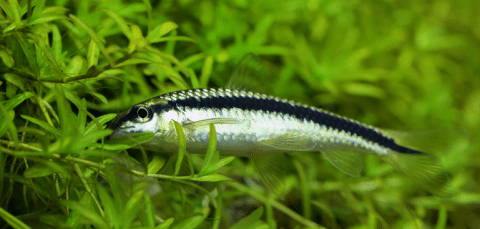
    Neon tetras are very peaceful fish that get along great with other peaceful tank mates. Like other tetras, these fish should be kept in groups of 8 or more to see them school and behave confidently.
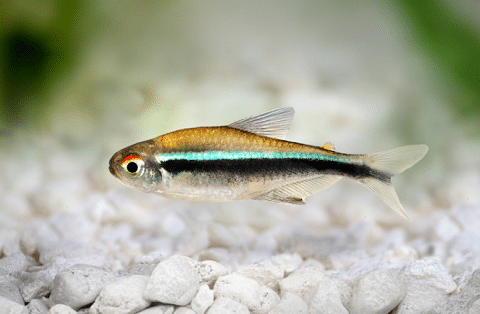
    12. Blue Glofish

    Blue Glofish
    • Scientific Name: Various
    • Difficulty Level: Easy-moderate
    • Adult Size: 2 inches for danios and tetras, 6 inches for sharks
    • Minimum Tank Size: 15 gallons for danios and tetras, 55 gallons for sharks
    • Temperature: 70-75ยฐF
    • pH: 7-8
    • Temperament: Peaceful/ semi-aggressive
    • Origin: Tank bred
    • Diet: Omnivorous
    • Difficulty to breed: Moderate
    • Planted tank suitability: Yes

    Glofish are some of the most colorful freshwater fish in the aquarium hobby. These fish are genetically modified to show the most amazing vivid color. The cosmic blue tetras, (also available in the longfin variety), cosmic blue danios, and cosmic blue sharks are awesome blue fish for freshwater aquariums.

    The tetras and danios are very peaceful schooling fish for an awesome freshwater community tank. They grow to just 2 inches or so in length and should be kept in schools of 6 or more. The cosmic blue sharks are larger fish that are classified as semi-aggressive.

    13. Praecox Rainbowfish (Dwarf Neon Rainbowfish)

    • Scientific Name: Melanotaenia praecox
    • Difficulty Level: Easy
    • Adult Size: 3 inches
    • Minimum Tank Size: 15 gallons
    • Temperature: 73-82ยฐF
    • pH: 6.8-7.5
    • Temperament: Peaceful
    • Origin: Indonesia
    • Diet: Omnivorous
    • Difficulty to breed: Moderate
    • Planted tank suitability: Yes

    The praecox rainbowfish is a beautiful blue fish with red fins and a red tail. This colorful fish is also known as the dwarf neon rainbowfish because it maxes out at just 3 inches or so and glows with color in the right lighting.

    Praecox rainbowfish are active fish that do great in an aquarium community with other shoaling fish. They are great-looking fish to add as a school in medium to large-sized aquariums.

    14. Electric Blue Crayfish

    • Scientific Name: Procambarus alleni
    • Difficulty Level: Easy
    • Adult Size: 4-6 inches
    • Minimum Tank Size: 30 gallons
    • Temperature: 65-70ยฐF
    • pH: 6.5-7.5
    • Temperament: Semi-aggressive
    • Origin: Southeastern United States
    • Diet: Omnivorous
    • Difficulty to breed: Moderate
    • Planted tank suitability: No

    If you’re looking for something a little different for your blue fish aquarium, look no further than the electric blue crayfish (video source)! These awesome critters are native to the United States and they thrive in fish tanks.

    Electric blue crayfish are opportunistic feeders that do occasionally catch slow-moving fish. They also love to eat aquarium plants, so they are not ideal for planted tanks. Fast tankmates are recommended, thought not guaranteed that they will not eaten.

    15. Freshwater Shrimp

    • Scientific Name: Neocaridina davidi, Caridina cantonensis, Caridina serrata
    • Difficulty Level: Easy/moderate
    • Adult Size: 0.75-1.5 inches
    • Minimum Tank Size: 5 gallons
    • Temperature: 72-82ยฐF
    • pH: 7-8
    • Temperament: Peaceful
    • Origin: Southeast Asia
    • Diet: Omnivorous
    • Difficulty to breed: Easy
    • Planted tank suitability: Yes

    There are many amazing blue shrimps available in the aquarium hobby. Some great examples include the blue velvet shrimp/ blue dream shrimp (Neocaridina davidi), the blue bolt shrimp (Caridina cantonensis), and the aura blue shrimp (Caridina serrata).

    Blue Freshwater Shrimp

    Adult shrimp can be kept with some small community fish, but larger fish will probably see your shrimp as a tasty snack! the great thing about shrimp is that you can keep them in a tank of just 5 gallons or so, making them a perfect choice when you don’t have a lot of room.

    Bonus for Freshwater Aquariums

    Just in case you’re curious about even more blue fish for freshwater aquariums, here are a few more beautiful fish species to check out!

    Aquarium Fish Care – The Basics

    If you’re new to fish keeping, there are some very important things to know before bringing your new blue fish home. Different fish species have different care needs, but the following tips are a good starting point.

    Tank Setup

    Setting up a great tank is the first step, and this should always be done before you bring your fish home! In fact, you should set up your tank at least a few weeks before introducing any fish to get it fully cycled and ready.

    Read on for a basic list of what you’ll need!

    Essential equipment

    The most important items you’ll need to set up a great freshwater aquarium for blue fish are:

    • Fish tank with a hood/cover- Match the size of the tank to the minimum tank size of the fish you want to keep. Bigger is always better, so go a little larger if you can.
    • Filter- A filter is extremely important for keeping your water clean and healthy. Choose a filter that is rated for your tank size or larger.
    • Aquarium light- Good lighting will make your fish look really amazing. Set your lights on a timer so that they fire up and switch off at the same time every day. This will give your pets a natural day/night rhythm.
    • Heater- Tropical fish need a heater to keep the water temperature stable in their preferred range. Choose a model that matches your tank size.
    • Thermometer

    These are the basic components of a tropical fish tank. While it is possible to set up a fish tank with just these components, you’ll also want to decorate your tank. Read on to learn more.

    Decor

    You can get creative or aim to make a really natural-looking environment for your fish. The choice is yours! Whatever you choose to decorate your tank with, however, always make sure it is fish-safe.

    Editor’s Choice
    Manzanita Driftwood

    Editor’s Choice

    Manzanita offers it all. Great shape, low tannins, quick to water log and reasonably priced. It’s the ultimate driftwood!

    Click For Best Price Click For Branch Pieces

    Pick up a selection of the following items to make a great home for your blue fish:

    Feeding your fish

    Different species of fish have different diets, so make sure to research the needs of your blue fish before picking up some food. Read on to learn some popular aquarium fish food types and how to feed your fish!

    Food types

    Most popular aquarium fish can be fed a regular diet of prepared dried foods. These come in different shapes and sizes and are designed for different types of fish. Prepared foods can either float or sink.

    Here are some common examples of prepared foods:

    Best Tropical Fish Flake Food
    Cobalt Aquatics Tropical Flake

    Best Tropical Fish Flake Food

    Cobalt offers a premium level flake food with probiotics. A color enhancing formula that works great for all tropical fish

    Buy On Amazon Buy On Chewy

    Apart from their regular daily food source, omnivorous and carnivorous fish will benefit hugely from the occasional meal of live or frozen food. These should not be provided every day, but rather as a supplement to improve color and condition. The best choices are:

    How much to feed your fish

    Overfeeding is very bad for the health of your fish and can lead to poor water quality as uneaten food spoils in the water. Most aquarium fish can be fed once or twice a day when the lights are on. Provide only as much food as the fish can finish in a minute or two.

    Maintenance

    Keeping your fish tank looking amazing requires you to do some regular aquarium maintenance. You’ll need to clean your aquarium glass with an algae scraper when necessary, and you’ll also need to rinse out your filter if it becomes clogged.

    The most important side of maintenance is to perform partial water changes once or twice a month. This will prevent the build-up of harmful chemicals in the water.

    Testing

    You’ll need a test kit to test your aquarium water quality and find out what your water parameters are. Liquid or strip test kits are really easy to use and very affordable. Use your test kit before adding any fish to your tank and then every week to monitor your water quality.

    Choose a test kit that can measure the following parameters:

    • pH
    • Hardness
    • Ammonia
    • Nitrite
    • Nitrate

    Where to Buy

    Most of the species on this list can be found at your local fish or pet store. If you can’t find what you’re looking for, you can always order from a trusted online retailer and have your new pets delivered to your home!

    FAQS

    Are There Any Fish?

    Bluefish species are pretty rare in freshwater, but there are some amazing species in the modern aquarium trade. Even common aquarium fish like guppies and betta fish are available in various shades of blue.

    What Kind Of Fish Is Bright Blue?

    The electric blue german ram cichlid and the cosmic blue glofish tetra are some of the brightest blue fish in the hobby. There are many other bright blue fish, however, so be sure to check out all the species in this article to find your favorite!

    Can You Keep This Type of Fish As Pets?

    There are many amazing bluefish species that can be kept as pets. These should not be confused with the saltwater fish species that is called a bluefish (Pomatomus saltatrix) of course. That species grows very large and would not make a good pet!

    What Is The Name Of A Small Fish?

    Fancy guppies, cardinal tetras, and cosmic blue glofish are some great examples of small blue fish. German blue rams are also amazing nano blue fish for more experienced fish keepers.

    What Kind Is Tropical And This Color?

    There are many amazing blue tropical fish in the aquarium hobby. Neon tetras are a very popular choice for fish keepers looking for a small schooling species, but other fish like discus are also amazing species for a tropical community aquarium.

    Final Thoughts

    There’s something about blue fish that really makes for a great display tank! With all the great species in this list, there’s a species to suit any aquarist. I hope you found some great ideas for your own tank, and remember, have fun!

    Do you keep blue fish in your freshwater tank? Tell us about your favorite species in the comments below!


    ๐Ÿ“˜ Want to learn more? This article is part of our complete Freshwater Fish Guide. your ultimate resource for freshwater species, care tips, tank setup, and more.

  • Ram Cichlid: Complete Care Guide (Care, Tank Mates, and Breeding)

    Ram Cichlid: Complete Care Guide (Care, Tank Mates, and Breeding)

    The Reality of Keeping Ram Cichlid

    Let me be honest with you. Rams are one of the most returned fish in the aquarium trade. They are stunning, and that is what sells them. But beauty does not equal easy.

    Three colors, one fragile fish.

    They need warm, soft, acidic water. Rams need temperatures between 82 and 86F with a pH under 7.0 and very low hardness. If your tap water is hard and alkaline, you are fighting an uphill battle from day one. Trying to keep rams in water with a pH of 7.8 is a recipe for stress and disease.

    They are fragile when stressed. Rams have almost zero tolerance for ammonia or nitrite. Even a small spike that other fish would shrug off will kill a ram. Your tank needs to be fully cycled and stable for weeks before you add these fish.

    Breeding stock quality varies wildly. Most rams in pet stores come from mass breeding operations in Asia where they are pumped full of hormones and antibiotics. These fish look incredible in the store but often crash within days of being brought home. Buying from a reputable breeder costs more but dramatically improves your odds.

    They are not community fish in the traditional sense. Rams need peaceful, slow-moving tank mates that will not outcompete them for food or stress them with aggression. Fast, nippy fish like tiger barbs will make a ram’s life miserable.

    Biggest Mistake New Ram Cichlid Owners Make

    Putting them in an uncycled or newly cycled tank. Rams need a mature, stable ecosystem. If your tank has been running less than two months, it is not ready for rams. Period.

    Expert Take

    Buy from a breeder, not a chain store. Start with a proven pair if you want to breed. Keep the temperature at 84F and never let it drop below 80F. These three things alone will double your success rate with rams.

    Table of Contents

    Ram cichlids are beautiful, delicate, and unforgiving. They need pristine water, elevated temperatures, and rock solid stability. One parameter swing and they stop eating. Two and they are dead. I have watched experienced keepers lose rams because they treated them like any other dwarf cichlid. They are not. Rams demand precision, and they punish anything less. All commercially bred ram variants are weakened by hormone treatments and inbreeding. That makes them the most frequently killed dwarf cichlid by new keepers.

    What Most Care Guides Get Wrong About Ram Cichlid

    The number one mistake I see with ram cichlids is people treating them like any other hardy tropical fish. They’re not. Rams are sensitive to water quality in ways that most beginner fish aren’t, and they absolutely need warm water. 80ยฐF minimum, ideally 82-84ยฐF. I’ve seen countless rams die within weeks of purchase because they were kept at 76-78ยฐF in a standard community tank. The other common misconception is lumping all ram varieties together. German blue rams, Bolivian rams, and electric blue rams have meaningfully different care requirements, especially regarding temperature tolerance and hardiness.

    German blue rams are one of the most visually stunning dwarf cichlids you can keep. And one of the most frequently killed by hobbyists who underestimate their water chemistry requirements. I’ve kept rams over the years and the pattern I see is always the same: someone buys them because they look incredible in the store, puts them in a standard community tank at 76ยฐF, and loses them within a few weeks. Rams want warm, soft, slightly acidic water. 82 to 86ยฐF is the sweet spot. Get that right, along with stable parameters, and they’re genuinely rewarding fish with real personality. This guide covers everything: care, compatible tank mates, and what it actually takes to breed them.

    The Ram or dwarf Cichlid is a stunning and tranquil freshwater fish species that have been observed for over 30 years. They go by many names, Ramirez’s dwarf cichlid, Blue ram, Butterfly ram, Ram ramirezi, and Dwarf cichlid. All these names lead to one beautiful fish species, belonging to the family Cichlidae and originating in South America, mostly in Amazon and Orinoco river extensions.

    Brief Overview of the Ram Cichlid

    Scientific NameMikrogeophagus ramirezi
    Common NamesRam Cichlid, blue ram, German blue ram, Asian ram, butterfly cichlid, Ramirez’s dwarf cichlid, dwarf butterfly cichlid, and Ramirezi
    FamilyCichlidae
    OriginSouth America
    DietOmnivore
    Care LevelModerate-Advanced
    ActivityModerate
    Lifespan3 – 4 years
    TemperamentPeaceful
    Tank LevelMid to bottom
    Minimum Tank Size30 gallons
    Temperature Range75 ยฐ to 82 ยฐF
    Water Hardness6-14 d GH
    pH Range5.0 to 7.5
    Filtration/Water FlowLow
    Water TypeFreshwater
    BreedingEgg layer
    Difficulty to BreedEasy
    CompatibilityCommunity tanks
    OK, for Planted Tanks?Yes

    Classification

    OrderCichliformes
    FamilyCichlidae
    SubfamilyGeophaginae
    GenusMikrogeophagus
    SpeciesM. Ramirezi (Myers & Harry, 1948)

    Ram Cichlids Appearance

    Blue Ram Cichlid in Planted Tank

    Ram cichlid are small dwarf cichlids with large fins that overshadow their oval-shaped bodies.

    Ram cichlid has vibrant reddish-orange, red and yellow spots all over their body with bright red eyes and a black band running through them. Due to their unique coloration and outstanding patterns, they make a great addition to your community aquarium. 

    In ram cichlids, the male rams are larger in length and possess the biggest dorsal fin. Because of their flowy dorsal fins and colorful appearance, they are commonly called butterfly cichlids.

    How Big Are They?

    Ram cichlids fall under the dwarf cichlids category. Therefore, they can never grow larger than 2-3 inches in captivity. However, in the wild, Ram cichlids are known to reach a maximum of 7 to 8 inches in length.

    How Long Do They Live?

    In captivity, the ram cichlid lives for up to 4 or 5 years. Even though hardy creatures, ram cichlids demand extreme care and a properly cleaned tank. Otherwise, they can develop deadly diseases such asย fish tuberculosis.ย If ram cichlids are not provided with ample care and maintenance, they can also die of stress.ย 

    The lifespan of Ram cichlids depends on many factors such as water quality, diet, water parameters and temperature, pH and water hardness, and above all, the overall health.

    Temperament and Activity Level

    Ram cichlids are community tank fish with a peaceful nature. However, some types such as Bolivian rams can get semi-aggressive and territorial, when they feel their territories are being invaded. 

    Ram cichlids are average swimmers and quick at hiding in their favorite spots to catch prey to eat. Therefore, an aquarium should be well-planted with lots of aquatic plants and hiding places such as driftwood, caves, rocks, etc.

    Tank Mates 

    No matter how agile and peaceful Ram cichlids are, you cannot keep them with any other fish. Here are the 15 most suitable tank mates for your ram cichlid.

    Aquarium Requirements

    Ram cichlids are very particular about their living environment. If the fish tank doesn’t meet all the requirements, ram cichlid can go into stress and eventually die. Therefore, it is imperative to take preventive measures and provide them with optimal conditions.

    Tank Size

    Even though ram cichlids are dwarf cichlids, they require plenty of swimming space. Therefore, go for a tank that is at least 20 gallons or more. It also depends on the number of fish you want to keep. If you’re aiming for more than one male, opt for a 29-gallon tank. One other reason to keep them in a large aquarium is they are highly sensitive to nitrates and prefer a gentle flow. So, more water and a larger tank ensure the maximum health of your rams. 

    Not just that, they appreciate regular water changes, and so I recommend installing a premium quality canister filter to raise a healthy ram cichlid.

    Water Parameters 

    One thing I can safely say about these cichlids is they don’t need a chiller, but a heater would suffice their needs.

    Ram cichlids are tropical fish that thrive in warm water temperatures of around 78 to 85 ยฐF. Therefore, I recommend installing a high-quality heater to provide them with the optimal temperature. Also, your rams will live happily if you create a natural environment for them. For this, fish experts suggest putting a fine substrate and plenty of plants with lots of hiding places in the form of rocks and caves for hiding or breeding

    Tank Setup

    A ram cichlid is very susceptible to certain chemicals and rapid changes in its environment. All these rapid changes and traces of chemicals can cause piscine (fish tuberculosis) which is fatal and inevitable if water quality is ignored.

    As far as the lighting is concerned, a ram cichlid prefers dim lights. If you have plants, I recommend using adjustable LED lights, low light plants, or getting floating plants to provide them with suitable shade without affecting your plants.

    Since ram cichlid are sensitive, make sure to check the levels of ammonia and nitrates in their tank and change the water weekly to ensure quality.

    Breeding

    To ensure the successful breeding of ram cichlid in their breeding season, make sure to provide soft water conditions by adding a small bag of rinsed peat to your canister filter. Also, make sure to keep the water pH neutral within recommended temperature range as ideal water conditions increase their activity level and improve the chances of breeding. 

    In the natural habitat, a ram cichlid is a known open spawner, which means they create family groups and lay around 150 to 200 eggs approx.

    Adult rams are difficult to pair with and costly as well. The cheaper and more effective way is to get juveniles and let them grow and pair together. Since they are monogamous pairs, I recommend keeping the breeding pair in a separate breeding tank for spawning.

    Additionally, make sure to keep the water warmer in the breeding tank by around 2 to 3ยฐF and more acidic with a slow water flow.

    You can also feed the breeding pair with live food, such as blood worms, white worms, and brine shrimp as a treat once a day.

    The Birth Process

    Before keeping ram or dwarf cichlid, be informed that they do not lay eggs at all, if they are stressed during breeding. Rams only lay eggs when they are relaxed and devoid of other distractions. When their females are pregnant, their pink bellies become visibly fat and a female blue ram cichlid lay eggs under large, flat rocks and demands complete solitude. Hence, you need to to keep the pregnant female in a separate tank, no matter how peaceful they are.

    Your tank setup and parameters should also be adjusted according to the liking of your breeding pair. The water should be of a neutral pH to slightly higher for optimal breeding and the temperature should be raised than the usual temperature which is around 77ยฐF and 82ยฐF. The warmer temperatures increase activity and improve the chances of successful breeding.

    In cichlids, both mother and father fish raise the fry, which is unique for freshwater fish species. The fry rests in father ram’s mouth if they sense any potential danger and you should pay special attention to the fry because they is swept into the filter.

    What do They Eat?

    Feeding rams with high-quality food that is rich in protein is quintessential for successful breeding and raising healthy, happy rams.

    Since ram cichlid is omnivorous, it relies on plants and meat. In their natural habitat, they feed on floating plants and small insects, larvae, and other invertebrates. 

    However, seasoned aquarists recommend feeding them brine shrimp, earthworms, artemia, blood worms, tubifex, white worms, and cyclopeeze. But bear in mind that the live food should be free of contaminants like bacteria, fungus, etc to avoid diseases and other health-related issues.

    I don’t recommend pellets and flakes on a daily. However, if you’re feeding them commercial food, make sure it sinks as butterfly cichlids are not surface dwellers. Also, incorporate plants and vegetables in their diet and feed them two to five small portions of meals several times a week. This also helps preserve the quality of water. 

    If your butterfly cichlid is new to the tank, it will be timid at the feeding time and may completely refuse to eat as they settle in its new fish tank. To cater to this, isolate the fish and feed them with treats such as mosquito larvae and start establishing their regular diet.

    Diseases

    Like most fish, rams are also vulnerable to tropical fish diseases, especially to poor water quality and stress that weakens their immune system.

    One common disease in ram cichlids is ichwhich is treated by increasing the water temperature to 86ยบF for three days.

    The butterfly cichlids are also susceptible to: 

    1. Parasitic infestations
    2. Bacterial infections
    3. Fungal infections
    4. Tuberculosis
    5. In addition to these, these fish species can also develop Costia diseases, flatworm, and tapeworm infestations.

    Different Types

    Among the plethora of strains of Ram cichlids, there are four common types that aquarists love.

    German Blue Rams 

    German blue ram cichlids are very popular among the aquarists because they are not only beautiful but docile and peaceful community tank fish. Like other ram cichlids, German blue rams are bred in captivity and are small fish around 2.5 inches with a calm personality.

    German blue rams originate from the river basins of Orinoco, in the savannas of Venezuela, Colorado, and South America. The main body of a German blue ram cichlid is divided into three prominent colors mainly orange, gold, and turquoise blue. Additionally, there’s a black striped line on their face that covers their vivid orange eyes. The fins of German blue rams have blue mottling and a black dot on their midriff.

    German blue rams live with other community tank fishes peacefully. However, they are territorial and aggressive fish, especially when other fish try to invade their territories. However, German blue rams are known to be good parents that do not abandon their fry hatch.

    Bolivian

    Bolivan Ram Cichlid

    Bolivian Ram cichlids are the largest of all ram cichlids that can reach up to inches in length. They are also available in the wild.

    They originate from the Amazon river basins, especially in Brazil and Bolivia. Hence, the name. They are found in slow-moving streams, rivers, lakes, and pools with densely populated vegetation that protects them from predators and provides them with food.

    Bolivian rams demand larger tanks of no less than 30 gallons and the tank size is crucial to the health of this fish. They also love densely planted aquariums with an appropriate substrate so they can continue their regular foraging activities.

    The bodies of Bolivian ram cichlids have a simple base, mainly yellow or golden. However, the most prominent feature of these ram cichlids is the red highlights along with their fins. Due to this, they are also known as the red ram cichlid.

    Bolivian rams are popularly known for their sifting behavior as they love sifting through the substrate for food. The recommended diet of these ram cichlids should contain pellets, flakes, chopped brine shrimp, blood worms, earthworms, and other protein content. Seasoned aquarists discourage feeding them live food as it will contaminate the water and spread fatal infections.

    Fun Fact: The scientific name of Bolivian Ram Cichlid is not Mikrogeophagus ramirezi, as it is a different species, known as Mikrogeophagus altispinosus.

    Golden Ram Cichlids

    Golden Ram Cichlid

    Like German blue ram, gold rams are also dwarf cichlids that reach a maximum of 2.5 inches overall with a light golden body and electric blue mottling on the fin. The dorsal fin of gold rams is spiky and they have pale eyes with a black pupil. Out of the four ram cichlids, golden rams are the lesser known and like Bolivian Rams, they are also found in a natural habitat.

    The Golden Ram cichlid originates from the Rio Orinoco drainage within Venezuela and Colombia and they are found in pairs.

    Like most cichlid species, the golden ram is a wonderful, colorful, and peaceful fish that is suitable for a community aquarium. However, it becomes territorial sometimes. They require a lot of swimming space in a fish tank with ample plantations and hiding places. They are omnivorous, so should be fed a decent diet balanced with protein and occasional treats of live food.

    Electric Blue

    Electric blue rams (video source) are so much like their wild-caught cousins, but the differences lie in their coloration. The electric blue ram cichlids are radiant-blue in color with red patches around their body. Their eyes are orangish yellow along the forehead and that’s the most beautiful feature of electric blue rams.

    The electric blue ram cichlids are popular in the aquarium trade since 2009 with their ovoid body and long spiky fins like blue rams. Unlike other dwarf cichlids, the electric blue rams are not suitable for beginners as they are more sensitive than other cichlid species.

    Also, an electric blue ram is a very shy fish that hides in caves, rocks, or other hiding places when they feel bullied or threatened. 

    3 Main Sources

    If you want a Ram fish for your aquarium, you can source it from:

    1. Local breeders or tradeshows
    2. Overseas fish farms
    3. Domestic fish farms (from your own country; from Florida)

    There are many fish stores that sell Ram cichlid. However, these cichlids will most likely be imported from overseas. Imported cichlids will appear brighter with longer fins, but sometimes, they are artificially boosted by several hormones to enhance their vibrancy and overall appearance. However, the use of such hormones may adversely affect the life span of your cichlids.

    If you wish to get a Ram Cichlid from domestic farms, be informed that they are mostly bred in Florida. It is better to get your Ram cichlids from domestic farms than an overseas farm, as they are in a much better condition.

    But I recommend getting your aquarium buddies from a local breeder since they are kept in water conditions and environments similar to yours. Hence, they live and thrive in your home aquariums.

    How to Pick a Healthy Fish?

    So, you’ve made a decision to bring home a Ram cichlid? Great. But you should know how to pick a healthy one to avoid hazards.

    1. Select a healthy-looking, active ram cichlid that eats and swims well
    2. Pick the ones that compete with other rams for a great spawning site
    3. Avoid choosing skinny or shrunken rams with a hollow belly

    If you’re looking for a breeding pair, aquarium breeders suggest getting a colorful make with extended dorsal fins and great pectoral fins. And if you find the female already paired with the male ram cichlid, get them; as there are higher chances of successful breeding. 

    How to Distinguish between Male and Female?

    To distinguish between a male and female ram cichlid, always remember:

    1. Females have tiny, bright blue dots inside their black spots on the sides of their bodies
    2. Males lack these dots on their black spots.

    FAQs

    How Many Should Be Kept Together?

    Ram cichlids require a large tank for free swimming space, easy feeding, and successful breeding. Therefore, a pair of ram fish can be kept in a 20- gallon community tank or an in a 10- gallon breeding rank with no other tank mates.

    You can add multiple rams in a community tank but you have to increase the aquarium size according to the number of pairs. For example, a 40-gallon tank should accommodate 2 pairs of rams.

    What Do They Eat?

    Blue rams are omnivorous so they prefer a mix of both; leafy plant and meaty proteins. Seasoned aquarists recommend feeding them brine shrimp, earthworms, artemia, blood worms, tubifex, white worms, and cyclopeeze. But bear in mind that the live food should be free of contaminants like bacteria, fungus, etc to avoid diseases and other health-related issues.

    Can I Keep A Single One?

    Rams are community tank fish and thrive well with other like-minded tank mates, but you can keep a single ram cichlid as long as you provide them with ample space, nutritious food, and lots of hiding places to forage and play.

    How Big Do They Get?

    Ram cichlids fall under the dwarf category so they don’t get beyondย 2-3 inchesย in captivity.

    Can You Mix Them Together?

    Yes, you can. However, please understand the needs of different cichlid types before mixing them together. Rams prefer warmer water temperatures that don’t go well with other fish. Also, choose a larger community tank of over 40 gallons to house multiple rams together.

    How Long Do T hey live?

    In captivity, the ram cichlid lives for up to 4 or 5 years. However, the lifespan of German blue rams highly depends on various factors, such as water quality, diet, water parameters and temperature, pH and water hardness, and above all, overall health.

    Is the Ram Cichlid Right for You?

    Before you commit to this species, here’s an honest assessment of whether it fits your setup and experience level.

    • Ideal if you want a stunning dwarf cichlid centerpiece. Few freshwater fish match the color and personality of a healthy ram cichlid.
    • Not recommended for brand-new fishkeepers. Their sensitivity to water quality and temperature makes them a poor first fish.
    • Great for planted tanks. Rams thrive in well-planted setups and won’t destroy your plants like larger cichlids will.
    • Skip if you can’t maintain stable warm temperatures. If your tank regularly drops below 80ยฐF, rams will struggle and eventually get sick.
    • Good for experienced community keepers. They work well with small tetras, corydoras, and other peaceful species in a warm tank.
    • Consider a Bolivian ram instead if you want something hardier. Bolivians tolerate cooler water and wider parameters while offering similar personality.

    What It Is Actually Like Living With Ram Cichlid

    This is the part no other care guide gives you. Forget water parameters for a minute. Here is what it is actually like to share your tank with this species.

    They are surprisingly interactive. Rams will learn your feeding schedule and come to the front glass when they see you. They pick through substrate constantly, rearrange small decorations, and display for each other throughout the day.

    Breeding behavior takes over the tank. When a pair bonds and starts breeding, they become intensely territorial and will chase everything away from their chosen spawning site. A peaceful tank becomes a war zone overnight.

    They color up dramatically under the right conditions. A ram in a bare, stressed-out pet store tank looks nothing like a ram in a planted, warm, dimly lit aquarium. The transformation is one of the most dramatic in freshwater fishkeeping.

    They have a hierarchy. In groups, rams establish a clear pecking order. The dominant pair gets the best territory, and subordinates get pushed to the edges. You need enough space and hiding spots to make this work.

    How the Ram Cichlid Compares to Similar Species

    The most common comparison is between the ram cichlid (German blue ram) and the Bolivian ram. Having kept both extensively, I can tell you they’re different fish in almost every way that matters for daily care. German blue rams need water at 82-84ยฐF, soft and acidic conditions, and pristine water quality. Bolivian rams are comfortable at 72-79ยฐF, tolerate a wider pH range, and forgive the occasional missed water change. If you’re newer to fishkeeping or run a cooler community tank, the Bolivian ram is the smarter choice. German blue rams are more colorful, but that beauty comes with a higher maintenance cost.

    The apistogramma genus is the other natural comparison for anyone shopping dwarf cichlids. Apistos offer incredible variety. There are hundreds of species and color forms. And many are hardier than German blue rams. They are more territorial during breeding but less demanding on temperature. If you want a dwarf cichlid that gives you breeding behavior and personality without the temperature sensitivity of a German blue ram, a hardy apisto species like A. Cacatuoides is worth considering.

    Final Thoughts

    Rams do not give second chances. Your tank is either perfect or they die.

    Ram cichlids are very small fish around 2-3 inches in length. Despite their size, they require immaculate attention and care. Therefore, make sure to provide at least 20 gallons tank with lots of hiding places and aquatic plants to raise healthy and happy rams.

    South American Cichlid Species Directory

    This article is part of our South American Cichlids: Complete A-Z Species Directory. Visit the hub page to explore care guides for all 32 South American cichlid species we cover.

  • Chili Rasbora: Complete Care Guide for the Hobby’s Most Striking Nano Fish

    Chili Rasbora: Complete Care Guide for the Hobby’s Most Striking Nano Fish

    Table of Contents

    Chili rasboras are one of the most beautiful nano fish you can keep. But in the wrong setup, they disappear completely and never show their true color. I have seen people buy a school of 12, add them to a bright, bare tank, and wonder why they never see them. The fish are there. They are just hiding, stressed, and washed out. Build the right tank and chili rasboras are breathtaking. Skip the setup work and you have invisible fish you paid premium prices for.

    Do not add chili rasboras to a tank that has been running for less than three months. They need mature water. Period.

    Why Chili Rasboras Do Not Look Good in Most Tanks

    Most people who buy chili rasboras never see the fish at their best. The problem is almost always the setup, not the fish.

    Too few fish. Keep fewer than 10 and they hide constantly. Their confidence comes from numbers. A school of 6 looks terrible. A school of 15 transforms the tank.

    Too much light. Bright lighting washes out their red. They look best under moderate or diffused light with a dark substrate underneath.

    Not enough plants. Without dense planting they have nowhere to feel safe. They retreat to corners and you never see their natural swimming behavior.

    Wrong tank mates. Anything bigger than 2 inches makes them nervous. They need dedicated nano setups or very carefully chosen companions.

    Chili rasboras do not stand out. They come alive when the tank is built around them.

    What Most Care Guides Get Wrong About Chili Rasbora

    The most common mistake I see with chili rasboras is keeping too few. Guides will say “minimum 6” and leave it at that. In reality, these fish behave completely differently in a proper group of 8 to 10 or more. Keeping just 3 or 4 often leads to stress, hiding, and fin nipping that wouldn’t happen in a larger school. Another thing most guides miss is how much lighting and decor affect this species. Chili Rasboras look washed out under bright white LEDs on a light substrate. Dim the lights, add some tannins, use a dark background, and you’ll see colors you didn’t know they had. I’ve also noticed that many care sheets recommend overly broad water parameters. Yes, chili rasboras are adaptable. But “adaptable” doesn’t mean they’ll thrive in just anything. In my experience, keeping them closer to their natural soft, slightly acidic conditions brings out the best color and longevity.

    Expert Take

    Never keep chili rasboras in groups smaller than 10. The commonly recommended minimum of 6 is not enough. In my experience, 10 is where they start acting like chili rasboras instead of acting like scared fish hiding behind a filter.

    Species Overview

    Scientific Name Boraras brigittae
    Common Names Chili rasbora, Mosquito rasbora
    Family Cyprinidae
    Origin Borneo, Southeast Asia
    Diet Carnivorous
    Care Level Moderate
    Activity Active
    Lifespan up to 8 years
    Temperament Peaceful
    Tank Level Midwater
    Minimum Tank Size 5 gallons (10G recommended!)
    Temperature Range 70 ยฐ to 82 ยฐF
    Water Hardness 3 to 12 dkH
    pH Range 4 to 7
    Filtration/Water Flow Low
    Water Type Freshwater
    Breeding Egg layer
    Difficulty to Breed Moderate
    Compatibility Community tanks
    OK, for Planted Tanks? Yes

    Classification

    Kingdom Animalia
    Phylum Chordata
    Class Actinopterygii
    Order Cypriniformes
    Family Cyprinidae
    Genus Boraras
    Species B. Brigittae (Vogt, 1978)

    Origins and Habitat

    Chili rasboras are native to Borneo in Southeast Asia. Their natural habitat consists of pools in blackwater streams with extremely soft, and quite acidic water.

    The water is often full of aquatic and floating plants and partially shaded by the forest trees above. Plenty of leaf litter accumulates in the water and stains it a dark color, creating quite a dim environment.

    The chili rasbora (Boraras brigittae) is the most popular of a few closely related Boraras species. If the word ‘boraras’ sounds a little fishy, that’s because it’s an anagram of the word r-a-s-b-o-r-a. Who says fish scientists aren’t fun?

    What Do They Look Like?

    What Does A Chili Rasbora Look Like

    The chili rasbora (Boraras brigittae) is a tiny nano fish with bold looks. The first impression when seeing this species is a very small, reddish fish with bold markings and huge eyes.

    The males have deeper color but are smaller and more slender than the females, which also have rounder bellies. Dominant male chili rasboras become especially colorful, turning a deep red shade.

    There is a characteristic black stripe on the sides of the fish’s body which can shine blueish green in good light. Just above this black stripe, you’ll notice a bright red or orange line.

    Another stand-out feature is the red patch on the fish’s gill plate. This makes these nano schooling fish look like they have rosy cheeks!

    To top it off, chili rasboras have great-looking fins. The base of their tail, and their dorsal and anal fins also have black and orange spots and markings.

    How Big Are They?

    If you thought something like a neon tetra or a guppy was small, just wait until you meet the chili rasbora! Chili rasboras are one of the smallest fish in the hobby, maxing out at less than an inch in total length.

    In fact, a full-grown adult will only reach about 0.8 inches with good care. The male chili rasbora is slightly smaller and slimmer in build than the female.

    How Long Do They Live?

    Chili rasboras have a surprisingly long lifespan for such a small fish. In the right conditions, these hardy fish can live for up to 8 years!

    To keep your fish living longer, make sure you provide them with a healthy and varied diet, a comfortable tank setup, and perform regular maintenance to keep your water quality pristine.

    Temperament And Activity Level

    The chili rasbora is a pretty outgoing and confident little fish if kept in the right kind of tank setup. With larger fish as tank mates, however, chili rasboras are timid.

    They spend most of their time up around the middle and top levels of the aquarium, but they show up just about anywhere too. The chili rasbora is known as a schooling fish and they are very social, although they do not always group tightly.

    Chili rasboras are very peaceful fish, so you don’t need to worry about them picking on any other fish in a community tank.

    What Are Good Tank Mates?

    The chili rasbora is a tiny fish, which can make choosing suitable tank mates a little challenging. Many fish keepers prefer to keep chili rasboras in species-only aquariums because they work so great in schools in nano tanks.

    These fish will get along with most other peaceful fish, however, as long as they are not big enough to eat your rasboras.

    Read on to learn more about the best (and worst) tank mates for chili rasboras.

    Best Tank Mates

    The best tank mates for chili rasboras are other peaceful nano fish. Let’s take a look at some of the best tank mates for these amazing fish:

    Least Compatible Fish

    Chili rasboras are so small that many of the most popular tropical aquarium fish will likely swallow them whole. As a general rule, avoid keeping them, with anything over about 2.5 inches long.

    You’ll also want to avoid any predatory fish, aggressive fin-nippers, and boisterous species that could outcompete them for food.

    Here are a few common aquarium fish that will not make good tank mates for chili rasboras:

    Inverts

    The chili rasbora is one of the safest fish to keep with dwarf shrimp. That being said, they are micro-predators so they will feed on tiny baby shrimp that have just hatched. If you plan on breeding your shrimp, a shrimp-only setup would be wiser.

    Here are some shrimp that you can keep with the chili rasbora:

    You can also keep snails with your chili rasboras. Snails do a terrific job of keeping an aquarium clean, but some species can really multiply fast. Nerite snails are a great choice because they look amazing, eliminate algae, and best of all, they won’t breed in your fish tank!

    What Do They Eat?

    The Chili rasbora is a micro predator that feeds on tiny insects and bugs. The name mosquito rasbora is probably a good clue as to what these tiny fish love to feed on in nature.

    Think small when looking for food for these fish. They will do great on a diet of fish flakes and nano pellets, but supplementing with live/frozen foods will bring out the best condition and color in these nano fish. A good micro pellet formula is Xtreme Aquatics Foods Nano.

    Great For Nano Fish


    Xtreme Aquatic Foods Nano

    Xtreme Aquatics Nano formula is specially designed for smaller fish and contained a well balance mix of raw ingredients. It is a great staple food for your nano fish.


    Buy On Amazon

    Let’s take a look at some of the types of food you can feed the chili rasbora:

    Prepared Foods

    • Crushed flakes
    • Micro pellets

    Live & Frozen Foods

    • Daphnia
    • Tubifex
    • Chopped bloodworms
    • White worms
    • Micro worms
    • Mosquito larvae
    • Baby brine shrimp

    How Much And How Often To Feed Your Fish

    Chili rasboras need to be fed regularly, at least once a day. It is better to feed these tiny fish small amounts two or three times a day, however.

    The chili rasbora is often kept in nano tanks as small as 5 gallons, but this makes overfeeding especially dangerous. A bunch of uneaten food in such a small volume of water can cause dangerous ammonia spikes.

    So how do you know how much to feed your fish?

    When you go to feed your chili rasboras, watch them eat- they should finish all the food in just a minute or two. Feeding them this amount 2 or 3 times a day is a great way to keep your fish well-fed, without creating too much waste.

    Setting Up Your Fish Tank

    The chili rasbora (Boraras brigittae) is right at home in a nano tank. They do best in a planted tank with a dark substrate and low water flow. Chili rasboras love live plants, and floating types are a great choice.

    Read on to learn more about how to set up a great chili rasbora tank!

    Tank Size

    The chili rasbora is one of the smallest freshwater fish in the aquarium trade, so they make a great choice for fish keepers who don’t have a lot of space.

    A small group of these nano fish can thrive in tanks as small as 5 gallons. This would be the minimum tank size, however, and if you’re new to fish keeping, I’d recommend a larger tank like a 10 or 15-gallon.

    Remember, the smaller an aquarium, the faster things can go wrong, so go slightly bigger to be on the safe side. A ten-gallon tank, for example, will be easier to maintain and allow you to keep an awesome little school of about 20 of these fish quite safely.

    Plants

    Chili rasboras do really well in a planted aquarium. Not only will your fish feel more at home between the leaves and roots, but live plants also have a number of great benefits when it comes to maintaining the high water quality these fish need.

    If you’re not already a planted tank enthusiast, consider picking up some common and easy to grow species like:

    These aquarium plants don’t need much maintenance and they won’t take over your tank too fast. Down the road you can look at improving your lighting, picking up some aquascaping tools, and investing in a CO2 injection system. I must warn you though, that the planted aquarium hobby can be addictive!

    Go ahead and browse through some of the great plant care articles on this website to learn more about specific species and their care.

    Substrate

    Chili rasboras look (and feel) their best when kept over a dark substrate. You can use a fine gravel or sand substrate as long as it is well rinsed and aquarium safe. If you plan on setting up a heavily planted tank, an aquarium soil would be a great option.

    Decor

    Chili rasboras like plenty of structure in their environment where they can hide out from predators. Fine driftwood like spider wood is great because it mimics the tangled roots and branches these fish are used to in their natural habitat.

    Water Quality

    The chili rasbora is actually really adaptable to a wide range of parameters, but they do require good water quality. They should never be added to an uncycled aquarium or kept in a tank with unstable or poor water quality. Consider doing a fishless cycle to make sure you start on the right foot.

    Filtration

    Filtration is vital because the chili rasbora requires, stable, high-quality water with zero nitrites and ammonia. This means your aquarium needs to be cycled before you introduce your fish.

    If you’re not sure how to cycle a new aquarium, go ahead and check out my article on aquarium cycling to learn everything you need to know about this vital step!

    The type of filter you choose is not that important as long as it is a good size for your tank. The most important factor to consider is that chili rasboras are tiny and they will get blown around in a strong current. They can also be sucked into strong filter intakes, so you might want to choose a model that has a prefilter sponge.

    Water Parameters

    The chili rasbora prefers a water temperature anywhere between 70ยฐF and 82ยฐF, with something around the middle of this range probably being ideal. Use a heater to keep the temperature stable in your tank.

    These fish prefer soft water that is slightly acidic. Aim for the following parameters:

    • pH: 4-7
    • GH: 1-2
    • KH: 3-12dKH

    The chili rasbora needs really good water quality in order to thrive. Your water test results should always read zero ammonia, zero nitrite, and less than 20 ppm nitrates.

    Aquarium Maintenance

    Regular aquarium maintenance is the only way to keep nano tanks clean and safe for your fish. Performing a partial water change of 20-30% per week is a good way to keep nitrate levels in a safe range.

    Be sure to remove any dead or dying plant matter, and suck up the dirt and waste that accumulates on your substrate with a gravel vacuum. If necessary, you can also rinse out your filter sponge media in the water you have just taken out of the tank. Remember to look after those precious beneficial bacteria!

    Your tap water probably contains chemicals like chlorine or chloramine that are added to keep the water safe for human use. Unfortunately, these chemicals are toxic to fish, so make sure you use a water conditioner to neutralize the harmful effects.

    Testing

    The only way to know for sure if your maintenance schedule is appropriate is to test your aquarium water. Get yourself a test kit that can measure the following parameters:

    • Ammonia
    • Nitrite
    • Nitrate
    • pH
    • GH
    • KH

    Test kits are really easy (and fun) to use. They work either by adding a drop of solution to some aquarium water in a test tube or by simply dipping a strip into your tank. All you need to do next is watch for the solution or strip to change color, and compare the results with the provided chart.

    You should test your aquarium water before introducing your fish. This way you will know what your pH and water hardness are out of the tap.

    If your tap water pH and hardness are too high, you need to use rainwater or RO water in your tank. Avoid using distilled water that is not remineralized.

    Breeding

    Breeding rasboras at home is a fun hobby that anyone can do with the right knowledge. Building up a big school can be a slow process, however, because these tiny fish only lay a few eggs at a time. Here is a wonderful video above by Mark’s Aquatics that goes into great detail. I have a few summary points below. Here’s what you need to know:

    Sexing

    Before you can breed these fish, you’ll need to make sure you have both males and females. The female chili rasbora grows a little larger than the males and will also have a rounder belly. Dominant male chili rasboras will turn a bright and deep shade of red.

    How They Breed

    The chili rasbora is an egg-scattering fish that doesn’t show any parental care. This means they won’t look after their eggs or fry. If your fish are happy in their tank and in good condition, they will start breeding on their own and you might even spot some babies after a while.

    If you want to breed this species in a more controlled way, you’re going to want to set up a separate breeding tank. The breeding tank only needs to hold 3 gallons or so, and a small sponge filter will work great for aerating the water and maintaining water quality.

    Conditioning And Breeding Your Fish

    Start by feeding your fish high-quality foods like micro worms and brine shrimp for a few days to bring them into peak condition.

    Next, add some well-conditioned adults to your breeding tank and if they are happy, the female chili rasbora should lay eggs after a day or so. Remove the breeding fish and the eggs will start to hatch after about 2 days.

    Raising Fry

    Chili rasbora fry need to be fed from their second day after hatching. Feed them infusoria. The fry are very small after hatching, so wait at least a week before doing a water change to avoid sucking them up by accident.

    Health & Disease

    The chili rasbora is known to be hardy fish, but like any species, they are susceptible to various health problems. Read on to learn how to evaluate your fish’s health, and which problems to look out for.

    Evaluating Your Their Health

    Whether you’re picking out fish down at your local fish store, or just keeping an eye on the health of your pets at home, knowing what to look out for is really important. Healthy chili rasboras are:

    • Active
    • Colorful
    • Able to swim right side up, without floating or sinking

    Unhealthy chili rasboras can show the following warning signs:

    • Rapid breathing
    • Floating, sinking, or swimming upside down
    • Flashing and rubbing their sides on the substrate
    • White spots on the body
    • Bulging eyes
    • White stringy feces
    • Bloating

    Common Health Issues And Treatment

    Aquarium fish can get sick for a number of reasons. The most common causes are infections from fungi, bacteria, viruses, and parasites. They can also suffer from physical injuries of course.

    Infections can come in with new fish or plants, so it’s important to quarantine before adding them to your tank. Fish that are comfortable in their environment have a much smaller chance of getting sick than fish that are under stress, so always look for the root cause when any fish gets ill.

    Here are some possible health issues (and their treatment) that your chili rasboras could develop:

    • Ich. Treat with medication or salt
    • Columnaris- Treat with antibiotics, medication, or salt
    • Fin rot. Treat with antibiotics or salt
    • Pop-eye- Treat with Epsom salts

    Whenever you are unsure, check my post about fish diseases and consult a veterinarian for more advice. A best practice is to quarantine your fish prior to putting them into a display tank. It’s more common with saltwater tanks, but it is also done in freshwater tanks, especially planted aquariums.

    Where To Buy

    Chili rasboras are popular fish that are available from many local pet and fish stores. There are a few very similar-looking species in the hobby though, so make sure you’re getting genuine chili/mosquito rasboras.

    If you can’t find any chili rasboras locally, or just prefer the convenience of online shopping, these fish are available from a number of trusted online retailers.

    FAQs

    How many should be kept together?

    The chili rasbora is a social schooling fish that should always be kept in groups. A minimum number of 6 or so is recommended, but 20 or more would be much better.

    Are they hardy?

    The chili rasbora is adaptable to a wide range of water parameters but they do require excellent water quality. They are very small fish, so it is best to acclimate them slowly when introducing them to your tank.

    How big do they get?

    The chili rasbora is a truly tiny species. They reach a maximum size of about 0.8 inches, but they is as small as 0.25 inches when you buy them!

    What fish can live with them?

    The chili rasbora can live with other freshwater fish in a community tank. Compatible tank mates include peaceful fish like otocinclus catfish, pygmy corydoras, and other fish that stay small. Avoid larger fish that could eat your chili rasboras or outcompete them for food.

    Can they live alone?

    Chili rasboras should never be kept alone because they are naturally social schooling fish. It is best to keep them in a nice big school, the bigger the better!

    Do they need plants?

    Chili rasboras don’t necessarily need plants to survive but they will be much happier in a heavily planted tank because this is similar to their natural habitat.

    Is the Chili Rasbora Right for You?

    Before you add a chili rasbora to your tank, it’s worth asking whether this species actually fits your setup and your goals. Here’s a quick breakdown to help you decide.

    This species is a good fit if:

    • You have a mature, cycled tank that has been running for at least three months.
    • You are willing to keep a school of at least 10. Fewer than that and they hide.
    • You have a planted nano tank with moderate or dim lighting and dark substrate.
    • You are not planning to keep them with anything larger than 2 inches.
    • You are comfortable feeding micro foods like crushed flake, micro pellets, or live baby brine shrimp.
    • You enjoy slow payoff. The best color takes weeks to develop in the right conditions.
    • You can commit to stable water parameters. These fish do not tolerate swings.

    If most of those points line up with your setup, the chili rasbora is worth serious consideration. If several do not, choose a species that matches your tank now rather than trying to force it.

    What It Is Actually Like Keeping Chili Rasboras

    You will not see them at first. For the first week they hide in plants and you will wonder if they are still alive. This is normal. Give them time.

    The color builds slowly. They do not look like the photos on day one. In mature, tannin-stained water with dim lighting, the red deepens over weeks. In clean, bright water, they stay pale.

    They school tighter when they feel safe. A stressed group scatters. A confident group moves together in a way that makes the entire tank look alive. That only happens in the right conditions.

    Feeding is a challenge. They have tiny mouths. Standard flake food is too big. You need crushed flake, micro pellets, or live baby brine shrimp. If you are not feeding them properly, they are slowly starving.

    How the Chili Rasbora Compares to Similar Species

    Chili Rasbora vs Ember Tetra

    Want a subtle, refined aquascape fish that rewards patience and perfect conditions? Chili rasbora. Want a visible, forgiving nano fish that shows color from day one without any special setup? Ember tetra. If you are not willing to build the tank around the fish, get the ember tetra. It will look better in a generic setup every single time.

    The chili rasbora occupies a specific niche in the aquarium hobby. The most common question people ask is whether they should choose the chili rasbora or something similar that is more widely available. The answer comes down to three things: tank size, water parameters, and what other fish you are keeping. If your setup matches what the chili rasbora needs, nothing else compares. If not, there are alternatives worth exploring.

    Final Thoughts

    Chili rasboras in a bright, bare tank are pale ghosts. In a blackwater nano with leaf litter and dim light, they turn into the most intense red nano fish in the hobby.

    Chili rasboras (Boraras brigittae) are one of the smallest tropical fish in the hobby. These stunning little fish are the perfect choice for fishkeepers who want a large number of fish but don’t have much room. Follow the tips in this guide to set up a great tank for your chili rasboras, and keep them happy and healthy.

    Do you keep chili rasboras in your fish room? Tell us about your nano setup in the comments below!

    This article is part of our Rasbora Species Directory. Visit the hub page to explore all species care guides.

    Check out our rasbora video where we cover the most popular rasboras in the hobby:

    This guide is part of our Rasboras & Danios: Complete Species Directory. Visit the hub page to explore care guides for all popular rasbora and danio species.