
Last Updated: June 25, 2026
Thank you for visiting! By the way… any links on this page that lead to products on Amazon and other stores/partners are affiliate links Aquarium Store Depot earns a commission if you make a purchase.
Table of Contents
- What Most Care Guides Get Wrong
- The Reality of Keeping Ornate Tetra
- Key Takeaways
- Species Overview
- Classification
- Origin & Natural Habitat
- Appearance & Identification
- Average Size & Lifespan
- Care Guide
- Is This Fish Right for You?
- What People Get Wrong
- Tank Mates
- Food & Diet
- Breeding & Reproduction
- Common Health Issues
- Common Mistakes to Avoid
- Where to Buy
- Frequently Asked Questions
- What It Is Actually Like Living With Ornate Tetra
- How It Compares to Similar Species
- Closing Thoughts
- Recommended Video
- References
The ornate tetra is a mid-size schooler that combines the best traits of several popular tetras without the worst problems of any of them. It is hardy enough for beginners, colorful enough for display tanks, and peaceful enough for community setups. The catch is finding them. Most stores do not stock them.
The ornate tetra does everything well. The only hard part is finding one.
The Reality of Keeping Ornate Tetra
Group size is not a suggestion. The minimum school size for ornate tetra is not just a guideline. In small groups, these fish lose color, become stressed, and display abnormal behavior. A proper group of 6 to 8+ is where you start to see natural schooling behavior, full color expression, and the confidence that makes them worth keeping.
Tank mate selection requires thought. The ornate tetra is not aggressive in the traditional sense, but it is assertive enough to cause problems with the wrong companions. Slow-moving, long-finned species are targets. Fast, short-finned fish of similar size are fine. Plan your community around this reality.
Hardy does not mean indestructible. The ornate tetra tolerates a range of conditions, but it still needs basic care. Ammonia spikes, dramatic temperature swings, and neglected water changes will catch up to even the toughest species. The difference is margin of error, not immunity.
Store appearance is not home appearance. Fish in store tanks are stressed, crowded, and under inappropriate lighting. The ornate tetra almost always looks better in a properly set up home aquarium than it does at the store. Dark substrate, live plants, and appropriate lighting bring out colors and behaviors you will never see in a retail environment.
Biggest Mistake New Owners Make
Keeping them with fish small enough to eat. This is a predator. It will eat anything it can fit in its mouth. If you stock smaller fish with a ornate tetra, you are feeding it expensive live food.
The ornate tetra is one of the more elegant tetras available. Males develop long, flowing dorsal and anal fins with distinctive white tips that give them a refined appearance in a planted tank. They are peaceful, adaptable, and easy to care for — a reliable community fish that looks far more expensive than it is.
Key Takeaways
- Elegant salmon-pink body with a signature black dorsal fin tipped in white
- Males display by flaring their fins at rivals – one of the most graceful tetra behaviors to observe
- Very closely related to the rosy tetra – distinguished primarily by a dark humeral spot behind the gill cover
- Hardy and peaceful – a reliable community fish for most setups
- Keep in groups of 8-10+ in a 20-gallon minimum with soft, slightly acidic water

Species Overview
| Field | Details |
|---|---|
| Scientific Name | Hyphessobrycon bentosi (recently moved to Megalamphodus bentosi) |
| Common Names | Ornate Tetra, Bentosi Tetra, White Tip Tetra, Bentos Tetra |
| Family | Acestrorhamphidae |
| Origin | Lower Amazon basin near Obidos, Brazil |
| Care Level | Easy |
| Temperament | Peaceful |
| Diet | Omnivore |
| Tank Level | Mid |
| Maximum Size | 1.8 inches (4.5 cm) |
| Minimum Tank Size | 20 gallons (75 liters) |
| Temperature | 68-82°F (20-28°C) |
| pH | 5.0-7.5 |
| Hardness | 1-12 dGH |
| Lifespan | 3-5 years in captivity |
| Breeding | Egg scatterer |
| Breeding Difficulty | Moderate |
| Compatibility | Community |
| OK for Planted Tanks? | Yes |
Classification
| Taxonomic Level | Classification |
|---|---|
| Order | Characiformes |
| Family | Acestrorhamphidae (reclassified from Characidae, Melo et al. 2024) |
| Subfamily | Megalamphodinae |
| Genus | Megalamphodus (revalidated; formerly Hyphessobrycon) |
| Species | M. Bentosi (Durbin, 1908) |
Ornate tetras are peaceful, easy community fish. The main consideration is tank mate selection — their long, flowing fins make them a target for fin-nippers.
The ornate tetra was described by Marion Durbin in 1908 and named after Colonel Bentos, a volunteer collector during the 1865-1866 Thayer Expedition to Brazil. The species has a complicated taxonomic history that’s intertwined with its close relative, the rosy tetra. For years, fish imported in 1933 were misidentified and described as Hyphessobrycon ornatus. In the 1960s, they were thought to be the same species, leading to the creation of two subspecies: H. Bentosi bentosi and H. Bentosi ornatus. A 2014 revision by Zarske confirmed that ornatus is actually a synonym of the rosy tetra (M. Rosaceus), not the ornate tetra.
Note on reclassification: The 2024 phylogenomic study by Melo et al. Moved the ornate tetra into the revalidated genus Megalamphodus within the new family Acestrorhamphidae, subfamily Megalamphodinae. This genus now includes several popular tetras: the rosy tetra, black phantom tetra, red phantom tetra, bleeding heart tetra, and serpae tetra.
Origin & Natural Habitat

The ornate tetra is native to the lower Amazon basin in Brazil, with the type locality at Obidos, Para State, located on the main channel of the Amazon between the mouths of the Rio Trombetas and Rio Tapajos. Additional populations have been reported from Peru and French Guiana.
In the wild, ornate tetras inhabit sluggish tributaries, side channels, and forest lakes away from the main river current. The water is typically soft, acidic, and stained brown with tannins from decomposing leaves and wood. These are shaded, vegetation-rich environments with submerged wood, root tangles, and overhanging riparian plants.
Most ornate tetras in the aquarium trade today are commercially farm-bred, which makes them hardier and more adaptable to a variety of water conditions compared to wild-caught specimens.
Appearance & Identification
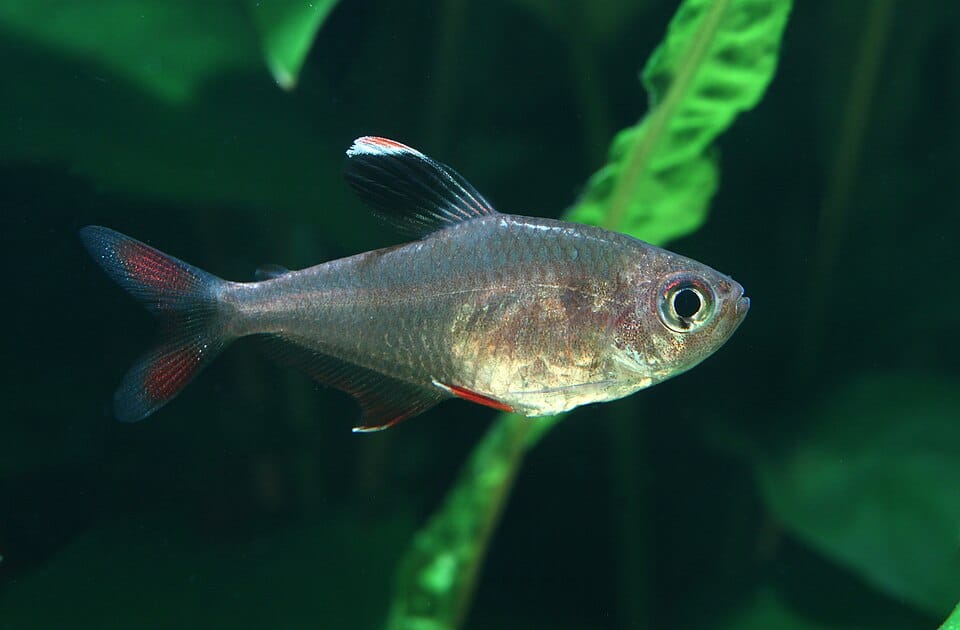
The ornate tetra has a deep, laterally compressed body with a soft salmon-pink to rosy base color and a semi-translucent quality. The most distinctive feature is the dorsal fin, which displays a bold black center with a contrasting white tip – earning the species its “white tip tetra” trade name. The anal and pelvic fins also show white tips or extensions.
The key identification feature that separates the ornate tetra from the nearly identical rosy tetra is the dark humeral spot – a small, dark mark located just behind the gill cover. The rosy tetra lacks this spot entirely. In practice, this is the most reliable way to tell the two species apart, since their overall body shape, coloration, and fin structure are extremely similar.
Male vs. Female
- Dorsal fin – Males develop a longer, more elongated dorsal fin with extended front rays that create an impressive flag-like shape. Females have a shorter, more rounded dorsal fin.
- Anal fin – Males also show a longer anal fin, often with white edging.
- Coloration – Males are typically more vivid, especially during displays. The pink tones deepen noticeably.
- Body shape – Females are rounder and fuller, particularly when carrying eggs.
Average Size & Lifespan
Ornate tetras reach about 1.6 to 1.8 inches (4-4.5 cm) in standard length. They’re a medium-small tetra, similar in size to their rosy tetra cousins. Their deep body and flowing fins give them more visual presence than their length alone suggests.
With proper care, expect a lifespan of 3 to 5 years. Farm-bred specimens are robust and handle aquarium conditions well.
Care Guide
Tank Size
A 20-gallon tank is the recommended minimum for a group of 8-10 ornate tetras. They’re moderate swimmers that appreciate both open space and planted retreats. For a multi-species community, 30 gallons or larger provides more room for everyone to coexist comfortably.
Water Parameters
| Parameter | Ideal Range |
|---|---|
| Temperature | 72-82°F (22-28°C) |
| pH | 5.5-7.5 |
| Hardness | 1-12 dGH |
| KH | 1-8 dKH |
Ornate tetras are adaptable, especially the farm-bred specimens that make up the vast majority of the trade. They do best in soft, slightly acidic water where their pink coloration intensifies noticeably. Hard, alkaline water will wash out their color. Indian almond leaves and driftwood create ideal conditions while staining the water a natural amber that complements their appearance beautifully.
One important note from Seriously Fish: ornate tetras are intolerant of organic waste buildup. Consistent weekly water changes of 20-25% are essential. Only add them to mature, fully cycled aquariums.
Filtration & Water Flow
Moderate filtration with gentle flow works best. A hang-on-back filter or canister turning over 4-5 times the tank volume per hour is ideal. They come from sluggish waters, so don’t blast them with strong currents. A sponge filter also works well, especially in smaller setups.
Lighting
Moderate to subdued lighting brings out the best coloration. The pink-salmon body and the translucent quality of their fins are most attractive under gentle, diffused lighting. Floating plants create natural shade that helps them feel secure and look their best.
Plants & Decorations
A planted tank with dark substrate is the way to go. Driftwood, dried leaf litter, and live plants create a natural environment that mimics their native habitat and brings out optimal coloration. Java fern, Anubias, Cryptocoryne, and floating plants work well. Leave some open swimming space in the center for the school to congregate and for males to display.
Is the Ornate Tetra Right for You?
The ornate tetra is one of the hobby’s best-kept secrets. Here’s who should discover them:
- You enjoy watching fish develop color over time. Ornate tetras are slow bloomers that reward patience
- You appreciate subtle color combinations rather than single bold hues
- You want to keep a larger school (10+) to see their complex social interactions
- You have a planted tank with soft, slightly acidic water
- You’re looking for an overlooked species that most hobbyists don’t even know exists
- Skip if you want instant impact. Ornate tetras need settling-in time before they show their best
What People Get Wrong
The most common mistake is housing ornate tetras with fin-nippers. The flowing dorsal and anal fins on males are visually striking and also a major target. Tiger barbs, serpae tetras, and even active danios will nip at those fins given the opportunity. Once the fins are damaged, the fish looks poor and the recovery takes months. Plan tank mates carefully before buying ornate tetras.
Second issue: misidentification. Ornate tetras (Hyphessobrycon bentosi) are frequently confused with several similar-looking Hyphessobrycon species — rosy tetras, bleeding heart tetras, and others. The ornate tetra is specifically identified by the elongated dorsal fin with a white tip on males. If the store cannot confirm the species, ask for the scientific name before buying.
Third: the fins require clean water to develop properly. Males kept in suboptimal water quality or with fin-nippers will never show the full elegant fin development that makes this species distinctive. Clean water, peaceful tank mates, and the right group size of 6 or more bring out the best in ornate tetras.
Tank Mates
Best Tank Mates
- Other peaceful tetras (cardinal tetras, neon tetras, ember tetras, rosy tetras)
- Corydoras catfish – ideal bottom-dwelling companions
- Hatchetfish – surface dwellers from similar habitats
- Pencilfish – gentle, similarly sized South American fish
- Dwarf cichlids (rams, Apistogramma) – great biotope pairing
- Otocinclus – small, peaceful algae eaters
- Bristlenose plecos – stay out of the way
- Cherry barbs – similarly peaceful and complementary in color
Tank Mates to Avoid
- Aggressive or boisterous species – ornate tetras are easily startled and stressed by rowdy tank mates
- Very long-finned species – occasional fin nipping is possible, especially in smaller groups
- Large predatory fish – anything that could eat them
Food & Diet
Ornate tetras are omnivorous and accept a wide range of foods. A high-quality flake or micro-pellet makes a good daily staple. Supplement regularly with live or frozen foods like daphnia, baby brine shrimp, bloodworms, and mosquito larvae for the best health and coloration.
A varied diet is key – fish fed only dry food will look noticeably paler than those getting regular protein-rich supplements. The pink coloration responds well to high-quality, varied feeding.
Feeding tip: Feed small portions once or twice daily. Ornate tetras are moderate feeders that won’t aggressively dominate mealtimes, but make sure food reaches them if they’re housed with more competitive species.
Breeding & Reproduction
Ornate tetras are egg scatterers that is bred in home aquariums with the right setup.
Spawning Tank Setup
Set up a separate breeding tank with dim lighting, fine-leaved plants like Java moss, and a mesh grid on the bottom to prevent adults from eating the eggs. Water should be soft and slightly acidic – pH 5.5-6.5, very low hardness, temperature around 80°F. A sponge filter provides gentle circulation.
Conditioning & Spawning
Condition a pair or small group with generous live and frozen foods for 1-2 weeks. Males will intensify their displays and flare their dorsal fins. Spawning occurs in dim conditions, with eggs scattered among fine-leaved plants. Remove adults immediately after spawning.
Egg & Fry Care
Eggs hatch in 24-36 hours. Fry become free-swimming 3-4 days later. Start with infusoria or very fine dry fry food, then graduate to baby brine shrimp as they grow. Keep lighting dim and water quality pristine. Growth is moderate, with juvenile fish beginning to show adult coloration at around 2-3 months.
Common Health Issues
Ornate tetras are hardy once established, but they is sensitive to poor water quality and fluctuating conditions:
Ich (White Spot Disease)
The most common disease, typically triggered by temperature swings or stress. Gradually raise the temperature to 82°F and treat with standard ich medication.
Fin Rot
Bacterial deterioration of the fins, especially concerning in males with their beautiful elongated finnage. Usually caused by poor water quality or high organic waste levels. Extra water changes and antibacterial treatment if needed.
General Prevention
Quarantine new fish for 2-3 weeks. Only add ornate tetras to mature, fully cycled tanks. Maintain consistent water changes – they don’t tolerate waste buildup well. A varied diet supports a strong immune system.
Common Mistakes to Avoid
- Adding to new tanks – Ornate tetras should only go in mature, cycled aquariums. They’re sensitive to the unstable conditions in newly set up tanks.
- Keeping too few – Groups smaller than 6 become timid and stressed. Males need other males to display to. Aim for 8-10 or more for natural behavior.
- Skipping water changes – They don’t tolerate organic waste accumulation. Consistent weekly water changes are essential, not optional.
- Confusing with rosy tetras – Check for the humeral spot behind the gill cover. Ornate tetras have it, rosy tetras don’t. Care is virtually identical either way, so it’s more of an identification issue than a practical concern.
- Bright, unnatural setups – They look washed out in bare tanks with bright lighting and light substrates. Dark substrate, live plants, and diffused lighting bring out their best.
Where to Buy
Ornate tetras are widely available at local fish stores and online retailers, often sold under various common names including “bentosi tetra,” “white tip tetra,” or simply “ornate tetra.” Pricing typically runs $4-7 per fish. Most specimens are farm-bred and generally hardy.
For quality stock with live arrival guarantees, check Flip Aquatics and Dan’s Fish.
Frequently Asked Questions
What is the difference between an ornate tetra and a rosy tetra?
The main difference is the humeral spot – a small dark mark behind the gill cover. The ornate tetra (M. Bentosi) has this spot, while the rosy tetra (M. Rosaceus) lacks it. Geographically, the ornate tetra comes from the lower Amazon basin in Brazil, while the rosy tetra hails from Guyana and Suriname. Care requirements are virtually identical for both species.
Are ornate tetras the same as white tip tetras?
Yes. “White tip tetra,” “bentosi tetra,” “bentos tetra,” and “ornate tetra” are all common names for the same species, Megalamphodus bentosi. The “white tip” name refers to the distinctive white tip on the black dorsal fin.
Are ornate tetras peaceful?
Yes, they’re generally very peaceful community fish. Males will spar and flare their fins at each other, but this behavior is harmless and actually entertaining to watch. They may occasionally nip at very long-finned species like bettas or fancy guppies, but this tendency is greatly reduced when kept in proper-sized groups of 8-10 or more.
How many ornate tetras should I keep?
A minimum of 6, but 8-10 is strongly recommended. Larger groups bring out natural schooling behavior and encourage males to display their impressive dorsal fins. In small groups, they will hide and look stressed.
What It Is Actually Like Living With Ornate Tetra
In a proper school, ornate tetra display natural movement patterns that are genuinely engaging to watch. The fish interact with each other, establish subtle hierarchies, and move through the tank with purpose.
They spend most of their time near the surface, which fills a level of the tank that many other species ignore. This makes them excellent complements to mid-water and bottom-dwelling fish.
Feeding time is when their personality comes out. They learn your routine quickly and will anticipate feeding before you even open the lid.
Their color and behavior improve over time as they settle into a stable environment. Fish that have been in the same tank for months look noticeably better than recently added stock.
They coexist peacefully with virtually every other appropriately-sized community fish. This compatibility makes tank planning straightforward.
How the Ornate Tetra Compares to Similar Species
Ornate Tetra vs. Rosy Tetra
Rosy tetras share warm pink-orange tones with ornate tetras and occupy a similar niche in community tanks. Rosy tetras are more immediately colorful. They look good sooner and maintain color more consistently across different water conditions. Ornate tetras take longer to develop but arguably reach higher peaks of coloration when conditions are perfect. Rosy tetras are also more widely available and less expensive. For most hobbyists, rosy tetras are the practical choice. For the dedicated keeper who wants something less common, ornate tetras are the rewarding alternative. Check out our Rosy Tetra care guide for more details.
Ornate Tetra vs. Flame Tetra
Flame tetras offer reliable warm coloration in a smaller, hardier package. They’re one of the most forgiving tetras in the hobby, while ornate tetras need a bit more attention to water quality. Both are excellent community citizens that get along with virtually anything peaceful. Flame tetras are the “just works” option. Ornate tetras are the “I want something different and I’m willing to put in a little extra effort” option. In a well-maintained planted tank, the ornate tetra’s multi-toned coloration is genuinely more interesting than the flame tetra’s uniform orange. Check out our Flame Tetra care guide for more details.
Closing Thoughts
The ornate tetra is one of those species that rewards patience and attention to detail. Give them soft water, a planted tank with some tannins, and a proper group of 8-10 fish, and the males will put on fin-flaring displays that rival anything in the tetra world. There’s a reason this species has been a staple in the hobby for nearly a century.
If you’re a fan of the rosy tetra, the ornate tetra offers an almost identical experience with a slightly different origin story. They mix beautifully with other Megalamphodus species like black phantom tetras for a stunning “phantom and ornate” display tank.
Recommended Video
Check out our tetra tier list video where we rank the most popular tetras in the hobby:
References
- Hyphessobrycon bentosi Profile – Seriously Fish
- Megalamphodus bentosi (Durbin, 1908) – FishBase
- Megalamphodus bentosi – Wikipedia
- Phylogenomics of Characidae – Melo et al, 2024
- About the Author
- Latest Posts

I’m Mark Valderrama, founder of Aquarium Store Depot and a fishkeeper with over 25 years of hands-on experience. I started in the hobby at age 11, worked at local fish stores, and have kept freshwater tanks, ponds, and reef tanks ever since. I’ve been featured in two best-selling aquarium books on Amazon and built this site to share practical, experience-based fish keeping knowledge.
Leave a Reply