
Last Updated: June 25, 2026
Thank you for visiting! By the way… any links on this page that lead to products on Amazon and other stores/partners are affiliate links Aquarium Store Depot earns a commission if you make a purchase.
Table of Contents
- What Most Care Guides Get Wrong
- The Reality of Keeping Rosy Tetra
- Key Takeaways
- Species Overview
- Classification
- Origin & Natural Habitat
- Appearance & Identification
- Average Size & Lifespan
- Care Guide
- Is This Fish Right for You?
- What People Get Wrong
- Tank Mates
- Food & Diet
- Breeding & Reproduction
- Common Health Issues
- Common Mistakes to Avoid
- Where to Buy
- Frequently Asked Questions
- What It Is Actually Like Living With Rosy Tetra
- How It Compares to Similar Species
- Closing Thoughts
- Recommended Video
- References
The rosy tetra is an underappreciated schooling fish that delivers color, behavior, and hardiness in one package. A mature school with proper lighting shows off pink bodies with dramatic black-edged fins. Keep fewer than 6 and you lose the schooling display. Keep them right and they rival much more expensive species.
Rosy tetras in a proper school rival fish that cost five times as much. Most people just never give them the chance.
The Reality of Keeping Rosy Tetra
Males develop impressive dorsal fins. The extended, flowing dorsal fin on mature males is the rosy tetra’s best feature. It gives the fish a dramatic profile that exceeds what you expect from a standard community tetra. Fin nippers will damage this extension, so choose tank mates carefully.
The color is subtle but refined. The salmon-pink body color is not flashy, but it is genuinely attractive. It creates a warm tone in the tank that complements planted setups beautifully. The color deepens with quality food and good water conditions.
They are one of the most peaceful tetras. Rosy tetras rarely cause problems in any community. They are peaceful, non-aggressive, and tolerant of a wide range of tank mates. This makes them one of the safest tetra choices for mixed community tanks.
Biggest Mistake New Owners Make
Overlooking them in favor of flashier species. The rosy tetra does not photograph as well as it looks in person. The subtle pink coloring and flowing fins are best appreciated live.
The rosy tetra is one of the most reliable, rewarding community tetras available. It does everything well and causes zero problems. For keepers who value consistency and elegance over flash, this is a top choice.
Key Takeaways
- Soft pink-salmon coloration with a distinctive black-and-white dorsal fin that makes them instantly recognizable
- Males develop beautiful flowing fins and display by flaring at rivals – one of the more elegant tetra behaviors
- Hardy and peaceful – a great community fish that works well with most similarly sized species
- Keep in groups of 8-10+ for natural schooling behavior and the best male displays
- 20-gallon minimum with soft, slightly acidic water for optimal coloration

Species Overview
| Field | Details |
|---|---|
| Scientific Name | Hyphessobrycon rosaceus (recently moved to Megalamphodus rosaceus) |
| Common Names | Rosy Tetra, White Fin Ornate Tetra |
| Family | Acestrorhamphidae |
| Origin | Guyana and Suriname (Essequibo and Suriname River basins) |
| Care Level | Easy |
| Temperament | Peaceful |
| Diet | Omnivore |
| Tank Level | Mid |
| Maximum Size | 1.6 inches (4 cm) |
| Minimum Tank Size | 20 gallons (75 liters) |
| Temperature | 75-82°F (24-28°C) |
| pH | 5.5-7.5 |
| Hardness | 1-12 dGH |
| Lifespan | 3-5 years in captivity |
| Breeding | Egg scatterer |
| Breeding Difficulty | Moderate |
| Compatibility | Community |
| OK for Planted Tanks? | Yes |
Classification
| Taxonomic Level | Classification |
|---|---|
| Order | Characiformes |
| Family | Acestrorhamphidae (reclassified from Characidae, Melo et al. 2024) |
| Subfamily | Megalamphodinae |
| Genus | Megalamphodus (revalidated; formerly Hyphessobrycon) |
| Species | M. Rosaceus (Durbin, 1909) |
Rosy tetras are peaceful, hardy, and adaptable. One of the most reliable community tetras for beginner and intermediate setups alike.
The rosy tetra was originally described by Marion Durbin in 1909 as Hyphessobrycon rosaceus. The species has a tangled taxonomic history – for years, Hyphessobrycon ornatus was used interchangeably in the hobby, and it took a 2014 revision by Zarske to sort things out and confirm that ornatus is a synonym of rosaceus.
Note on reclassification: The 2024 phylogenomic study by Melo et al. Moved the rosy tetra into the revalidated genus Megalamphodus within the new family Acestrorhamphidae, subfamily Megalamphodinae. This same genus now includes the red phantom tetra, bleeding heart tetra, serpae tetra, and black phantom tetra. Most hobbyist sources still use Hyphessobrycon rosaceus, but FishBase has already adopted Megalamphodus rosaceus.
Origin & Natural Habitat

The rosy tetra is native to Guyana and Suriname in northern South America, specifically the Essequibo River basin and the Suriname and Corantijn River basins. The type locality is Gluck Island in the Essequibo River, Guyana.
In the wild, rosy tetras inhabit forested areas where they’re found in sluggish tributaries off the main river channels. The water is typically stained brown with tannins from decaying leaves and wood, making it soft and acidic. These are classic South American blackwater forest stream environments with sandy substrates, abundant leaf litter, and overhanging vegetation providing shade.
Most rosy tetras available in the aquarium trade today are commercially farm-bred rather than wild-caught, which means they are hardier and more adaptable to a range of water conditions than their wild ancestors.
Appearance & Identification
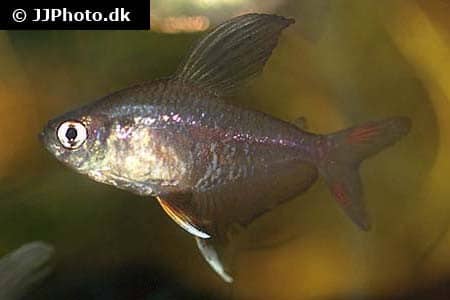
The rosy tetra has a moderately deep, laterally compressed body with a semi-translucent quality that gives it an almost ethereal appearance. The base color is a soft pink to salmon that deepens and intensifies in good conditions. The body has a warm, rosy glow that’s unlike the bolder colors of most tetras – it’s more subtle and refined.
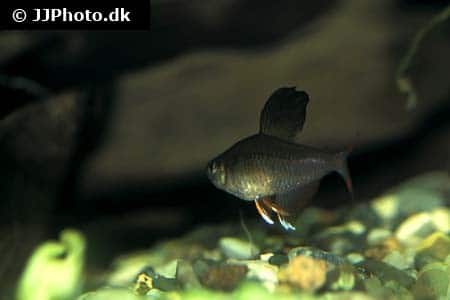
The standout feature is the dorsal fin, which displays a distinctive black center or base with a contrasting white tip. In mature males, this fin becomes elongated and flag-like, creating a striking visual when flared during displays. The anal fin is also elongated in males and often shows white edging. The pinkish-red caudal fin may display two small oval red spots.
One important identification note: the rosy tetra lacks a humeral (shoulder) spot behind the gill cover. This is the key feature that separates it from the very similar ornate tetra (M. Bentosi), which has a visible dark mark in that position.
Male vs. Female
- Dorsal fin – Males develop a much longer, more elongated dorsal fin with an extended front ray that creates a dramatic flag-like shape. Females have a shorter, more rounded dorsal fin.
- Anal fin – Males also have a longer, more extended anal fin with white edging.
- Coloration – Males display deeper, more intense pink-salmon coloring, especially during courtship and territorial displays.
- Body shape – Females are rounder and deeper-bodied, particularly when carrying eggs. Males are slimmer.
Average Size & Lifespan
Rosy tetras reach about 1.4 to 1.6 inches (3.5-4 cm) in standard length. They’re a medium-small tetra, similar in size to serpae tetras and slightly smaller than bleeding heart tetras. Their deep body shape and flowing fins make them appear a bit larger than they actually are.
With proper care, expect a lifespan of 3 to 5 years. Farm-bred specimens are robust and long-lived when given stable, clean conditions.
Care Guide
Tank Size
A 20-gallon tank is the recommended minimum for a group of 8-10 rosy tetras. They’re not particularly demanding swimmers, but they do need enough space for males to establish small territories and display without constantly bumping into each other. A 30-gallon or larger tank is ideal for a community setup with other species.
Water Parameters
| Parameter | Ideal Range |
|---|---|
| Temperature | 75-82°F (24-28°C) |
| pH | 5.5-7.5 |
| Hardness | 1-12 dGH |
| KH | 1-8 dKH |
Rosy tetras are adaptable fish, especially the farm-bred specimens that dominate the trade. That said, they’ll show their most vibrant pink coloration in soft, slightly acidic water. Hard, alkaline water will wash out their color noticeably. Indian almond leaves and driftwood help create ideal conditions while also adding tannins that enhance their natural look.
Filtration & Water Flow
Moderate filtration with gentle flow is ideal. These fish come from sluggish tributaries and don’t appreciate strong currents. A hang-on-back or sponge filter works well. Canister filters are fine if you baffle the output. Keep up with 20-25% weekly water changes for consistent water quality.
Lighting
Moderate to subdued lighting brings out the best in rosy tetras. Their pink coloration and the translucent quality of their bodies are most visible under gentle, diffused light. Floating plants provide natural shade that helps them feel secure and show their best colors.
Plants & Decorations
A well-planted tank with a dark substrate is the ideal setup. The dark background makes the soft pink body really stand out. Driftwood, dried leaf litter, and live plants create a natural environment that brings out the best coloration and behavior. Java fern, Cryptocoryne, Anubias, and floating plants all work well. Leave some open swimming space in the middle for the school to move together.
Is the Rosy Tetra Right for You?
Rosy tetras are one of the most well-rounded tetras in the hobby. Here’s who should be keeping them:
- You want warm pink-salmon coloration in a truly peaceful package. No nipping, no aggression
- You’re looking for a reliable, mid-difficulty tetra that colors up beautifully with good care
- You keep a planted community tank and want a species that complements every other peaceful fish
- You can provide a varied diet with color-enhancing foods to bring out their best
- You want a tetra that’s widely available and affordably priced
- These work in almost any peaceful community. They’re one of the most versatile tetras available
What People Get Wrong
The most underappreciated issue with rosy tetras is their fin-nipping potential in small groups. In the right group size of 8 or more, they are genuinely peaceful community fish. In a group of 4 or 5, they become nippy and competitive — a behavior pattern that surprises keepers who bought them expecting pure peace.
Second issue: identification. Rosy tetras are frequently confused with several similar Hyphessobrycon species — bleeding heart tetras, ornate tetras, and others. Correct identification matters because care requirements and temperament vary across these similar-looking fish. If you are buying from a store that mixes them or does not know the difference, ask for the scientific name.
Third: the rosy color is environment-dependent. In bright, harshly lit tanks with no plants, rosy tetras look washed out and pale. In a planted tank with warm lighting and dark substrate, the pink and rose tones deepen significantly. The setup determines the color as much as the genetics do.
Tank Mates
Best Tank Mates
- Other peaceful tetras (cardinal tetras, ember tetras, neon tetras)
- Corydoras catfish – ideal peaceful bottom dwellers
- Hatchetfish – surface dwellers that fill a different zone
- Pencilfish – gentle, similarly sized companions
- Dwarf cichlids (rams, Apistogramma) – great South American community pairing
- Otocinclus – small, peaceful algae eaters
- Bristlenose plecos – stay out of the way
- Angelfish and discus – rosy tetras’ deep body shape makes them less likely to be viewed as food
Tank Mates to Avoid
- Aggressive or boisterous species – will stress out the relatively calm rosy tetras
- Very long-finned species – rosy tetras may occasionally nip at trailing fins, especially in small groups
- Large predatory fish – anything that could eat them
Food & Diet
Rosy tetras are omnivorous and accept a wide variety of foods without fuss. A high-quality flake or micro-pellet forms a solid daily staple. Supplement with live or frozen foods like daphnia, brine shrimp, bloodworms (in moderation), and micro worms for the best health and coloration.
A varied diet is particularly important for maintaining the rosy-pink coloration. Fish fed only dry food will look washed out compared to those getting regular live and frozen supplements.
Feeding tip: Feed small portions once or twice daily. Rosy tetras are moderate feeders that won’t out-hustle aggressive eaters, so make sure food reaches the group if they’re in a community with more competitive species.
Breeding & Reproduction
Rosy tetras are egg scatterers that is bred in captivity with some preparation. They’re moderately easy to spawn if the water conditions are right.
Spawning Tank Setup
Set up a separate 10-gallon breeding tank with dim lighting and fine-leaved plants like Java moss or spawning mops. Water should be very soft and acidic – pH 5.5-6.5, hardness under 5 dGH, temperature 80-84°F. A sponge filter provides gentle circulation.
Conditioning & Spawning
Condition a pair or small group with generous live and frozen foods for 1-2 weeks. Males will intensify their displays, flaring their dorsal and anal fins at rivals. Spawning typically occurs in the morning, with eggs scattered among fine-leaved plants.
Egg & Fry Care
Remove adults immediately after spawning – they will eat the eggs without hesitation. Eggs hatch in 24-36 hours, and fry become free-swimming 3-4 days later. Feed infusoria initially, then graduate to microworms and baby brine shrimp. Growth is moderate, and juvenile fish begin showing adult coloration at around 2-3 months.
Common Health Issues
Rosy tetras are hardy once established, but they is sensitive during initial acclimation. Common health concerns include:
Ich (White Spot Disease)
The most common disease, typically triggered by temperature swings or stress. White spots on the body and fins are the telltale sign. Gradually raise temperature to 82°F and treat with standard ich medication.
Fin Rot
Bacterial deterioration of the fins, which is especially concerning for males with their beautiful elongated finnage. Usually caused by poor water quality. Improve conditions with extra water changes and treat with antibacterial medication if it doesn’t resolve.
General Prevention
Quarantine all new fish for 2-3 weeks. Acclimate rosy tetras slowly, especially if transitioning from soft to harder water or vice versa. Maintain stable parameters and provide a varied diet. Once established, they’re quite resilient.
Common Mistakes to Avoid
- Keeping too few – Groups smaller than 6 become timid and stressed. Males need other males to display to. Aim for 8-10 or more.
- Hard, alkaline water – The rosy-pink coloration fades significantly in hard water. If your tap water is very hard, consider blending with RO water.
- Confusing with ornate tetras – Most fish sold as “rosy tetra” in stores may actually be ornate tetras (M. Bentosi). Check for a humeral spot behind the gill cover – rosy tetras don’t have one, ornate tetras do. The care is nearly identical either way.
- Expecting instant color – Newly purchased rosy tetras often look pale and washed out from shipping stress. Give them a few weeks in good conditions and you’ll see a dramatic color transformation.
- Plain, undecorated tanks – Rosy tetras look terrible in bare tanks. They need plants, driftwood, and a dark substrate to show their best colors.
Where to Buy
Rosy tetras are widely available at local fish stores and online retailers. They’re one of the more common tetras in the hobby and are reasonably priced at $3-5 per fish. Most specimens in the trade are farm-bred, which means they are hardy and well-acclimated to aquarium conditions.
Never add them to an uncycled tank. Rosy tetras need clean, stable water to maintain their color and health. Ammonia or nitrite from a new tank will cause stress and fade their coloring fast.
For quality stock with live arrival guarantees, check Flip Aquatics and Dan’s Fish.
Frequently Asked Questions
What is the difference between a rosy tetra and an ornate tetra?
They’re extremely similar and frequently confused in the hobby. The main difference is the humeral spot – the ornate tetra (M. Bentosi) has a dark mark behind the gill cover, while the rosy tetra (M. Rosaceus) does not. The ornate tetra also be slightly paler and more transparent. Care requirements are virtually identical for both species, so if you end up with one instead of the other, the good news is that nothing changes in terms of how you keep them.
Are rosy tetras the same as Hyphessobrycon ornatus?
Yes and no. Hyphessobrycon ornatus was long used as a separate species name, but a 2014 taxonomic revision confirmed that ornatus is actually a synonym of rosaceus – they’re the same fish. To add to the confusion, both have now been moved to the genus Megalamphodus as of 2024. The name you’ll see most in shops is still “rosy tetra” regardless of which scientific name is on the label.
Why are my rosy tetras pale?
Several factors can cause pale coloration. Hard, alkaline water is the most common culprit – rosy tetras need soft, slightly acidic water to display their best pink tones. Stress from a new environment, bright lighting, a light-colored substrate, or a bare tank can also wash them out. A varied diet that includes live and frozen foods alongside quality dry food helps intensify their color. Give new fish 2-3 weeks to settle in before judging their coloration.
How many rosy tetras should I keep together?
A minimum of 6, but 8-10 or more is strongly recommended. Larger groups bring out natural schooling behavior and encourage males to display their impressive dorsal fins. In too-small groups, the fish become timid and spend most of their time hiding.
What It Is Actually Like Living With Rosy Tetra
Rosy tetras bring a warm, calming presence to any tank. The salmon-pink bodies moving through green plants create a natural, inviting aesthetic.
Male fin displays are subtle but beautiful. The extended dorsal fin catches light and creates a flowing silhouette that is elegant rather than dramatic.
They are one of the most trouble-free tetras I have encountered in 25+ years. No aggression, no special demands, just consistent, peaceful behavior.
They pair beautifully with other pink and warm-toned species for a cohesive color palette.
How the Rosy Tetra Compares to Similar Species
Rosy Tetra vs. Ornate Tetra
Ornate tetras share warm tones with rosy tetras but take longer to develop color and are less widely available. Rosy tetras are the more practical choice for most hobbyists. They color up faster, they’re easier to find, and they’re slightly hardier. Ornate tetras reward patience with arguably more complex coloration, but the difference is subtle. For most community tanks, rosy tetras are the better value and the more reliable performer. Check out our Ornate Tetra care guide for more details.
Rosy Tetra vs. Bleeding Heart Tetra
Bleeding heart tetras are the rosy tetra’s larger, more dramatic cousin. Both share warm pink tones, but bleeding hearts add that distinctive red spot and grow significantly bigger. Bleeding hearts need more tank space (30 gallons minimum) and is mildly assertive at feeding time. Rosy tetras are smaller, more peaceful, and work in 20-gallon setups comfortably. If you have the space, bleeding hearts are the more impressive display fish. For smaller tanks or maximum peace, rosy tetras are the smart pick. Check out our Bleeding Heart Tetra care guide for more details.
Closing Thoughts
The rosy tetra is the kind of fish that grows on you. It’s not flashy in the same way a serpae or Colombian tetra is, but there’s a quiet elegance to a well-kept school that’s hard to match. Watching mature males flare their flag-like dorsal fins at each other in a planted tank with tannin-stained water is genuinely beautiful.
Give them soft water, dim lighting, and a natural-looking setup, and the rosy tetra rewards you with some of the most refined aesthetics in the tetra world. They pair beautifully with cardinal tetras for color contrast, or alongside their close relatives like black phantom tetras for a Megalamphodus showcase tank.
Recommended Video
Check out our tetra tier list video where we rank the most popular tetras in the hobby:
References
- Hyphessobrycon rosaceus Profile – Seriously Fish
- Megalamphodus rosaceus (Durbin, 1909) – FishBase
- Rosy Tetra – Wikipedia
- Phylogenomics of Characidae – Melo et al, 2024
- About the Author
- Latest Posts

I’m Mark Valderrama, founder of Aquarium Store Depot and a fishkeeper with over 25 years of hands-on experience. I started in the hobby at age 11, worked at local fish stores, and have kept freshwater tanks, ponds, and reef tanks ever since. I’ve been featured in two best-selling aquarium books on Amazon and built this site to share practical, experience-based fish keeping knowledge.
Leave a Reply