Blackwater is one of my favorite aquarium styles, and one that doesn’t get nearly enough attention. There’s something genuinely beautiful about a dimly lit tank with amber-tinted water, leaf litter, driftwood roots, and a school of wild-type tetras or apistogramma moving through it. Done right, it looks like a slice of the Amazon. because that’s exactly what it’s mimicking.
A lot of people who end up with tannin-stained water from new driftwood actually have the beginnings of a blackwater setup without knowing it. Understanding what blackwater really means. and which species evolved for it. opens up one of the most rewarding directions in freshwater fishkeeping. Here’s a practical guide to setting one up, plus the 6 fish types that belong in it.
Keep reading!
What Are Blackwater Aquariums (Blackwater Biotopes)?
Blackwater tank aquariums mimic the natural habitat of rivers, swamps, floodplains, and lakes. Since these blackwater rivers have low minerals and high organic compounds or matter, the color of the blackwater habitat is mostly dark water with a tannin-stained appearance.
And so, the fish species that inhabit these environments are called blackwater fish. Most blackwater fish prefer slightly acidic conditions having a pH of around 6.5 or below. Also, they need a balanced diet with live food or frozen foods.
Though mesmerizing, a blackwater tank is challenging to keep and maintain because of the unique water chemistry and conditions required by the blackwater fish.
Types of Blackwater Aquarium Fish
It is a popular belief that blackwater fish such as Tetras, Discus, Apistos, Loaches, and rams can thrive without soft water, low pH, or perfect water chemistry or water parameters. However, it’s not true.
Blackwater fish requires exceptionally crystal clean and clear water that is bacteria-free. Thus, make sure to keep blackwater fish, only if you can keep your tank clean.
Here is a list of some of the popular blackwater aquarium fish to keep in your home aquariums:
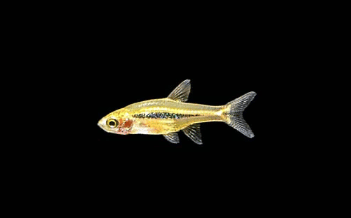
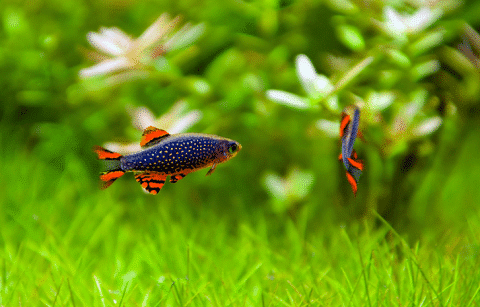
Many species of tetras thrive in a blackwater tank. The tetras that live in dark water such as in swamps, peat bogs, and blackwater rivers prefer low concentrations of dissolved minerals and ph-neutral substrates such as freshwater sand. Avoid using marine sand or gravel sand since they are usually made of limestone that breaks up and increases the pH levels of your tank.
The tetras living in blackwater biotope have adapted to the blackwater conditions, thus, are very sensitive to changes in the water chemistry or parameters than other tetra species. Blackwater tetras are also more prone to stress and illness. So, proper monitoring should be done to avoid any mishaps.
2. Geophagus
Geophagus are a species of Cichlids found in the streams and blackwater rivers of South America. Blackwater tank hobbyists love Geophagus fish for the fact that it is a blackwater fish. Since they are a blackwater fish species, they require a specialized diet and water conditions to thrive in.
Also, they are territorial and aggressive towards other fish, so they need plenty of hiding places and large tank size to tame their aggressive traits. Nevertheless, Geophagus is a unique and enchanting addition to your freshwater fish tank.
3. Discus Fish
When we speak of blackwater aquarium fish, Discus is the first one that comes to mind.
Discus fish are usually called “the king of the aquarium fish”, and rightfully so. They have a serene, vibrantly colored body with a unique body shape that stands out from the crowd. Discus are well-adapted for blackwater tanks with low pH and high levels of organic matter.
Discus loves hanging out in small groups, hence, ideal for a community tank. Also, it requires a varied diet to maintain the vibrancy of its colors and overall health. Therefore, the water conditions and nutritional requirements need to be met to keep a discus fish in a blackwater tank.
4. Gouramis
Pearl Gourami Fish” class=”wp-image-554652″/>
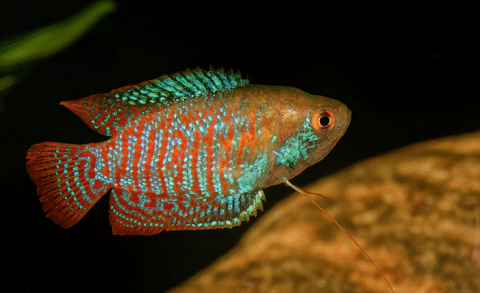
Gouramis, especially Chocolate Gouramis, enjoy the blackwater biotope setup as much as bettas and cichlids do. Just make sure your Gourami is happy with the soft, acidic, and tannin-filled water.
5. Dwarf Cichlids
Dwarf Cichlids are an excellent choice for a biotope aquarium. Check out our article on them for more info. There are several types available with German Rams being the most colorful
6. Betta Fish
If you’ve kept Betta fish or the Siamese fighting fish, you’ll understand that the use of tannins is not a novel concept. Experts aquarists use dried or dead Indian almond leaves to keep their bettas healthy, happy, and thriving. In the past, it has also been noted that bettas kept in tannin water with organic matter leached are more colorful and healthier.
Setting up a blackwater biotope properly requires special attention and care due to the unique conditions of these environments. Here are some steps you can follow to set up a blackwater aquarium:
1. Choose A Suitable Tank Size
Choosing a suitable aquarium size for blackwater fish is not an issue. Since these fish species are usually small, the tank size is pretty flexible. Also, nano blackwater biotope are easy to maintain under strict water conditions.
Therefore, I recommend setting up a smaller tank starting with ultra-purified water and treating it with plant tannins.
If you want to keep fish species such as Discus fish and angelfish, you can opt for a 55 gallons tank or over only if you can maintain it.
2. Choose The Right Substrate
I recommend using a fine gravel substrate to provide your plants with a root zone. You can opt for a dark substrate, especially for planted aquariums. In all cases, marine sand or gravel should never be used because they are made of limestone and aragonite, which increase the pH levels of water.
To keep the pH neutral, it’s important to use freshwater sand or gravel. Basically, any substrate that is rich in organics or pH neutral would be the best choice for a blackwater biotope.
3. Add Live Aquatic Plants
If you’re into keeping live plants, choose plants that are adapted to low light and low pH conditions, such as Anubias or Java fern.
Live aquatic plants, although not necessary, provide beautiful aesthetics and a more natural environment for the blackwater fish. Also, plants are an ideal source of natural tannins, especially with the dead or decaying leaves.
Choose plants that can survive low light and low pH conditions. Some good choices include Anubias, Java fern, and Cryptocoryne. Also, you can add floating plants such as Amazon frog bit, Najas Indica, red root floaters floating plants, etc.
Use natural materials for decorations: Natural materials, such as driftwood, Indian almond leaves, aquarium wood, and rocks, can help to create blackwater habitats.
To maintain excellent overall water chemistry, it’s important to install and set up an effective filtration system. Choosing a reliable filtration system for a blackwater aquarium is a daunting task because of the critical requirements.
I recommend setting up a canister filter or power filter. Also, remove activated carbon from the media chambers and use peat in place of activated carbon in the filter’s media. After adding the peat, closely monitor watercolor and water quality and adjust the peat quantity accordingly.
The blackwater habitat is relatively different from any freshwater or saltwater tanks. Therefore, it is important to prepare the fish before adding so it can adapt well.
6. Maintain The Water Quality
Blackwater aquarium tank works the best with general water hardness (GH) and carbonate hardness (CH) in the 2 to 5-degree range. This range has low dissolved minerals which are ideal for a blackwater aquarium.
Ideally, you should do partial water changes to keep the water in pristine condition for your blackwater fish.
Maintaining your tank water is the best bet for keeping a blackwater biotope aquarium. If the tank becomes too dark, up the number of water changes or does them a bit more regularly. If you need to clean the substrate or gravel, I recommend doing a quick “sweep” with a gravel siphon.
7. Choose The Right Tank Mates
It’s crucial to take the fish’s size, temperament, and care needs into account when selecting tank mates for blackwater fish.
To fit their tank size, many aquarium owners choose for smaller schooling fish that flourish in a planted aquarium. The following advice will help you select the best tank mates for your blackwater fish:
Think About The Fish’s Size
It is crucial to select tank mates that are comparable in size and temperament to blackwater fish because they are often tiny and quiet. Avoid larger or more aggressive fish since they could intimidate or damage the blackwater fish.
Choose Compatible Species
Blackwater fish originate from a range of habitats, so it’s crucial to pair them with tank mates who are acclimated to the same types of water. Included in this are elements like pH, temperature, and water hardness.
Think About The Care Demands
Some blackwater fish species could need particular care, including a particular food or amount of water flow. To guarantee that every fish can survive in the aquarium, it is crucial to pair species that require a similar level of care.
Pay Attention To The Amount Of Fish
Overcrowding the blackwater tank should be avoided as it might result in poor water quality and stress for the fish. Make careful to look up the appropriate tank size and stocking rates for each fish species you are thinking about.
FAQs
Is This Good For Tanks?
Yes, blackwater aquariums are suitable for fish designed for blackwater biotope. However, freshwater or saltwater fish might not be the right choice for a blackwater aquarium. Blackwater aquarium has low levels of dissolved minerals and high concentration of organic matter, which is not suitable for all fish types.
Why Is the Water Dark?
Blackwater is dark water because of humic substances or humic and fulvic acids.
Do Neon Tetras Like This?
Yes, Neon tetras (Paracheirodon innesi) are well adapted for Amazonian Blackwater environment and can thrive in these environments when given proper care.
Can Tetras Live In Blackwater?
Yes, some species of tetras are adapted to living in blackwater environments.
Can You Have Plants In This Type Of Tank?
Yes, you can have plants in a blackwater tank. Some examples of plants that may be suitable for a blackwater tank include Amazon sword plants, Anubias species, and Cryptocoryne species.
What Does This Look Like In A Tank?
Blackwater in an aquarium is water that appears black and tannin-stained, usually as a result of the presence of organic materials and little dissolved mineral content.
Blackwater habitats are prevalent in nature and are characterized by very low levels of dissolved minerals and a high concentration of organic matter. They may be found in shallow, slow-moving waterways like rivers, swamps, and floodplains. In the realm of fishkeeping, blackwater tanks can be formed by utilizing a dark-colored substrate consisting of organic materials, such peat moss or coconut coir, or by employing leaves (Indian almond leaves or oak).
These leaves can be added to your aquarium to help promote a natural habitat for bettas, shrimp, and other soft-water loving fish. Betta breeders can use these leaves to help encourage breeding behavior.
Blackwater tanks, also known as “blackwater aquariums,” are aquariums that are designed to mimic the natural habitat of certain species of fish, plants, and other aquatic animals. These environments are typically characterized by low pH and high levels of dissolved organic matter, which can be achieved by using specialty filters and substrates, such as peat or leaf litter.
Some people find blackwater tanks to be aesthetically pleasing and enjoy the unique appearance of the water and plants in these environments. Additionally, some species of fish and plants are adapted to living in blackwater environments and may thrive in these conditions.
However, blackwater tanks can be more challenging to maintain compared to traditional freshwater aquariums. The low pH and high levels of organic matter can make it more difficult to keep the water clean and healthy, and it can be challenging to find the appropriate filtration and water-changing equipment for these types of tanks.
Do All Fish Like Dark Water?
No, not all fish species are adapted to living in blackwater environments, which are characterized by low pH and high levels of dissolved organic matter.
Can Shrimp Live In This Type of Tank?
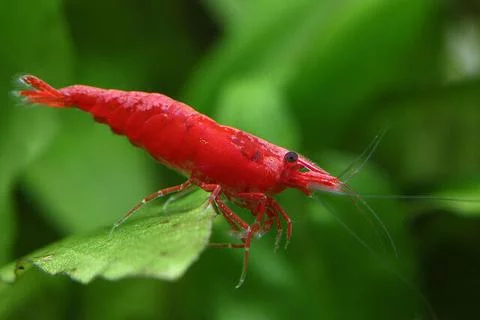
Yes, some species of shrimp, such as Red Cherry shrimp, Pinto shrimp, and bamboo shrimps thrive in blackwater environments.
Final Thoughts
Blackwater aquariums, despite being challenging to set up and maintain, look ravishing and refreshing.
It is important to carefully research the care requirements of the fish you are considering for a blackwater aquarium to ensure that they are suitable for these conditions. Blackwater aquariums can be rewarding to keep, as they provide a unique and beautiful setting for the fish to thrive in.
📘 Want to learn more? This article is part of our complete Freshwater Fish Guide. your ultimate resource for freshwater species, care tips, tank setup, and more.
After 25+ years of keeping everything from community tetras to large predatory cichlids and saltwater fish, the most consistent feeding mistake I see is people picking one food and sticking to it forever. Most fish do better with variety, and matching the diet to the species’ natural feeding behavior makes a bigger difference than most beginners expect. Feed an MBuna too much protein and you’re asking for Malawi bloat. Feed a predator nothing but flake and you’re leaving their immune system short.
This guide breaks down the 3 main diet types and 7 food categories worth knowing, so you can make smarter choices for whatever you’re keeping.
Key Takeaways
Fish species are classified into three categories, each with its own dietary needs.
Every fish species needs nutrients to survive, which they get from a well-balanced diet no matter what category they fall into.
Fish owners have plenty of options to choose fish food from, given they understand the dietary requirements of their pets.
The Importance Of Feeding Your Aquarium The Right Food
Feeding your fish the right type of fish food is pretty essential, especially when you have different species housed in the same tank.
All species, regardless of where they come from, need a nutrient-rich diet. Some fish species get these nutrients from vegetable matter, while others need meaty foods to stay healthy.
And like humans, fish also need a well-rounded combination of proteins, fats, minerals, and vitamins in their food so that they can survive against all odds and have better lifespans. And in case you don’t know, fish can be picky eaters, too. Some fish prefer a plant-based diet, while other fish love to hunt down live prey.
In their natural habitat, they are privileged to decide what they want to eat. But since they don’t have this option in captivity, the responsibility of providing them with a balanced diet falls on your shoulders.
If you know where your fish comes from and what they are accustomed to eating in the wild, the process of choosing the right food will be easier and faster.
Some fish species are found living in the depths, while others colonize the surface areas. Some species are freshwater fish, whereas others can be saltwater species. Their origin, as well as where they live in the water areas, determine the type of food they need.
Fish diets can generally be broken into three different categories, which we are going to cover in the next part.
Remember that if you know what category your fish fall into, you can easily design their menu according to their needs.
Different Types Of Diets
With different species known across the world, the change in their dietary needs is common and therefore necessary to get familiar with.
You can generally classify your fish’s diet into three categories: Carnivorous, Herbivorous and Omnivorous.
Let’s talk about each of them in more detail!
Herbivores
The first category on this list is Herbivorous fish.
These fish get most of their nutrients from a plant-based diet. They can munch on algae or eat vegetable matter to stay healthy and active. In the wild, herbivorous fish get plenty of food options to choose from. Apart from algae and plant matter, you can supplement your pet with fruits for better growth in your home aquarium.
Fish that fall into this category often have flat teeth or a beak that helps them bring off algae from rocks, wood, substrate, or other areas where they can find algae. These fish usually graze on areas with grown algae throughout the day and night.
There are only a few named species that survive only on a plant-based diet because most species need a well-balanced diet of meaty foods and vegetables. You cannot feed them meat since they won’t be able to digest it.
Compared to other types, Herbivorous fish can be challenging to keep because of their dietary needs. You need to supplement their tank with an abundant amount of food to graze on. Sometimes meeting their needs becomes pretty difficult, which can starve the fish to death. Luckily, there are options you can consider to avoid any mishap (more on that).
Carnivorous fish can also be called predatory fish that drive their energy from a meat-based diet. In the wild, they chase down smaller fish, insects, worms, snails, and shrimp. You can find fish like sharks actively hunting for live foods. On the other hand, other fish from the same category prefer sitting perfectly calm, waiting for their prey to become their next meal.
Carnivorous fish feature bigger mouths, larger teeth, and aerodynamic bodies that help them with rapid swimming through water.
In the aquarium hobby, it’s unlikely to find a fish owner housing Carnivorous fish since these species have a very predatory nature. Carnivorous fish enjoy tearing apart their prey and swallowing them instead of chewing on their meals.
Unlike those species that fall into the previous categories, Omnivorous fish have a solid digestive tract and offer you a wide range of options to consider when it comes to feeding them. They have a digestive system that allows both plant matter and meat to travel through, making them a pretty easy pet to care for.
Fulfilling their nutritional requirements is pretty simple as long as you feed them a varied diet of vegetables and meat.
And for a good reason, you are more likely to see Omnivorous fish in your local pet store than Herbivorous or Carnivorous fish.
Though these fish are a common type to find, you can come across some species that are more inclined towards either meaty foods or greens. The best way to find that out beforehand is to research their natural environment and the diet they consume in the wild.
Before you go and bring home a new pet, it’s always recommended to know the biology, size, and environment of the fish.
Fish are extremely diverse, which makes their dietary needs different from one another. Fish that are Carnivorous can eat live food, such as other young fish. And as far as the herbivorous category is concerned, they love to eat plants and spend their whole lives eating only that. Fish that are omnivores can take both vegetable and meaty foods as their main diet.
To get you started, I’ve listed out some common types of fish food suitable for different types of fish.
Dried Food
Dried fish food is one of the most common and convenient options to consider for your pet’s diet.
Apart from being cheap and easily available, dried food offers a range of options for carnivores, herbivores, and omnivore fish. And not only that, but when stored properly, this can last for several years. So it doesn’t matter if your fish wants to have insects, plants, or both.
There are different types of dried foods available in almost every pet store. Let’s dive into that!
Flakes
If you have top and mid-feeding fish, then flakes are for you.
Flake foods are small pieces of paper-thin fish food that float on the surface from where mid-dwellers and surface feeders can effortlessly consume them.
You can find some specific kinds of dried flakes perfect for fish like goldfish. Apart from this, there are different varieties that can give you the freedom to go for enhancing the color of your fish.
The size of dried flakes doesn’t have to coexist with the size of your pet since you can crush them into smaller bits and then feed them to your pet.
The main downside to flakes is that as soon as they get into the water, they begin losing their nutrients. They will dissolve in the water, and that’s why I don’t recommend you feed them to your bottom feeders.
Pellets
Giving your fish floating pellets is another great option, especially when you want to keep every fish in your aquarium happy doesn’t matter where they live.
Pellets, like flakes, are dried food that is made with different ingredients to target a specific diet.
Typically, you will see three different types of pellets.
The number one type is floating pellets that stay on the surface and transcend other types of fish food in size. Since they contain lots of air to stay afloat, some fish can potentially go through bloating or buoyancy issues, depending on what brand you’re using.
The second type is slow-sinking pellets. These pellets are designed to target the appetite of mid-dwellers who are too shy to eat up their food. As for the size, these pellets come in different sizes, so you can find the one that best suits the size of your fish’s mouth.
The third and last type is fast-sinking pellets. These pellets quickly sink down to the bottom for bottom-dwelling fish to feast on. Unlike the other two types, fast-sinking pellets contain the most nutrients and make a perfect meal for fish like plecos.
Wafers
Wafers are another type of dry fish food that comes in both large and small sizes. They take time to dissolve and therefore are perfect for your slow-feeder fish to devour.
Wafers become gradually soft in the water and can be eaten either by breaking up or by nibbling on them.
Herbivore fish can be fed algae wafers to fulfill their need since finding grown algae on a frequent basis is not possible for your pet.
Though less in protein as compared to fresh or frozen food, freeze-dried food is still a fine option for fish owners.
Typically freeze-dried food is something that was once alive but has been freeze-dried. It can include shrimp or worms and is usually given to those fish that need protein-rich foods.
Aside from worms and brine shrimp, you can freeze-dry daphnia, bloodworms, tubifex, and krill.
The good thing about freeze-dried food is that it can outlive other foods and can easily fit in the mouths of smaller fish species.
Live Foods
If you’re a beginner, then fetching live food for your fish will be pretty demanding. Except for live feeder fish and ghost shrimp, it’s like an enterprise to get live food for your pet fish.
Live foods are rich in nutrients, but they can turn your freshwater aquarium into a disease center for your pet fish. You can buy bloodworms, feeder fish, and ghost shrimp from any local fish store, where you can find plenty of live foods that have been farmed specifically for this purpose.
But in case you don’t want to run to the store every time you run out of supply, you can grow mosquito larvae at home to feed your fish. Just make sure you get a fresh supply available.
Since live foods can introduce tons of diseases to home aquariums and to your fish, I recommend going for frozen food. Culturing live food is a better venture for an aquarist with more experience (and who doesn’t mind getting messy).
Frozen Foods
fish food Frozen fish food is typically fish, shrimp, or other crustaceans frozen into cubes. Unlike live foods, frozen food is superior in quality and can become a nutrient-rich diet for your fish.
At the time of feeding, just drop the cube into the aquarium and let your little pet enjoy the feast.
Frozen foods can live longer than live foods when properly stored in a freezer. They are easily available online and at local fish stores. If you are a beginner and measuring servings is hard for you, then you can use these cubes to ensure you are not overfeeding your pets.
FAQs
What Is Their Main Food?
The main food of the fish depends on the category they fall into. For carnivores and omnivores, smaller fish, insects, worms, and snails are the main source of food whereas herbivores eat plants.
What Do They Eat In The Ocean?
The diet of an ocean fish can vary depending on the category. Herbivorous fish eats algae while omnivores and carnivores can feast on shrimp, plankton, and crustaceans.
Closing Thoughts
Different types of fish have different dietary needs, which can be met by a variety of food options. It’s important to know what type of diet your fish requires and the foods that fit them best in order to ensure they’re getting the nutrients they need. Have you tried any new fish food products for your pets lately? Let us know about your experiences in the comments below!
🐟 Want to learn more? This article is part of our complete Aquarium Care Guide. your ultimate resource for water chemistry, maintenance, feeding, disease prevention, and everything you need for a healthy tank.
Color fading in bettas is one of the most common concerns I hear from keepers, and in most cases it’s fixable once you identify the actual cause. After years of keeping bettas, the first things I always check are water quality and temperature. a stressed or cold betta will pale out fast, and those two factors account for most cases I’ve seen.
That said, some color changes are completely normal. Marble bettas change color throughout their lives. that’s genetics, not disease. Older bettas (2+ years) will naturally fade some. Knowing which situation you’re in changes what you do about it. Here are the 7 most likely reasons and how to tell them apart.
Top 7 Reasons Why Your Betta Fish Is Losing Its Color
Here are the top 7 reasons why your Betta is losing color.
1. Introducing A New Member To The Tank
Betta fish are highly territorial and aggressive. Therefore, any new fish added to the aquarium is seen as a potential threat to their territory. Hence, this leads to aggression and territorial behavior in the aquarium. Your betta fish might flare the fins or chase new fish to get rid of the new fish, eventually leading to stressful behavior.
Therefore, I always suggest choosing the tank mates carefully for your betta’s aquarium. If you’re planning to introduce a new fish in the tank, provide lots of hiding places and decorations for the fish.
2. Stress
Betta will always lose color under stress. When Bettas are under stress, their bodies release a hormone that results in your fish losing color. The amount of color loss is dependent on the severity of the stress. In serious circumstances, your betta fish turns white or loses color1.
There are so many reasons for stress in Betta fish such as changes in the environment, poor water quality, poor diet, and other fish that are incompatible.
If you want your fish to maintain their vibrant colors, it’s important to provide them with a stress-free environment. Always maintain water quality, monitor water parameters, and avoid adding too many fish in the betta tank.
3. Diseases
If stress or other water parameters are not the underlying cause of your betta fish losing color, then illness is a possible reason.
Betta fish may catch fish diseases such as parasites or bacterial infections that cause them to lose their vibrancy.
Ich
Ich is a parasitic infection that causes white spots on the betta’s skin and fins. Ich is one of the leading reasons your betta fish turning white or losing color. To treat ich, several medications are prescribed but it’s important to identify the underlying cause.
Fin Rot
Fin rotis caused by bacterial infections. The symptoms include; frayed betta fins or ragged fins and may also affect the fish’s skin. If left untreated, it can be a deadly infection.
Anchor worms are contagious. And the best part is they can see with the naked eye. Anchor worms are parasites that appear as long, thin, and thread-like particles on the betta’s body.
The infected fish shows symptoms such as:
Scratching or rubbing against objects
Loss of appetite
Loss of color
Lacerations and ulcerations on the betta’s body
4. Poor Water Quality
Betta fish are native to slow-moving waters in Southeast Asia. Therefore, they need particular water conditions to remain healthy and happy in their tank. When the water parameters are not properly maintained, it can lead to a variety of problems, including fish diseases and loss of color.
I always suggest regularly testing the water and making adjustments to maintain water parameters and quality. Always test the water to make sure that it is within the ideal ranges.
pH
First of all, the pH of betta tank water should be maintained. Betta fish likes slightly acidic pH ranging between 6.5 to 7.5. If you keep the pH too high or low, your fish might fall victim to stress and ultimately lose color.
Ammonia, Nitrite, and Nitrates
It is vital to monitor the levels of ammonia, nitrite, and nitrate in the tank water. High levels of ammonia and other toxins may result in deadly fish diseases.
If the tank water is not properly maintained, it can lead to a variety of health problems, including a loss of color. Proper water quality is essential for bettas, and it is important to regularly test the water and make sure that it is within the proper range for pH, ammonia, nitrite, and nitrate levels to avoid ammonia poisoning or nitrate poisoning.
Betta fish require a varied, nutritious, and carnivorous diet in order to maintain their health and vibrancy. A diet that is lacking in nutrients or that is unbalanced can lead to a variety of health problems, including a loss of color.
Since betta is carnivorous, their diet mainly consists of protein. It’s crucial to feed them food high in protein such as live or frozen foods, brine shrimp, daphnia, and bloodworms. I also advise feeding them freeze-dried foods or dry food supplements to improve their health and color vibrancy.
Along with protein-rich diet, feed your betta vitamins and minerals as a color-enhancing food but make sure the diet is balanced to maintain the health and vibrancy of the fish, without overfeeding fish.
6. Incorrect Water Temperature
Water temperature plays a vital role in maintaining the vibrancy of your betta fish. Since bettas are tropical fish, they prefer consistent water temperatures to remain happy and healthy. Too high or too low water temperature can cause stress and other health problems in your betta fish, including color loss.
Effect Of High Temperatures
At high temperatures, betta fish is susceptible to stress and diseases, and this might be the reason for your betta fish turning white or losing color. At high temperatures, the betta’s body stops functioning properly, which results in low pigment production. Hence, the color loss.
Effect Of Low Temperatures
Low water temperature is equally harmful to the betta fish as the cold water usually slows down your fish’s metabolism. As a result, they become more prone to diseases and stress. Additionally, the pigment cells of betta fish contract at low temperatures, resulting in a loss of color.
Ideal Water Water For Betta Fish
To maintain the color and vibrancy of your betta fish, it’s important to keep the water temperature in ideal range.
The ideal water temperature for your betta tank is between 76 and 82 degrees Fahrenheit (24-28 degrees Celsius). I suggest using a reliable thermometer to monitor and maintain a consistent temperature.
7. Old Age
One of the main reasons your betta is suffering from color loss is nothing, but the inevitable; old age!
As your betta fish ages, you’ll realize that it appears less vibrant and less colorful as the younger fish in the tank.
There are many factors that contribute to the color loss in older betta fish.
Low production of pigment in the betta’s body
Decline in overall’s betta health
Stress and fish diseases
If your older Betta is suffering from color loss, it’s not uncommon. However, you need to maintain proper water quality and betta’s diet to avoid other problems and illness.
How To Brighten Their Color
If your betta fish is progressively losing its color and you have no idea why, there are a few things you can do to get those beautiful, bright colors back.
Monitor Water Quality
The good thing about betta fish is its ability to thrive in small aquariums. However, the small containers, vases and jars often become too toxic for your betta fish to live in. The traces of ammonia, nitrates, and nitrites may cause other deadly fish diseases, resulting in a loss of color.
Therefore, it is recommended to monitor and maintain the water quality and choose the appropriate tank size for your betta fish. The ideal tank size should be no less than5 gallons.
Feed Them Shrimp
It’s a known fact that betta regains their bright, beautiful colors when you feed your betta protein-rich food. Also, natural foods containing carotenoids have a proven record to restore Betta’s color.
Thus, when you feed your betta just fish food, they become constipated and lose color. Experienced betta keepers always recommend feeding betta fish color-enhancing foods such as brine shrimp and other crustaceans to brighten up your tank with the natural beauty of your adorable bettas.
Use LED Aquarium Lighting
This might sound like the most bizarre option, but it actually works.
If you notice your betta fish turning white or getting grey and dull in color, just install LED aquarium lighting and within the next few hours, the colors will be back. That’s because the aquarium lighting causes the colors of betta to become more intense and darker.
Why Are They Turning Black?
Sometimes, betta doesn’t lose their color but turns black, especially from their fins. The process of betta fish turning black might disturb aquarists. However, it’s not worrisome if your fish’s health is good.
There are several factors that contribute to your betta fish turning black.
The Marble Betta Gene Factor
If your betta has the marble gene, it will most likely turn black after the age of two. And as your betta ages, it will become darker and darker with time. Therefore, under the age of one or two, if your betta turns black, there can be a problem. The problem can be poor water quality, stress or improper tank cycling. In severe cases, it can be a disease called the black spot disease.
What Should I Do If They Are Turning Black?
If your betta is suffering from black spots or turning black, you should first rule out the black spot disease and other environmental factors. If everything seems okay, the fish changing color should not be a problem.
Here are a few things you could do to avoid your bettas from getting black.
Provide enough oxygen to the betta tank by using airstone kits that are reliable and easy to use.
Cycle your tank properly by establishing beneficial bacteria that help balance the nitrogen levels in the tank.
Choose suitable tank mates for your betta tank and eliminate stress from the aquarium.
FAQs
Why Are They Turning White?
Your beloved betta fish might be turning white because of stress, some underlying cause such as stress, and other fish diseases, including bacterial infection, fungal infection, or poor water quality and water parameters. Last but not the least, the major cause of color loss in your precious betta fish might be as simple as old age.
How Do I Get Their Color Back?
If you experience your betta fish losing color, there are things you can do to restore the vibrancy. 1. Identify and address the underlying cause 2. Provide a balanced nutritious diet 3. Maintain a healthy and consistent tank atmosphere 4. Seek professional help
Do They Turn White When Stressed?
Yes, betta fish can turn white when stressed. It is due to the release of hormones that cause the color pigments to contract, resulting in a loss of color.
Do They Turn White?
Yes, Betta can turn white or pale under certain circumstances. Some possible causes of color loss in bettas include:
1. Introducing a new fish to the betta tank 2. Old age 3. Stress 4. Bacterial or fungal infection 5. Poor water quality 6. Poor diet 7. Fish diseases 8. Incorrect water parameters and water temperature
Final Thoughts
Betta fish are beautiful aquatic creatures with long, flowy fins that drape beautifully around their bodies. The key characteristic of betta fish is their vibrant colors and beautiful patterns. However, stress, poor water quality, fish illness, and other factors may result in a loss of color that concerns fish keepers.
To keep your betta fish healthy and happy and in their best shape and colors, it’s essential to provide them with the right water conditions, diet, and tank mates, so they develop more vivid colors to awe their owners.
📘 Want to learn more? This article is part of our complete Betta Fish Guide. your ultimate resource for betta care, types, tank setup, feeding, tank mates, and more.
Water hardness is one of the parameters beginners most often overlook. it doesn’t affect fish the same immediate way ammonia does, but long-term mismatches between your tap water hardness and your fish’s requirements will quietly work against you. I’ve seen it cause health problems that take months to show up and are hard to diagnose without testing the right things.
The two numbers you need to understand are GH (general hardness) and KH (carbonate hardness/alkalinity). they measure different things and affect your fish differently. If you’re keeping African cichlids, hard and alkaline is what you want. If you’re keeping bettas, apistos, or tetras, soft and acidic is the goal. Here’s how to test both, what the numbers mean, and how to adjust them in either direction.
Key Takeaways
Water hardness is a measure of the dissolved minerals in your water.
Tap water from different parts of the world has different total hardness/ general hardness (GH) and carbonate hardness (KH) levels.
GH is a measure of calcium and magnesium ions, while KH is a measure of calcium carbonate anions. pH is a measure of the acidity or basicity of the water.
Water hardness affects the kind of tropical fish, invertebrates, and plant species you can keep in your aquarium.
It is possible to adjust water hardness, but it is easier to choose fish species that are adapted to your local water.
What Is Water Hardness?
Water hardness is the concentration of minerals dissolved in the water. More specifically, it refers to the amount of calcium and magnesium in the water, as well as trace amounts of other minerals. You can check out our lastest video from our YouTube Channel. We go into more details in the blog post below. Be sure to subscribe if you enjoy our content!
The concentration of these minerals depends on the geology of the area where the water originates. That means water hardness varies from area to area, and it all depends on the kinds of rocks the water passes over before it gets to your home. Dolomite and limestone are common rock types that alter water chemistry.
You can get a general idea of the hardness of your tap water in the US by checking out the United States Geological Survey (USGS) website1. However, testing your aquarium water quality and parameters at home is the best way to get an accurate picture.
We can break it down one step further and measure general hardness (GH) and carbonate hardness/alkalinity (KH), and both can be very important.
Read on to learn everything you need to know about water mineral levels.
General Hardness (GH)
General hardness measures the concentrations of mineral salts in your aquarium water. These minerals are magnesium (Mg) and calcium (Ca) ions, and they can be measured in degrees (dGH) or parts per million (ppm).
A water GH level of 4-8dGH or 70-140 ppm is a suitable level for most freshwater fish tanks. However, this depends on the type of fish, invertebrates, and plants you keep.
Carbonate Hardness (KH)
Carbonate hardness refers to the measure of carbonate and bicarbonate levels in the water. This determines your water’s buffering capacity against pH crashes and swings. Unstable water quality can be very dangerous to many fish, so this is an important parameter to consider.
Water pH levels change slightly throughout the day but within a certain range. This is a natural process, but it is dangerous if it happens too fast.
The higher the KH, the higher your pH is likely to be, and also, the more stable your pH level will stay. On the other hand, a very low KH is typical in a tank with a low pH which is prone to fluctuations.
However, a higher KH is not always ideal. High carbonate hardness makes it more difficult to adjust your pH levels. This can be a problem if you want to change your water parameters to keep a certain species of fish.
When it comes to carbonate hardness, 3 dKH is a safe level, although many commercially bred aquarium fish are adaptable between 1 and 10 dKH.
Does Water Hardness Really Matter?
Different aquatic plants and fish species have evolved to live in the type of water found in their part of the world. The minerals that make water hard or soft are very important for healthy fish and plants, but the amount they need varies between species.
Many aquarium fish are very adaptable to water hardness, especially when captive bred. However, it’s still a good idea to match the preferred natural habitats and water chemistry of your fish. Some species have very specific requirements and just won’t do well in the wrong water.
Most fish do well in slightly hard water, and many can adapt to even harder water parameters. However, few species will thrive in very hard water. African cichlids are a notable exception and a great example of fish that need very hard water.
As you will learn later in this guide, you can change the water hardness in your aquarium to suit the types of fish you want to keep. However, it might be easier to match your fish to the kind of water you already have.
How Does Water Hardness Affect Fish?
Water hardness affects osmoregulation in fish. This impacts their ability to regulate salt and water in their bodies. Outside of their tolerance range, fish can become very stressed or even die.
Carbonate Hardness (Kh)
Earlier in this post, we learned that a low carbonate hardness (KH) allows your pH value to swing drastically, which can be stressful for your fish.
Carbonate Hardness does not have the same physiological effects as general hardness, but the buffering capacity is key to maintaining a stable pH level and environment for your pets.
General Hardness (GH)
Fish need minerals, just like we do. Without them, normal bodily functions like growing and reproducing would be impossible.
So, we know that incorrect carbonate and general hardness can be dangerous for fish, but what about the other life in our aquariums? Does hard water affect invertebrates and plants too?
Low general hardness can be very dangerous for aquarium invertebrates. It can cause problems for molting shrimp and cause thin, weak shells on snails.
Very soft water can also be dangerous for live aquarium plants, although many plants are also sensitive to high carbonate hardness. Some plant species, like Vallisneria, show a definite preference for harder water.
How to Measure Your Water Chemistry
You probably know that you should measure your aquarium water parameters regularly to be sure you are performing enough regular aquarium maintenance. However, aquarium water testing also allows you to monitor other important parameters like hardness.
Unfortunately, simply testing your pH levels is not enough. pH, KH, and GH are often linked in nature, which means that water with a low pH tends to have a low GH and KH too.
However, tap water can be different. Therefore, it is important to test both GH and KH, since they aren’t necessarily linked to pH.
The good news is that the process is pretty much the same as measuring other water quality parameters like nitrates. Let’s take a look at the basic process of testing your hardness levels.
Strip Tests
Strip tests are super easy to use. Some all-in-one kits can be used to measure multiple parameters, including pH, GH, KH, nitrates, and nitrites.
Simply dip the strip into your aquarium water and compare the colors on the strip with the example card to read your water parameters. Some aquarists even cut the strips in half to save a few bucks, but be sure to follow the instructions on your product for the most accurate results.
Liquid Test Kits
Liquid test kits are also very easy to use and even more fun! These tests use droplets of colorful liquid to measure the GH, KH, and other parameters of your aquarium water.
We can put water hardness into different categories from very soft water, all the way up to ‘liquid rock’! Let’s take a look at five basic categories and their general hardness levels:
Very soft water: 0-4 dGH /0-70 ppm
Very soft water has low levels of dissolved calcium and magnesium. Most plants and animals will not do well in these conditions.
Soft water: 4-8 dGH/70-140 ppm
Many South American and Southeast Asian fish thrive in softer water. Softer water is also ideal for many freshwater plant species.
Livebearers and other fish that enjoy moderately hard water can often adjust to hard water conditions.
Very hard water: 18-30 dGH/ 320-530 ppm
Very hard water is often known as ‘liquid rock’ because it contains high concentrations of minerals. Most freshwater fish will not thrive in very hard water, although cichlids from Central America and East Africa prefer these parameters.
What Fish Are Good For Hard (And Soft) Water
Let’s take a look at some popular examples of hard and soft water fish that you might want to keep in your home aquarium.
It is possible to change your water hardness, but that is not always your best option. Stability is important, and when you start having to adjust levels, there is always the chance of human error.
Inconsistent water parameters can be stressful for your fish. However, if your water is naturally soft and you want to keep African Cichlids, you’re going to need to increase your water hardness.
Increasing Your Water Hardness
Increasing general hardness is a matter of adding calcium and magnesium salts to the water in a safe and manageable way. Before you adjust your water hardness, make sure you have tested your GH, KH, and pH level.
Let’s take a look at some simple methods of increasing water hardness.
Crushed Coral/Coral Sand
Adding crushed coral is a great natural way to increase your water hardness. However, it is not easy to reach an exact level using this method.
You can add crushed coral directly to your substrate or use it in your aquarium filter. It will act faster if you place it in a mesh bag in your filter where there is a constant flow of water.
Limestone Rock
Another way to gradually increase your tank water hardness is to use certain types of rocks as your hardscape. Rocks like Texas Holey Rock are beautiful limestone-based rocks that are very popular. This rock is high in calcium carbonate, so it will increase the pH, Gh, and KH of your water over time.
Purpose-made products like Seachem Equilibrium are available for managing your water hardness levels.
Similarly, products like Seachem Alkaline Buffer are available for managing your carbonate hardness levels. These products are great because they allow more precise control.
Decreasing Your Water Hardness
Decreasing your water hardness can be achieved by reducing the concentrations of magnesium and calcium salts in the water. Read on to learn how to soften aquarium water.
RO/DI Water
It is more difficult to soften aquarium water if you have very hard water. One way to achieve this is to start over with pure water and add the minerals that you need. Reverse osmosis deionized (RO/DI) water is neutral and contains no minerals.
You can make your own RO/DI water at home using a reverse osmosis system. Buying one of these systems is a small investment, but they will pay for themselves in the long run.
This pure water is extremely soft and has a neutral pH. It is not safe for your fish or plants until you have remineralized it with something like Seachem Equilibrium or mixed it with tap water.
Distilled Water
Distilled water can be used in the same way as reverse osmosis water. However, you will still need to increase the total hardness of the water with magnesium and calcium carbonate compounds before it is suitable for keeping fish.
A simple way to remineralize distilled and RO/DI water is to cut it with tap water. Simply add small amounts of tap water to the pure water until the desired water hardness level is reached.
Your water will become harder over time if you are not performing regular water changes and simply topping up your tank with tap water. Test your water regularly and use the correct mixture of distilled and tap water each time you top up your tank to keep your levels stable.
Water Softening Pillows
Water-softening pillows are another great option, and they are very easy to use. These pouches use a resin that attracts magnesium and calcium to remove them from the water.
You will have less precise control when using this method, but it is very easy and works well for soft water fish like tetras and angelfish.
Peat Moss
Peat moss can be used to lower pH levels in your fish tank. This organic material will leach tannins into the water, staining it yellow or darker.
Peat moss can be effective for creating blackwater freshwater aquariums and softening your water to some degree, but it is not very effective as a water softener if you have very hard water.
Aquarium Soils and Driftwood
Some aquarium soils, like Controsoil, can also effectively soften water, making them a great choice for planted tanks. Driftwood, almond leaves, and other plant materials that leach tannins and stain the water will lower the pH and hardness somewhat.
Water hardness is the amount of dissolved calcium carbonate anions, and magnesium and calcium ions in the water. The hardness of water varies depending on where you live in the world and the kinds of rocks your water flows over before reaching your home.
Does Aquarium Water Hardness Matter?
Aquarium water hardness can be very important. Most aquarium fish are quite adaptable, but some species have specific requirements for survival and breeding.
What Should Water Hardness Be For An Aquarium?
The ideal water hardness varies depending on which kind of fish you keep. Most aquarium fish and plants will thrive in water with a general hardness (GH) of 4-8 degrees or 70-140 parts per million.
What Should Water Hardness Be For An Aquarium?
The ideal water hardness varies depending on which kind of fish you keep. Most aquarium fish and plants will thrive in water with a general hardness (GH) of 4-8 degrees or 70-140 parts per million.
Does Water Hardness Affect Aquarium Fish?
Water hardness has some important effects on a fish’s ability to live and grow, so fish can become sick in water that is too soft or too hard. Some fish will survive in water with an incorrect hardness but will not spawn or breed.
Final Thoughts
Understanding water hardness is important, especially if you want to keep fish or plants with specialized requirements. I recommend testing your local water parameters before you set up an aquarium. That way, you can choose the perfect species to match your conditions.
However, it is possible to adjust your water hardness with the right materials, techniques, and a little practice. Just be sure to make your changes slowly and carefully to avoid stressing out your fishy friends!
Do you have a hard or soft water fish tank? Tell us about your experiences in the comments below!
🐟 Want to learn more? This article is part of our complete Aquarium Care Guide. your ultimate resource for water chemistry, maintenance, feeding, disease prevention, and everything you need for a healthy tank.
Choosing tank mates for dwarf gouramis is harder than most guides make it sound. These fish stress easily, carry disease risk from poor breeding, and become territorial in small tanks. The wrong tank mates turn a sick-prone fish into a dead one faster. In my experience, the tank mate question is almost always secondary, the first question is whether the fish you bought is even healthy enough to survive long-term.
Tank mate selection for dwarf gouramis is about reducing stress, not adding decoration.
Healthy dwarf gouramis in a well-planted tank are wonderful community fish. One thing to know: males will be aggressive with each other, so keep only one male unless the tank is large enough to establish separate territories. I’ve seen two male dwarf gouramis in the same 20-gallon tank more times than I’d like, it always ends the same way, with one hiding in a corner and slowly declining. Here are 15 tank mates that work well with them.
The Dwarf Gourami is known scientifically as Colisa lalia1. It is indigenous to Pakistan, Bangladesh, Borneo, Myanmar, and Nepal. It may thrive in flooded rice fields and is found in slow-moving streams, lakes, and tributaries of the Ganges and Brahmaputra rivers.
Key Takeaways
Choose suitable tank mates for Dwarf Gouramis so they can live in harmony
Dwarf gouramis are a type of labyrinth fish that have a special organ that allows them to take in oxygen from the surface of the tank
Since dwarf gouramis are calm fish, they may be kept in community tanks. However, you should be aware that certain fish species may end up harassing the dwarf gourami.
How To Choose Tank Mates
Choosing suitable tank mates for Dwarf Gouramis is very important. Since they can get aggressive at times, make sure the tank mates you choose complement the Gourami tank.
There are a few parameters you need to consider before choosing the right tank mate for your Dwarf gouramis.
Since Dwarf Gourami is a tropical fish, they require high temperatures to thrice. The ideal temperature range of 75-82°F is preferred.
Nitrite and ammonia should test negative at 0 ppm. Any type of nitrogenous waste is bad for dwarf gouramis; even nitrate levels need to be carefully watched. The dwarf gouramis prefer slightly acidic water with a pH of 5.5 – 7.0. Stress will be reduced to levels of 10 ppm or less nitrate. To ensure that a fresh aquarium is properly cycled, add dwarf gouramis last to a new aquarium.
Temperament
Tank mates for dwarf gourami should be docile and social fish species of comparable size. Male dwarf gourami may occasionally display semi-aggressive behavior against other fish. However, they lack the aggression to kill them.
When no female gouramis are around, male gouramis frequently exhibit aggressive behavior. When your male gourami is trying to win over a female, his colors will likewise be more vibrant.
Tetras, rasboras, danios, and cherry barbs are a few examples of shy, soft water aquarium fish that make suitable tank mates. Semi-aggressive species like dwarf cichlids, pea puffers, betta fish, and angelfish are also good for bigger aquariums (40+ gallons).
Size
Dwarf Gourami does well in community tanks that are 20 gallons in size or larger. They need a serene, peaceful setting.
Therefore, avoid placing your aquarium in a busy area if you intend to keep them there. You should also note that the aquarium shouldn’t receive any direct sunlight. There shouldn’t be much movement in the water, and the lighting should be minimal.
Honey Gourami vs Dwarf Gourami
Both the honey and the dwarf gourami are beautiful fish species with amazing traits and appearances. Each fish has a unique set of characteristics. If you have trouble deciding which one to get, I’ll list down some important pointers in this section.
Read on.
Appearance and Size
Dwarf gourami and honey dwarf gourami have drastically distinct appearances.
Firstly, when male honey gourami becomes adult and more mature, they start to display vivid yellow, orange, red, and golden colors.
Comparatively, females have more silver and grey coloring. Since the fins of both sexes frequently resemble each other and male honey gouramis only later tend to develop vivid, distinguishing colors, it can occasionally be challenging to seduce juvenile honey gouramis.
Female honey gouramis grow to a maximum of 2 inches, although males often reach 1.5 inches.
Temperament
As far as temperament is concerned, dwarf gouramis are semi-aggressive fish at times, especially with other male gouramis. Whereas honey gouramis are more peaceful fish, ideal for beginners for a community tank.
It is believed that in a community tank where any fish shows the slightest of aggressive behavior, honey gouramis will hide and feel intimidated by them
Color Variety
In terms of color variety and overall beauty, honey gouramis cannot compete with dwarf gouramis.
Blue, orange, rainbow, and red are just a few of the many hues that dwarf gouramis may have. Dwarf gouramis have several colors, which gives them a more appealing appearance than honey gouramis.
Males and females both have bright patterns, while females are often more silvery. Because male dwarf gouramis tend to be leaner and shorter and females have a rounder abdomen and a smaller dorsal fin, sexing dwarf gouramis is not difficult.
Since dwarf gouramis may reach lengths of up to 4.5 inches, they are larger than honey gouramis and need a larger aquarium.
Top 15 AquariumCompanions
Now that you know how to choose the ideal tank mates for your dwarf Gouramis and whether honey gouramis or dwarf gouramis are better for you.
Let’s take a look at my favorite list of 15 Dwarf Gouramis tank mates.
Expert Take
After 25+ years in this hobby and years managing fish stores, I’ve sold and kept more dwarf gouramis than I can count, and I’ve watched the quality of farmed stock decline significantly over that time. Dwarf gouramis have a reputation problem, not because they’re difficult community fish, but because they’re very sensitive to aggression and disease. Iridovirus has devastated the farmed dwarf gourami supply, meaning a significant percentage of dwarf gouramis sold in stores carry a fatal virus. Before you worry about tank mates, source your fish carefully. Wild-type and captive-bred from reputable suppliers are your best insurance. — Mark Valderrama, AquariumStoreDepot
Quick-Reference Comparison Table
Species
Adult Size
Min Tank
Ease
Compatibility
Corydoras Catfish
2.5 to 12 cm (1.0 to 4.7 in)
20 gallons
7/10
High
Harlequin Rasboras
2 inches
10 gallons
7/10
High
Bristlenose Pleco
4 to 5 inches
20 to 30 gallons
7/10
High
Cherry Barb
2 inches
25 to 30 gallons
7/10
High
Neon Tetra
4 inches
10 gallons
7/10
High
Cardinal Tetra
1.25 inches
10 gallons
7/10
High
Black Skirt Tetra
3 inches
15 gallons
7/10
High
Molly Fish
3½ to 6 inches
10 gallons
7/10
High
Chili Rasbora
0.7 inches
5 gallons
7/10
High
Zebra Danios
1.5 inches
5 gallons
7/10
High
Rainbowfish
4.7 inches
30 gallons
7/10
High
Otocinclus Catfish
1 1/2. 2 inches
10 gallons
7/10
High
Glass Catfish (Ghost Fish)
3.1 inches
30 gallons
7/10
High
Amano Shrimp
2 inches
5 gallons
7/10
High
1. Corydoras Catfish
Ease: 7/10. Good choice with a few conditions to watch.
Scientific Name”: Corydoras
Adult Size: 2.5 to 12 cm (1.0 to 4.7 in)
pH: 6.5 to 7.8
Water Temperature: 72 and 82°F.
Minimum Tank Size: 20 gallons
Safe With Dwarf gourami Fry? Yes
Recommended School Size: Group of 5 or more
The Corydoras catfish species are well-known across North America. There are over 150 identified species, which are dispersed worldwide.
Corydoras catfish are excellent for maintaining in aquariums with other fish of the same type. They coexist quietly and never bother the other fish in the tank. They assist in cleaning the debris and extra food that has been collected at the bottom of the aquarium as they continue to forage for food there.
As they would join a group with other Corydoras, they are regarded as “social” in the aquarium. Together, they will swim, look for food, and even take breaks. One catfish will often be perched on top of another. They will make friends with other tank mates and live contentedly even if there are no catfish around. In the aquarium, you must keep them together or at least with other fish species of the same kind.
2. Harlequin Rasboras
Ease: 7/10. Good choice with a few conditions to watch.
As a schooling fish, the Harlequin Rasbora should be kept in a reasonable-sized group. A group of twelve Harlequin Rasboras in a fish aquarium is a stunning and lovely sight. Despite being an Asian fish of a different species, it has many traits with little tetras from South America.
The Harlequin Rasbora is a perfect fish for a community tank with adorable little fish, but I would steer clear of large or aggressive species. Lemon, Neon, Cardinal, Emperor, Head and Tail, Glowlight, Corydoras Catfish, White Cloud Mountain Minnows, Dwarf Gourami, Zebra Danios, and other small fish species are examples of companion fish that are suitable for Harlequin Rasboras.
3. Bristlenose Pleco
Ease: 7/10. Good choice with a few conditions to watch.
Because they are the smaller version of the common pleco, bristlenose plecos are frequently preferable for smaller aquariums with like-minded fish species. They can only reach a maximum size of around 5 inches, which is rather comparable to the dwarf gouramis.
The fact that Bristlenose plecos are nice and peaceful fish makes them ideal tank mates for dwarf gourami species. They have a five-year lifespan.
The majority of their food is herbivore, which is something to keep in mind, but because dwarf gouramis are omnivores, this shouldn’t be too much of an issue. Because they like to hide and swim between barriers in the tank, bristlenose plecos require a sufficient amount of plants and hiding spots.
4. Cherry Barb
Ease: 7/10. Good choice with a few conditions to watch.
Compared to other barbs, the Cherry Barb (Puntius titteya) is a considerably more calm fish. It originates in Sri Lanka (which used to be called Ceylon). It is uncommon in its natural environment, where habitat degradation is a danger. It is a quiet and well-liked, peaceful community fish (schooling fish).
Cherry Barbs are omnivores, like the Gourami fish. In the wild, they will consume algae, insect larvae, particularly young mosquitoes, and a variety of other little things. They are simple fish to feed and will consume any typical fish food in the tank. All these factors make them good tank mates for Dwarf Gourami.
They like the occasional feeding of live food, such as daphnia or wrigglers, like almost other aquarium fish do. Frozen blood worms, for example, are a tasty delicacy.
5. Neon Tetra
Ease: 7/10. Good choice with a few conditions to watch.
One of the most popular aquarium fish is the Neon Tetra or Paracheirodon innesi. It can grow to a maximum length of a little over 3cm. Neon Tetras are suitable for an aquarium with other small fish in it.
Small Rasboras, tiny tetras, and livebearers like platies, swordtails, and guppies are some fish species that is excellent tank mates for them.
There should be Plants or other covering present in the community tanks. This gives the fish some security and also, these fish species reveal more of themselves around plants.
Since the neon fish schools are in groups of four or more, I advise keeping them in groups. Additionally, a group of neon Tetra fish in an aquarium is a stunning sight. The Neon’s colors fade in the dark but immediately return when it is illuminated.
Neon Tetra fish feeds on all typical aquarium diets, including flakes. They also benefit from eating dry fried food.
Hard Rule: Never keep two male dwarf gouramis together. Two males in the same tank will fight continuously until the submissive one is dead or too stressed to recover. One male, or a male-female pair, is the only safe configuration.
6. Cardinal Tetra
Ease: 7/10. Good choice with a few conditions to watch.
Recommended School Size: Group of at least 6 or more
The Cardinal Tetra originates from the upper Amazon River. Both the environment and the fish are tropical. Unless they is housed in an environment that never gets chilly, cardinals need hot water. An aquarium heater is a logical choice for heating the water. I advise adjusting the temperature to 24C for Cardinals.
Cardinal Tetra and Dwarf Gourami are frequently successfully housed, and they appear to be better able to withstand high temperatures. Dwarf Gourami requires different care than neon fish. Additionally, they are slightly larger than Dwarf Gouramis and are less prone to be eaten by them.
All large, aggressive fish, Buenos Aires Tetras, and Tiger Barbs are not advisable to keep with Cardinals. There is a considerable risk if you do that, but I am aware of examples where people have successfully kept Cardinals with some of the fish I just mentioned.
7. Black Skirt Tetra
Ease: 7/10. Good choice with a few conditions to watch.
Scientific Name: Gymnocorymbus ternetzi
Adult Size: 3 inches
pH: 6.0. 7.5
Water Temperature: 78°F. 82°F
Minimum Tank Size: 15 gallons
Safe With Dwarf gourami Fry? Yes
Recommended School Size: Group of at least 6 or more
Black Skirt Tetras are calm, peaceful fish species. As long as no other fish in the community are particularly hostile, they are peaceful schooling fish and thrive in community fish tanks.
The fish swim in teams. As a result, adding many tetras with other tank mates like the Dwarf Gourami to your community tank is a smart idea. The ideal range is four to six.
8. Molly Fish
Ease: 7/10. Good choice with a few conditions to watch.
Scientific Name: Poecilia sphenops
Adult Size: 3½ to 6 inches
pH: 7.5. 8.5
Water Temperature: 75°-80°F
Minimum Tank Size: 10 gallons
Safe With Dwarf gourami Fry? Yes
Recommended School Size: Group of at least 4
Mollies are fish that dwells on the surface and are active. They are available in practically all live fish shops. There are a variety of captive-bred species that can adapt to a variety of water characteristics. Mollies and dwarf gourami is kept together even though they both prefer harsher water.
Mollies may also be fairly aggressive when it comes to eating and are extremely swift. They are such chowhounds that it is challenging for slower fish to reach food quickly enough, not because they intentionally hurt other fish when they are feeding.
To give the gourami fish a greater opportunity of snatching a meal away from the voracious mollies, you might want to think about putting food in more than one location.
9. Chili Rasbora
Ease: 7/10. Good choice with a few conditions to watch.
Recommended School Size: Group of at least 6 or more
Chili Rasboras are small fish with thin bodies. Although they are very peaceful fish and require a group of at least 10 fish to school, this species is exceptionally appealing. These fish’s crimson hue contrasts beautifully with powder blue dwarf gouramis.
Dwarf Gouramis and Chili Rasboras require the same sort of water. Therefore, they go along perfectly. The origin of this fish is Southeast Asia, which explains why their requirements for conditions are so similar.
10. Zebra Danios
Ease: 7/10. Good choice with a few conditions to watch.
Scientific Name: Danio rerio
Adult Size: 1.5 inches
pH: 7.0 to 7.8
Water Temperature: 64. 75 °F
Minimum Tank Size: 5 gallons
Safe With Dwarf gourami Fry? Yes
Recommended School Size: Group of at least 6 or more
The Zebra Danio fish are small fish that only gets to be approximately 2 inches (5 cm) long. Although it is mostly calm, I have seen enough aggressiveness to classify it as mildly hostile as opposed to serene.
It is a schooling fish that is more prone to act aggressively when there are fewer tank mates.
The Siamese Fighting Fish has been known to be attacked by a school of Zebra Fish, therefore, I would stay away from slow-moving fish with long fins around Zebra Fish.
White Cloud Mountain Minnows, the majority of tetras, including Neon Tetras, Cardinal Tetras, Glass Bloodfin Tetras, Emperor Tetras, Black Widow Tetras, tiny Goldfish, Dwarf Gourami, and other fish species of comparable size are all good tank mates for zebrafish.
11. Rainbowfish
Ease: 7/10. Good choice with a few conditions to watch.
Scientific Name: Melanotaeniidae
Adult Size: 4.7 inches
pH: 7.0 to 8.0
Water Temperature: 74° and 78° F
Minimum Tank Size: 30 gallons
Safe With Dwarf gourami Fry? Yes
Recommended School Size: Group of at least 6
There is a solid reason why rainbow fish are adored in the aquarium hobby all around the world. These fish are serene and lovely. They are freshwater fish that have their roots in Southeast Asia and Australia.
Rainbow tropical fish are not only attractive, but they also get along well with many different aquarium freshwater fish species.
Finding tropical freshwater fish that get along with rainbow fish is frequently a challenge; even tetras have a reputation for occasionally biting fins. Guppies, angel fish, rasboras, and loaches are some other fish that are similarly unconcerned. They are incredibly patient creatures who are also rather hardy, which makes them a good tank mate for Dwarf Gourami as well.
12. Otocinclus Catfish
Ease: 7/10. Good choice with a few conditions to watch.
The Dwarf Suckermouth Catfish, also known as the Otocinclus Catfish, is one of the most popular algae-eating fish for small aquariums, but they do have certain possible issues that are important to be aware of before purchasing.
At first, they is challenging to keep as they are captured from the wild. Unfortunately, pet shops and distributors frequently treat them poorly. The poor tiny oto cats are underfed and may be nearly dead by the time they reach a display tank in a store.
The active and healthy Oto cats must be kept in groups of at least five.
The Kuhli loach belongs to the family Cobitidae. They are also known as Pangio kuhli or Acanthophthalmus kuhli. Kuhli loach are native to Indonesia. You can also find them in Singapore, Malaysia, Borneo, and Java.
The bodies of kuhli loaches are long and eel-like without scales. They frequently have bands down the length of their bodies that alternate between light and dark colors. They resemble a snake more than a fish because of the way the form and color bands combine. Kuhli loach is a bottom dweller and unquestionably one of the aquarium’s most intriguing additions.
14. Glass Catfish (Ghost Fish)
Ease: 7/10. Good choice with a few conditions to watch.
Scientific Name: Kryptopterus vitreolus
Adult Size: 3.1 inches
pH: 6.6 – 7.5
Water Temperature: 77°F
Minimum Tank Size: 30 gallons
Safe With Dwarf gourami Fry? Yes
Recommended School Size: Group of at least 5 or more
Even though Glass Catfish is mainly a predator, it goes along with other fish as long as they are not in its very small mouth. While any reasonably sized adult fish, including tiny Neon Tetras, Cardinal Tetras, Green Neon Tetras, and Dwarf Gourami are safe, they will undoubtedly consume newborn fish.
Others that make good aquarium mates are Diamond Tetras, Splashing Tetras, White Cloud Mountain Minnows, Cherry Barbs, Penguin Tetras, Pristella Tetras, Glowlight Tetras, Red Eye Tetras, Silvertip Tetras, Gold Barbs, Rummy Nose Tetras, Scissortail Rasboras, Emperor Tetras, Head and Tail Light Tetras, Glass Bloodfin Tetras, Swordtails.
15. Amano Shrimp
Ease: 7/10. Good choice with a few conditions to watch.
When it comes to keeping a healthy planted aquarium, Amano Shrimp are the best. These hard-working crustaceans will dutifully wipe your plants and rockwork clean of algae. Their appetite for different types of algae that can’t be matched by other shrimp breeds!
If you’re keen on keeping shrimps in your aquarium, Amano shrimp is a good tank mate for Dwarf Gourami.
Amanos are too big to fit in a dwarf gouramis mouth. Thus, eating shrimp becomes too challenging for your Dwarf Gouramis.
Also, Amano Shrimps are really good at getting out of the way quickly if they have to.
Amanos hide a lot and they seem more aware of where they go and how they move. Additionally, dwarf gouramis don’t really hunt and attack like that so there are fewer chances of accidents.
Mark’s Pick: Corydoras catfish and small tetras (neon tetras, ember tetras) that share soft, slightly acidic water. Gouramis are mid-to-surface fish; bottom dwellers and small schoolers that occupy different zones won’t provoke their territorial instincts.
FAQs
What fish live well with this type of fish?
Dwarf Gourami goes well with small, peaceful fish that don’t attack or bully them. Dwarf gouramis don’t become that big, as their name suggests.
They are also rather timid, even though they occasionally display aggression toward other males of the same species.
The ideal tank mates are: Neon tetra Cardinal tetra Harlequin Rasbora Glass catfish Amano shrimp Zebra danios
Can they live with other fish?
Yes, even though Dwarf gourami is not schooling fish, if given adequate space, certain species is housed alongside another gourami of the same sort. They are territorial toward other Anabantoids, but if each has adequate space for a territory, they may cohabit happily.
Are they aggressive?
In contrast to the much bigger regular gourami, which may become aggressive, dwarf gouramis are mostly docile fish. Dwarf gouramis thrive in most community aquariums and get along well with most species, including Tetras, Mollies, Ghost Catfish, Platies, and Plecostomus.
Can they go in a community tank?
The dwarf gourami, a small freshwater fish with vivid colors, is a great addition to the community tank. The dwarf gourami is the ideal community fish if you want a fish that gets along well with other peaceful species.
How many gouramis should be together?
Dwarf Gourami is not schooling fish but thrives in a community of at least ten other fish. As a result, trying to keep them in a smaller tank prevents them from having enough space to swim around and learn. They need some open swimming places but will happily weave in and out of heavily planted regions.
Are they good with other fish?
Yes, Dwarf Gourami are good with many fish species such as Neon Tetras, Cardinal Tetras, ghost fish, Ghost shrimp, Amano shrimp, and other suitable tank mates.
How big do they get?
Dwarf Gourami fish species may grow to a maximum length of 8.8 cm (3.5 in). In the wild, male dwarf gouramis have diagonal stripes that alternate between blue and red hues; females are silvery in appearance.
Who Is This Setup Right For?
Good Fit If:
You want a peaceful planted community tank with soft, slightly acidic water (pH 6.5–7.0)
You keep one male gourami only, no other male gouramis or similarly shaped fish
You have small, non-aggressive species that won’t stress the gourami or compete for the surface layer
You want a centerpiece fish that can coexist peacefully with active schooling fish
Avoid If:
You want to keep multiple male dwarf gouramis, they will fight to the death
You keep fin-nipping species, a gourami under attack will stop eating and decline rapidly
You have hard, alkaline water that doesn’t suit their preferred parameters
You want an active, boisterous community, gouramis need calmer conditions and tank mates
Final Thoughts
Dwarf Gouramis are docile, friendly freshwater fish that shouldn’t be kept with any larger, more aggressive fish. They also shouldn’t be housed with fish that reproduce and become territorial, such as cichlids, as these fish would pester the gourami nonstop while guarding their young.
When needed, hiding spaces will be established because they are frequently territorial among one another.
📘 Want to learn more? This article is part of our complete Freshwater Fish Guide. Your ultimate resource for freshwater species, care tips, tank setup, and more.
Eel reproduction is one of those topics where the more you dig in, the stranger and more fascinating it gets. I’ve kept eels in my saltwater tanks over the years, and even knowing the basic life history, it’s remarkable that despite centuries of scientific study, nobody has ever observed a European eel spawn in the wild. not once. The Sargasso Sea is where it’s believed to happen, but we’re still largely working from indirect evidence.
This isn’t just an academic curiosity. It has real implications for eel conservation, and it helps explain some strange behaviors you’ll notice in eel species kept in the aquarium trade. Here’s what science actually knows, what it doesn’t, and why the eel reproduction question has stumped researchers for as long as it has.
What Are Eels?
If you’re not familiar at all with eels, then they’ll initially look otherworldly. Are they fish? Are they snakes? Or are they something new altogether?
Don’t be fooled, these are actually thin, almost finless fish that belong to the Anguilliformes order. Within this scientific order are 8 suborders and almost 800 species! Both saltwater and freshwater eels belong to this scientific order, though not every fish that’s labeled as an ‘eel’ is a true eel!
If you are familiar with eels at all, then you may have heard of the electric eel (Electrophorus spp.) which is capable of delivering a deadly shock. While these fish certainly look like true eels, they are actually more closely related to knife fish as members of the Gymnotiformes order.
Although freshwater eels and saltwater eels look very different from each other and their related genera, there are a few defining features that make them true eels of the Anguilliformes order.
Anguilliformes are ray-finned fish. But unlike other fish, eels lack pelvic fins entirely and most species don’t have pectoral fins. Eels also have a conjoined dorsal and anal fin that makes a singular, long fin that extends across the latter half of their body. Interestingly, this evolution also allows these fish to swim backward. Another defining feature of eels is that some species have small scales while others have incorporated scales into their skin. Some may lack scales entirely.
Anglers and other eel-handlers especially note their ability to produce slime, which is a defense mechanism against predators and pathogens. Eels have sharp teeth fixed in their mouths, with some species having a second jaw known as the pharyngeal jaw. The first set of jaws is thought to specialize in catching the prey while the second set processes the food and moves it along to the digestive tract.
True eels can be found in freshwater and marine ecosystems around the world. Some species are catadromous which means that they migrate from one body of water to another. As we’ll see, some species of eel, especially those in the Anguillidae family, make extensive journeys from freshwater ecosystems to purely saltwater conditions.
An example of a true eel is the European freshwater eel. This species of freshwater eel lacks scales and breathes through its skin. This unique ability makes them able to survive out of water for up to 48 hours! European freshwater eels can also bury themselves and hibernate in the mud over the winter months; this is also needed when their natural habitats dry out over the summer.
Where Do They Come From?
Fish have been around for a long time which means that they’ve been studied for a long time. So much so that even ancient Greek philosophers devoted their entire lives to understanding their origins, especially the beginnings of eels and their reproductive processes. Surprisingly, the great Aristotle contributed much thought to these lifecycles.
According to Aristotle, eels materialized from mud and were actually a type of earthworm. This became a popular theory as no one had ever seen eels reproduce and there was no other reasonable explanation; this also eliminated the need to explain their apparent absence of reproductive organs.
It’s hard to believe that this exact explanation for eel reproduction persisted for over 2,000 years, but few dared to challenge the findings of Aristotle.
It wasn’t until Pliny the Edler, a Roman naturalist and natural philosopher, theorized another answer to eel reproduction. He believed that new eels were born from the old shed skins of parent eels that scratched themselves on hard surfaces, like on the seafloor and on rocks. Each scraping would turn into a new eel.
Other popular beliefs included eels being born from sea foam or from when sunlight reflected off the surface of the water in just the right way. Some even thought that eels hatched on the rooftops of great buildings or derived from the gills of other fish. The more absurd theories mentioned the involvement of beetles and hair from horses falling into the river.
Many centuries later, famous psychoanalyst Sigmund Freud took a stab at uncovering the mystery of eel reproduction. In 1876, while a medical student at the University of Vienna, Freud bought as many eels as possible. After 400 dissections, Freud finally located the male eel’s gonads deep within the abdominal cavity, dispelling any previous theories!
Geography
This was a major breakthrough in understanding eel reproduction and their lifecycle.
You might be saying to yourself that you’ve never actually seen an eel in the wild. This isn’t because eels aren’t abundant, but rather because they’re reclusive and nocturnal.
When not migrating thousands of miles, these fish like to stay as elusive as possible, cramming themselves into tight caves and rock formations, burying themselves in the substrate, or even living together in communities known as eel pits.
In freshwater ecosystems, they can be found on nearly every continent excluding Antarctica in rivers, lakes, streams, and even ponds. Keep in mind that some eels are able to move across land, allowing them to enter isolated areas of water. Marine eels have a much larger range and can be found in most regions of the ocean at varying depths.
How Do They Reproduce?
The long-asked and long-evaded question: how do eels reproduce? Even today, after thousands of theories and anatomical dissections, there are many unknowns about the lives of eels.
To help understand how eels reproduce, we need to first look at the 5 incredibly complex stages of an eel’s life cycle.
5 Stages Of Their Life Cycle
The lifecycle of an eel is divided into 5 distinct stages. Each one marks different biological and sexual maturity levels of the eel. Most notably, sex organs develop in the later stages.
Larvae
Glass Eel
Elver
Yellow Eel
Silver Eel
You can see an illustration of the life cycle in the photo below (Wikipedia photo source)
The Larvae
The first stage of an eel’s lifecycle is the larval stage, individually known as leptocephalus. In this phase, the baby eel emerges from its fertilized egg in or near its species’ breeding grounds.
Leptocephalus are largely transparent. They have radically compressed bodies with minimal muscles and organs. One of their most defining features is a simple stripe that runs down the middle of their pane-like body. During the next metamorphosis period from larva to glass eel, the transparent gel changes into solid adult tissue.
Interestingly, leptocephali feed on marine snow and other organic matter to facilitate growth. They are largely planktonic and depend on ocean currents to get them to where they need to go, mostly estuaries and other safe coastal ecosystems. Once in an intertidal region, they begin their transformation into glass eels.
Glass
The transformation from leptocephalus to glass eel is both a geographical and physical change. As leptocephali, eel larvae live in the ocean. As they begin their metamorphosis into glass eels, they must make their way into protected estuaries where freshwater and saltwater ecosystems mix. This is a challenging move and many eels do not survive due to their lack of control over their navigation.
Physically, leptocephali start to change into more recognizable glass eels. One of the major changes during this life stage is the development of pigmentation which takes over the previous clear gel. But underneath their skin, there is another major change happening.
A regular fish’s body needs to osmotically adapt to changes in salinity, like the differences between freshwater and saltwater conditions; typically, when marine fish enter brackish water, their cells begin to swell as there is a difference in osmotic pressure. Eels have evolved to combat this problem with specialized kidneys that are able to retain more salt to better match their internal salinity to their external salinity.
Elvers
The next stage of an eel’s life cycle is the elver stage. This is the pre-adult stage that occurs once the eel is about 2 to 3 years old. The elver will have dark yellow pigmentation and reach up to 8 inches in length. If they’ve not already made their way upstream to freshwater rivers and streams, then young elvers will begin their journey.
At this point, the eels are omnivores and will try to eat anything they can fit into their mouth. This largely includes crustaceans, worms, and insects. Elvers and the next lifecycle, yellow eels, can stay in these freshwater upstream regions of rivers for up to 20 years until they are mature enough to migrate back out to the ocean. Many eel species return to the Sargasso Sea to spawn, though this varies by species.
Sadly, elvers are a very popular dish that has caused issues with eel sustainability in the past.
Yellow
Before becoming a silver eel, or an adult eel, elvers must first become a yellow eel. This is when the pigmentation turns even darker and their true adult colors start to form, including brown, olive green, yellow, and black. These colors will largely depend on environmental factors, such as temperature and turbidity. At this point, juvenile eels can measure over 30 inches in length.
Yellow eels will continue to live in and move from one freshwater ecosystem to the next until they’re ready to transform into their final life stage, the silver eel.
Silver or Adult
Believe it or not, not much is known about adult eels, also known as silver eels. Scientists aren’t sure what determines when eels transition into their final form. This is even more complicated by being unable to tell how old an eel is by its appearance alone at this point. One thing is understood though, eels aren’t considered fully mature until they develop sex organs in the last stage of their life cycle as an adult eel.
As adult eels, males can reach 2 feet in length while females can grow up to 4 or more feet. They change drastically in color from dark natural colors to steel silver. Only as adults is when eels are mature enough to make the trip to the Sargasso Sea or other spawning grounds depending on the species.
How Do They Mate In The Wild
When talking about eel reproduction, you’ll often hear about the Sargasso Sea. The Sargasso Sea encompasses Bermuda (including the infamous Bermuda Triangle), the Azores, and the West Indies. This area of the Atlantic Ocean is a 2-million-square-mile span of saltwater that is home to the breeding grounds of millions of eels. Most notably, freshwater European and American eels make this thousand-mile journey.
When male and female eels arrive at their specific breeding grounds, it is believed that eels reproduce through external fertilization. This means that the females release millions of eggs that then get fertilized by the males’ sperm. Sadly, the adult eels die soon after. The eggs then get fertilized and repeat the previous lifecycles, making their way back to North America and Europe respectively. Other species of eel have different, yet still specific breeding grounds.
Different Types
Remember, there are 800 species of known eel around the world! Imagine how many there are undiscovered if scientists couldn’t even identify their sexual organs for thousands of years.
The truth is that a lot is still unknown about eels and new species are still being discovered. Even the species that we have documented are not fully understood.
Here are some of the most well-known species of freshwater eel.
European
The European eel is a common type of freshwater eel that can live to be 85 years old in the wild and 55 years old in captivity! Unfortunately, they are listed as a critically endangered species due to overfishing, parasites, and other human activity.
These fish feature a pair of small pectoral fins and have the typical snake-like body. They grow to between 2 to 3 feet in length. As catadromous fish, European eels spend their adult lives in freshwater rivers and streams throughout much of Europe and migrate to saltwater conditions to reproduce. This particular species travels to the Sargasso Sea in the Atlantic Ocean.
Interestingly, European eels don’t stop traveling upstream until they’re sexually mature. They’ve been found in seasonal ecosystems that dry up over hot months and in isolated lakes and ponds, confirming their ability to travel over land and to survive for extended periods buried in the substrate.
Many breeding programs have been installed to help declining numbers of the European eel with slight success using hormones and controlled conditions.
Shortfin and Longfin
Two more common types of eels originate from New Zealand: the longfin eel (Anguilla dieffenbachii) and the shortfin eel (Anguilla australis). The longfin eel is endangered while the shortfin eel is near threatened.
Like European eels, longfin and shortfin eels can live for a considerably long time. They are found in freshwater streams and lakes and make their way to regions in the Pacific Ocean for spawning. Longfin eels are found further inland in New Zealand than shortfin eels, but shortfin eels can also be found in several other countries across the South Pacific.
These two fish also have different breeding grounds. Longfin eels travel to areas near Tonga while shortfin eels migrate to deep waters around New Caledonia. Every female can produce up to 20 million eggs!
Longfin eels are aptly named for their lengthy fins. Their dorsal fin is almost two-thirds the length of their body. Shortfin eels have a similar appearance but have a fin that starts farther away from the head. Another difference is that when a longfin eel bends, wrinkles form on its skin; a shortfin eel’s skin will remain smooth. Females are notably larger and live longer than males.
Japanese
Japanese eels (Anguilla japonica) are mainly found in Japan, Korea, China, and Vietnam. Like the other types of eel on this list, Japanese eels also spawn in the sea but spend a large majority of their lives in freshwater.
When the time comes, Japanese eels travel to the North Equatorial Current in the western North Pacific. Throughout this long journey, Japanese eels do not eat. Instead, they collect all the nutrients they need through a specialized oil before making the trip.
These fish feature a dull grey, brown, and greenish dorsal on top of a white underbelly, though these colors depend on environmental factors.
Sadly, Japanese eel populations are decreasing due to changing ocean temperatures, habitat loss, and fluctuating salinities. Japenese eels are also a popular culinary dish, popularly known as unagi, though regulations have been implemented to reduce overharvesting and to encourage supplementation. As a result, they are listed as an endangered species.
The African Longfin
The African longfin eel (Anguilla mossambica) is another common type of eel, though not much is known about them. They have olive, gray, and black bodies with a light underside. They prefer fast currents in the western Indian Ocean off of Africa.
They eat a variety of fish and invertebrates, but will also scavenge.
Difference Between Freshwater and Saltwater
There are freshwater eels and there are saltwater eels, but most freshwater eels spend some time in saltwater conditions. Where marine eels live in the ocean can vary, with some preferring coastal lagoons and others enjoying the open sea. Some species even dig into the mud and sand.
The major difference between freshwater and saltwater eels is body texture and appearance. Freshwater eels have a firmer texture, while saltwater eels are softer and leaner. Most saltwater eels are also much more colorful than freshwater eels, making them a very popular addition to the marine aquarium.
For the adventurous eel connoisseur, freshwater and marine species also have different tastes.
How Do They Survive Migration?
You might be wondering how eels survive for thousands of miles as they transition from freshwater to saltwater. What do they eat? When do they sleep? How do they know where to go?
In fact, most eels don’t eat on their way to their final destination. In most cases, their stomach deteriorates. The blood vessels around the swim bladder increase for additional support while swimming. Their eyes also double in size, which increases sensitivity to blue waves of light, increasing their ability to see in the dark. Their kidneys also adapt to hold more salt to increase internal salinity levels to compensate for their surrounding salinity changes.
European eel migration is one of the longest migrations documented by any marine creature. They typically start their migration in autumn and arrive at the Sargasso Sea in late winter and spring. This journey is approximately 3,000 miles long and can range from 80 to 170 days.
It is believed that eels use every sense they have to navigate their journey. It’s also strongly believed that they rely on lunar cycles and wait for the perfect conditions in regard to temperature, salinity, tides, and currents, to make their move.
What About Captivity?
Because of their complex lifecycles, eels have not been bred in the home aquarium. Many researchers and hobbyists have attempted artificial breeding, but nothing can replicate the years spent in freshwater, transition to saltwater, and external fertilization.No one has ever seen captive eels breeding in a home aquarium. They have a complex life cycle, and their sexual organs only develop at the last stage. Also, they spend months and years traveling to the spawning ground present in the Sargasso Sea, where once eel eggs and sperm are realized, the fish die. Those free-floating eggs get externally fertilized.
That isn’t to say that researchers aren’t close, though. In fact, some species of eel have been successfully bred in closely monitored systems with the help of hormones and fluctuating parameters. However, the full lifecycle of an eel has never been achieved in captivity.Many people tried different artificial ways to breed mature eels in a home aquarium but to no avail.
Their Lifespan
Eels are very hard to kill. They are built to withstand extreme differences in environmental conditions and have a very long lifespan. Their blood is poisonous and they have been known to swim for hours on end even with their head cut off.
However, any traces of toxic ammonia, nitrite, or nitrate in the aquarium can cause your freshwater or saltwater eel to succumb to unfavorable environmental factors.
FAQs
Do They Have A Reproductive System?
This exact question puzzled philosophers and scientists for hundreds of years. Even after thousands of dissections, it was unclear how eels could reproduce if young males lacked sexual organs. However, it isn’t until males and females reach full sexual maturity that they develop these organs deep within their abdominal cavities.
So, yes, eels have a reproductive system but it doesn’t develop or become evident until much later in their lives.
What About In Captivity?
Eels have not been fully bred in captivity, though some life stages have been achieved. It is too difficult to replicate external fertilization where a female releases millions of eggs and has them fertilized by a male. It is also impossible to recreate the incredible growth and migration these fish make from freshwater to saltwater to their spawning grounds over the course of decades.
Do They Lay Eggs Or Give Live Birth?
Yes, female eels lay eggs which males then fertilize through external fertilization. As soon as they are done spawning, the mature eels die. A fun fact is that electric eels (not true eels) reproduce during the dry season by the female depositing eggs into a saliva nest made by the male.
As soon as they have done spawning, the mature will die.
Unlike real eels, electric eels reproduce during the dry season. The females deposit the eggs in a hidden nest made of saliva by the males.
Closing Thoughts
Eels are some of the most complex aquatic creatures but you wouldn’t know that from their simple snake-like appearance. For years, it was impossible to know the complex life stages these fish go through while transitioning from freshwater to saltwater. While we’re still not exactly sure how eels go through these stages and make their migrations, we will make those dissections over time.
Do you have any theories about how eels reproduce? Let us know your thoughts below! Let us know your thoughts below! Subscribe to our YouTube channel for more crazy videos.
An African cichlid tank is not a community tank with colorful fish. It’s a controlled aggression system — and the moment you forget that, fish start dying. After 25+ years in this hobby and time managing retail fish stores, I’ve seen more bad stocking decisions in cichlid tanks than almost anywhere else. The rules for tank mates here are not suggestions. They’re the difference between a thriving display and a body count.
If you’re thinking of adding “a few peaceful fish” to soften the tank — don’t. That’s not how this works.
The good news: there are species that reliably work. Synodontis catfish are native to the same African rift lake systems and are the gold standard companion. Rainbowfish, large plecos, and carefully chosen cichlids from the same lake round out the short list. Here’s what you need to know before you stock anything.
Key Takeaways
African cichlids are aggressive, territorial fish — tank mate selection is about managing aggression, not finding peaceful companions.
The combination of high pH (7.8–8.5), high hardness, and extreme aggression eliminates almost every common community fish from contention.
The best tank mates are other African cichlids from the same lake, Synodontis catfish, large plecos, and fast-moving rainbowfish.
Never mix Lake Malawi and Lake Tanganyika species in the same setup — the behavioral dynamics don’t overlap, even if the water parameters are close.
Introduction To African Cichlids
African cichlids originate from some of the oldest freshwater lakes in the world — Lake Tanganyika, Lake Malawi, and Lake Victoria. These lakes are isolated ecosystems where species have undergone millions of years of divergent evolution, adapting to different depths, territories, and niches. The result is a group of fish that are as diverse as they are aggressive.
There are over 2,500 known members of the Cichlidae family worldwide, with many more unnamed and undiscovered. The African species kept in the hobby are primarily from Lake Malawi and Lake Tanganyika — and they do not share tanks gracefully.
It’s no wonder African cichlid aquariums are so popular. These fish are bold, colorful, and behaviorally fascinating. But their care requirements — especially regarding tank mates — are not forgiving.
What People Get Wrong
The most common mistake is treating an African cichlid tank like a community tank that happens to have aggressive fish. People add dithers, bottom dwellers, or “tough” fish hoping they’ll survive in the margins. Sometimes they do — for a while. Then breeding season hits, or a dominant male establishes a hierarchy, and the body count starts.
The second mistake is mixing African cichlids from different lakes. Lake Malawi mbuna and Lake Tanganyika species have overlapping water chemistry requirements, but their behavioral patterns are completely different. Tanganyikan shell dwellers and substrate spawners need structured, calm zones. Malawi mbuna are relentless, constant-movement fish that destroy those zones on sight.
The third mistake is understocking. In an African cichlid tank, more fish is often safer — not because they tolerate each other, but because aggression gets spread across more targets. A tank with three cichlids will have one dominant fish that kills the other two. A tank with twelve gives the dominant fish too many targets to fixate on any one.
Stocking A Tank
A standard African cichlid setup starts at 55 gallons (208 L), though 75 gallons (283 L) gives significantly more room to manage aggression. Decoration should be rock-heavy — stacked to create caves, territories, and broken sight lines. Cichlids rearrange everything, so anchor what you can.
Substrate should be bare bottom or crushed coral — both help buffer the pH up toward the 7.8–8.5 (ideally 8.0–8.2) range African cichlids need. Avoid live plants; cichlids will uproot them within days.
If you plan to add non-cichlid tank mates, you need at minimum 125 gallons (473 L). Many of the compatible species — plecos, large catfish, rainbowfish in schools — need volume to avoid the constant line of sight cichlids maintain.
Things To Consider
Before you add anything to an African cichlid tank, run through three questions — and be honest with yourself on all three.
1. Can it handle the water? Cichlids need hard, alkaline water: pH 7.8–8.5, hardness 10–20 dGH, temperature 76–82°F (24–28°C). Most freshwater fish come from soft, acidic rivers in South America or Southeast Asia. They won’t crash immediately in high-pH water — they’ll just slowly decline. You’ll think they’re fine, then one day they’re not.
2. Can it handle the aggression? Cichlids establish territories and defend them viciously, especially during spawning. Slow fish, small fish, and unarmored bottom dwellers are targets. If a cichlid can catch it and it can’t fight back, it’s either food or a punching bag.
3. Will it blow up the hierarchy? Every new fish triggers a re-establishment of the pecking order. That process involves chasing, fin nipping, and sometimes killing. Add fish in groups, add them all at once if possible, and rearrange the rockwork when you do — that resets territory claims and reduces targeted attacks on the newcomers.
The Biggest Mistake
Adding one or two of the “wrong” fish to an established cichlid tank, hoping they’ll find a quiet corner. They won’t. A lone rainbowfish in an mbuna tank is a meal waiting to happen. A single Synodontis without hiding spots gets cornered. The fish that work as tank mates work because of group dynamics, specific positioning, and tank size — not because they’re tough enough to survive individually.
I’ve watched hobbyists lose hundreds of dollars in fish trying to create a “mixed community” in a cichlid tank — and I’ve seen it happen at the store level too, where customers would bring fish back after a week, bewildered at what went wrong. It doesn’t work. You either build the tank around the cichlids and choose mates that fit the system — or you end up with dead fish and a lesson learned the hard way.
Reality of Keeping an African Cichlid Tank
This is not a set-it-and-forget-it tank. Cichlid keepers check on their fish daily because the social dynamics shift constantly. A fish that was fine yesterday can be the target of coordinated harassment tomorrow if a dominant male decides to rearrange his territory.
Spawning changes everything. A breeding pair of mbuna will terrorize every other fish in the tank — including fish twice their size. I’ve moved fish out of cichlid tanks at 10pm because a pair decided to spawn and the rest of the tank was taking damage. You need to be prepared to remove fish, add dividers, or rearrange the tank on short notice. These aren’t edge cases. This is routine cichlid management.
Here’s what the day-to-day actually looks like: the dominant male patrols his rock formation constantly, flaring at rivals and displaying full color when he’s confident. At feeding time, the whole tank goes from structured hierarchy to chaos — fish sprinting in every direction, lower-ranked individuals darting for scraps between the dominant fish’s rushes. Within a few weeks, you can predict which fish owns which corner of the tank. It’s a living social map, and it changes every time you rearrange the rocks or add a new fish.
The reward is a tank that looks like nothing else in freshwater. High color, constant movement, visible personality — African cichlids know their keeper. They’ll display for you, react to your presence, and establish routines. But you have to manage the system. It doesn’t run itself.
The Best Tank Mates
There are a few reliable options once tank size, water conditions, and aggression levels have been matched. Here are the species worth considering — with honest notes on each.
Expert Take
Having worked with African cichlids for 25+ years, including managing store tanks packed with them, my advice is blunt: stop trying to build a community around these fish. I’ve had African cichlid tanks work beautifully and I’ve had them turn into war zones — the difference was always stocking density and territory structure, not which tank mates I chose. In my experience with African cichlid setups, overstocking intentionally is counterintuitive but it works. The fish are beautiful but territorial, aggressive, and constantly rearranging the social order. The secret to a stable tank isn’t finding the “right tank mates” — it’s overstocking deliberately, using rock formations to break sight lines, and accepting that some fish will get beaten up. You’re managing a dynamic system, not picking peaceful companions. — Mark Valderrama, AquariumStoreDepot
Quick-Reference Comparison Table
Species
Adult Size
Min Tank
Ease
Compatibility
Other African Cichlids
Varies
55 gal (210 L)
7/10
High
Jewel Cichlid
6 in (15 cm)
40 gal (150 L)
6/10
Medium
Paratilapia polleni
12 in (30 cm)
75 gal (280 L)
6/10
Medium
Synodontis Catfish
8 in (20 cm)
55 gal (210 L)
7/10
High
Rainbowfish
4 in (10 cm)
30 gal (114 L)
7/10
Medium
Pleco Fish
6–18 in (15–46 cm)
55 gal (210 L)
7/10
High
Red Tail Shark
6 in (15 cm)
55 gal (210 L)
6/10
Medium
1. Other African Cichlids
The best tank mates for African cichlids are other African cichlids — from the same lake. This is where most setups work long-term. But mixing cichlids from different genera, different aggression levels, or different lakes is where things fall apart.
African cichlids originate from massive lakes where populations of the same species might never interact. The behavioral differences between species from opposite ends of Lake Malawi are significant. Size, activity level, and aggression strategy all vary — and you have to match those variables carefully.
Key rules for mixing African cichlids:
Match aggression levels — don’t pair highly aggressive mbuna with peaceful peacocks
Stock multiple females per male (3–4:1 ratio) to distribute aggression
Stick to one lake — Malawi or Tanganyika, not both
Add all fish at the same time when possible, and rearrange rocks to reset territories
Choose fish with different coloration — cichlids target fish that look like them
Popular genera for Malawi setups include Melanochromis, Pseudotropheus, Aulonocara, and Labidochromis. Tanganyikan setups commonly feature Neolamprologus, Cyphotilapia, and Julidochromis. It is very common to keep species-only tanks featuring peacock cichlids (Aulonocara spp.), hap cichlids, or mbuna.
How many can you keep? A standard 55-gallon (208 L) mbuna setup typically holds 10–15 cichlids. The key is deliberate overstocking — enough fish that no single individual becomes a constant target. Underpopulate an mbuna tank and the dominant male will kill everything else.
2. Jewel Cichlid
Ease: 6/10 — Works, but requires more careful management.
Scientific name: Hemichromis bimaculatus
Temperament: Semi-aggressive (becomes extremely aggressive when spawning)
Origin: Western Africa
Size: 6 inches (15 cm)
Minimum Tank Size: 75 gallons (283 L)
Diet: Omnivore
pH: 7.0–8.0
Temperature: 75–82°F (24–28°C)
The jewel cichlid is one of the most attractive African cichlids available — bright red with iridescent blue flecks. At baseline, they’re semi-aggressive and manageable. When spawning, they become a different animal entirely. Jewel cichlids will fight to the death to defend their young, and they attack fish far larger than themselves during that period.
Hobbyists have found success keeping jewels with more aggressive mbuna species — the mbuna’s constant pressure keeps the jewels from settling into a dominant breeding mode. This isn’t a recommendation; it’s a tradeoff. Understand what you’re signing up for before adding jewel cichlids to an established mbuna tank.
3. Paratilapia polleni
Scientific name: Paratilapia polleni
Temperament: Aggressive to smaller fish
Origin: Madagascar
Size: 12 inches (30 cm)
Minimum Tank Size: 75 gallons (283 L)
Diet: Omnivore (naturally piscivorous)
pH: 6.5–8.0
Temperature: 75–82°F (24–28°C)
Sometimes called the starry night cichlid, Paratilapia polleni is a relatively peaceful East African cichlid — relative being the operative word. These endangered, speckled near-black fish are the last surviving species of their genus and can be difficult and expensive to source.
The key issue: Paratilapia polleni grows to 12 inches (30 cm) and is naturally piscivorous. Any fish that can fit in its mouth will eventually end up there. Tank mates need to be large enough to be safe from predation. With appropriately sized companions, this species holds its own in an African cichlid system.
4. Synodontis Catfish
Ease: 7/10 — The closest thing to a guaranteed winner in a cichlid tank.
Scientific name: Synodontis spp.
Temperament: Peaceful
Origin: Africa (including Lake Tanganyika and Lake Malawi populations)
Size: Varies (typically 4–10 inches / 10–25 cm depending on species)
Minimum Tank Size: 55 gallons (208 L)
Diet: Omnivore
pH: 7.5–9.0
Temperature: 75–82°F (24–28°C)
Synodontis catfish are native to the same African rift lake systems as the cichlids — which is exactly why they work. They evolved alongside these fish, adapted to the same hard, alkaline water, and occupy a different layer of the water column (bottom vs. mid-to-upper). Cichlids generally leave them alone because they don’t compete for the same territory.
In my experience, Synodontis are the single most reliable non-cichlid fish you can add to one of these tanks — I’ve kept them with mbuna for years without a single issue. The best species for cichlid tanks include the cuckoo catfish (Synodontis multipunctatus), dwarf lake Synodontis (Synodontis petricola), and the Malawi squeaker (Synodontis njassae). Keep them in groups of at least 3–4 — they prefer company and behave better in small shoals. Give them plenty of caves and rock structure to retreat into. They’re nocturnal and will spend most of the day hidden; that’s normal behavior, not stress.
5. Rainbowfish
Ease: 7/10 — Surprisingly effective as a dither fish when kept in proper schools.
Scientific name: Melanotaenia spp.
Temperament: Peaceful
Origin: Australia and New Guinea
Size: 4–5 inches (10–13 cm)
Minimum Tank Size: 55 gallons (208 L) for a cichlid pairing
Diet: Omnivore
pH: 7.0–8.0
Temperature: 75–82°F (24–28°C)
Rainbowfish are one of the few genuinely peaceful fish that can coexist with African cichlids — not because they’re tough, but because they’re fast and move in coordinated schools. A school of 8–10 Boeseman’s rainbowfish (Melanotaenia boesemani) creates enough movement that cichlids can’t easily isolate an individual. They also function as dither fish — their open-water swimming signals safety to the cichlids and actually reduces overall aggression in the tank.
Not all rainbowfish work here. Boeseman’s is the standout choice: large enough not to be eaten, fast enough to evade cichlid aggression, and tolerant of harder water. I’ve seen a school of 10 Boeseman’s completely change the energy of an mbuna tank — the cichlids were still territorial, but they had less time to fixate on any single target. Avoid smaller rainbowfish species — they’ll be targeted. A single rainbowfish in a cichlid tank doesn’t survive. The school is the protection mechanism.
Hard Rule: Never mix Lake Malawi and Lake Tanganyika species in the same tank. The water chemistry overlaps, but the behavioral dynamics do not. Tanganyikan shell dwellers and substrate spawners will be relentlessly harassed by the larger, dominant Malawi mbuna. Pick one lake and build the tank around it.
6. Pleco Fish
Ease: 7/10 — Solid choice when sized correctly relative to the cichlids.
Scientific name: Hypostomus spp., Ancistrus spp.
Temperament: Peaceful
Origin: South America
Size: Varies — 4–18 inches (10–46 cm) depending on species
Minimum Tank Size: 125 gallons (473 L) for larger species
Diet: Algae, biofilm, occasional meaty foods
pH: 7.0–8.0
Temperature: 75–82°F (24–28°C)
Plecos are armored, bottom-dwelling fish from South America that have adapted well enough to hard, alkaline water that they work in African cichlid setups. They occupy the substrate, rarely compete with mid-water cichlids for territory, and their bony armor gives them meaningful protection against cichlid aggression.
Chosen plecos need to be large — at least several inches at introduction. A juvenile bristlenose in a cichlid tank gets beaten up. A full-grown common pleco (Hypostomus plecostomus) or large bristlenose holds its own. The 125-gallon minimum applies when pairing with larger cichlid species — the pleco needs escape routes and resting zones the cichlids don’t control.
7. Red Tail Shark
Ease: 6/10 — The most conditional option on this list. Know the limitations before adding one.
Scientific name: Epalzeorhynchos bicolor
Temperament: Semi-aggressive to aggressive
Origin: Thailand
Size: 4–6 inches (10–15 cm)
Minimum Tank Size: 55 gallons (208 L)
Diet: Omnivore
pH: 6.5–7.5 (upper end required for cichlid compatibility)
Temperature: 75–82°F (24–28°C)
The red-tail shark is the most conditional option on this list. It’s fast, territorial, and can hold its own in a cichlid tank — but only at the pH overlap point of about 7.5. African cichlids prefer 7.8–8.5; red-tail sharks top out around 7.5. That’s a narrow window, and keeping pH at 7.5 long-term means the cichlids are at the bottom of their comfort range.
Red-tails are also frequently confused with the rainbow shark (Epalzeorhynchos frenatum) at the store level — make sure you’re buying what you think you’re buying. These freshwater sharks work best with less aggressive African cichlid species. Pair one with dominant mbuna and you’ll have constant conflict. Read the full red tail shark profile before committing.
Fish To Avoid
More fish fail in African cichlid tanks than succeed. The combination of high pH, high hardness, and extreme aggression eliminates the vast majority of common freshwater species. Here are the most common wrong choices:
Most Community Freshwater Fish
Most freshwater community fish originate from soft, acidic South American or Southeast Asian rivers. Tetras, barbs, rasboras, danios — these fish are incompatible on two levels. First, they deteriorate in high-pH, hard water over time. Second, cichlids treat small, schooling fish as prey. The cichlid doesn’t see a school. It sees targets.
A freshwater community tank is also structured differently — planted, dense with hiding spots, relatively calm. An African cichlid tank is open, rocky, and constantly active. Community fish don’t thrive in that environment even before the cichlids start targeting them.
Goldfish
Goldfish are coldwater fish that need temperatures under 72°F (22°C). African cichlids need 76–82°F (24–28°C). These fish don’t share a viable temperature range. Add the high waste output of goldfish to the high aggression of cichlids and you have a tank that’s simultaneously dangerous and poorly filtered. Fancy goldfish in particular are slow-moving and would be immediately targeted.
Koi
Same reasons as goldfish — coldwater fish that belong in ponds, not tropical cichlid tanks. The temperature incompatibility alone ends the conversation.
Corydoras Catfish
Corydoras look like survivors — bottom dwellers, fast movers, safety in numbers. People try them all the time. They don’t work. Corydoras need soft, acidic water and temperatures in the lower 70s°F (low-to-mid 20s°C). That’s the opposite of what an African cichlid tank runs. Even if they could tolerate the water, they’d still be small, slow, and unarmored in a tank full of fish that are none of those things. They get hurt. They get eaten. They don’t belong here.
South and Central American Cichlids
South American cichlids — Mikrogeophagus, Apistogramma, Symphysodon — prefer soft, acidic water and are far less aggressive than African cichlids. Pairing them is almost always a disaster. The African cichlids bulldoze the water parameters and the South Americans simply don’t have the aggression to compete.
Large Central American cichlids (Oscars, Jack Dempseys, Dovii) can hold their own behaviorally — but they need soft, acidic to neutral water that is chemically incompatible with an African cichlid system. I’ve seen it done — a heavily buffered tank held at pH 7.4–7.5 where both sides survive. But that’s expert-level management, the parameters are a compromise for everyone involved, and it’s not a starting point. Don’t build your first cichlid tank around it.
Mark’s Pick: For a Malawi mbuna tank, the best “tank mate” approach is to stock multiple species at the same aggression tier. Pseudotropheus, Labidochromis, and Melanochromis in appropriate ratios — with 3–4 females per male — create enough social pressure that no single fish becomes the permanent target. Add them all at once, rearrange the rockwork, and let the hierarchy establish itself. That’s the system that actually works long-term.
Frequently Asked Questions
Can I keep African cichlids with community fish?
No. African cichlids need hard, alkaline water (pH 7.8–8.5) that most community fish can’t tolerate, and their aggression level makes peaceful coexistence impossible. The combination of parameter mismatch and territorial aggression eliminates virtually all standard community species from consideration.
Can I mix Lake Malawi and Lake Tanganyika cichlids?
No. While the water chemistry is similar, the behavioral dynamics are not compatible. Malawi mbuna are relentless, high-aggression fish that harass the more structured, territory-respecting Tanganyikan species. The mixing almost always results in Tanganyikan fish being bullied to death or chronic stress. Pick one lake and build around it.
How many African cichlids should I keep in a 55-gallon tank?
A 55-gallon (208 L) mbuna setup typically holds 10–15 cichlids. Deliberate overstocking is the key — enough fish that aggression gets spread across multiple targets rather than fixating on one individual. An understocked mbuna tank is a more dangerous tank, not a safer one.
What is the best non-cichlid tank mate for an African cichlid setup?
Synodontis catfish — specifically Synodontis multipunctatus or Synodontis petricola. They’re native to the same African rift lake systems, adapted to identical water parameters, occupy the bottom of the tank rather than competing for mid-water territory, and cichlids largely leave them alone. Keep them in groups of 3–4.
Can I keep a pleco with African cichlids?
Yes, with conditions. The pleco needs to be large enough not to be bullied — a juvenile bristlenose in an mbuna tank will take damage. A full-grown common pleco or large bristlenose holds up well. You also need a 125-gallon (473 L) tank or larger if you’re pairing big cichlids with big plecos — both need space they don’t share.
Will rainbowfish survive in an African cichlid tank?
Boeseman’s rainbowfish (Melanotaenia boesemani) can work in a large tank when kept in a school of 8–10. Their speed and coordinated movement make them difficult targets. They also function as dither fish, reducing overall cichlid aggression. Don’t attempt this with smaller rainbowfish species — they won’t last. And never add a single rainbowfish. The school is the survival mechanism.
Who Is This Setup Right For?
Good Fit If:
You want a high-activity, high-color display tank and can manage ongoing aggression
You have a 75+ gallon (283+ L) tank with substantial rock structure and broken sight lines
You’re prepared to remove, rehome, or separate fish when aggression escalates
You want to keep species-appropriate cichlids from one lake — Malawi or Tanganyika
You understand that “tank mate management” is an ongoing part of this hobby, not a one-time decision
Avoid If:
You want a peaceful community tank — African cichlids are not community fish
You plan to mix delicate, slow-moving, or small fish — they will die
Your tank is under 55 gallons (208 L) — aggression management requires volume
You’re not willing to monitor the tank daily during the first weeks after any new introduction
You want fish from different African lakes to coexist — it doesn’t work reliably
Final Thoughts
An African cichlid tank is one of the most visually impressive things you can do in freshwater. High color, constant activity, genuine personality — these fish deliver on all of it. But the tank mate question has one real answer: you’re not looking for peaceful companions. You’re building a system where aggression is managed through density, structure, and smart species selection.
The short list of what works — other same-lake cichlids, Synodontis catfish, large plecos, Boeseman’s rainbowfish in schools — is short for a reason. Everything else either can’t survive the water parameters or can’t survive the cichlids. Respect that list and your tank will thrive. Ignore it and you’ll be relearning the lesson the expensive way.
Build the system right and nothing in freshwater looks like it.
📘 Want to learn more? This article is part of our complete Freshwater Fish Guide — your ultimate resource for freshwater species, care tips, tank setup, and more.
Oscars are the fish that eat your other fish. I say that upfront because the number one mistake I see with oscar tank mates is people underestimating just how large and predatory these cichlids get. A juvenile oscar at the fish store looks manageable. by the time it hits 10 to 12 inches in a year or two, it will eat anything that fits in its mouth and bully anything that doesn’t. That means tank mates need to be big, tough, and ideally from similar South American river environments. I’ve seen oscars housed with small plecos, tetras, and even medium-sized cichlids. it rarely ends well. The picks that actually work long-term share one trait: they’re large enough that the oscar doesn’t see them as food and confident enough not to get pushed around. Here are 10 that have the best track record.
Key Takeaways
Oscar fish are one of the most exciting freshwater fish to keep in the aquarium hobby.
Oscars are large fish that aren’t usually kept with other fish due to their size and behavior.
A few fish species make great oscar tank mates as long as the tank size and filtration can accommodate them.
Oscar fish should never be kept in community tanks and should be considered a type of monster fish instead.
Expert Take (Mark Valderrama, AquariumStoreDepot)
After 25 years in the hobby and running aquarium stores, oscars are among the most commonly misstocked fish I have seen. People buy them as juveniles, put them with medium-sized cichlids or plecos, and three months later they have a dead community tank. The fish on this list are genuine long-term options, not “they might work if you try it.” Every pick here has a track record in oscar tanks. If a fish is not on this list, assume it does not belong in the tank.
Introduction To Oscar Fish
Before we jump into the best tank mates for Oscars, we need to understand how oscar fish behave by themselves and with others. These are one of the most dynamic and charismatic fish in the freshwater aquarium hobby and are often referred to as water puppies.
The oscar fish is a large species of South American cichlid scientifically known as Astronotus ocellatus1. These fish are regularly sold as juveniles when they are only just a couple of inches big. Their bright colors and ‘easy’ care requirements make them popular among unknowing beginner hobbyists. The truth is that oscar fish can grow to be over 18 inches long and live to be 20 years old.
Oscar fish are not beginner fish and should only be kept in large tank setups. That means that adding tank mates would require an even bigger setup.
Tank Requirements
Alone, an oscar fish requires a 75-gallon tank setup. A 125-gallon aquarium is preferred to give your fish more room to swim and to keep water parameters balanced. Oscar fish are messy eaters and can create a lot of waste, so a large and efficient filtration system is definitely required.
Otherwise, oscar fish have simple tank requirements. They need some structure for protection in the form of rocks or driftwood. A sandy substrate is preferred to allow your fish to burrow and arrange its home as it sees fit. Regular tank maintenance is a must to keep waste levels down.
As you can see, oscar fish are big, messy fish. Add more oscars or other fish species into the mix and you’re looking at a relatively demanding system. Many hobbyists are successful at keeping other fish with oscars despite their needs, though.
Do They Need Tank Mates?
The question at hand is, do oscar fish even need other tank mates at all?
The answer is no.
Oscar fish don’t get lonely and can happily entertain themselves. As mentioned before, these fish are the puppies of the freshwater aquarium hobby and can be personally interacted with in ways that can’t be done with other species.
There are a few ways that oscar fish can be given enrichment:
1) Create a dynamic aquarium setup. One of the best ways to keep your oscar fish engaged is by giving it an intricate home. Use rocks and driftwood to create burrows and tunnels. Regularly shift items around to keep your fish guessing what comes next without kicking up the substrate too much. This gives your fish different ways to recreate and rearrange its new home.
2) Introduce new items. On top of moving objects around, add new pieces and remove old ones. Some hobbyists even add cheap live plants that can be uprooted and eaten for an additional treat. Other alternatives include plastic floating balls and air stones.
3) Feed live food. Another great way to enrich your oscar fish is by giving live food every now and then. These freshwater fish have a big appetite and will eat even when they’re not hungry, though we don’t recommend overfeeding them! Oscar fish will happily take worms, brine shrimp, and even live fish and snails; use caution when introducing live fish and snails, as they can carry parasites.
4) Make feeding time exciting in addition to feeding live food and make dry foods exciting to eat. Oscar fish are known for waiting at the surface of the water for food and responding to objects (including fingers) entering the tank. Some Oscars can be trained to do simple tricks before they are fed. Food can also be placed in feeding mechanisms that make the fish work for its meal.
5) Add tank mates. Lastly, oscar tank mates may be added to the aquarium, including other Oscars. This provides constant interaction and reaction between the fish.
Top 10
If you have the space and filtration to consider possible tank mates for oscar fish, then you will need to decide which species best fit your system. Oscar fish aren’t particularly aggressive fish, but they need to be paired with large species that can tolerate being investigated and nudged from time to time.
Here are some of the best oscar tank mates available for a large freshwater fish tank setup!
1. Other Types
Scientific name: Astronotus ocellatus
Temperament: Semi-aggressive
Origin: South America
Size: 18 inches
Minimum Tank Size: 75 gallons
Diet: Omnivore
pH: 6.0-8.0
Temperature: 75-82°F
Difficulty to breed: Difficult
Oscar fish might not seem like schooling fish, but they can sometimes be found in small groups throughout their natural habitat in the Amazon River basin. These fish can be kept in a loose school setting, given the right aquarium conditions.
By themselves, oscar fish do not appear to be schooling fish at all. They happily explore the tank by themselves and feel comfortable out in the front of the aquarium alone. But given the space and the numbers, oscar fish will move together in a loose school.
This is best achieved in a large tank with similar-sized fish introduced together.
What Size Tank Do You Need For 2?
It is not recommended to keep only 2 Oscars together. It is very difficult to tell males apart from females, which could lead to a combination of two males. While not overly aggressive fish, two male oscar fish will definitely fight.
Unless the two fish are a known breeding pair, oscar fish should only be kept by themselves or in a group.
How Many Can Live Together?
Given unlimited space, there is no limit to how many oscar fish can live together. Eventually, even a large group would dissipate into smaller groupings.
For a captive-kept group, 7 oscar fish is ideal. This will require at least a 300-gallon tank.
There is a big difference in temperament between a solitary oscar and a shoal of Oscar. Oscars that live alone are very playful and responsive to their owner’s actions. A group of Oscars is much mellower and uniform in their intentions.
2. Blood Parrots
Scientific name: Hybrid
Temperament: Semi-aggresssive
Origin: Not naturally occurring
Size: 8 inches
Minimum Tank Size: 55 gallons
Diet: Omnivore
pH: 6.5-8.0
Temperature: 72-80° F
Difficulty to breed: Mostly infertile
Not the most popular oscar pairing; the blood parrot is extremely popular on its own. This is a hybrid species created by selectively breeding different types of cichlid, mainly species from Central America. Blood parrots are largely infertile as a result.
The problem with blood parrots as tank mates for oscar fish is the difference in demeanor. Blood parrots are physically inflated and have limited movement and speed. Oscar fish have strong tail fins that can easily overcome a blood parrot.
Still, some hobbyists have made this pairing work as long as neither of them is an overly aggressive fish.
3. Silver Dollars
Scientific name: Metynnis spp.
Temperament: Peaceful
Origin: Southeast South America
Size: 6 inches
Minimum Tank Size: 30 gallons
Diet: Herbivore
pH: 5.0-7.0
Temperature: 72-77°F
Difficulty to breed: Easy
If you’re looking for tank mates that will form true schools, then silver dollars are a good choice for an oscar tank. Beware that these peaceful fish get much bigger than you might expect, with individuals growing to be 6 inches each. This means that a school of six can quickly max out a big tank.
It’s also important to note that silver dollars are active fish. They might have a small minimum tank size on their own, but they excel when given plenty of horizontal space to swim.
Silver dollars are one of the best fish species for Oscars due to their size and agility. They are also exclusively herbivores, which can make feeding them and your Oscars separately that much easier.
Mark’s Pick: Silver Dollars
If I had to choose one tank mate that works reliably in every oscar setup regardless of tank size or oscar temperament, it is silver dollars. They are fast enough to avoid aggression, large enough not to be eaten, peaceful enough not to provoke the oscar, and they look spectacular alongside a large oscar in a well-planted or open setup. Start here if you are not sure what to add.
4. Green Terror
Scientific name: Andinoacara rivulatus
Temperament: Semi-aggressive
Origin: Southeast South America
Size: 8 inches
Minimum Tank Size: 55 gallons
Diet: Omnivore
pH: 6.5-8.0
Temperature: 75-80°F
Difficulty to breed: Moderate
The green terror cichlid is similar in shape, size, and needs to the oscar fish. These two fish have similar demeanors, which helps prevent bullying; juvenile green terror cichlids are more likely to get picked on by older Oscars, so it’s recommended to get them both while they’re the same size.
In most cases, a green terror cichlid and oscar is the best combination available without having a monster fish tank. A 125-gallon tank will fit both of these fish very comfortably. However, temperaments between individual fish can vary, so it’s important to have a backup plan if one needs to be removed.
5. Jack Dempsey Fish
Jack Dempsey Fish” class=”wp-image-553072″/>
Scientific name: Rocio octofasciatum
Temperament: Aggressive
Origin: Central America
Size: 10 inches
Minimum Tank Size: 55 gallons
Diet: Carnivore
pH: 6.5-8.0
Temperature: 75-82°F
Difficulty to breed: Moderate
The Jack Dempsey cichlid is one of the most popular and well-known species of freshwater fish available. These are big, colorful fish that have fierce personalities. There are several varieties of Jack Dempsey available for even more heightened coloration.
Jack Dempsey cichlids are a good tank mate option for most oscar setups. These are aggressive fish that grow to be around the same size as Oscars and can hold their own in a fight. Still, fighting is not ideal and can lead to injury and eventual death.
The best way to increase compatibility between a Jack Dempsey cichlid and an oscar is by picking individuals that are similar in size and introducing them into the aquarium at the same time. This leaves equal opportunity for territories to be claimed.
Also, do not buy a breeding pair of Jack Dempsey as they will become incredibly aggressive toward all other fish in the aquarium.
6. Giant Gourami
Scientific name: Osphronemus goramy
Temperament: Generally peaceful
Origin: Southeast Asia
Size: 18+ inches
Minimum Tank Size: 200 gallons
Diet: Herbivore
pH: 6.0-8.0
Temperature: 68. 86°F
Difficulty to breed: Difficult
The giant gourami isn’t commonly seen in the aquarium hobby anymore, but–if you’re able to get your hands on one–could be a great choice for a large oscar tank. Simply put, giant gouramis are giant and can easily surpass 2 feet in length. Surprisingly, they’re relatively peaceful fish that intimidate Oscars out of sheer size; mature giant gourami has been known to become more aggressive as they age.
In some ways, the giant gourami is the best tank mate species for Oscars as their calm demeanor also calms down the Oscars. Giant gouramis have also been known to relax overly dominant male Oscars.
7. Arowanas
Scientific name: Osteoglossinae subfamily
Temperament: Semi-aggressive
Origin: South America
Size: 2.5 feet
Minimum Tank Size: 250 gallons
Diet: Carnivore
pH: 6.0-7.0
Temperature: 75-82°F
Difficulty to breed: Difficult
Arowanas, most commonly the silver Arowana (Osteoglossum bicirrhosum), are regularly kept in oscar tank setups–if you have the space for a potentially 3-foot fish. Arowanas are one of the most unique fish species available in the aquarium hobby.
Arowanas have downward-pointing mouths that create a trapdoor for prey on the surface. This behavior keeps them at the surface of the aquarium, which means they’re less likely to interact with the Oscars below.
Arowanas aren’t always big, though; smaller ones can make the perfect snack for a larger oscar. When buying an Arowana, make sure that it can’t easily fit into the mouth of your oscar.
What Bottom Feeders Can Live With Oscars?
It’s always ideal for picking tank mates that don’t cohabitate at the same levels of the tank. That’s one of the reasons why the surface-dwelling Arowana is a great choice for an oscar tank setup. Luckily, there are a few potential oscar tank mates to fill up the bottom of the tank too.
8. Clown Loaches
Scientific name: Chromobotia macracantha
Temperament: Semi-agressive
Origin: Southeast Indonesia
Size: 12 inches
Minimum Tank Size: 75 gallons
Diet: Omnivore
pH: 6.0-7.5
Temperature: 72-82°F
Difficulty to breed: Rarely documented
Clown loaches might not seem like they could be oscar tank mates, but that’s because many hobbyists fail to realize their potential mature size. The clown loach can grow to be over a foot in length. Add on the fact that these loaches need to be kept in schools of at least 6 or more, and you have a pretty demanding fish.
On top of its size, the clown loach is a semi-aggressive fish that will defend its place at the bottom of the tank. They are also a good tank mate choice for Oscars as they will sift through the substrate and help pick up any food that is missed from the messy eaters above.
9. Common Pleco
Scientific name: Hypostomus plecostomus
Temperament: Generally peaceful
Origin: South America
Size: 20 inches
Minimum Tank Size: 125 gallons
Diet: Omnivore
pH: 6.5-7.5
Temperature: 72-82°F
Difficulty to breed: Difficult
The common pleco might be seen as a small bottom-dwelling fish to the unknowing hobbyist, but these fish are monsters. The common pleco can grow to be at least 20 inches at full size and live for a long time.
Common plecos are commonly seen in nano community tanks but do best in monster-fish setups or ponds. Though a suckerfish is capable of clinging to vertical surfaces, they tend to stay on the bottom of the substrate, which means that they’ll stay out of the way of their oscar tank mate. In addition, they’ll help clean up any uneaten food.
Common plecos are typically peaceful. However, they’ve been known to cling onto the sides of other fish and become aggressive to species that venture too far to the bottom.
10. Freshwater Stingrays
Scientific name: Potamotrygonidae family
Temperament: Semi-aggressive
Origin: Mainly South America
Size: Varies
Minimum Tank Size: 180 gallons
Diet: Carnivore
pH: 6.5-7.5
Temperature: 75-82°F
Difficulty to breed: Moderate
Freshwater stingrays might not be the first tank mates you think to add to your oscar tank, but they’re one of the best if you have the space and legal permits. Freshwater stingrays are generally easy to care for but require a lot of space and a high-quality protein diet.
Picking the right species is also important to consider in regard to tank size. Here are some of the most popular freshwater stingrays available in the hobby:
Ocellate river stingray/Moto stingray (Potamotrygon Motoro)
Bigtooth river stingray/P12 (Potamotrygon henlei)
Black diamond stingray (Potamotrygon leopoldi)
Though carnivores, stingrays will likely avoid going after live fish; they prefer their natural diet of mollusks and crustaceans. That means that, for the most part, your Oscars and stingrays will live independent lives in the same tank even though they originate from similar areas of the world.
Oscar Tank Mates at a Glance
Fish
Min Tank Size
Aggression Match
Risk Level
Other Oscars
125 gal (473 L)
High
Medium (territory fights)
Blood Parrots
75 gal (284 L)
Medium
Low
Silver Dollars
75 gal (284 L)
Low (schooling)
Very Low
Green Terror
125 gal (473 L)
High
Medium
Jack Dempsey
100 gal (378 L)
High
Medium
Giant Gourami
125 gal (473 L)
Medium
Low-Medium
Arowana
200+ gal (757 L)
Medium
Low (size buffer)
Clown Loach
75 gal (284 L)
Low
Low
Common Pleco
75 gal (284 L)
Low
Low
Freshwater Stingray
180 gal (681 L)
Low
Low (bottom only)
Final Thoughts
Oscars are great fish with tons of personality that can be kept on their own, in a school, or with other tank mates. There is a large selection of oscar tank mates available to the casual hobbyist or the committed enthusiast, with the usual determining factor being space and diet.
These are monster fish that need monster tanks! But as long as their basic needs are met, then both oscar and their oscar tank mates will live together successfully.
Fish to Avoid Entirely with Oscars:
Any fish under 6 inches (15 cm) — will be eaten once the oscar reaches adult size
Long-finned or slow-moving species (angelfish, fancy guppies, bettas) — easy targets
Aggressive but smaller cichlids (convicts, firemouths) — will be bullied relentlessly
Delicate catfish under 8 inches — will not survive oscar aggression at the substrate
Neon tetras were probably one of the first fish I ever kept, and 25+ years later they’re still among my favorites for a well-planted community tank. A school of 15. 20 neons moving through a planted setup catches the light in a way that genuinely doesn’t get old. They’re also about as peaceful as fish come, which gives you a lot of flexibility with tank mates.
The main consideration is size. Neons are small (under 1.5 inches), and anything large enough to fit one in its mouth eventually will. Beyond that, you want peaceful fish that can share soft, slightly acidic water without outcompeting neons at feeding time. In the neon tetra tanks I’ve run, the biggest mistake was always school size, people understock and then wonder why their neons look washed out and stressed. Here are 15 tank mates that reliably work.
Key Takeaways
Neon tetras need to be kept in a group to thrive. Six should be the bare minimum, but ten or more is a better choice.
You can mix different species of neon tetras – just make sure you have enough of each species to form their own schools.
Avoid any tank mates that are large enough to eat neon tetras.
Neon tetras prefer acidic to neutral water. Avoid tank mates that need hard, alkaline water.
Choosing NEON TETRA Tank Mates – A Word Of Caution
Neon tetras get along with loads of other tropical fish, but there are just as many species that don’t make good tank mates. So how do you choose?
Size
Neon Tetras are very small fish with a maximum size of about 1.25 inches. At this size, many larger fish can (and will) swallow them whole!
Most popular aquarium species are omnivorous or carnivorous fish, so choosing similar-sized tank mates is always a good idea. There are exceptions, but most fish that grow over 3 or 4 inches will be risky.
Neon tetras can be housed in tanks as small as 10 gallons on their own, but bigger is better if you want to keep more than one species. 15 gallons will work, but 20+ is a better bet when setting up a community tank.
Group Size
Group or school size is another important factor to consider when choosing neon tetra tank mates.
You will notice that the fish species in this article are small, up to 2 inches. Fish of that size might not need very much room, but these species are social creatures that need to be kept with their own kind to behave confidently.
Parameters
Neon tetras prefer slightly cooler water than most other tropical fish. They also enjoy mildly acidic water. These are important factors when choosing tank mates because some fish need colder or warmer conditions or water with a higher pH.
Let’s take a look at the ideal parameters for your neon tetras:
Neon tetras are peaceful fish, and they need peaceful tank mates. Avoid territorial fish or species that are known to be aggressive or nip fins. Be aware that even peaceful fish can behave badly if they are not kept in groups or if they are under stress.
Swimming Level
It’s a good idea to add fish that occupy various levels in the water column. This article focuses on colorful schooling and shoaling fish, but adding a few bottom feeders will help to keep your tank clean while adding another layer of movement.
Top 15 Companions
Now that you know what to look for in the perfect neon tetra tank mate let’s jump in and meet 15 amazing species you can add to your fish tank. Take note of the following facts and guidelines for each species:
Scientific Name
Adult Size
Care Level
Temperament
Swimming Level
Minimum Tank Size
pH
Water Temperature
Let’s get started!
Expert Take
After 25+ years keeping and selling freshwater fish, neon tetras remain one of the species I have the most opinions about, because I’ve seen how badly they fail when the setup is wrong. They’re one of the most forgiving community fish in the hobby when the conditions are right, and one of the most fragile when they’re not. They need a mature, stable, soft water tank with no aggressive fish. I see more neon tetra deaths from stress and aggression than from any disease. I’ve seen neon tetra schools thrive for years and I’ve seen them crash in weeks, the difference is almost always school size and water maturity, not bad luck. Pick tank mates that are genuinely peaceful, similar in size, and compatible with soft, slightly acidic water. — Mark Valderrama, AquariumStoreDepot
Quick-Reference Comparison Table
Species
Adult Size
Min Tank
Ease
Compatibility
Other Types
1.25 inches
10 gallons
9/10
High
Black
1.5 inches
15 gallons
9/10
High
Green
0.75 – 1 inch
10 gallons
9/10
High
Dwarf Rasbora
0.75 – 1 inch
10 gallons
7/10
High
Exclamation Point Rasbora
0.5 – 0.75 inches
10 gallons
7/10
High
Harlequin Rasbora
1.5 – 1.75 inches
15 gallons
9/10
High
Celestial Pearl Danio
0.75 inches
10 gallons
7/10
High
Cherry Barbs
1.75 – 2 inches
15 gallons
9/10
High
Dwarf Gourami
3 inches
15 gallons
7/10
High
Honey Gourami
2 inches
15 gallons
7/10
High
Amano Shrimp
2 inches
10 gallons
7/10
High
Cherry Shrimp
1.25 – 1.5 inches
5 gallons
9/10
High
Nerite Snail
1- 1.5 inches
5 gallons
9/10
High
Mystery Snails
2 inches
5 gallons
9/10
High
1. Other Types
Ease: 9/10. One of the safest choices for this tank setup.
Sometimes, the best tank mates for neon tetras are other neon tetras! These peaceful tropical fish are very social creatures that live in large schools in their natural habitat.
There is no limit to the number of neon tetras you can keep if you have enough room, but you should keep a minimum of 6. Like other schooling aquarium fish, your neon tetras just won’t be comfortable without the company of their own species.
2. Black
Ease: 9/10. One of the safest choices for this tank setup.
Black neon tetras are a different species from regular neon tetras, but they have very similar behavior. Their bold black, silver, and red colors contrast with the blues of the neon tetras for an amazing display.
Black neon tetras are true community fish. They grow slightly larger than regular neon tetras, but you can easily keep a small school of both species in a 15-gallon tank with good filtration and plenty of swimming space.
3. Green
Ease: 9/10. One of the safest choices for this tank setup.
Green Neon Tetra School” class=”wp-image-1067276″/>
Scientific Name: Paracheirodon simulans
Adult Size: 0.75 – 1 inch
Care Level: Easy
Temperament: Peaceful
Swimming Level: Mid/ top-water
Minimum Tank Size: 10 gallons
pH: 5 – 6.5
Water Temperature: 76 – 95 °F
The green neon tetra is very similar to the regular neon, but it stays a little smaller. These little fish have even brighter blue and green coloration but have less red than regular neon tetras.
Green neons can make great neon tetra tank mates, but they prefer warmer water. That means the two species must be kept right around 77°F to keep everyone happy.
4. Dwarf Rasbora
Ease: 7/10. Good choice with a few conditions to watch.
Scientific Name: Boraras maculatus
Adult Size: 0.75 – 1 inch
Care Level: Moderate
Temperament: Peaceful
Swimming Level: Mid/ top-water
Minimum Tank Size: 10 gallons
pH: 5 – 6.5
Water Temperature: 68 – 82 °F
The dwarf rasbora (video resource) is a tiny fish from Southeast Asia. They are very peaceful fish that will thrive in a well-maintained community tank with neon tetras and other smaller fish.
The dwarf rasbora is a good tank mate for a heavily planted aquarium. These fish can thrive in a small tank, but maintaining excellent water quality in a low volume of water is best left to more experienced aquarists.
5. Exclamation Point Rasbora
Ease: 7/10. Good choice with a few conditions to watch.
Exclamation point rasboras are good neon tetra tank mates in a heavily planted aquascape. They are ideal for more advanced aquarists looking for a nano community fish.
Hard Rule: Never add neon tetras to a tank with fish significantly larger than them. Anything that can fit a neon in its mouth (angels, large cichlids, large barbs) will eventually eat them. And neons that survive being chased will live in constant stress, which kills them slowly.
6. Harlequin Rasbora
Ease: 9/10. One of the safest choices for this tank setup.
Looking for a hardy fish with great color and personality for your neon tetra community tank? Look no further than the harlequin rasbora! These beautiful fish make quite a statement with their bold black triangular markings.
Harlequin rasboras will get along great with your neon tetras, but it’s very important to keep them with other fish of their own species. Pick up a group of at least 8 of these active fish.
7. Celestial Pearl Danio
Ease: 7/10. Good choice with a few conditions to watch.
Celestial pearl danios (AKA galaxy rasboras) are very suitable tank mates for neon tetras in a well-maintained home aquarium. These little fish are very peaceful, but they are easily outcompeted for food by larger active swimmers, so choose their tank mates carefully.
You will love the way these shoaling fish hang out and display for each other. They are not exactly coldwater fish, but they enjoy the same cooler water temperatures as neon tetras.
8. Cherry Barbs
Ease: 9/10. One of the safest choices for this tank setup.
Cherry barbs are a great nano community fish from the same family as goldfish. They are a very peaceful barb species that won’t bother your neon tetras.
These schooling fish come from forest streams in Asia, and they thrive in community tanks with other peaceful schooling fish.
Cherry barbs are very active swimmers, and they need the company of their own species to feel comfortable. Keep a group of at least 6 in a tank with plenty of swimming space, and you’ll find that they make great tank mates for your neon tetras!
9. Dwarf Gourami
Ease: 7/10. Good choice with a few conditions to watch.
Scientific Name: Trichogaster lalius
Adult Size: 3 inches
Care Level: Moderate
Temperament: Peaceful
Swimming Level: All levels
Minimum Tank Size: 15 gallons
pH: 6 – 7.5
Water Temperature: 72 – 80°F
Dwarf Gouramis are active and curious fish that enjoy exploring their aquarium. These fascinating fish breathe air at the surface of the tank, so keep that in mind if you plan on growing floating plants.
The male dwarf gourami is a very colorful fish with iridescent blues, reds, and silvers – just like your neon tetras! These fish should be kept in pairs or small groups.
10. Honey Gourami
Ease: 7/10. Good choice with a few conditions to watch.
The honey gourami is similar to the dwarf gourami but stays even small at around 2 inches. These peaceful tropical fish will brighten up your aquarium with their beautiful golden color.
Honey gouramis are easy to care for, so they make a great choice for beginner fish keepers looking for a new species with an interesting shape and calm personality. You can keep a pair of these fish in a tank of 15 gallons but jump up to 20 gallons or more if you want a small group.
11. Sparkling Gourami
Sparkling gouramis (video source) are also known as pygmy gouramis. They are one of the smallest gourami species in the aquarium hobby, and they are a great choice for your neon tetra tank.
They are more streamlined than other gouramis, and their large fins and bright blue eyes really make them stand out in a tropical community. Sparkling gouramis are not exactly schooling fish, but they prefer to be kept in a group with their own species.
12. Amano Shrimp
Ease: 7/10. Good choice with a few conditions to watch.
When it comes to keeping a healthy planted aquarium, Amano Shrimp are the best. These hard-working crustaceans will dutifully wipe your plants and rockwork clean of algae. Their appetite for different types of algae that can’t be matched by other shrimp breeds!
Amano shrimp are one of the larger freshwater shrimp species in the aquarium hobby. These shrimp are named after Takashi Amano, the legendary aquarist and photographer.
Amano Shrimp are amazing algae eaters, which makes them the perfect choice for planted aquariums. They may not be the most colorful inverts, but they are fascinating to watch.
Adults are generally safe with neon tetras and other small fish, but shrimplets can be risky. Providing plenty of hiding spaces and dense plants like Java moss will give them a safe place to hang out until they are large enough to explore.
13. Cherry Shrimp
Ease: 9/10. One of the safest choices for this tank setup.
Cherry shrimp are popular, hardy, and affordable freshwater shrimp that can be great neon tetra tank mates. These bottom feeders eat algae and other waste, which makes them a natural choice for your clean-up crew!
Adult cherry shrimp are usually safe to keep with neon tetras, but the babies will be eaten if they don’t have plenty of hiding places like caves and fine-leaved plants. You may wish to add a few inexpensive ghost shrimp first to see if your fish are going to be shrimp-safe.
14. Nerite Snail
Ease: 9/10. One of the safest choices for this tank setup.
Nerite snails are beautiful and hardworking members of your clean-up crew. These colorful creatures cruise around on the leaves of plants and your aquarium glass, slowly grazing on algae to keep your tank looking great.
Nerite snails do not breed in freshwater, so you don’t have to worry about them multiplying in your tank. Many amazing species are available in the aquarium trade, with zebra and tiger nerites being the most popular.
15. Mystery Snails
Ease: 9/10. One of the safest choices for this tank setup.
Scientific Name: Pomacea bridgesii
Adult Size: 2 inches
Care Level: Easy
Temperament: Peaceful
Swimming Level: Bottom
Minimum Tank Size: 5 gallons
pH: 7 – 8.4
Water Temperature: 68 – 82°F
Mystery snails are another great invertebrate option for your neon tetra tank. These large snails come in a variety of colors, including white, golden, purple, and blue.
These snails lay their eggs outside of the water, so you don’t have to worry about them breeding if you keep your tank full. Mystery snails can be kept with neon tetras if you have water right around neutral but they do not thrive in low-pH conditions.
Other Possibilities
Want even more neon tetra tank mate ideas? These fish are also potential choices:
Now that we’ve covered a bunch of great neon tetra tank mates let’s take a look at some of the tank mates you should avoid.
In over 25 years in this hobby, the species that caused the most problems with neons weren’t always the obvious predators, it was the mid-size, semi-aggressive fish that people thought were “probably fine” that did the real damage.
Most of the fish listed above are examples of larger fish that can eat your neon tetras. Avoid fish that grow larger than about 3 inches to stay on the safe side.
Betta fish aren’t going to eat neon tetras, but they can be a little aggressive toward them. The least risky will be female bettas. Other small aggressive fish like tiger barbs and silvertip tetras should also be avoided as well as any species that require water temperatures above 78 °F or a pH above 7.
Community Tank Tips
Have you chosen your favorite neon tetra tank mates? Before you go out and order your new fish, take a few minutes to read through these handy neon tetra tank tips!
Tank Size
You can keep neon tetras in a tank of just 10 gallons, but your options are pretty limited. I would suggest a tank of at least 15 gallons, but 20 gallons or more is advisable. Remember, neon tetras are schooling fish, so you’re going to want at least 6.
If you add some other schooling aquarium fish like harlequin rasboras, your total stocking will increase to at least 14 fish.
Bigger is (almost) always better when setting up a community tank, so keep this in mind if you don’t already have your aquarium set up.
Filtration, Lighting & Heating
A successful neon community tank requires good filtration, a reliable aquarium heater, and six to eight hours of lighting each day.
Neon tetras do not mind a decent flow rate in their tank since they live in rivers in their natural environment. Nevertheless, they are small fish that will become stressed if forced to swim against a strong current all day.
Decorating Your Tank
Your Neon Tetras will enjoy plenty of swimming space, but they prefer to have some structure in their home. Add some driftwood and rocks to create a more natural habitat.
Growing live plants in your aquarium is a great way to improve your water quality and make your tank even more beautiful.
Choose easy plants like Java ferns and Amazon sword if you’re just starting out. These plants don’t need any specialized equipment to thrive.
Neon tetras are very easy to feed. Providing high-quality flake food once or twice each day will keep them happy and healthy. Provide the occasional treat like live or frozen bloodworms and brine shrimp to keep your fish in top condition.
Overfeeding your fish is a common mistake that can have some surprisingly serious consequences. Watch your fish eat; they should be able to finish their food in a minute or so.
Tank Maintenance
Maintaining a healthy neon tetra community tank takes a little regular maintenance.
Schedule an hour or so each week to perform regular water changes and tank maintenance. I recommend testing your water every week to monitor the build-up of nitrates and phosphates.
You can plan your maintenance schedule around the results of your tests and aim to keep your nitrate levels down to about 20 parts per million or less. You’ll also want to clean your glass and ornaments from time to time and rinse out your filter media when it begins to clog up.
However, there are some things you can do to minimize the amount of maintenance you need to do. Use these tips to keep your tank cleaner for longer:
Avoid overstocking your tank. More fish means more food and more fish poop!
Add clean-up crew animals like nerite snails and cherry shrimps
Where To Buy
Are you ready to get some new friends for your neon tetras? You should have no trouble tracking down the species in this list. Most local fish stores will stock these fish; just make sure to buy from stores that take great care of their animals.
More and more aquarists are buying their fish online these days. You can also consider ordering your fish from a trusted online retailer and having them delivered directly to your door!
Mark’s Pick: Corydoras catfish. They share the same water parameter range, stay on the bottom while neons stay mid-water, and are completely non-aggressive. A school of 8 neons with 6 corydoras in a planted 20-gallon is one of the most reliable, visually striking community combinations in freshwater.
FAQs
Are They Good Companions?
Neon tetras make wonderful tank mates for many other fish. These peaceful fish are safe to keep with similar-sized tropical fish that enjoy the same water parameters.
How Many Can I Put In A 10-gallon Tank?
A school of 6 neon tetras is a good option for a 10-gallon aquarium with good filtration. It is easy to overstock a small aquarium, but remember that these fish need to be kept in a school.
Do All Tetra Fish Get Along?
Most tetras are very peaceful fish, but some can be a little bit nippy. Serpae tetras and silvertip tetras are two species that can be aggressive towards other fish and their own species.
Do Tetra Fish Need Companions?
Tetra fish absolutely need the companionship of their own species. That means you need at least 6 neon tetras together in the same tank. Six different species of tetras, or two groups of three, will not school together in the same way.
What Fish Gets Along With Tetras?
Most small, peaceful tropical fish get along with tetras. Small schooling fish like rasboras, gouramis, and other species like cardinal tetras are all great options for the middle levels of the water column. Small bottom feeders like cory catfish and even African dwarf frogs also make excellent tank mates.
Can 4 Of Them Live Together?
Try to keep at least 6 neon tetras together in your tank. These fish live in huge schools in nature where they enjoy the benefits of safety in numbers. They may be shy and nervous in a group of four.
What Big Fish Can Live With Them?
Most big fish will eat your neon tetras, but a few vegetarian species are pretty safe. Plecos are one of the few large fish that are safe to keep with tetras.
How Many Should Be Kept Together?
Neon tetras are social schooling fish who are shy and nervous. They should be kept in schools of at least 6, although 12 or more is even better.
Who Is This Setup Right For?
Neon tetras were probably the first fish I ever kept seriously, and I’ve come back to them dozens of times since. The tanks where they look best are always the ones that were built around their needs first, soft water, plenty of plants, a large school, and peaceful companions that leave them alone.
Good Fit If:
You want a peaceful planted community with soft, slightly acidic water (pH 6.0–7.0)
You keep small, non-aggressive species that won’t stress or outcompete neons
Your tank is mature, at least 3–4 months cycled, and water parameters are stable
You’re stocking mid-water schooling fish with bottom-dwelling companions
Avoid If:
You have cichlids, large barbs, or any fish that might view neons as snacks
Your water is hard and alkaline, neons struggle outside their preferred parameters long-term
You want to add them to a new tank, neons are sensitive to uncycled or unstable conditions
You keep fin-nipping species, stressed neons hide, stop eating, and waste away
Final Thoughts
Use the tips in this guide to help you choose your next tank mates. Remember, choose peaceful, similar-size fish that enjoy the same water parameters as your neon tetras. Give them plenty of swimming space and keep their tank clean for a happy and healthy home aquarium!
What is your favorite neon tetra tank mate? Let us know in the comments below!
📘 Want to learn more? This article is part of our complete Freshwater Fish Guide. your ultimate resource for freshwater species, care tips, tank setup, and more.
Guppies are one of the most popular fish in the hobby for good reason, they’re colorful, hardy, and breed readily. But there’s something most beginner articles won’t tell you upfront: male guppies, with those long, flowing tails, are a fin nipper’s dream target. Get the tank mates wrong and you won’t notice it all at once, you’ll notice it gradually, as ragged fins become the new normal and stressed males stop displaying entirely.
Choosing tank mates for guppies isn’t really about “peaceful vs. aggressive.” It’s about whether your other fish will leave those tails alone.
I’ve kept guppies for decades (from basic feeder strains to show-quality fancy varieties) and the tank mate question comes up constantly. After 25 years in the hobby and time running fish stores, I’ve seen what works and what absolutely doesn’t. Plan for two things: anything that nips fins, and anything large enough to eat an adult guppy whole. One thing to plan for upfront: if you keep males and females together, you’ll get fry. Constantly. Some tank mates naturally help manage this by eating fry, which can actually work in your favor. Here are 21 tank mates that check all the right boxes.
Key Takeaways
Male guppies’ long fins make them a target for fin nippers: this is the #1 stocking mistake with guppies
Any fish large enough to fit a guppy in its mouth will eventually try: size matters as much as temperament
Choose tank mates that share guppies’ preference for hard, alkaline water (pH 7–8.5)
Guppies breed constantly: almost every tank mate will eat fry; use a separate breeding tank if you want to raise them
Tiger barbs, male bettas, and large cichlids are never appropriate guppy tank mates: no exceptions
How To Choose Guppy Tank Mates
What People Get Wrong
The most common mistake I see is assuming that “peaceful community fish” automatically means safe for guppies. It doesn’t. There’s a big difference between a fish that ignores guppies and a fish that will nip at those long, flowing tails given the opportunity. Serpae tetras are labeled “peaceful” in some stores and are notorious fin nippers. I’ve sold serpae tetras to customers who came back a week later wondering why their fancy guppies looked ragged, the label doesn’t tell the whole story.
The second mistake is ignoring size. Male guppies top out around 1.5 inches (3.8 cm). Any fish that can fit a guppy in its mouth (angelfish, large gouramis, cichlids, even bigger mollies) is a predation risk. You won’t see it happen immediately. You’ll just notice your guppy count dropping.
The Biggest Mistake
Adding tiger barbs. I can’t count how many times a customer came back to the store saying their guppies had shredded fins. Tiger barbs are relentless fin nippers, and they target male guppies specifically because those tails are impossible to ignore. Within a week, your fancy males will look like they’ve been through a paper shredder. The damage stresses the fish, opens the door to infections, and the fins often don’t fully recover even after the barbs are removed. In the guppy tanks I’ve run over the years, keeping a single-species or all-livebearer setup was always the cleanest solution. I’ve put this to the test more times than I can count, and the tanks I kept guppy-only or livebearer-only were consistently the most stable and the best-looking long-term. Male bettas are the second most common mistake, they see male guppies as rivals and will harass them relentlessly.
Water Parameters
Guppies prefer relatively hard, alkaline water, conditions that don’t suit every community fish. Here’s what to match when choosing tank mates:
Soft, acidic water lovers (like cardinal tetras or most South American cichlids) aren’t a good fit, even if their temperament is peaceful. Chemistry compatibility matters.
Temperament
Guppies are peaceful and slow-moving, especially the males. That combination makes them vulnerable to aggressive fish and fin nippers like tiger barbs. You want fish that are genuinely non-aggressive, not just labeled peaceful on the store tag.
Size
Male guppies reach just 1.5 inches (3.8 cm). That’s bite-sized for a lot of common aquarium fish. Keep tank mates under 3.5 inches (9 cm) with small mouths. Guppies breed constantly, dropping live fry, most fish in a community tank will eat them, including the guppy parents. That’s the reality of keeping livebearers. Use a separate breeding tank if raising fry is the goal.
The Best 21 Guppy Tank Mates
Every species below passes the two-part test: it won’t nip guppy fins, and it won’t eat adult guppies. Each entry includes the key stats so you can match it to your tank. We cover the first 10 in the video below, give us a subscribe on our YouTube Channel if you find it helpful.
Each species of fish will include the following stats:
Scientific Name
Adult Size
pH
Water Temperature
Minimum Tank Size
Safe With Guppy Fry?
Recommended School Size
Expert Take
After 25+ years in the hobby and time running aquarium retail, guppy communities were some of the most successful tanks I’d see customers pull off, and some of the most frustrating failures when the wrong fish got added. Guppies are ideal community fish on paper, peaceful, colorful, and adaptable. The problem is their fins. Long-finned males are irresistible to fin nippers, and male-heavy tanks create internal aggression issues too. Choose tank mates that are genuinely non-aggressive, not just ‘peaceful.’ There’s a big difference between a fish that ignores guppies and a fish that will eventually nip at those tails. At the stores I managed, guppy community tanks were some of the most successful displays we ran, the key was always keeping male-to-female ratios right and steering customers away from anything remotely fin-nippy. — Mark Valderrama, AquariumStoreDepot
Before we get started with other tank mates, take a moment to consider adding more guppies. These fish come in a wonderful array of different colors and fin types, and they all do great in the same conditions!
I wouldn’t recommend mixing fancy guppy strains if you plan on breeding specific types, but if you don’t mind mixing your breeds, why not pick up a variety of different guppies?
2. Octocinclus Catfish
Ease: 7/10: Good choice with a few conditions to watch.
Otocinclus catfish (or just otos) are one of the most peaceful fish in the aquarium hobby. These nano catfish stay small and only eat algae, so they are a safe choice for guppy breeders.
Otos can be kept in tanks as small as 10 gallons, but they can be tricky to feed in such a small space because they are prolific algae eaters and can run out of food. Supplement their diet with zucchini and algae wafers if necessary.
3. Cherry Shrimp
Ease: 7/10: Good choice with a few conditions to watch.
Freshwater shrimp are fascinating tank mates for guppies, and you don’t have to worry about them eating your fry. Some guppies will snack on small shrimp, so make sure you have plenty of plants and caves where they can hide. Fine-leaved plants like Java moss are ideal for this.
There are loads of different freshwater shrimp species and breeds, which come in beautiful colors too. If you’re just starting out with inverts, choose cheaper beginner breeds like cherry shrimp to see if they get along with your fish.
4. Pygmy Cory Catfish
Ease: 7/10: Good choice with a few conditions to watch.
Scientific Name: Corydoras pygmaeus
Adult Size: 1.4 inches
pH: 6.2 – 7.2
Water Temperature: 72 – 79 °F
Minimum Tank Size: 10 gallons
Safe With Guppy Fry?: Possibly
Recommended School Size: 6+
Pygmy cory catfish are excellent tank mates for guppies. These tiny schooling fish prefer to hang out in the mid-water levels of the tank, unlike their larger bottom-dwelling relatives.
Pygmy cory catfish are super peaceful, so they are usually a safe bet with shrimp, and they probably won’t snack on your guppy fry either.
There are many other species of cory catfish in the aquarium hobby, and most of them make great guppy tank mates. However, the larger species will work better in a tank of at least 30 gallons.
5. Kuhli Loach
Ease: 7/10: Good choice with a few conditions to watch.
Kuhli Loaches are excellent tank mates for guppies if you have water right around neutral on the scale. These strange, stripey eel-like fish are super entertaining to watch as they search the bottom of the tank for morsels.
These scaleless fish can be pretty shy because they are nocturnal, but you will love seeing them when they come out. Kuhli loaches are also very peaceful, so they won’t ever bother your guppies.
Hard Rule: Keep at least 2 females per male guppy, and never add any fin-nipping species. Male guppies that are constantly harassed (from inside the school or from tank mates) develop clamped fins, stop displaying, and die faster. The ratio and the company matter more than tank size.
6. Swordtail Fish
Ease: 7/10: Good choice with a few conditions to watch.
Scientific Name: Xiphophorus hellerii
Adult Size: 5 – 6 inches
pH: 7 – 8
Water Temperature: 61 – 82 °F
Minimum Tank Size: 20 gallons
Safe With Guppy Fry?: No
Recommended School Size: 5+
Swordtail fish are livebearers, just like your guppies. You’ll see the resemblance when you look at these fish, although swordtails actually grow a lot larger.
Male swordtails grow long, pointed tail fins which are where they get their name. Swordtails usually make great tankmates for guppies, but the males can sometimes get a little aggressive. I recommend having a backup plan in case things don’t work out between these two popular tropical fish species.
7. Endler’s Livebearers
Ease: 7/10: Good choice with a few conditions to watch.
Endler’s are very similar to guppies and will get along perfectly. In fact, these fish are so closely related that they can breed together to create hybrids. The results are beautiful little fish, but I would not recommend mixing Endler’s and fancy guppies if you are planning on breeding your fish.
8. Platy Fish
Ease: 7/10: Good choice with a few conditions to watch.
Scientific Name: Xiphophorus maculatus
Adult Size: 2 – 3 inches
pH: 7 – 8.2
Water Temperature: 68 – 79 °F
Minimum Tank Size: 15 gallons
Safe With Guppy Fry?: No
Recommended School Size: 5+
Platies are yet another awesome livebearer fish. These colorful fish grow just a little larger than guppies, but they enjoy the same water conditions, making them great guppy tank mates!
Platies come in many different color varieties, including gold wagtails, neon blues, and even black. Platy fish are easy to feed and easy to care for, so they are a great choice for beginners setting up a community tank.
9. Black Neon Tetra
Ease: 7/10: Good choice with a few conditions to watch.
The black neon tetra is a beautiful freshwater fish from South America. These peaceful schooling fish get along great with many other freshwater fish, including guppies!
These fish grow to a similar size and will thrive on the same diet. Just be sure to pick up a school of at least six black neons. You will love the way they swim together!
10. Ember Tetra
Ease: 7/10: Good choice with a few conditions to watch.
Ember tetras are true nano fish and they make great tank mates for guppies. These golden orange fish have a very peaceful nature and they are the perfect choice for a heavily planted tank.
Ember tetras prefer slightly acidic to neutral water pH. They will work with guppies if you have a pH of about 7.
11. Chili Rasbora
Ease: 7/10: Good choice with a few conditions to watch.
Chili rasboras are tiny freshwater fish from Southeast Asia. These peaceful fish make great guppy tank mates.
Chili rasbora fish can be a little shy, which is understandable because they are so small. Keep them in a big school in a well-planted aquarium to really enjoy their beautiful colors and patterns.
Galaxy rasbora fish are a great species for your guppy fish tank. These peaceful freshwater fish stay really small at less than an inch, so you can comfortably keep a small school with some guppies in a 15-gallon aquarium.
Galaxy rasboras are also known as celestial pearl danios, and both names suit them well. They have bright orange fins, and the pearly spots on their sides look just like a starry night sky!
13. Harlequin Rasbora
Ease: 7/10: Good choice with a few conditions to watch.
Harlequin Rasbora fish are a go-to community fish in the aquarium hobby and one of my favorite guppy tank mates. These schooling fish have great colors and personalities and won’t fight with your guppies.
Harlequin Rasboras do best in fish tanks with plenty of live plants. They will definitely snack on your guppy fry if they can, so consider a separate breeding tank if you want your baby fish to grow out safely.
14. White Cloud Minnows
Ease: 7/10: Good choice with a few conditions to watch.
White cloud minnows are peaceful shoaling fish from China. These small fish have beautiful red fins and a neon stripe down their sides.
White cloud minnows make awesome guppy tank mates in lower water temperatures. These two freshwater aquarium fish can be kept together in water temperatures between about 66 and 70°F
15. Cherry Barbs
Ease: 7/10: Good choice with a few conditions to watch.
Cherry barbs are another peaceful species of small, schooling fish that you can keep with guppies. These fish usually thrive in the same water conditions as your guppies, and the two species won’t fight if you keep them in schools.
Cherry barbs are social fish and need to have a few of their own kind around to be comfortable. Pick up at least six of these beautiful reddish fish, but go for more if you have a big enough tank.
16. Honey Gourami
Ease: 7/10: Good choice with a few conditions to watch.
Honey gouramis are small, peaceful relatives of the betta fish. They can be kept on their own as a small centerpiece fish, but are more comfortable in a small group.
These colorful fish usually have a very peaceful nature, but you can expect males to become a little territorial during the breeding season. At this time they will develop a dark throat and belly that contrasts with their bright yellow or orange body color.
17. Peacock Gudgeon
Ease: 7/10: Good choice with a few conditions to watch.
Scientific Name: Tateurndina ocellicauda
Adult Size: 3 inches
pH: 6.5 – 7.5
Water Temperature: 72 – 79°F
Minimum Tank Size: 10 gallons
Safe With Guppy Fry?: No
Recommended School Size: 6 +
Peacock gudgeons are unique and colorful fish from Papua New Guinea. These peaceful carnivores will not harm your guppies, although they will snack on their fry.
Peacock gudgeons are easy to care for, and you can even breed them in your home aquarium. They will feel most at home in a tank with plenty of rocks, driftwood, caves, and live plants.
18. Bristlenose Pleco
Ease: 7/10: Good choice with a few conditions to watch.
Like the otocinclus catfish, bristlenose plecos help to keep your tank clean because they are great algae eaters. These unique fish are hardy and easy to keep, so they are great for beginners. Plecos hang out at the bottom of the tank, and they need a small cave and plenty of driftwood to really thrive.
Bristlenose plecos are territorial fish, so keep just one in your guppy community tank to avoid any conflict. Fortunately, these fish won’t bother your guppies, and they are unlikely to eat your baby guppies.
19. Molly Fish
Ease: 7/10: Good choice with a few conditions to watch.
Scientific Name: Poecilia sphenops / P. latipinna
Adult Size: 4 – 6 inches
pH: 7 – 8
Water Temperature: 68 – 82 °F
Minimum Tank Size: 30 gallons
Safe With Guppy Fry?: No
Recommended School Size: 4+
Molly fish are very similar to guppies in many ways, and they can live together in the same tank. However, mollies grow much larger than guppies, and they can sometimes be a little mean towards their smaller relatives.
You can certainly try mixing the two species in a 30-gallon or larger community setup. Maintaining excellent water quality and growing plenty of live plants will give you the best chance at success, but have a backup plan ready, just in case.
20. Female Betta
Ease: 7/10: Good choice with a few conditions to watch.
Scientific Name: Betta splendens
Adult Size: 2.5 inches
pH: 6 – 8
Water Temperature: 72 – 86 °F
Minimum Tank Size: 5 gallons
Safe With Guppy Fry?: No
Recommended School Size: 1
Betta fish are extremely popular in the aquarium hobby, and many fish keepers wonder if they can live with guppies. However, there are no guarantees because each betta fish has their own personality.
A single female betta is your best chance at success. They may not be as colorful as the males, but they are still amazing fish and tend to be less aggressive. However, I still recommend having a backup plan, just in case your fish don’t get along.
21. Shell Dwelling Dwarf Cichlids
Ease: 7/10: Good choice with a few conditions to watch.
Scientific Name: Neolamprologus multifasciatus
Adult Size: 1.5 inches
pH: 7.5 – 9
Water Temperature: 75 – 81 °F
Minimum Tank Size: 10 gallons
Safe With Guppy Fry?: No
Recommended School Size: 2+
Most Cichlids will not go well with guppies, but the African shell dwellers are an awesome exception. A few species are available in the hobby, but Multis (Neolamprologus multifasciatus) are usually the easiest to find.
These tiny fish have a fascinating lifestyle. They live in empty snail shells at the bottom of the tank.
Multis are not very aggressive fish, but they are pretty territorial around their shells, so you’ll find that your guppies tend to hang out at the top. However, shell-dwelling cichlids will eat baby guppies. In fact, guppy fish fry are a great food source for them!
Planning Your Community Aquarium
If you already have a healthy guppy tank set up, you might already have everything you need to start a guppy community with other freshwater species. If you’re starting a new tank, here’s what you’ll need:
10+ gallon tank with hood
Filter, heater, lighting
Gravel or sand substrate
Driftwood, rocks, and decorations
Live plants (optional)
Water test kit and thermometer
Gravel vacuum and algae scraper
Water conditioner
Tank Size
You don’t need a large tank to set up an amazing guppy community aquarium. In fact, many of the fish in this list can be kept in a tank as small as 10 gallons!
However, there are limits to how many fish you can fit in a nano aquarium. I recommend starting with at least a 15-gallon setup if you want to mix two or more fish species.
Heating And Filtration
Guppies are tropical freshwater fish. You will need a heater to keep the water in its preferred range. Choose a heater that is designed to fit your fish tank size.
Filtration is essential for guppies and their tank mates. There are many different types to choose from, so choose a model that suits your needs. Guppies prefer a low water flow, so sponge filters are a great choice.
Look at a canister filter designed for your fish tank size for superior filtration. These filters produce little water flow while holding a large amount of filter media for biological and mechanical filtration.
Choosing Companions
You won’t be able to keep all the great tankmates in this post in the same tank, so how do you choose? One great way to plan a community tank is to think about where the different fish will hang out in your tank.
Bottom Dwellers
Guppies are mid-to-top swimmers. That leaves the bottom half of your tank completely unused, which is a waste of space and bio-load capacity. Adding bottom dwellers fills that zone and gives you cleanup crew benefits too. These are the best options:
Cory catfish
Kuhli loach
Bristlenose pleco
Schooling Fish
Guppies are not really schooling fish. They tend to spread out all over the tank when they feel comfortable. A group of schooling fish will make an awesome feature in your guppy community tank. The following species are ideal:
Cherry barbs
Black neon tetras
Chili rasboras
Neon Rainbowfish
Invertebrates
Invertebrates are an underrated addition to a guppy tank. They occupy completely different space, add visual interest, and won’t touch your guppies’ fins. Just know that guppies will pick at small shrimp, so give shrimp dense planting to hide in.
One or two feedings per day is plenty for most guppy community setups. The bigger issue isn’t frequency, it’s quantity. Overfeeding is the fastest way to crash a tank’s water quality. Uneaten food breaks down, drives up ammonia, and suddenly your guppies are gasping at the surface. That’s not a filtration problem. That’s a feeding problem.
Feed only what they can finish in about a minute. If anything is hitting the bottom uneaten, you’re feeding too much. Scale back, not up.
Watch your fish during feeding to make sure everyone is getting a share, faster, more aggressive eaters can hog surface flakes while slower fish go hungry. Bottom feeders like corydoras and kuhli loaches need sinking wafers, not just the scraps that drift down.
Flake food or micro-pellets are ideal for most schooling guppy tank mates, but supplement their diet with brine shrimp and other live or frozen foods from time to time. Bottom feeders like kuhli loaches and cory catfish will eat leftover food, but they should also be fed sinking foods for bottom feeders.
Water Quality And Tank Maintenance
A guppy community tank isn’t high-maintenance, but it’s not zero-maintenance either. With multiple species producing waste, water quality degrades faster than a single-species setup. Budget an hour every week or two (test, vacuum, water change) and this tank will run cleanly for years.
Cycling
Cycle your fish tank before adding any fish. This involves setting up your fish tank and filter and allowing the nitrogen cycle to get started for a few weeks before adding your fish. You can skip this step if you already have a cycled tank with guppies.
Add new fish in small numbers over a few days or weeks. This will allow your tank to adjust and build stronger colonies of beneficial bacteria.
Testing
Test your water quality regularly to monitor the health of your aquarium. You should test your water before adding any fish to know your pH and water hardness levels.
You’ll also want to test for ammonia and nitrites when cycling your tank. A tank that reads zero parts ammonia and zero parts nitrite is cycled and ready to be stocked.
Nitrates build up in your water over time. They increase as the beneficial bacteria in your filter break down fish poop and uneaten food. Nitrates are not highly toxic, but you’ll want to keep their levels below about 20 parts per million by performing regular maintenance.
Water Changes
Change your water regularly depending on your water test results. You might need to do this once, twice, or four times per month, depending on the size of your tank, your filtration, and how many fish you keep.
Start by switching off your heater and filter. Remove the water from your tank with your gravel vacuum, taking care to suck up as much waste from the bottom of the tank as possible. Replace the old water with dechlorinated water of the same temperature as your aquarium. Lastly, don’t forget to switch your heater and filter back on!
Where To Buy
You will find many of the guppy tank mates in this post at your local fish store. However, some of the less common species, like shell-dwelling cichlids and peacock gudgeons, might be easier to find online. Only buy from trusted retailers that take great care of their livestock.
Mark’s Pick: Corydoras catfish. They complement guppies perfectly, different water column zones, no aggression toward fins, and similar hardwater preferences. A guppy and corydoras combination is as classic as it gets in community fishkeeping.
FAQs
Who Is This Setup Right For?
After keeping guppies across dozens of setups over the years, my honest recommendation is this: if you want a mixed community, stick to other livebearers or genuinely non-nippy small tetras. The simpler the stocking, the better the tank looks.
Good Fit If:
You want a colorful, active community tank with peaceful mid-water and bottom species
You keep other livebearers (platies, mollies) that share the same water preferences
Your water is moderately hard and alkaline, which guppies prefer
You accept and plan for fry production: guppies breed constantly
Avoid If:
You want to add tiger barbs, serpae tetras, or any fin-nipping species
You only have males and are concerned about fin health: male competition is real even without nippers
You keep large cichlids or any predatory species that will see guppies as food
You have soft, acidic water: guppies do poorly in South American biotope conditions
Final Thoughts
Guppies are easy to keep. Keeping their fins intact (and keeping the rest of the tank from treating them as a snack) is where the real work happens. The fish on this list work because they share the same water preferences, stay small enough to pose no predation threat, and won’t spend their time targeting those tails. That’s the actual filter for guppy tank mates, not just a “peaceful” label.
My go-to guppy community: corydoras on the bottom, cherry barbs or ember tetras for mid-water schooling color, and a sponge filter to keep flow low. Simple, proven, and genuinely hard to beat for a beginner setup. If you’re ever in doubt about a species, ask yourself one question: will it leave those tails alone? If you can’t answer that confidently, don’t add it.
Which tank mate is working best in your guppy setup? Drop a comment below, I’d love to hear what’s working for you.
📘 Want to learn more? This article is part of our complete Freshwater Fish Guide. your ultimate resource for freshwater species, care tips, tank setup, and more.
Moss balls, also known as aquatic moss, are a unique addition to any fish tank. Not only do they add color and interest, but they also provide an important function in the tank by filtering the water. If you’re thinking of adding a moss ball to your aquarium or wanting a moss ball aquarium we have you covered. We will go over care tips and environment. Read on for everything you need to know!
Key Takeaways
Marimo moss balls are a unique type of algae rarely found in the wild.
This algae has a unique spherical shape that it gets from being rolled around by gentle currents in its natural habitat.
Marimo moss balls require little to no extra care in the aquarium and can be kept in hotter or cooler temperatures.
Marimo balls can live extremely long lives but have a very, very slow growth rate!
Expert Take (Mark Valderrama, AquariumStoreDepot)
Marimo moss balls are one of the most underrated beginner additions in this hobby. They’re genuinely hard to kill, look great in planted tanks and betta setups, and shrimp absolutely love them. The two things hobbyists get wrong: keeping them in too much light and never rotating them. Do those two things right and a marimo can outlive your tank, your next tank, and probably you. Oldest known one is 200 years old. That should tell you something.
ASD Difficulty Rating: Beginner
Marimo moss balls are about as close to zero-maintenance as you can get in the aquarium hobby. They need low to moderate light, no CO2, no fertilizer dosing, and occasional rotation. Perfect first plant for any freshwater setup.
A Brief Overview Of Moss Balls
Scientific Name
Aegagropila linnaei
Common Names
Marimo moss balls, Moss balls, Cladophora balls, Lake balls
Family
Pithophoraceae
Origin
Japan, Iceland, and regions of Northern Europe
Skill Level
Very Easy
Lighting
Low to Moderate
Tank Placement
Bottom of tank
Flow Rate
Low
Temperature Range
65–80°F (18–27°C)
Height
Under 5 inches (12.7 cm) in diameter in aquariums
pH Range
6.5–7.0
Growth Rate
Slow
Feed Type
Water column feeder
CO2 Requirement
No
What People Get Wrong
The most common mistake with marimo moss balls is putting them under high light. Direct, intense aquarium lighting will bleach them. They come from the shaded floor of cold lakes and do best in low to moderate indirect light. Treating them like a high-light aquarium plant will slowly kill them through bleaching and brown spots.
The second mistake is forgetting to rotate them. A marimo ball that sits in one position too long develops brown or white patches on whichever side isn’t getting light. Rotating once a week during water changes takes five seconds and keeps them round and green across the entire surface.
Third mistake: buying them without rinsing first. Since the 2021 zebra mussel recall, it’s especially important to rinse any new marimo ball in old tank water before introducing it to your aquarium.
The Hard Rule
Keep marimo moss balls out of direct, intense aquarium lighting. They are not a high-tech plant. They don’t want metal halide intensity or strong LED full-spectrum blasts aimed at them. Low to moderate is the sweet spot. Too much light and they’ll turn brown and fall apart. This is the one thing that kills more marimo balls than anything else in the hobby.
Introduction
Marimo moss balls can be found for sale at most aquariums and pet stores. They can usually be found sitting idly on a shelf in a small container of water, sometimes next to the selection of betta fish. Fortunately, marimo moss balls can withstand these conditions, unlike their betta fish counterparts.
Marimo moss balls are one of the most interesting yet understated living things you could add to your aquarium. We call these little green balls living things because they don’t quite fit into any other category of fish, plant, or even coral. In fact, moss balls are a type of algae.
The marimo moss ball is a species of filamentous green algae called Aegagropila linnaei. Their common marimo name originates from Japanese meaning water plant and bouncy ball, which perfectly summarizes its appearance and texture. Though the second part of their common name is moss, this is a misnomer that tends to sell better than an algae label. Even though the marimo moss ball is technically an algae, many hobbyists still refer to them as aquarium plants.
While marimo moss balls are very common to find in the aquarium hobby, their populations are decreasing in the wild. Habitat destruction and dredging have disrupted the bottoms of lakes where these balls are found, while eutrophication has led to excessive algae growth and subsequently limited photosynthesis. All this combined has left marimo moss balls to starve.
Compared to other plants, marimo moss balls were discovered a long time ago. These algae balls were first discovered in the 1800s on the floor of Lake Zeller in Austria and then later in Japan. They only just rose in popularity in the aquarium hobby over the past decade.
Are They A Type Of Pest Algae?
For a while, marimo moss balls were scientifically categorized as Cladophora aegagropila. If you’re familiar with algae taxonomy, then some red flags might be going up.
The Cladophora genus is notorious for housing some of the most frustrating algae species known to the home aquarium. Species of this algae have a similar filamentous texture to marimo balls but grow very quickly and in an unorganized fashion in comparison. It can be very easy to confuse this pest algae for a rogue marimo moss ball, but scientists were able to find definitive differences between the Cladophora and Aegagropila genera.
No, marimo moss balls are not a type of pest algae, though they are still a species of freshwater algae. If you find green algae that happens to look like your moss ball is spreading across the tank, then you’re most likely facing a Cladophora algae problem.
Cultural Significance
The marimo moss ball is a very important part of Japanese culture. So much so that it was deemed a national treasure that brings good luck and fortune. Marimo balls may also be given to significant partners as a way of expressing the heart’s true desires.
Are They Good For Fish Tanks?
Algae isn’t inherently bad. In fact, algae is a necessary component of both freshwater and saltwater ecosystems, providing food for fish and invertebrates while also taking and storing nutrients out of the water column. In the same way, marimo moss balls are beneficial for freshwater fish tank setups.
Marimo moss balls aren’t the most efficient plants you can have in your aquarium, but they’re better than nothing. Aquarium plants depend on nutrients that are available in the water column to grow. These nutrients come from water changes, fish waste, and other organics that enter the system. Plants and algae can then use these nutrients to grow.
However, marimo moss balls have an extremely slow rate of growth, which means that they don’t need nutrients often. Still, they are processing excess nutrients that would otherwise need to be converted by beneficial bacteria or manually removed.
At the same time, marimo moss balls also introduce fresh oxygen into the aquarium through photosynthesis. Fish and invertebrates create carbon dioxide which can then be used by the algae to create their own food. Freshwater shrimp and snails also appreciate grazing on any waste and detritus that gets stuck on the marimo balls.
Do They Keep Fish Tanks Clean?
A marimo ball will not outcompete other more advantageous species of plant or algae. These are slow-growing algae that fail to thrive if overcrowded. So unlike some other species of fast-growing plant that can be used as biological control, a marimo moss ball will not help to remove enough excess nutrients to the point where other algae fail to grow.
How Long Do They Live In A Fish Tank?
A very long time. The oldest known marimo ball is about 200 years old and it is unknown how long they can actually live. These algae will continue to live and grow as long as some basic conditions are met. On top of that, marimo moss balls are very hardy and will adapt to most imperfections and sudden changes in their environment.
Origin And Habitat
Marimo moss balls are rare to find in the wild and need pretty exact conditions. They prefer cooler temperatures, slower currents, and low light. Other species of plant and algae must also be limited so that the marimo balls are not out-competed.
Marimo balls are native to Japan, Iceland, and regions of Northern Europe. They have also been found in North America and Australia, but are not considered to be native to those regions.
Marimo moss balls usually live on the bottom of freshwater lakes, but can also be found attached to rocks or free floating. They are most likely to be found in their unique circular shape while on the lake floor where they are gently rolled by tides and currents mostly caused by wind action.
As mentioned before, the wild marimo moss ball population has been on the decline for many years due to habitat destruction and eutrophication.
Appearance
There is nothing else that quite looks like a marimo moss ball. In the wild, marimo balls can have a perfectly rounded shape thanks to the gentle current on the lake floor. In the aquarium, hobbyists can gently roll their moss balls from time to time to keep this shape intact.
Marimo balls are green algae made up of small individual strands. There is no core. Together, these strands make a compact ball that ranges in size from 2 inches (5 cm) to a foot (30 cm) in diameter. Most aquarium marimo moss balls stay under 5 inches (12.7 cm) in diameter, which takes a very long time to accomplish.
Hobbyists should not confuse a marimo ball with a floating Christmas moss ball. These two balls are very similar in appearance and are often sold from the same fish tank. Christmas moss balls are covered in Christmas moss (Vesicularia montagnei), a true freshwater aquarium plant. Christmas moss has long, light green, fuzzy individual strands that take a Christmas-tree shape upon closer inspection. These balls are able to float as there is a buoyant core in the center.
Marimo balls are very slow-growing, but how slow is slow? On average, marimo moss balls grow 0.20 inches (5 mm) every year. That means 1 inch (2.5 cm) every 5 years. Now, recall that these algae can grow to 12 inches (30 cm) in diameter!
What Makes A Good Tank Mate For Them?
Moss balls are the perfect addition to both coldwater and tropical fish tanks. Here are just a few fish species that this aquarium algae are perfect for:
In general, any fish that can be kept with true freshwater plants can successfully be kept with marimo moss balls. Freshwater shrimp and snails will also especially love foraging on and around marimo balls as food and detritus get stuck.
A marimo ball is also a great alternative to other live plants for small betta fish tanks. Some betta fish like to pick at plants, but will generally ignore marimo moss balls.
Fish Species To Avoid
We mentioned that a marimo moss ball is a great addition to a coldwater setup, like one designed with goldfish in mind. Goldfish will love to nip at their marimo ball, pushing them around the tank to help keep their round shape. However, that curiosity and fun can quickly turn into an appetite. For this reason, use caution when introducing a moss ball into a goldfish aquarium.
For the same reason, use with cichlids should also be watched. Many cichlids like to move the decorations in their homes around, which can help keep a moss ball round but can also become food or destroyed over time.
Other species to avoid with marimo moss balls are plecos and crayfish.
Are They Harmful To Fish?
It is true that some species of algae can be harmful to fish and invertebrates, especially when eaten. However, there is no known toxicity or lethality associated with Aegagropila linnaei, making them perfectly safe to use with fish and invertebrates!
Feeding Moss Balls
Moss balls are very undemanding. They do not require a lot of light or nutrients.
In general, feeding your moss ball is unnecessary. As long as there are available nutrients in the water from fish waste and other organics, there should be enough food in the water column for your moss to survive. For this same reason, carbon dioxide injections are also not needed.
If you’re placing your moss ball in a heavily planted tank, then you may want to dose liquid or dry fertilizers to help keep nutrients available for the slower-growing species.
How Much And How Often To Feed
How much and how often you feed your planted aquarium with fertilizers is dependent on how nutrients move throughout the system. If you find that you have low nitrates, generally considered under 10 ppm for a planted tank, then you may need to dose supplements to keep nutrients available.
Care
Marimo moss ball care is simple and straightforward. In fact, your algae ball might be even easier to keep alive than some pest snail species.
There are a few conditions that need to be met to keep your marimo moss ball happy and healthy, though.
What Do They Need In Their Tank?
Marimo moss balls don’t need to be kept in a conventional planted tank with strong lighting or carbon dioxide dosers.
In fact, many people keep marimo moss balls in glass jars on their bookshelf without any substrate, filtration, or air movement. Some rerolling and water changes may be needed from time to time. The only requirement is that they are constantly submerged and exposed to low to moderate lighting for at least 7 hours a day.
Marimo moss balls can be kept on a gravel or sand substrate or on a bare bottom. They are most commonly kept on the bottom of the tank, but they can be attached to rock and driftwood as well.
Otherwise, marimo moss balls don’t even need to be kept with fish or invertebrates and can be used for household decoration!
Water Parameters
Marimo balls do not need any special water parameters. They are very hardy and can withstand fluctuating parameters and temperatures as long as they aren’t stressed too much.
That being said, this aquarium algae does best when kept in a cooler area of the home or in a coldwater or tropical setup. The water temperature should remain steady between 65 and 80°F (18 to 27°C). When kept with fish, pH should remain fairly neutral around 7.0 with 0 ppm ammonia and nitrite and minimal nitrates.
Marimo moss balls should also be kept in dechlorinated water, no matter if kept in a jar or in a fish tank. Water dechlorinators are cheap and easy to use.
Marimo moss balls live on the lake floor where sunlight struggles to penetrate. This means that, in the home aquarium, lighting does not need to be strong either. Marimo balls do best when grown under low to moderate lighting. Too much light will cause the algae to burn, which causes discoloration. Not enough light may cause the algae to grow looser and turn brown or white as well.
If keeping a marimo moss ball without artificial lighting, make sure that it is getting enough light to photosynthesize. This usually means indirect sunlight for at least 7 hours or more.
It is also important to remember that the bottom of the marimo moss ball needs to get sunlight too. To help prevent brown spots from forming on the underside of the ball, the moss ball should be rotated about every week or so. Many hobbyists do this during their weekly water change schedule.
Filtration
Marimo balls do not require filtration, though it’s strongly recommended to use a sponge filter or hang on the back filter. Canister filters can be overly strong for your moss ball.
If you decide not to use filtration when keeping marimo balls, regular water changes will be needed to keep the water healthy.
Flow
When it comes to keeping marimo moss balls, flow is more important than filtration.
The ideal water flow for a moss ball is gentle and random. This imitates the light currents found at the bottom of freshwater lakes that help keep this algae rounded. Unfortunately, this isn’t really possible in the aquarium unless filters or an air stone are hooked up to a timer.
The best way to imitate these conditions is by placing the moss ball near a filter or air bubbles so that the ball is gently rocked back and forth. This helps bring water movement under the moss ball and slowly turns it over.
If this is not possible, then you will need to manually reshape your marimo ball from time to time.
How To Keep Them Round
Marimo balls are popular due to their minimal care requirements and unique round shape. Unfortunately, this algae doesn’t naturally grow in a spherical shape and depends on environmental factors to round it out.
Luckily, it’s easy to keep your moss ball in shape. Every couple of weeks, simply remove your marimo ball from the water and roll it around in your hands. It should easily return to its compact shape.
At the same time, gently squeeze out your moss ball with old aquarium water. Detritus easily gets stuck in marimo balls and rinsing them occasionally can help remove some of this waste.
How To Propagate
In all honesty, it is usually easier to buy another moss ball than it is to propagate one that you already own. This is because of how long it takes for this algae to grow.
The easiest way to propagate marimo moss balls is by cutting them in half and reshaping the new pieces into spheres. It may be necessary to use thread or fishing line to wrap around the new pieces until they hold their shape on their own.
The problem is that it will take years for both these new pieces to reach the size that the original piece was. Because of this, buying an entirely new marimo moss ball of similar size is usually the better call.
Introducing Them To The Tank
Introducing marimo balls into the freshwater aquarium is easy, though it wasn’t so easy a few years ago. In 2021, zebra mussels (Dreissena polymorpha), small invasive freshwater mussels, were discovered living inside store-bought marimo balls. Luckily, the problem was caught early on and infected marimo balls were recalled.
To safely introduce your marimo ball into its new tank, first rinse it off with old tank water. This will help remove the tank water from the store, which could possibly contain unwanted chemicals and pests.
Next, place the marimo moss ball in its desired location. It may float in the water column for a couple of days until it becomes waterlogged. You may tie it down or wait for it to naturally settle.
And that’s it! With some regular rinsing and reshaping, you will have your marimo moss ball for decades.
Health And Disease
Marimo moss balls are very hardy and resilient to internal and external stresses. However, they can start to develop white or brown spots if there is too much or not enough lighting.
Signs Of Health
A healthy marimo moss ball will be fuzzy and bouncy. The dark or bright green coloration should be even across the surface. This algae should be easy to mold into a circular shape, but firm enough that it holds its own in the water.
Signs Of Ill Health
A struggling marimo ball may be brown, yellow, or white. This is usually indicative of a lighting issue instead of a nutrient problem.
If your marimo ball develops discolored spots on one side, make sure that lighting is even across the surface of the ball. Discoloration can mean too much or too little light. It can also mean that the ball has been on one side for too long.
In time, this discoloration will grow out on its own. If there is not a large area present, then the marimo ball may be trimmed once placed in better conditions.
Should You Get A Marimo Moss Ball?
Good Fit If:
You want a low-maintenance, nearly indestructible addition to your tank
You keep shrimp or snails (they love foraging on marimo balls)
You have a betta tank, nano tank, or planted tank with low to moderate light
You want something living in a jar or bowl that requires minimal upkeep
You’re a beginner who wants to add something green without the complexity of live plants
Avoid If:
Your tank houses aggressive cichlids, plecos, or crayfish that will tear them apart
You run high-intensity lighting (metal halide, strong LED) with nowhere to dim it down
You have goldfish that are known grazers and will eventually eat them
You want fast, visible growth (you’ll wait 5 years per inch)
Where To Buy
Marimo moss balls may be conveniently found at your local fish or pet store. They are often sold in little cups near other fish tank decorations or near the betta display. If your store of choice does not carry them, they can easily be bought and shipped online.
On average, small moss balls retail for about $5. Larger ones can cost upwards of $15. You can also find them through:
BucePlant: My go-to source for aquarium plants online. Great selection of tissue cultures, healthy specimens, and reliable shipping.
Final Thoughts
Marimo moss balls aren’t like other aquarium plants. In fact, they’re not considered plants at all. This unique algae is rare in the wild but has become a staple for coldwater tanks and betta fish setups. Moss balls require little to no extra care but need to be rerolled every once in a while to maintain their circular shape.
If you don’t feel like adding marimo balls to your fish tank, you can even keep them in glass jars around your home as decoration. Easy, beautiful, and practically unkillable when kept correctly. There aren’t many things in this hobby you can say that about.
Want to learn more? This article is part of our complete Planted Tank & Aquascaping Guide – your ultimate resource for aquarium plants, aquascaping styles, substrates, and more.
Pearl weed (Micranthemum umbrosum) is one of those plants I keep coming back to after 25+ years of keeping planted tanks. It will grow in almost anything – but if you want it to actually look good, you need to understand what it wants. The gap between “alive” and “thriving” is lighting, nutrients, and consistency.
Pearl weed will grow in almost anything. That is its greatest strength and the reason it takes over tanks.
Any plant stays alive. Making it look good takes understanding.
Hard Rule
Pearl weed needs at least moderate light (30+ PAR) to stay compact and healthy. In low light it grows tall and leggy, reaching upward rather than staying compact. Without CO2, growth is slow but possible with adequate light.
Pearl weed (Micranthemum umbrosum) is one of those plants I keep coming back to when I want something that carpets beautifully without the extreme demands of something like HC Cuba. I’ve grown it in both CO2 and low-tech setups. It performs differently in each, and I’ll tell you exactly what to expect from both approaches. If you’re setting up a planted tank and want dense, bright-green carpeting stems without losing your mind over precision dosing, this guide covers everything I’ve learned firsthand.
What Most Care Guides Get Wrong About Pearl Weed
Most guides give you a cookie-cutter care sheet for Pearl Weed without mentioning the nuances. After 25+ years in this hobby, I have seen how small details in tank setup and maintenance make a real difference in long-term health. Another thing guides gloss over is temperament. Pearl Weed are often described with a single label, but their behavior shifts depending on tank size, tank mates, and territory. You need to plan for the worst-case scenario, not the best. Group size is another area where most guides fall short. Saying ‘keep them in groups’ is not enough. The difference between keeping 3 and keeping 8 or more is night and day when it comes to coloration, confidence, and natural behavior.
ASD Difficulty Rating: Intermediate – Planted Tank
Pearl weed (Hemianthus micranthemoides) is a delicate stem plant that can be used as a foreground or midground plant. It needs moderate light and benefits from CO2 injection for dense, compact growth.
Key Takeaways
Pearl weed does best with CO2 if your goal is to create a carpet
It is best as a foreground plant due to its small height
It does well in a nutrient-rich environment and requires moderate to intense lighting
A Brief Overview of Pearl Weed
Scientific Name
Hemianthus micranthemoides
Common Names
Pearl weed, Baby tears, Pearl grass, Amano pearl grass
Family
Scrophulariaceae
Origin
North America
Skill Level
Easy
Lighting
Moderate to high
Tank Placement
Foreground, midground
Flow Rate
Moderate
Temperature Range
66 F° – 82 F°
Height
2 to 5 inches
pH Range
6.5 – 7.5
Growth Rate
Moderate
Feed Type
Water column feeder
Co2 Requirement
Recommended
Classification
Division
Magnoliophyta
Class
Magnoliopsida
Order
Lamiales
Family
Linderniaceae
Genus
Micranthemum
Species
M. Micranthemoides (Nuttall) Wettstein
Introduction
Pearl weed is popular around the world for its bright green color, high coverage growth, and ability to decorate your tank in different ways.
It scientifically goes as Hemianthus Micranthemoides, commonly known as Pearl Weed, Baby Tears, or Pearl Grass.
It belongs to the Scrophulariaceae family from the genus Hemianthus. When left on its own, it can create a dense carpet for the base of your tank.
Origin And Habitat
Pearl Weed originates from Florida and is found growing in damp areas in its natural habitat. They are used to thrive in moving waters where the substrate is either made up of gravel or sand.
They were found by an English botanist and zoologist, Thomas Nuttal, almost 2 centuries ago. They are pretty old plant species compared to other aquatic plants.
They are often mistaken for Hemianthus Callitrichoides due to their slightly similar appearance. We will go over what sets Pearl Weed apart from the other species later.
What Does It Look Like?
Apart from being easy to care for, Pearl Weed lives up to your expectations of making your plant beautiful to look at.
Pearl weed looks bright green in color. This looks amazing in contrast with red or deep backgrounds and plants in aquariums.
It grows thin green stems and is used for different spots of the tank. The stems are delicate so make sure you are careful while planting them into the substrate.
The leaves are small and narrow and have a compact setting. They are 1 cm to only 0.4 inches long that grow in whorls of at least 3.
In suitable conditions, it forms dense bushes and produces side shoots. These shoots are horizontal, but you can see them growing vertically with larger gaps or internodes between the leaves under low lighting.
Pearl weed is an extremely fragile plant with thin green-colored stems. If you want to carpet it, increase the light, and it will turn into a dense carpet. Other than that, frequent trimmings are necessary so it can branch out new sheets more frequently.
One of the good things about getting a Pearl weed is that it can tolerate substantial pruning. You can make arrangements depending on how you want to see it in your tank. You can make regular trimmings to prevent it from growing vertically. But if you want to use it as a background plant, leave Pearl Weed on its own to grow. Also, if you trim it on a regular basis, it will encourage the spread of runners horizontally.
Since Pearl Weed is pretty easy to manage, you can use it for foreground coverage, too.
Aquarists who are always on the hunt for finding plants that provide fish with thick coverage during breeding seasons can use Pearl weed completely risk-free.
Difference Between This and Monte Carlo
When your goal is finding a carpeting plant, both Pearl Weed and Monte Carlo are good to go with.
Since both plants are pretty popular as carpeting plants in the hobby, they are often mistaken for each other.
Both plants can form a dense carpet for the bottom of your tank and are easy to maintain. They also need proper conditions for optimal growth, but there’s a difference between them. Pearl weed has very delicate roots, while Monte Carlo stays on the stronger side in the hobby. The strong root system of Monte Carlo allows it to avoid getting easily uprooted.
Also, you will see Pearl weed growing very rapidly vertically. And even if you trim it on time, maintaining it as a carpet is slightly challenging compared to Monte Carlo. Overall, Monte Carlo is an easier plant to grow and care for.
Placement And Lighting
The high adaptability of a Pearl weed helps you decide where and how to place it in your aquarium.
From my experience: Pearl weed performs well under lower to medium light – I wouldn’t blast it with high intensity. In high light without CO2 you’ll get algae problems before you get a nice carpet. I run it under moderate lighting following Tom Barr’s PAR recommendations, which keeps it compact and carpet-forming rather than reaching upward.
You can grow it as a background plant, use it for the mid-ground area, and even place it with other small plants in the foreground section of your tank. The growth will entirely depend on how often you trim it, which will also influence its position in the tank.
If you have carpet in your mind, pruning it will help with creating a lush green carpet in the foreground of your aquarium.
Pearl Weed grows nicely when attached to driftwood. If you want to use it as a background plant, you can use CO2 injection that will trigger its bushier growth.
Though growing it as a carpet is tough for beginners and intermediate tank owners since it naturally grows vertically. You can take out one stem and carefully place it horizontally into the substrate so spread across and create a beautiful carpet.
And as for lighting, the plant grows best when you keep it under sufficient lighting. A weaker access to proper lighting can disturb its growth rate, resulting in internodes between the leaves, more delicate roots, and discoloration.
What Are Good Tank Mates For Them?
Pearl weed can get along with a wide range of fish species.
Even though it has delicate roots, Pearl Weed acts like a hunter when it comes to absorbing excess nutrients. It is also a good option to consider for providing your fish with a safe place to hide.
Oxygenating water and functioning as a buffet of biofilm for the newly hatched fry and shrimplets are some other benefits you can get from a Pearl Weed.
Ideal Tank Mates
Pearl weed plants are compatible with the following fish:
If you want snails to introduce to your planted tank, ramshorn snails, nerite snails, black devil snails, and japanese trapdoor snails are some of the best options to consider.
For shrimps, you get a variety to choose from. Red Cherry Shrimp, Snowball Shrimp, Blue Velvet Shrimp, and Green Jade are some of my recommendations. Amano shrimp and Crystal Red Shrimp can also be great to pair up with a Pearl weed. In fact, the presence of Pearl weed will encourage most shrimp species to inhabit your tank.
Since this light plant grows a thick green carpet, most small fish will love to have them in their tank. It can work well as a cover for your small pet against intense lighting and aggressive fish species when grown as a background plant.
Fish Species To Avoid
Pearl Weed can nicely withstand minor attacks of fish. But some species are too aggressive to put in planted tanks.
Most species from this list will hungrily attack the plant unless you use it as a floating plant.
Feeding And Fertilization
Pearl weed is known for growing incredibly fast in its natural habitat. And when kept in optimal conditions in a home aquarium, these plants grow large and strong on their own.
, Pearl weed is a water column feeder. It needs a protein or nutrient-rich substrate to thrive. This makes it a great choice for aquarists who want to make the underwater environment safe for their pet. Since this stem plant doesn’t have any strong root system, it mostly absorbs nutrients through its leaves. Therefore, I will recommend using liquid fertilizers instead of root tabs.
As I mentioned earlier, because of the frail root system, a Pearl weed’s growth and survival depend on regular doses of liquid fertilizers. The occasional addition of fertilizers will ensure that the plant stays safe from suffering from turning yellow and malnutrition. It can help encourage the plant’s super-dense growth as long as they are fed plenty of fertilizers.
How Much And How Often to Feed?
The cycle of feeding your plants mostly revolves around how dense your planted tank is. And with each plant having its own individual needs, you need to make a routine that suits all of them.
As a general rule of thumb, you should feed your plants twice a day in a small amount. The frequency might alter if you perform frequent water changes and dose CO2.
You can also get a nutrient-rich substrate. Pearl weed will grow best in the dirt since it has lots of nutrients. Apart from that, it fits the needs of the plants related to when and how much they want to consume.
CO2 Injection
Apart from being one of the most uncomplicated plants for novice planted tank owners, Pearl weed has a high chance of growing without CO2 in low-tech tanks, as well as high-tech tanks.
But supplementing it with CO2 can improve the growth, help it grow faster, and facilitate pearling. Still, that’s totally optional. Pearl weed can already go big faster than other aquarium plants even with its delicate roots.
My take: I’ve grown pearl weed both with and without CO2, and the difference is significant. Any plant performs better with CO2 injection – pearl weed included. If you have a pressurized CO2 system, run it. You’ll get tighter internodes, faster carpeting, and genuine pearling. I follow Tom Barr’s planted tank methodology, which means I pair CO2 with proper macro and micro dosing rather than relying on CO2 alone. Without CO2 the plant grows, but slower and leggier, especially in a high-light setup.
The highest end offering by CO2Art. This package includes everything you need to perform consistent and the highest quality CO2 injection in the industry!
Knowing what works best for your plants helps in the long run. You can always make arrangements for your plants and take precautions to ensure they stay healthy and thrive, even if there are minor water fluctuations.
Pearl weed can adapt to a range of conditions, given you feed it on time and keep it with compatible fish species. However, it has a high chance of overrunning your tank if you don’t trim the foliage on time. Without constant pruning, the plant can turn into a thick bush. To prevent it from overrunning your tank, all you need is occasional trimmings.
If you’re using it as a foreground plant, you will need to work harder to keep the growth under control. Intense trimmings will also encourage dense growth and proper formation of side shoots. And compared to other carpeting plants, this one will be easier to maintain.
Also, its growth rate and capability to survive solely depend on the availability of nutrients, the intensity of light, and CO2 supplementation. Apart from these, maintaining proper water temperature is also beneficial for the plant.
Pro Tip: Trim it only when it's at least 2.5 inches or 6 cm so you can create a beautiful carpet.
Planted Tank Parameters
Even though Pearl weed is a low-maintenance plant, maintaining its bright green leaves and dense growth with a delicate root system is possible. You need to know how many fluctuations in water it can withstand.
It can grow a dense mat in stagnant waters in the wild.
Pearl weed needs a 10-gallon tank to grow. Apart from exposing it to intense lighting, set water parameters that align with its needs. Keep the water temperature between 66 F° to 82 F°, water hardness around 1 to 15 dGH, and pH range 6.5 to 7.5.
Filtration
Keeping water clean is essential when you have a pearl weed in the tank. Apart from making regular water changes, you should invest in getting a good-quality filter to weed out toxins before they pile up in the tank.
Despite its frail roots, the plant prefers water with enough movement.
Keeping it in water that is still or has a very rapid flow will stress out the plant. In fact, if you keep it in water with a stronger flow, you might damage the delicate stems.
So make sure you keep the flow moderate.
How To Propagate
You can boost the population of this stem plant through vegetative propagation.
Start propagating by trimming the ends of the stems. Be careful while trimming the stems since they are quite weak and prone to damage. After that, make several bundles and place them into the substrate.
The adult plant will regrow, while the new plants will root in the substrate and sprout new shoots under good aquarium conditions.
Pro tip: While burying the stems into the substrate, make sure that the foliage doesn't cover them
Health And Disease
There are a few problems associated with Pearl weed. If you understand how to protect your plant by taking proper measurements on time, you can minimize the potential of running into adverse situations.
Melting is one of the biggest problems with Pearl weed. It happens when you shift it from an emersed to a submersed environment.
This environmental transition triggers a negative response from this species. The first thing you will notice is the shedding of leaves. This will last a few weeks before you see your plant adjusting to the new environment. This is more common with stem plants, so it’s okay to see them going through this temporary phase.
Another common problem with a Pearl weed is the difficulty plant. The fragile root system of Pearl weed often makes it a hard species to plant. If you try too hard, you are very likely to damage the stems. But if you are too light on the plantation, it will begin floating.
Yellowing leaves are yet another common disease in them. In dim lighting, it will have upward growth. And if the pH levels are too high or they are low on nutrients, the leaves can turn yellow.
Signs Of Good Health
A healthy Pearlweed will display fuller green leaves without too many internodes.
The stems will stay the same, though.
Where To Buy?
Pearlweed is a pretty old and famous species in the hobby. There are plenty of online stores that offer competitive prices.
This species does not grow rapidly, at least until it takes hold. Though it is adaptable, you need to give it some time and provide it with intense lighting, a healthy fish colony, a nutrient-rich substrate, and sometimes CO2 to improve its growth rate. Once the species gets used to the new environment, you will have to make regular pruning every week.
Is This A Carpeting Plant?
It’s not difficult for a versatile species like Pearlweed to grow as a carpet and sit in the mid-ground or background. It takes it 2 to 3 months to turn into a carpet for a small tank.
Are They Low Tech?
Pearl is ideal to grow in a low-tech tank with proper trimming, light, water parameters, and nutrients. It is a low-maintenance alternative to other aquarium plants for beginners who don’t want any hassle.
How the Pearl Weed Compares to Similar Species
The most common alternative to the Pearl Weed is the Monte Carlo, another popular carpeting plant. Monte Carlo creates a denser, more manicured carpet but needs CO2 and high light to look its best. Pearl Weed carpets without CO2 and grows faster, making it the better low-tech option.
ASD Plant Rating: Pearl Weed
After growing pearl weed in multiple tank setups over the years, here’s how it scores on the dimensions that matter most to planted tank keepers:
Difficulty: 5/10 (Moderate) – Forgiving for beginners in low-tech tanks; rewards intermediate keepers who add CO2 with dramatically better results. CO2 Dependency: Optional but recommended (7/10 impact) – Grows without it, but becomes noticeably leggier and slower. With CO2, growth rate doubles and carpet density is significantly better. Carpet Potential: 8/10 – One of the better carpeting options for mid-tech tanks. Not as tight as HC Cuba but far more forgiving. Light Requirement: Low to Medium – Performs well at lower PAR than most carpet plants. I follow Tom Barr’s balanced dosing approach, which keeps it healthy without triggering algae from excess nutrients. Beginner-Friendly: 7/10 – Yes, with the caveat that CO2 makes a real difference if you want the carpet look. ASD Overall: 7.4/10 – A versatile plant that punches above its weight in mid-tech setups. Better value than Monte Carlo for most hobbyists.
Closing Thoughts
Pearl Weed is a beautiful and unique addition to any freshwater aquarium. With the right care, it can carpet the bottom of your tank in no time! Although Pearl Weed require some extra attention at first, regular grooming, good lighting, and CO2 will help this plant thrive.
🐠
Before you go — free aquarium tips!
Get Mark's weekly fish & reef guides. No fluff, no spam — just real hobby experience from 25+ years in the tank.
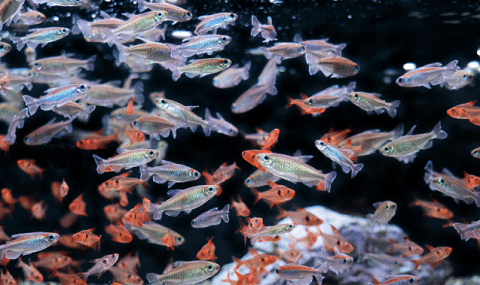
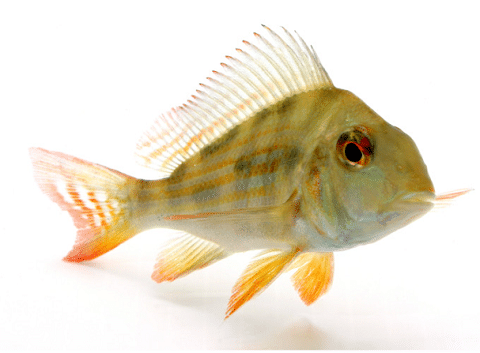
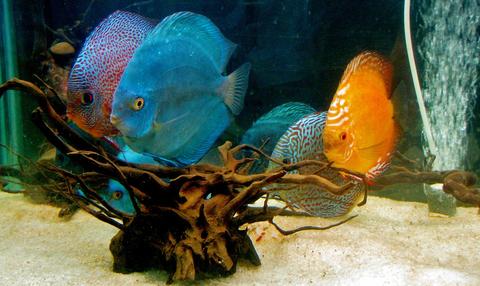
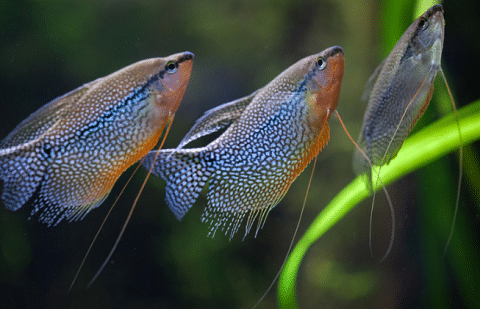 Pearl Gourami Fish” class=”wp-image-554652″/>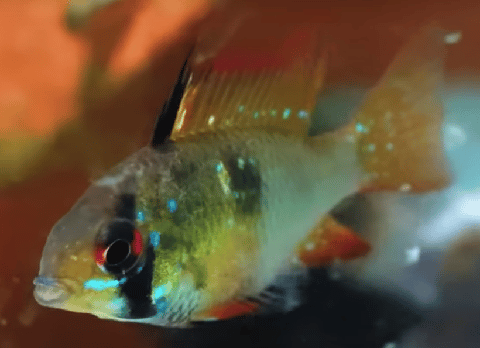

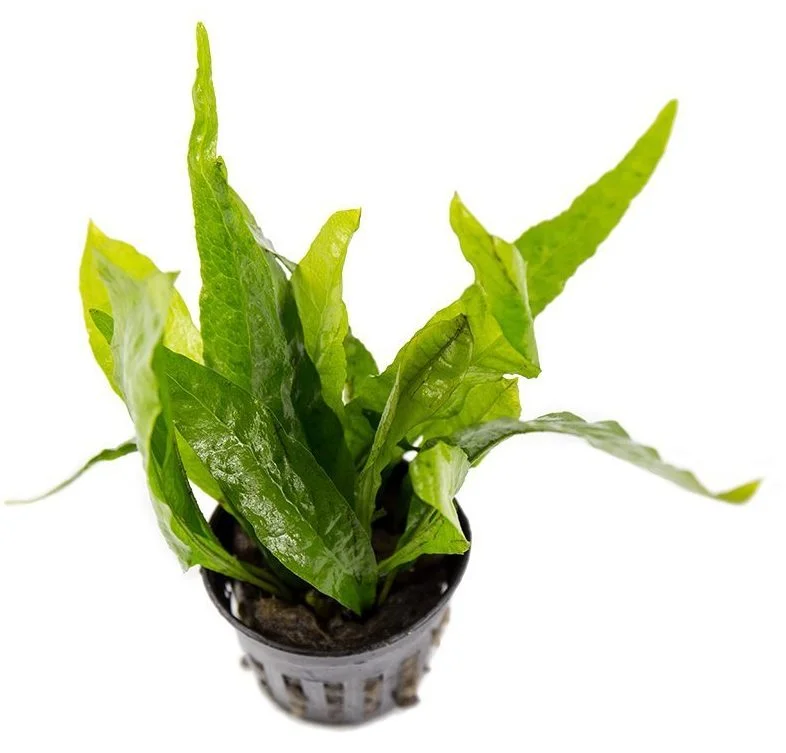
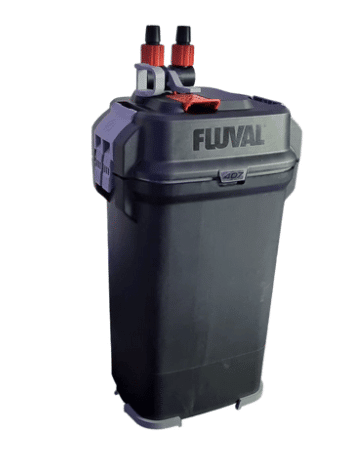
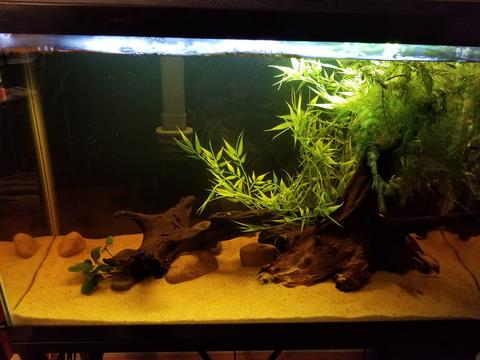


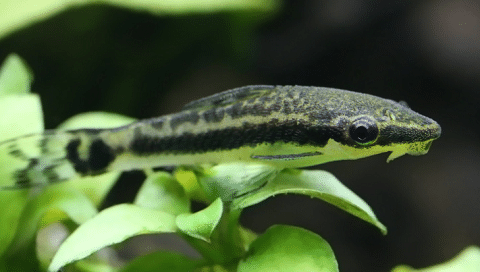
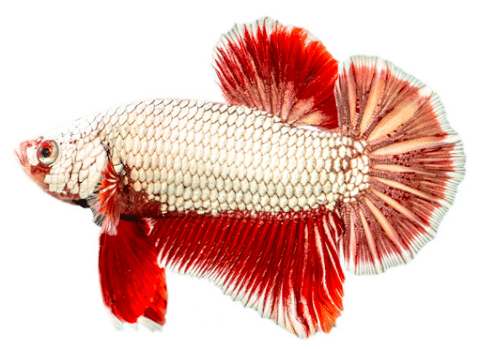
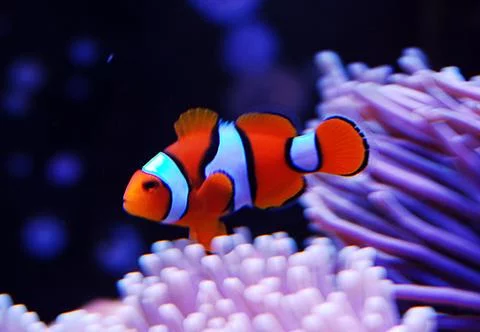



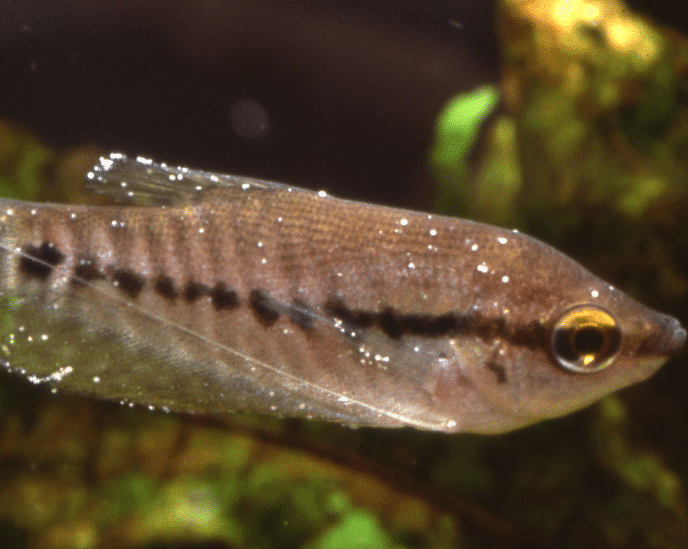
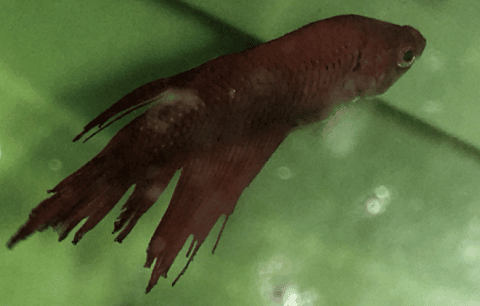



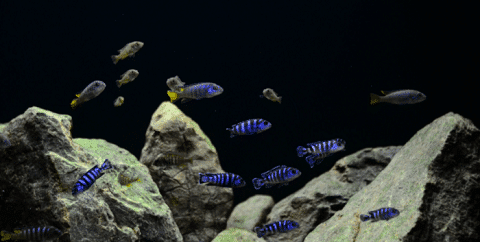

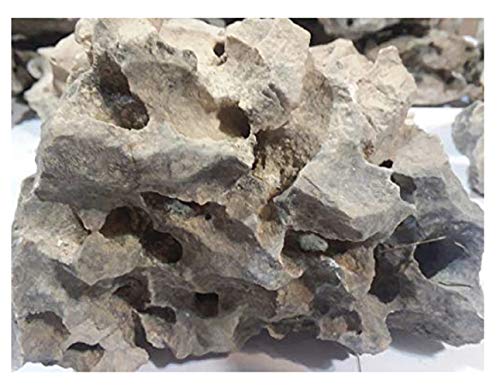
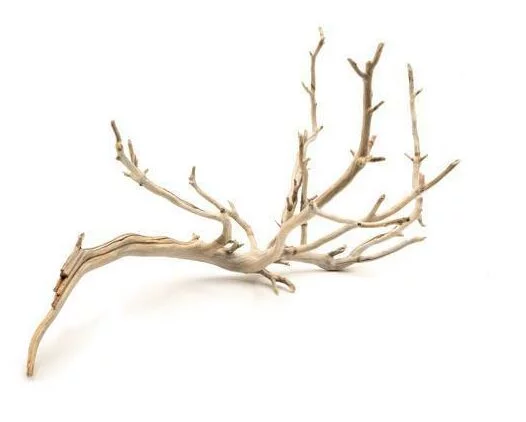
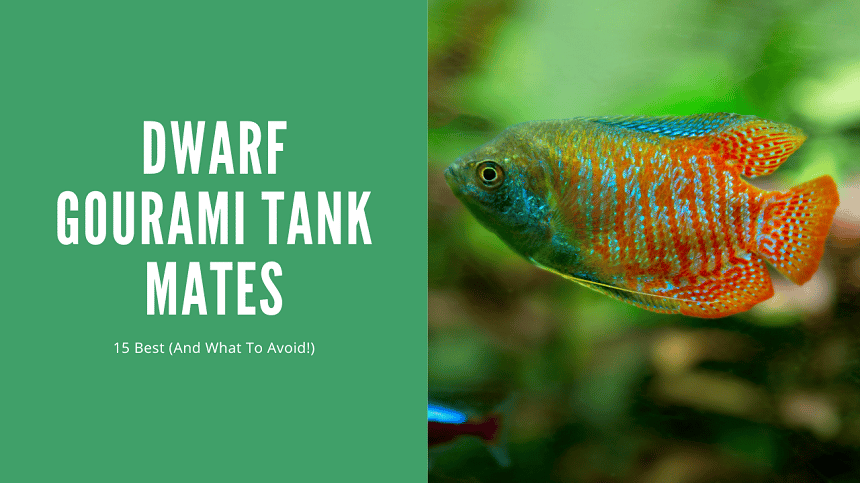
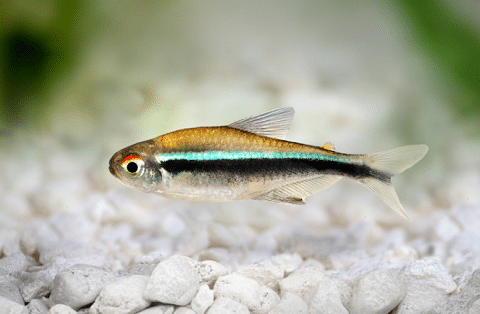
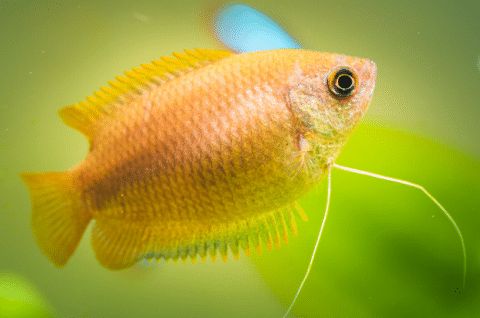
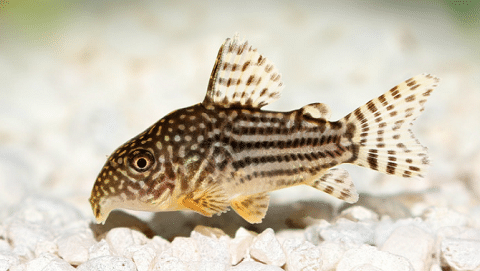
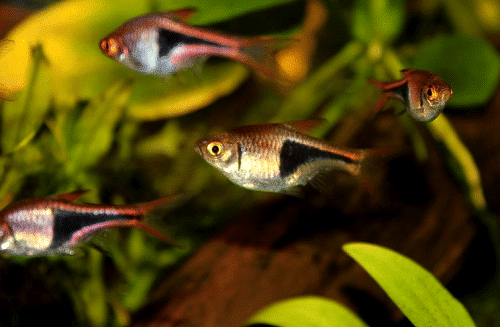
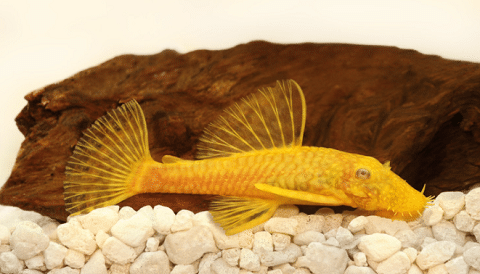
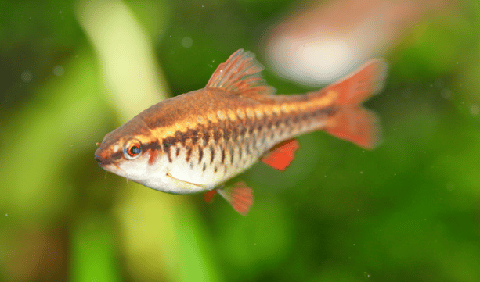
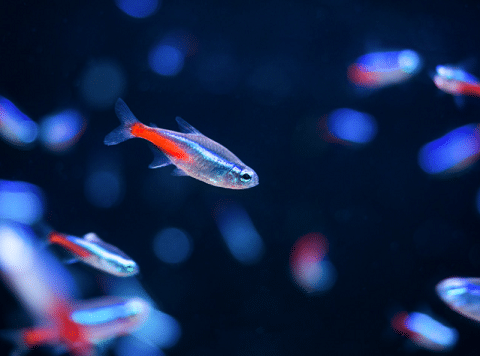
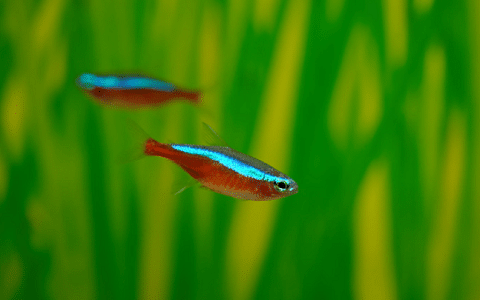
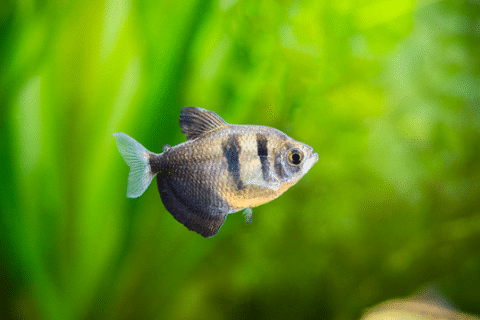
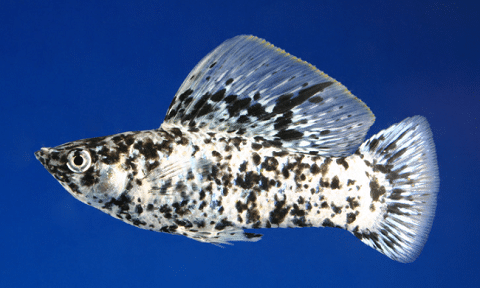
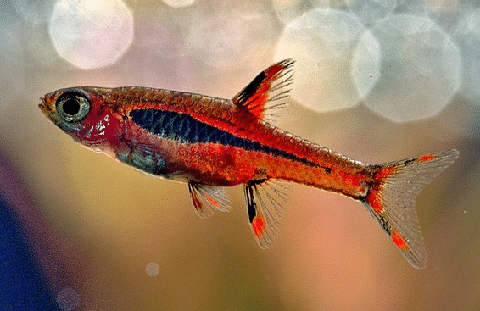
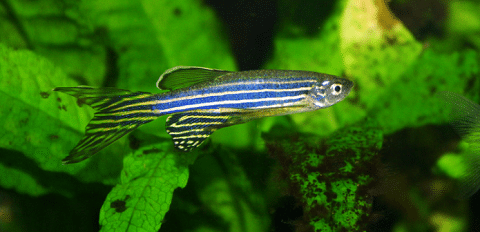
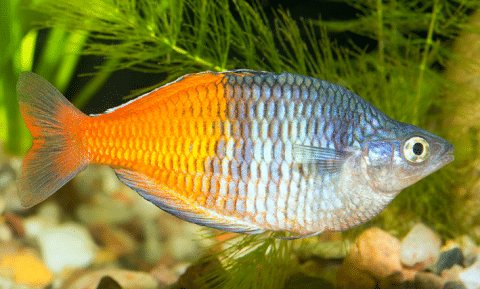

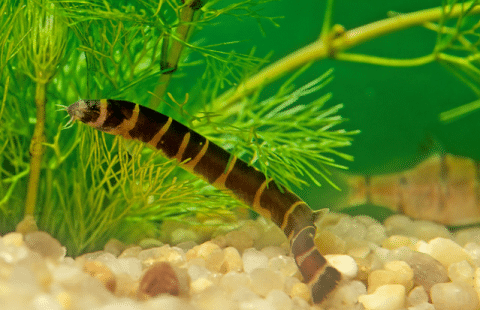


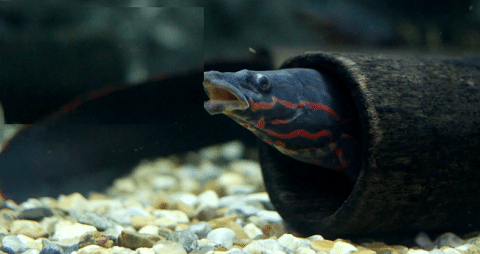


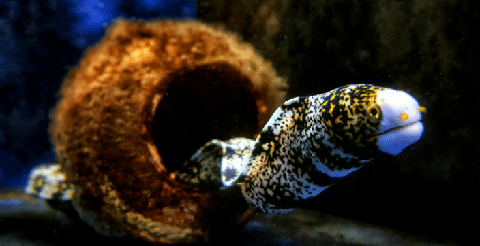
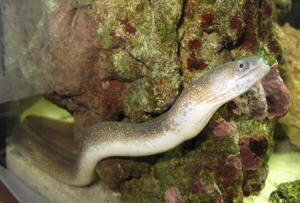
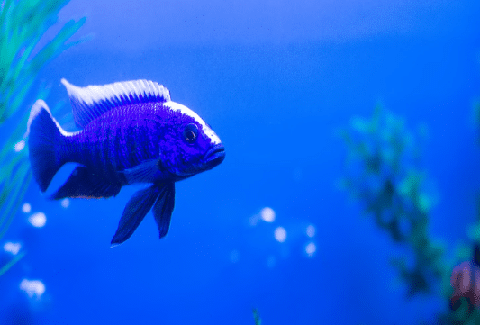
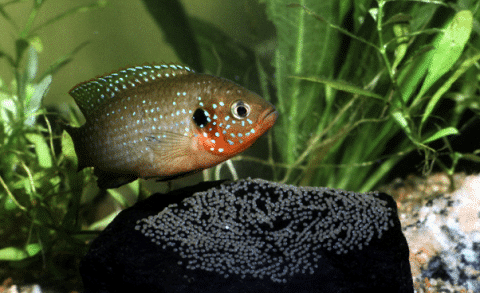
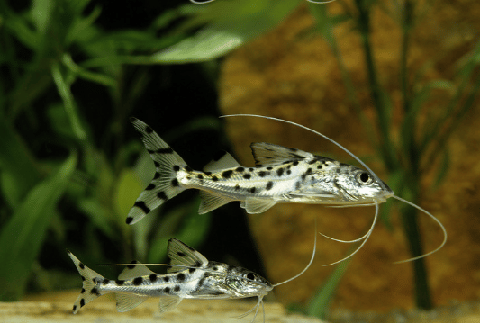
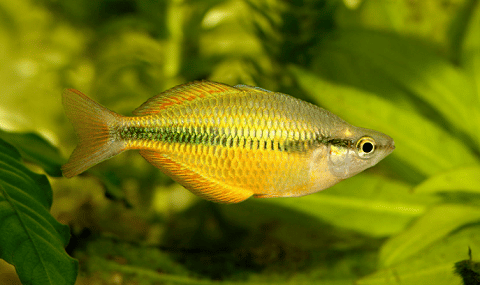
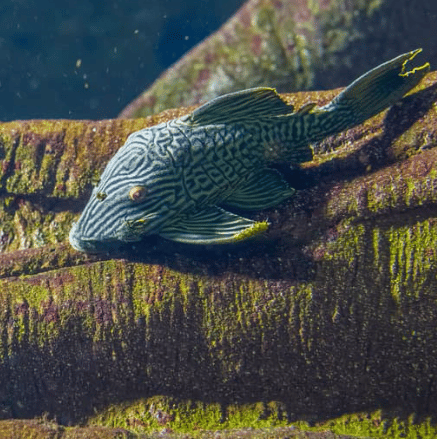
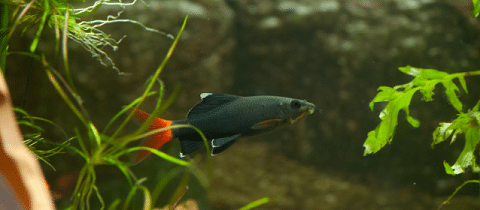
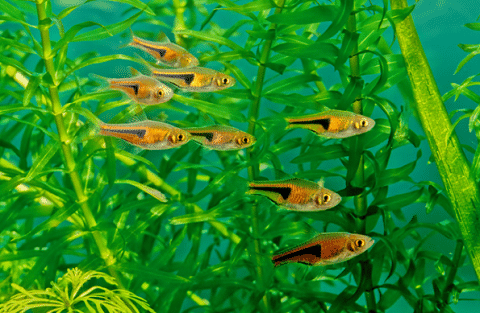

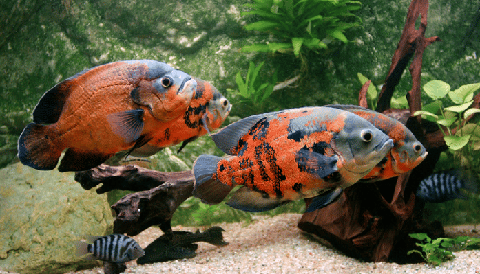
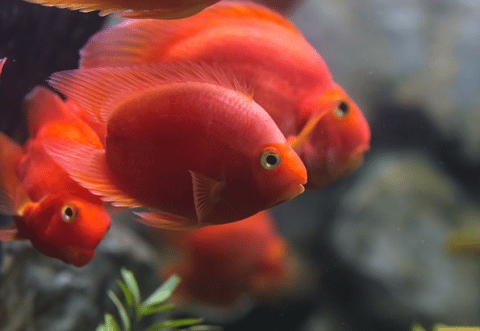
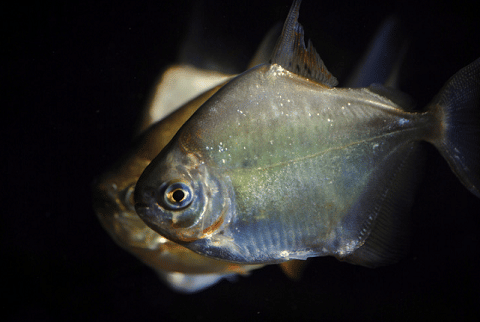
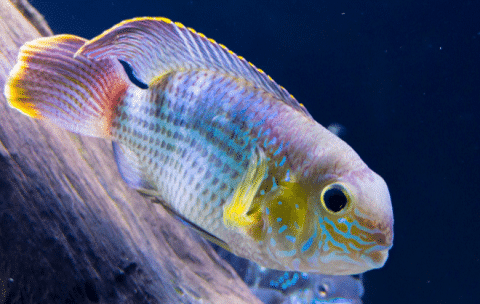
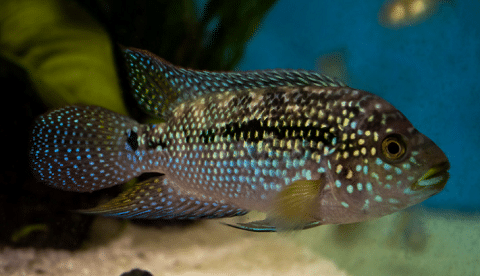 Jack Dempsey Fish” class=”wp-image-553072″/>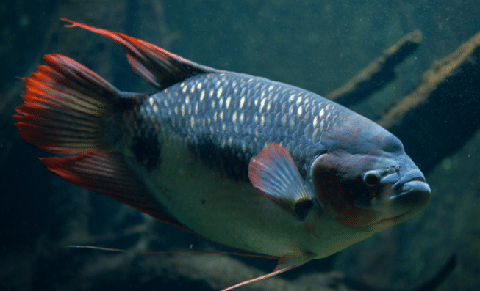
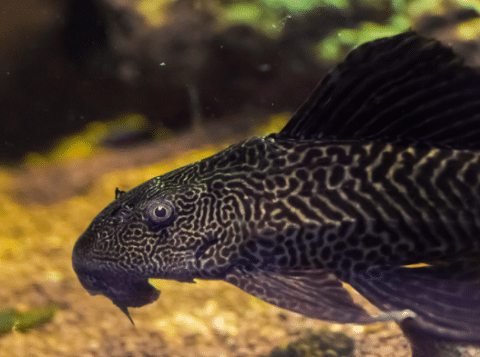
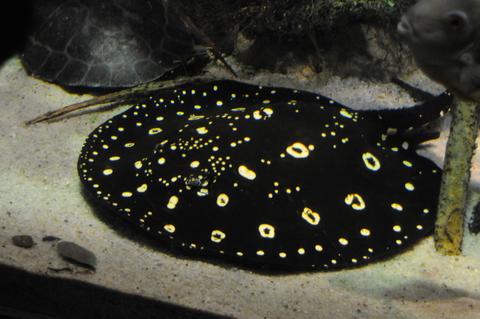

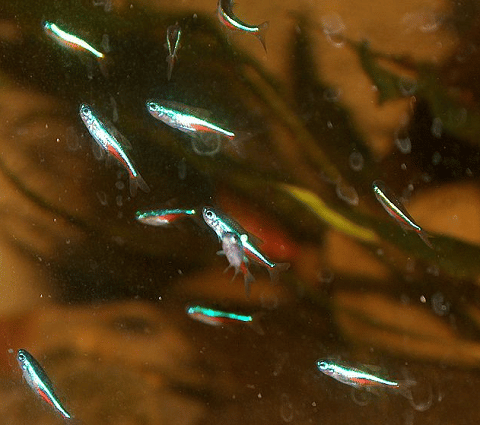 Green Neon Tetra School” class=”wp-image-1067276″/>