Tag: Fish Profiles

  • African Dwarf Frog: Complete Care Guide (Not the Same as African Clawed!)

    African Dwarf Frog: Complete Care Guide (Not the Same as African Clawed!)

    African Dwarf Frogs are terrible at finding food. They are nearly blind, slow, and get outcompeted by every fish in the tank. Targeted feeding with a turkey baster is not optional.

    African dwarf frogs in a community tank starve unless you hand-deliver food to their face. That is not an exaggeration.

    Table of Contents

    The Reality of Keeping African Dwarf Frog

    This species has specific needs most generic guides skip. The African Dwarf Frog does not thrive in average community conditions. It needs targeted water parameters, the right diet, and compatible tank mates. Half-measures lead to chronic stress and shortened lifespans.

    Observation is your best tool. Watch this fish daily. Changes in color, activity level, or feeding response tell you more about water quality and health than any test kit alone.

    Long-term success requires consistency. Regular maintenance, stable parameters, and a consistent feeding schedule are the foundation of keeping the African Dwarf Frog healthy for years.

    Biggest Mistake New Owners Make

    Treating this fish like a generic community species. The African Dwarf Frog has specific requirements that differ from the typical tropical fish setup. Ignoring those differences leads to problems within the first few months.

    Expert Take

    After 25 years of keeping African Dwarf Frog, the single most important factor is consistency. Stable parameters, regular feeding, and a maintenance schedule you actually follow matter more than any piece of equipment.

    The African Dwarf Frog is not a fish and should not be kept like one. This is a fully aquatic amphibian with completely different needs, sensitivities, and behaviors. I have kept them for years and the care mistakes I see are almost always the same ones.

    This is an amphibian, not a fish. That distinction matters for every care decision you make.

    Keeping African Dwarf Frog long-term requires consistent water quality, proper diet, and a tank that meets their specific needs. This is not a set-and-forget species.

    When kept right, the African Dwarf Frog is one of those fish that makes the entire hobby worth it.

    African Dwarf Frogs (Hymenochirus spp.) are one of the most entertaining animals you can add to a freshwater community tank. Fully aquatic, peaceful, and genuinely fascinating to watch. The single most important thing to get right before you buy: make sure you’re actually getting an African Dwarf Frog and not an African Clawed Frog. They look nearly identical as juveniles, but ACFs grow to 5 inches and will eat your fish. ADFs stay small and are safe with community tank mates. Here’s the full care guide.

    Key Takeaways

    • African Dwarf Frogs can live up to 10 years in aquariums
    • They need at least 10 gallons of aquarium space to thrive
    • They are peaceful that do best with schooling fish that take up the middle and top of the aquarium

    An Overview

    Scientific NameHymenochirus
    Common NamesDwarf Clawed Frog
    FamilyPipidae
    OriginEquatorial Regions, Africa
    DietOmnivore
    Care LevelIntermediate
    ActivityEnergetic
    Lifespan5 to 10 years
    TemperamentPeaceful
    Tank LevelBottom
    Minimum Tank Size10 gallons
    Temperature Range74 – 80 Fยฐ
    Water Hardness5 to 20 dGH
    pH Range6.5 to 7.8
    Filtration/Water FlowLow
    Water TypeFreshwater
    BreedingEgg Layer
    Difficulty to BreedEasy
    CompatibilityCommunity tanks
    OK, for Planted Tanks?Yes

    Classification

    OrderAnura
    FamilyPipidae
    GenusHymenochirus
    SpeciesH. Boettgeri (Tornier, 1896)

    What are they?

    African Dwarf Frogs are technically recognized as Hymenochirus. They are a part of the Pipidae family from the order Anura.

    Unlike other frogs that have a mixed interest in dry and watery lands, the African Dwarf Frog stay at the bottom water levels throughout its lifespan.

    African Dwarf Frogs make excellent community tanks. But failing to look after their dietary needs induces predatory behavior in them. And as a result, they munch on their tank mates to fill their stomachs.

    Origin and Habitat

    The African Dwarf Frogs are native to multiple African regions. Their natural territories are spread all over the continent of Africa. These include areas like Eswatini, Mozambique, Congo, and Cameron.

    In addition to these localities, they also appear in West Africa including Nigeria.

    The African Dwarf Frog was first sighted in the year 1896. Other species from the same group were discovered at minor intervals after these frogs were found.

    Ever since entering the pet trade, they have never failed to connect their owners to their fun-filled activities.

    Appearance

    African Dwarf frogs are one of the most popular aquatic frogs to date. They are curious and energetic. Their cuteness can influence your passion for getting them a few tank mates from their own species.
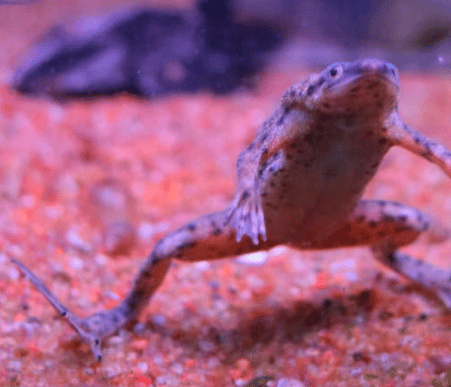
    How Does an African Dwarf Frog Look Like

    African Dwarf frogs don’t have a traditional appearance. In fact, if you compare them to other frogs, they stand out pretty well because of their appearance.

    They have flat, slender bodies with streamlines on them. This trait functions as a helping hand for trouble-free moving in waters. In the wild, African Dwarf frogs have to keep their pace intact with water currents that are closer to river beds. Their streamlined bodies help them do that.

    The African Dwarf frogs compose a middle shade of dark olive green and light brown. They can also feature gray, a darker mud-brown shade, and sometimes a subtle tan color. On the base of their bodies, they have deep black dots dispersed throughout their bodies.

    These spots help them mix in with the substrate, plants, and leaves to avoid predators in the wild. These frogs have a set of four legs that are slender with webbed feet. Because they don’t live on land, their webbed feet help them flit freely through the water.

    African Dwarf Frogs are devoid of sticky tongues and teeth, unlike other frog species. So to chase down any floating living thing, they use their small claw that sits on the tip of each toe.

    Aside from this function, the feet of the African Dwarf frog help it swallow the prey down its throat much more easily. They have smooth heads similar to their bodies with a prominent snout. You can see the pair of their eyes visible on the sides of their head like other frogs.

    Differentiating a male and a female is quite easy. Apart from other differences, the major distinguishing characteristic is the abdomen of the female. The females have an ovipositor used for laying eggs. The males have a pair of white-colored glands sitting behind their feet instead of the ovipositor.

    These glands give way to a subtle effect that makes the identification even easier. Another difference is their size. Females are larger than males with plump bodies and more projecting genital areas.

    While African Dwarf Frogs don’t have teeth, they also lack ears. And to steer through the water, they use their lateral line. The lateral line also functions as a detector of environmental changes. The African Dwarf frog doesn’t have gills to breathe under the water. They often travel to the water’s surface to breathe air using their lungs.

    Four Common Species

    Want an easy community fish? This is not it. Want a species that rewards dedicated care? The African Dwarf Frog delivers if you put in the work.

    It’s essential to mention that mistaking a different frog species for African Dwarf Frogs is common.

    African Dwarf Frogs are linked with the Hymenochirus genus. There are four species in the same genus having similar personalities and physical traits.

    The variations in their diet and water temperatures are also quite simple.

    1. Zaire Dwarf Clawed

    • Scientific Name: Hymenochirus boettgeri
    • Temperature Range: 75 Fยฐ to 80 Fยฐ
    • Lifespan: 15 to 20 years

    2. Gaboon Dwarf Clawed

    • Scientific Name: Hymenochirus feae
    • Temperature Range: 75 Fยฐ to 82 Fยฐ
    • Lifespan: 5 to 10 years

    3. Eastern Dwarf Clawed

    • Scientific Name: Hymenochirus boulengeri
    • Temperature Range: 75 Fยฐ to 82 Fยฐ
    • Lifespan: 8 years

    4. Western Dwarf Clawed

    • Scientific Name: Hymenochirus curtipes
    • Temperature Range: 75 Fยฐ to 80 Fยฐ
    • Lifespan: 10 years

    , the African Clawed Frog (video source) is sold under the name of African Dwarf Frogs. While there’s nothing wrong with the former frog species, their size and temperament are very problematic.

    The average size of an African Clawed frog is 5 inches. They can stretch themselves up to even more in length in the wild. Aside from the difference in size, there are some other notable features that African Dwarf Frogs have but African Clawed Frogs don’t.

    The African Dwarf Frog has four webbed feet while the other species don’t. They also have a pointed snout, unlike African Clawed Frogs that have curved but smooth snouts. You will notice the different locations of their eyes. Your intended frog species have eyes sitting on the sides of their heads. But the larger species have eyes on the top of their heads.

    Lifespan

    The average life cycle of the African Dwarf frog is 5 years. But species like Zaire Dwarf Clawed Frog can live as long as 20 years in captivity.

    African Dwarf Frogs are pretty resilient. And this makes them ideal to house in aquariums even if you’re just starting out as an aquarist. But like other freshwater species, they also go through common diseases. And if you want to improve their longevity, you need to properly look after them.

    Average Size

    African Dwarf Frogs don’t grow above 3 inches. Even in the wild, this is the typical size they can hit.

    A female African Dwarf Frog, however, is slightly bigger than the male African Dwarf Frog. They look even bigger during the breeding season.

    Care

    Before starting off with the idea of purchasing African Dwarf Frogs, understanding their behavior and natural scaling system of growth is essential.

    The apparently easy-going frogs will do things contrary to their typical practices.

    The African Dwarf Frog has a good tolerance for its tank mates. But if the dwarf frogs are starving, they can eat the undersized fish easily. A proper tank setup can improve the life quality of your African Dwarf Frog. As in their natural habitat, their association is always with warmer temperatures, you should construct their tanks with that in mind.

    Aquarium Setup

    African Dwarf Frogs spend their time inhabiting shallow water levels with still to moderate water currents.

    And while they pay great attention to exploring their accommodation, they still chatter about what’s missing in their tank. These frogs don’t live on land. In their natural habitat, water areas with warm temperatures and plenty of hiding spaces help them stay happy.

    They don’t have gills. So to breathe air, they regularly travel up to the surface of the water. This can last for as long as they want. Since they prefer moisture in their environment, you’ve to replicate that condition in their aquarium.

    Although African Dwarf Frogs are completely aquatic, they can jump out of the tank at any moment. You need to secure the surface of the tank with a tight lid to control their potential sudden movements.

    Tank Size

    The minimum African Dwarf Frog Tank should be at least 5 gallons. It’s better to bump that number up to a 10 gallon tank in order to give them enough space to freely move.

    If there are other fish with these fully aquatic frogs, get them a larger tank.

    For example, you should have a 20-gallon tank for 5-6 frogs. And fish species with higher demands will influence the number, too.

    Water Parameters

    Their preferred water temperature is 74ยฐ F to 80ยฐ F, with water hardness around 6.5 to 7.8.

    They live in slightly acidic water and can tolerate water hardness ranging from 5 to 20 KH.

    These frogs can put up with warmer temperatures. The reason is inhabiting areas that are sometimes at their hottest during the year.

    Filtration and Aeration

    African Frogs have sensitive skin. Like oxygen, they can absorb toxins like ammonia and nitrate through their skin which eventually ends their life.

    So no matter what species from their genus you go for, proper water filtration is equally important as other care measurements., African Dwarf Frogs like water areas that contain natural minerals. So, using tap water will be extremely toxic for them.

    Before thereโ€™s an outbreak of ammonia and nitrate levels, get a power filter or a canister filter for proper filtration.

    Editor’s Choice
    Hagen AquaClear

    The Best Aquarium Power Filter

    The worlds best selling and most reliable power filter on the market. Unchanged for years because it’s so reliable and versatile

    Buy On Amazon Click For Best Price

    Also, occasional water changes up to 30% are great for further water cleanness.

    Make sure any filtration system that you use doesnโ€™t disturb water currents.

    Pro Tip: Donโ€™t leave your pet without water for more than 15 minutes. Because exceeded time can cause severe dehydration or even death. These frogs are 100% aquatic and should be out of water!

    Lighting

    You don’t have to use bright lighting for the African Dwarf Frog Aquarium. Mild exposure to Natural sunlight or standard aquarium lights is more than enough.

    These frogs love to hide in any manufactured caves that you introduce to their tanks. And if there’s none, they will hide behind plants and rocks to feel at ease.

    Aquatic Plants and Decorations

    As far as decoration goes, the African Dwarf Frog is good to go with pretty much everything you put in the tank.

    Most frogs from their species act shy. And to feel good, they resort to hideaways. To give them that secure environment, you can use manufactured caves, clay-pot caves, or stones for creating ideal hideouts. You can also go for smooth rocks as hiding spaces.

    There’s nothing wrong with using plastic plants. But live plants are always better for boosting oxygenation within the tank. The frogs need to regulate their breathing cycles. Live plants help with that.

    Some great choices is live plants like:

    Pro Tip: Make sure the plants are not hindering their free movement. Especially, when they go up to the surface of the water for breathing. African dwarf frogs while needing to live completely in water, do need to go to the surface to breath oxygen as they have lungs instead of gills.

    Also, avoid using decor items with rough edges. While swimming, African Dwarf Frogs can hurt their frail skin if they bump into rocks.

    Tank Maintenance

    As far as tank maintenance goes, the procedure is pretty simple.

    Apart from cleaning tank water using a strong filtration system, you have to clean the tank, decorations, and plants as well.

    Pro Tip: Never use any liquid or a bar of soap that contains chemicals. These frogs can sense the presence of chemicals and can absorb them through their skin. And if they do so, they can get seriously sick!

    Substrate

    They live at the bottom of the tank. Hence, substrate holds intrinsic value to their overall physical fitness.

    Choosing the color of the substrate is entirely up to you. But make sure the grains are not too small for your pet to consume. If you use larger grains, that too can host problems for the pet.

    So, layer the base of the tank using the sandy substrate. Fine aquarium gravel is another great option for layering the foot of the tank.

    Add rocks, caves, and live plants throughout the tank as well.

    Community Tank Mates

    They do well with a number of peaceful community fish species. Though they can attack small fish if hungry, any aggressive fish can do the exact same to them.

    , the behavior African Dwarf Frogs display is friendly and encouraging. However, under certain situations, they can act hostile to non-aggressive fish or fish that are smaller than them.

    To avoid their predatory conduct or getting attacked by other fish, here’s a list of some of the ideal tank mates you can select for your pet.

    1. Congo Tetras
    2. Swordtails
    3. Mollies
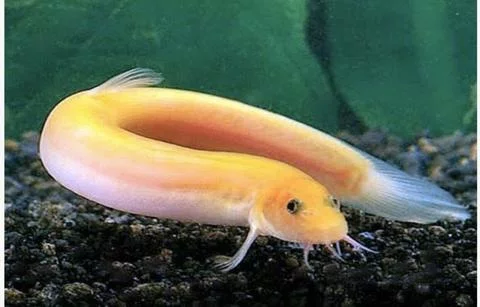
    4. Kuhli Loaches
    5. Giant Danios
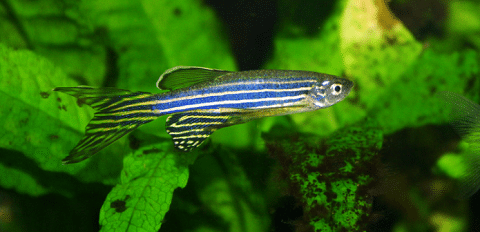
    6. Zebra Danios
    7. Black Skirt Tetras
    8. Rummy Nose Tetras
    9. Guppies
    10. Platys
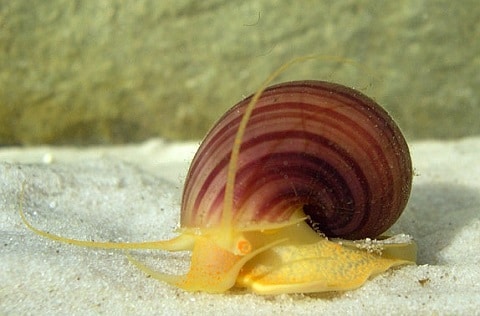
    11. Rabbit Snails
    12. Nerite Snails
    13. Gabon Shrimp
    14. Cory Catfish
    15. Betta Fish

    Poor Tank Mates

    Any aggressive fish or frog will be a poor choice to group up with your pet. Or, if the fish is too small and with poor defensive skills, your African frog can make them their next meal.

    1. African Clawed Frogs
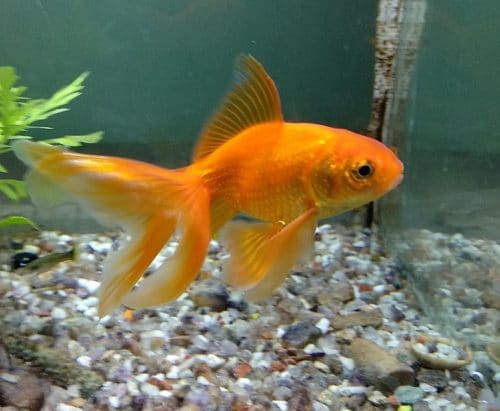
    2. Goldfish
    3. Shrimp

    Breeding

    These amphibians are easy to breed as long as you know your way around carrying out the procedure.

    To successfully condition these frogs for breeding, create a separate breeding tank. It’s always better to guide the intended pair to the tank, excluding them from the other African Dwarf Frogs until the breeding process lasts.

    Over a course of three weeks, you have to keep water levels 3 inches deep. With that, start gradually raising the temperature up to 85ยฐ F degrees. Here is a quick video from IHTW Reptiles/Amphibians that has some additional tips.

    While they can breed on their own, you’ve to stimulate a proper breeding season for them that resembles the season of their native towns.

    Apart from the above, include protein-based foods on their menu to further increase the chances of successful breeding. You can feed them brine shrimp, bloodworms, mosquito larvae, and insect larvae.

    Also, make sure the frequency of feeding goes up for at least a couple of weeks. While you’re busy feeding them excessive amounts of food, don’t let the food scraps get piled up in the aquarium. Because neglect of cleaning the tank can raise nitrate levels.

    The best way to know whether they’ve begun breeding is by looking at the size of females. The female frogs will appear larger because of the eggs. Within a span of two to three weeks, she will get swollen with eggs.

    And once she is filled with eggs, the male will attract her attention by singing. He will then cover the lower half of her body with his before they travel up to the surface.

    During swimming, the female will produce eggs in the water which the male will fertilize. He releases sperm into the water by traveling behind her.

    After this, separate the pair from the fry. Within 3-5 days, all the eggs will hatch. The female can lay almost 1000 eggs in a single spawning. And that means you should prepare yourself for raising that many tadpoles.

    The tadpoles will stay at the water surface for another set of 5 days until there’s no yolk sac.

    But before you start feeding tadpoles brine shrimp, stick to infusoria for as long as it takes them to grow legs and hit the froglet stage. The juvenile frogs will take almost a month to develop into adults. They will get fully mature within 2 months.

    And as I mentioned earlier, raising the eggs is pretty demanding. If you see the eggs sinking to the bottom, know that they won’t hatch and therefore should be removed from the tank. The eggs are sticky. As a result, you need to place a glass jar in the tank to collect them.

    Unlike the parents, you need to lower the temperature of the water up to 80ยฐ F for the eggs to flourish. Similar to adult frogs, the fry also needs a clean water aquarium to stay healthy and upbeat. Because poor water quality is way more dangerous in their case than it is for adult frogs.

    Food and Diet

    If fed properly, your pet will never attack any smaller fish to fill their stomachs.

    But there’s one problem. These frogs will give you a tough time with eating anything. Before they actually start consuming the food down their throats, you have to train them.

    It includes placing their food at the bottom until they get familiar with the spot. Aside from this, you’ve to set a proper feeding routine to feed them daily. This will get them used to both the routine and the spot, making it easier for you to feed and for them to eat.

    They’re omnivores and can eat plant materials and algae. But for optimal nourishment, foods like brine shrimp, frozen brine shrimp, bloodworms, and insect larvae are recommended. You can also add fish fry and earthworms to their core diet. Some other great choices is daphnia, moina, and mysis shrimp. Like other species, they also appreciate variations in their regular diets.

    For that, you can go for tuna, salmon, and beef heart to make them happy. They are fond of fatty foods so make sure you don’t overfeed them. To monitor their fitness, feed them only once a day. But their diet should include high-quality foods as mentioned above to keep them healthy and active.

    Common Health Problems

    Want an easy community fish? This is not it. Want a species that rewards dedicated care? The African Dwarf Frog delivers if you put in the work.

    Their skin is extremely sensitive to bacterial infections.

    If you touch them with bare hands or neglect weeding out toxins from their tank, your frog will end up developing different health issues.

    While they are not too resilient, treating them is easy. But only if you know the cause of their disease. They are also susceptible to fungal infections and some other common ailments.

    1. Fungal Infection

    Contaminated water is the core reason your frog will catch this infection. If you fail to detect the presence of ammonia and nitrate levels within the tank, things can get pretty serious.

    Here are some common symptoms your pet might show:

    1. Excessive skin shedding
    2. Reddening of the skin
    3. Seizures
    4. Patches on skin

    2. Dropsy

    This is another common disease among frogs. It occurs as a result of some bacterial infection or poor food management.

    Here are some common symptoms:

    1. Severe bloating
    2. Lethargy
    3. Unusual behavior

    Handling African dwarf frogs while they are infected is not that easy. They can easily spread diseases to other frogs, as well as humans. If you notice any symptoms in them, seek veterinary help immediately. Antibiotics can help them get rid of these ailments. But make sure to isolate the infected frog from the rest of their community.

    Author's Note: African Dwarf Frogs shed skin at least once in a while. Before they do that, their skin will look whitish. These frogs shed skin while growing. So, it's perfectly normal behavior among them.

    FAQs

    Are they easy to take care of?

    They are pretty easy to manage. Their friendly disposition and ability to withstand slight water changes are some of their best qualities. But if your frog is infected, you will have a tough time managing them as a beginner.

    How many should be kept together?

    You can keep 4-5 frogs together. They appreciate social gatherings and therefore keeping African Dwarf Frogs in groups is easier than you think. As their size is small, you might want to increase the number. But doing this can result in overcrowding the tank and strong interruption in their day-to-day practices.

    Do they need land?

    They have webbed feet that can’t sustain their movements on land. They are designed like this because they stay in watery areas almost all their lives. In fact, if you put them outside water for more than 10-15 minutes, they can get seriously dehydrated that eventually leading them to their death.

    What do they eat?

    They can eat algae off the plants and other plant materials you give them. In the wild, they attack floating living things and eat worms to stay healthy. In your aquarium, you can give them brine shrimp and foods that are rich in protein.

    How do I know if my croaker is happy?

    If they display active physical traits, bright body coloration, and speed in eating food, know that your pet is completely fine and happy with you.

    Do they like being held?

    Their sensitive skin doesn’t allow them to get in direct contact with humans. But since they’re social and friendly, you can play with them by taking precautions.

    How big do they get?

    They can grow a maximum size of 3 inches. It is necessary to feed them healthy foods for proper growth in your aquarium.

    Can they live in a tank with a filter?

    They certainly can live with a filter that doesn’t disturb water currents. In fact, a strong filtration water system is extremely essential for water cleanness and overall fitness.

    Closing Thoughts

    African Dwarf Frogs are one of the most popular amphibians kept in captivity, and for good reason. Theyโ€™re cute, active, and easy to care for. However, as with any new pet, there is a bit of research that should be done before adding them to your tank. In this article, weโ€™ve tried to cover all the basics so you can make an informed decision about whether or not ADFs would be a good fit for your aquarium. Have you kept African Dwarf Frogs before? Let us know in the comments! Weโ€™d love to hear about your experiences.
  • Tiger Barb Care Guide: The Truth About Keeping These “Bullies”

    Tiger Barb Care Guide: The Truth About Keeping These “Bullies”

    Table of Contents

    Tiger barbs are one of the most misunderstood fish in the hobby. They are not aggressive by nature. But put them in the wrong setup and they will absolutely terrorize your tank. Fin nipping, chasing, relentless harassment of slow moving fish. I have seen people blame the fish when the real problem was keeping four of them in a 10 gallon with an angelfish. That is not a tiger barb problem. That is a stocking problem.

    Tiger barbs do not create chaos. They expose bad stocking decisions.

    Why Tiger Barbs Get a Bad Reputation

    The tiger barb reputation problem comes down to three mistakes that people keep making over and over again.

    Mistake #1: Keeping them in small groups. Four tiger barbs is not a school. It is a gang. When there are not enough fish to spread the pecking order across, the aggression concentrates on whoever is weakest. That might be another barb, or it might be your angelfish. You need eight at minimum. Not six. Eight. Six is the commonly cited number, but eight is where the behavior truly stabilizes and the group starts acting like a school instead of a hit squad.

    Mistake #2: Picking the wrong tank mates. Slow moving fish with long, flowing fins are targets. Period. Bettas, angelfish, fancy guppies. These fish trigger the nipping instinct in tiger barbs the same way a dangling string triggers a cat. It is not personal. It is hardwired. If you stock tiger barbs with the wrong fish, you will see fin damage. That is not the tiger barb being a bully. That is you making a bad stocking decision.

    Mistake #3: Tiny tanks. A 10 gallon tank is not big enough for tiger barbs. A 20 gallon is the absolute bare minimum for a small group, and 30 gallons is where things start working properly. Tiger barbs never stop moving. They need room to swim, chase, spar, and establish territory. Cram them into a small tank and all that energy turns destructive.

    The Reality of Keeping Tiger Barbs

    Tiger barbs are not a fish you set up and forget about. They are always doing something. Always moving, always chasing, always jockeying for position. The pecking order is constant. You will see sparring, flaring, and lip locking every single day. This is normal. This is what healthy tiger barb behavior looks like.

    They eat like machines. Feeding time is a full contact sport. Every barb rushes the surface the second food hits the water, and the dominant fish eat first. If you have slower tank mates, you need a feeding strategy or they will go hungry.

    Biggest Mistake New Tiger Barb Owners Make

    Buying four tiger barbs for a 10 gallon tank with an angelfish. It happens constantly. The barbs shred the angelfish fins within days. The owner blames the barbs. The barbs get returned or rehomed. But the fish was never the problem. The stocking was the problem. Four barbs is not enough to form a stable hierarchy. A 10 gallon is not enough space. And an angelfish is the single worst tank mate you could pick. Every part of that setup is wrong, and the tiger barb gets blamed for all of it.

    Expert Take

    Never keep tiger barbs in groups smaller than eight. Six is the commonly cited minimum but in my experience, eight is where the behavior truly stabilizes. Below that number, the pecking order never settles and the aggression spills over onto tank mates. Eight fish, 30 gallons, appropriate tank mates. That is the formula.

    Key Takeaways

    • Keep in groups of at least 6, ideally 8 or more. Small groups lead to stressed, aggressive barbs that take out their frustration on tank mates
    • Not suitable for tanks with slow, long-finned fish like bettas, angelfish, or fancy guppies. They will nip those trailing fins relentlessly
    • Need a 20-gallon minimum with plenty of horizontal swimming space. Active fish need room to roam
    • Multiple color variants available including the standard striped form, green (moss) tiger barbs, albino tiger barbs, and GloFish varieties
    • Hardy and easy to feed, accepting flakes, pellets, frozen, and live foods readily
    • Easy to breed in home aquariums, but adults will eat their own eggs if not separated immediately after spawning

    Species Summary

    FieldDetails
    Scientific NamePuntigrus tetrazona (Bleeker, 1855)
    Former NamesPuntius tetrazona, Barbus tetrazona, Capoeta tetrazona, Systomus tetrazona
    Common NamesTiger Barb, Sumatra Barb, Partbelt Barb
    FamilyCyprinidae (subfamily Smiliogastrinae)
    OriginSumatra, Indonesia (Borneo populations now recognized as separate species)
    Care LevelEasy
    TemperamentSemi-aggressive (fin nipper in small groups)
    DietOmnivore
    Tank LevelMiddle
    Maximum Size2.75 inches (7 cm)
    Minimum Tank Size20 gallons (76 liters)
    Temperature68 to 79ยฐF (20 to 26ยฐC)
    pH6.0 to 8.0
    Hardness5 to 19 dGH
    Lifespan5 to 7 years
    BreedingEgg scatterer
    Breeding DifficultyEasy
    CompatibilityCommunity (with appropriate tank mates)
    OK for Planted Tanks?Yes

    Classification

    KingdomAnimalia
    PhylumChordata
    ClassActinopterygii
    OrderCypriniformes
    FamilyCyprinidae
    GenusPuntigrus
    SpeciesP. tetrazona (Bleeker, 1855)

    You will see this fish listed under several different scientific names depending on where you look. Older references use Puntius tetrazona, Barbus tetrazona, or Capoeta tetrazona. The currently accepted name is Puntigrus tetrazona, following Kottelat’s 2013 revision that split several barb species into the new genus Puntigrus. The genus name combines “Puntius” and “tigrus,” which is a nod to the tiger-like banding pattern these fish are famous for.

    Origin & Natural Habitat

    Tiger barbs are native to the island of Sumatra in Indonesia, where they inhabit shallow, slow-moving rivers and streams. Their habitat ranges across several river systems in Riau, Jambi, and South Sumatra provinces, including the Indragiri, Batang Hari, and Musi basins. For years, populations in Borneo were also classified as P. tetrazona, but recent taxonomic work has shown that those Bornean fish actually represent separate species within the Puntigrus genus, including P. anchisporus, P. navjotsodhii, and P. pulcher.

    In the wild, tiger barbs are found in densely vegetated waters with sandy or muddy substrates. Their natural environment typically features plenty of submerged roots, fallen branches, and leaf litter that provide both cover and foraging opportunities. The water is soft and slightly acidic, though tiger barbs have proven remarkably adaptable to a wide range of conditions in captivity.

    It is worth noting that virtually all tiger barbs available in the aquarium trade today are commercially bred, not wild-caught. Breeding facilities across Southeast Asia, Eastern Europe, and other regions produce these fish in massive numbers. While this makes them affordable and widely available, it has also led to some concerns about inbreeding and the overall genetic health of captive populations.

    Appearance & Size

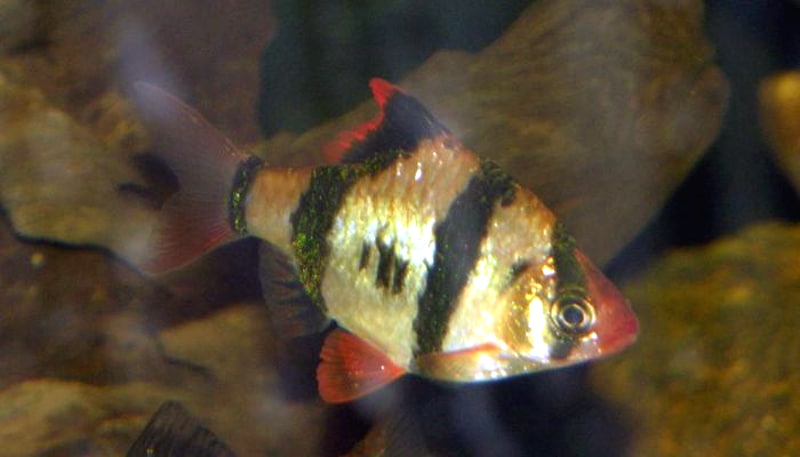
    The standard tiger barb is an immediately recognizable fish. The body is deep and laterally compressed, with a golden-yellow to orange base color crossed by four bold, vertical black bars. The first bar runs through the eye, the second sits just behind the pectoral fin, the third spans the middle of the body, and the fourth sits at the base of the tail. The snout and fins display a vibrant red-orange coloring, which intensifies in well-kept specimens and becomes especially vivid in dominant males during spawning.

    Adult tiger barbs typically reach about 2.5 to 2.75 inches (6 to 7 cm) in total length, though most aquarium specimens stay closer to 2 inches (5 cm). They are a compact, muscular fish built for speed and constant movement.

    Male vs. Female

    Sexing tiger barbs is straightforward once they mature. Males are slimmer, more intensely colored, and develop a noticeably red snout and fin edges. They also are slightly smaller. Females are rounder-bodied (especially when carrying eggs), slightly larger overall, and have less vivid coloration. When a female is ready to spawn, her belly becomes visibly swollen.

    Color Variants

    Decades of selective breeding have produced several popular color morphs. All of these are the same species with identical care requirements, and they can all be kept together in the same school.

    Green Tiger Barb (Moss Barb): One of the most striking variants, the green tiger barb has a heavily melanistic body that appears deep green to almost black, depending on the lighting and the individual fish. The green sheen is caused by the Tyndall effect, where light scatters off the dense dark pigmentation. These vary quite a bit in how green they look. Some appear almost solid black, while others show a beautiful emerald sheen. They carry the same body shape and barring pattern as standard tiger barbs, but the bars are often obscured by the darker overall coloration.

    Albino Tiger Barb: Albino tiger barbs lack the dark melanin pigmentation of the standard form. Their body is a pale cream to light yellow, with the characteristic bars appearing as faint white or cream bands rather than black. Their eyes are red, which is the hallmark of true albinism in fish. The orange-red fin coloring is still present and often stands out even more against the lighter body. These are slightly less common than standard tiger barbs but readily available in most fish stores.

    GloFish Tiger Barbs: GloFish tiger barbs are genetically modified to express fluorescent proteins, giving them vivid neon colors that glow under blue or UV lighting. They are currently available in four colors: Starfire Red, Sunburst Orange, Electric Green, and Galactic Purple. Both short-fin and long-fin varieties are sold. These are not painted or dyed; the fluorescent genes are inherited from their parents, so the color is permanent and present from birth. Care requirements are identical to standard tiger barbs, though GloFish recommends slightly warmer temperatures of 76 to 80ยฐF (24 to 27ยฐC). One important note: short-fin GloFish barbs should not be kept with long-fin varieties, since the long-finned fish become targets for fin nipping.

    Behavior & Temperament

    This is the section that matters most if you are considering tiger barbs. Their behavior is what makes them both exciting and potentially problematic, and understanding it is the difference between a great tank and a disaster.

    Tiger barbs are active, social, and hierarchical. In a properly sized group, they spend much of their time chasing each other, sparring for dominance, and establishing a pecking order within the school. This is completely normal behavior. You will see them dart at each other, flare, circle, and occasionally lock lips. As long as no one is getting seriously injured (which is rare in a well-managed group), this is just how tiger barbs communicate.

    The problems start when people keep too few of them. A lone tiger barb or a group of just two or three will redirect all that social energy outward, targeting other fish in the tank. This is where the infamous fin-nipping reputation comes from. A tiger barb that does not have enough of its own kind to interact with will chase, harass, and nip the fins of slower tank mates relentlessly. Tiger barbs have a lot of social energy that needs somewhere to go. Deny them that outlet and they redirect it at whatever fish is closest.

    The minimum group size is six, but eight to twelve is better. In larger groups, the aggression spreads out across many individuals, and the pecking order stays more stable. You will notice that a group of twelve tiger barbs is actually less aggressive toward other tank mates than a group of four. It works because they are so busy keeping each other in check that they mostly leave everyone else alone.

    Even in an ideal group, tiger barbs are fast, curious fish that will investigate everything in the tank. They will sample plant leaves, pick at decorations, and zoom up to inspect any new addition. They occupy the middle water column for the most part but will venture to all levels of the tank throughout the day. If you want a calm, peaceful display, tiger barbs are not the right choice. If you want action, personality, and a tank that is never boring, these are your fish.

    Tank Requirements

    Tank Size

    A 20-gallon tank is the minimum for a group of six tiger barbs, and a 20-gallon long is preferable to a standard 20-gallon tall because it provides more horizontal swimming space. These fish are fast and active; they need room to cruise and chase. If you plan to keep a larger group of eight to twelve (which is recommended), or if you want to add other species to the mix, aim for 30 gallons or more. A 55-gallon tank works beautifully for a large tiger barb community.

    A tight-fitting lid is also a must. Tiger barbs are capable jumpers, especially during feeding frenzies or when startled.

    Water Parameters

    ParameterRecommended Range
    Temperature68 to 79ยฐF (20 to 26ยฐC)
    pH6.0 to 8.0
    General Hardness (GH)4 to 10 dGH
    Carbonate Hardness (KH)5 to 19 dKH
    Ammonia / Nitrite0 ppm
    NitrateBelow 20 ppm

    Tiger barbs are tolerant of a fairly wide range of water conditions, which is one of the reasons they have remained so popular for so long. They do best in slightly soft, acidic water in the mid-70sยฐF, but they will adapt to most municipal tap water without issues. Consistency matters more than hitting an exact number. Avoid large swings in temperature or pH, and keep up with regular water changes of 20 to 25% weekly.

    Filtration & Water Flow

    A standard hang-on-back filter or canister filter rated for your tank size works well. Tiger barbs appreciate moderate water flow, which mimics the gentle currents of their native rivers. They are strong swimmers, so you do not need to worry about them getting pushed around by normal filtration output. Good mechanical and biological filtration is important since tiger barbs are messy eaters and produce a fair amount of waste for their size.

    Plants & Decorations

    Planted tanks work great for tiger barbs. They will not destroy your plants the way some larger barbs might. Use taller plants like Java fern, Vallisneria, and Amazon sword along the sides and back of the tank to provide cover, but leave the center open for swimming. Floating plants help diffuse light and add a natural feel. Driftwood and rocks create visual barriers that help break lines of sight, which can reduce chasing and give less dominant fish places to retreat.

    For substrate, fine gravel or sand both work well. Tiger barbs spend most of their time in the mid-water column and are not picky about what is on the bottom.

    Diet & Feeding

    Tiger barbs are true omnivores and enthusiastic eaters. In the wild, they feed on small invertebrates, insect larvae, algae, and plant matter. In captivity, they will eat just about anything you offer.

    A high-quality flake or small pellet food should form the staple of their diet. Supplement this regularly with frozen or live foods like bloodworms, brine shrimp, and daphnia, which help maintain vivid coloration and overall health. Blanched vegetables like zucchini or spinach make a nice occasional addition and satisfy their need for plant-based nutrition.

    Feed two to three times daily, offering only what they can consume in about two minutes per feeding. Tiger barbs are fast, aggressive eaters that will outcompete slower fish at feeding time, so keep this in mind when choosing tank mates. If you notice other fish not getting enough food, consider using sinking pellets or wafers for bottom-dwelling species so they get their share before the barbs grab everything.

    One tip: vary their diet regularly. Tiger barbs that get a rotating selection of flakes, frozen foods, and occasional live treats display noticeably better color and more active behavior than those fed a monotonous diet.

    Tank Mates

    Choosing tank mates for tiger barbs requires a bit of thought, but it is not as difficult as some people make it sound. The key is to avoid two categories of fish: anything with long, flowing fins, and anything that is very slow-moving or timid. Beyond that, you have a lot of solid options.

    Best Tank Mates

    Other barbs are the most natural companions. Rosy barbs, cherry barbs, and Odessa barbs are all excellent choices. They share similar care requirements, they are fast enough to hold their own, and their short fins do not attract nipping behavior.

    Loaches are another great pairing. Clown loaches, yo-yo loaches, kuhli loaches, and zebra loaches all coexist peacefully with tiger barbs. Bottom-dwelling loaches occupy a different zone of the tank and rarely come into conflict with mid-water barbs.

    Corydoras catfish work well for the same reason as loaches. They stay near the bottom, have thick skin that discourages nipping, and are peaceful enough to avoid confrontation.

    Larger tetras like Congo tetras, Buenos Aires tetras, and serpae tetras can work in a spacious tank. These species are fast, active, and assertive enough that tiger barbs will not single them out. Avoid smaller, delicate tetras like neons or embers, which will get bullied.

    Danios like zebra danios and giant danios are fast-moving schoolers that match tiger barbs in energy. They are quick enough to avoid trouble and tough enough to take the occasional chase in stride.

    Plecos and other catfish like bristlenose plecos, pictus catfish, and Siamese algae eaters make solid bottom-dwelling companions. They are armored, generally unbothered by barb antics, and occupy different tank space.

    Rainbowfish are an underrated option. Species like Boesemani and turquoise rainbowfish are fast, active, and large enough to coexist comfortably with a group of tiger barbs.

    Tank Mates to Avoid

    Bettas are the worst possible choice. Their long, flowing fins are an irresistible target, and bettas are too slow to escape the constant harassment. This combination almost always ends badly.

    Angelfish are another common mistake. Their tall, trailing fins make them prime nipping targets. Even in a large tank with a big group of barbs, angelfish end up with shredded fins and chronic stress.

    Fancy guppies with their large, ornamental tails are similarly vulnerable. Male guppies in particular will get nipped relentlessly.

    Goldfish are incompatible for multiple reasons: different temperature preferences, different water chemistry needs, and their flowing fins make them easy targets.

    Dwarf shrimp like cherry shrimp or Amano shrimp are risky. Tiger barbs will hunt smaller shrimp, and even larger Amano shrimp will get harassed. If you want shrimp, a separate tank is safer.

    The reasoning is straightforward. Tiger barbs are fast, curious fish with a strong instinct to investigate and nip at anything that moves slowly or dangles in front of them. Long, flowing fins trigger this behavior the way a cat toy triggers a cat. It is not malicious; it is instinctual. Choose tank mates that are fast enough, tough enough, or armored enough that they simply do not register as targets.

    Breeding

    Tiger barbs are one of the easier freshwater species to breed, and spawning can happen at a surprisingly young age. They become sexually mature as early as six to eight weeks old, though most breeders wait until the fish are at least four to five months old for best results.

    Setting Up a Breeding Tank

    Set up a separate breeding tank of 10 to 20 gallons with mature water from your main tank. Keep the lighting dim and the temperature slightly warmer than usual, around 77 to 80ยฐF (25 to 27ยฐC). The bottom should be covered with a mesh or grate that allows eggs to fall through but prevents the adults from reaching them. Glass marbles, spawning mops, or dense clumps of fine-leaved plants like Java moss also work well as egg-catching substrates.

    Use a gentle sponge filter for water circulation. Strong currents will scatter eggs too aggressively.

    Conditioning & Spawning

    Select healthy, well-colored adults and separate males from females for one to two weeks before spawning. During this conditioning period, feed heavily with high-protein live and frozen foods like bloodworms, brine shrimp, and daphnia. A ratio of one male to one or two females works well.

    Introduce the conditioned fish to the breeding tank in the evening. Spawning typically occurs the following morning. The male will chase and nudge the female, and she will scatter eggs throughout the tank while the male fertilizes them. A healthy female will produce 200 to 500 eggs per spawning event.

    Remove the adults immediately after spawning. Tiger barbs are notorious egg eaters and will consume every egg they find if left in the tank. This is the single most important step in breeding them successfully.

    Egg & Fry Care

    Eggs are small, transparent, and about 1 mm in diameter. They typically hatch within 24 to 48 hours at breeding temperature. The newly hatched fry are tiny and will absorb their yolk sacs over the next three to five days. Once they become free-swimming, start feeding them infusoria, vinegar eels, or commercial liquid fry food. After about a week, they can graduate to baby brine shrimp and powdered fry food. As they grow, introduce finely crushed flakes and micro worms.

    Keep the breeding tank clean with small, frequent water changes, and maintain stable temperatures. Growth is relatively fast, and young tiger barbs will start showing their characteristic barring pattern within a few weeks.

    Common Health Issues

    Tiger barbs are hardy fish that do not have any species-specific diseases, but they are susceptible to the same common freshwater ailments that affect most tropical fish. Poor water quality is the root cause of the vast majority of health problems.

    Ich (White Spot Disease)

    Ich is the most commonly seen illness in tiger barbs. It presents as tiny white spots covering the body and fins, and infected fish will often flash (rub against objects) and become lethargic. Ich is typically triggered by stress, temperature fluctuations, or the introduction of new fish without proper quarantine. Treatment involves raising the temperature gradually to 82 to 86ยฐF (28 to 30ยฐC) and using a commercial ich medication. Tiger barbs tolerate heat treatment well.

    Fin Rot

    Fin rot shows up as fraying, discoloration, or erosion of the fins. It is a bacterial infection that often takes hold when water quality slips or when fins have been damaged by nipping. Keep the water clean, address any aggression issues, and treat with an antibacterial medication if the condition does not improve with water quality corrections alone.

    Swim Bladder Issues

    Occasionally, tiger barbs will develop swim bladder problems, causing them to float oddly, swim on their side, or struggle to maintain their position in the water column. This is often related to overfeeding, constipation, or a diet that lacks variety. Fasting the affected fish for a day or two and then offering blanched, deshelled peas often resolves mild cases.

    General Prevention

    The best medicine is prevention. Maintain consistent water parameters, perform regular water changes, avoid overfeeding, quarantine new fish before adding them to an established tank, and provide a varied diet. Commercially bred tiger barbs, particularly those from mass-production facilities, will have weaker immune systems due to inbreeding. Sourcing your fish from reputable breeders helps avoid some of these issues.

    Where to Buy

    Tiger barbs are one of the most widely available freshwater fish in the hobby. You can find standard tiger barbs at virtually any local fish store, and color variants like green and albino tiger barbs are also commonly stocked. GloFish tiger barbs are available at most major chain pet stores.

    For healthier stock from dedicated breeders and sellers, I recommend checking out these online retailers:

    • Flip Aquatics is a great source for quality freshwater fish shipped directly to your door. Their livestock is healthy and well-acclimated.
    • Dan’s Fish is another excellent option for buying tiger barbs and other barb species online. They are known for their careful packing and healthy arrivals.

    When buying tiger barbs, look for active fish with bright, clear coloring and intact fins. Avoid any fish that appear pale, lethargic, or have clamped fins. Since you will need at least six, it is worth taking a few extra minutes to pick out healthy individuals. Buying from a reputable source makes a real difference with this species, given the inbreeding concerns with mass-produced stock.

    Frequently Asked Questions

    Are Tiger Barbs aggressive?

    Tiger Barbs are fin nippers rather than truly aggressive. They establish a pecking order through chasing and nipping within their school. Keep them in groups of 8+ to keep this behavior contained within the group rather than directed at tank mates.

    How many Tiger Barbs should be kept together?

    A minimum of 8 Tiger Barbs is recommended, and 10-12 is even better. Small groups of 3-5 are much more aggressive toward other fish. In larger groups, they focus their nipping behavior on each other.

    Can Tiger Barbs live with Angelfish?

    This is one of the worst tank mate combinations in the hobby. Tiger Barbs will relentlessly nip Angelfish fins. Even in large groups, Tiger Barbs should not be kept with any slow-moving or long-finned species.

    What size tank do Tiger Barbs need?

    A 20-gallon tank is the minimum for a small group of Tiger Barbs, but 30-40 gallons is better for a proper school of 10+. They are active swimmers that need horizontal swimming space.

    Do Tiger Barbs eat plants?

    Tiger Barbs will nibble on soft plants occasionally but are not destructive plant eaters. Hardy plants like Java Fern, Anubias, and Amazon Swords hold up well in Tiger Barb tanks.

    What It Is Actually Like Living With Tiger Barbs

    Your tank is never boring. That is the first thing you notice. Tiger barbs are always doing something. Swimming laps, chasing each other, investigating every corner of the tank. There is no downtime with these fish.

    Feeding time is a war zone. The second food hits the water, every barb in the tank charges the surface. Dominant fish eat first. Subordinate fish grab what they can. If you have bottom dwellers, you need to drop sinking food for them because the barbs will intercept everything that falls slowly.

    You will see fin damage. Small nicks and tears on fins within the group are normal and heal quickly. This is not a sign of a problem. This is tiger barbs being tiger barbs. The pecking order is physical, and minor fin wear is part of it. As long as no single fish is getting cornered and destroyed, you are fine.

    They get bolder over time. New tiger barbs hide and act skittish for the first few days. Give them a week. Once they settle in, they own the tank. They will come to the front glass when you walk up. They will follow your hand during water changes. They will beg for food every time you open the lid. These are fish with personality.

    Tiger Barb vs Cherry Barb

    Want active, chaotic schooling fish that never stop moving? Tiger barb. Want a peaceful, calm community barb that blends into the background? Cherry barb. Do not try to split the difference by keeping fewer tiger barbs. That makes the problem worse, not better.

    Closing Thoughts

    Tiger barbs have earned their place as one of the all-time classic freshwater aquarium fish, and their reputation for being difficult is honestly overblown. The nipping, the aggression, the terrorizing of tank mates: all of that traces back to people keeping too few of them with the wrong companions. Set up a proper group of eight or more in a 30-gallon or larger tank, choose fast and short-finned tank mates, and you will have a lively, colorful display that never gets boring.

    Whether you go with the classic striped form, the striking green moss barb variant, or even the eye-catching GloFish versions, tiger barbs deliver personality in abundance. They are hardy, they eat anything, they breed readily, and they bring a level of energy that few other community fish can match. Just respect what they are, plan your tank accordingly, and you will be rewarded with one of the most entertaining fish groups in the hobby.

    This guide is part of our Barbs: Complete Species Directory. Visit the hub page to explore care guides for all popular barb species.

    This article is part of our Barb Species Directory. Visit the hub page to explore all species care guides.

    References

    1. Froese, R. and D. Pauly, Editors. “Puntigrus tetrazona (Bleeker, 1855).” FishBase. fishbase.se
    2. “Puntigrus tetrazona. Tiger Barb.” Seriously Fish. seriouslyfish.com
    3. “Tiger Barb (Puntigrus tetrazona) Ecological Risk Screening Summary.” U.S. Fish & Wildlife Service. fws.gov
    4. “Tiger Barb (Puntigrus tetrazona).” USGS Nonindigenous Aquatic Species Database. nas.er.usgs.gov
    5. Kottelat, M. (2013). “The fishes of the inland waters of Southeast Asia: a catalogue and core bibliography of the fishes known to occur in freshwaters, mangroves and estuaries.” The Raffles Bulletin of Zoology, Supplement No. 27: 1-663.
  • Betta Sorority Tank: The Good, The Bad, and What It Actually Takes to Make It Work

    Betta Sorority Tank: The Good, The Bad, and What It Actually Takes to Make It Work

    Betta sororities fail more often than they succeed. Multiple female bettas in one tank sounds great. The reality is constant stress, hidden aggression, and slow deaths that most keepers do not notice until it is too late.

    If you cannot commit to a heavily planted 40-gallon tank with 6 or more females, do not attempt a sorority.

    If you cannot commit to a heavily planted 40-gallon tank with 6 or more females, do not attempt a sorority.

    A betta sorority is one of the most dynamic and visually striking setups in freshwater. But I’ve seen more sorority tanks go wrong than right, especially when they’re set up by hobbyists who treat it like a standard community tank. Female bettas is just as aggressive toward each other as males. The difference is that aggression in a sorority is managed with the right conditions: a minimum of 5 females (odd numbers prevent one fish from being singled out), a heavily planted tank with plenty of line-of-sight breaks, and 20+ gallons. Skip any of those and you’ll end up with one dominant fish terrorizing the rest. This guide covers what it actually takes to run a stable sorority long-term.

    What Is A Betta Sorority?

    A betta sorority is a term used in the freshwater fishkeeping hobby for when multiple betta fish are kept together in the same tank. This mostly comprises of smaller, less color female bettas of the Betta splendens species. These setups have become increasingly popular over the years, and here’s why.

    To start, there is a huge misconception about the true care requirements of betta fish as a whole. Too often, these fish are kept in tight spaces with no heater or filtration. Some beginner hobbyists see female betta fish as smaller and more docile than males, meaning that they is kept in even smaller tanks with other fish.

    This simply isn’t true and hobbyists are fighting for overall better betta care. However, these bare minimum care requirements continue to be pushed to their limits with a new fad, female betta sororities.

    Female betta sororities are not all bad though, and many experienced hobbyists have been very successful at raising beautiful tanks with dozens of female bettas. The trick is knowing the ins and outs of betta behavior, providing more than adequate aquarium care, and being able to monitor and quickly resolve any issues that arise.

    How Many Betta Fish Are In A Sorority?

    Two’s a couple, three’s a crowd, but when does a group of female betta fish turn into a sorority?

    In general, a sorority contains about four to five female bettas. In these cases, more fish equals fewer chances of aggression, which leads some hobbyists to having a sorority tank with dozens of bettas!

    Why is five female betta fish the magic number for a successful sorority tank?

    If you’ve ever kept a school of tropical fish before, then you might have noticed some interesting behaviors in terms of group dynamics. When dealing with small schools, the fish tend to lose track of each other. This results in one or two fish straying off to create their own school. Female bettas share this same behavior and might pair off given the chance.

    However, a worse case is that your bettas pair off into small, aggressive groups. This is when the odd-one-out becomes the target of aggression from the rest of the group, possibly due to size, color, or another unknown factor.

    To help keep female bettas from pairing off, it’s recommended to add a decently large group all at once. This will prevent larger and more aggressive individuals from claiming too much territory in the tank before the other ones have the chance.

    Female Controversy

    One of the biggest debates in the freshwater aquarium hobby is about female betta fish sororities.

    One side believes that they are doomed from the very beginning and that even a very successful betta sorority tank will eventually take a turn for the worst1. The other side believes that these fish can live unproblematically together as long as some basic conditions are met. Depending on who you are talking to, a betta fish sorority can either be one of the most exciting tank setups to have or a money sink that will prove to be a failure.

    We personally believe that betta fish sororities is successful as long as care requirements and tank conditions are met. Even though betta fish is the perfect fish for beginners, keeping them in sororities is an entirely different story and should only be attempted by experts to avoid unnecessary fish deaths.

    Before setting up a betta sorority tank, it’s important to understand the truth about female betta aggression.

    Do Female Bettas Fight?

    Yes, female bettas fight. Betta splendens are territorial and aggressive as a species, regardless of male or female. These fish form tight territories in the wild that they will defend to the death if need be.

    In the aquarium hobby, it’s often said that female betta fish are much more peaceful than their male counterparts. For the most part, this is on a fish-to-fish basis and females have been known to be just as aggressive as males.

    However, there is some truth to female betta fish being more peaceful than male betta fish as they is kept together in large groups. As we’ll see, it is likely that you’ll run into one or two problematic individuals, though.

    Setting Up A Female Tank

    Setting up a betta sorority aquarium is not very different from setting up an aquarium for a single betta fish. The main difference comes from acclimating the fish to the aquarium setting and to each other.

    Tank Size

    Tank size is very important for keeping a successful betta sorority tank. While bettas is kept in a small tank under 5 gallons on their own, a sorority should be given plenty of space.

    Not only does more space allow for better water quality, but aggression can also be spread out across the tank. A bigger tank means that each female can have the respective space that won’t make her feel threatened.

    Some hobbyists have successfully kept a betta sorority in a 10 gallon. We do not recommend this unless the fish has previously been held together for extended periods of time. Instead, five female bettas is kept in a 20-gallon aquarium, preferably a longer tank that allows for more horizontal swimming space.

    Even then, a 20 gallon tank is small for a betta sorority and limits the number of tank mates that is kept with them, which will become a crucial aspect later on.

    Tank Setup

    Betta fish are very tolerant of poor water conditions on their own but a sorority needs pristine water quality and a planned out tank setup. The best-looking female betta tank setups have a sand substrate, dim lighting, and are heavily planted.

    A sand substrate isn’t necessary and female bettas will happily live on a gravel substrate. However, gravel has been known to tug at long fins and collect detritus. Injured fins can quickly turn into fin rot while sitting fish waste can lead to water quality problems. Both situations are not ideal and can lead to a system crash.

    Betta fish come from the acidic, tannin-stained waters of Southeast Asia. When organics leak into the water, they change the color of the water and add certain benefits to the surrounding ecosystem, such as a bolstered immune system in fish.

    This tannin-stained water is replicated by adding dried leaves, such as Indian almond leaves. There are several ways to introduce tannins into the system, be it through a tannin extract, a leaf litter substrate, or a singular leaf every few months. The darkness of the water will encourage fish to come out into the open and make them feel more comfortable overall.

    In addition to tannins, heavy foliage and the use of driftwood and rocks will encourage your fish to display their natural, nonaggressive behaviors. Remember, betta fish are territorial animals that like to setup a space of their own. Providing them with several carefully placed structures throughout the tank will help keep them away from each other. Floating plants can also add extra coverage and a source of food.

    Filtration should be appropriately sized for the tank and the given bioload. The same nano problem of an overly strong water current is possible, though a larger tank helps diffuse a direct current. Still, the filtration need to be baffled or creatively angled as to not push the fish around.

    Water Parameters

    Betta fish show their best colors when given a high-quality diet, correct tank conditions, and water parameters are met. A stressed-out betta will quickly lose its color and might even develop stress stripes, which appear as dark horizontal lines across the sides of your fish.

    Incorrect water conditions are the fastest way to stress out a betta fish. Even though these fish have adapted to live in some of the most unforgiving ecosystems in the world, they are still sensitive to fluctuating parameters and improper care.

    To keep your betta fish happy and healthy, these water parameters must be met in addition to 0 ppm ammonia and nitrite:

    • Nitrate: <20 ppm
    • Water temperature: 78-80ยฐ F
    • pH: 6.0-7.5
    • KH: 3-5 dKH

    Most betta fish have been born and raised within the aquarium hobby and are kept in neutral pH aquariums. If adding tannin-releasing organics to the fish tank, the pH will naturally drop due to chemical changes. This change in pH will not affect fish as long as changes are made over time and not all at once.

    There is also some discussion about whether or not betta fish need heaters. Male and female bettas are tropical fish that need warm temperatures to live. Cold and fluctuating temperatures can cause your fish to go into shock and subsequently die. Even if the room temperature is close to that of the preferred one for bettas, small yet constant fluctuations can also stress out your fish.

    For this reason, it’s always recommended to use an aquarium heater when keeping betta fish. A tropical water temperature will also allow for more tank mate pairings.

    Managing Aggression In A Female Tank

    The setup is easy. Maintaining peace among a group of female betta fish all together in the same tank is hard.

    The betta sorority tank controversy stems from the unknown levels of aggression that these fish are capable of on an individual basis. Every fish is different. However, hobbyists have picked up a few trips and tricks to lessen aggression as much as possible.

    These methods include social acclimation, good choice of tank mates, removal of bullies, and picking related bettas.

    Social Acclimation

    We’ve all floated our bags of fish in our tanks and waited patiently for a 2-hour drip acclimation to finish, but most hobbyists don’t bother to practice social acclimation. Adding new fish to a tank is stressful for both the hobbyist and the fish, especially when you’re adding several aggressive fish all at once.

    Luckily, there are ways to minimize the chances of your female bettas from attacking each other at first glance. There are a couple of ways to approach social acclimation for female betta fish:

    1. Quarantine the fish in adjacent tanks. Make sure that the fish are able to see each other through the sides of the glass. This is a safe way to introduce fish to each other without any chance of either getting hurt. However, this method is limited in how many fish you can keep side by side.
    2. Keep pairs of fish together for short periods of time. Another option is to do trial runs of compatibility. This means keeping two or three bettas together in a smaller, more controlled tank and managing aggression as it arises.

    Though these methods are not foolproof, they give a good idea as to how your bettas will react in each other’s company.

    The Right Tank Mates

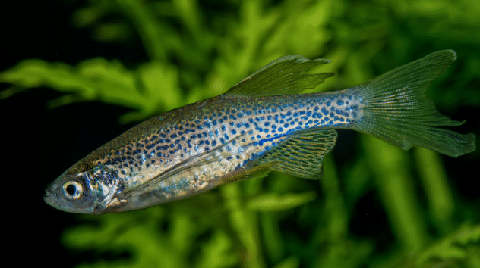
    Leopard Danio in Planted Tank

    It’s strongly encouraged to keep tank mates in a female betta sorority tank, so think about potential stocking when picking out a minimum tank size. A bigger aquarium will always be better, especially when picking tank mates for female bettas tank mates.

    Female bettas do best with active schooling fish. This might seem like a contradiction as solitary betta fish community tanks are recommended for slower, peaceful species. However, the logic behind keeping active schooling species makes a lot of sense.

    These fish will serve as a distraction to prevent the female bettas from going after each other. Instead, the idea is that they take more interest in the other species around them. In return, the schooling fish have safety in numbers and can quickly evade an aggressive female betta if need be.

    Not only will schooling fish distract your fish, but they also bring even more color and excitement to the aquarium. It’s recommended to steer clear of more aggressive and brightly colored species as this can create even greater competition. Female bettas are extremely colorful on their own, but carefully picked schooling fish is added to create contrast and interest.

    Some possible female betta sorority mates are:

    Keep in mind that there is always the chance for a tank mate to be killed in the process. However, keeping your fish fed and providing enough hiding places in the tank should greatly increase the chances of long-term survival.

    Female bettas may also be kept with snails and shrimp, which are beneficial cleanup crew members for the system. Likewise, it’s not uncommon for snails and shrimp to be eaten by female bettas, so expect to lose one or two in the process.

    Removal Of Bullies And The Bullied

    Once all fish have successfully been added to the aquarium, the real work begins. This work consists of keeping a happy and healthy betta sorority free of drama. This is definitely harder than it might sound in the beginning!

    One of the best ways to avoid future problems is by socially acclimating your fish to one another. However, aggression can still happen between fish that have known each other for years and it’s important to know what to do should that happen.

    If aggression is observed, remove the aggressive betta. Make sure that the bullied betta is safe and on its way to making a full recovery. This might mean also removing the bullied betta and placing it in quarantine until it’s able to hold its own in the tank; even if the other female bettas are initially aggressive, they may start to pick on a weakened betta.

    Removal of the bullies and the bullied is what makes betta fish sororities so difficult to keep: you need the space to be able to quickly rehouse and recover bullies and bullied fish. Not many hobbyists have the spare room to have standby systems set up for just this problem.

    Once the bully has been removed, the other female bettas need to sort out their hierarchy again. This may result in additional fin-nipping and chasing as they decide who’s at the top of the group.

    Related Bettas

    This is the most difficult step towards setting up a betta sorority and isn’t entirely necessary to make things work. If possible, always buy related betta fish or ones that have already been in the same tank for extended periods of time.

    Related bettas are much more likely to get along than picking up random ones from several different stores. The best chance of getting related bettas is by going through a betta breeder directly. However, this might take more time than some hobbyists are willing to wait and is much more expensive than buying from a commercial pet store.

    In addition, related bettas will be limited in color as they share the same genes. Buying separate bettas allows the hobbyist to handpick their sorority, which is much more aesthetically preferable.

    Even if these bettas are related, it’s highly recommended to socially acclimate them to one another to prevent possible future aggressive behavior.

    Final Thoughts

    Aggression is common in betta sororities, but there are ways to mitigate it. By managing the requirements for joining a sorority and providing bigger tanks, you can create an environment where your bettas are more likely to thrive. If you’re looking for a low-risk option when adding new bettas to your collection, consider breeders as a source. They have the lowest rates of aggression among their fish. Have you had success with a betta sorority? Leave us a comment below and let’s chat about it!


    ๐Ÿ“˜ Want to learn more? This article is part of our complete Betta Fish Guide. Your ultimate resource for betta care, types, tank setup, feeding, tank mates, and more.

  • Betta Tank Mates: My 15 Best Picks (And 4 I’d Never Risk)

    Betta Tank Mates: My 15 Best Picks (And 4 I’d Never Risk)

    Betta tank mates are something I get asked about constantly. and my answer is always: it depends on the individual betta. I’ve kept bettas with peaceful community fish successfully, and I’ve had bettas that would go after anything that moved. After 25+ years keeping them, I’ve developed a pretty good sense of which species work and which ones are just asking for trouble. These 15 picks are the ones I’d actually try in a betta community setup.

    Bettas get a reputation for being impossible to keep with other fish. and honestly, that reputation isn’t entirely wrong. I’ve seen bettas that would destroy anything you put in the tank, and I’ve seen others that coexist peacefully in a fully stocked community. The key is knowing which tank mates reduce the risk and which ones almost always end badly. After years of keeping bettas and fielding questions from hobbyists, I’ve settled on 15 species that consistently work, along with 4 that I’d avoid regardless of what someone at the fish store tells you.

    Choosing Betta Fish Mates. What You Need To Know

    Many fishkeepers start out with a single male betta in a nano tank as their first aquarium. Fishkeeping is such a fascinating hobby that those keepers soon start looking for new fish to add to their betta tank.

    But wait, aren’t betta fish really aggressive? Bettas live peacefully with many other fish in their natural habitat and in home aquariums, the trick is just to know which fish to avoid!

    Bettas have earned their reputation for being highly aggressive and territorial towards other bettas. In fact, male bettas were kept for fighting with other male bettas as a sport, and this is why betta fish are also called Siamese fighting fish.

    So let’s start by reminding everyone that only one male betta fish can be kept in a small fish tank.

    There are many factors that determine what makes a good tank mate for your betta, so lets’ run through the most important things to consider.

    Water Parameters and Aquarium Size

    Betta fish are usually kept in small aquariums. While these fish can be kept in tanks as small as 5 gallons, it’s really important to remember that many other fish species need a lot more room. For example, some aquarium fish that grow to just half the size of a betta fish need 15 gallons or more to be comfortable!

    After factoring in the size of your fish tank, the next step is to compare the water parameters that each fish prefers. Most fish have slightly different preferences so it’s really important to have some overlap with the needs of the other tank mates.

    These are the most important water parameters to consider:

    In regards to water temperature, Betta fish prefer a temperature around 78 degrees. This will restrict some of the fish you will want to keep like coldwater fish.

    Temperament

    With the mean reputation of the betta fish, your first thought might be to find fish that the betta can’t harm. The fact is that bettas can get bullied too, and with such long, beautiful fins, many bettas are weak swimmers that are vulnerable to fin nippers. Your goal is to select mates that aren’t going to bully or be bullied by your betta.

    Male vs Female

    Male bettas should not be kept with female bettas in the same aquarium. In fact, only one male betta should be kept in any community tank, unless it’s really large.

    Female bettas can still be aggressive towards other bettas, but they are not as bad as males. In fact, many experienced fish keepers are able to keep a few female bettas together in the same tank. This type of setup is known as a betta sorority tank.

    Picking female betta tank mates can actually be a little easier than for male bettas because females do not have such huge fins and are less likely to be bullied by fin nippers.

    Size

    Fish size is one of the first factors to consider when choosing betta fish mates. Avoid keeping your betta with any fish that are large enough to swallow it whole. Bettas stay pretty small, so there aren’t many fish species that they will eat.

    Competition

    Some fish species aren’t very competitive when it comes to food. It’s important that both your betta and its tank mates get access to enough food at mealtimes. Watch your fish carefully to see that no one is going hungry.

    15 of the Best Companions

    Now that you know how to pick tank mates for your betta, you could use the thought process to choose from the many tropical fish available in the hobby. This requires careful research, so to make your life easier, I’ve chosen 15 amazing and proven tank mates for betta fish. For those who prefer a visual reference. I have supplied a video from my YouTube channel. If you like videos like this, be sure to subscribe!

    Pay attention to the following facts to help you choose the best tank mates for your betta community tanks!

    • Scientific Name
    • Adult Size
    • Minimum tank size
    • Compatibility
    • Care Level
    • Water Temperature
    • Diet
    • Origin
    • Swimming Level

    1. Corydoras Catfish

    Corydoras trilineatus
    • Scientific Name: Corydoras spp.
    • Adult Size: 1-4 inches
    • Minimum tank size: 20 gallons (depending on species)
    • Compatibility: High, very safe choice
    • Care Level: Easy
    • Water Temperature: 72-82ยฐF
    • Diet: Omnivore
    • Origin: South America
    • Swimming Level: Bottom

    Cory catfish get along with pretty much any other small tropical fish. These social bottomfeeders make some of the best tank mates for bettas because they are really peaceful and do a great job of keeping the substrate clean.

    There are loads of different types of cory catfish in the hobby, and just about any of them will work as a betta tank mate. Just be sure to pick up a school of at least 6, that way you’ll get to see the gang school around in your tank. Cory catfish come in different sizes, so make sure you research the adult size of any species before bringing them home.

    2. Platys

    Platy Fish
    • Scientific Name: Xiphophorus maculatus
    • Adult Size: 2-3 inches
    • Minimum tank size: 15 gallons
    • Compatibility: Medium, should not be kept in acidic water
    • Care Level: Easy
    • Water Temperature: 68-79ยฐF
    • Diet: Omnivore
    • Origin: Central America
    • Swimming Level: All levels

    Platy fish are colorful little livebearers that could make great mates for siamese fighting fish. These peaceful fish come in a huge range of colors, and they are really easy to care for so they are a great choice for beginners.

    Platy fish can live in a pretty wide range of pH levels, but they do prefer neutral to alkaline water conditions.

    3. Harlequin Rasbora

    Rasboras
    • Scientific Name: Trigonostigma heteromorpha
    • Adult Size: 2 inches
    • Minimum tank size: 15 gallons
    • Compatibility: High
    • Care Level: Easy
    • Water Temperature: 72-77ยฐF
    • Diet: Omnivore
    • Origin: Southeast Asia
    • Swimming Level: Middle

    Harlequin rasboras are easy to recognize by the distinctive black triangle on their sides. The rest of their body is golden orange, which makes these little fish really stand out in an aquarium. Harlequin rasboras are a great choice for a planted betta tank.

    4. Cardinal Tetra

    Cardinal Tetra Fish
    • Scientific Name: Paracheirodon axelrodi
    • Adult Size: 1.5 inches
    • Minimum tank size: 15 gallons
    • Compatibility: High
    • Care Level: Moderate
    • Water Temperature: 73-84ยฐF
    • Diet: Omnivore
    • Origin: Venezuela & Brazil
    • Swimming Level: Middle, top

    Cardinal tetras are one of the most brightly colored fish in the aquarium hobby. These nano schooling fish can make amazing tank companions if kept in schools of 6 or more.

    Cardinal tetras grow a little larger and are a little more difficult to care for than the more common neon tetras.

    5. Neon Tetra

    Neon Tetra
    • Scientific Name: Paracheirodon innesi
    • Adult Size: o.8-1.2 inches
    • Minimum tank size: 10 gallons
    • Compatibility: High
    • Care Level: Easy
    • Water Temperature: 70-77ยฐF
    • Diet: Omnivore
    • Origin: South America
    • Swimming Level: Middle

    The classic neon tetra is just as well known as the betta, but did you know they make great mates for the tank? That’s right, a school of neon tetras will add amazing color and activity to your betta fish tank. The most important thing to remember is that neon tetras need to be kept in a school to be comfortable.

    6. Ember Tetras

    Ember Tetra
    • Scientific Name: Hyphessobrycon amandae
    • Adult Size: 0.75 inches
    • Minimum tank size: 10 gallons
    • Compatibility: High
    • Care Level: Easy
    • Water Temperature: 72-77ยฐF
    • Diet: Carnivore
    • Origin: Brazil
    • Swimming Level: Middle

    Ember tetras are another awesome schooling fish that can live with bettas. These tiny fish have an amazing bright orange color that can make any fish tank look amazing.

    If you want to brighten up your betta tank, consider picking up a school of 6 or more of these peaceful tetras!

    7. Rummy Nose Tetra

    Rummy Nose Tetra
    • Scientific Name: Petitella spp.
    • Adult Size: 2 inches
    • Minimum tank size: 20 gallons
    • Compatibility: High
    • Care Level: Moderate
    • Water Temperature: 74-79ยฐF
    • Diet: Omnivore
    • Origin: Brazil & Peru
    • Swimming Level: Middle

    Rummy nose tetras are beautiful schooling fish that make suitable companions for both male and female bettas. These distinctive fish have red faces and bold black and white tails.

    Rummynose tetras need higher water quality and a larger tank than some other fish, so they are a better choice for more experienced fish keepers.

    8. Molly Fish

    How Do Molly Fish Look Like
    • Scientific Name: Poecilia latipinna, P. spenops, P. velifera
    • Adult Size: 5 inches
    • Minimum tank size: 15 gallons
    • Compatibility: Medium, requires hard water
    • Care Level: Moderate
    • Water Temperature: 72-82ยฐF
    • Diet: Omnivore
    • Origin: North & South America
    • Swimming Level: Middle

    Molly fish are medium-sized livebearers that come in all sorts of shapes and sizes and colors. These peaceful fish species make awesome tank mates, but only if you have naturally hard water.

    Molly fish (like platyfish, and guppies) are livebearers. This means they give birth to live young. If you have a male and a female livebearer in the same tank, they can multiply pretty fast. The adult fish (and your betta) will eat these fry, but if you’d prefer your fish to not breed, choose just males or females.

    9. Endler’s Livebearers

    Endler's Livebearer
    • Scientific Name: Poecilia wingei
    • Adult Size: 1 inch
    • Minimum tank size: 10 gallons
    • Compatibility: Medium, prefers hard water
    • Care Level: Easy
    • Water Temperature: 64-82ยฐF
    • Diet: Omnivore
    • Origin: Venezuela
    • Swimming Level: All levels

    Endler’s livebearers are one of the best choices if you want tank companions for your betta but don’t have a lot of room. Endler’s livebearers stay really small and can be kept in as little as a 10-gallon tank. These fun little fish are super peaceful, and really colorful too!

    10. Honey Gourami

    Honey Gourami in Fish Tank
    • Scientific Name: Trichogaster chuna
    • Adult Size: 2 inches
    • Minimum tank size: 20 gallons
    • Compatibility: Medium, chance of conflict in small tanks
    • Care Level: Easy
    • Water Temperature: 72-80ยฐF
    • Diet: Carnivore
    • Origin: India, Bangladesh, Nepal
    • Swimming Level: All levels

    The honey gourami is a wonderful community fish that is very peaceful. They are easy to care for and have great colors too. Honey gouramis get along great with betta fish provided they all have enough room.

    As a side note, avoid larger gouramis. Honey gouramis are considered passive. Other types can be risky!

    11. Chili Rasbora

    What Does A Chili Rasbora Look Like
    • Scientific Name: Boraras brigittae
    • Adult Size: 0.75 inches
    • Minimum tank size: 5 gallons
    • Compatibility: High, great for nano tanks
    • Care Level: Moderate
    • Water Temperature: 70-82ยฐF
    • Diet: Carnivore
    • Origin: Borneo
    • Swimming Level: Midwater

    If you keep your betta in a nano tank of 5 gallons or so, companions can be pretty tough to find. The chili rasbora is a tiny species that feels right at home in a small tank, and these fish can live happily with one betta fish in a small tank.

    These schooling fish should always be kept in groups, or they will tend to be very shy. A betta fish and a school of chili rasboras in a heavily planted nano tank makes for a great display!

    12. Otocinclus

    Otocinclus Catfish in Planted Tank
    • Scientific Name: Otocinclus spp.
    • Adult Size: 2 inches
    • Minimum tank size: 10 gallons
    • Compatibility: High, great clean-up crew
    • Care Level: Moderate
    • Water Temperature: 74-79ยฐF
    • Diet: Algae
    • Origin: South America
    • Swimming Level: All levels

    Otocinclus catfish are one of the best betta tank mates. They grow to just 2 inches or so, but they have a big appetite for algae! These fascinating suckerfish are the perfect algae eaters for mature aquariums.

    These fish should not be added to very small, new aquariums because there just won’t be enough food for them. You also want to actually feed them as they tend to do their job well, then starve from not having enough food!

    Otos are probably the most peaceful aquarium fish in the entire hobby, so there’s no chance of them harming your betta fish.

    13. Bristle Nose Pleco

    Bristle Nose Pleco
    • Scientific Name: Ancistrus spp.
    • Adult Size: 5 inches
    • Minimum tank size: 15 gallons
    • Compatibility: High
    • Care Level: Moderate
    • Water Temperature: 70-78ยฐF
    • Diet: Herbivore
    • Origin: South America
    • Swimming Level: Bottom

    Bristlenose plecos are great betta fish mates that stay pretty small and do a great job of keeping the bottom of your tank clean. These odd-looking catfish love to graze on driftwood, and they also need some hiding spaces where they can hang out and relax.

    Bristle nose plecos are really strange-looking fish, but they won’t bother your betta fish. Like bettas, you should keep just one fish of this kind in the tank to avoid fighting.

    14. Kuhli Loach

    Kuhli Loach in Aquarium
    • Scientific Name: Pangio semicincta
    • Adult Size: 4 inches
    • Minimum tank size: 15 gallons
    • Compatibility: High, no risk of conflict
    • Care Level: Easy
    • Water Temperature: 70-79ยฐF
    • Diet: Omnivore
    • Origin: Southeast Asia
    • Swimming Level: Bottom

    Kuhli loaches are great little fish. They’re really peaceful, look amazing, and are great for cleaning up uneaten food from the bottom of the tank.

    These eel-like fish will get along great with your betta fish! The only downside to kuhli loaches is that they are a little shy, and tend to spend a lot of time hiding out in the substrate and under decorations or hardscape.

    15. Bamboo Shrimp

    Bamboo Shrimp on Driftwood
    • Scientific Name: Atyopsis Mollucensis
    • Adult Size: 2 inches
    • Minimum tank size: 20 gallons
    • Compatibility: High
    • Care Level: Moderate
    • Water Temperature: 68-77ยฐF
    • Diet: Filter feeder
    • Origin: Southeast Asia
    • Swimming Level: Bottom dweller

    Unfortunately, bettas love to snack on small shrimp species like cherry and crystal shrimp. There is one shrimp that does great with bettas, however, the bamboo shrimp! These fascinating filter feeders are too big for your betta to bother or eat, so they make great male and female betta tank companions.

    Fish To Avoid

    There are many great tank mates for betta fish out there, but there are also a few to steer clear of! Let’s take a look at some betta fish companions you’ll want to avoid.

    1. Tiger Barbs

    Tiger Barb Fish

    Tiger barbs might be beautiful, but they tend to be a little too boisterous to make good mates for bettas. These colorful fish also have a reputation for fin-nipping, which is why they can be such a threat to the male betta with its long, flowing fins. This is one barb fish you should definitely keep out of your betta tank!

    2. Cichlids

    Most cichlid species will not make good mates for your betta. These fish tend to be pretty territorial, and the larger species can be very predatory too. There are some cichlids like rams that could make potential tank companions for bettas but even they would be risky.

    3. Angelfish

    Angelfish are a really beautiful tropical fish species. They are happy in the same water conditions as your betta too, so what’s the problem?

    Unfortunately, bettas and angelfish have been known to fight. It could be because they have similar body shapes. To be on the safe side, avoid keeping angelfish as betta tank companions.

    4. Goldfish

    Goldfish are coldwater fish that need a water temperature of 65-72ยฐF to really thrive. Bettas like it much warmer at 76-81ยฐF, so the problem with these two tank mates is pretty obvious!

    5. Nippy Tetras

    While many tetras can make great betta fish tank mates, some of them just don’t play along. Avoid the following tetra species:

    Fish Community Aquarium Setup

    As you can see, there are loads of awesome betta fish mates to choose from. Before bringing any of these fish homes, however, you’re going to need to make sure your tank setup is ready for them.

    Read this section to learn more about setting up a great betta community.

    Introducing Companions

    Each betta fish has his or her own personality, so it’s really important to have a ‘plan-B’ in case your fish aren’t getting along. A small aquarium that you can use as a hospital tank is the ideal backup plan.

    You should also use this tank to quarantine the new fish for about two weeks before you add tank mates to your display tank. Adding some hiding spaces and live plants will also help to break up the line of sight and let your fish get away from any conflict.

    The cleanup crew

    Believe it or not, there are some aquarium animals that can be really helpful in keeping your aquarium clean.

    Here are some examples of clean-up crew animals:

    While all these animals will help to keep your tank clean by feeding on algae, cleaning the substrate, or eating up leftover food, it’s important to never let them go hungry. Remember to feed your clean-up crew a healthy diet in addition to the food they will scavenge in the tank.

    Aquarium Size

    Many fish keepers keep their betta fish in a five-gallon tank or even less. The fact is that adding more tank mates to such a small tank can be risky. There are options, however, and you could look at adding some small fish like chili rasboras.

    If you really want to set up a great community betta tank and add more tank mates, look at upgrading your tank to a 15 or 20-gallon. These are still small tanks but they open up your options to pretty much all of the great betta fish mates on my list.

    Heating

    Betta fish are tropical fish, and so are all the other fish in this article. Unless you live in a tropical climate, that means you’re going to need a good quality aquarium heater to keep the water temperature in a comfortable range. Your heater is adjustable, so make sure you dial it to the right temperature.

    Bettas prefer a temperature of between 76-81ยฐF. If you were to add a school of neon tetras (70-77ยฐF) and a bristle nose pleco (70-78ยฐF) for example, you would need to set your thermometer to about 77ยฐF to keep everyone happy.

    Filtration

    Quality filtration and maintenance are what keep your fish healthy and your tank looking great. These are two things you just can’t go without!

    Picking out the right aquarium filter can be a little intimidating with all the different makes and models available in the hobby, so let’s take a look at a few options:

    • The most cost-effective option would be a sponge filter and air pump combination. These work great in small tanks but they do take up a bit of room in the aquarium. Make sure you pick up a decent air pump too because some models can be pretty noisy.
    • Internal power filters and hang-on back filters are ideal mid-range filters for a community betta tank. They don’t take up too much room, they’re affordable, and they’re really easy to set up. Here’s an important tip: choose a model with an adjustable flow rate and pay attention to the current it creates, remember, betta males aren’t strong swimmers!
    • A small canister filter comes in at a higher price than the other options but has some great benefits. These filters are housed externally, so they are not visible when looking at the aquarium. This style also holds a high volume of filtration media, and you can customize this media to suit your needs.

    Maintenance & Testing

    Having a great clean-up crew and high-quality filtration will help to keep your betta community tank clean and healthy, but you’ll still need to roll up your sleeves and perform regular tank maintenance.

    If you don’t already have a kit, go ahead and pick up a water test kit. These are super important for monitoring your water quality. You’ll want to be able to measure the following parameters:

    • pH
    • Hardness
    • Ammonia
    • Nitrite
    • Nitrate

    It’s very important to know what your pH and water hardness are before planning any aquarium, although there are some things you can do to change them if really necessary.

    Ammonia, nitrite, and nitrate, on the other hand, are nitrogen compounds that increase and decrease naturally in fish tanks. If you measure any ammonia or nitrite, your tank has not completely cycled and is not yet ready for a betta fish or any other tank companions.

    Nitrate levels naturally rise over time as more fish waste and uneaten food are processed by the beneficial bacteria in your filter. This nitrogen compound is less harmful to your fish and can be allowed to increase to 20 ppm or a little more before you’ll need to perform a water change.

    Live Plants

    Live plants can turn an average fish tank into an amazing natural underwater world. Aquarium plants also have all sorts of benefits for your fish and even help to keep your water quality high, reducing the amount of maintenance you need to do.

    Start with a few easy plants like Java ferns, marimo moss balls, and Anubis if you’re new to growing live plants. These plants don’t need specialized lighting and require very little maintenance.

    Great Beginner Plant
    Anubias Nana

    Hardy, forgiving and easy to grow. The Anubias Nana is your ticket to the incredible hobby that is aquascaping!

    Click For Best Price Buy Tissue Culture

    Substrate & Decorations

    Substrate and decorations mostly come down to your personal preference, but there are a few important tips that I can share:

    • Make sure everything you put into your tank is aquarium-safe and designed for fish tank use.
    • Wash your substrate carefully before adding it to your tank.
    • Most fish feel more comfortable over a darker substrate.
    • Bettas love caves and leaf hammocks where they can hang out. Other fish like bristlenose plecos also love hiding spaces, so make sure to provide each tank mate with a comfortable environment.
    • Avoid ornaments and other objects with sharp edges that can tear the flowing fins of the male betta.

    Fish Companions

    The great thing about the betta fish tank mates in this list is that they are common and easy to find at most local pet stores. Buying online is a better option if you don’t have a decent fish store nearby, or just prefer the convenience of having the fish delivered safely to your door.

    Do The Fish Need Companions?

    Betta fish do not need to live with other fish. Your betta won’t get lonely, but it might get bored if kept in a very small and empty fish tank.

    What Fish Can They Live With?

    There are many excellent betta fish mates in the aquarium hobby. Certain mates work better than others in a community tank, however. Some of the best tank mates for betta fish include peaceful fish like corydoras and otocinclus catfish, as well other brightly colored fish like ember tetras and rummy nose tetras.

    Can Male And female Live Together?

    A male betta should not be kept with female bettas in the same tank. Unfortunately, this can lead to serious fighting and even death. Male and female bettas should only be brought together to breed.

    Can Guppies Live With Them?

    Guppies can live with bettas in a community tank. Guppies prefer higher pH water, however, so they can make ideal mates for betta fish as long as the water pH is neutral or slightly higher. Fancy tail males are also prone to get picked by a male Betta

    Final Thoughts

    Choosing the best mates for your betta fish can be pretty stressful, especially with the aggressive reputation of these awesome fish. Fortunately, betta fish can get along really well with loads of different fish in carefully planned community tanks. The 15 species in this list are some of the best betta tank mates in the hobby, so you can add them to your community tank with confidence!

    Do you love betta fish? Tell us about your favorite tank mates for betta fish in the comments below!


    ๐Ÿ“˜ Want to learn more? This article is part of our complete Betta Fish Guide. your ultimate resource for betta care, types, tank setup, feeding, tank mates, and more.

  • 11 Best Goldfish Tank Mates: What Actually Works (Cold-Water Only)

    11 Best Goldfish Tank Mates: What Actually Works (Cold-Water Only)

    Goldfish tank mates are one of the most common questions I get, and after keeping goldfish for years I can tell you the cold-water requirement eliminates most tropical fish right away. I’ve seen people add neon tetras to a goldfish tank and wonder why they die within weeks. Water temperature alone is the culprit. When you stick to true cold-water species, you’ll have a much better experience.

    Goldfish tank mates are one of those topics where a lot of online advice goes wrong. Mostly because people ignore the cold-water requirement. Goldfish do best between 65 and 72ยฐF, which immediately rules out the vast majority of tropical community fish. Neon tetras, guppies, and angelfish are not goldfish tank mates, regardless of what you might read. What actually works are other cold-tolerant species: dojo loaches, white cloud minnows, weather loaches, and of course other goldfish. There’s also the bioload issue. Goldfish are messy fish, and any tank mate needs to tolerate the high-nutrient environment that comes with them. This guide covers the 11 species that genuinely work.

    Choosing Goldfish Tank Mates – What You Need To Know

    When it comes to choosing goldfish tank mates, there are a couple of different factors you need to consider. If you already have goldfish, their happiness should be your number one priority. Of course, you also need to think about the welfare of the other species of fish you plan to add.

    Here are the most important factors to think about:

    Temperament

    Firstly, assuming you already have some pet goldfish, you need tank mates that will not harm or bully them in any way. This goes both ways, of course, so basically, you need to prevent any form of aggression. This means you need to avoid any territorial species of fish that are known to be aggressive or nip fins.

    Size

    The best tank mates for your goldfish are species that are similar-sized and will not be able to eat your goldfish. Goldfish will eat smaller fish that are slow enough to catch, so you need to think about it from both angles.

    Competition

    It’s very important that every animal in the tank has fair access to food. This is especially important when choosing tankmates for some of the slow-swimming fancy goldfish breeds that might not be able to get enough food.

    Parameters & Setup

    Goldfish have certain water parameter preferences, and their tankmates need to be comfortable in the same conditions. All of the following parameters should be considered:

    Author Note: the biggest limiting factor when it comes to tank mates. While a goldfish can adapt to higher temperatures, it’s not ideal. And many tropical fish will struggle with the lower temperatures a goldfish can tolerate.

    11 of the Best

    With all of the factors above in mind, we’re ready to look at some great goldfish tank mates for your aquarium. All of the recommended goldfish tank mates are peaceful fish that is kept in the conditions you should already have in your goldfish tank.

    Check out the video below from our YouTube channel. If you like our content, please subscribe as we upload new videos every week!

    Take note of the following important stats for each of the goldfish tank mates in the list:

    • Scientific Name
    • Adult Size
    • Compatibility
    • Water Temperature
    • Minimum tank size
    • Care Level
    • Diet
    • Origin
    • Swimming Level

    So let’s meet some goldfish tank mates!

    1. Other Types

    Fantail Goldfish Swimming
    • Scientific Name: Carassius auratus
    • Adult Size: 6-8 inches
    • Water Temperature: 65-72ยฐF
    • Minimum tank size: 20 gallons
    • Care Level: Moderate
    • Diet: Omnivorous
    • Origin: China and surrounding Asian countries
    • Swimming Level: Midwater

    This might seem like an obvious choice, but it’s important to note that different breeds of goldfish aren’t always compatible with other fish species and even other goldfish.

    There are many amazing goldfish breeds, and they is separated into two categories to make things a little easier:

    Fancy Breeds

    Fancy goldfish are some of the most colorful and ornamental fish breeds in the aquarium hobby. They often have long, flowing fins and strange body features like telescopic eyes and missing dorsal fins.

    These slow-moving goldfish is tough to find tank mates for because they is pretty clumsy and can struggle to get to the food before other fish do. They are often uncomfortable in flowing water because they are poor swimmers. On the plus side, these fish are super peaceful and no threat to their tankmates.

    The following breeds are all known as fancy goldfish:

    Fast-moving (AKA Slim-Bodied)

    Goldfish are not particularly fast fish, but the wild types and other slim-bodied goldfish are stronger swimmers that can even catch other small fish sometimes! These goldfish are less likely to be outcompeted for food by faster tankmates.

    It is best to keep fancy goldfish with similar breeds, and common goldfish with other slim-bodied breeds.

    2. Japanese Rice Fish

    • Scientific Name: Oryzias latipes
    • Adult Size: 1.5 inches
    • Compatible with: Fancy goldfish breeds
    • Water Temperature: 61-72ยฐF
    • Minimum tank size: 10 gallons
    • Care Level: Easy
    • Diet: Carnivorous
    • Origin: East Asia
    • Swimming Level: bottom, middle, and top

    The Japanese rice fish, or Medaka fish as it is also known, is a great nano cold-water fish that can live with goldfish. These schooling fish are available in a variety of colors, including silver, golden, and orange.

    Japanese rice fish are hardy and make ideal fancy goldfish tank mates. Even though they are small enough to be eaten by hungry goldfish, they are way too fast to be caught.

    3. Dojo Loach

    Dojo Loach
    • Scientific Name: Misgurnus anguillicaudatus
    • Adult Size: Up to 12 inches
    • Compatible with: Most goldfish breeds
    • Water Temperature: 64-74ยฐF
    • Minimum tank size: 55 gallons
    • Care Level: Easy
    • Diet: Carnivorous
    • Origin: Eastern & Central Asia
    • Swimming Level: Bottom

    Dojo loaches make great goldfish tank mates because they are peaceful and enjoy the same water parameters. These guys get pretty large, however, so you’ll need a tank of at least 55 gallons to give them enough swimming space.

    Dojo loaches are also known as weather loaches. They are bottom dwellers that are happy to feed on the same food sources as your goldfish, which makes them very easy to care for.

    4. White Cloud Mountain Minnows

    White Cloud Minnow
    • Scientific Name: Tanichthys albonubes
    • Adult Size: 1.5 inches
    • Compatible with: Fancy goldfish breeds
    • Water Temperature: 57-71ยฐF
    • Minimum tank size: 10 gallons
    • Care Level: Easy
    • Diet: Carnivorous
    • Origin: China
    • Swimming Level: Middle

    White cloud mountain minnows are very popular tank mates for goldfish. These peaceful freshwater fish are also comfortable in relatively cold water. They come in some beautiful varieties, including golden and long-finned forms.

    White cloud mountain minnows are colorful fish that grow to just 1.5 inches or so, which means it is possible for a full-grown goldfish to swallow them whole. It is safer to keep them with slow-moving fancy goldfish that are too clumsy to catch them.

    5. Bristlenose pleco

    Bristle Nose Pleco
    • Scientific Name: Ancistrus sp.
    • Adult Size: 4-5 inches
    • Compatible with: Fast-moving goldfish breeds
    • Water Temperature: 70-78ยฐF
    • Minimum tank size: 15 gallons
    • Care Level: Moderate
    • Diet: Herbivorous
    • Origin: Argentina
    • Swimming Level: Bottom

    The bristlenose pleco is a sucker fish that can make a good goldfish tank mate for more experienced keepers. These interesting fish require plenty of driftwood to graze on as well as some hiding places to feel secure.

    Bristlenose plecos is kept in cooler water than other tropical fish, but their temperature preference only overlaps with the goldfish by a few degrees. Regulating the water temperature with a heater is the safest way to keep both species happy if kept together.

    6. Hillstream Loach

    • Scientific Name: Sewellia lineolata
    • Adult Size: 2-2.5 inches
    • Compatible with: Fast-moving goldfish breeds
    • Water Temperature: 68-75ยฐF
    • Minimum tank size: 20 gallons
    • Care Level: Moderate
    • Diet: Eats algae
    • Origin: Vietnam & Laos
    • Swimming Level: Bottom

    The hillstream loach must be one of the coolest looking aquarium fish in the hobby. They can make a great tankmate for goldfish, but there is one important catch.

    These fish need good water flow and oxygenation to replicate their natural environment. You could use an internal filter or a small powerhead to create an area in the tank with good flow, but this will mean avoiding weak swimming fancy goldfish breeds.

    7. Rosy Barbs

    Rosy Barb in Planted Tank
    • Scientific Name: Pethia conchonius
    • Adult Size: 2.5-3.5 inches
    • Compatible with: Fast-moving goldfish breeds
    • Water Temperature: 61-75ยฐF
    • Minimum tank size: 25 gallons
    • Care Level: Easy
    • Diet: Omnivorous
    • Origin: Bangladesh, Pakistan, Nepal, India
    • Swimming Level: Middle

    Rosy barbs, like goldfish, are part of the Cyprinid family. These social fish is a little badly behaved if kept on their own or in small numbers. Keep a group of at least 8 to 10 rosy barb fish to ensure they remain peaceful.

    8. Variatus Platy

    • Scientific Name: Xiphophorus variatus
    • Adult Size: 2-2.8 inches
    • Compatible with: Fast-moving goldfish breeds
    • Water Temperature: 68-79ยฐF
    • Minimum tank size: 15 gallons
    • Care Level: Easy
    • Diet: Omnivorous
    • Origin: Mexico
    • Swimming Level: bottom, middle, and top

    The variatus or variable platy fish is another colorful freshwater fish that makes a great tank mate for goldfish. They enjoy cooler water temperatures and they are both peaceful and very easy to keep.

    Platys are livebearers, which means they will produce plenty of fry if you keep both males and females in the same tank. The fry will be eaten by the goldfish, which is good for keeping the population down, but not great if you want your platies to multiply!

    9. Hoplo Catfish

    • Scientific Name: Megalechis thoracata / hoplosternum thoracatum
    • Adult Size: 6 inches
    • Compatible with: All goldfish breeds
    • Water Temperature: 64-82ยฐF
    • Minimum tank size: 30 gallons
    • Care Level: Easy
    • Diet: Omnivore
    • Origin: South America
    • Swimming Level: Bottom

    The hoplo catfish (video source) is a very hardy and peaceful nocturnal catfish. They are perfectly safe to keep with goldfish, but they can eat small fish like white cloud minnows or rice fish.

    Hoplo catfish love to dig through the substrate, so keep them over fine sand, and expect them to rearrange the floor somewhat. These fish should be kept in a group of at least 5 and be sure to provide some hiding places like driftwood or caves.

    10. Zebra Danio

    What Does A Zebra Danio Look Like
    • Scientific Name: Brachydanio rerio
    • Adult Size: 1.5-2 inches
    • Compatible with: Fancy goldfish breeds
    • Water Temperature: 64-77ยฐF
    • Minimum tank size: 10 gallons
    • Care Level: Easy
    • Diet: Carnivorous
    • Origin: India
    • Swimming Level: middle and top

    Zebra danios are a great little schooling fish species that also do well in cooler temperatures. These peaceful fish can make good goldfish tank mates, even though they are technically small enough to be eaten. Danios are speedy and lively fish, so this isn’t a problem, but keeping them with slower goldfish is the safest bet.

    11. Mystery Snails

    Mystery Snail
    • Scientific Name: Pomacea bridgesii
    • Adult Size: 2 inches
    • Compatible with: All goldfish breeds
    • Water Temperature: 68-84ยฐF
    • Minimum tank size: 5 gallons
    • Care Level: Easy
    • Diet: Eats algae
    • Origin: Brazil, Peru, Paraguay, Bolivia
    • Swimming Level: Bottom

    Mystery snails make excellent tankmates for goldfish. These colorful aquarium snails look great and help to keep your tank clean by eating leftover food scraps. They are hard-working creatures and can even help to keep your glass and substrate clean by feeding on algae!

    Unfortunately, young specimens and other freshwater snails will not be safe from a hungry and curious goldfish. Mystery snails can grow to over two inches, however, which is too big to be on your goldfishes menu!

    Companions To Avoid

    Now that you know eleven of the best goldfish tank mates, let’s run through a few species that you should avoid.

    Tropical Fish

    Goldfish are coldwater fish that do not occur in tropical regions. They prefer to live in a temperature range between about 65ยฐF and 72ยฐF. Any tropical fish that needs warmer water temperatures will not make a suitable tank mate. Here are a few examples

    Aggressive, Territorial & Fin-nipping Fish

    African Cichlids in a Rock Aquarium

    Goldfish should never be kept with aggressive tank mates. Long goldfish fins are prime targets for fin-nipping fish, and fancy breeds are not strong enough to defend themselves against bullies. In the aquarium hobby, there are a few ‘prime suspects’ to watch out for like:

    You’ll also want to avoid keeping any smaller fish that is dangerous if swallowed like:

    Freshwater Shrimp

    Goldfish are omnivorous, which means they feed on both plant and animal matter. Inverts like cherry shrimp and bamboo shrimp are definitely on the menu, so you can expect a hungry goldfish to see them as a tasty snack.

    They might survive fine with plenty of hiding spaces, but it’s not worth the risk. Even slow-moving fancy goldfish are likely to eat freshwater aquarium shrimp eventually.

    Community Tank Setup

    Now that you know more about suitable goldfish tank mates, let’s take a look at how to set up your own peaceful goldfish community aquarium!

    Introducing Tankmates

    While all the species in this list have been proven to get along great with goldfish, it’s important to understand that fish can have individual personalities and their behavior is complex.

    Make sure you have some sort of backup plan in place in case there’s any unexpected conflict. It’s also a good idea to quarantine any goldfish tank mate for at least 2 weeks before introducing it to your aquarium.
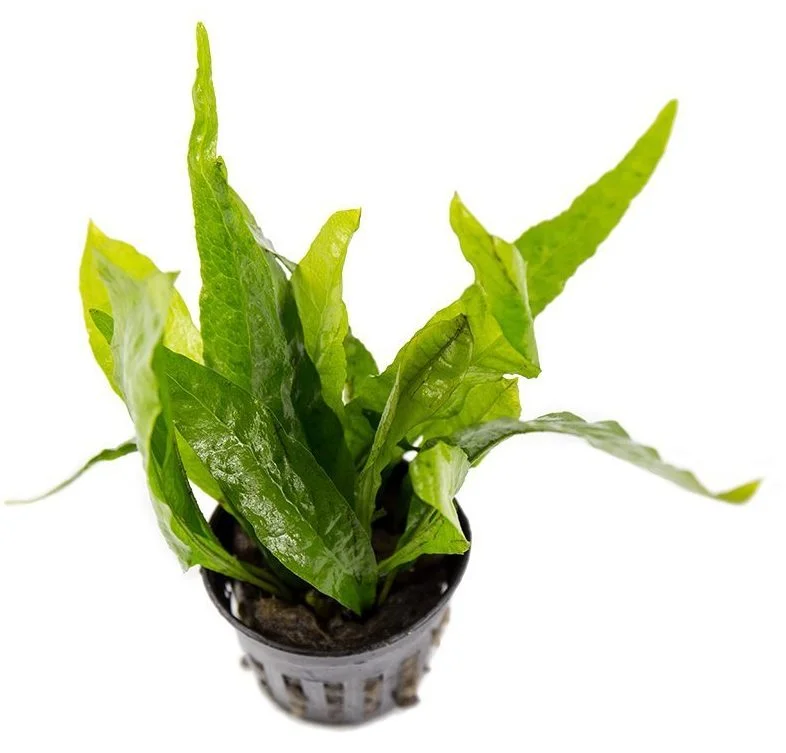
    Tank Size

    The size of your goldfish community aquarium will depend on the number and type of fish you keep. A single goldfish needs a tank of 20 gallons at the very least, and this should be increased by a further 20 gallons for every additional goldfish you keep.

    White cloud mountain minnows, for example, are nano fish that is kept in aquariums as small as 10 gallons, so adding a small school will not have a big effect on the bioload of your goldfish tank. The dojo/weather loach on the other hand is a large fish that should be kept in a tank of at least 55 gallons.

    Heating

    Goldfish prefer cooler water temperatures than tropical fish so they can often be kept in an unheated aquarium. Naturally, this will depend on the temperature in your home, office, or wherever you keep your goldfish tank.

    Author Note: If the room temperature range varies between 65ยฐF and 72ยฐF, you will not need a heater to keep goldfish. You will need to heat or cool the water if the temperature rises or falls below these values, however..

    The temperature preferences of the 10 goldfish tank mates in this list all vary, but they do overlap with the goldfish’s preferred parameters by at least a few degrees in each case. Running a heater can make it a lot easier to keep your aquarium temperature dialed into that ‘happy medium’.

    Filtration & Aquarium Maintenance

    Goldfishes create a large bioload in the aquarium, and adding tank mates will put even more pressure on your filtration system. This means excellent filtration is necessary to maintain great water quality.

    Goldfish are not the strongest swimmers, and the fancy breeds in particular will not enjoy a strong water current. A good-quality canister filter is a great option for your goldfish tank, especially if fitted with a spray bar to minimize the water flow and oxygenate the water.

    Best Value
    Fluval Canister Filters

    Our Subscriber’s Choice

    Top name brand, Italian made, and updated design. The next gen Fluval Canisters are a best buy!

    Buy On Amazon Buy On Petco

    Supplementing this with a hang-on back, or sponge filter is a good way to increase your filtration capacity and can also be seen as a great ‘insurance policy’ in case either filter fails.

    Your filtration system will keep your aquarium water looking beautiful while working to convert the ammonia in fish waste and uneaten food into nitrates. These nitrate levels should be monitored regularly using your test kit. At high levels, nitrates become toxic to your fish, so work out a partial water change schedule that keeps your nitrate levels to 20 ppm or less.

    Live Plants

    Growing live plants in your aquarium has a number of great benefits for your goldfish- and they look great too! Unfortunately, goldfish are notorious for eating aquarium plants, so you need to choose your species carefully. Here are a few goldfish-friendly plants that you can grow in your tank:

    Keep in mind that even if your goldfish doesn’t eat your plants, they can uproot them. Plants that do not need to be planted in substrate or float will work best with goldfish.

    Substrate & Decorations

    A layer of aquarium sand or gravel on the bottom of your tank can create a more natural habitat for your fish to forage on. Many goldfish tanks are successfully run without any substrate at all, however. This is a great way to keep your aquarium spotless and clean, but it does not create a very natural environment.

    Great For Bottom Feeders
    Fine Natural Sand

    Natural sand is excellent for bottom feeder fish to forage around in.

    Click For Best Price Buy On Amazon

    Adding decorations and hardscape features like rocks and driftwood is a great way to add structure to your tank and provide your goldfish and their tank mates with a more natural home. Goldfish with long, flowing fins are vulnerable to tears and damage from sharp objects, so make sure that everything in your aquarium has smooth, rounded edges to avoid any injuries.

    Where To Buy

    This list of goldfish tankmates was chosen to include species that are easy to find. You should be able to find most of these fish down at your local fish store. Alternatively, you can check out trusted online retailers. Some specialty online dealers will have rare breeds available.

    FAQs

    Final Thoughts

    Choosing companion fish for your goldfish doesn’t have to give you sleepless nights. Choose one of the great species listed in this article to create your own peaceful goldfish community tank today!

    Do you keep companion fish with your goldfish? Let us know about your experiences in the comments below!


    ๐Ÿ“˜ Want to learn more? This article is part of our complete Freshwater Fish Guide. Your ultimate resource for freshwater species, care tips, tank setup, and more.

  • Japanese Rice Fish (Medaka): Care, Breeding, and the Best Color Morphs

    Japanese Rice Fish (Medaka): Care, Breeding, and the Best Color Morphs

    Having worked with livebearers for over two decades, japanese Rice Fish are the most underrated nano fish in the hobby. Cold-tolerant, surface-dwelling, and available in multiple color strains.

    Rice fish are the low-maintenance nano fish that most people overlook because they are not flashy enough. Their keepers know better.

    Rice fish are the low-maintenance nano fish that most people overlook because they are not flashy enough. Their keepers know better.

    The Japanese rice fish (Oryzias latipes) is a peaceful nano species that is becoming increasingly popular among aquarists. These fish are highly underrated in the hobby, being one of the hardiest coldwater nano fish choices.

    Brief Overview of the Japanese Rice Fish

    Scientific NameOryzias latipes
    Common NamesJapanese rice fish, Japanese killifish, Medaka
    FamilyAdrianichthyidae
    OriginJapan, China, Vietnam, Laos, Taiwan, & Korea
    DietOmnivore
    Care LevelEasy
    ActivityModerate
    Lifespan2-5 Years
    TemperamentPeaceful
    Tank LevelMidwater, Top
    Minimum Tank Size10 gallons
    Temperature Range61ยฐF. 75ยฐF
    Water Hardness5-25 dKH
    pH Range7.0. 8.0
    Filtration/Water FlowLow
    Water TypeFreshwater, Brackish water
    BreedingEgg-layer
    Difficulty to BreedEasy
    CompatibilitySpecies-only tank or community tank 
    OK, for Planted Tanks?Yes

    Japanese Rice Fish Origins and Habitat

    Japanese rice fish are small schooling fish that are native to Southeast Asia from eastern China and eastern Korea to Japan and Vietnam. Phylogenetic analysis has shown that there are actually 33 closely related species in the genus Oryzias.

    The Japanese rice fish has a rich history in the aquarium hobby. They have been a favorite among Asian aquarists for centuries! These celebrated fish look amazing when viewed from above, which was important before glass fish tanks became available.

    Rice fish are highly adaptable fish that are found in a variety of habitats like rice paddies and shallow rivers. They occur naturally in both freshwater, and brackish water where fresh and saltwater mix according to the tides. Check out the video above from my YouTube channel. There is more information on this post so let’s keep reading on!

    What Do They Look Like?

    Japanese Rice Fish in Planted Tank

    The first thing you might notice about rice fish is that they are almost transparent! They also have beautiful big blue eyes.

    Japanese rice fish have been selectively bred to produce beautiful and fairly stable color varieties. There are hundreds of known rice fish breeds, but the following types are most accessible in the hobby.

    • Pink Medaka Rice Fish

    This variety is one of the most colorful ricefish available in the hobby. The Pink Medaka Rice Fish have an orange-pink body color that brings life to any fish tank.

    • Galaxy Medaka

    The galaxy rice fish has a whitish body color. Under good lighting, their scales shine like a rainbow. Like other rice fish varieties, these fish look almost transparent.

    • Red Cap Medaka

    This stunning color form of the Japanese rice fish has an orange/red crown and back that merges into its pearl-colored body. This combination of color contrasts amazingly with their bright blue eyes.

    • Yokihi Medaka Rice Fish

    The Yokihi medaka is a rare breed with beautiful deep orange coloration.

    Other Ricefish Species

    • Javanese Medaka Rice Fish

    The Javanese rice fish (Oryzias javanicus) is actually a different species from the Japanese rice fish. These beautiful little fish are from more tropical areas and are suitable for heated tropical fish tanks. It is told from the Japanese rice fish by its deeper body shape and pointed tail fin.

    • Woworae Medaka Rice Fish

    The woworae, or Daisy’s blue rice fish (Oryzias woworae) is one of the most colorful tropical Asian medakas in the genus Oryzias. This awesome little nano species wows fishkeepers with its bright orange body trim and pectoral fins. The males, in particular, have a beautiful blue glowing body color, although both sexes boast bright blue eyes.

    How Big Are They

    Medaka are very small fish that reach a maximum length of between 1 and 1.4 inches. Their small size and hardiness make them great fish for nano tanks.

    How Long Do They Live?

    Rice fish, like most nano species, are not particularly long-lived fish. With good care, however, these fish can live for as long as 5 years. The most important factors that affect the longevity of your fish are:

    • Water quality
    • Water temperature and parameters
    • Feeding
    • Disease & stress prevention

    Fish Temperament and Activity Level

    medaka fish

    Japanese ricefish are relatively active little fish that spend most of their time in the midwater of the aquarium. It is best to keep your ricefish in a group of at least 8.

    They are not shy if kept in a comfortable environment and will be found schooling together in an open area of the tank outside of the current created by your filter. Rice fish are very peaceful, so you don’t have to worry about any bad behavior in a community fish tank.

    Interestingly, the hardy and adaptable nature of these fish have made them a popular model for scientific research and education. Believe it or not, they were the first vertebrate species to be bred in space!1

    What Are Good Tank Mates for Them?

    Japanese rice fish are very peaceful creatures that get along great with other species of fish in a community tank. They are very small, so it’s important to avoid larger fish that might see them as dinner.

    Choosing fish that are similar or the same size is the best way to avoid any disappearances, but there are other factors you need to consider when planning a peaceful community.

    Firstly, Japanese ricefish are cold water fish, so they should not be kept in water temperatures higher than the mid-70s. They may survive in a tropical setup, but their lifespan will probably be reduced, so keep them on the cooler side.

    The fact that they thrive in cooler water temperatures is actually a real bonus for aquarists looking to set up a cold water community tank. Let’s take a look at some of the freshwater fish species that you can keep with medaka.

    Best Tank Mates

    Least Compatible Fish for Companions

    What Do They Eat?

    Ricefish are not very picky when it comes to diet. The most important factor to consider is their small size.

    Ricefish is fed a diet of dried prepared foods like pellets, granules, or flakes. Flakes can easily be crushed up, but harder foods like pellets need to be very small.

    Rice fish are said to be omnivorous, which means they are both animal and plant eaters. Small insects and other tiny animals are an important component of their diet, and these should be provided as a supplement to keep them in great health. This is also very important to bring your ricefish into top breeding condition. A good staple food to try would be Xtreme Aquatics Nano formula.

    Great For Nano Fish
    Xtreme Aquatic Foods Nano

    Xtreme Aquatics Nano formula is specially designed for smaller fish and contained a well balance mix of raw ingredients. It is a great staple food for your nano fish.

    Buy On Amazon

    Here are a few great supplementary frozen and live foods that you can provide:

    • Blood worms
    • Brineshrimp
    • Daphnia
    • Grindal worms
    • Small vegetables

    How Much and How Often to Feed Them

    Aquarists often make the mistake of overfeeding their pets. This can result in obesity, and more importantly, reduced water quality. So how do you know how much food to provide?

    Feeding them more than once a day is a great tip. Providing a small amount that they can finish in just a minute or so will prevent any uneaten food from sinking to the bottom or getting sucked into your filter.

    If your medaka fish are colorful, growing, healthy, and active, you know you’re keeping them well fed!

    Setting Up Your Tank

    Japanese ricefish are very easy to care for and will thrive in a variety of setups. In fact, many aquarists keep these hardy freshwater fish outdoors in ponds and containers.

    They will thrive in any setup that provides an environment that is similar to their natural habitat. In this section, you can learn how to set up a great tank for your rice fish, so let’s get started!

    Tank Size

    Rice fish are a nano species that can survive in aquariums as small as a few gallons or as big as outdoor ponds! I would recommend starting out with a tank of 10 gallons or larger, however, because this provides enough swimming space for a nice school while being stable enough to maintain water quality.

    More important than the size of the tank is its cover. These little jumpers can easily escape out of an open aquarium, so make sure it has a secure lid.

    Aquarium Plants

    Rice fish absolutely thrive in a planted aquarium. They feel more comfortable with floating plants on the water surface. That doesn’t mean you can’t keep medaka, without live plants, however.

    You might think growing live plants requires special lighting, equipment, and soils, but that doesn’t have to be the case.

    Start out with a few easy aquarium plants like Java ferns and anubias to green up your aquarium. These plants will grow under standard aquarium lighting if tied to your hardscape.

    If you want to upgrade your tank into an amazing underwater aquascape, you can look at starting a tank with decent aquarium soil, good quality lights, and a pressurized CO2 injection system.

    Substrate

    A darker, natural colored substrate bring out the best color in aquarium fish, and also makes them feel more at ease. Any aquarium-safe substrate is used, however, since ricefish will not spend much time at the bottom of the tank.

    If you’re setting up a planted aquarium, starting out with a quality aquarium soil will provide the best results. Alternatively, a well-rinsed sand or gravel substrate will work great.

    Decor

    Arranging some rocks or driftwood in the aquarium is a great way to make a natural environment for all the fish, and a more attractive aquarium for you to look at too. Be sure to use clean, aquarium-safe materials and place them carefully to prevent any damage to the glass.

    Water Quality

    Keeping the water clean and safe is the next priority after setting up a great tank for your ricefish. The tank should be fully cycled before introducing the fish. Check out this article if you’d like to learn more about the aquarium cycle and why it’s so important.

    Let’s take a look at how to keep your cycled aquarium safe and healthy for your fish.

    Filtration

    Many aquarists will tell you a filter is not essential for keeping ricefish. I recommend good filtration for all aquariums just because they are so effective for maintaining the nitrogen cycle, aerating the water, and of course, filtering out particles and impurities in the water.

    A simple sponge filter works great, but if you plan on keeping many fish or a community setup, consider upgrading to a canister filter. Both of these filter types create very little flow, which is ideal for these freshwater fish that prefer living in calm water.

    Water Parameters

    One of the great things about ricefish is how hardy and adaptable they are. Chances are, the temperature in your home is very comfortable for them, and this means most keepers don’t need aquarium heaters.

    Here are the most important water parameters that you should maintain for your rice fish:

    • Water Temperature: 61ยฐF. 75ยฐF
    • pH: 7 – 8
    • Hardness: 5-25 dKH
    • Ammonia: 0 ppm
    • Nitrite: 0 ppm
    • Nitrate: < 20 ppm

    Aquarium Maintenance

    Keeping your aquarium clean and healthy is the most important thing you can do for your ricefish. Here are some of the steps you’ll need to take:

    • Perform a regular water change every week or two
    • Suck up uneaten aquarium fish food and waste from the substrate with your gravel vac
    • Clean your aquarium glass with an algae scraper when necessary
    • Rinse out your filter media with old tank water on a regular basis

    Test Tank Conditions

    The only way to really know if your water parameters are suitable for your ricefish is by testing your water regularly. This will also tell you if your maintenance schedule is up to scratch.

    Testing your water is easy with an aquarium test kit. These kits come in liquid or strip form and are easy (and fun) to use.

    Breeding

    Rice fish are easy to breed in the home aquarium. Read on to learn how (I’ve also provided a video from Aquaviva below)!

    Sexing

    Of course, you’re going to need both male and female ricefish if you want them to reproduce. But how do you know which sex they are? Here’s what to look for:

    • Adult female rice fish are larger than males
    • Females often carry eggs on their anal fins
    • Males tend to be more colorful
    • Males have a small bump on the body in front of the anal fins
    • Male ricefish also have longer rays in the dorsal and anal fin

    Getting Ricefish Ready to Breed

    Conditioning your fish is very important since unhealthy ricefish will produce fewer eggs, or they might not reproduce at all. Feed your fish a healthy diet of frozen and live food before you plan on breeding them to increase your success rate.

    The Breeding Process

    Once the female is in breeding condition, she will lay eggs every day for several weeks or even months. The male fertilizes them and then the adhesive eggs are deposited on fine-leaved plants like Java moss.

    Spawning mops made from green wool or synthetic fibers can also be used to simulate a live plant.

    Caring For Fry

    The fertilized eggs will hatch after 2 weeks or so. The fry will need to be fed infusoria or liquid fry foods due to their small size. Live plants and the tiny animals that grow on them can provide a great natural food source too.

    The fry are vulnerable to larger fish at this age, which is why spawning them in a dedicated spawning tank is the safest option. The fry grow quickly, however, and can reach maturity in less than 6 months.

    Health and Disease

    Japanese rice fish are very hardy, but there is always a chance that your fish may develop health problems. Read on to learn more about what to look out for.

    Evaluating Your Ricefishesโ€™ Health

    The easiest way to assess the health of your fish is to observe their physical characteristics and their behavior. Fish that are hiding, breathing rapidly, or have lost all of their usual colors are showing signs of stress.

    Flashing against the substrate, floating, or sinking are other common signs of distress. Observing your fish often will help you pick up problems early, and allow you to notice changes over time.

    Common Ricefish Health Issues

    Where To Buy

    You don’t have to travel to Japan to get your own beautiful medaka rice fish. Sure, they aren’t always the easiest fish to find at your local pet store, but in today’s world of online fish stores, that’s no problem at all! You can click the link below to check out the variety of rice fish available for sale by our partners.

    Frequently Asked Questions

    What do they eat?

    Japanese ricefish are not fussy when it comes to food. Feed them a regular diet of flakes or micro pellets. Providing live foods like baby brine shrimp and micro worms is a great way to keep them in perfect health.

    Are ricefish aggressive?

    Rice fish are not aggressive at all. These peaceful nano fish are great community tank mates.

    Why are they called ricefish?

    Rice fish get their name from their habit of living in rice paddies. These are shallow swamps where the rice plant is grown.

    Are ricefish the same as killifish?

    Ricefish may look and act a lot like killifish but they are not all that closely related. Genetic research has shown that ricefish are in the Adrianichthyidae family while killifish are in other families like the Aplocheilidae and Fundulidae.

    How long do ricefish live?

    You can expect your ricefish to live for a few years if you provide it with the right care. Their expected lifespan is anything from 2 to 5 years.

    Closing Thoughts

    Medaka rice fish are kept everywhere from Japan to space! It’s a shame that these coldwater nano fish aren’t better known, but fortunately, they have become more accessible all over the world in modern times.

    Do you keep Japanese rice fish? Let us know about your experiences with these nano fish in the comments below!


    ๐Ÿ“˜ Want to learn more? This article is part of our complete Freshwater Fish Guide. Your ultimate resource for freshwater species, care tips, tank setup, and more.

  • Flame Angelfish Care: What Every Reefer Should Know Before Buying

    Flame Angelfish Care: What Every Reefer Should Know Before Buying

    The flame angelfish is one of the most visually striking dwarf angels you can put in a reef tank. that bright orange-red body with black vertical bars is genuinely hard to beat. In my experience, they’re also one of the more commonly impulse-purchased reef fish, and that’s where trouble starts. The big thing people overlook is the coral-nipping risk. Like most dwarf angels, flame angels can develop a taste for soft corals and LPS, and once they start it’s nearly impossible to stop. That doesn’t mean you can’t keep them in a reef, but it does mean you need to go in with realistic expectations and a plan. Here’s everything I know about keeping them successfully.

    The flame angelfish is reef safe until it decides it is not. That decision is permanent.

    Species Overview

    Scientific NameCentropyge loricula
    Common NamesFlame angelfish, flaming angelfish, flame angel
    FamilyPomacanthidae
    OriginCountry – Pacific Ocean
    DietOmnivore
    ColorsReds, yellows, oranges, purples, blacks
    Care LevelIntermediate
    TemperamentSemi-Aggressive
    Minimum Tank Size70 gallons
    Max Size4 inches
    Temperature Range76. 82 degrees F
    pH Range8.0. 8.4
    Salinity1.025 or 35 PPT
    Reef SafeWith caution
    Available As Tank Breed?Available

    Origins And Habitat

    As one of the most colorful fish in the entire saltwater aquarium hobby, the flame angelfish comes from the tropical waters of the Pacific Ocean. These marine fish have a very wide natural range, taking to the shallow lagoons and reefs of tropical island ecosystems, like the Great Barrier Reef. Flame angels are highly dependent on the reef for food and shelter and rarely venture deeper than 60 meters in depth.

    Interestingly, these dwarf angels form harems with one male for every 2-6 females. Like most other saltwater fish that form harems, flame angelfish are hermaphrodites. This means that all flame angels are born with male and female reproductive organs, though their external appearances are nearly identical; this can make it difficult to form harems in the reef tank setting.

    As environmental and social changes occur, the largest and most colorful flame angelfish will assume the position of the male in the harem; this could be caused by a sudden death of the previous male or external factors, like resource availability or mating patterns.

    In the aquarium, this sex change is unlikely to occur to your flame angelfish. As we’ll see, flame angels cannot be kept together due to various aquarium limitations, though some hobbyists have been successful. This makes for an otherwise stable environment where the flame angelfish does not need to adapt so drastically by changing its sex.

    What Do Flame Angelfish Look Like?

    Flame Angel

    Flame angelfish are one of the brightest and most appealing fish in the aquarium hobby. These fish have bold colorations and stay under 4 inches when fully grown, making them a suitable addition to the saltwater aquarium for the average hobbyist.

    The flame angelfish has a compact body, with rounded dorsal and ventral fins. The overall color is a bright red, with several vertical black stripes along the side of its body. The middle portion of the body may be more orange or red than the rest, along with the caudal fin. The outer margins of the dorsal and anal fins may have electric blue or purple accents.

    Color and intensity will greatly depend on the lights being used on the reef tank and the quality of diet.

    The flame angelfish is a dwarf angelfish species. They have a very similar body shape and temperament to the closely related coral beautiful angelfish (Centropyge bispinosa). Though these fish may be smaller than their full-sized angel counterparts, they are still active fish that need a decent amount of aquarium space.

    Coral Beauty Species

    In comparison, coral beauties are slightly less desirable than the flame angelfish for the reef tank. However, they’re still one of the most beautiful fish available in the hobby and within the price range and care requirements that the average hobbyist can afford and provide.

    Coral beauty angelfish have a more concentrated natural range throughout the Indo-Pacific. They grow to be about 4 inches and require a 70 gallon tank or more. They have a deep purple body with many thin black lines across the middle of their body; this area is lighter in color, ranging from dull yellow to intense oranges. Their behavior is nearly identical to that of the flame angelfish, though they can sometimes be shyer in personality.

    It is also believed that coral beauties are slightly more reef-safe than their more colorful counterparts. Still, there is no guarantee that a coral beauty will leave all the corals in the tank alone for an indefinite period of time and caution is needed.

    These dwarf angelfish have also been successfully captive-bred, which lessens environmental impact and increases overall hardiness and availability.

    Tank Requirements

    Though small, the flame angelfish can be more challenging to keep than the average community fish. This is largely due to their level of activity, green-based diet, and semi-aggression.

    At the bare minimum, dwarf flame angels need 70 gallons or more. For many years, these reef fish were believed to be a nano tank fish species that could fit into small aquariums under 40 gallons. As hobbyists began to understand their true needs, it was revealed that they are very active swimmers that heavily rely on the live rock for food and protection.

    Like larger angels, flame angelfish are algae grazers. They will spend their time weaving in and out of the live rock, looking for food. Unfortunately, this also sometimes includes sessile invertebrates which don’t make them completely reef-safe, though we’ll discuss more later.

    Otherwise, flame angels don’t require much. They can be slightly more sensitive to changes in water parameters than other fish species but will show their best colors when happy.

    Are They Easy To Keep?

    Yes, flame angelfish are relatively easy to keep. They’re not as hardy as other community fish, like clownfish, but they don’t require any special water parameters or diet.

    That being said, flame angelfish should not be attempted as one of the first additions to a new aquarium. Not only is water quality subject to change during this time, but this stocking sequence can also affect your fish’s ability to adapt to new additions in terms of aggression.

    Are They Prone To Marine Ich?

    For the most part, flame angelfish aren’t any more prone to contracting marine ich than any other saltwater fish. For some reason though, most flame angelfish in-store have often already been affected.

    With any fish, it is always recommended to do a quarantine period before adding the new fish to the display aquarium. Allowing 2-4 weeks of seclusion will let illnesses arise in a safe environment where medications can be freely dosed.

    If your fish does show signs of ich or another parasite while in your display aquarium, it is still strongly recommended to start the quarantine process and dose medications accordingly.

    Marine Ich Symptoms & Cures

    It can be very scary dealing with marine ich for the first time in the aquarium. These parasites are relentless and much more difficult to treat than their freshwater counterparts, which are not closely related at all.

    Unlike freshwater ich (Ichthyophthirius multifiliis), marine ich cannot be solved with simple water changes and water temperature adjustments. Instead, there is a pretty exact protocol that needs to be followed.

    Marine ich is a type of parasite called Cryptocaryon irritans. The most obvious sign of ich is a sprinkled coating of small white specks that cover the entire body of the fish; these can be especially difficult to see under some aquarium lights and on lighter colored fish bodies.

    Contrary to popular belief, these white spots are not actually the parasite, but a symptom instead; as the parasite digs into the skin of the fish, the body excretes a mucus that causes the signature ich-appearance. These spots might not always be visible as the parasite can internally infect gills. At this stage, the parasite is depending on the fish for survival.

    After this stage, the parasite drops off and attaches to the substrate or another surface. These create daughter parasites that swim until they find another host. This means that ich can be transferred through aquarium water alone while in this life stage.

    Other symptoms of marine ich include:

    • Heavy breathing
    • Discoloration
    • Lack of appetite
    • Flashing
    • Lethargy

    The best way to prevent ich is by stopping it from entering the aquarium altogether. Purchasing from a reputable seller and a subsequent quarantine period will increase the chances of receiving a healthy fish on arrival that can be observed and treated for any given ailments.

    If ich manages to enter the display aquarium, there are few options available to the hobbyist for treatment. All fish must be captured and transferred to a quarantine tank while the main display is left fallow for several weeks. Most prescribed medications are too strong for biological filtration, which could easily wipe out everything that’s living in the display.

    Once in quarantine, there are a few courses of treatment that can be done for marine ich. In general, raising the temperature has little effect on saltwater fish suffering from ich. However, raising the temperature to about 81ยฐF has shown to result in a shorter fallow period needed for the display. The freshwater dip method has also been proven to be ineffective.

    Ich will not treat itself and medication is needed on top of a quality diet and stable water parameters. Some of the recommended medications are copper and chloroquine phosphate.

    One of the least aggressive methods of treatment is hyposalinity. This involves lowering both the pH and salinity over the course of a few days to combat an ich infestation. While this method is very gentle on fish and can be successfully executed in the display aquarium, it can be very difficult to execute with precision.

    This is mainly due to needing exact recordings of water parameters while keeping on top of freshwater top-offs and buffering the pH.

    As mentioned before, flame angelfish can be hardy once established in the aquarium. Though they don’t have the thickest mucus protecting their skin from parasites such as ich, they are not the most susceptible either.

    Temperament

    You never know what you’re going to get when you bring home a flame angelfish (video source). In general, they are regarded as being a semi-aggressive species that might nip at other similar-looking species. This is especially true if hoping to keep the popular combination of flame angelfish and coral beauty angelfish together.

    Flame angels and coral beauties have successfully been kept together in the same aquarium, even in those that are probably too small. However, this pairing isn’t recommended unless the aquarium is over 200 gallons.

    The problem is that flame angelfish are generally more aggressive than coral beauties, leaving one fish from this duo to be bullied. A larger tank will allow for territories to be farther apart, decreasing the chances of your fish interacting with each other; it also helps if the fish are added at the same time so that neither one has the upperhand.

    In the wild, flame angelfish are regularly seen in harems. In the reef aquarium setting, very few hobbyists have had luck keeping more than one flame angel per tank.

    In most cases, this would require a very large aquarium, well over 200 gallons. All members of the harem would then need to pick a dominant male, though this can be achieved if you group them together while they’re still young and have time to establish their sexes.

    Are They Reef-Safe?

    Flame angelfish are reef-safe with caution. This is neither a yes nor a no and results will vary from tank to tank.

    There are times when flame angelfish are completely reef-safe, partially reef-safe, or not reef-safe at all. There is no way to know which one your fish will be until it’s too late. If you have any corals, especially soft corals and fleshy large polyp stony (LPS) corals, that you don’t want to lose, do not introduce a flame angel into the system.

    But are there any corals that a flame angelfish will leave alone no matter what?

    What Corals Are Safe With Them?

    If you have a coral-hungry flame angel, then chances are that they’ve destroyed your zoanthid colony. For one reason or another, their favorite coral seems to be expensive zoanthids.

    Unfortunately, there is no way to stop your fish from eating your corals as this change can literally happen overnight. However, there is a good chance that flame angelfish will leave harder corals, like small polyp stony (SPS) corals, alone as opposed to fleshier varieties.

    To help deter your fish even more from going after your corals, feed regularly. This isn’t a foolproof solution but can help keep your fish interested in food other than your corals. Maybe try substituting new foods every now and then to really keep them guessing.

    Tank Mates

    One of the most popular flame angelfish tank mates is the coral beauty; there is no denying that the bright orange and electric purple of these two fish makes for an unparalleled combination in the home aquarium. Sadly, this pairing can only be achieved in larger systems.

    If wanting to keep these two dwarf angelfish species together, a bare minimum tank size of 200 gallons is needed. Still, it is not unheard of for a more aggressive flame angel to harass and kill a coral beauty in these larger setups.

    Otherwise, flame angelfish can hold their own against slightly more aggressive fish but might be too overpowering for more docile species. Good tank mates include:

    Pairing your flame angelfish with other angels is always tricky. As long as the two fish don’t look too similar, there is a good chance that the combination will work.

    Remember that flame angelfish are not 100% reef-safe. They are very likely to pick at and devour soft coral polyps. Flame angelfish typically leave snails and hermit crabs alone but might take interest in small shrimp.

    What Do They Eat?

    As a species of angelfish, flame angels heavily rely on algae and other microscopic flora that can be found growing naturally on the rocks. Because of this, they are not recommended for new aquariums that have little to no established algae growth.

    A happy flame angel can be seen weaving in and out of the live rock, picking at whatever they happen to come across. Just because flame angelfish are algae-eating fish does not mean that they will solve a pest algae problem. For algae problems, first combat unstable or poor water quality and then introduce better biological solutions, like a bristle tooth tang if tank size permits.

    In order to keep their dwarf angelfish constantly fed, many hobbyists leave a piece of seaweed clipped to the side of the tank for regular feedings. In addition, live and frozen foods, like brine shrimp and mysis shrimp, can regularly be given along with a high-quality marine fish flake or pellet. Flame angelfish will also enjoy algae flakes and pellets to meet their omnivorous needs.

    Final Thoughts

    Dwarf flame angelfish have always been a popular addition to the home aquarium, though their care requirements and needs have changed drastically over time. These beautiful fish need a decently sized aquarium with some attention to tank mate stocking. They will also do best when kept in a mature tank that has had time to grow enough algae to keep your angel fed.

    And yes, a flame angelfish and coral beauty angelfish pairing is possible. Tank conditions and individual personalities of fish need to be right to make this combination work, though.

  • Saltwater Fish for Beginners: 10 Hardy Species (and 3 to Avoid)

    Saltwater Fish for Beginners: 10 Hardy Species (and 3 to Avoid)

    The saltwater hobby has a reputation for being brutally difficult, and that reputation was earned. twenty years ago. Today, with captive-bred fish widely available, better affordable equipment, and the collective knowledge of online communities, it’s far more accessible than people think. The biggest mistake beginners make isn’t water chemistry or filtration. it’s fish selection. Walk into any fish store and you’ll find gorgeous, exotic species that are genuinely unsuitable for a new tank: mandarin dragonets that only eat live copepods, moorish idols that almost never acclimate to captivity, and powder blue tangs that need expert-level water quality to survive. In my 125-gallon reef, I started with forgiving species and worked up to harder ones over years. That progression is what this guide is about. the fish that actually give beginners a fighting chance.

    Are you new to reef tanks? Thinking of setting one up and don’t know where to start when it comes to choosing fish? Well, you’ve come to the right place! In this article, we’re going to take a look at 10 saltwater fish that are perfect for beginners. and 3 that you should avoid at all costs. By the time you’re done reading, you’ll be armed with all the information you need to make the right choices for your tank. So let’s get started!

    Saltwater For Beginners

    Before considering which fish to get for your new saltwater aquarium, make a checklist and be prepared as best as possible for beginner mistakes and errors.

    The saltwater hobby is said to be more difficult than the freshwater side. This is true to some extent–and saltwater is definitely much more expensive–but if done right, it doesn’t have to be a challenge. Instead, make sure that your tank is fully set up and ready to accommodate an ecosystem:

    1. Allow the tank to fully cycle.
    2. Compile a stocking list with respect to space and aggression.
    3. Add beginner saltwater fish slowly and test water parameters regularly.
    4. Continue regular tank maintenance.

    Keep in mind that cycling a saltwater aquarium can take anywhere from 4 to 6 weeks and cannot be rushed. Also, remember that saltwater fish require much more space than freshwater ones, which can greatly impact the vision you originally had for your tank.

    But how hard are saltwater fish for beginners and how can you make sure you’re stocking your tank correctly?

    How Hard Is It To Keep This Type for a Pet?

    The truth is that many popular saltwater fish are incredibly hardy and forgiving of beginner mistakes. Popular species, like damselfish, are some of the hardiest fish available and can make the transition from freshwater to saltwater seamless.

    Saltwater tanks aren’t difficult to keep and beginner saltwater fish adapt quickly. The most challenging aspect of keeping a marine ecosystem is balancing parameters, regulating algae, and not getting discouraged when things go wrong.

    The new parameter relevant to saltwater is salinity, which needs to remain around 1.020-1.025. Saltwater aquariums evaporate very quickly, especially if rimless. Unlike freshwater that can easily be topped off, evaporation causes salinity to increase. This requires some calculations as to how much freshwater needs to be added in order to maintain a constant salinity. An auto top off system and help take the guess work away.

    Algae can also be much more difficult to remove in the saltwater aquarium. Various aspects, like marine salt mix, source water, and lighting, can all affect how phosphates and nitrates enter the system and subsequently influence algae growth. It will take a few months for a new tank to move past its ugly stage and even longer for hobbyists to understand how nutrients are moving through their systems.

    Lastly, and probably the most challenging step, is to not get discouraged. Saltwater is expensive and losing a fish hurts. Hobbyists quickly learn to use a quarantine system to their advantage and have various medications on hand for immediate response.

    It is also very common to experience a complete tank crash at least once. This can be due to malfunctioning equipment, power outages, aggressive fish, marine fish diseases, or even invertebrates that expel toxins into the water column overnight. Sadly, there is no absolute way to prevent a crash, though you will get better at damage control.

    It will take some time to understand how to regulate and correct mistakes and irregularities in your system. Once your fish are established though, the payoff definitely becomes worth it.

    Is This Species High Maintenance?

    Saltwater fish tanks can be high maintenance, but routine makes it easy.

    In the beginning stages of your tank, you may need to perform more regular water changes and test water parameters more often. During this time, the tank is becoming established, growing beneficial bacteria and balancing with the added bioload of new fish and invertebrates.

    Once the tank has matured and all livestock has been added, then maintenance becomes routine. Most hobbyists only need to spend an hour or two with their tanks every week for weekly or biweekly water changes and freshwater top-offs.

    It should be noted that this time range can change dramatically depending on the size and stocking of the system. A small polyp stony (SPS) coral-dominant tank will require much more trial and error and general maintenance than a basic fish only (FO) setup.

    How much time you’re willing to put in will have direct effects on the appearance and health of the ecosystem. That being said, you might be wondering which size tanks take the least time but offer the biggest reward. Again, this will largely depend on the budget allowed and the type of system desired.

    What Is The Best Tank Size For Newbies?

    In general, a 40 gallon breeder or 60 gallon breeder tank (which replaced the 55 gallon tank) are recommended as the best tanks for beginners. Both of these tanks are standard in size, keeping equipment relatively inexpensive and easy to find. These sizes also have decent water volume, which can make fluctuations and imperfections in water parameters easier to manage. Lastly, they don’t take up too much space but can still hold a decent amount of livestock.

    Great Beginner SW Tank
    Aqueon 60 Gallon Breeder

    This new 60 gallon breeder by Aqueon has the length and width of a 75 gallon tank, but at a shorter height. This is the most economical and effective 4 foot gallon tank for the saltwater hobby now.

    Buy on Petco

    While these are the recommended sizes, both larger and smaller setups are completely in reach of beginner’s capabilities. Larger setups generally require a larger budget and more equipment but allow for much more life. Smaller setups need more consistency through testing and maintenance and don’t allow as much biodiversity, but are much less expensive and more compact.

    10 Best Winners

    Though saltwater aquarium fish are easier than they might seem, there are some species that are considerably easier than others and more suited for beginners. Below is our YouTube video from our channel if you want a visual. We’ll go into further detail below in the blog.

    Don’t be fooled, though! This doesn’t make these fish any less beautiful and many are staples for the home aquarium.
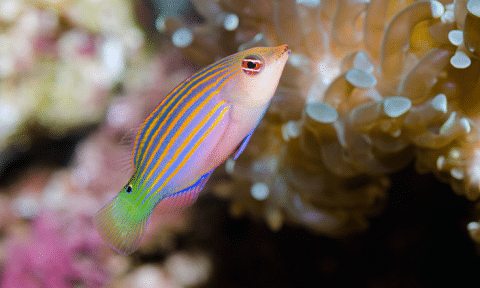
    1. Clownfish

    Editor’s Choice
    Tank Raised Clownfish

    Best Choice For Reef Tanks!

    Clownfish are hardy, full of personality, and are safe for all corals. They are an icon for any saltwater tank

    Click For Best Price Purchase ORA Clownfish
    • Genera: Amphiprion and Premnas
    • Size: 3-6 inches
    • Origin: Indo-Pacific
    • Tank Size: 20 gallons
    • Available As Tank Bred: Available

    Clownfish are one of the most recognizable saltwater aquarium fish available. But did you know that there are about 30 different species of this orange and white striped marine fish with even more variations available?

    The ocellaris clownfish (Amphiprion ocellaris), also known as the false percula clown, is the most common species to come across and is an ideal tank mate for smaller community tanks. More aggressive types and larger clownfish, like the maroon clownfish (Premnas biaculeatus), can easily fit into bigger reefs and more involved ecosystems.

    2. Royal Gramma

    • Species Type: Gramma
    • Scientific Name: Gramma loreto
    • Size: 3 inches
    • Origin: Western Central Atlantic Ocean
    • Tank Size: 30 gallons
    • Available As Tank Bred: Rare

    The royal gramma is another popular addition to the saltwater aquarium. This half-yellow and purple fish is appealing for beginner hobbyists due to its small size and bright colors.

    Though colorful and inexpensive, these beginner saltwater fish can become aggressive towards other fish in the aquarium, especially similar-looking species that were added afterward. Royal gramma are extremely hardy fish and definitely have a lot of character to bring to the home saltwater aquarium, but aggression will need to be monitored as the fish becomes more confident in its environment.

    3. Bangaii Cardinalfish

    • Species Type: Pterapogon
    • Scientific Name: Pterapogon kauderni
    • Size: 3 inches
    • Origin: Banggai Islands, Indonesia
    • Tank Size: 30 gallons
    • Available As Tank Bred: Available

    Bangaii cardinalfish, or Kaudern’s cardinalfish, are a little more desirable than the related pajama cardinal (Sphaeramia nematoptera). These small, black and white mouthbrooding fish have also been known to successfully breed in the aquarium, making them a fun challenge for more experienced hobbyists.

    Bangaii cardinalfish are only native to the Banggai Islands in Indonesia and some surrounding islands, making them a rare fish to come across in the wild. As a result, most of the Bangaii cardinalfish available in the aquarium hobby have been aquacultured.

    4. Chalk Bass

    Chalk Bass in Reef Tank
    • Species Type: Serranus
    • Scientific Name: Serranus tortugarum
    • Size: 3 inches
    • Origin: Western Atlantic Ocean
    • Tank Size: 30 gallons
    • Available As Tank Bred: Available

    If you’re looking for a marine fish that isn’t commonly found in beginner aquariums, then the chalk bass might be right for you. These fish are relatively plain in color, with a bluish-white base coat and overlaying red stripes at the top of their dorsal.

    Chalk bass are very hardy and fit perfectly into the community reef tank. In fact, these beginner saltwater fish are commonly kept together in small groups, though they might not always exhibit schooling behaviors. They can be shy at first but will swim in the open given the correct conditions.

    5. Yellow Coris Wrasse

    Yellow Coris Wrasse - A Great Addition for Pest Control
    • Species Type: Halichoere
    • Scientific Name: Halichoeres chrysus
    • Size: 5 inches
    • Origin: Eastern Indian Ocean
    • Tank Size: 50 gallons
    • Available As Tank Bred: Rare

    The yellow coris wrasse is bright yellow and difficult to pass over when shopping for new saltwater aquarium fish. Due to the size and activity of this beginner saltwater fish, yellow coris wrasses need more space than the other fish on this list.

    These fish are one of the hardiest species of wrasse and like to be around other wrasses. They won’t touch corals in a reef tank, but they are likely to eat other small invertebrates available in and around the rock.

    6. Tank Raised Coral Beauty Angelfish

    Coral Beauty Angelfish
    • Species Type: Centropyge
    • Scientific Name: Centropyge bispinosa
    • Size: 4 inches
    • Origin: Indo-Pacific Ocean
    • Tank Size: 70 gallons
    • Available As Tank Bred: Available

    For a long time, coral beauty angelfish were shoved into nano tanks. Just recently, hobbyists have started appreciating them as the fish that they are and housing them in the large tank setups they deserve. Though relatively small, coral beauties need room to swim and algae to graze on.

    Coral beauty angelfish are relatively peaceful, but have been known to be aggressive towards similar species, like the flame angelfish (Centropyge loricula). It is believed that coral beauties are more reef-safe than their flame counterparts, but it is still possible for them to nip at corals. They are available as tank bred now. These tank bred varieties are hardier and establish better in home aquariums than their wild caught counterparts.

    7. Azure Damselfish

    Azure Damselfish
    • Species Type: Chrysiptera
    • Scientific Name: Chrysiptera hemicyanea
    • Size: 3 inches
    • Origin: Indo-Pacific Ocean
    • Tank Size: 30 gallons
    • Available As Tank Bred: Available

    In addition to clownfish, other species of damselfish are very popular saltwater fish for beginners. However, they’re not always the best choice.

    In general, damselfish are very aggressive fish; though cheap and small, beginners often make the mistake of adding these beginner saltwater fish to their aquariums and having other fish be terrorized by them.

    Luckily, the azure damsel is one of the least aggressive species of damselfish though there’s still the possibility that they’ll establish strict territories and attack tank mates.

    8. Yellow Watchman Goby

    Watchman Goby in Reef
    • Species Type: Cryptocentrus
    • Scientific Name: Cryptocentrus cinctus
    • Size: 4 inches
    • Origin: Western Pacific Ocean
    • Tank Size: 20 gallons
    • Available As Tank Bred: Available

    The yellow watchman goby is a very fun fish to have, especially if you pair it with a symbiotic species of pistol shrimp, like the tiger pistol shrimp (Alpheus bellulus); this pairing is especially popular in nano setups. Otherwise, these beginner saltwater fish are bright yellow and can bring activity to the bottom of any tank.

    Yellow watchman gobies can be timid fish at first. They will burrow into the substrate and underneath rock to form tunnels, which can help be maintained by a pistol shrimp. Though these gobies won’t stray far from their burrows, they’ll come out for food and constantly try to make their home better.

    9. Tank Raised Yellow Tang

    Yellow Tang In Reef Tank
    • Species Type: Zebrasoma
    • Scientific Name: Zebrasoma flavescens
    • Size: 8 inches
    • Origin: Pacific Ocean
    • Tank Size: 125 gallons
    • Available As Tank Bred: Available

    Yes, yellow tangs can be a great beginner saltwater fish given that conditions are right. Hobbyists interested in getting a yellow tang for their tank need to understand that these fish are active swimmers and active grazers; they need a lot of open swimming space but they also need a lot of rock to pick at algae and other microflora.

    Many yellow tangs originated from Hawaii. Unfortunately, these ecosystems have been affected by overharvesting and Hawaiiโ€™s Department of Land and Natural Resources has needed to intervene. In early 2021, harvesting permits could not be renewed and all current permits became invalid.

    Luckily, the yellow tang is commonly bred in captivity so that their delicate Hawaiin ecosystems can be repaired. This tank bred yellow tangs are hardy and adapt easily to aquarium life.

    10. Firefish Goby

    Firefish
    • Species Type: Nemateleotris
    • Scientific Name: Nemateleotris magnifica
    • Size: 3 inches
    • Origin: Indo-Pacific Ocean
    • Tank Size: 10 gallons
    • Available As Tank Bred: Available

    Firefish goby are cheap, small, and unique looking, but they can quickly disappear from a saltwater tank. Unfortunately, these fish have a bad habit of jumping out of aquariums or disappearing behind rocks. This can dissuade some hobbyists, thinking they’ve done something wrong to kill the fish when actually these fish are just notorious for being difficult!

    If you’re looking for something a little more colorful but with the same personality as the firefish, then a purple firefish (Nemateleotris decora) might be what you’re looking for! Make sure to use a tight-fitting lid.

    Top 3 Types To Avoid

    Before going out and picking up a fish for your new aquarium, there are some saltwater fish species you should actively try to avoid. Here’s another video by yours truly. I’ll provide details below in the blog post.

    Though saltwater isn’t much more difficult than freshwater in the basic sense, there are some saltwater fish you will want to avoid as a beginner. Some other fish species can be sensitive to water parameters, prone to illness, or demanding when it comes to tank size and diet. These fish require extra time, consideration, and budget.

    1. Hippo Tang (Blue Tang AKA Dory)

    Blue Tang
    • Species Type: Paracanthurus
    • Scientific Name: Paracanthurus hepatus
    • Size: 12 inches
    • Origin: Indo-Pacific Ocean
    • Tank Size: 180 gallons
    • Available As Tank Bred: Available

    The hippo tang goes by a few names including blue tang, hepatus tang, regal tang, and Dory fish. The fame from the movie has made this a very popular saltwater aquarium fish. Unfortunately, they are rarely kept in the conditions they need to thrive, though.

    The hippo tang is not the best beginner saltwater fish due to its size, high activity levels, and sensitivity to water parameters and diseases. These fish are sold while they are only a few inches long, making them seem attainable by the average hobbyist. Within a year, they can grow to be several inches, causing many unaware hobbyists to have to find new homes for their tang.

    2. Mandarin Goby

    Healthy Mandarin Goby
    • Species Type: Synchiropus
    • Scientific Name: Synchiropus splendidus
    • Size: 3 inches
    • Origin: Western Pacific Ocean
    • Tank Size: 30 gallons
    • Available As Tank Bred: Rare

    Mandarin gobies are probably the most beautiful saltwater fish available but are actually one of the worst fish to have for anyone lacking experience.

    These fish need a constant supply of copepods and other small invertebrates. Not only does this mean that the tank should naturally be mature with a stable ecosystem, but it may also involve setting up another system just to harvest food. Even then, these fish have been known to reject food and starve.

    3. Copperband Butterflyfish

    • Species Type: Chelmon
    • Scientific Name: Chelmon rostratus
    • Size: 8 inches
    • Origin: Indo-Pacific Ocean
    • Tank Size: 125 gallons
    • Available As Tank Bred: Rare

    The copper band butterflyfish is another beautiful yet difficult-to-keep saltwater fish. Like mandarin gobies, copperband butterflies rely heavily on live rock and supplemental feedings for their invertebrate-based diet. In addition, the copperband butterfly can grow to be relatively large and is an active swimmer.

    These fish also fail to thrive when there are other larger, more active fish in the reef aquarium so some stocking consideration is needed. If you want to see how a healthy establish copper band butterfly behaves, check out Aaron’s video above. They need a well-established reef aquarium to thrive.

    FAQs

    What Is The Most Peaceful Types?

    If you’re looking to set up a community reef tank, then you’ll want fish that are fully compatible with each other. This is definitely more difficult in the saltwater setting than for a freshwater aquarium, but there are still many options available.

    Many of the species on our list of the best saltwater fish for beginners are compatible with one another. This extends to other species of tang, goby, blenny, butterflyfish, and angelfish. For the most part, these fish will happily live alongside one another; it should be noted that some species cannot be kept with similar-looking species, so caution is needed.

    What Is The Most Aggressive?

    Instead of the traditional reef tank, some saltwater hobbyists choose to set up a predatory tank. These can be popular among beginner hobbyists who are more attracted to statement fish, like pufferfish and triggerfish.

    It can be difficult to tell which saltwater fish are aggressive, though. Of course, the ones with noticeable spikes or protruding teeth should be avoided if planning on setting up a community tank. However, some damselfish can be even more aggressive than predatory fish and every individual fish will have its own personality and behavior in the tank.

    Because of this, it’s important to have a back up plan if suddenly one of your peaceful fish becomes aggressive overnight–yes, this does happen! This might include being able to return the fish to a local pet store or rehoming it to another hobbyist.

    What Is The Easiest Type To Keep?

    Tank raised clownfish are the overall easiest saltwater fish to keep in the trade. There are many varieties available and they are tolerate of many beginner mistakes. For smaller tanks, tank raised gobies can be a good option.

    Are They High Maintenance?

    No, saltwater fish are not high maintenance if you select the right ones. However, there are more factors to consider with saltwater fish than with freshwater fish. Marine fish require more water prep, and more expensive equipment, and diseases are more prevalent. All these factors make them more difficult to keep than most freshwater fish.

    Final Thoughts

    The world of saltwater can be scary, but also incredibly exciting! There are tons of popular fish species to pick from and the options might seem limitless.

    If you’re just starting out though, there are definitely some beginner saltwater fish that are easier to keep than others. Once you feel confident in keeping those, then you can move on to the more challenging and expensive species.

    Until then, maintain your water parameters and make your fish as happy as they can be!

  • Six Line Wrasse Care Guide: The Popular Reef Fish With a Reputation (and How to Manage It)

    Six Line Wrasse Care Guide: The Popular Reef Fish With a Reputation (and How to Manage It)

    The Six Line Wrasse is a pest controller that becomes a pest itself. It eats flatworms and bristleworms, which is great. It also terrorizes peaceful tankmates once it establishes territory.

    Add the six line wrasse last. If you add it first, nothing peaceful survives after.

    Add the six line wrasse last. If you add it first, nothing peaceful survives after.

    Table of Contents

    The Six Line Wrasse is one of the most popular saltwater fish for a reason, but popularity does not mean easy. This fish has specific requirements that reef store employees rarely explain. After 25 years of reef keeping, I know what separates a healthy specimen from a slow decline.

    Saltwater fish do not forgive mistakes the way freshwater fish do.

    Saltwater fish require stable parameters, quality food, and a mature tank. The startup cost and ongoing maintenance are significantly higher than freshwater.

    In saltwater, the tank runs on stability. Every shortcut you take shows up weeks later as a problem.

    What Most Care Guides Get Wrong About Six Line Wrasse The Popular Reef Fish With a Reputation (and How to Manage It)

    The most common mistake I see with six line wrasse the popular reef fish with a reputation (and how to manage it)s is keeping too few. Guides will say “minimum 6” and leave it at that. In reality, these fish behave completely differently in a proper group of 8 to 10 or more. Keeping just 3 or 4 often leads to stress, hiding, and fin nipping that wouldn’t happen in a larger school. Another thing most guides miss is how much lighting and decor affect this species. Six Line Wrasse The Popular Reef Fish With a Reputation (and How to Manage It)s look washed out under bright white LEDs on a light substrate. Dim the lights, add some tannins, use a dark background, and you’ll see colors you didn’t know they had. I’ve also noticed that many care sheets recommend overly broad water parameters.

    The Reality of Keeping Six Line Wrasse

    A mature tank is mandatory. Most saltwater fish need a tank that has been running and stable for at least 3 to 6 months. New tanks have unstable parameters that stress saltwater fish far more than freshwater species.

    Diet is not just flake food. Many saltwater fish need frozen mysis, brine shrimp, or specialty foods to thrive. A pellet-only diet leads to malnutrition, faded colors, and immune suppression. Variety is not optional.

    Quarantine is essential. Marine ich and velvet are common in newly purchased saltwater fish. A proper quarantine tank before adding fish to your display tank prevents devastating disease outbreaks.

    Biggest Mistake New Owners Make

    Skipping quarantine and adding a new saltwater fish directly to the display tank. One infected fish introduces marine ich to your entire system. Treatment in a reef tank is nearly impossible because copper kills corals and invertebrates.

    Expert Take

    Quarantine every new fish for 4 to 6 weeks before adding it to your display. I have never met a serious reefer who regretted quarantining. I have met dozens who regretted skipping it.

    Frequently Asked Questions

    Are Six Line Wrasses aggressive?

    Six Line Wrasses can become territorial and aggressive, especially toward other small, similarly shaped fish. They are fine in larger tanks with plenty of rockwork and hiding spots. Adding them as one of the last fish to the tank can help reduce territorial behavior.

    Are Six Line Wrasses reef safe?

    Yes, Six Line Wrasses are reef safe and will not bother corals. They actually benefit reef tanks by eating flatworms, pyramidellid snails, and other small pests. They are one of the most useful pest-control fish available for reef aquariums.

    How big do Six Line Wrasses get?

    Six Line Wrasses reach about 3 inches in length at full maturity. Their compact size makes them suitable for tanks as small as 30 gallons, though a larger tank helps manage their territorial tendencies.

    Will a Six Line Wrasse eat cleaner shrimp?

    Six Line Wrasses leave adult cleaner shrimp alone but may harass or eat very small shrimp. They are known to eat tiny ornamental shrimp and may pick at newly molted shrimp. Most keepers report no issues with established cleaner shrimp.

    What do Six Line Wrasses eat?

    Six Line Wrasses eat a variety of meaty foods including mysis shrimp, brine shrimp, and finely chopped seafood. They also hunt small pests like flatworms and pyramidellid snails. Feed them two to three times daily for best health and coloring.

    Species Overview

    Scientific NamePseudocheilinus hexataenia
    Common NamesSix line wrasse and six stripe wrasse
    FamilyLabridae
    OriginIndo-Pacific and the Red Sea
    DietOmnivore
    ColorsPurplish-pink, blue, yellow, orange, green
    Care LevelEasy
    TemperaturementSemi-aggressive to Aggressive
    Minimum Tank Size40 Gallons
    Max Size3 inches
    Temperature Range76. 82 degrees F
    pH Range8.0. 8.4
    Salinity1.025 or 35 PPT
    Reef SafeYes

    Classification

    OrderPerciformes
    FamilyLabridae
    GenusPseudocheilinus
    SpeciesP. Hexataenia (Bleeker, 1857)

    Origins And Habitat

    Six line wrasses are a widespread species found throughout the Red Sea and Indo-Pacific. More specifically, they is found in warm waters all the way from the west coast of southern African, up to the coasts of India, across to Japan, and down to Fiji; they is found near surrounding islands as well1.

    These attractive fish are found in shallow reefs no deeper than about 65 feet. They especially favor dense reefs with close-knit branched corals where they can easily hide and forage for small crustaceans.

    Though six line wrasses are not very social, they will be seen in mating pairs or loose shoals as they forage the reef for food.

    How Long Do They Live?

    There is no average lifespan for six line wrasses, but it’s safe to say that they have the possibility to live 10 years or more.

    In general, six line wrasses are incredibly hardy fish once established in the reef aquarium. There is some difficulty with stress from improper care or poor acclimation, but these fish do extremely well once settled in.
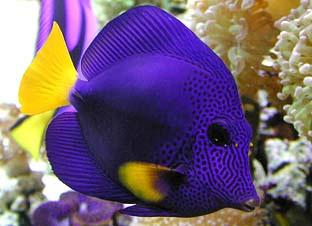
    What Do They Look Like?

    Six Line Wrasse in Reef Tank

    Six line wrasses are very colorful and active fish. They are also very small, staying under 3 inches when fully mature, which can make them appealing to hobbyists with nano tanks. As we’ll discuss later, even though this fish is small it is by no means an appropriate nano species.

    These fish have beautiful colors and patterns. They have a purplish-pink base color that will appear as dark red in different settings; the underbelly is the lightest portion of the body and can have a tan appearance against the bluish anal and ventral fins. In shape, the body is very aerodynamic with exact curvature for quick and efficient travel.

    Six line wrasses are named after the six alternating blue and orangey-yellow stripes along the sides of their body that run from behind the gill, onto the dorsal fin, and onto the caudal (tail) fin. The tail fin is green at the base and transition into yellow or become transparent. At the top of the base of the tail, there is also a black eyespot which is used to confuse predators.

    Six line wrasses also have very characteristic red eyes with two horizontal stripes at either side of the pupil.

    Hermaphroditism

    While six line wrasses have not been successfully bred on a large scale in the aquarium hobby, their reproductive habits and life stages have been closely studied.

    Like many other species of wrasse, the six line wrasse is a protogynous hermaphrodite. This means that the individual fish are born as females and transition into males as they mature in response to internal and external factors.

    This is very unlikely to happen in the aquarium setting which is a closed system without additional environmental factors.

    Tank Requirements

    There is a lot of debate surrounding six line wrasse tank and care requirements. For many years, they were eagerly shoved into small tanks due to their small size. However, over the past few years, hobbyists have agreed that they need a lot more space than was originally believed.

    Still, experienced keepers have had success keeping six line wrasses in 20 gallons. Other hobbyists find that 55 gallons is the bare minimum. We believe that a standard 40 gallon fish tank with intricate rockwork should be enough space for your six line wrasse to freely roam.

    As they heavily rely on the structure of reefs and corals in the wild, live rocks are a necessity for this species. It is also recommended to use a sand substrate as six line wrasses, like many other species of wrasse, will use the sandbed to hide if stressed. Some will even sleep in the sandbed, though this is a sign that something else is wrong in the tank.

    Otherwise, six line wrasses are incredibly hardy. They is a little tricky to acclimate and don’t do well with sudden changes in water parameters but will thrive once established. There is no special care or maintenance needed to make sure your six line wrasse does well once introduced into the aquarium.
    However, it is also a necessity to have a tight-fitting lid on the tank. Remember, these fish are aerodynamic and can easily jump out of small openings in the top of the aquarium. If you have a rimless aquarium, consider getting a mesh net to prevent your fish from jumping.
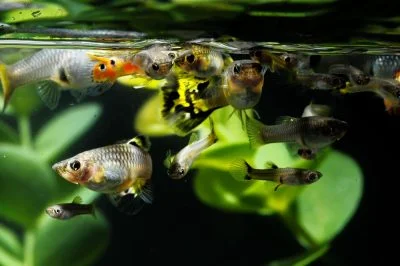
    Temperament

    https://youtu.be/3Ck-0ZQKLRY

    Not only are six line wrasses known for their activity levels, but they can also be very big bullies. There are a few benefits to having them in the tank though as they will act as a type of cleaner fish and will even control some pest populations (Video source).

    Six line wrasses are often the most active fish in any aquarium setup. They can quickly dash across the front of the reef tank or take their time maneuvering in and out of the rocks, looking for some microorganism to nibble on. No matter what they’re doing, they’re always moving.

    However, when they’re not looking for food they is bothering other fish. There are many stories from hobbyists who have had to trade in or give away their six line wrasse after a year of having them because they turn into a menace overnight. This is one of the risks you take when adding one of these fish to your aquarium!

    Six line wrasses are labeled as being semi-aggressive, though they’re either peaceful or aggressive with no in-between. The problem with these fish is that they is model citizens until they’re not. One day, they may start terrorizing other peaceful fish in the aquarium and they won’t stop; six line wrasses are very persistent at pestering other fish, which can quickly lead to weakened, sick, and dead tankmates.

    As mentioned before, many hobbyists end up giving their six line wrasses away as the aggression only gets worse with time. However, increasing feedings and providing more hiding places may help deter some aggression, though this is not guaranteed.

    If you’re looking for a fish that’s not as aggressive but still as colorful, then you may consider the eight line wrasse (Pseudocheilinus octotaenia); note that these fish are considerably larger and can also be relatively aggressive. Other larger peaceful wrasses like the Yellow Coris do not exhibit this behavior, but may harass and eat shrimp.

    Are They Cleaner Fish?

    It has been said that six line wrasses can act as a cleaning species for other fish, though this isn’t often observed. In general, a cleaner shrimp is going to do a better job.

    Experienced keepers have seen their six line wrasse approach other fish and pick at parasites and other foreign bodies that is present. While some wrasses, like the bluestreak cleaner wrasse (Labroides dimidiatus), are known for having a mutualistic cleaning relationship with fish, this behavior is largely undocumented with six lines.

    If you find that your six line wrasse is picking at the sides of other fish in a friendly manner, then you may have a cleaner six line wrasse! Keep an eye out for if this turns into aggression and/or starts to bother the other fish.

    Pest Control

    Bristle Worm Upclose

    Though your wrasse might not be a natural cleaner, there is a good chance that it will control some pests in your saltwater aquarium. Six line wrasses are foragers and advantageous scavengers. They will happily eat any small invertebrates they come across as they swim in and out of the rocks.
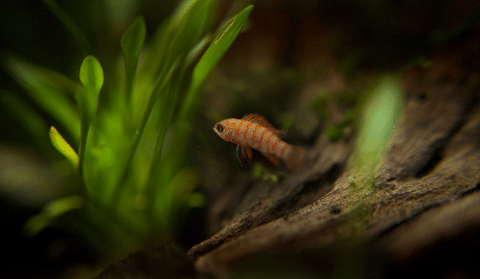
    Some of the six line’s favorite quick snacks include flatworms and bristle worms. This is beneficial for hobbyists struggling with flatworm or nudibranch hitchhikers, like those commonly found on small polyp stony (SPS) corals. They can also help hobbyists who don’t enjoy the appearance of bristle worms, though these worms is some of the best cleanup crew members.

    At the same time, six line wrasses will eagerly eat any copepods they come across. Hobbyists work years to establish a healthy copepod population in their aquariums, especially if they have a finicky eater like the mandarin goby (Synchiropus splendidus). If this applies to your tank, you should not add a six line wrasse.

    It should also be said that six line wrasses will not eradicate a pest infestation. Though they will definitely help control populations, there are simply too many pests for one fish to eat. In addition, these fish should never be added to a tank simply to help with a pest problem!

    Are They Reef-Safe?

    Past their aggression and interesting behaviors, six line wrasses make a great reef-safe fish; of course, there will always be one individual that is not reef-safe from this sample, but in general, six line wrasses are reef-safe.

    In fact, these fish feel especially at home in between the branches of elaborate SPS colonies. In the wild, they use these branches for protection and this natural behavior will translate into the saltwater aquarium setting as well.

    Tankmates

    Purple Tang

    Six line wrasses are largely regarded as a community species fit for any fish only (FO), fish only with live rock (FOWLR), or reef setup. However, they shouldn’t be treated as just another community fish.

    In general, you want tankmates that can stand against your six line wrasse, either in terms of speed or aggression. Species like tangs, angelfish, and damsels, will be able to escape or hold their own against the tyranny of an aggressive six line wrasse.

    There are a few methods to increase the chances of compatibility among your tankmates.

    1. Add the six line wrasse last. Adding this species to the tank last leaves little room for a hierarchy to form among other fish and even less physical space for a large territory to be established.
    2. Acclimate slowly. In this case, we don’t mean acclimation in the sense of matching water parameters. Instead, use a glass or plastic container to slowly introduce your wrasse to the rest of the tankmates. Simply submerge or float this container with your wrasse inside for several days. This should get all fish familiarized with each other so there is less immediate aggression.
    3. Get a pair of six line wrasse. Pairs of wrasses are difficult to come by. This method only really works if you know with certainty that the two fish are already a mated pair. Experienced keepers have found that keeping six line wrasses in pairs completely diminishes aggression.

    Lastly, you want to stock your tank accordingly. There are definitely a few species you will want to avoid if you’re trying to eventually add a six line wrasse to the stock list.

    Can They Live With Clownfish?

    Whether or not six line wrasses can live with clownfish is completely up to the personality of the individual fish. I, personally, kept a six line wrasse with ocellaris clowns (Amphiprion ocellaris) and never had a problem. Other hobbyists have had their clownfish killed overnight.

    If you desperately want to keep your clownfish alive, then do not add a six line wrasse. There are also a few other species of clown that is able to tolerate possible aggression instead.

    Some varieties of maroon clown (Premnas biaculeatus) can grow to be very large, which could possibly intimidate the wrasse. Tomato clowns (Amphiprion frenatus) can also get to be very big and are one of the most aggressive species, making them a good candidate as a six line wrasse tankmate.

    Can They Live Together?

    Yes, experienced keepers have successfully kept pairs of six line wrasse together, though this is rare. In fact, pairs often help diffuse aggression.

    More importantly, though, wrasses of different species should not be kept with six lines. It is not unheard of for a six line wrasse to kill another, larger species of wrasse. The territories, body shapes, and behaviors can overlap too much and the six line may see the other fish as a threat.

    Of course, experienced keepers have had complete success keeping an assortment of wrasses together, though this is uncommon.

    What Do They Eat?

    Six line wrasses are very opportunistic feeders. On top of the many bristle worms, snails, and microorganisms they find among the rocks, they will readily eat fish flakes and pellets. They will also appreciate meaty foods like live, frozen, and freeze-dried options like brine shrimp and mysis shrimp as well. Blackworms are also a good option. For frozen foods, I highly recommend LRS foods.

    Will They Eat Peppermint Shrimp?

    While these fish gladly eat small invertebrates, they leave bigger snails, crabs, and shrimp alone. This includes peppermint shrimp (Lysmata wurdemanni) that are much larger than the very small mouth of the six line wrasse.

    Of course, if your fish is especially hungry, it might try to go after bigger prey and it’s not unheard of for them to eat snails and smaller shrimp. As long as you keep your fish fed and watch for signs of aggression, there should be no problems with keeping other invertebrates.

    Is the Six Line Wrasse The Popular Reef Fish With a Reputation (and How to Manage It) Right for You?

    Before you add a six line wrasse the popular reef fish with a reputation (and how to manage it) to your tank, it’s worth asking whether this species actually fits your setup and your goals. Here’s a quick breakdown to help you decide.

    This species is a good fit if:

    • You have a large enough tank to manage territories. Cramped conditions amplify aggression.
    • You’re comfortable managing aggression through stocking ratios, line of sight breaks, and tank layout.
    • You can commit to regular water changes. These fish produce more waste than many smaller species.
    • You’re not planning a peaceful community tank. Six Line Wrasse The Popular Reef Fish With a Reputation (and How to Manage It)s need tank mates that can hold their own.
    • You enjoy watching active, interactive fish. Cichlids have personality that smaller species simply don’t match.
    • You have backup plans. Sometimes a particular fish just doesn’t work out, and you need a way to rehome it.
    • You’re feeding a varied, high-quality diet. Color and health depend on nutrition.

    If most of those points line up with your setup, the six line wrasse the popular reef fish with a reputation (and how to manage it) is worth serious consideration. If several don’t, it’s better to choose a species that matches your tank now rather than trying to make it work.

    How the Six Line Wrasse The Popular Reef Fish With a Reputation (and How to Manage It) Compares to Similar Species

    Want a hardy first saltwater fish? Get clownfish. Want more personality? Get a six-line wrasse. Want a showstopper? This fish is worth the effort if your tank is ready.

    Choosing between similar species is tricky. Here’s how the six line wrasse the popular reef fish with a reputation (and how to manage it) stacks up against some common alternatives.

    The six line wrasse the popular reef fish with a reputation (and how to manage it) occupies a specific niche in the aquarium hobby, and direct comparisons really depend on what you’re looking for. In my experience, the most common question people ask is whether they should choose the six line wrasse the popular reef fish with a reputation (and how to manage it) or something similar that’s more widely available. The answer comes down to three things: tank size, water parameters, and what other fish you’re keeping. If your setup matches what the six line wrasse the popular reef fish with a reputation (and how to manage it) needs, it’s hard to beat. If not, there are alternatives worth exploring.

    Final Thoughts

    Six line wrasse have been misunderstood for a very long time. Just recently, hobbyists have come to understand their true needs and aggression levels. Though these fish are relatively peaceful and reef-safe, they definitely have the capability of attacking and killing other fish in the tank.

    Keeping aggression in mind, these popular saltwater aquarium fish bring color to the home display like no other and are exceptionally hardy once established in the tank.

  • Fish For A 5 Gallon Tank – 10+ Great Choices (With Pictures)

    Fish For A 5 Gallon Tank – 10+ Great Choices (With Pictures)

    Five-gallon tanks are tricky because the stocking options are genuinely limited. and I see a lot of bad advice online suggesting fish that have no business being in that small a space. I’ve set up 5-gallon tanks myself for bettas and nano fish, and done right they can look absolutely stunning. The key is respecting the volume and sticking to species actually suited for it.

    Are you looking for ideas on which fish to put in your 5-gallon tank? Choosing fish for this aquarium size can take some planning because there aren’t that many species that will do well in such a small tank.

    In this article, I’ll introduce you to 13 of the best fish and shrimp species that you can keep in your 5-gallon aquarium and give you some good advice on setting up and maintaining your nano tank. So let’s get started!

    The 13 Best Fish For A 5 Gallon Tank

    There aren’t many species for freshwater aquariums of this size, but you can still find some great options. Below is my video for you visual learners. I go into more detail in the blog post below. If you like the content, give us a sub on our YouTube channel.

    In this list, I’ll introduce you to the best fish and shrimp species for your 5-gallon aquarium. For each of the species, I’ll provide you with some important information and facts like:
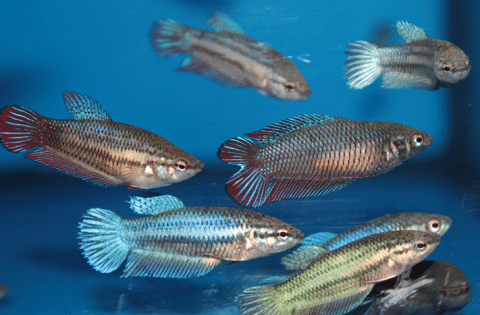
    • Scientific Name
    • Adult Size
    • Care Level
    • Temperament
    • Diet
    • Origin
    • Water Temperature
    • Swimming Level

    As with pretty much every aquarium fish, a larger tank would be better, but all of these awesome animals can do great in a 5-gallon tank if you provide them with the right care.

    So let’s meet the 13 best fish and shrimp!

    1. Betta

    WYSIWYG Available!
    Betta Fish

    Use Coupon Code ASDFISH at Checkout

    Betta Fish are one of the most beautiful varieties of freshwater fish available in the hobby. Easy to care for with plenty of varieties!

    Buy Premium Varieties Buy On Petco Online
    • Scientific Name: Betta splendens
    • Adult Size: 2.5-3 inches
    • Care Level: Moderate
    • Temperament: Agressive
    • Diet: Carnivorous, Feed live/frozen foods, flakes, and pellets
    • Origin: Asia, Thailand, Vietnam, Cambodia
    • Temperature: 75-80ยฐF
    • Swimming Level: Midwater, Top

    Betta fish are one of the best freshwater fish for a nano tank and that’s why they are so popular in the fishkeeping hobby. These beautiful fish are available in a bunch of different varieties with different color patterns and fin shapes.

    You might know them as the Siamese fighting fish because the males are really aggressive towards other males, that’s why you should only keep one male in a tank. Bettas have big personalities and make awesome pets.

    They like to play and can even be taught a few simple tricks like jumping right out of the water. A 5-gallon tank is perfect for a betta, just be sure to set it up with a filter and a heater.

    2. Guppy

    Guppy Fish
    • Scientific Name: Poecilia reticulata
    • Adult Size: 2 inches
    • Care Level: Easy
    • Temperament: Peaceful
    • Diet: Carnivorous, Feed live/frozen foods, flakes, and pellets
    • Origin: The Caribbean and Northeastern countries of South America
    • Temperature: 63-82ยฐF
    • Swimming Level: Midwater, Top

    Guppies are an awesome and often overlooked nano fish species that can be kept in a 5-gallon aquarium. These fish come in all sorts of different colors and are really easy to breed because they are livebearers.
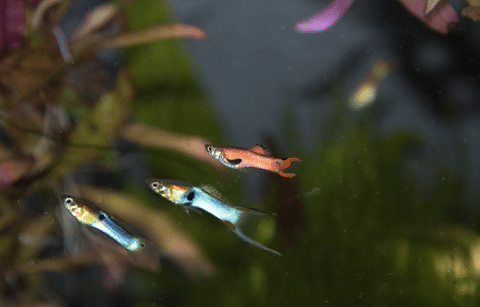
    In a 5-gallon tank, the population can grow really quick, so a good option is to keep just a trio of males. The males are usually easy to spot because they are smaller, have longer fins, and are more colorful than the females.

    3. Chili Rasbora

    • Scientific Name: Boraras brigittae
    • Adult Size: 0.8 inch
    • Care Level: Easy
    • Temperament: Peaceful
    • Diet: Carnivorous, Feed live/frozen foods, flakes, and pellets
    • Origin: Southeast Asia
    • Temperature: 68-82ยฐF
    • Swimming Level: Midwater, top

    Chilli, or mosquito rasboras (video source) as they are also known are awesome little fish for a 5-gallon tank. They have really vibrant color and are peaceful enough to keep with inverts like shrimp and snails.

    Chilli rasboras are one of the smallest fish you can get. They do great in a 5-gallon tank and it is best to keep them without other species that might outcompete them for food. They are a great fish for a no heater setup. They are able to thrive in room temperature homes without a heater. They are arguably the best looking coldwater fish you can purchase at this size.

    4. White Cloud Mountain Minnows

    White Cloud Minnow
    • Scientific Name: Tanichthys albonubes
    • Adult Size: 1.5 inches
    • Care Level: Easy
    • Temperament: Peaceful
    • Diet: Carnivorous, Feed live/frozen foods, flakes, and pellets
    • Origin: China
    • Temperature: 58-72ยฐF
    • Swimming Level: Midwater

    White cloud minnows are beautiful and peaceful fish that do best in cooler water than your standard tropical setup. Although these fish will do better in a larger aquarium, 5 gallons is about their minimum tank size.

    A small group of about 4 of these fish can be kept in 5-gallon fish tanks with good filtration and regular maintenance. This is another fish where a heater is not necessary.

    5. Scarlet Badis

    Scarlet Badis
    • Scientific Name: Dario dario
    • Adult Size: 0.5-0.75 inches
    • Care Level: Moderate
    • Temperament: Semi-agressive
    • Diet: Carnivorous, Feed live/frozen foods
    • Origin: India, Asia
    • Temperature: 64-79ยฐF
    • Swimming Level: Bottom, Midwater

    Scarlet Badis are amazing tiny fish with great colors. They are one of the best fish for more experienced fish keepers. Scarlet badis fish don’t feed well on processed food and will need to be fed frozen or live foods to stay healthy.

    They are shy little creatures that aren’t good at competing with other fish, so it is best to keep these little jewels in their own tank and to watch to make sure they are eating well. The perfect setup would be one male with a group of females.

    6. Dwarf Pea Puffer

    • Scientific Name: Carinotetradon travancoricus
    • Adult Size: 1 inch
    • Care Level: Moderate
    • Temperament: Agressive
    • Diet: Carnivorous, feed live and frozen foods
    • Origin: Asia, India
    • Temperature: 72-82ยฐF
    • Swimming Level: Midwater, Top

    Dwarf Pea puffers (video source) are one of the coolest little fish species available in the hobby. These fish have sharp teeth and are true carnivores so it is best to keep them on their own without any other species as tank mates. Shrimp are definitely not safe with these tiny but aggressive fish.

    One of these fish will make a great pet for a 5-gallon tank. Dwarf puffers need live and/or frozen foods like brine shrimp, micro-worms, bloodworms, and snails. These fish love to explore so consider growing some live plants in their tank. Some floating plants will also bring out the best of their personality.

    7. Celestial Pearl Danio

    CELESTIAL <a href=PEARL DANIO” class=”wp-image-546585″/>
    • Scientific Name: Celestichthys margaritatus
    • Adult Size: 0.75 inch
    • Care Level: Moderate
    • Temperament: Peaceful
    • Diet: Omnivorous, Feed live/frozen foods, flakes, and pellets
    • Origin: Asia, Myanmar, Thailand
    • Temperature: 68-78ยฐF
    • Swimming Level: Midwater

    Celestial pearl danios are one of the most popular fish species for small aquariums because they’re just so pretty and interesting to watch. These small fish look amazing in heavily planted nano tanks.

    CPDs are shy little fish that can be kept quite safely with shrimps as tank mates. Adult males have the best colors and can be pretty territorial so make sure there are some live plants in the tank to break up their line of sight with other fish.

    8. Cherry Shrimp

    Beginner Friendly
    Cherry Shrimp

    Great red color and very hardy. Cherry shrimp are the best beginner shrimp for shrimp tanks

    Click For Best Price Buy In Bulk
    • Scientific Name: Neocaridina heteropoda
    • Adult Size: 1.5 inches
    • Care Level: Easy
    • Temperament: Peaceful
    • Diet: Omnivorous, feed shrimp pellets, algae wafers, vegetables
    • Origin: Taiwan, Asia
    • Temperature: 65-85ยฐF
    • Swimming Level: Bottom

    Cherry shrimp are a great alternative to fish for your 5-gallon tank. You can keep quite a few of these peaceful and fascinating little creatures in your tank without overstocking.

    It is best to keep a group of at least ten cherry shrimp together in a shrimp-only tank because most freshwater aquarium fish can potentially injure or eat them. Cherry shrimps are ideal animals for aquascaped planted aquariums.
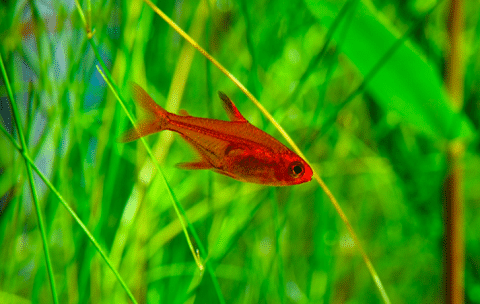
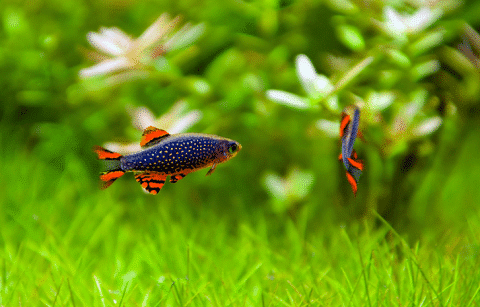
    9. Amano Shrimp

    • Scientific Name: Caridina multidentata
    • Adult Size: 2.5 inches
    • Care Level: Moderate
    • Temperament: Peaceful
    • Diet: Omnivorous, feed shrimp pellets, algae wafers, vegetables
    • Origin: East Asia
    • Temperature: 65-85ยฐF
    • Swimming Level: Bottom

    Even though Amano shrimp are not as colorful as cherry shrimp, they are one of the best fish tank cleaners and are also super interesting in their own right. Amano shrimp scavenge and love feeding on algae and decaying plant material, so they are perfect for planted tanks.

    Unfortunately, Amano shrimp can easily be hurt by other tank mates. Although there a few fish species that they can be kept with, a shrimp only tank can be great fun too. They will not cross bred with other shrimp types.

    10. Female Betta

    Female Betta Group
    • Scientific Name: Betta splendens
    • Adult Size: 2.5 inches
    • Care Level: Moderate
    • Temperament: Semi-aggressive
    • Diet: Carnivorous, Feed live/frozen foods, flakes, and pellets
    • Origin: Asia, Thailand, Vietnam, Cambodia
    • Temperature: 75-80ยฐF
    • Swimming Level: Midwater, Top

    Female betta fish are a lot less popular in the hobby than males, but they do have a bunch of great advantages. Female bettas are a lot smaller than males, their fins aren’t as big and their colors aren’t as bright. On the plus side, female betta fish tend to be a lot less aggressive than males, which means you can keep more than one of them in the same tank.

    11. Endler’s Livebearer

    Endler's Livebearer
    • Scientific Name: Poecilia wingei
    • Adult Size: 0.75-1.25 inches
    • Care Level: Easy
    • Temperament: Peaceful
    • Diet: Omnivorous, Feed live/frozen foods, flakes, and pellets
    • Origin: Venezuela, South America
    • Temperature: 75-86ยฐF
    • Swimming Level: Midwater, Top

    Endler’s livebearers look a lot like guppies but they are not actually the same fish species. These are peaceful fish, although females can be a little aggressive towards one another if you don’t have enough of them to spread the aggression.

    Livebearers breed very easily in home freshwater aquariums, so you can expect a lot of babies if you keep both males and females together in the same tank. The males are smaller and more colorful than the females, so many aquarists choose to keep males only.

    12. Ember Tetra

    Ember Tetra
    • Scientific Name: Hyphessobrycon amandae
    • Adult Size: 0.8 inches
    • Care Level: Easy
    • Temperament: Peaceful
    • Diet: Carnivorous, Feed live/frozen foods, flakes, and pellets
    • Origin: Brazil, South America
    • Temperature: 68-82ยฐF
    • Swimming Level: Midwater

    Ember tetras are awesome aquarium fish for small tanks. They are peaceful, stay small, and have great colors.

    These fish prefer planted tanks where they can feel more comfortable in their environment. Growing some live aquarium plants can also be very helpful in maintaining good water quality in small setups.

    13. Emerald Dwarf Rasbora

    • Scientific Name: Microrasbora erythromicron
    • Adult Size: 0.8 inches
    • Care Level: Moderate
    • Temperament: Peaceful-Semi-aggressive
    • Diet: Omnivorous, Feed live/frozen foods and sinking pellets
    • Origin: Myanmar, Asia
    • Temperature: 68-75ยฐF
    • Swimming Level: Bottom, Midwater

    The emerald dwarf rasbora (video source) is an amazing fish species for your 5-gallon tank. These little guys need higher pH water to thrive and appreciate a densely planted tank. They can be pretty shy so the live plants will help them to feel more secure and act out their natural behaviors.

    Why Choose A Tank This Small?

    There is a general rule in the fishkeeping hobby that the bigger the tank, the better it is for your fish. Many new fishkeepers think a smaller aquarium is easier to keep than a larger one, but this isn’t actually true.

    Small fish tanks have a number of benefits though, especially if you have limited space or want a tank for your desk. Maintaining a small fish tank can be quite challenging, so I usually recommend these aquariums to more experienced fish keepers.

    The fact is though, that as long as you put in the research, and keep up with your maintenance, there’s no reason you can’t be successful in keeping your pets healthy and your miniature underwater world looking great.

    How To Set Up This Size of Aquarium

    Now that you’ve met some of the best fish for 5-gallon aquariums, it’s time to learn more about setting up their home, so let’s get started! If you want to skip all of this and get a ready-to-run aquarium, I would suggest looking into a Fluval Spec V.

    Editor’s Choice!
    Fluval Spec V

    The Best Betta Fish Tank

    Best filtration, best light, perfect size and with everything you need to get started. It was made for Bettas!

    Buy On Petco Buy on Amazon

    Filtration

    The challenge with keeping a small aquarium is keeping the water healthy and safe for your pets. The smaller the amount of water, the faster things can go wrong in there. Your first line of defense here is good filtration!

    You absolutely have to have a filter for your 5-gallon tank, there’s no getting around it. But what kind of filter should you get? Well, there are many great options out there, including, hang-on back, internal power filters, and sponge filters.

    You can even use a small internal power filter AND a sponge filter, just remember that your space in the tank is limited and you want to keep the current gentle. If you do use a power filter, make sure it is fitted with a pre-filter sponge to avoid your fish or shrimp being sucked up through the intake.

    Heating

    Another important piece of equipment that you will need is a heater. Temperatures will swing quickly in small tanks, and that’s why you need a heater to maintain the stable temperature that your fish prefer. You should also install a thermometer to keep an eye on your heater’s performance.

    Aquarium Maintenance

    The most important part of your tank maintenance routine with a 5-gallon tank is to perform regular water changes. As a rough guide, a water change of 20-30% of the volume of your tank every week or 2 is recommended. The size of the water change and how often you need to do them will vary though depending on a couple of factors like:

    • How heavily stocked your tank is (number and size of fish)
    • The quality of your filtration
    • How many plants do you have in the tank

    When putting new water back into your tank, make sure it’s the same temperature as your aquarium to avoid shocking your livestock. Always treat the water with a conditioner before adding it to your tank to neutralize any harmful chemicals.

    Water Quality

    Performing regular water changes and running a good quality filter are the first steps towards maintaining great water in your 5-gallon aquarium, but there are a few other things you should be doing to keep your water parameters in line.

    Keeping Your Aquarium Clean

    Solid waste tends to build up on the bottom of the tank in time, and this should be cleaned up when you’re doing your water changes. Go ahead and use a gravel vacuum to suck up all that dirt and uneaten food while you’re removing water.

    When it comes to feeding your fish, try not to supply more food than your fish can consume right away (within a few minutes). That way you don’t have to worry about the food rotting away in your small tank.

    Algae is a natural, but sometimes annoying part of fish keeping. You can use an algae scraper to keep your glass clean. Unfortunately, this aquarium is too small to consider an algae clean up crew. The best clean up crew member would be an amano shrimp, however, your Betta will likely hunt it down given the lack of space and stimulation your betta fish will have. You could upgrade to a 10 or 20 gallon tank to recruit clean up members.

    Water Testing

    Testing your water regularly is the best way to monitor your water parameters. The most important things to monitor are ammonia, nitrite, and nitrate levels.

    Keep a close eye on your ammonia and nitrite levels. These should read zero to indicate that the nitrogen cycle is running properly in your small aquarium. Testing is easy with a liquid test kit or some strip tests that you can find at your local fish keeping store.

    Mixing Different Types In the Aquarium

    Due to the size of a 5 gallon aquarium, it is best to stick to one species of fish. The best fish that do well in a tank this size are going to be nano fish. Nano fish are fish that are going to be 2 inches or less in length. Most of these fish are schooling fish. They will need a group of 4 to 6 fish to do well. Because of the schooling requirement, you will be limiting to picking one fish species for your setup.

    Not if you chose a Betta fish, you only be able to house this freshwater aquarium fish. You can add other inverts like aquarium snails, but the fish itself adds a lot of bioload to an already small tank.

    Growing Plants

    Many of the fish on this list will do best in a planted small tank because the structure creates great hiding places and shelter that makes the fish feel more secure. This helps the fish behave more naturally and lowers their stress levels.

    Another huge benefit of keeping fish with live aquatic plants in your freshwater tank is their usefulness in lowering nitrates in the water. This helps keep the water quality good for your pets. Here are a few examples of great plants that would work for nano tank like this:

    If you’ve never tried before, growing live plants can be really easy, so go ahead and check out my aquarium plant growing guides for more information.

    Lighting for a Planted Tank

    If you pick the Fluval 5, you will have the light you need in order to grow low light/low energy plants. If you build your own 5 gallon tank, or want to take a step up to a better light, you can look up specialty planted tank led systems.

    If you are looking for a quick recommendation, consider the Current USA Serene RBG lights. It’s easy to use, has the PAR and spectrum output, and is reasonably affordable.

    Best Value
    Serene RGB Pro LED

    Current USA’s offering into aquascaping is an incredible value. Spectrum, spread, easy to program and great PAR output.

    Click For Best Price Buy On Amazon

    Where To Buy Items

    Most of the fish on this list are easy to find at local aquarium stores, but nano fish can be a little harder to track down sometimes.

    Flipaquatics.com is a trusted online fish supplier that I recommend. They keep pretty much all of the fish on this list!

    They put all their livestock through a 30-day quarantine and have an amazing live arrival guarantee which takes so much of the stress out of transporting small, fragile fish.

    FAQS

    How many pets can you keep in this size aquarium?

    In the aquarium hobby, 5 gallons is considered pretty small, and aquarists need to be careful not to overstock their tank. So how many fish is too many fish in small tanks?

    There is an old rule of thumb that says you can keep 1 inch of fish for every gallon in the tank. This is only a very rough guideline, and depending on your setup, you might be able to keep more fish or less.

    The guideline is a useful start for the fish in this list, as long as you have good filtration, and stay on top of maintenance.

    Is this size of aquarium big enough for 2 fish?

    You can keep 2 fish in a 5-gallon aquarium, provided they are suited for such a small tank. Tiny species like the dwarf rasboras and danios can do great in small schools of 2 or more in a 5-gallon fish tank.

    What varieties can I put in my aquarium?

    Your options are a little limited when it comes to stocking a 5-gallon tank because most of the freshwater fish in the aquarium hobby need a much bigger fish tank. Any of the amazing fish in this list can be kept as long as you have all the necessary equipment and stay on top of your maintenance schedule.

    What else can live in this tank?

    Apart from the great fish on my list, you can also keep red cherry shrimp or other dwarf freshwater shrimp, freshwater snails, or even one or two African dwarf frogs in a 5-gallon tank

    Is this tank big enough for a betta?

    5 gallons is a great size for a betta fish tank. Just remember to pick up a heater and a filter for your betta fish, and keep up with regular tank maintenance to keep your pet happy and healthy.

    Final Thoughts

    Keeping fish in a 5-gallon tank is a fascinating and fun hobby. It does take a little discipline and effort but as long as you stick to the species on this list, and provide them with the care they need, you can create your own amazing miniature aquatic environment.

    Have fun with it, and comment below with any questions! If you are looking for fish for a 10-gallon tank, check out my other post. We also have a list for 20 gallon fish too!


    ๐Ÿ“˜ Want to learn more? This article is part of our complete Freshwater Fish Guide. your ultimate resource for freshwater species, care tips, tank setup, and more.

  • Koi Betta: The Ultimate Guide to the Marble Betta’s 6 Types

    Koi Betta: The Ultimate Guide to the Marble Betta’s 6 Types

    Koi Bettas are bred for their marbled color patterns, and those patterns change. Constantly. The fish you buy is not the fish you will have in six months. If you want a specific look, koi bettas are the wrong choice.

    Koi bettas are a lesson in letting go of expectations. The fish decides what it looks like.

    Koi bettas are genuinely one of the most fascinating fish you can keep. Not just because of their stunning multicolored patterns, but because those patterns can change over time. What most guides don’t mention is that koi bettas are actually marble bettas carrying a genetic quirk called the “jumping gene,” or transposon, that causes pigment cells to shift position as the fish matures. A betta that looks mostly white with orange patches when you buy it might develop deep black marbling over the next year. I’ve watched this happen firsthand and it never stops being interesting. Their care requirements are identical to other betta varieties. Heated filtered tank, quality diet, plenty of hiding spots. But the genetics make them a uniquely rewarding fish to observe long-term. Here are the 6 main types and what sets each apart.

    Species Overview

    The Koi Betta is a fancy variety of your traditional betta fish. What really means them stand out is their coloration.

    Scientific NameBetta splendens
    Common Name (Species)Koi Betta, Marble Betta
    FamilyOsphronemidae
    OriginAsia
    DietOmnivore
    Care LevelEasy
    ActivityActive, social
    SizeUp to 3 inches
    Lifespan2-3 years
    TemperamentPeaceful
    Tank LevelAll Areas
    Minimum Tank Size5 Gallons
    Temperature Range70. 80 Degrees F
    pH Range7 pH
    Filtration/Flow RateClam to Moderate
    Water TypeFreshwater
    BreedingEgg-layers, easy to breed
    CompatibilityPeaceful community species
    Ok For Planted Tanks?Yes

    Origins And Habitat

    Koi Bettas originated from Orville Gulley, a Betta breeder. Both an unusual and intriguing story surrounds these fish. He originally started breeding them in peanut butter jars while in prison!

    The Marble Betta was born from a failed attempt at trying to create the first butterfly black betta. It was discovered that it had the marble gene and after examining this new discovery, Gully submitted some of these new Betta variants to the International Betta Congress, well-known hobbyists, and book authors who have written about Betta fish.

    The Marble Betta became a recognized Betta breed and took on the commercial moniker “Koi Betta” as a trading name since the Betta’s colors and shine resemble that of Koi fish.

    There are no Koi Bettas in the wild as a result of their origins. They are the result of a genetic mutation. The mutation is a jumping gene, a DNA sequence that can change its position within the genome. As a result, the colors of the Koi Betta can change over time as they age.

    Appearance (What Do Koi Betta Fish Look Like?)

    The Koi Betta is a Palkat Betta variety so their shape exhibits a Palkat, however it’s their colors that really stand out. The best way to explain how they look like is to go over all the various varieties of koi bettas.

    Types

    There are 6 types of koi bettas you will see store online or in specialty stores. They are the following:

    • Fancy
    • Galaxy
    • Candy
    • Tiger
    • Nemo Palkat
    • Samurai

    Fancy

    Fancy Marble Plakat Betta

    A Fancy Marble Betta is a fish that exhibits at minimum 3 difference colors

    Galaxy

    Galaxy Koi Betta

    A Galaxy Koi Betta is the most common type you will find. They get the name Galaxy from their iridescent scaling that shimmer when they are moving

    Candy

    Candy Koi Betta Fish

    Candy Koi Bettas are characterized by their black, red, blue or yellow colors. The name comes from looking like a candy treat. Personally, I like to call them ice cream bettas because they remind of sorbert and ice cream bars.

    Tiger

    Tiger Koi Betta

    A tiger betta has a striking yellow body with black or blue colors to compliment it.

    Nemo

    Nemo Koi Betta

    The nemo betta is a marble with orange red and blacks they are the second most popular koi betta you will find

    Samurai

    Samurai Koi Betta

    A Samurai Koi Betta is the rarest of them all. It has the desired dragon scaling with the marble. They come in a variety of colors.

    Note that there is combined varieties in the trade. It’s not uncommon to find a Candy Galaxy Betta has an example. You will also find fancy tail type varieties. Crowntails and halfmoons tend to be the most common. The fancier the fins, the more delicate your betta will be so keep this in mind.

    How Big Can They Get?

    Koi bettas are no different than traditional bettas when it comes to size. They can grow up to 3 inches in length.

    Lifespan

    Just like other Betta fish, the koi betta will have an average lifespan of 2-3 years. Optimal water conditions, low stress, and great nutrition will extend lifespan and quality of life.

    Temperament And Activity Level

    Most Koi Betta fall into the Plakat Betta variety. These betta fish are closer to natural bettas in the wild. As a result, they are more lively and athletic to their fancy finned brothers and sisters. This also makes them more aggressive than the fancy style varieties. This opens them up to larger aquariums and community tanks as they are able to hold their own with more active fish species.

    What Are Good Tank Mates For Them?

    When looking for good tanks mates for your Koi Betta, it is no different than any other betta. You are looking for tank mates that are peaceful, keep to themselves, and enjoy a planted tank setup.

    Good Tank Mates (Species and Inverts)

    The following are excellent choices for your Koi Betta:

    Species To Avoid

    You want to avoid any fish that is semi-aggressive to aggressive. Any fish that can fit your bettas head in its mouth should also be avoided. Examples of fish to avoid would be:

    • Cichlids
    • Aggresive barbs like tiger barbs
    • Fish with long colorful fins

    What Do They Eat?

    There is no specialized diet for a Koi Betta. They are no different than a traditional betta. The same hierarchy is involved with frozen>pellet>flake food. Fish can get bored of eating the same food though. Let’s look at what you can feed your Koi Betta.

    What To Feed Them

    I don’t work with flake food even with bettas. I work with pellet betta fish food at minimum and my go to is Northfin. If I’m going for freeze dried,I prefer feeding my bettas blackworms and soaking with VitaChem to provide extra nutrients for my Betta’s immune system.

    If you are looking for live foods, check with your local fish stores. You might get lucky and find one that offers live blackworms. These are great for bettas. Bloodworms are more available, but blackworms are simply fantastic if you can find them.

    You can order live blackworms online in bulk if you are extra brave with having worms shipped to you ๐Ÿ˜…. Brine shrimp can also work, but lack the nutrient punch that blackworms provide for these freshwater fish.

    Your Betta is also an algae eater, so they will also accept algae wafers.

    How To Set Up A Suitable Tank (Tank Requirements)

    Here’s what you need to keep in mind when setting up your koi bettas’ fish tanks. We also included a video from our YouTube channel for more visuals. Please sure to subscribe to our channel if you like our content. We post new videos every week.

    What Is A Proper Tank Size?

    It would be best to have a new tank of at least 2.5 to 5 gallons for your koi betta fish. Please do not make the mistake of putting these long finned fish in a small bowl, like children’s films and comics; this will stress them out and decrease their lifespan significantly, and they already have a short lifespan.

    Heater

    Koi bettas originate in warm Southeast Asian regions such as Thailand and Indonesia. As such, it’s important to provide a submersible heater in their tank that will allow the water to remain between 76 and 80 degrees F.

    Be careful not to let the temperature get too high. This might cause your koi bettas to age faster. On the other hand, if the temperature is too low, your fish are at greater risk of infections.

    So what do you do? Choose a heater that comes with a thermostat. That way, you don’t have to worry about upsetting the balance.

    Decor

    The decor you choose for your koi betta should be smooth to not hurt your fish. If you’re thinking of installing artificial plants, go for those made of silk. Also, consider installing some tunnels and caves for your koi bettas to hide in.

    Live Aquarium Plants

    The natural habitat of koi betta fish is heavily vegetated. As such, you should provide many plants which your fish can use as hiding or sleeping spots. This is particularly important if you put them in a community tank.

    Substrates

    Gravel and sand are the best substrate choices for koi bettas. However, it would help if you aimed to provide a substrate that promotes the growth of your chosen live plants like an active soil.

    Lighting

    The koi bettas follow a similar schedule as humans; they sleep at night and wake up during the day. Therefore, when it comes to the lighting conditions, you don’t need to put extra effort into creating artificial light for your tank. All you need to do is turn off the lights before heading off to bed.

    Tank Position

    You must be careful with where you place your koi bettas’ tank. If it’s too close to the window, the tank will heat up or cool down too quickly (depending on the season). For the same reasons, avoid putting your koi bettas near sources of heat, such as radiators.

    Additionally, place the tank on a flat and stable surface.

    Water Quality And Tank Conditions

    Water quality is very important for your Koi to be healthy and avoid common fish diseases. Let’s dive into it more below.

    Which Filters Are Most Suitable For This Type of Fish?

    Koi betta fish need gentle filters in their aquarium to emulate their natural habitat. A sponge filter can work great, but may not provide enough filtration in a full planted setup. Adjustable filters are best as this allows for optimal current creation. Power filters is adjusted for lower flow and you can place a sponge on the intake to prevent the filter from suck the fins of your Betta.

    Whatever you do, though, don’t skip out on the filter; it keeps the aquarium water clean and prevents the buildup of toxic waste.

    Water Conditions. Parameters

    To successfully sustain a Betta fish ecosystem, you must keep certain parameters in check. Here’s what you should know:

    Water Temperature

    For Koi Bettas, the ideal water temperature should be around 76 to 80 degrees Fahrenheit. The waters in Vietnam and Indonesia are mainly warm with neutral and slightly acidic conditions. And, to allow the fish to rest and feed on, make sure you change the water at least twice a month and keep some live plants around.

    Water Hardness And pH Range

    Koi betta fishes are used to living in soft water conditions. For pH, you should keep it slightly acidic from 6.0 to 8.0 in the aquarium.

    Not only that, you need to ensure that they can swim up to the aquarium surface to take in oxygen. Koi bettas have respiratory organs using which they can convert oxygen from the air into energy. And so, if the oxygen saturation within the tank is low, they should be able to swim to the surface to obtain it.

    Breeding

    Breeding Betta Fish is a separate post in itself. If you’re looking to breed healthy Marble Bettas, be ready for a slow and nerve-wracking journey. These fishes are easy to breed, but if you want a specific color pattern or variation, you’re going to have to be very selective of the partners selected for the Koi Betta.

    To keep this all in one article, I’m going to supply this great video from Ale’s GuppiLine. I’ll provide some bullet points below to summarize

    The video above covers breeding in general. With Koi Bettas, ss their genes are said to be codominant, pairing them with solid fishes will rarely spawn fishes with unique marble patterns. Almost nine out of 10 times, you are likely to get solid-colored offspring.

    Similarly, if you cross breed two Marble Bettas, it doesn’t necessarily mean your breeding pair will produce a tank full of marble offspring. In fact, the possibilities are endless. Crossing marble genes with one another will give you a range of fry from dark or light solid colors to marbles and sometimes even butterflies.

    When a male koi betta fish is ready to mate, he will start to build bubble nests (a healthy male will also do this sometimes, even when not in mating mode). The male might get aggressive towards a female koi betta fish when she tries to approach his bubble nest.

    How to Distinguish between Male and Female

    How can you tell the gender of your betta fish? For starters, looking at the fins is one way of differentiating male betta from females.

    Female betta fish tend to have smaller fins (by which we mean thinner and sometimes shorter fins) than their male counterparts. However, the fins of females can also be of the same size in length, but male bettas will always have bulkier ventral fins.

    Moreover, the physique of the female betta fish is more streamlined than the male koi betta. You can also look for an egg spot (white lump) which adult female betta fish develop near their ventral fins. Don’t be alarmed if your female Betta doesn’t have one; it simply suggests that they are still very young.

    Furthermore, the body color of male betta fish is comparatively brighter than that of females. Male koi betta have larger heads than females, and they have a curved shape which makes their body appear bulky as opposed to the streamlined look of females.

    Where To Buy

    You will probably find koi bettas listed as an exotic type at your local pet stores. If not, you is able to order them online.

    However, these beautiful fish really deserve to be seen upfront before you purchase them, so we’d suggest finding pet stores where you can do that or a what you see is what you get (WYSIWYG) vendor. You can click on the link below to view WYSWIYG Betta Fish available, which includes Koi Bettas!

    WYSIWYG Available!
    Betta Fish

    Use Coupon Code ASDFISH at Checkout

    Betta Fish are one of the most beautiful varieties of freshwater fish available in the hobby. Easy to care for with plenty of varieties!

    Buy Premium Varieties Buy On Petco Online

    Koi Bettas are one of the more expensive types of Betta Fish. They can go up to $65 apiece, with the lowest price being around $30. The price is even higher if you opt for a breeder quality male.

    Closing Thoughts

    The current popularity of bettas is undeniable. Their wide array of color options and their distinct behavioral traits truly set them apart, as does their hardy build. But the ease of caring for these beautiful fish is what makes them so special. If you are looking for a general overview of Bettas, check out this article.

    Got any questions about Koi Bettas? Leave a comment below and let’s start a conversation!


    ๐Ÿ“˜ Want to learn more? This article is part of our complete Betta Fish Guide. Your ultimate resource for betta care, types, tank setup, feeding, tank mates, and more.

  • How To Care For Oranda Goldfish – A Complete Guide

    How To Care For Oranda Goldfish – A Complete Guide

    Oranda Goldfish grow a fleshy head cap called a wen that requires monitoring and sometimes trimming. This is not a set-it-and-forget-it fish. The wen overflows and blocks vision or traps bacteria.

    An oranda wen is its crown and its curse. The bigger it grows, the more problems it can hide.

    If you are not prepared to monitor and potentially trim a wen, an oranda is not the right goldfish for you.

    Table of Contents

    When you first bring home your new Oranda goldfish, it is overwhelming with all the things you have to do. You may worry about how much water to change each week and what kind of food to feed them. But don’t fret! I’m here to help!


    I’ll teach you everything there is about caring for your Oranda goldfish – from tank size requirements and the best type of food, to proper feeding techniques and even a few tips on breeding fish. So get ready because we are about dive deep into this fascinating Goldfish!

    What Most Care Guides Get Wrong About Oranda Goldfish. A

    The biggest mistake I see with oranda goldfish. As is underestimating their aggression. Guides will label them “semi-aggressive” and move on. In practice, that label doesn’t tell you much. Tank layout, stocking density, and territory management all play a huge role in whether these fish coexist or constantly fight. Tank size is another area where most guides get it wrong. The minimum listed on most care sheets is exactly that, a minimum. For long-term success, especially if you’re keeping a group, I always recommend going at least one size up from whatever the guide suggests. Finally, diet gets oversimplified. Pellets alone won’t cut it. In my 25+ years keeping fish, I’ve found that variety in diet directly affects color, growth, and overall vitality. Include frozen foods, quality pellets, and occasional vegetable matter for the best results.

    A Brief Overview Of The Oranda Goldfish

    Scientific NameCarassius auratus
    Common Name (Species)Oranda Goldfish
    FamilyCyprinidae
    OriginChina
    DietOmnivore
    Care LevelEasy
    ActivityActive, social
    LifespanUp to 15 years
    TempermentPeaceful
    Tank LevelAll Areas
    Minimum Tank Size30 Gallons
    Temperature Range65 – 72 Degrees F
    KH150
    pH Range6.0. 8.0
    Filtration/Flow RateModerate
    Water TypeFreshwater
    BreedingEgg-layers, Easy to breed
    CompatibilityPeace commuity species
    Ok, For Planted Tanks?With Research

    Classification

    Taxonomic RankClassification
    Common NameOranda Goldfish
    Scientific NameCarassius auratus
    OrderCypriniformes
    FamilyCyprinidae
    GenusCarassius
    SpeciesC. Auratus

    Origins and Habitat

    The Oranda Goldfish is a beautiful and hardy cold water fish with an interesting history. Originating in China, this variety of goldfish was bred to resemble the Chinese Lion Dog. The lion dog features prominently on many pieces of art, furniture and jewelry as well as serving as guardian for the temples where it was kept!

    They are descendants of Wild Carp and Goldfish (Carassius auratus). They are an artificially cultivated breed, also known as the Red Cap Oranda Goldfish. There are no Oranda Goldfish living in the wild, as they are raised in captivity. Their distant relative, the Prussian Carp, can still be found today in the slow-moving fresh waters of Central Asia.  

    Oranda Goldfish Infographic

    What Does the Oranda Goldfish Look Like?

    Oranda Goldfish Carassius auratus are egg-shaped fish and is identified by the cap on their head. This is a series of outgrowths that is easily spotted and is also known as the โ€œwenโ€. The head growth develops as the fish ages and normally starts appearing when the fish is four or five months old. They are different than a lionhead or Ranchu goldfish due to their dorsal fin.

    There are different types and colors, with the most common being a shimmering yellow or orange Oranda. Some of the most distinctive Oranda Goldfish species are:

    • Black Oranda Goldfish: This is a stunning but sinister fish thatโ€™s completely black, including its black cap.
    • Blue Oranda: Goldfish These are extremely colorful fish that come in every shade of blue, from light, baby blue to vibrant, cobalt blue. 
    • Red Cap Oranda Goldfish: This Oranda Goldfish is the most popular species. Itโ€™s completely white with a bright red cap that stands out. This fish breed comes from the aquarium Goldfish Carassius auratus.
    Oranda Goldfish Close Up

    (Source)

    How Big Are They?

    Oranda Goldfish grow to around 6 or 7 inches. However, they have been known to grow to double this size in well-maintained tanks or ponds. 

    Most of the length of the fish is due to its tail fin, which is up to two-thirds of its length in some species. The largest Oranda Goldfish ever recorded was a whopping 14 inches long and named Bruce. 

    How Long Do They Live?

    The life expectancy of an Oranda Goldfish Carassius auratus is largely dependent on the care given and their surroundings.

    These fancy Goldfish have a potential lifespan of between 10. 15 years but have been known to live beyond this, up to 20 years in some cases. Proper care will allow your fish to live beyond the average goldfish lifespan.

    Temperament and Activity Level

    Oranda Goldfish peaceful fish with a calm temperament. They keep themselves away from any trouble. They are social and friendly fish. They will get along with most other fish, especially other breeds of Goldfish Carassius auratus.

    They are pretty active and will spend most of the day swimming around the tank. Theyโ€™re great fish to observe, and youโ€™ll never tire of watching them gracefully swimming, digging, and foraging.

    What Are Good Tank Mates?

    Oranda Goldfish are great tank mates and can live with most species, but some are better than others.

    Good Tank Mates

    These fish love spending time with other Oranda Goldfish or similar fancy Goldfish varieties. If you get other species, they should be able to live in the same living conditions and at the same water temperatures. Other fancy variety Cyprinid fish like the Pearlscale Goldfish or Catfish are other freshwater fish that are good tank mates for the Oranda Goldfish. They will also keep the tank clean and clean up after the Goldfish, which is a little messy. 

    Fish Species to Avoid

    Small fish is mistaken as a snack for your Oranda Goldfish, so itโ€™s best to avoid putting them together. You donโ€™t want any fin-nippers that could cause damage to your beautiful Oranda, such as Neons, Mollies, or small Barbs.

    Oranda Goldfish are not the quickest swimmers; they like to saunter rather than speed along. This isnโ€™t ideal when racing against a speedy comet for lunch.

    Orandas Together In A Fish Tank

    (Source)

    What Do They Eat?

    Oranda Goldfish arenโ€™t fussy eaters; they are omnivores and will eat pretty much anything. They is greedy and will eat whatever they can get in their mouths, including any small fish or invertebrates that may be in the tank.

    They like to eat flake foods or pellets and will also eat nutritious spinach or salad. For staple pellet food, I recommend NorthFin Goldfish Food.

    My Pick
    Northfin Goldfish Formula

    The Best Goldfish Pellet

    Specially designed for goldfish and free from fillers

    Buy On Amazon Buy On Chewy

    What About Live Foods?

    Your Oranda Goldfish needs a varied, balanced diet, and live foods are an excellent way to add to this. They like high protein foods, such as bloodworms, tubifex worms, brine shrimp, and daphnia.

    How Much and How Often To Feed?

    You should be careful not to overfeed your Oranda Goldfish as they donโ€™t seem to have a full sensor and will just keep eating. Feed younger fish twice a day and adult fish just once a day. 

    Small portions are a good way to control how much your fancy Goldfish eats every mealtime. 

    Tank Requirements

    The tank requirements for Oranda Goldfish are not restrictive, and they is kept quite simple in the right environment. 

    Oranda Close Up

    (Source)

    Tank Size

    If youโ€™re starting off with just one Oranda, make sure you have the right tank size. It should be at least 20 gallons for one fancy Goldfish. For every additional fancy Goldfish you add to the tank, you should increase the tank size by 10 gallons. 

    They arenโ€™t speedy swimmers, but they do need lots of room, and they can grow quite big, quite quickly. They also create a lot of waste, so a larger tank will help to give a healthier environment for your fish.

    Tank Setup

    Oranda Goldfish arenโ€™t fussy and donโ€™t need much to keep them happy, so their tank setup is easy. 

    They need plenty of space when swimming around, and they have the wen on their head that may compromise their eyesight. With this in mind, you should not over-decorate the tank.  

    Oranda Goldfish like to dig, so make sure that the substrate you choose isnโ€™t sharp and wonโ€™t harm them. Sand or rounded gravel is a good choice, and your fish will have hours of fun digging.

    Freshwater plants are good to have, but these should be hardy as your fish will like to eat the plant leaves. They may also damage more fragile aquatic plants when digging and scattering the sand or gravel. Lighting for your tank isnโ€™t necessary for the fish, but it may help with your live plants. Hardy plants that are column feeders like java fern do well in fish tanks with Orandas.

    Water Quality

    Oranda Goldfish are freshwater fish that is sensitive to water temperature. Itโ€™s essential to get the water conditions, quality, and temperature just right.

    Filtration

    Oranda Goldfish Carassius auratus is mucky and create a lot of waste, so you need a good filtration system. An efficient filter will remove all toxins from the tank and keep the water clean. 

    However, your fish can become stressed by strong water movement, so keep this in mind when getting a filter. An adjustable flow outlet will help with this, or you can redirect the flow via the plants away from the swimming area. Due to their messy nature, filtration is one of the most important water parameters of oranda goldfish care.

    Water Parameters

    Oranda Goldfish like to be in cooler freshwater with a temperature between 65. 72 degrees Fahrenheit. They prefer a neutral pH level, which should be between 6.0. 8.0. The water hardness level should be between 4 and 20 dGH.

    As long as you stick within these parameters, your fancy goldfish should live very comfortably. 

    Aquarium Maintenance

    You should maintain your aquarium to a high standard to ensure that your fish are safe and healthy. To keep the water toxin-free and clean from waste, you should complete a 25. 30 percent water change each week and check the water hardness.

    You can clean the glass of your tank with an algae magnet. Be careful not to remove all the biofilm and bacteria that make your biological filter effective. To clean the substrate, use an aquarium vacuum. This will pick up all the waste from your fish, any leftover food, and plant debris.

    Your filter media should be cleaned in tank water once a month, depending on your water hardness, to get rid of all the sludge that builds up. This should be replaced as recommended by the manufacturer.

    Test Water Conditions

    To make sure that your water is kept to an optimal standard for your Oranda Goldfish, you should test it once a week before your weekly water change. You can buy strip tests or liquid tests to test your water. Strip tests are quick and easy to use, but liquid tests give a more accurate result.

    The water conditions should be tested for the following content:

    • pH: This shows how acidic or alkaline the water is. 
    • Ammonia: This is a byproduct of your fishโ€™s waste and is highly toxic.
    • Nitrite: This is produced when ammonia is broken down and is toxic also.
    • Nitrate: I recommend you have no more than 40ppm of nitrate in your water.

    How to Set Up Your Fish Tank

    Once you have everything you need for your fish tank, you need to set it up ready for its new inhabitants. It should be set up to give your Oranda Goldfish the space, oxygen, and healthy lifestyle that they need. 

    How To Set Up a Fish Tank

    The first thing you should do is clean the tank and wash the gravel that will go into the tank. They should be rinsed under running water to remove any dust or dirt. Then put a few inches of the gravel or other substrate into the tank. Once you have done this, place an upturned bowl on the substrate. Youโ€™ll soon find out why.

    Before you add any water to the tank, you need to install the filter and heater, if required. Donโ€™t switch these on just yet, though.

    You then need to start adding dechlorinated tap water. Do this by pouring it over the upturned bowl so that the substrate doesnโ€™t get moved all over the tank. Tap water alone is no good for your fish; you need to start the nitrogen cycle to make the water safe. A little liquid ammonia needs to be added to the water to start the cycle.

    You can then add your decorations and live plants, making sure that these have been washed thoroughly. Plants should have any dead or damaged leaves removed before planting in the substrate. They is planted in pots or directly into the substrate.

    The filter system should then be switched on and run 24/7. Live plants require light, so switch any lights on also. If you are looking for a power filter (AKA hang on back filter), the Hagen Aquaclear is my top recommendation.

    Editor’s Choice
    Hagen AquaClear

    The Best Aquarium Power Filter

    The worlds best selling and most reliable power filter on the market. Unchanged for years because it’s so reliable and versatile

    Buy On Amazon Click For Best Price

    Youโ€™re almost ready, but not quite. You need to leave the tank as it is without adding any fish for at least 10 days. You should then test the water hardness to make sure that itโ€™s suitable. All levels should be correct before adding any fish, or they wonโ€™t survive.

    Once everything is at the right level, you can introduce your fancy Goldfish to their new home.

    Health and Disease

    Oranda Goldfish are pretty resistant to ill health. However, they sometimes get sick, so you need to know how to spot the signs and how to care for them.

    Signs of Health

    Oranda Goldfish are social fish and spend most of their day swimming around the tank. When not swimming, you can find them foraging in the gravel at the bottom of the tank or around the plants. Donโ€™t forget feeding; the greedy Orandas are always on the lookout for food!

    If theyโ€™re doing this, they are healthy fish, and you have nothing to worry about. 

    Signs of Ill Health

    There are easy ways to tell if your Oranda is not feeling itself or is ill. The most common signs are:

    • Leaving food and not eating.
    • Rubbing its body on the substrate or plants.
    • Not socializing and avoiding its tank mates.
    • Staying at the water surface.
    • Sitting at the bottom of the tank.
    • Swimming on its side.
    • Sores or ulcers appearing on its skin.

    If you spot any of these signs, check your fish out, as it is ill. Check out my freshwater fish disease post for info, care, and guides on how to cure common fish diseases.

    Common Health Issues and Treatment

    Goldfish Carassius auratus can suffer from several diseases. Some of these is treated quite easily, and your fish will make a full recovery.

    The most common disease for Orandas is Ich, which is also known as white spot disease. This is an aquatic parasite that causes tiny white dots to appear on your fancy goldfish. The fish will rub against objects in the tank when affected. The treatment for this is to treat the water with an Ich medication.  

    Orandas can suffer from fungal infections where they have growths on their body. The affected Goldfish should be quarantined away from the other fish, and the water in their tank treated.

    Here are other common diseases that Orandas suffer from:

    • Anchor worms
    • Fish lice
    • Bacterial infections
    • Swim bladder issues
    • External parasites
    • Fungal infection from wounds

    In some varieties, they can suffer from their cap growing and obstructing their vision or preventing them from being able to eat. If this happens, pay a visit to your local pet store for medication that will help.

    Breeding

    Itโ€™s becoming more popular to breed Oranda Goldfish at home, which is easy to do. You should have a separate tank for the breeding pair of Orandas. There, you should recreate the same conditions as the main tank, with the addition of fine leaf plants. The Goldfish will then lay their eggs in the leaves of the plant.

    Feed them plenty of live food before breeding. Once these fancy Goldfish are ready to breed, the color will intensify, and they will chase each other around the tank.

    Female Goldfish Carassius auratus can lay in excess of 10,000 eggs over several hours. Once the eggs are laid, the adults must be removed from the tank straight away so as not to eat the goldfish fry. The eggs hatch in less than a week, and the fry should be fed liquid food. Once they are bigger, they is given baby brine shrimp.

    Availability

    Oranda Goldfish is found at any fish store or pet store, and they vary in price. They can cost from just a couple of dollars per fish to several hundred dollars for rare breeds, colors, or fancier varieties.

    If you are looking for a specific color such as black or blue or rare variety of fancy Goldfish Carassius auratus species, itโ€™s best to contact an online store with a specialty. However, these will be more expensive than your standard colors. Make sure that you know what you are buying before adding it to your cart. For a guide on the best places to back fish online, check out my guide. You can also shop on this link for WYSIWYG Orandas!

    What You Need to Buy

    Things that you need to buy in the store to give your fancy Goldfish a healthy life would be:

    FAQs

    What size tank do they need?

    Oranda Goldfish need at minimum a 20 gallon tank. While that is the bare minimum, the recommended is at least 30 gallons. A 30 gallon fish tank will allow for more space for your goldfish to grow and thrive.

    How Long Do They Live?

    , an Oranda Goldfish will live up to 15 years in an aquarium environment. There have been cases of these fish actually living longer – in larger tanks or well maintained indoor ponds.

    Are They Aggressive?

    Oranda goldfish are not aggressive fish. They are pretty docile and will not act aggressively towards other fish. However, they are foragers. They will pick on animals with barbels like axolotls. This isn’t because they are aggressive, it’s because it’s their nature to forage.

    Do They Need A Heater?

    Oranda Goldfish do not need an aquarium heater. They are coldwater fish and will do well in more home. If anything, the worry with goldfish is in hot climates in the summer where the room temperature can raise to over 78 degrees. In those cases, it is best to consider getting fans or an aquarium chiller to lower the temperature.

    Is the Oranda Goldfish. A Right for You?

    Before you add a oranda goldfish. A to your tank, it’s worth asking whether this species actually fits your setup and your goals. Here’s a quick breakdown to help you decide.

    This species is a good fit if:

    • You have a large enough tank to manage territories. Cramped conditions amplify aggression.
    • You’re comfortable managing aggression through stocking ratios, line of sight breaks, and tank layout.
    • You can commit to regular water changes. These fish produce more waste than many smaller species.
    • You’re not planning a peaceful community tank. Oranda Goldfish. As need tank mates that can hold their own.
    • You enjoy watching active, interactive fish. Cichlids have personality that smaller species simply don’t match.
    • You have backup plans. Sometimes a particular fish just doesn’t work out, and you need a way to rehome it.
    • You’re feeding a varied, high-quality diet. Color and health depend on nutrition.

    If most of those points line up with your setup, the oranda goldfish. A is worth serious consideration. If several don’t, it’s better to choose a species that matches your tank now rather than trying to make it work.

    How the Oranda Goldfish. A Compares to Similar Species

    Choosing between similar species is tricky. Here’s how the oranda goldfish. A stacks up against some common alternatives.

    The oranda goldfish. A occupies a specific niche in the aquarium hobby, and direct comparisons really depend on what you’re looking for. In my experience, the most common question people ask is whether they should choose the oranda goldfish. A or something similar that’s more widely available. The answer comes down to three things: tank size, water parameters, and what other fish you’re keeping. If your setup matches what the oranda goldfish. A needs, it’s hard to beat. If not, there are alternatives worth exploring.

    Closing Thoughts

    The Oranda Goldfish Carassius auratus is a diverse fish that comes in all colors and sizes. It looks stunning in your aquarium with its vibrant colors, huge head, and flowing fins. 

    These fancy Goldfish are easy to care for when looked after properly, and they could live for many years. Whether you choose a black or red cap

    We hope you found our guide helpful, and it helps you get started with your new aquarium of beautiful Orandas. If you want a bigger deep dive on goldfish in general, check out my goldfish care guide.