Author: Mark Valderrama

  • How To Care For Oranda Goldfish – A Complete Guide

    How To Care For Oranda Goldfish – A Complete Guide

    Oranda Goldfish grow a fleshy head cap called a wen that requires monitoring and sometimes trimming. This is not a set-it-and-forget-it fish. The wen overflows and blocks vision or traps bacteria.

    An oranda wen is its crown and its curse. The bigger it grows, the more problems it can hide.

    If you are not prepared to monitor and potentially trim a wen, an oranda is not the right goldfish for you.

    Table of Contents

    When you first bring home your new Oranda goldfish, it is overwhelming with all the things you have to do. You may worry about how much water to change each week and what kind of food to feed them. But don’t fret! I’m here to help!


    I’ll teach you everything there is about caring for your Oranda goldfish – from tank size requirements and the best type of food, to proper feeding techniques and even a few tips on breeding fish. So get ready because we are about dive deep into this fascinating Goldfish!

    What Most Care Guides Get Wrong About Oranda Goldfish. A

    The biggest mistake I see with oranda goldfish. As is underestimating their aggression. Guides will label them “semi-aggressive” and move on. In practice, that label doesn’t tell you much. Tank layout, stocking density, and territory management all play a huge role in whether these fish coexist or constantly fight. Tank size is another area where most guides get it wrong. The minimum listed on most care sheets is exactly that, a minimum. For long-term success, especially if you’re keeping a group, I always recommend going at least one size up from whatever the guide suggests. Finally, diet gets oversimplified. Pellets alone won’t cut it. In my 25+ years keeping fish, I’ve found that variety in diet directly affects color, growth, and overall vitality. Include frozen foods, quality pellets, and occasional vegetable matter for the best results.

    A Brief Overview Of The Oranda Goldfish

    Scientific NameCarassius auratus
    Common Name (Species)Oranda Goldfish
    FamilyCyprinidae
    OriginChina
    DietOmnivore
    Care LevelEasy
    ActivityActive, social
    LifespanUp to 15 years
    TempermentPeaceful
    Tank LevelAll Areas
    Minimum Tank Size30 Gallons
    Temperature Range65 – 72 Degrees F
    KH150
    pH Range6.0. 8.0
    Filtration/Flow RateModerate
    Water TypeFreshwater
    BreedingEgg-layers, Easy to breed
    CompatibilityPeace commuity species
    Ok, For Planted Tanks?With Research

    Classification

    Taxonomic RankClassification
    Common NameOranda Goldfish
    Scientific NameCarassius auratus
    OrderCypriniformes
    FamilyCyprinidae
    GenusCarassius
    SpeciesC. Auratus

    Origins and Habitat

    The Oranda Goldfish is a beautiful and hardy cold water fish with an interesting history. Originating in China, this variety of goldfish was bred to resemble the Chinese Lion Dog. The lion dog features prominently on many pieces of art, furniture and jewelry as well as serving as guardian for the temples where it was kept!

    They are descendants of Wild Carp and Goldfish (Carassius auratus). They are an artificially cultivated breed, also known as the Red Cap Oranda Goldfish. There are no Oranda Goldfish living in the wild, as they are raised in captivity. Their distant relative, the Prussian Carp, can still be found today in the slow-moving fresh waters of Central Asia.  
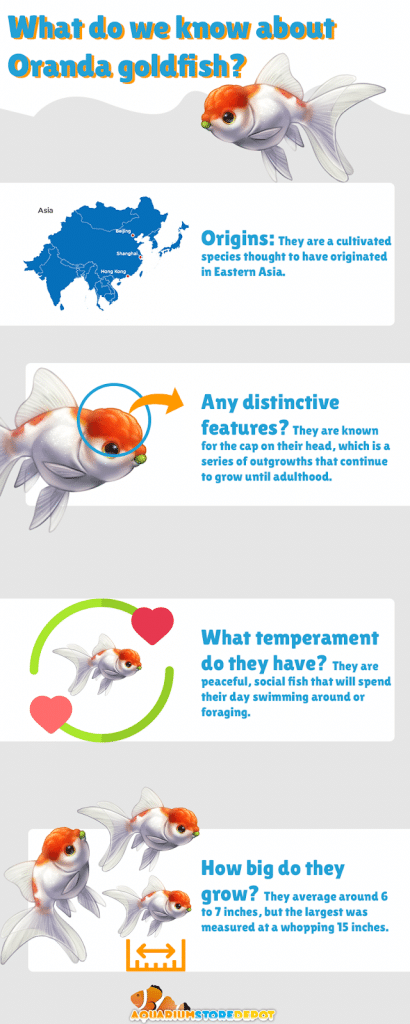
    Oranda Goldfish Infographic

    What Does the Oranda Goldfish Look Like?

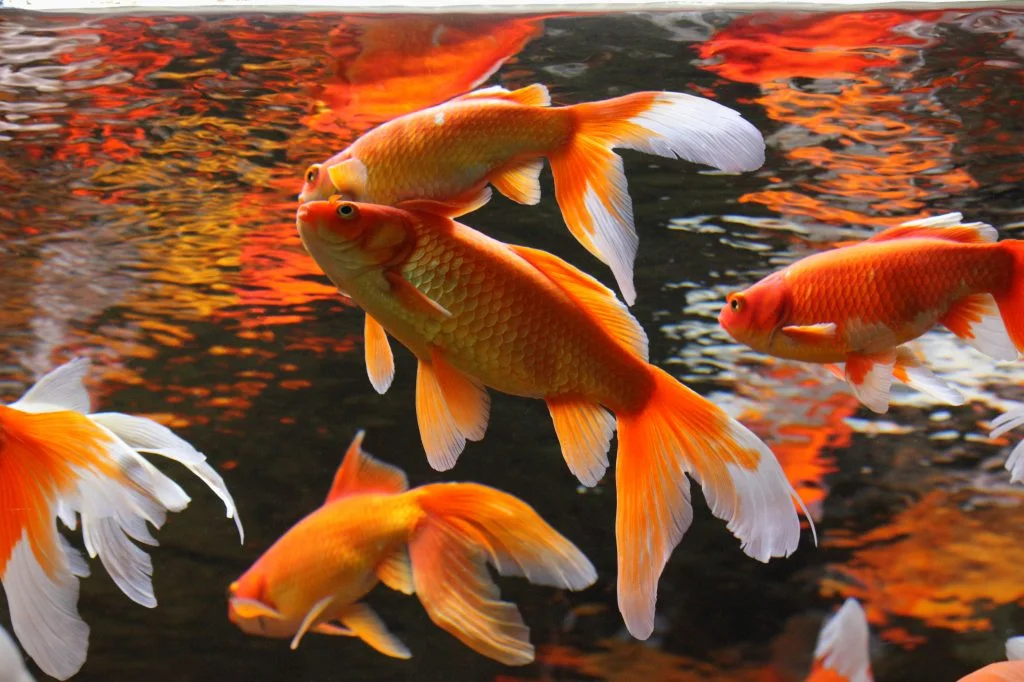
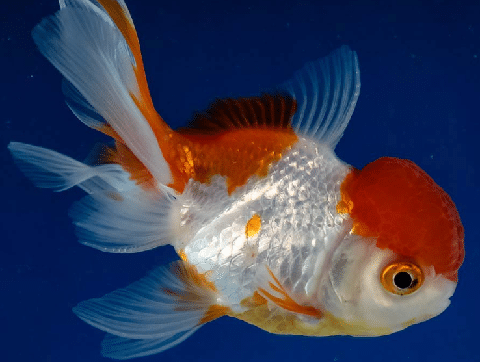
    Oranda Goldfish Carassius auratus are egg-shaped fish and is identified by the cap on their head. This is a series of outgrowths that is easily spotted and is also known as the โ€œwenโ€. The head growth develops as the fish ages and normally starts appearing when the fish is four or five months old. They are different than a lionhead or Ranchu goldfish due to their dorsal fin.

    There are different types and colors, with the most common being a shimmering yellow or orange Oranda. Some of the most distinctive Oranda Goldfish species are:

    • Black Oranda Goldfish: This is a stunning but sinister fish thatโ€™s completely black, including its black cap.
    • Blue Oranda: Goldfish These are extremely colorful fish that come in every shade of blue, from light, baby blue to vibrant, cobalt blue. 
    • Red Cap Oranda Goldfish: This Oranda Goldfish is the most popular species. Itโ€™s completely white with a bright red cap that stands out. This fish breed comes from the aquarium Goldfish Carassius auratus.
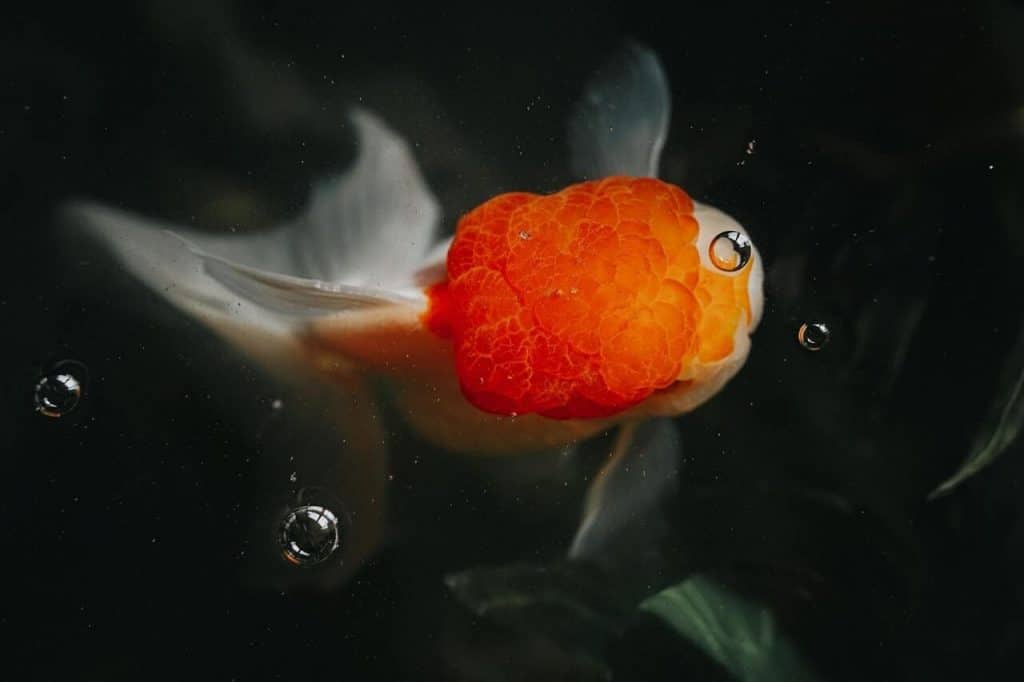
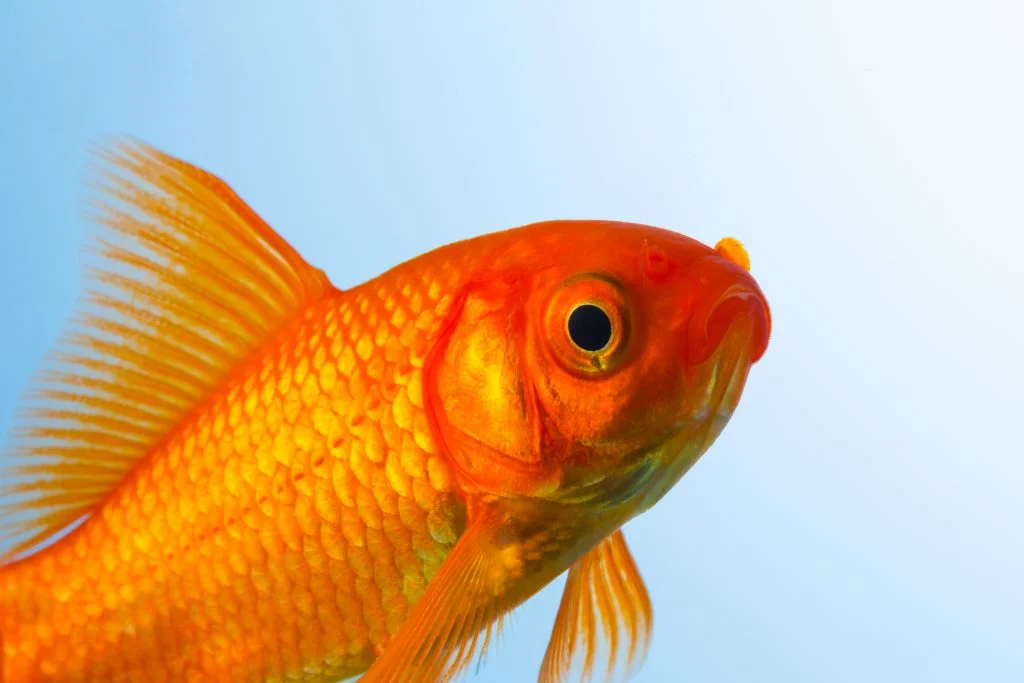
    Oranda Goldfish Close Up

    (Source)

    How Big Are They?

    Oranda Goldfish grow to around 6 or 7 inches. However, they have been known to grow to double this size in well-maintained tanks or ponds. 

    Most of the length of the fish is due to its tail fin, which is up to two-thirds of its length in some species. The largest Oranda Goldfish ever recorded was a whopping 14 inches long and named Bruce. 

    How Long Do They Live?

    The life expectancy of an Oranda Goldfish Carassius auratus is largely dependent on the care given and their surroundings.

    These fancy Goldfish have a potential lifespan of between 10. 15 years but have been known to live beyond this, up to 20 years in some cases. Proper care will allow your fish to live beyond the average goldfish lifespan.

    Temperament and Activity Level

    Oranda Goldfish peaceful fish with a calm temperament. They keep themselves away from any trouble. They are social and friendly fish. They will get along with most other fish, especially other breeds of Goldfish Carassius auratus.

    They are pretty active and will spend most of the day swimming around the tank. Theyโ€™re great fish to observe, and youโ€™ll never tire of watching them gracefully swimming, digging, and foraging.

    What Are Good Tank Mates?

    Oranda Goldfish are great tank mates and can live with most species, but some are better than others.

    Good Tank Mates

    These fish love spending time with other Oranda Goldfish or similar fancy Goldfish varieties. If you get other species, they should be able to live in the same living conditions and at the same water temperatures. Other fancy variety Cyprinid fish like the Pearlscale Goldfish or Catfish are other freshwater fish that are good tank mates for the Oranda Goldfish. They will also keep the tank clean and clean up after the Goldfish, which is a little messy. 

    Fish Species to Avoid

    Small fish is mistaken as a snack for your Oranda Goldfish, so itโ€™s best to avoid putting them together. You donโ€™t want any fin-nippers that could cause damage to your beautiful Oranda, such as Neons, Mollies, or small Barbs.

    Oranda Goldfish are not the quickest swimmers; they like to saunter rather than speed along. This isnโ€™t ideal when racing against a speedy comet for lunch.
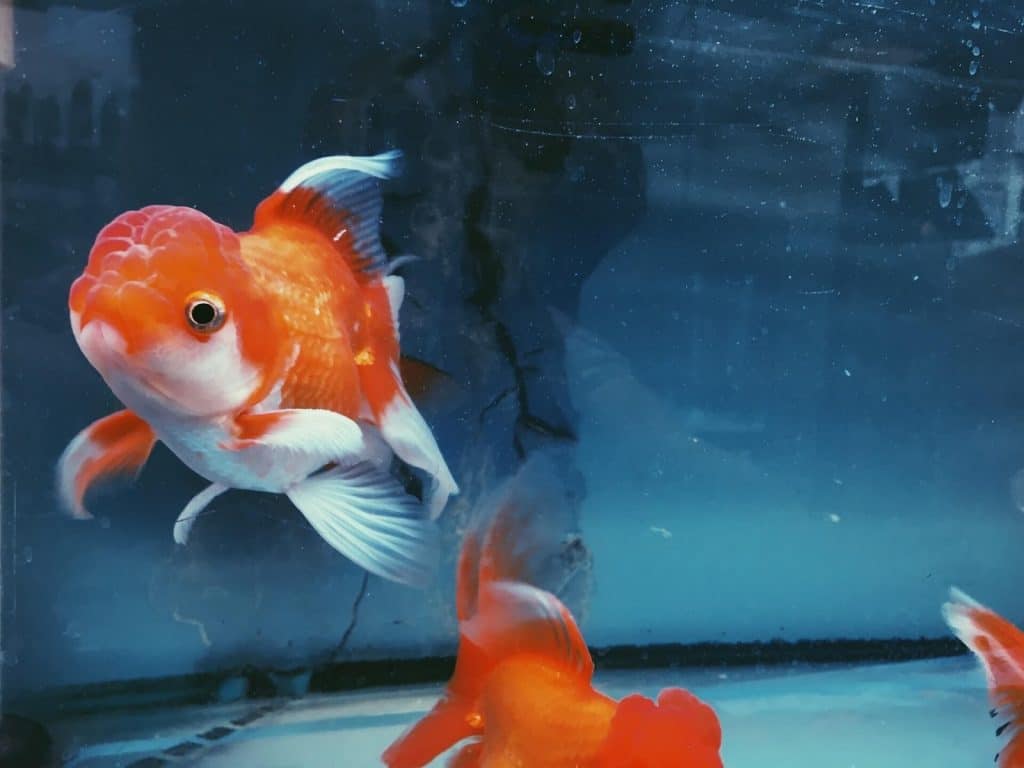
    Orandas Together In A Fish Tank

    (Source)

    What Do They Eat?

    Oranda Goldfish arenโ€™t fussy eaters; they are omnivores and will eat pretty much anything. They is greedy and will eat whatever they can get in their mouths, including any small fish or invertebrates that may be in the tank.

    They like to eat flake foods or pellets and will also eat nutritious spinach or salad. For staple pellet food, I recommend NorthFin Goldfish Food.

    My Pick
    Northfin Goldfish Formula

    The Best Goldfish Pellet

    Specially designed for goldfish and free from fillers

    Buy On Amazon Buy On Chewy

    What About Live Foods?

    Your Oranda Goldfish needs a varied, balanced diet, and live foods are an excellent way to add to this. They like high protein foods, such as bloodworms, tubifex worms, brine shrimp, and daphnia.

    How Much and How Often To Feed?

    You should be careful not to overfeed your Oranda Goldfish as they donโ€™t seem to have a full sensor and will just keep eating. Feed younger fish twice a day and adult fish just once a day. 

    Small portions are a good way to control how much your fancy Goldfish eats every mealtime. 

    Tank Requirements

    The tank requirements for Oranda Goldfish are not restrictive, and they is kept quite simple in the right environment. 
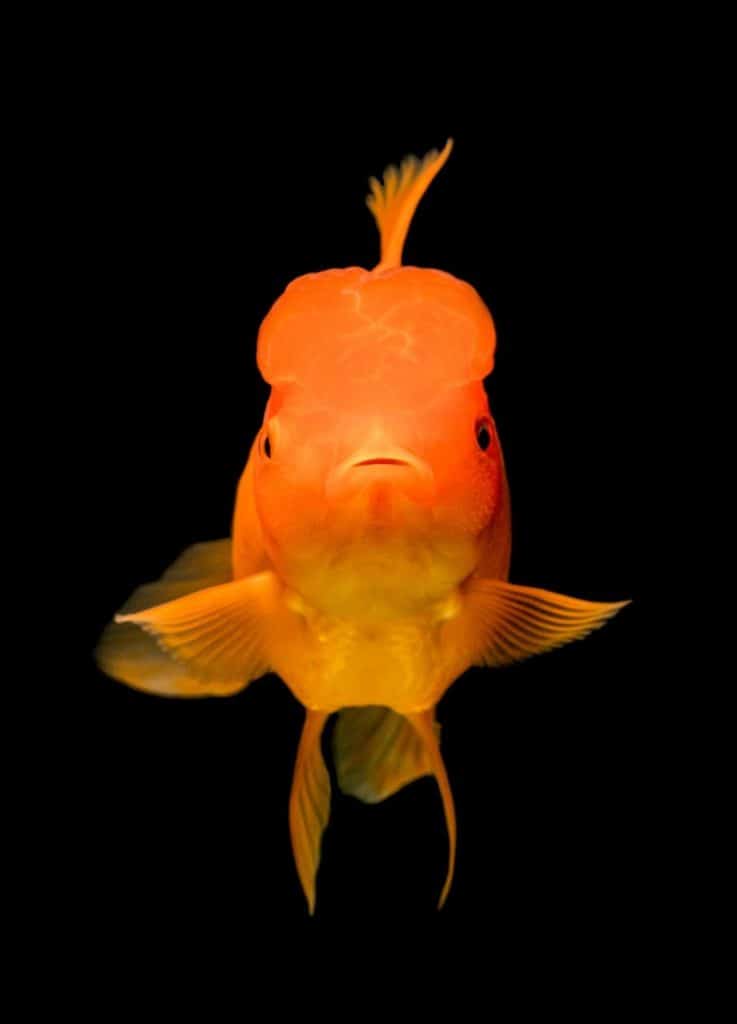
    Oranda Close Up

    (Source)

    Tank Size

    If youโ€™re starting off with just one Oranda, make sure you have the right tank size. It should be at least 20 gallons for one fancy Goldfish. For every additional fancy Goldfish you add to the tank, you should increase the tank size by 10 gallons. 

    They arenโ€™t speedy swimmers, but they do need lots of room, and they can grow quite big, quite quickly. They also create a lot of waste, so a larger tank will help to give a healthier environment for your fish.

    Tank Setup

    Oranda Goldfish arenโ€™t fussy and donโ€™t need much to keep them happy, so their tank setup is easy. 

    They need plenty of space when swimming around, and they have the wen on their head that may compromise their eyesight. With this in mind, you should not over-decorate the tank.  

    Oranda Goldfish like to dig, so make sure that the substrate you choose isnโ€™t sharp and wonโ€™t harm them. Sand or rounded gravel is a good choice, and your fish will have hours of fun digging.

    Freshwater plants are good to have, but these should be hardy as your fish will like to eat the plant leaves. They may also damage more fragile aquatic plants when digging and scattering the sand or gravel. Lighting for your tank isnโ€™t necessary for the fish, but it may help with your live plants. Hardy plants that are column feeders like java fern do well in fish tanks with Orandas.

    Water Quality

    Oranda Goldfish are freshwater fish that is sensitive to water temperature. Itโ€™s essential to get the water conditions, quality, and temperature just right.

    Filtration

    Oranda Goldfish Carassius auratus is mucky and create a lot of waste, so you need a good filtration system. An efficient filter will remove all toxins from the tank and keep the water clean. 

    However, your fish can become stressed by strong water movement, so keep this in mind when getting a filter. An adjustable flow outlet will help with this, or you can redirect the flow via the plants away from the swimming area. Due to their messy nature, filtration is one of the most important water parameters of oranda goldfish care.

    Water Parameters

    Oranda Goldfish like to be in cooler freshwater with a temperature between 65. 72 degrees Fahrenheit. They prefer a neutral pH level, which should be between 6.0. 8.0. The water hardness level should be between 4 and 20 dGH.

    As long as you stick within these parameters, your fancy goldfish should live very comfortably. 

    Aquarium Maintenance

    You should maintain your aquarium to a high standard to ensure that your fish are safe and healthy. To keep the water toxin-free and clean from waste, you should complete a 25. 30 percent water change each week and check the water hardness.

    You can clean the glass of your tank with an algae magnet. Be careful not to remove all the biofilm and bacteria that make your biological filter effective. To clean the substrate, use an aquarium vacuum. This will pick up all the waste from your fish, any leftover food, and plant debris.

    Your filter media should be cleaned in tank water once a month, depending on your water hardness, to get rid of all the sludge that builds up. This should be replaced as recommended by the manufacturer.

    Test Water Conditions

    To make sure that your water is kept to an optimal standard for your Oranda Goldfish, you should test it once a week before your weekly water change. You can buy strip tests or liquid tests to test your water. Strip tests are quick and easy to use, but liquid tests give a more accurate result.

    The water conditions should be tested for the following content:

    • pH: This shows how acidic or alkaline the water is. 
    • Ammonia: This is a byproduct of your fishโ€™s waste and is highly toxic.
    • Nitrite: This is produced when ammonia is broken down and is toxic also.
    • Nitrate: I recommend you have no more than 40ppm of nitrate in your water.

    How to Set Up Your Fish Tank

    Once you have everything you need for your fish tank, you need to set it up ready for its new inhabitants. It should be set up to give your Oranda Goldfish the space, oxygen, and healthy lifestyle that they need. 

    How To Set Up a Fish Tank

    The first thing you should do is clean the tank and wash the gravel that will go into the tank. They should be rinsed under running water to remove any dust or dirt. Then put a few inches of the gravel or other substrate into the tank. Once you have done this, place an upturned bowl on the substrate. Youโ€™ll soon find out why.

    Before you add any water to the tank, you need to install the filter and heater, if required. Donโ€™t switch these on just yet, though.

    You then need to start adding dechlorinated tap water. Do this by pouring it over the upturned bowl so that the substrate doesnโ€™t get moved all over the tank. Tap water alone is no good for your fish; you need to start the nitrogen cycle to make the water safe. A little liquid ammonia needs to be added to the water to start the cycle.

    You can then add your decorations and live plants, making sure that these have been washed thoroughly. Plants should have any dead or damaged leaves removed before planting in the substrate. They is planted in pots or directly into the substrate.

    The filter system should then be switched on and run 24/7. Live plants require light, so switch any lights on also. If you are looking for a power filter (AKA hang on back filter), the Hagen Aquaclear is my top recommendation.
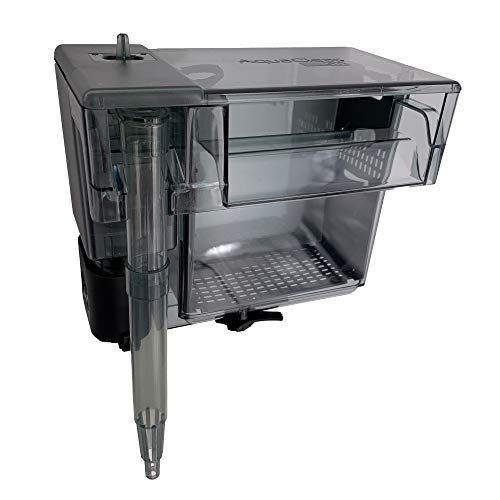
    Editor’s Choice
    Hagen AquaClear

    The Best Aquarium Power Filter

    The worlds best selling and most reliable power filter on the market. Unchanged for years because it’s so reliable and versatile

    Buy On Amazon Click For Best Price

    Youโ€™re almost ready, but not quite. You need to leave the tank as it is without adding any fish for at least 10 days. You should then test the water hardness to make sure that itโ€™s suitable. All levels should be correct before adding any fish, or they wonโ€™t survive.

    Once everything is at the right level, you can introduce your fancy Goldfish to their new home.

    Health and Disease

    Oranda Goldfish are pretty resistant to ill health. However, they sometimes get sick, so you need to know how to spot the signs and how to care for them.

    Signs of Health

    Oranda Goldfish are social fish and spend most of their day swimming around the tank. When not swimming, you can find them foraging in the gravel at the bottom of the tank or around the plants. Donโ€™t forget feeding; the greedy Orandas are always on the lookout for food!

    If theyโ€™re doing this, they are healthy fish, and you have nothing to worry about. 

    Signs of Ill Health

    There are easy ways to tell if your Oranda is not feeling itself or is ill. The most common signs are:

    • Leaving food and not eating.
    • Rubbing its body on the substrate or plants.
    • Not socializing and avoiding its tank mates.
    • Staying at the water surface.
    • Sitting at the bottom of the tank.
    • Swimming on its side.
    • Sores or ulcers appearing on its skin.

    If you spot any of these signs, check your fish out, as it is ill. Check out my freshwater fish disease post for info, care, and guides on how to cure common fish diseases.

    Common Health Issues and Treatment

    Goldfish Carassius auratus can suffer from several diseases. Some of these is treated quite easily, and your fish will make a full recovery.

    The most common disease for Orandas is Ich, which is also known as white spot disease. This is an aquatic parasite that causes tiny white dots to appear on your fancy goldfish. The fish will rub against objects in the tank when affected. The treatment for this is to treat the water with an Ich medication.  

    Orandas can suffer from fungal infections where they have growths on their body. The affected Goldfish should be quarantined away from the other fish, and the water in their tank treated.

    Here are other common diseases that Orandas suffer from:

    • Anchor worms
    • Fish lice
    • Bacterial infections
    • Swim bladder issues
    • External parasites
    • Fungal infection from wounds

    In some varieties, they can suffer from their cap growing and obstructing their vision or preventing them from being able to eat. If this happens, pay a visit to your local pet store for medication that will help.

    Breeding

    Itโ€™s becoming more popular to breed Oranda Goldfish at home, which is easy to do. You should have a separate tank for the breeding pair of Orandas. There, you should recreate the same conditions as the main tank, with the addition of fine leaf plants. The Goldfish will then lay their eggs in the leaves of the plant.

    Feed them plenty of live food before breeding. Once these fancy Goldfish are ready to breed, the color will intensify, and they will chase each other around the tank.

    Female Goldfish Carassius auratus can lay in excess of 10,000 eggs over several hours. Once the eggs are laid, the adults must be removed from the tank straight away so as not to eat the goldfish fry. The eggs hatch in less than a week, and the fry should be fed liquid food. Once they are bigger, they is given baby brine shrimp.

    Availability

    Oranda Goldfish is found at any fish store or pet store, and they vary in price. They can cost from just a couple of dollars per fish to several hundred dollars for rare breeds, colors, or fancier varieties.
    If you are looking for a specific color such as black or blue or rare variety of fancy Goldfish Carassius auratus species, itโ€™s best to contact an online store with a specialty. However, these will be more expensive than your standard colors. Make sure that you know what you are buying before adding it to your cart. For a guide on the best places to back fish online, check out my guide. You can also shop on this link for WYSIWYG Orandas!

    What You Need to Buy

    Things that you need to buy in the store to give your fancy Goldfish a healthy life would be:

    FAQs

    What size tank do they need?

    Oranda Goldfish need at minimum a 20 gallon tank. While that is the bare minimum, the recommended is at least 30 gallons. A 30 gallon fish tank will allow for more space for your goldfish to grow and thrive.

    How Long Do They Live?

    , an Oranda Goldfish will live up to 15 years in an aquarium environment. There have been cases of these fish actually living longer – in larger tanks or well maintained indoor ponds.

    Are They Aggressive?

    Oranda goldfish are not aggressive fish. They are pretty docile and will not act aggressively towards other fish. However, they are foragers. They will pick on animals with barbels like axolotls. This isn’t because they are aggressive, it’s because it’s their nature to forage.

    Do They Need A Heater?

    Oranda Goldfish do not need an aquarium heater. They are coldwater fish and will do well in more home. If anything, the worry with goldfish is in hot climates in the summer where the room temperature can raise to over 78 degrees. In those cases, it is best to consider getting fans or an aquarium chiller to lower the temperature.

    Is the Oranda Goldfish. A Right for You?

    Before you add a oranda goldfish. A to your tank, it’s worth asking whether this species actually fits your setup and your goals. Here’s a quick breakdown to help you decide.

    This species is a good fit if:

    • You have a large enough tank to manage territories. Cramped conditions amplify aggression.
    • You’re comfortable managing aggression through stocking ratios, line of sight breaks, and tank layout.
    • You can commit to regular water changes. These fish produce more waste than many smaller species.
    • You’re not planning a peaceful community tank. Oranda Goldfish. As need tank mates that can hold their own.
    • You enjoy watching active, interactive fish. Cichlids have personality that smaller species simply don’t match.
    • You have backup plans. Sometimes a particular fish just doesn’t work out, and you need a way to rehome it.
    • You’re feeding a varied, high-quality diet. Color and health depend on nutrition.

    If most of those points line up with your setup, the oranda goldfish. A is worth serious consideration. If several don’t, it’s better to choose a species that matches your tank now rather than trying to make it work.

    How the Oranda Goldfish. A Compares to Similar Species

    Choosing between similar species is tricky. Here’s how the oranda goldfish. A stacks up against some common alternatives.

    The oranda goldfish. A occupies a specific niche in the aquarium hobby, and direct comparisons really depend on what you’re looking for. In my experience, the most common question people ask is whether they should choose the oranda goldfish. A or something similar that’s more widely available. The answer comes down to three things: tank size, water parameters, and what other fish you’re keeping. If your setup matches what the oranda goldfish. A needs, it’s hard to beat. If not, there are alternatives worth exploring.

    Closing Thoughts

    The Oranda Goldfish Carassius auratus is a diverse fish that comes in all colors and sizes. It looks stunning in your aquarium with its vibrant colors, huge head, and flowing fins. 

    These fancy Goldfish are easy to care for when looked after properly, and they could live for many years. Whether you choose a black or red cap

    We hope you found our guide helpful, and it helps you get started with your new aquarium of beautiful Orandas. If you want a bigger deep dive on goldfish in general, check out my goldfish care guide.


  • How to Get Rid of Pond Scum: Root Causes and What Actually Works

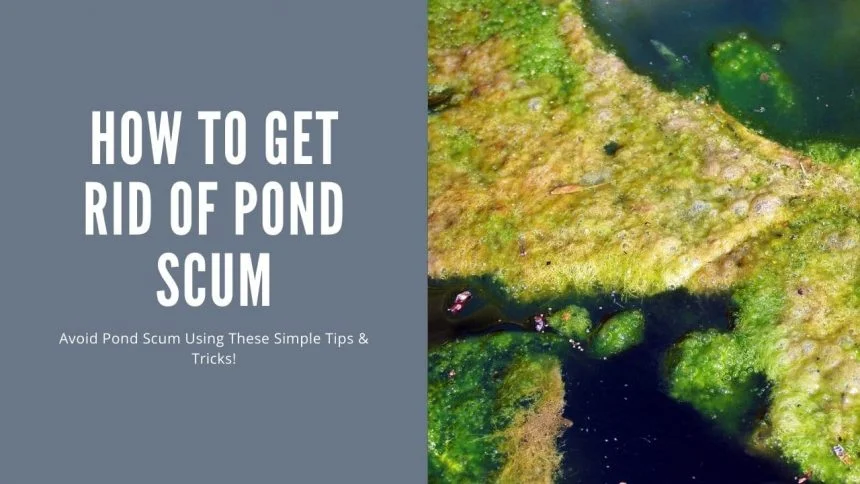
    How to Get Rid of Pond Scum: Root Causes and What Actually Works

    Pond scum is one of those problems that sneaks up on you. the water looks fine one week, and the next you’ve got a layer of green or brown slime coating the surface. I’ve dealt with it in my own outdoor setups, and I can tell you it’s almost always a nutrient issue at the root. Once you identify what’s feeding it, the solution becomes a lot more straightforward than most guides make it out to be.

    Pond scum is almost always a nutrient problem first and an algae problem second. The algae is just taking advantage of conditions you’ve created. too much fish waste, overfeeding, decomposing leaves sitting at the bottom. I see pond keepers chase it with treatments and UV sterilizers when the real fix is cutting off the nutrient source. That said, once you’re in the middle of a bloom, there’s a smart order of operations to get things back under control. Here’s what actually works, starting with root causes.

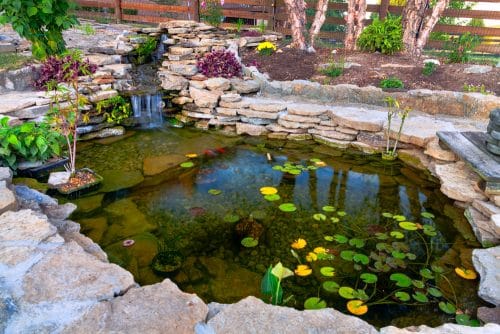
    In this article, I’ll discuss the causes of pond scum, types of different algae, and preventive measures to control pond scum in your garden ponds.

    Causes of Pond Scum

    The causes of pond scum are the high level of specific nutrients, excessive daylight, and warm temperatures.

    Excess nutrients, including fish waste, decaying vegetation, and fertilizers, can enter the water and feed algae, resulting in rapid multiplication of algae.

    Excessive daylight is also the prime cause of pond scum, as clear shallow ponds are the breeding ground for algae forms.

    Low levels of oxygen and warm temperature are also the culprits of pond scum.

    To cater to these causes, pond or fountain filters must be properly maintained with the right size to prevent pond scum.

    Also, limiting the number of nutrients that enter your pond should be controlled. Try to manually skim the debris and waste from a pond and remove the algae. You can also install an effective filtration system to prevent scum.

    Direct sunlight adds to the pond scum. Therefore, pond dye and aquatic plants, including water iris or water lilies, should be added to reduce algae growth.

    Types of Algae

    There is a variety of pond algae. However, not all of them are harmful to your ponds. Some algae are beneficial that clings on the sides of your pond, producing oxygen during the day and utilize nutrients in the water. Furthermore, they provide nutrition to your pond fish.

    Pond algae are divided into three primary forms; filamentous, macrophytic, and planktonic.

    Filamentous Algae

    Filamentous Algae

    Filamentous algae (Picture Source), also hair-like algae, are the most common types of algae, eerie filaments, and attach themselves to the pond’s bottom floor or rocks and aquatic plants. When the filamentous algae grow rapidly, it breaks free and floats on the surface in the form of thick algae mats or pond scum.

    Filamentous algae is further classified into spirogyra, Cladophora and Pithophora. 

    The prevention and control of filamentous algae mats in garden ponds are easy, provided the proper treatment and early diagnosis. Depriving the filamentous algae with favorable conditions, such as nutrients and temperature, helps to control their growth and reduce the chances of potential damage to your pond and aquatic plants.

    Chara

    If there is a horrible onion-like smell in your pond, this is likely due to the presence of Chara algae.

    Chara these freshwater algae forms grow on the bottom of the pond floor. Chara is usually misunderstood as a weed. However, it lacks roots and does not grow above the water surface.

    Oscillatoria

    The red-purple or bluish tint in your pond is because of Oscillotoria.

    It’s freshwater, blue-green algae (cyanobacteria) that thrive in hot water springs. Oscillatoria forms blue-green mats on the bottom of the water surface. However, when they multiply, provided favorable conditions, they release and float at the water surface, making the water appear brackish.
    Planktonic/Microscopic Algae

    The normal production or presence of Planktonic algae is healthy for your pond as they supply your pond with dissolved oxygen, mandatory for the health of your pond and aquatic life.

    However, during summers, the planktonic algae bloom, giving your pond a pea-soup coloration, and that’s when you should take preventive measures to control the plankton algae.

    Since they are unicellular and multiply rapidly, you cannot detect them with your naked eye. Some common types of Planktonic algae are Chlamydomonas, chlorella, and euglena species.

    How To Control Algae Naturally?

    If you’re someone who doesn’t want to use chemicals, there are natural ways to control algae. The most effective ones are good water quality, pond aeration, the addition of beneficial bacteria, and the use of ultrasonic algae control.

    Aeration

    Ponds experts recommend using pond aeration methods to improve the overall appearance and health of the pond. Aeration will also curb pond scum growth.

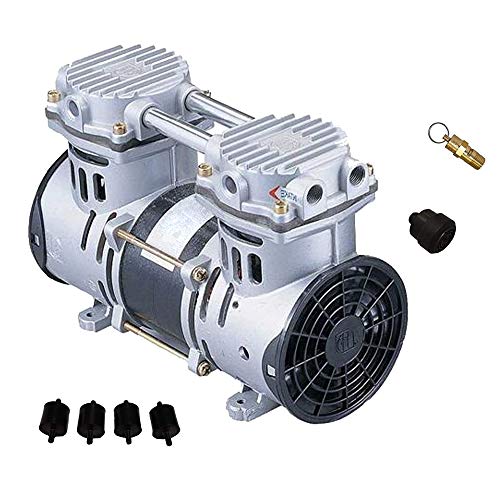
    To facilitate pond aeration for large ponds, the use of a land-based compressor is encouraged, which boosts the level of dissolved oxygen in your garden pond.

    For Large Ponds
    Patriot Pond Pro

    The Pond Pro is a land based compressor that works to aerate large ponds and lakes

    Buy On Amazon

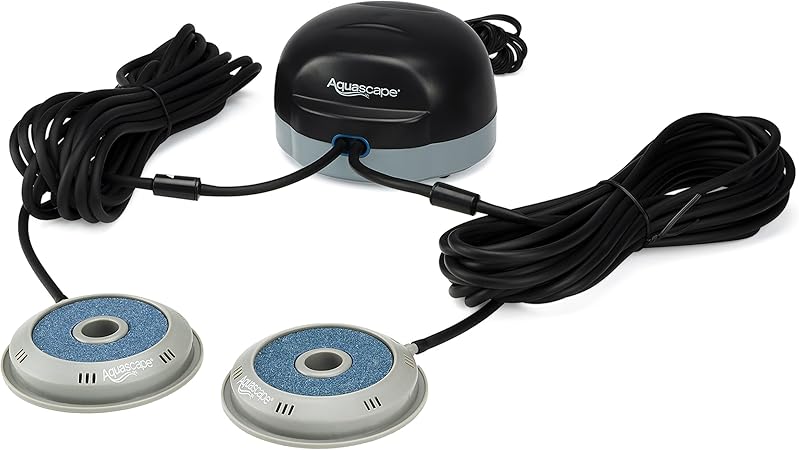
    For smaller to mid-sized Koi or Goldfish ponds, you can utilize aeration pumps, fountains, or an oxygenator.

    Best For Small To Mid-Sized Ponds
    Aquascape Aeration Kit

    This aeration kit is a great way to get added much needed aeration to your pond to prevent pond scum

    Buy On Amazon

    Adding Beneficial Bacteria

    The bacteria level in your pond should be maintained to control the situation.

    1. It is recommended to add beneficial bacteria in ponds where the bacterial count is low
    2. You can add the bacteria in liquid or powder form. Either way, they have the same function, i.e., to eliminate the pond algae and pond scum by lowering the nutrient content of the water
    3. Beneficial bacteria works the best to maintain the cleanliness of your pond if supported by the aeration method. Therefore, pond aeration is the primary requirement. Many DIY Pond Kits have both a filtration and aeration component.
    Great For Ponds!
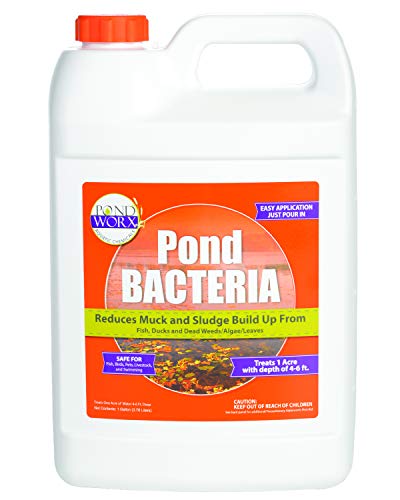
    PondWorx Pond Bacteria

    This product is great for removing muck and nutrients from your pond rocks and surface. A great preventative for pond scum

    Buy On Amazon

    Ultrasonic Algae Control

    An advanced technology that has done wonders to control specific types of algae and pond scum in your pond is the use of ultrasonics.

    1. The process works by sending sound waves through water that vibrates every algae in the pond. The vibrations eventually damage the algae cell, and it dies
    2. Ultrasonic algae control tends to eliminate the algae alone. However, it can also be integrated with beneficial bacteria and aeration to control the algae blooms and pond scum.

    A common install is an Aquascape IonGen for smaller ponds. Large ponds and lakes would look more into a commercial solution, of which KLM Solutions is the go to brand.

    Low Cost Ultrasonic
    Aquascape IonGen

    The Aquascape IonGen is a great low cost ultrasonic that will work in most ponds

    Buy On Amazon

    Product Recommendations to prevent Algae Blooms

    I have faced the problems of algae blooms and pond scum in my garden ponds, and so I know how badly it affects your pond ecosystem and the overall appearance.

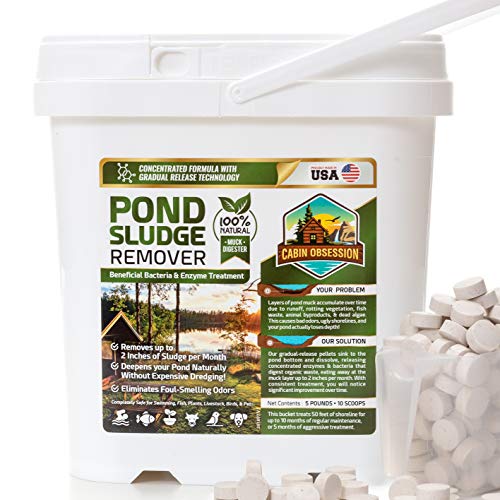
    However, I’ve tried two products and never looked back since then. I recommend using API Pond- Zyme Sludge destroyer and Cabin Obsession Pond Sludge remover to prevent algae blooms in your pond. Both work great against pond scum

    But please be informed that not all ponds have the same response to the treatment 

    API Pond-Zyme Sludge Destroyer

    Great For Small Ponds
    API Pond-Zyme

    This is a readily available product that works to remove sludge from your pond. Available at most pet stores

    Buy On Amazon Buy On Petco

    If you own a Koi or Goldfish Pond, you’d know that springs bring generous algae blooms and a foul smell that is a distraction for your visitors.

    Luckily, the API pond-zyme sludge destroyer works like a charm in gulping the sludge and improves water clarity. It has pond cleaner with natural pond bacteria and barley, which breaks down fish waste and destroys pond scum and sludge effectively.

    If you keep using this product religiously, I reckon it would save you a lot of money on pond maintenance and cleanliness.

    Cabin Obsession Sludge Remover

    Great For Large Ponds
    Cabin Obsessions Pond Sludge Remover

    This sludge remover is great for large ponds and lakes. A commercial level product at a consumer price

    Buy On Amazon

    If you’d like to deepen your pond naturally without dredging, Cabin Obsession Pond Sludge Remover is a total steal!

    It removes around 2 inches of sludge by releasing concentrated enzymes and bacteria that gulp the organic waste and destroy the muck, up to 2 inches per month. The product is all-natural and hence safe to use for fish and other aquatic life.

    Cabin Obsession Pond Sludge Remover is the most affordable solution for your pond’s maintenance needs for large ponds. It comes in a bucket that would last you approximately 10 months of regular pond maintenance.

    This allows you to get rid of the foul-smelling odors, ugly shorelines, and layers of pond scum with just a bucket of goodness.

    FAQS

    How do I get rid of pond-scum?

    The easiest ways to get rid of pond scum are 1) Improve oxygen levels of your pond by proper aeration methods 2) Add aquatic plants 3) Make use of the organic, environmentally-friendly algaecide to treat your ponds 4)Reduce the use ofย fertilizers

    What is the brown scum?

    It’s pond scum. Pond scum is usually black or brown, and a slimy, sticky substance that accumulates at the bottom of your ponds. It is nothing but the decaying waste in the form of fish debris, grass clippings, dead algae. It acts as a fertilizer for the harmful pond algae, so you should treat it promptly to prevent the layers of muck from developing on the pond surface.

    What causes green scum on ponds?

    The green color comes from the presence of single-cell planktons in your pond, giving it a pea-soup coloration.

    What does ponds scum eat?

    Pond scum is algae, and algae do not consume any plants or animals. The source of nourishment for algae is sunlight, warm temperatures, and excess nutrients within your water.

    How Do I Keep My Water Crystal Clear?

    You should take baby steps to keep the pond water crystal clear

    1) Do not overfeed your fish to prevent the accumulation of waste
    2) Add lots of aquatic plants to improve oxygen levels
    3) Facilitate aeration methods
    4) Use beneficial bacteria to eliminate the plankton that turns the water green1)
    5) Remove the debris and waste manually after feeding your fish
    6) Use environmentally-friendly algaecide to keep the water clear and pond scum free

    Final Thoughts

    Pond scum can be a nuisance if you don’t treat it timely and maintain your pond’s ecosystem. Don’t forget to aerate your ponds and add a large biofilter to keep healthy water quality and less stressful for your aquatic life. Also, the products you use should be environmentally friendly and organic, safe to use in ponds and lakes. If you have any questions about dealing with pond scum, leave us a comment below.

  • 7 Best Pond Fish: My Picks and the Popular Choices I’d Actually Avoid

    7 Best Pond Fish: My Picks and the Popular Choices I’d Actually Avoid

    Picking pond fish isn’t as simple as grabbing whatever looks good at the garden center. Climate is the variable most people underestimate. a fish that thrives in a mild-winter climate can die in a harsh one, and I’ve seen that mistake made more times than I can count. There are also a couple of very popular fish that regularly end up in ponds and simply don’t belong there. In this guide I’ll walk through the 7 pond fish I’d actually recommend and explain why a few of the crowd favorites are worth skipping.

    The 7 Best Pond Fish

    Using my years of experience, I’m listing the 7 best pond fish that stood the test of time, regardless of weather conditions or other circumstances.

    1. Koi

    My Pick!
    Next Day Koi

    Use Coupon Code: ASDEPOT

    Next Day Koi offers WYSIWYG Koi from the best breeders and farms in the country.

    Shop Now

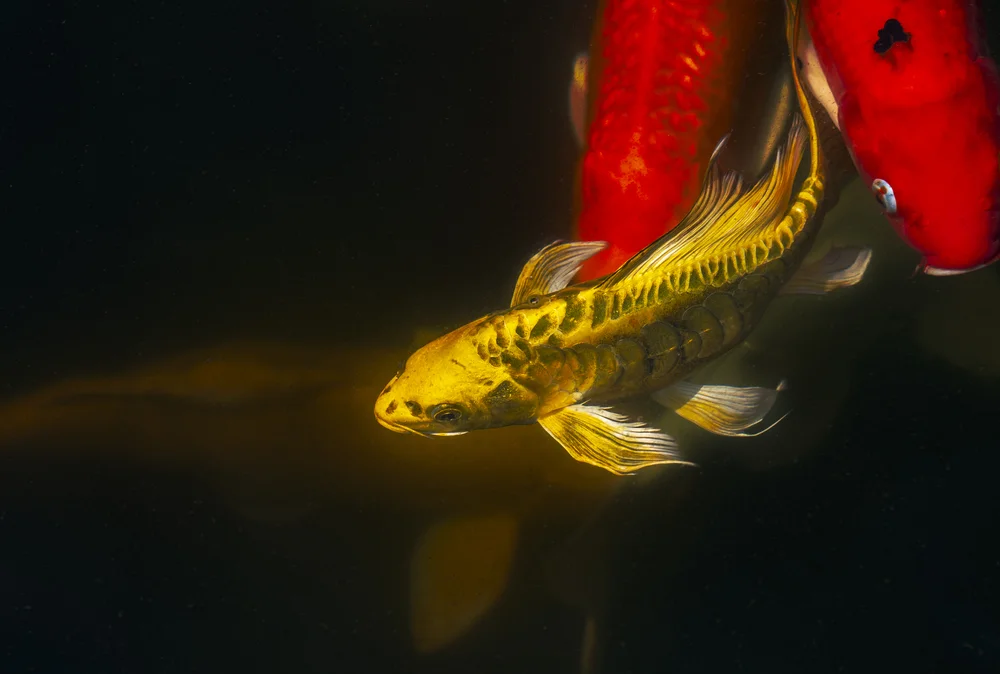
    It wouldn’t be wrong to say that the Koi are the king of ponds.

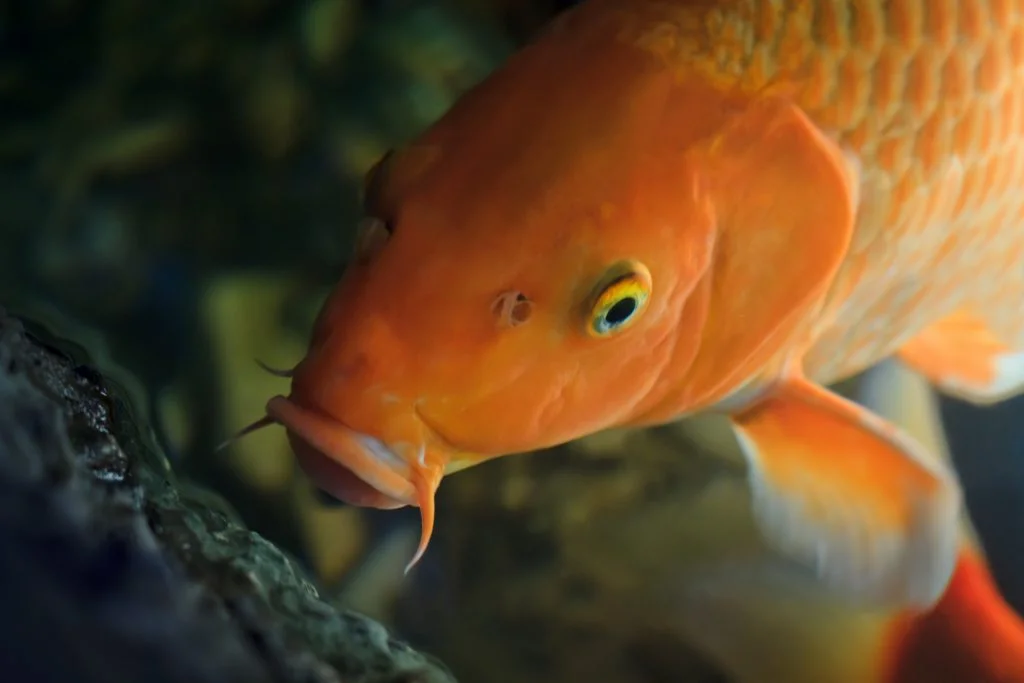
    With their beautiful, colorful, and cylindrical bodies flexing gracefully, the Koi fish is a treat for sore eyes.

    Koi Fish

    As for outdoor ponds, Koi is a perfect fit since it tends to grow very large if kept in optimal water conditions. Also, they are robust and strong fish that can withstand extreme winter and summer. However, while keeping Koi, consider the regular maintenance and upkeep of your ponds as they are much larger and difficult to maintain as compared to aquariums.

    If you’re considering Koi for your garden ponds, you should know the following factors.

    Cost

    In the case of Koi, “The more costly, the rarer and less defective.”

    Koi fish range from $15 for young to thousands of dollars for adult Koi or rare fish species. However, the price makes up for their extended lifespan. Koi, in healthy ponds, can live generally 25 – 35 years, provided that they are given nutritious food and quality water.

    Size

    Koi needs an Enriched Diet and a large environment to grow healthily and happily.

    The ideal size for Koi ponds should be over 1000 gallons and three feet deep to provide the fish with everything they need. Most Koi Pond Kits are designed to build koi ponds to these specs

    Additionally, if you’re planning to keep a shoal of fish, you will probably need a pond with over 3000 gallons.

    Filtration System

    The best thing about Koi is its hardiness against extreme conditions.

    However, still, they are living beings that demand basic care and attention, you will need some additional installments, such as a pond filter to keep your pond Koi-friendly.

    Protection in the Water

    Koi are largely susceptible to predators and so you will need to cover your garden ponds with netting or electric fencing.

    The best budget-friendly option is the addition of aquatic plants to provide shelter from the direct scorching heat of the Sun or deterring predators. Have your pond at least 3 feet deep is also great at keeping predators from getting to your prized pets.

    That’s pretty much the gist of what you should consider before buying Koi fish for your garden ponds.

    Still interested? I recommend purchasing your beautiful and healthy Koi with Next Day Koi that offers a broad variety of Koi at affordable prices.

    2. Goldfish

    Pond Goldfish

    Like Koi, Goldfish also appreciates wholesome, well-aerated outdoor ponds.

    Goldfish are small, hardy fish that does well in extreme temperatures. Hence, the perfect choice for your garden ponds. I recommend keeping the following important points in mind before going for Goldfish for your garden ponds.

    Proper Location

    Since Goldfish are cold water fish, you should provide a decent shade to your pond for maintaining the water temperature. However, in colder climates, there’s no need to cover the ponds as the warmth of sun perfectly balances the pond environment.

    Size

    The size of your outdoor pond should accommodate around 20 gallons of water per goldfish. Since Goldfish are smaller in size than Koi, they do pretty well in medium-sized ponds. However, make sure the fish swims freely without bumping into other mates or ornaments.

    For Goldfish, a pond depth of 18 inches is all that is needed. They will do well in 3 feet deep ponds, they are just less demanding then Koi.

    Water filter system

    A good filtration system is essential for Goldfish ponds that deal with waste or leftovers to avoid spikes in toxic nutrient levels and stress. Most pond kits come with high quality filtration systems.

    Mates

    Goldfish are very social, docile, and amiable creatures that relish the presence of other fish. However, if you have got a pond already occupied with Koi, it’s better to examine the size of your Koi before getting Goldfish, as mature Koi sized with juvenile Goldfish usually don’t get along with and might end up killing them.

    All in all, Goldfish need care, love, and dedication with water temperatures around 65 and 72 degrees Fahrenheit to thrive in your outdoor pond. Personally, my favorite is the Shubunkin Goldfish.

    3. Chinese High-Fin Banded Sharks

    Chinese High Fin Banded Shark

    High Fin banded sharks are a popular freshwater fish species that are extremely unique and a must-have for pond keepers. And even though their name might scare you, trust me!

    High Fin Banded sharks are not sharks at all!

    There are your usual algae-eating freshwater fish with just a single row of pharyngeal teeth. We call them sharks because they have a long sharp-like fin at the top, which gives them a striking resemblance to the mighty sharks.

    However, know that they require a larger pond area as they grow about 1.35 m (4 ft 5 in). Furthermore, the markings on High Fin banded sharks are majestic, making it a rewarding choice for your ponds.

    They are difficult to find locally. I recommend purchasing online through one of the Best Online Fish Stores on my list.

    4. Golden Tench

    Golden Tench

    If you want friendly mates in the pond for your Koi, you should try Golden Tench (Source Pic).

    Commonly known as the doctor fish, Golden Tench makes sure no fish in the pond falls ill. Legend has it, that the skin of Golden Tench contains an antibiotic that protects other fish from diseases.

    I don’t claim that’s true, however, I know for the fact that Golden Tench cleans up water, which ultimately helps other fish to remain healthy in the pond.

    Also, Golden Tench are tough fish and their life expectancy is around 15 – 20 years, making it a great fit for your garden ponds.

    Here are some things you should consider before buying Golden Tench.

    1. The depth of your pond should be at least 28 inches
    2. Your pond should hold a good amount of aquatic plants to keep Golden Tench happy
    3. It’s never a good idea to overcrowd your pond when keeping Golden Tench

    5. Sturgeon

    Sturgeon Fish

    Sturgeon, an easy-going fish that may reach the age of over 50 or 100 years. They are popular in larger ponds and waterscapes.

    At first glance, Sturgeon can be misunderstood with sharks – stronger and bigger with their mouths, underside. However, they are sensitive to sharp gravels and sand in the bottom of the pond.

    The Sturgeon requires a large pond with proper filtration because they prefer a strong current. Also, a sturgeon needs special feed that sinks to the bottom with a strong odor that looks like natural feed.

    If you’re thinking to get sturgeon as a beautiful pet for your ponds, here’s what you should consider.

    1. Keep the bottom of the pond clean because Sturgeons are bottom inhabitants, and so the accumulated dirt may cause gasification, causing harm to the fish.
    2. The Sturgeons require frequent feedings. They cannot digest most plant proteins so they need a high fish meal or shrimp meal content.
    3. Your pond should have a depth of at least 50 inches with minimal aquatic plants

    All in all, there’s a rule of thumb to determine your pond size for Sturgeons; keep the pond size 10 times larger than the size of your fish to ensure maximum safety and health.

    6. Minnows

    White Cloud Minnow

    Minnows (picture source) are small fish that are great for smaller or patio pond setups. For large ponds, if you want your other pond fish to feed on something naturally, Minnows are a good choice. Minnows are an excellent source of food for other bigger pond fish that can live up to seven years and keep your pond ecosystem clean by eating larvae, reducing algae growth, and adding movement into your pond.

    Out of various types of Minnows, the fathead minnow and white cloud mountain minnow the best suited for outdoors.

    Fathead Minnow

    Fathead Minnows display an appearance of light green or grey with a hazy spot on their dorsal fin. Fathead Minnows feed on insects, crustaceans, and zooplankton (algae), keeping your ponds clean and inviting for other fish. Therefore, they are suitable for outdoor ponds where the growth of algae is at its peak. Fathead Minnows are hardy creatures and can withstand extreme temperatures.

    White Cloud Minnow

    White cloud minnows are the smallest minnows you would ever find that grow up to 1.5 inches only. With their shiny green appearance and bright red fins, they add a moving effect to your backyard ponds.

    Aquarists and pond owners usually keep white cloud minnow in ponds meant for frogs to be bred. White cloud minnows are omnivorous and feed on insect larvae and other aquatic plants.

    Even though minnows are usually used for bait in garden ponds, there are a few things you should consider while choosing Minnows.

    1. Minnows need plenty of Oxygen. Hence, installing an oxygenator or waterfall is highly recommended
    2. Minnows are tiny fish and so they don’t need large ponds to survive
    3. Add lots of aquatic plants to provide shelter for your Minnows and to maintain the water temperature.
    4. Occasional food and treats increase the likelihood of fish survival. You can feed them fish flakes every once or twice a week

    7. Guppies

    Guppy Fish

    Guppies are small, bright fish species that thrive in outdoor pond as well as an aquarium.

    Despite their small size, Guppies take up a lot of space for nonstop swimming hours. Since guppies are tropical fish, they enjoy warm waters with a temperature tolerance of up to 68ยฐF (20ยฐC). Therefore, your garden pond would keep them happy as long as it’s not chilly outside.

    The peak months to keep your Guppies in the outdoor pond is between April and October when the water is warm enough to keep the fish healthy.

    Even though you can keep Guppies in aquariums, they enjoy garden ponds as they are avid and active swimmers. Another advantage to keeping Guppies in ponds is that they receive more sunlight and nutritious food, keeping their skins bright and more colorful than ever.

    Therefore, if you love small pond fish that add life to your pond, I suggest that you go for Guppies. There are a few things you should know about before considering Guppies as your pond inhabitant.

    1. Guppies enjoy clean water and so, the water filter is a must
    2. If you’re looking for long-term investment, note that they might not be the best choice because of their low life expectancy. 1 to 3 years
    3. Guppies are small fish species, but they require ample space for swimming around the pond, which makes them highly suitable for pond life
    4. Guppies are easy prey for the predators. Much larger pond fish will eat them
    5. You would need a fishnet to inspect the Guppies for potential diseases or overall health

    What You Should Avoid

    I know you might not agree with my disapproval of these fish species because they are popularly kept in garden ponds for so long.

    Know that it’s not that I’m completely against keeping these fish species, it’s just that I don’t find it suitable for pond life.

    1. Fancy Goldfish

    Fancy goldfish like Orandas have long, flowy fins with celestial color patterns to keep the visitors in awe. However, No matter how ‘fancy’ it gets, keeping fancy variants in ponds is a no-no.

    I’ll tell you why.

    Fancy goldfish are known for their slow, clumsy nature which is ill-suited for outdoor ponds, especially if you have other fish in the pond, such as Koi or single-tailed goldfish. Koi and non-fancy Goldfish will outcompete Fancy Goldfish for food. They are slow swimmers and will get left behind, starving for food. They are also highly prone to infections and diseases.

    All in all, their fins are delicate that are easily damaged by other pond fish.

    Therefore, I strictly advise you to avoid fancy goldfish and pick other hardy counterparts.

    2. Catfish

    Catfish In Ponds

    Keeping aquatic plants in ponds is every aquarist’s dream, and so is mine.

    Which is what makes Catfish a bad fit for a pond. That’s because they are voracious eaters and destroy aquatic plants, turning the water cloudy with debris and plant waste.

    FAQS

    What kind can I group together in the water?

    You have to look and research for fish that are hardy and can survive extreme temperatures. Also, fish that can adapt to indoor-outdoor life easily are highly recommended for ponds. Additionally, the temperament of fish matters the most as not every fish gets along with others really well.

    The best pond fish are:
    1.Koi
    2.Goldfish
    3.Chinese High Fin Shark
    4.Golden Tench
    5.Sturgeon
    6.Minnows
    7.Guppies

    What kind can live in small outdoor water areas?

    For small ponds, choose a variety of fish that is small and doesn’t require much space for swimming, For very small ponds Fathead Minnows and guppies are a good choice. Goldfish are also a great addition to smaller outdoor ponds.

    What type can survive winter?

    The fish that can survive winters in outdoor ponds are

    1.Goldfish
    2.Fathead Minnows
    3.Koi

    Can aquarium fish survive in this type of water?

    Absolutely they can if provided with the right pond ecosystem and water conditions. Even though this factor varies from fish to fish, aquarium fish are usually tropical, therefore prefer warmer temperatures.

    As long as you maintain the water temperatures, your aquarium fish should thrive in a pond.

    What kind can live with a goldfish?

    Goldfish is suitable for ponds and makes the best mates with the following two pond fish.
    1.White cloud minnows
    2.Young Koi

    Final Thoughts

    Fish are graceful, scaly creatures that add colors to your backyard ponds. Pond fish, despite being healthy and hardy, need some extra and special care regarding their habitat and food.

    In this article, I’ve listed seven of the best pond fish species with their recommended care to add value to your pond.

  • Shubunkin Goldfish: The Complete Care Guide to the Pond Keeper’s Favorite

    Shubunkin Goldfish: The Complete Care Guide to the Pond Keeper’s Favorite

    The Shubunkin Goldfish: The is not a beginner fish. It is a cold-water species that produces enormous waste, needs real filtration, and outgrows most tanks within a year. I have kept goldfish in ponds and large tanks for over 25 years. Here is the honest care guide most people need before buying one.

    A goldfish in a bowl is not thriving. It is slowly suffocating.

    Goldfish live 10 to 15 years, sometimes longer. This is a decade-long commitment to large water volumes, heavy filtration, and consistent maintenance.

    A goldfish kept properly is more impressive than most tropical fish. The problem is almost nobody keeps them properly.

    Table of Contents

    What Most Care Guides Get Wrong About Shubunkin Goldfish

    The biggest mistake I see with shubunkin goldfishs is underestimating their aggression. Guides will label them “semi-aggressive” and move on. In practice, that label doesn’t tell you much. Tank layout, stocking density, and territory management all play a huge role in whether these fish coexist or constantly fight. Tank size is another area where most guides get it wrong. The minimum listed on most care sheets is exactly that, a minimum. For long-term success, especially if you’re keeping a group, I always recommend going at least one size up from whatever the guide suggests. Finally, diet gets oversimplified. Pellets alone won’t cut it. In my 25+ years keeping fish, I’ve found that variety in diet directly affects color, growth, and overall vitality. Include frozen foods, quality pellets, and occasional vegetable matter for the best results.

    The Reality of Keeping Shubunkin Goldfish: The

    Tank size requirements are not negotiable. A single fancy goldfish needs at minimum 20 gallons. A single-tail variety like a comet needs 40 gallons minimum, and realistically belongs in a pond. The one-gallon-per-inch rule does not apply to goldfish.

    Filtration needs to be oversized. Goldfish produce more ammonia than tropical fish of the same size. Your filter should be rated for at least double your actual tank volume. A 40-gallon tank with goldfish needs filtration rated for 75 to 100 gallons.

    They are cold-water fish that do not need heaters. Goldfish thrive between 65 and 72 degrees. Putting them in a heated tropical tank stresses them and shortens their lifespan. Room temperature water is fine for most homes.

    Biggest Mistake New Owners Make

    Putting a goldfish in a small bowl or tank without filtration. Goldfish produce massive amounts of waste. Without proper filtration, ammonia levels spike within days and the fish suffers organ damage long before it shows visible symptoms.

    Expert Take

    The best goldfish keepers I know run heavy filtration and do large weekly water changes. There is no shortcut or trick that replaces those two fundamentals.

    A Brief Overview Of The Shubunkin

    Scientific NameCarassius auratus
    Common Name (Species)Shubunkin Goldfish
    FamilyCyprinidae
    OriginJapan
    DietOmnivore
    Care LevelEasy
    ActivityActive, social
    LifespanUp to 30 years
    TempermentPeaceful
    Tank LevelAll Areas
    Minimum Tank Size75 Gallons
    Temperature Range65 – 72 Degrees F
    KH150
    pH Range6.0. 8.0
    Filtration/Flow RateModerate
    Water TypeFreshwater
    BreedingEgg-layers, Easy to breed
    CompatibilityPeace commuity species
    Ok, For Planted Tanks?With Research

    Classification

    Taxonomic RankClassification
    Common NameShubunkin Goldfish
    Scientific NameCarassius auratus
    OrderCypriniformes
    FamilyCyprinidae
    GenusCarassius
    SpeciesC. Auratus

    Origins and Habitat

    Shubunkin Goldfish are also known as Calico Goldfish, meaning multicolored. As a type of Goldfish (Carassius auratus), theyโ€™re descendants from the wild carp living in Asia today and were first bred in Japan. The Shubunkin earns its name from a town in Japan called Shubuta where they were first bred. These fish were first brought into the West in 1882 by James Meehan, who was a curator at the London Zoo.

    As for habitat, Shubunkins are a member of the Cyprinidae family, which means they like to live in slow rivers, lakes, ditches, or ponds. In Asia, fish kept in ponds have a habitat moderately decorated with plastic plants, driftwood, and rocks.

    What Does They Look Like?

    Features of Shubunkin Goldfish

    The Shubunkin is similar to the Common Goldfish and the Comet Goldfish in appearance and is crossbred from these two, as well as the Calico Telescope Eye Goldfish. They have nacreous scales which are pearly in appearance and look like a mix between transparent and metallic scales.

    The Calico Goldfish has overlapping patches of white, gray, red, black, and blue colors that is seen on their long, flowing tail fins. The most valued color of a Shubukin is blue, and this is also the rarest color. These fish are heavily spotted as well.

    , people divide Shubunkins into three different types:

    London

    The London Shubunkin goldfish has a slender body and shorter tails that are more rounded, similar to the Common Goldfish.

    American

    The American Shubunkin is also known as the Japanese Shubunkin. An American Shubunkin has longer fins and a sharper fork tail, and looks more like Comet Goldfish than the other types.

    Bristol

    The Bristol Shubunkin is quite rare and has a B-shaped tail that stands out. Also, the Bristol Shubunkin be longer and broader than other types.

    Shubunkin Goldfish Vs. Koi

    Below is a good reference video from J Lo on the difference between Shubunkin Goldfish and Koi. As you can see, the Shubunkin compliments as Koi with it’s varied color and fin shapes. They look amazing together in a pond! In some Koi keeping circles, the Shubunkin is often label a “poor man’s Koi”. The way I see it, they remind me of Butterfly Koi and allow you to keep the purity of the Koi line if you do not want to stick to Traditional Koi.

    How Big Are They?

    One common feature among the Goldfish freshwater species is that they grow based on their surroundings., Shubunkin Goldfish reach a size between 6. 12 inches, but if you keep them in a small space, theyโ€™ll be smaller.ย 

    These are excellent pond fish as well, since they can grow up to 14. 18 inches if they have enough room, and there have even been reports of them reaching lengths beyond 18 inches.

    How Long Do They Live?

    Depending on their environment, Shubunkin Goldfish are hardy fish and have a lifespan of 10. 15 years with proper care.

    Shubunkins that are kept in ponds live even longer since they have lots of space to explore and live a happy life. Some even have a lifespan of up to 30 years.

    Temperament and Activity Level

    These fish are super social and like to hang out in groups. Theyโ€™ll likely spend their days exploring their aquarium or pond, meaning that theyโ€™re very active. Like most Goldfish species, theyโ€™re fast swimmers and do well paired with other fast-swimming fish.

    They also like to eat whatever they can get their hands (or mouths) on, and they often scavenge for food at the bottom of the tank. Therefore, the only type of aggression you might encounter with Shubunkins is that theyโ€™re quick to steal food.

    What Are Good Tank Mates?

    While they can live alone, the Shubunkin thrives in tanks with other fish, and they make a good addition to community tanks. Some species suit them better than others, however.

    Good Tank Mates

    These quick swimmers pair well with other fast-moving fish that thrive in cooler waters as the Shubunkin does. They do well with other species of Goldfish as well as many other species. Here are some suggestions for fish to pair with your Shubunkin Goldfish:

    Fish Species to Avoid (Bad Tank Mates)

    Since Shubunkin Goldfish will steal as much food as they can manage, itโ€™s best not to pair them with slow-moving and shy species, as they might have a hard time getting enough nutrition.

    For the more experienced fish owner, you can pair your Shubunkin with slower swimmers as well. Just make sure to watch and feed your fish at different times, starting with the fast ones and then moving onto the slower ones.

    Shubunkin Goldfish donโ€™t pair well with aggressive fish such as Tiger Barbs or Cichlids since they donโ€™t like fighting. They also do not pair well with Fancy Goldfish because they are very fast compared to them. Fancy goldfish will struggle to eat enough with an athletic Shubunkin in the tank or pond.

    Finally, some tropical fish species might not be the best mates for Shubunkin, since they prefer cooler waters.

    What Do They Eat?

    Shubunkins are omnivores and eat almost anything you drop into the water. But for them to get all the nutrition they need, itโ€™s best to feed them high-quality dried food such as flakes and pellets.

    Another great thing is that these fish are scavengers and will eat up whatever they can find at the bottom of the tank, such as plant material and detritus. Just they might uproot live plants while theyโ€™re at it.

    What About Live Foods?

    Like all types of Goldfish, Shubunkin feed on insects and small crustaceans. Some live or frozen foods to feed them occasionally include Daphnia, blood worms, tubifex worms, krill, and brine shrimp.

    How Much and How Often to Feed

    You should feed your Goldfish twice a day and give them as much as they can eat for two minutes each time. For the everyday staple meal, pellets or flakes are your best choices. Occasionally, they should also get a treat in the form of live or frozen food.

    Once or twice a week, you can also give them some fresh vegetables from your kitchen, such as spinach, lettuce, or cucumber, but peel and blanch them first.

    Tank Requirements

    Shubunkin Tank Requirements

    While the Goldfish Shubunkin is rather easy to take care of, you need to consider the type of tank itโ€™s going to live in as well as how to decorate it.

    Tank Size

    There is lots of misleading information out there in regards to keeping a Goldfish. While your Shubunkin Goldfish will stay alive in a tank thatโ€™s 15. 20 gallons, itโ€™s too small for them to live a healthy life. Instead, you should invest in an aquarium thatโ€™s with a minimum tank size of 75 gallons to give them room to swim and search for food.

    As your fish will grow depending on how much space it has to move around in, the bigger the tank, the better. Shubunkins live the happiest in wide-open spaces where they can roam around and are great to keep as pond fish.

    If you add more fish to your aquarium, remember to increase the tank size by 10. 15 gallons per new member. A 75-gallon tank should only keep one Shubunkin Goldfish.

    Tank or Pond Setup

    Since this Goldfish type lives in slow-moving rivers or lakes, you want to make sure that your tank has low to moderate water movement. Speaking, a water filtration system provides enough movement in the tank. You can invest in some air stones if you wish to help keep the oxygen at reasonable levels.

    Shubunkins arenโ€™t picky, and most substrate works with this fish. The best choice is medium-sized gravel since theyโ€™ll be able to sift through this material and look for food. You can also opt for a bare bottom pond, a favorite setup for Koi Pond setups and for ease of cleaning.

    You can also invest in some underwater live plants for a more natural-looking habitat. This fish is a quick eater, so it’s likely to unroot almost anything you plant. Your best bet here is fast-growing plants such as Hornwort, Java Fern, and Anacharis.

    In terms of other decorations, Shubunkins arenโ€™t picky and wonโ€™t mind plastic or silicone plants. The most important thing for them is to have a good amount of swimming space, so you can use some driftwood or rocks in your tank or pond but keep it minimal.

    Finally, you need to provide a sufficient amount of light. This will help your Shubunkin Goldfish maintain its natural sleeping pattern. There are many tanks on the market that have built-in LED lights with different settings for day and night that is a good investment.

    Water Quality

    Filtration

    The Shubunkin is a messy fish and has a high waste load, which means that you need a good filtration system in your pond or tank. Your best bet is a filter with biological media. Without a filter, nitrate and ammonia levels in the water might reach unhealthy levels. However, also remember make that water change frequent and clean the tank or pond.

    When picking a filter, look for one that can clean all the water in your tank or pond. If it lacks in this aspect, youโ€™ll end up with unfiltered water. I recommend a high quality power filter or opt for a canister filter.

    Water Parameters

    One good thing with the Goldfish species is that it tolerates changes in water conditions much better than more sensitive tropical fish, for example. They can even survive in temperatures a few degrees over freezing, which is why they make such great pond fish. However, you should invest in a water heater if you plan on keeping your Shubunkins in an outdoor pond during the winter.

    Here are the ideal water parameters for Shubunkins:

    Aquarium Maintenance

    Shubunkin Goldfish in Aquarium

    (Source)

    Since Goldfish are messy types of fish, you need to clean out their tank more frequently than many other species. Keeping your aquarium clean is the most efficient way to prevent your Shubunkin from getting sick or developing any fish diseases.

    Every one to two weeks, you should clean your aquarium. First, wipe off the outside of the tank with an ammonia-free cleaner and a cloth, then shake the plants inside the aquarium to get rid of debris. Also, scrape the inside of the glass to remove algae, and then take a break for 15 minutes. Finally, siphon the substrate to further remove debris and then perform a 25 percent water change.

    Test Water Conditions

    You should check the pH level, hardness, and water temperature frequently, especially when setting up your tank and after changing the water. Make sure that the levels are within the spectrums stated in the section above.

    Other things you need to test are the levels of ammonia, nitrite, and nitrate. For Shubunkin Goldfish, the levels should be the following:

    • Ammonia: 0 ppm.
    • Nitrite: 0 ppm.
    • Nitrate: <40 ppm.

    In order to test the water conditions, invest in an aquarium water test kit. A good rule is to test the water conditions on a monthly basis. At the same time, make sure you also change the filter media.

    How To Set Up Your Fish Tank

    Before your Shubunkin moves into its new home, you need to set up the tank. Make sure you have a clean aquarium with the proper water conditions and temperature for your fish to start with, and itโ€™ll be easier to tweak them later.

    How To Set Up a Fish Tank

    Follow these seven steps to set up the fish tank for your Shubunkin Goldfish.

    1. Clean the Tank

    First of all, wipe off any dust with a damp cloth, never use any household chemicals or old cleaning equipment to clean the inside of your tank. If you have an old aquarium that needs some extra cleaning, you can use vinegar to dissolve dirt.

    2. Position the Tank

    Now itโ€™s time to position your tank. Itโ€™s best to put it into place before filling it with water since itโ€™ll get heavier. Make sure that itโ€™s out of direct sunlight and placed on a stable stand. It should also be level.

    3. Fill Tank With Substrate and Water

    After this, itโ€™s time to fill the tank with the substrate. For the Shubunkin, use medium-size gravel and rinse it with cold water before you fill the aquarium.

    Follow a ratio of 1 pound of substrate per gallon of water for a 1-inch thick bed, or 2 pounds of substrate per gallon of water for one thatโ€™s 2 inches thick. For a 75-gallon minimum tank size, this means 75. 150 pounds of substrate. For 125 gallons, youโ€™ll need 150. 300 pounds.

    When the gravel is inside the tank, fill it with water. Shubunkin Goldfish are freshwater fish, so youโ€™ll need to use fresh water. A tip to prevent the running water from spreading out the gravel is to place a bowl or saucer at the bottom of the tank and pour water onto it. After filling the aquarium, add dechlorinator to the water, following the instructions on the bottle.

    4. Install the Filter

    You can choose to use an external or internal filter, but we recommend an external one since it filters water more efficiently and has more space for media. The best choice for Shubunkins is to use a filter with biological media.

    Set up depends on the brand, so look at the instructions. You place it within the sand below the tank. Before you plug it in, fill it with water to start the filtering process. When you install it, make sure that the inlet and outlet tubes are straight so that water flows through them easily.

    5. Decorate It

    When youโ€™re done with the basic setup, itโ€™s time to decorate the tank. Remember that Shubunkins like to have lots of space to swim but that some plants and other items are okay to add. Rinse every item before you place it into the tank to prevent dirty water.

    Most plants are fine being buried in the gravel, but some species such as Java Fern need to be attached to some driftwood first and then placed into the aquarium.

    6. Cycle the Tank

    Before adding any fish, you need to cycle the water in the tank to build up bacteria in your biofilter that can convert ammonia into nitrites and then nitrites into nitrates. This is to prevent toxins from building up in the water.

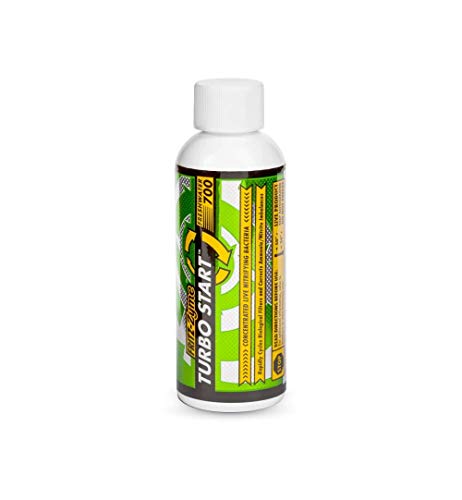
    Simply add some ammonia into the tank (I recommend using Dr. Tim’s Ammonia), following the instructions on the bottle. You need to check the levels of these substances frequently. When they reach 0 ppm, your tank is fully cycled. This might take a few weeks, so prepare your aquarium well in advance. For bacteria in a bottle, check out Fritz Turbo start.

    My Pick For Freshwater Bacteria
    Fritz Turbo Start 700 Freshwater

    Fritz Turbo Start is known in the industry as the fastest acting nitrifying bacteria you can purchase. This 700 version is specialized for freshwater tank and has my highest recommendation

    Buy On Amazon Click For Best Price

    7. Add Your Fish

    Now your Shubunkin Goldfish is ready to move in. Since fish is sensitive to changes in water conditions, you want to acclimatize your Goldfish by slowly adding half a cup of water from the tank into its bag and wait for 5 minutes between adding another half a cup.

    When youโ€™ve acclimatized your Shubunkin, use a net to transfer it to the tank. Discard the remaining water in the sink and observe your new friend for the next 24 hours to make sure it eats and settles in well.

    If you opt to quarantine your fish (which I recommend), consider quarantine for 30 days in a separate tank.

    Health and Disease

    While this is a hardy fish, that doesnโ€™t mean that itโ€™s immune to freshwater fish diseases. So, letโ€™s talk about how you recognize a healthy as well as an unhealthy Shubunkin.

    Signs of Good Health

    A healthy Shubunkin swims constantly and eats regularly. It looks shiny, its colors are vibrant, and the scales are intact and not damaged. They also get along well with their tank mates and frequently explore the tank, digging and scavenging for food.

    Signs of Ill Health

    Some signs to be wary of include:

    • White spots on its scales.
    • Swimming sideways or just floating around without swimming actively.
    • Only staying close to the surface or the bottom of the tank.
    • Staying in one corner.
    • Not eating.
    • Constipation.
    • Injured scales.
    • Rubbing its scales against tank walls and plants.

    Common Health Issues and Treatment

    Ich is one of the most common diseases for freshwater fish. This is a parasite that appears as white spots on fish scales, and if left untreated, the white wounds can lead to bacterial infections and kill the fish. If you notice your Shubukin rubbing itself against surfaces and developing white spots, take it to a vet immediately. There are several products you can add to your tank to treat Ich.

    Swim bladder disease is another issue Shubunkin Goldfish can suffer from. Signs include swimming sideways, staying close to the surface or the bottom of the tank, or swimming in strange patterns. A home remedy against swim bladder disease is to feed your fish blanched peas, but your best bet is to seek help from a professional.

    Other diseases that can affect this Goldfish type include fin rot and skin flukes that other parasites or fungus cause. If your Shubunkin shows signs of ill health, seek advice from a vet.

    Breeding

    Shubunkin spawns during the spring and to start this process, move the fish into a separate breeding tank and drop the temperature to 60 degrees Fahrenheit. Then warm the water in the breeding tank by 2. 3 degrees F every day until the temperature reaches 72 degrees F.

    Youโ€™ll see the malesโ€™ colors begin to intensify, and theyโ€™ll start chasing the females. After a few days, theyโ€™ll push the females into the plants, where theyโ€™ll lay up to 10,000 eggs. After a few hours, spawning is done, and you need to remove the adult fish from the tank, or theyโ€™ll eat the eggs.

    After 4. 7 days, the eggs will hatch. Proceed to feed the baby fish with fry food until they reach 1-inch, and then put them into the adult tank.

    Are Your They Male or Female?

    You probably wonโ€™t be able to tell males and females apart until they reach maturity. During the breeding seasons, males will develop breeding tubercles on their gills and heads, which will look like white spines. The females will get rounder bellies when eggs develop.

    Availability

    Youโ€™ll find Shubunkin Goldfish available to buy at almost any pet store, fish supply shop, and even online. Not everyone has access to a quality local fish store. For those who do not have a good local fish store, check out my best places to buy fish online post. To save you time, for Shubunkins, I would recommend NextDayKoi for purchasing the quality quality Shubunkins.

    My Pick For Shubunkins!
    Next Day Koi

    Use Coupon Code: ASDEPOT

    Next Day Koi offers the finest Koi and Pond Goldfish from quality breeders. A great place to shop for Shubunkins!

    Click For Best Price

    What You Need To Buy

    • Fish tank
    • Medium-sized gravel
    • Filtering system with biological media
    • Dried fish food flakes
    • Fast-growing plants
    • De-chlorinator
    • Ammonia and Bacteria
    • Aquarium water test kit

    Is the Shubunkin Goldfish Right for You?

    Before you add a shubunkin goldfish to your tank, it’s worth asking whether this species actually fits your setup and your goals. Here’s a quick breakdown to help you decide.

    This species is a good fit if:

    • You have a large enough tank to manage territories. Cramped conditions amplify aggression.
    • You’re comfortable managing aggression through stocking ratios, line of sight breaks, and tank layout.
    • You can commit to regular water changes. These fish produce more waste than many smaller species.
    • You’re not planning a peaceful community tank. Shubunkin Goldfishs need tank mates that can hold their own.
    • You enjoy watching active, interactive fish. Cichlids have personality that smaller species simply don’t match.
    • You have backup plans. Sometimes a particular fish just doesn’t work out, and you need a way to rehome it.
    • You’re feeding a varied, high-quality diet. Color and health depend on nutrition.

    If most of those points line up with your setup, the shubunkin goldfish is worth serious consideration. If several don’t, it’s better to choose a species that matches your tank now rather than trying to make it work.

    How the Shubunkin Goldfish Compares to Similar Species

    Want a pond fish? Get comets or shubunkins. Want an indoor aquarium goldfish? Get fancies and plan for a 40-gallon minimum. Want a low-maintenance pet? Get a betta instead.

    Choosing between similar species is tricky. Here’s how the shubunkin goldfish stacks up against some common alternatives.

    The shubunkin goldfish occupies a specific niche in the aquarium hobby, and direct comparisons really depend on what you’re looking for. In my experience, the most common question people ask is whether they should choose the shubunkin goldfish or something similar that’s more widely available. The answer comes down to three things: tank size, water parameters, and what other fish you’re keeping. If your setup matches what the shubunkin goldfish needs, it’s hard to beat. If not, there are alternatives worth exploring.

    Closing Thoughts

    The Shubunkin Goldfish is an active, beautiful, and hardy species that socializes well with other freshwater fish and is kept in outdoor ponds or indoor tanks. Theyโ€™ll make a great addition to your aquarium as long as you give it enough space to swim around and maintain healthy water conditions in the tank.


  • Cloudy Fish Tank – 7 Common Reasons (and How To Fix It)

    Cloudy Fish Tank – 7 Common Reasons (and How To Fix It)

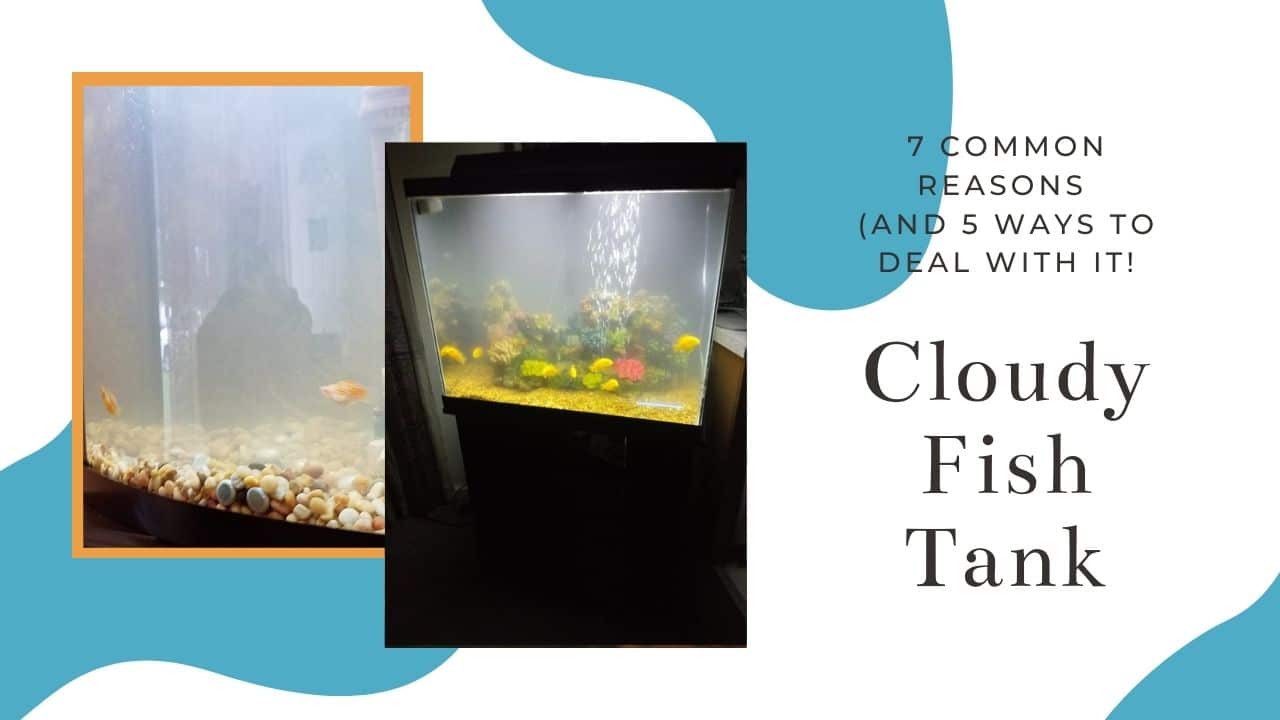
    Cloudy water is one of the first problems new fishkeepers run into. and honestly, one that experienced hobbyists still deal with from time to time. I’ve troubleshot this in my own tanks more than once over the years. The frustrating part is that cloudiness has several different causes, and treating the wrong one can make things worse. Once you know how to read the type of cloudiness, though, most cases clear up quickly.

    Dealing with a cloudy fish tank? If you have dealt with this, you will know it is one of the most frustrating things that can happen in the fish tank water. I get your pain, as I have been in the hobby for over 25 years. While the problem is not as common on the saltwater tank side, it is far more common for freshwater tanks.

    There are several reasons for cloudy water in freshwater tanks. In todayโ€™s post, Iโ€™m going to go through the 7 most common reasons for a cloudy fish tank, and 5 ways you can go about resolving the issue. Knowledge is power in this hobby and Iโ€™m here to empower you! Letโ€™s get started.

    Key Takeaways

    • The most common reason for a tank that is murky or water cloudy is having a new tank
    • Proper maintenance and stocking are good ways to prevent a tank from becoming cloudy
    • If your tank needs to be cycled, consider bacteria in bottle products
    • Glass can also make your tank look hazy, clean the inside and outside of your glass

    Why Is My Fish Tank Cloudy? The 7 Most Common Reasons for Cloudy Water

    Murky water sucks. It makes your tank look ugly and unappealing. Fortunately, there are 7 common reasons for it occurring, they are:

    1. You Have A New Tank
    2. You Are Overfeeding Your Fish
    3. You Have Too Many Fish
    4. You Don’t Have Adequate Filtration
    5. There Is A Dead Fish Or Decaying Matter
    6. Your Glass
    7. Your Substrate

    Check out our video from our YouTube channel below. We go into more detail in the blog post. Free to follow along with both.

    1. New Aquarium and Murky Water

    Cloudy water in a fish aquarium and a new tank go hand in hand with our hobby. It is very common for this to happen when you are cycling a tank or have a newly-cycled tank. When you start adding livestock to the tank, you introduce new sources of nutrients and waste to the tank. If you add too fast, the system is thrown off balance.

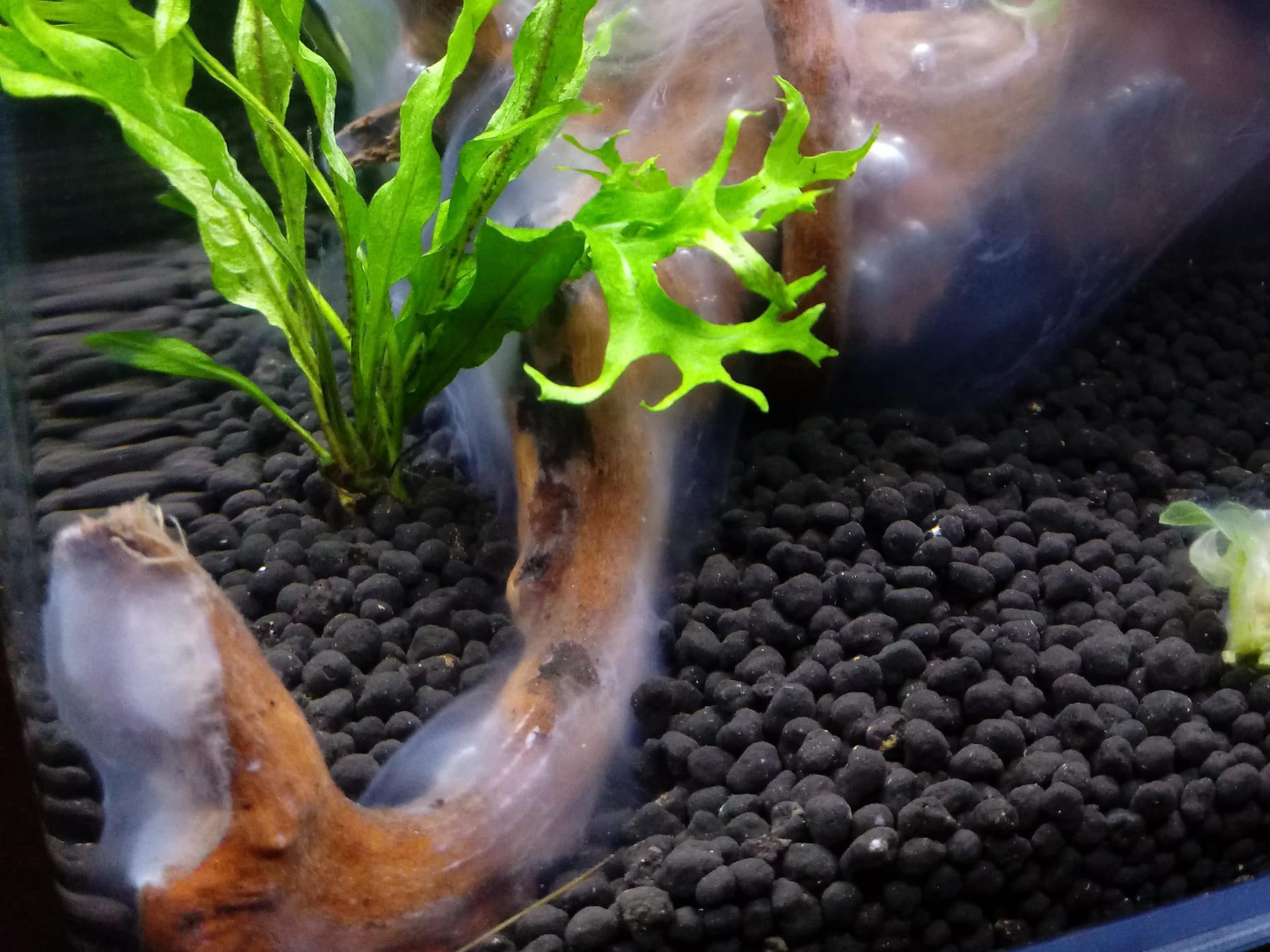
    As a result of this imbalance, the beneficial nitrifying bacteria in your tank reproduce like crazy in order to digest the excess nutrients. The massive amounts of new bacteria create a cloud, which results in your water looking cloudy. The best way to fix cloudy water issues is patience. Just stop adding fish and let your tank settle down. It should clear up on its own.

    During this time, it is a good choice to do a water test with an aquarium test kit. You will want to look at the big three new tank parameters, which are going to be Ammonia, Nitrite, and Nitrate. Ammonia and nitrite are going to be your biggest concerns with a brand-new tank.

    2. Overfeeding

    If you have an established tank, this is a common reason for tank water in your aquarium to become cloudy. It’s understandable to want to feed your fish all the time. After all, they usually greet you when they see you with their cute little faces. They look at you, and the top of the tank waiting for you to feed them. If you start feeding a lot, your system gets thrown off balance and a bacteria bloom occurs.

    Lay off the feeding for a bit and test your aquarium water. It’s actually a good thing to have your fish go without food for a day to let their digestive systems settle down. Excess food is problematic and can lead to dirty aquarium water. The only fish you don’t want to do this with would be fish that lack stomachs, like goldfish. Look out for automatic fish feeders as it is easy to overfeed with them.

    3. Too Many Fish

    Too many fish in the tank is going to lead to a dirty-looking aquarium. Adding them too fast will also cause the water in the tank to look clouded. Slow yourself down with additions and avoid adding any more fish until you get this problem under control.

    When planning out fish, a really great site to get an overview is AdAdvisor. Just plug in the fish you want to add and run the calculator. As a rule of thumb, you do not want to increase your fish population by 50% and you want to spread out your additions to 4-6 week timelines so your tank has time to balance out. The only time I feel where you can get away from this is if you have done a dry start for a planted aquascape. Here is the link to the calculator.

    4. Inadequate Filtration

    Filtration is a major cause of this problem in an established tank. The main culprit here is going to be your mechanical filtration. Cheaper power filters tend to use coarse foam, which finer particles will pass through. When it comes to canister filters, the issue may be the choice of foam. Fortunately, high-end brands like the Biomaster Thermo will have multiple foam densities you can choose from. If you have a heavily populated tank, you might want to consider going for a finer foam.

    If you are using a power filter, you might want to consider adding a layer of filter to improve your mechanical filtration. I prefer to use the blue floss that is put in canister filters and sumps. You can purchase it in bulk online and then cut it to fit.

    5. Dead Fish Or Matter

    Decaying matter can cause murky water in your tank and will get dirty fast. The biggest piece of decaying matter is going to come from a dead fish. Check your tank every day and see if all the fish you own are accounted for. Sometimes, if your fish are breeding, you may have dead fry that is dirtying up your tank water.

    The other factor is going to be chunks of uneaten fish food and decaying plant matter. Check your substrate for both and trim off any decaying leaves you see on your live plants.

    6. Your Glass

    Your glass can be a source making your tank water look murky. The main cause is from bacterial biofilm. Biofilm looks the most obvious on aquarium driftwood like in the photo below, but it also grows on your glass.

    Biofilm In Aquariums

    This biofilm will stick to your glass and give it a cloudy look if left unchecked. On larger fish tanks, your tank will have a slight tint to it that will make it look a little darker. Low iron rimless aquariums and acrylic tanks will have better clarity and show better than traditional glass tanks.

    7. Your Subtrate

    New substrates can cause cloudiness or milky water that will look hazy if they are not rinsed. Always make sure you wash your substrate thoroughly before putting it in your aquarium. The other cause can be an existing substrate that is stirred up. Stirring up too much of your substrate at once can cause the release of additional nutrients, which will cause a bacterial bloom or cause discoloration of your aquarium water causing it to look milky. If you are going to stir your substrate, it is best to do so when gravel vacuuming so you get most of the debris that comes out

    5 Ways To Deal with It

    Alright, so we know the 7 common causes of cloudy aquarium water. Let’s talk about what we can do about it. Itโ€™s actually simpler than you think and here are 5 ways to get rid of it:

    • Proper Tank Maintenance
    • Making Sure Your Glass Is Clean
    • Proper Filtration Maintenance
    • Cycling Your Aquarium
    • Improving Quality Of Light Duration

    1. Proper Aquarium Maintenance

    Dirty Fish Tank

    Proper maintenance on your tank is going to be the #1 solution for white cloudy aquarium water. Most problems in this hobby can be resolved with a water change. A water change can bring balance back into your aquarium and balance the water chemistry. In most cases, clouded water is going to be a result of a bacterial bloom due to spikes in nutrients. Doing a water change will remove these nutrients and get everything in balance. If the problem is more serious, you will need to do more water changes over time to get everything back to where it should be.

    In extreme cases, 40-50% water change every day or every other day is not uncommon when dealing with a serious nutrient spike that causes a tank to become dirty. Gravel vac your substrate. If you have a fine substrate, surface skims it with the gravel vac to remove the top layer of debris.

    2. Making Sure Your Glass Is Clean

    Both the outside and inside of your glass matter. Outside of the tank, water stains on the glass can make your tank look like there is hazy water when trying to look in. Work with a safe cleaner, like white vinegar, or better yet, use a DIYers secret weapon – Magic Erasers!

    Yes, that’s correct. The original Magic Eraser by Mr. Clean has been a blessing for acrylic aquarium owners for many years and goes unnoticed in our hobby. I’ve used it on the outside of the glass with great results. Rumor has it that it works inside the tank as well, but I’m not that brave ?. Still, I’ve had hobby friends tell me that it’s like cleaning with a plastic scraper and is completely safe. I’ve only had personal experience on the outside. For the inside, I prefer a razor blade for glass or a Flipper Cleaner.

    My Pick
    Flipper Algae Scraper

    I love the Flipper. Just put it in your aquarium and clean from the outside. You can even move it to other sides of the tank with its flipper feature. Simply Amazing!

    Click For Best Price Buy On Amazon

    The Flipper is amazing for cleaning the inside of your tank. It’s been my go to for years. It is also a great way to get your kids involved, as they can clean from the outside without having to put their tanks in the tank. There is also a cool factor with flipper the scraper when you move it to the other sides of the tank. It will scrape off the toughest of algae from your glass and make your glass look spotless!

    3. Proper filtration maintenance

    If you slack on filter maintenance, this can lead to dirty tank water problems. Your mechanical filtration is not operating at its maximum efficiency. Get into those filters and replace your filter floss and wash out your sponges. You should be changing out your filter floss every other week. For all the filter media you clean, make sure you clean them out with your tank water. If you use tap water or RO water, you risk losing those beneficial bacterial colonies in the process.

    Clean out the piping in your power filters and the tubing in your canister filters. If you have mechanical filtration, consider replacing it for a fresh set. Sometimes upgrading to a premium chemical filtration media like chemi-pure will help, though it is expensive to do. All this maintenance pays off because your filters will operate at their best, keeping your tank water looking crystal clear.

    4. Cycling Your Aquarium

    If you have a new tank, cycling your aquarium is your first step to avoiding  having a brown water tank. Reduce your feeding and donโ€™t add any more fish until the problem goes away. Test your water for ammonia and nitrite levels and do a water change to reduce the excessive nutrients.

    Another thing you can consider if you have a newer tank is getting used filter media from a disease-free tank. This will import beneficial bacteria that will jump-start the cycle. You can also opt for using beneficial bacteria-in-a-bottle solutions like Fritz Turbo Start 700.

    My Pick For Freshwater Bacteria
    Fritz Turbo Start 700 Freshwater

    Fritz Turbo Start is known in the industry as the fastest acting nitrifying bacteria you can purchase. This 700 version is specialized for freshwater tank and has my highest recommendation

    Buy On Amazon Click For Best Price

    If you are looking for a longer-term solution, a UV Sterilizer is a great addition for not only water clarity purposes but also for disease mitigation. Check out my article on Aquarium UV Steriliziers for more information on what makes a good one. There are many out there, and only a few that I would recommend.

    5. Improve quality of light and Reduce Lighting Times

    Poor lighting can really dull out your aquarium and give it a hazy look. This is more common with LED lighting as the light is more focused than T5 lights. Because the light is focused, it can lead to a disco effect and shadows can dull out your tank. I prefer an LED fixture that expands to the length of the entire tank like the Twin Star or Fluval planted tank led.

    If you have T5s, it may be time to replace the bulbs. Getting new bulbs will brighten up the aquarium and make it look more lively and clearer. T5s in general also tend to display a clearer tank, given their even spread of their light. You can get close to this with LEDs, but only with higher end LEDs, like the ones I mentioned previously.

    Reducing your lighting time can also help. This will slow down the reproduction of algae which will keep your glass and water clear.

    Common Questions (FAQS)

    Why Is My Aquarium this way?

    A tank can get dirty or look clouded for one of the 7 common reasons. You have a new tank, you are overfeeding, you are overfeeding your fish, your tank is overstocked, you do not have enough filtration, there is a dead fish or decaying matter in the tank, your glass needs to be cleaned, or you have put in new substrate.

    Is Dirty Water Bad For Fish?

    The appearance of clear cloudy aquarium water is not bad for a fish, but is a sign of imbalance and possibly a greater problem. The first thing you should do when you see hazy water would be to assess your water quality by testing your aquarium water. Get a baseline of your nutrient levels and take action as needed. Usually a water change will help put things back in balance.

    How Do I Make My Aquarium Water Crystal Clear?

    Great filtration, a good aquarium maintenance schedule, and keeping your stock levels stable are the best ways of making your aquarium water crystal clear. You can also purchase equipment and supplies that can assist greatly like an aquarium UV sterilizer.

    Will A Filter Clear Hazy Water?

    A filter can fix cloudy aquarium water. If your tank is new, your filtration system needs to catch up to balance your tank. If you have a heavily stocked tank, you may lack filtration and may need another filter to alleviate water that looks cloudy or hazy. Other times, the filter is the problem because itโ€™s dirty and needs to be maintained.

    Can Driftwood Make My Aquarium Murky?

    Driftwood can make a tank look cloudy or murky. However, the most common issue with driftwood is it can turn your aquarium water a tea like color due to the release of tannins. Some aquarium owners like this look, I personally donโ€™t. If you want to avoid that tea color, purchase a driftwood with a low tannin count like Manzanita or Tigerwood

    Conclusion – Share Your Experiences

    Implementing a proper aquarium care routine will help to avoid cloudy water tanks. Various types of fish that can also make the water cloudy such as Yellowfish and tropical fish, so you have to make a regular cleaning schedule to maintain your aquarium. Tropical fish also require specific water and temperature conditions, or they will get sick. Sand and other equipment can also affect the water in your aquarium when not properly cleaned.

    Have you dealt with dirty water before? How did you clear it up? Share your experiences below and let’s start a conversation! I hope you found this article helpful. I also love to hear from my readers. We have all dealt with this before and we can work together as a community to help others. Thanks for reading and see you next time!

  • Marine Velvet โ€“ Symptoms, Treatment & Prevention Guide

    Marine Velvet โ€“ Symptoms, Treatment & Prevention Guide

    Marine velvet is the disease I fear most in a saltwater system. more than ich, more than bacterial infections. I’ve seen it kill entire tanks within 48 hours when it goes undetected, and because the early symptoms are so easy to miss, it often does. Running a 125-gallon reef for years, I’ve learned to spot the signs early and act immediately. If you keep saltwater fish, this is the one guide you can’t afford to skip.

    Marine velvet is one of the most deadly diseases in the saltwater hobby. it kills faster than ich and is often misidentified until it’s too late. I’ve seen it wipe out entire tanks, and I’ve helped hobbyists navigate outbreaks after they reached out through my YouTube channel. The key is recognizing the early signs and acting immediately, because once fish are in late-stage velvet, your window to save them is very narrow. This guide covers exactly how to identify marine velvet, differentiate it from ich, and the treatment protocols that give your fish the best chance of survival.

    What You Need To Know (The Facts)

    NameAmyloodinium ocellatum
    Common TreatmentsChloroquine Phosphate or Copper
    Short-Term TreatmentAcriflavine or Formalin bath
    CausesTransferred from infected fish, corals, or water
    Fallow Period6 weeks
    Common SymptomsNumerous white dots on the body, fins, flashing, swimming to flow of wavemakers, erratic swimming behavior

    What is Marine Velvet? (Amyloodinium ocellatum)

    Marine Velvet Disease, scientifically known as Amyloodinium ocellatum is a dinoflagellate (not the same brown stuff mentioned in my other post). It is well known for killing prized saltwater fish in less than 24 hours, and it spreads the most during the warmest months of the year in the aquarium trade. If you are well versed in the hobby, you will often hear of increased cases of this disease during the summer. It makes summer one of the riskiest times to purchase fish locally or online.

    Because it is a dinoflagellate, it has unique features compared to other diseases in our hobby. It is often mistaken as ich (Cryptocaryon irritans), and because of this, you should learn the differences between the two.

    Marine Velvet vs Ich – The 4 Key Differences

    It’s very easy to confuse these two diseases. I’ve heard many folks say, “ich wiped my tank.” However, their stories, of how quickly everything happened, made me suspect it was actually Velvet. Let’s go into the four main differences so you know what you are tackling. They are:

    1. The number of spots
    2. Type of free swimmers
    3. Life cycle
    4. Time of infection

    1. The Number of Spots

    Your first indicator is usually the number of spots. Ich’s white spots are spread out and easy to count. With Velvet, the spots are so numerous it’s difficult to count them all. It’s almost as if the fish was dusted with white power (source). You can see an example of both diseases below. Note how the purple tang has spots spread out while the Achilles tang has spots all over its body, including the eyes.

    2. Type Of Free Swimmers

    Because Marine Velvet disease is a dinoflagellate, the free swimmers are called velvet dinospores, while ich’s are called theronts. While this is a technical term, one thing to know is that dinoflagellates feed off sunlight which makes it susceptible to blackouts, UV, and Ozone – though once you have an outbreak you will need to take more extreme measures to fight it off. All of these will control the spread, but will not cure an already infected fish!

    3. Life Cycle

    Velvet averages a 4-day life cycle and there are more attacking free swimmers than ich. This is why they can overwhelm and kill fish so fast. Ich’s life cycle can be as long as 2 weeks.

    4. Time Of Infection

    Because Velvet is a dino, it remains infective for up to 15 days. This is because as dinos, they can feed off sunlight. Ich is only infectious for up to 48 hours. The fact that it remains infective longer and attacks in larger numbers and longer is what makes this disease far deadlier than ich.

    Life Cycle

    As I mentioned before, the life cycle is only 4 days and starts when a Velvet dinospore attaches to a fish’s skin. The attached velvet dinospores are then called trophonts. This trophont will feed on your fish for several days before detaching. Sometimes, the trophonts are so numerous and overwhelming that it will kill the fish before it shows any symptoms.

    Once the trophont detaches, it is called a tomont. These tomonts divide until they burst. When they burst, they become new velvet dinospores. These dinospores then attach to a new host, starting the lifecycle all over again.

    Let’s illustrate this lifecycle with an image. The image below is from Dr. Fish himself, Humblefish. He is the go-to for all marine fish diseases in our hobby. Check out his site for further info on all other saltwater ailments and treatments.

    Marine Velvet Life Cycle

    Treatment (How To Cure)

    Marine Velvet disease needs to be treated ASAP. You need to treat it in a quarantine tank as all effective medications against it are not suitable to be used in reef tanks. There are several steps you will need to take:

    • Get the proper medication
    • Get a test kit
    • Set up a quarantine tank
    • Perform short-term relief procedures
    • Perform treatment procedures

    1. Get The Proper Medication

    Step number 1 here. The preferred treatment option for Velvet is chloroquine phosphate. Unfortunately, due to the COVID-19 pandemic and its mass usage for treating malaria1 , it is getting difficult to find. Even with a vet, most are now reluctant to prescribe it to a hobbyist. Chloroquine phosphate is highly effective and can be used with no ramp-up time. However, given its lack of availability, it will not be your primary treatment option.

    Copper is your new go-to treatment option. We will need to do some additional steps to make it work against Velvet. There are two types of copper: ionic and chelated. Ionic copper is what you will find in most fish stores due to the availability of SeaChem Cupramine. It has a shorter range of therapeutic levels (0.4 – 0.5 mg/L) and degrades fast. It’s not my preferred choice.

    Chelated copper is stable and has a larger range of therapeutic levels. Fish are more tolerant to it than ionic copper, and it is generally more effective against diseases than ionic copper. My preferred choice for chelated copper is Copper Power by Endich. Make sure you get the blue version, as there is a green version that is exclusive to freshwater Velvet. The effective range for chelated copper is 1.5 to 2.0 PPM. If you want research-backed info of copper medications – see this write-up from the University of Florida (UF is also the source of my featured image).

    Unfortunately, most stores will not have Copper Power in stock. Amazon Prime is your best bet for fast delivery. If you are researching this article and do not have a fish that is sick, I would purchase some now. It has a long shelf life.

    2. Get A Test Kit

    If you manage to get your hands on chloroquine phosphate, you are in luck. You do not have to use a test kit for CP because there is none available to the hobbyist. Only lab-grade equipment can test for CP and that is way out of the price range of most people, and also not available to purchase unless you are a lab tech.

    If you get copper, you will need a test kit. There are many factors with copper that call for a test kit. For one, copper gets absorbed by lots of things in your aquarium – your filter, the silicone in your aquarium, and any decorations. This is why hospital tanks are set up with PVC piping and simple power filters or sponge filters.

    Of all copper test kits available, the best out there is the Hanna Checker

    3. Set Up A Quarantine Tank

    A proper quarantine (AKA hospital tank) is a must. You will need to remove all fish from your display tank as the disease will need to be starved out of your display. More on this later when I explain the fallow period. Depending on the number and size of fish, most people will be working with a 10, 20L, or 55-gallon tank when treating for Marine Velvet disease. I prefer the 20L gallon since it is a nice combo of size, space, and cost-effectiveness. A 55-gallon tank is used for large or multiple fish. Ammonia levels should be monitored with a SeaChem Ammonia Alert Badge.

    For the full setup you will need:

    I walk you through the part selection below in my video. I bookmarked it to the section where I go through each piece of equipment.

    The main concern with a hospital tank is not having a bacteria culture to jumpstart it. If you have media in your display tank, move it over to the hospital tank to seed the tank. I would also recommend using Bio-Spera. This is my preferred choice for bacteria in a bottle for hospital tanks because you can find it everywhere – even in chain pet stores.

    4. Perform Short-Term Relief Procedures

    Because most of you will need to use copper to treat Marine Velvet disease, you will need to perform short-term relief procedures to give your fish relief from the disease. To do so, we will want to use an Acriflavine or Formalin bath. Since Formalin is a controversial medication and even banned in some states, Acriflavine is going to be our best choice.

    There is actually one product in our hobby that contains both Acrifalvine and Formalin, That product would be Ruby Reef Rally. This is the preferred solution for providing relief to our fish. Here are the steps:

    • Prepare a 2.5 gallon or 5 gallon bucket depending on your fish size with a heater and air pump
    • Put your display tank water into the bucket
    • Add the recommended dosage of Ruby Reef Rally to the bucket and mix fully
    • Place fish into the bucket and allow 90 minutes to observe for signs of stress
    • Remove fish and place it into your hospital tank – start the next relief procedures

    Ruby Reef Rally is my go to for dips. I use it for disease relief and also before I introduce any fish into my quarantine tanks. It is available at most local fish stores.

    If you are unable to procure Rally, you can do a 5-minute freshwater dip. Walking through a freshwater dip can be a separate article in itself. Here is a video from Meredith Presley to get you going. She does this for gill flukes, but a freshwater dip is an effective short-term option for Marine Velvet disease.

    5. Perform Treatment Procedures

    It’s time to attack this disease full-on. Since there are two ways to tackle this beast, I’ll walk you through both.

    Treating With Chloroquine Phosphate

    If you are fortunate to get this wonder drug, here is how you eradicate Velvet with it:

    • The typical dosage is 40mg per gallon
    • Use a digital scale when measuring your dosage
    • Use your hospital tank water in a cup to pre-dissolve the solution
    • For Velvet – you will need to maintain 40 mg per gallon for a minimum 14 days to treat – 30 days is preferred
    • If a water change is done, you must replace the water with medicated water using the same 40mg per gallon dosage
    • To top off water, you will not need to add medication

    I provided my video again, this time at the 7:00 mark where I walk you through how I mix CP in my quarantine tanks. You can see how I use the digital scale to measure, how I pre-dissolve, and how I add it to the aquarium.

    Treating With Copper

    Copper is a bit tricky because we have to work with the ramp up time. Most fish cannot tolerate an instant ramp up to therapeutic ranges. This is why we need to perform those short term procedures I explained previously to buy us time. We will need to perform a 24-hour ramp up. Here are the steps to getting us to effective levels:

    • Start off by raising copper levels to 1.0 ppm – verify with your Hanna Checker
    • Over the next 24 hours – raise your levels to 1.5 ppm. Do this every 8 hours, raising 0.125 PPM each time
    • After you raise it to 1.5 ppm – bring it to 2.0 ppm over the next 24 hours. Do this every 8 hours, raising 0.125 PPM each time
    • Treat for 30 days keeping levels above 1.50 ppm. If you drop below 1.50 at any time, your countdown to 30 days starts over!

    The Fallow Period – How to Eradicate The Disease In Your Display Tank

    Treating the disease in the hospital tank and saving your fish is the first battle we fight. Completely eradicating Velvet from your display is how to get a total victory. To do this, we must understand the fallow period needed to wipe it out. I also need to explain what fallow means.

    Fallow means no fish in your display. Velvet needs the fish as a host, without the fish, the disease starves out and can’t reproduce. Any coral inverts, and clean-up crew you have in your display can stay in your tank. This can be really discouraging for a reefer to have a fishless tank. There have been times that I have recommended to a hobbyist to impulse buy corals when at the beginning of the fallow period. Just buy a bunch now.

    Why would I say that? Because after you place all those corals you always wanted, you can begin your fallow period. It’s something you can look forward to. When your fish return they will be treated to new corals and structures to explore in a disease-free tank! The fallow period is also a long time.

    How long is it? The fallow period needed to completely wipe out Velvet from a display tank is 76 days. Yes, I know that is a long time. Now you see why I’m suggesting you go buy those corals you always wanted now where there is no risk to spread disease to your fish!

    During this time, you must make sure you do not cross-contaminate your tanks. Keep your hospital tank 10 feet away from your display tank and use separate nets, buckets, and equipment. Make sure you wash your hands before switching tanks with a reef-safe cleaner like dawn dish soap.

    Frequently Asked Questions

    I’m going to add some FAQS here that I get from readers and also to help with visibility online so people can find this post. If you have any questions, I encourage you to leave a comment below. I will add to this FAQ over time.

    Can Fish Survive This?

    Yes, fish can survive Marine Velvet disease. They will need treatment to survive, however. Surviving fish have been known to develop an immunity to the disease, but can still be carriers. This is why we must treat the disease and completely eradicate it from your display tank.

    How Do You Get Rid Of It?

    There are two medications that are effective in getting rid of Marine Velvet disease. The most available is chelated copper using a product like Copper Power. The other medication is chloroquine phosphate, which is more effective but difficult to obtain. Both need to be treated in a hospital tank, and a fallow period must be done in the display tank to remove it completely.

    How Do You Treat It?

    You need to treat Velvet with either chelated copper or chloroquine phosphate in a hospital tank, then have a 76-day fallow period in your display tank to completely remove it from the system.

    How Long Can They Live Without A Host?

    Marine Velvet can live without a host fish for up to 72 days per a Texas A&M study. This is why I recommend a 76-day fallow period. This builds a buffer so you can ensure complete eradication

    How Long Can A Fish Live With This?

    It depends on the fish, but generally most fish cannot live with Velvet longer than 1-2 days. Some will die before they have any visible symptoms! This is why it’s critical for you to begin treatment as soon as possible. It is not a disease to take lightly!

    The most resistant fish in our hobby are those with a thick slime coat. These would be fish like clownfish, mandarins, wrasses, and rabbitfish. Nevertheless, Velvet is capable of wiping out every fish in your aquarium!

    References

    Conclusion

    I hope this guide got you all the information you need to combat this tank killer. Marine Velvet disease shouldn’t be taken lightly. You should run to your local fish store to get supplies now if you are dealing with it. If you are not dealing with it, work on building up your medicine cabinet now. It may save your fish’s life one day or save a fellow reefer’s fish. If you have any questions, please leave a comment below. I’ve successfully fought off Velvet in the past and I am happy to share my experience with you.


    ๐Ÿ“˜ Want to learn more? This article is part of our complete Saltwater Fish & Reef Guide. your ultimate resource for marine fish, coral care, reef setup, and more.

  • 11 Most Popular Types of Koi: A Guide to Varieties, Patterns, and What to Look For

    11 Most Popular Types of Koi: A Guide to Varieties, Patterns, and What to Look For

    Koi are pond fish. Not aquarium fish. They reach 2 to 3 feet long and live 25 years or more. The commitment is closer to owning a dog than keeping a fish tank.

    Koi outlive most pets. Make sure your pond plan matches a 25-year commitment.

    Koi keeping is a hobby within a hobby, and once you go down that rabbit hole it can get seriously deep. I’ve seen vendors at Aquashella selling single fish for thousands of dollars. And the buyers know exactly what they’re looking at. The variety of koi is genuinely staggering, from the classic Kohaku with its white body and red pattern to the metallic Ogon to the butterfly koi that divide opinion in the hobby. What most beginners don’t realize is how different show-quality Japanese koi are from the inexpensive pond-store fish. The bloodlines and growing conditions matter enormously. Here are 11 of the most popular varieties worth knowing, whether you’re starting a pond or shopping more seriously.

    Top 11 different types of Koi fish Varieties

    There are over a hundred Koi varieties. However, I’m listing down 11 of the most popular varieties of Koi fish that have taken the fishing world by storm. Below is a quick infographic. You can see the full site graphic here.

    Types Of Koi

    1. Gosanke

    Gosanki Koi

    When I speak of Koi fish, my mind automatically shifts and pulls me in the direction of Gosanke.

    And I’ll tell you why.

    In the world of Koi, nothing beats Gosanke since this Koi variety is granted the highest status among all the varieties. The family of Gosanke Koi includes three popular Koi varieties and that’s the reason we call Gosanke the “big three”.

    Gosanke Koi is a diverse group of the world’s best koi fish including, Kohaku Koi, Taisho Sanshoku or Taisho Sanke, and Showa Sanshokuall of which are Grand champion winners. The signature colors of Gosanke Koi are red (Hi), black (Sumi), and solid white (Shiroji), where red and white are common among the three varieties. 

    Let’s dissect the characteristics of the three varieties of Gosanke koi fish (Kohaku, Sanke, Showa).

    2. Kohaku

    Kohaku Koi

    If you’re an avid Koi keeper, you know that Koi keeping begins and ends with Kohaku.

    Kohaku, which was once known as Sarasa appeared 200 years ago. Its distinctive characteristic was the red color that made it pop out in the pool of fishes.

    Now any Koi variety that is graced with red color is judged on the basis of the Kohaku pattern, which is loved by Koi enthusiasts all around the world.

    Kohaku Appearance

    Note: There’s no Sumi in Kohaku Koi

    The contemporary Kohaku Koi fish has a solid white (shiroji) body covered with red (hi or beni) markings. However, when the Koi fish is young, the base color (shiroji) may appear translucent or pinkish. The translucency of Shiroji in young Koi fish is ideal as the high-quality Shiroji (white) develops with the time that is seen in Koi competitions. For Koi hobbyists, the white base color holds more importance than the patterned red (hi) because a stunning base color makes the red patterns stand out in the crowd.

    As far as the patterns are concerned, the only color is red (hi or beni). However, beni can further be classified into two hues under some circumstances. The most popular and common color of beni is orange-red or purple-red. The color is transformed into a deep scarlet by maintaining water quality and good nutritional Koi fish food with the right amount of color enhancers.

    Things to look for

    When choosing among a large batch of Kohakus, these are the things to look out for the perfect and healthy fit.

    1. Choose the Koi fish with red (beni) on the head that only goes down about as far as the nostrils
    2. The eyes of Kohaku should be clear with no red markings. However, recent research shows that red can cover one eye but never both the eyes
    3. The base or shiroji should be milky or snowy white with no yellow coloration
    4. The hi around tails and fins should be less
    5. The interior of Hi should have no hues of Shiroji
    6. The quality or depth of beni should be thick; the thicker the Beni, the better

    3. Taisho Sanke

    Taisho Sanke Koi

    This winning breed of Koi fish is a bit confusing to many neophytes because of the three different names; Sanke, Taisho Sanke, and Taisho Sanshoku.

    Whatever the name may be, they all represent Taisho Sanshoku. However, the most common name for this Koi fish breed is Sanke, and the most appropriate is Taisho Sanshoku. Sanshokumeans tricolor in Japanese, indicating three different colors of Sanke, particularly white, black, and red.

    Simply put, Sanke Koi is a solid white (shiroji) Koi fish with red (hi, beni) and black (Sumi) markings. 

    Taisho Sanke appearance

    To find a Taisho Sanke that is both healthy and happy, you need to choose a healthy Kohaku. The Kohaku Koi sets the standard for a wholesome Sanke. The clearer the white (shiroji), the healthier the Sanke Koi.

    The base color of Sanke Koi fish is shiroji (solid, creamy white), which begins at the nose and extends to the tail and fins. The Hi on Sanke is a deep-orange shade rather than Cardinal red. Sanke possesses large, reddish-orange spots that make their color pattern appealing with shiroji between the patches of Hi.

    Whereas, the Sumi be the rarest color on Sanke Koi. The Sumi (black) on Sanke are comparatively smaller than the Hi or Beni, making it a secondary color, while Beni or Shiroji are primary.

    Things to look for

    1. Shiroji should be clean, bright, and not discolored
    2. Sumi should appear as round patches and should be only present above the lateral line
    3. The head should have no Sumi
    4. On Sanke, the red should take up to 70% of Koi, the black about 10%, and the rest should be Shiroji
    5. Avoid Sanke with lots of small, peppery like Sumi markings. It’s a sign of poor quality Koi fish
    6. The fins should be all-white or partial white with black stripes

    4. Showa Sanshoku

    Show Sanskoku Koi

    Novice Koi keepers often confuse Showa Sanshoku with Sanke because of the uncanny resemblance between the two types of Koi.

    Showa Sanshoku is a tri-colored Koi variety with Sumi as the dominant color. In short, Showa is a black Koi adorned with white (Shiroji) and red (Hi) patterns.

    Appearance

    Appearance-wise, Showa is confused with Sanke because of the same colors. However, Sanke is graced with a white base that does not go beyond the lateral line or onto the head. Alternatively, Showa possesses a black skin that shows through Shiroji and Hi.

    Also, one biggest difference between sanke-showa is the patterns of Showa wrap around.

    The Showa is further classified into seven different types of koi according to their body markings.

    1. Hi Showa with dominant red and black and very little Shiroji (white).
    2. Kindai Showa with 40% white or more, and varying amounts of Hi and Sumi.
    3. Old style Showa is mostly black with scarce Shiroji and Hi as a secondary color.
    4. Doitsu Showa has a shortage of scales except for some broad scales.
    5. Kin Showa has a gold, metallic sheen that sparkles.
    6. Gin Rin Showa has a silver metallic sheen. However, there are some Koi varieties with a combination of gold and silver sheen. The class of Koi is known as Kin Gin Rin.
    7. Ai Showa has blue or deep indigo speckles over the body.

    What to look for

    1. Thick base color with a lustrous appearance
    2. Sumi extends along the body length and extends into the fins moderately
    3. Red in Showa is strong and dense, particularly on the face, back, and tail region
    4. The pattern should be evenly distributed and easy on the eyes with sharp edges between the patterns

    5. Utsurimono

    Utsurimono Koi

    Utsurimono belongs to the same family as Showa Sanshoku. They are graced with a black coat and divided into further categories according to the color of their body markings.

    Utsurimono possesses a non-metallic black color mixed with any secondary color, producing beautiful interlacing patterns.

    Fun fact: Utsurimono was once considered a defective Showa Koi that lacked Hi (red) coloring. However, over the years, Koi enthusiasts have started to admire and adore this majestic Koi breed.

    Appearance

    Like other varieties of Koi, Utsurimono is defined by its distinctive color patterns that leave the fish lovers in awe.

    Appearance-wise, Utsurimono falls under three primary varieties.

    1. Ki Utsuri have a black coat with yellow as an accent color
    2. Hi Utsuri, as the name suggests, Hi utsuri has a black coat accentuated with a scarlet color.
    3. Shiro Utsuri has black skin with crystal white as the accent color. Also, the base of the pectoral fins of Shiro Utsuri is black.

    What to look for

    1. The Sumi of Utsurimono should cover the nose, pectoral fin joints, and side faces
    2. Always look out for four common patterns on the head of Utsurimono, which are the lightning strike, the small black patches, the two distinctly different black patches, and the heavy black pattern. These patterns are then separated by the accent color of the variety
    3. The accent color should be properly distributed as if the black base is wrapped around the accent colors

    6. Hikarimono

    Hikarimono Koi

    Koi fish are known for their bizarre colors but not all Koi fish show various colors at once. There’s a variety of Koi that shows only one color which is known as Hikarmono or Ogon Koi.

    The Ogon Koi is of any color ranging from yellow, red, orange, platinum ogon, and cream. All these Koi colors can either be regular or metallic. However, the most common colors that the Ogon Koi comes in are white and yellow.

    To be sure if you have a pure breed Hikarimono, identify its colors. If there’s more than one color, it’s not a pure breed of Ogon Koi. Suppose you have a platinum ogon, it should only possess one color i.e., platinum. If the color of your Platinum Ogon is not uniform, then it’s not purebred.

    Hikarimono is a hardy Koi fish with a greater lifespan than other varieties. Hence, it’s low-maintenance and easy to breed.

    Hikarimono Koi is classified into 3 sub-categories.

    1. Hikari-Moyo is a metallic breed with patterns
    2. Hikari-Utsuri is a metallic variant of Utsurimono
    3. Hikari- Muji is a metallic version of Mujimono

    7. Kawarimono

    Kawarimono Koi

    The meaning of Kawarimono in Japanese means “Oddballs” and so Kawarimono is a classification of a variety of Koi that are non-metallic and don’t fit into other classes.

    The Kawarimono Koi comes in three groups.

    Single-colored

    The Koi breeds that fall under the single-colored category are called Benigoi, where the Hi (red) covers almost the entire body that looks like a giant goldfish.

    The Single-colored Koi breed features a uniform color tone with red or white-tipped fins and a voluminous body shape.

    Black

    Koi varieties with black color display deep and even Sumi on fins or body. The four main varieties of Koi are.

     a. Karasu has black fins and a body with an orange or white tummy

    b. Hajiro has a black coat with a white nose and white-tipped fins

    c. Hageshiro has a white head to the color combination

    d. Youtsujiro has white fins

    Other Types

    Other odd Koi varieties are Midorigoi (green-colored) and Matsuba Koi (red Koi with dark scales).

    8. Gin rin

    Gin Rin Koi

    In a Koi fish pond, all that glitters is Gin rin.

    Gin Rin or Kin Gin Rin is more like a scale-type reference, which means silver scales. Therefore, Gin Rin have glittery scales that resemble floating diamond in water ponds.

    The color of the Gin Rin scales highly depends on the base color of Koi fish. For example, the Gin Rin reflects golden color when they cover red base (Hi) and silver while covering black or white skin.

    Gin Rin Koi is different from Hikarimono and metallic variety of Koi because Gin Rin are metallic scales whereas, the Hikarimono and metallic variety display a shiny, lustrous coat.

    There are four types of Gin Rin Koi.

    1. Diamond Gin Rin is the most common type with a crackled glass-like appearance
    2. Beta Gin is less common and the surface of skin sparkles like that of a mirror
    3. Pearl Gin is the most unusual type of Gin Rin with raised shiny deposits on the center of scales
    4. Kado Gin Rin is the least preferred type of Koi

    9. Doitsu

    Doitsu Koi

    Doitsu Koi are a modern addition to the Koi family. It is a crossbreed of Wagoi and European Caprinus Carpio Carpio with little to no scales.

    However, in terms of scales, the Doitsu Koi is divided into two types of Koi.

    1. The leather carp with little or no scales on the body
    2. The mirror carp with a row of enlarged scales on the lateral line and two lines running alongside the dorsal fin

    Furthermore, the types of scales in Doitsu Koi fish is divided into three types.

    1. Kawi Goi
    2. Kagami Goi
    3. Yoroi Goi

    Pto Tip: In competitions, the Doitsu Koi is beat out in shows by the scaled Koi varieties.

    10. Butterfly

    Butterfly Koi

    The butterfly Koi is one of the most popular and beautiful varieties of Koi. It’s a shame that it’s considered a fake breed of Koi fish by the Japanese, which is the reason it’s more famous in the USA than in other parts of the world.

    The butterfly Koi is the descendant of Goldfish and inherits one of the fanciest traits of its parent. I.e., long and flowing fins.

    However, despite being one of the most graceful ornamental fish, it is not suitable for conditions because it deviates from the traditional Koi characteristics.

    11. Tancho

    Tancho Koi

    Tancho is a red-head Koi variety that wears its Hi (red) marking as a crown on the head.

    Tancho Koi possess Hi markings on the head region only and comprise the family of Kohaku with lone, circular patterns of Hi on the head without Hi markings on the white, solid body.

    The red spot on the head should be circular and crimson red in color for the ideal Tancho Koi, such as Tancho, Tancho Showa, and Tancho Sanke.

    Most Popular Types For Shows

    Though any Koi fish is truly capable of winning competitions, there are certain groups of Koi fish that are more prevalent for shows than others. They include.

    1. Kohaku 
    2. Sanke
    3. Showa 

    Particularly the Gosanke variety of Koi is the most popular for Koi shows. However, the other classes are that are also in vogue for competitions are Utsuri, Bekko, Shusui, Koromo, Hikari Muji, Hikari Mono, Hikari Utsuri, Kawarigoi, Tancho, Kin Gin Rin. While some shows might also entertain the Doitsu Koi. 

    FAQS

    How many types are there?

    There are over more than a hundred (100) varieties of Koi fish known to mankind to date. Each variance has its own distinctive features that set them apart from others. The most prominent features of Koi lie in the color, patterns, and body conformation.ย 

    What are the three varieties?

    The three varieties of Koi or the “big three” refer to Gosanke, chieflyย Kohaku,ย Taisho Sanshokuย (Sanke), andย Showa Sanshokuย (Showa). These three types of koi out of 100 varieties are highest-rated for their excellence, popularity, and quality.

    What color is most expensive?

    Kohaku Koi, the red and white carp is the most expensive Koi species in the world it was sold for around $2.2 million US dollars in China.

    What is the rarest?

    The rarest Koi fish till date is Ki Utsuri. The group of Utsurimono with yellow patterns over a black, lacquer body.

    What is the biggest type?

    Koi is humongous. However, some Koi grow out to be bigger than the expectations. The same happened in 2007 when the Koi named “Big girl” was in the limelight as the world’s biggest Koi fish. Big Girl weighed around 90lbs and was 1.2m long.

    No other Koi has beaten the the record of monstrous ‘Big Girl‘ so far.

    What are the best to buy?

    Choosing the best Koi for your garden ponds is a nuisance. Because you never know the water quality and nutritional health of your fish before you spend some time with it.

    I don’t recommend buying fish online, no matter how trustworthy the site seems. That’s because you can only check out for abnormalities and problems in person. Therefore, I recommend going to the store and analyzing the water conditions and nutritional needs of the fish before making a purchase.ย 

    I’m an avid Koi keeper, and all my life, I’ve bought my Koi fromย Next Day Koi.ย They have an extensive collection of Koi breeds that are bred for perfection and excellence at reasonable rates. Also, the freedom to pick your own delivery date while ordering is what makesย Next Day Koiย the best bet for an occupied person like me. You can use my promo code ASDEPOT for an extra 10% off!

    Do they grow faster than goldfish?

    Koi are hardy animals that are voracious eaters. Also, they live much longer than goldfish and have a healthier immunity system. As compared to Goldfish, Koi grow at a rapid rate, doubling the Goldfish in their first year.

    How Can You Tell a Male from a Female?

    Here are some pointers to look for when identifying a female or male Koi in the swarm of fish.
    Koi males have more slender bodies than females. A female Koi has a rounded body, especially when she’s carrying eggs.

    The pectoral fins of male Koi are pointed and solid in color. The female possesses rounder fins as compared to its male counterparts.

    The breeding season brings many changes to Koi fish. Therefore, look out for Tubercles (little, white growths on the male head and pectoral fins). Comparatively, female Koi fish don’t develop Tubercles.

    Closing Thoughts

    The Nishikigoi family has over a hundred different types of Koi, capable of animating your garden ponds through their rich, vibrant colors and unique body conformation. We identify the Koi varieties on the basis of their markings, pattern placement, accent colors, and history. This article speaks about nine different Koi varieties, out of which three are prized Koi, ideal for Japanese Koi competitions.

    Koi keeping is a hobby within a hobby, and once you go down that rabbit hole it can get seriously deep. I’ve seen vendors at Aquashella selling single fish for thousands of dollars. And the buyers know exactly what they’re looking at. The variety of koi is genuinely staggering, from the classic Kohaku with its white body and red pattern to the metallic Ogon to the butterfly koi that divide opinion in the hobby. What most beginners don’t realize is how different show-quality Japanese koi are from the inexpensive pond-store fish. The bloodlines and growing conditions matter enormously. Here are 11 of the most popular varieties worth knowing, whether you’re starting a pond or shopping more seriously.

    Top 11 different types of Koi fish Varieties

    There are over a hundred Koi varieties. However, I’m listing down 11 of the most popular varieties of Koi fish that have taken the fishing world by storm. Below is a quick infographic. You can see the full site graphic here.

    Types Of Koi

    1. Gosanke

    Gosanki Koi

    When I speak of Koi fish, my mind automatically shifts and pulls me in the direction of Gosanke.

    And I’ll tell you why.

    In the world of Koi, nothing beats Gosanke since this Koi variety is granted the highest status among all the varieties. The family of Gosanke Koi includes three popular Koi varieties and that’s the reason we call Gosanke the “big three”.

    Gosanke Koi is a diverse group of the world’s best koi fish including, Kohaku Koi, Taisho Sanshoku or Taisho Sanke, and Showa Sanshokuall of which are Grand champion winners. The signature colors of Gosanke Koi are red (Hi), black (Sumi), and solid white (Shiroji), where red and white are common among the three varieties. 

    Let’s dissect the characteristics of the three varieties of Gosanke koi fish (Kohaku, Sanke, Showa).

    2. Kohaku

    Kohaku Koi

    If you’re an avid Koi keeper, you know that Koi keeping begins and ends with Kohaku.

    Kohaku, which was once known as Sarasa appeared 200 years ago. Its distinctive characteristic was the red color that made it pop out in the pool of fishes.

    Now any Koi variety that is graced with red color is judged on the basis of the Kohaku pattern, which is loved by Koi enthusiasts all around the world.

    Kohaku Appearance

    Note: There’s no Sumi in Kohaku Koi

    The contemporary Kohaku Koi fish has a solid white (shiroji) body covered with red (hi or beni) markings. However, when the Koi fish is young, the base color (shiroji) may appear translucent or pinkish. The translucency of Shiroji in young Koi fish is ideal as the high-quality Shiroji (white) develops with the time that is seen in Koi competitions. For Koi hobbyists, the white base color holds more importance than the patterned red (hi) because a stunning base color makes the red patterns stand out in the crowd.

    As far as the patterns are concerned, the only color is red (hi or beni). However, beni can further be classified into two hues under some circumstances. The most popular and common color of beni is orange-red or purple-red. The color is transformed into a deep scarlet by maintaining water quality and good nutritional Koi fish food with the right amount of color enhancers.

    Things to look for

    When choosing among a large batch of Kohakus, these are the things to look out for the perfect and healthy fit.

    1. Choose the Koi fish with red (beni) on the head that only goes down about as far as the nostrils
    2. The eyes of Kohaku should be clear with no red markings. However, recent research shows that red can cover one eye but never both the eyes
    3. The base or shiroji should be milky or snowy white with no yellow coloration
    4. The hi around tails and fins should be less
    5. The interior of Hi should have no hues of Shiroji
    6. The quality or depth of beni should be thick; the thicker the Beni, the better

    3. Taisho Sanke

    Taisho Sanke Koi

    This winning breed of Koi fish is a bit confusing to many neophytes because of the three different names; Sanke, Taisho Sanke, and Taisho Sanshoku.

    Whatever the name may be, they all represent Taisho Sanshoku. However, the most common name for this Koi fish breed is Sanke, and the most appropriate is Taisho Sanshoku. Sanshokumeans tricolor in Japanese, indicating three different colors of Sanke, particularly white, black, and red.

    Simply put, Sanke Koi is a solid white (shiroji) Koi fish with red (hi, beni) and black (Sumi) markings. 

    Taisho Sanke appearance

    To find a Taisho Sanke that is both healthy and happy, you need to choose a healthy Kohaku. The Kohaku Koi sets the standard for a wholesome Sanke. The clearer the white (shiroji), the healthier the Sanke Koi.

    The base color of Sanke Koi fish is shiroji (solid, creamy white), which begins at the nose and extends to the tail and fins. The Hi on Sanke is a deep-orange shade rather than Cardinal red. Sanke possesses large, reddish-orange spots that make their color pattern appealing with shiroji between the patches of Hi.

    Whereas, the Sumi be the rarest color on Sanke Koi. The Sumi (black) on Sanke are comparatively smaller than the Hi or Beni, making it a secondary color, while Beni or Shiroji are primary.

    Things to look for

    1. Shiroji should be clean, bright, and not discolored
    2. Sumi should appear as round patches and should be only present above the lateral line
    3. The head should have no Sumi
    4. On Sanke, the red should take up to 70% of Koi, the black about 10%, and the rest should be Shiroji
    5. Avoid Sanke with lots of small, peppery like Sumi markings. It’s a sign of poor quality Koi fish
    6. The fins should be all-white or partial white with black stripes

    4. Showa Sanshoku

    Show Sanskoku Koi

    Novice Koi keepers often confuse Showa Sanshoku with Sanke because of the uncanny resemblance between the two types of Koi.

    Showa Sanshoku is a tri-colored Koi variety with Sumi as the dominant color. In short, Showa is a black Koi adorned with white (Shiroji) and red (Hi) patterns.

    Appearance

    Appearance-wise, Showa is confused with Sanke because of the same colors. However, Sanke is graced with a white base that does not go beyond the lateral line or onto the head. Alternatively, Showa possesses a black skin that shows through Shiroji and Hi.

    Also, one biggest difference between sanke-showa is the patterns of Showa wrap around.

    The Showa is further classified into seven different types of koi according to their body markings.

    1. Hi Showa with dominant red and black and very little Shiroji (white).
    2. Kindai Showa with 40% white or more, and varying amounts of Hi and Sumi.
    3. Old style Showa is mostly black with scarce Shiroji and Hi as a secondary color.
    4. Doitsu Showa has a shortage of scales except for some broad scales.
    5. Kin Showa has a gold, metallic sheen that sparkles.
    6. Gin Rin Showa has a silver metallic sheen. However, there are some Koi varieties with a combination of gold and silver sheen. The class of Koi is known as Kin Gin Rin.
    7. Ai Showa has blue or deep indigo speckles over the body.

    What to look for

    1. Thick base color with a lustrous appearance
    2. Sumi extends along the body length and extends into the fins moderately
    3. Red in Showa is strong and dense, particularly on the face, back, and tail region
    4. The pattern should be evenly distributed and easy on the eyes with sharp edges between the patterns

    5. Utsurimono

    Utsurimono Koi

    Utsurimono belongs to the same family as Showa Sanshoku. They are graced with a black coat and divided into further categories according to the color of their body markings.

    Utsurimono possesses a non-metallic black color mixed with any secondary color, producing beautiful interlacing patterns.

    Fun fact: Utsurimono was once considered a defective Showa Koi that lacked Hi (red) coloring. However, over the years, Koi enthusiasts have started to admire and adore this majestic Koi breed.

    Appearance

    Like other varieties of Koi, Utsurimono is defined by its distinctive color patterns that leave the fish lovers in awe.

    Appearance-wise, Utsurimono falls under three primary varieties.

    1. Ki Utsuri have a black coat with yellow as an accent color
    2. Hi Utsuri, as the name suggests, Hi utsuri has a black coat accentuated with a scarlet color.
    3. Shiro Utsuri has black skin with crystal white as the accent color. Also, the base of the pectoral fins of Shiro Utsuri is black.

    What to look for

    1. The Sumi of Utsurimono should cover the nose, pectoral fin joints, and side faces
    2. Always look out for four common patterns on the head of Utsurimono, which are the lightning strike, the small black patches, the two distinctly different black patches, and the heavy black pattern. These patterns are then separated by the accent color of the variety
    3. The accent color should be properly distributed as if the black base is wrapped around the accent colors

    6. Hikarimono

    Hikarimono Koi

    Koi fish are known for their bizarre colors but not all Koi fish show various colors at once. There’s a variety of Koi that shows only one color which is known as Hikarmono or Ogon Koi.

    The Ogon Koi is of any color ranging from yellow, red, orange, platinum ogon, and cream. All these Koi colors can either be regular or metallic. However, the most common colors that the Ogon Koi comes in are white and yellow.

    To be sure if you have a pure breed Hikarimono, identify its colors. If there’s more than one color, it’s not a pure breed of Ogon Koi. Suppose you have a platinum ogon, it should only possess one color i.e., platinum. If the color of your Platinum Ogon is not uniform, then it’s not purebred.

    Hikarimono is a hardy Koi fish with a greater lifespan than other varieties. Hence, it’s low-maintenance and easy to breed.

    Hikarimono Koi is classified into 3 sub-categories.

    1. Hikari-Moyo is a metallic breed with patterns
    2. Hikari-Utsuri is a metallic variant of Utsurimono
    3. Hikari- Muji is a metallic version of Mujimono

    7. Kawarimono

    Kawarimono Koi

    The meaning of Kawarimono in Japanese means “Oddballs” and so Kawarimono is a classification of a variety of Koi that are non-metallic and don’t fit into other classes.

    The Kawarimono Koi comes in three groups.

    Single-colored

    The Koi breeds that fall under the single-colored category are called Benigoi, where the Hi (red) covers almost the entire body that looks like a giant goldfish.

    The Single-colored Koi breed features a uniform color tone with red or white-tipped fins and a voluminous body shape.

    Black

    Koi varieties with black color display deep and even Sumi on fins or body. The four main varieties of Koi are.

     a. Karasu has black fins and a body with an orange or white tummy

    b. Hajiro has a black coat with a white nose and white-tipped fins

    c. Hageshiro has a white head to the color combination

    d. Youtsujiro has white fins

    Other Types

    Other odd Koi varieties are Midorigoi (green-colored) and Matsuba Koi (red Koi with dark scales).

    8. Gin rin

    Gin Rin Koi

    In a Koi fish pond, all that glitters is Gin rin.

    Gin Rin or Kin Gin Rin is more like a scale-type reference, which means silver scales. Therefore, Gin Rin have glittery scales that resemble floating diamond in water ponds.

    The color of the Gin Rin scales highly depends on the base color of Koi fish. For example, the Gin Rin reflects golden color when they cover red base (Hi) and silver while covering black or white skin.

    Gin Rin Koi is different from Hikarimono and metallic variety of Koi because Gin Rin are metallic scales whereas, the Hikarimono and metallic variety display a shiny, lustrous coat.

    There are four types of Gin Rin Koi.

    1. Diamond Gin Rin is the most common type with a crackled glass-like appearance
    2. Beta Gin is less common and the surface of skin sparkles like that of a mirror
    3. Pearl Gin is the most unusual type of Gin Rin with raised shiny deposits on the center of scales
    4. Kado Gin Rin is the least preferred type of Koi

    9. Doitsu

    Doitsu Koi

    Doitsu Koi are a modern addition to the Koi family. It is a crossbreed of Wagoi and European Caprinus Carpio Carpio with little to no scales.

    However, in terms of scales, the Doitsu Koi is divided into two types of Koi.

    1. The leather carp with little or no scales on the body
    2. The mirror carp with a row of enlarged scales on the lateral line and two lines running alongside the dorsal fin

    Furthermore, the types of scales in Doitsu Koi fish is divided into three types.

    1. Kawi Goi
    2. Kagami Goi
    3. Yoroi Goi

    Pto Tip: In competitions, the Doitsu Koi is beat out in shows by the scaled Koi varieties.

    10. Butterfly

    Butterfly Koi

    The butterfly Koi is one of the most popular and beautiful varieties of Koi. It’s a shame that it’s considered a fake breed of Koi fish by the Japanese, which is the reason it’s more famous in the USA than in other parts of the world.

    The butterfly Koi is the descendant of Goldfish and inherits one of the fanciest traits of its parent. I.e., long and flowing fins.

    However, despite being one of the most graceful ornamental fish, it is not suitable for conditions because it deviates from the traditional Koi characteristics.

    11. Tancho

    Tancho Koi

    Tancho is a red-head Koi variety that wears its Hi (red) marking as a crown on the head.

    Tancho Koi possess Hi markings on the head region only and comprise the family of Kohaku with lone, circular patterns of Hi on the head without Hi markings on the white, solid body.

    The red spot on the head should be circular and crimson red in color for the ideal Tancho Koi, such as Tancho, Tancho Showa, and Tancho Sanke.

    Most Popular Types For Shows

    Though any Koi fish is truly capable of winning competitions, there are certain groups of Koi fish that are more prevalent for shows than others. They include.

    1. Kohaku 
    2. Sanke
    3. Showa 

    Particularly the Gosanke variety of Koi is the most popular for Koi shows. However, the other classes are that are also in vogue for competitions are Utsuri, Bekko, Shusui, Koromo, Hikari Muji, Hikari Mono, Hikari Utsuri, Kawarigoi, Tancho, Kin Gin Rin. While some shows might also entertain the Doitsu Koi. 

    FAQS

    How many types are there?

    There are over more than a hundred (100) varieties of Koi fish known to mankind to date. Each variance has its own distinctive features that set them apart from others. The most prominent features of Koi lie in the color, patterns, and body conformation.ย 

    What are the three varieties?

    The three varieties of Koi or the “big three” refer to Gosanke, chieflyย Kohaku,ย Taisho Sanshokuย (Sanke), andย Showa Sanshokuย (Showa). These three types of koi out of 100 varieties are highest-rated for their excellence, popularity, and quality.

    What color is most expensive?

    Kohaku Koi, the red and white carp is the most expensive Koi species in the world it was sold for around $2.2 million US dollars in China.

    What is the rarest?

    The rarest Koi fish till date is Ki Utsuri. The group of Utsurimono with yellow patterns over a black, lacquer body.

    What is the biggest type?

    Koi is humongous. However, some Koi grow out to be bigger than the expectations. The same happened in 2007 when the Koi named “Big girl” was in the limelight as the world’s biggest Koi fish. Big Girl weighed around 90lbs and was 1.2m long.

    No other Koi has beaten the the record of monstrous ‘Big Girl‘ so far.

    What are the best to buy?

    Choosing the best Koi for your garden ponds is a nuisance. Because you never know the water quality and nutritional health of your fish before you spend some time with it.

    I don’t recommend buying fish online, no matter how trustworthy the site seems. That’s because you can only check out for abnormalities and problems in person. Therefore, I recommend going to the store and analyzing the water conditions and nutritional needs of the fish before making a purchase.ย 

    I’m an avid Koi keeper, and all my life, I’ve bought my Koi fromย Next Day Koi.ย They have an extensive collection of Koi breeds that are bred for perfection and excellence at reasonable rates. Also, the freedom to pick your own delivery date while ordering is what makesย Next Day Koiย the best bet for an occupied person like me. You can use my promo code ASDEPOT for an extra 10% off!

    Do they grow faster than goldfish?

    Koi are hardy animals that are voracious eaters. Also, they live much longer than goldfish and have a healthier immunity system. As compared to Goldfish, Koi grow at a rapid rate, doubling the Goldfish in their first year.

    How Can You Tell a Male from a Female?

    Here are some pointers to look for when identifying a female or male Koi in the swarm of fish.
    Koi males have more slender bodies than females. A female Koi has a rounded body, especially when she’s carrying eggs.

    The pectoral fins of male Koi are pointed and solid in color. The female possesses rounder fins as compared to its male counterparts.

    The breeding season brings many changes to Koi fish. Therefore, look out for Tubercles (little, white growths on the male head and pectoral fins). Comparatively, female Koi fish don’t develop Tubercles.

    Closing Thoughts

    The Nishikigoi family has over a hundred different types of Koi, capable of animating your garden ponds through their rich, vibrant colors and unique body conformation. We identify the Koi varieties on the basis of their markings, pattern placement, accent colors, and history. This article speaks about nine different Koi varieties, out of which three are prized Koi, ideal for Japanese Koi competitions.

  • Koi vs Goldfish: 7 Key Differences That Determine Which Is Right for Your Pond

    Koi vs Goldfish: 7 Key Differences That Determine Which Is Right for Your Pond

    Koi are pond fish. Not aquarium fish. They reach 2 to 3 feet long and live 25 years or more. The commitment is closer to owning a dog than keeping a fish tank.

    Koi outlive most pets. Make sure your pond plan matches a 25-year commitment.

    Origins

    It’s safe to say that Goldfish are the distant “elder” cousins of Koi fish. I’ll tell you why.

    Goldfish and Koi both originated from East Asia as a result of selective breeding. However, goldfish were bred from a dull olive green colored edible fish, namely ‘Prussian Carp’.

    Whereas, Koi are colorful variants of Amur carp, which emerged in the 1820s. Up until recently, it’s believed that Koi fish have been bred from Common Carp (Cyprinus carpio). Ranger Homesteading has an excellent video below that goes into greater depth about the history of koi fish.

    However, goldfish are a species of their own, while Koi still falls under the Cyprinus carpio category.

    Appearance

    Koi and Goldfish look so much alike when they’re young, wild, and free. However, as they age, things start to change.

    The most significant difference between Koi and goldfish lies in their body shape. Koi are all almost the same size, but goldfish are wider and have an egg-like appearance. However, most goldfish have a variety of body types and shapes depending on their characteristics. They have dorsal fins and tail configurations with round, bulging eyes.

    On the other hand, Koi have a common body shape that remains the same regardless their type with their fins and tail connected. The most interesting trait of Koi is that they possess the same body size even with different color types that leave their owners in awe.

    Appearance-wise, size is the most dominant difference between Koi and goldfish. Goldfish are smaller in size and grow to around 6 inches long. However, in some rare cases, they might grow to be around one foot long.

    Koi, comparatively grow out to be much bigger with an average size of around 20 inches to 25 inches. In some rare cases, Koi are found to be 4 feet long, if given enough food and space.

    Personally, when I was new to fish keeping, I started distinguishing between goldfish and Koi based on their barbels. Barbels are whiskers at the side of the mouth. If the barbels are present, you’ve got Koi. If not, then goldfish.

    Colors

    When it comes to colors, the difference between Koi fish and goldfish are more apparent. That’s because Koi shows a more diverse and striking range of colors than goldfish. This may be because Koi fish are the descents of Common carp, and therefore, show colors in the metallic coloration along with red, orange, yellow, black, and white. The patterns are more unique to Koi due to their selective breeding.

    Contrastingly, goldfish come in red, orange, grey, brown, yellow, white, and black with the exception of gold coloration.

    Fins

    One significant difference between Koi and goldfish lies in the fins and tails.

    Goldfish are graced with two sets of paired fins (pectoral and pelvic) and three sets of single fins (dorsal, caudal, anal). Whereas, the fins of Koi are as simple as a fish’s fin can get.

    There’s an exception in Koi varieties with long, flowy fins, namely Butterfly Koi. And even though, many pond owners love the flowy look of butterfly Koi, Koi enthusiasts do not consider them to be true Koi.

    In addition to that, the distribution of fins in goldfish is highly dependent on the tails. Common goldfish is single-tailed or double-tailed where the single varieties have a single caudal and anal fin and double varieties, such as the fancy goldfish possess two caudal and anal fins. Some goldfish, like the Shubunkin tend to have the fanciest scales and colors that Koi have.

    Lifespan

    Do you know?

    The oldest known Koi in Japan lived for about good 226 years, whereas, the oldest known goldfish lived for about 43 years. Hence, this record speaks volumes about their overall lifespan.

    Koi fish live much longer than goldfish. It is due to the dramatic changes in the body shape of goldfish that lessens their life expectancy.

    The fun part is, both, Koi and goldfish reach their maturity by the age of two or three. However, their lifespan differs from each other. Koi fish are believed to live for about 25 to 35 years or over, while the life expectancy of goldfish is around 5 to 10 years depending on the pond conditions and nutritional analysis.

    Food

    Concerning the matters of food, Koi fish and goldfish are so much similar. They both are omnivorous, lack a traditional stomach, i.e., food passes into the mouth and then straight to the intestine.

    However, due to the variety in body shape and sizes of Koi. Koi Food is tailored for each size – from pellets to food sticks. Also, Koi fish are voracious eaters and might end up eating other small fish in the pond.

    Compared to Koi, goldfish have smaller mouths and pharyngeal teeth to crunch the food into smaller pieces. Like Koi, they are omnivorous and enjoy flakes and small pelleted food.

    Aquarium Life

    One of the most frequently asked questions about Koi and goldfish is about their aquarium life.

    I’ve talked about this before; Koi don’t do well in aquariums. They are born to thrive in garden ponds with at least 200 gallons of water per fish, a capacity of 1000 gallons, and in a pond at least 2 feet in depth.

    Therefore, Koi demands a proper pond with optimal water level and quality. For raising healthy and happy Koi, they should be kept in Ponds, provided that the oxygen levels, diet, and water quality are top-notch.

    On the other hand, goldfish are happy and healthy in aquariums, especially the fancy varieties, which are slower and incompetent than the common goldfish. Furthermore, if you decide to keep your goldfish in indoor aquariums, it’s recommended that you provide them with enough space to move around freely and grow healthily.

    Compatibility with Plants

    Plants With Koi or Goldfish

    If you fancy submerged plants in your garden ponds, this news might disappoint you. Koi do not get along with most aquatic plants. As I mentioned before, Koi are avid eaters with bigger mouths and they ingest small aquatic plants, leaving little to no vegetation behind.

    Goldfish, as opposed to Koi, are fast friends with aquatic plants and will swim around lotus and Lillies merrily, without causing any damage.

    You can keep plants with Koi, but you need to be more selective with the varieties you choose versus with Goldfish.

    Diseases

    Koi are a very hardy breed of fish compared to goldfish, which makes them a perfect fit for extreme weather. However, under circumstances, Koi develop some conditions that might cease their growth and overall performance. Some common Koi diseases are Aeromonas, carp pox, Dropsy, costia, columnaris, and anchor worms. 

    These diseases are either caused by bacteria, viruses, or some parasites, and the best treatment for Koi diseases is isolation. However, the problem is, Koi is a powerful and large breed of fish. It is a nuisance to capture them single-handedly. It’s recommended that you use a net with long handles to reach your Koi without causing much trouble.

    On the other hand, goldfish may be low-maintenance and easy to care for, but they are more sensitive and demand specialized care. This is especially true if you prefer fancy goldfish.

    Some of the most common Goldfish diseases are ich, flukes, fish lice, velvet, fin rot, etc., The treatment of goldfish is much easier than Koi because of the water volume. Also, goldfish are smaller in size and is removed with a regular-sized net.

    FAQs

    I’ve compiled a list of the most frequently asked questions concerning Koi vs Goldfish. Please don’t hesitate to comment if you have more to add.

    Can they survive in the same pond?

    Frankly, yes, under some circumstances.

    As I discussed earlier, Koi are much larger in size than goldfish. Therefore, you would need ample space to fill your ponds with Koi and goldfish, both.
    Furthermore, goldfish enjoy the company of aquatic plants while Koi will enjoy to eating most of them. Hence, there should be a partition for aquatic plants to keep the two breeds catered to and happy.

    The last point is the treatment of diseases. Koi body has different requirements, and since they are graced with larger bodies than goldfish, it is tough to catch and isolate them. Therefore, you need better nets with a solid strategy to deal with such unfortunate situations.

    In addition to these points, despite being hardy and low-maintenance, Koi and goldfish demand proper attention and extensive care. Consequently, you will have to invest more time and knowledge in keeping the two together.

    Other than that, Koi and goldfish get along pretty well and enjoy each other’s company. In fact, many expert Koi enthusiasts love keeping their Koi and goldfish together for ornamental purposes.

    Will koi fish kill goldfish?

    In my years of experience, I’ve never experienced this scenario personally. However, I believe accidents may occur only if you keep the two fish of different sizes together. Koi are greedy and voracious, and they might end up killing fish smaller than them, including goldfish. Therefore, while keeping the two together, be wary of their body size.

    Are koi fish aggressive to Goldfish?

    No, Koi are not aggressive to goldfish. However, there are a few exceptions, such as fancy varieties of goldfish that are unhurried, clumsy, and slow, which might not get along with Koi due to their competence for food and speedy nature. As a rule of thumb, avoid keeping Koi with any small and slow specie

    Koi vs Goldfish. Which Fish Is Right for My Pond? (Main Differences)

    Koi and goldfish, both are a mystical addition to your garden ponds. However, there comes a time when you have to choose between the two.

    So the answer to which is right for your pond lies in your preferences, available space, and time investment.

    Koi offers a rich variety of colors and different sizes to your pond. Yet, they need ample space to thrive and grow happily. You should only consider keeping Koi if you can at least manage 200 gallons of water per fish and have a pond of over 1000 gallons. The fish themselves are also more expensive than goldfish. Since they require large ponds, pond maintenance would require a proper routine with bigger and more expensive equipment to maintain water quality.

    Whereas, Goldfish are much smaller in size and require at least 20 gallons of water. Furthermore, goldfish can thrive in small tanks or aquariums provided that the water quality is excellent. However, due to the varying body shape and configuration, they are slightly more difficult to take care of than Koi.

    All in all, if you have a pond that is less than 1000 gallons, you should go for goldfish.

    Alternatively, if you want a breed hardier than goldfish and you can invest time and money in building a larger pond, Koi would be your best bet.

    Koi vs Goldfish Differences. Which Is The Best Fish For Garden Ponds?

    Apart from body sizes and pond requirements, a few things should be taken into consideration while choosing between the two fish breeds.

    The longevity or life expectancy of Koi is much greater than that of goldfish. Hence, if you’re looking for a long-term investment for your garden ponds, you should definitely opt for Koi.

    Also, if you’re someone who admires a pet’s personality, Koi would be compatible with you. Scientists believe that Koi are more social, smarter, and have more developed personalities than goldfish. And that’s why most fish connoisseurs prefer Koi over goldfish because what’s more rewarding than keeping your fish as companions throughout your life and establishing a healthy relationship with them?

    Nonetheless, both fish make excellent pets that add value, life, and intense colors to your garden ponds.

    Closing Thoughts

    As I promised, after reading this article, you’ll no longer feel the need to ask, Koi vs. Goldfish: which is which?

    Be informed that the major difference between Koi and goldfish lies in the size, lifespan, colors and patterns, appearances, and most importantly, the presence of barbels. Other than that, both are prized pets, loved and adored by pond keepers.


    ๐Ÿ“˜ Want to learn more? This article is part of our complete Freshwater Fish Guide. Your ultimate resource for freshwater species, care tips, tank setup, and more.

  • Butterfly Koi Fish – Care Guide & Where To Buy

    Butterfly Koi Fish – Care Guide & Where To Buy

    Butterfly Koi, also known as dragon carp or long-finned Koi are gaining popularity in the fishing hall of fameWith their exotic, flashy colors and dramatic long flowing wings that never stop growing and add opulence to your pond interiors.

    Butterfly Koi Fish are notably amiable, docile, and hardy. The only thing they need is clean water and a balanced diet high in nutrients. However, if you’re new to Koi keeping, chances are you’re in the dark about this hybrid yet graceful breed of long fin Koi that’s taking the koi hobby by storm.

    In this article, I’ll walk you through some basic information about butterfly Koi – from their behavior, care, and recommended intake to their life expectancy and temperament.

    Species Overview

    Scientific NameCyprinus carpio
    Common NameButterfly Koi, Dragon Koi, Long-fin Koi
    FamilyCyprinidae 
    OriginIndonesia
    DietOmnivorous 
    MaintenanceEasy
    Activity LevelVery active, free-swimming carps
    Lifespan25 to 35 years or longer
    Size12 to 15 inches 
    TemperamentAmiable, calm, and peaceful
    Minimum Pond Size1000 gallons
    Water TypeFreshwater
    Pond set-upPlanted heavily in garden ponds
    CompatibilityOther carps, amphibians, and game fish

    The beautiful butterfly Koi or American Koi is one of the hardiest and social Koi breeds sold by Blue Ridge fish hatchery. The scientific name of Dragon Koi is Cyprinus carpio that belongs to the family Cyprinidae. Butterfly Koy is famous for its signature, long-flowing fins that are graced with dozens of rays of cartilage that support the longer fins and radiate outwardly, bringing blissful color to your garden ponds.

    The butterfly Koi comes in various beautiful hues ranging from red, orange, yellow, blue, black, and metallic colors that look nothing less than precious jewels in the fishpond.

    Origin and Habitat

    Butterfly Koi vs. Standard Koi: Whatโ€™s Actually Different

    Butterfly koi and standard koi are the same species โ€” Cyprinus carpio โ€” with identical water, filtration, and feeding requirements. But there are meaningful practical differences worth understanding before choosing one over the other.

    FeatureStandard KoiButterfly Koi
    FinsFixed lengthGrow continuously throughout life โ€” older fish have longer fins
    Body shapeBroader, rounderSlightly slimmer and more elongated
    Show eligibilityEligible for traditional Nishikigoi competitionsExcluded from Japanese koi shows โ€” not considered a true koi breed
    PriceWide range depending on variety and qualityGenerally commands a premium; longer fins = higher price
    Fin maintenanceNo special considerationProne to fin rot; avoid sharp edges in pond; inspect regularly
    Viewing angleBest viewed from aboveStunning from above or the side

    Even though the word Koi is a Japanese word for carps, Butterfly Koi are not true breeds. Hence, they are dismissed from Koi competitions in Japan as they are not considered an original koi type.

    The origin of Butterfly Koi is a debatable topic. Some believe they originated from Indonesia through the interbreeding of Indonesian long-finned wild carp and traditional Koi. Some fish enthusiasts claim that the Blue Ridge fish hatchery bred Koi butterfly under the supervision of Wyatt LefeverThe outcome was a beautiful long fin Koi with vivid colors, resembling the butterflies, and hence the name.

    Speaking of the habitat, I highly recommend that you keep your Butterfly Koi in ponds rather than an aquarium. That’s because they tend to grow much bigger. Also, they are voracious eaters and might need some extra treats and plants to feed on. 

    One main reason to opt for the pond is that they look elegant from the top than their sides, making them a perfect fit for your garden ponds.

    However, you should have plenty of space for your butterfly Koi as they need at least 1000 gallons of water to thrive and survive healthily.

    How Big are Butterfly Koi Fish?

    The bodies of Butterfly Koi fish are slender and skinnier than Japanese Koi. Nevertheless, they usually grow to the same length as their short-finned cousins, i.e., about 12 to 15 inches. However, some dragon Koi might become as big as 3 feet, provided optimum favorable conditions.

    The beauty of Butterfly Koi enhances with time as they grow older and develop graceful, long flowing fins and whiskers. The older the Koi Butterfly, the longer and better their fins and whiskers, and the more graceful they look while swimming.

    How Long Do They Live?

    Since butterfly Koi are a hybrid of traditional Koi and Indonesian carps, they are hardy, robust, and disease resistant, which increases their life expectancy. Most butterfly Koi fish live up to the same age as traditional Koi, i.e.,ย 25 to 30 years.

    What Do They Look like?

    Koi butterfly is a beautiful result of breeding wild carps and traditional Koi. Since they are hybrids, they inherit incredible qualities from both parents โ€” the carp’s long fins and Koi’s vibrant color.ย 

    Furthermore, their bodies are slimmer with long barbels on their face than Japanese Koi. The thing that sets this breed of Koi apart from its short-finned cousins is the lush, flowing, long and delicate fins that are larger in proportion than their standard body size, resembling a butterfly’s wings when in motion.

    Why Butterfly Koi Fins Never Stop Growing

    Most care guides mention that butterfly koi fins keep growing throughout the fishโ€™s life without explaining why โ€” and the biology is genuinely interesting. Standard fish fins stop growing once they reach their genetically programmed length because a regulatory signal tells fin tissue to stop dividing. Butterfly koi carry a mutation that disrupts this stop-signal, so fin tissue continues dividing as long as the fish is healthy and growing. This is why older, well-cared-for butterfly koi command significantly higher prices โ€” those long, flowing fins represent years of uninterrupted growth under good water conditions. It also explains why water quality has a more visible, cumulative effect on butterfly koi than on standard koi: stress and poor conditions show permanently in the fins, which is why fin condition is the single best indicator of a butterfly koiโ€™s history.

    Gold-Butterfly-Koi

    Temperament and Activity Level

    Just like their cousins, butterfly Koi are social, calm, and amiable. Therefore, they are a perfect fit for novice Koi parents. The activity level of Koi depends on fish to fish. Some tend to play, jump, hide all day, while others prefer to stay aloof.

    Good Tank Mates

    Choosing tank mates for Butterfly Koi can be a nuisance because Koi are coldwater fish, and even though friendly, some might turn out to be aggressive with other species.

    Therefore, before selecting tank mates for your butterfly Koi, make sure your fish are not aggressive. Also, you should avoid keeping anti-social fish with Koi as it may cause trouble.

    Also, if you’re keeping Butterfly Koi in the tank, you can choose tropical fish as the temperature can be controlled and maintained in tanks.

    Here’s a list of fish you can keep as good tank mates with Koi.

    Pond-Goldfish-For-Koi
    1. Pond Goldfish
    2. Barbels
    3. Barbs
    4. Catfish (tropical fish that can be kept as Koi tank mate)
    5. Golden Orfe
    6. Tench
    7. Pleco (tropical fish that gets along with butterfly Koi well)

    Fish to avoid

    Due to several reasons, you should avoid the following fish in the same tank or pond as Koi.

    1. Cichlid (aggressive)
    2. Guppies (easy prey for Koi due to their small size)
    3. Danios (too small)
    4. Fancy goldfish (slow-paced)

    What Do they eat? 

    The diet of Butterfly Koi is no hassle. You can feed absolutely anything from you would feed a traditional Koi. However, it is ideal that you feed your butterfly Koi high-quality pellet feed with protein contents of no more than 30%. Pellet Koi Food for butterfly Koi ensures maximum nutrients and a balanced diet keeping them healthy and growing.

    What About Live Foods?

    Koi butterfly loves live treats. They are voracious eaters and can eat everything a human would. From oranges, lettuce, peas, and watermelon to shrimps and algae โ€” you name it.

    How Much And How Often To Feed

    During hot weather, it’s recommended that you feed a Koi butterfly one or two times a day. During winters, you should serve it less because the physical activity level is low, and Koi go into hibernation.

    Pro Tip: It’s advisable not feeding Koi butterfly before and after rains or storms because fish needs Oxygen to digest their food, and in extreme weather conditions, oxygen levels drop down.

    Butterfly Koi Care Requirements

    Since Koi butterfly grows out to become large fish, even up to 40 inches. It’s advisable to have a pond size that can hold at least 1000 gallons or more. Also, butterfly Koi are graceful swimmers and need more room to swim around freely to reach their full potential.

    What Iโ€™ve Observed Handling Koi at Fish Stores

    I havenโ€™t kept butterfly koi in a personal pond, but I spent years handling them in fish store environments โ€” and that perspective is useful for buyers. The most common issue I saw arriving with store inventory was early fin rot: it starts as faint whitening or fraying at the fin edges, easy to miss in a crowded display tank but a red flag for the fishโ€™s recent care. When evaluating butterfly koi to purchase, watch them being fed if possible โ€” fish that arenโ€™t actively competing for food at the surface are often stressed or unwell. And pay close attention to fin symmetry on young fish: asymmetrical fin development at that stage rarely corrects itself as they mature. The most spectacular butterfly koi I handled in store settings were always the ones with the most even, undamaged fin pairs โ€” that symmetry is a sign of consistently good conditions from a young age.

    Pond Sizing Guide: How Many Butterfly Koi Can Your Pond Hold?

    The โ€œ1,000 gallon minimumโ€ figure you see everywhere is a starting point for a single fish, not a full stocking guide. Hereโ€™s a more practical breakdown based on how koi actually grow and how pond filtration works:

    Pond SizeYoung Koi (under 6″)Adult Koi (12″+)Notes
    1,000 gallons4โ€“51โ€“2Absolute minimum; leaves no room for growth or error
    2,500 gallons8โ€“103โ€“5Comfortable for a small koi pond with good filtration
    5,000 gallons15โ€“208โ€“10Recommended for serious keepers; fish can reach full potential
    10,000+ gallons30+15โ€“20Fish display natural schooling behavior; ideal for large butterfly specimens

    Water Quality

    If you want your Koi to be wholesome with lustrous glowing skin, maintain the recommended pond water quality. The ideal temperature Koi can handle is between 33 to 90 degrees Fahrenheit.

    Even though, Koi are coldwater fish. It is crucial to keep the temperature at bay in extreme conditions. You should install a pond de-icer to maintain the water quality if the temperatures drop to 33 degrees Fahrenheit and consider making your pond deeper (3 foot deep at least) in order for your Koi to go dormant safely.

    Furthermore, warmer water can exacerbate other diseases with less dissolved oxygen and more Ammonia that is toxic for your butterfly Koi.

    Therefore, I recommend keeping a check and balance of the water quality and maintaining temperatures between 65 and 75 degrees Fahrenheit. 

    Pond Maintenance

    As air is to humans, so is water to fish. 

    The water quality is essential for maintaining your fish’s overall health. Therefore, pond maintenance is an obligation to do.

    Being a responsible Koi owner, your job is to perform a frequent fish water test to be sure your pond water meets the optimal requirements of your Koi. There are several indicator tests for testing water quality and would help you maintain the pond easily.

    Please note that these tests are not as accurate as the laboratories. However, they are economical and give an estimate of what could be improved.

    Ammonia Testing

    Ammonia is a slow poison for your butterfly Koi. A clean and well-maintained pond should show zero readings of Ammonia.

    To prevent Ammonia from developing in your Butterfly Koi ponds, you should change water as needed and keep performing the tests every week. If you want an overview on how to change water, check out Dee’s Yard’s video below:

    I recommend daily Ammonia tests in new ponds.

    Oxygen Testing (Dissolved)

    You can keep a healthy track of your fishpond’s water temperature with a thermometer โ€” it is essential during hotter months to maintain the temperature.

    Furthermore, the dissolved oxygen test is crucial during warm weather because high temperatures tend to deplete the oxygen levels. Your Koi should not come at the surface of the pond gasping for air.

    Therefore, it’s imperative to add aeration by installing air pumps and a waterfall to maintain a reading of 6.00 ppm or above.

    pH Test

    pH reading of 7.5 to 7.8 is considered ideal for healthy water readings.

    Please note that the readings can fluctuate in a new pond during days and nights. Therefore, you should take the readings in the evenings or mornings.

    Nitrite Test

    Your pond should show a reading of zero for excellent water conditions. If the recordings turn out to be high, discontinue the feedings and change water immediately to avoid harmful diseases.

    I recommend analyzing nitrite readings regularly until and unless they become consistent.

    How To Set Up A Pond

    Seting Up A Pond For Butterfly Koi

    The only thing to consider while setting up Butterfly Koi pond is the water quality and proper aeration. Koi enjoys well-aerated ponds with aquatic plants. However, avoid too much vegetation as it might cause oxygen deficiency for your Koi.

    Here are some significant pointers to consider while setting up a pond for butterfly Koi. 

    1. Feed the Koi two times and carefully monitor their eating habits.
    2. Remove the leftover food so that the pH of the pond remains unaffected.
    3. It is recommended to install nets over the pond to save your Koi from predators

    Health And Disease

    Butterfly Koi are very hardy and can survive extreme conditions provided that the water and pond maintenance is top-notch. You should never worry about the health concerns in Koi if you’re feeding them nutritional food with protein contents.

    However, Koi usually develop diseases over time that are dangerous and fatal.

    Signs Of Poor Health

    Your Koi is struggling with health issues if you find the following symptoms.

    1. Less of appetite
    2. Clamped fins
    3. Ulcers or open wounds
    4. White spots
    5. Self-isolation
    6. Restless and lethargic
    7. Gasting at the pond surface 

    Common Health Issues And Treatment

    There are common health issues that should not concern you much, but the treatment should be carried out to avoid further inconvenience.

    Here are some common issues in Koi with their recommended treatments.

    a. Bacterial infections.

    To treat bacterial infections, isolate your Koi in a quarantine tank to prevent spreading and consult with a vet for recommended treatment.

    b. Parasites.

    To treat parasites, you should manually remove the parasite with the tweezer and ensure that the whole body comes out.

    c. Viruses.

    The treatment of the virus is similar to the treatment of Bacteria and parasites.

    Availability

    Since Koi butterfly is a popular breed, they are readily available from online stores and Koi breeders. However, before investing, it is imperative that you choose the best quality Koi for your valuable garden ponds. Unfortunately, most stores and breeders sell inferior quality fish. Hence you should visit the breeders’ inventory and evaluate the fish. Butterfly koi typically are not cheap, so be wary if prices are too good to be true.

    My Pick!
    Butterfly Koi

    Use Coupon Code: ASDEPOT

    I recommend Next Day Koi for the best quality What You See Is What You Get (WYSIWYG) Butterfly Koi available online. Use our offer code for an extra discount!

    Click For Best Price

    Personally, I trust Next Day Koi for all my Koi fish. The best thing that I love about Next day Koi is that they give you the liberty to choose your own delivery date at unbelievable prices. If you are curious about other places, check out my best places to buy fish online post for recommended places to buy.

    Closing Thoughts

    If you’re considering buying a beautiful butterfly Koi for your garden ponds, don’t worry. They are mystical pets with long and flowing fins that add excellence and value to your pond without demanding much. All you need to do to keep them happy is to maintain their water quality.

    One thing you should be careful about this Koi breed is their long fins. You should never handle them with hands as the fins are delicate and might rot.

  • What’s The Best Place To Buy Fish Online? Here’s My Top 15

    What’s The Best Place To Buy Fish Online? Here’s My Top 15

    I get asked all the time where to buy fish online. and I take this question seriously, because buying from the wrong source is one of the fastest ways to lose fish. I’ve ordered from dozens of online vendors over 25 years, and the difference between a reputable seller and a bad one shows up the moment your box arrives. This guide reflects real experience buying fish for my own tanks.

    Looking for the best place to buy fish online? I get this asked of me a lot and it brings back memories of when I started out in the saltwater tank hobby back in the early 90s. Back then you just went to the local fish store to get your fish, live plants, and corals. I remember there was a store called Flying Fish Express and me told myself how crazy this is that you can get a fish shipped to you overnight.

    I have been have been Been Buying Fish Online For Over 20 Years: I have been embraking on my aquatic journey since the late 90s and have witness the boom of the online fish stores. I have been buying fish online since the late 90s and I have hands on experience working at local fish stores and understand the shipping process from unboxing numerous wholesaler boxers over the years. I developed one of the most comprehensive quarantine processes as documented on my YouTube Channel and have lent my expertise as the technicial editor for two books about freshwater and saltwater fish care (Freshwater Aquarium For Dummies and Saltwater Aquarium For Dummies). My passion for this hobby is why I write on this blog for my readers. I want the best for you and your finned friends.

    No one wants to see a list of 50+ stores to buy fish, you only want the best of the best right?

    My Top Picks

    Let’s get straight to the point with my go to picks. These are the three places I trust the most. I will have others I list in this blog, but these three on the main standouts and cover most of my readers needs.

    Best For Freshwater Fish
    Flip Aquatics
    • Quarantines all livestock
    • Small business
    Best For Plants
    Buce Plant
    • Great tissue culture collection
    • Also sells high end equipment
    Best For Saltwater Fish
    TSM Aquatics
    • Best quarantine process in the business
    • Sells exotic breeds

    My friend Rob, whom I’ve known for several years at Flip Aquatics has the best quarantine process when it comes to the freshwater trade. BucePlant is my go to for freshwater plants and for high end freshwater equipment. TSM Aquatics is the only place I will purchase saltwater fish over $100 now, as their quarantine process is unmatched.

    Since I can only include 3 in my top picks. My post goes into 5 separate categories with top 3s for each. Here are the categories.

    15 Best Place To Buy Fish Online

    Many of these stores I have purchased from personally over the years, and others I have gotten to know from my time in aquarium clubs and with other aquarist friends.

    I included a video from my YouTube Channel. If you like our content, be sure to subscribe as we post new videos every week. We include a summary of the list below and go into more detail in our blog post.

    Top Freshwater Store on the Internet

    Most of us are used to buying freshwater fish at local fish stores since their variety and care are pretty good. After all, most freshwater fish are tank bred these days. There are a few places I would recommend if you are looking online.

    1. Flip Aquatics

    I’m a huge fan of Flip Aquatics. In fact, I’ve known Rob for a few years and have run into him a few times at Aquashella in Chicago and Dallas.

    Mark with Rob at Flip

    Rob started Flip Aquatics in 2010 and has set the standard when it comes to best practices in freshwater fish conditioning. He was the first in the industry to have a full 30-day quarantine process for shrimp. No other retailer on the internet is as robust when it comes to raising and selling properly conditioned shrimp. You can check out his video below from his YouTube channel. He is now the #1 online freshwater fish retail on the internet.

    Rob and his team have also ventured into conditioned nano fish. You can now purchase the following fish types from his store:

    You can also purchase basic supplies and aquarium decor from his store. Rob is a great livestock retailer. Definitely give his store a visit!

    2. Imperial Tropicals

    • US Based
    • Specialized in Cichlids

    This is my go-to for high-quality South American and African Cichlids. They have been around since 1970 and have been one of Florida’s leading tropical fish farms in the US. They have been a wholesaler to fish stores for many years and only recently have decided to branch out and offer their fish to the general public.

    They specialize in African Cichlids, American Cichlids, Rainbow Fish, and Tetras. Their website has a few in construction pages, but they are easy to reach via email and are quick to respond. Because they are mainly a wholesaler, their shipping is expensive, so either order in bulk or order with a friend to keep your shipping costs low. They do not offer a free shipping option so keep that in mind when buying.

    3. King Koi and Goldfish

    Best For Bettas & Goldfish!
    King Koi & Goldfish

    Serving the hobby since 2016, this seller offers one of the most exotic collections of Fancy Goldfish and Bettas available on the internet!

    Click For More Info
    • US Based
    • Betta & Fancy Goldfish focused

    King Koi and Goldfish is a family-owned business that has been operating since 2016. They are known for providing the rarest and most exotic Bettas and Fancy Goldfish on the internet. They even sell rare Ranchu, and show-size Oranda goldfish. They also sell Koi fish, but I do not have familiarity with their Koi Quality. One thing that sets them apart is their quarantine process.

    This is one of the rare online shops that have a large selection of Betta Fish where you do not have to deal with import sellers. It is tough to find a quality what you see is what you get (WYSIWYG) seller of Bettas and King Koi and Goldfish nails it. They work with top breeders to obtain unique Bettas. There is a lot of peace of mind that you aren’t risking it with an overseas seller that may ship fish over under a lot of stress or infected with diseases.

    They will ship orders the next day and will ship to Canada!

    4. Aquabid

    Aquabid

    Aquabid is the eBay of the Freshwater fish trade. Come here to bid on live freshwater fish and shop for exotic imports.

    Click For More Info
    • Auction based
    • Exotic breeds

    Aquabid is the eBay of freshwater fish buying. They have been around for ages, as you can tell by their outdated-looking interface and website. However, this is the place where a lot of folks go when they are looking for rare and what you see is what you get (WYSIWYG) freshwater fish. You can find some rare imported freshwater fish this way, some you typically will not see in stores.

    It is pretty crazy to think about how Aquabid has managed to build its community over time, especially with all the shipping matters when it comes to shipping live aquatic animals. Aquabid’s interface can look odd, but they have been doing it for years and once you get to know the sellers they will be a good source of unique freshwater fish and other livestock.

    Top Place for Freshwater Aquarium Plants

    1. Buceplant

    My Pick
    Buce Plant

    Buce Plant offers a wide variety of aquatic plants for sale. With one of the largest selections in the US, you will find what you need here. They are also a great source for freshwater shrimp!

    Click For More Info
    • Freshwater Plant and Shrimp Focused
    • US Based

    Buceplant is a Freshwater focused aquarium store that sells mainly live freshwater plants and freshwater shrimp. Buce was created by aquascaping hobbyists for the planted tank enthusiast. They are located in Southern California and their name came about because they became the premier Bucephalandra provider locally.

    They offer a variety of high-end cultured live plants and back everything they sell with a guarantee. You can purchase just about any freshwater plant for your aquascaping project and even purchase the stones and aquarium driftwood directly from them. They are also one of the few online sellers that sell the highest-end freshwater equipment brands like UNS Aquariums.

    They also have a stellar freshwater shrimp collection. They have a bunch of varieties including Fire Red Cherry Shrimp and Amano Shrimp. If you are a big aquascaper and looking for a wide variety of plants, this is a great stop! Give them a try!

    2. Aquarium Co-Op

    • Freshwater Plants
    • US Based

    I’m a big fan of Cory. He has one of the most informational YouTube channels on the internet about the freshwater hobby. He covers a lot of basic and intermediate material that really takes the intimidation of the hobby away. He’s been an inspiration of the blog style that I do here to keep things simple and approachable for all. He also owns one of the best local fish stores in the country.

    Cory and his team sell a variety of freshwater plants. They have all the basic beginner aquarium plants and several rare varieties. His team lives this hobby with a passion and it shows with the quality of plants you get from them. Cory has been part of our community for a long-time and he represents an ever shrinking list of online sellers who are truly small businesses. More and more of these online stores are becoming large corporations like Live Aquaria. It’s good to see Cory is still around serving the hobby as one of the little guys.

    3. Amazon

    Amazon!

    They really do sell everything! Amazon has a number of high quality sellers of aquarium plants for sale. My favorites are SoShrimp and GreenPro

    Buy On Amazon
    • Freshwater Plants, Some Livestock
    • US Based

    Amazon would be one of the place of places you won’t think of at first, but there have been a number of high quality sellers such as SoShrimp, GreenPro, and Big Pete’s Aquatics. For fish, Toledo Fish has been a great source of value cost Goldfish and Koi. If you have been a regular Amazon customer (let’s face, most of us are at this point), it doesn’t hurt to look at what is available.

    Where To Get Saltwater Types On the Internet

    Ah, my favorite topic. I am unashamedly a saltwater fish and reef tank junkie. Selecting saltwater fish is a tough job as the quality of livestock varies and there is a risk of diseases that can wipe out your tank. You only want to purchase from a top retailer with a solid history. Here is where I get my fish.

    1. Saltwaterfish.com

    • Saltwater Fish Focused
    • US Based

    Saltwaterfish.com has a great history as an online seller. They have been around since the early days and built their own community with a message board that customers regularly interact with to give advice on saltwater fish keeping. They offer a variety of saltwater fish for sale, corals, live rock, inverts, and even reef tank setup supplies.

    They are a saltwater fish store that will offer you a 15 day live guarantee on fish. These guarantees from sellers like SWF are the reasons why I get so many of my saltwater fish online now. Many local fish stores will not give you this guarantee. It’s the best piece of mind you can get in hobby.

    They ship all their fish via FedEx overnight and you only need to spend $99 to get free shipping. That may seem like a lot, but saltwater fish are expensive. It’s pretty easy to get up to that level with 2 fish, sometimes one. You can see now why that guarantee is really important! No one likes to spend over $100 and have a fish die the next day and your investment just goes up in smoke!

    These people care and it shows with their over 4,200 Trustpilot reviews. Give them a chance when you are shopping. You won’t be disappointed! They are one of the best online fish stores.

    2. Live Aquaria

    Check Out Driver’s Den!
    LiveAquaria.com

    A great source to get pre-conditioned fish through Drivers Den. The original WYSIWYG online fish store dating back to the 90s

    Click For More Info
    • Freshwater, Saltwater, and Ponds
    • US – Based

    Live aquaria got a lot of bad rap when they were acquired by Petco back in 2015. Before they were acquired, they were Flying Fish Express. Yes, that’s right, the original online fish store. Live Aquaria has been shipping fish to customer’s doors since the 90’s. I would consider them the top dog sales wise when it comes to saltwater fish. These days though, I shop with them in only one section. That would be Diver’s Den.

    Diver’s Den would be a what you see is what you get (WYSISYG) shopping section where Live Aquaria displays fish for sale and you get the exact fish in the picture. Each fish is put through Live Aquaria’s quarantine process. While the process is no where near as robust as my quarantine process, it is still one of the best out there in the industry and really the best place to go if you aren’t a fan of quarantining saltwater fish.

    Live Aquaria has expanded into freshwater fish, koi, live plants, and corals over time, all of which are offered via Drivers Den. Their livestock has a guarantee like Saltwaterfish.com. Driver’s Den is more expensive, but if you are willing to spend a little more, this is a great option to look at for high quality saltwater aquarium fish.

    3. TSM Aquatics

    • Saltwater
    • US – Based

    TSM Aquatics is where I refer all my high end clients. If you are looking for the most exotic fish, the newest tank bred varieties, and want the best quarantine process in the industry, TSM is where you go. They are a standard above all other fish stores. They have super rare and exotic saltwater aquarium fish like the Gem Tang, Wrought Iron Butterflyfish, Flame Fairy Wrasses and Crosshatch Triggers!

    All their fish are put through a rigorous quarantine process, the best I have seen in an saltwater fish store. You can even pre-order fish and they will put it through their process and get it ready for you. They are the best full-service fish store you can find today. All their fish are expensive as a result, but for my high-end clients who don’t want to deal with the QT process and want the most exotic fish money can buy this is where you go.

    If you are looking for any single saltwater aquarium fish over $200, I would highly recommend you shop here over any other saltwater fish store.

    Saltwater Corals On the Internet

    Ah my favorite topic. It’s so easy to get lost in that saltwater candy. I’m guilty of impulse buys here, but I’m comfortable to purchase from these three sellers. To me they are the best sources on the internet.

    1. TCK Corals

    TCK Corals is the place to go online to get the rarest and best-looking corals online in my opinion. It’s also the only place I will shop if I’m looking for an exotic bubble tip anemone type like a Black Widow or Rainbow BTA. They sell WYSIWYG corals, so every coral you see in their style is the exact coral. I also like that they are not heavy photoshop issues, an all too common problem I see with online coral dealers.

    Their prices can be pretty expensive, however, they do have frequent specials. They are selling off their reputation. They have been around since 2007, based in NY, and have a stellar rating online as the source to go find the rarest corals and anemones. This is a coral shop you definitely want to visit often!

    2. Ebay

    Ebay can be a tricky place to buy saltwater corals from. You can get some of the most exotic and nice looking corals from there, but there are also a number of bad sellers on their who photoshop like crazy. I am a fan of EBay myself and know the shops to look at. I’ll make your search easier by point you towards the ones I’ve had the best experience with:

    Always do your own research when looking corals on EBay. Check reviews, check around in your local reef clubs, and check forum reviews. A bad coral seller won’t last long, but they will often rebrand to keep selling online.

    3. Unique Corals

    Uniquecorals

    Unique Corals is a family owned coral seller in Van Nuys, CA focused on environmentally responsible livestock collection for reef hobbyists, retail stores, and public aquariums

    Click For More Info

    Unique Coral is a great place to get stock corals and WYSIWYG corals from. They also have bubble-tip anemones for sale, inverts, and some fish for sale on their site. They are also one of the few sellers out there that offers financing on large coral purchases. While I’m personally not a fan of that, I know several reefers like to do this to spread out payments for their builds.

    They are a family owned business with a 6,000 square foot facility in Van Nuys, CA. They supply livestock to hobbyists, fish stores stores, and even public aquariums throughout the country.

    Top Store To Purchase Koi (And Also Pond Goldfish)

    Buying Koi is definitely a high-end hobby. There are some really fancy Koi you can buy these days and not everyone has access to a local garden nursery to get high-quality Koi. Fortunately, I have several I have dealt with over the years.

    1. Next Day Koi

    My Pick!
    Next Day Koi

    Use Coupon Code: ASDEPOT

    Next Day Koi offers WYSIWYG Koi from the best breeders and farms in the country.

    Shop Now
    • Pond Focused
    • US – Based

    Next Day Koi is a e-store that is completely dedicated on shipping you the finest exotic Koi to your door. They focus on WYSIWYG Koi. Every fish you see on their website is exactly the one you will get when you order. They back all their orders with a 14 day live arrival guarantee and will also allow you chose your delivery date.

    I really like that feature about them, as we are all busy people with schedules. It’s a nice feature to pick your date instead of trying to order on the right date to ensure it gets there when you are actually home. They sell a variety of koi including butterfly koi and all the popular koi fish types. They even sell pond goldfish and highly quality koi food.

    You also get a 10% discount from me when you shop with them. Use my offer code ASDEPOT to get 10% off your order!

    2. Kloubec Koi Farm

    Kloubec Koi Farm is a direct dealer of exotic Koi. They have a farm that is 80 acres in size and have been around for over 30 years. They are known as the premier breeder of champion Koi in the US. They produce Koi to many retailers and they have a comprehensive quarantine process. They are also unique in the space as they do not rely on imported Koi. Every Koi you purchase from them was domestically born.

    You actually have two ways you can order from them. You can either order directly on their website or you can shop their EBay store, which you can find bulk packages and super rare Koi for auction. Check out the Ebay store if you are looking for a champion-level Koi fish. The prices can get pretty crazy!

    Internet Stores To Avoid

    There are a few online fish stores I would not recommend. Below are a couple I steer my clients away from

    1. PetSmart

    • Freshwater, tropical, marine
    • US Based

    PetSmart is a source you can get live fish from online, however, I generally avoid it. The livestock quality isn’t that great – especially on the saltwater side. For freshwater, you can get fish from there; however, I would just rather go to other sources I mentioned above online. They do sell aquarium supplies, but honestly, if you are shopping for supplies, it’s best to buy from Chewy, which was the e-commerce subsidiary that they acquired in 2017 and then split off in 2020.

    2. Petco

    • Freshwater, tropical, marine
    • US Based

    Everyone in the US knows about Petco as they are the largest retailer of pet supplies in the country. However, they have issues with quality when it comes to caring for freshwater and marine fish. For marine fish, the tanks in most of their stores simply aren’t designed for them. Many fish you purchase from them will often be very stressed as a result. There are good Petcos though, but usually, there are more bad ones than good ones.

    However, there is one way to purchase from Petco without all the issues that you see in their local stores. That would be purchased directly online. The reason why is the fish purchased from their online store are drop-shipped from the distributors. These distributors are usually going to be the same that many local fish stores in your area are going to use. This is no different than purchasing fish at the local fish store that just got shipped and is still in the bag.

    While it will need conditioning and I recommend quarantining fish shipped overnight, they can be purchased at great prices from Petco. They also have a guarantee on freshwater fish.

    Pro Tip: I'll make it very clear to my readers here that I ONLY recommend purchasing fish from Petco online since I know they dropship from the distributor. Your mile will vary if you purchase in store.

    They are also great for getting supplies in a pitch though. I’ve gone to Petco before in a pinch when my local fish store was closed for supplies. If you are looking for conditioned/quarantined livestock, I would recommend buying from their subsidiary that specializes in it – Live Aquaria.

    Conclusion

    Well, there you have it, folks. That’s my recommended list of the best places to buy fish online. Are you a fan of a store that I left off of the list? Give a comment below and let’s start a discussion. If you are looking for guidance on how to set up your fish tank, I have several guides below that might help get you started.

    Thanks again and see you next time!

  • Reef Tank Setup: 7 Essential Must-Knows for First-Time Reef Keepers

    Reef Tank Setup: 7 Essential Must-Knows for First-Time Reef Keepers

    Setting up a reef tank is one of the most rewarding things you can do in this hobby. and one of the most intimidating if you try to research it online. After 25 years in the saltwater side of this hobby and running a 125-gallon reef of my own, I understand how overwhelming the conflicting advice can be. Everyone has strong opinions on filtration, flow, lighting, and dosing, and beginners often end up paralyzed by contradictory information. In this guide I’m cutting through that noise with 7 things I consider genuinely essential for reef tank success. the fundamentals I wish someone had laid out clearly for me early on.

    Reef Tanks Setup – The 7 Essentials

    I get it, information is everywhere and not all sources of information are good to use either because some innocently tries to give you an answer not really having the knowledge because they want to help or the source of the information is biased with sponsors (looking at you YouTube). I’m completely sponsor free here and while I run a e-commerce shop, I am happy to refer folks to other sites and vendors to get the right equipment for them.

    With saltwater reef tanks, while there isn’t one definitive answer, there are concepts for success. Following these concepts will put you in the best position to succeed. These 7 essentials are:

    1. Figuring out what you want (planning)
    2. Getting the right equipment
    3. Obtaining quality saltwater
    4. Understanding light needs
    5. Knowing the flow you need
    6. Adding livestock
    7. Maintenance

    1. Figuring Out What You Want (Aquarium Planning)

    This part here can cause the biggest buyers anxiety or just get folks spread thin instead of focusing. To have success with a reef tank, you need to be focused on what you want to build. Saltwater fish and corals have various requirements and not coming up with a plan can cause all sorts of problems in the long run. The factors you want to consider are:

    • How big is your space?
    • What is your budget?
    • How much time do you want to put into your tank?

    Yes, just these three. I am not even focusing on what fish you think are pretty or what corals you think look cool. The reason why is because you aren’t grounded to the limitations you have. I don’t want you to overstretch. A saltwater aquarium contains aquatic living beings after all. It’s heartbreaking to lose them, and it does happen often in this hobby for various reasons – with planning or impatience usually being the main culprits.

    How Big Is Your Space?

    This should be the first consideration you should think about setting up your reef aquarium. Where are you going to place your reef tank? If you only have space on a desktop or have an apartment, your choices will be limited. If you have a large space, but your significant other isn’t keen on you taking up a 1/4 of the living room with a massive tank, you are going to want to size down.

    Tanks when it comes to interior design are accents to our home and a place of quiet and serenity for you and guests. You don’t want it be massive to the point where it is creating visual noise in your desired area. It needs to fit and highlight your home.

    In saying this, the largest saltwater aquarium for most people will be a 4 foot long tank. This typically has the best options for builds and livestock and the dimensions make it easier to build a high end setup. A 6 foot long reef tank can do similar in a larger space, but is going to be more expensive, which brings me to the next factor.

    What Is Your Budget?

    Budget is a major limiting factor when it comes to reef aquarium building. It’s a fact that reef tanks are expensive. And it’s not just the equipment, but the fish and corals as well that add up to the space. Think about what you can afford for your initial setup. The general rule of thumb that has worked for me on client builds is $40 per gallon on a quality saltwater aquarium setup.

    So if I take that rule then a 40 gallon reef tank should roughly cost $1600 to get it up and running with a quality setup. Can I go lower than that? Of course I can, but bear in mind we will have livestock to purchase and ongoing maintenance costs. One best practice I like to do with clients is when I get the number they are willing to work with, I try to size down.

    For example, if someone tells me they have a $5000 budget for a 120 gallon reef aquarium, I will try to talk them down to a 75 gallon tank using the same budget. This gives you more wiggle room to purchasing the fish and corals you want and also go up in quality on the equipment you can purchase. This also finally gives you a budget on the most missed part of most hobbyist’s setups – aquarium power outage readiness.

    How Much Time Do You Want To Put Into You Saltwater Aquarium?

    Time and Money In A Reef Tank

    This is the final limiting factor you will need to consider. Reef tanks require maintenance, and the more advance the setup, the more time you are going to be spending maintenance. While larger tanks are more stable and easier to be successful (hence the “bigger is always better” saying in our hobby), they also require more time to maintain.

    A good example of this is comparing the 125 gallon mixed reef tank I had versus my 40 gallon breeder. The 125 gallon reef tank required 20 gallon water changes and needed a 10 gallon auto top off container. I needed a large brute trash can to make water changes and have to had an RODI System on deck to make 0 TDS water. It got to be a chore so I make a DIY water changing station.

    The 40 gallon breeder on the other hand only needed a 5 gallon bucket to change water. I could have purchased water from the fish store at that size or could have used a more budget friendly RODI system.

    The 40 gallon reef aquarium was an all in one so I only need to care about the return pump and wavemakers for maintenance. The 125 gallon had an oversized protein skimmer, a sump, and larger fish that needed to be feed regularly. The corals were more advanced in the 125, requiring a dosing pump and more considered on the fish I selected.

    The 40 gallon was just a softie tank and got to the point where it didn’t really need water changes – a reef tank owner’s dream.

    2. Getting The Right Equipment (Setting Up A Saltwater Aquarium)

    Equipment is critical for your reef tank. With modern reefs, it has gotten to the point where equipment runs off controllers and can do all sorts of automated tasks. With this in mind, it also makes it easy for you to either buy yourself poor or just want to get every new toy manufacturers come up with every year. Here are the basics of what you need to get started. Fortunately, I have buyers guide for each one which I will link to:

    • An Aquarium – Rimless or All-In-One is what most reefers prefer these days. Waterbox Aquariums and Red Sea are the big names in premium ready to run reef tanks.
    • Aquarium Stand – Either buy a high quality one or consider DIY or hiring someone to make one
    • Return Pump – Whether you go all-in-one or with a sump everyone will need one
    • Wavemakers – Corals need flow. Wavemakers are the best source for getting consistent flow to make your corals thrive
    • Lighting – These days Reef LEDS are the rage. Consider a hybrid lighting system if SPS is your thing
    • Heater – An Aquarium Heater and a proper heater controller setup is essential. Always go with a heater controller. Heaters fail too often!
    • Reef Salt – If you want corals, you need the right salt. There is a specialized salt for every build
    • Rocks – Either live rock or dry rock. Personally I recommend a combination of live and dry rock to avoid Dinoflagellates
    • RODI System – For larger reef tanks. Consider a budget system for smaller ones

    Notice I did not include a sump? Since an all-in-one tank doesn’t need an Aquarium Sump it’s off the list. I also left off a Protein Skimmer as smaller tanks do not need one. Protein skimmers are a consideration for larger saltwater aquariums.

    3. Obtaining Quality Saltwater

    Reef tanks need 0 TDS water. Without 0 TDS water, you will run into algae problems – typically hair and cyanobacteria due to the high levels of nutrients you are introducing into your system. There are two ways to obtain this water.

    The first way is to purchase distilled water at a store or RODI water from your local fish store. Some local fish stores will sell you saltwater already mixed. All options work. The main issue you run into is if you have a tank emergency and it’s late at night or weekend, you are out of options.

    That’s why I recommend that every reef tank owner purchase a quality RODI system for their aquarium. It is a one-time investment that will be with you on your entire reef aquarium keeping journey. Even if you decide to get out of the hobby later, you can always convert your system to a drinking water solution just running the RO piece of the system.

    Budget Option
    Aquatic Life RO Buddie

    Budget Option

    Compact and great for smaller tanks. This is the best unit if you live in an apartment or dorm

    Buy On Petco Buy On Amazon

    4. Understanding Light Needs

    Lighting is a major factor with a reef tank. It is also a consistent source of confusion and frustration with every new reef keeper. The main issue I see with out hobby is overbuying LEDs for corals that don’t really need it. I’ll attempt to break it down very simply for you. There are three factors when it comes to lighting that you must know:

    • Intensity
    • Spectrum
    • Coverage

    Light Intensity

    Light intensity with corals is measured in either Lumens or PAR. Most of us use PAR. There are three types of corals in our trade and they will have different PAR requirements they are the following:

    So when you just think about, the highest end corals will generally thrive in environments of 350 PAR. Let’s talk about this for a moment. Many manufacturers just light to boast about their high PAR figures. Really, if you can get consistent PAR, it doesn’t matter how high the PAR stated from the manufacture is. It’s just a number they like to brag about to think it is the best because it’s easier to talk about PAR versus the next factor.

    Spectrum

    Light Spectrum

    Spectrum is the holy grail when it comes to coral. I don’t care how high that PAR number is from the manufactuer. If they get a high PAR number because they use a bunch of white LEDS (a common way of upping PAR), you will not get good results with that light.

    Blues, violets, and UVs speak when it comes to coral grow, and the top manufactures like EcoTech understand this. Other manufactures like Kessil focus on Spectrum primarily over light intensity for this very reason. Spectrum is everything when it comes to coral growth. PAR is easy to manipulate. The only important manufacturer I’ve seen that gets this is Ocean Revive in the budget range, which is why many Coral Growers use them when trying to save money.

    Coverage

    So you got the right PAR and Spectrum, but still have issues? What could be the problem? That would be coverage. This is another major issue with lower quality lighting. They are build off narrow 60 or 90 degree lenses in order to pump up those PAR numbers, which leads to hotspots and board PAR ranges. The high quality manufacturers will use 120 degree lenses and double down on coverage so that PAR spreads more eventually the deeper you do into the tank.

    Despite this, with a reef aquarium that is dominated with SPS corals, you will deal with shadowing with LEDs. This is because LEDs are designed to be a focused light source. To balance out coverage in these systems, a hybrid system is often use that combines T5s and LEDs. This combines the spread of T5 lights with the decrease electricity and maintenance costs of LEDs.

    5. Knowing The Flow You Need

    Corals have various flow needs depending on what type you keep. SPS corals generally need high flow while most soft corals like Zoas and Mushrooms will do flow in lower flow. I’ll break it down simply here:

    • Soft Corals – 15-20 times gallons per hour
    • LPS Corals and Mixed Reefs – 20-30 times
    • SPS Dominated – 45 times and up

    So to provide an example, if you have a 75 gallon mixed reef tank you should be aiming for 1500 gallons an hour in flow as a minimum. You would place corals that want more flow at the top of the aquarium and those that prefer lower flow at the bottom. Flow is primarily regulated by your wavemakers.

    6. Adding Livestock

    Orange Spotted Filefish

    Once you figured out what you can work with and cycled your tank, it’s time to work on adding livestock. The great things about corals is you can add them as soon as your tank is cycled. Fish can as well, but there are other factors to consider.

    Many folks, including myself prefer to quarantine fish. Saltwater diseases are rampant today and getting more mutated with vendors using low doses of cooper in their holding tanks and with the conditions of our oceans with wild caught fish. I actually have a detailed post on How To Quarantine Saltwater Fish. Definitely give that a look!

    You can now purchase quarantined fish online. If you are looking for that, TSM Corals is my go to. They have the more comprehensive quarantine process I have seen in the industry. I use them exclusively for my high end clients. No one likes spending $200 on a fish only to have it die from marine velvet with no guarantee.

    Also check out my article on reef safe fish for good picks.

    7. Aquarium Maintenance

    Now that you got a reef tank going, you have to maintenance. It’s more than just water changes (which in all honestly you can get away with doing less of these or even none when your tank gets older!), you have to maintenance stability in your tank.

    For LPS, SPS, and Mixed reefs, this involves keeping your reef parameters up – Calcium, Alkalinity, and Magnesium. You will need to get on a regular water testing schedule to monitor your levels. You will also want to test for nitrates and phosphates. You keep up your reef parameters with doing. Most of use a two part solution. For nitrates and phosphates, if they are high we can lower with water changes or using media like GFO.

    There are also low nutrient tanks, a common issue a modern reef aquarium where you will actually need to dose phosphate and nitrates to keep your levels healthy in your aquarium.

    Ideal Parameters Are:

    • Alkalinity – 8 – 11 dKH
    • Calcium: 350-450 ppm
    • Magnesium: 1250-1350
    • Phosphate: 0.001 to 0.25 (never go zero)
    • Nitrate: 1 to 10 (for most corals — never go to zero)
    • Salinity: 35 ppt or 1.026 specific gravity

    Dosing can be done by using a dosing pump. There are even dosing systems now like the Neptune Triton that can automate dosing for you while testing your water at the same time! It’s all a matter of how much you want to invest in your tank. I always recommend people get on a regular test schedule with their reef aquarium first before going the automation route. You want to build up the discipline of checking your reef tank so you stay on top of things.

    Budget Option
    Kamoer X1 Micropump

    Budget Option

    The Kamoer X1 is an excellent dosing system that will grow as you build your reef tank. WiFi enabled, user friendly, and easy to use

    Click For Best Price Buy On Amazon

    Reef Tank equipment will need to maintained as well. RODI and white vinegar are the cleaning tools of choice here. Just do a blended solution. a 1 to 10 solution will work for general cleaning and a 50/50 will work for tougher jobs. Just get a bucket, dip your equipment in there. After a few hours, get a brush and scrub off the the parts. If you are dealing with Coralline algae, consider dipping it into the solution overnight.

    Got Any Questions? Ask For Help ๐Ÿ˜

    Got any buyer’s anxiety or not sure what to do? Ask a question in the comments and I will get back to you! I love talking to my readers and seeing them grow on their reef aquarium journey. No question is a silly one. Thanks for reading and see you next time.


    ๐Ÿ“˜ Want to learn more? This article is part of our complete Saltwater Fish & Reef Guide. your ultimate resource for marine fish, coral care, reef setup, and more.

    References

  • Best Aquarium Dosing Pump (2026 reviews) โ€“ 7 To Automate Your Tank!

    Best Aquarium Dosing Pump (2026 reviews) โ€“ 7 To Automate Your Tank!

    Dosing pumps are one of those pieces of equipment that reef keepers either swear by or never bother with. and I understand both camps. When I set up my 125-gallon reef, manually dosing two-part was manageable at first, but as the coral load grew, consistency became critical. A good dosing pump takes the guesswork out of it completely. The difference in stability I saw after switching was noticeable within weeks.

    Looking for the best aquarium dosing pump? It is common to have a lot of buyer anxiety when it comes to buying one. After all, you just graduated into the next level of reefing when you start considering a dosing pump. It is the gateway to advanced reef tanks like LPS and SPS dominated tanks and getting into coral fragging.

    This is an exciting time for you. I’ve been in your shoes when I first started with my favorite tanks, The LPS dominated tank. I was going crazy with euphillyas to the point where I needed to dose regularly to keep up my levels. Over my 25 years of experience keeping saltwater tanks, I’ve seen it all and been through the journey you are going through now.

    Finding the a dosing pump that is right for you involves several factors. My goal with this post is to help guide you in your decision to make an informed buy. Let’s first talk about what to look for.

    What To Look For When Buying An Aquarium Dosing Pump

    Before we start comparing dosing pumps, we need to talk about what to look for when purchasing one. Dosing pumps are precision instruments and not every model can stay accurate for long.

    Dosing pumps are a premium piece of reef aquarium equipment. It is for advanced reefers and can be a expensive purchase. A solid dosing pump has the potential to automate the supplement schedule of your aquarium. Others can even change your water automatically!

    For these dosing pumps I’m reviewing today, this is my criteria:

    • Quality
    • Features and Accessories
    • Brand Name
    • Price

    Dosing Pumps – A Quick Comparison

    Now that we know the criteria I’m looking at, let’s see who makes the cut. The list below are the picks I would be proud to put into my tank setups. They are offered by high quality manufacturers who have been around for years. There is no up and coming venture backed company here. These are all high quality name brand controllers. Let’s continue further below.

    In a hurry? I recommend the Neptune DOS!

    PictureNameTypeLink
    Editor’s Choice
    Neptune DOS
    Neptune DOS
    • Controller Capable
    • Multi-Features
    • Auto Water Changes
    Click For Best Price
    Best Value
    Bubble Magus BM-T11
    Bubble Magus BM-T11
    • 3 Pumps in One
    • User Friendly
    Click For Best Price
    Budget Option
    Kamoer X1
    Kamoer X1
    • Wi-Fi Enabled
    • Price
    Click For Best PriceBuy On Amazon
    GHL Doser GHL Doser
    • WiFi Enabled
    • Lab Accurate
    • German Made
    Click For Best Price
    EcoTech Versa EcoTech Versa
    • Brand Name
    • WiFi Enabled
    Click For Best PriceBuy 4 Head Model
    Kamoer Peristaltic WiFi Pump Kamoer Peristaltic WiFi Pump
    • Quiet
    • Super Accurate
    Click For Best Price
    Jabao Programmable Auto Dosing Pump Jabao Programmable Auto Dosing Pump
    • 4 Pumps
    • Price
    Buy On ChewyBuy On Amazon

    7 Top Reviewed (2023 Update)

    Dosing pumps come in all pieces and quality. Let’s see what these made the cut.

    1. Neptune DOS

    Editor’s Choice!
    Neptune DOS

    The Best Dosing Pump

    With great premium features like the ability to auto change water and an industrial level pump, the DOS is the best piece of equipment you can purchase today for your doing needs.

    Click For Best Price

    The Neptune DOS is the most advanced doser on the market today. It is one of only two dosers on the market that is capable of performing automatic water changes. It is designed to function with the Neptune Apex system, which in my aquarium controller review, was named the best controller you can purchase in our hobby.

    Because the DOS works off a controller, it has the ability to perform multiple functions. Aside from being able to perform automatic water changes, it can provide provide 2 part dosing and any other type doing like trace elements through the controller.

    The DOS separates itself for others with its build quality. The tubing is 3.3mm in diameter, nearly double of the what you see standard. It allows the pump to not only run for shorter amount of time, but also prevent clogging and promotes a longer pump life.

    The main issue with the DOS is it requires you to have a Neptune Controller. It won’t run without one. If you are looking for doser with its own controller included, you can look at the other options I review below.

    Perfect For – The Reef Junkie

    Pros
    • Controller Capable
    • Multiple Features
    • Auto Water Changes
    Cons
    • Price
    • Only Has Two Pumps

    2. Bubble Magus BM-T11

    Best Value
    Bubble Magus Dosing Pump

    Best Value

    The Bubble Magus is a reliable dosing pump with multiple heads. A great way to get started with coral dosing

    Click For Best Price

    The Bubble Magus Dosing Pump is a dosing all in one dosing pump. It is a self run unit that has German-made medical tubing and is easy for a beginner to use.

    The clock feature is easy to setup and program and these units have been known for lasting a long time. They remind me Bubble Magus’ Protein Skimmers, which are seen as value buys in our hobby. Bubble Magus delivers a high end offering with a reasonable price tag with this dosing pump.

    The main issue with this pump is the tubing. While it is German-made, the tubing is thin so it is best to replace it once a year. As long as you do that, you shouldn’t have any issues using this doser for the long-term.

    Amazing For – The Value Hunter

    Pros
    • Multiple Pumps
    • Comes With A Controller
    • Can Link With Multiple Pumps
    Cons
    • Price

    3. Kamoer X1

    Budget Option
    Kamoer X1 Micropump

    Budget Option

    The Kamoer X1 is an excellent dosing system that will grow as you build your reef tank. WiFi enabled, user friendly, and easy to use

    Click For Best Price Buy On Amazon

    I’m a huge fan of the Kamoer X1. When dosers first came out, they were expensive and lacked simplicity. The X1 is the answer to that problem. Not only is it easy to use with its WiFi enabled app, but you can grow with it. The initial investment is very reasonable and as you grow in the hobby you can just buy additional units.

    Kamoer will allow you to chain up to 4 of these units within the mobile app. This gives you the flexibility of not just running two part solution for your corals, but also trace elements and macronutrients for those of you who run a low nutrient reef tank. The fact that you can grow into this system makes it an excellent choice for a beginner.

    The only downfall I can find with this wonderful product is that it only comes with one pump. You have to purchase additional units and pair them. Fortunately, the price for these units are very reasonable.

    Perfect For – The Beginner On A Budget

    Pros
    • Price
    • WiFi Enabled
    • Easy To Use
    Cons
    • Only One Pump

    4. GHL Doser

    The GHL Doser is Germany’s answer to the Neptune DOS. I would argue that this is the best overall doser on this list. It not only comes with 4 dosing heads, but it comes with it’s own controller that is WiFi enabled. The app itself is easy to use and the pumps are powerful. They can push and pull liquids up to 50 feet in length, giving you a lot of flexibility on where you place this pump.

    You can add an additional slave unit to this dosing pump for a total of 8 pump heads all controlled by the mobile app. It has one of the most accurate and reliable doing motors and each pump can be calibrated individually.

    So what keeps it off from my editor’s choice badge? Its the price. It is very expensive, almost double the price of most other dosing pumps available. It tends to be out of the range for most hobbyists. It is worth the investment if you can afford it. It’s the most accurate and reliable dosing pump money can buy.

    Amazing for – Those Looking For The Best Money Can Buy

    Pros
    • Multiple Features
    • WiFi Enabled
    • 4 Heads
    Cons
    • Expensive

    5. EcoTech Versa

    The EcoTech Versa is Ecotech’s Answer to the GHL Dosing Pump. It is a perisaltic pump that is designed to run off Ecotech’s Mobius app. As we have seen in my reef led review post, the mobius app is well designed and easy to use. The dosing pump offers three modes of dosing with automated, continuous, or manual.

    This is a great pump solution if you are already running EcoTech equipment since mobius can run everything for you in the app. The pump system also has nearly limitless expansion. The app will allow you to run 200 versa pumps per system. That number is just unheard of – not even an aquarium controller solution can pull that off! This pump is definitely for the hardcore reefer with multiple tanks or the frag grower.

    The price to start isn’t that bad either for a premium solution. Because you can purchase these on a per unit basis, you can start with two to get you started on a two part dosing solution and still be under $300. Given the brand name and quality, that’s not a bad place to start.

    For – Those Looking A High-End Solution They Can Growth Into

    Pros
    • Intregrates With EcoTech Equipment
    • WiFi Enabled
    • Nearly Limitless Expansion
    Cons
    • Expensive
    • Limited Supply

    6. Kamoer Peristaltic WiFI

    Peristaltic pumps are very popular for advanced reefers and also in the medical industry1. Their biggest selling point is their ability to change flow rates while they are running. They are designed to run constantly.

    This new version model works off a WIFI app, which means it user friendly and easy to use. These pumps work really well with calcium reactors. One of the biggest issues with calcium reactors is frequent adjustments. You will save a bunch of time switching to this solution over other pumps like the Tom Aquatics dosing pumps. Just set it and relax.

    It comes with a heft price tag, but if you are running a calcium reactor, it’s a great choice.

    Perfect For – Those Wanting An Accurate Device or Using A Calcium Reactor

    Pros
    • Peristaltic Pump
    • WiFi Enabled
    Cons
    • Price

    7. Jebao Programmable Auto Device

    The Jebao Dosing Pump is usually what reefers on a budget go for when they looking for cheap dosing pump to get them started. I saved this product for last on my list. You may be wondering why. After all, it has four dosing pumps and has a great price!

    The main thing is that they have a history of bad quality control. Quality can vary when you order an import product and for something like a dosing pump, I would prefer to stick to higher quality brand. I feel the Kamoer X1 is a better buy and easier to use.

    If you are looking for cheap and multiple pump heads, this can be the solution for you. Just make sure you calibrate the pump consistently.

    Amazing For – Those Looking For A Cheap Option

    Pros
    • 4 Dosing Heads
    • Great Price
    Cons
    • Quality
    • Needs To Caliberated Often

    What Kind Of Tanks Will Benefit from This?

    The best aquariums for a dosing pump would be reef tanks that have a heavy need for calcium and alkalinity. These would be aquariums that are dominated by LPS and SPS corals. They are also beneficial for tanks that run on low nutrients. This is a more common issue with modern reef tanks. They often run low on phosphates and nitrates and need to be dosed into other to keep them at stable levels.

    Another good aquarium to use a dosing pump for would be high end planted tanks. You can use a dosing pump to automate your micro and macro nutrient dosing and keep your planted tank stable

    Which One Is Right For Me? ( My Recommendation)

    Editor’s Choice!
    Neptune DOS
    Neptune DOS
    • Controller Capable
    • Multi-Features
    Best Value
    Bubble Magus BM-11
    Bubble Magus BM-11
    • 3 Dosing Heads
    Budget Option
    Kamoer X1
    Kamoer X1
    • Slimmest Design

    The best aquarium dosing pump to buy would the the following three:

    • Neptune DOS – The best overall pump and works directly with the Neptune APEX
    • Bubble Magus – The best value in dosing pumps. Reliable and easy to use
    • Kamoer X1 – The more budget friendly way when it comes to purchasing a dosing pump

    FAQS

    How Do They Work in Tanks?

    Aquarium dosing pumps work by injecting additives to your aquarium on a set schedule. They will often include controllers where you can adjust the injection rate and frequency. Others like the Neptune DOS, work with an aquarium controller and will have more advanced feaures

    Do I Need This Device?

    No, you do not need a dosing pump to run a successful reef tank. In fact, if you lack any hard corals like LPS or SPS corals, you will not need a dosing pump. Dosing pumps are best suited for reef tank owners who run LPS or SPS dominated tanks. You will also need them for mixed reefs as your hard corals get larger over time.

    In saying that, there are many reefers who still manually dose these days. There are also others who upgrade to a calcium reactor. A dosing pump is the easier to use, and most pain free method of the three. They also work with planted tanks for micro and macro nutrient dosing as well as trace elements.

    How Do You Set This Up?

    A dosing pump is very easy to setup. Once you find the doing pump that fits for you, the main thing you will need to do is calibrate it. Every dosing pump has calibration instructions where you run some of your additives through the tubes to determine the flow rate of the pump. Once you calibrate, it’s a matter of knowing your dosing needs and setting up the schedule. Once you set up the dosing schedule, you will want to regularly test your aquarium water in order to see if you need to make any adjustments.

    How Do You Calibrate this Device?

    The best tip with calibration is to calibrate with the fluid you are planning to dose. Do not use water, as it is not the same thickness as the solution you are using. If you use water, you will likely calibrate incorrectly. It’s best to calibrate for 20 minutes into a breaker to get the flow rate. Measure with the breaker to calibrate.

    What’s Your Favorite? (Your Turn!)

    Get a model I missed that you want to talk about? Leave a comment below and let’s start a discussion. I hope this post helped you make an informed decision. See you next time!


    ๐Ÿ”ง Want to learn more? This article is part of our complete Aquarium Equipment & Gear Guide. your ultimate resource for filters, heaters, lights, pumps, tanks, and more.