Generic selectors

Exact matches only

Search in title

Search in content

Post Type Selectors

Tag: Freshwater

  • Ticto Barb Care Guide: Tank Setup, Diet, Tank Mates & More

    Ticto Barb Care Guide: Tank Setup, Diet, Tank Mates & More

    Table of Contents

    The ticto barb does everything a good community fish should do. It is peaceful, hardy, stays at a manageable 3 to 4 inches, and gets along with virtually everything. And absolutely nobody recommends it. It is the forgotten barb, overlooked in favor of flashier species that cause more problems and cost more money.

    In a group of six or more, ticto barbs are reliable, attractive, and easy to keep. They are not going to be the centerpiece of your tank, but they will fill out a community setup without causing a single issue. This guide covers what you need to know, because the ticto barb is the definition of a solid fish nobody recommends because nothing about it is dramatic.

    Sometimes the best fish for a community tank is the one nobody is talking about.

    The Reality of Keeping Ticto Barb

    The ticto barb is a small, hardy species from South Asia that is often overlooked in favor of flashier barbs. It reaches about 2.5 inches and works well in community tanks starting at 20 gallons.

    Males develop a subtle red flush on their fins during breeding, which is the primary visual interest beyond the basic silver body with dark spot.

    They are one of the hardiest barb species available, tolerating a wide range of temperatures and water chemistry. This makes them reliable but rarely exciting.

    Biggest Mistake New Owners Make

    Expecting bright colors. The ticto barb is a subtle fish. It adds motion and structure to a community tank without being a visual centerpiece. If you want flash, look elsewhere. If you want reliability, the ticto delivers.

    ASD Difficulty Rating: Tier 1 – Beginner
    Ticto barbs (Pethia ticto) are a hardy, adaptable barb from South Asia with distinctive spot patterning. They tolerate a wide range of water parameters and are suitable for community tanks from 30 gallons.

    Expert Take – Mark Valderrama, AquariumStoreDepot

    The ticto barb is the fish you add to fill the mid-level of a community tank without worrying about anything. It schools, it eats everything, it gets along with everything, and it never surprises you. A group of six in a 20-gallon is the definition of a worry-free addition.

    Hard Rule: Keep ticto barbs in groups of at least 6. Smaller groups become nippy and chase tank mates – in a proper school, the inter-group activity occupies their attention and reduces aggression toward other species.

    Key Takeaways

    • One of the hardiest barbs available, tolerating a remarkably wide temperature range of 62 to 77°F (17 to 25°C) and adapting to a broad range of water chemistry
    • Peaceful and community-friendly, making it an excellent choice for mixed-species tanks with other small, non-aggressive fish
    • Keep in groups of 6 or more in a minimum 15-gallon (57 liter) tank to see natural schooling behavior and the best fin coloration in males
    • Easy to breed as an egg-scattering species, ideal for beginners looking to try their hand at breeding cyprinids
    • An underappreciated classic that was formerly classified as Puntius ticto and is one of the original aquarium barbs from South Asia

    Species Overview

    FieldDetails
    Scientific NamePethia ticto (Hamilton, 1822)
    Common NamesTicto Barb, Two Spot Barb, Firefin Barb
    FamilyCyprinidae
    OriginSouth Asia (India, Pakistan, Bangladesh, Nepal, Sri Lanka)
    Care LevelEasy
    TemperamentPeaceful
    DietOmnivore
    Tank LevelMiddle
    Maximum Size2 inches (5 cm)
    Minimum Tank Size15 gallons (57 liters)
    Temperature62 to 77°F (17 to 25°C)
    pH6.0 to 7.5
    Hardness2 to 12 dGH
    Lifespan4 to 6 years
    BreedingEgg scatterer
    Breeding DifficultyEasy
    CompatibilityCommunity
    OK for Planted Tanks?Yes

    Classification

    Taxonomic LevelClassification
    OrderCypriniformes
    FamilyCyprinidae
    SubfamilySmiliogastrinae
    GenusPethia
    SpeciesP. Ticto (Hamilton, 1822)

    The ticto barb was originally described by Francis Hamilton in 1822 as Cyprinus ticto, and for much of the 20th century it was known as Puntius ticto. The genus Puntius was a catch-all for dozens of small Asian barbs until molecular studies made it clear the group needed splitting up.

    In 2012, a major revision moved many of these species into new genera. The ticto barb landed in Pethia, named after the Sinhalese word for small barb-like fish. You’ll still see it sold under the old Puntius ticto name at many stores, so don’t be thrown off by the labeling. It’s also been historically confused with the Odessa barb (Pethia padamya), so you may encounter mislabeled fish.

    Origin & Natural Habitat

    The ticto barb is one of the most widespread small cyprinids in South Asia. Its native range spans India, Pakistan, Bangladesh, Nepal, and Sri Lanka, covering river systems from the Indus drainage in Pakistan through the Ganges and Brahmaputra basins and south into Sri Lanka. This is not a fish confined to a single river or valley, and that broad distribution is a big part of why it’s so adaptable in captivity.

    In the wild, ticto barbs inhabit slow-moving streams, rivers, ponds, rice paddies, and irrigation ditches. They favor shallow, still to slow-flowing water with sandy and muddy substrates, often with aquatic vegetation or overhanging riparian cover. These habitats vary considerably in water chemistry and temperature depending on the season and altitude, which explains the species’ remarkable tolerance for a range of conditions in the aquarium.

    South Asia’s monsoon climate means temperatures in their native range can drop into the low 60s°F during cooler months and climb into the upper 70s°F during the warm season. This seasonal variation is worth keeping in mind, as ticto barbs genuinely benefit from not being kept at a single static temperature year-round.

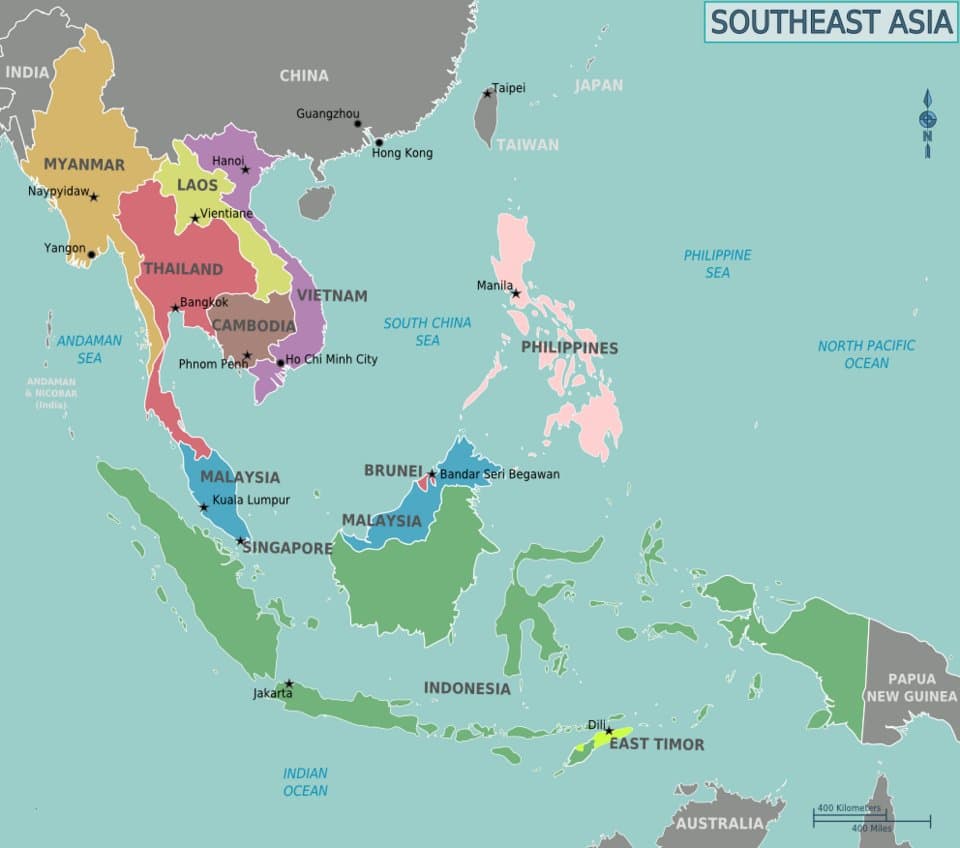
    Map of Southeast Asia showing freshwater fish habitats
    Map of Southeast Asian freshwater habitats. Via Wikimedia Commons.

    Appearance & Identification

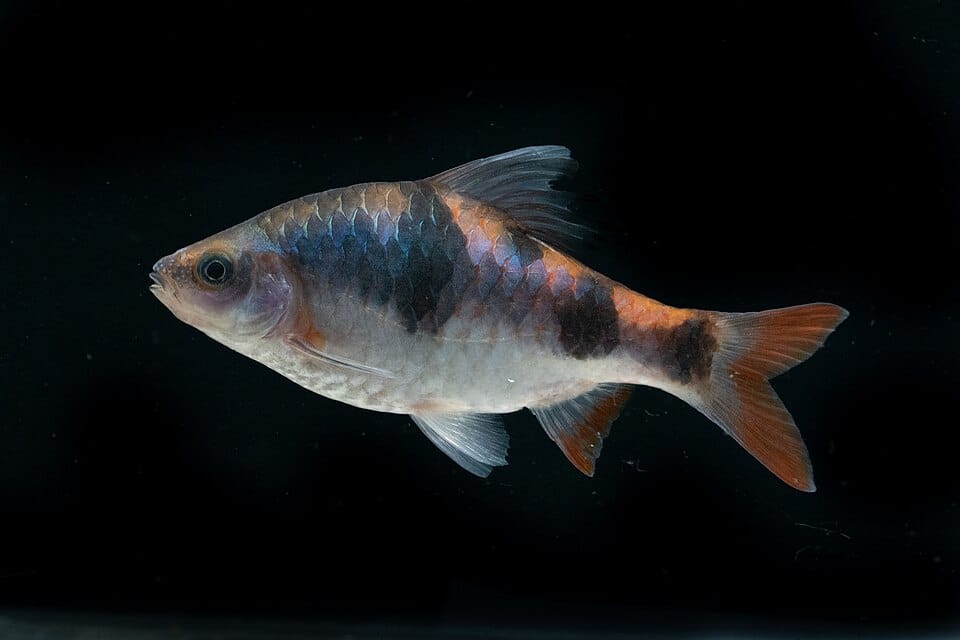
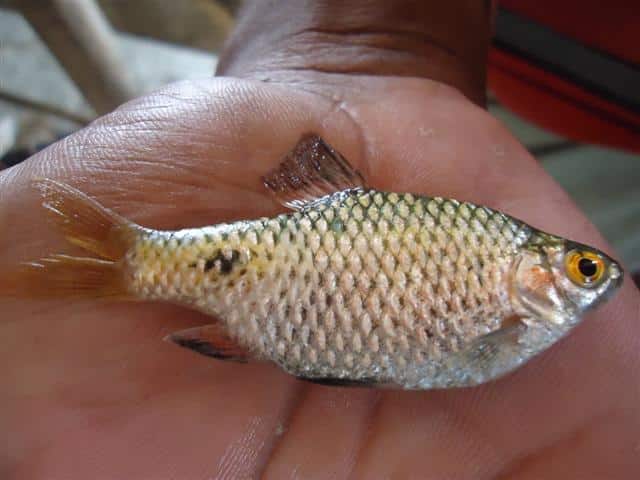
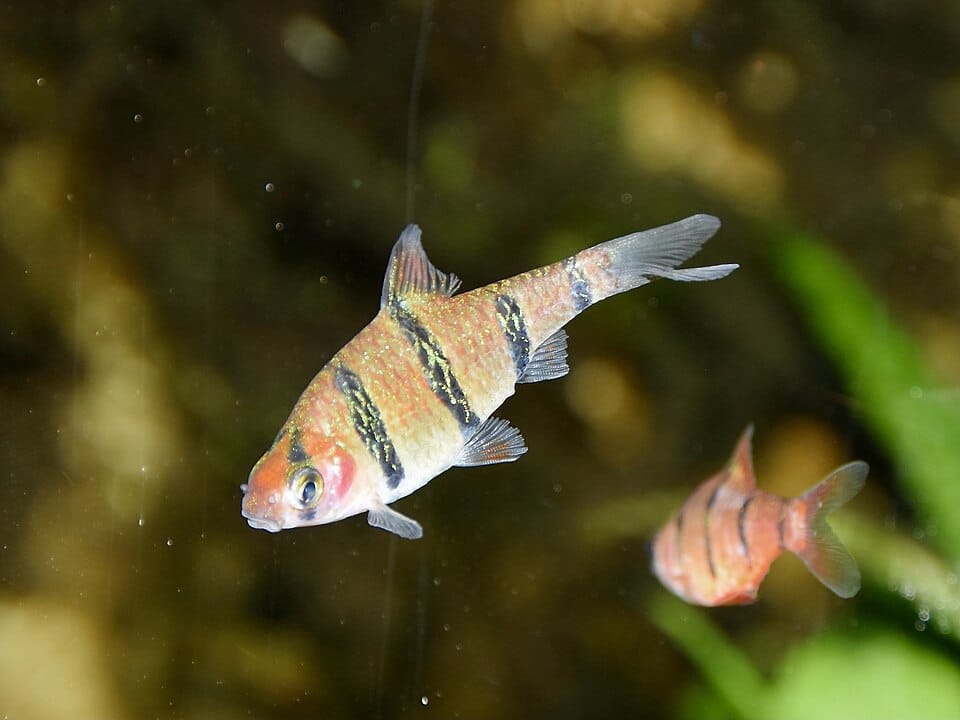
    The ticto barb is a small, compact fish with a moderately deep, laterally compressed profile, a slightly arched back, and a forked tail. The base body color is silvery to olive-golden, with scales that catch the light with a subtle iridescent sheen. It’s not an in-your-face colorful fish, but under good lighting there’s a warmth to their coloring that’s easy to appreciate.

    The defining feature is the “two spot” pattern that gives the fish one of its common names. There’s a prominent dark blotch just behind the gill cover near the pectoral fin base, and a second dark spot at the base of the caudal fin (tail). These markings are present in both sexes and are the quickest way to identify a ticto barb. The spots are deep black and well-defined, giving the fish a clean, graphic look.

    Where the ticto barb really comes alive is in breeding-condition males. Their dorsal and anal fins develop a striking reddish to orange-red coloration at the tips and margins, which is where the common name “firefin barb” comes from. The red is most intense during courtship and spawning, and it fades when the fish is stressed or kept in poor conditions. Females maintain a more subdued appearance year-round.

    Male vs. Female

    FeatureMaleFemale
    ColorationSilvery-gold with red-tipped dorsal and anal finsSilvery-olive, fins mostly clear
    Body ShapeSlimmer and more streamlinedRounder and deeper-bodied, especially when gravid
    Fin ColorDorsal and anal fins develop red-orange marginsFins largely transparent or pale
    Two SpotsPresent but sometimes less boldBoth spots typically dark and well-defined
    SizeSlightly smaller on averageSlightly larger when full of eggs

    Average Size & Lifespan

    Ticto barbs reach a maximum size of about 2 inches (5 cm). Most aquarium specimens top out around 1.5 to 2 inches (4 to 5 cm), with females occasionally running slightly larger when carrying eggs. This small size is one of the reasons it works well in modestly sized aquariums.

    With proper care, ticto barbs live 4 to 6 years in captivity. Good water quality, a varied diet, and an appropriately sized group are the main factors in reaching the upper end of that range. Hobbyists report specimens living beyond 6 years, but 4 to 5 is a more typical expectation.

    Care Guide

    Tank Size

    A 15-gallon (57 liter) aquarium is the minimum for a school of ticto barbs. This provides enough horizontal swimming space for a group of 6 with room for plants and decor. For a larger group of 8 to 12 or a mixed community, step up to a 20-gallon (76 liter) long or 30-gallon (114 liter) tank. A longer tank is always preferable to a taller one for active schooling fish.

    Water Parameters

    ParameterIdeal Range
    Temperature62 to 77°F (17 to 25°C)
    pH6.0 to 7.5
    Hardness2 to 12 dGH
    Ammonia0 ppm
    Nitrite0 ppm
    NitrateBelow 20 ppm

    The temperature range on this fish is genuinely impressive. In many homes, an unheated aquarium at room temperature is right in their comfort zone. A heater set to the low end as a safeguard against sudden drops isn’t a bad idea, but you may not need one at all.

    They prefer soft to moderately hard water with a slightly acidic to neutral pH. While they can adapt to harder water within reason, they show their best colors in softer conditions. Consistency matters more than hitting a specific number, so focus on stable parameters and regular water changes of 20 to 30 percent weekly.

    Filtration & Water Flow

    A hang-on-back or small canister filter that turns the tank volume over 4 to 5 times per hour is ideal. Ticto barbs come from still to slow-moving water, so aim for a gentle to moderate current. A sponge filter is also an excellent option, especially in a breeding setup, since it provides biological filtration without generating strong flow.

    Lighting

    Standard aquarium lighting works fine. They look their best under moderate lighting rather than harsh, bright conditions. If you’re running a planted tank, the lighting you choose for your plants will work perfectly. Aim for 8 to 10 hours of light per day on a timer.

    Plants & Decorations

    Ticto barbs are perfectly safe in planted tanks and won’t uproot or eat your plants. Hardy, undemanding plants are a natural fit given the cooler water preference. Java fern, Anubias, Vallisneria, Cryptocoryne species, and various aquatic mosses all thrive in the same temperature range.

    Arrange the tank with open swimming space in the center and denser planting along the sides and back. Driftwood, smooth river rocks, and leaf litter add a natural feel while creating visual barriers that reduce stress and encourage natural behavior.

    Substrate

    Fine gravel or sand both work well. A dark-colored substrate will bring out the best coloration in most barb species, and the ticto barb is no exception. The silvery body and red fin tips contrast nicely against a dark background. Planted tank substrates like aqua soil are also a fine choice if you’re building a heavily planted setup.

    Is the Ticto Barb Right for You?

    Before you buy, run through this honest checklist. The Ticto Barb is a great fish for the right keeper, but it is not for everyone.

    • You want an easy, peaceful barb for a community tank
    • You have a 20-gallon or larger tank with a planted setup
    • You can keep a group of 6+ for schooling behavior
    • You enjoy subtle coloring that improves over time with good care
    • Your tank includes other small, peaceful species
    • You want a hardy species that tolerates a range of conditions

    Tank Mates

    Ticto barbs are genuinely peaceful community fish. They’re not fin nippers and they don’t bother other species. The main consideration is temperature compatibility, since ticto barbs prefer cooler water than many tropical species.

    Best Tank Mates

    • Other peaceful barbs like cherry barbs, gold barbs, Odessa barbs, and rosy barbs
    • White Cloud Mountain minnows, which share a similar cooler temperature tolerance
    • Zebra danios and other danio species that appreciate active, well-oxygenated water
    • Corydoras catfish, especially cooler-tolerant species like peppered corys (Corydoras paleatus) and bronze corys (Corydoras aeneus)
    • Bristlenose plecos, which are adaptable enough to handle cooler setups
    • Smaller peaceful tetras that tolerate lower tropical temperatures, such as bloodfin tetras and Buenos Aires tetras
    • Hillstream loaches, which also prefer cooler, clean water
    • Amano shrimp and nerite snails for algae control and cleanup

    Tank Mates to Avoid

    • Fish that require consistently warm water above 80°F (27°C), such as discus, German blue rams, and cardinal tetras
    • Large aggressive cichlids that would intimidate or prey on them
    • Very slow-moving, long-finned fish like fancy guppies or bettas, as the active swimming style of a barb school can stress them
    • Large predatory fish that could view ticto barbs as food
    • Tiger barbs, which are significantly more aggressive and can harass smaller, gentler barb species

    Food & Diet

    Ticto barbs are unfussy omnivores that will eat just about anything you offer. In the wild, they feed on small invertebrates, insect larvae, algae, zooplankton, and plant matter.

    Start with a high-quality flake food or micro pellet as the daily staple. Supplement two to three times a week with live or frozen foods like bloodworms, daphnia, brine shrimp, and tubifex worms. These protein-rich foods are important for conditioning fish for breeding and bringing out the red fin coloration in males. Blanched vegetables like zucchini or spinach can be offered occasionally.

    Feed small amounts two to three times per day rather than one large meal. They’re enthusiastic mid-water feeders that will quickly learn your schedule. Remove uneaten food after a few minutes to maintain water quality.

    Breeding & Reproduction

    The ticto barb is one of the easier barb species to breed, making it an excellent project for hobbyists who are new to breeding cyprinids. Like all Pethia species, they’re egg scatterers with no parental care.

    Breeding Difficulty

    Easy. Healthy, well-conditioned fish will often spawn without any special intervention. The challenge isn’t getting them to spawn. It’s saving the eggs from being eaten by the adults.

    Spawning Tank Setup

    Set up a separate breeding tank of 10 to 15 gallons (38 to 57 liters). Fill the bottom with fine-leaved plants like java moss, spawning mops, or clumps of Cabomba. Alternatively, place a mesh grid or marbles on the bottom to allow eggs to fall through where the adults can’t reach them. Use a gentle sponge filter for filtration, as it won’t suck up eggs or tiny fry.

    Water Conditions for Breeding

    Slightly warmer water within their range will encourage spawning. Aim for around 72 to 77°F (22 to 25°C). Keep the pH slightly acidic to neutral, around 6.5 to 7.0, and use soft to moderately soft water (4 to 8 dGH). A partial water change with slightly cooler water will trigger spawning behavior by mimicking the onset of the monsoon season in their native range.

    Conditioning & Spawning

    Condition your breeding group with frequent feedings of live and frozen foods for one to two weeks before placing them in the breeding tank. Males will intensify their fin coloration and display actively, chasing and nudging the females.

    Spawning typically happens in the early morning. The female scatters 100 to 300 small, adhesive eggs among the plants while the male fertilizes them. Remove the adults immediately after spawning, as they will eat every egg they can find.

    Egg & Fry Care

    Eggs hatch within 24 to 48 hours depending on temperature. Keep the tank dimly lit, as eggs and fry are light-sensitive. The fry absorb their yolk sacs over one to two days before becoming free-swimming.

    Feed free-swimming fry infusoria or liquid fry food for the first week, then transition to freshly hatched baby brine shrimp and microworms. Young ticto barbs show the two-spot pattern within a few weeks and develop sex-specific coloration at around 8 to 12 weeks.

    Common Health Issues

    Ticto barbs are genuinely hardy fish. Their wide natural distribution across varied habitats has produced a species with strong disease resistance when kept in clean water. That said, no fish is completely bulletproof, and there are a few issues to be aware of.

    Ich (White Spot Disease)

    The most common freshwater aquarium disease, showing up as small white spots on the body and fins. Usually triggered by temperature fluctuations or stress from transport. Treat with a standard ich medication and raise the temperature slightly to around 78°F (26°C) to speed up the parasite’s lifecycle. Quarantine all new arrivals for at least two weeks before adding them to your display tank.

    Fin Rot

    A bacterial infection that causes ragged, frayed, or discolored fin edges. Almost always a water quality issue. Test your parameters, do a large water change, and in many cases the problem will resolve on its own. For advanced cases, an antibacterial medication may be needed.

    Columnaris

    A bacterial infection that presents as white or grayish cottony patches on the body, mouth, or fins. It can progress quickly if left untreated. Maintain excellent water quality, reduce stress factors, and treat with an appropriate antibacterial medication. Columnaris thrives in warmer water, so keeping ticto barbs at their preferred cooler temperatures actually offers some natural protection.

    Intestinal Parasites

    Wild-caught specimens may carry internal parasites. Signs include weight loss despite eating, stringy white feces, or a hollow belly. An antiparasitic medication can address most common internal parasites. Buying from reputable sources and quarantining new fish helps prevent introducing parasites to your tank.

    Common Mistakes to Avoid

    • Keeping them alone or in pairs. Ticto barbs are schooling fish that need a group of at least 6 to feel secure and behave naturally. Solitary specimens become stressed, pale, and prone to hiding.
    • Overly warm water. While they can technically handle temperatures up to 77°F, keeping them at 80°F+ will stress them over time. They’re a subtropical to temperate species, not a tropical one in the traditional sense.
    • Skipping variety in their diet. A flake-only diet will keep them alive, but males will never develop their full red fin coloration without regular offerings of live or frozen foods.
    • Too small a tank. A 10-gallon tank might seem big enough for a 2-inch fish, but a school of 6 or more active swimmers needs at least 15 gallons (57 liters) of horizontal space.
    • Confusing them with Odessa barbs. Both species are in the genus Pethia and share some superficial similarities, but they’re different species with different care preferences. Odessa barbs develop a bold red lateral stripe, while ticto barbs show red on the fin margins only. Make sure you’re buying the species you actually want.
    • Neglecting water changes. These fish are hardy, but that doesn’t mean they can handle neglect. Consistent 20 to 30 percent weekly water changes are essential for long-term health and coloration.

    Where to Buy

    The ticto barb isn’t as commonly stocked as tiger barbs or cherry barbs, but specialty retailers and online vendors carry them. Your local fish store may be able to special order them. For online purchasing, I recommend:

    • Flip Aquatics is a great source for high-quality freshwater fish, including barb species. They’re known for carefully packing and shipping healthy livestock directly to your door.
    • Dan’s Fish carries a wide selection of barbs and cyprinids, and they regularly stock species that are harder to find at chain pet stores. Their pricing on schooling fish is competitive.

    When buying ticto barbs, purchase a group of at least 6 to 8 fish. Try to get a mix of males and females if possible. Males can be identified by their slightly slimmer build and red-tipped fins, though young juveniles may not show clear sex differences yet. Expect to pay around $3 to $5 per fish depending on the source and size.

    Frequently Asked Questions

    How many ticto barbs should I keep together?

    At least 6, with 8 to 10 being even better. They’re schooling fish that show their best behavior and coloration in a group. Larger schools distribute any chasing behavior among more individuals, keeping stress low for everyone.

    Do ticto barbs need a heater?

    In most homes, no. If your room temperature stays above 62°F (17°C), these fish will be comfortable without a heater. A heater set to around 68°F (20°C) can serve as a safety net during winter in colder climates, but they don’t need the consistently warm temperatures that most tropical fish require.

    Are ticto barbs aggressive?

    No. They’re one of the more peaceful barb species available. Males may chase each other during spawning, but it’s harmless sparring that rarely results in injury. They’re much gentler than tiger barbs and safe with most community tank inhabitants.

    What’s the difference between a ticto barb and an Odessa barb?

    Both are in the genus Pethia and share some physical similarities, which is why they’re often confused. The key difference is male coloration. Male Odessa barbs (P. Padamya) develop a bold crimson stripe along the body, while male ticto barbs show red only on the fin margins. Geographically, ticto barbs are from South Asia while Odessa barbs are from Myanmar.

    Can ticto barbs live with shrimp?

    Adult Amano shrimp are safe. Smaller species like cherry shrimp may be at risk, especially baby shrimplets. Provide dense plant cover if keeping a shrimp colony alongside them. Very small shrimp will likely become snacks.

    Why are my ticto barb’s fins not red?

    Only males develop red-tipped fins, so first check whether you have males. If you do and they’re not coloring up, the usual causes are stress, poor water quality, a bland diet, or too small a group. Increase live and frozen food offerings, maintain clean water, and keep at least 6 fish. A dark substrate also helps.

    Are ticto barbs good for beginners?

    Absolutely. Their hardiness, wide temperature tolerance, peaceful temperament, and easy feeding requirements make them one of the best barb species for newcomers. They’re forgiving of minor mistakes and easy to breed once you’re ready to try. The only caveat is they may be harder to find in stores than more mainstream barb species.

    How the Ticto Barb Compares to Similar Species

    Ticto Barb vs. Stoliczkae’s Barb

    These two are frequently confused, and for good reason. They look similar. Stoliczkae’s Barb generally shows brighter red coloring and a more distinct shoulder spot. If you can tell them apart (and your supplier can accurately identify them), Stoliczkae’s Barb is the more colorful option. In practice, you may get either one regardless of the label.

    Ticto Barb vs. Melon Barb

    The Melon Barb has warmer, more distinct coloring and is easier to identify. Both are peaceful, easy-to-keep community barbs. The Melon Barb is the better choice if you want guaranteed visual appeal. The Ticto Barb is fine if you want a simple, reliable schooler.

    What It Is Actually Like Living With Ticto Barb

    Ticto barbs are background fish that make the foreground fish look better. They add motion and life to the mid-level without competing for visual attention.

    Schooling behavior is reliable and consistent. A group of six maintains formation throughout the day, providing a steady visual rhythm.

    They are the first fish to the food and the last to complain about anything. Maintenance is minimal and problems are rare.

    Closing Thoughts

    The ticto barb is the definition of an underappreciated fish. It’s been in the hobby since the earliest days of tropical fishkeeping, yet it barely gets a mention in most modern stocking discussions. This is a small, peaceful, incredibly hardy barb that handles a wider range of conditions than most community fish, breeds easily, and looks genuinely attractive when kept well.

    In person, a school of these fish in a planted tank with males flashing their red-tipped fins is a sight that grows on you in a way that flashier fish sometimes don’t. If you’re setting up a cooler-water community tank or you just want a bulletproof barb species that won’t cause problems, give the ticto barb a chance. It’s been quietly proving itself for over a century and deserves a spot back in the conversation.

    References

    1. Hamilton, F. (1822). An account of the fishes found in the river Ganges and its branches. Edinburgh & London.
    2. Pethiyagoda, R., Meegaskumbura, M. & Maduwage, K. (2012). A synopsis of the South Asian fishes referred to Puntius. Ichthyological Exploration of Freshwaters, 23(1), 69-95.
    3. Froese, R. & Pauly, D. (Eds.). (2024). Pethia ticto in FishBase. fishbase.se
    4. SeriouslyFish. (2024). Pethia ticto species profile. seriouslyfish.com
    This article is part of our Barbs: Complete Species Directory. Visit the hub page to explore care guides for all species we cover.
  • Golden Dwarf Barb Care Guide: Tank Setup, Diet, Tank Mates & More

    Golden Dwarf Barb Care Guide: Tank Setup, Diet, Tank Mates & More

    Table of Contents

    The golden dwarf barb stays tiny, barely reaching an inch, and needs everything that implies: mature water, gentle filtration, no aggressive tank mates, and a group large enough to feel secure. It is not a beginner nano fish. It is a specialist species that rewards experienced keepers who can provide stable conditions in a small tank.

    In the right setup, golden dwarf barbs display a warm golden shimmer with dark markings that are genuinely beautiful at close range. In the wrong setup, they stress, fade, and die quickly. This guide covers the narrow window of conditions they need, because the golden dwarf barb is not a beginner fish that happens to be small. It is a small fish that happens to be fragile.

    If your nano tank is not fully cycled and stable, the golden dwarf barb will not give you a second chance.

    The Reality of Keeping Golden Dwarf Barb

    The golden dwarf barb is a tiny species that stays under 1.5 inches, making it one of the smallest barbs in the hobby. It belongs in nano tanks with other small, peaceful species. Standard community fish are too large and too active for it.

    Water quality is critical at this size. Every parameter fluctuation hits harder on a 1-inch fish than a 4-inch fish. Stable, mature tanks only.

    The golden coloration is subtle but warm, showing best on dark substrate with moderate lighting.

    Biggest Mistake New Owners Make

    Putting them in a standard community tank with medium-sized fish. Golden dwarf barbs are intimidated by anything over 2 inches. They need nano-appropriate tankmates like small rasboras, ember tetras, and shrimp.

    ASD Difficulty Rating: Tier 1/2 – Beginner-Intermediate
    Golden dwarf barbs (Pethia gelius) are a tiny, peaceful barb species reaching about 1.5 inches (4 cm). They are suitable for planted nano tanks with calm, similarly sized tank mates.

    Expert Take – Mark Valderrama, AquariumStoreDepot

    The golden dwarf barb is the nano barb option for keepers who want barb behavior in a tiny package. A group of ten in a 10-gallon with fine sand, live plants, and gentle filtration gives you schooling behavior and warm golden color at a scale that fits apartment tanks.

    Hard Rule: Golden dwarf barbs need calm, peaceful tank mates only. At 1.5 inches (4 cm), they are small enough to be bullied by most medium-sized community fish – keep them with other nano species only.

    Key Takeaways

    • One of the smallest barbs available at just 1.5 inches (4 cm), making it a perfect candidate for planted nano tanks as small as 10 gallons (38 liters)
    • Cool water species that thrives between 64 and 75°F (18 and 24°C), which sets it apart from most tropical community fish and pairs well with other subtropical species
    • Peaceful and schooling. Keep in groups of at least 8 to 10 for best behavior and coloring. Small groups lead to shy, stressed fish that hide constantly
    • Semi-transparent golden body with dark blotches gives this fish a unique, delicate appearance that looks stunning against dark substrates and dense plantings
    • Micropredator in the wild. Needs small, high-quality foods like baby brine shrimp, daphnia, and micro pellets to thrive
    • Often confused with Pethia aurea, a closely related species sometimes sold under the same common name

    Species Overview

    Field Details
    Scientific Name Pethia gelius (Hamilton, 1822)
    Common Names Golden Dwarf Barb, Golden Barb
    Family Cyprinidae
    Origin India, Bangladesh, Nepal
    Care Level Moderate
    Temperament Peaceful
    Diet Omnivore / Micropredator
    Tank Level Middle
    Maximum Size 1.5 inches (4 cm)
    Minimum Tank Size 10 gallons (38 liters)
    Temperature 64 to 75°F (18 to 24°C)
    pH 6.0 to 7.0
    Hardness 2 to 10 dGH
    Lifespan 3 to 5 years
    Breeding Egg scatterer
    Breeding Difficulty Moderate
    Compatibility Community (nano)
    OK for Planted Tanks? Yes

    A note on common names: The name “Golden Barb” is also used for Barbodes semifasciolatus (sometimes listed as Puntius semifasciolatus), which is a completely different and much larger fish. If you’re shopping for Golden Dwarf Barbs, always confirm the scientific name Pethia gelius to make sure you’re getting the right species.

    Classification

    Taxonomic Level Classification
    Order Cypriniformes
    Family Cyprinidae
    Subfamily Barbinae
    Genus Pethia
    Species P. Gelius (Hamilton, 1822)

    The Golden Dwarf Barb was originally described by Francis Hamilton in 1822 as Cyprinus gelius. It later moved through Barbus and Puntius before being placed in Pethia in 2012 when Pethiyagoda and colleagues revised the small South Asian barbs. You’ll still see it listed as Puntius gelius in older references, but Pethia gelius is the currently accepted name. There’s also ongoing confusion with Pethia aurea, a closely related species that looks very similar. If your “Golden Dwarf Barbs” have fewer, more defined dark blotches rather than scattered irregular spots, they may be P. Aurea. Both species require essentially the same care.

    Origin & Natural Habitat

    The Golden Dwarf Barb is native to the Indian subcontinent, with its range spanning across India, Bangladesh, and Nepal. It’s found primarily in the Ganges and Brahmaputra river drainages, as well as smaller river systems in eastern India and Bangladesh. In the wild, Pethia gelius lives in sluggish streams, ponds, ditches, and the quiet margins of larger rivers. Typically shallow, heavily vegetated habitats with soft, silty substrates and lots of submerged plant growth.

    The water in these habitats is usually soft and slightly acidic to neutral, stained by tannins from decaying vegetation. Light levels are subdued, filtered through dense marginal vegetation and floating plants. What’s particularly notable is the temperature range. The northern parts of this species’ range experience significant seasonal variation, with winter temperatures dropping well below what most hobbyists would consider “tropical.” This is why the Golden Dwarf Barb does so well in cooler aquarium conditions and why the elevated temperatures common in many community tanks are actually counterproductive.

    Map of Southeast Asia showing freshwater fish habitats
    Map of Southeast Asian freshwater habitats. Via Wikimedia Commons.

    Appearance & Identification

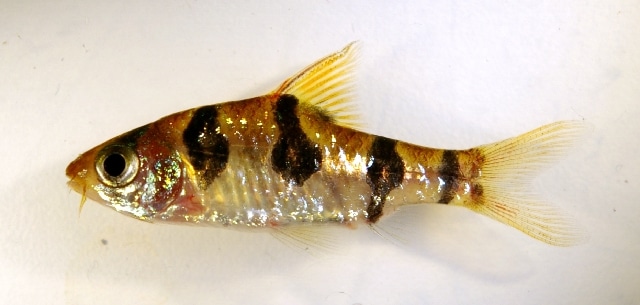
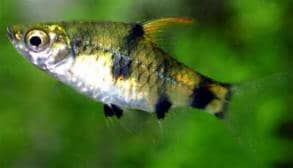
    The Golden Dwarf Barb is a small, somewhat laterally compressed fish with a delicate, subtle appearance. The base coloration is a pale, semi-transparent golden to yellowish tone, and when the light catches them at the right angle in a planted tank, they have an almost glowing quality. The most distinctive feature is the pattern of dark blotches on the flanks. Irregular dark markings scattered along the lateral line and toward the caudal peduncle. Some specimens show two or three distinct blotches, while others have more scattered spotting. The fins are largely transparent to faintly yellowish, and healthy fish have a subtle iridescent shimmer to their scales.

    This is a fish that reveals its beauty gradually. In a store tank under harsh lighting with a bare bottom, Golden Dwarf Barbs look like nothing special. Put them in a planted tank with dark substrate and some tannin-stained water, and they transform. The golden tones warm up, the dark markings provide contrast, and their active schooling behavior adds life to the midwater zone.

    Male vs. Female

    Sexing Golden Dwarf Barbs is possible once the fish are mature. Males are slimmer and more streamlined, with more intense golden coloration and slightly warmer, more orange-tinted tones when in breeding condition. Females are noticeably rounder and deeper-bodied, especially when full of eggs. A gravid female looks distinctly plump compared to the sleeker males. The body shape difference is the most reliable way to distinguish the sexes.

    Average Size & Lifespan

    Golden Dwarf Barbs max out at about 1.5 inches (4 cm), making them one of the smallest barb species in the hobby. Most specimens you see in aquariums will be in the 1 to 1.3 inch (2.5 to 3.3 cm) range. With proper care, they typically live 3 to 5 years. The keys to longevity are stable water conditions, cool temperatures, a varied diet with plenty of live or frozen foods, and keeping them in a large enough group that they feel secure.

    Care Guide

    Tank Size

    A 10-gallon (38-liter) tank is the minimum for a school of Golden Dwarf Barbs. I’d recommend starting with at least 8 to 10 fish, and a 10-gallon can handle that comfortably as long as it’s well filtered and planted. If you want to add tank mates, step up to a 15 or 20-gallon (57 to 76-liter) tank. A longer tank is always preferable to a taller one, as these fish are active horizontal swimmers.

    Water Parameters

    Parameter Ideal Range
    Temperature 64 to 75°F (18 to 24°C)
    pH 6.0 to 7.0
    Hardness (GH) 2 to 10 dGH
    Ammonia 0 ppm
    Nitrite 0 ppm
    Nitrate Below 20 ppm

    The temperature range is the most important thing to get right with this species. Golden Dwarf Barbs genuinely prefer cooler water than most tropical fish. The sweet spot is around 68 to 72°F (20 to 22°C) for long-term keeping. If your home stays in the high 60s to low 70s°F, you may not even need a heater. The water should be soft to moderately soft, with a slightly acidic to neutral pH. If you have harder water, consider blending with RO water or using botanicals like Indian almond leaves to soften it. Stability matters more than hitting an exact number, so avoid chasing a perfect pH at the expense of fluctuating conditions.

    Filtration & Water Flow

    Golden Dwarf Barbs come from slow-moving or still waters, so keep the flow gentle. A sponge filter is an excellent choice. It provides biological filtration without strong current and won’t suck up tiny fry if your barbs spawn. For larger tanks, a small hang-on-back filter with an adjustable flow rate works well. Just baffle the output if the current is too strong.

    Lighting

    Moderate lighting works best. In the wild, their habitats are shaded by vegetation, so strong lighting makes them feel exposed and stressed. If you’re running higher light for plant growth, floating plants like water lettuce, duckweed, or Amazon frogbit will create dappled shade zones where the barbs can feel comfortable. The contrast of light and shadow actually makes their golden coloration look its best.

    Plants & Decorations

    This species absolutely thrives in a planted tank. Dense vegetation is essential, both for security and for bringing out their best behavior. Good plant choices include Java moss, Java fern, Cryptocorynes, Anubias, and various stem plants. Driftwood and leaf litter are excellent additions. Decaying Indian almond leaves release tannins that soften the water and mimic their natural habitat, while also providing surfaces for biofilm growth that the barbs will pick at throughout the day.

    Substrate

    A dark, fine-grained substrate is the way to go. Dark sand or fine gravel brings out the golden tones in these fish dramatically compared to a light-colored substrate. Their natural habitats have soft, silty bottoms, so a fine substrate that supports rooted plants is ideal. Aqua soil designed for planted tanks works perfectly. Avoid large, coarse gravel that traps debris and doesn’t suit the aesthetic or practical needs of a nano setup.

    Is the Golden Dwarf Barb Right for You?

    Before you buy, run through this honest checklist. The Golden Dwarf Barb is a great fish for the right keeper, but it is not for everyone.

    • You have a nano tank (10-15 gallons) or a calm planted community
    • You want a tiny, warm-colored barb that complements live plants beautifully
    • You can keep a group of 8+ for confident, active behavior
    • Your tank does not include fast-moving or aggressive species
    • You keep soft to moderately hard water with a neutral to slightly acidic pH
    • You want a beginner-friendly species that still looks impressive in the right setup

    Tank Mates

    Choosing tank mates for Golden Dwarf Barbs requires some thought because of their tiny size and preference for cooler water. Any fish large enough to eat them is out, and species that require temperatures above 76°F (24°C) aren’t compatible. The good news is there’s a solid selection of peaceful, cool-tolerant nano fish that work beautifully alongside them.

    Best Tank Mates

    • White Cloud Mountain Minnows. A classic pairing. Both species love cooler water and are peaceful.
    • Celestial Pearl Danios. Small, peaceful, and does well in the same temperature range.
    • Pygmy Corydoras. Tiny, peaceful bottom-dwellers that add activity to the lower levels.
    • Ember Tetras. Can overlap at the upper end of the barb’s range around 72 to 75°F (22 to 24°C).
    • Dwarf Rasboras (Boraras species). Peaceful and appropriately sized.
    • Amano Shrimp and Cherry Shrimp. Adults are safe; barbs may eat the occasional baby shrimp.
    • Nerite Snails. Excellent algae cleaners that won’t interact with the barbs.

    Tank Mates to Avoid

    • Tiger Barbs. Too large and boisterous for these tiny fish.
    • Cichlids. Even dwarf cichlids can be territorial and may view them as food.
    • Large gouramis. Any gourami big enough to eat them will eventually try.
    • Aggressive feeders. Fast-moving fish will outcompete these timid barbs for food.
    • High-temperature species. Fish needing 78°F and above (discus, angelfish) aren’t compatible.

    Food & Diet

    In the wild, Golden Dwarf Barbs are micropredators that feed on tiny invertebrates, insect larvae, zooplankton, and small worms. They also graze on algae and biofilm. The most important thing to get right in captivity is food size. Standard flakes and pellets are often too large for their tiny mouths. Crushed flakes or micro pellets designed for nano fish should be a staple.

    Live and frozen foods make a significant difference with this species. Baby brine shrimp, daphnia, micro worms, grindal worms, and cyclops are all excellent choices. I’d recommend offering live or frozen foods at least 3 to 4 times per week, with high-quality micro pellets or crushed flakes filling in the gaps. A well-fed Golden Dwarf Barb shows noticeably better coloration than one living on dry food alone. Feed small amounts two to three times daily rather than one large feeding. These tiny fish have fast metabolisms but can’t eat much at once.

    Breeding & Reproduction

    Golden Dwarf Barbs are egg scatterers that can be bred in captivity with some preparation. The challenge isn’t so much triggering spawning. It’s protecting the eggs and raising the tiny fry.

    Breeding Difficulty

    Moderate. Getting them to spawn isn’t particularly hard, but raising the fry requires small foods and clean water conditions. The biggest challenge is preventing the adults from eating their own eggs immediately after spawning.

    Spawning Tank Setup

    Set up a separate breeding tank of 5 to 10 gallons (19 to 38 liters) with gentle sponge filtration. The bottom should be covered with fine-leaved plants like Java moss, spawning mops, or a mesh grid that allows eggs to fall through but keeps the adults from reaching them. This egg protection is critical. Without it, the parents will consume the eggs almost immediately after spawning.

    Water Conditions for Breeding

    Breeding water should be soft and slightly acidic: aim for a pH around 6.0 to 6.5 and a GH of 2 to 5 dGH. Temperature should be at the warmer end of their range, around 72 to 75°F (22 to 24°C). A slight temperature increase of a few degrees combined with increased feeding of live foods often triggers spawning behavior.

    Conditioning & Spawning

    Condition a group of adults with heavy feedings of live foods for one to two weeks before transferring them to the breeding tank. Females should be visibly plump with eggs. Spawning typically occurs in the morning with the first light. The male will chase and display to the female, and she’ll scatter small, semi-adhesive eggs among the fine-leaved plants or moss. A single female may produce 50 to 100 eggs per spawning. Remove the adults immediately after spawning to prevent egg predation.

    Egg & Fry Care

    The eggs hatch in approximately 24 to 36 hours depending on temperature. The fry are extremely small and will absorb their yolk sacs for a couple of days before becoming free-swimming. First foods should be infusoria, paramecium, or liquid fry food for the first week, then transition to newly hatched baby brine shrimp. Keep the fry tank extremely clean with gentle sponge filtration and small, frequent water changes. Growth is slow compared to larger barb species, and it takes several months for the young fish to reach community-safe size.

    Common Health Issues

    Golden Dwarf Barbs are reasonably hardy when kept in appropriate conditions, but their small size makes them vulnerable to environmental stress. Most health problems trace back to water quality issues, temperature mismatches, or dietary deficiencies.

    Ich (White Spot Disease)

    Ich is the most common freshwater parasite, and Golden Dwarf Barbs can be susceptible when stressed by temperature fluctuations or recent shipping. Treatment with a commercial ich medication at half dose combined with a gradual temperature increase to around 78°F (26°C) is the standard approach. Be cautious with copper-based treatments, as small fish can be more sensitive to these medications.

    Fin Rot

    Ragged, deteriorating fins typically indicate a bacterial infection driven by poor water quality. Prevention through regular water changes and proper filtration is the best medicine. Mild cases often clear up on their own once water quality improves. More severe cases requires antibiotic treatment, but always try improving conditions first before reaching for medications with these small, sensitive fish.

    Columnaris

    This bacterial infection presents as white or grayish patches on the body, often starting around the mouth area. It can progress rapidly and is often fatal if not caught early. Columnaris thrives in warmer water, which is another reason to keep Golden Dwarf Barbs at the cooler end of their range. Treatment typically involves antibiotic medications and lowering the water temperature.

    Stress-Related Issues

    Many health problems trace back to chronic stress from water that’s too warm, groups that are too small, aggressive tank mates, or lack of plant cover. A stressed barb shows faded colors, clamped fins, and reduced appetite. Addressing the root cause is always more effective than treating symptoms.

    Common Mistakes to Avoid

    • Keeping them too warm. Golden Dwarf Barbs do best between 64 and 75°F (18 and 24°C). Keeping them at 78 to 82°F stresses them and shortens their lifespan.
    • Too few in the group. A group of 3 or 4 will be shy and spend most of their time hiding. You need at least 8 to 10 for natural schooling behavior.
    • Food too large. Standard flakes and pellets are too big for their tiny mouths. Crush flakes or use micro pellets designed for nano fish.
    • Confusing them with the larger “Golden Barb.” Barbodes semifasciolatus reaches 3 inches (7.5 cm) and has different care requirements. Always verify the scientific name.
    • Bare tanks with no plant cover. Dense vegetation is not optional. It’s essential for their wellbeing.
    • Housing with large tank mates. Anything that can fit them in its mouth will cause serious problems.

    Where to Buy

    Golden Dwarf Barbs aren’t as commonly stocked as Cherry Barbs or Tiger Barbs, but they’re not rare either. You’re more likely to find them at specialty shops that cater to planted tank and nano hobbyists than at big box pet stores. For healthy specimens shipped directly to your door, I recommend these trusted online retailers:

    Both are reputable sellers who ship responsibly. Availability of less common species like the Golden Dwarf Barb can vary, so check their sites regularly if the species isn’t currently listed.

    Frequently Asked Questions

    How many Golden Dwarf Barbs should I keep?

    A minimum of 8, with 10 to 12 being even better. These are social, schooling fish that need numbers to feel secure. In small groups, they become reclusive and stressed, hiding among the plants instead of swimming actively in the open. Larger groups produce much bolder, more interesting behavior and better coloration.

    Do Golden Dwarf Barbs need a heater?

    It depends on your room temperature. If your home stays consistently above 64°F (18°C), you may not need a heater at all. Many hobbyists keep these fish successfully in unheated tanks year-round. In cooler climates or during winter, a low-wattage heater set to around 68°F (20°C) provides a safety net against dangerous temperature drops. These fish actually prefer cooler conditions, so don’t heat their water to the standard 78°F tropical range.

    Are Golden Dwarf Barbs the same as Gold Barbs?

    No, and this is a very common source of confusion. The Golden Dwarf Barb (Pethia gelius) is a tiny species maxing out at 1.5 inches (4 cm). The Gold Barb or Golden Barb (Barbodes semifasciolatus) is a larger species reaching about 3 inches (7.5 cm) with different care requirements and a much bolder, more solid gold coloration. Always check the scientific name when purchasing.

    Can Golden Dwarf Barbs live with shrimp?

    Yes, adult Cherry Shrimp and Amano Shrimp are safe with Golden Dwarf Barbs. The barbs may eat very small baby shrimp, but adults are too large to be bothered. If you’re breeding shrimp in the same tank, dense Java moss and other hiding spots will help shrimplets survive. This is one of the more shrimp-safe fish species available due to their tiny mouth size.

    What’s the difference between Pethia gelius and Pethia aurea?

    Pethia aurea is a closely related species that was formerly included within P. Gelius. The two look very similar and are often sold interchangeably. P. Aurea will have fewer, more well-defined dark blotches compared to the more scattered irregular markings on P. Gelius. From a care standpoint, both species have essentially identical requirements, so the distinction mainly matters to taxonomists and purists.

    Are Golden Dwarf Barbs good for beginners?

    They’re rated as moderate care. Not the best first fish, but suitable for anyone with basic fishkeeping experience. The main considerations are their need for cooler water, soft water parameters, small food sizes, and a properly planted environment. A 10-gallon (38-liter) planted tank is the minimum. If you’ve successfully maintained a planted tank before, you should have no trouble with them.

    How the Golden Dwarf Barb Compares to Similar Species

    Golden Dwarf Barb vs. Checker Barb

    The Checker Barb is slightly larger and more confident, making it better for tanks with moderate activity. The Golden Dwarf Barb is smaller and shyer, making it better for dedicated nano setups. Both are peaceful and community-safe.

    Golden Dwarf Barb vs. Emerald Dwarf Rasbora

    Despite being different families, both fill the same nano tank role. The Emerald Dwarf Rasbora has more intense coloring with blue and orange tones, while the Golden Dwarf Barb has warmer golden tones. Both need groups and calm tank mates. They can actually be combined in a nano setup.

    What It Is Actually Like Living With Golden Dwarf Barb

    Golden dwarf barbs are the warm-toned option for nano tanks dominated by cool-colored fish. The golden body adds a different light quality than the silvers and blues of most nano species.

    They school tightly when nervous and loosely when comfortable. Watching the transition from tight school to relaxed drift tells you your tank is working.

    Feeding requires small foods. Crushed flake and micro pellets are the staples. Live baby brine shrimp brings out the best color.

    Closing Thoughts

    At barely an inch, the golden dwarf barb is the nano barb that proves you do not need size to have schooling behavior worth watching.

    The Golden Dwarf Barb rewards patience. It won’t wow you the moment you drop it in a tank, but give it time in a planted setup with dark substrate, soft water, cool temperatures, and a proper-sized group, and it becomes something genuinely special. That semi-transparent golden shimmer, the active schooling behavior, the way they pick through moss and leaf litter. There’s a quiet elegance to these fish that flashier species can’t replicate.

    If you’re looking for a cool water schooling fish with real character, the Golden Dwarf Barb deserves a spot on your shortlist. They pair beautifully with White Cloud Mountain Minnows, they won’t bother your shrimp, and they bring life to the midwater zone of a small planted tank. Just remember: keep them cool, keep them in numbers, and give them plenty of plants. Do that, and these little barbs will reward you with years of subtle, shimmering beauty.

    References

    1. Froese, R. And D. Pauly, Editors. FishBase. Pethia gelius (Hamilton, 1822). https://www.fishbase.se/summary/Pethia-gelius.html
    2. Seriously Fish. Pethia gelius. Golden Dwarf Barb. https://www.seriouslyfish.com/species/pethia-gelius/
    3. Pethiyagoda, R., Meegaskumbura, M., & Maduwage, K. (2012). A synopsis of the South Asian fishes referred to Puntius. Ichthyological Exploration of Freshwaters, 23(1), 69-95.
    4. Practical Fishkeeping. Golden Dwarf Barb species profile. https://www.practicalfishkeeping.co.uk
    This article is part of our Barbs: Complete Species Directory. Visit the hub page to explore care guides for all species we cover.
  • Sunshine Peacock Care Guide: The Bright Yellow Aulonocara

    Sunshine Peacock Care Guide: The Bright Yellow Aulonocara

    Table of Contents

    Sunshine peacocks are one of the brightest yellow cichlids in Lake Malawi, and that color makes them a target for hybridization. The single biggest issue with sunshine peacocks is getting a pure specimen. Mixed stock is everywhere, and hybrids never color up the same way. I have kept aulonocara stuartgranti for years and the first rule is buying from a reputable breeder, not a pet store with unlabeled fish. Start with bad genetics and no amount of care fixes it. One of the brightest yellow cichlids available, but only if the genetics are pure and the water is clean.

    The brightest yellow in freshwater, if genetics and diet cooperate.

    The Reality of Keeping Sunshine Peacock

    Mbuna keeping is a different discipline from regular fishkeeping. The Sunshine Peacock is no exception. Here is what you need to prepare for.

    Hard, alkaline water is mandatory. Lake Malawi chemistry means pH between 7.8 and 8.6, high GH, and high KH. There is no faking this. If your tap water is soft and acidic, you need to buffer every water change without exception.

    Overstocking is the strategy. Keeping 3 or 4 Sunshine Peacocks leads to one bully and victims. You need groups of 12 or more to spread aggression. But overstocking only works with heavy filtration and consistent water changes.

    Diet is critical. Spirulina and veggie-based foods are essential. High-protein diets cause Malawi Bloat, which is often fatal.

    Rockwork defines territories. Mbuna need piles of rocks with caves and passageways. Without proper rockwork, dominant fish have nowhere to establish boundaries and subordinates have nowhere to hide. Stack rocks from substrate to near the waterline.

    Biggest Mistake New Sunshine Peacock Owners Make

    Understocking. Keeping a small group of Sunshine Peacocks means the dominant fish picks off the weak ones. You need a large group to distribute aggression. Twelve is the minimum for most mbuna species.

    Expert Take

    Start with a group of 12 or more in a 55 gallon minimum. Use aragonite or crushed coral substrate to buffer pH naturally. Feed spirulina-based food as the staple. Stack rocks to create territories. This formula works for Sunshine Peacocks and most other mbuna.

    Key Takeaways

    • Brilliant yellow and blue coloration in males, making it one of the most visually striking Peacock species available
    • Peaceful temperament typical of all Peacocks, and should not be housed with aggressive Mbuna
    • Critically endangered in the wild due to its restricted range in Lake Malawi, but widely available as captive-bred specimens
    • Sand substrate is essential for natural sand-sifting feeding behavior
    • Minimum 55-75 gallon tank with hard, alkaline water (pH 7.8-8.6) and consistent maintenance
    Map showing Lake Malawi and the African Great Lakes region
    Map of Lake Malawi. Via Wikimedia Commons.

    Species Overview

    FieldDetails
    Scientific NameAulonocara baenschi
    Common NamesSunshine Peacock, Nkhomo Benga Peacock, Benga Peacock, Yellow Peacock, Baensch’s Peacock, New Yellow Regal
    FamilyCichlidae
    OriginLake Malawi, East Africa (western shoreline)
    Care LevelEasy to Moderate
    TemperamentPeaceful (for a cichlid)
    DietMicro-predator / Omnivore
    Tank LevelBottom to Mid
    Maximum Size5-6 inches (12-15 cm)
    Minimum Tank Size55 gallons (208 liters)
    Temperature76-82°F (24-28°C)
    pH7.8-8.6
    Hardness10-20 dGH
    Lifespan6-10 years
    BreedingMaternal mouthbrooder
    Breeding DifficultyEasy
    CompatibilityPeacock & Hap community
    OK for Planted Tanks?Limited (may uproot plants while sifting)

    Classification

    Taxonomic LevelClassification
    OrderCichliformes
    FamilyCichlidae
    SubfamilyPseudocrenilabrinae
    GenusAulonocara
    SpeciesA. Baenschi (Meyer & Riehl, 1985)

    The Sunshine Peacock was described by Meyer and Riehl in 1985 and named after Ulrich Baensch, a well-known aquarium publisher and cichlid enthusiast. The genus name Aulonocara means “flute face” in Greek, referring to the enlarged sensory pores on the head that all Peacock cichlids use to detect prey in the substrate. This species has gone through several common names in the hobby, including Nkhomo Benga Peacock (referencing its locality at Nkhomo Reef near Benga) and the somewhat confusing “New Yellow Regal Peacock.”

    There has been some taxonomic confusion between A. Baenschi and the closely related Aulonocara sp. “Maleri” from the Maleri Islands. Some sources treat them as the same species, while others consider the Maleri form a separate, undescribed species. In the hobby, fish from the Maleri Islands are sometimes sold as A. Baenschi, which can create confusion. True A. Baenschi is specifically associated with the Nkhomo Reef and Benga area.

    Origin & Natural Habitat

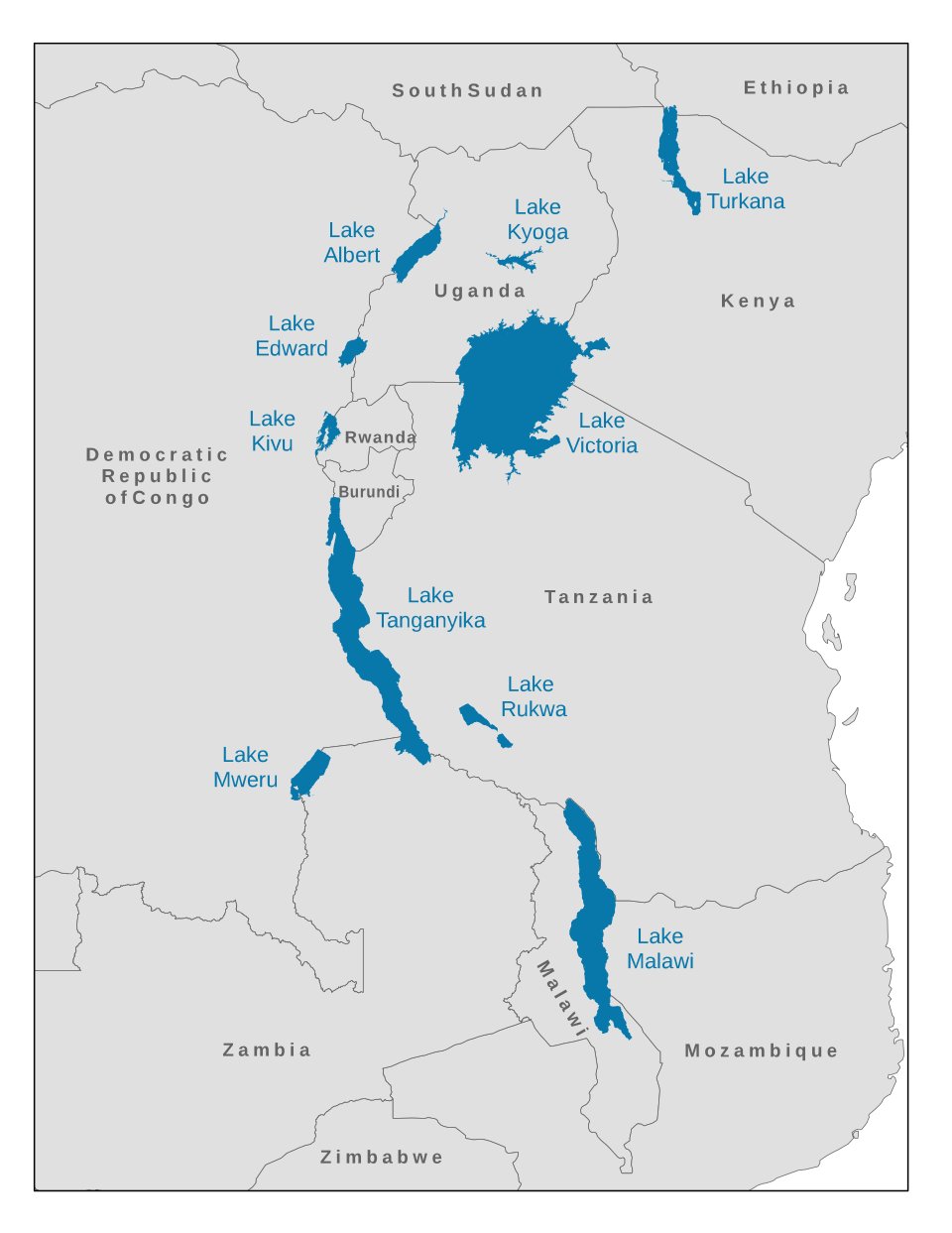
    The Sunshine Peacock is endemic to Lake Malawi in East Africa, with a natural distribution restricted to the western shoreline of the lake, particularly around the Nkhotakota District of Malawi. Known localities include Chipoka, the Maleri Islands, Nkhomo Reef, Usisya, and the Benga area. This relatively limited range is one reason the species faces conservation concerns.

    Like all Peacock cichlids, A. Baenschi inhabits the intermediate zones of Lake Malawi where sandy substrates transition to rocky outcrops. These transitional habitats are found at depths of roughly 30 to 100 feet (10-30 meters). The fish spend most of their time over sandy-bottomed regions, sifting through fine sediment in search of small invertebrates. Nearby rock crevices provide shelter and spawning sites.

    The water in Lake Malawi is characteristically hard and alkaline, with remarkable year-round stability. Temperature, pH, and mineral content remain consistent, which is a critical detail for aquarium care. Peacocks do not handle fluctuating water conditions well because they’ve evolved in one of the most stable freshwater environments on Earth.

    Conservation note: Aulonocara baenschi is considered critically endangered by the IUCN, primarily due to collection for the aquarium trade. The good news is that virtually all specimens in the hobby are captive-bred, so purchasing aquarium fish does not directly impact wild populations. But it’s still worth being aware of this species’ vulnerability in its natural habitat.

    Map showing Lake Malawi and the African Great Lakes region
    Map by MellonDor, CC BY-SA 4.0, via Wikimedia Commons

    Appearance & Identification

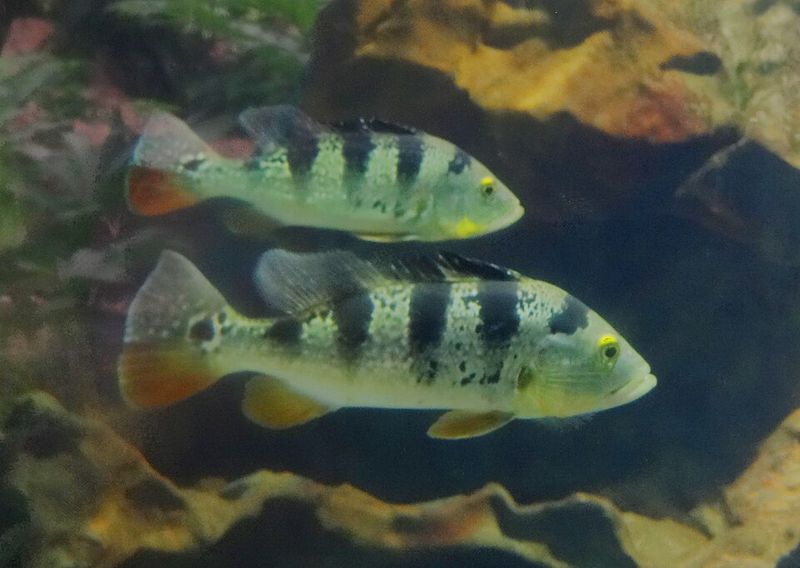
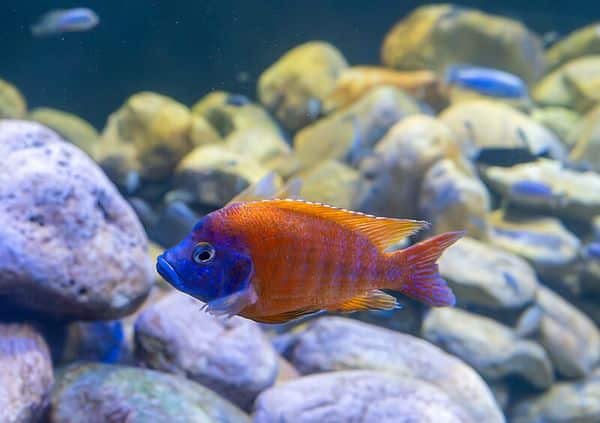
    The Sunshine Peacock fully earns its common name. Dominant males develop an intense, bright yellow coloration across the entire body, from the gill plate through the flanks, belly, and into the tail and fins. The head and face display a vivid metallic blue that contrasts beautifully against the yellow body. The dorsal fin is yellow with a blue edge, and the anal fin is yellow with egg spots. The overall effect is a genuinely radiant fish that glows in any tank.

    Males take approximately two years to develop their full adult coloration, and color intensity varies based on dominance, mood, diet, and water quality. A dominant male with good genetics, a proper diet, and stable water conditions will show colors that are dramatically more vivid than a stressed or subdominant individual. Lighting matters too. Moderate lighting with a warmer spectrum make the yellow body pop, while cooler lighting highlights the blue face.

    Juveniles of both sexes and subdominant males are plain silver-grey with faint vertical bars, identical to juvenile Peacocks of most other species. Males begin showing yellow coloration around 2.5 to 3 inches (6-8 cm), but patience is needed because full color development is gradual.

    Male vs. Female

    Sexual dimorphism in the Sunshine Peacock is extreme, consistent with the entire Aulonocara genus. Adult males and females look like entirely different species.

    FeatureMaleFemale
    ColorBrilliant yellow body with metallic blue facePlain silver-grey with faint bars
    Size5-6 inches (12-15 cm)4-5 inches (10-12 cm)
    Body ShapeSlightly larger and more elongatedSmaller with rounder belly
    FinsLonger, more pointedShorter, rounded
    Egg SpotsProminent on anal finAbsent or very faint

    Sexing juveniles is essentially impossible by visual inspection alone. If you’re purchasing young fish, buy a group of 6-8 to improve your odds of getting at least one male. Venting (examining the fish’s genital papilla) is the only reliable method for sexing juveniles, but it requires experience and practice.

    Average Size & Lifespan

    Sunshine Peacocks reach a maximum size of 5 to 6 inches (12-15 cm), with males being slightly larger. They’re a medium-sized Peacock species, comparable to most other commonly kept Aulonocara. Most fish available in stores are juveniles around 1.5 to 2 inches, so expect them to need 12-18 months to approach full size.

    Lifespan is 6 to 10 years with proper care, and some specimens may exceed this in ideal conditions. The species is relatively long-lived for a mid-sized cichlid. Clean water, stable parameters, a varied diet, and low-stress tank mates are the keys to maximizing lifespan.

    Care Guide

    Tank Size

    A minimum of 55 gallons (208 liters) can work for a single-species setup with one male and a small harem. However, 75 gallons (284 liters) is a better starting point and gives you more flexibility for stocking. If you’re building a mixed Peacock and Hap community, go with 125 gallons (473 liters) or larger.

    Tank length is more important than height for Peacocks. These fish use floor space, not vertical space. A 4-foot tank is the bare minimum, and a 6-foot tank provides significantly more territory for multiple males to coexist peacefully.

    Water Parameters

    ParameterIdeal Range
    Temperature76-82°F (24-28°C)
    pH7.8-8.6
    General Hardness (GH)10-20 dGH
    Carbonate Hardness (KH)6-12 dKH
    Ammonia0 ppm
    Nitrite0 ppm
    NitrateBelow 20-30 ppm

    Consistency is everything with Malawi cichlids. These fish evolved in one of the most chemically stable bodies of water on the planet, and they struggle with parameters that fluctuate. Weekly water changes of 20-30% are essential to maintain low nitrates and stable chemistry. If your tap water is naturally soft, use aragonite substrate or cichlid buffer products to keep the pH and hardness where they need to be.

    Filtration & Water Flow

    Over-filtration is standard practice for any Malawi cichlid tank. A canister filter rated for at least 1.5 times your tank volume is a solid starting point. Many keepers double up on filtration with a canister and a hang-on-back filter or sump for additional capacity and redundancy. The high pH of Malawi water makes ammonia more toxic, so excess biological filtration capacity is insurance against problems.

    Water flow should be moderate. Peacocks inhabit calmer sandy areas in the wild, not the wave-battered rocky shores that Mbuna prefer. Good surface agitation for oxygenation is important, but don’t create a high-current environment.

    Lighting

    Standard aquarium lighting works well. Sunshine Peacocks look fantastic under moderate lighting that brings out the warmth of their yellow coloration. Extremely bright overhead lights can make them feel exposed and reduce color intensity. If your tank has intense LEDs, provide some shaded areas through rock formations. Many keepers find that a warm-spectrum light makes the yellow body color appear even more vivid.

    Plants & Decorations

    Design the tank with a mix of rock formations and open sandy areas. Peacocks need open floor space for sand sifting and swimming, so don’t fill the entire tank with rocks the way you would for Mbuna. Stack rocks along the back and sides to create caves and visual barriers, which help break up sight lines and reduce aggression between males.

    Hardy plants like Anubias (attached to rocks or driftwood), Java Fern, and Vallisneria can work in a Peacock tank. Avoid delicate plants rooted in the substrate, as they’ll be constantly uprooted during sand sifting. The alkaline water also limits plant options compared to a typical freshwater planted tank.

    Substrate

    Fine sand is required. This is a universal rule for all Peacock cichlids. Sunshine Peacocks are natural sand sifters that take mouthfuls of substrate, filter out edible invertebrates, and expel the sand through their gills. Coarse gravel prevents this behavior and can cause physical damage to their delicate gill filaments.

    Pool filter sand, play sand, or aragonite sand are all excellent choices. Aragonite sand has the added benefit of buffering the water to maintain high pH and hardness. Many experienced keepers recommend a darker substrate color, as Peacocks will display more intense coloration over dark sand compared to bright white substrates.

    Tank Mates

    Sunshine Peacocks are among the most peaceful Malawi cichlids you can keep. They have a calm, almost regal demeanor that’s a world apart from the hyperactive aggression of Mbuna. This peaceful nature is their greatest appeal, but it also makes proper tank mate selection absolutely critical. Put a Sunshine Peacock with aggressive fish and it will be bullied into a pale, stressed shell of what it should be.

    Best Tank Mates

    • Other Peacock cichlids (Aulonocara spp.) — Multiple Peacock species in a large tank is the classic setup. Choose species with distinctly different coloration to reduce male aggression. Avoid other predominantly yellow Peacocks if possible.
    • Mild HaplochrominesCopadichromis azureus, Copadichromis borleyi, Placidochromis electra, Otopharynx lithobates, and Cyrtocara moorii are all excellent choices with compatible temperaments.
    • Synodontis catfishSynodontis multipunctatus and Synodontis petricola add bottom-level interest and do well in the same alkaline water conditions.
    • Bristlenose Plecos — Hardy, peaceful algae eaters that get ignored by cichlids and handle the high pH well.

    Tank Mates to Avoid

    • Aggressive Mbuna — This cannot be stressed enough. Species like Melanochromis auratus, Metriaclima lombardoi, Pseudotropheus demasoni, and most Mbuna are far too aggressive. They will relentlessly harass Sunshine Peacocks, causing chronic stress, color loss, and eventual health problems.
    • Other yellow-colored Peacocks or Haps — Males interpret similarly colored fish as rivals. If stocking multiple Peacock species, choose ones with clearly different color patterns.
    • Large predatory HapsNimbochromis species and other large, aggressive Haplochromines will dominate and potentially eat smaller Peacocks.
    • Non-Malawi species — Fish from different water chemistry requirements (South American cichlids, community tropicals) should never be mixed with Malawi cichlids.

    A good stocking ratio is one male to three or four females per species. This distributes the male’s attention and protects individual females from excessive pursuit. In a 75-gallon tank, a single-species group of one male and four females works well. In a 125-gallon, you can keep two or three Peacock species with their respective harems.

    Food & Diet

    Sunshine Peacocks are micro-predators that feed primarily on small invertebrates in the wild. They hover motionless over sandy substrates, using their highly developed lateral line system to detect the vibrations of crustaceans, insect larvae, and other small organisms moving in the sand. When prey is detected, a quick plunge into the substrate captures the food, and the sand is expelled through the gills.

    In the aquarium, feeding is uncomplicated. A quality sinking cichlid pellet should form the dietary foundation. Supplement regularly with frozen foods like Mysis shrimp, brine shrimp, cyclops, and daphnia. Occasional bloodworms are fine but shouldn’t be a staple. Include some vegetable-based foods such as spirulina-enriched pellets to round out the diet. Color-enhancing foods containing astaxanthin or carotenoids can help maintain and enhance the brilliant yellow coloration.

    Feed once or twice daily, offering only what the fish can consume within 2-3 minutes. Avoid overly fatty foods and never feed mammalian proteins like beef heart. Peacocks have a digestive system adapted for small invertebrates and plant matter, and fatty foods contribute to Malawi Bloat, the most dangerous health threat for this group of fish.

    Breeding & Reproduction

    Sunshine Peacocks breed readily in captivity and are considered one of the easier African cichlids to spawn. They’re maternal mouthbrooders, following the typical Aulonocara breeding pattern.

    Spawning Behavior

    Males establish territories, around a flat rock surface or a cleared area in the sand. When a ripe female enters his territory, the male intensifies his coloration to maximum display levels. He performs a shimmying, fin-flaring courtship dance designed to impress the female and guide her to his spawning site. The female deposits eggs on the substrate, then immediately picks them up in her mouth. She then mouths at the male’s egg spots on his anal fin, which triggers him to release sperm, fertilizing the eggs in her mouth.

    Mouthbrooding & Fry Care

    After spawning, the female carries the developing eggs for approximately 21 to 28 days. She does not eat during this entire incubation period. A holding female is easily identified by her distended throat and a characteristic chewing motion as she rotates the eggs to keep them oxygenated. She’ll become secretive, sticking to hiding spots and avoiding the male.

    Typical brood sizes range from 12 to 40 fry depending on the female’s size. The fry are released fully formed and able to eat baby brine shrimp and finely crushed flake food immediately. For maximum fry survival, strip the female around day 18-21 or move her to a separate tank before she releases. In a community tank, some fry will survive if there are adequate hiding spots, but most will be eaten by other fish.

    Hybridization Warning

    All Aulonocara species readily hybridize. If you keep multiple Peacock species together, cross-breeding is likely if females have access to multiple species of males. This is a significant problem in the hobby because hybrid Peacocks are sold under made-up names, muddying the genetic pool. If you intend to breed, keep a single Aulonocara species per tank.

    Common Health Issues

    Malawi Bloat

    The most serious and common health issue for all Peacock cichlids. Malawi Bloat manifests as severe abdominal swelling, loss of appetite, white stringy feces, lethargy, and rapid breathing. It can progress to organ failure and death within days if left untreated. Contributing factors include poor water quality (especially high nitrates), stress from aggressive tank mates, overfeeding, and diets too high in fat.

    Prevention is far more effective than treatment. Keep nitrates below 20-30 ppm through regular water changes, feed a balanced diet, maintain stable water chemistry, and house Peacocks only with appropriate non-aggressive companions. If symptoms appear, perform an immediate large water change, isolate the affected fish, and treat with Metronidazole. Early detection is critical for survival.

    Ich (White Spot Disease)

    Ich can strike after temperature fluctuations or when new fish are added without quarantine. Small white spots across the body and fins are the telltale sign. Treatment involves gradually raising the temperature to 82-86°F (28-30°C) over 48 hours and using a commercial ich medication. Remove activated carbon from the filter during treatment. Sunshine Peacocks tolerate standard ich treatments without issues.

    Hole-in-the-Head Disease (HLLE)

    Pitting and erosion around the head and lateral line area is sometimes seen in Peacocks maintained in suboptimal conditions. It’s linked to chronic poor water quality, nutritional deficiencies (particularly vitamins C and D), and possibly the long-term use of activated carbon in filtration. Improving water quality, diversifying the diet with vitamin-enriched foods, and removing carbon from filters leads to gradual healing.

    Common Mistakes to Avoid

    • Keeping them with aggressive Mbuna. Sunshine Peacocks are among the most peaceful Malawi cichlids. Mixing them with aggressive Mbuna results in stressed, pale fish that hide constantly and eventually develop bloat or other health issues.
    • Using gravel substrate. Sand is essential for Peacock cichlids. They are biologically programmed to sift substrate for food, and gravel prevents this behavior while potentially damaging their gills.
    • Neglecting water quality. Peacocks are more sensitive to nitrate buildup than many other cichlids. Regular weekly water changes of 20-30% are critical. Letting nitrates climb is the fastest path to Malawi Bloat.
    • Overstocking males. Multiple male Sunshine Peacocks in a small tank leads to one dominant, colorful fish and several stressed, grey subdominants. Keep one male per species unless the tank is very large with plenty of territory.
    • Adding to an immature tank. Peacocks should never be the first fish in a newly set up aquarium. The tank must be fully cycled and biologically stable before they’re introduced.
    • Confusing species. Several yellow Peacocks exist in the hobby, including fish from the Maleri Islands that may or may not be true A. Baenschi. Buy from reputable sources that can verify what species you’re getting.

    Where to Buy

    Sunshine Peacocks are widely available in the hobby as captive-bred specimens. You’ll find them at specialty African cichlid retailers, online fish stores, and occasionally at well-stocked local fish shops. Chain pet stores sometimes carry them under generic labels, but species identification is unreliable in those settings.

    For quality, properly identified specimens, check out Flip Aquatics and Dan’s Fish. Both are reputable online retailers that ship healthy, well-conditioned fish and are transparent about species identification. Expect to pay $8-$25 per fish depending on size and sex. Males showing color will be priced higher than unsexed juveniles.

    Frequently Asked Questions

    Are Sunshine Peacocks endangered?

    Yes, Aulonocara baenschi is considered critically endangered in its natural habitat in Lake Malawi due to its very limited distribution and collection pressure for the aquarium trade. However, the species is widely bred in captivity, so the aquarium specimens you buy are captive-bred and do not impact wild populations. Captive breeding has actually helped preserve the species’ genetics.

    Can Sunshine Peacocks live with Mbuna?

    No. Mbuna are significantly more aggressive than Peacocks and will bully them relentlessly. The one exception some keepers make is Labidochromis caeruleus (Yellow Lab), which is the most peaceful Mbuna species. But as a rule, keep Sunshine Peacocks with other Peacocks and mild Haplochromines only.

    How long does it take for males to color up?

    Males begin showing hints of yellow coloration around 2.5 to 3 inches (6-8 cm), around 8-12 months of age. Full adult coloration can take up to 2 years to fully develop. Good nutrition, stable water conditions, and low stress from tank mates all accelerate color development. Be patient with juvenile Peacocks.

    What’s the difference between Sunshine Peacock and Maleri Peacock?

    This is a point of ongoing debate. Aulonocara baenschi from Nkhomo Reef and the yellow Peacocks from the Maleri Islands are very similar and are sometimes treated as the same species. Some authorities consider the Maleri form to be a separate, undescribed species or a geographic variant. In the hobby, both are often sold as “Sunshine Peacock.” The care requirements are identical regardless of the locality form.

    Do Sunshine Peacocks need sand substrate?

    Yes, absolutely. Sand is essential for all Peacock cichlids. They sift substrate to feed on small invertebrates, a behavior that’s hardwired into their biology. Gravel prevents this natural behavior and can physically damage their gills. Use fine pool filter sand, play sand, or aragonite sand.

    How many Sunshine Peacocks should I keep together?

    Keep one male with three to four females in a 55-75 gallon tank. In larger tanks (125+ gallons), you could potentially keep two males if there’s sufficient territory and line-of-sight breaks. Never keep two males in a small tank, as the dominant male will suppress the subdominant’s coloration and cause chronic stress.

    What It Is Actually Like Living With Sunshine Peacock

    This is the part no other care guide gives you. Forget water parameters for a minute. Here is what it is actually like to share your tank with this species.

    They have more personality than you expect. The Sunshine Peacock is not a fish that just sits in the background. Once settled in, they become interactive, curious, and responsive to your presence.

    Feeding time reveals their character. Watch how the Sunshine Peacock approaches food and you will see real personality. Some are bold, some are cautious, and their feeding behavior tells you a lot about their mood and health.

    They establish routines. After a few weeks, your Sunshine Peacock will have favorite spots, preferred paths through the tank, and predictable patterns. Learning these routines makes you a better keeper.

    Color is a health indicator. The Sunshine Peacock’s coloration is a real-time report card on your husbandry. Vibrant color means happy fish. Faded color means something is wrong. Pay attention.

    Closing Thoughts

    A sunshine peacock from a bad source will never color up. Genetics come first, care comes second.

    The Sunshine Peacock is everything that makes Peacock cichlids great, concentrated into one brilliantly colored package. That intense yellow and blue combination is legitimately one of the most eye-catching color patterns in all of freshwater fishkeeping. And unlike some colorful fish that require expert-level care, the Sunshine Peacock is accessible to anyone willing to maintain proper water quality and make smart tank mate choices.

    The formula for success is the same as with all Peacocks: sand substrate, hard alkaline water, robust filtration, regular water changes, and peaceful companions. Keep them away from aggressive Mbuna, feed a varied diet, and give males time to develop their full coloration. Do these things, and you’ll have a centerpiece fish that earns its sunny name every time it catches the light.

    This article is part of our Lake Malawi Cichlid Species Directory: Complete A-Z Care Guide List. Visit the hub page to explore care guides for all 28 Lake Malawi cichlid species we cover.

    Recommended Video

    References

  • Drape Fin Barb Care Guide: Tank Setup, Diet, Tank Mates & More

    Drape Fin Barb Care Guide: Tank Setup, Diet, Tank Mates & More

    Table of Contents

    The drape fin barb is a nano species that develops fin extensions completely disproportionate to its body size. Males grow dramatic, elongated dorsal fins that drape down like a cape, creating one of the most striking displays in the nano fish world. It stays under 2 inches but commands attention like a fish five times bigger.

    It needs soft, slightly acidic water, a mature tank, and a group to trigger the full display behavior between males. Skip those conditions and you get a plain-looking micro fish that never shows you what it can do. This guide covers how to bring out the display, because the drape fin barb is proof that tiny fish can have more presence than anything ten times their size.

    If you have never seen a male drape fin barb in full display, you do not know what nano fishkeeping is capable of.

    The fins that sold you on this fish won’t appear unless you build the tank around them.

    The Reality of Keeping Drape Fin Barb

    The drape fin barb is a small, rare species with elongated dorsal and anal fins that drape gracefully when the fish is at rest. Males in display mode spread these fins like a peacock tail, creating a visual effect disproportionate to the fish’s 2-inch body.

    Availability is very limited. This is a specialist species that appears in the trade sporadically. When they are available, expect premium pricing.

    They need soft, acidic water and a mature tank. This is not a beginner fish despite its small size.

    Biggest Mistake New Owners Make

    Keeping them in hard, alkaline water. Drape fin barbs are soft-water specialists that lose color and fin condition in water above 8 dGH. If your tap water is hard, you need RO water or a different species.

    ASD Difficulty Rating: Tier 2 – Intermediate
    Drape-fin barbs (Oreichthys crenuchoides) are a rare nano barb prized for the distinctive sail-like dorsal fin in adult males. They prefer slow-moving, soft water and planted nano setups.

    Expert Take – Mark Valderrama, AquariumStoreDepot

    The drape fin barb is a collector’s jewel. A group of six in a blackwater nano tank with tannin-stained water, Indian almond leaves, and dim lighting creates a display that no other barb can replicate. The draped fins in soft-water conditions are genuinely beautiful. This fish rewards keepers who take water chemistry seriously.

    Hard Rule: Drape-fin barbs require very slow filtration and gentle water movement. Their draping fins are easily damaged by strong currents, and the species prefers still or near-still water unlike most active barbs.

    Key Takeaways

    • Males sport a dramatically elongated dorsal fin that drapes like a flag, making this one of the most visually unique barb species in the freshwater hobby
    • A true nano-friendly barb that tops out at just 2 inches (5 cm) and can be kept in tanks as small as 15 gallons (57 liters)
    • Prefers cooler, soft, acidic water at 68 to 77°F (20 to 25°C), pH 6.0 to 7.0, and 2 to 10 dGH, mimicking its native forest stream habitat
    • Peaceful and shy, best kept in groups of 6 or more with calm, similarly-sized tank mates
    • A micropredator in the wild that thrives on a varied diet of small live and frozen foods supplemented with quality dry foods

    Species Overview

    FieldDetails
    Scientific NameOreichthys crenuchoides (Schaefer, 2009)
    Common NamesDrape Fin Barb
    FamilyCyprinidae
    OriginIndia (West Bengal, Meghalaya)
    Care LevelModerate
    TemperamentPeaceful
    DietOmnivore / Micropredator
    Tank LevelMiddle to Bottom
    Maximum Size2 inches (5 cm)
    Minimum Tank Size15 gallons (57 liters)
    Temperature68 to 77°F (20 to 25°C)
    pH6.0 to 7.0
    Hardness2 to 10 dGH
    Lifespan3 to 5 years
    BreedingEgg scatterer
    Breeding DifficultyModerate
    CompatibilityCommunity (peaceful species only)
    OK for Planted Tanks?Yes

    Classification

    Taxonomic LevelClassification
    OrderCypriniformes
    FamilyCyprinidae
    SubfamilySmiliogastrinae
    GenusOreichthys
    SpeciesO. Crenuchoides (Schaefer, 2009)

    The genus Oreichthys is a small group of cyprinid fishes native to South and Southeast Asia. It was originally established by Smith in 1933, and the drape fin barb was added to it relatively recently when Schaefer described it in 2009. The species name “crenuchoides” refers to its superficial resemblance to the South American family Crenuchidae, which includes the sailfin characins. This is a case of convergent evolution at work. Two completely unrelated fish on different continents independently developed the same dramatic dorsal fin structure.

    Within the broader barb family tree, Oreichthys sits in the subfamily Smiliogastrinae alongside other small Asian barb genera like Pethia and Puntius. It’s a relatively obscure genus compared to those more familiar names, but the drape fin barb is by far its most well-known representative in the aquarium trade.

    Origin & Natural Habitat

    The drape fin barb hails from northeastern India, specifically from small forest streams in the states of West Bengal and Meghalaya. These are not the wide, open rivers that many tropical fish come from. Instead, think narrow, shallow streams flowing through dense tropical and subtropical forest cover. The water is typically clear to slightly tannin-stained, slow-moving, and shaded by overhanging vegetation.

    The substrate in these habitats is usually a mix of sand, gravel, leaf litter, and fallen branches. There’s often dense marginal vegetation along the banks and submerged plant growth where the light penetrates. The water chemistry is soft and slightly acidic, consistent with forest streams that receive a steady input of organic matter from the surrounding environment. This is important context for anyone setting up a tank for this species, because replicating these conditions goes a long way toward keeping drape fin barbs healthy and colorful.

    The fact that this species wasn’t described until 2009 says a lot about how remote and underexplored its native range is. Northeastern India is a biodiversity hotspot, and ichthyologists are still discovering and describing new species from the region. The drape fin barb is a perfect example of a fish that was likely known to local communities for generations before Western science caught up.

    Map of Southeast Asia showing freshwater fish habitats
    Map of Southeast Asian freshwater habitats. Via Wikimedia Commons.

    Appearance & Identification

    Let’s start with the obvious: the dorsal fin. In mature males, the dorsal fin is dramatically elongated, extending well above the body and tapering to a flowing, flag-like point. It’s the single most distinctive feature of this species and the reason it got the common name “drape fin.” When a male displays, he raises that fin and it ripples and catches the current, creating a visual effect unlike anything else in the barb world. There’s genuinely nothing comparable in Cyprinidae.

    Beyond the fin, the drape fin barb has a sleek, laterally compressed body with a base coloration that ranges from golden-olive to warm bronze. There’s often a subtle dark lateral stripe or series of markings along the midline, and the scales can catch the light with a faint iridescent sheen. The overall impression is of an understated, elegant fish, until the male raises that dorsal fin and transforms into something extraordinary.

    Coloration will intensify in mature, well-conditioned specimens, especially when the fish are kept over a dark substrate with subdued lighting. Males in display mode can show deeper golden tones and more pronounced markings. The caudal and anal fins may carry subtle tinting as well.

    Male vs. Female

    FeatureMaleFemale
    Dorsal FinDramatically elongated, flag-like, flowingStandard size, rounded
    ColorationDeeper golden-bronze with more intense markingsPaler, more muted tones
    Body ShapeSlimmer and more streamlinedSlightly fuller-bodied, especially when gravid
    FinsOther fins may show subtle color and extensionFins mostly clear and shorter

    Sexing is straightforward once the fish are mature. The male’s dorsal fin is so dramatically different that there’s virtually no chance of confusing the two. In juvenile fish, the differences are less obvious, but the dorsal fin begins to elongate in males relatively early.

    Average Size & Lifespan

    Drape fin barbs are a small species, reaching a maximum size of about 2 inches (5 cm) in standard length. Most aquarium specimens will settle in the 1.5 to 2 inch (4 to 5 cm) range. This compact size is a big part of their appeal, since it puts them firmly in nano fish territory.

    With proper care, you can expect a drape fin barb to live 3 to 5 years in the aquarium. Reaching the upper end of that range comes down to the usual fundamentals: stable water chemistry, a varied diet, low stress from appropriate tank mates, and a clean, well-maintained environment. These aren’t the hardiest fish in the hobby, so cutting corners on water quality will shorten their lifespan noticeably.

    Care Guide

    Tank Size

    A 15-gallon (57 liter) aquarium is the minimum recommended size for a group of drape fin barbs. This gives a school of 6 fish enough space to establish small territories and display without constant conflict. If you want a larger group of 8 to 10, which is ideal for seeing the best social dynamics, step up to a 20-gallon (76 liter) long or larger. The emphasis should be on horizontal footprint rather than height, since these fish primarily occupy the middle and lower portions of the water column.

    This species does well in densely planted setups and benefits from having structured hardscape like driftwood and rocks that break up sight lines. Males will stake out display areas near prominent features in the tank, and watching them raise their fins and posture for each other is one of the great pleasures of keeping this species.

    Water Parameters

    ParameterIdeal Range
    Temperature68 to 77°F (20 to 25°C)
    pH6.0 to 7.0
    Hardness2 to 10 dGH
    Ammonia0 ppm
    Nitrite0 ppm
    NitrateBelow 20 ppm

    Water chemistry is where the drape fin barb gets a bit more demanding than your average community fish, and this is a big reason it’s rated as moderate care rather than easy. These fish come from soft, acidic forest streams, and they do best when you replicate those conditions. Hard, alkaline water can stress them and dull their coloration over time.

    If your tap water is naturally hard, consider using RO (reverse osmosis) water blended with tap water to bring the hardness down into their preferred range. Indian almond leaves, driftwood, and peat filtration can all help lower pH naturally while also tinting the water with tannins, which these fish seem to appreciate. Keep the temperature on the moderate side. They don’t need tropical heat, and cooler temperatures within their range will promote better health and longer lifespans.

    Filtration & Water Flow

    Gentle filtration is key. Drape fin barbs come from slow-moving forest streams, and strong current will stress them and make it difficult for the males to display their signature dorsal fin. A sponge filter is an excellent choice, especially in smaller setups. It provides biological filtration without creating excessive flow, and it won’t suck up fry if you end up with a spawning event.

    If you’re using a hang-on-back filter, baffle the outflow or turn it down to its lowest setting. The goal is to keep the water clean and oxygenated without creating a current that pushes these small fish around. Turn the tank over 3 to 4 times per hour, and you’ll be in good shape.

    Lighting

    Subdued lighting works best for drape fin barbs. Remember, these fish come from shaded forest streams where dense canopy cover filters most of the sunlight. Bright, direct overhead lighting can make them feel exposed and lead to washed-out coloration and skittish behavior.

    Floating plants are your best friend here. A layer of Amazon frogbit, red root floaters, or water lettuce creates dappled shade that mimics the fish’s natural habitat and immediately makes them more comfortable and willing to display. If you’re growing rooted plants that need more light, balance the coverage so the fish still have shaded retreats.

    Plants & Decorations

    A well-planted tank is the ideal environment for drape fin barbs. Think of a biotope-inspired setup with dense vegetation, plenty of hiding spots, and a natural forest stream aesthetic. Java fern, Anubias, Cryptocoryne species, and various mosses are all excellent choices that thrive in the same soft, slightly acidic conditions these barbs prefer.

    Driftwood is almost mandatory. It provides visual barriers, leaches tannins into the water (which these fish love), and creates a natural look that complements the species perfectly. Dried Indian almond leaves scattered over the substrate add to the blackwater effect and provide surfaces where beneficial biofilm and microorganisms can grow, giving the fish additional natural grazing opportunities.

    Leave some open areas between planting zones for the fish to swim and display. Males need a bit of space to show off that remarkable dorsal fin to rivals and potential mates.

    Substrate

    Fine sand or fine-grained gravel is the best substrate choice. A dark substrate will bring out the drape fin barb’s coloration noticeably better than a light-colored one. Aqua soils designed for planted tanks work well too and have the added benefit of slightly lowering pH, which aligns with this species’ preferences. Avoid anything sharp-edged, as these fish will occasionally nose around the bottom looking for food particles.

    Is the Drape Fin Barb Right for You?

    Before you buy, run through this honest checklist. The Drape Fin Barb is a great fish for the right keeper, but it is not for everyone.

    • You can provide soft, acidic water (pH 5.5-6.5) with low mineral content
    • You have a calm, heavily planted tank with subdued lighting
    • You appreciate the elegant trailing fins on mature males
    • Your tank does not include nippy, fast-moving species that will stress this fish
    • You have at least a 15-gallon tank for a small group
    • You enjoy subtle beauty over flashy coloring

    Tank Mates

    Drape fin barbs are peaceful, somewhat shy fish. Tank mate selection is important because overly boisterous or aggressive companions will cause them to hide, refuse to eat, and never display their best behavior. The ideal community is a calm, low-energy setup with species that share similar water chemistry preferences.

    Best Tank Mates

    • Small rasboras like chili rasboras, dwarf rasboras, and lambchop rasboras that share the preference for soft, acidic water
    • Small peaceful tetras like ember tetras, green neon tetras, and cardinal tetras
    • Other small barbs with a calm disposition, such as cherry barbs
    • Dwarf corydoras like Corydoras habrosus, C. Pygmaeus, and C. Hastatus that stay small and occupy the bottom
    • Otocinclus catfish, which are peaceful algae grazers that won’t bother anyone
    • Small peaceful loaches like kuhli loaches
    • Amano shrimp and nerite snails for a cleanup crew
    • Cherry shrimp can work in heavily planted setups, though adult barbs may snack on baby shrimp

    Tank Mates to Avoid

    • Active, boisterous species like tiger barbs, Buenos Aires tetras, or giant danios that will outcompete them for food and stress them with constant activity
    • Aggressive cichlids of any kind, including dwarf species that may become territorial
    • Large fish that could view drape fin barbs as food
    • Fast-swimming surface dwellers that create too much commotion in the tank
    • Fish requiring hard, alkaline water like African cichlids or livebearers, since the water chemistry needs are incompatible

    Food & Diet

    In the wild, drape fin barbs function as micropredators, feeding on tiny invertebrates, insect larvae, small crustaceans, and other live prey found in and around forest stream substrates. They also graze on biofilm and will take small amounts of plant-based material. This natural diet gives us a clear blueprint for feeding them in captivity.

    A quality micro pellet or crushed flake food can serve as a daily staple, but the real key to keeping drape fin barbs in top condition is regular supplementation with live and frozen foods. Daphnia, baby brine shrimp, cyclops, grindal worms, and micro worms are all excellent choices. Frozen bloodworms can be offered as an occasional treat, though they’re larger than this species’ natural prey items, so chop them up or use the smaller grades.

    Feed small amounts two to three times daily rather than one large feeding. These are small fish with small stomachs, and they’ll do better with multiple light meals throughout the day. A varied diet is especially important for conditioning males to show their best color and fin development. If you’re feeding nothing but basic flakes, you’ll never see this fish at its best.

    Breeding & Reproduction

    Breeding drape fin barbs is achievable but not quite as straightforward as some of the more commonly bred barb species. It takes a bit of planning and attention to water conditions, which is why it’s considered moderate difficulty.

    Breeding Difficulty

    Moderate. Spawning can be triggered with proper conditioning and water management, but raising the fry requires attention to detail with feeding and water quality.

    Spawning Tank Setup

    Set up a dedicated breeding tank of 5 to 10 gallons (19 to 38 liters) with fine-leaved plants like java moss, or use spawning mops. A layer of glass marbles or mesh on the bottom prevents the adults from consuming eggs after scattering them. Keep the lighting dim, as these are forest stream fish that naturally spawn in low-light conditions. Use a gentle sponge filter to maintain water quality without creating current that could sweep tiny eggs and fry around.

    Water Conditions for Breeding

    Soft, acidic water is important for triggering spawning and ensuring good egg viability. Aim for a pH of 6.0 to 6.5, temperature around 74 to 77°F (23 to 25°C), and very low hardness of 2 to 4 dGH. Using RO water remineralized to these parameters gives you the most control. A partial water change with slightly cooler, soft water will be the nudge needed to trigger spawning behavior.

    Conditioning & Spawning

    Condition your breeding group with frequent feedings of high-quality live and frozen foods for two to three weeks before attempting to breed them. Males will begin displaying their dorsal fins more frequently and intensely as they come into peak condition. Introduce a well-conditioned pair or small group into the breeding tank in the evening, and spawning often occurs the following morning.

    The male’s dorsal fin display plays a central role in courtship. He’ll position himself near the female, raising and rippling his dramatic fin to attract her attention. When the female is receptive, she’ll scatter eggs among the plants or over the substrate while the male follows and fertilizes them. Remove the adults promptly after spawning, as they will eat the eggs if given the opportunity.

    Egg & Fry Care

    Eggs are small and adhesive, sticking to plant surfaces and spawning media. They typically hatch within 24 to 48 hours depending on temperature. The fry are tiny and will absorb their yolk sacs over the next one to two days before becoming free-swimming. At that point, start feeding infusoria, commercially prepared liquid fry food, or paramecium cultures. After about a week, the fry should be large enough to accept freshly hatched baby brine shrimp and microworms.

    Keep the breeding tank scrupulously clean during fry rearing. Small, frequent water changes with matching parameters are better than large changes that could shock the delicate fry. Growth is steady but not fast, and young males will begin developing their elongated dorsal fin at around 3 to 4 months of age.

    Common Health Issues

    Drape fin barbs are reasonably hardy once established in a mature, stable aquarium, but their preference for soft, acidic water means they can be sensitive to poor conditions or sudden parameter swings. Here are the most common issues to watch for.

    Ich (White Spot Disease)

    The most common freshwater ailment across all species. Ich presents as tiny white spots on the body and fins, and it’s usually triggered by temperature fluctuations, stress from transport, or introducing new fish without quarantine. Treat with a standard ich medication and gradually raise the temperature to around 80°F (27°C) for the duration of treatment. Always quarantine new arrivals for at least two weeks before adding them to your main tank.

    Fin Rot

    Bacterial infection that causes progressive deterioration of the fins. This is especially concerning with drape fin barbs because the males’ signature dorsal fin is particularly vulnerable. Fin rot is almost always caused by poor water quality, so the first step is testing your parameters and doing water changes. If caught early, improved conditions alone are often enough for recovery. More advanced cases requires antibacterial medication.

    Fungal Infections

    White, cottony growths on the body or fins indicate a fungal infection. These typically develop on fish that are already weakened by stress, injury, or bacterial infection. Treat with an antifungal medication and address whatever underlying condition allowed the fungus to take hold. Maintaining stable, clean water is the best prevention.

    Stress-Related Issues

    Drape fin barbs are sensitive to stress, and chronic stress leads to faded coloration, loss of appetite, clamped fins (including that prized dorsal fin flattening against the body), and increased vulnerability to disease. Common stressors include aggressive tank mates, water that’s too hard or alkaline, excessive current, bright lighting without cover, and being kept in groups that are too small. Address the root cause, and the fish will typically recover.

    Common Mistakes to Avoid

    • Keeping them in hard, alkaline water. This is the number one mistake. Drape fin barbs need soft, slightly acidic water. Throwing them into a tank with a pH of 7.8 and 15+ dGH hardness is a recipe for stressed, dull-looking fish with shortened lifespans.
    • Housing them with boisterous tank mates. These are shy, retiring fish. Putting them in a tank full of tiger barbs or other hyperactive species means they’ll hide constantly and never show their best behavior or coloration.
    • Keeping too few. Like most barbs, drape fin barbs are social fish that need a group of at least 6. Keeping a pair or trio leads to stressed, reclusive fish. In a proper group, males compete and display, which is the entire reason you bought this species in the first place.
    • Feeding only dry foods. These are micropredators that need regular live and frozen foods to thrive. A diet of flakes alone won’t support good color development or fin growth in males.
    • Too much light, no cover. Without floating plants or shaded areas, drape fin barbs feel exposed and stressed. Adding some floating plant cover is one of the simplest things you can do to improve their well-being immediately.
    • Skipping quarantine. Because these fish can be sensitive to disease when stressed, introducing pathogens from unquarantined new additions is especially risky. Always quarantine newcomers for two weeks minimum.

    Where to Buy

    Drape fin barbs are not a fish you’ll find at your average big box pet store. They’re still relatively uncommon in the trade, which means you’ll likely need to turn to specialty retailers or online sellers who focus on uncommon and nano species. Here are two reliable options I recommend:

    • Flip Aquatics specializes in high-quality freshwater fish and is a great source for harder-to-find species like drape fin barbs. They carefully pack and ship healthy livestock directly to your door.
    • Dan’s Fish stocks a wide variety of freshwater species, including uncommon barbs and nano fish. They offer competitive pricing and reliable shipping.

    Availability can be seasonal and sporadic, so if you see drape fin barbs listed in stock, don’t hesitate. They will sell quickly when they pop up. When purchasing, try to get a group of at least 6 to 8 fish with a mix of males and females. Males are easy to identify by their elongated dorsal fins, even in subadult fish. Expect to pay a premium over common barb species, typically in the range of $8 to $15 per fish depending on size and availability.

    Frequently Asked Questions

    Are drape fin barbs good for beginners?

    They’re better suited for intermediate hobbyists. The need for soft, acidic water, a specific diet that includes live and frozen foods, and their sensitivity to water quality issues puts them a step above beginner-friendly species like cherry barbs or zebra danios. If you already have experience maintaining stable water parameters in a planted tank, you’ll do fine with this species.

    How many drape fin barbs should I keep?

    A minimum of 6, with 8 to 10 being ideal. In larger groups, males display more frequently and intensely, and the social dynamics are much more interesting to observe. Keeping fewer than 6 typically results in stressed, reclusive fish that rarely show their dorsal fin display.

    Can drape fin barbs live in a nano tank?

    Yes, and they’re actually one of the best barb species for nano setups. A 15-gallon (57 liter) tank is the minimum for a group, and a well-planted 20-gallon (76 liter) setup gives you room to keep a nice school along with a few compatible nano tank mates. Their small adult size of 2 inches (5 cm) makes them well-suited to smaller aquariums.

    Do drape fin barbs nip fins?

    Generally, no. Drape fin barbs are one of the most peaceful barb species available. Males may spar with each other by displaying their dorsal fins and posturing, but this is normal social behavior and rarely results in any actual physical contact or damage. They are not fin nippers in the way that tiger barbs are notorious for.

    Why isn’t my male drape fin barb displaying his dorsal fin?

    Several factors can suppress fin displays. The fish may still be immature (the dorsal fin develops fully over several months), stressed by poor water conditions or aggressive tank mates, or lacking the social stimulation that comes from being in a proper group. Check your water parameters, make sure the tank has adequate cover and subdued lighting, and confirm you have multiple males present. Rival males trigger the most dramatic displays.

    What water parameters do drape fin barbs need?

    Soft, slightly acidic water is essential. Aim for a temperature of 68 to 77°F (20 to 25°C), pH of 6.0 to 7.0, and hardness of 2 to 10 dGH. These fish are notably less tolerant of hard, alkaline water than many other barb species, so testing and adjusting your water chemistry before purchase is strongly recommended.

    Can drape fin barbs live with shrimp?

    Adult Amano shrimp are safe. Smaller species like cherry shrimp can coexist in heavily planted tanks, but be aware that drape fin barbs are micropredators by nature and will likely prey on baby shrimp. If you’re running a breeding shrimp colony, keep it in a separate tank. For a mixed community with adult shrimp, provide dense plant cover like moss mats and you should be fine.

    What It Is Actually Like Living With Drape Fin Barb

    The drape fin barb in motion is ballet. The elongated fins flow behind and beneath the fish, responding to every current change with fluid movement. In still water, they drape. In flow, they stream.

    Males display to each other by spreading every fin to maximum extension, hovering parallel, and slowly circling. It is one of the most graceful aggression displays in the barb family.

    They are shy and need a calm tank with muted lighting. Bright lights and active tankmates push drape fin barbs into permanent hiding.

    Closing Thoughts

    The drape fin barb is one of those rare fish that genuinely offers something different. In a hobby where so many species start to blur together, a barb with a dorsal fin that drapes like a flag is an immediate conversation starter. It’s not the easiest fish to keep, and it’s not the most widely available, but that’s part of its charm. This is a fish for hobbyists who enjoy creating specific conditions and being rewarded with behavior and appearance that you simply can’t get from more common species.

    Set up a dimly lit, densely planted tank with soft, acidic water, add a group of 8 or more, feed them well with live and frozen foods, and give them time to settle in. When those males start raising their dorsal fins and displaying for each other, you’ll understand exactly why this hidden gem from the forests of India is worth the extra effort.

    References

    1. Schaefer, S.A. (2009). Oreichthys crenuchoides, a new species of cyprinid fish from the upper drainage of the Ganges River. Zootaxa, 2271, 41-50.
    2. Froese, R. & Pauly, D. (Eds.). (2024). Oreichthys crenuchoides in FishBase. fishbase.se
    3. SeriouslyFish. (2024). Oreichthys crenuchoides species profile. seriouslyfish.com
    4. Practical Fishkeeping. Drape Fin Barb care guide and species profile. practicalfishkeeping.co.uk
    This article is part of our Barbs: Complete Species Directory. Visit the hub page to explore care guides for all species we cover.
  • Filament Barb Care Guide: Tank Setup, Diet, Tank Mates & More

    Filament Barb Care Guide: Tank Setup, Diet, Tank Mates & More

    Table of Contents

    The filament barb reaches 6 inches or more and develops long, dramatic fin extensions that make it one of the most visually impressive barbs in the hobby. But those fins and that size need space. This is a 55-gallon minimum species that does better in 75 or more, and it needs a school to look its best.

    In a spacious planted tank, a group of mature filament barbs with their flowing fin filaments is genuinely spectacular. In a cramped tank, they are just big, stressed fish with damaged fins. This guide covers the space and conditions they need, because the filament barb is the fish that turns a large tank into a spectacle. In a small tank, it just turns into a problem.

    If you cannot give this fish the space it needs for its fins to develop fully, you will never see what makes it special.

    The Reality of Keeping Filament Barb

    The filament barb gets its name from the extended dorsal fin rays on mature males that trail behind like streamers. These filaments are the defining feature and they only develop in well-cared-for males in a group with competition.

    The filament in its name is a promise your tank has to keep. And most tanks can’t.

    At 5 to 6 inches, this is a large barb that needs a 55-gallon minimum. It is not a nano fish despite sometimes being sold alongside smaller species.

    They are peaceful for their size but their swimming speed and bulk can intimidate smaller tankmates.

    Biggest Mistake New Owners Make

    Expecting the filaments in a young fish. The dorsal extensions develop gradually over the first year and only reach full length in dominant males. Juveniles look like plain barbs with no distinctive features.

    ASD Difficulty Rating: Tier 1 – Beginner
    Filament barbs (Dawkinsia filamentosa) are an attractive, medium-sized barb with elongated fin filaments in adult males. They are hardy and peaceful in appropriate group sizes.

    Expert Take – Mark Valderrama, AquariumStoreDepot

    A mature male filament barb with fully developed dorsal extensions in a 55-gallon planted tank is one of the most elegant freshwater fish displays available. The filaments trail through the water like pennants. Getting there requires patience, a group with males competing, and a tank large enough for a 6-inch fish.

    Hard Rule: Filament barbs need open swimming space in a 30-gallon minimum. Their fin display – the feature that makes them interesting – only develops fully in uncrowded conditions with proper swimming room.

    Key Takeaways

    • Filament Barbs are peaceful, active schooling fish that need a group of at least 8 to feel secure and display natural behavior.
    • They require a minimum tank size of 75 gallons (284 liters) due to their adult size of 5 inches (13 cm) and active swimming habits.
    • Mature males develop dramatic elongated dorsal fin filaments that set this species apart from other barbs.
    • They prefer cooler water temperatures of 68-77°F (20-25°C) with moderate to strong flow and excellent oxygenation.
    • This species is an easy-to-feed omnivore that accepts flakes, pellets, and live or frozen foods without fuss.
    • Formerly classified as Puntius filamentosus, this species was reclassified into the genus Dawkinsia in 2012.

    Species Overview

    Scientific NameDawkinsia filamentosa (Day, 1871)
    Common NamesFilament Barb, Blackspot Barb
    FamilyCyprinidae
    OriginWestern Ghats, India (Kerala, Karnataka); also Sri Lanka
    Care LevelModerate
    TemperamentPeaceful, active schooler
    DietOmnivore
    Tank LevelMiddle to bottom
    Maximum Size5 inches (13 cm)
    Minimum Tank Size75 gallons (284 liters)
    Temperature68-77°F (20-25°C)
    pH6.0-7.5
    Hardness5-15 dGH
    Lifespan5-8 years
    IUCN StatusLeast Concern

    Classification

    OrderCypriniformes
    FamilyCyprinidae (reclassified from Puntius to Dawkinsia in 2012 by Pethiyagoda et al.)
    SubfamilyBarbinae
    GenusDawkinsia
    SpeciesD. Filamentosa (Day, 1871)

    If you’ve been in the hobby for a while, you might know this fish under its former name, Puntius filamentosus. In 2012, ichthyologist Rohan Pethiyagoda and colleagues revised the South Asian barbs and moved several species out of the catch-all genus Puntius into the newly erected genus Dawkinsia, named after evolutionary biologist Richard Dawkins. You’ll still see the old Puntius name in older references and some fish stores, but Dawkinsia filamentosa is the accepted name today.

    Origin & Natural Habitat

    The Filament Barb is native to southern India, primarily found in the Western Ghats mountain range across Kerala and Karnataka. It has also been recorded in Sri Lanka. The Western Ghats are one of the world’s most important biodiversity hotspots, and the Dawkinsia genus is one of several barb groups endemic to this area.

    In the wild, Filament Barbs inhabit a range of freshwater environments including clear streams, rivers, lakes, ponds, reservoirs, and marshes. They favor areas with rocky or sandy substrates where water-worn boulders and gravel create natural flow patterns. The water is typically well-oxygenated and clean, with riparian vegetation providing shade along the banks.

    Water chemistry across their range is slightly acidic to neutral, with soft to moderately hard conditions. Temperatures stay on the cooler side, generally in the low to mid-70s°F (low 20s°C). These aren’t fish that need the 78-80°F (26-27°C) range that many hobbyists default to for tropical community tanks.

    Map of Southeast Asia showing freshwater fish habitats
    Map of Southeast Asian freshwater habitats. Via Wikimedia Commons.

    Appearance & Identification

    The Filament Barb is a streamlined cyprinid with a fusiform body built for active swimming. The overall color is silvery with a subtle golden or olive-green sheen on the upper half. Scales are well-defined and reflective, catching light nicely as the fish moves. The most distinctive marking is a prominent dark blotch (the “blackspot” that gives rise to one of its common names) on the caudal peduncle, typically covering 2 to 5 scales. The caudal fin tips display dark bands with reddish or yellowish accents.

    But the real showpiece is the dorsal fin. In mature males, the branched dorsal fin rays extend into long, elegant filament-like projections that trail behind the fish as it swims. These filaments give the fish a flowing, almost regal appearance unique among barb species. When a male is in peak condition and displaying for females, those trailing filaments combined with intensified coloration create a genuinely impressive sight.

    Male vs. Female

    Sexing Filament Barbs becomes relatively straightforward once the fish are mature. Males are the ones that develop the characteristic elongated dorsal fin filaments, which is the most obvious difference between the sexes. Males also will display more vivid and intense coloration overall, with stronger hues on the body and fins. When in breeding condition, males may develop small tubercles (breeding spots) on the head and face.

    Females, on the other hand, grow slightly larger than males and have a noticeably heavier, rounder body shape, especially when carrying eggs. Their coloration is more subdued compared to displaying males, and their dorsal fin rays remain at a normal length without the dramatic filament extensions. In a school of mature fish, the difference is pretty easy to spot once you know what to look for.

    Average Size & Lifespan

    Filament Barbs reach a maximum size of about 5 inches (13 cm) in aquarium conditions, though some sources note a total length potential of up to 7 inches (18 cm) in the wild. The common length in a home aquarium is typically closer to 4 to 5 inches (10 to 13 cm). Plan your tank size around their adult dimensions rather than the 1 to 2 inch (3 to 5 cm) juveniles you’ll likely purchase.

    With proper care, clean water, and a balanced diet, Filament Barbs can live for 5 to 8 years in captivity. Lifespan is heavily influenced by water quality, diet variety, stress levels, and overall husbandry. A cramped, poorly maintained tank will shorten their lifespan significantly.

    Care Guide

    Tank Size

    A 75-gallon (284-liter) tank is the minimum I’d recommend for a school of Filament Barbs. These are active, fast-swimming fish that need room to move, and anything smaller is going to feel cramped once they reach adult size. Remember, you’re keeping a school of at least 8, and each fish can hit 5 inches (13 cm). The length of the tank matters more than the height here, so prioritize a setup that’s at least 48 inches (120 cm) long. If you have the space, a 90-gallon (340-liter) or 120-gallon (454-liter) tank will give the school even more room to stretch out and school properly.

    Water Parameters

    Temperature68-77°F (20-25°C)
    pH6.0-7.5
    Hardness5-15 dGH
    Ammonia0 ppm
    Nitrite0 ppm
    Nitrate<20 ppm

    Filament Barbs do best in slightly acidic to neutral water and are intolerant of organic pollution. Keep nitrates low with weekly water changes of 30-50%. The cooler temperature range is important to note. Many hobbyists run their tanks at 78-80°F (26-27°C) out of habit, but Filament Barbs do better around 72-75°F (22-24°C).

    Filtration & Water Flow

    Good filtration is non-negotiable with Filament Barbs. You want a filter that turns over the tank volume at least 4 to 5 times per hour. A canister filter is ideal for a tank this size, and adding a spray bar or powerhead to create moderate water flow along the length will replicate their natural habitat. They don’t need rapids-level flow, but gentle to moderate current keeps them active. High dissolved oxygen is important, so surface agitation from your filter output or an air stone is a good idea.

    Lighting

    Standard aquarium lighting works fine for Filament Barbs. Moderate lighting will bring out their coloration best. If you’re running a planted tank, adjust your lighting to suit your plants. The fish are comfortable under a range of light levels and will swim openly regardless. In very bright setups, provide some shaded areas with floating plants or tall background plants where they can retreat.

    Plants & Decorations

    A setup that mimics a riverbed or flowing stream works perfectly for Filament Barbs. Use a combination of water-worn rocks, smooth boulders, and driftwood to create a natural-looking hardscape. Hardy plants like Microsorum (Java Fern), Bolbitis, and Anubias are excellent choices because they can be attached to rocks and wood rather than planted in substrate, and they tolerate the moderate flow these fish prefer. Leave plenty of open swimming space in the middle and front of the tank for the school to cruise through. Background plantings can provide cover without restricting movement.

    Substrate

    Sand or fine gravel is the best substrate choice for Filament Barbs. This matches the sandy, rocky bottoms of their natural habitats. A mix of sand with scattered river pebbles and some larger stones creates an attractive and functional riverbed look. Dark substrates will bring out the fish’s coloration more effectively than light-colored options. Avoid sharp or rough substrates that could injure the fish as they forage near the bottom.

    Is the Filament Barb Right for You?

    Before you buy, run through this honest checklist. The Filament Barb is a great fish for the right keeper, but it is not for everyone.

    • You have a 55-gallon or larger tank that can handle a school of 5-6 inch barbs
    • You appreciate the elegant trailing dorsal filament on mature males
    • You can keep a group of 6+ for proper schooling
    • You enjoy watching a species that changes dramatically as it matures
    • Your tank has open swimming space with some planted areas
    • You want a robust, hardy barb that is easy to care for despite its size

    Tank Mates

    Filament Barbs are peaceful schooling fish that do well in community setups with other similarly sized, non-aggressive species. They occupy the middle and lower water column. Avoid anything small enough to be food and anything aggressive enough to bully them.

    Best Tank Mates

    • Other Barbs. Denison Barbs, Rosy Barbs, and other similarly sized, peaceful barb species school well alongside Filament Barbs and create an active, dynamic display.
    • Larger Tetras. Congo Tetras, Buenos Aires Tetras, and Colombian Tetras are robust enough to hold their own and appreciate similar water conditions.
    • Rainbowfish. Boesemani Rainbowfish, Turquoise Rainbowfish, and other medium-sized rainbows are excellent companions that enjoy the same temperature range and active swimming style.
    • Corydoras Catfish. Most Corydoras species work well as bottom-dwelling tank mates. They stay out of the barbs’ way and help clean up leftover food.
    • Loaches. Clown Loaches, Yoyo Loaches, and Kuhli Loaches are peaceful bottom-dwellers that complement the barbs nicely.
    • Gouramis. Pearl Gouramis and Moonlight Gouramis are calm, medium-sized fish that won’t compete aggressively with the barbs.
    • Bristlenose Plecos. A solid algae-eating companion that stays on the glass and driftwood, completely ignoring the barbs.

    Tank Mates to Avoid

    • Small fish. Neon Tetras, Ember Tetras, Celestial Pearl Danios, and other fish under 1.5 inches (4 cm) may be at risk, especially with larger adult Filament Barbs.
    • Long-finned or slow-moving species. Fancy Guppies, Bettas, and Angelfish with elaborate fins can be targets for occasional nipping in an active barb tank.
    • Aggressive cichlids. Large or territorial cichlids like Jack Dempseys, Red Devils, or aggressive African cichlids will stress and potentially injure Filament Barbs.
    • Dwarf shrimp. Cherry Shrimp and other small shrimp species will be eaten. Amano Shrimp are large enough to be safe, but baby shrimp won’t survive.
    • Very slow or timid feeders. Filament Barbs are enthusiastic eaters that can outcompete slow feeders at mealtime.

    Food & Diet

    Filament Barbs are true omnivores and one of the easiest fish to feed. A good-quality flake or pellet food should form the base of their diet. Supplement regularly with live or frozen foods like bloodworms, brine shrimp (Artemia), and daphnia. These protein-rich treats bring out their best coloration and are important when conditioning for breeding.

    Don’t overlook the plant-based side of their diet. In the wild, they graze on algae and plant matter, so include blanched vegetables like zucchini, spinach, or shelled peas. Spirulina-based flakes are another easy way to get greens in. Feed two to three times per day in amounts the school can consume within two to three minutes. Overfeeding with 8 or more barbs can quickly foul the water.

    Breeding & Reproduction

    Breeding Difficulty

    Breeding Filament Barbs is moderately difficult. They’re egg scatterers with no parental care, which means the adults will readily eat their own eggs if given the chance. The spawning act itself isn’t hard to trigger with proper conditioning, but successfully raising fry requires a separate spawning tank and careful management during the first few weeks.

    Spawning Tank Setup

    Set up a dedicated spawning tank of at least 20 to 30 gallons (76 to 114 liters). The tank should have very dim lighting or be placed in a low-light area, as eggs and newly hatched fry are sensitive to bright light. Cover the bottom with a mesh or grate that allows eggs to fall through but prevents the adults from reaching them. Alternatively, line the bottom with a thick layer of fine-leaved plants like Java Moss or spawning mops that catch and protect the eggs. A gentle air-driven sponge filter provides filtration without creating enough suction to trap eggs or fry.

    Water Conditions for Breeding

    Slightly warmer, softer water often triggers spawning behavior. Raise the temperature to the upper end of their range, around 75-77°F (24-25°C), and aim for slightly acidic conditions with a pH around 6.0 to 6.5. Soft water in the 5-8 dGH range will produce better results. A partial water change with slightly cooler water will simulate the onset of the rainy season and stimulate spawning.

    Conditioning & Spawning

    Condition a breeding group with frequent feedings of high-quality live and frozen foods for two to three weeks before introducing them to the spawning tank. You can breed them in pairs or a small group with two males and three females. Spawning typically occurs in the morning. The males chase the females vigorously, and the female scatters hundreds of small eggs among the plants or through the mesh. Remove the adults immediately after spawning to prevent egg predation.

    Egg & Fry Care

    The eggs hatch in approximately 24 to 48 hours depending on temperature. The fry become free-swimming within about 24 hours after hatching. Start feeding infusoria or liquid fry food for the first few days, then transition to freshly hatched baby brine shrimp within a week. Keep the water clean with small, frequent water changes and maintain consistent temperature. The fry are fragile during the first few weeks, so avoid sudden changes in water chemistry.

    Common Health Issues

    Filament Barbs are hardy fish that don’t suffer from any species-specific diseases. However, like all freshwater fish, they are susceptible to the common ailments that affect tropical aquarium species, particularly when water quality declines or the fish are stressed.

    Ich (White Spot Disease)

    Ich is one of the most common diseases in freshwater aquariums and can affect Filament Barbs, especially after introduction to a new tank or during periods of stress. Symptoms include small white spots on the body and fins, rapid breathing, and flashing (rubbing against objects). Raise the temperature gradually to 82-86°F (28-30°C) and treat with a commercial ich medication. The elevated temperature speeds up the parasite’s life cycle, making treatment more effective.

    Fin Rot

    Fin rot causes the fin edges to become ragged, discolored, and progressively shorter. In Filament Barbs, damage to those dorsal filaments can be slow to regenerate. The primary cause is almost always poor water quality, so test your water and perform a large water change first. In mild cases, improved water quality alone halts the progression. Advanced cases requires antibacterial medication.

    Columnaris

    Columnaris is a bacterial infection that presents as white or grayish patches on the body, mouth, or fins. It looks similar to a fungal infection but progresses faster. It thrives in warm water with high organic loads, which is another reason to stay on top of water changes. Treatment involves antibacterial medications and lowering the temperature slightly, since the bacteria grow faster in warmer water. Quarantine affected fish and consider treating the entire tank to prevent spread.

    Common Mistakes to Avoid

    • Keeping too few fish. Filament Barbs are schooling fish that need a group of at least 8. Small groups of 2 to 3 become stressed, hide constantly, and may develop aggressive behavior toward tank mates.
    • Using too small a tank. These are 5-inch (13 cm) active swimmers. A 30 or 40-gallon tank won’t cut it. Start with 75 gallons (284 liters) at minimum.
    • Keeping the water too warm. Many hobbyists default to 78-80°F (26-27°C) for tropical fish, but Filament Barbs prefer cooler temperatures around 72-75°F (22-24°C). Prolonged exposure to excessively warm water can shorten their lifespan.
    • Neglecting water changes. This species is intolerant of accumulated organic waste. Skipping water changes leads to elevated nitrates and increases disease risk. Stick to 30-50% weekly changes.
    • Insufficient filtration and flow. These are riverine fish that need well-oxygenated water with moderate current. A weak hang-on-back filter on a 75-gallon tank isn’t going to provide the turnover rate they need.
    • Mixing with very small fish. Adult Filament Barbs can swallow small nano fish. Keep them with similarly sized or larger community species.
    • Overfeeding. A school of 8 or more barbs will eat enthusiastically, but leftover food breaks down fast and degrades water quality. Feed only what they can consume in 2 to 3 minutes.

    Where to Buy

    Filament Barbs aren’t as commonly stocked as Tiger Barbs or Cherry Barbs, but they’re available through specialty retailers and online fish stores. Two sources I recommend checking are Flip Aquatics and Dan’s Fish. Both are reputable sellers that ship healthy, well-acclimated fish directly to your door. Availability can vary depending on the season and breeding cycles, so if they’re not in stock when you check, it’s worth signing up for restock notifications.

    When purchasing, try to buy a group of 8 or more at once from the same source. Look for fish that are active, alert, and showing clear eyes with no signs of fin damage or white spots. Juveniles won’t display the dramatic dorsal filaments yet, so don’t be disappointed if the young fish look plain. The filaments develop as the males mature, and watching that transformation unfold over months is part of the fun.

    Frequently Asked Questions

    How many Filament Barbs should I keep together?

    Keep a minimum of 8, with 10 being even better. A properly sized school reduces stress, spreads out aggression between males, and encourages natural schooling behavior. Keeping fewer than 6 often leads to skittish fish that hide and may direct aggression toward other tank mates.

    Are Filament Barbs aggressive?

    No, Filament Barbs are peaceful community fish. Males will spar and display for each other, but this is normal behavior that rarely results in injury. In a large enough group, these interactions stay contained within the school. The only concern is keeping them with very small fish that is seen as food.

    Can Filament Barbs live in a planted tank?

    Absolutely. Hardy plants like Java Fern, Anubias, and Bolbitis are ideal because they tolerate moderate current and attach to hardscape. They will nibble on softer-leaved plants, but they’re not dedicated plant eaters like some barbs can be.

    What is the difference between Filament Barbs and Denison Barbs?

    Both come from the Western Ghats of India but are in different genera. Denison Barbs (Sahyadria denisonii) have distinctive red and black lateral stripes, while Filament Barbs (Dawkinsia filamentosa) are silvery with a caudal blotch and elongated dorsal filaments in males. Denison Barbs are classified as Endangered, while Filament Barbs are Least Concern.

    Do Filament Barbs need a heater?

    It depends on your room temperature. Filament Barbs prefer cooler water in the 68-77°F (20-25°C) range. If your home stays consistently in the low to mid-70s°F (22-24°C), you may not need a heater at all. In cooler climates or during winter months, a heater set to 72-74°F (22-23°C) is a good safety net to prevent temperatures from dropping too low overnight. Avoid overheating their tank, as prolonged exposure to temperatures above 77°F (25°C) can stress them.

    Why is my Filament Barb’s dorsal fin not growing filaments?

    There are a few possible explanations. First, only males develop the filaments, so your fish may be female. Second, filaments don’t appear until sexual maturity, which can take a year or more. Third, poor water quality, inadequate diet, or chronic stress can suppress fin development. Make sure your fish are well-fed, the water is clean, and the tank is large enough.

    How the Filament Barb Compares to Similar Species

    Filament Barb vs. Arulius Barb

    Both are medium-large barbs with extended dorsal fins. They are often confused in the trade. The Arulius Barb generally shows better iridescence, while the Filament Barb has a more prominent filament extension. Care needs are nearly identical. Check multiple sources to confirm what you are actually buying.

    Filament Barb vs. Snakeskin Barb

    Both are large barbs needing 55+ gallons. The Snakeskin Barb has more intricate body patterning, while the Filament Barb has the signature dorsal extension. Both are peaceful for their size and work in similar setups.

    What It Is Actually Like Living With Filament Barb

    Watching a mature male filament barb swim is hypnotic. The dorsal filaments trail behind, undulating in the current. No other commonly available barb offers this aesthetic.

    They school in a stately formation, moving slower than smaller barbs but covering the tank with an unhurried confidence that comes from being the biggest barb in the room.

    Plant safety varies. They are less destructive than tinfoil barbs but will occasionally nibble soft-leaved plants. Hardy species like anubias and Java fern are safe.

    Closing Thoughts

    The Filament Barb is one of those species that deserves far more attention than it currently gets. It’s not flashy in the way a Neon Tetra or Discus is, but there’s something deeply satisfying about watching a school of mature males trailing those elegant dorsal filaments through a well-designed tank. It’s a refined beauty that grows on you over time.

    They’re hardy, peaceful, eat everything, and don’t demand anything unreasonable. Give them a big enough tank, keep the water clean and cooler than the typical tropical setup, maintain a proper school, and they’ll reward you with years of active, engaging behavior. If you’re looking for a mid-sized barb that brings something unique to the table, the Filament Barb is well worth considering. Give a school a try and let those filaments do the talking.

    Check out our barb overview video where we cover some of the most popular barbs in the hobby, including the Filament Barb:

    References

    1. Froese, R. And D. Pauly, Editors. FishBase. Dawkinsia filamentosa (Day, 1871). https://www.fishbase.se/summary/Dawkinsia-filamentosa.html
    2. Seriously Fish. Dawkinsia filamentosa. Filament Barb. https://www.seriouslyfish.com/species/dawkinsia-filamentosa/
    3. Pethiyagoda, R., Meegaskumbura, M., & Maduwage, K. (2012). A synopsis of the South Asian fishes referred to Puntius (Pisces: Cyprinidae). Ichthyological Exploration of Freshwaters, 23(1), 69-95.
    4. IUCN Red List of Threatened Species. Dawkinsia filamentosa. https://www.iucnredlist.org
    This article is part of our Barbs: Complete Species Directory. Visit the hub page to explore care guides for all species we cover.
  • Sawbwa Barb Care Guide: Tank Setup, Diet, Tank Mates & More

    Sawbwa Barb Care Guide: Tank Setup, Diet, Tank Mates & More

    Table of Contents

    The sawbwa barb is scaleless, which means it has almost no defense against poor water quality. Ammonia burns, bacterial infections, and medication reactions all hit harder and faster than they would with a scaled fish. It is a stunning little species with blue body coloration and red-tipped nose and tail, but it demands pristine, stable water to show any of that.

    In a mature, well-maintained tank with soft water and a group of at least eight, sawbwa barbs are one of the most visually unique nano fish in the hobby. This guide covers why water quality is everything for this species, because the sawbwa barb has no scales. That one fact changes everything about how you keep it.

    If your tank is not fully cycled and stable, the sawbwa barb will be the first fish to tell you. It tells you by dying.

    Calling it a barb sets the wrong expectation. It’s a lake specialist pretending to be a community fish.

    The Reality of Keeping Sawbwa Barb

    The sawbwa barb (also called the Asian rummynose) is a tiny, delicate species from Myanmar with a translucent body and red nose and tail markings that resemble the rummy-nose tetra. It stays under 1.5 inches and needs soft, slightly acidic water.

    Bought as a colorful nano barb, it fades, stops eating, and dies in hard water or temps above 75F because it’s an Inle Lake specialist.

    It is not a standard community barb. The sawbwa is sensitive to water quality, needs a mature tank, and does best with peaceful nano tankmates that will not outcompete it for food.

    Males are territorial in a small way, claiming areas around plant stems and driftwood. This territorial behavior is mild and entertaining rather than problematic.

    Biggest Mistake New Owners Make

    Treating it like a hardy barb. The sawbwa is not a cherry barb or a gold barb. It needs stable, clean water in a mature tank. Adding sawbwa barbs to a new setup or a tank with inconsistent maintenance is asking for losses.

    ASD Difficulty Rating: Tier 2 – Intermediate
    Sawbwa barbs (Sawbwa resplendens) are a rare, strikingly colored species from Inle Lake, Myanmar. They prefer hard, alkaline water – the opposite of most barbs – and need carefully matched tank mates.

    Expert Take – Mark Valderrama, AquariumStoreDepot

    The sawbwa barb is the Asian rummynose, and in a well-maintained nano tank, it is every bit as attractive as its tetra namesake. A group of ten in a mature 10-gallon with soft water, live plants, and gentle filtration creates a delicate display that rewards careful observation. This is a fish for patient keepers with stable tanks.

    Hard Rule: Sawbwa barbs need hard, alkaline water (pH 7.5-8.0, GH 10-15). This species is from Inle Lake, which has unique water chemistry – keeping them in soft acidic water causes chronic stress and color loss.

    Key Takeaways

    • Scaleless barb that needs careful handling and stable water quality to avoid skin infections
    • Cool water species that thrives at 68-75°F (20-24°C), well below typical tropical temperatures
    • Keep in groups of 8 or more to reduce skittishness and spread out male aggression
    • Micro predator that does best with live and frozen foods like daphnia and brine shrimp
    • Endangered in the wild, making captive-bred specimens the responsible choice

    Species Overview

    Field Details
    Scientific Name Sawbwa resplendens
    Common Names Sawbwa Barb, Asian Rummy Nose, Naked Micro Fish
    Family Cyprinidae
    Origin Lake Inle, Myanmar
    Care Level Moderate
    Temperament Peaceful (males can spar)
    Diet Micro predator / Omnivore
    Tank Level Mid
    Maximum Size 1.5 inches (3.5 cm)
    Minimum Tank Size 10 gallons (38 liters)
    Temperature 68-75°F (20-24°C)
    pH 7.0-8.0
    Hardness 5-15 dGH
    Lifespan 3-5 years in captivity
    Breeding Egg depositor (leaf spawner)
    Breeding Difficulty Moderate
    Compatibility Nano community
    OK for Planted Tanks? Yes

    Classification

    Taxonomic Level Classification
    Order Cypriniformes
    Family Cyprinidae
    Subfamily Cyprininae
    Genus Sawbwa
    Species S. Resplendens (Annandale, 1918)

    Sawbwa resplendens is a monotypic genus, meaning it’s the only species in the genus Sawbwa. The name comes from the Burmese word for “prince” or “chief.” Despite being called a “barb” in the hobby, this fish is quite different from typical barbs. It lacks scales entirely, making it one of the very few scaleless cyprinids kept in aquariums.

    Origin & Natural Habitat

    The Sawbwa barb is endemic to Lake Inle in the Shan State of Myanmar. This shallow freshwater lake sits at about 2,900 feet (880 meters) above sea level, which is key to understanding this fish’s care needs. The altitude means the water is naturally cooler than lowland tropical environments.

    Lake Inle is heavily vegetated, and Sawbwa barbs are found in large shoals among dense aquatic plants, both in clear open water and in the surrounding swamps. The water is alkaline, moderately hard, and well oxygenated.

    Unfortunately, the lake’s ecosystem is under serious pressure from agricultural runoff, deforestation, and sedimentation. The Sawbwa barb is listed as Endangered on the IUCN Red List. Most specimens in the hobby are captive bred, which is the responsible way to obtain this species.

    Map of Southeast Asia showing freshwater fish habitats
    Map of Southeast Asian freshwater habitats. Via Wikimedia Commons.

    Appearance & Identification

    The Sawbwa barb is a small, slender fish with a translucent, metallic silvery-blue body. The most obvious feature is that it has no scales at all. Males develop vivid red-orange coloration on the snout and tail fin tips, earning the common name “Asian rummy nose.” Males also show more intense blue coloring overall.

    Females are considerably plainer, lacking the red markings entirely and showing a more muted, silvery body color. They’re slightly larger and rounder than males, especially when carrying eggs.

    Male vs. Female

    Sexing is straightforward once they mature. Males are smaller, slimmer, and display bright red on the nose and tail tips. Females are larger, fuller bodied, and lack the red markings. In a mixed group, the difference is obvious at a glance.

    Average Size & Lifespan

    Adults reach about 1.5 inches (3.5 cm), making them a true nano fish. In a well-maintained aquarium, expect a lifespan of 3 to 5 years. Their lack of scales makes them more sensitive to environmental stress, so consistent water quality is especially important for longevity.

    Care Guide

    Tank Size

    A 10-gallon (38-liter) tank is the minimum for a group of 8, but 15 to 20 gallons is better for a larger group or adding tank mates. These active swimmers appreciate horizontal space, and extra room helps spread out aggression between males.

    Water Parameters

    Parameter Ideal Range
    Temperature 68-75°F (20-24°C)
    pH 7.0-8.0
    Hardness 5-15 dGH
    KH 4-10 dKH

    These are not your typical tropical fish. They come from a high-altitude lake and need cooler water than most community species. Keeping them at standard tropical temps of 78-80°F will stress them over time. The water chemistry is actually easy to accommodate, though. If your tap water falls in the 7.0-8.0 pH range with moderate hardness, you’re probably set without modifications.

    Because these scaleless fish have their skin directly exposed to the water, stability matters more than hitting exact numbers. Consistent, regular water changes are essential.

    Filtration & Water Flow

    Gentle filtration is a must. A sponge filter is an excellent choice, providing biological filtration with minimal current. For larger setups, use a hang-on-back or canister filter with the flow turned down. Weekly water changes of 20-25% keep things stable.

    Plants & Decorations

    Heavy planting is the single best thing you can do for Sawbwa barbs. Dense plant cover provides retreat spots, breaks up line-of-sight between sparring males, and recreates their natural habitat. Vallisneria, Java fern, Anubias, Cryptocorynes, and Java moss all work well. Add driftwood and smooth rocks for structure, but make sure everything has smooth surfaces since their scaleless skin is easily damaged.

    Substrate

    Fine sand or a smooth planted tank substrate is ideal. Avoid anything coarse or sharp-edged. A dark substrate helps their silvery-blue bodies and red markings stand out.

    Is the Sawbwa Barb Right for You?

    Before you buy, run through this honest checklist. The Sawbwa Barb is a great fish for the right keeper, but it is not for everyone.

    • You can maintain stable soft water with consistent parameters
    • You have a well-established tank with low nitrates and excellent water quality
    • You appreciate a unique species with a fascinating red-tipped nose and blue body
    • You can keep a group of 10+ in a 20-gallon or larger tank
    • Your tank has gentle filtration without strong current
    • You want a species that most fishkeepers have never seen in person
    • You are an experienced enough keeper to maintain stable water chemistry

    Tank Mates

    Best Tank Mates

    The key is matching their cool water needs and peaceful temperament. Most standard tropical community fish run too warm:

    • White cloud mountain minnows – perfect match for temperature, size, and temperament
    • Celestial pearl danios – another cool-water nano that pairs beautifully
    • Rosy loaches – peaceful bottom dwellers from similar Myanmar habitats
    • Emerald dwarf rasboras (Danio erythromicron) – natural Lake Inle companions
    • Cherry shrimp – safe with adults, though tiny shrimplets may be picked off
    • Nerite snails – great algae cleaners that tolerate harder, cooler water

    Tank Mates to Avoid

    • Most tropical community fish – 78-82°F is too warm for Sawbwa barbs
    • Aggressive or boisterous species – anything that outcompetes them for food
    • Large or predatory fish – at 1.5 inches, they’re snack-sized
    • Tiger barbs and nippy species – too rough for delicate, scaleless fish

    Food & Diet

    Sawbwa barbs are micro predators, feeding on tiny invertebrates and zooplankton in the wild. While they can be trained to accept dried foods, they do best when live and frozen foods make up a significant portion of their diet. Frozen or live daphnia, baby brine shrimp, cyclops, and micro worms will bring out the brightest colors and keep them in peak health.

    Many will reluctantly accept crushed flake food or micro pellets, but don’t rely on dry food alone. Some individuals stubbornly refuse anything that isn’t alive or frozen.

    Feeding frequency: Two to three small feedings per day. These are small fish with fast metabolisms, and multiple small meals mimic their natural feeding on drifting zooplankton.

    Breeding & Reproduction

    Breeding Difficulty

    Moderate. Achievable with proper conditions, though raising the extremely small fry is the biggest challenge.

    Spawning Tank Setup

    Use a 5 to 10-gallon (19-38 liter) breeding tank with broad-leaved plants like Anubias or Java fern. Sawbwa barbs are leaf spawners that deposit eggs on the undersides of broad leaves rather than scattering them. Keep temperature around 68-72°F (20-22°C) with a gentle sponge filter.

    Conditioning & Spawning

    Condition with live and frozen foods for 1-2 weeks. Use a ratio of at least 4 females per male to reduce aggression. Unlike many small cyprinids that need soft, acidic water to breed, Sawbwa barbs need moderately hard water (10+ dGH) with a pH around 7.0-7.5. Several pairs may spawn simultaneously.

    Egg & Fry Care

    Remove adults after spawning, as they’ll eat eggs and fry. Eggs hatch in 48-72 hours. Fry are extremely tiny and need infusoria or liquid fry food for the first 5-6 days before graduating to freshly hatched baby brine shrimp. Keep the fry tank very clean with small, frequent water changes.

    Common Health Issues

    Bacterial & Fungal Infections

    Scaleless fish are significantly more prone to infections because their skin provides less barrier. Any scratch or wound can develop quickly. Prevention is everything: clean water, smooth decorations, and minimal handling.

    Ich (White Spot Disease)

    Scaleless fish absorb medications more readily, so standard doses can be toxic. Use half-strength treatments. Heat treatment (raising to 82°F / 28°C) can work but monitor closely since this exceeds their normal comfort range.

    Temperature Stress

    Keeping them above 78°F (26°C) causes chronic stress, increased disease susceptibility, and shortened lifespan. If your home runs warm, consider a cooling fan for the tank during summer.

    General Prevention

    Quarantine new fish for two weeks. Avoid copper-based medications, as scaleless fish are extremely sensitive to copper. When treating any illness, always start with reduced doses.

    Common Mistakes to Avoid

    • Keeping them too warm – Sawbwa barbs need 68-75°F. Standard tropical temperatures of 78-80°F will cause chronic stress.
    • Too few fish – Groups under 8 lead to excessive skittishness and concentrated male aggression.
    • Rough decor or substrate – Sharp materials injure their scaleless skin, leading to infections.
    • Only feeding dry food – These micro predators need live or frozen foods to thrive and show their best colors.
    • Housing with boisterous tank mates – Large or aggressive fish will stress them and outcompete them for food.

    Where to Buy

    Sawbwa barbs are a specialty fish you won’t typically find at big box pet stores. Check dedicated online retailers or specialty local fish stores that carry nano and unusual species.

    I recommend checking Flip Aquatics and Dan’s Fish for availability. Both specialize in healthy, well-acclimated fish and are reliable sources for less common species. Availability may be seasonal, so check back periodically if they’re out of stock.

    When purchasing, buy a group of at least 8-10 at once to ensure a proper social group with a good mix of males and females.

    Frequently Asked Questions

    How many Sawbwa barbs should I keep together?

    A minimum of 8, with 10-12 being better. Larger groups spread out male aggression and produce bolder, more colorful fish. Aim for at least 4 females per male.

    Can Sawbwa barbs live in a tropical tank?

    Not ideally. They prefer 68-75°F (20-24°C), and standard tropical temperatures of 78-82°F will stress them over time. They need a cool-water or subtropical setup.

    Are Sawbwa barbs hard to keep?

    Moderate difficulty. The main challenges are cooler water temperatures, appropriate live or frozen foods, and high water quality for a scaleless species. Meet those three needs and they’re not particularly demanding.

    Do Sawbwa barbs really have no scales?

    Yes. Sawbwa resplendens is one of the very few scaleless cyprinids, making water quality and careful handling especially important.

    Can Sawbwa barbs be kept with shrimp?

    Adult cherry shrimp are safe. However, very small shrimplets may be picked off since Sawbwa barbs naturally eat tiny invertebrates. Dense moss gives baby shrimp the best survival chance.

    How the Sawbwa Barb Compares to Similar Species

    Sawbwa Barb vs. Golden Dwarf Barb

    The Golden Dwarf Barb is hardier, more forgiving, and easier to find. The Sawbwa Barb is more visually striking but significantly more sensitive. For beginners, the Golden Dwarf Barb is the clear choice. For experienced nano keepers looking for something special, the Sawbwa Barb is worth the effort.

    Sawbwa Barb vs. Emerald Dwarf Rasbora

    Both are small, colorful fish from Myanmar that need groups and stable water. The Emerald Dwarf Rasbora is slightly easier to keep and more colorful overall. The Sawbwa Barb has the unique rummy-nose-style red marking. Both are excellent choices for an experienced nano keeper.

    What It Is Actually Like Living With Sawbwa Barb

    Sawbwa barbs are ethereal. The translucent body with red accents at the nose and tail creates a ghostly, elegant effect in planted tanks. Under good lighting, they seem to glow.

    Male territorial displays involve hovering near their claimed spot and gently pushing away rivals. No damage, no stress. Just fish being fish in a structured environment.

    Feeding requires small foods. Crushed flake, micro pellets, and live baby brine shrimp are the staples. Standard-sized pellets are too large for their tiny mouths.

    Closing Thoughts

    The Sawbwa barb is genuinely unique in the freshwater hobby. A scaleless barb with a red nose and tail tips, the sole member of its genus, from an endangered lake in Myanmar. There’s nothing else quite like it. It’s not a fish for every setup, but if you can provide cooler temperatures, a gentle environment, and quality live foods, you’ll be rewarded with one of the most distinctive nano fish available.

    If you’ve kept Sawbwa barbs, I’d love to hear about your experience. Drop a comment and let us know how your setup is working!

    Check out our video on barbs to learn more about this fascinating group of fish:

    References

    This article is part of our Barbs: Complete Species Directory. Visit the hub page to explore care guides for all species we cover.
  • Zodiac Loach Care Guide: The Striking Indian Hill Stream Dweller

    Zodiac Loach Care Guide: The Striking Indian Hill Stream Dweller

    Table of Contents

    The zodiac loach is a strikingly patterned species from fast-flowing Indian streams, and it needs the same high-flow, oxygen-rich conditions that every hillstream species demands. Most people buy it for the pattern and put it in a standard tropical setup. It survives for a while, but it never thrives. This species needs current, not just filtration.

    In a proper hillstream setup with powerheads, cool water, and smooth rocks, the zodiac loach is active, bold, and displays its namesake patterning at its best. This guide covers the conditions that make the difference, because the zodiac loach is a hillstream fish in a hobby that does not build enough hillstream tanks.

    If you want a zodiac loach to look the way it does in photos, you need to build the tank it came from. There is no shortcut.

    The Reality of Keeping Zodiac Loach

    The zodiac loach is a hillstream-adjacent species from India that needs moderate current and cooler temperatures than standard tropical fish. It is not as demanding as true hillstream loaches but it is not a standard community fish either. Think of it as the middle ground between a kuhli loach and a hillstream loach.

    At 3 to 4 inches, it is a medium-sized loach that fits tanks starting at 30 gallons. The bold banding pattern is attractive on dark substrate, and the active daytime behavior makes it more visible than many loach species.

    Scaleless and medication-sensitive. The half-dose rule applies to every treatment. The zodiac loach is also sensitive to warm temperatures, preferring 68 to 76F rather than the typical tropical range.

    Biggest Mistake New Owners Make

    Keeping it in warm water above 78F. The zodiac loach is a subtropical species that prefers cooler temperatures. Long-term exposure to standard tropical temperatures (78 to 82F) stresses the immune system and leads to chronic health issues.

    Expert Take

    The zodiac loach is the coolwater community loach that more people should consider. It bridges the gap between specialized hillstream setups and standard community tanks. A 30-gallon tank with moderate flow, sand substrate, and temperatures around 72 to 74F gives you a beautiful, active loach without the extreme flow requirements of true hillstream species.

    Key Takeaways

    • Distinctive triangular/zodiac markings on a pale gold body make it one of the most visually unique loaches in the hobby
    • Territorial toward its own species, so keep singly, in compatible pairs, or in groups of 6 or more to distribute aggression
    • Needs fast-flowing, well-oxygenated water with strong filtration (4 to 5x tank volume turnover per hour)
    • Minimum 20-gallon (76 liter) tank with rocky substrate, caves, and visual barriers
    • Extremely rare breeder in captivity, with only a single documented case of successful aquarium spawning

    Species Overview

    Field Details
    Scientific Name Mesonoemacheilus triangularis
    Common Names Zodiac Loach, Batik Loach
    Family Nemacheilidae
    Origin Western Ghats, southern India (Kerala and Tamil Nadu)
    Care Level Moderate
    Temperament Semi-Aggressive / Territorial
    Diet Omnivore
    Tank Level Bottom
    Maximum Size 3 inches (7.5 cm)
    Minimum Tank Size 20 gallons (76 liters)
    Temperature 65 to 78°F (18 to 26°C)
    pH 6.0 to 7.5
    Hardness 6 to 16 dGH
    Lifespan 3 to 5 years
    Breeding Egg scatterer (extremely rare in captivity)
    Breeding Difficulty Extremely Difficult
    Compatibility Community with caution
    OK for Planted Tanks? Yes (hardy, current-tolerant species)

    Classification

    Taxonomic Level Classification
    Order Cypriniformes
    Family Nemacheilidae
    Genus Mesonoemacheilus
    Species M. Triangularis (Day, 1865)

    This species was first described by Francis Day in 1865 and has been previously placed in the genus Nemacheilus before being reclassified to Mesonoemacheilus. It’s an endemic species found only in specific river drainages in the Western Ghats of southern India, one of the world’s biodiversity hotspots.

    Origin & Natural Habitat

    The zodiac loach is native to the Western Ghats mountain range in southern India, specifically in river systems in Kerala and Tamil Nadu. It’s been collected from the Manimala River and other drainages on both the eastern and western slopes of the Ghats. This region is recognized as a biodiversity hotspot, home to hundreds of species found nowhere else on Earth.

    In the wild, zodiac loaches inhabit clear, fast-flowing streams with rocky substrates. The water runs over beds of gravel, pebbles, and boulders, with occasional patches of sand in calmer pools. These habitats receive seasonal monsoon rains that affect flow rates and water chemistry throughout the year. The streams are well-shaded by surrounding forest, maintaining cool temperatures even in India’s tropical climate.

    Like most stream-dwelling nemacheilid loaches, zodiac loaches are found clinging to rocks and darting between sheltered spots in the current. They occupy the benthic (bottom) zone and are rarely seen in open water. This habitat preference directly informs how to set up their aquarium, prioritizing rocky structure, current, and clean water above all else.

    Map of Southeast Asia showing freshwater fish habitats
    Map of Southeast Asian freshwater habitats. Via Wikimedia Commons.

    Appearance & Identification

    The zodiac loach’s claim to fame is its extraordinary patterning. The body is elongated and cylindrical, typical of nemacheilid loaches, with a base color of pale gold to cream. Over this lighter background, dark brown to black triangular or wedge-shaped markings are arranged along the flanks. These markings create a mosaic-like effect that’s been compared to batik fabric patterns, hence the alternative common name.

    The exact pattern varies between individuals, with some showing more defined triangles and others displaying a more interconnected maze-like design. Well-conditioned specimens in clean water show the highest contrast between the dark markings and pale base color. The fins are translucent with subtle spots or banding. Like other nemacheilid loaches, they have small barbels around the mouth used for sensing food on the substrate.

    In terms of body shape, zodiac loaches are built for life in currents. They’re streamlined and muscular, with a slightly flattened ventral surface that helps them maintain contact with the substrate in flowing water. Their overall build is similar to other Schistura-type loaches, though the patterning sets them apart immediately.

    Male vs. Female

    Feature Male Female
    Size Slightly smaller Slightly larger
    Body Shape Slimmer, more streamlined Rounder, fuller when gravid
    Pectoral Fins Thicker, with rows of tubercles when mature Thinner, smooth
    Sub-orbital Flap Present (small flap beneath the eye) Absent

    Mature males develop a couple of distinguishing features that help with identification. The pectoral fins become noticeably thicker and develop rows of small tubercles (tiny bumps) along the rays. Males also develop a small sub-orbital flap, a fleshy extension beneath the eye. Females grow slightly larger overall and develop rounder bodies, particularly when carrying eggs. These differences are most apparent in fully mature, well-conditioned fish.

    Average Size & Lifespan

    Zodiac loaches reach a maximum size of about 3 inches (7.5 cm) in total length, though they often stay slightly smaller in aquarium conditions. Most specimens sold in stores are juveniles around 1.5 to 2 inches (4 to 5 cm). They fill out nicely once established in a proper setup with good feeding.

    With appropriate care, zodiac loaches live 3 to 5 years. Maintaining clean, oxygen-rich water and offering a varied diet are the most important factors for longevity. Fish kept in stagnant, warm, or poorly filtered conditions typically have shortened lifespans.

    Care Guide

    Tank Size

    A minimum of 20 gallons (76 liters) is recommended, with a footprint of at least 30 by 12 inches (75 by 30 cm). As always with stream loaches, wider is better than taller. For a group of 6 or more zodiac loaches, a 30 to 40-gallon (114 to 151 liter) tank provides enough territory for each fish to establish its own space.

    The single most important aspect of the tank layout is providing enough caves, crevices, and visual barriers so that each loach has its own territory. Without adequate structure, territorial disputes will escalate and weaker individuals will be harassed constantly.

    Water Parameters

    Parameter Ideal Range
    Temperature 65 to 78°F (18 to 26°C)
    pH 6.0 to 7.5
    GH 6 to 16 dGH
    KH 2 to 6 dKH
    Ammonia 0 ppm
    Nitrite 0 ppm
    Nitrate Under 20 ppm

    The zodiac loach has a notably wide temperature tolerance, from a cool 65°F (18°C) up to 78°F (26°C). This gives you some flexibility in choosing tank mates. However, they’re particularly sensitive to water quality degradation, and regular maintenance is essential. At higher temperatures, oxygen levels drop naturally, so extra aeration becomes critical if you’re keeping them at the warmer end of their range.

    Weekly water changes of 30 to 50% are strongly recommended. These fish evolved in constantly refreshed stream water, and they don’t tolerate the buildup of organic waste that can occur in under-maintained aquariums.

    Filtration & Flow

    Strong filtration with substantial water movement is a core requirement. Target a flow rate of 4 to 5 times the tank volume per hour. A canister filter combined with a powerhead or wavemaker is the most effective approach. Direct the flow across the main swimming area to create a current, while allowing calmer zones to form behind larger rocks and driftwood.

    The combination of strong mechanical filtration and high oxygenation through surface agitation is essential. Consider adding an air stone or bubble wall as additional insurance for oxygen levels, especially during warmer months or if your room temperature will run high.

    Lighting

    Moderate lighting works well for zodiac loaches. Their natural habitat is partially shaded by forest canopy, so they don’t need intense light. If you’re growing attached plants like Anubias or Java fern, standard planted tank lighting is perfectly fine. Providing some shaded areas through rockwork overhangs and plant cover helps the fish feel secure.

    Plants

    While plants aren’t a strict requirement, they add valuable structure and help improve water quality. Choose species that tolerate moderate to strong flow and don’t require rooting in substrate. Microsorum (Java fern), Bolbitis (African water fern), Anubias, and Bucephalandra all work well attached to rocks and driftwood. Mosses can also be tied to rocks to provide additional cover without impeding water flow.

    Substrate & Decor

    A river-style biotope is the ideal setup. Use a mix of fine gravel, sand, and variably-sized smooth rocks as the substrate. Add water-worn boulders, flat stones, and cobbles arranged to create multiple caves and crevices. Each zodiac loach will claim its own shelter, so plan for at least one cave per fish plus a few extras.

    Driftwood can be used to create additional visual barriers and hiding spots. The more complex the bottom landscape, the more peacefully your loaches will coexist. Large, open stretches of bare substrate invite territorial disputes, so break up the tank floor with structure wherever possible.

    Is the Zodiac Loach Right for You?

    Before you buy, run through this honest checklist. The Zodiac Loach is a great fish for the right keeper, but it is not for everyone.

    • You can provide cooler water temperatures (65-75°F) with strong flow
    • Your tank has smooth rocks and cobbles that mimic a hillstream habitat
    • You appreciate bold, striking markings on a medium-sized loach
    • You can dedicate at least a 30-gallon tank with good oxygenation
    • You do not mind a loach that claims territory at the bottom
    • You are comfortable with subtropical setups rather than standard tropical parameters

    Tank Mates

    Zodiac loaches are territorial with conspecifics and other similar bottom dwellers, but they generally coexist well with active mid-water species. The right dither fish can actually improve the zodiac loach’s behavior by making it feel more secure and less focused on defending territory.

    Best Tank Mates

    • Small barbs (cherry barbs, gold barbs, checkered barbs)
    • Danios (zebra, pearl, celestial pearl)
    • Devario species
    • Garra species
    • White Cloud Mountain minnows
    • Hillstream loaches (Sewellia, Pseudogastromyzon)
    • Crossocheilus species
    • Rasboras (medium-sized species)

    Shoaling mid-water fish work particularly well because they act as dither fish, creating a sense of normalcy in the tank that encourages the zodiac loaches to venture out of hiding more frequently.

    Tank Mates to Avoid

    • Other nemacheilid loaches in similar size range (high conflict risk)
    • Long-finned species (zodiac loaches have been reported as fin nippers)
    • Slow-moving, timid bottom dwellers
    • Very small or delicate nano fish
    • Bettas and gouramis (incompatible flow and temperature preferences)

    Food & Diet

    Zodiac loaches are omnivores in the wild, feeding primarily on small insects, worms, crustaceans, and zooplankton, with smaller amounts of plant material. In the aquarium, they’re not picky eaters, but a varied diet keeps them in the best condition and brings out the most vibrant contrast in their patterning.

    Recommended foods include:

    • Frozen foods: Bloodworms, brine shrimp, daphnia, white mosquito larvae
    • Live foods: Daphnia, brine shrimp, blackworms, grindal worms
    • Sinking prepared foods: High-quality sinking pellets, catfish wafers, granules
    • Supplemental: Spirulina-based sinking foods for occasional plant matter

    Feed once or twice daily with sinking foods so the zodiac loaches can access them on the bottom. If mid-water fish in the tank intercept everything before it reaches the substrate, try target-feeding the loaches using a turkey baster or feeding tube to deliver food directly to their hiding spots.

    Breeding & Reproduction

    Breeding Difficulty

    Breeding zodiac loaches in captivity is extremely rare. There is only one documented case of successful aquarium spawning, making this one of the most challenging loaches to breed outside of their natural habitat.

    Breeding Setup

    The single documented breeding success involved moving a pair to a smaller 10-gallon (38 liter) aquarium equipped with a hang-on-back filter. The filter discharge was directed toward a plastic container filled with gravel, and spawning mops were placed in the tank. The water temperature was maintained at around 76°F (24°C). The relatively simple setup suggests that isolating a compatible pair and providing spawning sites may be more important than replicating every aspect of their natural habitat.

    Spawning Conditions

    The triggers for spawning remain largely unknown, though seasonal water changes that mimic monsoon conditions (cooler, slightly softer water) may play a role. Conditioning both sexes with regular live and frozen foods is likely essential for bringing them into breeding condition. Males in breeding readiness should show prominent pectoral fin tubercles.

    Fry Care

    In the documented breeding, eggs showed remarkably fast development, hatching just 24 hours after fertilization. The breeding effort ultimately yielded approximately 500 saleable individuals, suggesting that once spawning is achieved, zodiac loaches is prolific.

    Fry are extremely small at hatching and require infusoria or powdered fry food as their initial diet. As they grow, they can transition to freshly hatched baby brine shrimp. Cover all filter intakes with fine sponge to prevent tiny fry from being drawn into the filtration system.

    Common Health Issues

    Ich (White Spot Disease)

    Ich is a risk for any freshwater fish, and zodiac loaches are no exception. Small white spots appear on the body and fins, and affected fish may flash (rub against objects). Treat with loach-safe medications at half the standard dose. Since zodiac loaches tolerate cooler water, the heat-treatment approach (raising temperature to 86°F) should be used cautiously. Increasing aeration during any treatment is always advisable.

    Oxygen Deprivation

    As a stream-dwelling species, the zodiac loach has high oxygen demands. Symptoms of oxygen deprivation include gasping near the surface, lethargy, and congregating near filter outputs or air stones. This most commonly occurs when water temperatures rise above 78°F (26°C), when flow rates are insufficient, or during power outages that shut down filtration. Address immediately by increasing surface agitation and adding air stones.

    Territorial Injuries

    Fish kept in inappropriate group sizes (2 to 4 individuals) often develop injuries from territorial disputes. Torn fins, scrapes, and bite marks are common, and these wounds can become secondarily infected if water quality isn’t pristine. Prevention through proper stocking numbers and abundant hiding spots is always better than treatment. If injuries occur, maintain excellent water quality and consider isolating severely injured individuals to recover.

    Sensitivity to Water Quality

    Zodiac loaches are notably intolerant of poor water quality. Elevated nitrates, organic waste buildup, or insufficient filtration can lead to lethargy, loss of appetite, faded coloration, and increased susceptibility to infections. Regular water changes and strong filtration aren’t optional with this species, they’re the foundation of successful care.

    Common Mistakes to Avoid

    • Keeping groups of 2 to 3. This almost always results in one dominant individual relentlessly harassing the others. Keep singly, as a compatible pair, or in groups of 6 or more.
    • Insufficient hiding spots. Every zodiac loach needs its own territory. Without enough caves and crevices, fights are inevitable.
    • Weak water flow. A standard filter on a low setting doesn’t provide the current these stream fish need. Invest in proper flow from canister filters and powerheads.
    • Skipping water changes. These fish are sensitive to water quality degradation. A consistent schedule of weekly 30 to 50% water changes is essential.
    • Keeping with long-finned fish. Zodiac loaches have been reported as fin nippers, so avoid bettas, fancy guppies, and other long-finned species.
    • Tall, narrow tanks. Bottom-dwelling fish need floor space. A wider tank with more horizontal area is always better than a tall one for this species.

    Where to Buy

    Zodiac loaches are available from specialty retailers but aren’t commonly stocked by chain pet stores. They will come in waves depending on import seasons. For reliable sourcing from quality vendors, check out:

    • Flip Aquatics. Frequently stocks zodiac loaches and other specialty loach species with excellent care before shipping
    • Dan’s Fish. Good source for hard-to-find loach species with reliable shipping and healthy stock

    Since zodiac loaches are primarily wild-caught, availability can be seasonal. When you find healthy specimens, purchase the full group you want at once. Introducing new individuals into an established territory later is a recipe for aggression problems.

    Frequently Asked Questions

    Are zodiac loaches aggressive?

    They’re territorial rather than truly aggressive. Zodiac loaches will defend their chosen resting spot against other bottom dwellers, especially other loaches. They generally ignore fish that occupy different areas of the water column. The key to managing their territoriality is providing abundant hiding spots and keeping them in appropriate numbers (one, a pair, or 6 or more).

    Can zodiac loaches live in a tropical community tank?

    With some caveats, yes. Their temperature range extends up to 78°F (26°C), which overlaps with many tropical species. The bigger concern is flow: zodiac loaches need more current than most typical community fish prefer. If you can create zones of different flow intensity in a larger tank, it can work. Just make sure tank mates can handle the water movement and avoid long-finned species.

    What’s the difference between a zodiac loach and a sumo loach?

    While they share similar care requirements and both come from the family Nemacheilidae, they’re different species from different continents. Zodiac loaches (Mesonoemacheilus triangularis) are from India’s Western Ghats and have distinctive triangular/mosaic patterning. Sumo loaches (Schistura balteata) are from Myanmar/Thailand and display bold vertical bands. Both are territorial bottom dwellers, but the sumo loach is stockier and more physically imposing.

    How many zodiac loaches should I keep?

    One, a compatible pair, or 6 or more. The worst choice is a group of 2 to 4, which leads to serious bullying. In larger groups of 10 or more, aggression is spread thin enough that individual fish rarely face sustained harassment. If your tank can’t comfortably house a larger group, a single zodiac loach works fine and will display interesting behavior on its own.

    Do zodiac loaches eat snails?

    They’re not known as snail eaters. Their natural diet focuses on small insects, worms, and crustaceans rather than mollusks. If you’re dealing with a snail problem, zodiac loaches aren’t the solution. They may pick at very small snails opportunistically, but it’s not a reliable behavior.

    Why is my zodiac loach losing color?

    Faded coloration in zodiac loaches is usually a sign of stress or suboptimal conditions. Common causes include poor water quality, insufficient oxygen, inadequate hiding spots, chronic harassment from tank mates, or an unvaried diet. Check your water parameters, increase flow and aeration if needed, ensure there are enough shelters, and diversify the diet with frozen and live foods. Healthy, well-kept zodiac loaches display vivid contrast between their dark markings and pale body.

    How the Zodiac Loach Compares to Similar Species

    Zodiac Loach vs. Chinese Hillstream Loach

    Both prefer cool water and flow, but the Zodiac Loach is more of a traditional loach in body shape while the Chinese Hillstream Loach is a flat, suction-cup-style grazer. The Zodiac Loach is more active and visible, while the Chinese Hillstream Loach spends most of its time clinging to surfaces. For a hillstream-style tank, you could keep both.

    Zodiac Loach vs. Bengal Loach

    The Bengal Loach is a warm-water species with a similar bold striped pattern, but it grows larger and prefers warmer temperatures. If you have a subtropical setup, the Zodiac Loach is the better choice. For a standard tropical tank, the Bengal Loach is the more appropriate option.

    What It Is Actually Like Living With Zodiac Loach

    Zodiac loaches are active during the day, patrolling the substrate and investigating every corner of the tank. The bold banding pattern makes them easy to track as they move through the aquascape.

    They interact with their environment more than most loaches. Zodiac loaches explore new additions to the tank within minutes, investigate water changes, and respond to feeding cues faster than many bottom dwellers.

    The cooler temperature preference means they pair well with white cloud mountain minnows, hillstream loaches, and other subtropical species that struggle in heated tropical tanks. Building a coolwater community around the zodiac loach opens up stocking options that tropical-only keepers never consider.

    Closing Thoughts

    The zodiac loach fills the gap between hillstream specialists and community tanks. Get the flow right, and you get a loach most people have never seen.

    The zodiac loach is a fish for aquarists who appreciate the unusual. That geometric patterning is genuinely unlike anything else in the freshwater hobby, and watching these fish navigate a carefully structured rock scape is endlessly engaging. They have personality, they have looks, and they reward keepers who take the time to set up their tank properly.

    The care requirements aren’t complicated, but they are specific: strong flow, clean water, rocky structure with plenty of shelters, and sensible stocking. Nail those fundamentals, and you’ve got a fish that will be a conversation starter every time someone looks at your tank. There’s something deeply satisfying about keeping a species that most hobbyists have never even heard of, and the zodiac loach is one of those fish that’s worth the effort to track down.

    Have you kept zodiac loaches? I’d love to hear about your setup and experience. Drop a comment below!

    This guide is part of our Loaches: Complete Species Directory. Visit the hub page to explore care guides for all popular loach species.

    References

  • Five-Banded Barb Care Guide: Tank Setup, Diet, Tank Mates & More

    Five-Banded Barb Care Guide: Tank Setup, Diet, Tank Mates & More

    Table of Contents

    The five-banded barb is a rare, beautifully marked species that most hobbyists will never find in a local pet store. It reaches about 5 inches, needs a group, and does best in a soft-water planted tank. It is not difficult to keep, but it is difficult to find, and that rarity is both its appeal and its challenge.

    For the keeper who wants something outside the usual cherry-and-tiger lineup, the five-banded barb offers bold vertical banding and active schooling behavior in a package that stands out. This guide covers what you need to know if you manage to find them, because the five-banded barb is for the hobbyist who has kept everything common and wants something nobody else has.

    Finding this fish is harder than keeping it. If you spot them for sale, do not hesitate.

    Cherry barbs got famous, five-banded barbs got forgotten. But the pattern speaks for itself.

    The Reality of Keeping Five-Banded Barb

    The five-banded barb is a small, uncommon species with five dark vertical bands on a golden body. At under 2 inches, it is a nano-sized barb that works in tanks starting at 15 gallons.

    Availability is limited. This is not a fish you will find at chain stores. Specialty retailers and online sellers stock them occasionally, and when they appear, they sell quickly.

    They are peaceful and shy, making them suitable for quiet community setups but poor choices for tanks with boisterous or aggressive tankmates.

    Biggest Mistake New Owners Make

    Putting them with active, pushy fish that dominate feeding time. Five-banded barbs are timid feeders that will lose out to faster species. They need calm tankmates and designated feeding strategies.

    ASD Difficulty Rating: Tier 1 – Beginner
    Five-banded barbs are a small, peaceful barb species suitable for community tanks with similarly sized, active fish. They are hardy and adaptable, tolerating a range of water parameters.

    Expert Take – Mark Valderrama, AquariumStoreDepot

    The five-banded barb is the collector’s nano barb. If you enjoy rare species that most hobbyists have never seen, this is your fish. A group of eight in a well-planted 15-gallon creates a display that is unique to your tank. Nobody else on your block has these fish.

    Hard Rule: Five-banded barbs are nippy toward slow-moving or long-finned species. Despite their peaceful reputation compared to tiger barbs, they will harass angelfish, bettas, or long-finned tetras given the chance.

    Key Takeaways

    • Minimum tank size is 20 gallons (76 liters) for a school of 8-10
    • One of the most peaceful barbs in the hobby, shy and non-aggressive
    • Micropredator that thrives on a varied diet of frozen and live foods alongside quality dry foods
    • Best for intermediate keepers due to preference for soft, acidic water
    • Looks best in a heavily planted, dimly lit tank with tannin-stained water

    Species Overview

    Field Details
    Scientific Name Desmopuntius pentazona
    Common Names Five-Banded Barb, Pentazona Barb, Fiveband Barb
    Family Cyprinidae
    Origin Malay Peninsula, Borneo (Sarawak)
    Care Level Moderate
    Temperament Peaceful
    Diet Omnivore (micropredator)
    Tank Level Mid
    Maximum Size 2 inches (5 cm)
    Minimum Tank Size 20 gallons (76 liters)
    Temperature 73-79°F (23-26°C)
    pH 4.0-7.0
    Hardness 1-5 dGH
    Lifespan 4-6 years in captivity
    Breeding Egg scatterer
    Breeding Difficulty Moderate to Difficult
    Compatibility Community
    OK for Planted Tanks? Yes

    Classification

    Taxonomic Level Classification
    Order Cypriniformes
    Family Cyprinidae
    Subfamily Smiliogastrinae
    Genus Desmopuntius
    Species D. Pentazona (Boulenger, 1894)

    The genus Desmopuntius was erected relatively recently to separate these smaller, peaceful barbs from the broader Puntius group. This fish was originally described as Barbus pentazona and has moved through several genera over the years. You may still see it listed under older names, but Desmopuntius pentazona is the current accepted classification.

    Origin & Natural Habitat

    The five-banded barb is native to Southeast Asia, found across parts of the Malay Peninsula and the island of Borneo, primarily in the Malaysian state of Sarawak. These are lowland fish that inhabit slow-moving forest streams and peat swamp forests in densely vegetated tropical environments.

    In the wild, five-banded barbs live in heavily shaded waterways where the forest canopy filters out most sunlight. The water is stained deep amber by tannins from decomposing leaves and wood. These are classic blackwater and peat swamp conditions with extremely soft, acidic water, where the pH can drop as low as 4.0. The substrate is a mix of sand, mud, and thick layers of leaf litter, with submerged roots and fallen branches providing structure and cover.

    Very little aquatic plant life grows in the darkest peat swamps, but marginal vegetation provides shade and debris. Five-banded barbs share these habitats with other soft-water species like rasboras, small gouramis, and various loach species.

    Map of Southeast Asia showing freshwater fish habitats
    Map of Southeast Asian freshwater habitats. Via Wikimedia Commons.

    Appearance & Identification

    The five-banded barb has a compact, laterally compressed body with a warm golden to reddish-copper base color. The defining feature is five bold vertical black bands running from the dorsal area down toward the belly, evenly spaced from just behind the eye to the base of the caudal fin. The fins are mostly transparent to slightly yellowish, and the body shape is more streamlined than the deeper-bodied tiger barb.

    Adults reach about 2 inches (5 cm) in total length. When healthy and comfortable, the golden base color takes on a warm reddish hue that stands out beautifully against a dark background. This species is sometimes confused with the closely related Desmopuntius hexazona (six-banded barb), which carries six bands instead of five. Counting the bands is the most reliable way to tell them apart, though the two are sometimes mislabeled in the trade.

    Male vs. Female

    Males are slimmer and more intensely colored, with a deeper reddish-gold tone, particularly when in breeding condition. Females are noticeably rounder and fuller-bodied, especially when carrying eggs. Outside of breeding season the differences can be subtle, so keeping a group of 8-10 ensures you’ll have a good mix of both sexes.

    Average Size & Lifespan

    Adult five-banded barbs reach approximately 2 inches (5 cm) in standard length. They’re a small species that works well in modestly sized tanks, though they need the swimming space that comes with a proper school.

    With good care, expect a lifespan of 4 to 6 years in captivity. Stable water quality and a varied diet are the biggest factors in reaching the upper end of that range.

    Care Guide

    Tank Size

    A 20-gallon (76-liter) tank is the minimum for a school of 8-10. Keeping them in anything smaller leads to stress and washed-out colors. A 30-gallon (114-liter) long is even better for a community setup, giving you space for tank mates while maintaining the horizontal swimming length these barbs prefer.

    Water Parameters

    Parameter Ideal Range
    Temperature 73-79°F (23-26°C)
    pH 5.0-7.0
    Hardness 1-5 dGH
    KH 1-4 dKH

    This is where the five-banded barb gets more demanding than your typical community fish. They strongly prefer soft, acidic water, and while captive-bred specimens are somewhat more adaptable, they look and behave their best on the softer side. If your tap water is hard or alkaline, you’ll likely need RO water or peat filtration to get things right. They also prefer slightly cooler water than many tropical fish at 73-79°F (23-26°C).

    Filtration & Water Flow

    Gentle to moderate flow is the way to go. These barbs come from slow-moving forest streams, so strong currents will stress them. A sponge filter works great for species tanks, while a hang-on-back or canister filter with a spray bar suits larger community setups. Weekly water changes of 20-25% will keep things stable.

    Lighting

    Subdued lighting is essential. Bright, open lighting makes them shy and pale. Floating plants create the dappled shade that brings out their confidence and color. Under dim conditions against a dark background, the golden-copper tones really come alive.

    Plants & Decorations

    A heavily planted tank with plenty of cover is ideal. Java fern (Microsorum), Java moss (Taxiphyllum), and various Cryptocoryne species all thrive in the same low-light, soft-water conditions these barbs prefer. Driftwood serves double duty, providing cover while releasing tannins that soften the water and mimic their blackwater habitat. Adding Indian almond leaves on the substrate completes the biotope look and feeds beneficial microfauna.

    Substrate

    Dark sand or a fine planted tank substrate is strongly recommended. It brings out the golden coloration far better than light gravel and helps the fish feel at home.

    Is the Five-Banded Barb Right for You?

    Before you buy, run through this honest checklist. The Five-Banded Barb is a great fish for the right keeper, but it is not for everyone.

    • You want a small, peaceful barb with clear vertical banding
    • You have a 20-gallon or larger tank with dark substrate
    • You can keep a group of 8+ for tight schooling behavior
    • You enjoy collecting less common barb species
    • Your tank has moderate lighting and live plants
    • You keep other small, peaceful community species

    Tank Mates

    Tank mate selection matters with this shy species. You want calm companions that won’t intimidate them or outcompete them for food. Stick with other soft-water Southeast Asian species for the most natural pairing.

    Best Tank Mates

    • Harlequin rasboras – classic Southeast Asian companion with overlapping water requirements
    • Chili rasboras – tiny, calm fish that share the same soft-water preference
    • Chocolate gouramis – shy species from similar blackwater habitats
    • Sparkling gouramis – small, peaceful anabantoids
    • Kuhli loaches – gentle bottom dwellers that stay out of the mid-level zone
    • Corydoras habrosus – smaller cory species suited to softer water
    • Dwarf pencilfish – peaceful fish that occupy a different niche
    • Ember tetras – calm tetras with complementary warm coloration
    • Cherry shrimp – generally safe, though tiny shrimplets may be eaten
    • Otocinclus catfish – gentle algae eaters

    Tank Mates to Avoid

    • Tiger barbs – too boisterous and nippy
    • Large cichlids – big enough to view these small barbs as food
    • Chinese algae eaters – become territorial and aggressive as they mature
    • Fast, aggressive feeders – will outcompete these shy barbs at feeding time
    • Livebearers (mollies, platies) – need harder, more alkaline water

    Food & Diet

    In the wild, five-banded barbs are micropredators feeding on small insects, worms, and crustaceans. A high-quality micro pellet or crushed flake works as a daily staple, but don’t rely on dry foods exclusively. Offer frozen daphnia, brine shrimp, cyclops, or bloodworms several times per week. Live foods are even better and will bring out noticeably more vivid coloration.

    Feeding frequency: Once or twice daily, only what they can consume in about 2 minutes.

    Pro tip: Five-banded barbs can be shy at feeding time. Drop food near plant cover or driftwood where they hang out so the shyer individuals can eat without competing with faster tank mates.

    Breeding & Reproduction

    Breeding five-banded barbs is possible in the home aquarium, but it requires some effort and attention to water conditions. This isn’t a species that will spawn on its own in a general community tank.

    Breeding Difficulty

    Moderate to difficult. The main challenge is providing the very soft, acidic water conditions that trigger spawning and support egg development. If you can nail the water chemistry, the actual spawning process is fairly straightforward.

    Spawning Tank Setup

    Set up a separate 10-15 gallon (38-57 liter) breeding tank with very dim lighting. Line the bottom with Java moss or spawning mops, and place a mesh screen above the substrate to prevent adults from eating fallen eggs. Use a gentle air-powered sponge filter.

    Water Conditions for Breeding

    Very soft, acidic water is critical. Aim for a pH of 5.0-6.0, hardness below 2 dGH, and a temperature of 77-79°F (25-26°C). RO water or peat-filtered water is almost always necessary to achieve these conditions. Adding Indian almond leaves or alder cones to the breeding tank helps acidify the water naturally and introduces beneficial compounds.

    Conditioning & Spawning

    Condition 2-3 pairs with live and frozen foods for 1-2 weeks. When females are visibly plump and males show their most intense coloration, introduce them to the breeding tank. Spawning typically occurs in the morning. The fish scatter adhesive eggs among the plants, and you should remove adults promptly afterward to prevent egg predation.

    Egg & Fry Care

    Eggs hatch in 24-36 hours, and fry become free-swimming around 3-4 days after hatching. Start with infusoria or liquid fry food, graduating to microworms and freshly hatched baby brine shrimp as they grow. Keep the tank dark during early stages since eggs and fry are light-sensitive. Growth is slow, so patience is key. Most five-banded barbs in the trade are either wild-caught or commercially bred in Southeast Asia.

    Common Health Issues

    Five-banded barbs are hardy once established, but they can be sensitive during initial acclimation, especially wild-caught specimens.

    Ich (White Spot Disease)

    Five-banded barbs can develop ich when stressed, typically after introduction to a new tank or a sudden temperature drop. Gradually raising the temperature to the upper end of their range (around 79°F / 26°C) combined with a standard ich treatment is usually effective.

    Bacterial Infections

    Five-banded barbs kept in water that’s too hard or alkaline can become susceptible to bacterial issues including fin rot. Maintaining the soft, acidic conditions they prefer goes a long way toward prevention.

    General Prevention

    Quarantine all new fish for at least two weeks before adding them to your main tank. This is especially important with five-banded barbs, as wild-caught specimens may carry parasites. Maintain stable water parameters and keep up with your water change schedule. A well-established, biologically mature tank is the best foundation for keeping these fish healthy.

    Common Mistakes to Avoid

    • Keeping too few – They need at least 8-10. Smaller groups lead to stressed, hiding fish that lose their color.
    • Water that’s too hard or alkaline – They genuinely need soft, acidic water. Hard tap water causes chronic stress even if they survive initially.
    • Housing with boisterous tank mates – Pairing with aggressive species like tiger barbs results in stressed fish that never show their best colors.
    • Bright, open lighting – Without floating plants or shade, they’ll hide and look washed out.

    Where to Buy

    Five-banded barbs aren’t as commonly stocked as tiger barbs or cherry barbs, so check specialty fish stores with a good Southeast Asian selection. Prices typically range from $4-8 per fish. For online purchases, check Flip Aquatics and Dan’s Fish for availability. Since this is a less mainstream species, stock may come and go, so sign up for restock notifications.

    Frequently Asked Questions

    How many five-banded barbs should be kept together?

    A minimum of 8-10. They’re a tight-schooling species that become stressed in small groups. A proper school lets them swim in the open and display their best coloration.

    What size tank does a five-banded barb need?

    A 20-gallon (76-liter) tank is the minimum for a school of 8-10. A 30-gallon (114-liter) long is better for community setups.

    Are five-banded barbs easy to care for?

    Moderate difficulty. The main challenge is their preference for soft, acidic water. Once you have the water chemistry dialed in, they’re straightforward to maintain.

    Can five-banded barbs live with bettas?

    It’s not ideal. While five-banded barbs won’t nip fins, they need larger groups that produce more activity than most bettas are comfortable with. The water parameter overlap is also limited.

    Are five-banded barbs fin nippers?

    No. Unlike tiger barbs, five-banded barbs are not fin nippers. They’re one of the most peaceful barb species available and pose no threat to long-finned tank mates.

    How long do five-banded barbs live?

    With proper care, 4 to 6 years in captivity. Stable water quality and a varied diet are the keys to reaching the upper end of that range.

    What is the difference between five-banded and six-banded barbs?

    They’re closely related species that look very similar. The simplest way to tell them apart is counting the vertical black bands. They require identical care and are occasionally mislabeled in the trade.

    How the Five-Banded Barb Compares to Similar Species

    Five-Banded Barb vs. Six-Banded Barb

    Nearly identical in care and behavior, the main difference is band count. Both are peaceful schoolers that look best in large groups. They are frequently sold interchangeably in the trade. Either works well; choose based on availability.

    Five-Banded Barb vs. Striped Barb

    The Striped Barb has horizontal stripes while the Five-Banded Barb has vertical bands. Both are peaceful and easy to keep. They create an interesting visual contrast if kept together in a large enough tank.

    What It Is Actually Like Living With Five-Banded Barb

    Five-banded barbs are wallflowers. They drift through the tank in a loose school, pausing near plant cover and rarely drawing attention to themselves. In a quiet tank, that subtlety is the appeal.

    The five distinct bands are crisp and clean on healthy specimens, creating a barcode effect that is simple but distinctive.

    They become more confident over time. The first month is mostly hiding. By month three, they school in the open and come to the front glass at feeding time.

    Closing Thoughts

    The five-banded barb deserves far more attention than it gets. If you appreciate soft-water Southeast Asian biotopes and enjoy building natural planted tanks, this species is well worth seeking out. A large school in a dimly lit, tannin-stained tank is one of the more rewarding displays you can create. For more barb species, check out our care guides for cherry barbs, tiger barbs, and Odessa barbs.

    Have you kept five-banded barbs? Drop a comment below!

    Check out our barb species video where we cover some of the best barbs for your aquarium:

    References

    This article is part of our Barbs: Complete Species Directory. Visit the hub page to explore care guides for all species we cover.
  • Checker Barb Care Guide: Tank Setup, Diet, Tank Mates & More

    Checker Barb Care Guide: Tank Setup, Diet, Tank Mates & More

    Table of Contents

    The checker barb is everything people wish the tiger barb was. It is colorful, active, and fits into a community tank without terrorizing everything in it. Males develop attractive fin coloration and a checkered pattern that gives the species its name, and they do it without nipping, chasing, or stressing out their tank mates.

    In a group of six or more, checker barbs are reliably peaceful, easy to care for, and consistently attractive. They are not flashy in the way that tiger barbs or odessa barbs are, but they will not cause you problems either. This guide covers the straightforward care they need, because the checker barb is what people wish the tiger barb was: colorful, active, and not a menace.

    If you want a barb that does not come with a behavioral warning label, start here.

    The Reality of Keeping Checker Barb

    The checker barb gets its name from the black-edged scales that create a checkerboard pattern across its body. It is a small, peaceful species that stays under 2 inches and works well in community tanks starting at 15 gallons.

    Males develop red-tipped fins during breeding that add a subtle accent to the checkered body pattern. This combination of pattern and color makes the checker barb more visually interesting than its size suggests.

    They are hardy and adaptable, tolerating a wide range of parameters. This makes them a good choice for beginners who want something more distinctive than a zebra danio but equally reliable.

    Biggest Mistake New Owners Make

    Keeping them in groups too small to show natural behavior. Like all barbs, checker barbs need a school. Six is the minimum. In smaller groups, they lose confidence and hide among plants instead of swimming in the open.

    ASD Difficulty Rating: Tier 1 – Beginner
    Checker barbs (Oliotius oligolepis) are a small, attractive barb with a distinctive checkered scale pattern. They are peaceful, hardy, and suitable for community tanks from 20 gallons.

    Expert Take – Mark Valderrama, AquariumStoreDepot

    The checker barb is the nano barb that more people should consider. At under 2 inches, a group of eight fits a 15-gallon tank comfortably. The checkered pattern is unique among commonly available barbs, and the red-tipped fins on males add color without the aggression concerns of tiger barbs. It is the peaceful, pretty, small barb that fills a gap in many community setups.

    Hard Rule: Keep checker barbs in groups of 6 or more with multiple females per male. Males in small groups with few females become aggressive and chase persistently rather than displaying normally.

    Key Takeaways

    • Peaceful schooling barb that works well in most community tanks. Keep them in groups of at least 6, though 8 to 10 is even better
    • Males develop striking orange-tipped fins and a distinct checkerboard scale pattern that intensifies in planted aquariums
    • Stays small at around 2 inches (5 cm), suitable for tanks as small as 20 gallons
    • Hardy and adaptable with wide tolerance for water conditions, excellent for beginners
    • Easy to breed as egg scatterers with eggs hatching in 24 to 48 hours
    • Endemic to Sumatra, but virtually all fish in the hobby are commercially bred
    Map of Southeast Asia showing freshwater fish habitats
    Map of Southeast Asian freshwater habitats. Via Wikimedia Commons.

    Species Overview

    Field Details
    Scientific Name Oliotius oligolepis (Bleeker, 1853)
    Common Names Checker Barb, Checkered Barb, Checkerboard Barb, Island Barb
    Family Cyprinidae
    Origin Sumatra, Indonesia
    Care Level Easy
    Temperament Peaceful
    Diet Omnivore
    Tank Level Middle to Bottom
    Maximum Size 2 inches (5 cm)
    Minimum Tank Size 20 gallons (76 liters)
    Temperature 72 to 79°F (22 to 26°C)
    pH 5.5 to 7.5
    Hardness 2 to 12 dGH
    Lifespan 3 to 5 years
    Breeding Egg scatterer
    Breeding Difficulty Easy
    Compatibility Community
    OK for Planted Tanks? Yes

    Classification

    Taxonomic Level Classification
    Order Cypriniformes
    Family Cyprinidae
    Subfamily Barbinae
    Genus Oliotius
    Species O. Oligolepis (Bleeker, 1853)

    The Checker Barb was originally described by Pieter Bleeker in 1853 as Barbus oligolepis. It was later moved into Puntius, the catch-all genus for small Asian barbs. More recently, it was transferred to Oliotius to better reflect evolutionary relationships among Southeast Asian barb species. You’ll still see it listed as Puntius oligolepis in older references, but Oliotius oligolepis is the currently accepted name.

    Origin & Natural Habitat

    The Checker Barb is endemic to Sumatra, Indonesia. Its natural range is concentrated in the western part of the island, where it inhabits slow-moving creeks, small rivers, and lake margins. These are warm, forested waterways shaded by dense tropical canopy, with soft, slightly acidic water filtered through layers of decomposing leaves.

    In the wild, these barbs favor calm waters with plenty of vegetation. The substrate is sand and fine gravel with accumulated leaf litter, and the water is often lightly tannin-stained. The species is classified as Least Concern by the IUCN, and virtually all Checker Barbs sold in the hobby today are commercially bred in fish farms across Southeast Asia.

    Map showing Southeast Asia region
    Map by Cacahuate, CC BY-SA 4.0, via Wikimedia Commons

    Appearance & Identification

    The Checker Barb is a small, moderately deep-bodied fish that tops out at about 2 inches (5 cm). Its most recognizable feature is the distinctive checkerboard pattern formed by dark-edged scales arranged in neat rows along the flanks. The base body color ranges from silvery-green to warm golden-olive depending on the fish’s condition and environment, often with a subtle iridescent sheen.

    What really makes this species stand out are the fins. In well-conditioned males, the dorsal, anal, and pelvic fins develop beautiful orange to reddish-orange tips with dark edges, giving the fish an elegant look that belies its modest price tag.

    Male vs. Female

    Males are the more colorful of the two, with those signature orange-tipped fins, distinct black edging, deeper golden tones, and a slimmer body profile. Females are rounder and fuller-bodied, especially when carrying eggs, with more translucent fins that show only pale yellow at best. The checkerboard pattern is present on both sexes but more sharply defined in males.

    Average Size & Lifespan

    Checker Barbs reach a maximum size of about 2 inches (5 cm), with most specimens settling around 1.5 to 1.75 inches (4 to 4.5 cm). They typically reach full size within 6 to 8 months. With proper care, expect a lifespan of 3 to 5 years. Clean water, a varied diet, and a stress-free environment with plenty of companions are the biggest factors in reaching the upper end of that range.

    Care Guide

    Tank Size

    A 20-gallon (76-liter) aquarium is the minimum for a group of 6 to 8 Checker Barbs. For a larger group or a community setup, bump up to 30 or 40 gallons. These are active swimmers, so longer tanks are always preferable to tall, narrow ones.

    Water Parameters

    Parameter Recommended Range
    Temperature 72 to 79°F (22 to 26°C)
    pH 5.5 to 7.5
    Hardness 2 to 12 dGH
    Ammonia 0 ppm
    Nitrite 0 ppm
    Nitrate Below 20 ppm

    One of the best things about Checker Barbs is their adaptability. While they prefer soft, slightly acidic water, most dechlorinated tap water within the ranges above works just fine. They do best at the slightly cooler end of the tropical spectrum.

    Filtration & Water Flow

    A standard hang-on-back or sponge filter with a turnover rate of 4 to 5 times the tank volume per hour is ideal. Checker Barbs come from slow to moderately moving water, so keep flow gentle. Weekly water changes of 20 to 25% will maintain good water quality.

    Lighting, Plants & Substrate

    Moderate lighting works best, as their natural habitat is shaded by forest canopy. Add floating plants if running high-intensity lights. Checker Barbs look their best in a well-planted aquarium with dense planting along the sides and open swimming space in the center. Java fern, Anubias, Cryptocorynes, and Vallisneria all work well. Driftwood and Indian almond leaves help recreate their natural environment.

    For substrate, dark sand or smooth gravel makes their colors pop. Avoid sharp-edged substrates that could damage their barbels.

    Is the Checker Barb Right for You?

    Before you buy, run through this honest checklist. The Checker Barb is a great fish for the right keeper, but it is not for everyone.

    • You want a reliable, peaceful barb that works with nearly any community fish
    • You have a 20-gallon or larger planted tank
    • You can keep a group of 6-8+ for the best visual effect
    • You want a species that is genuinely forgiving of beginner mistakes
    • You enjoy warm reddish tones with a distinctive checkered pattern
    • Your tank needs a mid-level schooling fish that is active but not aggressive

    Tank Mates

    Checker Barbs are genuinely peaceful fish that integrate well into community setups. They’re not fin nippers like some barb relatives, and they’re not aggressive or territorial.

    Best Tank Mates

    • Other small, peaceful barbs (Cherry Barbs, Gold Barbs)
    • Rasboras (Harlequin Rasboras, Lambchop Rasboras)
    • Small tetras (Ember Tetras, Neon Tetras, Cardinal Tetras)
    • Corydoras catfish
    • Small loaches (Kuhli Loaches, Pygmy Chain Loaches)
    • Peaceful dwarf gouramis and Otocinclus
    • Dwarf shrimp (Neocaridina and Amano shrimp)

    Tank Mates to Avoid

    • Large, aggressive cichlids (Oscars, Jack Dempseys)
    • Large predatory species
    • Fin-nipping species like Serpae Tetras or aggressive Tiger Barb groups
    • Slow-moving, long-finned fish (Bettas, fancy guppies) as a precaution

    Food & Diet

    Checker Barbs are easy-to-feed omnivores that accept just about anything. A good-quality flake or micro pellet food should form the base of their diet. Supplement regularly with live or frozen foods like bloodworms, brine shrimp, and daphnia, which are especially important for bringing out the full intensity of those orange fin tips on males.

    They’ll also nibble on blanched vegetables and pick at algae in the tank. Feed small amounts twice daily rather than one large feeding, and remove uneaten food after a few minutes.

    Breeding & Reproduction

    Breeding Difficulty

    Checker Barbs are among the easier barbs to breed. They’re egg scatterers with no parental care, and spawning can happen spontaneously in a well-maintained tank. To raise fry, you’ll need a dedicated setup since adults will eat the eggs.

    Spawning Tank Setup

    Set up a 10 to 15-gallon breeding tank with a layer of marbles or spawning mops on the bottom so eggs fall where adults can’t reach them. Java moss also works well. Keep lighting dim and add a gentle sponge filter.

    Water Conditions for Breeding

    Slightly softer, more acidic water encourages spawning. Aim for pH 6.0 to 6.5, temperature around 77 to 79°F (25 to 26°C), and hardness of 2 to 6 dGH.

    Conditioning & Spawning

    Condition a small group (2 males and 3 to 4 females) with live and frozen foods for about a week before introducing them to the breeding tank. Spawning usually occurs in the morning, with the pair scattering eggs among plants or marbles. A single female can produce 100 to 300 eggs.

    Egg & Fry Care

    Remove the adults immediately after spawning. Eggs hatch in 24 to 48 hours, and fry become free-swimming about 3 to 4 days after hatching. Start feeding infusoria or liquid fry food, then transition to baby brine shrimp after a week. Keep water clean with frequent small water changes.

    Common Health Issues

    Checker Barbs are hardy fish without species-specific diseases, but they’re susceptible to common freshwater ailments when water quality slips.

    Ich (White Spot Disease)

    Shows up as tiny white spots on the body and fins, usually triggered by temperature fluctuations or stress. Gradually raise the temperature to 82 to 86°F (28 to 30°C) and treat with a quality ich medication. Caught early, it’s very treatable.

    Fin Rot

    Appears as fraying or disintegrating fin edges, almost always tracing back to poor water quality. Improve conditions with frequent water changes and use antibacterial medication in severe cases. This is especially noticeable on males with their colorful finnage.

    Columnaris

    White or grayish patches on the body, often around the mouth or gills. Requires antibacterial treatment and isolation of affected fish. The best prevention for all these issues is consistent maintenance, regular water changes, and quarantining new additions.

    Common Mistakes to Avoid

    • Keeping too few. They need a group of at least 6. Keeping just 2 or 3 results in stressed fish that hide and never color up.
    • Skipping live and frozen foods. A flake-only diet won’t bring out the full intensity of those orange fin tips.
    • Using bright, bare tanks. These fish come from shaded forest streams. Dark substrate and dense planting bring out their best.
    • Ignoring water changes. They’re tolerant, but letting nitrates creep up dulls colors and invites health problems.
    • Pairing them with aggressive species. Just because they’re barbs doesn’t mean they can handle large or aggressive tank mates.

    Where to Buy

    Checker Barbs are widely available and very affordable, making them one of the best-value fish in the hobby. Most local fish stores carry them regularly. For guaranteed quality and healthy stock, I recommend trusted online retailers.

    Flip Aquatics is a great option for sourcing healthy barbs with careful shipping practices. Dan’s Fish is another excellent choice with a wide selection and solid reputation. Both ship directly to your door.

    When buying, try to purchase a group of at least 6 from the same source. Look for active fish with clear eyes, intact fins, and visible checkerboard patterning.

    Frequently Asked Questions

    How many Checker Barbs should I keep together?

    A minimum of 6, though 8 to 10 is ideal. Larger groups bring out more natural behavior and bolder coloring, and males will compete harmlessly, which intensifies their fin displays.

    Are Checker Barbs fin nippers?

    No, they’re among the most peaceful barb species available. They lack the fin-nipping reputation of Tiger Barbs. Keeping them in proper schools eliminates any minor nipping risk.

    Can Checker Barbs live with shrimp?

    Yes, they’re generally safe with adult Neocaridina and Amano Shrimp. They may eat very small shrimplets, so a heavily planted tank is important if you want your shrimp colony to sustain itself.

    Do Checker Barbs eat plants?

    They may nibble on very soft or tender leaves occasionally, but they’re not plant destroyers. Hardy species like Java fern, Anubias, and Cryptocorynes will be left alone.

    Are Checker Barbs good for beginners?

    Absolutely. Their hardiness, peaceful temperament, easy feeding requirements, and tolerance for a range of water conditions make them one of the best barb species for new fishkeepers.

    How the Checker Barb Compares to Similar Species

    Checker Barb vs. Melon Barb

    Both are peaceful, community-safe barbs of similar size. The Checker Barb has more defined patterning; the Melon Barb has warmer solid tones. Both are excellent beginner barbs. The Checker Barb is slightly more widely available.

    Checker Barb vs. Six-Banded Barb

    The Six-Banded Barb has clean vertical bars, while the Checker Barb has a more checkered pattern with red finnage. Both are peaceful schoolers. The Checker Barb will show more individual character, while the Six-Banded Barb looks best in a tight school.

    What It Is Actually Like Living With Checker Barb

    Checker barbs are active but polite. They school mid-tank, investigate their surroundings, and coexist with everything. The checkered pattern catches light in a way that makes them more noticeable than their small size suggests.

    Male displays are subtle. The red fin tips intensify slightly during courtship, and males position themselves near females with fins spread. It is understated compared to tiger barb sparring but elegant.

    They are one of the best barbs for planted tanks because they do not eat plants and their small size means minimal substrate disturbance.

    Closing Thoughts

    The checker barb is everything people wish the tiger barb was. Colorful, active, and it leaves its tank mates alone.

    The Checker Barb is a hidden gem in the hobby. It doesn’t have the name recognition of a Tiger Barb or the flashy color of a Cherry Barb, but in a well-planted community tank, a healthy school of Checker Barbs is genuinely beautiful. The combination of their intricate checkerboard patterning, orange-tipped fins on the males, and calm disposition makes them an ideal choice for community setups of all kinds.

    If you’re looking for a small, peaceful barb that’s easy to care for, affordable, and offers more visual interest than most people expect, give the Checker Barb a serious look. They’re proof that you don’t need to spend a fortune to stock a stunning aquarium.

    Check out our barb species overview video where we cover some of the most popular barbs in the hobby, including the Checker Barb:

    References

    1. Froese, R. And D. Pauly, Editors. FishBase. Oliotius oligolepis (Bleeker, 1853). fishbase.se
    2. Seriously Fish. Oliotius oligolepis – Checkered Barb. seriouslyfish.com
    3. IUCN Red List of Threatened Species. Oliotius oligolepis. Assessment 2020.
    This article is part of our Barbs: Complete Species Directory. Visit the hub page to explore care guides for all species we cover.
  • Melon Barb Care Guide: Tank Setup, Diet, Tank Mates & More

    Melon Barb Care Guide: Tank Setup, Diet, Tank Mates & More

    Table of Contents

    The melon barb is a peaceful, warm-toned schooler that never causes problems and never gets the credit it deserves. It has a subtle salmon-to-orange coloration that deepens with age, gets along with virtually everything, and stays at a manageable 3 to 4 inches. If you want a schooling barb that brings color without bringing conflict, this is the one.

    The issue is availability. Melon barbs are not as common in pet stores as cherry or tiger barbs, and many hobbyists have never encountered them. This guide covers everything you need to know if you do find them, because the melon barb is the barb you recommend when someone wants color without chaos.

    The melon barb will not wow you with flash. It will win you over with consistency. That is a harder thing to find in this hobby.

    The Reality of Keeping Melon Barb

    The melon barb is a peaceful, mid-sized barb from India with a warm orange-pink coloration that resembles a slice of cantaloupe. It reaches about 3 inches and fits comfortably in tanks starting at 20 gallons.

    It is one of the more consistently colored barbs, maintaining its warm tones without requiring breeding condition or male competition. This makes it more predictable than species like the black ruby barb where color depends heavily on mood.

    Availability is moderate. Melon barbs are not stocked at every pet store, but specialty retailers and online sellers carry them regularly.

    Biggest Mistake New Owners Make

    Keeping them in water that is too hard. Melon barbs come from soft, slightly acidic streams in southern India and show their best color in softer water. Hard, alkaline tap water will not kill them, but it will mute their coloration.

    ASD Difficulty Rating: Tier 1 – Beginner
    Melon barbs (Puntius fasciatus) are a medium-sized barb with attractive banding and a peaceful temperament compared to some of their more aggressive relatives. They do well in groups in planted community tanks.

    Expert Take – Mark Valderrama, AquariumStoreDepot

    The melon barb is the most consistent-looking barb in the hobby. You do not need breeding condition, male competition, or perfect water to see attractive coloration. A group of six in a 20-gallon with moderate planting and dark substrate gives you warm orange-pink fish that look good every day, not just during displays.

    Hard Rule: Melon barbs need a group of at least 8 to prevent fin-nipping. In smaller numbers, inter-species aggression increases and they begin targeting long-finned or slow-moving tank mates.

    Key Takeaways

    • Colorful and variable. Melon Barbs display warm reddish-orange to purplish-red coloring with prominent dark vertical bands. Color intensity varies by geographic origin and intensifies when males compete
    • Peaceful schooling fish that should be kept in groups of 8 to 10. They’re active without being aggressive, making them excellent community tank residents
    • A 30-gallon tank is recommended to give a proper school enough swimming room. They prefer planted setups with moderate flow
    • Prefers slightly cooler tropical water between 72 and 79°F (22 to 26°C), with soft to moderately hard, slightly acidic to neutral pH
    • Omnivorous and easy to feed. They accept flakes, pellets, frozen, and live foods readily. Include plant-based foods in their diet for best health
    • Endemic to India’s Western Ghats across Kerala, Karnataka, Goa, and Tamil Nadu. Currently listed as Least Concern by the IUCN
    Map of Southeast Asia showing freshwater fish habitats
    Map of Southeast Asian freshwater habitats. Via Wikimedia Commons.

    Species Overview

    Field Details
    Scientific Name Haludaria fasciata (Jerdon, 1849)
    Common Names Melon Barb, Red Panda Barb
    Family Cyprinidae
    Origin Southern India (Western Ghats)
    Care Level Easy
    Temperament Peaceful
    Diet Omnivore
    Tank Level Middle to Bottom
    Maximum Size 3.5 inches (7 cm)
    Minimum Tank Size 30 gallons (114 liters)
    Temperature 72 to 79°F (22 to 26°C)
    pH 6.0 to 7.5
    Hardness 2 to 10 dGH
    Lifespan 4 to 6 years
    Breeding Egg scatterer
    Breeding Difficulty Moderate
    Compatibility Community
    OK for Planted Tanks? Yes

    Classification

    Taxonomic Level Classification
    Order Cypriniformes
    Family Cyprinidae
    Subfamily Smiliogastrinae
    Genus Haludaria
    Species H. Fasciata (Jerdon, 1849)

    The Melon Barb has had a bit of a taxonomic journey. It was originally described by Thomas C. Jerdon in 1849 and spent many years classified under the catch-all genus Puntius as Puntius fasciatus. In 2012, it was briefly moved into the genus Dravidia as part of a broader reorganization of South Asian barbs. Then in 2013, Rohan Pethiyagoda revised the classification again, placing it in the newly erected genus Haludaria. The accepted name today is Haludaria fasciata, though you’ll still see it listed under Puntius fasciatus in many older references and on retailer websites.

    Origin & Natural Habitat

    The Melon Barb is endemic to southern India, specifically the Western Ghats mountain range. Its natural range stretches across multiple states, including Kerala, Karnataka, Goa, and Tamil Nadu. This is one of the world’s biodiversity hotspots, with a remarkable number of species found nowhere else on Earth. The Melon Barb is one of many freshwater fish species that call these ancient mountains home.

    In the wild, Melon Barbs inhabit rivers and streams at various elevations, from lowland waterways near sea level up to cooler highland streams. They will favor shallow, quiet sections of these waterways where there’s submerged cover in the form of aquatic vegetation, fallen leaves, roots, and overhanging bank vegetation. The substrate is typically a mix of sand and gravel, with smooth rocks and organic debris scattered throughout.

    The water in these habitats is soft and slightly acidic, flowing at a gentle to moderate pace. Depending on the elevation, temperatures can range from the low to mid 70s°F. An interesting aspect of this species is that different populations across its range display distinct color variations. Highland fish will show more orange coloration, while lowland populations can appear more purplish or reddish. These geographic color forms are different enough that some researchers have questioned whether they represent separate species entirely, though they’re currently all classified under Haludaria fasciata.

    Map showing Southeast Asia region
    Map by Cacahuate, CC BY-SA 4.0, via Wikimedia Commons

    Appearance & Identification

    The Melon Barb is a moderately sized barb with a somewhat elongated, laterally compressed body. Its most recognizable feature is the series of prominent dark vertical bands that run along its flanks, typically 4 to 5 in number. These bold bars contrast sharply against the fish’s warm base coloration, which ranges from bright reddish-orange to deeper purplish-red depending on the population of origin. The species name fasciata means “banded,” and it’s an accurate description.

    Overall body color can shift quite a bit depending on the fish’s mood, condition, and environment. When males are actively competing or in peak condition, those warm orange and red tones really intensify across the body. In less-than-ideal conditions or when stressed, they can appear considerably more muted. The fins may show red or orange coloring as well, particularly in dominant males. There is often a slight iridescent or golden sheen visible on the scales when the light catches them at the right angle.

    Male vs. Female

    Sexing Melon Barbs becomes fairly straightforward once the fish reach maturity. Males are slimmer and more streamlined, with noticeably more intense coloration. They will show stronger reds and oranges across the body, and their dorsal fin often develops distinct red and black markings that females lack.

    Females are larger and fuller-bodied, especially when carrying eggs. Their coloration is more subdued compared to males, with less intense orange or reddish tones and less prominent fin coloring. The dark vertical bands are present in both sexes, though they will stand out more dramatically against the male’s brighter background color.

    Average Size & Lifespan

    Melon Barbs reach a maximum size of around 2.5 to 3.5 inches (6 to 7 cm) standard length in aquarium conditions. They’re a bit larger than some of the more common small barbs like Cherry Barbs or Black Ruby Barbs, which is one reason a 30-gallon tank works better than a 20-gallon for a proper school. They have enough body mass and activity level that they appreciate the extra swimming space.

    With good care, Melon Barbs typically live 4 to 6 years in captivity. Consistent water quality, a varied diet, and keeping them in a proper school all contribute to hitting the upper end of that range. Stressed fish kept in small groups or poor conditions will obviously not fare as well.

    Care Guide

    Tank Size

    A 30-gallon tank is the recommended minimum for a school of Melon Barbs. These are active, energetic swimmers that use the full length of the tank, and a group of 8 to 10 needs room to move without feeling crowded. A standard 30-gallon long is ideal because it provides more horizontal swimming space than a taller tank of the same volume. If you plan to keep them in a mixed community, stepping up to 40 gallons or larger gives everyone more breathing room.

    Water Parameters

    Parameter Recommended Range
    Temperature 72 to 79°F (22 to 26°C)
    pH 6.0 to 7.5
    Hardness (dGH) 2 to 10
    Ammonia / Nitrite 0 ppm
    Nitrate Below 20 ppm

    Melon Barbs come from soft, slightly acidic water in the wild, and they do show their best coloration in similar conditions in the aquarium. That said, commercially bred specimens are reasonably adaptable and will tolerate a range of conditions as long as extremes are avoided. Keep the water on the softer side if you can, and avoid pushing the pH much above neutral.

    Temperature-wise, they prefer the mid-70s°F range. They don’t need particularly warm water, and keeping them at the lower end of their range is perfectly fine. Consistency matters more than hitting an exact number. Regular water changes of 25 to 30% weekly will keep nitrates low and water quality stable.

    Filtration & Water Flow

    A good quality hang-on-back or canister filter with a turnover rate of 4 to 5 times the tank volume per hour works well. Melon Barbs come from flowing rivers and streams, so a gentle to moderate current is natural and appreciated. They don’t need a powerhead creating a river simulation, but completely still water isn’t ideal either. Position your filter output to create some flow across the tank, and you’ll see them swimming into it from time to time.

    Lighting

    Moderate lighting works best for Melon Barbs. In the wild, they will inhabit areas with some degree of overhead cover, so extremely bright, open lighting can make them feel exposed. If you’re running a planted tank with higher intensity lights, provide some shaded areas using floating plants or tall stem plants. Their warm coloration looks best under natural or slightly warm-toned lighting rather than harsh white LEDs.

    Plants & Decorations

    A planted tank is the way to go with Melon Barbs. Live plants provide cover, break up sight lines, and create a more natural environment that encourages confident behavior and better coloration. Java fern, Anubias, Cryptocorynes, and Vallisneria are all solid choices. Floating plants like Amazon frogbit or red root floaters help diffuse light and give the fish a sense of security.

    Driftwood, smooth river stones, and root structures all work well as hardscape. A few dried Indian almond leaves scattered on the substrate add tannins that replicate the natural leaf-litter environment and can help bring out deeper coloring. Just replace them as they break down every few weeks.

    Substrate

    Sand or fine gravel best replicates their natural habitat. A darker substrate is recommended, as it brings out the warm tones in their coloring much more effectively than light-colored gravel. Dark sand, black gravel, or a planted tank substrate like Fluval Stratum all work well. Melon Barbs naturally forage along the bottom, picking through the substrate for bits of food, so a soft or fine-grained substrate is more comfortable for them.

    Is the Melon Barb Right for You?

    Before you buy, run through this honest checklist. The Melon Barb is a great fish for the right keeper, but it is not for everyone.

    • You want a peaceful barb that is safe with nearly every community fish, including long-finned species
    • You have a 20-gallon or larger planted tank
    • You enjoy warm, subtle coloring rather than flashy reds
    • You can keep a group of 6+ for the best color and social behavior
    • You want a hardy, forgiving species that does not demand perfect conditions
    • You need a mid-sized barb that will not nip fins or bully tank mates

    Tank Mates

    Melon Barbs are peaceful community fish that get along well with a wide range of tank mates. They’re active and can be vigorous feeders, so the main consideration is avoiding species that are very slow or timid, as they might get outcompeted at feeding time. Keep them in a proper school and they’ll largely stay focused on each other rather than bothering other species.

    Best Tank Mates

    • Other barbs (Cherry Barbs, Black Ruby Barbs, Gold Barbs, Odessa Barbs)
    • Tetras (Ember Tetras, Pristella Tetras, Glowlight Tetras, Bleeding Heart Tetras)
    • Danios (Zebra Danios, Pearl Danios, Celestial Pearl Danios)
    • Rasboras (Harlequin Rasboras, Scissortail Rasboras)
    • Corydoras catfish (Bronze Corys, Sterbai Corys, Peppered Corys)
    • Loaches (Kuhli Loaches, Yo-yo Loaches)
    • Rainbowfish (Boesemani Rainbowfish, Dwarf Neon Rainbowfish)
    • Peaceful gouramis (Honey Gouramis, Pearl Gouramis)
    • Peaceful bottom-dwellers (Bristlenose Plecos, Otocinclus)

    Tank Mates to Avoid

    • Large, aggressive cichlids (Oscars, Jack Dempseys, Green Terrors)
    • Aggressive or nippy barbs in small groups (Tiger Barbs kept in groups under 8 can be trouble)
    • Very slow, long-finned species that is outcompeted at feeding time
    • Fish requiring very warm water (Discus, German Blue Rams) since their preferred temperature ranges don’t align well
    • Large predatory fish that could view Melon Barbs as a meal

    Food & Diet

    Melon Barbs are foraging omnivores that are genuinely easy to feed. In the wild, they spend their time picking through substrate and vegetation, consuming a mix of algae, diatoms, small invertebrates, and organic detritus. In the aquarium, they’ll accept just about anything you offer.

    A high-quality flake or micro-pellet food should serve as the daily staple. Look for formulas that include both protein and plant-based ingredients, as Melon Barbs need vegetable matter in their diet to stay healthy. Supplement regularly with frozen or live foods like bloodworms, daphnia, brine shrimp, and mosquito larvae. These protein-rich foods are especially good for conditioning fish and bringing out their best coloration.

    Blanched vegetables like zucchini, cucumber, or spinach are a good addition a few times per week. You’ll also notice them grazing on algae growth in the tank, which is perfectly natural behavior. Feed small portions two to three times daily rather than one large feeding. These fish are natural grazers, and spreading out meals keeps them more active and healthier overall.

    Breeding & Reproduction

    Melon Barbs are egg scatterers with no parental care. Breeding them in captivity is achievable with a bit of preparation, though it requires more deliberate effort than some of the easier barb species like Cherry Barbs.

    Breeding Difficulty

    Moderate. They can be bred in a dedicated spawning tank, but successful fry raising requires attention to water quality and proper first foods. They won’t typically spawn readily in a standard community setup without some encouragement.

    Spawning Tank Setup

    Set up a separate breeding tank of at least 10 to 15 gallons. Use a mesh or grid on the bottom to prevent the adults from eating the eggs once they’re scattered. Alternatively, a thick layer of java moss or spawning mops provides enough cover to protect at least some of the eggs. Keep the lighting dim, as bright light can discourage spawning. A sponge filter provides gentle filtration without risking injury to eggs or fry.

    Water Conditions for Breeding

    Soft, slightly acidic water will produce the best results. Aim for a pH around 6.0 to 6.5, temperature of 77 to 79°F (25 to 26°C), and low hardness around 2 to 5 dGH. A slight temperature increase from their normal conditions, combined with a large water change using slightly cooler water, can help trigger spawning behavior.

    Conditioning & Spawning

    Condition a breeding group with generous amounts of high-quality live and frozen foods for one to two weeks before attempting to spawn them. Bloodworms, daphnia, and brine shrimp are all excellent conditioning foods. Select the most colorful, healthy males and the plumpest females for your breeding group.

    Spawning typically happens in the morning. Males will display to females with intensified coloring and active chasing. The female scatters her eggs among plants or across the mesh, and the male fertilizes them as they fall. Remove the adults promptly after spawning, as they will readily eat their own eggs.

    Egg & Fry Care

    Eggs typically hatch within 24 to 48 hours depending on temperature. The fry will absorb their yolk sacs over the next day or so before becoming free-swimming. At that point, start feeding infusoria or a commercial liquid fry food. After about a week, you can introduce microworms and freshly hatched baby brine shrimp (Artemia nauplii).

    Keep the water exceptionally clean with small, frequent water changes. Use a sponge filter to avoid sucking up the tiny fry. As they grow, gradually transition them to crushed flake food and finely ground pellets. Growth is steady but not rapid, so patience is key during the first several weeks.

    Common Health Issues

    Melon Barbs are hardy fish that don’t suffer from species-specific diseases. Most health issues are related to water quality, stress, or introduction of pathogens from new fish. Here are the most common problems to watch for.

    Ich (White Spot Disease)

    Ich is the most common freshwater fish disease, and Melon Barbs can be affected, especially after transport or sudden temperature changes. Watch for small white spots on the body and fins, along with flashing or rubbing against objects. Gradually raising the temperature to 82°F (28°C) combined with a commercial ich treatment is the standard approach. Caught early, ich is very treatable.

    Fin Rot

    Frayed or deteriorating fins usually indicate a bacterial infection triggered by poor water quality. The best prevention is consistent water changes and proper filtration. Mild cases often clear up with improved water conditions alone. More severe infections requires antibiotic treatment.

    Velvet Disease

    Caused by the parasite Piscinoodinium, velvet shows up as a fine gold or rust-colored dusting on the body. It’s easy to miss in early stages, especially on fish with warm-colored bodies like Melon Barbs. Affected fish often clamp their fins and rub against surfaces. Copper-based medications are the go-to treatment, and reducing light in the tank helps since the parasite uses photosynthesis.

    Stress-Related Color Loss

    If your Melon Barbs look washed out and pale, it’s almost always an environmental issue rather than a disease. Common causes include too-small group sizes, bright lighting with no cover, light-colored substrates, poor water quality, or an overly aggressive tank mate stressing them out. Address the underlying cause and the color should return within a few days to weeks.

    Common Mistakes to Avoid

    • Keeping too few. Melon Barbs are schooling fish that need a group of at least 8 to feel secure and show natural behavior. In smaller groups, they become shy, stressed, and never develop their full coloring. Males need competition to bring out their best display.
    • Tank too small. These are active swimmers that reach 3.5 inches (7 cm). A 20-gallon tank is cramped for a proper school. Give them at least 30 gallons, ideally a long-format tank for maximum swimming length.
    • Mixing geographic populations. Different color forms exist across the Melon Barb’s range. Mixing populations risks hybridization, which can dilute the distinct coloring of each form. Try to buy from the same source to keep your school consistent.
    • No plant cover. A bare tank with no plants or hiding spots will leave Melon Barbs feeling exposed and stressed. They need vegetation and cover to behave naturally and show good color.
    • Skipping vegetable foods. These fish are omnivores that naturally graze on algae and plant matter. A protein-only diet is incomplete. Include foods with spirulina or algae content, and offer blanched vegetables regularly.
    • Light-colored substrate. A bright white or beige substrate washes out their warm tones. Switch to dark sand or gravel and you’ll see a dramatic improvement in coloration.

    Where to Buy

    Melon Barbs aren’t as commonly stocked as Cherry Barbs or Tiger Barbs, but they do show up at specialty fish stores and online retailers with reasonable regularity. Because of the geographic color variation in this species, it’s worth asking your seller which color form they carry if you have a preference for more orange vs. More reddish-purple fish.

    For healthy, well-cared-for specimens shipped to your door, I recommend checking these trusted online retailers:

    Both are reputable sellers who take good care of their livestock and ship responsibly. Availability varies, so check their sites regularly or sign up for stock notifications if the species isn’t currently listed.

    Frequently Asked Questions

    How many Melon Barbs should I keep together?

    A minimum of 8 is recommended, though 10 or more is even better. Larger groups distribute any minor chasing behavior and give males more competition, which drives better coloration. In a big enough tank, a school of 12 or more is a genuinely impressive sight.

    Are Melon Barbs the same as Red Panda Barbs?

    Yes, they’re the same species. “Melon Barb” and “Red Panda Barb” are both common names for Haludaria fasciata. You also see it listed under its older name, Puntius fasciatus, in some shops and online listings.

    Are Melon Barbs aggressive?

    No. They’re a peaceful species overall. Males will display and posture to each other, but this is normal social behavior, not aggression. They don’t nip fins or harass other species the way some barbs can. They are vigorous feeders, though, so make sure slower tank mates are getting enough food.

    Can Melon Barbs live with shrimp?

    Adult Amano Shrimp are safe, as they’re too large to eat. Adult Cherry Shrimp may be fine as well, but baby shrimp will likely get picked off. If you’re breeding shrimp in the same tank, dense moss and plenty of hiding spots will help some shrimplets survive, but losses should be expected.

    Why do Melon Barbs have different colors?

    The color variation is geographic in origin. Populations from different parts of the Western Ghats display different dominant colors. Highland fish are more orange, while lowland populations show more purple or reddish tones. These are natural variants, not different species, though the taxonomy is still being studied. Avoid mixing populations if possible to preserve each form’s distinct look.

    What temperature do Melon Barbs prefer?

    They do best at 72 to 79°F (22 to 26°C). They don’t need the warmer temperatures that some tropical fish require, and keeping them in the mid-70s°F range is perfectly fine. Avoid pushing above 80°F (27°C) for extended periods.

    What It Is Actually Like Living With Melon Barb

    Melon barbs are the steady state fish. Their color does not fluctuate dramatically based on mood or competition. They look good when you wake up and they look good when you go to bed.

    They are gentle enough for the most peaceful community tanks but active enough to add motion. The mid-tank swimming pattern complements bottom-dwelling cories and top-dwelling surface feeders.

    Feeding is uncomplicated. They accept everything and eat at a moderate pace that does not outcompete slower tankmates.

    Closing Thoughts

    The melon barb never looks bad. That is its superpower in a hobby full of fish that only look good half the time.

    The Melon Barb is a fish that deserves more attention in the hobby than it currently gets. It has the coloring to turn heads, the temperament to fit into a wide range of community setups, and the hardiness to thrive without demanding expert-level care. A school of 8 to 10 in a well-planted tank with dark substrate is the kind of display that gets visitors asking what those gorgeous fish are.

    They’re active without being hectic, colorful without being delicate, and social without being aggressive. The natural color variation across different populations adds an extra layer of interest that most barb species don’t offer. Whether you end up with the warmer orange form or the deeper reddish-purple variety, you’re getting a fish with real visual impact. Give them a proper school, decent water quality, and a setup that makes them feel at home, and they’ll reward you with years of color and activity.

    References

    1. Froese, R. And D. Pauly, Editors. FishBase. Haludaria fasciata (Jerdon, 1849). https://www.fishbase.se/summary/Haludaria-fasciata.html
    2. Seriously Fish. Haludaria fasciata. Melon Barb. https://www.seriouslyfish.com/species/haludaria-fasciata/
    3. Pethiyagoda, R. (2013). Haludaria, a replacement generic name for Dravidia (Teleostei: Cyprinidae). Zootaxa, 3646(2), 199.
    4. Pethiyagoda, R., Meegaskumbura, M., & Maduwage, K. (2012). A synopsis of the South Asian fishes referred to Puntius. Ichthyological Exploration of Freshwaters, 23(1), 69-95.
    This article is part of our Barbs: Complete Species Directory. Visit the hub page to explore care guides for all species we cover.
  • Reticulated Hillstream Loach Care Guide: The Patterned Current Surfer

    Reticulated Hillstream Loach Care Guide: The Patterned Current Surfer

    Table of Contents

    The reticulated hillstream loach needs everything every hillstream loach needs: high flow, high oxygen, cool water, and a surface to cling to. The difference is the stunning reticulated pattern on its body that makes it one of the more visually striking species in the group. But no amount of good looks will save it in a warm, low-flow tropical tank.

    This guide covers the setup that keeps them alive and thriving, because hillstream loaches are not hard to keep once you commit to the right conditions. The problem is that most people try to compromise, and hillstream species do not compromise.

    If your tank does not have a powerhead and stays below 75F, you are not ready for any hillstream loach, including this one.

    The Reality of Keeping Reticulated Hillstream Loach

    The reticulated hillstream loach shares the same coolwater, high-flow requirements as all hillstream species. Temperature between 65 and 75F, strong current, high oxygen, and mature biofilm-covered surfaces. The reticulated pattern distinguishes it from other hillstream loaches, but the care is identical.

    Bought for its looks and placed in a standard tank, it slowly starves because biofilm doesn’t grow fast enough in low-flow environments to sustain it.

    This loach doesn’t eat algae. It eats the biofilm that only grows where the current is strongest.

    This is another species that dies in standard tropical community tanks. Every hillstream loach needs a specialized setup, and the reticulated variety is no exception despite being marketed as a general community fish by some retailers.

    Biofilm and algae are the primary food sources. Supplementing with blanched vegetables and algae wafers helps, but the tank must support natural biofilm growth on rocks and other hard surfaces.

    Biggest Mistake New Owners Make

    Treating it as interchangeable with any other algae-eating fish. The reticulated hillstream loach is not a substitute for a pleco or an otocinclus. It needs specific temperature and flow conditions that those species do not require. Different fish, different setup.

    Expert Take

    The reticulated hillstream loach adds visual variety to a dedicated hillstream setup without requiring any care modifications. If you already have the coolwater, high-flow environment running for another hillstream species, adding reticulated hillstreams is a way to diversify the bottom level. The patterning contrasts nicely with plainer hillstream species.

    Key Takeaways

    • High-flow specialists that need strong water movement (10 to 15x tank volume turnover per hour) and well-oxygenated water to thrive
    • Cool water fish preferring 68 to 75°F (20 to 24°C), making them incompatible with most tropical community setups
    • Outstanding algae and biofilm grazers that need established tanks with natural biofilm growth as their primary food source
    • Social species that should be kept in groups of 3 or more, ideally 6+, in a minimum 30-gallon (114 liter) tank
    • Escape artists that can climb wet glass, so a tight-fitting lid is essential

    Species Overview

    FieldDetails
    Scientific NameSewellia lineolata
    Common NamesReticulated Hillstream Loach, Tiger Hillstream Loach, Gold Ring Butterfly Loach
    FamilyGastromyzontidae
    OriginCentral Vietnam
    Care LevelModerate
    TemperamentPeaceful
    DietHerbivore / Biofilm Grazer
    Tank LevelBottom / Glass surfaces
    Maximum Size2.5 inches (6.4 cm)
    Minimum Tank Size30 gallons (114 liters)
    Temperature68 to 75°F (20 to 24°C)
    pH6.5 to 7.5
    Hardness1 to 10 dGH
    Lifespan8 to 10 years
    BreedingEgg scatterer
    Breeding DifficultyDifficult
    CompatibilityPeaceful community (cool water)
    OK for Planted Tanks?Yes (choose cool-water tolerant plants)

    Classification

    Taxonomic LevelClassification
    OrderCypriniformes
    FamilyGastromyzontidae
    SubfamilyGastromyzoninae
    GenusSewellia
    SpeciesS. Lineolata (Valenciennes, 1846)

    This species was first described by Achille Valenciennes in 1846. The genus Sewellia belongs to the family Gastromyzontidae, a group of specialized loaches adapted for life in fast-flowing streams across Southeast Asia. While several Sewellia species are imported for the aquarium trade, S. Lineolata is by far the most commonly available and widely kept.

    Origin & Natural Habitat

    The reticulated hillstream loach is native to central Vietnam, where it inhabits shallow, fast-flowing streams and rivers. These waterways are typically clear, well-oxygenated, and flow over substrates of smooth rocks, pebbles, and boulders. The current in these habitats is significant, and the water is relatively cool compared to lowland tropical environments.

    In nature, these streams receive dappled sunlight through the forest canopy, promoting the growth of biofilm and algae on rock surfaces. This biofilm is the primary food source for Sewellia lineolata. The fish use their specialized ventral sucking disc to maintain position in the current while grazing continuously. They are typically found clinging to flat rock surfaces in areas of moderate to strong flow, rarely venturing into still water or mid-column swimming.

    Understanding this natural habitat is the key to keeping them successfully. Everything about their body shape, diet, and behavior is adapted for life in fast, shallow streams. Replicating these conditions as closely as possible in the aquarium is what separates successful keepers from those who struggle with this species.

    Map of Southeast Asia showing freshwater fish habitats
    Map of Southeast Asian freshwater habitats. Via Wikimedia Commons.

    Appearance & Identification

    The reticulated hillstream loach is built like no other aquarium fish. Its body is dorsoventrally flattened, almost disc-shaped when viewed from above, with greatly enlarged pectoral and pelvic fins that fuse together to form a broad, flat suction cup along the underside. This disc allows the fish to cling to smooth surfaces in powerful currents where other fish would be swept away.

    The dorsal surface displays the species’ namesake reticulated pattern, an intricate network of golden, cream, or yellowish lines and spots against a dark brown to black background. The pattern varies between individuals, and well-conditioned specimens show more vibrant contrast. When they settle on the glass, you can see their underside, which is pale and features the remarkable suction disc that generates negative pressure to hold them in place.

    Their movement style is also distinctive. Rather than swimming normally, they will “hop” from surface to surface in short bursts, repositioning their suction disc each time. When they do swim through open water, they use rapid undulations of their body and tail. It’s fascinating to watch.

    Male vs. Female

    FeatureMaleFemale
    Body ShapeSlimmer, more streamlinedWider, plumper body
    Head ShapeMore squared-off snoutSlightly rounder head
    Pectoral FinsSlightly jagged leading edge near “shoulders”Smooth leading edge
    SizeSlightly smallerSlightly larger

    Sexing reticulated hillstream loaches takes a practiced eye. The most reliable method is checking the leading edge of the pectoral fins near the body. Males develop a slightly jagged or raised edge in this area, while females have a smooth contour. Females also are wider overall when viewed from above, especially when carrying eggs.

    Average Size & Lifespan

    Reticulated hillstream loaches reach a maximum size of about 2.5 inches (6.4 cm) in total length. Despite their flattened shape making them look larger from above, they’re actually quite compact fish. Most specimens available in stores are around 1.5 inches (3.8 cm).

    With proper care, pristine water quality, and adequate nutrition, these loaches can live 8 to 10 years in the aquarium. That’s a notably long lifespan for a fish this size, but it depends heavily on maintaining cool, well-oxygenated water and ensuring they have access to sufficient biofilm. Fish kept in warm, poorly oxygenated conditions often have significantly shortened lifespans.

    Care Guide

    Tank Size

    A minimum of 30 gallons (114 liters) is recommended for a group of reticulated hillstream loaches. While some sources suggest 20 gallons can work, the additional volume makes it much easier to maintain stable, cool water temperatures and support the high-flow filtration these fish require. A longer, shallower tank is preferable to a tall one because these fish are bottom dwellers that need horizontal surface area for grazing.

    If you plan to keep a larger group of 6 or more (which is ideal), a 40 to 55-gallon (151 to 208 liter) tank gives everyone enough grazing territory and prevents any territorial squabbles over prime spots.

    Water Parameters

    ParameterIdeal Range
    Temperature68 to 75°F (20 to 24°C)
    pH6.5 to 7.5
    GH1 to 10 dGH
    KH3 to 8 dKH
    Ammonia0 ppm
    Nitrite0 ppm
    NitrateUnder 20 ppm

    Temperature is the single most important parameter for this species. They come from cool mountain streams and do not tolerate sustained warmth. Keeping them at typical tropical temperatures of 78 to 82°F (26 to 28°C) will stress them and shorten their lifespan considerably. If your home runs warm, you need a chiller or fan to keep the water in range.

    Pristine water quality is non-negotiable. These fish are extremely sensitive to ammonia and nitrite, and even elevated nitrate levels can cause problems over time. Weekly water changes of 25 to 30% are the minimum, and many successful keepers do 50% weekly.

    Filtration & Flow

    This is where hillstream loach care differs from virtually every other freshwater fish. You need strong water flow, ideally 10 to 15 times the tank volume per hour in turnover. For a 30-gallon tank, that means combined filtration and powerhead output of 300 to 450 gallons per hour.

    A canister filter paired with one or two wavemakers or powerheads is the standard approach. Position the flow to create a strong current across the rock surfaces where the loaches graze. Some keepers build dedicated river manifolds or closed-loop systems for maximum flow. The goal is to simulate the fast-moving stream conditions these fish evolved in.

    The high flow also serves a critical purpose: it keeps oxygen levels high. These fish have very high oxygen demands, and stagnant water is a death sentence. An air stone or bubble wall adds extra insurance.

    Lighting

    Moderate to high lighting is actually beneficial for hillstream loach tanks because it promotes algae and biofilm growth on rock surfaces. This is the opposite of most fish setups where you’re trying to minimize algae. A 10 to 12-hour photoperiod encourages the biofilm production that these fish depend on for nutrition. Just make sure the lighting doesn’t raise your water temperature above the acceptable range.

    Plants

    Planted tanks work well with hillstream loaches, but you need to choose species that tolerate cool water and strong flow. Anubias, Java fern, and Bucephalandra are excellent choices because they attach to rocks and driftwood, tolerate the current, and their leaves can host biofilm. Avoid delicate stem plants that will be battered by the high flow. Mosses like Java moss and Christmas moss also work well, especially when attached to rocks in the current.

    Substrate & Decor

    Smooth river rocks and pebbles of various sizes are the ideal substrate and decor for a hillstream loach tank. These provide the flat, biofilm-covered surfaces the loaches need for grazing. A fine sand base with larger cobbles and flat rocks placed on top creates a natural-looking stream biotope.

    Avoid sharp-edged rocks that could injure the soft underside of the fish. Slate, granite, and water-worn stones work perfectly. Stack rocks to create caves and gaps where the loaches can retreat, but make sure the current still flows through these areas. Driftwood also works well, especially pieces with flat surfaces.

    Important: Use a tight-fitting lid or cover every opening. Reticulated hillstream loaches are notorious escape artists. They can climb wet glass, and they will find any gap in your aquarium cover. Many keepers have found their loaches on the floor, so take this seriously.

    Is the Reticulated Hillstream Loach Right for You?

    Before you buy, run through this honest checklist. The Reticulated Hillstream Loach is a great fish for the right keeper, but it is not for everyone.

    • You can keep water temperatures in the 65-75°F range with high oxygenation
    • Your tank has strong flow and smooth surfaces for biofilm growth
    • You appreciate intricate lace-like patterning on a unique body shape
    • You have experience with hillstream or subtropical fish species
    • You can provide supplemental foods like blanched vegetables alongside biofilm
    • You want a loach that clings to surfaces and displays fascinating feeding behavior

    Tank Mates

    The biggest limiting factor for tank mates isn’t temperament, it’s temperature. Most popular tropical fish prefer water warmer than what hillstream loaches need, so your options are restricted to species that thrive in cooler conditions.

    Best Tank Mates

    • White Cloud Mountain minnows
    • Zebra danios and other danio species
    • Gold barbs
    • Cherry barbs
    • Rosy barbs
    • Corydoras species (cooler-tolerant types like peppered corys)
    • Amano shrimp
    • Nerite snails
    • Other hillstream loach species
    • Medaka / ricefish

    Tank Mates to Avoid

    • Discus and angelfish (too warm)
    • Most cichlids (too warm and/or aggressive)
    • Bettas (too warm, slow flow preference)
    • Gouramis (prefer calm water)
    • Large plecos (may compete for grazing surfaces)
    • Any aggressive or territorial bottom dwellers

    Food & Diet

    Diet is one of the trickiest aspects of keeping reticulated hillstream loaches. Their primary food source is biofilm and algae that naturally grow on surfaces in well-lit, established tanks. This isn’t something you can substitute entirely with prepared foods. An established tank with plenty of rock surfaces and moderate to high lighting is essential so that biofilm is constantly growing.

    Supplemental feeding is still important. Offer high-quality algae wafers, spirulina-based sinking pellets, and blanched vegetables like zucchini, cucumber, and spinach. These are especially important when the tank’s natural biofilm can’t keep up with grazing pressure from multiple loaches.

    While they’re primarily herbivores and biofilm grazers, reticulated hillstream loaches will also accept small meaty foods. Frozen or live daphnia, baby brine shrimp, and bloodworms can be offered occasionally as supplemental protein. Don’t make these the staple diet, though, because plant matter and biofilm should make up the majority of their nutrition.

    One helpful trick is to keep extra rocks in a separate container with water and light, allowing biofilm to grow on them. Rotate these rocks into the main tank periodically to ensure a constant fresh supply of natural grazing material.

    Breeding & Reproduction

    Breeding Difficulty

    Breeding reticulated hillstream loaches in the home aquarium is challenging but not impossible. It has been accomplished by hobbyists who maintain optimal conditions, and some keepers have even had surprise batches of fry appear in well-established tanks.

    Breeding Setup

    The best breeding results come from established tanks that closely replicate the species’ natural stream habitat. Strong flow, cool temperatures, pristine water quality, and an abundance of biofilm are all prerequisites. Mature, well-conditioned adults that have been fed a varied diet rich in both plant matter and protein are most likely to spawn.

    Spawning Conditions

    A slight temperature increase combined with a large water change will trigger spawning, simulating seasonal rainfall in their native habitat. Males will perform a courtship “dance” around the female, and if she’s receptive, she’ll follow him to a spawning site. The pair deposits eggs in hidden areas among the rocks, typically in crevices or under flat stones where the current provides good water flow over the eggs.

    Fry Care

    The eggs hatch after a few days, and the tiny fry are extremely small and vulnerable. They’ll initially feed on infusoria and microorganisms in the biofilm. Cover your filter intake with a fine sponge pre-filter to prevent fry from being sucked in. As they grow, they can transition to vinegar eels, microworms, live baby brine shrimp, and powdered fry foods.

    Having a well-established tank with plenty of mulm, biofilm, rock piles, and hiding spots gives fry the best chance of survival. Some breeders report that leaving the fry in the main tank with the adults works, provided there is sufficient cover and food.

    Common Health Issues

    Skinny Disease (Chronic Wasting)

    This is the most common issue with hillstream loaches, and it’s usually a sign that the fish isn’t getting enough to eat. Hillstream loaches that arrive from the store already thin can be extremely difficult to recover. The belly appears sunken and concave when viewed from the side. Prevention is key: always inspect fish before purchasing and reject any with sunken bellies. Ensuring abundant biofilm in the tank and offering supplemental foods regularly helps prevent this in established fish.

    Ich (White Spot Disease)

    Ich can appear as tiny white spots scattered across the body and fins. Hillstream loaches are sensitive to many common medications, so treatment needs to be approached carefully. Raising the temperature, which is the standard first-line ich treatment for most fish, should be done cautiously with this cool-water species. Use half-dose medications labeled as safe for scaleless fish, and increase aeration during treatment. Many keepers prefer heat-free methods using aquarium salt at a low dose, though some hillstream loach keepers avoid salt entirely.

    Oxygen Deprivation

    This is a common but often overlooked issue. If your loaches are gasping at the surface, appear lethargic, or are congregating near filter outputs, oxygen levels may be too low. This typically happens when water temperatures rise above 75°F (24°C), flow rates are insufficient, or the tank is overstocked. Increase surface agitation, add air stones, and address the root cause of low oxygen immediately.

    Bacterial and Fungal Infections

    These can appear as sores, ulcers, cottony growths, or reddened areas on the body. They usually occur in stressed or injured fish, often secondary to poor water quality. Quarantine affected fish and treat with loach-safe antibacterial or antifungal medications. As always, address the underlying water quality issue that caused the infection in the first place.

    Common Mistakes to Avoid

    • Keeping them in warm water. This is the number one mistake. They are not tropical fish and will slowly decline at temperatures above 78°F (26°C).
    • Insufficient water flow. A standard hang-on-back filter doesn’t cut it. You need strong, dedicated flow from canister filters and/or powerheads.
    • Adding them to a new tank. These fish need an established tank with mature biofilm on surfaces. A brand-new tank has nothing for them to eat.
    • Relying solely on prepared foods. Algae wafers alone won’t keep these fish healthy. They need natural biofilm growing in the tank.
    • No lid. Hillstream loaches can and will climb out of uncovered tanks. A secure lid is mandatory.
    • Buying skinny specimens. Always inspect before purchasing. Fish with sunken bellies are extremely difficult to recover and may already be too far gone.
    • Keeping a single loach. They are social fish that do much better in groups. A lone hillstream loach is a stressed hillstream loach.

    Where to Buy

    Reticulated hillstream loaches have become increasingly popular and are available from many online retailers and local fish stores. For quality specimens from reliable sources, check out these trusted vendors:

    • Flip Aquatics. Known for healthy, well-acclimated fish with excellent packaging and shipping practices
    • Dan’s Fish. Offers a solid selection of loach species with reliable overnight shipping

    When ordering online, look for sellers who show clear photos of actual stock and have good reviews regarding fish health on arrival. Since hillstream loaches are sensitive to shipping stress, choosing a vendor that ships quickly with proper insulation and oxygen is critical.

    Frequently Asked Questions

    Can reticulated hillstream loaches live in a tropical tank?

    Not ideally. They prefer temperatures of 68 to 75°F (20 to 24°C), which is below the comfort zone for most tropical species. Hobbyists report keeping them at slightly warmer temperatures with heavy oxygenation, but for long-term health and longevity, cooler water is strongly recommended. Sustained exposure to temperatures above 78°F (26°C) will shorten their lifespan.

    Do hillstream loaches eat algae?

    Yes, but more accurately they eat biofilm, which is the thin layer of algae, bacteria, and microorganisms that grows on surfaces in established tanks. They’re excellent natural algae controllers, though they won’t eliminate heavy algae blooms on their own. Think of them more as maintenance grazers rather than cleanup crew.

    How many hillstream loaches should I keep?

    Keep at least 3, but a group of 6 or more is ideal. In pairs, the dominant fish may bully the weaker one over territory and food. In larger groups, aggression is spread out and minimized. They’re social fish that display much more natural behavior when kept in groups.

    Can hillstream loaches live with shrimp?

    Absolutely. Amano shrimp and Neocaridina shrimp are excellent companions for hillstream loaches. They share similar temperature preferences, and the loaches are completely peaceful toward shrimp. Just be aware that both hillstream loaches and shrimp graze on biofilm, so you need to supplement feeding more heavily with both in the tank.

    Why is my hillstream loach not moving?

    Hillstream loaches can appear very still when they’re resting or grazing. This is normal behavior, as they anchor themselves to surfaces and methodically scrape biofilm. However, prolonged inactivity combined with a sunken belly, loss of color, or heavy breathing could indicate stress, illness, or poor water conditions. Check your water parameters, temperature, and oxygen levels immediately if the fish seems genuinely lethargic.

    Will hillstream loaches climb out of my tank?

    Yes, they can and will. Their suction disc allows them to climb wet glass above the waterline. A tight-fitting lid with no gaps is essential. Pay special attention to openings around filter intakes, heater cords, and airline tubing where small gaps might exist.

    How the Reticulated Hillstream Loach Compares to Similar Species

    Reticulated Hillstream Loach vs. Chinese Hillstream Loach

    Very similar care requirements, but the Reticulated Hillstream Loach has more intricate patterning. The Chinese Hillstream Loach is more widely available and slightly cheaper. Both make excellent additions to a cool-water, high-flow tank. Choose based on aesthetics and availability in your area.

    Reticulated Hillstream Loach vs. Panda Loach

    The Panda Loach is rarer and significantly more expensive, with a more dramatic black-and-white pattern. The Reticulated Hillstream Loach is easier to source and less demanding overall. For most hobbyists, the Reticulated Hillstream Loach delivers similar enjoyment at a fraction of the cost.

    What It Is Actually Like Living With Reticulated Hillstream Loach

    The reticulated pattern makes this hillstream loach easier to spot than plainer species. On light-colored river rocks, the dark reticulation stands out clearly, making it a more visible resident than some other hillstream varieties.

    Grazing behavior is constant and methodical. They work across rock surfaces in systematic passes, leaving clean trails in their wake. Two or three reticulated hillstreams can keep a surprising amount of rock surface clean of algae.

    They are peaceful with their own species when given enough grazing territory. Unlike some hillstream species that become territorial in tight quarters, reticulated hillstreams generally coexist well as long as there are enough rock surfaces to go around.

    Closing Thoughts

    The reticulated hillstream loach is one of the most rewarding freshwater fish you can keep, if you’re willing to meet its specific requirements. That cool, fast-flowing, well-oxygenated water isn’t optional, it’s the entire foundation of successful care. But set up a proper hillstream biotope, and you’ll be rewarded with a fish that’s endlessly fascinating to watch, incredibly long-lived, and unlike anything else in the hobby.

    These aren’t fish you should impulse-buy at the store. Do the research first (which you’re doing right now), set up the tank ahead of time so biofilm has a chance to establish, and invest in proper filtration and flow. The payoff is a stunning, unique fish that can be with you for a decade or more. That’s hard to beat.

    Have you kept reticulated hillstream loaches? I’d love to hear about your setup. Drop a comment below!

    This guide is part of our Loaches: Complete Species Directory. Visit the hub page to explore care guides for all popular loach species.

    References

  • Clown Barb Care Guide: Tank Setup, Diet, Tank Mates & More

    Clown Barb Care Guide: Tank Setup, Diet, Tank Mates & More

    Table of Contents

    The clown barb grows to 5 or 6 inches and needs a tank to match. Most people buy them small, expecting a mid-sized community fish, and end up with a group that has outgrown the tank within a year. It is a beautiful, active species with bold patterning, but it needs 55 gallons minimum and does better in 75 or more.

    In a spacious, planted tank with a proper school, clown barbs are active, peaceful, and visually impressive. They develop striking orange and black markings that improve with age and conditions. This guide covers the real space requirements, because the clown barb grows to 6 inches and most people find that out after it is already in a tank that is too small.

    Check the adult size before you buy. The clown barb is beautiful but it is not small, and it will not stay in a 20-gallon tank.

    The Reality of Keeping Clown Barb

    The clown barb grows larger than most barb keepers expect, reaching 4 to 5 inches in captivity. That size puts it in the medium-large category and means it needs a 40-gallon minimum for a proper group.

    The red-spotted pattern intensifies with age and proper conditions. Juvenile clown barbs look underwhelming. Adults in a well-maintained tank with dark substrate develop rich orange spots on a golden body that improves over months.

    They are plant-safe , which separates them from rosy barbs and tinfoil barbs that treat live plants as salad.

    Biggest Mistake New Owners Make

    Judging them as juveniles. Clown barbs look ordinary at the store. The color development takes months of good care, varied diet, and a mature group. The fish you buy is not the fish you end up with. It gets better.

    ASD Difficulty Rating: Tier 2 – Intermediate
    Clown barbs are a large barb species reaching 4 inches (10 cm), making them one of the bigger barbs in the hobby. They are active, robust fish that need a spacious tank and a peaceful but bold community.

    Expert Take – Mark Valderrama, AquariumStoreDepot

    The clown barb is a sleeper species. It does not look like much at the store, but an adult group of six in a 55-gallon planted tank with dark substrate develops into one of the most attractive barb displays available. The orange spots intensify with age, and the overall appearance improves for the first two years of keeping them. Patience is the investment.

    Hard Rule: Clown barbs need a 55-gallon minimum at adult size. Their 4-inch (10 cm) length and constant activity level make smaller tanks stressful and behaviorally stunted for a proper school of 6.

    Key Takeaways

    • A larger barb species that reaches up to 5 inches (13 cm), requiring at least a 30-gallon (114 liter) tank for a group
    • Peaceful and community-friendly despite its size, making it a great choice for medium-sized community setups
    • Keep in groups of 6 or more to encourage natural schooling behavior and reduce skittishness
    • Omnivore with a taste for greens that thrives on a varied diet including vegetable matter, live foods, and quality flakes
    • Native to the Malay Peninsula where it inhabits acidic swamp waters and slow-moving streams
    Map of Southeast Asia showing freshwater fish habitats
    Map of Southeast Asian freshwater habitats. Via Wikimedia Commons.

    Species Overview

    Field Details
    Scientific Name Barbodes dunckeri (Ahl, 1929)
    Common Names Clown Barb, Bigspot Barb, Duncker’s Barb
    Family Cyprinidae
    Origin Peninsular Malaysia (Malay Peninsula)
    Care Level Easy to Moderate
    Temperament Peaceful
    Diet Omnivore
    Tank Level Middle to Bottom
    Maximum Size 5 inches (13 cm)
    Minimum Tank Size 30 gallons (114 liters)
    Temperature 75 to 82°F (24 to 28°C)
    pH 6.0 to 7.5
    Hardness 2 to 12 dGH
    Lifespan 5 to 8 years
    Breeding Egg scatterer
    Breeding Difficulty Moderate
    Compatibility Community (medium-sized fish)
    OK for Planted Tanks? Yes (with hardy plants)

    Classification

    Taxonomic Level Classification
    Order Cypriniformes
    Family Cyprinidae
    Subfamily Smiliogastrinae
    Genus Barbodes
    Species B. Dunckeri (Ahl, 1929)

    The clown barb has bounced around a few genera over the years. You’ll still see it listed as Puntius dunckeri or Barbus dunckeri in older references and on some retailer websites. The current accepted placement is in Barbodes, which contains several of the larger Southeast Asian barb species. The species was named after Dr. Georg Duncker, a German zoologist and ichthyologist who contributed significantly to our understanding of Southeast Asian fish species.

    Origin & Natural Habitat

    The clown barb is native to Peninsular Malaysia, the southern portion of the Malay Peninsula. It was originally described from specimens collected near Bukit Timah in Singapore, though the species may no longer be found there. Today, wild populations are concentrated in the freshwater habitats of mainland Peninsular Malaysia.

    In the wild, clown barbs inhabit acidic swamp waters, slow-moving streams, and densely vegetated lowland waterways. These habitats typically feature tannin-stained water from decaying leaf litter, soft and slightly acidic conditions, and muddy or sandy substrates covered with organic debris. The water is warm year-round due to the tropical equatorial climate, with temperatures generally staying in the upper 70s to low 80s°F.

    This is important context for aquarium care. Clown barbs come from warm, soft, slightly acidic environments with lots of plant cover and subdued lighting. Replicating these conditions will bring out their best colors and most natural behavior. Most specimens available in the hobby today are commercially farmed rather than wild-caught, but they still do best when their water chemistry leans toward their natural preferences.

    Map showing Southeast Asia region
    Map by Cacahuate, CC BY-SA 4.0, via Wikimedia Commons

    Appearance & Identification

    The clown barb is a substantial fish with an elongated, laterally compressed body that gives it a robust, athletic look. The base body color ranges from golden to pinkish-orange, overlaid with large, irregular dark blotches that give the species its “clown” common name. These markings are bold and distinctive, making this fish easy to identify in a group of similarly-sized cyprinids.

    The fins are where the clown barb really stands out. The dorsal, caudal, and anal fins develop a rich reddish-orange hue, especially in mature, well-conditioned fish. Under good lighting and with a proper diet, the overall impression is a large, colorful barb that fills a space in the hobby between the smaller community barbs and the truly large species like the tinfoil barb.

    Male vs. Female

    Males will display more intense fin coloration and develop small breeding tubercles (tiny raised bumps) on the head when they’re in spawning condition. They also stay a bit slimmer in body profile. Females are slightly larger, heavier-bodied (especially when carrying eggs), and show less vivid coloration overall. In a well-maintained group, the differences become fairly obvious once the fish mature.

    Average Size & Lifespan

    Clown barbs can reach approximately 5 inches (13 cm) in standard length, which is larger than most of the popular barb species in the hobby. They’re not massive fish by any means, but they have a solid, noticeable presence in the tank that species like cherry barbs or tiger barbs just can’t match.

    With proper care, expect a lifespan of 5 to 8 years. Good water quality, a varied diet, and appropriate tank size all play a role in how long these fish live. Specimens kept in cramped or poorly maintained conditions will have a significantly shorter lifespan.

    Care Guide

    Tank Size

    A minimum of 30 gallons (114 liters) is required for a group of clown barbs, though 40 to 55 gallons (151 to 208 liters) is a much better starting point. These are active swimmers that need horizontal space to move. A 4-foot tank (48 inches / 120 cm long) is ideal. Remember, you’re keeping a group of 6 or more fish that each grow to 5 inches, so space matters.

    Water Parameters

    Parameter Recommended Range
    Temperature 75 to 82°F (24 to 28°C)
    pH 6.0 to 7.5
    Hardness 2 to 12 dGH (36 to 215 ppm)
    Ammonia/Nitrite 0 ppm
    Nitrate Below 20 ppm

    Clown barbs prefer soft, slightly acidic water, which reflects their swampy natural habitat. They can adapt to moderately hard water, but you’ll see better color and behavior in softer conditions. Weekly water changes of 30 to 50% are important to keep nitrates low and maintain stable conditions.

    Filtration & Water Flow

    A filter rated for 4 to 5 times the tank volume per hour is a good target. Clown barbs appreciate well-oxygenated water with moderate flow. A canister filter or a quality hang-on-back filter works well. Just make sure there’s enough surface agitation for proper gas exchange without creating a current so strong that the fish are constantly fighting it.

    Lighting

    Moderate lighting works best. Clown barbs come from shaded, tannin-stained waters and can look washed out under very bright lights. If you’re running a planted tank with higher lighting, make sure there are shaded areas where the fish can retreat. Floating plants are an excellent way to diffuse overhead light naturally.

    Plants & Decorations

    A planted tank with driftwood and some rock formations is the ideal setup. Hardy plants like Java fern (Microsorum), Anubias, and Bolbitis are great choices because they can be attached to driftwood and are tough enough to handle the activity of a barb group. Floating plants like Amazon frogbit or red root floaters provide the subdued lighting these fish prefer. Adding dried leaf litter (Indian almond leaves or oak leaves) can mimic their natural environment and release beneficial tannins.

    Substrate

    Sand or fine gravel works well. Clown barbs spend time foraging along the bottom, and a soft substrate allows them to sift through it naturally without damaging their barbels. A dark-colored substrate will also help bring out the golden and reddish tones in their coloration.

    Is the Clown Barb Right for You?

    Before you buy, run through this honest checklist. The Clown Barb is a great fish for the right keeper, but it is not for everyone.

    • You have a 75-gallon or larger tank – this is not a small fish
    • You want a large, peaceful barb with bold orange and black patterning
    • You can keep a group of 6+ for confident schooling behavior
    • Your tank has other medium-to-large community fish
    • You appreciate a species that becomes more impressive as it grows
    • You have robust filtration for a school of large, active fish

    Tank Mates

    Best Tank Mates

    Clown barbs are peaceful community fish, but their size means you need to choose tank mates that won’t be intimidated or outcompeted at feeding time. Medium-sized, similarly-tempered species work best.

    • Other medium to large barbs (tiger barbs, Odessa barbs, Denison barbs)
    • Larger rasboras (scissortail rasboras, brilliant rasboras)
    • Rainbowfish (Boeseman’s, turquoise)
    • Larger tetras (Congo tetras, Buenos Aires tetras)
    • Corydoras catfish
    • Loaches (kuhli loaches, yoyo loaches)
    • Bristlenose and rubber lip plecos
    • Gouramis (pearl gouramis, moonlight gouramis)

    Tank Mates to Avoid

    • Very small fish like neon tetras, ember tetras, or microrasboras that is stressed or outcompeted
    • Long-finned, slow-moving species like fancy guppies, bettas, or angelfish that may be nipped or harassed
    • Aggressive or territorial cichlids that could bully the barbs
    • Dwarf shrimp like cherry shrimp, which may become snacks for a 5-inch barb

    Food & Diet

    Clown barbs are true omnivores with a notable appreciation for vegetable matter. In the wild, they forage on worms, insects, small crustaceans, algae, and plant material. In the aquarium, they’ll accept just about anything you offer, but a varied diet is key to good health and color.

    A quality flake or pellet food can form the daily staple. Supplement this regularly with frozen or live foods like bloodworms, brine shrimp, and daphnia. What sets clown barbs apart from many other barbs is how much they benefit from vegetable-based foods. Blanched spinach, zucchini medallions, shelled peas, and spirulina-based flakes or wafers should be part of their regular rotation. You’ll notice them actively grazing on soft algae in the tank, too.

    Feed once or twice daily, offering only what the group can consume in 2 to 3 minutes. Overfeeding is one of the quickest ways to foul water quality in a barb tank, and with 6 or more 5-inch fish, waste production adds up fast.

    Breeding & Reproduction

    Breeding Difficulty

    Clown barbs are egg-scattering free spawners with no parental care. Breeding difficulty is moderate. They will occasionally spawn in a well-maintained community tank, but raising fry successfully requires a dedicated breeding setup since the adults will eat their own eggs.

    Spawning Tank Setup

    Set up a separate breeding tank of around 20 to 30 gallons (76 to 114 liters). The bottom should have a mesh or grate that allows eggs to fall through where the adults can’t reach them. Alternatively, a thick layer of fine-leaved plants like Java moss or spawning mops can serve the same purpose. Keep the lighting dim.

    Water Conditions for Breeding

    Slightly warmer water in the 78 to 82°F (26 to 28°C) range with a pH around 6.0 to 6.5 and soft water (2 to 6 dGH) will trigger spawning. A partial water change with slightly cooler water will act as a spawning trigger, simulating the onset of the rainy season in their native habitat.

    Conditioning & Spawning

    Condition the breeding group with generous feedings of live and frozen foods for one to two weeks before attempting to spawn them. Females will plump up noticeably when full of eggs. Spawning typically occurs in the morning. The female scatters eggs among plants or across the substrate while the male fertilizes them. Remove the adults immediately after spawning to prevent egg predation.

    Egg & Fry Care

    Eggs hatch in approximately 24 to 48 hours depending on temperature. The fry become free-swimming about 24 hours after hatching. Initial food should be infusoria or liquid fry food, then transition to baby brine shrimp and microworms as they grow large enough to accept them. Keep the breeding tank clean with gentle sponge filtration and small daily water changes. Growth is moderate, and fry will start developing their characteristic blotchy pattern within a few weeks.

    Common Health Issues

    Ich (White Spot Disease)

    Ich is the most common ailment across freshwater fish, and clown barbs are no exception. It presents as small white spots covering the body and fins. It’s usually triggered by temperature fluctuations or stress from transport. Treatment involves gradually raising the water temperature to 82 to 86°F (28 to 30°C) combined with aquarium salt or an ich-specific medication.

    Fin Rot

    Fin rot is a bacterial infection that causes the edges of the fins to become ragged, discolored, or frayed. It’s almost always a symptom of poor water quality. The treatment starts with improving water conditions through more frequent water changes, and in advanced cases, an antibacterial medication may be necessary. Catching it early usually means clean water alone will resolve the issue.

    Internal Parasites

    Since many clown barbs in the trade are farm-raised, internal parasites can occasionally be an issue. Signs include weight loss despite eating normally, white stringy feces, and a sunken belly. If you suspect internal parasites, treat with a medicated food containing praziquantel or metronidazole. Quarantining new fish for 2 to 4 weeks before adding them to your display tank is the best preventative measure.

    Common Mistakes to Avoid

    • Keeping them in a tank that’s too small. A 10 or 15-gallon tank is nowhere near enough for a fish that grows to 5 inches. You need at least 30 gallons, and bigger is always better with this species.
    • Keeping too few. Clown barbs are schooling fish. Keeping fewer than 6 will result in skittish, stressed fish that hide constantly. A proper school is active, colorful, and far more engaging to watch.
    • Skipping the vegetables. Unlike many barbs, clown barbs genuinely need plant matter in their diet. Feeding only protein-based foods leads to subpar health and less vibrant coloration.
    • Mixing with very small tank mates. While clown barbs are peaceful, a 5-inch fish can still stress or outcompete tiny species. Choose tank mates that are proportionate in size.
    • Neglecting water changes. A group of large barbs produces significant waste. Skipping water changes in a barb tank leads to nitrate buildup fast, which opens the door to disease.

    Where to Buy

    Clown barbs aren’t as commonly stocked as tiger barbs or cherry barbs, so you need to look beyond your local fish store. For healthy, well-conditioned specimens, I recommend checking these online retailers:

    • Flip Aquatics is a great source for high-quality freshwater fish, including barb species. They’re known for carefully packing and shipping healthy livestock.
    • Dan’s Fish regularly stocks a wide selection of barbs and cyprinids. They ship directly to your door and offer competitive pricing on schooling fish.

    When purchasing clown barbs, buy a group of at least 6 and ask for a mix of males and females if possible. Since these are larger barbs, they may be priced a bit higher than the more common small species. Quarantine new arrivals for 2 to 4 weeks before introducing them to your main display tank.

    Frequently Asked Questions

    How big do clown barbs get?

    Clown barbs reach approximately 5 inches (13 cm) in standard length, making them one of the larger commonly available barb species. They need a tank that can accommodate their size and active swimming behavior.

    Are clown barbs aggressive?

    No. Despite their size, clown barbs are genuinely peaceful fish. They may chase each other within the group as part of normal social behavior, but they’re not aggressive toward other species. Just make sure tank mates aren’t so small that they feel threatened by a 5-inch fish.

    How many clown barbs should I keep together?

    A minimum of 6. Clown barbs are schooling fish, and keeping fewer leads to stress, hiding, and faded colors. Groups of 8 to 10 are even better if your tank size allows it. A larger group distributes any minor sparring behavior and brings out more natural, confident activity.

    Can clown barbs live in a planted tank?

    Yes, and they actually do best in planted setups. However, since they appreciate vegetable matter, they may nibble on soft or delicate plants. Stick with hardy species like Java fern, Anubias, and Bolbitis that are attached to hardscape rather than rooted in the substrate. These are tough enough to handle barb activity.

    What’s the difference between a clown barb and an everett barb?

    The clown barb (Barbodes dunckeri) and the clown barb (Barbodes everetti) are sometimes confused because they share a common name in certain references. The key difference is that B. Dunckeri has significantly larger dark body markings compared to B. Everetti. Scale counts also differ, with B. Dunckeri having 4.5 scales above the lateral line. If you’re buying “clown barbs,” check the scientific name to know which species you’re getting.

    Do clown barbs eat algae?

    They’ll graze on soft algae in the tank, which is a nice bonus. However, they shouldn’t be relied on as an algae control solution. They’re omnivores that appreciate plant matter, and supplementing their diet with blanched vegetables and spirulina foods is more effective than hoping they’ll keep your tank spotless.

    How the Clown Barb Compares to Similar Species

    Clown Barb vs. Snakeskin Barb

    Both are large barbs that need big tanks and schools. The Clown Barb is slightly larger and has bolder coloring, while the Snakeskin Barb has more intricate patterning. Both need 55+ gallons minimum. The Clown Barb is more commonly available.

    Clown Barb vs. Denison Barb

    The Denison Barb is more sleek and fast-swimming, while the Clown Barb is heavier-bodied and more colorful. Both need large tanks and schools. The Denison Barb prefers cooler water; the Clown Barb is more flexible on temperature.

    What It Is Actually Like Living With Clown Barb

    Adult clown barbs are dignified fish. They do not have the hyperactivity of tiger barbs or the nervousness of cherry barbs. They cruise through the tank with a calm confidence that comes from their size.

    The color development over time is the best part. Each month, the orange spots become richer. Each molt reveals a slightly more impressive fish. It is a slow reveal that rewards patient keepers.

    They school loosely, maintaining proximity without the tight formation of smaller barbs. The effect is a drift of orange-spotted bodies moving through a planted tank. It is subtle and elegant.

    Closing Thoughts

    The clown barb does not look like much at the store. Give it six months in a planted tank and it will be the fish visitors ask about.

    The clown barb is one of those species that quietly rewards the fishkeeper who takes the time to set up a proper tank for it. It’s not a fish you’ll find in every store, and it doesn’t have the instant name recognition of a tiger barb. But give a school of clown barbs a spacious, planted tank with clean water and a good diet, and you’ll end up with a display that stops people in their tracks.

    Their combination of size, color, and peaceful nature makes them an excellent choice for anyone looking to build a medium to large community tank around a centerpiece barb species. Feed them well, keep the water soft and warm, and don’t forget the vegetables. That’s really all it takes to keep clown barbs happy and looking their best.

    Check out our barb species video where we cover some of the most popular barbs in the hobby, including the clown barb:

    References

    1. Froese, R. & Pauly, D. (Eds.). (2024). Barbodes dunckeri in FishBase. fishbase.se
    2. SeriouslyFish. (2024). Barbodes dunckeri species profile. seriouslyfish.com
    3. Kottelat, M. & Tan, H.H. (2011). Barbodes binotatus and B. Dunckeri, taxonomy and distribution in the Malay Peninsula. Raffles Bulletin of Zoology.
    4. Practical Fishkeeping. Clown Barb care guide and species profile. practicalfishkeeping.co.uk
    This article is part of our Barbs: Complete Species Directory. Visit the hub page to explore care guides for all species we cover.