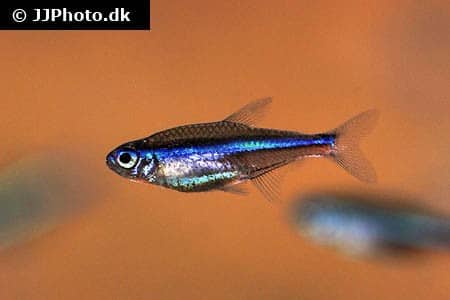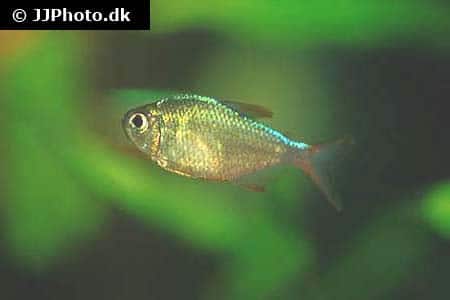
Tag: Freshwater Fish Profiles

  • Emperor Tetra Care Guide: Tank Setup, Diet, Tank Mates, & More

    Emperor Tetra Care Guide: Tank Setup, Diet, Tank Mates, & More

    Table of Contents

    The emperor tetra is one of the most regal-looking freshwater fish you can keep. Mature males develop extended dorsal and caudal fin rays and an iridescent purple-blue body that photographs poorly and looks incredible in person. This is not a fish you appreciate from pictures. You have to see it live.

    No photo does the emperor tetra justice. It is a fish you have to see in person to understand.

    The Reality of Keeping Emperor Tetra

    Males are dramatically different from females. Male emperor tetras develop deep purple-black coloring, extended tail fin rays, and iridescent blue eyes. Females are lighter and lack the fin extensions. You need both sexes for the best display, and at least 2 to 3 males to see the full range of male behavior.

    The iridescent blue eye is mesmerizing. Under the right lighting, the emperor tetra’s eyes glow an electric blue that is unlike anything else in the small tetra world. This feature alone makes the species worth keeping.

    They are peaceful but not pushovers. Emperor tetras hold their own in a community without being aggressive. They are not timid fish that hide. They occupy space with quiet confidence and rarely get bullied by other similarly-sized species.

    Biggest Mistake New Owners Make

    Keeping them under bright white lighting on a light background. The purple-black coloring and the blue eye iridescence both need dark backgrounds and moderate lighting to show properly. Bright lights flatten the colors completely.

    Expert Take

    The emperor tetra is one of the most elegant freshwater fish you can keep at this size. It does not demand attention through flash or brightness. It earns it through refinement. For keepers who appreciate subtle beauty, this is a top-tier choice.

    Key Takeaways

    • One of the most visually striking tetras with purple iridescence, a dark lateral stripe, and a unique trident-shaped tail
    • Eye color reveals the sex – males have blue eyes, females have green eyes
    • Hardy and beginner-friendly, adaptable to a wide range of water conditions
    • Keep in groups of 6-10 for natural behavior and the best male displays
    • 20-gallon minimum with dim lighting and planted tank for optimal coloration
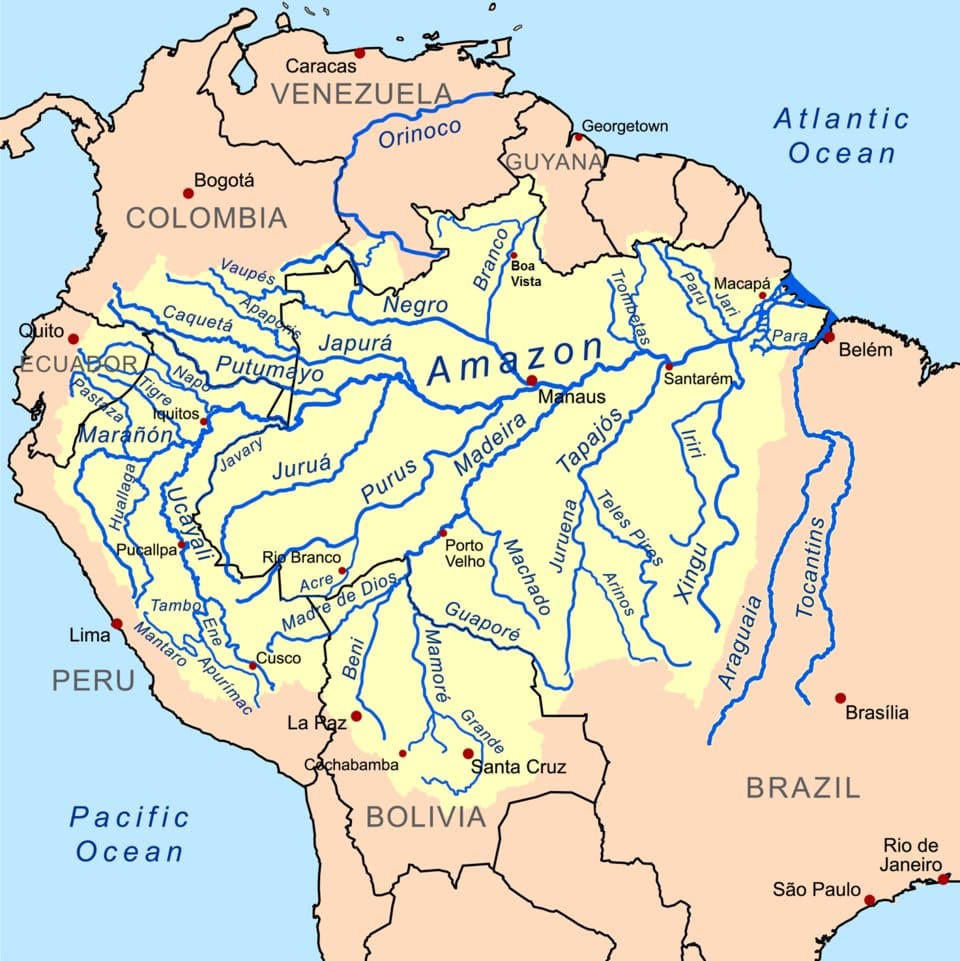
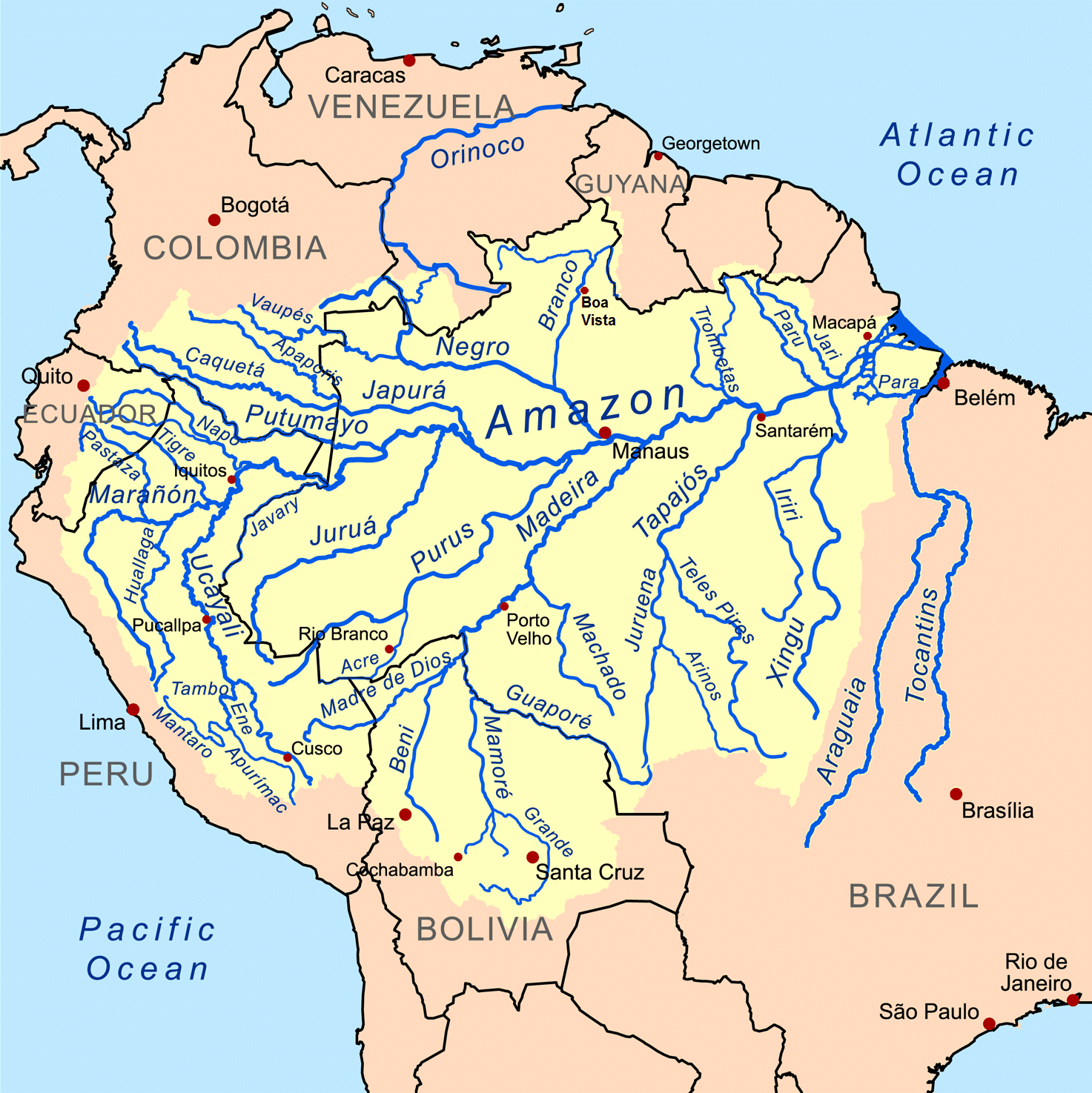
    Map showing the Amazon River Basin in South America
    Map by Kmusser, CC BY-SA 3.0, via Wikimedia Commons

    Species Overview

    Field Details
    Scientific Name Nematobrycon palmeri
    Common Names Emperor Tetra, Palmer’s Tetra
    Family Acestrorhamphidae
    Origin Atrato & San Juan River basins, Colombia
    Care Level Easy
    Temperament Peaceful
    Diet Omnivore
    Tank Level Mid
    Maximum Size 1.6 inches (4.2 cm)
    Minimum Tank Size 20 gallons (75 liters)
    Temperature 73-81ยฐF (23-27ยฐC)
    pH 5.0-7.5
    Hardness 1-12 dGH
    Lifespan 3-6 years in captivity
    Breeding Egg scatterer
    Breeding Difficulty Moderate
    Compatibility Community
    OK for Planted Tanks? Yes

    Classification

    Taxonomic Level Classification
    Order Characiformes
    Family Acestrorhamphidae (reclassified from Characidae, Melo et al. 2024)
    Subfamily Rhoadsiinae
    Genus Nematobrycon
    Species N. Palmeri (Eigenmann, 1911)

    The emperor tetra was described by Carl Eigenmann in 1911 and named after the collector, T. Palmer. The genus name Nematobrycon refers to the thread-like extension of the central caudal fin ray that’s a hallmark of this fish. There are only two species in the genus: N. Palmeri (the emperor tetra) and N. Lacortei (the rainbow emperor tetra).

    Note on reclassification: The 2024 phylogenomic study by Melo et al. Moved the emperor tetra from the old catch-all family Characidae into the new family Acestrorhamphidae, placed within the subfamily Rhoadsiinae. FishBase has already updated to reflect this new classification.

    Origin & Natural Habitat

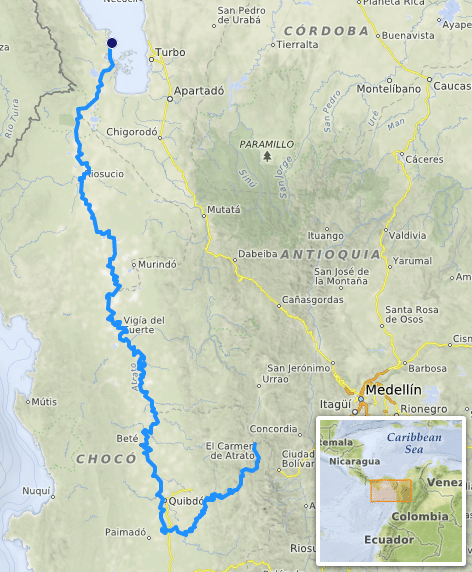
    Map of the Rio Atrato in Colombia, native habitat of the emperor tetra
    Map of the Rio Atrato in western Colombia. The emperor tetra is native to the Atrato and San Juan river basins in the Choco region. Image by OpenStreetMap contributors & Ccmpg, CC BY-SA 4.0, via Wikimedia Commons.

    The emperor tetra is endemic to Colombia, specifically the Atrato and San Juan river basins in the Choco department on the country’s Pacific coast. This is a region of incredibly high biodiversity and heavy rainfall, with dense tropical forests surrounding the river systems.

    In the wild, emperor tetras inhabit slower-moving sections of rivers, minor tributaries, and backwater areas. The water is soft and slightly acidic, shaded by dense riparian vegetation. Substrates are sandy with abundant leaf litter and submerged wood. These are calm, shaded environments with relatively warm, stable water temperatures.

    Understanding their natural habitat explains why emperor tetras look their absolute best in planted aquariums with dim lighting, dark substrates, and plenty of natural structure like driftwood and leaf litter.

    Appearance & Identification

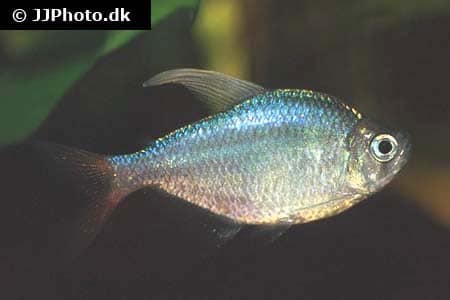
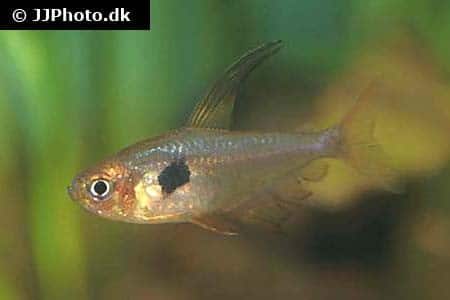
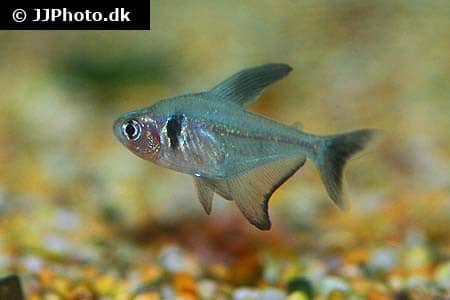
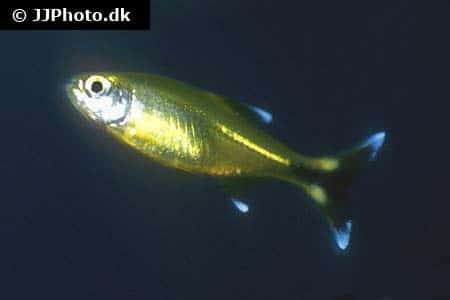
    Emperor tetra (Nematobrycon palmeri) showing purple iridescence and trident tail
    Emperor tetra displaying its signature purple iridescence and dark lateral stripe. Photo: AquariumPhoto.dk

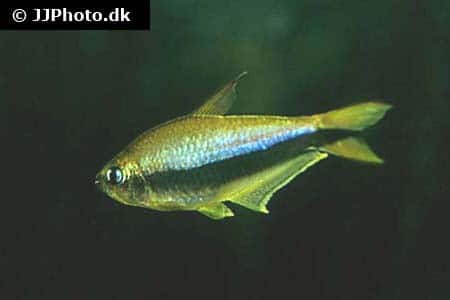
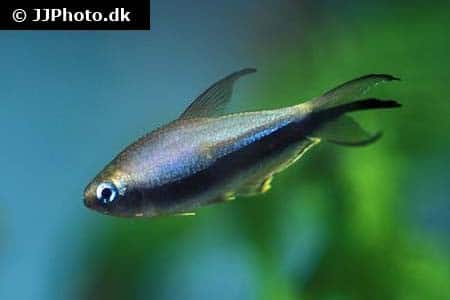
    The emperor tetra has a moderately deep, laterally compressed body with a color scheme that’s unlike any other common tetra. The body has a warm cream-to-golden base overlaid with a deep purple-blue iridescence that shifts and shimmers as the fish moves. A bold dark lateral stripe runs from the snout through the eye to the base of the tail, and the fins take on yellow-gold tones with dark edging.

    The standout feature is the trident-shaped caudal fin. In mature males, the central ray of the tail fin extends into a distinctive spike, creating a three-pronged appearance that’s completely unique among popular aquarium tetras. No other commonly kept tetra has this feature.

    Male vs. Female

    Emperor tetras are one of the easiest tetras to sex, thanks to several clear differences:

    • Eye color – Males have brilliant blue irises, while females have green irises. This is the quickest way to tell them apart.
    • Fins – Males develop much longer, more extended dorsal, anal, and caudal fins. The central caudal ray extension (the “trident”) is much more pronounced in males.
    • Coloration – Males are more intensely colored with deeper iridescence.
    • Body shape – Females are slightly rounder and deeper-bodied, especially when carrying eggs.

    Average Size & Lifespan

    Emperor tetras reach about 1.4 to 1.6 inches (3.5-4.2 cm) in standard length, putting them in the medium range for commonly kept tetras. They’re a bit larger than neon tetras but smaller than bleeding hearts or Congo tetras.

    With proper care, expect a lifespan of 3 to 6 years. Some well-maintained specimens can push past 5 years, which is on the longer end for small tetras.

    Care Guide

    Tank Size

    A 20-gallon tank is the recommended minimum for a group of 6-8 emperor tetras. They need enough space for males to establish small territories and display without constantly clashing. A 30-gallon or larger tank is ideal if you want a bigger group or a multi-species community.

    Water Parameters

    Parameter Ideal Range
    Temperature 73-81ยฐF (23-27ยฐC)
    pH 5.0-7.5
    Hardness 1-12 dGH
    KH 1-8 dKH

    Emperor tetras are adaptable and tolerate a fairly wide range of conditions. That said, they show their most intense iridescence in soft, slightly acidic water with some tannins. Driftwood and Indian almond leaves help create ideal conditions naturally. The key is stability – avoid sudden parameter swings.

    Filtration & Water Flow

    Moderate flow is ideal. They come from slower-moving waters, so don’t blast them with a strong current, but they can handle more flow than some of the more delicate nano tetras. A hang-on-back or canister filter turning over 4-5 times the tank volume per hour works well. Weekly water changes of 20-25% keep things clean.

    Lighting

    Subdued to moderate lighting brings out the best in emperor tetras. Their iridescent purple-blue coloration is most visible under gentle, angled lighting rather than harsh overhead lights. Floating plants are your friend here – they create natural shade patterns that really make the iridescence pop.

    Plants & Decorations

    A well-planted tank with driftwood and a dark substrate is the ideal setup. Live plants provide territory boundaries that help manage male territoriality, and the dark background makes their iridescent coloration stand out dramatically. Java fern, Anubias, Cryptocoryne, and floating plants all work beautifully. Dried leaf litter adds a natural biotope feel.

    Is the Emperor Tetra Right for You?

    Emperor tetras reward patient keepers with one of the most elegant displays in freshwater fishkeeping. Here’s who should keep them:

    • You’re patient. Emperor tetras take 6-8 months to reach their full stunning potential
    • You have at least a 20-gallon tank, ideally 30 gallons, to let males develop properly
    • You want a tetra that rivals some dwarf cichlids in terms of finnage and elegance
    • You appreciate deep purple-blue iridescence. Fully mature males are breathtaking
    • You want a peaceful species that works with virtually any community tank mate
    • Don’t bother if you expect instant gratification. The payoff with emperors is long-term and worth the wait

    Tank Mates

    Best Tank Mates

    • Other peaceful tetras (rummy-nose, cardinal, neon, ember tetras)
    • Corydoras catfish – ideal bottom-dwelling companions
    • Pencilfish – gentle mid-level fish from similar habitats
    • Hatchetfish – top-dwelling fish that fill a different zone
    • Dwarf cichlids (rams, Apistogramma) – natural South American biotope pairing
    • Honey gouramis – peaceful, complementary centerpiece
    • Bristlenose plecos – peaceful algae eaters
    • Otocinclus – small, peaceful bottom feeders

    Tank Mates to Avoid

    • Large aggressive cichlids – anything that could eat or bully them
    • Very active, boisterous species – tiger barbs and giant danios will outcompete and stress them
    • Other emperor tetras in too-small groups – males is territorial, so keep enough females to distribute attention

    Food & Diet

    Emperor tetras are omnivorous micropredators. In the wild, they feed primarily on small insects, larvae, and invertebrates. In the aquarium, they accept a wide range of foods and are not picky eaters.

    A high-quality flake or micro-pellet makes a good daily staple. Supplement with live or frozen foods like daphnia, baby brine shrimp, cyclops, and bloodworms (in moderation) for the best coloration and overall health. Daily feeding of small live or frozen foods is recommended by Seriously Fish for optimal condition and breeding readiness.

    Feeding tip: Feed small portions once or twice daily. Emperor tetras are active feeders but have small mouths, so appropriately sized food is important.

    Breeding & Reproduction

    Emperor tetras are egg scatterers and are considered not particularly difficult to breed, making them a good species for hobbyists looking to try tetra breeding.

    Spawning Tank Setup

    Set up a separate 10-gallon breeding tank with dim lighting and fine-leaved plants like Java moss or spawning mops. Use a mesh or marble layer on the bottom to protect eggs. Water should be soft and slightly acidic – pH 6.0-6.5, temperature 78-80ยฐF, with minimal hardness.

    Conditioning & Spawning

    Condition a breeding pair with plenty of live foods for 1-2 weeks. Males will display intensely, showing off their extended fins and iridescent coloration. Spawning typically occurs in the morning, with the female scattering eggs among the plants.

    Egg & Fry Care

    Remove adults after spawning to prevent egg predation. Eggs hatch in 24-36 hours, and fry become free-swimming 4-5 days later. Feed infusoria or liquid fry food initially, then graduate to microworms and baby brine shrimp as the fry grow. Growth is moderate, and juveniles begin showing adult coloration at about 2-3 months.

    Common Health Issues

    Emperor tetras are hardy, but they’re susceptible to the standard tropical fish diseases:

    Ich (White Spot Disease)

    The most common ailment. White spots on body and fins, usually triggered by temperature fluctuations or stress. Raise temperature gradually to 82ยฐF and treat with standard ich medication.

    Fin Rot

    Bacterial deterioration of the fins, particularly concerning in males with their beautiful extended finnage. Usually caused by poor water quality. Improve conditions with extra water changes and treat with antibacterial medication if needed.

    General Prevention

    Quarantine all new fish for 2-3 weeks. Maintain stable water parameters and keep up with regular water changes. A varied diet supports a strong immune system. Emperor tetras are robust when their basic needs are met.

    Common Mistakes to Avoid

    • Keeping too few – In groups smaller than 6, males become overly territorial and females get harassed. Groups of 8-10 are ideal.
    • Bright lighting – Their iridescent coloration washes out under harsh lights. Subdued lighting with floating plants is the way to go.
    • Not enough structure – Males establish small territories. Without plants and driftwood to break sight lines, aggression within the group increases.
    • Expecting color from juveniles – Young emperor tetras look pretty plain. The deep purple iridescence and fin extensions develop as they mature, so give them time.
    • Missing the trident tail – Sometimes pet stores sell emperor tetras with damaged or nipped caudal fins. The central ray extension grows back, but it takes time.

    Where to Buy

    Emperor tetras are moderately available at local fish stores and widely available online. Pricing is typically $4-8 per fish. The “black emperor tetra” variant (a selectively bred darker form) may be available at slightly higher prices.

    Make sure the tank is fully cycled first. Emperor tetras need stable, clean water to show their best coloring, and ammonia or nitrite spikes in a new tank will set them back immediately.

    For quality stock with live arrival guarantees, check Flip Aquatics and Dan’s Fish. Both retailers regularly carry emperor tetras and ship healthy, well-acclimated specimens.

    Frequently Asked Questions

    How can you tell male and female emperor tetras apart?

    The easiest method is eye color. Males have brilliant blue irises, while females have green irises. Males also develop much longer fins, a more extended central caudal ray (the “trident”), and more intense iridescent coloration. Females are slightly rounder and deeper-bodied.

    What is the black emperor tetra?

    The black emperor tetra is a selectively bred color variant of Nematobrycon palmeri with significantly darker overall coloration. The body is much darker (almost black in some specimens) while retaining the characteristic iridescence and trident tail. Care requirements are identical to the standard emperor tetra.

    Are emperor tetras aggressive?

    Not truly aggressive, but males are mildly territorial. They establish small domains in the aquarium and will display and posture at other males that enter their space. This behavior is normal and rarely causes injury in a properly sized, decorated tank. Keeping a group of 8-10 with more females than males manages this behavior effectively.

    Why does my emperor tetra’s tail look different?

    If the trident-shaped tail is missing or irregular, it may have been nipped by tank mates or damaged during shipping. The central caudal ray extension will regrow over time in good conditions. It’s also possible you have a young specimen that hasn’t fully developed the extension yet, or a female (whose caudal ray is less extended).

    What size tank do emperor tetras need?

    A minimum of 20 gallons for a group of 6-8. A 30-gallon or larger tank is recommended for a proper school of 10 or more, especially in a community setup. Males need enough space to establish territories without constant conflict.

    What It Is Actually Like Living With Emperor Tetra

    Male emperor tetras have a presence that exceeds their small size. The deep purple-black coloring and elongated fins give them a regal bearing that stands out in any community.

    The blue eye glow is most visible during the first hour after lights come on and during social interactions. It is a small detail that makes checking the tank a genuine pleasure.

    They move through the tank with a deliberate, unhurried pace. There is no frantic swimming or darting. Everything about this fish says calm authority.

    They pair exceptionally well with other subtle species like pencilfish, corydoras, and small rasboras.

    How the Emperor Tetra Compares to Similar Species

    Emperor Tetra vs. Blue Emperor Tetra

    Blue emperor tetras deliver more intense blue coloration but are more assertive in temperament. Regular emperors are the more predictably peaceful option and work in a wider range of community setups. Blue emperors need more careful management of group dynamics and tank mate selection. If peace is your priority, stick with regular emperors. If you want maximum blue impact and can handle slightly feistier fish, blue emperors are the upgrade. Check out our Blue Emperor Tetra care guide for more details.

    Emperor Tetra vs. Diamond Tetra

    Diamond tetras and emperor tetras are often compared because both develop impressive finnage on mature males. Diamond tetras lean toward iridescent sparkle while emperors offer deep purple-blue with flowing rays. Both need time and space to reach their potential. Diamond tetras are slightly hardier and less demanding about tank size. Emperors are more colorful and elegant when fully mature. In a large planted tank, a school of each species creates one of the most visually stunning tetra displays possible. Check out our Diamond Tetra care guide for more details.

    Closing Thoughts

    The emperor tetra is one of the hobby’s most underappreciated fish. When you see a mature male in a well-planted tank – that deep purple iridescence glowing under soft lighting, the trident tail fanned out, those piercing blue eyes – it’s genuinely one of the most beautiful freshwater fish you can keep. And it’s not even that difficult to care for.

    Give them a planted tank with dim lighting, soft water, and a proper group of 8-10, and you’ll have one of the most impressive tetra displays in the hobby. They’re especially stunning alongside rummy-nose tetras for schooling contrast, or paired with cardinal tetras for a South American biotope theme.

    Check out our tetra tier list video where we rank the most popular tetras in the hobby, including the emperor tetra:

    References

    Explore More Tetras

    Looking for more tetra species? Check out our complete Tetras A to Z directory covering every tetra species in the freshwater hobby.

  • Red Phantom Tetra Care Guide: Tank Setup, Diet, Tank Mates & More

    Red Phantom Tetra Care Guide: Tank Setup, Diet, Tank Mates & More

    Table of Contents

    The red phantom tetra is the overlooked sibling of the black phantom. It has the same great schooling behavior and dorsal fin displays but in deep red instead of black. Keep fewer than 8 and they fade to nothing. Keep them in soft, slightly acidic water with a dark substrate and they become one of the most striking mid-level schoolers available.

    The red phantom tetra is the black phantom’s better-looking sibling. But it needs soft water to prove it.

    The Reality of Keeping Red Phantom Tetra

    Color varies dramatically between sources. Wild-caught red phantom tetras from specific locations show deeper, more intense red than tank-bred specimens. The color also varies with diet, water chemistry, and lighting. Expect variation and be prepared to work for the best color expression.

    They share the sparring behavior of black phantoms. Males display to each other with spread fins just like black phantom tetras, but the visual effect is different because the fins are translucent red rather than dark. The combination of red coloring and fin displays is stunning.

    They need softer water than most common tetras. Red phantom tetras show their best color in soft, slightly acidic water. In hard, alkaline water, the red fades to a washed-out pink. If your tap water is hard, consider RO water or a dedicated setup for this species.

    Biggest Mistake New Owners Make

    Keeping them in hard, alkaline water where the red color fades. The entire visual appeal of this fish depends on maintaining appropriate water chemistry. If you cannot provide soft water, choose a different tetra.

    Expert Take

    The red phantom tetra is one of the most beautiful small tetras available when properly maintained. The combination of translucent red coloring, phantom-style sparring displays, and an elegant body shape makes it a standout in any planted tank.

    Key Takeaways

    • Vibrant red-orange coloration that intensifies in soft, slightly acidic water with dim lighting
    • Perfect pairing with black phantom tetras for a striking dark-and-red contrast in the same tank
    • Keep in groups of 8-10 for the best behavior and coloration
    • Hardy and beginner-friendly, adaptable to a wide range of water conditions
    • Small size (1.2 inches) makes them ideal for nano and planted aquariums
    Map showing the Amazon River Basin in South America
    Map by Kmusser, CC BY-SA 3.0, via Wikimedia Commons

    Species Overview

    Field Details
    Scientific Name Megalamphodus sweglesi (formerly Hyphessobrycon sweglesi)
    Common Names Red Phantom Tetra, Sweglesi Tetra
    Family Acestrorhamphidae
    Origin Orinoco River basin (Colombia, Venezuela)
    Care Level Easy
    Temperament Peaceful
    Diet Omnivore
    Tank Level Mid
    Maximum Size 1.2 inches (3 cm)
    Minimum Tank Size 15 gallons (57 liters)
    Temperature 68-82ยฐF (20-28ยฐC)
    pH 4.5-7.5
    Hardness 1-12 dGH
    Lifespan 3-5 years in captivity
    Breeding Egg scatterer
    Breeding Difficulty Moderate
    Compatibility Community
    OK for Planted Tanks? Yes

    Classification

    Taxonomic Level Classification
    Order Characiformes
    Family Acestrorhamphidae (reclassified from Characidae, Melo et al. 2024)
    Subfamily Megalamphodinae
    Genus Megalamphodus
    Species M. Sweglesi (Gรฉry, 1961)

    The red phantom tetra was described by Jacques Gรฉry in 1961 and originally placed in Megalamphodus before being moved to the catch-all genus Hyphessobrycon. The species is named after Kyle Swegler, a tropical fish collector who discovered the species.

    Note on reclassification: The 2024 phylogenomic study by Melo et al. Returned this species to Megalamphodus within the new family Acestrorhamphidae, subfamily Megalamphodinae. This puts it in the same genus as its close relative, the black phantom tetra (M. Megalopterus), and the bleeding heart tetra (M. Erythrostigma). Most hobby sources still use Hyphessobrycon sweglesi, but the scientific literature now uses Megalamphodus sweglesi.

    Origin & Natural Habitat

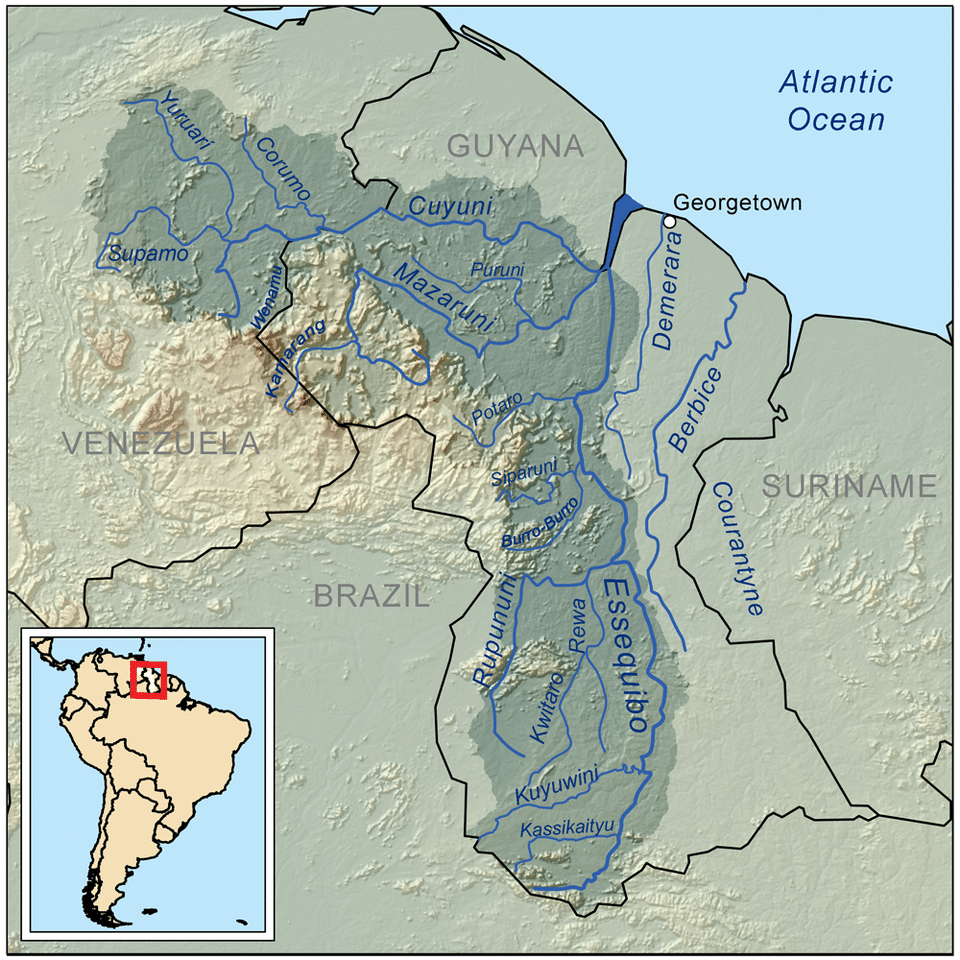
    Map of the Orinoco River drainage basin in Colombia and Venezuela, native habitat of the red phantom tetra
    Map of the Orinoco River drainage basin. The red phantom tetra is found in tributaries of the upper and middle Orinoco in Colombia and Venezuela. Image by Sรฉmhur, Fev & Milenioscuro, CC BY-SA 4.0, via Wikimedia Commons.

    The red phantom tetra is native to the upper and middle Orinoco River watershed in Colombia and Venezuela. It inhabits minor tributaries, smaller rivers, oxbow lakes, and seasonally flooded forests across the llanos (grassland plains) and morichal (palm swamp) habitats of the region.

    In the wild, these fish live in both blackwater and clearwater environments. The water is typically soft, acidic, and stained with tannins from decomposing leaves and wood. Substrates are sandy, and the habitat features dense aquatic vegetation, overhanging riparian plants, and submerged root structures that provide shelter and foraging opportunities.

    Understanding their natural habitat explains why red phantoms show their best colors in aquariums with soft water, dim lighting, and plenty of botanicals like driftwood and leaf litter.

    Appearance & Identification

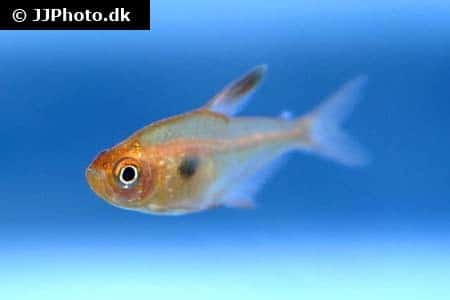
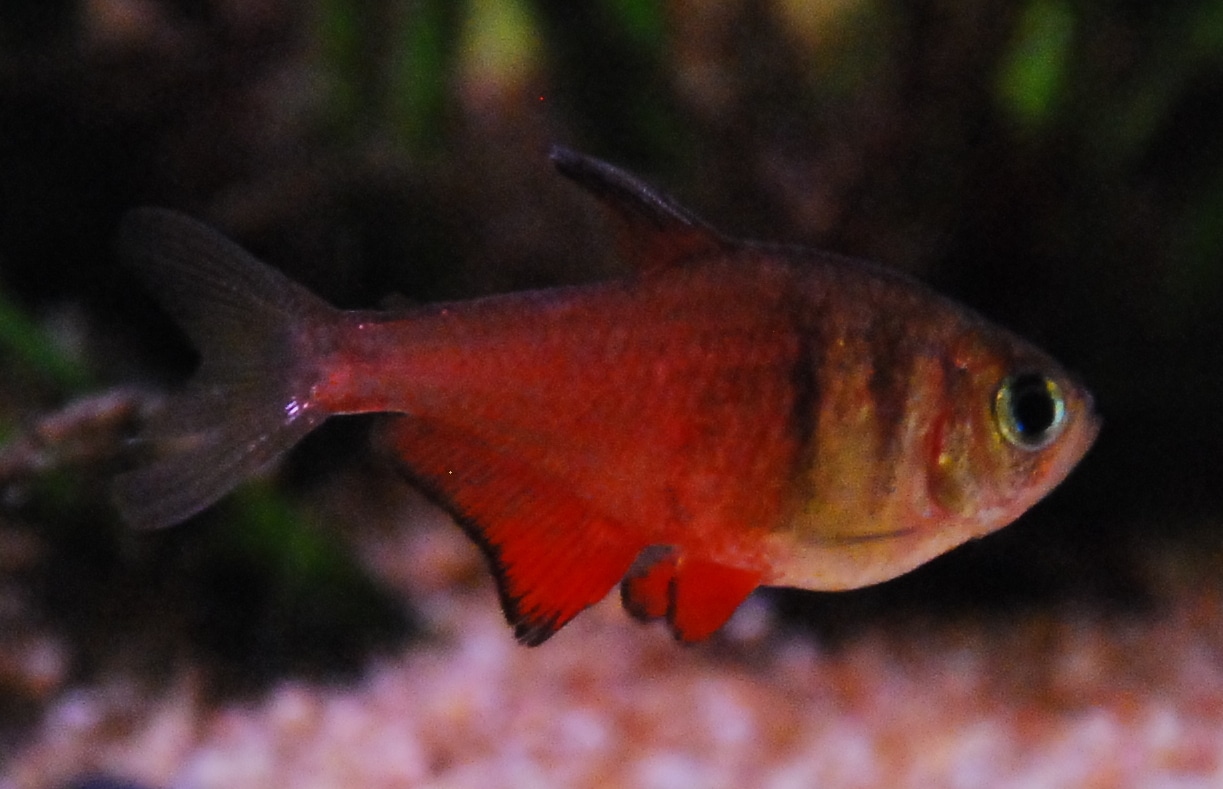
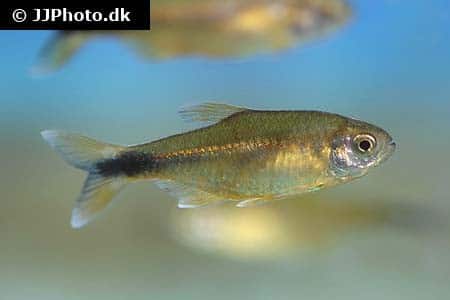
    Red phantom tetra (Megalamphodus sweglesi) showing vibrant red-orange coloration
    Red phantom tetra displaying its characteristic warm red-orange coloration. Photo: AquariumPhoto.dk

    The red phantom tetra has a laterally compressed, somewhat deep body with a beautiful translucent red-orange coloration that does glow from within. A prominent dark shoulder spot (humeral blotch) sits just behind the gill cover, which is shared with other phantom tetras and is one of the genus’s defining features.

    The fins are translucent with red tinting, and a dark blotch on the dorsal fin adds a nice accent. Under good conditions in soft, slightly acidic water, the red coloration intensifies to a deep, warm crimson. There are at least two color forms in the trade, including a particularly vivid red variant that’s especially sought after.

    Male vs. Female

    Like its black phantom cousin, the red phantom shows clear sexual dimorphism:

    • Males are slimmer with extended dorsal and anal fins. They will show more intense coloration, especially when displaying.
    • Females have deeper, rounder bodies (particularly when carrying eggs) with shorter fins.

    The differences are less dramatic than in the black phantom tetra, where males and females look almost like different species. In red phantoms, both sexes share the same warm red-orange coloration.

    Average Size & Lifespan

    Red phantom tetras are on the smaller side, reaching about 1 to 1.2 inches (2.5-3 cm) in standard length. This makes them smaller than black phantoms and considerably smaller than bleeding heart tetras, so they’re a great choice for smaller aquariums and nano setups.

    With proper care, expect a lifespan of 3 to 5 years. Clean, stable water conditions and a varied diet are the keys to longevity.

    Care Guide

    Tank Size

    A 15-gallon tank works as a minimum for a school of 8-10 red phantom tetras, though 20 gallons gives them more room and makes it easier to maintain stable water conditions. Their smaller size compared to black phantoms means they don’t need quite as much space, making them well-suited for moderately sized planted tanks.

    Water Parameters

    Parameter Ideal Range
    Temperature 68-82ยฐF (20-28ยฐC)
    pH 5.5-7.0
    Hardness 1-12 dGH
    KH 1-8 dKH

    Red phantoms tolerate a fairly wide range of conditions, but they show their best coloration in soft, slightly acidic water. Tannin-stained water from driftwood or Indian almond leaves brings out deeper reds. They can handle temperatures down to 68ยฐF, which gives you more flexibility than many tropical tetras.

    Filtration & Water Flow

    Gentle to moderate flow is best. These fish come from slow-moving tributaries and flooded forest environments, so a strong current will stress them. A sponge filter is ideal for smaller setups, while a hang-on-back filter with a baffle works well in larger tanks. Weekly water changes of 20-25% keep water quality high.

    Lighting

    Subdued lighting is the way to go with red phantom tetras. Under bright lights, they look washed out and will hide. Add floating plants to diffuse the light, and you’ll see their red coloration deepen significantly. This is one of those species where the lighting setup makes a huge difference in how impressive they look.

    Plants & Decorations

    A well-planted tank with driftwood and a dark substrate is the ideal setup. Live plants provide security and territory boundaries, while driftwood releases tannins that soften the water and bring out the fish’s best colors. Dried leaf litter on the substrate mimics their natural habitat and promotes beneficial microorganism growth. Java fern, Anubias, Cryptocoryne, and floating plants all work well.

    Is the Red Phantom Tetra Right for You?

    Red phantom tetras are one of the hobby’s best-kept secrets for peaceful color. Here’s who should be keeping them:

    • You want vibrant red coloration in a genuinely peaceful species. Red phantoms are not serpaes
    • You appreciate the combination of transparent body and deep red that creates a glowing effect
    • You have a planted tank with soft water. Their red intensifies dramatically in the right conditions
    • You want a tetra that’s confident enough to stay visible but never causes problems
    • You keep a group of 8+ for the best schooling display and color development
    • These are an excellent choice for almost any peaceful community. Very few situations where they don’t work

    Tank Mates

    Best Tank Mates

    • Black phantom tetras – the classic pairing for stunning visual contrast
    • Other small tetras (neon tetras, ember tetras, cardinal tetras, green neon tetras)
    • Corydoras catfish – peaceful bottom dwellers that stay out of the way
    • Pencilfish – gentle nano fish from similar South American habitats
    • Otocinclus – tiny peaceful algae eaters
    • Honey gouramis – a peaceful, complementary centerpiece fish
    • Dwarf cichlids (rams, Apistogramma) – natural biotope pairing
    • Small rasboras (chili rasboras, harlequin rasboras)

    Tank Mates to Avoid

    • Large or aggressive fish – anything that could eat or intimidate them
    • Fast, boisterous species (giant danios, large barbs) – will outcompete them for food and stress them
    • Breeding shrimp colonies – baby shrimp will be eaten, though adult shrimp are safe

    Food & Diet

    Red phantom tetras are omnivores that accept a wide range of foods. In the wild, they feed on small insects, larvae, and organic matter in the water column. In the aquarium, high-quality micro-flakes or crushed pellets make a good daily staple.

    Supplement with live or frozen foods 2-3 times per week for optimal coloration and health. Daphnia, baby brine shrimp, cyclops, and bloodworms (in moderation) are all excellent choices. Their small mouths mean food should be appropriately sized – crushed flakes and micro-foods work best.

    Feeding tip: Feed small amounts once or twice daily. Overfeeding leads to water quality issues, which shows up quickly as faded coloration and stressed behavior.

    Breeding & Reproduction

    Red phantom tetras are egg scatterers that show no parental care. They’re considered moderately easy to breed and will sometimes spawn spontaneously in a well-maintained, mature aquarium.

    Spawning Tank Setup

    For controlled breeding, set up a separate 10-gallon tank with very dim lighting. Use fine-leaved plants like Java moss or spawning mops to catch eggs, and place mesh or marbles on the bottom to protect fallen eggs from the parents. Water should be very soft and acidic – pH 6.0-6.5 with minimal hardness.

    Conditioning & Spawning

    Condition a breeding pair or small group with plenty of live foods for 1-2 weeks. Males will display intensely for females, showing off their extended dorsal fins. Spawning usually occurs in the early morning. The female scatters eggs among the plants while the male fertilizes them.

    Egg & Fry Care

    Remove adults immediately after spawning because they will eat the eggs. Keep the tank dimly lit since the eggs are light-sensitive. Hatching occurs in about 24-36 hours, and fry become free-swimming 3-4 days later. Feed Paramecium or liquid fry food initially, then graduate to baby brine shrimp (Artemia nauplii) as the fry grow.

    Common Health Issues

    Red phantom tetras are hardy fish, but they’re susceptible to the standard tropical fish diseases:

    Ich (White Spot Disease)

    The most common ailment. Small white spots appear on the body and fins, usually triggered by temperature swings or stress. Raise the temperature gradually to 82ยฐF and treat with a standard ich medication.

    Neon Tetra Disease

    Caused by the parasite Pleistophora hyphessobryconis. Symptoms include fading color, irregular swimming, and a curved spine. Unfortunately, there’s no cure. Prevention through quarantine of new fish and maintaining excellent water quality is the only defense.

    General Prevention

    Quarantine all new fish for 2-3 weeks before adding them to your main tank. Maintain stable water parameters and keep up with regular water changes. A varied diet helps support a strong immune system.

    Common Mistakes to Avoid

    • Keeping too few – In small groups, red phantoms are shy and barely show any color. Keep 8-10 minimum to see their natural schooling behavior and full coloration.
    • Bright lighting – These fish wash out under intense light. Use floating plants and subdued lighting to bring out the deep red tones.
    • Hard, alkaline water – While they’ll survive in it, hard water mutes their coloration significantly. Soft, slightly acidic water makes a dramatic difference.
    • Mixing with large or aggressive fish – Red phantoms are small and peaceful. Boisterous tank mates will stress them and they’ll spend all their time hiding.
    • Expecting instant color – Pet store specimens often look pale. Give them a few weeks in a well-set-up tank and their true colors will develop.

    Where to Buy

    Red phantom tetras are moderately available at local fish stores and widely available online. Pricing is typically $4-8 per fish, depending on the source and color quality. Some retailers offer a particularly vivid “super red” variant that commands slightly higher prices.

    Only add them to a fully cycled, mature tank. Red phantoms are sensitive to water quality, and ammonia or nitrite from an uncycled setup will cause stress and disease quickly.

    For quality stock with live arrival guarantees, check Flip Aquatics and Dan’s Fish. Both retailers ship healthy, well-acclimated fish directly to your door.

    Frequently Asked Questions

    Can you keep red and black phantom tetras together?

    Absolutely. It’s one of the best combinations in the hobby. The warm red-orange of the red phantoms alongside the dark, smoky black phantoms creates a stunning visual contrast. They have nearly identical care requirements and coexist peacefully. This is a combination I recommend to anyone looking for a visually striking tetra community.

    How many red phantom tetras should I keep?

    A minimum of 6, but 8-10 is strongly recommended. In larger groups, they establish natural dominance hierarchies, display more confidently, and show significantly better coloration. A school of 10+ in a planted tank is genuinely impressive.

    Are red phantom tetras the same as rosy tetras?

    No. The “rosy tetra” (Hyphessobrycon rosaceus) is a different species, though both belong to the broader “rosy tetra clade” of related species. Red phantoms (M. Sweglesi) are smaller, more intensely colored, and have the characteristic shoulder spot that defines the phantom tetras.

    Why are my red phantom tetras pale?

    The most common causes are stress (from too-small groups, aggressive tank mates, or new surroundings), bright lighting, hard water, or poor water quality. Fix these factors and give them 2-3 weeks to settle in. Well-conditioned red phantoms in soft water with dim lighting are dramatically more colorful than stressed specimens.

    What size tank do red phantom tetras need?

    A 15-gallon tank works for a group of 8-10 red phantom tetras. Their small adult size (about 1.2 inches) makes them suitable for smaller aquariums compared to larger tetra species. A 20-gallon tank provides even more comfort and flexibility for a community setup.

    What It Is Actually Like Living With Red Phantom Tetra

    Red phantom tetras glow under moderate lighting in a way that photographs fail to capture. The translucent red body catches light from within, creating a warm ruby luminescence.

    Male sparring displays are enhanced by the red coloring. When two males face off with spread fins, the red intensifies noticeably.

    They are peaceful with other species and make excellent companions for other calm, small tetras, corydoras, and shrimp.

    In a school of 6 to 8 against a dark background, the combined effect of multiple translucent red bodies moving together creates one of the warmest, most inviting displays in nano fishkeeping.

    How the Red Phantom Tetra Compares to Similar Species

    Red Phantom Tetra vs. Black Phantom Tetra

    Black phantom tetras are the cool-toned sibling. Smoky grey-black where red phantoms are warm red. Both share the same peaceful temperament and the distinctive dorsal fin spot. Males in both species display to each other by flaring their fins, but neither species is actually aggressive during these displays. Keeping both species together creates a stunning warm-and-cool contrast. If you can only pick one, red phantoms offer more color impact, while black phantoms have more dramatic male display behavior. Check out our Black Phantom Tetra care guide for more details.

    Red Phantom Tetra vs. Flame Tetra

    Flame tetras are another red-orange option, but they’re more solidly opaque where red phantoms have that characteristic translucency. Flame tetras are hardier and more forgiving of varied water conditions. Red phantoms need softer water for peak coloration. In terms of pure visual impact, red phantoms in the right setup are the more striking fish. Flame tetras are the more practical, low-maintenance choice that still delivers warm tones reliably. Check out our Flame Tetra care guide for more details.

    Closing Thoughts

    The red phantom tetra is one of those fish that rewards you for doing things right. In a bare, brightly lit tank, they look average at best. But put them in a well-planted aquarium with soft water, dim lighting, driftwood, and a dark substrate, and the transformation is remarkable. The warm red-orange glow, the confident schooling behavior, and the subtle fin displays make them one of the most satisfying tetras to keep.

    If you’re looking for one recommendation, pair them with black phantom tetras. The dark-and-red combination is hard to beat, and both species have identical care requirements. Add some ember tetras to fill out the warm color palette, throw in a school of rummy-nose tetras for the tight schooling contrast, and you’ve got one of the best tetra community tanks possible.

    Check out our tetra tier list video where we rank the most popular tetras in the hobby, including the red phantom tetra:

    References

    Explore More Tetras

    Looking for more tetra species? Check out our complete Tetras A to Z directory covering every tetra species in the freshwater hobby.

  • Black Phantom Tetra Care Guide: Tank Setup, Diet, Tank Mates & More

    Black Phantom Tetra Care Guide: Tank Setup, Diet, Tank Mates & More

    Table of Contents

    The black phantom tetra is the best display tetra most people have never kept. Males flare their oversized dorsal fins at each other in constant sparring matches that look like a slow-motion boxing match. Keep fewer than 6 and you lose the behavior entirely. Keep them in a proper school and you get a show that never stops.

    Male black phantom tetras flaring at each other is one of the best free shows in the freshwater hobby.

    The Reality of Keeping Black Phantom Tetra

    Male sparring is the main attraction. Male black phantom tetras spread their oversized fins and face off with each other in ritualized displays. No physical contact. Just fin-flaring, posturing, and dramatic showmanship. This behavior is constant in a group with multiple males and it is genuinely entertaining.

    Females are a completely different fish visually. Males are dark, dramatic, and large-finned. Females are lighter colored with reddish-tinted fins and a more compact body. Both are attractive, but for different reasons. A mixed group shows both looks.

    They need dark backgrounds to look their best. Against a light background, black phantom tetras look washed out. Against a dark background with moderate lighting, the dark coloring becomes rich and dramatic, and the fin displays are much more visible.

    Biggest Mistake New Owners Make

    Keeping all females or only one male. The sparring behavior between males is the entire appeal of this species. Without multiple males, you miss the show.

    Expert Take

    The black phantom tetra is one of the most behaviorally interesting small fish in the hobby. The male sparring displays are fascinating and they happen all day long. If you want a fish that does more than just swim around, this is an excellent choice.

    Key Takeaways

    • Hardy and beginner-friendly – one of the easiest tetras to keep, adaptable to a wide range of water conditions
    • Striking sexual dimorphism – males have large black fins, females have reddish-pink fins, making mixed groups visually stunning
    • Males spar with dramatic fin displays – flaring and posturing that’s entertaining to watch and rarely causes any harm
    • Keep in groups of 6. 8 minimum – proper group size prevents fin-nipping and brings out natural behavior
    • 20-gallon tank minimum with dim lighting and dark substrate for best coloration
    Map showing the Amazon River Basin in South America
    Map by Kmusser, CC BY-SA 3.0, via Wikimedia Commons

    Species Overview

    Field Details
    Scientific Name Megalamphodus megalopterus (formerly Hyphessobrycon megalopterus)
    Common Names Black Phantom Tetra
    Family Acestrorhamphidae
    Origin Upper Paraguay & Guaporรฉ River basins (Brazil, Bolivia)
    Care Level Easy
    Temperament Peaceful
    Diet Omnivore
    Tank Level Mid
    Maximum Size 1.8 inches (4.5 cm)
    Minimum Tank Size 20 gallons (75 liters)
    Temperature 72. 82ยฐF (22. 28ยฐC)
    pH 6.0. 7.5
    Hardness 2. 18 dGH
    Lifespan 3. 5 years in captivity
    Breeding Egg scatterer
    Breeding Difficulty Moderate
    Compatibility Community
    OK for Planted Tanks? Yes

    Classification

    Taxonomic Level Classification
    Order Characiformes
    Family Acestrorhamphidae (reclassified from Characidae, Melo et al. 2024)
    Subfamily Megalamphodinae
    Genus Megalamphodus
    Species M. Megalopterus (Eigenmann, 1915)

    The black phantom tetra was originally described by Carl Eigenmann in 1915 as Megalamphodus megalopterus. For decades it was placed in Hyphessobrycon, the enormous catch-all genus that housed dozens of loosely related tetras. The species name megalopterus means “large-finned” in Greek – a fitting description once you see a mature male’s oversized dorsal fin.

    Note on reclassification: The 2024 phylogenomic study by Melo et al. Reorganized the tetra family tree significantly. The black phantom was returned to its original genus Megalamphodus within the new family Acestrorhamphidae, subfamily Megalamphodinae. This same subfamily includes other “rosy tetra clade” species like the red phantom tetra and the bleeding heart tetra. Most hobby sources still reference the old name Hyphessobrycon megalopterus, but the scientific literature now uses Megalamphodus megalopterus.

    Origin & Natural Habitat

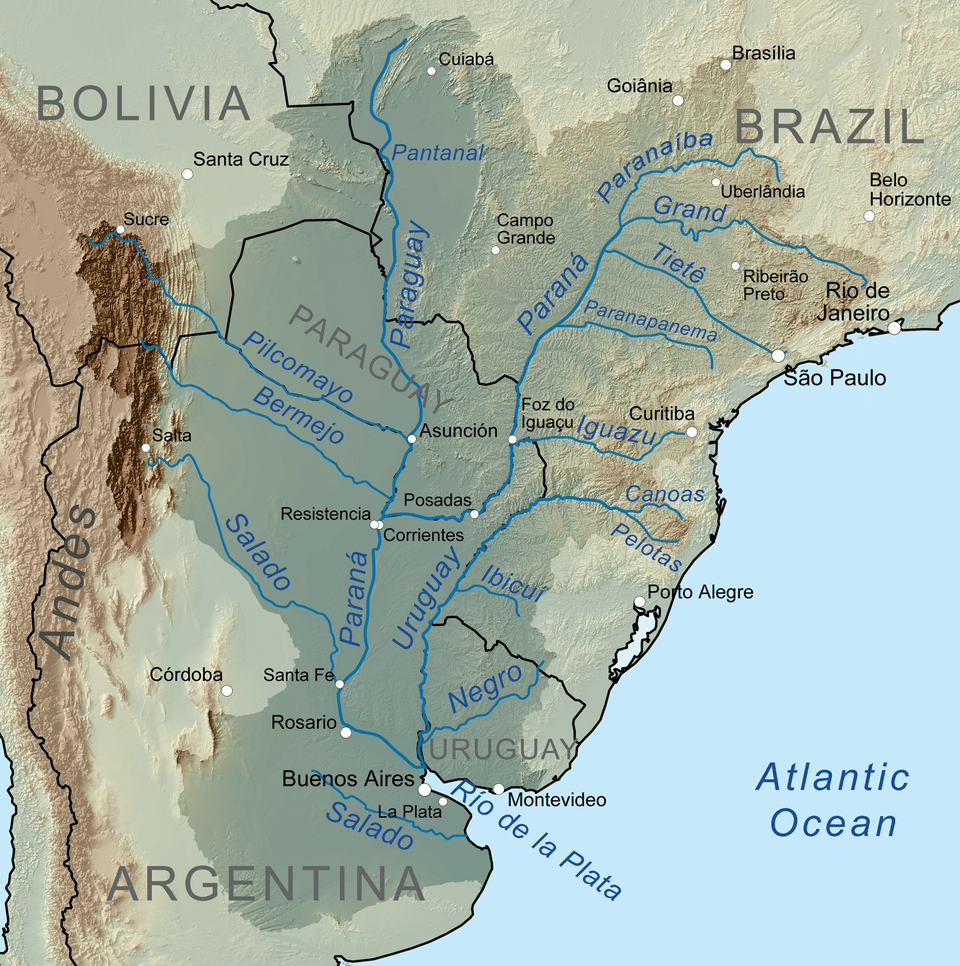
    Map of the Rio de la Plata drainage basin in South America showing the Paraguay River - native habitat region of the black phantom tetra
    Map of the Rio de la Plata drainage basin – the black phantom tetra is found in the upper Paraguay and Guaporรฉ River systems in Brazil and Bolivia. Image by Kmusser, CC BY-SA 3.0, via Wikimedia Commons.

    The black phantom tetra is native to the upper Paraguay River basin and the upper Guaporรฉ (Itรฉnez) River drainage in central South America, spanning parts of Brazil and Bolivia. The type locality is the Rio Guaporรฉ, which forms part of the border between the two countries.

    In the wild, these fish inhabit slow-moving tributaries, streams, and marshy areas with soft, sandy or muddy substrates. The habitat is typically shaded by overhanging vegetation, with plenty of submerged roots, fallen branches, and leaf litter. The water is often stained brown from tannins – soft, slightly acidic, and warm.

    This is classic South American blackwater and clearwater habitat, and it explains why black phantoms look their best in aquariums that replicate these conditions – dim lighting, dark substrate, and plenty of botanical elements.

    Appearance & Identification

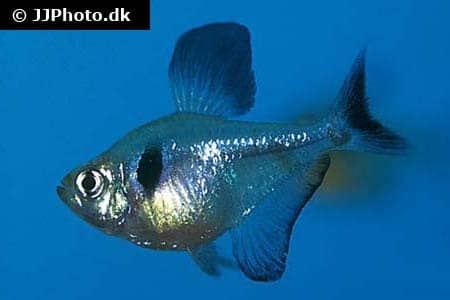
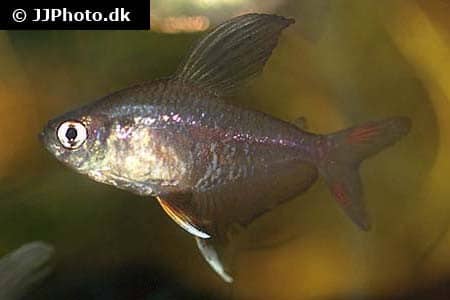
    Black phantom tetra (Megalamphodus megalopterus) showing dark coloration and large fins
    Black phantom tetra displaying its characteristic dark coloration and oversized fins. Photo: AquariumPhoto.dk

    The black phantom tetra has a laterally compressed, somewhat deep body with a distinctive smoky gray to dark charcoal coloration. A prominent dark shoulder spot (humeral blotch) sits just behind the gill cover, which is one of its most recognizable features. The overall impression is of a shadowy, elegant fish – nothing flashy, just effortlessly cool.

    Under good conditions, the body takes on a subtle silvery sheen with darker edges. The fins are where things get really interesting, and this is where the dramatic sexual dimorphism comes into play.

    Male vs. Female

    This is one of the easiest tetras to sex, and the differences are striking:

    • Males are slimmer and develop very large, dramatic black dorsal, anal, and pelvic fins. The dorsal fin in particular becomes tall and sail-like. Males are darker overall and intensify their coloration during displays.
    • Females have a rounder, deeper body (especially when carrying eggs) with shorter fins that are reddish-pink in color. The pectoral fins in females also show a distinctive pink-red hue.

    Keeping a mixed group of males and females together creates a beautiful contrast – the dark, dramatic males alongside the warmer-toned females. It’s one of the best examples of sexual dimorphism in the tetra world.

    Average Size & Lifespan

    Black phantom tetras reach about 1.5 to 1.8 inches (4. 4.5 cm) in standard length, placing them in the medium range for commonly kept tetras. They’re noticeably larger than neons but smaller than bleeding hearts or Congo tetras.

    With proper care, expect a lifespan of 3 to 5 years. Consistent water quality and a varied diet are the biggest factors in maximizing their longevity.

    Care Guide

    Tank Size

    A 20-gallon tank is the recommended minimum for a group of 6. 8 black phantom tetras. They’re active mid-level swimmers and need enough horizontal space to school and for males to establish display territories. If you want a larger group of 10+ (recommended for the best behavior), step up to a 30-gallon or larger.

    Water Parameters

    Parameter Ideal Range
    Temperature 72. 82ยฐF (22. 28ยฐC)
    pH 6.0. 7.5
    Hardness 2. 18 dGH
    KH 4. 8 dKH

    Black phantoms are impressively adaptable. They’ll do fine in a fairly wide range of conditions, which is one reason they’re such a good choice for beginners. That said, they show their best coloration in softer, slightly acidic water with some tannins – think driftwood and Indian almond leaves. Avoid extremes and keep parameters stable.

    Filtration & Water Flow

    Gentle to moderate flow suits them best. In the wild, they inhabit still to slow-moving water, so don’t blast them with a strong current. A sponge filter or a hang-on-back with a baffle works well. Weekly water changes of 20. 25% keep things clean.

    Lighting

    Subdued lighting is the key to getting the best out of black phantom tetras. Under harsh, bright lights they look pale and washed out. Dim the lights, add floating plants for shade, and watch the transformation – their colors deepen, their fins spread, and their behavior becomes much more confident and natural.

    Plants & Decorations

    A densely planted tank with driftwood, root structures, and a dark substrate is the ideal setup. The dark background makes their subtle coloration pop. Live plants provide security and natural territory boundaries that help manage male displays. Java fern, Anubias, Cryptocoryne, and floating plants like Amazon frogbit all work beautifully.

    Substrate

    Dark sand or fine gravel is strongly recommended. A dark substrate enhances their coloration dramatically – on light-colored substrate, they will look washed out and stressed. This is one of those fish where the substrate choice makes a huge visual difference.

    Is the Black Phantom Tetra Right for You?

    Black phantom tetras combine dramatic looks with fascinating behavior. Here’s who should keep them:

    • You enjoy watching natural display behaviors. Male black phantoms put on an incredible show
    • You want a tetra that offers visual variety between males and females in the same school
    • You have a planted tank with moderate to low lighting. Their dark coloring pops in these conditions
    • You appreciate dramatic fin shape. Males develop some of the largest dorsal fins relative to body size of any tetra
    • You want a hardy, easy-to-keep species that still offers sophisticated behavior
    • Perfect for hobbyists who value behavior and personality as much as color

    Tank Mates

    Best Tank Mates

    Black phantom tetras are peaceful community fish that pair well with a wide range of tank mates:

    • Other tetras – neon tetras, ember tetras, rummy-nose tetras, cardinal tetras
    • Red phantom tetras – the classic pairing, creating a beautiful dark-and-red contrast in the same tank
    • Corydoras catfish – ideal bottom-dwelling companions
    • Pencilfish – gentle nano fish from similar habitats
    • Honey gouramis – peaceful, complementary colors
    • Dwarf cichlids (rams, Apistogramma) – natural South American biotope pairing
    • Otocinclus – peaceful algae eaters that stay out of the way
    • Hatchetfish – occupy the top level, filling a different zone

    Tank Mates to Avoid

    • Large aggressive cichlids – anything that could eat or bully them
    • Slow-moving long-finned fish (bettas, fancy guppies) – black phantoms may nip at trailing fins, especially in small groups
    • Dwarf shrimp – adult shrimp are fine, but baby shrimp will be hunted

    Food & Diet

    Black phantom tetras are unfussy omnivores that accept just about anything you offer. In the wild, they feed on small insects, larvae, and organic matter. In the aquarium, a high-quality flake or micro-pellet should form the staple diet.

    Supplement with frozen or live foods 2. 3 times per week to maintain good condition and bring out the best coloration. Daphnia, baby brine shrimp, cyclops, and bloodworms (in moderation) are all excellent choices. A little spirulina or vegetable-based food rounds things out nicely.

    Feeding tip: Feed small amounts once or twice daily – only what they can finish in 2 minutes. These fish have small mouths, so make sure the food is appropriately sized.

    Breeding & Reproduction

    Black phantom tetras are egg scatterers and moderately easy to breed compared to some other tetras. They’re a good species for hobbyists looking to try their hand at tetra breeding for the first time.

    Spawning Tank Setup

    Set up a separate 10-gallon breeding tank with very dim lighting. Use fine-leaved plants like Java moss or spawning mops to catch eggs, and consider a mesh or marble layer on the bottom to protect fallen eggs from the parents. Water should be soft and slightly acidic – pH 6.0. 6.5, temperature around 76. 80ยฐF (24. 27ยฐC), with minimal hardness.

    Conditioning & Spawning

    Condition a breeding pair (or small group) with plenty of live foods for 1. 2 weeks. When the female is visibly plump with eggs and the male is showing intense coloration, introduce them to the spawning tank in the evening. Spawning usually occurs the following morning. The female scatters eggs among the plants while the male fertilizes them.

    Egg & Fry Care

    Remove the adults immediately after spawning – they will eat the eggs without hesitation. Eggs are light-sensitive, so keep the tank dark or very dimly lit. Hatching occurs in about 24. 36 hours, and fry become free-swimming 3. 4 days later. Feed infusoria or liquid fry food initially, graduating to baby brine shrimp as they grow.

    Common Health Issues

    Black phantom tetras are hardy fish, but they’re susceptible to the same common tropical fish diseases:

    Ich (White Spot Disease)

    The most common ailment – white salt-grain-like spots on the body and fins. Usually triggered by temperature fluctuations or stress. Raise the temperature gradually to 82ยฐF and treat with a standard ich medication.

    Fin Rot

    Bacterial deterioration of the fins, often caused by poor water quality. Particularly worth watching for in males with their large fins. Improve water quality with extra water changes and treat with antibacterial medication if needed.

    General Prevention

    Quarantine new fish for 2. 3 weeks before adding them to your main tank. Maintain stable water parameters – consistency matters more than hitting exact numbers. Regular water changes and a varied diet keep the immune system strong.

    Common Mistakes to Avoid

    • Keeping too few – In groups smaller than 6, black phantoms become shy, stressed, and more likely to nip at other fish. A group of 8+ is ideal.
    • Bright lighting with no shade – These fish look terrible under bright lights. Add floating plants and use subdued lighting to bring out their best colors.
    • Light-colored substrate – A white or light sand substrate will wash out their coloration significantly. Always use dark substrate with this species.
    • Pairing with long-finned fish – Black phantoms can be fin-nippers, especially in undersized groups. Keep them away from bettas and fancy guppies.
    • Expecting instant color – Pet store specimens often look pale and drab from stress. Give them a few weeks to settle in and their true colors will emerge.

    Where to Buy

    Black phantom tetras are widely available at local fish stores, chain pet retailers, and online. They’re typically priced between $3. 6 per fish, making them one of the more affordable tetras. Because they’re commercially bred in large numbers, availability is good.

    Only add them to a fully cycled, stable tank. Black phantoms handle a range of water chemistry, but they do not handle ammonia or nitrite. A new tank that has not finished cycling will stress them out and open the door to disease.

    For quality stock with live arrival guarantees, check Flip Aquatics and Dan’s Fish. Both carry this species regularly, though stock can fluctuate. Buying online lets you get healthy, well-acclimated specimens shipped directly to your door.

    Frequently Asked Questions

    How many black phantom tetras should I keep?

    A minimum of 6, but 8. 10 is ideal. Larger groups distribute male aggression, reduce fin-nipping of tank mates, and produce much better schooling and display behavior. In a proper group, male sparring displays become a regular and entertaining feature.

    Are black phantom tetras aggressive?

    Not truly aggressive, but males are territorial and will spar with each other through dramatic fin-flaring displays. This is normal behavior and rarely results in injury – it’s more like a posing contest. The main concern is fin-nipping, which is almost always solved by keeping them in larger groups.

    Can you keep black and red phantom tetras together?

    Absolutely – it’s one of the best combinations in the hobby. The dark coloration of the black phantoms alongside the warm red tones of the red phantoms creates a stunning visual contrast. They have nearly identical care requirements and coexist peacefully.

    Why do my black phantom tetras look pale?

    The most common causes are stress (from too few in the group, too-small tank, or aggressive tank mates), bright lighting, light-colored substrate, or poor water quality. Fix these issues and give them a few weeks – their color should deepen noticeably. Well-settled black phantoms in a dim, planted tank look dramatically different from stressed pet store fish.

    Do black phantom tetras nip fins?

    They is mild fin-nippers, particularly if kept in insufficient numbers (fewer than 6). In a proper school, the nipping behavior is directed at each other during displays rather than at tank mates. Avoid housing them with slow-moving, long-finned species like bettas or fancy guppies.

    What It Is Actually Like Living With Black Phantom Tetra

    Watching male black phantom tetras spar is addictive. They face each other, spread their oversized fins to maximum extension, and hold the pose for several seconds before darting away. It happens dozens of times a day.

    Despite the dramatic displays, no actual fighting occurs. The sparring is purely ritualistic and no fish gets hurt. This makes it one of the most entertaining social behaviors you can observe without any welfare concerns.

    They prefer the lower to middle water column and look best in tanks with plenty of plants and dark substrate.

    They are completely peaceful toward other species. All the drama stays within the school.

    How the Black Phantom Tetra Compares to Similar Species

    Black Phantom Tetra vs. Red Phantom Tetra

    Red phantoms are the warm-toned counterpart. Vivid red versus the black phantom’s smoky darkness. Both are equally peaceful and share similar care requirements. The main difference beyond color is that male black phantoms are more dramatic displayers, putting on more visually striking fin-flaring shows. Red phantoms school more cohesively. Keeping both together is one of the best tetra combinations in the hobby. The warm red and cool dark fish create a natural contrast that looks deliberate and artistic. Check out our Red Phantom Tetra care guide for more details.

    Black Phantom Tetra vs. Emperor Tetra

    Emperor tetras share the black phantom’s elegant fin development and dignified presence, but in completely different colors. Deep purple-blue versus smoky black. Both species reward patience as males develop their full finnage over months. Emperors are slightly more refined in appearance; black phantoms are more dramatic in behavior. Both are excellent peaceful community choices. If you want color and elegance, go emperor. If you want behavioral drama and dark sophistication, go black phantom. Check out our Emperor Tetra care guide for more details.

    Closing Thoughts

    The black phantom tetra is proof that you don’t need bright colors to make a visual impact. Their moody, smoky coloration, dramatic fin displays, and the striking contrast between dark males and pink-finned females make this one of the most visually interesting tetras available. Add in their hardiness, affordability, and peaceful temperament, and you’ve got a fish that deserves way more attention than it gets.

    Give them dim lighting, a dark substrate, a proper group of 8 or more, and watch the magic happen. They’re especially stunning paired with red phantom tetras for a dark-and-red theme that’s hard to beat.

    For more tetra species to consider alongside your black phantoms, check out our care guides for bleeding heart tetras, ember tetras, and rummy-nose tetras.

    Check out our tetra tier list video where we rank the most popular tetras in the hobby, including the black phantom tetra:

    References

    Explore More Tetras

    Looking for more tetra species? Check out our complete Tetras A to Z directory covering every tetra species in the freshwater hobby.

  • Diamond Tetra Care Guide: Tank Setup, Diet, Tank Mates & More

    Diamond Tetra Care Guide: Tank Setup, Diet, Tank Mates & More

    Table of Contents

    The diamond tetra is one of the most visually stunning tetras in the hobby when mature. The problem is that juvenile specimens at the store look like nothing. It takes 6 to 12 months of stable conditions for the scales to develop that full diamond sparkle. This fish rewards patience and punishes impulse buyers.

    A mature diamond tetra in the right light is one of the most beautiful freshwater fish alive. But you have to wait for it.

    The Reality of Keeping Diamond Tetra

    Juveniles look nothing like adults. This is the biggest barrier to diamond tetra adoption. At the store, they are plain, grayish fish that nobody looks twice at. The reflective scales and flowing fins develop gradually over months. You are buying the potential, not the finished product.

    Lighting determines the sparkle intensity. Under flat overhead lighting, the reflective scales look muted. Under angled or diffused lighting with a dark background, each scale catches light individually, creating a sparkling effect across the entire body. The right lighting setup transforms this fish.

    Males grow long, flowing fins. Mature male diamond tetras develop extended dorsal and anal fins that rival some of the most popular long-finned aquarium fish. These extensions take months to fully develop and are easily damaged by fin nippers or rough decorations.

    Biggest Mistake New Owners Make

    Judging them by their juvenile appearance at the store. Every diamond tetra keeper went through the same process. Buy plain-looking juveniles, wait a few months, and then wonder why everyone does not keep this fish. The payoff is worth the patience.

    Expert Take

    The diamond tetra is the most visually underrated tetra in the hobby. No photo or video captures what the sparkle looks like in person. If you have the patience to wait for the transformation, this is one of the most rewarding species you will ever keep.

    Key Takeaways

    • Patience is key – juveniles look plain, but mature adults develop an incredible iridescent shimmer that rivals any tetra in the hobby
    • Minimum tank size is 20 gallons, but 30+ gallons lets a proper school of 8. 10 really shine
    • Subdued lighting is critical – bright lights wash them out, but dim conditions make the diamond scales sparkle
    • Endangered in the wild – listed as EN by the IUCN, but widely available as captive-bred stock in the hobby
    • Males develop elongated dorsal fins with violet iridescence, making them easy to sex and impressive to watch
    Map showing the Amazon River Basin in South America
    Map by Kmusser, CC BY-SA 3.0, via Wikimedia Commons

    Species Overview

    Field Details
    Scientific Name Makunaima pittieri (formerly Moenkhausia pittieri)
    Common Names Diamond Tetra, Pittier’s Tetra
    Family Acestrorhamphidae
    Origin Lake Valencia basin, Venezuela
    Care Level Easy
    Temperament Peaceful
    Diet Omnivore
    Tank Level Mid
    Maximum Size 2.4 inches (6 cm)
    Minimum Tank Size 20 gallons (75 liters)
    Temperature 75. 82ยฐF (24. 28ยฐC)
    pH 5.5. 7.0
    Hardness 5. 12 dGH
    Lifespan 3. 5 years in captivity
    Breeding Egg scatterer
    Breeding Difficulty Moderate
    Compatibility Community
    OK for Planted Tanks? Yes

    Classification

    Taxonomic Level Classification
    Order Characiformes
    Family Acestrorhamphidae (reclassified from Characidae, Melo et al. 2024)
    Genus Makunaima (Terรกn, Benรญtez & Mirande, 2020)
    Species M. Pittieri (Eigenmann, 1920)

    This species was originally described as Moenkhausia pittieri by Carl H. Eigenmann in 1920. The genus Makunaima was erected by Terรกn, Benรญtez, and Mirande in 2020 based on phylogenetic analyses, and the diamond tetra was transferred to it from Moenkhausia. Most aquarium sources still use the old name, but scientific literature and FishBase now recognize Makunaima pittieri.

    Note on reclassification: The 2024 Melo et al. Phylogenomic study further reorganized the tetra family tree, confirming the placement of Makunaima within the new family Acestrorhamphidae (formerly part of Characidae). The genus name Makunaima references an indigenous Venezuelan mythological figure – fitting for a species endemic to Venezuela.

    Origin & Natural Habitat

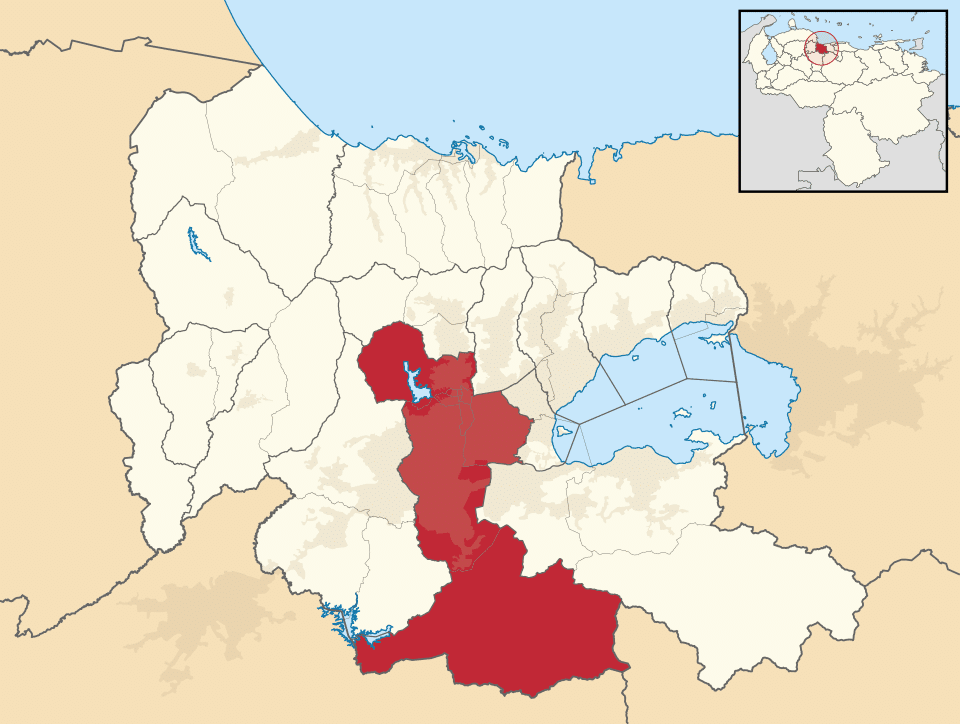
    Map showing the Valencia region in Carabobo state, Venezuela - native habitat of the diamond tetra
    Map of the Valencia municipality in Carabobo state, Venezuela – the diamond tetra is endemic to the Lake Valencia basin in this region. Map data ยฉ OpenStreetMap contributors, via Wikimedia Commons.

    The diamond tetra is endemic to the Lake Valencia basin in northern Venezuela, specifically within the states of Carabobo and Aragua. This is one of the most geographically restricted ranges of any common aquarium tetra – the entire wild population exists in a single lake basin.

    In the wild, diamond tetras inhabit slow-moving, vegetation-rich tributary streams and backwater areas around Lake Valencia. These are shallow, leaf-littered environments with overhanging tree cover that keeps the water shaded. The substrate is typically sandy, with plenty of submerged branches and decomposing organic matter that stains the water a tea-brown color.

    Conservation note: The diamond tetra is listed as Endangered (EN) by the IUCN due to habitat loss and degradation in the Lake Valencia basin. However, virtually all fish in the aquarium trade are captive-bred, so keeping them in your tank doesn’t impact wild populations.

    Appearance & Identification

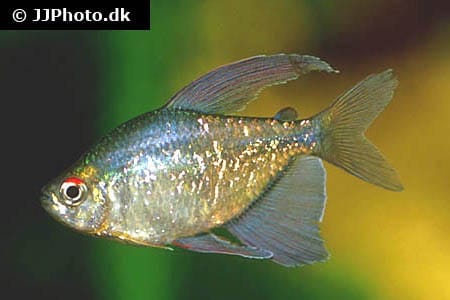
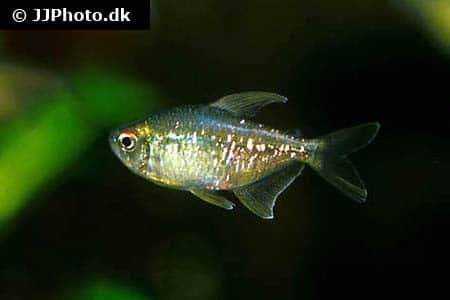
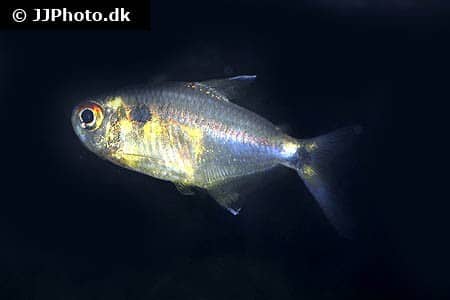
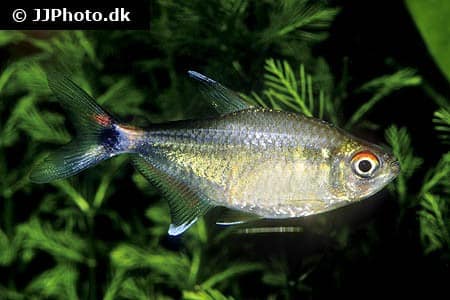
    Diamond tetra (Makunaima pittieri) showing iridescent scales
    Diamond tetra displaying the signature iridescent shimmer. Photo: AquariumPhoto.dk

    The diamond tetra earns its name from the dazzling, diamond-like iridescence that covers its body when the light catches it at the right angle. Each scale reflects light individually, creating a shimmering, sparkly effect that’s completely unique among commonly available tetras. The base body color is silver to grey-green, overlaid with this iridescent coating that can flash gold, green, blue, and violet depending on the lighting.

    Here’s the thing most people don’t expect: juvenile diamond tetras look incredibly plain. They’re basically just silver fish with no personality. The iridescence develops as they mature, typically becoming truly impressive around 6. 12 months of age. A dark substrate and dim lighting dramatically enhances the shimmer effect.

    Male vs. Female

    Sexing diamond tetras is straightforward once they’re mature. Males are slimmer and develop noticeably longer dorsal and anal fins with a beautiful violet iridescence. The dorsal fin extension in males is quite dramatic and becomes a key display feature during social interactions. Females are deeper-bodied (especially when full of eggs) with shorter, nearly transparent fins.

    Average Size & Lifespan

    Adult diamond tetras reach about 2 to 2.4 inches (5. 6 cm) in standard length. They’re a mid-sized tetra – not as small as neons or embers, but not as large as bleeding hearts or congos. Their laterally compressed body and extended fins give them a slightly larger visual presence than their measurements might suggest.

    With proper care, expect 3 to 5 years in captivity. Good water quality, a varied diet, and low-stress conditions are the main factors in reaching the upper end of that range.

    Care Guide

    Tank Size

    A 20-gallon tank works for a small group of 6. 8, but I’d recommend 30 gallons or more for a school of 10+ in a community setting. Diamond tetras are active swimmers and the extra horizontal space lets them school properly. A longer tank (at least 24 inches) is more important than a tall one.

    Water Parameters

    Parameter Ideal Range
    Temperature 75. 82ยฐF (24. 28ยฐC)
    pH 5.5. 7.0
    Hardness 5. 12 dGH
    KH 1. 8 dKH

    Diamond tetras prefer soft, slightly acidic water but captive-bred specimens are quite adaptable to a range of conditions. They’ll tolerate moderately hard water fine, though the best coloration and iridescence develops in softer water. Stability matters more than hitting an exact number – avoid sudden parameter swings.

    Lighting

    This is where diamond tetras are a bit different from many fish. They look their absolute best under subdued, indirect lighting. In bright light, they actually look washed out and lose much of their sparkle. Floating plants are essential – they diffuse the light and create the dappled, shaded conditions where the iridescence really pops. If you want the “diamond” effect, low lighting is non-negotiable.

    Plants & Decorations

    A densely planted tank is ideal and is where diamond tetras truly come into their own. Use a combination of background plants, midground varieties, and especially floating plants. Driftwood branches and leaf litter on the substrate complete the natural biotope look and release beneficial tannins that enhance coloration. A dark substrate is strongly recommended – it brings out the shimmer dramatically compared to light-colored substrates.

    Filtration & Water Flow

    Gentle to moderate water flow. These fish come from slow-moving streams, so they don’t need strong currents. A quality hang-on-back or canister filter turning over 4. 5 times the tank volume per hour is perfect. Keep nitrates very low – diamond tetras don’t tolerate accumulated organic waste well. Weekly water changes of 25. 30% are essential.

    Is the Diamond Tetra Right for You?

    Diamond tetras are one of the most rewarding long-term tetra investments in the hobby. Here’s who should commit to them:

    • You’re incredibly patient. Diamond tetras need 6+ months to show their true beauty
    • You can provide moderate, angled lighting rather than harsh overhead illumination
    • You have at least a 20-gallon tank to let males develop their full finnage
    • You want a species that genuinely gets better with age. Peak diamond tetras are show-quality fish
    • You appreciate iridescent, light-catching qualities over solid color
    • Not for the impatient. If you want instant beauty, look at red phantoms or bleeding hearts instead

    Tank Mates

    Best Tank Mates

    Diamond tetras are peaceful community fish that pair well with a wide range of species:

    • Other peaceful tetras – neons, cardinals, embers, rummy-nose, bleeding hearts
    • Rasboras – harlequins, chili rasboras, lambchop rasboras
    • Danios – celestial pearl danios, zebra danios
    • Livebearers – platies, endlers (avoid fancy guppies – see below)
    • Corydoras catfish – ideal bottom-dwelling companions
    • Dwarf cichlids – rams, Apistogramma
    • Peaceful gouramis – honey gouramis, pearl gouramis
    • Otocinclus – gentle algae eaters that won’t compete

    Tank Mates to Avoid

    • Long-finned species – diamond tetras have a reputation for fin-nipping, especially in small groups. Avoid fancy guppies, angelfish, and bettas.
    • Large aggressive cichlids – anything that would bully or eat them
    • Slow-moving, elaborately finned fish – the temptation to nip is too strong

    Important note on fin-nipping: Diamond tetras get a bad reputation as fin nippers, but this behavior is almost always caused by keeping them in groups that are too small. In a proper school of 8. 10, they focus their social energy on each other. In groups under 6, they redirect that energy toward other fish’s fins.

    Food & Diet

    Diamond tetras are unfussy omnivores that accept a wide range of foods. A high-quality flake or micro pellet serves well as a daily staple. Supplement several times per week with frozen or live foods – bloodworms, daphnia, brine shrimp, and cyclops are all eagerly accepted.

    A varied diet is the key to developing and maintaining the iridescent coloration this species is known for. Fish fed only dried food will never look as good as those getting regular live and frozen supplementation. A little spirulina or vegetable-based food also benefits overall health.

    Feeding frequency: Once or twice daily, only what the school can finish in 2. 3 minutes. Overfeeding is a bigger risk than underfeeding with diamond tetras, as they’re sensitive to the water quality decline that comes with excess food.

    Breeding & Reproduction

    Diamond tetras are egg scatterers that is bred in the home aquarium with some preparation. They’re moderately difficult – easier than bleeding hearts, but requiring more attention to water conditions than some other tetras.

    Spawning Tank Setup

    Set up a dedicated spawning tank of at least 10 gallons with very dim lighting. Use fine-leaved plants like Java moss, spawning mops, or mesh on the bottom to protect fallen eggs from hungry parents. The water should be soft and acidic – pH 5.5. 6.5, hardness 1. 5 dGH, temperature around 80. 84ยฐF (27. 29ยฐC).

    Conditioning & Spawning

    Condition a breeding pair or small group with plenty of high-quality live foods – brine shrimp, bloodworms, and daphnia – for 1. 2 weeks. Spawning typically occurs in the morning when light first hits the tank. The female scatters eggs among fine-leaved vegetation while the male fertilizes them.

    Egg & Fry Care

    Remove adults immediately after spawning – they will eat the eggs without hesitation. Eggs hatch in 24. 36 hours, and fry become free-swimming 3. 4 days later. Feed infusoria or liquid fry food for the first few days, then graduate to microworms and baby brine shrimp as they grow. Keep the rearing tank dimly lit and maintain excellent water quality with small daily water changes.

    Common Health Issues

    Diamond tetras are hardy fish that rarely develop problems in well-maintained tanks. Like all tetras, they’re susceptible to the standard tropical fish ailments:

    Ich (White Spot Disease)

    The most common issue, usually triggered by temperature fluctuations or stress from transport. Small white cysts appear on the body and fins. Raise temperature gradually to 82ยฐF and treat with a standard ich medication. Diamond tetras generally respond well to treatment.

    Fin Rot

    Bacterial infection that causes fin deterioration, typically a sign of poor water quality. Address the underlying water conditions, perform extra water changes, and treat with an antibacterial medication if it doesn’t resolve.

    General Prevention

    Quarantine all new fish for at least two weeks before adding them to your display tank. Diamond tetras are sensitive to organic waste buildup, so consistent water changes and good filtration are your primary defense against disease. Maintain stable parameters – gradual changes are tolerated, but sudden swings cause stress and lower immunity.

    Common Mistakes to Avoid

    • Judging them as juveniles – The number one reason people pass on diamond tetras is because they look plain in store tanks. Give them time and good conditions, and they’ll transform.
    • Bright lighting – Nothing kills the diamond shimmer faster than blasting them with bright aquarium lights. Use floating plants and subdued lighting.
    • Light substrate – A pale or white substrate washes out their coloration. Dark sand or gravel makes an enormous difference.
    • Too few fish – Small groups lead to fin-nipping and stressed behavior. Keep at least 8, ideally 10+.
    • Poor diet variety – Diamond tetras on a flake-only diet never develop their full iridescence. Supplement with live and frozen foods regularly.

    Where to Buy

    Diamond tetras are widely available at local fish stores and specialty retailers. They’re typically priced between $5. 10 per fish. Because virtually all stock is captive-bred, quality can vary – look for active specimens with clear eyes and intact fins, even if the coloration looks plain (it will develop later).

    Only add them to a fully cycled tank. Diamond tetras need stable water to develop their full shimmer, and ammonia or nitrite from an uncycled tank will stress them and dull their coloring permanently.

    For quality stock, check Dan’s Fish, which regularly carries diamond tetras. Flip Aquatics does not currently carry this species but is worth checking for availability updates. Both retailers ship healthy, well-acclimated fish with live arrival guarantees.

    Frequently Asked Questions

    Why does my diamond tetra look plain?

    Almost certainly because it’s still young. Diamond tetras are famously plain as juveniles and only develop their signature iridescent shimmer as they mature – typically around 6. 12 months of age. Also check your lighting: bright lights wash out their colors. Use floating plants for subdued lighting and a dark substrate to maximize the shimmer effect.

    Are diamond tetras fin nippers?

    They is, but it’s almost always a group size problem. In groups of 8 or more, diamond tetras focus their social behavior on each other and leave tank mates alone. In small groups (under 6), they redirect that energy toward other fish’s fins. Keep them in a proper school and avoid pairing with long-finned species.

    How many diamond tetras should be kept together?

    A minimum of 6, but 8. 10 is strongly recommended. Larger groups reduce fin-nipping, encourage natural schooling behavior, and let you see the impressive male fin displays and social interactions that make this species so rewarding to keep.

    Are diamond tetras endangered?

    Yes, the wild population in Venezuela’s Lake Valencia basin is listed as Endangered by the IUCN due to habitat loss. However, virtually all diamond tetras in the aquarium trade are captive-bred, so keeping them in your tank has no impact on wild populations.

    What brings out the best color in diamond tetras?

    Three things: subdued lighting (floating plants are essential), a dark substrate, and a varied diet that includes live and frozen foods. Tannin-stained water from driftwood or Indian almond leaves also enhances the iridescent effect. The best diamond tetras are kept in heavily planted, dimly lit tanks with regular feeding of high-quality live foods.

    What It Is Actually Like Living With Diamond Tetra

    Mature diamond tetras in a properly lit tank are mesmerizing. The reflective scales create a shimmering, sparkling effect that changes with every movement and every shift in light angle.

    Males display to each other with spread fins, and the combination of flowing fins and sparkling scales during these interactions is one of the most beautiful displays in freshwater fishkeeping.

    They are mid-water swimmers that need open space to be appreciated. Dense plant cover is fine along the edges, but leave the center open for swimming and displaying.

    They are peaceful and hardy, making them suitable for any community with similarly-sized, non-aggressive fish.

    How the Diamond Tetra Compares to Similar Species

    Diamond Tetra vs. Emperor Tetra

    Emperor tetras and diamond tetras are the two premier “elegant finnage” tetras, and choosing between them often comes down to color preference. Emperors offer deep purple-blue; diamonds offer iridescent silver-gold sparkle. Both need time to mature and space for males to develop. Emperors are slightly more colorful overall; diamonds are more light-reactive and sparkly. In a large planted tank, keeping both species together creates one of the most visually sophisticated tetra displays possible. Dark elegance meets light-catching shimmer. Check out our Emperor Tetra care guide for more details.

    Diamond Tetra vs. Silver Tetra

    Silver tetras share metallic qualities with diamond tetras but achieve the effect differently. Silver tetras are uniformly reflective like polished metal, while diamond tetras scatter light from individual iridescent scales. Silver tetras also reach their full appearance much faster. They look good within weeks, not months. For immediate impact, silver tetras deliver. For long-term payoff with more complex visual textures, diamond tetras are the premium choice. Check out our Silver Tetra care guide for more details.

    Closing Thoughts

    The diamond tetra is a perfect example of why patience matters in this hobby. What starts as an unremarkable silver fish transforms into something genuinely breathtaking when you give it the right conditions and time to mature. The iridescent shimmer, the elongated male fins, the tight schooling behavior – it all comes together into one of the most visually rewarding tetra species you can keep.

    The recipe for success is simple: a well-planted tank, dim lighting, dark substrate, a proper group size of 8+, and a varied diet. Do those things and you’ll have a centerpiece school that draws every visitor’s eye.

    Looking for other stunning tetra species to pair with your diamonds? Check out our care guides for bleeding heart tetras, ember tetras, and cardinal tetras.

    Check out our tetra tier list video where we rank the most popular tetras in the hobby, including the diamond tetra:

    References

    Explore More Tetras

    Looking for more tetra species? Check out our complete Tetras A to Z directory covering every tetra species in the freshwater hobby.

  • Bleeding Heart Tetra Care Guide: Tank Setup, Diet, Tank Mates & More

    Bleeding Heart Tetra Care Guide: Tank Setup, Diet, Tank Mates & More

    Table of Contents

    The bleeding heart tetra needs space. This is a larger tetra that develops serious attitude problems in small tanks. A 30-gallon minimum for a school. Stable, soft water. And no slow-moving tank mates with flowing fins. Get these basics wrong and you get a stressed, aggressive fish that looks nothing like the photos.

    Bleeding heart tetras in a small tank are aggressive and pale. In a proper setup, they are one of the best tetras in the hobby.

    The Reality of Keeping Bleeding Heart Tetra

    They are bigger than most people expect. Bleeding heart tetras reach about 3 inches, making them significantly larger than most popular community tetras. A school of 6 in a 20-gallon feels cramped. They need a 30-gallon or larger tank to swim comfortably and display properly.

    Males develop impressive fin extensions. Mature males grow elongated dorsal and anal fins that flow beautifully when the fish is swimming in open water. In cramped tanks or with fin nippers, these extensions get damaged and never fully develop. Give males space and the right tank mates.

    The red spot fades with stress. The signature bleeding heart marking is a reliable stress indicator. A vivid red spot means the fish is healthy and comfortable. A faded or pale spot means something in the environment needs attention. Water quality, temperature, or social stress are the usual causes.

    Biggest Mistake New Owners Make

    Keeping them in a tank that is too small. At 3 inches, these are not nano fish. They need space to swim, display, and develop their fin extensions. A cramped tank produces stressed, pale fish with damaged fins.

    Expert Take

    The bleeding heart tetra is the best large tetra for a standard community tank. It has the size, the color, and the visual drama to serve as the centerpiece species in a 30 to 55-gallon planted setup.

    Key Takeaways

    • Minimum tank size is 20 gallons (75 liters), but 30+ gallons gives them proper room to school and display
    • One of the larger common tetras – adults reach 2.5 inches (6+ cm), making them more substantial than neons or embers
    • Males develop spectacular extended dorsal fins – among the most dramatic finnage of any tetra species
    • Keep in groups of 8. 10 to distribute male aggression and see the best social behavior
    • Extremely difficult to breed in home aquariums, though commercially bred stock is widely available
    Map showing the Amazon River Basin in South America
    Map by Kmusser, CC BY-SA 3.0, via Wikimedia Commons

    Species Overview

    Field Details
    Scientific Name Megalamphodus erythrostigma (formerly Hyphessobrycon erythrostigma)
    Common Names Bleeding Heart Tetra, Punto Rojo
    Family Acestrorhamphidae
    Origin Upper Amazon basin (Peru, Colombia, Brazil)
    Care Level Easy to Moderate
    Temperament Peaceful (males mildly territorial)
    Diet Omnivore
    Tank Level Mid
    Maximum Size 2.5 inches (6 cm)
    Minimum Tank Size 20 gallons (75 liters)
    Temperature 72. 82ยฐF (22. 28ยฐC)
    pH 5.5. 7.5
    Hardness 2. 12 dGH
    Lifespan 3. 5 years in captivity
    Breeding Egg scatterer
    Breeding Difficulty Very Difficult
    Compatibility Community
    OK for Planted Tanks? Yes

    Classification

    Taxonomic Level Classification
    Order Characiformes
    Family Acestrorhamphidae (reclassified from Characidae, Melo et al. 2024)
    Subfamily Megalamphodinae
    Genus Megalamphodus
    Species M. Erythrostigma (Fowler, 1943)

    This species has had quite a taxonomic journey. It was originally described as Hemigrammus erythrostigma by Fowler in 1943, then moved to Hyphessobrycon – the name most hobbyists still know it by. The species name erythrostigma means “red mark” in Greek, referring to that unmistakable crimson spot on the flank.

    Note on reclassification: In 2024, a major phylogenomic study (Melo et al.) reorganized the tetra family tree. The bleeding heart tetra was moved into the revalidated genus Megalamphodus (originally erected by Eigenmann in 1915) within the new family Acestrorhamphidae, subfamily Megalamphodinae. This same move affected other “rosy tetra clade” species. Most aquarium sources still use the old name Hyphessobrycon erythrostigma, but FishBase and scientific literature now use Megalamphodus erythrostigma.

    Origin & Natural Habitat

    Map of the Amazon River basin in South America - native habitat region of the bleeding heart tetra
    Map of the Amazon River drainage basin – the bleeding heart tetra is found in the upper Amazon region where Peru, Colombia, and Brazil meet. Image by Kmusser, CC BY-SA 3.0, via Wikimedia Commons.

    The bleeding heart tetra comes from the upper Amazon basin, in the “Tres Fronteras” region where the borders of Peru, Colombia, and Brazil converge. Its range extends from the Rio Purus in Brazil upstream to the Nanay watershed near Iquitos, Peru.

    In the wild, these fish inhabit sluggish tributaries, side channels, and forest lakes. They’re typically found in small streams (igarapรฉs) just 5. 7 meters wide, shaded by dense riparian vegetation, with sandy substrates and plenty of submerged woody structure – fallen branches, tree roots, and leaf litter. They will hang out in the boundary zones between shallow and deeper water.

    The water in these habitats is extremely soft and acidic – field measurements have recorded pH values as low as 3.8 and dissolved oxygen levels that most fish couldn’t survive. The water is stained brown by tannins from decomposing organic matter. While you don’t need to replicate these extreme conditions in an aquarium, understanding the natural habitat explains why bleeding hearts appreciate soft, slightly acidic water and dim lighting.

    Appearance & Identification

    Bleeding heart tetra (Megalamphodus erythrostigma) showing the signature red chest spot
    Bleeding heart tetra showing the signature crimson spot. Photo: AquariumPhoto.dk

    The bleeding heart tetra has a deep, laterally compressed body that’s noticeably taller and more robust than most popular tetras. The body color ranges from silvery beige to a soft pinkish-orange hue, and the standout feature is the vivid crimson spot on the flank near the shoulder – the “bleeding heart” that gives this fish its name. It’s a striking mark that catches the light and draws attention immediately.

    The fins are translucent with hints of red and pink coloration. Under good conditions, the overall color intensifies and the fins develop a beautiful warm tone. A faint dark lateral line may be visible depending on the fish’s mood and the lighting.

    Male vs. Female

    Bleeding hearts are one of the easier tetras to sex, especially once mature. Males are larger and more intensely colored, but the real giveaway is the fins – mature males develop dramatically elongated, sickle-shaped dorsal fins that are among the most impressive finnage you’ll see on any tetra species. Males also have bony hooks on the anal and pelvic fins and darker fin tips. Females are rounder and deeper-bodied (especially when carrying eggs), with shorter, more rounded fins.

    Average Size & Lifespan

    Adult bleeding heart tetras reach about 2 to 2.5 inches (5. 6 cm) in standard length, making them one of the larger commonly available tetra species. They have a noticeably heavier build than most tetras, which gives them a commanding presence in a community tank.

    In captivity, expect a lifespan of 3 to 5 years with proper care. Some individuals can push past 5 years under optimal conditions. Their larger size compared to smaller tetras will come with slightly more longevity.

    Care Guide

    Tank Size

    A 20-gallon tank is the minimum for a group of 6 bleeding heart tetras, but I’d recommend 30 gallons or more if you want a proper school of 8. 10. These fish are more active and larger than many popular tetras, and they need the horizontal swimming space to school comfortably and for males to establish their territories without constantly clashing.

    Water Parameters

    Parameter Ideal Range
    Temperature 72. 82ยฐF (22. 28ยฐC)
    pH 5.5. 7.5
    Hardness 2. 12 dGH
    KH 1. 8 dKH

    Bleeding hearts come from extremely soft, acidic water in the wild, but captive-bred specimens adapt well to a broader range of conditions. They’ll do fine in moderately hard water around neutral pH, though they show their best coloration and behavior in softer, slightly acidic conditions. Indian almond leaves or driftwood can naturally soften the water and add tannins.

    One thing to watch: bleeding hearts are sensitive to accumulated organic waste. Keep up with regular water changes and make sure your biological filtration is mature before adding them.

    Filtration & Water Flow

    Moderate flow works best. These fish come from slow-moving waters, so they don’t need a strong current, but they can handle a bit more flow than some of the smaller delicate tetras. A quality hang-on-back or canister filter turning over the tank volume 4. 5 times per hour is ideal. Weekly water changes of 25. 30% are essential to keep organic waste levels down.

    Lighting

    Subdued to moderate lighting brings out the best in bleeding heart tetras. In the wild, their habitat is heavily shaded by overhanging vegetation, and they respond well to similar conditions in the aquarium. Floating plants are your best friend here – they soften the light, create shaded areas the fish naturally gravitate to, and help reduce stress. Under harsh, bright lighting, bleeding hearts can look washed out and nervous.

    Plants & Decorations

    A well-planted tank with plenty of structure is ideal. Use a mix of background plants, midground varieties, and floating plants to create layers. Driftwood and branching root structures mimic their natural habitat and give males natural territory boundaries – this actually helps reduce aggression by breaking sight lines.

    Dried leaf litter on the substrate is a great addition for a biotope-style setup. The leaves release tannins, promote beneficial microorganisms, and give the tank a natural blackwater feel that these fish evolved in.

    Substrate

    A soft sandy substrate is preferred – it’s closest to their natural habitat and won’t damage their barbels or fins if they forage near the bottom. Dark sand or substrate enhances their coloration significantly, making the reds and pinks pop against the background.

    Is the Bleeding Heart Tetra Right for You?

    Bleeding heart tetras are bold, beautiful, and bigger than most people expect. Here’s who should keep them:

    • You have a 30-gallon or larger tank. These are bigger tetras that need real space
    • You want a bold, visible species that’s always front and center during feeding
    • You appreciate the iconic red heart spot. It’s one of the most recognizable markings in the tetra world
    • You keep similarly assertive tank mates that can compete at feeding time
    • You want a long-lived tetra. Bleeding hearts regularly exceed 5 years with good care
    • Not the best choice for tanks full of shy, slow-feeding species. They’ll dominate meal time

    Tank Mates

    Best Tank Mates

    Bleeding heart tetras are peaceful community fish, though they’re slightly more assertive than smaller tetra species. They do best with similarly sized or slightly larger tank mates:

    • Rummy-nose tetras – similar size, tight schoolers that complement bleeding hearts well
    • Emperor tetras – another larger tetra with similar care requirements
    • Congo tetras – peaceful, similarly sized, beautiful contrast
    • Corydoras catfish – ideal bottom-dwelling companions that stay out of the way
    • Hatchetfish – top-dwelling fish that fill a different zone in the tank
    • Pencilfish – gentle mid-level fish from similar habitats
    • Dwarf cichlids (rams, Apistogramma) – a natural South American biotope pairing
    • Gouramis (peaceful species) – honey or pearl gouramis work well as centerpiece fish
    • Bristlenose plecos – peaceful algae eaters that ignore tetras entirely

    Tank Mates to Avoid

    • Long-finned species (angelfish, bettas) – bleeding hearts may nip at trailing fins
    • Large aggressive cichlids – any fish that would bully or eat them
    • Very small tetras (embers, green neons) – may be intimidated by the bleeding hearts’ larger size and activity level
    • Slow-moving long-finned fish – the temptation to nip is real, especially in small groups

    Food & Diet

    Bleeding heart tetras are opportunistic omnivores with a surprising dietary quirk – in the wild, stomach analyses have shown that up to 98.5% of their diet consists of fruit remains. They’re predominantly frugivorous, which is unusual for a tetra. They also eat aquatic insects and their larvae.

    In the aquarium, they’re unfussy eaters. A high-quality flake or micro pellet makes a good daily staple. Supplement with frozen or live foods like bloodworms, daphnia, and brine shrimp several times per week to maintain good coloration and health. They’ll also accept spirulina flakes and plant-based foods – and interestingly, in my experience, hobbyists report they’ll even nibble on small pieces of fresh fruit placed in the tank.

    Feeding frequency: Once or twice daily, only what the school can finish in about 2. 3 minutes. Their larger size means they eat more than small tetras, so adjust portions accordingly.

    Breeding & Reproduction

    Fair warning: bleeding heart tetras are notoriously difficult to breed in home aquariums. This is one of the few common tetras where hobbyist breeding success is genuinely rare. Females frequently reject male advances, and getting the conditions just right is a challenge.

    Breeding Difficulty

    Very difficult. Despite being commercially bred on farms (which is where virtually all aquarium stock comes from), replicating those results at home has proven extremely challenging for most hobbyists.

    Spawning Tank Setup

    If you want to attempt breeding, set up a dedicated 20. 40 gallon spawning tank with very dim lighting. Use fine-leaved plants like Java moss or spawning mops, and cover the bottom with mesh or marbles to prevent the parents from eating fallen eggs. Very soft, acidic water is critical – use RO water or peat-filtered water to achieve pH 6.0. 6.5 and minimal hardness.

    Conditioning & Spawning

    Group breeding (3 males and 3 females) will yield better results than pairing, as it lets the fish choose their own mates. Condition the group with plenty of live foods – bloodworms, brine shrimp, and daphnia – for several weeks. Weekly water changes with slightly cooler water helps simulate rainy season conditions and trigger spawning behavior. Spawning typically occurs after dark.

    Egg & Fry Care

    Remove adults immediately after spawning – they will eat eggs and fry aggressively. Eggs hatch in approximately 36 hours. Once fry become free-swimming, feed infusoria or liquid fry food initially, then graduate to baby brine shrimp. Keep the rearing tank dimly lit and maintain excellent water quality with small daily water changes.

    Common Health Issues

    Bleeding heart tetras are robust fish, but like all tetras, they’re susceptible to several common ailments:

    Ich (White Spot Disease)

    The most common tropical fish disease. Small white cysts appear on the body and fins, usually triggered by temperature fluctuations or stress. Raise the temperature gradually to 82ยฐF (28ยฐC) and treat with a standard ich medication. Bleeding hearts generally tolerate treatment well.

    Metallic Gold Scale Condition

    A distinctive condition where some or all body scales develop a metallic gold appearance. The cause isn’t well understood (possibly parasitic), but affected fish show no signs of discomfort and lifespan appears unaffected. It’s relatively common in small characins and is considered cosmetic rather than dangerous.

    General Prevention

    Quarantine all new fish for at least two weeks. Bleeding hearts are intolerant of poor water quality and accumulated organic waste, so staying on top of water changes is your best defense. Maintain stable parameters – sudden swings in temperature or pH cause more problems than slightly imperfect numbers.

    Common Mistakes to Avoid

    • Keeping too few – This is the single biggest mistake with bleeding hearts. In small groups (under 6), they become stressed and may resort to fin-nipping tank mates. Keep 8. 10 to distribute aggression and see proper schooling behavior.
    • Too small a tank – These are larger, more active tetras. A 10-gallon tank is far too small. Give them at least 20 gallons, preferably 30+.
    • Pairing with long-finned fish – Bleeding hearts have a tendency to nip flowing fins, especially in undersized groups. Avoid angelfish, bettas, and fancy guppies.
    • Neglecting water changes – They’re sensitive to organic waste buildup. Skipping water changes will show up as faded colors, stress, and eventually disease.
    • Expecting easy breeding – Unlike most common tetras, bleeding hearts are very difficult to breed at home. Don’t set up a breeding project expecting quick results.

    Where to Buy

    Bleeding heart tetras are readily available at most local fish stores and some chain pet retailers. They’re typically priced between $5. 10 per fish, depending on size and source. Wild-caught specimens from the Rio Nanay in Peru are occasionally available and will show more intense coloration than farm-bred stock.

    Never add them to an uncycled tank. Bleeding hearts are sensitive to ammonia and nitrite, and a new tank that has not finished cycling will stress them into disease quickly.

    For quality stock, check Flip Aquatics and Dan’s Fish. Dan’s Fish occasionally carries wild-caught “Rio Nanay” bleeding hearts that are particularly impressive. Both retailers ship healthy, well-acclimated fish with live arrival guarantees.

    Frequently Asked Questions

    How many bleeding heart tetras should be kept together?

    A minimum of 6, but 8. 10 is strongly recommended. In smaller groups, males become territorial and may nip at other fish. Larger groups distribute aggression and let you see their natural social dynamics – including the entertaining male displays and sparring that are a highlight of keeping this species.

    Are bleeding heart tetras aggressive?

    Not truly aggressive, but they’re more assertive than smaller tetras. Males will display and spar with each other – flaring their fins and posturing – but this rarely results in actual injury. The main risk is fin-nipping if they’re kept in too-small groups or housed with long-finned species. In a proper school of 8+, aggression is distributed and manageable.

    Can you breed bleeding heart tetras at home?

    It’s possible but very difficult. Bleeding hearts are notoriously reluctant to spawn in home aquariums, even when conditions seem ideal. Commercial breeding farms have success, but hobbyist breeding is rare. If you want to try, use very soft, acidic water, dim lighting, and group spawning (3 males, 3 females) rather than pairs.

    What size tank do bleeding heart tetras need?

    At least 20 gallons for a minimum group of 6. A 30-gallon or larger tank is recommended for a proper school of 8. 10, especially if you’re keeping them in a community setup with other species.

    Do bleeding heart tetras nip fins?

    They can, especially in undersized groups. Bleeding hearts are more prone to fin-nipping than most tetras, which is why keeping them in groups of 8+ is so important. In large groups, they focus their social behavior on each other rather than on tank mates. Avoid pairing them with slow-moving, long-finned species.

    What do bleeding heart tetras eat in the wild?

    Surprisingly, they’re predominantly fruit-eaters. Stomach analyses of wild specimens have shown up to 98.5% fruit remains, supplemented by aquatic insects and larvae. In the aquarium, they accept standard flake and pellet foods, but supplementing with live and frozen foods brings out the best coloration.

    What It Is Actually Like Living With Bleeding Heart Tetra

    In a proper school, bleeding heart tetra display natural movement patterns that are genuinely engaging to watch. The fish interact with each other, establish subtle hierarchies, and move through the tank with purpose.

    They spend most of their time near the surface, which fills a level of the tank that many other species ignore. This makes them excellent complements to mid-water and bottom-dwelling fish.

    Feeding time is when their personality comes out. They learn your routine quickly and will anticipate feeding before you even open the lid.

    Their color and behavior improve over time as they settle into a stable environment. Fish that have been in the same tank for months look noticeably better than recently added stock.

    They coexist peacefully with virtually every other appropriately-sized community fish. This compatibility makes tank planning straightforward.

    How the Bleeding Heart Tetra Compares to Similar Species

    Bleeding Heart Tetra vs. Flameback Bleeding Heart Tetra

    The flameback variety adds intense red-orange dorsal coloration on top of the standard bleeding heart’s already-attractive design. Flamebacks are slightly more demanding about water chemistry. They need softer, more acidic water to develop that signature dorsal color. Regular bleeding hearts are hardier and more forgiving. If you want maximum visual impact and are willing to dial in water parameters, the flameback is the premium option. For reliability and ease of care, the standard bleeding heart is the smarter starting point. Check out our Flameback Bleeding Heart Tetra care guide for more details.

    Bleeding Heart Tetra vs. Rosy Tetra

    Rosy tetras share warm pink tones with bleeding hearts but stay significantly smaller and are much more peaceful at feeding time. If you love the bleeding heart aesthetic but have a smaller tank or more timid tank mates, rosy tetras deliver a similar warm color palette in a gentler, more compact package. Bleeding hearts are the bold, assertive option for larger setups. Rosy tetras are the diplomatic option that works in almost any community. Check out our Rosy Tetra care guide for more details.

    Closing Thoughts

    The bleeding heart tetra is one of the most visually striking tetras you can keep, and it brings a level of personality and presence that smaller species can’t match. Those extended dorsal fins on the males, the vivid crimson heart mark, and the active social dynamics make this a fish that’s genuinely fun to watch – not just pretty background movement.

    The key to success is simple: keep them in a proper group of 8. 10, give them enough space, maintain clean water, and provide some dim lighting with a dark substrate. Do that, and you’ll have one of the best-looking tetra displays in the hobby.

    If you’re looking for other larger tetras to keep alongside your bleeding hearts, check out our care guides for Congo tetras, rummy-nose tetras, and black skirt tetras.

    Check out our tetra tier list video where we rank the most popular tetras in the hobby, including the bleeding heart tetra:

    References

    Explore More Tetras

    Looking for more tetra species? Check out our complete Tetras A to Z directory covering every tetra species in the freshwater hobby.

  • Flame Tetra Care Guide: Tank Setup, Diet, Tank Mates & More

    Flame Tetra Care Guide: Tank Setup, Diet, Tank Mates & More

    Table of Contents

    The flame tetra is one of the hardiest and most overlooked tetras in the hobby. It thrives in conditions that stress most small fish, breeds readily, and develops deep red-orange color in mature specimens. Most people skip it because it looks plain at the store. That is a mistake.

    The flame tetra at the store and the flame tetra in a mature tank are two completely different fish.

    The Reality of Keeping Flame Tetra

    Color development takes time. Young flame tetras look nothing like adults. The warm orange-red body color develops gradually over weeks to months in the right conditions. Dark substrate, moderate lighting, quality food, and a large school all contribute. This is not an instant-gratification fish.

    Group size is the biggest color trigger. In a school of 4 or 5, flame tetras stay pale and timid. In a school of 10+, they compete socially, display more, and the color deepens dramatically. The visual difference between 5 fish and 12 fish is enormous.

    Lighting can make or break the color. Harsh white LEDs wash out the warm orange-red tones completely. Warm-toned or moderate lighting on dark substrate lets the flame coloring reach its full intensity. This species rewards the keeper who adjusts lighting to suit the fish rather than the plants.

    Biggest Mistake New Owners Make

    Buying 4 or 5 juveniles, putting them in a bright tank on light substrate, and judging the species as boring. You have not seen a flame tetra until you have seen a mature school of 10+ on black sand under warm lighting.

    Expert Take

    The flame tetra has survived a century of competition from newer, flashier species because it delivers when set up properly. It is one of the most underrated warm-toned tetras and deserves far more attention than it gets.

    Key Takeaways

    • Minimum tank size is 15 gallons (57 liters) for a school of 6, but 20+ gallons with 8. 10 fish brings out the best behavior
    • Hardy and beginner-friendly – tolerates a wide range of water conditions and accepts all common foods
    • Endangered in the wild but thriving in captivity – every aquarium specimen is captive bred
    • Best color comes out under dim lighting with a dark substrate and tannin-stained water
    • Peaceful community fish that works well with other small tetras, corydoras, and rasboras
    Map showing the Amazon River Basin in South America
    Map by Kmusser, CC BY-SA 3.0, via Wikimedia Commons

    Species Overview

    Field Details
    Scientific Name Hyphessobrycon flammeus
    Common Names Flame Tetra, Von Rio Tetra, Red Tetra, Rio Tetra
    Family Acestrorhamphidae
    Origin Coastal rivers near Rio de Janeiro, Brazil
    Care Level Easy
    Temperament Peaceful
    Diet Omnivore
    Tank Level Mid
    Maximum Size 2 inches (5 cm)
    Minimum Tank Size 15 gallons (57 liters)
    Temperature 72. 82ยฐF (22. 28ยฐC)
    pH 5.5. 7.5
    Hardness 3. 15 dGH
    Lifespan 3. 5 years in captivity
    Breeding Egg scatterer
    Breeding Difficulty Easy to Moderate
    Compatibility Community
    OK for Planted Tanks? Yes

    Classification

    Taxonomic Level Classification
    Order Characiformes
    Family Acestrorhamphidae (reclassified from Characidae, Melo et al. 2024)
    Subfamily Hyphessobryconinae
    Genus Hyphessobrycon
    Species H. Flammeus (Myers, 1924)

    The genus Hyphessobrycon is one of the largest in the order Characiformes, with well over 150 described species. The name comes from the Greek hyphesson (“of lesser stature”) combined with Brycon, a related genus – essentially meaning “small Brycon.” The species name flammeus is Latin for “flame-colored,” which perfectly describes the fish’s signature orange-red coloration.

    Note on reclassification: In 2024, a major phylogenomic study (Melo et al.) split the traditional family Characidae into four separate families. Hyphessobrycon was moved into the newly erected family Acestrorhamphidae under the subfamily Hyphessobryconinae. Some older references still list this species under Characidae.

    Origin & Natural Habitat

    Map of the Paraรญba do Sul river basin in southeastern Brazil - native habitat region of the flame tetra
    Map of the Paraรญba do Sul River watershed in southeastern Brazil – native range region of the flame tetra. Created with the Global Watersheds web app, via Wikimedia Commons.

    The flame tetra has one of the most restricted natural ranges of any popular aquarium fish. It’s found only in a handful of small coastal rivers and tributaries near Rio de Janeiro in southeastern Brazil – specifically in the Guanabara Bay drainage, the middle Rio Paraรญba do Sul basin, and the Rio Guandu basin.

    In the wild, flame tetras inhabit shallow, slow-moving tributary streams less than half a meter deep. These streams are shaded by surrounding forest, with dense aquatic vegetation and a substrate of sand and organic debris. The water ranges from clear to dark brown depending on the amount of dissolved tannins.

    Here’s the sobering part: the flame tetra is classified as Endangered on the IUCN Red List. The rivers around Rio de Janeiro are some of the most heavily urbanized and polluted waterways in Brazil. Dam construction, water extraction, pollution, and invasive species like tilapia and largemouth bass have devastated native fish populations. The last confirmed collection of wild flame tetras from Rio de Janeiro state was in 1992. There are populations in the upper Rio Tietรช drainage in Sรฃo Paulo state, though researchers suspect those fish may have been introduced by aquarists rather than being naturally occurring.

    Every flame tetra in the aquarium trade today is captive bred. The hobby has, in a sense, become the conservation backup for this species.

    Appearance & Identification

    Flame tetra (Hyphessobrycon flammeus) showing vibrant orange-red coloration
    Flame tetra. Photo by Joel Bez, CC BY 2.0, via Wikimedia Commons.

    The flame tetra has a moderately deep, laterally compressed body – a bit stockier than some of the slimmer tetras like neons or cardinals. The front half of the body is silvery with a yellowish-beige tinge, while the rear half transitions into the signature flame-red to orange-red that gives this fish its name.

    One of the most distinctive identification features is the pair of dark humeral spots – two vertically elongated bars on the shoulder area behind the gill cover. These are always present and help distinguish the flame tetra from other red-toned Hyphessobrycon species. All fins except the pectorals carry red coloration, and the caudal (tail) fin is transparent.

    Several selectively bred color variants are available in the trade. The Orange Von Rio is the most common, with intensified orange coloration. You also encounter golden and albino forms. These are purely ornamental strains – not separate species – and all require the same care.

    Male vs. Female

    Flame tetras are one of the easier tetras to sex once they’re mature. Males are slimmer and show deeper, more intense red coloration. Their anal fin has a straighter edge with dark or black tips, and they develop small bony hooks on the anal and pelvic fins – you will sometimes feel these if you gently run a fine net along the fin. Females are deeper-bodied, especially when carrying eggs, and show lighter coloration overall. Females also have a unique trait: a black tip on the pectoral fin that males lack.

    Average Size & Lifespan

    Adult flame tetras reach about 1.5 to 2 inches (4. 5 cm) in total length, making them a small tetra well suited for tanks in the 15. 30 gallon range.

    In captivity, expect a lifespan of 3 to 5 years with proper care. They’re a long-established captive species – the hobby has been breeding them continuously since the 1920s – so genetic stock is healthy and consistent.

    Care Guide

    Tank Size

    A 15-gallon tank is the minimum for a school of 6 flame tetras. As with most schooling tetras, bigger is better – a 20-gallon long gives you room for a proper group of 8. 10 and lets the fish school naturally across the length of the tank. That extra space also makes a visible difference in coloration, as the fish feel more secure and display more confidently.

    Water Parameters

    Parameter Ideal Range
    Temperature 72. 82ยฐF (22. 28ยฐC)
    pH 5.5. 7.5
    Hardness 3. 15 dGH
    KH 2. 8 dKH

    Flame tetras are adaptable fish that handle a broader range of conditions than many popular tetras. They can tolerate temperatures as low as 64ยฐF (18ยฐC) – which makes them one of the few tetras that can work in unheated tanks in mild climates. That said, they look their best and are most active in the 72. 82ยฐF range.

    Like most tetras, they show the most vibrant coloration in softer, slightly acidic water. But captive-bred stock adapts well to moderately hard water around neutral pH. As always, consistency matters more than hitting perfect numbers.

    Filtration & Water Flow

    Gentle to moderate flow works best. In the wild, flame tetras come from slow-moving streams, so they don’t appreciate being blasted by strong currents. A sponge filter or hang-on-back filter with a diffused output is ideal. Weekly water changes of 25. 30% will keep conditions stable.

    One important note: flame tetras are sensitive to accumulated organic waste. Make sure the tank is fully cycled before adding them, and stay on top of your maintenance routine.

    Lighting

    Subdued lighting is where flame tetras really come alive – which sounds counterintuitive, but lower light brings out their richest reds and oranges. Under harsh overhead lighting, they can look washed out and pale. Add some floating plants like Amazon frogbit or salvinia to create shaded areas, and you’ll see a noticeable improvement in color intensity.

    Plants & Decorations

    A planted tank is the ideal setting for flame tetras. Dense planting along the sides and back with open swimming space in the center gives them the best of both worlds – shelter when they want it and room to school when they’re feeling confident. Java fern, Anubias, Cryptocoryne species, and Java moss all work well.

    Driftwood and dried leaf litter add structure and release beneficial tannins that soften the water and give it that natural amber tint these fish evolved in. Indian almond leaves are a great addition – they slowly decompose, providing tannins and a surface for biofilm that the fish will pick at.

    Substrate

    Dark substrate is essential for getting the best color out of flame tetras. Fine dark sand or a dark planted tank substrate makes those reds and oranges pop against the background. On light-colored gravel, the fish pale out significantly – it’s one of the most dramatic substrate-dependent color differences you’ll see in any tetra.

    Is the Flame Tetra Right for You?

    Before you buy, run through this honest checklist. The Flame Tetra is a great fish for the right keeper, but it is not for everyone.

    • You want a warm-toned tetra with orange-red body coloring that intensifies with maturity
    • You can keep a large school of 10+ for full color development
    • You have a 20-gallon or larger planted tank with dark substrate
    • You want a hardy species with over a century of proven success in the hobby
    • You appreciate warm tones and do not need neon-bright flashy coloring
    • Your tank has moderate lighting. Harsh LEDs wash out the flame coloring

    Tank Mates

    Best Tank Mates

    Flame tetras are solidly peaceful community fish. They’re slightly more active and assertive than very small species like ember tetras, but they get along well with a wide range of tank mates:

    • Corydoras catfish – ideal bottom-dwelling companions that occupy a different zone
    • Neon tetras – classic pairing, the blue and red contrast beautifully
    • Glowlight tetras – similar size and temperament with complementary warm tones
    • Harlequin rasboras – peaceful mid-level schoolers
    • Ember tetras – another warm-toned species that creates a cohesive color palette
    • Otocinclus catfish – gentle algae eaters that won’t cause any issues
    • Dwarf gouramis – a colorful centerpiece that coexists well with flame tetras
    • Kuhli loaches – peaceful bottom dwellers that add variety to the lower tank zone
    • Apistogramma dwarf cichlids – great for a South American biotope setup
    • Hatchetfish – occupy the top water level, filling a different niche

    Tank Mates to Avoid

    • Angelfish – will eat flame tetras once they reach adult size
    • Large cichlids – any fish big enough to view a flame tetra as a snack
    • Tiger barbs – too nippy and boisterous
    • Red tail sharks – territorial and aggressive toward small tetras
    • Shrimp (juvenile) – flame tetras will prey on baby shrimp, though adult shrimp are safe

    Food & Diet

    Flame tetras are unfussy omnivores that accept virtually anything you offer. In the wild, they feed on small invertebrates, worms, crustaceans, and plant matter. A high-quality micro pellet or flake food makes a good daily staple.

    To bring out the best color and keep them in peak condition, supplement their diet with frozen or live foods a few times per week. Daphnia, baby brine shrimp, bloodworms, and cyclops are all eagerly accepted and make a real difference in how vibrant the red-orange coloration looks. Some blanched spirulina or vegetable-based flakes round out the diet nicely.

    Feeding frequency: Once or twice daily, only what the school can finish in about 2 minutes. These are small fish – overfeeding leads to water quality issues faster than you’d expect.

    Breeding & Reproduction

    Flame tetras are one of the easier tetras to breed at home, making them a good choice for hobbyists getting into egg-scatterer breeding for the first time.

    Breeding Difficulty

    Easy to moderate. With the right conditions and conditioning, they’ll spawn readily.

    Spawning Tank Setup

    Set up a separate 10. 15 gallon (38. 57 liter) breeding tank with dim lighting. Add fine-leaved plants like Java moss or spawning mops for egg deposition. A mesh or grid on the bottom prevents the adults from reaching fallen eggs – flame tetras are notorious egg eaters. Use a small air-powered sponge filter for gentle filtration.

    Water Conditions for Breeding

    Soft, slightly acidic water triggers spawning most reliably. Aim for pH 6.0. 6.5, hardness of 2. 5 dGH, and raise the temperature to 78. 82ยฐF (26. 28ยฐC). Frequent water changes of up to 50% every couple of days can simulate the rainy season and help trigger spawning behavior.

    Conditioning & Spawning

    Condition the breeding group or pair with plenty of live and frozen foods – baby brine shrimp, daphnia, and bloodworms – for 1. 2 weeks before introducing them to the spawning tank. When females are visibly plump with eggs and males show their most intense coloration, they’re ready. Spawning typically occurs in the morning. The female scatters adhesive eggs on plant surfaces while the male fertilizes them.

    Egg & Fry Care

    Remove the adults immediately after spawning – they will eat every egg they can find. A healthy female can produce 200. 300+ eggs per spawn. Eggs hatch in 24. 36 hours, and the fry become free-swimming about 3 days later. Feed infusoria or liquid fry food initially, then graduate to freshly hatched baby brine shrimp and microworms as they grow. Keep the tank dimly lit during the early stages.

    Common Health Issues

    Flame tetras are hardy fish, but they’re susceptible to the same diseases that affect most small tropical species. Here’s what to watch for:

    Ich (White Spot Disease)

    The most common ailment in freshwater fish. Small white spots appear on the body and fins, usually triggered by temperature fluctuations or stress from a new environment. Raise the temperature gradually to 82ยฐF (28ยฐC) and treat with a standard ich medication. Flame tetras generally respond well to treatment when caught early.

    Neon Tetra Disease (NTD)

    Despite the name, this disease affects many tetra species, not just neons. It’s caused by the microsporidian parasite Pleistophora hyphessobryconis, which invades the fish’s muscle tissue. Symptoms include fading color, pale patches, restlessness, a curved spine, and isolation from the school. There is no effective cure – infected fish should be removed immediately to prevent spreading to the rest of the group.

    General Prevention

    Quarantine all new fish for at least two weeks before adding them to your main tank. Maintain stable water parameters and keep up with regular water changes. Flame tetras don’t tolerate accumulated organic waste well, so a consistent maintenance schedule is your best defense against disease.

    Common Mistakes to Avoid

    • Keeping too few – Groups under 6 result in stressed, pale fish that hide. Get at least 6, ideally 8. 10. Larger groups bring out bolder behavior and more intense coloration.
    • Light-colored substrate – This is the single biggest factor in washed-out flame tetras. Dark sand or substrate is non-negotiable if you want to see the full flame effect.
    • Too much light, no shade – Bright overhead lighting fades their colors. Add floating plants to create dappled shade and watch the transformation.
    • Adding to an uncycled tank – Flame tetras are sensitive to organic waste. Always make sure the tank is fully cycled before adding them.
    • Mixing with baby shrimp – Flame tetras enjoy small live prey. Adult cherry shrimp are fine, but baby shrimp will be picked off.

    Where to Buy

    Flame tetras are widely available at most local fish stores and chain pet retailers. They’re typically sold under the names “flame tetra,” “Von Rio tetra,” or “orange Von Rio tetra,” and are priced at $2. 5 per fish. You’ll often find discounts when buying a school.

    For better quality stock, check Flip Aquatics, which carries the Orange Von Rio variety, or Dan’s Fish. Both prioritize healthy, well-conditioned fish that arrive in better shape than big box store stock. Since all flame tetras in the trade are captive bred, quality largely depends on the breeder – buying from reputable sellers makes a difference.

    Frequently Asked Questions

    How many flame tetras should be kept together?

    A minimum of 6, but 8. 10 or more is strongly recommended. Flame tetras are a shoaling species that become stressed and lose their color when kept in small numbers. In larger groups, they school more actively and display their best reds and oranges.

    What size tank does a flame tetra need?

    A 15-gallon tank is the minimum for a school of 6. A 20-gallon long is better for a group of 8. 10, giving them enough horizontal space to school naturally.

    Are flame tetras good for beginners?

    Yes. Flame tetras are one of the hardiest small tetras available. They tolerate a wide range of temperatures and water chemistry, accept all common foods, and are peaceful with virtually all community tank mates. Just make sure your tank is cycled before adding them.

    Can flame tetras live in an unheated tank?

    Potentially, yes. Flame tetras can tolerate temperatures down to about 64ยฐF (18ยฐC), which makes them one of the few tropical tetras that can work in unheated indoor tanks in mild climates. However, they’ll show their best color and activity in the 72. 82ยฐF range, so a heater is still recommended for optimal conditions.

    What’s the difference between a flame tetra and a Von Rio tetra?

    They’re the same species – Hyphessobrycon flammeus. “Von Rio tetra” and “flame tetra” are just different common names. The “Orange Von Rio” you see in stores is a selectively bred color variant with enhanced orange coloration.

    Are flame tetras endangered?

    In the wild, yes – the flame tetra is listed as Endangered on the IUCN Red List. Its native rivers near Rio de Janeiro have been severely impacted by urbanization and pollution. However, the species is extremely common in the aquarium trade, where all specimens are captive bred. It’s one of the most fascinating conservation paradoxes in the hobby.

    What It Is Actually Like Living With Flame Tetra

    A mature school of flame tetras on dark substrate has a warm, fiery quality that is unlike any other tetra display. The orange-red bodies create a sunset effect as they move through the plants.

    They are calm, peaceful swimmers that occupy the lower to middle water column. Their movement is unhurried and steady.

    Males in breeding condition develop deeper, more intense coloring and display to females with spread fins. This is one of the most attractive breeding behaviors in any small tetra.

    They coexist peacefully with virtually everything. In 25+ years I have never seen a flame tetra cause a compatibility issue.

    How the Flame Tetra Compares to Similar Species

    Flame Tetra vs. Ember Tetra

    Both are warm orange-red tetras, but the Ember is much smaller and better for nano tanks. The Flame Tetra is larger with deeper body coloring that develops with maturity. For nano tanks, the Ember wins. For standard community tanks, the Flame Tetra has more presence and a richer color palette.

    Flame Tetra vs. Serpae Tetra

    The Serpae Tetra has more intense red coloring but is a notorious fin nipper. The Flame Tetra is more peaceful and better for mixed community tanks. If you want red without the aggression, the Flame Tetra is the clear winner.

    Closing Thoughts

    The flame tetra deserves far more attention than it gets. It’s hardy, peaceful, affordable, and absolutely beautiful when set up properly – dark substrate, dim lighting, tannin-stained water, and a proper school of 8 or more. The warm orange-red glow of a well-kept flame tetra group rivals fish that cost ten times as much.

    There’s also something meaningful about keeping a species that’s endangered in the wild. Every flame tetra in the hobby is a captive-bred descendant of fish collected from rivers that may no longer support wild populations. In a small way, keeping them helps ensure the species persists.

    If you’re looking for other underrated tetras to pair with flame tetras, check out our care guides for ember tetras, glowlight tetras, and lemon tetras.

    Check out our tetra tier list video where we rank the most popular tetras in the hobby, including the flame tetra:

    References

    Explore More Tetras

    Looking for more tetra species? Check out our complete Tetras A to Z directory covering every tetra species in the freshwater hobby.

  • Head and Tail Light Tetra Care Guide: The Underrated Beacon of Community Tanks

    Head and Tail Light Tetra Care Guide: The Underrated Beacon of Community Tanks

    If you’ve been in the hobby for a while, you’ve walked past head and tail light tetras at your local fish store without giving them a second look. They’re always there, tucked in a corner tank, priced at a couple of dollars. And that’s exactly why they get overlooked – they’re so common that people assume they’re boring. But set up a school of ten or more in a properly aquascaped tank with dim lighting, and those twin copper beacons start doing their thing. The reflective spots near the eye and at the tail base catch every bit of ambient light and throw it back like tiny lanterns. There’s a reason one of their common names is the beacon tetra.

    I’ve recommended this species to countless beginners over the years, and it rarely disappoints. They’re hardy, peaceful, undemanding, and they school tightly – everything you want in a community tetra. Let me walk you through everything you need to know about keeping them successfully.

    What Most Care Guides Get Wrong About the Head and Tail Light Tetra

    The Head and Tail Light Tetra gets overlooked because its beauty is subtle and conditional. The two copper-gold reflective spots at the eye and tail base only truly shine under specific lighting conditions. In a brightly lit store tank, they look like plain silver fish. Under angled or moderate lighting in a home tank, the spots catch light like tiny headlights and taillights, which is where the name comes from. The misconception is that what you see at the store is what you get. It is not. This is a fish that transforms in the right home setup.

    The Reality of Keeping Head and Tail Light Tetra

    Lighting position matters more than lighting intensity. The reflective spots on this species only “glow” when light hits them at the right angle. Overhead lighting at full power creates a flat, washed-out look. Angled lighting, moderate intensity, and a dark background allow the copper-gold spots to catch and reflect light naturally.

    They are one of the hardiest classic tetras. This species has been in the hobby for decades and it survives because it is genuinely tough. It tolerates a wide range of water parameters and rarely gets sick. For a fish with such a specific visual appeal, the care requirements are remarkably forgiving.

    They are underrated for a reason. Most fishkeepers have never seen a head and tail light tetra at its best because most tanks do not have the lighting setup to show the reflective spots. In the right setup, this fish stops people and makes them ask what it is.

    Biggest Mistake New Owners Make

    Keeping them under standard bright overhead lighting on light gravel. In this setup, the signature headlight and taillight effect is invisible, and you are left with a plain silver fish. The entire appeal depends on lighting and background.

    Expert Take

    The head and tail light tetra is one of the most rewarding “setup-dependent” species in the hobby. If you are willing to adjust your lighting for this fish, the payoff is a display that genuinely impresses.

    Key Takeaways

    • Minimum tank size is 20 gallons (76 liters) for a school of 6, though 10+ fish in a 30-gallon tank looks spectacular
    • One of the hardiest tetras available – tolerant of a wide range of water conditions, making it ideal for beginners
    • Named for its two reflective copper spots – one near the top of the eye and one at the base of the tail, which glow under aquarium lighting
    • Very peaceful community fish – safe with virtually all common community species including shrimp
    • Easy to breed – one of the simpler egg-scattering tetras to spawn in a home aquarium
    • Recently reclassified from Hemigrammus ocellifer to Holopristis ocellifera under the 2024 Melo et al. Revision

    The head and tail light tetra is one of the most reliable community fish that nobody talks about. It schools well, eats everything, tolerates a wide range of conditions, and almost never causes problems. It does not have the flash of a neon, but it also does not have the problems.

    The head and tail light tetra is the fish that just works. No drama, no special requirements, no surprises.

    Species Overview

    Head and tail light tetra swimming in a planted aquarium showing translucent body and reflective spots
    The head and tail light tetra in a planted aquarium. Photo courtesy of AquariumPhoto.dk.
    Common Names Head and tail light tetra, beacon tetra, head-and-taillight tetra
    Scientific Name Holopristis ocellifera (formerly Hemigrammus ocellifer)
    Family Acestrorhamphidae
    Origin Amazon basin, Guyana, Suriname, French Guiana (South America)
    Temperament Peaceful, schooling
    Size 1.75. 2 inches (4.5. 5 cm)
    Minimum Tank Size 20 gallons (76 liters)
    Diet Omnivore
    Temperature 72. 80ยฐF (22. 27ยฐC)
    pH 5.5. 7.5
    Hardness 2. 20 dGH
    Lifespan 3. 5 years
    Care Level Easy

    Contents

    Map of the Amazon River Basin and South American river systems
    Map of South American freshwater habitats. Via Wikimedia Commons.

    Classification

    The head and tail light tetra has an interesting taxonomic history. It was originally described as Tetragonopterus ocellifer by Franz Steindachner in 1882. Just a year later, Carl H. Eigenmann created a new genus Holopristis specifically for this species. However, for most of the 20th century, the fish was reclassified under Hemigrammus and widely known as Hemigrammus ocellifer – the name you’ll still find in most aquarium books and websites.

    Under the 2024 Melo et al. Phylogenetic revision of the Characidae, this species was moved back to Holopristis and placed in the family Acestrorhamphidae, subfamily Thayeriinae. The genus name Holopristis comes from the Greek holo (whole) and pristis (saw), referring to the toothed maxilla. Because Holopristis is a feminine genus, the species epithet changes from ocellifer to ocellifera.

    You also encounter references to a subspecies, Hemigrammus ocellifer falsus, which lacks the dark humeral (shoulder) spot found in the typical form. Most aquarium specimens are the standard form with the shoulder spot present.

    Map showing the Amazon River Basin in South America
    Map by Kmusser, CC BY-SA 3.0, via Wikimedia Commons

    Origin & Natural Habitat

    Map of the Amazon River drainage basin in South America showing the native range of the head and tail light tetra
    The Amazon River basin in South America – part of the extensive native range of the head and tail light tetra. Map by Lojwe, via Wikimedia Commons.

    The head and tail light tetra has one of the broadest distributions of any tetra in the hobby. It’s found across the Amazon basin in Brazil and Peru, as well as the coastal rivers of Guyana, Suriname, and French Guiana. This wide range partly explains why it’s so adaptable in captivity – the species has evolved to handle a range of water conditions across different river systems.

    In the wild, these tetras inhabit slow-moving tributaries, creeks, and floodplain lakes rather than the main channels of major rivers. Their preferred habitats feature soft, slightly acidic water with plenty of overhead vegetation that filters sunlight. The substrate is typically sandy or muddy, and the bottom is littered with fallen leaves, branches, and other organic debris that tints the water with tannins.

    The species’ ability to thrive across such varied habitats – from clear forest streams to tannin-stained blackwater environments – is a big part of what makes it such a forgiving aquarium fish. It doesn’t need precise water parameters to do well, which is exactly what you want in a beginner-friendly species.

    Appearance & Identification

    The head and tail light tetra gets its common name from two distinctive reflective spots that act like tiny copper-gold lanterns. The first spot sits on the upper part of the iris, right above the eye, creating a bright “headlight” effect. The second, equally eye-catching spot is located at the base of the tail (caudal peduncle), forming the “taillight.” Both spots are ocelli – eye-like markings – which is reflected in the species name ocellifera, meaning “bearing small eyes.”

    Beyond the signature spots, the body is a somewhat translucent silvery-olive color with a faint iridescent sheen that shifts between green and gold depending on the light angle. Most specimens also have a small dark humeral spot (shoulder blotch) just behind the gill plate, though this can vary in intensity. The fins are mostly transparent with a slight yellowish tinge.

    The overall body shape is typical of small Hemigrammus-type tetras – laterally compressed, slightly elongated, and built for agile swimming. They have an adipose fin, which is a small fleshy fin between the dorsal fin and the tail.

    Sexing head and tail light tetras is straightforward once you know what to look for. Females are noticeably rounder and deeper-bodied when viewed from above or the side, especially when carrying eggs. Males are slightly slimmer with a more streamlined profile. The swim bladder is also visible through the translucent body and is more pointed in males and rounder in females – a useful trick for sexing that works with several transparent tetra species.

    Average Size & Lifespan

    Head and tail light tetras reach an adult size of about 1.75 to 2 inches (4.5 to 5 cm) in total length. They’re a compact species that won’t outgrow a standard community tank.

    With proper care, you can expect a lifespan of 3 to 5 years. Some well-maintained specimens have been reported to live even longer, but 4 years is a reasonable average in a well-kept aquarium. Consistent water quality, a varied diet, and low stress from proper schooling numbers are the biggest factors in maximizing their lifespan.

    Care Guide

    This is one of the easiest tetras to keep, and that’s not an exaggeration. Head and tail light tetras are tolerant of a wide range of water parameters, accepting of virtually any aquarium food, and rarely prone to behavioral issues. Here’s what you need to know to set them up for success.

    Tank Size

    A 20-gallon (76 liter) tank is the recommended minimum for a school of 6 head and tail light tetras. If you want a larger school of 10 or more – which I’d strongly recommend for the best visual impact and the most natural behavior – aim for 30 gallons or larger. These are active swimmers that appreciate horizontal swimming space, so a longer tank footprint is preferable to a tall, narrow one.

    Water Parameters

    • Temperature: 72. 80ยฐF (22. 27ยฐC)
    • pH: 5.5. 7.5
    • Hardness: 2. 20 dGH
    • Ammonia/Nitrite: 0 ppm
    • Nitrate: Below 20 ppm

    The standout feature here is the wide tolerance range. While they prefer slightly acidic to neutral water, they’ll adapt to mildly alkaline conditions without issue. This flexibility makes them suitable for most tap water situations without needing to chase specific parameters. Just keep the water clean and stable, and they’ll be fine.

    Tank Setup

    Replicate their natural habitat with a dark substrate (sand or fine gravel), plenty of live or artificial plants, and some driftwood or bogwood pieces. Floating plants are a nice touch – they diffuse the lighting and create the kind of dappled shade that really makes those copper spots pop.

    Leave plenty of open swimming space in the center and front of the tank. These fish are active mid-water swimmers that will use every inch of horizontal space you give them. A few scattered Indian almond leaves or dried oak leaves on the substrate will add beneficial tannins and complete the natural look.

    Filtration & Maintenance

    Any standard aquarium filter rated for your tank size will work. A hang-on-back filter or sponge filter is perfectly adequate. They don’t need strong flow – in fact, they come from slow-moving water, so moderate to gentle current is ideal.

    Perform 25. 30% water changes weekly or biweekly. As with any tetra, consistent water quality matters more than hitting exact parameter targets. A good maintenance routine is the single most important factor in keeping these fish healthy long-term.

    Is the Head and Tail Light Tetra Right for You?

    Before you buy, run through this honest checklist. The Head and Tail Light Tetra is a great fish for the right keeper, but it is not for everyone.

    • You want a classic tetra with unique light-reflecting spots at head and tail
    • You have a tank with angled or moderate lighting that catches reflective features
    • You can keep a school of 8+ for confident behavior and visual impact
    • You want a hardy, peaceful tetra that works with almost any community fish
    • You have a 15-gallon or larger planted tank with dark substrate
    • You appreciate classic species that have proven themselves over decades in the hobby

    Tank Mates

    The head and tail light tetra is one of the safest community fish you can choose. It’s genuinely peaceful – no fin nipping tendencies, no territorial behavior, and no aggression toward smaller tank mates. This makes it compatible with a very wide range of species.

    Good Tank Mates

    Tank Mates to Avoid

    • Large cichlids: Oscars, Jack Dempseys, green terrors – they’ll eat them
    • Aggressive species: Red devil cichlids, aggressive barbs in large groups
    • Large predatory fish: Arowana, large catfish, pike cichlids

    Honestly, if a fish is commonly sold as a community species, it’s almost certainly safe with head and tail light tetras. They’re one of the most universally compatible tetras in the hobby.

    Food & Diet

    Head and tail light tetras are undemanding omnivores that will eat virtually anything offered. In the wild, they feed on small insects, insect larvae, worms, crustaceans, and plant matter. In the aquarium, replicating this dietary variety is easy.

    Recommended Foods

    • Staple diet: High-quality micro pellets or flake food formulated for tropical fish
    • Frozen foods: Bloodworms, brine shrimp, daphnia, cyclops (2. 3 times per week)
    • Live foods: Baby brine shrimp, daphnia, microworms, grindal worms
    • Freeze-dried: Bloodworms, tubifex worms (occasional treat)

    Feed small amounts twice daily – only what the school can consume within 2. 3 minutes. These are small fish with small stomachs, so frequent small feedings beat occasional large ones. The frozen and live foods aren’t strictly necessary, but they noticeably improve coloring and overall vitality. Those copper beacon spots really intensify when the fish are well-fed on a varied diet.

    Breeding & Reproduction

    Head and tail light tetras are one of the easier egg-scattering tetras to breed, making them a good species for hobbyists looking to try their hand at breeding for the first time. Here’s the process:

    Breeding Setup

    Set up a separate breeding tank of 10. 15 gallons with soft, slightly acidic water (pH 6.0. 6.5, temperature around 77ยฐF/25ยฐC). Keep the lighting dim – the eggs and fry are sensitive to bright light. Add fine-leaved plants like java moss, spawning mops, or a mesh grid at the bottom to catch eggs and prevent the parents from eating them.

    Conditioning & Spawning

    Condition a breeding pair (or a small group of 3 males and 3 females) with plenty of live and frozen foods for 1. 2 weeks before moving them to the breeding tank. Spawning typically occurs in the morning hours. The female scatters adhesive eggs among the plants or spawning media while the male fertilizes them. A productive pair can produce 100. 200 eggs per spawning event.

    Egg & Fry Care

    Remove the parents immediately after spawning, as they will readily eat their own eggs. The eggs hatch in approximately 24. 36 hours, and the fry become free-swimming 3. 4 days after hatching. Feed the fry infusoria or commercially available liquid fry food for the first week, then graduate to baby brine shrimp and microworms as they grow. Keep the fry tank dimly lit during the early stages.

    Common Health Issues

    Head and tail light tetras are hardy fish, and disease issues are uncommon when water quality is maintained. However, like all freshwater fish, they is affected by certain conditions:

    • Ich (white spot disease): The most common ailment in freshwater fish. Look for small white spots on the body and fins. Treat by raising the temperature to 86ยฐF (30ยฐC) and using an ich medication.
    • Fin rot: Usually caused by poor water quality or stress. Ragged, deteriorating fins are the main symptom. Improve water quality and treat with antibacterial medication if needed.
    • Neon tetra disease: Despite the name, this parasitic infection can affect many tetra species. Symptoms include loss of color, cysts, and erratic swimming. There is no reliable cure, so quarantine new fish and maintain good water quality for prevention.
    • Internal parasites: Can cause weight loss despite normal eating. Treat with anti-parasitic medicated food.

    The best prevention is simply good husbandry: regular water changes, proper filtration, quarantine new fish for 2. 4 weeks before adding them to your main tank, and avoid overfeeding. Stress from inadequate school sizes can also suppress their immune system, so keeping them in proper groups of 6+ is important for their health as well as their behavior.

    Common Mistakes to Avoid

    • Keeping too few: A single head and tail light tetra or a pair will be stressed and hide constantly. Always keep at least 6, ideally 10+.
    • Too much lighting: These fish look washed out under intense lighting. Subdued or diffused lighting (floating plants help) brings out their best colors and makes those copper spots shine.
    • Skipping the quarantine: They’re hardy, but introducing disease to an established tank is always a risk. A simple 2-week quarantine period saves a lot of headaches.
    • Ignoring water changes: Their tolerance of varied parameters doesn’t mean they can handle dirty water. Consistency and cleanliness matter.
    • Overlooking them as “boring”: This is the biggest mistake of all. In the right setup, a large school of beacon tetras is genuinely impressive. Don’t write them off because they’re inexpensive.

    Where to Buy

    Head and tail light tetras are one of the most widely available tetras in the hobby. You’ll find them at virtually every local fish store, big-box pet stores like Petco and PetSmart, and most online fish retailers. They’re typically very affordable – usually $2. 4 per fish, with discounts for buying groups.

    When shopping, look for active fish with clear eyes, intact fins, and visible copper beacon spots. Avoid any fish that are lethargic, have clamped fins, or show signs of disease like white spots or faded coloring. Since virtually all specimens in the trade are commercially bred (wild-caught fish are essentially nonexistent), quality is consistent regardless of where you purchase them.

    Frequently Asked Questions

    How many head and tail light tetras should I keep together?

    A minimum of 6, but 10 or more is ideal. Larger schools display tighter schooling behavior, more natural interactions, and reduced stress. In a group of 10+, you’ll see them moving in coordinated formations that are really impressive to watch.

    Can head and tail light tetras live with bettas?

    Yes, they generally make good betta tank mates in a 20-gallon or larger tank. They’re not fin nippers and they will stay in the mid-water column, giving the betta space. As always with bettas, monitor for aggression during the first few days of introduction.

    Why are my head and tail light tetras hiding?

    The most common reasons are: too few in the school (under 6), too much bright lighting, recent introduction to a new tank (give them a few days to settle in), or aggressive tank mates causing stress. Address these factors and they should start swimming openly.

    Are head and tail light tetras the same as beacon tetras?

    Yes – “beacon tetra” and “head-and-taillight tetra” are different common names for the same species, Holopristis ocellifera. The “beacon” name refers to the way the reflective copper spots resemble beacon lights in dim aquarium lighting.

    What’s the difference between head and tail light tetras and glowlight tetras?

    Despite both having “light” in their names, they’re quite different species. The glowlight tetra (Hemigrammus erythrozonus) has a continuous orange-red stripe along its body, while the head and tail light tetra has two distinct reflective spots – one near the eye and one at the tail base. Both are excellent community fish, but they look nothing alike.

    What It Is Actually Like Living With Head and Tail Light Tetra

    When the lighting is right, you see the reflective spots flashing as the school moves through the tank. It creates a twinkling effect that is unique to this species.

    They are peaceful, steady swimmers that occupy the middle column. No aggression, no hiding, just reliable, calm behavior.

    In a school of 10+, the combined effect of 20+ reflective spots catching light simultaneously is surprisingly dramatic.

    They pair well with other warm-toned species. Glowlight tetras and ember tetras create a cohesive warm-palette display.

    How the Head and Tail Light Tetra Compares to Similar Species

    Head and Tail Light Tetra vs. Pristella Tetra

    Both are underrated classic tetras with subtle beauty. The Pristella has banded fins while the Head and Tail Light has reflective spots. Both need dark substrates and good lighting to show their best. Either is an excellent choice for a keeper who values subtlety over flash.

    Head and Tail Light Tetra vs. Glowlight Tetra

    The Glowlight Tetra has a warm glow stripe running along its body, while the Head and Tail Light has two point-source reflective spots. Both are warm-toned and underappreciated. The Glowlight is slightly more visually consistent. The Head and Tail Light has more dramatic light-catching moments.

    Closing Thoughts

    The head and tail light tetra is the kind of fish that rewards patience and proper setup. In a bare, brightly lit dealer tank, it looks like just another small silver tetra. But put a school of 12 in a dimly lit, well-planted tank with a dark substrate and some tannin-stained water, and those twin copper beacons transform the entire aquarium. They’re hardy, peaceful, easy to breed, and tolerant of beginner mistakes – a combination that’s hard to beat.

    If you’re looking for a reliable schooling tetra that won’t cause problems in a community setup and offers a subtle, elegant beauty that grows on you over time, the beacon tetra deserves a serious look. Don’t let the low price tag fool you – this is a genuinely great aquarium fish.


    Check out our tetra tier list video where we rank the most popular tetras in the hobby:

    References

    • Melo, B.F, et al. (2024). Phylogenomics of Characidae. Molecular Phylogenetics and Evolution.
    • Steindachner, F. (1882). Original description of Tetragonopterus ocellifer.
    • Seriously Fish. Hemigrammus ocellifer species profile. seriouslyfish.com
    • FishBase. Holopristis ocellifera. fishbase.org

    ๐ŸŸ Explore Our Complete Tetra Species DirectoryTetras: Complete A-Z Species Directory ๐ŸŸ

  • Silvertip Tetra Care Guide: The Feisty Copper Schooler That Lights Up Any Community Tank

    Silvertip Tetra Care Guide: The Feisty Copper Schooler That Lights Up Any Community Tank

    Table of Contents

    The silvertip tetra is one of the most active and feisty small tetras in the hobby. Keep them in a proper school of 8+ and they put on a constant display of chasing and flashing. Keep fewer than 6 and they redirect that energy into nipping every other fish in the tank.

    Silvertip tetras in a big school are electric. In a small group, they are bullies. The number is everything.

    Expert Take

    The silvertip tetra is one of my favorite “personality” tetras. It is not for every tank, but in the right setup with robust, fast-moving tank mates, it brings an energy level that peaceful tetras simply cannot match.

    The Reality of Keeping Silvertip Tetra

    They nip fins. Plan for it. Silvertip tetras are semi-aggressive and will target slow-moving fish with long fins. Bettas, angelfish, and fancy guppies are not compatible. This is not occasional nipping. It is persistent and will cause visible damage over time.

    The copper body color is the real attraction. Most people buy silvertip tetras for the silver tips on their fins. But the real beauty emerges over time as mature fish develop a warm copper-gold body color that is genuinely unique among common tetras. This color only appears in well-fed, healthy fish kept in groups.

    A larger group reduces aggression. In a school of 4 or 5, the dominant fish terrorize the weaker ones. In a school of 8 to 12, the aggression is distributed and the nipping stays manageable. Group size is the biggest factor in making this species work.

    Biggest Mistake New Owners Make

    Mixing them with bettas or angelfish. This combination fails within days and the damage is immediate and visible. If you have slow-moving, long-finned fish, do not add silvertips.

    Key Takeaways

    • Minimum tank size is 20 gallons (75 liters) for a school of 8. 10 – these are active swimmers that need room
    • Peaceful but feisty – avoid keeping them with slow-moving or long-finned fish like bettas and fancy guppies
    • Omnivore – accepts flake food, pellets, frozen and live foods readily
    • Great beginner fish – very hardy and tolerant of a wide range of water conditions
    • Unique among tetras – one of the few that naturally lacks an adipose fin
    Map showing the Amazon River Basin in South America
    Map by Kmusser, CC BY-SA 3.0, via Wikimedia Commons

    Species Overview

    Field Details
    Scientific Name Hasemania nana
    Common Names Silvertip Tetra, Silver Tip Tetra, Copper Tetra
    Family Acestrorhamphidae
    Origin Sรฃo Francisco River basin, eastern Brazil
    Care Level Easy
    Temperament Peaceful (can be nippy in small groups)
    Diet Omnivore
    Adult Size 1.2. 2 inches (3. 5 cm)
    Lifespan 5. 10 years
    Minimum Tank Size 20 gallons (75 liters)
    Temperature 71. 82ยฐF (22. 28ยฐC)
    pH Range 6.0. 8.0
    Hardness 5. 19 dGH
    Breeding Egg scatterer

    Classification

    The silvertip tetra was originally described as Tetragonopterus nanus by Lรผtken in 1875, with specimens collected from Lagoa Santa in Minas Gerais state, Brazil. It was later moved to the genus Hasemania, which was established by Ellis in 1911. The genus name honors John Haseman, an American ichthyologist who collected fish extensively across South America.

    Under the 2024 Melo et al. Reclassification, Hasemania nana was moved from the traditional family Characidae into the family Acestrorhamphidae, subfamily Stichonodontinae – a change that affected many tetra genera. The genus Hasemania is small, containing only about eight described species, all endemic to Brazil. Of these, H. Nana is by far the most well-known in the aquarium hobby.

    What makes Hasemania taxonomically distinctive is the absence of an adipose fin – that small, fleshy fin between the dorsal and caudal fins that most tetras and other characins possess. This is one of the defining features that Ellis used to separate the genus, and it’s a handy identification trait in the fish store.

    Origin & Natural Habitat

    Map of the Sรฃo Francisco River drainage basin in eastern Brazil - native habitat of the silvertip tetra
    Map of the Sรฃo Francisco River basin, eastern Brazil – native range of the silvertip tetra. Map by Shannon1, CC BY-SA 4.0, via Wikimedia Commons.

    The silvertip tetra is endemic to the Sรฃo Francisco River basin in eastern Brazil, one of the largest river systems in South America. Within this basin, the species is found in the state of Minas Gerais, where it inhabits small creeks, tributaries, and streams rather than the main river channel itself.

    In the wild, silvertip tetras are found in both clear and tannin-stained blackwater environments. Their natural habitat is slow-moving water with sandy or muddy substrates, plenty of fallen branches and leaf litter, and relatively little aquatic vegetation. The water in these tributaries is typically soft and slightly acidic, though the species has proven remarkably adaptable to a wide range of conditions in captivity.

    The Sรฃo Francisco basin flows through the Brazilian cerrado – a tropical savanna ecosystem – so these streams can experience seasonal fluctuations in water level and temperature. This likely contributes to the species’ hardiness and tolerance of varying conditions, making it well-suited for aquarium life.

    Appearance & Identification

    The silvertip tetra is a compact, torpedo-shaped fish that earns its name from the brilliant silver-white tips on its fins. The body color varies between the sexes and deepens significantly with age and good care. Males develop an intense coppery-orange body color that practically glows under aquarium lighting, while females and juveniles tend toward a more translucent lemon-yellow hue.

    Silvertip tetra swimming in a planted aquarium showing characteristic silver fin tips
    The silvertip tetra’s silver-white fin tips are visible on all fins and become even more pronounced in well-conditioned males. Photo credit: AquariumPhoto.dk

    The signature silver tips appear on the dorsal, caudal, anal, and pectoral fins. The forked caudal fin also features a short black stripe in the middle, creating a nice contrast with those bright tips. Males will have more vivid and sharply defined silver tips compared to females.

    The most distinctive anatomical feature of the silvertip tetra – and the entire Hasemania genus – is the complete absence of an adipose fin. While most tetras have this small, fleshy fin positioned between the dorsal and caudal fins, silvertips lack it entirely. This is an easy way to confirm identification, especially when distinguishing silvertips from similarly colored species.

    Average Size & Lifespan

    Silvertip tetras are small fish, typically reaching 1.2. 1.5 inches (3. 4 cm) in standard length in aquariums, with exceptional specimens reaching up to 2 inches (5 cm). Males are slightly slimmer than females, which develop a rounder body shape when mature and well-fed.

    With proper care, silvertip tetras can live 5. 10 years in captivity – a surprisingly long lifespan for such a small tetra. Most will comfortably hit the 5-year mark with basic good husbandry, and reaching 7. 8 years isn’t uncommon. Factors that contribute to longevity include stable water conditions, a varied diet, proper group size, and adequate swimming space.

    Care Guide

    Tank Size

    A 20-gallon (75-liter) tank is the recommended minimum for a school of 8. 10 silvertip tetras. These are active, fast swimmers that use every inch of horizontal space you give them, so a longer tank is always better than a tall one. If you plan to keep a larger group or a community setup, 30 gallons (115 liters) or more is ideal.

    I wouldn’t recommend keeping silvertips in anything smaller than 20 gallons. In cramped tanks, their natural energy and mild competitive streak can turn into actual fin-nipping problems – the extra space lets them sort out their hierarchy without causing real damage to each other or to tankmates.

    Water Parameters

    Parameter Ideal Range
    Temperature 72. 79ยฐF (22. 26ยฐC)
    pH 6.0. 7.5
    General Hardness (GH) 5. 15 dGH
    Carbonate Hardness (KH) 3. 10 dKH
    Ammonia / Nitrite 0 ppm
    Nitrate Below 20 ppm

    One of the big advantages of the silvertip tetra is its adaptability. While they originate from soft, acidic water, captive-bred specimens (which make up virtually all of the aquarium supply) do well across a broad range of parameters. They can handle pH levels from 6.0 all the way up to 8.0, making them viable even for moderately hard water setups.

    That said, they’ll show their best colors in slightly softer, mildly acidic water with some tannin staining. A few catappa leaves or a piece of driftwood helps replicate those Sรฃo Francisco basin conditions without any complicated water chemistry adjustments.

    Tank Setup

    Silvertip tetras look best against a dark substrate – dark sand or fine gravel really makes that copper body color pop. They appreciate a well-planted tank with open swimming areas in the center and plants around the sides and back. Java fern, anubias, vallisneria, and floating plants all work well.

    Interestingly, their natural habitat is largely devoid of aquatic plants – the wild biotope features driftwood, leaf litter, and sandy substrates. If you want to create a biotope-accurate setup, use plenty of driftwood branches, dried leaves (catappa or oak), and a sandy bottom with dim lighting. But honestly, they look fantastic in planted tanks too – the green plants against their copper bodies create a beautiful contrast.

    Moderate water flow is fine, but avoid creating a river-style current. These fish come from slow-moving creeks, so a gentle filter output or sponge filter suits them well. Make sure you have a tight-fitting lid – like many active tetras, silvertips are capable jumpers.

    Filtration & Maintenance

    Any standard aquarium filter rated for your tank size will work. Hang-on-back filters, sponge filters, and canister filters are all fine choices. Silvertips don’t have any special filtration needs – just keep up with regular 25. 30% weekly water changes and don’t let nitrates creep above 20 ppm.

    These are hardy fish that tolerate minor fluctuations well, but like all tetras, they don’t do well with sudden parameter swings. Consistency is the name of the game.

    Is the Silvertip Tetra Right for You?

    Before you buy, run through this honest checklist. The Silvertip Tetra is a great fish for the right keeper, but it is not for everyone.

    • You want an active, feisty tetra with warm copper-gold body coloring
    • You can keep a school of 8+ to keep fin nipping within the group
    • Your tank does NOT include slow-moving, long-finned species like bettas or guppies
    • You have a 20-gallon or larger tank with open swimming space
    • You want a tetra with more personality and energy than typical peaceful schoolers
    • You enjoy watching active, spirited fish that interact with each other constantly

    Tank Mates

    Here’s where the silvertip tetra needs a little nuance. They’re generally peaceful community fish, but they have a mildly assertive personality that can cause problems with certain tankmates. In groups of 8 or more, they mostly direct their energy at each other – establishing hierarchies, sparring, and chasing within the school. In smaller groups, that energy gets redirected at other species, and that’s when fin-nipping becomes an issue.

    Good Tank Mates

    • Other similarly-sized tetras (black neon tetras, red eye tetras, bloodfin tetras)
    • Rasboras (harlequin rasboras, chili rasboras)
    • Danios (zebra danios, celestial pearl danios)
    • Corydoras catfish (any species)
    • Bristlenose and other small plecos
    • Cherry barbs and other peaceful barbs
    • Dwarf gouramis
    • Small loaches (kuhli loaches, pygmy chain loaches)

    Tank Mates to Avoid

    • Bettas – those long, flowing fins are too tempting for silvertips
    • Fancy guppies – same fin-nipping risk with long tails and flowing fins
    • Angelfish – their trailing fins make them targets, and adults may eat silvertips
    • Slow-moving species – anything that can’t keep up will get harassed
    • Large aggressive cichlids – silvertips are too small to hold their own
    • Shrimp – adult cherry shrimp may be fine, but shrimplets will be eaten

    The most important factor is group size. A school of 10+ silvertips in a well-sized tank will mostly leave other species alone. A group of 4. 5 in a cramped tank is a recipe for fin-nipping problems. If you’re going to keep them, commit to a proper group – your other fish will thank you.

    Food & Diet

    Silvertip tetras are enthusiastic, unfussy omnivores that will eat just about anything you offer. They feed in the mid-water column and at the surface, and they’re fast enough to beat most tankmates to the food – something to keep in mind if you have slower feeders in the same tank.

    A good feeding schedule for silvertip tetras includes:

    • Staple diet: High-quality flake food or micro pellets – feed once or twice daily, only what they can finish in 2. 3 minutes
    • Frozen foods: Bloodworms, brine shrimp, daphnia – offer 2. 3 times per week for variety and color enhancement
    • Live foods: Baby brine shrimp, micro worms, daphnia – excellent for conditioning breeding fish
    • Treats: Freeze-dried tubifex, spirulina flakes – occasional variety

    Color-enhancing foods with carotenoids and astaxanthin will bring out the best copper tones in males. The difference between a silvertip on a basic flake diet versus one getting regular frozen and live foods is genuinely striking – the copper deepens and the silver fin tips become almost blindingly bright.

    Breeding & Reproduction

    Silvertip tetras are egg scatterers and easy to breed compared to some other tetra species. Like most tetras, they show no parental care and will readily eat their own eggs and fry, so a dedicated breeding setup is essential if you want to raise a decent number of young.

    Sexing

    Males and females are fairly easy to tell apart once they’re mature (around 5. 8 months old). Males are slimmer, more intensely copper-orange in body color, and have brighter, more sharply defined silver tips on their fins. Females are fuller-bodied – especially when gravid with eggs – and display a paler, more yellowish body tone with less vivid fin tips.

    Breeding Setup

    Set up a separate 10. 15 gallon (38. 57 liter) breeding tank with the following conditions:

    • Temperature: 78. 82ยฐF (26. 28ยฐC) – slightly warmer than their normal range
    • pH: 6.0. 6.5
    • Hardness: 2. 4 dGH (soft water)
    • Substrate: Bare bottom with plastic craft mesh raised slightly off the bottom to protect eggs
    • Plants: Dense clumps of java moss or spawning mops underneath and around the mesh
    • Lighting: Very dim – eggs and fry are light-sensitive
    • Filtration: Air-driven sponge filter only

    Spawning Process

    Condition breeding pairs or groups (3 males to 3 females works well) separately with plenty of live and frozen foods for 1. 2 weeks. When the females are visibly plumper and the males are at their most colorful, introduce them to the breeding tank in the evening.

    Spawning typically occurs in the early morning hours. The female scatters her adhesive eggs among the plants and mesh while the male fertilizes them. A healthy female can produce up to a few hundred eggs per spawning event. Remove the adults immediately after spawning – they will eat every egg they can find.

    Eggs hatch in 24. 36 hours, and the fry become free-swimming 3. 4 days later. Feed infusoria or commercially prepared liquid fry food for the first few days, then transition to baby brine shrimp nauplii and micro worms as they grow. Keep the tank dimly lit throughout the early development period, as both eggs and fry are photosensitive. Adding a couple of catappa leaves helps tint the water and provide natural biofilm for the fry to graze on.

    Common Health Issues

    Silvertip tetras are among the hardier tetra species and aren’t especially prone to any specific diseases. That said, they’re susceptible to the usual freshwater fish ailments:

    • Ich (white spot disease): The most common issue, usually triggered by temperature drops or stress. Look for white salt-grain spots on the body and fins. Treat by slowly raising the temperature to 86ยฐF (30ยฐC) and/or using an ich medication.
    • Neon tetra disease: Despite the name, this Pleistophora parasite can affect many tetra species including silvertips. Symptoms include color loss, erratic swimming, and wasting. Unfortunately, there’s no reliable cure – prevention through quarantining new fish is key.
    • Fin rot: Usually caused by poor water quality. Ragged, deteriorating fins are the telltale sign. Improve water quality and treat with antibacterial medication if needed.
    • Columnaris: A bacterial infection that presents as white or grayish patches. Maintain clean water and treat with appropriate antibiotics.

    The best prevention for all of these is straightforward: maintain clean, stable water conditions, quarantine new arrivals for 2. 4 weeks, avoid overcrowding, and provide a varied diet. Silvertips that are kept in proper conditions with a good group size rarely develop health issues.

    Common Mistakes to Avoid

    • Keeping too few: This is the #1 mistake with silvertips. Groups under 6 will fin-nip other fish. Keep 8. 10 minimum – more is always better.
    • Mixing with long-finned fish: Bettas, fancy guppies, and angelfish are poor choices. Their trailing fins are irresistible targets for active silvertips.
    • Undersized tanks: These are hyperactive swimmers. A 10-gallon tank is too small – they need at least 20 gallons to burn off their energy properly.
    • Skipping the lid: Silvertips jump, especially when startled or during feeding frenzies. A well-fitting lid or cover is essential.
    • Boring diet: They’ll survive on flakes alone, but they won’t thrive. Regular frozen and live food additions bring out dramatically better color and behavior.

    Where to Buy

    Silvertip tetras are widely available and affordable, typically priced between $2. 4 per fish. Since they need to be kept in groups, buying 8. 10 at once is standard. Here are some reliable sources:

    • Flip Aquatics – Great source for healthy, well-acclimated freshwater fish with live arrival guarantees
    • Dan’s Fish – Excellent selection of tetras with competitive pricing for group purchases
    • Local fish stores – Silvertips are common enough that most decent LFS will carry them or can order them

    When shopping, look for active fish with bright silver fin tips and clear eyes. Avoid any fish with clamped fins, white spots, or faded coloring – these are signs of stress or disease. Since virtually all silvertips in the trade are captive-bred, they are hardy shippers, but always acclimate new arrivals slowly and quarantine before adding to an established tank.

    Frequently Asked Questions

    Are silvertip tetras fin nippers?

    They is, especially in small groups. In schools of 8 or more, they mostly direct their chasing and sparring behavior at each other. In groups under 6, they’re much more likely to nip at slower-moving or long-finned tankmates. The solution is always to keep a proper-sized group and give them enough space.

    How many silvertip tetras should I keep together?

    A minimum of 8, with 10. 12 being ideal. Larger groups display better schooling behavior, more natural color, and significantly less aggression toward other species. In a big enough tank, a group of 15. 20 silvertips is an absolutely stunning display.

    Why don’t my silvertip tetras have an adipose fin?

    That’s completely normal! The silvertip tetra belongs to the genus Hasemania, which naturally lacks an adipose fin. This is actually one of their defining characteristics and a key way to identify them. Your fish aren’t missing anything – they were born that way.

    Can silvertip tetras live with bettas?

    This combination is not recommended. Silvertip tetras are active, fast swimmers with a tendency to nip at flowing fins, which makes betta fins an obvious target. Even in larger groups, the risk is higher than with calmer tetras like ember tetras or glowlight tetras.

    Do silvertip tetras need a heater?

    In most homes, yes. They prefer temperatures between 72. 79ยฐF (22. 26ยฐC). Unless your room temperature stays consistently in this range year-round, a heater is essential for maintaining stable conditions. Temperature fluctuations stress these fish and can trigger disease.

    What It Is Actually Like Living With Silvertip Tetra

    Silvertip tetras are constantly in motion. They chase each other, flare at rivals, and patrol the tank with a confidence that is entertaining to watch.

    The within-school dynamics are fascinating. You will see a clear hierarchy develop with dominant fish claiming the best positions and food.

    Their copper-gold body color is most vivid under warm-toned lighting. Cool white LEDs wash it out. Adjust your lighting to bring out the best in this species.

    Feeding time is competitive and energetic. These fish are not shy about food and will outcompete slower tank mates.

    How the Silvertip Tetra Compares to Similar Species

    Silvertip Tetra vs. Serpae Tetra

    Both are semi-aggressive tetras that nip fins. The Serpae is redder and arguably worse at fin nipping. The Silvertip has a warmer copper tone and is slightly more manageable in groups. Both need careful tank mate selection. If you can only keep one feisty tetra, the Silvertip is the more versatile choice.

    Silvertip Tetra vs. Glowlight Tetra

    The Glowlight Tetra is much more peaceful and better for calm community tanks. The Silvertip is more active and assertive. If your tank has active, robust fish, the Silvertip adds energy. If your tank has peaceful, shy species, the Glowlight is the safer pick.

    Closing Thoughts

    The silvertip tetra is one of those species that deserves way more attention than it gets. In a hobby dominated by neons and cardinals, the silvertip brings something different to the table – that active, feisty personality combined with gorgeous copper coloring and those distinctive flashing silver fin tips. They’re not the right choice for a slow, peaceful betta community tank, but in a lively setup with other active species, they’re absolutely fantastic.

    Keep them in a proper group, give them room to swim, and feed them well – you’ll be rewarded with a school of shimmering copper fish that never stops moving and never gets boring to watch. In my 25+ years in the hobby, I can confidently say these are one of the most underrated tetras available.

    Check out our tetra tier list video where we rank the most popular tetras in the hobby, including the silvertip tetra:

    References


    ๐ŸŸ This article is part of our Tetras: Complete A-Z Species Directory – your guide to every tetra species in the hobby.

  • Pristella Tetra Care Guide: The See-Through Schooler That Belongs in Every Community Tank

    Pristella Tetra Care Guide: The See-Through Schooler That Belongs in Every Community Tank

    Table of Contents

    The pristella tetra is the closest thing to a bulletproof community fish. It handles hard water, soft water, brackish conditions, and temperature swings that would stress most tetras. If you cannot keep a pristella alive, the problem is not the fish. It is your tank.

    If pristella tetras are dying in your tank, the problem is not the fish. Fix your setup.

    Expert Take

    The pristella tetra is one of the most versatile and visually unique tetras available. Its adaptability makes it suitable for almost any freshwater or mild brackish setup, and its appearance rewards a proper dark-substrate tank.

    The Reality of Keeping Pristella Tetra

    The transparency is the feature, not a limitation. in my experience, keepers dismiss the pristella because it looks “see-through.” That transparency is what makes it unique. The internal organs are slightly visible, the light passes through the body in interesting ways, and the banded fins stand out against the clear body. It is subtle beauty at its best.

    They handle brackish water. Very few tetras tolerate any salinity. The pristella is one of the rare exceptions, making it compatible with mild brackish setups. This versatility is almost never highlighted in standard care guides.

    Dark substrate is essential. On white or light gravel, pristella tetras become nearly invisible. On black sand or dark substrate, the fin bands pop dramatically and the transparent body catches light beautifully. This single choice determines whether the fish looks stunning or forgettable.

    Biggest Mistake New Owners Make

    Keeping them on light-colored substrate where they disappear visually. The entire appeal of this species depends on contrast. Dark background, dark substrate, moderate lighting. Get this wrong and you have invisible fish.

    Key Takeaways

    • Minimum tank size is 15 gallons (57 liters) for a school of 6, but 20+ gallons with 10 fish is ideal
    • Extremely peaceful. One of the safest tetras for community tanks, including with shrimp
    • Omnivore. Accepts flake, frozen, and live foods without fuss
    • Great beginner fish. Tolerates a wide range of water conditions
    • Translucent body reveals internal skeleton and organs. Hence the “X-ray” nickname
    Map showing the Amazon River Basin in South America
    Map by Kmusser, CC BY-SA 3.0, via Wikimedia Commons

    Species Overview

    FieldDetails
    Scientific NamePristella maxillaris
    Common NamesPristella Tetra, X-Ray Tetra, Water Goldfinch, Golden Pristella
    FamilyAcestrorhamphidae
    OriginAmazon, Orinoco, and coastal rivers of Venezuela, Guyana, Suriname, French Guiana, and northern Brazil
    Care LevelEasy
    TemperamentPeaceful
    DietOmnivore
    Tank LevelMid
    Maximum Size1.8 inches (4.5 cm)
    Minimum Tank Size15 gallons (57 liters)
    Temperature72. 82ยฐF (22. 28ยฐC)
    pH6.0. 7.5
    Hardness2. 20 dGH
    Lifespan4. 5 years in captivity
    BreedingEgg scatterer
    Breeding DifficultyModerate
    CompatibilityCommunity
    OK for Planted Tanks?Yes

    Classification

    Taxonomic LevelClassification
    OrderCharaciformes
    FamilyAcestrorhamphidae (reclassified from Characidae, Melo et al. 2024)
    SubfamilyPristellinae
    GenusPristella
    SpeciesP. Maxillaris (Ulrey, 1894)

    Pristella is a monotypic genus. Meaning P. Maxillaris is the only species in it. The genus name comes from the Greek pristis, meaning “saw,” referring to the serrated upper jaw. Despite its wide distribution across northern South America, no additional species have been described, which is unusual for such a broadly distributed fish.

    Note on reclassification: In 2024, a major phylogenomic study (Melo et al.) reorganized the traditional family Characidae into multiple families. Pristella was moved into the newly erected family Acestrorhamphidae under the subfamily Pristellinae. Which is actually named after this genus. Older references will still list this species under Characidae.

    Origin & Natural Habitat

    The pristella tetra has one of the broadest natural distributions of any popular aquarium tetra. It ranges across the Amazon basin, the Orinoco drainage, and coastal river systems from Venezuela through Guyana, Suriname, and French Guiana into northern Brazil. That’s a massive geographic range for such a small fish, and it speaks to how adaptable this species is.

    In the wild, pristellas show an interesting seasonal migration pattern. During the dry season, they stick to clearwater streams and tributaries. When the rains come and the savannahs flood, they move out into the inundated grasslands where they spawn among submerged vegetation. This seasonal flooding behavior is common among South American tetras but is especially well-documented in pristellas.

    Their natural habitat includes calm, densely vegetated swamps and slow-moving streams. The water ranges from clear to tea-stained with tannins, over sandy or muddy substrates with abundant leaf litter and aquatic plant cover. Some populations occur in slightly brackish coastal waters, which is unusual for a tetra and further demonstrates their exceptional adaptability.

    Map showing the Amazon and Orinoco river basins in South America where pristella tetras are found
    Pristella tetras are found across a wide range including the Amazon basin, Orinoco basin, and coastal rivers of the Guianas.

    Appearance & Identification

    Pristella tetra swimming in a planted aquarium showing transparent body and colorful fin tips
    Pristella tetra showing the characteristic transparent body and banded fin pattern. Photo: AquariumPhoto.dk

    The pristella tetra’s most striking feature is its translucent body. You can literally see the backbone and internal organs through the skin, which is how it earned the “X-ray tetra” nickname. The body has a silvery-gold base with a subtle iridescent sheen that shifts between gold and silver depending on the lighting angle.

    The fins are where the real visual interest lies. The dorsal and anal fins display a distinctive banded pattern of yellow at the base, a bold black stripe in the middle, and a white tip. This tricolor pattern is unique among commonly kept tetras and makes pristellas immediately identifiable. The caudal fin is slightly forked with a pinkish-red tinge. A small, round humeral spot sits just behind the gill cover. About the size of the fish’s pupil.

    There’s a popular selectively bred “golden” or albino variety that has a warm golden-peach body with red eyes while retaining the distinctive fin banding pattern. It requires identical care to the wild-type form.

    Male vs. Female

    Sexing pristellas is straightforward once they’re mature. Females are noticeably larger and stockier than males, with a fuller, rounder belly. Especially when carrying eggs. Males are slimmer with a more streamlined profile. There are no significant color differences between the sexes, so body shape is your primary indicator.

    Average Size & Lifespan

    Adult pristella tetras reach about 1.6. 1.8 inches (4. 4.5 cm) in total length. They’re a small species, comparable in size to neon tetras and glowlights, making them well suited for tanks in the 15. 30 gallon (57. 114 liter) range.

    Lifespan is typically 4 to 5 years in captivity with proper care. In my experience, hobbyists report them lasting longer in ideal conditions, but that 4. 5 year window is a realistic expectation. As with most tetras, stable water quality and a varied diet are the keys to maximizing their lifespan.

    Care Guide

    Tank Size

    A 15-gallon tank works as a minimum for a school of 6 pristella tetras, but a 20-gallon long is the sweet spot. Like most schooling tetras, they look and behave best in groups of 10 or more, and that requires a bit more room. Pristellas are active mid-level swimmers, so horizontal swimming space matters more than tank height.

    Water Parameters

    ParameterIdeal Range
    Temperature72. 82ยฐF (22. 28ยฐC)
    pH6.0. 7.5
    Hardness2. 15 dGH
    KH2. 10 dKH

    Pristellas are remarkably adaptable when it comes to water chemistry. Their enormous natural range. From the Amazon to coastal Guyana. Means they’ve evolved to handle everything from soft, acidic blackwater to slightly brackish coastal conditions. In the aquarium, they’ll do well in most typical tap water as long as it’s not extreme in either direction.

    They show their best coloration in slightly soft, acidic water with some tannin staining. Adding driftwood or Indian almond leaves to the tank naturally creates these conditions while giving the translucent body that extra “glow” against the darker water.

    Filtration & Water Flow

    Gentle to moderate flow works best. Pristellas come from calm waters in the wild, so they don’t appreciate being buffeted by strong currents. A hang-on-back filter or sponge filter provides adequate filtration without creating excessive flow. For larger tanks, a canister filter with a spray bar to diffuse the output is ideal. Aim for 4. 5 times tank volume turnover per hour.

    Weekly water changes of 20. 25% will keep conditions stable. Pristellas are forgiving, but consistent maintenance always pays off in better color and longer life.

    Lighting

    Moderate lighting is ideal. Pristellas look best under subdued conditions where their translucent body and fin markings can really stand out against a darker backdrop. Under harsh, bright lights they can look washed out. Floating plants like Amazon frogbit or salvinia are a great way to create dappled shade that mimics their natural habitat while still supporting your planted tank.

    Plants & Decorations

    Planted tanks are where pristellas truly shine. They’re completely plant-safe. No nibbling, no digging. Java fern, Anubias, Cryptocoryne species, and stem plants like Rotala and Hygrophila all work beautifully. Dense planting along the back and sides with open swimming space in the center creates the ideal layout.

    Driftwood is highly recommended. It releases tannins that slightly stain the water, which brings out the pristella’s transparency and fin colors beautifully. Leaf litter from Indian almond or oak leaves adds to the natural look and provides beneficial tannins while giving the fish surfaces to pick microfauna from.

    Substrate

    A dark substrate makes the biggest visual difference with pristellas. Their translucent body practically glows against a dark background, and the yellow-black-white fin banding pops dramatically. Fine dark sand or a dark planted substrate is the way to go. On light-colored gravel, pristellas look pale and unremarkable. It’s one of those fish where substrate choice makes or breaks the visual impact.

    Is the Pristella Tetra Right for You?

    Before you buy, run through this honest checklist. The Pristella Tetra is a great fish for the right keeper, but it is not for everyone.

    • You want a unique-looking tetra with see-through body and banded fin markings
    • You can provide a dark substrate and moderate lighting to show off the fin patterns
    • You keep a school of 8 to 10+ for confident behavior and visual impact
    • You want one of the most adaptable tetras that tolerates a wide range of water conditions
    • You have a 15-gallon or larger community tank with peaceful tank mates
    • You appreciate understated elegance rather than loud, flashy coloring

    Tank Mates

    Best Tank Mates

    Pristella tetras are among the most peaceful tetras you can keep. They won’t nip fins, they won’t bully smaller fish, and they won’t outcompete timid tank mates for food. This makes them compatible with an exceptionally wide range of species:

    • Corydoras catfish. Classic bottom-dwelling companions that complement pristellas perfectly
    • Neon tetras. Similar size and temperament, beautiful visual contrast
    • Glowlight tetras. Another peaceful tetra that pairs well both visually and behaviorally
    • Harlequin rasboras. Equally gentle mid-level schoolers
    • Dwarf gouramis. A colorful centerpiece that pristellas won’t bother
    • Otocinclus catfish. Peaceful algae eaters that thrive in the same conditions
    • Cherry shrimp. Pristellas are one of the safest tetras to keep with adult shrimp
    • Pencilfish. Gentle, slender fish from overlapping natural habitat
    • Apistogramma dwarf cichlids. Great for a South American biotope pairing
    • Kuhli loaches. Peaceful bottom dwellers that add interest to the lower tank zone

    Tank Mates to Avoid

    • Large cichlids. Anything big enough to view a pristella as food
    • Tiger barbs. Too boisterous and nippy for the gentle pristella
    • Red tail sharks. Territorial and prone to chasing small tetras
    • Aggressive or very active species. Pristellas are peaceful to a fault and will be outcompeted by aggressive tank mates at feeding time

    Food & Diet

    In the wild, pristella tetras are micropredators that feed on small invertebrates, worms, insects, and tiny crustaceans. In the aquarium, they’re completely unfussy eaters that accept everything from flake food to live prey.

    A quality flake food or micro pellet makes a good daily staple. Supplement 2. 3 times per week with frozen or live foods like daphnia, brine shrimp, bloodworms, and cyclops. These protein-rich foods bring out the best fin coloration and keep the fish in optimal health.

    Feeding frequency: Once or twice daily, only what they can eat in about 2 minutes. Small stomachs mean small portions.

    Pro tip: Pristellas feed in the mid-water column and are gentle, non-aggressive feeders. If you’re keeping them with faster or more assertive species, make sure food is distributed across the tank so the pristellas get their fair share. They won’t fight for food.

    Breeding & Reproduction

    Pristella tetras is bred in the home aquarium, though raising the fry takes more effort than getting the adults to spawn. They’re a solid intermediate-level breeding project for hobbyists who have some experience with egg scatterers.

    Breeding Difficulty

    Moderate. The spawning itself is easy to trigger, but the fry are tiny and require careful feeding through the first few weeks. The biggest challenge is keeping them fed with appropriately sized food during the critical early growth period.

    Spawning Tank Setup

    Set up a separate breeding tank. An 18 ร— 10 ร— 10 inch (roughly 8 gallons / 30 liters) tank works well. Keep the lighting dim and add fine-leaved plants like Java moss or spawning mops for the fish to scatter eggs into. A gentle sponge filter is all the filtration you need. Cover the sides of the tank to reduce light. Both eggs and fry are light-sensitive.

    Water Conditions for Breeding

    Breeding conditions differ from regular care parameters. Aim for soft, acidic water. PH 5.5. 6.5, hardness of 1. 5 dGH, and a temperature around 78. 82ยฐF (26. 28ยฐC). Using RO water or peat-filtered water helps achieve these conditions. The softer, more acidic water mimics the flooded savannah conditions where pristellas spawn in the wild.

    Conditioning & Spawning

    Condition the breeding group on a diet rich in live foods. Daphnia and brine shrimp are ideal. You can spawn them in pairs or small groups. Separate males and females for about a week before pairing, or use a tank divider. When females are visibly plump and males are displaying their brightest fin colors, introduce them to the spawning tank. Spawning typically occurs the following morning. A healthy female can produce 300 to 400 eggs per spawn. That’s a solid yield for such a small fish.

    Egg & Fry Care

    Remove the adults immediately after spawning. They will eat their own eggs without hesitation. Eggs hatch in 24. 36 hours, and the fry become free-swimming 3. 4 days later. Keep the tank dark during this period. Feed infusoria or liquid fry food for the first few days, then transition to microworms and freshly hatched baby brine shrimp as the fry grow large enough to take them.

    Virtually all pristella tetras in the trade are commercially bred. Most stock comes from farms in Eastern Europe and Asia. Wild-caught specimens are uncommon in retail.

    Common Health Issues

    Pristella tetras are hardy fish that rarely encounter serious health problems when kept in well-maintained tanks. Here are the main concerns to watch for:

    Ich (White Spot Disease)

    The most common ailment across all freshwater fish. Pristellas can pick up ich when stressed, typically after introduction to a new tank or after a sudden temperature change. The small white spots are easy to identify on the translucent body. Raise the temperature gradually to 82ยฐF (28ยฐC) and treat with a standard ich medication.

    Neon Tetra Disease (NTD)

    Like all tetras, pristellas are susceptible to neon tetra disease caused by the microsporidian parasite Pleistophora hyphessobryconis. Symptoms include pale patches, loss of color, lethargy, and eventually a curved spine. There’s no cure. Infected fish should be removed immediately to prevent spreading to the rest of the school.

    General Prevention

    Quarantine all new fish for at least two weeks before adding them to your display tank. Maintain stable water parameters and keep up with your regular water change schedule. The translucent body of pristellas actually makes it easier to spot early signs of disease. Any internal discoloration or unusual patches are visible sooner than they would be on an opaque fish.

    Common Mistakes to Avoid

    • Light-colored substrate. On white or beige gravel, pristellas look ghost-like and unimpressive. A dark substrate transforms them from invisible to eye-catching. This is the single biggest mistake people make with this species.
    • Bright, harsh lighting. Subdued lighting with floating plants brings out their best qualities. Under intense light, they look washed out and hide more.
    • Keeping too few. Groups under 6 result in stressed, shy fish. Get at least 6, ideally 10+. In a proper school, they become confident and display natural behavior that’s genuinely enjoyable to watch.
    • Pairing with aggressive feeders. Pristellas are gentle eaters that won’t compete for food. If your tank has aggressive feeders, make sure food reaches all areas of the tank.

    Where to Buy

    Pristella tetras are widely available at most local fish stores and chain pet retailers. They’re a common, affordable species usually priced at $2. 4 per fish, with discounts often available on schools of 6 or more. The golden/albino variant may command a slightly higher price.

    For better quality stock, check Flip Aquatics or Dan’s Fish. Online specialty retailers will carry healthier, better-acclimated fish that show superior coloration compared to mass-market chain store stock.

    Frequently Asked Questions

    How many pristella tetras should be kept together?

    A minimum of 6, but 10 or more is strongly recommended. Pristella tetras are shoaling fish that become stressed and shy in small numbers. In larger groups, they school actively and display much more confident, natural behavior.

    What size tank does a pristella tetra need?

    A 15-gallon tank is the minimum for a small school of 6. A 20-gallon long is the sweet spot for a proper school of 10+, providing enough horizontal swimming space for natural schooling behavior.

    Are pristella tetras good for beginners?

    Yes. Pristellas are an excellent beginner fish. They’re very hardy, tolerate a wide range of water conditions, accept any food, and are completely peaceful. They’re often recommended alongside glowlight tetras as ideal starter tetras.

    Can pristella tetras live with bettas?

    Yes. Pristella tetras are one of the safest tetra choices for a betta tank. They are not fin nippers and won’t harass a long-finned betta. Use at least a 20-gallon tank with plenty of plants, and as always, monitor the betta’s temperament since individual personalities vary.

    How long do pristella tetras live?

    Pristella tetras typically live 4 to 5 years in a well-maintained aquarium. With optimal care. Stable water quality, varied diet, and a stress-free environment. Some individuals may live slightly longer.

    Why is my pristella tetra see-through?

    That’s completely normal. It’s actually the species’ most distinctive trait. The transparent body that allows you to see the skeleton and organs is why they’re called “X-ray tetras.” It’s not a sign of illness. In fact, this transparency makes it easier to spot health issues early since internal problems become visible sooner.

    What is the difference between a pristella tetra and a golden pristella tetra?

    The golden pristella is a selectively bred albino variety of the same species. It has a warm golden-peach body with red eyes instead of the wild-type’s silver-translucent body with dark eyes. The distinctive yellow-black-white fin banding pattern is retained. Care requirements are identical for both forms.

    What It Is Actually Like Living With Pristella Tetra

    Pristella tetras have a gentle, unhurried swimming style that adds elegance to any tank. They drift through the middle column with a calm that is noticeably different from more active tetras.

    The fin bands are most visible when viewed from the side at eye level. The black, yellow, and white banding creates a subtle pattern that reveals itself under the right lighting.

    They are extremely peaceful and make excellent companions for other calm species. In 25+ years, I have never seen a pristella tetra cause problems in a community tank.

    Their adaptability means you can focus on aquascaping and tank mate selection rather than obsessing over water chemistry.

    How the Pristella Tetra Compares to Similar Species

    Pristella Tetra vs. Lemon Tetra

    Both are subtly colored, transparent-bodied tetras that look best on dark substrates. The Lemon Tetra has warmer yellow tones and the signature red eye. The Pristella has more defined fin banding. Both are hardy and peaceful. They complement each other well in a mixed school.

    Pristella Tetra vs. Head and Tail Light Tetra

    Both are classic tetras with light-reflective features. The Head and Tail Light has copper spots at the eye and tail base, while the Pristella has banded fins. Both are hardy and underrated. The Pristella has a more distinctive overall look. The Head and Tail Light is slightly easier to find.

    Closing Thoughts

    The pristella tetra is one of those fish that rewards the hobbyist who takes the time to set up the tank properly. Give them a dark substrate, some driftwood, and subdued lighting, and you’ll have a school of living crystal that catches the eye every time you walk past the tank. They’re peaceful, hardy, affordable, and genuinely beautiful when displayed correctly.

    If you’re looking for other peaceful tetras to school alongside your pristellas, check out our care guides for glowlight tetras, cardinal tetras, and ember tetras.

    Have you kept pristella tetras? I’d love to hear about your setup. Drop a comment below!

    Check out our tetra tier list video where we rank the most popular tetras in the hobby, including the pristella tetra:

    References


    ๐ŸŸ This article is part of our Tetras: Complete A-Z Species Directory. Your guide to every tetra species in the hobby.

  • Bloodfin Tetra Care Guide: The Century-Old Classic That Outlives Everything

    Bloodfin Tetra Care Guide: The Century-Old Classic That Outlives Everything

    Table of Contents

    The bloodfin tetra has been in the hobby for over a century and it outlives almost everything else in a community tank. Reports of 10+ year lifespans are common. This is the fish you buy when you want something that will still be swimming long after everything else in the tank has been replaced.

    The bloodfin tetra outlives everything. I have seen them survive conditions that killed every other fish in the tank.

    Expert Take

    The bloodfin tetra is one of the most reliable long-term investments in the hobby. It is not exciting on day one, but give it proper care and time, and it becomes one of the most satisfying fish in your collection.

    The Reality of Keeping Bloodfin Tetra

    The lifespan is the real selling point. A well-maintained bloodfin tetra routinely reaches 7 to 10 years. That is comparable to many cichlids and significantly longer than most other small tetras. This longevity means you build a relationship with the fish that you simply do not get with shorter-lived species.

    Cold water tolerance sets it apart. Bloodfin tetras handle temperatures down to 64F, making them suitable for unheated indoor tanks in most climates. This cold tolerance, combined with their hardiness, makes them one of the most versatile tetras available.

    The color is understated but effective. The blood-red fins against a silver body create a clean, graphic look. It is not flashy, but it is consistently attractive. The fin color deepens with age and quality food.

    Biggest Mistake New Owners Make

    Dismissing them as boring because they are silver. The bloodfin tetra is a slow-burn species that gets better with time. By year 3 or 4, when the color is fully developed and the fish is displaying confidently, you realize you have something genuinely impressive.

    Key Takeaways

    • Minimum tank size is 20 gallons (76 liters) for a school of 6+. They’re active swimmers that need room
    • Exceptionally hardy. Tolerates temperatures as low as 64ยฐF (18ยฐC), making them suitable for unheated tanks
    • Omnivore. Eats virtually anything from flake to frozen to live foods
    • Great beginner fish. One of the most forgiving tetras available
    • Impressive lifespan. Regularly lives 5. 7 years, with reports of 10+ years in well-maintained tanks
    Map showing the Amazon River Basin in South America
    Map by Kmusser, CC BY-SA 3.0, via Wikimedia Commons

    Species Overview

    FieldDetails
    Scientific NameAphyocharax anisitsi
    Common NamesBloodfin Tetra, Glass Bloodfin, Red-Finned Tetra
    FamilyCharacidae
    OriginParanรก River basin. Argentina, Paraguay, Brazil
    Care LevelEasy
    TemperamentPeaceful (may nip long-finned tank mates)
    DietOmnivore
    Tank LevelMid to Top
    Maximum Size2.2 inches (5.5 cm)
    Minimum Tank Size20 gallons (76 liters)
    Temperature64. 82ยฐF (18. 28ยฐC)
    pH6.0. 8.0
    Hardness3. 25 dGH
    Lifespan5. 7 years (up to 10+ years reported)
    BreedingEgg scatterer
    Breeding DifficultyEasy
    CompatibilityCommunity
    OK for Planted Tanks?Yes

    Classification

    Taxonomic LevelClassification
    OrderCharaciformes
    FamilyCharacidae
    SubfamilyAphyocharacinae
    GenusAphyocharax
    SpeciesA. Anisitsi (Eigenmann & Kennedy, 1903)

    The genus Aphyocharax contains around 11 recognized species of small, slender characins. The bloodfin tetra was originally described from specimens collected near Asunciรณn, Paraguay. You’ll still see the old synonym Aphyocharax rubropinnis pop up in older aquarium books and some retail listings. It’s the same fish.

    Note on taxonomy: Unlike many tetra genera that have been reshuffled in recent years, Aphyocharax has remained relatively stable. FishBase still places this species in the family Characidae, subfamily Aphyocharacinae. Some older references may list additional synonyms including Phoxinopsis typicus and Aphyocharax affinis.

    Origin & Natural Habitat

    Map of the Rio de la Plata drainage basin in South America showing the Paranรก River system. Native range of the bloodfin tetra
    Map of the Rรญo de la Plata basin, South America. Native range of the bloodfin tetra. Image by Kmusser, CC BY-SA 3.0, via Wikimedia Commons.

    The bloodfin tetra is native to the Paranรก River drainage in South America, spanning parts of Argentina, Paraguay, and southern Brazil. The type specimens were collected near Asunciรณn, Paraguay. This is a massive river system. The second largest in South America after the Amazon. And it drains a huge subtropical region that experiences significant seasonal temperature swings.

    In the wild, bloodfins inhabit streams, smaller rivers, and tributaries rather than the main Paranรก channel itself. They gravitate toward areas with overhanging or floating vegetation that provides shade and cover. The habitat is subtropical rather than tropical, with water temperatures that can dip quite low during the southern winter months. This explains their remarkable cold tolerance in the aquarium.

    The substrate in their natural streams is typically sandy with patches of mud, littered with fallen branches and leaf debris. Water conditions vary widely across their range, from soft and slightly acidic in forest tributaries to moderately hard and alkaline in more open waterways. This broad natural variability is a big part of why bloodfins are so adaptable in captivity.

    Appearance & Identification

    Bloodfin tetra swimming in a planted aquarium showing characteristic red finnage
    Bloodfin tetra showing the signature blood-red fin coloration. Photo: AquariumPhoto.dk

    The bloodfin tetra has a sleek, elongated body that’s more streamlined than many other common tetras. The base body color is a silvery-blue with a subtle iridescent sheen that catches the light as they swim. But the real standout feature. And the source of their common name. Is the vivid blood-red coloration on the anal, pelvic, and caudal fins. The dorsal fin often shows red tinting as well.

    When they’re healthy and in good condition, the contrast between that polished silver body and the deep red fins is genuinely striking. Stressed or newly introduced fish will look washed out, but once they settle in and color up, you’ll see why they’ve been popular for over a century. The body is also semi-translucent. You will sometimes see internal organs and the backbone, which adds to their “glass-like” appearance.

    Male vs. Female

    Males are noticeably slimmer and more streamlined than females, with slightly more intense red coloration in the fins. The most reliable identifier comes at maturity. Males develop tiny hook-like structures on the rays of their pelvic and anal fins. These hooks are visible under close inspection and are unique among commonly kept tetras. Females are fuller-bodied, especially when carrying eggs, and show slightly less vivid fin color.

    Average Size & Lifespan

    Adult bloodfin tetras reach about 2 inches (5 cm) in standard length, with some individuals pushing 2.2 inches (5.5 cm) in total length. They’re a bit larger than neons or embers, which gives them a slightly more substantial presence in a community tank.

    Where bloodfins really stand out is longevity. Most sources cite 5 to 7 years as typical, but Seriously Fish notes that captive specimens frequently exceed 10 years. That’s exceptional for a small tetra and one of the strongest selling points for this species. Good water quality, a varied diet, and a stress-free environment are the keys to reaching those upper numbers.

    Care Guide

    Tank Size

    A 20-gallon (76 liter) tank is the minimum for a school of 6 bloodfin tetras. These are active, fast-moving fish that spend a lot of time cruising the upper and middle water column, so they need horizontal swimming space. A 20-gallon long is ideal for the footprint. If you want a larger school of 10+, bump up to a 30-gallon (114 liters) or bigger.

    One important note: bloodfins are known jumpers. A tight-fitting lid or cover is essential. They’re not as bad as hatchetfish, but they will jump. Especially if startled or if water quality drops.

    Water Parameters

    ParameterIdeal Range
    Temperature64. 82ยฐF (18. 28ยฐC)
    pH6.0. 8.0
    Hardness3. 25 dGH
    KH2. 15 dKH

    The temperature range on bloodfins is remarkable. They’re subtropical fish that naturally experience cool winters in the wild, so they handle temperatures down to 64ยฐF (18ยฐC) without any issues. This makes them one of the few tetras that can thrive in an unheated tank in a climate-controlled home. On the warm end, they’ll do fine up to 82ยฐF (28ยฐC), though I wouldn’t keep them permanently at tropical extremes.

    Their pH and hardness tolerance is equally broad. They’ll adapt to anything from soft, acidic water to moderately hard, alkaline conditions. If your tap water falls anywhere in the 6.0. 8.0 pH range, you’re good. This adaptability is a huge advantage for beginners who might not have access to RO water or buffering products.

    Filtration & Water Flow

    Bloodfins handle moderate water flow well. They’re stronger swimmers than many small tetras, so they won’t be pushed around by a standard hang-on-back or canister filter. Aim for 4. 5 times tank volume turnover per hour. A sponge filter works for smaller setups, but for a 20-gallon or larger, an HOB or small canister filter will provide better mechanical filtration.

    Weekly water changes of 20. 25% keep things stable. Bloodfins are tolerant fish, but consistent maintenance extends that impressive lifespan even further.

    Lighting

    Moderate lighting works best. Bloodfins aren’t as light-sensitive as some tetras. They won’t wash out under bright lights the way glowlights do. But they do show more natural behavior and better color under moderate to slightly subdued lighting. Floating plants to create some shaded areas are a nice touch and mimic the overhanging vegetation they gravitate toward in the wild.

    Plants & Decorations

    Bloodfins do well in planted tanks and. Unlike some other Paranรก basin tetras. They leave plants completely alone. Java fern, Anubias, Amazon swords, Vallisneria, and Cryptocoryne species all work well. Plant densely along the back and sides, leaving open swimming space in the center and front for their active schooling behavior.

    Driftwood and some scattered rocks add structure. Floating plants like Amazon frogbit or water sprite provide the overhead cover they appreciate. These fish spend most of their time in the upper half of the water column, so decorations that create mid-level and surface interest are more useful than ground-level caves.

    Substrate

    Any substrate works for bloodfins since they rarely interact with the bottom. Fine sand or gravel in a dark color will make their silver bodies and red fins pop visually. If you’re running a planted tank, a nutrient-rich planted substrate works perfectly well. The bloodfins won’t dig in it or disturb plant roots.

    Is the Bloodfin Tetra Right for You?

    Before you buy, run through this honest checklist. The Bloodfin Tetra is a great fish for the right keeper, but it is not for everyone.

    • You want a nearly indestructible tetra that can live close to a decade
    • You keep a cooler tank (64 to 80F) where more sensitive tetras would struggle
    • You want vibrant red fin coloring on a clean silver body
    • You can keep a school of 6+ in a 20-gallon or larger tank
    • You want a species that has proven itself over more than a century in the hobby
    • You value longevity and hardiness over flashy whole-body coloring

    Tank Mates

    Best Tank Mates

    Bloodfin tetras are peaceful community fish. They’re active swimmers that stick to the upper-middle water column, so they pair well with fish that occupy different levels:

    • Corydoras catfish. Perfect bottom-dwelling companions, no territorial overlap
    • Buenos Aires tetras. Same native habitat, similar size and temperament
    • Black skirt tetras. Hardy, mid-level swimmers that match bloodfins in activity level
    • Cherry barbs. Peaceful, similarly sized, and add great color contrast
    • Harlequin rasboras. Calm mid-level schoolers that complement nicely
    • Bristlenose plecos. Peaceful bottom dwellers that stay out of the way
    • White Cloud Mountain minnows. Another subtropical species, perfect for an unheated tank pairing
    • Zebra danios. Equally active and cold-tolerant, great match
    • Kuhli loaches. Peaceful bottom dwellers from a completely different tank zone
    • Rainbowfish. Active upper-level swimmers that hold their own with bloodfins

    Tank Mates to Avoid

    • Angelfish. Bloodfins may nip their long trailing fins, and adult angels may eat smaller bloodfins
    • Bettas. The long fins are a target for occasional nipping
    • Fancy guppies. Flowing tails attract unwanted attention from bloodfins
    • Large cichlids. Anything big enough to consider a bloodfin a snack
    • Slow-moving, long-finned species. Bloodfins aren’t aggressive, but their active nature and occasional fin-nipping habit makes them a poor match for delicate, flowing fins

    Food & Diet

    Bloodfin tetras are unfussy omnivores that accept just about anything you offer. In the wild, they feed on small worms, insects, crustaceans, and whatever bits of organic matter drift by. In the aquarium, they’re equally easy to please.

    A quality flake food or micro pellet makes a solid daily staple. Supplement 2. 3 times per week with frozen or live foods. Bloodworms, daphnia, brine shrimp, and cyclops are all eagerly taken. The live and frozen foods make a noticeable difference in fin coloration, bringing out deeper reds.

    Feeding frequency: Once or twice daily, only what they can consume in about 2 minutes. Bloodfins feed primarily in the upper water column, so they’ll grab food at or near the surface before it sinks.

    Pro tip: Bloodfins are surface-oriented feeders. If you’re keeping them with bottom dwellers like corydoras, make sure you’re feeding sinking wafers or pellets separately. The bloodfins won’t leave much for anything that waits for food to hit the bottom.

    Breeding & Reproduction

    Bloodfin tetras are one of the easiest egg-scattering tetras to breed at home. They’re prolific, they spawn readily, and the fry are easy to raise. Making them an excellent choice for a first breeding project.

    Breeding Difficulty

    Easy. Bloodfins are among the most readily bred small tetras in the hobby. A well-conditioned pair will often spawn with minimal effort on your part.

    Spawning Tank Setup

    A 10-gallon (38 liter) breeding tank is plenty. Add clumps of fine-leaved plants like Java moss or spawning mops for the eggs to scatter into. A bare bottom with a layer of glass marbles or mesh works too. The goal is to prevent the adults from reaching the eggs after spawning. Use a gentle sponge filter for water movement and keep lighting dim.

    Water Conditions for Breeding

    Bloodfins aren’t picky about breeding water. A temperature around 75. 79ยฐF (24. 26ยฐC), pH 6.5. 7.0, and hardness of 4. 8 dGH is ideal. They’ll often spawn in conditions close to their regular tank parameters, which is one of the reasons they’re so easy to breed.

    Conditioning & Spawning

    Separate males and females for 1. 2 weeks and feed heavily with live or frozen foods. Daphnia and brine shrimp are excellent conditioners. When females are noticeably plump with eggs and males are showing their brightest fin coloration, introduce the pair (or a group of 3 males and 3 females) to the spawning tank in the evening. Spawning typically occurs the following morning, often at first light. Females can scatter 700 to 800 eggs in a single session. That’s remarkably productive for a small tetra.

    Egg & Fry Care

    Remove the adults immediately after spawning. They will eat every egg they can find. Eggs are non-adhesive and glass-clear, hatching in approximately 20. 24 hours. Fry become free-swimming about 3. 4 days after hatching. Feed infusoria or liquid fry food for the first week, then graduate to microworms and freshly hatched baby brine shrimp as they grow. Growth is relatively fast with good feeding.

    Commercially, bloodfins are extensively captive-bred. Most stock in the trade comes from breeding farms, though wild-caught specimens still appear occasionally. Either way, their willingness to breed makes them a sustainable choice.

    Common Health Issues

    Bloodfin tetras are exceptionally hardy, and health problems are uncommon in well-maintained tanks. That said, here are the issues to watch for:

    Ich (White Spot Disease)

    The most common issue for any freshwater fish. Bloodfins can pick up ich after sudden temperature drops or the stress of being introduced to a new tank. White salt-grain spots on the body and fins are the telltale sign. Raise the temperature gradually to 82ยฐF (28ยฐC) and treat with a standard ich medication. Bloodfins handle treatment well.

    Fin Rot

    Bacterial fin rot can occur if water quality slips. Since bloodfins’ most distinctive feature is their red fins, any deterioration is very noticeable. Frayed, discolored, or receding fin edges are the warning signs. Clean water and a good antibiotic treatment usually resolve it quickly.

    General Prevention

    Bloodfins are tough, but they’re not immune to the basics. Quarantine all new fish for at least two weeks before adding them to an established tank. Maintain stable parameters and keep up with weekly water changes. Their exceptional lifespan is directly linked to consistent, quality care. Cut corners on maintenance, and you’ll cut years off their life.

    Common Mistakes to Avoid

    • No lid on the tank. Bloodfins jump. It’s not a matter of if, it’s when. A tight-fitting cover is non-negotiable with this species.
    • Keeping too few. Groups under 6 lead to stressed, pale fish that becomes nippy. Aim for 8. 10 minimum to see proper schooling behavior and the best coloration.
    • Pairing with long-finned fish. While bloodfins are peaceful, they can nip at trailing fins. Avoid bettas, fancy guppies, and angelfish.
    • Overheating. Many beginners assume all tetras need tropical heat. Bloodfins actually prefer cooler conditions and can suffer from prolonged exposure to temperatures above 82ยฐF (28ยฐC). Room temperature is often perfect.

    Where to Buy

    Bloodfin tetras are widely available at most local fish stores and chain pet retailers. They’re one of the classic, always-in-stock community fish, typically priced at $2. 4 per fish with discounts on larger groups.

    For healthier stock and better coloration, I’d recommend checking Flip Aquatics or Dan’s Fish. Online-sourced fish from specialty retailers will arrive in much better condition than mass-market chain store stock, and they acclimate faster.

    Frequently Asked Questions

    How many bloodfin tetras should be kept together?

    A minimum of 6, but 8. 10 is ideal. Bloodfins are schooling fish that display their best behavior and color in larger groups. In small numbers, they can become stressed and may nip at tank mates.

    What size tank does a bloodfin tetra need?

    A 20-gallon (76 liter) tank is the minimum for a school of 6. These are active swimmers that need horizontal space. A 20-gallon long provides an ideal footprint, and larger tanks allow for bigger schools with even better schooling displays.

    Are bloodfin tetras good for beginners?

    Yes. Bloodfins are one of the best beginner tetras available. They tolerate a wide range of water conditions, accept any food, and are extremely hardy. Their cold tolerance also means they don’t require a heater in most homes.

    Can bloodfin tetras live in an unheated tank?

    Absolutely. Bloodfins tolerate temperatures as low as 64ยฐF (18ยฐC) and do perfectly well in unheated tanks in climate-controlled homes. They’re subtropical fish that naturally experience cool winters in the wild. Pair them with other cold-tolerant species like white cloud mountain minnows or zebra danios for an unheated community setup.

    How long do bloodfin tetras live?

    Bloodfins are one of the longest-lived small tetras, regularly reaching 5. 7 years in captivity. With excellent care, individuals can exceed 10 years. Making them a surprisingly long-term commitment for such a small fish.

    Are bloodfin tetras fin nippers?

    They is, especially with slow-moving, long-finned tank mates like bettas, angelfish, and fancy guppies. In a proper school of 8+ fish, nipping is significantly reduced because they redirect that energy toward each other. Avoid pairing them with any fish that has flowing, trailing fins.

    Are bloodfin tetras safe for planted tanks?

    Yes. Unlike their relative the Buenos Aires tetra, bloodfins leave plants completely alone. They’re perfectly safe in any planted setup, from low-tech to high-tech aquascapes.

    What It Is Actually Like Living With Bloodfin Tetra

    Bloodfin tetras are active, confident swimmers that patrol the middle and upper water column. They are not shy and do not hide.

    The blood-red fins catch light beautifully, especially against a dark background. Males display their fin color more intensely during social interactions.

    They are one of the most peaceful mid-sized tetras. Fin nipping is minimal in groups of 6+.

    After years of keeping them, you notice individual personality differences. Some are bold leaders, others are followers. This individuality develops over their long lifespan.

    How the Bloodfin Tetra Compares to Similar Species

    Bloodfin Tetra vs. Glass Bloodfin Tetra

    The Glass Bloodfin is more transparent with a subtler red tint, while the standard Bloodfin has stronger red fin coloring and a more solid silver body. The Bloodfin is hardier and easier to find. The Glass Bloodfin is for keepers who want something more delicate and translucent.

    Bloodfin Tetra vs. Buenos Aires Tetra

    Both are extremely hardy, cool-water tolerant tetras. The Buenos Aires Tetra is larger, bolder, and will destroy live plants. The Bloodfin is more peaceful and plant-safe. For planted tanks, the Bloodfin is the obvious choice. For raw hardiness in an unplanted setup, the Buenos Aires Tetra is unbeatable.

    Closing Thoughts

    The bloodfin tetra is the definition of an underappreciated classic. It’s been in the hobby for over a century, it’s one of the hardiest and longest-lived small tetras available, and it looks genuinely impressive when given proper care. The fact that it thrives in unheated tanks is a bonus that makes it accessible to hobbyists who might not want to invest in a heater.

    If you’re looking for other hardy tetras to keep alongside your bloodfins, check out our care guides for Buenos Aires tetras, black skirt tetras, and serpae tetras.

    Have you kept bloodfin tetras? I’d love to hear about your experience. Drop a comment below!

    Check out our tetra tier list video where we rank the most popular tetras in the hobby, including the bloodfin tetra:

    References


    ๐ŸŸ This article is part of our Tetras: Complete A-Z Species Directory. Your guide to every tetra species in the hobby.

  • Buenos Aires Tetra Care Guide: The Hardy Plant-Eating Tetra Nobody Warns You About

    Buenos Aires Tetra Care Guide: The Hardy Plant-Eating Tetra Nobody Warns You About

    Table of Contents

    The Buenos Aires tetra is the toughest tetra you can buy. It is also the most destructive plant eater in the tetra family. Put them in a planted tank and they will strip it bare in weeks. This is a fish that thrives in nearly any water, but it comes with a warning label that most stores forget to mention.

    Buenos Aires tetras are indestructible. They will also destroy every live plant in your tank.

    Expert Take

    The Buenos Aires tetra is hands down the best tetra for unplanted tanks and cool water setups. If you have an unheated tank with artificial decor, this species delivers hardiness, activity, and color that nothing else at this price point can match.

    The Reality of Keeping Buenos Aires Tetra

    The plant destruction is total. This is not occasional nibbling. Buenos Aires tetras consume plants. Java fern, anubias, Amazon swords, everything. In my experience, keepers try tough plants thinking they will survive. They do not. If you value your plants, keep a different tetra.

    They thrive in conditions most tetras cannot handle. Buenos Aires tetras tolerate temperatures down to 64F, making them one of the few tetras suitable for unheated indoor tanks. They also handle a wide pH range and moderate hardness. This cold tolerance sets them apart from virtually every other common tetra.

    They are more active and bold than typical tetras. These are not shy, timid schoolers. Buenos Aires tetras are bold, fast, and assertive. They dominate feeding time and actively explore every inch of the tank. In a community with timid fish, they will outcompete for food.

    Biggest Mistake New Owners Make

    Putting them in a planted tank. Every month someone posts online about their destroyed aquascape after adding Buenos Aires tetras. The information is everywhere and people still ignore it. Do not be that person.

    Key Takeaways

    • Minimum 30-gallon tank for a school of 8 or more. These are active, larger-bodied tetras that need swimming room
    • One of the hardiest tetras available. Tolerates temperatures as low as 64ยฐF (18ยฐC), making them suitable for unheated setups
    • Notorious plant eaters. They will destroy soft-leaved plants; stick with Java fern, Anubias, or artificial plants
    • Semi-aggressive fin nippers. Avoid housing with long-finned or slow-moving tank mates like bettas or angelfish
    • Easy to breed. One of the simplest tetras to spawn in home aquaria, with females producing up to 2,000 eggs per spawn
    • Captive-bred specimens are widely available and very affordable
    Map showing the Amazon River Basin in South America
    Map by Kmusser, CC BY-SA 3.0, via Wikimedia Commons

    Species Overview

    Field Details
    Scientific Name Hyphessobrycon anisitsi
    Common Names Buenos Aires Tetra, Diamond Spot Characin, Red Cross Fish
    Family Characidae
    Origin Argentina, Paraguay, Uruguay, southeastern Brazil. Paranรก and Uruguay River basins
    Care Level Easy
    Temperament Semi-aggressive (fin nipper)
    Diet Omnivore (strong herbivorous tendencies)
    Tank Level Mid
    Minimum Tank Size 30 gallons (114 liters)
    Temperature 64. 82ยฐF (18. 28ยฐC)
    pH 6.0. 7.5
    Hardness 2. 20 dGH
    Lifespan 5. 7 years in captivity
    Breeding Egg scatterer
    Maximum Size 2.8 inches (7 cm)
    Breeding Difficulty Easy
    Compatibility Semi-aggressive community (robust tank mates only)
    OK for Planted Tanks? No (will eat most plants)

    Classification

    Taxonomic Level Classification
    Order Characiformes
    Family Characidae (reclassified to Acestrorhamphidae by some authors, 2020)
    Genus Hyphessobrycon (syn. Psalidodon)
    Species H. Anisitsi (Eigenmann, 1907)

    Origin & Natural Habitat

    The Buenos Aires tetra hails from the Paranรก and Uruguay river basins across Argentina, Paraguay, Uruguay, and southeastern Brazil. Despite the name, some of the Buenos Aires province records may actually belong to the closely related H. Togoi, so the common name is a bit misleading geographically.

    Map of the Rio de la Plata drainage basin in South America showing the Parana and Uruguay river systems - native range of the Buenos Aires tetra
    Rio de la Plata drainage basin. Native range of the Buenos Aires tetra. Map by Kmusser, CC BY-SA 3.0, via Wikimedia Commons.

    In the wild, you’ll find these fish in smaller streams, tributaries, floodplain lakes, and backwaters rather than the main river channels. The Paranรก basin is massive. Nearly 4,880 km long. And the climate ranges from tropical in the upper stretches to subtropical and even temperate further south. This explains why Buenos Aires tetras tolerate such a wide temperature range compared to most tropical tetras. Their natural habitat features sandy to muddy substrates, seasonal flooding, and moderate vegetation. They share their waters with other characins, catfish, and cichlids in these subtropical South American waterways.

    Appearance & Identification

    Buenos Aires tetras have a robust, slightly elongated body shape that’s noticeably larger than most common community tetras. The body is predominantly silver with a subtle blue-green iridescent sheen along the flanks. Their signature feature is the bright red-orange coloring on the caudal, anal, and pelvic fins. It really stands out against the silver body. There’s also a distinctive diamond-shaped black spot at the base of the tail fin that serves as a quick identification marker.

    Buenos Aires tetras swimming in an aquarium

    You’ll also see albino and gold variants in the trade. These selectively bred forms have a peach-orange body with light orange fins and red eyes. They’re the same species with the same care requirements.

    Male vs. Female

    Males are slimmer and display more intense red coloring in the fins, sometimes with yellowish tones. Females are larger overall with a deeper, rounder body. Especially when carrying eggs. The color difference is most obvious when the fish are in breeding condition, but even day-to-day, males will show more vivid finnage than females.

    Average Size & Lifespan

    Buenos Aires tetras reach about 2.8 inches (7 cm) in aquariums, making them one of the larger commonly available tetras. They’re noticeably bigger than neons, embers, or glowlights. In terms of lifespan, expect 5 to 7 years with proper care. These are hardy fish that will live longer than many smaller tetra species, so you’re making a reasonable commitment when you bring a school home.

    Care Guide

    Tank Size

    A 30-gallon (114-liter) tank is the minimum for a school of 8 Buenos Aires tetras. These are active swimmers that need horizontal space to move, and their larger body size means they produce more waste than your typical small tetra. If you’re planning a community setup with other robust species, bumping up to a 40- or 55-gallon tank gives everyone more breathing room and helps diffuse any fin-nipping behavior.

    If their red and orange colors look washed out, check the tank before blaming the fish. Hard, alkaline water, stress from being understocked, or a bare tank without plants or structure will drain their color. Give them the right conditions and the color comes back.

    Water Parameters

    Parameter Ideal Range
    Temperature 68. 78ยฐF (20. 26ยฐC)
    pH 6.0. 7.5
    Hardness 2. 20 dGH
    KH 3. 12 dKH

    One of the most adaptable tetras you’ll find. Buenos Aires tetras can handle a remarkably wide range of water conditions, which makes sense given their subtropical origin. They tolerate temperatures down to 64ยฐF (18ยฐC), which is unusual for a “tropical” fish and means they can even work in unheated tanks in mild climates. That said, for everyday keeping, 68. 78ยฐF (20. 26ยฐC) is the sweet spot. Captive-bred specimens are especially forgiving with water chemistry. Most tap water in the US will work just fine.

    Filtration & Water Flow

    A good hang-on-back or canister filter rated for your tank size will do the job. These fish aren’t picky about flow. Moderate current is fine. Aim for a turnover rate of 4. 5 times your tank volume per hour. Weekly water changes of 25. 30% will keep nitrate levels in check. Buenos Aires tetras are hardy, but they still appreciate clean, well-oxygenated water.

    Lighting

    Standard aquarium lighting works well. Moderate lighting brings out the best iridescence on their flanks and highlights the red in their fins. They’re not light-sensitive like some tetras, so you have plenty of flexibility here.

    Plants & Decorations

    Here’s where Buenos Aires tetras earn their reputation. These fish are voracious plant eaters. Soft-leaved plants like Cabomba, Hygrophila, Vallisneria, and baby tears will be reduced to stems within weeks. Even a small group of three can destroy a bunch of Vallisneria in under a month.

    If you want live plants, stick with tough, bitter-leaved species they will leave alone: Java fern, Anubias, and Cryptocoryne are your safest bets. Otherwise, artificial plants and driftwood make excellent alternatives that give your tank structure without becoming an expensive salad bar. Provide some open swimming space in the center. These are active fish that need room to cruise.

    Substrate

    Sand or fine gravel both work well. A darker substrate will make their silver bodies and red fins pop more dramatically. Since planted tanks aren’t really an option with these guys, your substrate choice is mostly aesthetic.

    Is the Buenos Aires Tetra Right for You?

    Before you buy, run through this honest checklist. The Buenos Aires Tetra is a great fish for the right keeper, but it is not for everyone.

    • You have an unplanted or hardscape-only tank where plant destruction is not an issue
    • You want one of the hardiest, most forgiving tetras that tolerates cooler water (64 to 82F)
    • You can keep a school of 6+ in a 30-gallon or larger tank
    • You want an active, bold tetra with silver body and red-accented fins
    • Your tank does NOT have live plants you care about keeping intact
    • You want a species that thrives in conditions most other tetras would struggle with

    Tank Mates

    Best Tank Mates

    • Tiger Barbs. Similarly active and robust, can hold their own
    • Rosy Barbs. Hardy, similar size, won’t be bullied
    • Giant Danios. Fast swimmers that match the energy level
    • Rainbow Fish. Tough enough to coexist peacefully
    • Corydoras Catfish. Peaceful bottom dwellers that stay out of the way
    • Bristlenose Plecos. Armored and unbothered by nipping
    • Serpae Tetras. Similarly semi-aggressive, matched temperament
    • Black Skirt Tetras. Robust tetras that can handle the pace
    • Swordtails. Active livebearers that are tough enough
    • Keyhole Cichlids. Peaceful cichlids with a sturdy build

    Tank Mates to Avoid

    • Bettas. Long fins make them a prime nipping target
    • Angelfish. Flowing fins will be shredded; angelfish are also too slow
    • Fancy Guppies. Long-finned and too small to coexist safely
    • Dwarf Shrimp. Will be eaten
    • Small tetras (Neons, Embers). May be bullied or outcompeted for food
    • Slow-moving or shy species. Will be stressed by the activity level

    Food & Diet

    Buenos Aires tetras are true omnivores with a strong lean toward herbivory. A quality flake or pellet food should be the staple. Something with spirulina or vegetable content works great. Supplement with frozen bloodworms, brine shrimp, and daphnia a few times a week for variety and protein.

    Here’s a pro tip: offering regular vegetable foods like blanched spinach, zucchini slices, or spirulina wafers helps reduce plant-nipping behavior. It won’t eliminate it entirely, but keeping their herbivorous appetite satisfied makes a noticeable difference. Feed small portions twice daily. Only what they can finish in about 2 minutes per feeding.

    Breeding & Reproduction

    Breeding Difficulty

    Easy. Buenos Aires tetras are one of the simplest tetras to breed in home aquaria. They’re prolific egg scatterers that require minimal intervention once conditions are right.

    Spawning Tank Setup

    Set up a separate 10- to 20-gallon (38- to 75-liter) breeding tank with dim lighting. Cover the bottom with marbles or a mesh grate to protect falling eggs from being eaten. Add clumps of Java moss or spawning mops as egg-catching surfaces. Use a gentle sponge filter. Strong flow will scatter eggs and stress the fish.

    Water Conditions for Breeding

    Slightly acidic water around pH 6.5. 7.0, soft to moderately soft (4. 8 dGH), and temperatures bumped up slightly to 75. 79ยฐF (24. 26ยฐC). If your regular tank water is already in this range, you will not need to adjust much at all.

    Conditioning & Spawning

    Condition a breeding group with protein-rich live and frozen foods. Daphnia and brine shrimp work well. For about a week. Females will visibly plump up with eggs. You can spawn them in pairs or small groups. Spawning typically happens at dawn, with males chasing females through the plants. The process lasts 2. 4 hours, and a single female can scatter up to 2,000 eggs per session.

    Egg & Fry Care

    Remove the adults immediately after spawning. They will eat every egg they can find. Eggs hatch in approximately 24 hours, and fry become free-swimming 3. 4 days later. Start feeding infusoria or liquid fry food for the first week, then transition to baby brine shrimp (Artemia nauplii) as they grow. The fry aren’t particularly light-sensitive, but keep lighting subdued for the first few days. Buenos Aires tetras are widely captive-bred in the trade, so this is a species where home breeding actually produces results.

    Common Health Issues

    Ich (White Spot Disease)

    The most common issue you’ll encounter. Watch for white salt-grain spots on the body and fins, along with flashing behavior (rubbing against objects). Raise the temperature to 86ยฐF (30ยฐC) gradually and treat with a quality ich medication. Buenos Aires tetras handle treatment well due to their overall hardiness.

    Always add them to a fully cycled tank. Buenos Aires tetras are tough, but no tetra handles ammonia or nitrite in a new setup. Let the tank mature before introducing them.

    Fin Rot

    Bacterial fin rot can show up in tanks with poor water quality. You’ll notice frayed or disintegrating fin edges, sometimes with redness at the base. Improve water quality with more frequent changes and treat with an antibacterial medication if it doesn’t resolve on its own.

    Neon Tetra Disease

    While named for neon tetras, this microsporidian parasite (Pleistophora hyphessobryconis) can affect any tetra species. Symptoms include loss of coloration, cysts on the body, and erratic swimming. Unfortunately there’s no cure. Affected fish should be removed immediately to prevent spread. Quarantining new arrivals is your best prevention.

    Common Mistakes to Avoid

    • Putting them in a planted tank without research. This is the number one mistake. Buenos Aires tetras will eat virtually every soft-leaved plant in your tank. Use tough species like Java fern and Anubias, or go with artificial plants.
    • Keeping too few. A school of fewer than 8 leads to increased fin-nipping and aggression. Larger groups spread the harassment and let you see more natural schooling behavior.
    • Housing with long-finned fish. Bettas, angelfish, and fancy guppies are all poor choices. Buenos Aires tetras will nip flowing fins relentlessly.
    • Underestimating their size. At nearly 3 inches, these are bigger than most hobby tetras. Don’t try to keep a school in a 10-gallon tank. They need space.

    Where to Buy

    Buenos Aires tetras are one of the most widely available tetras in the hobby. You’ll find them at most chain pet stores (Petco, PetSmart) and local fish stores, usually for just a few dollars per fish. For healthy, captive-bred specimens shipped directly to your door, check out Flip Aquatics. They’re a reliable source for quality freshwater fish. Wild-caught specimens are uncommon in the trade since captive breeding is so well established.

    FAQ

    How many Buenos Aires tetras should be kept together?

    A minimum of 8, but 10. 12 is better. Larger schools reduce fin-nipping behavior and create a more natural dynamic where the fish feel secure and show better coloration.

    What size tank does a Buenos Aires tetra need?

    A 30-gallon (114-liter) tank is the minimum for a school. These are active, larger-bodied tetras that need horizontal swimming space. A 40-gallon or larger is ideal for a community setup.

    Are Buenos Aires tetras easy to care for?

    Very easy. They’re one of the hardiest freshwater fish available, tolerating a wide range of temperatures and water chemistry. The main challenge is their plant-eating habit and tendency to nip fins on slow-moving tank mates.

    Will Buenos Aires tetras eat my plants?

    Almost certainly, yes. They’re notorious plant destroyers and will eat most soft-leaved species. Java fern, Anubias, and Cryptocoryne are safe because of their tough, bitter leaves. Supplementing their diet with vegetable foods reduces the behavior but won’t stop it entirely.

    Can Buenos Aires tetras live with bettas?

    No. Buenos Aires tetras are active fin nippers and will harass bettas relentlessly. The betta’s long, flowing fins make it an irresistible target. Choose robust, short-finned tank mates instead.

    Are Buenos Aires tetras fin nippers?

    Yes, they is. They’re semi-aggressive and known for nipping long-finned or slow-moving tank mates. Keeping them in a large enough school (8+) and choosing robust tank mates significantly reduces this behavior.

    Can Buenos Aires tetras live in cold water?

    They can tolerate temperatures down to 64ยฐF (18ยฐC), which is unusually low for a tropical tetra. This makes them one of the few tetra species suitable for unheated tanks in mild climates. However, their ideal range is 68. 78ยฐF (20. 26ยฐC).

    What It Is Actually Like Living With Buenos Aires Tetra

    Buenos Aires tetras are the most active fish in any community tank they occupy. They never stop moving, exploring, and interacting with each other.

    Feeding time is aggressive and fast. These fish hit the surface hard and eat voraciously. Slower tank mates need to be fed separately or they will miss out.

    The silver body with red-accented fins is attractive in a clean, simple way. Males develop deeper color when competing for dominance within the school.

    In an unplanted tank with rocks and driftwood, they look perfectly natural. The activity level compensates for the lack of plant life.

    How the Buenos Aires Tetra Compares to Similar Species

    Buenos Aires Tetra vs. Serpae Tetra

    Both are robust, active tetras that is nippy. The Buenos Aires Tetra is larger and will eat plants. The Serpae is a worse fin nipper but leaves plants alone. Choose based on whether you keep plants (Serpae) or not (Buenos Aires).

    Buenos Aires Tetra vs. Bloodfin Tetra

    Both are extremely hardy tetras that tolerate cooler water. The Bloodfin is more peaceful and does not eat plants. The Buenos Aires Tetra is bolder and more active but destructive to vegetation. For planted tanks, the Bloodfin wins. For unplanted setups, the Buenos Aires Tetra has more personality.

    Closing Thoughts

    The Buenos Aires tetra is a fantastic fish for hobbyists who want something bigger, bolder, and tougher than the typical small community tetra. They bring real energy to a tank, their colors are underrated, and they’re practically bulletproof when it comes to water conditions. Just skip the delicate planted setup and pair them with robust tank mates, and you’ll have a school that thrives for years. If you’ve kept Buenos Aires tetras, I’d love to hear about your experience in the comments below.

    Check out our tetra tier list video where we rank the most popular tetras in the hobby, including the Buenos Aires tetra:

    References


    ๐ŸŸ This article is part of our Tetras: Complete A-Z Species Directory. Your guide to every tetra species in the hobby.

  • Lemon Tetra Care Guide: What I Wish I Knew Before My First School

    Lemon Tetra Care Guide: What I Wish I Knew Before My First School

    Table of Contents

    The lemon tetra takes months to show its true colors. Buy a group of washed-out juveniles from the store and most people send them back thinking they got duds. Give them six months in stable, slightly acidic water and they transform into one of the most striking tetras in the hobby.

    Most people judge lemon tetras in the first week. The fish does not even start showing color for months.

    Expert Take

    I have worked with lemon tetras at the stores I managed over my 25+ years in the hobby, and the transformation from store tank to proper home setup is one of the most dramatic of any common tetra. This fish rewards effort.

    The Reality of Keeping Lemon Tetra

    Color takes time to develop. Newly purchased lemon tetras look pale and unremarkable. Full lemon-yellow coloring develops over weeks to months in the right conditions. Dark substrate, moderate lighting, tannins in the water, and high-quality food all contribute. If you expect instant color, this is not the fish for you.

    Group size directly affects color intensity. In a school of 4 or 5, lemon tetras are timid and washed out. In a school of 8 to 12, they compete socially, display more, and the color deepens noticeably. The jump from 6 to 10 fish makes a visible difference.

    The red eye is the signature feature. When a lemon tetra is healthy and settled, the upper half of the eye turns a vivid red that is genuinely striking against the translucent body. If the eye color is faded, something in the environment needs attention.

    Biggest Mistake New Owners Make

    Keeping a small group in a bright tank on white gravel and then calling them boring. That setup eliminates every visual feature that makes this species worth keeping.

    Key Takeaways

    • Lemon tetras are hardy, peaceful community fish that thrive in groups of 8 or more
    • They need a minimum 20-gallon (76-liter) tank with plenty of plants and subdued lighting to show their best colors
    • Water parameters are flexible: temperature 73. 82ยฐF (23. 28ยฐC), pH 5.5. 7.5, hardness 2. 15 dGH
    • Males display thicker black borders on their anal fins. The easiest way to tell them apart from females
    • They’re omnivores that do best on a varied diet of quality flakes, frozen foods, and occasional live foods
    • Breeding is possible but challenging. They need very soft, acidic water and dim conditions
    Map showing the Amazon River Basin in South America
    Map by Kmusser, CC BY-SA 3.0, via Wikimedia Commons

    Species Overview

    FieldDetails
    Scientific NameHyphessobrycon pulchripinnis
    Common NamesLemon Tetra, Citron Tetra
    FamilyAcestrorhamphidae
    OriginTapajรณs River basin, Brazil
    Care LevelEasy
    TemperamentPeaceful
    DietOmnivore
    Tank LevelMid
    Maximum Size2 inches (5 cm)
    Minimum Tank Size20 gallons (76 liters)
    Temperature73. 82ยฐF (23. 28ยฐC)
    pH5.5. 7.5
    Hardness2. 15 dGH
    Lifespan4. 8 years

    Classification

    Taxonomic LevelClassification
    OrderCharaciformes
    FamilyAcestrorhamphidae (reclassified from Characidae, Melo et al. 2024)
    SubfamilyHyphessobryconinae
    GenusHyphessobrycon
    SpeciesH. Pulchripinnis (Ahl, 1937)

    The genus Hyphessobrycon is one of the largest in the family and contains dozens of popular aquarium species including serpae, ember, and bleeding heart tetras. The lemon tetra was originally described by Ernst Ahl in 1937 from aquarium specimens, with its wild origin only later confirmed to be the Tapajรณs River basin in Brazil.

    Note on reclassification: In 2024, a major phylogenomic study (Melo et al.) split the traditional family Characidae into four separate families. The genus Hyphessobrycon was moved into the family Acestrorhamphidae under the subfamily Hyphessobryconinae. Some older references still list this species under Characidae.

    Origin & Natural Habitat

    The lemon tetra is native to the Tapajรณs River basin in Parรก and Mato Grosso states of central Brazil. Most confirmed wild populations come from the middle and lower reaches of the Tapajรณs, between the municipalities of Belterra and Jacareacanga. Additional records exist from the lower Xingu River basin near Senador Josรฉ Porfรญrio, and a single collection from the rio Kaiapรก, a tributary of the Teles Pires in Mato Grosso.

    In the wild, lemon tetras inhabit slow-moving tributaries and streams with soft, slightly acidic water. These environments are typically shaded by overhanging vegetation, with substrates of sand, leaf litter, and fallen branches. The tannin-stained water creates the dim conditions that bring out the species’ best coloration. Something worth replicating in your aquarium.

    Map of the Tapajรณs River drainage basin in Brazil, South America. Native habitat of the lemon tetra
    Map of the Tapajรณs River basin in Brazil. Map by Kmusser, CC BY-SA 3.0, via Wikimedia Commons.

    Appearance & Identification

    The lemon tetra has a laterally compressed, diamond-shaped body that’s deeper than many other tetra species. When healthy and well-conditioned, the body takes on a warm, translucent lemon-yellow hue. Though this can range from pale yellow to almost golden depending on diet, mood, and water conditions.

    Lemon tetra swimming in a planted aquarium
    Lemon tetra (Hyphessobrycon pulchripinnis). Photo courtesy of Dan’s Fish.

    The most striking feature is the eye. A brilliant ruby red with a thin gold ring. The dorsal and anal fins are edged in bold black with yellow highlights, and the front rays of the anal fin are bright lemon-yellow. Under good conditions, the entire fish does glow with a warm, buttery light that looks fantastic against green plants and dark substrate.

    A selectively-bred albino variant exists in the trade, though it’s less commonly seen than the standard wild-type coloration.

    Male vs. Female

    Sexing lemon tetras becomes straightforward once you know what to look for:

    • Males: Slimmer body profile, more intensely colored fins, and a noticeably thicker black border on the anal fin that covers most of the fin’s surface
    • Females: Deeper-bodied (especially when carrying eggs), broader when viewed from above, and a finer, thinner black line on the anal fin

    The anal fin difference is the most reliable indicator and can even be spotted in juvenile fish once they reach about an inch in size.

    Average Size & Lifespan

    Lemon tetras reach a maximum size of about 2 inches (5 cm) in aquarium conditions. Wild specimens occasionally measure slightly smaller. They’re a medium-sized tetra. Larger than neons or embers, but smaller than congos or diamonds.

    With proper care, lemon tetras typically live 4. 8 years in captivity. Hobbyists regularly report individuals pushing past 6 years in well-maintained planted tanks. Diet quality, stable water parameters, and keeping them in proper shoals all contribute to their longevity.

    Care Guide

    Tank Size

    I recommend a minimum of 20 gallons (76 liters) for a group of lemon tetras. While some sources suggest 15 gallons, these are active mid-level swimmers that benefit from extra horizontal swimming space. A 20-gallon long is ideal for a group of 8. 10 fish. If you’re building a community tank with other species, aim for 30 gallons (114 liters) or larger.

    Water Parameters

    ParameterIdeal Range
    Temperature73. 82ยฐF (23. 28ยฐC)
    pH5.5. 7.5
    Hardness2. 15 dGH
    KH1. 10 dKH

    Lemon tetras are remarkably adaptable fish. They tolerate a wider range of water conditions than many other tetra species, making them a great choice for beginners. That said, they show their best coloration in slightly acidic, softer water. Think pH 6.0. 6.8 with moderate hardness. If your tap water is on the harder side, they’ll still do fine as long as parameters are stable.

    Filtration & Water Flow

    A standard hang-on-back filter or canister filter rated for your tank size works well. Aim for a turnover rate of about 4. 5 times the tank volume per hour. Lemon tetras come from slow-moving waters, so avoid creating strong currents. If your filter output is too powerful, baffle it with a sponge or spray bar to diffuse the flow.

    Lighting

    This is where lemon tetras differ from many community fish. They genuinely look better under subdued lighting. Bright, harsh lights wash out their color and make them appear pale and skittish. Use moderate to low lighting, or provide plenty of floating plants to create dappled shade. The contrast between dark and light areas in the tank will encourage them to display their best colors.

    Plants & Decorations

    A well-planted tank is ideal for lemon tetras. They appreciate a mix of background plants for cover and open swimming space in the middle. Good plant choices include:

    • Java fern and Anubias (low light, easy care)
    • Amazon swords for background structure
    • Floating plants like Amazon frogbit or red root floaters to dim the lighting naturally
    • Driftwood and leaf litter to create tannin-stained water and additional hiding spots

    Substrate

    Dark substrate is strongly recommended. It makes a dramatic difference in how lemon tetras display their color. On light-colored gravel, they will look pale and washed out. On dark sand or fine gravel, their yellow body and red eyes really pop. I prefer a fine dark sand or aqua soil for planted tank setups.

    Is the Lemon Tetra Right for You?

    Before you buy, run through this honest checklist. The Lemon Tetra is a great fish for the right keeper, but it is not for everyone.

    • You want a tetra with subtle, elegant coloring that develops over time in the right tank
    • You have a planted tank with dark substrate and moderate to warm-toned lighting
    • You can keep a school of 8 to 10+ for full color development and confident behavior
    • You want a hardy species that tolerates a wide range of water conditions
    • You have a 20-gallon or larger tank with room for a proper school
    • You appreciate fish that look plain at the store but transform in a good setup

    Tank Mates

    Lemon tetras are peaceful community fish that get along with a wide range of similarly-sized species. Their slightly larger size compared to neons means they’re a bit more versatile in community setups.

    Best Tank Mates

    • Corydoras catfish. Bottom dwellers that won’t compete for space. Panda cories and sterbai cories are great options.
    • Other tetras. Neons, cardinals, embers, and glowlights all mix well. The color contrast is beautiful.
    • Rasboras. Harlequin rasboras and chili rasboras are excellent companions.
    • Small gouramis. Honey gouramis and sparkling gouramis are peaceful top-dwellers.
    • Otocinclus. Gentle algae eaters that share similar water preferences.
    • Dwarf cichlids. Apistogramma species and German blue rams work well in larger tanks.
    • Shrimp. Amano shrimp and cherry shrimp coexist peacefully with lemon tetras.

    Tank Mates to Avoid

    • Large cichlids. Oscars, Jack Dempseys, and other predatory cichlids will eat them.
    • Aggressive fish. Tiger barbs and some larger barb species can harass and nip at lemon tetras.
    • Large catfish. Anything big enough to swallow a 2-inch fish should be avoided.

    Food & Diet

    Lemon tetras are omnivores that aren’t picky eaters. A varied diet is the key to bringing out their best coloration. Especially that warm yellow glow and the intensity of their red eyes.

    • Staple: High-quality micro flakes or small pellets (look for formulas with color-enhancing ingredients like astaxanthin or spirulina)
    • Frozen foods: Bloodworms, brine shrimp, daphnia, and cyclops 2. 3 times per week
    • Live foods: Baby brine shrimp, daphnia, and mosquito larvae are excellent treats that trigger natural foraging behavior
    • Plant matter: Blanched spinach or zucchini occasionally. They do graze on algae and plant matter in the wild

    Feeding frequency: Feed small portions 1. 2 times per day. Only offer what they can consume in about 2 minutes to avoid overfeeding and water quality issues.

    Pro tip: If your lemon tetras look pale and washed out despite good water parameters, diet is the culprit. Increasing the variety and frequency of frozen and live foods almost always brings the color back within a couple of weeks.

    Breeding & Reproduction

    Breeding Difficulty

    Lemon tetras are egg scatterers that is bred in captivity, though it’s moderately challenging. They don’t provide any parental care and will readily eat their own eggs, so a dedicated breeding setup is essential.

    Spawning Tank Setup

    • A separate breeding tank of 10. 15 gallons (38. 57 liters) works well
    • Keep lighting very dim. Eggs and fry are light-sensitive
    • Use fine-leaved plants like Java moss, Cabomba, or spawning mops as egg deposition sites
    • A mesh or marble substrate helps protect fallen eggs from being eaten
    • A small, gentle sponge filter provides filtration without endangering eggs or fry

    Water Conditions for Breeding

    • pH: 5.5. 6.5
    • Hardness: 1. 5 dGH (very soft water is important)
    • Temperature: 78. 82ยฐF (26. 28ยฐC)
    • Use RO water or peat-filtered water to achieve the required softness

    Conditioning & Spawning

    Condition breeding pairs or small groups with frequent feedings of live and frozen foods for 1. 2 weeks before introducing them to the breeding tank. Spawning typically occurs in the early morning hours. Males will display to females, showing off their bold fin markings. The female scatters eggs among fine-leaved plants, and the male fertilizes them externally.

    Males are territorial during spawning and will actively court females. You can breed them in pairs or in small groups with a 2:3 male-to-female ratio.

    Egg & Fry Care

    Remove the adults immediately after spawning to prevent egg predation. The eggs are small, semi-transparent, and will hatch in approximately 24. 36 hours. Fry become free-swimming about 3. 4 days after hatching.

    Initial fry food should be infusoria or a liquid fry food in the 5. 50 micron range. After about a week, they can graduate to microworms and newly hatched brine shrimp (Artemia nauplii). Keep the tank dark during the first few days. Both eggs and newly hatched fry are photosensitive.

    Common Health Issues

    Neon Tetra Disease (NTD)

    Despite the name, neon tetra disease affects many tetra species including lemon tetras. It’s caused by the microsporidian parasite Pleistophora hyphessobryconis, which attacks the muscle tissue.

    Symptoms: Loss of color, restlessness, curved spine, cysts or lumps in the muscle tissue, difficulty swimming, and progressive wasting. Affected fish often separate from the school.

    Treatment: There is no known cure. Infected fish should be removed immediately to prevent the parasite from spreading to other tank inhabitants.

    Ich (White Spot Disease)

    Ich is caused by the protozoan Ichthyophthirius multifiliis and appears as small white spots on the body and fins. Lemon tetras are susceptible when stressed or when introduced to a new tank.

    Treatment: Gradually raise the temperature to 82. 86ยฐF (28. 30ยฐC) and treat with a copper-based or malachite green medication. Lemon tetras respond well to heat treatment combined with medication.

    General Prevention

    • Quarantine all new fish for at least 2 weeks before adding them to your main tank
    • Maintain stable water parameters with regular 20. 25% weekly water changes
    • Avoid overcrowding and keep stress levels low
    • Feed a varied, high-quality diet to support the immune system

    Common Mistakes to Avoid

    • Keeping too few: Lemon tetras need to be in groups of at least 6, ideally 8. 10. In smaller groups they become stressed, pale, and hide constantly.
    • Too much light: Bright lighting washes out their color. Use floating plants or moderate lighting to keep them looking their best.
    • Light-colored substrate: This is the single biggest mistake I see. Dark substrate makes a night-and-day difference in their appearance.
    • Judging them in the store: Don’t write them off based on how they look in a bare dealer tank. They need a settled, planted environment to show their true colors.
    • Skipping the quarantine: Commercially bred lemon tetras can carry diseases. Always quarantine before adding to an established community.

    Where to Buy

    Lemon tetras are sometimes available at local fish stores, though they’re not as commonly stocked as neons or cardinals. Online retailers are often the most reliable source for healthy specimens:

    • Flip Aquatics. A great source for quality freshwater fish with careful shipping practices.
    • Dan’s Fish. Known for healthy, well-acclimated fish and transparent livestock sourcing.

    When purchasing online, try to buy groups of 8 or more. This not only gives them the social group they need, but most retailers offer better per-fish pricing on larger orders.

    Frequently Asked Questions

    How many lemon tetras should be kept together?

    A minimum of 6, but I strongly recommend 8. 10 or more. Larger groups feel more secure, display more natural schooling behavior, and show dramatically better coloration. In groups under 6, they are shy, pale, and stressed.

    Are lemon tetras good for beginners?

    Yes, absolutely. They’re hardy, adaptable to a wide range of water conditions, and peaceful with virtually any community fish. The only thing beginners need to watch is providing appropriate lighting and substrate to bring out their color.

    Why do my lemon tetras look pale?

    Pale coloration is caused by one or more of: bright lighting, light-colored substrate, stress from being kept in too-small groups, poor diet, or recent introduction to a new tank. Address these factors and you should see improvement within 1. 2 weeks.

    Can lemon tetras live with bettas?

    Yes, lemon tetras can generally coexist with bettas in tanks of 20 gallons (76 liters) or larger. Their coloration is muted enough that most bettas don’t see them as rivals. As always with bettas, monitor the first few days for signs of aggression and have a backup plan.

    Do lemon tetras nip fins?

    Lemon tetras are not known as fin nippers. They’re one of the more peaceful tetra species. In rare cases, individual fish may nip at slow-moving tankmates with flowing fins, but this is uncommon and usually a sign of being kept in too-small groups.

    What is the difference between lemon tetras and ember tetras?

    Lemon tetras are significantly larger (2 inches vs. 0.8 inches) and have a diamond-shaped body compared to the ember tetra‘s slender profile. Lemon tetras are pale yellow with black-edged fins and red eyes, while ember tetras are a solid fiery orange-red. Both are peaceful and make great community fish, but they have very different visual impacts in a tank.

    What It Is Actually Like Living With Lemon Tetra

    A settled school of lemon tetras in a planted tank has a warm, ambient quality that is unlike any other tetra display. The translucent bodies catch light differently depending on the angle, creating a subtle shimmer effect.

    They are mid-water swimmers that stay in the center of the tank. Their movement is smooth and unhurried, which adds a calming presence to any community.

    The red eye is most vivid during the first few hours after lights come on and after feeding. It is one of those small details that makes checking the tank a daily pleasure.

    They pair beautifully with other warm-toned species like ember tetras, glowlight tetras, and honey gouramis.

    How the Lemon Tetra Compares to Similar Species

    Lemon Tetra vs. Yellow Tetra

    The Yellow Tetra has a deeper, more saturated yellow coloring, while the Lemon Tetra is more translucent and subtle. The Lemon Tetra is more commonly available and hardier. Both are warm-toned tetras that work in similar setups. The Yellow Tetra is the bolder color choice. The Lemon Tetra is the more refined option.

    Lemon Tetra vs. Pristella Tetra

    Both are transparent-bodied tetras with subtle coloring. The Pristella has more defined fin markings, while the Lemon Tetra has the signature red eye and lemon glow. Both are hardy and peaceful. They actually look great together in the same tank.

    Closing Thoughts

    The lemon tetra is one of those fish that rewards patience and attention to detail. They’re not the flashiest fish in the store display, but give them the right environment. Dark substrate, subdued lighting, a planted tank, and a good-sized group. And they become one of the most elegant and eye-catching species you can keep. Their warm yellow glow, ruby-red eyes, and bold fin markings are genuinely beautiful once they feel at home.

    If you’re looking for a hardy, peaceful tetra that’s a little different from the usual suspects, give lemon tetras a try. I know from experience you’ll be pleasantly surprised.

    Check out our tetra tier list video where we rank the most popular tetras in the hobby, including the lemon tetra:

    References

    1. Seriously Fish. Hyphessobrycon pulchripinnis species profile. seriouslyfish.com
    2. FishBase. Hyphessobrycon pulchripinnis (Ahl, 1937). fishbase.se
    3. The Aquarium Wiki. Hyphessobrycon pulchripinnis. theaquariumwiki.com
    4. Melo, B.F. Et al. (2024). Phylogenomics of Characidae, a hyper-diverse Neotropical freshwater fish lineage, with a phylogenetic classification including four families. Molecular Phylogenetics and Evolution.

    ๐ŸŸ This article is part of our Tetras: Complete A-Z Species Directory. Your guide to every tetra species in the hobby.