Tag: Freshwater Fish Profiles

  • Emerald Cory Care Guide: The Biggest and Boldest Cory Catfish

    Emerald Cory Care Guide: The Biggest and Boldest Cory Catfish

    Table of Contents

    The emerald cory is the largest commonly kept “cory” in the hobby, reaching 3 to 3.5 inches, and it is technically not even a corydoras. It was reclassified from Brochis splendens, and it shows in the body shape: deeper, broader, and more heavily built than any Corydoras species. If you want a bottom dweller with actual presence in a tank, this is the one.

    In a group of at least four on sand substrate, emerald corys are impressive, active, and display a deep iridescent green that looks stunning under good lighting. They are hardy, easy to keep, and fill a niche that smaller corys simply cannot. This guide covers what makes them different, because the emerald cory is the cory for people who want a bottom dweller they can actually see from across the room.

    If regular corydoras feel too small for your tank, the emerald cory is the answer. It is the biggest personality on the bottom of any community setup.

    What Most Care Guides Get Wrong About the Emerald Cory

    The Emerald Cory is not actually a Corydoras at all. It was reclassified as Brochis splendens (now sometimes placed back in Corydoras depending on which taxonomy you follow), and the care differences matter. This fish grows significantly larger than most corys, reaching 3 to 3.5 inches, and it has a deeper body profile. The misconception is treating it like a standard cory that fits in a 15-gallon tank. It does not. A school of Emerald Corys needs 30 gallons minimum, and they produce more waste than smaller species. The other mistake is underfeeding. These are big fish with big appetites.

    Keeping emerald cories means providing more space than most cory species need. These are large, active fish that produce proportionally more waste. A 30-gallon tank is the minimum for a group, and bigger is always better.

    This guide is part of our Corydoras: Complete A-Z Species Directory. Browse all corydoras species we have profiled.

    The taxonomy on this fish has been a rollercoaster. For years it was classified as Brochis splendens, separate from the Corydoras genus. Then some authors lumped Brochis into Corydoras entirely. But a 2024 revision by Dias et al. Actually restored Brochis as a valid genus again, so the correct name is back to Brochis splendens. You’ll still see it sold under both names in the hobby, and honestly, most fishkeepers just call it the emerald cory regardless. Whatever you call it, this fish deserves more attention than it gets. Let me walk you through everything you need to know to keep them thriving.

    Most people buy their first emerald cory expecting a small catfish and get a green tank with legs.

    The Reality of Keeping Emerald Cory

    The emerald cory has been bounced between genera more than almost any other aquarium fish. Originally described as Brochis splendens, it was later moved back into Corydoras by some taxonomists, while others still use Brochis. For keeping purposes, the classification debate does not change anything about how you care for them.

    Size is the defining characteristic that separates emerald cories from the rest of the genus. At 3 to 3.5 inches, a full-grown emerald cory is nearly twice the size of a bronze cory and significantly heavier-bodied. This means they need more food, produce more waste, and take up more space in your stocking calculations.

    Their metallic green coloration is real and spectacular under the right lighting. But it only shows its best in clean water with moderate lighting. In dirty water or under harsh LED fixtures, they can look dark and dull. Water quality is directly tied to how good these fish look.

    Biggest Mistake New Owners Make

    Treating them like small cories in stocking calculations. An emerald cory has roughly three times the bioload of a pygmy cory. Six emerald cories in a 20-gallon tank will overwhelm your filtration faster than you expect. Give them space.

    Expert Take

    The emerald cory is the fish I recommend when someone wants a bottom dweller with real visual impact. Most cories are charming but small. The emerald cory commands attention in a way that makes visitors ask about it. Pair a group of six with some medium-sized tetras in a 40-gallon planted tank and you have one of the best community setups in the hobby.

    Key Takeaways

    • The largest commonly available “cory” at 3 to 3.5 inches (7 to 9 cm), requiring a minimum 30-gallon tank
    • Stunning metallic emerald green coloration across the entire body, far more vivid than the similar-looking bronze cory
    • Sand substrate is essential to protect their sensitive barbels from damage and infection
    • Keep in groups of 6 or more for natural shoaling behavior and reduced stress
    • Obligate air breather that needs access to the surface to gulp atmospheric air
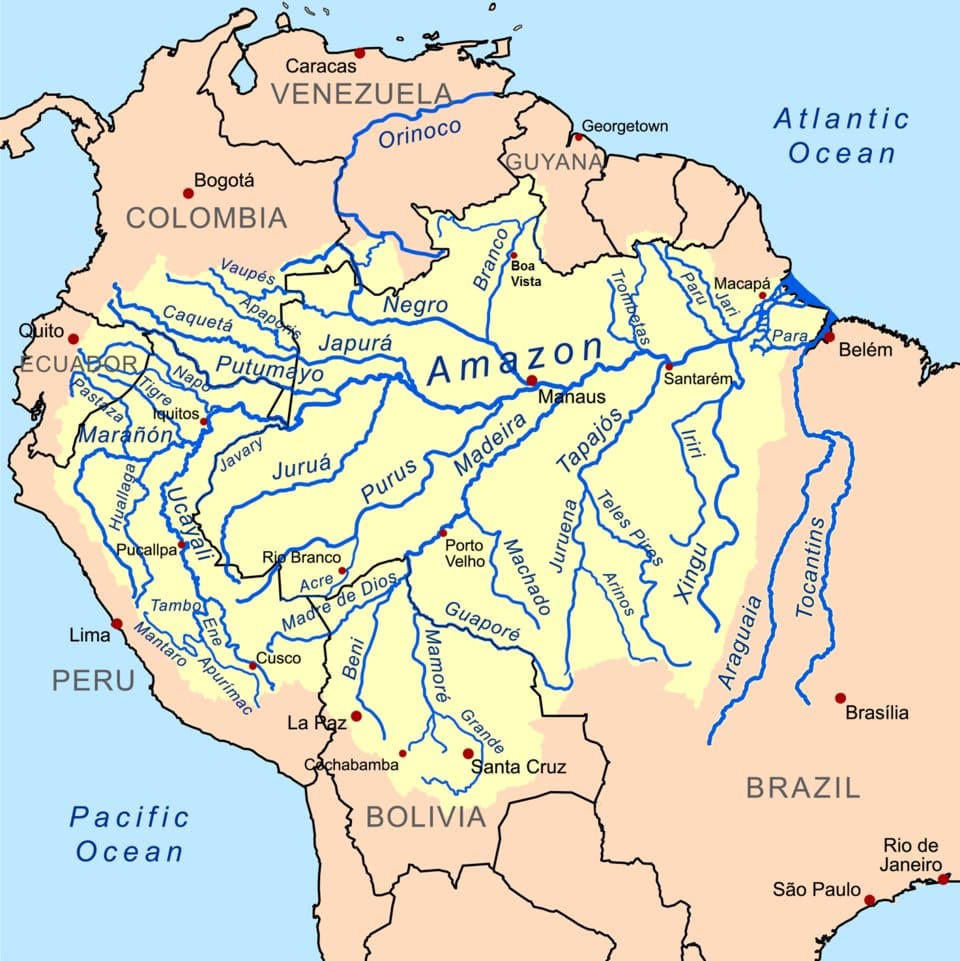
    Map showing the Amazon River Basin in South America
    Map by Kmusser, CC BY-SA 3.0, via Wikimedia Commons

    Species Overview

    Field Details
    Scientific Name Brochis splendens (Castelnau, 1855)
    Common Names Emerald Cory, Emerald Brochis, Green Cory, Emerald Catfish
    Family Callichthyidae
    Origin Upper Amazon basin (Peru, Ecuador, Colombia, Brazil)
    Care Level Easy to Moderate
    Temperament Peaceful
    Diet Omnivore
    Tank Level Bottom
    Maximum Size 3.5 inches (9 cm)
    Minimum Tank Size 30 gallons (114 liters)
    Temperature 72 to 82ยฐF (22 to 28ยฐC)
    pH 5.8 to 7.5
    Hardness 2 to 15 dGH
    Lifespan 5 to 8 years
    Breeding Egg depositor (T-position)
    Breeding Difficulty Difficult
    Compatibility Community
    OK for Planted Tanks? Yes

    Classification

    Taxonomic Level Classification
    Order Siluriformes
    Family Callichthyidae
    Subfamily Corydoradinae
    Genus Brochis (restored as valid genus, Dias et al. 2024)
    Species B. Splendens (Castelnau, 1855)

    The taxonomy of this fish has been debated for decades. The genus Brochis was originally erected to separate a small group of larger, deeper-bodied armored catfish from the closely related Corydoras. Some molecular studies suggested that Brochis was nested within Corydoras, leading several authors to merge the two genera. However, a comprehensive 2024 revision by Dias et al. Restored Brochis as a valid, distinct genus based on both morphological and molecular evidence.

    Note on naming: You’ll see this fish listed as both Corydoras splendens and Brochis splendens depending on the source and when it was written. The current accepted classification recognizes Brochis as a separate genus from Corydoras. In the hobby, most people still refer to them simply as “emerald corys” regardless of the formal taxonomy.

    Origin & Natural Habitat

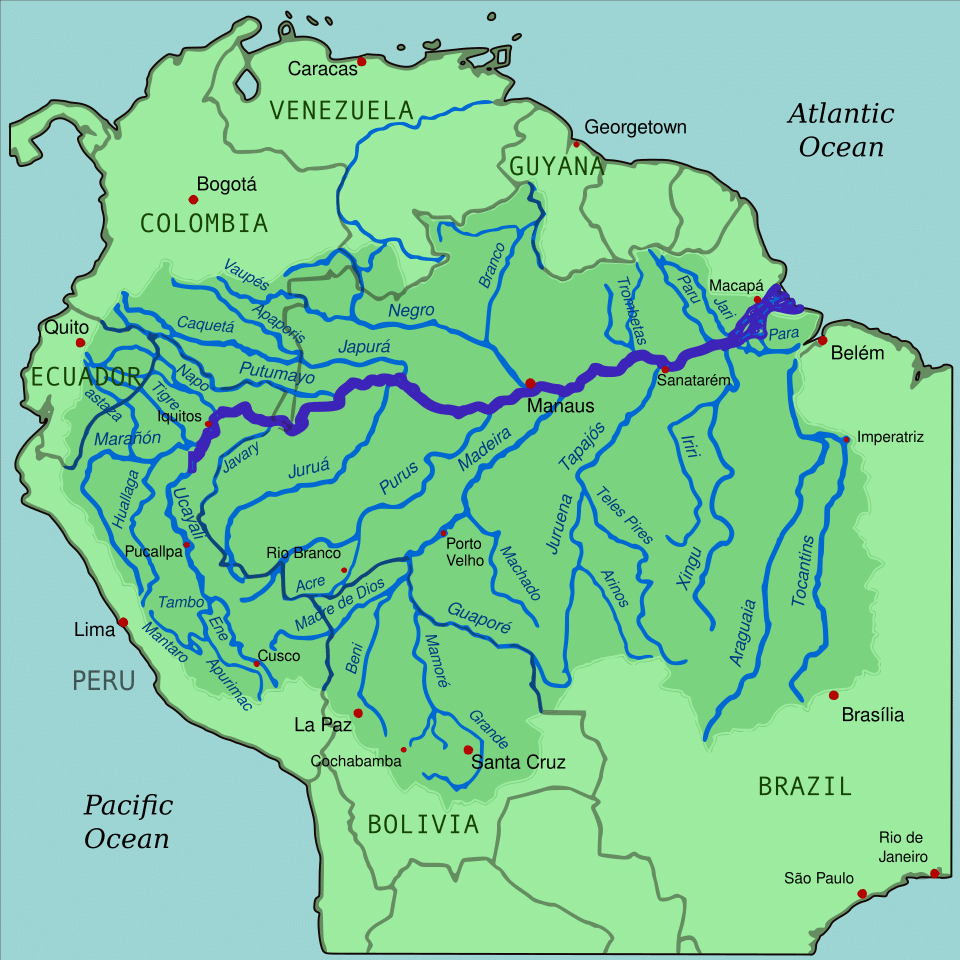
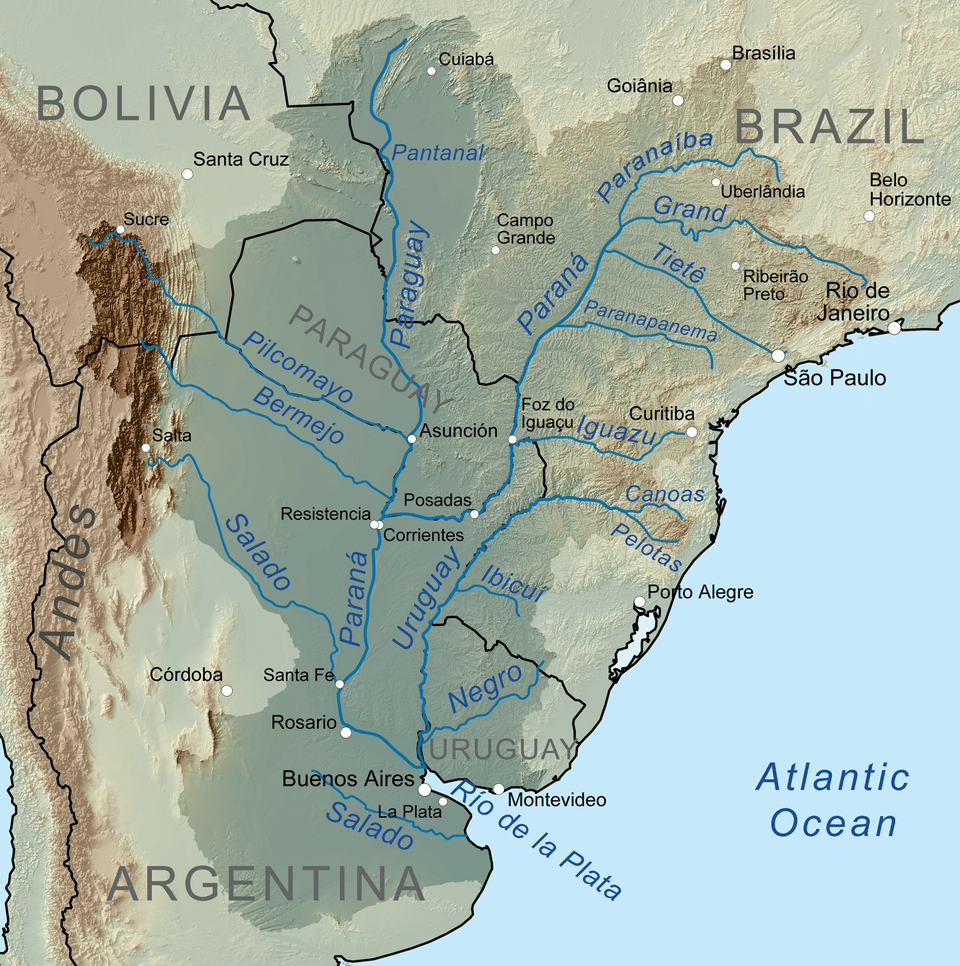
    Map of the Amazon River basin in South America, native habitat of the emerald cory
    Map of the Amazon River basin. The emerald cory is found throughout the upper Amazon drainage in Peru, Ecuador, Colombia, and Brazil.

    The emerald cory is native to the upper Amazon basin, with populations found across Peru, Ecuador, Colombia, and western Brazil. They’ve been collected from numerous river systems within this range, including tributaries of the Napo, Ucayali, and Maraรฑรณn rivers. It’s a fairly widespread species compared to some of the more geographically restricted Corydoras.

    In the wild, emerald corys inhabit slow-moving rivers, floodplain lakes, and shallow tributary streams with soft, silty or sandy bottoms. These habitats are typically shaded by overhanging vegetation and have water stained with tannins from decomposing organic matter. The substrate is covered in fallen leaves, decaying plant material, and fine sediment that the fish constantly sift through in search of food.

    The water in their natural habitat is warm, soft, and slightly acidic. During the rainy season, their habitat can flood dramatically, expanding their foraging range into the surrounding forest floor. This seasonal variation is something to keep in mind when understanding their adaptability in captivity.

    Most emerald corys in the aquarium trade are wild-caught, though some captive-bred specimens are available from specialty breeders. They’re not bred commercially on the same scale as bronze or peppered corys.

    Appearance & Identification

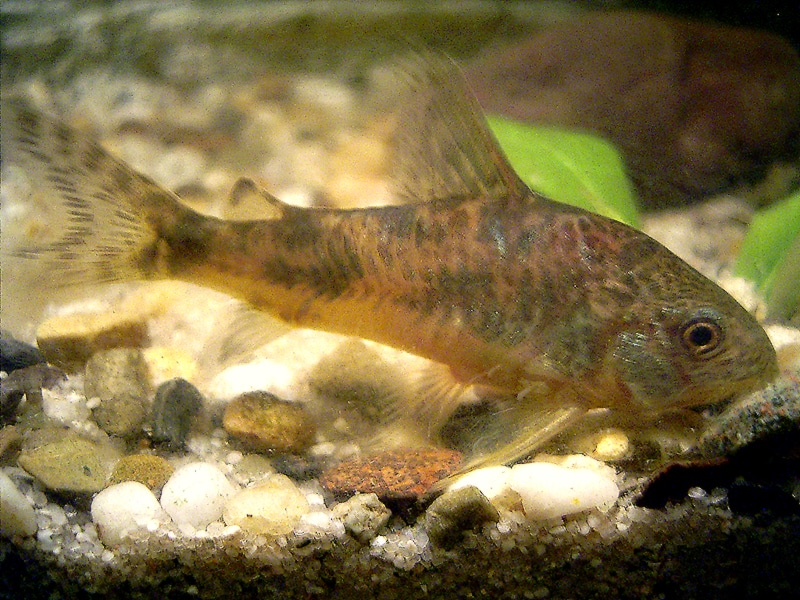
    Emerald cory (Brochis splendens) showing metallic emerald green coloration
    Emerald cory. Photo by Maschinenkanone, CC BY-SA 2.0 DE, via Wikimedia Commons

    The emerald cory is a genuinely beautiful fish. The entire upper body is covered in a brilliant metallic emerald green that shifts and shimmers as the fish moves. Under good aquarium lighting, the green iridescence can range from deep forest green to a bright, almost electric green depending on the angle. The belly is a pale pinkish-white to cream color, creating a sharp contrast with the metallic green flanks.

    Compared to typical Corydoras species, the emerald cory has a noticeably deeper, more robust body. It’s built like a tank. The head is also proportionally larger, and the snout is slightly more pointed. One of the most reliable ways to distinguish Brochis from Corydoras is the dorsal fin: emerald corys have 10 to 12 dorsal fin rays, while true Corydoras species typically have only 6 to 8. This gives the emerald cory a distinctly longer, more prominent dorsal fin.

    Like all callichthyid catfish, the body is covered in two rows of overlapping bony plates (scutes) rather than scales. The pectoral fin spines are sharp and can lock into an erect position as a defense mechanism, so use caution when netting them. They can get tangled in fine mesh nets, and a sting from those spines isn’t pleasant.

    People frequently confuse emerald corys with bronze corys (Corydoras aeneus). While bronze corys can show a greenish tint, the emerald cory’s green is far more vivid and saturated. The emerald cory is also noticeably larger and deeper-bodied. If you put them side by side, the difference is obvious.

    Male vs. Female

    Sexing emerald corys follows the same general rules as other corydoras-type catfish:

    • Females: Larger and noticeably rounder when viewed from above, especially when carrying eggs. They will have a wider, more robust body profile overall.
    • Males: Slightly smaller and slimmer than females. When viewed from above, males appear more streamlined and less rounded through the belly area.

    The differences become most apparent in mature fish. Juveniles are very difficult to sex accurately. The easiest time to tell them apart is when females are gravid (full of eggs), as they become visibly plumper.

    Average Size & Lifespan

    The emerald cory reaches a maximum size of about 3 to 3.5 inches (7 to 9 cm) in aquarium conditions. This makes it significantly larger than most popular corydoras species. For comparison, bronze corys top out around 2.5 inches, peppered corys around 2 inches, and many of the smaller species like pygmy corys stay under an inch. The emerald cory’s size is one of its most defining features and is important to factor into your tank planning.

    With proper care, emerald corys typically live 5 to 8 years in captivity. Hobbyists have reported individuals living even longer in well-maintained tanks with stable water conditions. A nutritious, varied diet and clean water are the biggest factors in reaching the upper end of that range.

    Care Guide

    Tank Size

    A minimum of 30 gallons (114 liters) is recommended for a group of emerald corys. This is larger than what you’d need for most other cory species, and for good reason. These are big, active fish that produce more waste than their smaller cousins. A group of 6 emerald corys in a 20-gallon tank will overload the filtration quickly and leave very little room for other inhabitants.

    A 30-gallon long is a solid starting point for a dedicated group of 6 to 8 fish. If you’re building a community tank with other species, aim for 40 gallons (151 liters) or larger. More floor space is always better for bottom-dwelling fish, so prioritize footprint over height when choosing your tank.

    Water Parameters

    Parameter Ideal Range
    Temperature 72 to 82ยฐF (22 to 28ยฐC)
    pH 5.8 to 7.5
    Hardness 2 to 15 dGH
    KH 1 to 12 dKH

    Emerald corys are fairly adaptable when it comes to water chemistry. They do best in slightly acidic to neutral water, but they’ll tolerate a range of conditions as long as things stay stable. Consistency matters more than hitting a perfect number. Avoid sudden swings in temperature or pH, as that’s what causes stress and health issues with these fish.

    One important note: like all corydoras-type catfish, emerald corys are sensitive to poor water quality, especially high nitrate levels. Keep nitrates below 20 ppm with regular water changes. They’re one of those fish that will let you know when water quality is slipping by becoming lethargic or losing their green sheen.

    Filtration & Water Flow

    A good quality canister filter or hang-on-back filter rated for your tank size is essential. Because emerald corys are larger and produce more waste than typical corys, you want a filter that can turn over the tank volume at least 4 to 5 times per hour. A canister filter with mechanical, biological, and chemical media stages is ideal for tanks of 30 gallons and up.

    Keep the flow moderate. Emerald corys come from slow-moving water in the wild, so you don’t want a powerful current blasting across the bottom of the tank. If your filter creates too much flow, use a spray bar or baffle to diffuse it. That said, good water circulation and oxygenation are still important.

    Lighting

    Emerald corys aren’t fussy about lighting. Moderate lighting works well and will help show off their metallic green coloration without stressing them. If you’re running a planted tank with higher light, just make sure there are shaded areas created by tall plants, driftwood, or floating plants where the corys can retreat. They are most active during lower light conditions and at dawn and dusk.

    Plants & Decorations

    A well-planted tank with plenty of structure works beautifully for emerald corys. They appreciate having places to explore and rest during the day. Good choices include:

    • Amazon swords and Cryptocoryne species for mid to background planting
    • Java fern and Anubias attached to driftwood for natural-looking hardscape
    • Floating plants like Amazon frogbit or red root floaters to create shaded areas
    • Driftwood and smooth river rocks for hiding spots and territory markers

    Leave plenty of open floor space for foraging. Emerald corys are active bottom feeders that spend a lot of time rooting through the substrate, and they need room to do their thing. A tank that’s too cluttered on the bottom will frustrate them.

    Substrate

    Sand substrate is not optional with emerald corys. It’s essential. These fish spend their entire lives on the bottom, constantly sifting through substrate with their sensitive barbels in search of food. Gravel, especially sharp-edged gravel, will damage and erode their barbels over time, leading to infections and reduced ability to find food.

    Fine-grain sand (pool filter sand, play sand, or aquarium-specific sand) is the best choice. You’ll get to watch their natural feeding behavior as they take mouthfuls of sand, sift out the food, and expel the clean sand through their gills. It’s fascinating to watch and something you’ll miss entirely with a gravel substrate. Dark sand also does a great job of making their emerald green coloration pop against the background.

    Is the Emerald Cory Right for You?

    Before you buy, run through this honest checklist. The Emerald Cory is a great fish for the right keeper, but it is not for everyone.

    • You have a 30-gallon or larger tank that can handle the bioload of a larger cory species
    • You want the most impressive looking corydoras with a deep metallic green body
    • You can provide sinking pellets and frozen foods to satisfy their larger appetites
    • You keep a group of 6+ on sand substrate with stable water quality
    • You want a bottom dweller that is visible and impressive, not tiny and easy to miss
    • Your tank has moderate flow and good filtration to handle the extra waste

    Tank Mates

    Emerald corys are peaceful community fish that get along with virtually anything that won’t try to eat them. Their larger size compared to other corydoras gives them a bit more versatility, as they’re less likely to be viewed as prey by medium-sized fish.

    Best Tank Mates

    • Tetras: Cardinal tetras, rummy-nose tetras, emperor tetras, and other medium-sized schooling tetras are perfect mid-water companions.
    • Rasboras: Harlequin rasboras and other peaceful rasbora species share similar water parameter preferences.
    • Other corydoras: They’ll shoal alongside smaller corydoras species without any issues, though they prefer the company of their own kind.
    • Small to medium gouramis: Honey gouramis, pearl gouramis, and dwarf gouramis make good top-level companions.
    • Dwarf cichlids: Apistogramma species and German blue rams coexist well in larger tanks (40+ gallons).
    • Bristlenose plecos: Another peaceful bottom dweller that won’t compete for the same food sources.
    • Peaceful livebearers: Platies and swordtails work well in the same water conditions.

    Tank Mates to Avoid

    • Large cichlids: Oscars, Jack Dempseys, green terrors, and other large predatory cichlids will harass or eat them.
    • Aggressive bottom dwellers: Avoid keeping them with territorial or aggressive catfish species that will compete for floor space.
    • Large predatory fish: Anything big enough to fit an emerald cory in its mouth is a threat. Their pectoral spines offer some protection, but it’s not worth the risk.

    Food & Diet

    Emerald corys are hearty eaters with bigger appetites than their smaller cory cousins. They’re omnivores that will eat just about anything that sinks to the bottom, but a varied diet is important for maintaining their health and that brilliant green coloration.

    • Staple: High-quality sinking pellets or wafers designed for bottom feeders. Choose a formula with good protein content and color-enhancing ingredients.
    • Frozen foods: Bloodworms, brine shrimp, daphnia, and tubifex worms 2 to 3 times per week. These are eagerly devoured.
    • Live foods: Blackworms, daphnia, and brine shrimp are excellent treats that trigger enthusiastic feeding behavior.
    • Vegetables: Blanched zucchini, cucumber, or shelled peas occasionally. They do graze on algae and decaying plant matter naturally.

    Feeding tip: Don’t assume your emerald corys are getting enough food just because you’re feeding the tank. In community setups, faster mid-water fish often eat everything before it reaches the bottom. Feed sinking foods after lights out, or drop wafers and pellets directly near the corys to make sure they get their share. Their bigger size means they need more food than a group of pygmy or dwarf corys.

    Feed once or twice daily, offering only what the group can consume in a few minutes. Overfeeding bottom feeders is easy because uneaten food sits on the substrate and fouls the water quickly.

    Breeding & Reproduction

    Breeding Difficulty

    Breeding emerald corys in captivity is difficult and rarely accomplished by hobbyists. While the general spawning process follows the same T-position mating behavior seen in other corydoras species, getting emerald corys to actually spawn in an aquarium setting is far more challenging than breeding bronze or peppered corys. Most of the emerald corys in the trade are still wild-caught.

    Spawning Tank Setup

    • A separate breeding tank of 20 to 30 gallons (76 to 114 liters) is recommended given their larger size
    • Use a bare bottom or thin layer of fine sand for easy egg collection
    • Broad-leaved plants like Anubias or Amazon swords provide surfaces for egg deposition
    • Smooth rocks and tank glass also serve as spawning sites
    • A gentle sponge filter provides filtration without endangering eggs or fry

    Water Conditions for Breeding

    • pH: 6.0 to 6.8
    • Hardness: 2 to 8 dGH (soft water is important)
    • Temperature: A large cool water change (dropping temperature by 4 to 6ยฐF) is often used to simulate the rainy season and trigger spawning
    • Increasing water flow and barometric pressure drops can also help initiate breeding behavior

    Conditioning & Spawning

    Condition breeding groups with heavy feedings of live and frozen foods for 2 to 4 weeks before attempting to spawn. A ratio of 2 males to every 1 female is often recommended. Spawning is typically triggered by a large, cool water change that mimics the onset of the rainy season in their native habitat.

    Like other corydoras, emerald corys use the characteristic T-position during mating. The female holds a small number of eggs between her pelvic fins while the male fertilizes them. She then swims to a chosen surface (plant leaves, glass, smooth rocks) and carefully deposits the adhesive eggs. This process repeats multiple times over several hours.

    Egg & Fry Care

    Remove the adults after spawning is complete, as they will eat the eggs if given the opportunity. The eggs typically hatch in 3 to 5 days depending on temperature. Adding a few drops of methylene blue to the breeding tank can help prevent fungal growth on the eggs.

    Fry become free-swimming a couple of days after hatching. Initial food should be microworms, infusoria, or commercial liquid fry food. After about a week, they can transition to freshly hatched brine shrimp (Artemia nauplii). Growth is relatively slow compared to some other corydoras species, and the fry can take 6 months or more to reach a sellable size.

    Common Health Issues

    Barbel Erosion

    This is the most common problem with emerald corys and it’s almost always caused by keeping them on gravel or in tanks with poor water quality. The barbels wear down, become infected, and eventually disappear. Without functional barbels, the fish can’t forage effectively.

    Prevention: Use fine sand substrate and maintain excellent water quality. If barbel erosion has already started, switching to sand and improving water conditions can allow them to regenerate over time.

    Ich (White Spot Disease)

    Ich is caused by the protozoan Ichthyophthirius multifiliis and appears as small white spots across the body and fins. Emerald corys are susceptible when stressed, especially after shipping or introduction to a new tank.

    Treatment: Raise the temperature gradually to 82 to 86ยฐF (28 to 30ยฐC) and treat with a half-dose of malachite green or a copper-free ich medication. Corydoras and related catfish are sensitive to many medications, particularly copper-based treatments. Always use half the recommended dose and monitor closely.

    Bacterial Infections

    Red streaks on the belly, frayed fins, or cloudy eyes can indicate bacterial infection. These typically arise from poor water quality or injuries from rough substrate.

    Treatment: Improve water quality immediately with partial water changes. Broad-spectrum antibacterial medications can be used, but again, dose conservatively with catfish. Quarantine affected fish if possible.

    General Prevention

    • Quarantine all new fish for at least 2 weeks before adding to your main tank
    • Maintain stable water parameters with regular 20 to 25% weekly water changes
    • Use sand substrate exclusively to protect barbels
    • Avoid overcrowding and maintain good filtration
    • Never use copper-based medications at full dose with catfish

    Common Mistakes to Avoid

    • Treating them like small corys: This is the biggest mistake people make. Emerald corys are substantially larger than most corydoras species and need a bigger tank, more food, and stronger filtration to match. A 10 or 15-gallon tank that works for pygmy corys is nowhere near adequate for a group of emerald corys.
    • Using gravel substrate: It cannot be overstated. Sand is absolutely essential. Gravel will destroy their barbels over time, and a corydoras without barbels is a fish that can’t eat properly.
    • Keeping too few: Emerald corys are social fish that need to be in groups of at least 6. Keeping one or two alone leads to stressed, inactive fish that hide constantly and never show their best behavior or coloration.
    • Not leaving surface access: Emerald corys are obligate air breathers that regularly dart to the surface to gulp atmospheric air. Make sure floating plants don’t completely cover the water surface, and leave enough open water for them to access the air freely.
    • Confusing them with bronze corys: If you’re specifically looking for emerald corys, pay attention. Pet stores sometimes mislabel bronze corys as emerald corys. The real emerald cory is larger, deeper-bodied, has more dorsal fin rays (10 to 12), and has a much more vivid metallic green coloration.
    • Underfeeding in community tanks: Because they’re bottom dwellers, they often get overlooked during feeding time. Make sure food actually reaches the bottom, especially in tanks with fast-eating mid-water species.

    Where to Buy

    Emerald corys are less commonly stocked at chain pet stores than bronze or peppered corys, but specialty fish stores sometimes carry them. Your best bet for healthy, well-acclimated specimens is ordering from reputable online retailers:

    • Flip Aquatics. A reliable source for quality freshwater fish with careful shipping practices.
    • Dan’s Fish. Known for healthy, well-acclimated fish and transparent livestock sourcing.

    When purchasing, always buy a group of at least 6. These are social fish that do poorly when kept alone or in pairs. Most retailers offer better per-fish pricing on larger orders, so buying a proper group often saves you money anyway.

    Frequently Asked Questions

    Is the emerald cory the same as the emerald green cory?

    Yes, they’re the same fish. “Emerald cory,” “emerald green cory,” “emerald brochis,” and “green cory” are all common names for Brochis splendens. The variety of names is partly because of the ongoing taxonomic debate about whether this fish belongs in Brochis or Corydoras, leading retailers to use different labels.

    How big do emerald corys get?

    Emerald corys reach about 3 to 3.5 inches (7 to 9 cm) in aquarium conditions. This makes them one of the largest commonly available species in the cory catfish group, roughly 50% larger than a bronze cory and two to three times the size of many popular dwarf species.

    Can emerald corys live with regular corydoras?

    Absolutely. Emerald corys are peaceful and will coexist happily with any other corydoras species. They may even loosely shoal together, though they prefer the company of their own species. Just make sure the tank is large enough to accommodate groups of both species comfortably.

    Why does my emerald cory dart to the surface?

    This is completely normal behavior. Emerald corys are obligate air breathers, meaning they need to periodically gulp air from the surface to supplement their gill respiration. They swallow atmospheric air and absorb oxygen through their highly vascularized intestine. If you see them doing this occasionally throughout the day, everything is fine. However, if they’re doing it frantically and constantly, it could indicate poor water oxygenation or high stress levels in the tank.

    What’s the difference between emerald corys and bronze corys?

    While they can look similar at first glance, there are several key differences. Emerald corys are larger (3 to 3.5 inches vs. 2.5 inches), have a deeper and more robust body, more dorsal fin rays (10 to 12 vs. 6 to 8), and display a much more vivid, saturated metallic green coloration. Bronze corys may show a greenish tint but it’s much more subdued. They’re also classified in different genera: Brochis vs. Corydoras.

    Do emerald corys need sand substrate?

    Yes, sand substrate is strongly recommended and really should be considered a requirement. Emerald corys constantly sift through substrate with their delicate barbels while foraging. Rough gravel will erode and damage these barbels over time, leading to infections and reduced ability to find food. Fine-grain sand lets them exhibit their natural feeding behavior safely.

    How the Emerald Cory Compares to Similar Species

    Emerald Cory vs. Bronze Cory

    The Bronze Cory is smaller, cheaper, and fits in 20-gallon tanks. The Emerald Cory is the premium upgrade with a deeper metallic green body and larger size. If space allows, the Emerald Cory is visually far more impressive. If you are working with a smaller tank, the Bronze Cory is the practical choice.

    Emerald Cory vs. Sterbai Cory

    The Sterbai Cory has better pattern detail with spotted body and orange fins, while the Emerald Cory has raw size and metallic sheen. The Sterbai handles warmer water better. Both are premium corys. Choose based on whether you prefer pattern detail (Sterbai) or size and presence (Emerald).

    What It Is Actually Like Living With Emerald Cory

    Emerald cories are surprisingly fast swimmers for their size. When spooked, they can launch across the tank in a burst that startles everyone, including the fishkeeper. Tight-fitting lids are not optional.

    They are enthusiastic eaters that will come to the front of the tank as soon as they see you approaching. This is one of the few cory species that consistently learns to associate your presence with food.

    Group behavior is pronounced. A school of six emerald cories foraging together across a sandy substrate is one of the best sights in freshwater fishkeeping. Their metallic green flanks catch the light as they move, creating a shimmering effect that photos simply cannot capture.

    They are louder than you expect. The clicking sounds from their pectoral spines are audible across the room, especially during water changes or when you are netting them. It is their way of protesting, and it works.

    Closing Thoughts

    The Emerald Cory is what happens when a corydoras decides it wants to be the biggest fish on the bottom of the tank.

    The emerald cory is one of those fish that makes you do a double-take the first time you see a healthy group in a well-set-up tank. That metallic emerald green shimmering across a robust, active catfish is something special, and their larger size gives them a presence that smaller corys just can’t match. They’re the fish you add to a community tank and suddenly everyone asks about.

    The care isn’t complicated, but it does require respecting their size. Give them a proper tank (30 gallons minimum), sand substrate, a good group of 6 or more, and clean water. Do that, and you’ll be rewarded with one of the most visually striking and entertaining bottom dwellers in the freshwater hobby. They’re worth every bit of the extra effort.

    Check out our corydoras tier list video where we rank the most popular cory catfish in the hobby:

    References

    1. Seriously Fish, Brochis splendens species profile. seriouslyfish.com
    2. FishBase, Corydoras splendens (Castelnau, 1855). fishbase.se
    3. The Aquarium Wiki, Brochis splendens. theaquariumwiki.com
    4. Dias, A.C. Et al. (2024). Phylogenomic analysis and revised classification of the armored catfishes (Siluriformes: Callichthyidae). Zoological Journal of the Linnean Society.
    5. Practical Fishkeeping, Emerald catfish (Brochis splendens) care guide. practicalfishkeeping.co.uk
  • Community Fish: My 21 Best Picks for a Peaceful Freshwater Tank

    Community Fish: My 21 Best Picks for a Peaceful Freshwater Tank

    Building a community tank is one of the most rewarding things you can do in this hobby. and also where beginners make the most mistakes. After 25 years keeping and working with freshwater fish, Iโ€™ve found that a great community tank always comes down to one thing: doing your homework before you buy. This list covers 21 of my go-to community fish, with honest takes on which ones are truly peaceful, which ones come with caveats, and how to think about compatibility before you stock your tank.

    Iโ€™ve also included a matching guide covering water parameters, size, swimming level, and temperament. read it before you head to the fish store.

    What Are Community Fish?

    Good community fish are species that can live peacefully with other types of fish. They are not aggressive or dangerous to their fish tank mates in any way. The ideal community tank fish species are:

    • Peaceful fish
    • Compatible with other species
    • Interesting and attractive to observe
    • Hardy and adaptable

    How To Match

    The first rule when matching fish for your community tank is to stock them together with other peaceful aquarium fish. You can check out the fish compatibility chart I have posted for an easy-to-reference guide.

    There are also a few less obvious factors to consider, however. Here’s what you need to know:

    Water Parameters

    All the species in your freshwater tank should be comfortable in the same water parameters. That means they should be comfortable with the same, water temperature, pH, and water hardness. As a rule of thumb, many tropical aquarium fish will prefer softer and slightly acidic water. It’s really easy to buffer your system with natural decorations like driftwood.

    Size

    In most cases, you should aim to stock your aquarium with similarly sized fish. This is useful for planning how many fish you can keep in your tank and for preventing predation.

    Remember, almost all carnivorous or omnivorous species will eat other fish that are small enough to fit in their mouths!

    Swimming Level

    A healthy mix of bottom dwellers, mid-water, and top-water swimming species will prevent overcrowding in the aquarium. Having fish that swim on all levels of the tank will also create a busier, more lively display tank.

    Biotopes

    Mixing fish breeds from different parts of the world can be very in interesting, but you can also keep things more natural. Many aquarists enjoy matching species that live together naturally in the same region or natural habitat to create biotope tanks.

    For example, a South American river biotope could include species like corydoras catfish, neon tetras, and blue rams. An Asian stream biotope would be another great option and could include fish like the honey gourami and cherry barb.

    Beyond biotopes, the two most important compatibility rules Iโ€™d give any beginner: first, match sizes. donโ€™t put fish small enough to fit in another fishโ€™s mouth. It sounds obvious, but itโ€™s the most common stocking mistake I see. Second, understand aggression across the full life cycle. A fish thatโ€™s peaceful as a juvenile can become territorial when it breeds. angelfish are the perfect example. Research behavior at maturity, not just how they look in the store tank.

    21 Of The Best Community Fish Species

    Now that you know what community species are and how to match them, it’s time to get to know some of the best species of fish for your freshwater aquarium. Pay attention to the following information when considering each species:

    • Scientific Name
    • Difficulty Level
    • Temperament
    • Adult Size
    • Minimum Tank Size
    • Origin
    • Diet
    • pH
    • Temperature
    • Planted Tank Suitability
    • Difficulty to breed

    Here’s a video from our YouTube Channel for those who are visual learners. I’ll go into further detail in our blog post. Please subscribe to our YouTube channel if you find our content helpful.

    Let’s get started!

    1. Cory Catfish

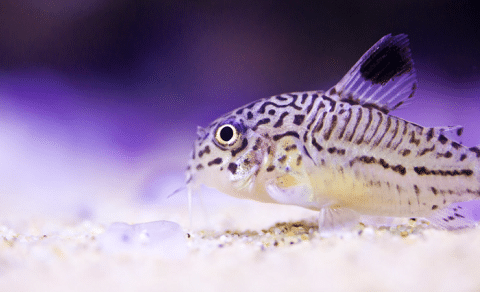
    Corydoras trilineatus
    • Scientific Name: Corydoras spp.
    • Difficulty Level: Easy
    • Temperament: Peaceful
    • Adult Size: 1-4 inches
    • Minimum Tank Size: 10-30 gallons (depending on species)
    • Origin: South American
    • Diet: Omnivorous
    • pH: 5.5-7.8 (depending on species)
    • Water Temperature: 72-82ยฐF (depending on species)
    • Planted Tank Suitability: Yes
    • Simming Level: Bottom

    There are more than 160 known species of these wonderful aquarium fish. Although Corydoras catfish spend most of their time on the bottom, these funny little fish will shoot up to the surface every now and then to take a breath of air. Corydoras catfish should be kept in groups of 6 or more to see them at their most playful and comfortable.

    Cory catfish are genuinely one of my favorite community fish. Theyโ€™re endlessly entertaining. always busy sifting through the substrate, and theyโ€™ll make you laugh when they dart up to the surface for a breath of air. With 160+ species, thereโ€™s a cory for almost any tank size, and theyโ€™re incredibly peaceful. Iโ€™d include them in almost any freshwater community setup.

    2. Rasboras

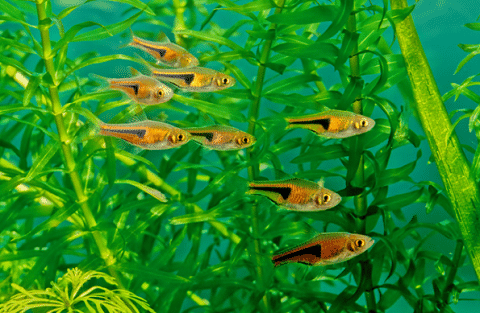
    School of Rasboras
    • Scientific Name: Rasbora spp., Boraras spp., etc
    • Difficulty Level: Easy
    • Temperament: Peaceful
    • Adult Size: 0.75-6 inches
    • Minimum Tank Size: 5-55 gallons (depending on species)
    • Origin: Asia
    • Diet: Omnivorous/carnivorous
    • pH: 4-8 (depending on species)
    • Water Temperature: 68-82ยฐF (depending on species)
    • Planted Tank Suitability: Yes
    • Swimming Level: Midwater, topwater

    There are many different rasbora species in the hobby, ranging from tiny fish like the chili rasbora up to the much larger scissortail species. These Asian schooling fish tend to be very peaceful and make wonderful peaceful community fish. Rasboras are some of the smallest fish in the hobby too, so they are a great choice for nano fish community setups.

    3. Guppy

    • Scientific Name: Poecilia reticulata
    • Difficulty Level: Easy
    • Temperament: Peaceful
    • Adult Size: 2 inches
    • Minimum Tank Size: 10 gallons
    • Origin: South American
    • Diet: Omnivorous
    • pH: 7-8
    • Water Temperature: 72-82ยฐF
    • Planted Tank Suitability: Yes
    • Swimming Level: All

    Guppy fish are the perfect community species for tropical aquariums with a water pH of over 7. These popular fish come in a wide range of different colors and often have big flowing fins.

    Guppies are great beginners fish because they are very adaptable and easy to care for. They are livebearers, so if you keep males and females together you can expect to see loads of little fry in your tank!

    4. Platies

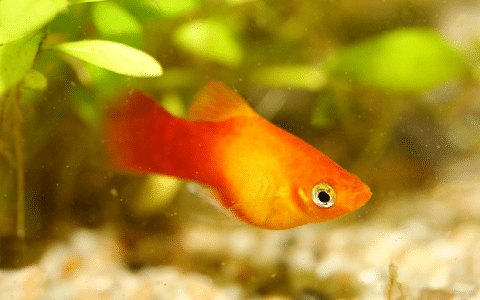
    Platies in Aquarium
    • Scientific Name: Xiphophorus spp.
    • Difficulty Level: Easy
    • Temperament: Peaceful
    • Adult Size: 2-3 inches
    • Minimum Tank Size: 15 gallons
    • Origin: North & South America
    • Diet: Omnivorous
    • pH: 6.8-8.5
    • Water Temperature: 70-82ยฐF
    • Planted Tank Suitability: Yes
    • Swimming Level: Midwater, topwater

    Like guppies, platy fish are peaceful livebearers that are available in some awesome breeds. They will make an ideal small community fish for your freshwater aquarium and have the added benefit of helping out with algae control.

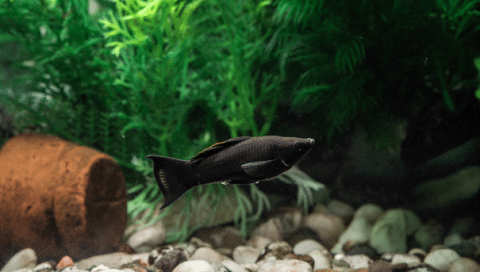
    5. Molly

    Black Molly
    • Scientific Name: Poecilia sphenops & P. latipinna
    • Difficulty Level: Moderate
    • Temperament: Peaceful
    • Adult Size: 3-5 inches
    • Minimum Tank Size: 30 gallons
    • Origin: North & South American
    • Diet: Omnivore
    • pH: 7-7.8
    • Water Temperature: 68-82ยฐF
    • Planted Tank Suitability: Yes
    • Swimming Level: Midwater, top

    Molly fish are excellent peaceful aquarium fish for fish keepers with naturally hard water. Like other livebearers, these fish breed freely in the aquarium. These larger livebearers are available in many different colors and fin shapes.

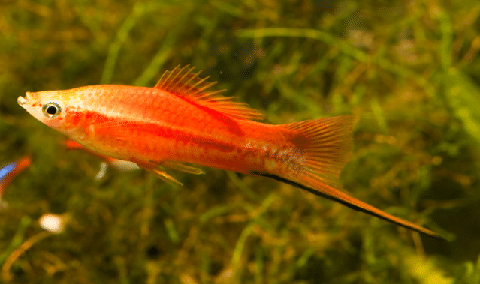
    6. Sword Tails

    Swordtail Fish in Planted Tank
    • Scientific Name: Xiphophorus helleri
    • Difficulty Level: Easy
    • Temperament: Peaceful
    • Adult Size:3-6 inches
    • Minimum Tank Size: 20 gallons
    • Origin: Central America
    • Diet: Omnivorous
    • pH: 7-8.5
    • Water Temperature: 64-82ยฐF
    • Planted Tank Suitability: Yes
    • Swimming Level: Midwater, top

    Swordtails are yet another highly popular livebearer that is available in a huge variety of colors and breeds. What sets swordtails apart is their distinctive long tail fins! They are great community fish for beginners and will do best if kept in a group of one male and a few females.

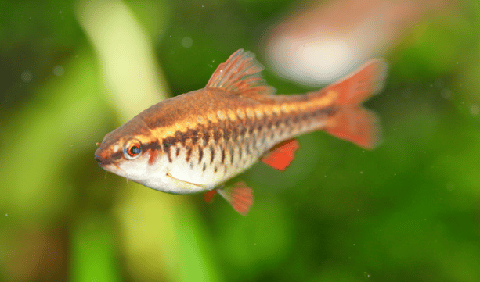
    7. Cherry Barbs

    • Scientific Name: Puntius titteya
    • Difficulty Level: Easy
    • Temperament: Peaceful
    • Adult Size: 1.75- 2 inches
    • Minimum Tank Size: 15 gallons
    • Origin: Asia
    • Diet: Omnivorous
    • pH: 6-8
    • Water Temperature: 68-80ยฐF
    • Planted Tank Suitability: Yes
    • Swimming Level: All levels

    Cherry barbs are beautiful and peaceful aquarium fish from the goldfish family. These active and colorful fish add rich orange-red color to your aquarium. The cherry barb fish is a social species that should be kept in groups of 6 or more fish to see them at their best.

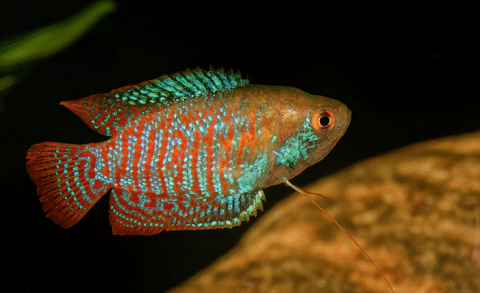
    8. Dwarf Gouramis

    Dwarf Gourami in Aquarium
    • Scientific Name: Trichogaster lalius
    • Difficulty Level: Moderate
    • Temperament: Peaceful
    • Adult Size: 3 inches
    • Minimum Tank Size: 10 gallons
    • Origin: South Asia
    • Diet: Omnivorous
    • pH: 6-7.5
    • Water Temperature:72-82ยฐF
    • Planted Tank Suitability: Yes
    • Swimming Level: Midwater, top

    A pair of dwarf gouramis make a wonderful addition to a peaceful community aquarium. These graceful labyrinth fish are both beautiful and peaceful. Dwarf gouramis are available in many different breeds such as the flame,neon blue dwarf, and honey gouramis for example.

    โš ๏ธ Honest warning: dwarf gouramis have become increasingly fragile in recent years due to Dwarf Gourami Iridovirus (DGIV), which is widespread in the hobby and notoriously difficult to treat. Theyโ€™re still beautiful community fish when healthy. just buy from a reputable source, quarantine new arrivals, and watch them closely.

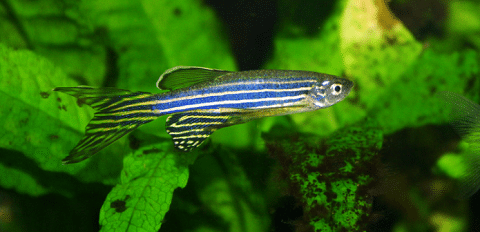
    9. Zebra Danio

    What Does A Zebra Danio Look Like
    • Scientific Name: Danio rerio
    • Difficulty Level: Easy
    • Temperament: Peaceful
    • Adult Size: 3 inches
    • Minimum Tank Size: 10 gallons
    • Origin: India
    • Diet: Omnivorous
    • pH: 6.5-7.5
    • Water Temperature: 64-75ยฐF
    • Planted Tank Suitability: Possible
    • Swimming Level: All levels

    Zebra danios are active fish that love darting around the aquarium. These peaceful freshwater community fish can thrive in relatively low water temperatures, making them a great choice for unheated aquariums, and they also get along with lots of fish. These hardy fish are available in long-finned, golden, and Glofish varieties.

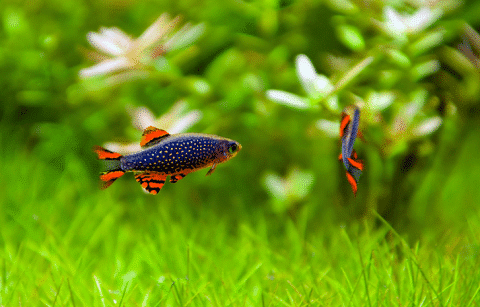
    10. Celestial Pearl Danio

    • Scientific Name: Celestichthys margaritatus
    • Difficulty Level: Moderate
    • Temperament: Peaceful
    • Adult Size: 0.75 inches
    • Minimum Tank Size: 10 gallons
    • Origin: Myanmar & Thailand
    • Diet: omnivorous
    • pH: 6.5-7.5
    • Water Temperature: 68-79ยฐF
    • Planted Tank Suitability: Yes
    • Swimming Level: All levels

    These colorful little danio fish are also known as the galaxy rasbora. They are an excellent choice for planted nano community tanks.

    Celestial pearl danios are very peaceful creatures although males may display and spar with each other. These shy little fish will do best if kept with other peaceful nano fish.

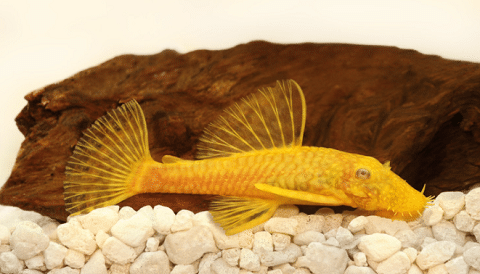
    11. Bristle Nose Pleco

    • Scientific Name: Ancistrus spp.
    • Difficulty Level: Easy
    • Temperament: Peaceful
    • Adult Size: 5 inches
    • Minimum Tank Size: 15 gallons
    • Origin: South American
    • Diet: Herbivorous
    • pH: 5.5-7.5
    • Water Temperature: 70-79ยฐF
    • Planted Tank Suitability: Yes
    • Swimming Level: Bottom

    The bristlenose pleco is a very strange and interesting-looking suckerfish. These bottom-dwelling catfish are very peaceful towards their tankmates, but should not be kept in groups with their own species. Bristle nose plecos love grazing on driftwood and they are very helpful in cleaning some kinds of soft algae.

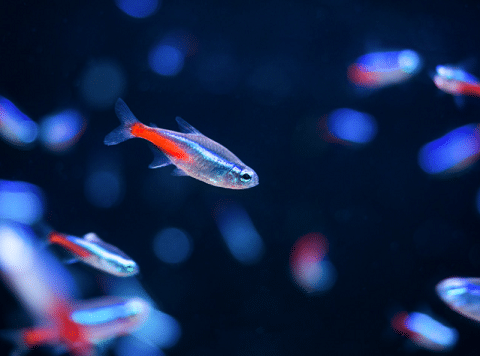
    12. Neon Tetras

    • Scientific Name: Paracheirodon innesi
    • Difficulty Level: Easy
    • Temperament: Peaceful
    • Adult Size: 1 inch
    • Minimum Tank Size: 15 gallons
    • Origin: South American
    • Diet: Omnivorous
    • pH: 4-7.5
    • Water Temperature: 70-77ยฐF
    • Planted Tank Suitability: Yes
    • Swimming Level: Mid-water

    Neon tetras are a stunning fish! These south American beauties are one of the most popular community species in the hobby because of their great color and easy care. Neon tetras are peaceful schooling fish that are perfect for everyone from beginners to experts.

    13. Cardinal Tetra

    • Scientific Name: Paracheirodon axelrodi
    • Difficulty Level: Easy
    • Temperament: Peaceful
    • Adult Size: 1-1.25 inches
    • Minimum Tank Size: 15 gallons
    • Origin: South American
    • Diet: Omnivorous
    • pH: 3.5-7.5
    • Water Temperature: 73-84ยฐF
    • Planted Tank Suitability: Yes
    • Swimming Level: Midwater

    The cardinal tetra is very similar to the neon tetra but is even more colorful! The main difference between the two species of tetras is the red stripe on the cardinal tetra which extends the whole length of the fish’s body. Cardinals are also slightly larger than neons, but at just over an inch long, they’re still very small fish.

    14. Congo Tetra

    Congo-Tetra
    • Scientific Name: Phenacogrammus interruptus
    • Difficulty Level: Moderate
    • Temperament: Peaceful
    • Adult Size: 3 inches
    • Minimum Tank Size: 20 gallons
    • Origin: Central Africa
    • Diet: Carnivorous
    • pH: 4-8
    • Water Temperature: 75-81ยฐF
    • Planted Tank Suitability: Yes
    • Swimming Level: Midwater, top

    The Congo tetra is one of the most beautiful tetras in the hobby. Congo tetras are native to Africa, unlike most other species which occur in South America. They are very peaceful but can be pretty shy if kept with larger or very active fish.

    Worth noting: Congo tetras do best in larger tanks. Theyโ€™re on the bigger side for tetras and can get stressed or outcompeted in smaller, busier setups. Iโ€™d give them at minimum a 40-gallon. they really shine in a 55 or 75-gallon where they can school properly and their colors fully develop.

    15. Black Skirt Tetra

    What Does Black Shirt Tetra Look Like
    • Scientific Name: Gymnocorymbus ternetzi
    • Difficulty Level: Easy
    • Temperament: Peaceful
    • Adult Size: 2.4 inches
    • Minimum Tank Size: 15 gallons
    • Origin: South American
    • Diet: Omnivorous
    • pH: 6-7.5
    • Water Temperature: 70-82ยฐF
    • Planted Tank Suitability: Possible
    • Swimming Level: Midwater, top

    The black skirt or black widow tetra is a really cool schooling tetra for community tanks. They might not be the most colorful tetras but their bold black markings and curios fin and body shape make up for that. These interesting-looking fish are very peaceful if kept in schools of at least 6 fish or so.

    โš ๏ธ Honest note: black skirt tetras are hit or miss as community fish. They can be nippy. especially in smaller, more crowded tanks. They do much better with plenty of space. Green Aqua has a fantastic YouTube video showing angelfish and black skirts coexisting peacefully in a 4-foot tank. it can absolutely work, but tank size matters a lot here.

    16. Otocinclus

    • Scientific Name: Otocinclus spp.
    • Difficulty Level: Easy
    • Temperament: Peaceful
    • Adult Size: 2 inches
    • Minimum Tank Size: 10 gallons
    • Origin: South America
    • Diet: Algae
    • pH: 6-7.5
    • Water Temperature: 74-79ยฐF
    • Planted Tank Suitability: Yes
    • Swimming Level: All levels

    These tiny sucker fish feed on algae, which helps to keep the glass, plants, and other surfaces in your tank clean. It’s fascinating to watch them feed as they stick to the glass, but they will also swim around in the midwater of the tank if kept in a school of at least 6 fish or so. Otos are great fish for the planted aquarium but should not be added to tanks that do not produce any algae.

    17. Ram Cichlids

    • Scientific Name: Mikrogeophagus ramirezi & M. altispinosa
    • Difficulty Level: Moderate
    • Temperament: Peaceful
    • Adult Size: 1.5 inches
    • Minimum Tank Size: 15 gallons
    • Origin: South America
    • Diet: Omnivorous
    • pH: 4-7
    • Water Temperature: 81-86ยฐF
    • Planted Tank Suitability: Yes
    • Swimming Level: Midwater, bottom

    If you thought all cichlids were big and mean, think again! Rams are small, shy fish that can be kept in community tanks with the right tankmates. It is best to keep just a pair of these stunning cichlids unless you have a tank of 40 gallons or more. Ram cichlids (video source) are tropical fish that need high water temperatures, so make sure their tank mates are compatible.

    18. Glass Catfish

    Glass Catfish in Aquarium
    • Scientific Name: Kryptopterus vitreolus
    • Difficulty Level: Moderate
    • Temperament: Peaceful
    • Adult Size: 2.5 inches
    • Minimum Tank Size: 30 gallons
    • Origin: Southeast Asia
    • Diet: Carnivorous
    • pH: 4-7
    • Water Temperature: 68-79ยฐF
    • Planted Tank Suitability: Yes
    • Swimming Level: Midwater, top

    The glass catfish is perfect for aquarists who want something a little more unusual in their tank. These Asian catfish are translucent, and you can see practically every bone in their bodies! They are very calm fish that prefer to school together, so make sure you keep at least 5 of them in the same tank.

    19. Dojo Loach

    • Scientific Name: Misgurnus anguillicaudatus
    • Difficulty Level: Moderate
    • Temperament: Peaceful
    • Adult Size: 6-10 inches
    • Minimum Tank Size: 50 gallons
    • Origin: Asia
    • Diet: Carnivorous
    • pH: 6.5-8
    • Water Temperature: 50-82ยฐF
    • Planted Tank Suitability: Yes
    • Swimming Level: Bottom

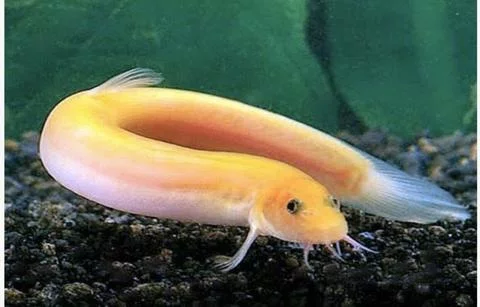
    Dojo loaches are an awesome addition to a larger peaceful community tank. They are also known as weather loaches because they seem to know when the weather will change! These eel-like bottom feeders are very hardy and make a great choice for unheated aquariums. If this loach is too large for your aquarium, you can look at these other loaches in this post.

    20. White Cloud Mountain Minnows

    • Scientific Name: Tanichthys albonubes
    • Difficulty Level: Easy
    • Temperament: Peaceful
    • Adult Size: 1.5 inches
    • Minimum Tank Size: 10 gallons
    • Origin: China
    • Diet: Carnivorous
    • pH: 6-8.5
    • Water Temperature: 57-72ยฐF
    • Planted Tank Suitability: Yes
    • Swimming Level: Midwater, top

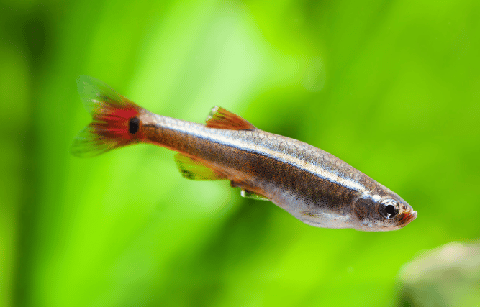
    White cloud mountain minnows are another beautiful fish that can be kept in unheated aquariums. These colorful schoolers prefer cooler water than most tropical fish. They are available in beautiful golden and long-finned forms, although the wild type looks just as good if you ask me!

    21. Glofish Tetras & Danios

    Glofish in Aquarium
    • Scientific Name: Gymnocorymbus ternetzi & Danio rerio
    • Difficulty Level: Easy
    • Temperament: Peaceful
    • Adult Size: 2.4-3 inches
    • Minimum Tank Size: 15 gallons
    • Origin: Captive
    • Diet: Omnivorous
    • pH: 6.5-7.5
    • Water Temperature: 70-75ยฐF
    • Planted Tank Suitability: Possible
    • Swimming Level: Midwater, top

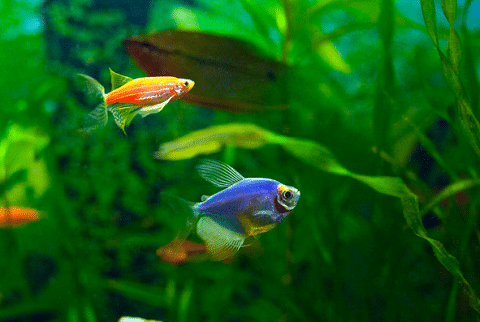
    The Glofish are a collection of several genetically modified fish species that just burst with color! For a really amazing display, try keeping these fish in a tank with blue LED lighting.

    Not all of the Glofish species are peaceful aquarium fish, but the glofish tetras and zebra danios are perfect! The glofish barbs, betta fish, and sharks are more aggressive fish that should not be added to a community.

    Freshwater Tank Setup

    When choosing a freshwater tank for a community, bigger is generally better. Most of the species in this list will be happiest if kept in a group of 6 or more individuals, so the numbers add up quickly as you introduce new species to the tank.

    Luckily, that doesn’t mean you need a huge aquarium to put together an awesome community! A 30-gallon tank or larger would be an awesome place to start, but you can have great success with a tank of half this size too.

    Once you’ve chosen your tank size, it’s time to get it set up for your fish. Read on to learn how.

    Substrate & Decorations

    Adding substrate and decorations to your aquarium can do more than just make it look pretty.

    The substrate also provides a place for your fish to forage and for plants to root themselves. Decorations and hardscape features like lava rock and driftwood also create structure and hiding places where your fish can explore and relax.

    Editor’s Choice
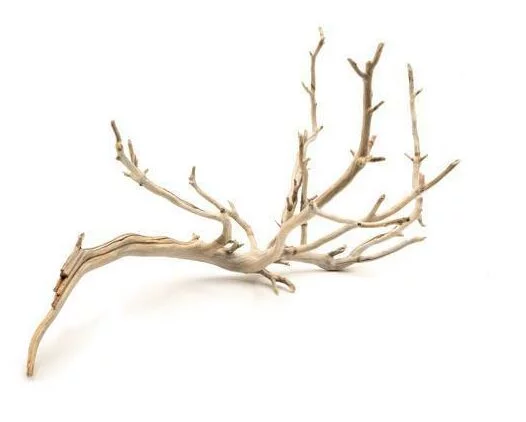
    Manzanita Driftwood

    Editor’s Choice

    Manzanita offers it all. Great shape, low tannins, quick to water log and reasonably priced. It’s the ultimate driftwood!

    Click For Best Price Click For Branch Pieces

    You can get creative with your choice of substrate color, although fish tend to be most comfortable over darker natural colors. Make sure your substrate, hardscape, and ornaments are aquarium-safe and thoroughly washed before adding them to the tank.

    Filtration

    Apart from the tank itself, there are a few important pieces of hardware that you will need to put together a great fish community. The most important of these is the filter. We run into several filter types in freshwater aquariums. From easiest to most high end they are:

    Your choice will depend on factors like your budget and stocking rate, but be sure to select a model that is designed for your aquarium size or larger. Canister filters are often considered the pinnacle in filtration systems with freshwater tanks. A model like the OASE Biomaster will get you professional level filtration that will last for years.

    Lighting

    Lighting is one of the pieces of gear we run into if we are looking into planted tanks. You want a light that is full spectrum and will support plant growth. An easy to use moderately powered light like the Current USA Serene RGB is great for someone who want to venture into keeping many plants. Plants are great for your community fish as it makes them feel safer.

    Best Value
    Serene RGB Pro LED

    Current USA’s offering into aquascaping is an incredible value. Spectrum, spread, easy to program and great PAR output.

    Click For Best Price Buy On Amazon

    Providing a natural period of daylight is important for your fish’s health. Run your freshwater aquarium lighting on a timer so that it switches on and off automatically at the same time each day. 8 hours of lighting per day is recommended.

    Heating

    Most of the popular freshwater aquarium fish are tropical species that require consistently warm water temperatures. For most of us, that means an aquarium heater is an essential piece of equipment. Choose a model designed for your tank size that has an adjustable temperature range.

    Editor’s Choice
    BRS Titanium Heater Element

    Best Aquarium Heater

    The ultimate in heater reliability today. It is the holy grail of high end aquarium heaters. A must for anyone with prized livestock.

    Click For Best Price

    If you do not want to run a heater, you can opt to house coldwater fish. There are many peaceful community fish that will tolerate room temperature or lower water

    Live Plants

    A planted aquarium has many amazing benefits for your fish. Aquarium plants help to clean and oxygenate the water, and floating plants can help your fish feel safer and more confident.

    You don’t need to rush into growing a high-tech, heavily planted tank, however. Low light and beginner plants are great to try. Here would be a few examples:

    How to Care For Your Pets

    Now that you know how to set up a great environment for your freshwater aquarium community, it’s time to learn about care and maintenance!

    Maintaining beautiful fish tanks and healthy fish is all about consistency. Once you settle into the right routine and habits, your tank will really thrive.

    Community Tank Maintenance

    Cleaning and maintaining your freshwater community aquarium regularly will keep your fish healthy and your tank looking great. You’ll need an aquarium test kit to monitor your water quality. This will help you determine your water parameters and whether you’re performing enough maintenance on your tank.

    Set aside a little time every week or two to perform a partial water change. This will reduce the concentrations of nitrate (a by-product of fish waste, decaying plant matter, and uneaten fish food) to keep the water safe and healthy.

    This is the perfect time to suck up any dirt that has collected on the substrate and to clean algae off the glass. Inspect your filter media and rinse it out with the water you have removed from the tank. The new water you put in should be treated with a water conditioner and brought up to the same temperature as the rest of your tank before being added.

    Feeding

    Feeding aquarium fish a healthy, balanced diet is essential for their long-term care. Different fish have different diets, but most freshwater community species will thrive on a high-quality pellet or flake food as their regular food source. Frozen food is great to try if you can get your fish to eat it. Bottom dwellers can miss out on fish flakes and floating foods, so provide them with sinking tablets or pellets.

    Supplementing their diet with unprocessed food sources will help to bring out the best in their colors and behaviors. The following supplementary treats are recommended:

    • Brine shrimp
    • Insect larvae like bloodworms
    • Vegetables

    Algae eaters like otocinclus catfish need a healthy source of algae to feed on. They should not be introduced to new, algae-free tanks for this reason. If your algae eaters have depleted the algae in your tank, their diet should be supplemented with blanched vegetables, algae wafers, and gel foods.

    Overfeeding fish is one of the biggest causes of poor water quality and ammonia spikes in home aquariums. To prevent this, feed your fish once or twice a day and provide only as much food as they can finish in a minute or two. It’s also a good idea to observe your fish and make sure that all of them can access enough food.

    Breeding

    Different species of fish have different breeding strategies. As a general rule, however, the community aquarium is not a good place for breeding fish.

    This is because most fish love eating the eggs and fry of their tank mates! If you plan on breeding your fish, your best bet is to set up a small, dedicated breeding tank and carefully research the best method for your specific species.

    Where To Buy

    All of the species in this list are common and easy to find. Your local fish store is usually a great place to shop for community species, and they will usually have most (or even all) of these fish in stock.

    If you’re looking for a safe and convenient alternative, consider buying from a reputable online dealer!

    FAQs

    What varieties can live together?

    With enough space and compatible water parameters, just about any similarly sized and peaceful fish can live together. Remember to keep each species in a big enough group to keep them peaceful and confident.

    What big fish can live in a community tank?

    Although the species in this list are all relatively small fish, there’s nothing to stop you from putting together a large fish community tank. The same rules apply, only you’ll need a much bigger tank! The rubber lip pleco, angelfish, and clown loaches are all great examples of larger freshwater fish for a community tank.

    What is the most peaceful fish?

    Otocinclus catfish are probably the most peaceful community fish in the hobby. These tiny algae eaters are great for the established planted community tank and they’re even safe to keep with shrimp and most snails.

    What tropical fish are like these?

    There is a large number of tropical community fish in the hobby. Most of the tetras, rasboras, and livebearers are great examples. It is very important to research the needs and behavior of any fish breed before adding it to a community tank.

    What fish are generally known as this type?

    Fish species that are calm and peaceful with other fish are generally referred to as community species. These fish can live together in harmony without causing their other tank mates any harm. Most tend to be small and won’t display aggression to other fish or attempt to eat them.

    Final Thoughts

    Setting up your first freshwater community tank is an awesome experience that we aquarists never forget. Choosing the right fish for your freshwater aquarium can be a little daunting at first, but if you choose from this list, you’ll have nothing to worry about. Just remember to take your time, do your research, and have fun!

    Do you have your own aquarium with community fish? Let us know about your favorite community species in the comments below!


    ๐Ÿ“˜ Want to learn more? This article is part of our complete Freshwater Fish Guide. your ultimate resource for freshwater species, care tips, tank setup, and more.


    ๐ŸŸ Want to learn more? This article is part of our complete Aquarium Care Guide. your ultimate resource for water chemistry, maintenance, feeding, disease prevention, and everything you need for a healthy tank.

  • Three-Line Cory Care Guide: The Fish Everyone Calls Julii

    Three-Line Cory Care Guide: The Fish Everyone Calls Julii

    Table of Contents

    The three-line cory is the most commonly mislabeled corydoras in the hobby. Almost every fish sold as a “julii cory” in pet stores is actually Corydoras trilineatus, the three-line cory. The real julii is rare and almost never appears in the trade. If you bought a “julii” from a pet store, you own this fish. And honestly, you got the better deal.

    The three-line cory is hardier, more readily available, and just as attractive as the true julii. It does well in standard community conditions with sand substrate and a group of six or more. This guide covers what you actually have and how to keep it well, because the three-line cory deserves recognition under its real name.

    Stop calling it a julii. It is a three-line cory, and it is a better, hardier fish than the one you think you bought.

    What Most Care Guides Get Wrong About the Three-Line Cory

    Here is the truth that the hobby needs to hear: almost every fish sold as a Julii Cory (Corydoras julii) is actually a Three-Line Cory (Corydoras trilineatus). The real Julii is rare and expensive. The Three-Line Cory has connected reticulated lines on its body, while the true Julii has isolated spots. Most keepers own Three-Line Corys and do not even know it. The care is identical, but the identity mix-up means most online advice about your fish is technically about the wrong species. The other misconception is that this is a shy species. It is not. In a proper group of 6+, Three-Line Corys are bold, active, and constantly exploring.

    Keeping three-line cories means accepting that taxonomy in the cory world is messy. What matters is that this species is hardy, active, and one of the best all-around corydoras for community tanks. Stop obsessing over the name and start enjoying the fish.

    This guide is part of our Corydoras: Complete A-Z Species Directory. Browse all corydoras species we have profiled.

    The good news? The three-line cory is a fantastic fish in its own right. It’s hardy, peaceful, full of personality, and just as fun to watch as any Corydoras species out there. They’re the little armored catfish that scoot around the bottom of your tank in groups, sifting through sand and occasionally darting to the surface for a gulp of air. In my 25+ years in the hobby, Corydoras have always been one of the most popular bottom dwellers for community tanks, and C. Trilineatus is one of the best. Let me walk you through everything you need to know to keep them happy and healthy.

    The Reality of Keeping Three-Line Cory

    The identity confusion between three-line cories and true julii cories is the most persistent case of mistaken identity in the entire aquarium hobby. Fish stores label them as julii because that is what customers ask for, and the visual difference between the two species requires close inspection. Three-line cories have connected, reticulated lines on the head, while true julii have isolated spots. In practice, almost no one checks.

    What matters for your tank is that three-line cories are excellent community fish. They are hardier than true julii cories, more widely available, and just as attractive. They tolerate a wider range of water parameters and are more forgiving of beginner mistakes.

    They are also surprisingly active compared to many cory species. Three-line cories spend a lot of time foraging in the open rather than hiding under driftwood, which makes them more visible and entertaining to watch.

    Biggest Mistake New Owners Make

    Getting hung up on whether you have a “real julii.” It does not matter for keeping purposes. The three-line cory is arguably the better aquarium fish of the two. Focus on providing proper care rather than chasing a label.

    Expert Take

    I tell every beginner the same thing: if you want a cory with bold patterning and bulletproof hardiness, buy the fish your store labels as “julii.” It is almost certainly a three-line cory, and it will serve you better than the rare true julii ever would. Save the exotic species for when you have more experience.

    Key Takeaways

    • Almost every “julii cory” sold in stores is actually Corydoras trilineatus, the three-line cory. True julii cories are rare in the hobby.
    • They need a minimum 20-gallon (76-liter) tank with a sand substrate. Gravel can damage their sensitive barbels.
    • Keep them in groups of 6 or more. They are social fish that become stressed and inactive when kept alone or in small numbers.
    • Water parameters: temperature 72 to 79ยฐF (22 to 26ยฐC), pH 5.8 to 7.2, hardness 2 to 15 dGH.
    • They are obligate air breathers that will regularly dart to the surface for a gulp of atmospheric air. This is completely normal behavior.
    Map showing the Amazon River Basin in South America
    Map by Kmusser, CC BY-SA 3.0, via Wikimedia Commons

    Species Overview

    Field Details
    Scientific Name Corydoras trilineatus
    Common Names Three-line Cory, False Julii Cory, Leopard Cory
    Family Callichthyidae
    Origin Peru, Ecuador, Colombia, Brazil (upper Amazon tributaries)
    Care Level Easy
    Temperament Peaceful
    Diet Omnivore
    Tank Level Bottom
    Maximum Size 2.5 inches (5 to 6 cm)
    Minimum Tank Size 20 gallons (76 liters)
    Temperature 72 to 79ยฐF (22 to 26ยฐC)
    pH 5.8 to 7.2
    Hardness 2 to 15 dGH
    Lifespan 5 to 8 years

    Classification

    Taxonomic Level Classification
    Order Siluriformes
    Family Callichthyidae
    Subfamily Corydoradinae
    Genus Corydoras
    Species C. Trilineatus (Cope, 1872)

    The genus Corydoras is one of the largest genera of freshwater fish, with well over 160 described species and dozens more awaiting formal description. In the 2024 taxonomic revision of armored catfishes, C. Trilineatus remained in Corydoras sensu stricto, meaning it stayed in the core genus rather than being moved into one of the newly erected genera. This fish was originally described by Edward Drinker Cope in 1872 from specimens collected in Peru.

    Origin & Natural Habitat

    Corydoras trilineatus is native to the upper Amazon River basin, with populations documented across Peru, Ecuador, Colombia, and western Brazil. They are found in tributaries of the Amazon including the Ucayali, Maraรฑรณn, and Napo river systems. This is a widespread species with a large natural range compared to many other Corydoras.

    In the wild, three-line cories inhabit shallow, slow-moving streams and tributaries with soft, sandy substrates. The water is typically soft and slightly acidic, often stained with tannins from decomposing leaf litter. They’re found in groups foraging through the sand and leaf debris on the bottom, picking through organic matter for small invertebrates and plant material. The habitats are usually well-shaded by overhanging vegetation, with plenty of submerged wood and leaf litter providing cover.

    Map of the Amazon River basin in South America, native habitat of the three-line cory
    Map of the Amazon River basin in South America. Corydoras trilineatus is found across tributaries in Peru, Ecuador, Colombia, and Brazil.

    Appearance & Identification

    The three-line cory has the classic Corydoras body shape: a compact, armored frame with overlapping bony scutes instead of traditional scales. The base body color is a silvery-white to pale cream, covered with a complex network of dark markings that form a reticulated, maze-like pattern across the head and body. The name “three-line” comes from the three dark stripes visible along the lateral line area, though the overall pattern is much more intricate than just three simple lines.

    The dorsal fin features a large dark blotch at the base, and the caudal fin has vertical bars or bands of dark pigment. Like all Corydoras, they have a pair of barbels on each side of the mouth that they use to probe the substrate for food. These barbels are sensitive and can be damaged by rough substrates, which is why sand is so important for this species.

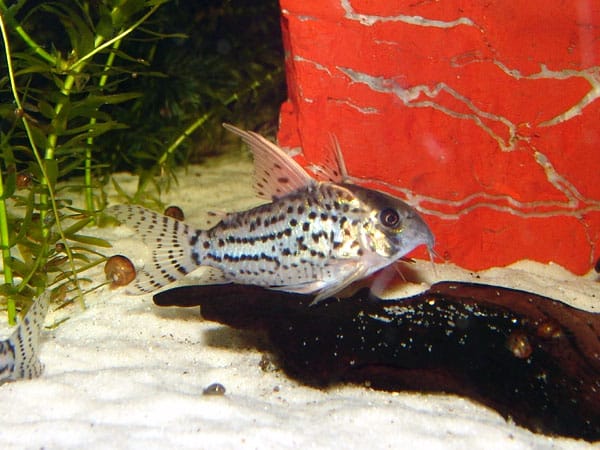
    Three-line cory catfish (Corydoras trilineatus), often sold as julii cory in the aquarium trade
    Three-line cory (Corydoras trilineatus), often sold as julii cory. Photo by h080, CC BY-SA 2.0, via Wikimedia Commons.

    How to Tell Trilineatus from True Julii

    This is the big one. If you bought a “julii cory” from a fish store, you almost certainly have a three-line cory instead. Here’s how to tell them apart:

    Corydoras trilineatus (Three-line Cory / False Julii): The dark spots and lines on the head and body are connected, forming a reticulated, maze-like network. If you look closely at the head and snout, the markings link together into continuous, squiggly lines and chains. The pattern looks like someone drew a complex network of connected pathways across the fish. The dark lateral stripe along the body is typically bold and well-defined.

    Corydoras julii (True Julii): The dark markings are isolated individual dots that do NOT connect to each other. Each spot stands alone with clear space between it and the next spot. The pattern on the head and snout is a scattering of individual, separated dots rather than connected lines. The overall appearance is much “cleaner” and less busy than trilineatus.

    The easiest way to check is to look at the head and snout area. If the dark spots connect into lines or chains, you have trilineatus. If every spot is clearly separated with space between them, you might actually have a true julii. In practice, nearly every fish sold as “julii” in local fish stores and even many online retailers is trilineatus. True C. Julii comes from a more restricted range in northeastern Brazil and is rarely collected for the aquarium trade.

    Male vs. Female

    Sexing three-line cories follows the same general principles as other Corydoras species:

    • Females: Noticeably larger and rounder-bodied than males, especially when viewed from above. Gravid females carrying eggs will look significantly wider. They also are slightly longer overall.
    • Males: Slimmer and slightly smaller than females. When viewed from above, males have a more streamlined body profile. Their pectoral fins are often slightly more pointed compared to the females’ rounder fin shape.

    Sexing is easiest in mature fish that are well-conditioned. If you have a group of 6 or more, the size and body shape differences become obvious when you compare them side by side.

    Average Size & Lifespan

    Three-line cories reach a maximum size of about 2.5 inches (5 to 6 cm) in aquarium conditions. They’re a medium-sized Corydoras, bigger than pygmy or hastatus cories but smaller than the larger species like brochis or emerald cories.

    With proper care, they typically live 5 to 8 years in captivity. Hobbyists have reported individuals living even longer in well-maintained tanks. Good water quality, a proper sand substrate, a varied diet, and keeping them in appropriate groups are the biggest factors in their longevity.

    Care Guide

    Tank Size

    A minimum of 20 gallons (76 liters) is recommended for a group of six three-line cories. While they’re not large fish individually, they need to be kept in groups and they are active bottom foragers that appreciate horizontal swimming space. A 20-gallon long is actually a better choice than a standard 20-gallon tall because of the larger footprint. If you’re building a community tank with midwater and top-dwelling species as well, aim for 30 gallons (114 liters) or more to give everyone enough room.

    Water Parameters

    Parameter Ideal Range
    Temperature 72 to 79ยฐF (22 to 26ยฐC)
    pH 5.8 to 7.2
    Hardness 2 to 15 dGH
    KH 1 to 12 dKH

    Three-line cories are fairly adaptable when it comes to water chemistry. They do best in softer, slightly acidic water that mimics their natural Amazon habitat, but they’ll tolerate a range of conditions as long as parameters remain stable. Consistency matters more than hitting an exact number. Avoid extreme swings in temperature or pH, and keep up with your regular water change schedule.

    Filtration & Water Flow

    A good hang-on-back filter or canister filter rated for your tank size works perfectly. Aim for a turnover rate of about 4 to 6 times the tank volume per hour. Corydoras come from relatively calm waters, so avoid blasting them with strong currents. If your filter output creates too much flow near the bottom, use a spray bar or baffle to diffuse it. A sponge filter makes an excellent supplemental or primary filter for Corydoras tanks, especially for breeding setups.

    Good oxygenation is important. While three-line cories are obligate air breathers that supplement their oxygen intake by gulping air at the surface, well-oxygenated water reduces the frequency of those surface trips and keeps them more comfortable overall.

    Lighting

    Three-line cories are not fussy about lighting. They are more active under moderate to subdued lighting, which makes sense given their natural shaded habitats. If you’re running high-intensity planted tank lights, provide some shaded areas with floating plants, driftwood overhangs, or dense plantings where the cories can retreat. They’ll spend more time out in the open if they have shady spots to duck into when they want a break.

    Plants & Decorations

    A well-decorated tank with plenty of hiding spots keeps Corydoras feeling secure and encourages natural behavior. Good choices include:

    • Driftwood and bogwood for shelter and tannin release
    • Smooth river rocks and caves for hiding spots
    • Java fern, Anubias, and Amazon swords (attach epiphytes to hardscape rather than planting in substrate to avoid root disturbance from foraging)
    • Floating plants like Amazon frogbit or water lettuce to create shaded areas
    • Dried leaf litter (Indian almond leaves, oak leaves) to replicate their natural environment and provide beneficial tannins

    Leave some open areas of substrate for foraging. Corydoras spend a lot of time sifting through sand, and they need clear bottom space to do their thing.

    Substrate

    This is non-negotiable: sand substrate is essential for Corydoras. These fish spend their entire lives on the bottom, constantly probing the substrate with their barbels as they search for food. Rough gravel, sharp-edged substrates, or coarse materials will damage and erode those delicate barbels over time, leading to infections and reduced ability to find food.

    Fine play sand, pool filter sand, or aquarium-specific sand all work well. If you prefer a planted tank substrate like aqua soil, consider creating a sand-only zone in part of the tank specifically for the cories. Watching them bury their snouts in the sand, take a mouthful, and sift it through their gills while searching for food is one of the most entertaining Corydoras behaviors, and they can only do it properly on sand.

    Is the Three-Line Cory Right for You?

    Before you buy, run through this honest checklist. The Three-Line Cory is a great fish for the right keeper, but it is not for everyone.

    • You want a beautifully patterned cory with intricate line markings along the body
    • You can keep a group of 6+ on sand substrate in a 20-gallon or larger tank
    • You want one of the most commonly available and affordable patterned corydoras
    • You do not mind that your fish was probably mislabeled as a Julii Cory at the store
    • Your tank is in the 72 to 79F range with stable, clean water
    • You want a cory that is active during the day, not just hiding under driftwood

    Tank Mates

    Three-line cories are among the most peaceful fish in the hobby. They mind their own business at the bottom of the tank and get along with virtually any non-aggressive community species. Just avoid anything large enough to eat them or aggressive enough to bully them.

    Best Tank Mates

    • Tetras: Neons, cardinals, embers, rummy-noses, and most other small tetras are perfect companions. They occupy different levels of the tank.
    • Rasboras: Harlequin rasboras, chili rasboras, and lambchop rasboras make excellent midwater companions.
    • Other Corydoras: You can mix different Corydoras species, though each species will shoal with its own kind. Keep at least 6 of each species.
    • Small gouramis: Honey gouramis and sparkling gouramis are peaceful top-dwellers that pair nicely with bottom-dwelling cories.
    • Otocinclus: Fellow peaceful bottom feeders that share similar water preferences.
    • Dwarf cichlids: Apistogramma species and German blue rams work well in larger tanks (30+ gallons).
    • Shrimp: Amano shrimp, cherry shrimp, and other dwarf shrimp are completely safe with Corydoras.
    • Snails: Nerite snails, mystery snails, and Malaysian trumpet snails are all compatible.

    Tank Mates to Avoid

    • Large cichlids: Oscars, Jack Dempseys, green terrors, and other predatory cichlids will eat or harass Corydoras.
    • Aggressive bottom dwellers: Red-tailed sharks, rainbow sharks, and aggressive loaches can bully cories off the bottom.
    • Large catfish: Anything big enough to swallow a 2.5-inch fish should be avoided.
    • Fin nippers: Tiger barbs and serpae tetras in small groups can pester cories.

    One thing to keep in mind: Corydoras have venomous spines in their dorsal and pectoral fins. The venom is mild and mainly a defense against predators, but it can cause a painful sting if a larger fish tries to swallow one. This is another reason to avoid housing them with predatory species.

    Food & Diet

    Three-line cories are omnivores and enthusiastic bottom feeders, but they should not be treated as “cleanup crew.” They need their own dedicated feeding, not just whatever scraps fall to the bottom from other fish.

    • Staple: High-quality sinking pellets or wafers specifically designed for bottom feeders. These should form the base of their diet.
    • Frozen foods: Bloodworms, brine shrimp, daphnia, and tubifex worms 2 to 3 times per week. Drop frozen foods near the bottom so they reach the cories before midwater fish intercept them.
    • Live foods: Blackworms, live brine shrimp, and daphnia are excellent for conditioning and bring out natural foraging behavior. Corydoras go absolutely wild over live blackworms.
    • Vegetables: Blanched zucchini, cucumber, or spinach occasionally. They’ll also graze on soft algae growth on surfaces.

    Feeding tip: Feed sinking foods after lights out or during the evening. Corydoras are most active at dawn and dusk, and evening feeding ensures they get their fair share without competition from faster midwater fish. Feed an amount they can consume in about 2 to 3 minutes.

    Breeding & Reproduction

    Breeding Difficulty

    Three-line cories are moderately difficult to breed in captivity. They’re not as easy as bronze or peppered cories, but experienced hobbyists have had success with them. The biggest challenges are triggering spawning behavior and raising the fry through the delicate early stages.

    Spawning Tank Setup

    • A dedicated breeding tank of 10 to 20 gallons (38 to 76 liters) works best
    • Bare bottom or thin layer of fine sand for easy egg management
    • Smooth surfaces for egg deposition: broad-leaved plants (Anubias, Amazon swords), flat rocks, or even the tank glass
    • A gentle sponge filter for filtration without risking eggs or fry
    • Keep lighting moderate to dim

    Water Conditions for Breeding

    • Temperature: 72 to 75ยฐF (22 to 24ยฐC), slightly cooler than normal maintenance temperature
    • pH: 6.0 to 6.5
    • Hardness: 2 to 8 dGH (softer water encourages spawning)
    • A large, cool water change (50% or more, 2 to 4ยฐF cooler than tank temperature) is the classic trigger for Corydoras spawning. This simulates the onset of the rainy season in their natural habitat.

    Conditioning & Spawning

    Condition a breeding group (2 to 3 males per female works well) with heavy feedings of protein-rich live and frozen foods for 1 to 2 weeks. Bloodworms, blackworms, and live brine shrimp are all excellent conditioning foods. Well-conditioned females will visibly plump up with eggs.

    Corydoras are famous for their unique T-position spawning behavior. The female presses her mouth against the male’s genital area, forming a T-shape. She takes sperm into her mouth (the exact fertilization mechanism is still debated by scientists), then swims to a chosen surface, clasps 1 to 4 eggs between her ventral fins, and deposits them on the glass, leaves, or other smooth surfaces. This process repeats many times over several hours, resulting in 50 to 200+ eggs scattered around the tank.

    Egg & Fry Care

    Remove the adults after spawning is complete to prevent egg predation. The adhesive eggs are about 1.5 to 2 mm in diameter and pale white to slightly yellow. They hatch in approximately 3 to 5 days depending on temperature.

    Fungus is the biggest threat to Corydoras eggs. Adding a few drops of methylene blue to the water or placing an Indian almond leaf in the tank helps prevent fungal growth. Remove any eggs that turn white and fuzzy, as fungus will spread to healthy eggs.

    Newly hatched fry will absorb their yolk sac over 2 to 3 days before becoming free-swimming. First foods should be microworms, vinegar eels, or newly hatched brine shrimp (Artemia nauplii). As they grow, gradually transition to crushed sinking pellets and larger frozen foods.

    Common Health Issues

    Barbel Erosion

    This is the most common health problem in Corydoras, and it’s almost always caused by keeping them on rough or sharp substrates. The barbels gradually wear down, shorten, and can become infected. Once the barbels are damaged, the fish has difficulty finding food.

    Prevention: Keep them on fine sand substrate. That’s really all there is to it. If your cories have shortened barbels, switching to sand and maintaining clean water will allow them to regrow over time, though severe cases may not fully recover.

    Ich (White Spot Disease)

    Ich is caused by the protozoan Ichthyophthirius multifiliis and shows up as white spots on the body and fins. Corydoras are susceptible to ich, particularly when stressed from transport or introduction to a new tank.

    Treatment: Be cautious with medications. Corydoras are scaleless fish (they have bony scutes, not true scales) and are sensitive to many common medications, especially copper-based treatments. Use half-dose medications and gradually raise the temperature to 82 to 84ยฐF (28 to 29ยฐC). Salt treatments should be avoided or used at very low concentrations, as cories are salt-sensitive.

    Red Blotch Disease

    Red blotch disease presents as reddish patches on the belly and is relatively common in Corydoras. It’s typically associated with bacterial infections triggered by poor water quality, particularly high nitrate levels or dirty substrates.

    Treatment: Improve water quality immediately with large water changes. In mild cases, pristine water conditions alone can resolve it. More severe cases requires antibacterial treatment, but always use medications cautiously with Corydoras.

    General Prevention

    • Quarantine all new fish for at least 2 weeks before adding to your main tank
    • Maintain clean water with regular 20 to 25% weekly water changes
    • Keep the substrate clean by vacuuming sand gently during water changes
    • Avoid overcrowding and maintain stable water parameters
    • Use medications cautiously and always at reduced doses for Corydoras

    Common Mistakes to Avoid

    • Thinking you have a julii cory: If you bought a “julii cory” from a fish store, look closely at the markings on the head. Connected lines forming a maze pattern? That’s trilineatus. It doesn’t change the care at all, but it’s good to know what you actually have.
    • Using gravel substrate: This is the single biggest care mistake with any Corydoras. Rough gravel erodes their barbels, causes infections, and prevents natural foraging behavior. Always use fine sand.
    • Keeping them alone or in pairs: Corydoras are social fish that need a group of at least 6 to feel secure. A single cory will be stressed, hide constantly, and likely have a shortened lifespan.
    • Relying on leftover food: Treating cories as a “cleanup crew” that survives on scraps is a recipe for underfed, unhealthy fish. They need their own dedicated sinking foods.
    • Panicking about surface breathing: New cory owners often worry when they see their fish dart to the surface for a gulp of air. This is completely normal. Corydoras are obligate air breathers that supplement their oxygen intake through their intestine. They’ll do it regularly regardless of water quality, though increased frequency can indicate low dissolved oxygen.
    • Overdosing medications: Corydoras are sensitive to many common fish medications. Always use half-doses and avoid copper-based treatments and salt when possible.

    Where to Buy

    Three-line cories (usually labeled as “julii cory”) are one of the most widely available Corydoras species. You’ll find them at most local fish stores, though online retailers are often the best source for healthy, well-acclimated specimens:

    • Flip Aquatics. A reliable source for quality freshwater fish with careful shipping practices.
    • Dan’s Fish. Known for healthy, well-acclimated fish and transparent livestock sourcing.

    When purchasing, always buy a group of 6 or more. Most retailers offer better per-fish pricing on larger orders, and your cories will be noticeably happier and more active in a proper group.

    Frequently Asked Questions

    Is my julii cory actually a three-line cory?

    Almost certainly, yes. Look at the markings on the head and snout. If the dark spots connect together into lines or a maze-like pattern, you have Corydoras trilineatus. True C. Julii has isolated, individual dots that never connect. The vast majority of “julii cories” sold in the aquarium trade are actually trilineatus. The care requirements are essentially identical for both species, so it doesn’t change anything about how you keep them.

    How many three-line cories should I keep together?

    A minimum of 6, and more is always better. In groups of 6 or more, they feel secure, display natural shoaling behavior, and spend much more time out in the open foraging. In smaller groups or kept alone, they hide, become stressed, and are more susceptible to health problems.

    Why does my cory keep going to the surface for air?

    This is completely normal behavior. Corydoras are obligate air breathers, meaning they have the ability to absorb oxygen through their intestinal lining. They’ll dart to the surface, take a quick gulp of atmospheric air, and shoot back down to the bottom. Every cory does this throughout the day. However, if you notice the frequency increasing significantly, it is a sign of low dissolved oxygen in the water. Check your aeration and water quality.

    Can I keep three-line cories with shrimp?

    Yes, absolutely. Corydoras are completely safe with all commonly kept shrimp species including cherry shrimp, Amano shrimp, and crystal shrimp. They won’t hunt or bother shrimp at all. They may accidentally bump into shrimp while foraging, but that’s about as aggressive as they get.

    Do three-line cories need sand substrate?

    Yes, sand is strongly recommended and really should be considered a requirement. Corydoras naturally sift through sand with their sensitive barbels, taking mouthfuls of substrate and filtering it through their gills as they search for food. Rough gravel damages their barbels over time, leading to erosion and infections. Fine sand allows them to exhibit their full range of natural behaviors and keeps them healthy long-term.

    Are three-line cories good for beginners?

    Yes, they make excellent beginner fish. They’re hardy, peaceful, tolerant of a range of water conditions, and have loads of personality. The main thing beginners need to get right is providing a sand substrate and keeping them in groups. Beyond that, they’re one of the most forgiving and enjoyable fish you can keep.

    Can I mix different Corydoras species?

    Yes, you can absolutely keep different Corydoras species together in the same tank. However, each species will shoal primarily with its own kind. So if you want to keep three-line cories and panda cories, for example, you should have at least 6 of each species rather than 3 of each. They’ll all share the bottom peacefully, but each species benefits from having its own proper group.

    How the Three-Line Cory Compares to Similar Species

    Three-Line Cory vs. Julii Cory

    The real Julii Cory has isolated spots instead of connected lines, but the care is identical. The Three-Line Cory is far more commonly available and much cheaper. Unless you specifically want the collector bragging rights of a true Julii, the Three-Line Cory gives you the same experience at a fraction of the cost.

    Three-Line Cory vs. Schwartz’s Cory

    Both have bold stripe patterns, but the Schwartz’s Cory has a cleaner, more defined horizontal stripe compared to the reticulated pattern of the Three-Line. Both are hardy and easy to keep. The Three-Line Cory is more commonly available, but the Schwartz’s Cory has a more distinctive look.

    What It Is Actually Like Living With Three-Line Cory

    Three-line cories are among the most visible corydoras in a community tank. While many cory species hug the back corners, three-liners regularly forage across the front glass and out in the open, making them excellent display fish.

    They school tightly and will often rest together in a pile during the afternoon. Finding five or six cories wedged into a corner on top of each other is normal behavior, not a sign of distress.

    Breeding is straightforward with this species. A large water change with slightly cooler water will often trigger spawning within 24 hours. The female carries eggs between her pelvic fins and deposits them on flat surfaces, glass, and plant leaves.

    Their reticulated pattern becomes more defined and bold as they mature. Juvenile three-liners can look somewhat plain, but by the time they reach full size, the network of dark lines across the head and body is genuinely eye-catching.

    Closing Thoughts

    Every “julii cory” you have ever seen at a pet store is almost certainly this fish. That is not a downgrade. The three-line cory is the better community fish.

    The three-line cory is one of those fish that earns its keep in any community tank. They’re constantly active at the bottom, always sifting and foraging, and watching a group of them work their way across a sandy substrate is genuinely entertaining. The identity confusion with the julii cory is just one of those quirks of the hobby that’s been going on for so long it might never get fully sorted out in the trade. But whether you call it a julii, a false julii, or a three-line cory, the fish itself is fantastic.

    Give them sand, keep them in a group, feed them well, and they’ll reward you with years of personality and bottom-dwelling charm. If you’re setting up a community tank and need a reliable, peaceful bottom dweller with a great pattern and tons of character, the three-line cory is hard to beat.

    Check out our corydoras tier list video where we rank the most popular cory catfish in the hobby:

    References

    1. Seriously Fish, Corydoras trilineatus species profile. seriouslyfish.com
    2. FishBase, Corydoras trilineatus (Cope, 1872). fishbase.se
    3. The Aquarium Wiki, Corydoras trilineatus. theaquariumwiki.com
    4. Practical Fishkeeping, Corydoras care and species identification guides. practicalfishkeeping.co.uk
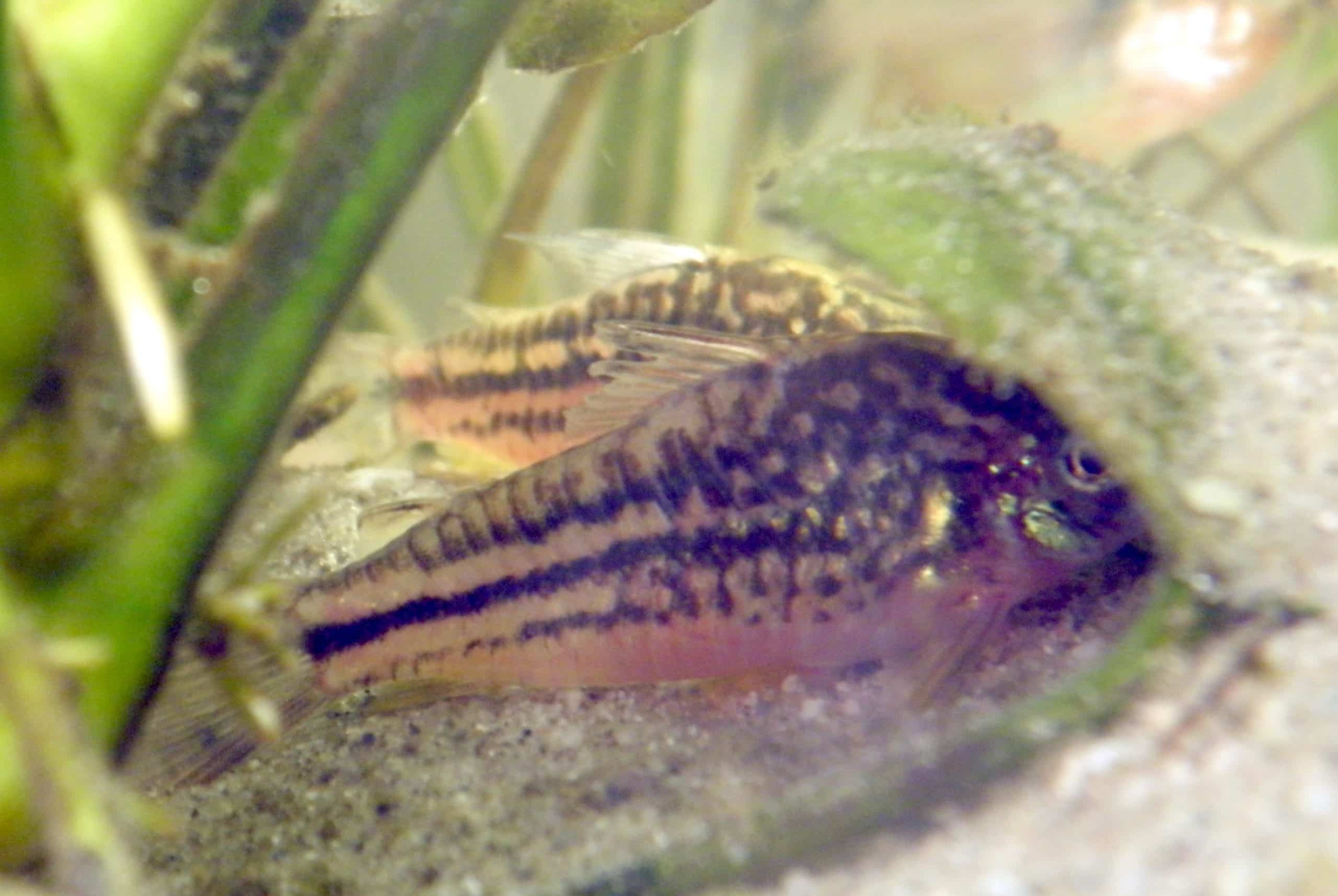
  • Sterbai Cory Care Guide: The Best Cory for Warm Water Tanks

    Sterbai Cory Care Guide: The Best Cory for Warm Water Tanks

    Table of Contents

    The sterbai cory is one of the few corydoras that actually thrives in warm water above 77F. If you keep discus, German blue rams, or any other warm-water species and want a bottom dweller, this is the one everyone recommends. And most of those recommendations still forget to mention that sand substrate is non-negotiable. The sterbai is an active substrate forager, and gravel will destroy its barbels faster than less active species.

    In a warm, well-maintained tank with sand and a group of six or more, sterbai corys are beautiful, active, and display striking spotted patterning with orange pectoral fin spines. This guide covers what actually matters for keeping them, because the sterbai cory is the one cory you can keep with discus. It is also the one that will punish you fastest for using gravel.

    Sand substrate, warm water, group of six. Get all three right and the sterbai cory is one of the best bottom dwellers in the hobby. Miss any one and you will have problems.

    What Most Care Guides Get Wrong About the Sterbai Cory

    The Sterbai Cory is one of the few corydoras that actually prefers warmer water, and most guides completely gloss over this. It thrives at 77 to 84F, making it the best cory for discus tanks and other warm-water setups where species like the Peppered or Panda Cory would suffer. The misconception is that all corys have the same temperature needs. They do not. The other mistake is putting Sterbai Corys on rough gravel and wondering why their barbels erode. Like all corydoras, they need sand. But the Sterbai is particularly active foraging through substrate, so smooth sand matters even more here.

    Keeping sterbai cories means running your tank warmer than most other cories tolerate. They thrive at 77 to 84F, which puts them in rare territory. If you keep discus, rams, or other warm water species, the sterbai is your bottom dweller.

    This guide is part of our Corydoras: Complete A-Z Species Directory. Browse all corydoras species we have profiled.

    What really sets the sterbai cory apart from most other corydoras, though, is its tolerance for warmer water. Most corys prefer things on the cooler side, but sterbai thrive at temperatures up to 86ยฐF (30ยฐC). That makes them the go-to cory for discus tanks and other warm water setups where peppered or bronze corys would struggle. In my 25+ years in the hobby, I’ve seen them become one of the most popular corydoras species for good reason. Here’s everything you need to know to keep them healthy and thriving.

    Every other cory wilts at discus temperatures. The sterbai was built for it.

    The Reality of Keeping Sterbai Cory

    The sterbai cory occupies a unique niche that no other commonly available corydoras fills. Most cories prefer temperatures below 78F, which makes them incompatible with warm water setups. The sterbai actually prefers the upper 70s to low 80s, making it the default choice for discus communities, German blue ram tanks, and other heated setups.

    They are not cheap. Sterbai cories typically cost three to five times what bronze or peppered cories run, and for good reason. They are harder to breed commercially, they grow more slowly, and the demand consistently outpaces supply. Budget for a group of six at the outset rather than trying to add them one at a time.

    Color development takes time. Juvenile sterbai cories look nice but nothing spectacular. It takes six to eight months of good feeding and stable warm water for the full spotted pattern and those signature orange pectoral spines to develop. Patience pays off with this species.

    Biggest Mistake New Owners Make

    Mixing them with cold water cories. I have seen people keep sterbai and peppered cories in the same tank, compromising on a middle temperature that suits neither species. Pick your cory based on your temperature range first, then build around it.

    Expert Take

    If you are running a discus tank and want a bottom dweller, stop searching. The sterbai cory is the answer. I have kept them alongside discus at 82-84F and they thrive. No other commonly available cory handles those temperatures without showing stress. The orange pectoral spines also complement the warm tones of most discus varieties beautifully.

    Key Takeaways

    • The warm water cory, tolerating temperatures up to 86ยฐF (30ยฐC), making it the best corydoras for discus and other heated community tanks
    • Bright orange pectoral fin spines are the signature feature, paired with a striking white-on-dark head pattern
    • Sand substrate is essential, as gravel can damage their delicate barbels and prevent natural foraging behavior
    • Keep in groups of 6 or more in a minimum 20-gallon (76 liter) tank for proper social behavior
    • Widely captive-bred and readily available, though breeding at home is moderately challenging
    Map showing the Amazon River Basin in South America
    Map by Kmusser, CC BY-SA 3.0, via Wikimedia Commons

    Species Overview

    Field Details
    Scientific Name Hoplisoma sterbai (formerly Corydoras sterbai)
    Common Names Sterbai Cory, Sterba’s Cory, Sterbai Corydoras
    Family Callichthyidae
    Origin Upper Rio Guaporรฉ, central Brazil (Mamorรฉ river basin)
    Care Level Easy to Moderate
    Temperament Peaceful
    Diet Omnivore
    Tank Level Bottom
    Maximum Size 2.5 inches (6 to 7 cm)
    Minimum Tank Size 20 gallons (76 liters)
    Temperature 75 to 86ยฐF (24 to 30ยฐC)
    pH 6.0 to 7.6
    Hardness 0 to 15 dGH
    Lifespan 5 to 8 years
    Breeding Egg depositor (T-position spawning)
    Breeding Difficulty Moderate
    Compatibility Community
    OK for Planted Tanks? Yes

    Classification

    Taxonomic Level Classification
    Order Siluriformes
    Family Callichthyidae
    Subfamily Corydoradinae
    Genus Hoplisoma (reclassified from Corydoras, Dias 2024)
    Species H. Sterbai (Knaack, 1962)

    This species was originally described by Joachim Knaack in 1962 and named in honor of Dr. Gรผnther Sterba, the German ichthyologist and author of the classic reference book Freshwater Fishes of the World. For decades, it was known as Corydoras sterbai, and you’ll still see that name on practically every retailer’s website and in most aquarium literature.

    Note on taxonomy: In 2024, a major phylogenetic revision by Dias et al. Split the massive genus Corydoras into multiple genera. The sterbai cory was reassigned to Hoplisoma. This reclassification affects a large number of commonly kept corydoras species. The hobby is still catching up, and most fish stores and databases continue to use Corydoras sterbai. Both names refer to the same fish.

    Origin & Natural Habitat

    Map of the Amazon River basin in South America highlighting the native range of the sterbai cory in central Brazil
    Map of the Amazon River basin, South America. The sterbai cory is native to the upper Rio Guaporรฉ within this drainage system.

    The sterbai cory is native to the upper Rio Guaporรฉ (also known as the Rรญo Itรฉnez) in central Brazil, which is part of the larger Mamorรฉ river basin within the Amazon drainage. This region sits along the border between Brazil and Bolivia, in an area characterized by tropical forest and seasonal flooding.

    In the wild, sterbai corys inhabit slow-moving tributaries, flooded forest areas, and shallow streams with sandy or muddy bottoms. The water is typically warm, soft, and slightly acidic, with plenty of leaf litter and submerged wood creating shaded refuges. Seasonal rains cause water levels to fluctuate significantly, and these fish are adapted to handling changing conditions. The consistently warm temperatures of their native range explain why sterbai tolerate higher temperatures than most other corydoras species.

    The substrate in their natural habitat is fine sand mixed with decomposing leaves and organic debris. They spend their time sifting through this material for insect larvae, worms, and other small food items. This foraging behavior is hardwired, which is why providing sand substrate in the aquarium isn’t just a preference, it’s a necessity.

    Appearance & Identification

    Sterbai cory catfish showing distinctive white spots on dark head and bright orange pectoral fin spines
    Sterbai cory. Photo by Matthew Mannell, Public domain, via Wikimedia Commons

    The sterbai cory is one of the most recognizable corydoras species thanks to its bold patterning and colorful fin spines. The head and front portion of the body feature a dark brown to black base covered in prominent white or cream-colored spots. As you move toward the tail, the pattern reverses. The rear body shows a lighter base with dark brown spots and a reticulated (net-like) pattern. This reversal is one of the easiest ways to distinguish sterbai from similar looking species like the julii cory (Corydoras julii) and the three-lined cory (Corydoras trilineatus), which have the opposite arrangement with dark spots on a lighter head.

    But the real showstopper is the pectoral fin spines. They’re a bright orange to deep yellow color that contrasts beautifully against the darker body. This coloration is present in both wild-caught and captive-bred specimens, though well-conditioned fish with a varied diet show the most vivid orange. No other commonly available cory has this level of color in the fins, and it’s the feature that makes sterbai instantly recognizable.

    The body shape is typical of the genus, compact and armored with two rows of overlapping bony plates (scutes) along each flank. They have the signature corydoras face with downturned mouth and two pairs of barbels used for sensing food in the substrate.

    An albino variant is also available in the hobby. Albino sterbai lack the dark pigmentation, showing a pale cream to pinkish body, but they retain the distinctive orange pectoral fin spines. They require identical care to the wild-type form.

    Male vs. Female

    Sexing sterbai corys is straightforward once they reach maturity. Females are noticeably larger and rounder when viewed from above, especially when carrying eggs. They have a wider, more robust body compared to males. Males are slimmer, slightly smaller, and have a more streamlined profile. When viewed from the front, females look significantly wider across the pectoral area. Both sexes display the same coloration and pattern, so body shape is the primary way to tell them apart.

    Average Size & Lifespan

    Sterbai corys reach a maximum size of about 2.5 inches (6 to 7 cm) in total length. Females are slightly larger than males. They’re a medium-sized corydoras, bigger than pygmy corys but smaller than the larger brochis species. Most fish sold in stores are juveniles around 1 to 1.5 inches, so give them time to fill out.

    With proper care, sterbai corys live 5 to 8 years in captivity. Reaching the upper end of that range depends on consistent water quality, a good diet, and avoiding chronic stress from incompatible tank mates or poor substrate choices. Wild-caught specimens sometimes have a harder time acclimating initially, but captive-bred sterbai are quite resilient once established.

    Care Guide

    Tank Size

    A 20-gallon (76 liter) tank is the minimum for a group of 6 sterbai corys. A 20-gallon long is ideal because it provides more bottom surface area than a standard 20-gallon tall, and that floor space is what matters for bottom-dwelling fish. If you’re planning a larger group of 10 or more, or want to keep them with other bottom feeders, step up to a 30-gallon (114 liter) or bigger. More floor space always means less competition and more comfortable fish.

    Water Parameters

    Parameter Recommended Range
    Temperature 75 to 86ยฐF (24 to 30ยฐC)
    pH 6.0 to 7.6
    Hardness 0 to 15 dGH
    Ammonia / Nitrite 0 ppm
    Nitrate Below 20 ppm

    The warm temperature tolerance is what makes sterbai corys special. While most corydoras species prefer the 72 to 78ยฐF range, sterbai comfortably handle temperatures up to 86ยฐF (30ยฐC). This is why they’re the number one corydoras recommendation for discus tanks. The discus community has essentially adopted sterbai as their default bottom-dwelling companion because few other corys can handle that kind of sustained warmth.

    Keep the water clean and well-oxygenated. Sterbai are obligate air breathers, meaning they regularly dart to the surface to gulp air. This is completely normal behavior and not a sign of low oxygen. However, if you see them doing it constantly rather than occasionally, that can indicate poor water quality or insufficient oxygen levels.

    Filtration & Water Flow

    A good hang-on-back filter or canister filter works well for sterbai corys. They don’t need strong flow and actually prefer moderate to gentle water movement along the bottom. Strong currents can stress bottom dwellers by making it harder for them to rest and forage. If you’re running a canister filter, angle the output toward the surface to improve gas exchange without blasting the substrate level. A sponge filter works too and has the added benefit of not creating a strong current while still providing excellent biological filtration.

    Lighting

    Sterbai corys don’t have specific lighting requirements. They’re most active during dawn, dusk, and nighttime in the wild, so they appreciate not being blasted with intense light all day. If you’re running a planted tank with higher lighting, make sure there are shaded areas where they can retreat. Floating plants are great for diffusing light and creating the dappled effect you’d see in their natural habitat.

    Plants & Decorations

    Sterbai corys are completely plant-safe and do well in planted tanks. They won’t dig up rooted plants or eat foliage. Good plant choices include java fern, anubias, amazon swords, and cryptocorynes. Floating plants like Amazon frogbit or red root floaters provide welcome shade.

    For hardscape, driftwood and smooth rocks give them places to rest and explore. Avoid anything with sharp edges that could damage their barbels or underbelly. PVC pipes and coconut caves make excellent hiding spots, especially if you’re hoping for breeding behavior. They like having retreat options, particularly when they’re new to a tank.

    Substrate

    This is non-negotiable: sand substrate is essential for sterbai corys. Fine, smooth sand (play sand, pool filter sand, or aquarium-specific sand) is the only appropriate choice. These fish spend their entire lives sifting through the substrate with their sensitive barbels, and rough or coarse gravel will wear those barbels down to nubs over time. Damaged barbels make it difficult for them to find food and can lead to secondary infections.

    Watching corys sift sand through their gills is one of the most satisfying things in the hobby. They take a mouthful of sand, filter out the food particles, and expel the clean sand through their gill plates. You can’t replicate that natural behavior on gravel. If you have a gravel substrate and want to keep corys, you can always add a sandy area to one section of the tank, though a full sand bottom is always the better option.

    Is the Sterbai Cory Right for You?

    Before you buy, run through this honest checklist. The Sterbai Cory is a great fish for the right keeper, but it is not for everyone.

    • You keep a warm-water tank (77 to 84F) and need a cory that actually thrives in heat
    • You have a discus tank and want a compatible bottom dweller
    • You can provide sand substrate for active foraging behavior
    • You want one of the most visually striking corydoras with spotted body and orange pectoral fins
    • You can keep a group of 6+ in a 20-gallon or larger tank
    • You appreciate a premium cory that justifies its higher price tag with looks and personality

    Tank Mates

    Sterbai corys are about as peaceful as it gets. They completely ignore other fish and focus entirely on the bottom of the tank. The main consideration when choosing tank mates is matching their warm temperature preference, since they thrive at the higher end of the tropical range.

    Best Tank Mates

    • Discus, the classic pairing and the main reason many people buy sterbai corys
    • Cardinal tetras and rummy-nose tetras, both handle warmer water well
    • German blue rams and Bolivian rams, peaceful dwarf cichlids that share similar water preferences
    • Hatchetfish, top-dwelling fish that stay out of the corys’ way completely
    • Bristlenose plecos, another bottom dweller that coexists peacefully
    • Otocinclus, peaceful algae eaters that do fine at warmer temperatures
    • Other sterbai corys, they’re social fish and bigger groups are always better

    Tank Mates to Avoid

    • Large or aggressive cichlids (oscars, jack dempseys, green terrors) that will harass or eat them
    • Aggressive bottom dwellers like red-tailed catfish or large loaches that compete for territory
    • Cold water fish (goldfish, white cloud mountain minnows, rosy barbs) that need temperatures well below the sterbai’s comfort zone
    • Any fish large enough to swallow them, corydoras have sharp, lockable pectoral fin spines that can injure predators and cause choking

    Food & Diet

    Sterbai corys are true omnivores and not at all picky about food. In the wild, they forage through sandy substrate for insect larvae, worms, small crustaceans, and organic debris. In the aquarium, they’ll accept practically anything that reaches the bottom.

    A quality sinking pellet or wafer should form the base of their diet. Hikari sinking wafers, Repashy gel foods, and similar products all work well. Supplement with frozen or live foods like bloodworms, brine shrimp, tubifex worms, and daphnia. These protein-rich foods are especially important if you’re conditioning them for breeding.

    One important note: don’t assume your corys are getting enough food just because you’re feeding the tank. In a community setup, faster midwater fish often eat most of the food before it hits the bottom. Feed sinking foods after lights out, or target-feed your corys by dropping pellets near their favorite resting spots. Watching a group of sterbai swarm a freshly dropped wafer is genuinely entertaining.

    Breeding & Reproduction

    Breeding sterbai corys is moderately difficult. They’re not as easy to spawn as bronze or peppered corys, but experienced hobbyists regularly breed them. The fact that so many captive-bred sterbai are available in the trade tells you it’s definitely achievable with the right setup and patience.

    Breeding Difficulty

    Moderate. Sterbai corys need specific triggers to spawn, and raising the fry requires attention to water quality and appropriate foods. They’re not a “leave them alone and find babies” species for most setups, but they’re well within reach for hobbyists willing to put in the effort.

    Spawning Tank Setup

    A dedicated breeding tank of 10 to 20 gallons works best. Use a bare bottom or thin layer of fine sand for easy egg collection. Include smooth surfaces like glass, slate tiles, or broad plant leaves where the female can deposit eggs. A sponge filter provides gentle filtration without risking fry being sucked in. Keep the tank dimly lit and provide a few hiding spots to reduce stress.

    Water Conditions for Breeding

    The classic trigger for corydoras breeding is a large, cool water change that simulates the onset of the rainy season. Drop the temperature by 4 to 6ยฐF from the normal range using cooler, fresh water. Maintain soft, slightly acidic water (pH around 6.5, hardness below 8 dGH) for the best results. Some breeders perform 50% to 70% water changes with cooler water over several days to trigger spawning.

    Conditioning & Spawning

    Condition breeding groups (ideally 2 males per female) with heavy feedings of protein-rich live and frozen foods for 2 to 3 weeks before attempting to trigger spawning. Bloodworms, blackworms, and brine shrimp are all excellent conditioning foods.

    When ready to spawn, sterbai corys use the classic corydoras “T-position.” The male positions himself perpendicular to the female, who cups her pelvic fins to hold a small batch of eggs. The female then swims to a chosen surface (glass, plant leaf, or flat stone) and carefully deposits the adhesive eggs. This process repeats over several hours, with the female placing eggs individually or in small clusters across multiple surfaces. A single spawning can produce 50 to 200 eggs.

    Egg & Fry Care

    Remove either the eggs or the adults after spawning, because corydoras will eat their own eggs. Many breeders carefully scrape the eggs off surfaces with a razor blade or credit card and transfer them to a separate hatching container with matching water parameters. Adding a few drops of methylene blue helps prevent fungal growth on the eggs.

    Eggs hatch in 3 to 5 days depending on temperature. The newly hatched fry absorb their yolk sacs over the next 2 to 3 days. Once free-swimming, feed them microworms, baby brine shrimp (BBS), and finely powdered fry food. Keep the rearing tank immaculately clean with daily water changes of 10% to 20%. Growth is steady, and fry begin to show adult coloration at around 8 to 10 weeks.

    Common Health Issues

    Barbel Erosion

    This is the most common issue with corydoras and it’s almost always caused by keeping them on rough substrate. Sharp gravel, crushed coral, or even coarse sand grinds down their sensitive barbels over time. Severely eroded barbels make it nearly impossible for them to find food. The fix is simple: use fine, smooth sand. If you notice barbel damage, switch substrates and the barbels will often regrow partially over time. Bacterial infections in dirty substrate can accelerate barbel loss, so keep the sand clean.

    Ich (White Spot Disease)

    Sterbai corys can contract ich, though their warm temperature preference actually works in their favor here. Since they tolerate 86ยฐF (30ยฐC), you can use the heat treatment method (raising temperature to 86ยฐF for 10 to 14 days) without stressing the fish. Many hobbyists prefer this over medication because corydoras and other scaleless fish are sensitive to common ich medications containing copper or malachite green. If you do use medication, dose at half strength and monitor closely.

    Bacterial Infections

    Red blotches on the belly, frayed fins, or cloudy eyes can indicate bacterial infections. These are almost always secondary to poor water quality or injuries from rough substrate. Maintain pristine water conditions, keep nitrates low, and address any substrate issues. Mild infections often resolve with clean water alone. For more serious cases, broad-spectrum antibacterial treatments designed for catfish are available.

    General Prevention

    Quarantine all new fish for at least two weeks before adding them to an established tank. Keep the substrate clean by gently stirring the sand during water changes to prevent pockets of anaerobic bacteria. Maintain stable water parameters and perform weekly water changes of 25% to 30%. Sterbai corys are hardy fish, and most health issues come down to substrate choice and water quality.

    Common Mistakes to Avoid

    • Using gravel instead of sand, this is the single biggest mistake people make with corydoras. Gravel destroys their barbels and prevents their natural sifting behavior. Always use fine, smooth sand.
    • Keeping too few, sterbai corys are social fish that need a group of at least 6 to feel secure. Lone corys or pairs often hide constantly, refuse to eat well, and live shorter lives.
    • Assuming they eat leftovers, corys are not just “cleanup crew.” They need dedicated feedings with sinking foods, especially in community tanks where faster fish intercept everything before it reaches the bottom.
    • Forgetting about their venomous spines, sterbai corys have sharp, mildly venomous pectoral fin spines that they lock out when stressed. Never net them with fine mesh nets (the spines get tangled). Use a plastic container or coarse mesh net instead.

    Where to Buy

    Sterbai corys are one of the most popular corydoras species in the hobby, and you can find captive-bred specimens at many local fish stores. They typically run $8 to $15 per fish depending on size, with discounts often available on groups of 6 or more. Wild-caught specimens are occasionally available but are more expensive and less common now that captive breeding is well established.

    For the healthiest stock and best selection, I’d recommend checking Flip Aquatics or Dan’s Fish. Online specialty retailers will ship healthier, better-conditioned fish than what you’ll find at chain pet stores, and they often carry both wild-type and albino variants.

    Frequently Asked Questions

    Can sterbai corys live with discus?

    Yes, this is actually the ideal pairing. Sterbai corys are one of the only corydoras species that comfortably tolerate the warm temperatures discus require (82 to 86ยฐF). They clean up fallen food from the substrate without bothering the discus at all. It’s one of the most popular combinations in the hobby for good reason.

    How many sterbai corys should I keep together?

    A minimum of 6, but more is always better. In groups of 8 to 10 or more, they display much more active, confident behavior. You’ll see them foraging together in a little swarm across the bottom of the tank rather than hiding individually behind decorations.

    Why does my sterbai cory keep going to the surface?

    This is completely normal. Sterbai corys (and all corydoras) are obligate air breathers. They regularly dart to the surface, gulp a bubble of air, and process it through a modified section of their intestine. Occasional trips to the surface are healthy behavior. However, if they’re doing it constantly (every few seconds), check your water quality and oxygen levels because that could indicate a problem.

    Do sterbai corys need sand substrate?

    Yes, absolutely. Sand isn’t a nice-to-have, it’s a requirement. Their barbels are designed for sifting through fine substrate, and coarse gravel will damage and erode them over time. Fine play sand, pool filter sand, or dedicated aquarium sand all work perfectly. This is the most important single thing you can do for any corydoras species.

    What is the difference between sterbai and julii corys?

    The pattern is essentially reversed. Sterbai corys have white spots on a dark head, while julii corys (and the much more commonly sold three-lined cory, Corydoras trilineatus) have dark spots on a lighter head. Sterbai also have those distinctive bright orange pectoral fin spines, which neither julii nor trilineatus possess. Additionally, sterbai tolerate significantly warmer water than either of those species.

    Are sterbai corys venomous?

    Their pectoral fin spines deliver a mild venom that can cause a sharp, stinging sensation if you get poked. It’s not dangerous to humans, but it’s definitely unpleasant. This is why you should never handle corys with your bare hands or use fine mesh nets that can tangle with their spines. Use a plastic cup or container when moving them. The spines are a defense mechanism, and sterbai will lock them out when they feel threatened.

    How the Sterbai Cory Compares to Similar Species

    Sterbai Cory vs. Adolfoi Cory

    Both are warm-water corys, but the Adolfoi is even more heat-tolerant and slightly more expensive. The Sterbai has the iconic spotted pattern with orange fins, while the Adolfoi has a cleaner black-and-white banded look. Both work perfectly in discus tanks. The Sterbai is easier to find and usually less expensive.

    Sterbai Cory vs. Bronze Cory

    The Bronze Cory is the budget-friendly, bulletproof option, but it does not handle heat as well as the Sterbai. For tropical community tanks above 78F, the Sterbai is the clear winner. For cooler or room-temperature setups, the Bronze Cory is perfectly fine and much cheaper.

    What It Is Actually Like Living With Sterbai Cory

    Sterbai cories are active foragers that spend most of the day working the substrate in coordinated groups. They are bolder than many cory species and will come out into open areas rather than sticking to the shadows.

    In a warm water tank, their metabolism runs high, which means they eat more than you might expect. Sinking wafers alone will not cut it. They need supplemental frozen bloodworms, brine shrimp, or high-quality pellets to maintain body condition and color.

    Watch a group of sterbai cories under good lighting and you will see the spotted pattern shift and shimmer as they move. Each fish has a slightly different spot arrangement, which makes individual identification possible once you learn to look for it.

    They produce audible clicks when you net them or when they feel threatened. It is a stress response using pectoral fin spine stridulation, and it always catches new keepers off guard. If you hear clicking, your cories are telling you they are unhappy about something.

    Closing Thoughts

    The Sterbai Cory is the only corydoras that belongs in a discus tank. Stop putting Peppered Corys in 84F water.

    The sterbai cory has earned its spot as one of the most popular corydoras in the hobby, and it’s easy to see why. That combination of stunning looks, warm water tolerance, and peaceful temperament makes it the perfect bottom dweller for a huge range of community setups. Whether you’re building a discus tank and need a compatible cory, or you simply want a beautiful bottom-dwelling fish that’s entertaining to watch, sterbai should be at the top of your list.

    Give them sand, keep them in a proper group, feed them well, and they’ll reward you with years of active foraging, that signature orange flash, and some of the most entertaining social behavior you’ll see from any catfish. They’re the kind of fish that makes you pay attention to the bottom of the tank.

    Have you kept sterbai corys? I’d love to hear about your experience, drop a comment below!

    Check out our corydoras tier list video where we rank the most popular cory catfish in the hobby:

    References

  • Peppered Cory Care Guide: The Cold-Hardy Classic

    Peppered Cory Care Guide: The Cold-Hardy Classic

    Table of Contents

    The peppered cory is one of the few corydoras that genuinely prefers cooler water, thriving between 64 and 75F. Most people keep it in heated tropical setups at 78 or higher, which stresses the fish, shortens its lifespan, and dials back the activity that makes it worth keeping. It is one of the hardiest corys available, but only when you stop overheating it.

    In a room-temperature tank with sand substrate and a group of six or more, peppered corys are active, social, and display attractive dark speckling over a bronze-silver body. This guide covers the temperature range that actually works, because the peppered cory prefers room temperature. Stop heating its tank to 78.

    If your peppered corys seem sluggish and dull, check your heater. The answer is usually that the tank is too warm.

    What Most Care Guides Get Wrong About the Peppered Cory

    The biggest misconception about the Peppered Cory is temperature. Most care guides list it as a tropical fish needing 75 to 80F water. That is wrong. This is one of the most cold-tolerant corydoras, thriving in water as cool as 64F. In fact, it does better in cooler water than most other corys. The second mistake is substrate. Sharp gravel will destroy their barbels over time, and once those barbels are damaged, the fish cannot forage properly. Smooth sand is not optional for this species. It is essential.

    Keeping peppered cories means providing cooler water than most tropical fish prefer. If your tank sits at 78-80F year-round, pick a different cory. These fish perform best at 65 to 74F, and pushing them into warmer water shortens their lifespan.

    This guide is part of our Corydoras: Complete A-Z Species Directory. Browse all corydoras species we have profiled.

    What makes the peppered cory stand out from the dozens of other corydoras in the hobby is its cold water tolerance. Most tropical fish need a heater, but peppered corys can thrive in temperatures as low as 64ยฐF (18ยฐC). That opens up a whole world of unheated tank possibilities that most corys simply can’t handle. Whether you’re a complete beginner or a seasoned hobbyist looking for a reliable bottom dweller, this fish deserves a serious look.

    The Reality of Keeping Peppered Cory

    The peppered cory is arguably the hardiest corydoras in the entire genus. I have seen them tolerate temperature swings, pH shifts, and beginner mistakes that would stress most other cories into illness. That does not mean you should test their limits, but it does mean they are incredibly forgiving fish for new keepers.

    Their cold tolerance is the standout feature. Most care guides list them as tropical fish, but peppered cories naturally come from subtropical streams in South America where water temperatures drop into the low 60s during winter. They are one of the few cories you can keep in an unheated tank in a temperature-controlled home.

    Color and pattern intensity varies wildly between individuals. Some peppered cories have bold, dark speckles across their entire body. Others are much lighter and more washed out. This is largely genetic, but diet and substrate color play a role. Dark substrates and a varied diet with frozen foods bring out the best patterning.

    Biggest Mistake New Owners Make

    Keeping them in tanks that are too warm. I see it constantly. Someone buys peppered cories for a 78F community tank with discus or angelfish, and wonders why they seem lethargic and short-lived. These fish need cooler water. Pair them with white clouds, hillstream loaches, or other subtropical species.

    Expert Take

    The peppered cory is my go-to recommendation for anyone who keeps a room-temperature tank without a heater. In a 68-72F setup with some white cloud minnows and a few cherry shrimp, peppered cories are in their absolute element. They become noticeably more active and their colors sharpen when the water is on the cooler side.

    Key Takeaways

    • One of the hardiest corydoras available, tolerating temperatures as low as 64ยฐF (18ยฐC), making them suitable for unheated tanks
    • Keep in groups of 6 or more in a minimum 20-gallon tank with a sand substrate to protect their delicate barbels
    • Among the easiest corydoras to breed in home aquariums, with cold water changes simulating rainfall to trigger spawning
    • Peaceful bottom dwellers that work well with nearly any community fish that won’t fit them in its mouth
    • Obligate air breathers that dash to the surface to gulp air, which is completely normal behavior and not a sign of distress
    Map showing the Amazon River Basin in South America
    Map by Kmusser, CC BY-SA 3.0, via Wikimedia Commons

    Species Overview

    Field Details
    Scientific Name Hoplisoma paleatum (formerly Corydoras paleatus)
    Common Names Peppered Cory, Peppered Catfish, Peppered Corydoras, Salt and Pepper Cory
    Family Callichthyidae
    Origin La Plata basin, South America (Brazil, Paraguay, Uruguay, Argentina)
    Care Level Easy
    Temperament Peaceful
    Diet Omnivore (bottom feeder)
    Tank Level Bottom
    Minimum Tank Size 20 gallons (76 liters)
    Temperature 64 to 77ยฐF (18 to 25ยฐC)
    pH 6.0 to 8.0
    Hardness 2 to 20 dGH
    Lifespan 5 to 8 years in captivity
    Breeding Egg depositor
    Maximum Size 2.5 inches (5 to 7 cm)
    Breeding Difficulty Easy
    Compatibility Peaceful community
    OK for Planted Tanks? Yes

    Classification

    Taxonomic Level Classification
    Order Siluriformes
    Family Callichthyidae
    Subfamily Corydoradinae
    Genus Hoplisoma (reclassified from Corydoras; Dias et al. 2024)
    Species H. Paleatum (Jenyns, 1842)

    If you’re wondering why you still see this fish listed as Corydoras paleatus everywhere, it’s because the reclassification is very recent. In 2024, Dias and colleagues published a major revision of the Corydoradinae subfamily, splitting the massive Corydoras genus into several smaller genera. The peppered cory was moved to Hoplisoma along with many other popular species. Most retailers and hobbyists still use the old name, so you’ll see both in the trade for years to come.

    Origin & Natural Habitat

    Peppered corys are native to the La Plata basin in South America, spanning the Paraguay, Parana, and Uruguay river systems across Brazil, Paraguay, Uruguay, and Argentina. This is a massive drainage that covers a huge swath of southern South America, and it includes some surprisingly cool, subtropical climates. That’s the key to understanding why this species handles cold water so well compared to most tropical fish.

    Map of the Paraguay River basin in South America showing the native range of the peppered cory
    Paraguay River basin, part of the greater La Plata drainage. Map by Kmusser, CC BY-SA 3.0, via Wikimedia Commons.

    In the wild, peppered corys inhabit slow-moving rivers, tributaries, streams, and floodplain pools with sandy or muddy bottoms. They’re typically found in shallow, well-vegetated areas where fallen leaves and organic debris accumulate. Water conditions in their native range vary widely, from soft and slightly acidic to moderately hard and alkaline, which explains their remarkable adaptability in captivity. These fish have also been introduced to waters outside their native range, including parts of the United States, making them one of the most widely distributed corydoras in the world.

    Appearance & Identification

    Peppered cory catfish resting on the bottom of an aquarium showing its distinctive dark spots and markings
    Peppered cory. Photo by NiKo, Public domain, via Wikimedia Commons.

    The peppered cory gets its name from the dark, irregular splotches and speckles that cover its olive to tan body. Think of it like someone scattered black pepper across a pale background. The pattern is unique to each fish, which is pretty cool once you start recognizing individuals in your school. The body has that classic corydoras shape: a flat belly, arched back, and armored plates (called scutes) running along the sides instead of traditional scales.

    A dark band runs vertically through each eye, and the dorsal fin features a prominent dark blotch that’s one of the easiest identification markers. The fins are mostly clear to slightly yellowish with faint dark spotting. Under good lighting and water conditions, you’ll sometimes catch a subtle greenish or bronze iridescence along the flanks.

    You’ll also find albino and longfin variants in the trade. The albino form has a pale pinkish-white body with red eyes and retains faint hints of the peppered pattern. The longfin variant has flowing, elongated fins that give the fish a more dramatic look. Both are the same species with the same care requirements and temperament, so everything in this guide applies to them as well.

    Male vs. Female

    Sexing peppered corys is straightforward once you know what to look for. Females are noticeably larger and wider when viewed from above, especially when they’re carrying eggs. They have a rounder, plumper body shape overall. Males are slimmer, slightly smaller, and have a more pointed dorsal fin. The easiest time to tell them apart is when the females are full of eggs and look like little submarines compared to the more streamlined males.

    Average Size & Lifespan

    Peppered corys reach about 2.5 inches (5 to 7 cm) in aquariums. Females will max out slightly larger than males. They’re a medium-sized corydoras, bigger than pygmy or habrosus corys but smaller than the giant brochis types.

    With proper care, peppered corys live 5 to 8 years. There are reports from hobbyists of individuals pushing past 10 years in well-maintained tanks with stable water quality and a good diet. That’s a solid commitment for a small catfish, and it means you’ll have these little guys scurrying around the bottom of your tank for years to come.

    Care Guide

    Tank Size

    A 20-gallon (76-liter) tank is the minimum for a group of 6 peppered corys. These are active bottom dwellers that need enough floor space to forage, and a 20-gallon long is ideal because it prioritizes footprint over height. If you’re building a community setup, stepping up to a 30 or 40 gallon gives everyone more room and keeps waste levels more manageable. Remember, corys are schooling fish, so you always need that group of 6 at minimum. More is always better.

    Water Parameters

    Parameter Range
    Temperature 64 to 77ยฐF (18 to 25ยฐC)
    pH 6.0 to 8.0
    Hardness 2 to 20 dGH
    Ammonia 0 ppm
    Nitrite 0 ppm
    Nitrate Below 20 ppm

    Here’s where the peppered cory really stands apart from most tropical fish. That lower temperature tolerance of 64ยฐF (18ยฐC) means you can keep these fish in an unheated tank in most homes. Most hobbyists keep them in the 68 to 74ยฐF (20 to 23ยฐC) range, which is cooler than the typical tropical setup. If you’re pairing them with other community fish, just make sure your tank mates overlap in temperature preference. Don’t stick them in an 82ยฐF tank with discus. That’s too warm for peppered corys and will shorten their lifespan.

    The pH and hardness range is extremely forgiving. Most tap water falls within their tolerance, which is another reason they’re such a great beginner fish. Just focus on keeping the water clean and stable rather than chasing a perfect number.

    Filtration & Water Flow

    A standard hang-on-back filter or sponge filter works perfectly for a peppered cory tank. They don’t need strong flow. In fact, they prefer gentler currents since they spend their time on the bottom where strong flow can push them around. Sponge filters are a popular choice for cory tanks because they provide gentle filtration without creating strong currents and won’t suck up fry if you end up breeding them (which is very likely with this species).

    Whatever filter you choose, make sure it can handle the bioload. Corys produce a fair amount of waste, especially in a group of 6 or more, and clean water is essential for keeping those barbels healthy.

    Lighting

    Peppered corys aren’t picky about lighting at all. They’re naturally most active during dawn, dusk, and nighttime hours, so subdued to moderate lighting is ideal. If you’re growing live plants (which you should consider), just match your light to your plant needs and the corys will be fine. Floating plants that diffuse overhead light are a nice touch that helps these fish feel more comfortable coming out to forage during the day.

    Plants & Decorations

    Live plants work great with peppered corys since they won’t eat or damage them. Java fern, Anubias, Amazon swords, and Vallisneria are all solid choices that appreciate the same cooler temperatures. Provide some hiding spots using driftwood, smooth rocks, or caves. Corys feel more secure when they have places to retreat to, and you’ll actually see them out in the open more often when cover is available. It sounds counterintuitive, but fish that feel safe are braver.

    Leave some open floor space for foraging. Corys need room to root around in the substrate, so don’t carpet every inch of the bottom with decorations.

    Substrate

    This is the single most important part of a cory setup, and it’s non-negotiable: use sand. Fine sand is the only appropriate substrate for peppered corys. These fish constantly sift through the substrate with their sensitive barbels, searching for food. Gravel, especially sharp or coarse gravel, will wear down and erode those barbels over time. Once the barbels are damaged, they become susceptible to bacterial infections that can spread and become life-threatening.

    Play sand, pool filter sand, or any aquarium-specific sand works well. You want a grain size that’s fine enough for the corys to sift through comfortably. If you already have gravel in your tank, you can add a thick layer of sand on top, but be aware it may mix over time. The bottom line: if you want to keep corys, sand is a must.

    Is the Peppered Cory Right for You?

    Before you buy, run through this honest checklist. The Peppered Cory is a great fish for the right keeper, but it is not for everyone.

    • You keep a cooler tank (64 to 75F) where most tropical corys would struggle
    • You can provide smooth sand substrate to protect their sensitive barbels
    • You want a hardy cory that handles temperature fluctuations without stress
    • You can keep a group of 6 or more for proper social behavior
    • You have a 20-gallon or larger tank with regular maintenance
    • You are looking for a species that pairs well with other cool-water fish like White Cloud Minnows

    Tank Mates

    Peppered corys are about as peaceful as it gets in the fish world. They mind their own business on the bottom of the tank and get along with just about anything that won’t try to eat them. The main considerations are temperature overlap (remember, these are cooler water fish) and making sure tank mates aren’t aggressive or large enough to harass them.

    Best Tank Mates

    • White Cloud Mountain Minnows – perfect cold water companions that share the same temperature preferences
    • Zebra Danios – hardy, active, and comfortable in the same cooler temperature range
    • Cherry Barbs – peaceful, colorful, and overlap well in water parameters
    • Platies – easy-going livebearers that do well in the mid to upper water column
    • Bristlenose Plecos – another peaceful bottom dweller that won’t compete with corys
    • Neon Tetras – classic community fish that add color to the mid level of the tank
    • Harlequin Rasboras – peaceful schooling fish that stay in the middle and top of the tank
    • Kuhli Loaches – another gentle bottom dweller, though they prefer slightly warmer water
    • Mystery Snails – peaceful algae cleaners that won’t bother the corys at all
    • Amano Shrimp – great cleanup crew members that coexist peacefully with corys

    Tank Mates to Avoid

    • Cichlids (large or aggressive) – fish like Jack Dempseys, oscars, or convicts will harass or eat peppered corys
    • Goldfish – despite the cold water overlap, goldfish produce too much waste, grow too large, and may try to eat smaller corys
    • Chinese Algae Eaters – become aggressive as they mature and will harass bottom-dwelling fish
    • Red-Tailed Sharks – territorial bottom dwellers that will aggressively chase corys out of their space
    • Large Catfish – anything big enough to swallow a cory should be avoided; remember, corys have sharp pectoral spines that can lodge in a predator’s throat

    Food & Diet

    Peppered corys are omnivores that will eat just about anything that sinks to the bottom of the tank. But don’t make the mistake of thinking they’ll survive on leftover flakes from your other fish. That’s one of the biggest myths in the hobby. Corys need their own dedicated feeding, and the food needs to actually reach them at the bottom.

    High-quality sinking pellets or wafers should be the staple of their diet. Brands like Hikari, Omega One, and Repashy make excellent options. Supplement with frozen or live foods like bloodworms, brine shrimp, daphnia, and tubifex worms. These protein-rich foods are especially important if you’re conditioning them for breeding. Blanched vegetables like zucchini or cucumber make a great occasional treat and add variety.

    Feed once or twice daily, and make sure the food makes it past any mid-water fish that might intercept it. Dropping food in after lights out can help ensure the corys get their fair share, since they’re naturally more active in low light.

    Breeding & Reproduction

    If you’ve ever wanted to try your hand at breeding fish, the peppered cory is one of the best species to start with. They’re among the easiest corydoras to breed in captivity, and many hobbyists have found their peppered corys spawning without even trying. It’s practically a rite of passage in the hobby.

    Breeding Difficulty

    Easy. The peppered cory is widely considered one of the simplest corydoras to spawn. Their cold water tolerance actually works in your favor here, because the breeding trigger is straightforward: simulate a rainstorm with a large, cool water change. It’s one of those rare fish where breeding feels natural rather than forced.

    Spawning Tank Setup

    A separate 10 to 20 gallon breeding tank works best, though peppered corys will often spawn in the main tank if conditions are right. Equip the breeding tank with a sponge filter (gentle filtration that won’t harm eggs or fry), fine sand substrate, and some broad-leaved plants or smooth surfaces like the tank glass where the female can deposit eggs. Java fern, Anubias, and even spawning mops give the female plenty of options for egg placement.

    Water Conditions for Breeding

    The trick to triggering a spawn is simulating the onset of the rainy season. Perform a large water change (50% or more) with water that’s noticeably cooler than the tank, around 5 to 10ยฐF lower. Drop the temperature to around 65 to 68ยฐF (18 to 20ยฐC). Many breeders also drop the water level slightly, then slowly refill with cool water to mimic rising floodwaters. A slight drop in barometric pressure can help too, so rainy days are genuinely a good time to try.

    Conditioning & Spawning

    Condition your breeding group with protein-rich live and frozen foods for 1 to 2 weeks before attempting the cool water change. Bloodworms, brine shrimp, and daphnia are all excellent choices. You’ll know the females are ready when they look noticeably plumper.

    Spawning behavior in peppered corys follows the classic corydoras pattern. Males will actively pursue females around the tank in what hobbyists call the “cory chase.” When a female is ready, she’ll adopt the distinctive T-position, where she presses her mouth against the male’s genital area to collect milt (sperm). She then cups her pelvic fins to form a basket, deposits a few adhesive eggs into it, and swims off to carefully place them on a surface like the tank glass, a plant leaf, or a decoration. She repeats this process with one or more males over the course of several hours, depositing anywhere from 100 to 300 eggs total.

    Egg & Fry Care

    Once spawning is complete, it’s best to either remove the adults or move the eggs to a separate hatching container. Peppered corys will eat their own eggs if given the opportunity, so don’t rely on parental care. Eggs hatch in about 4 to 6 days at room temperature. Adding a few drops of methylene blue to the water helps prevent fungus from attacking unfertilized eggs and spreading to healthy ones.

    The fry are tiny but can feed on infusoria and microworms immediately after absorbing their yolk sac. After a few days, graduate to baby brine shrimp (freshly hatched Artemia), which is the gold standard for corydoras fry food. Keep the water clean with small, frequent water changes, and the fry grow relatively quickly. Most hobbyists see them reach sellable or tradeable size within 2 to 3 months.

    Common Health Issues

    Peppered corys are hardy fish, but they do have a few vulnerabilities that every keeper should know about.

    Barbel Erosion

    This is the number one health issue with corydoras, and it’s almost always caused by keeping them on rough gravel or in dirty substrate. The barbels gradually wear down, become inflamed, and can get infected by bacteria. In severe cases, the barbels erode completely, leaving the fish unable to forage properly. Prevention is simple: use fine sand substrate and keep it clean. If you catch barbel erosion early, switching to sand and improving water quality will often allow the barbels to regenerate.

    Ich (White Spot Disease)

    Like most freshwater fish, peppered corys are susceptible to ich, especially during temperature swings or after being introduced to a new tank. Be cautious with medications, though. Corys are scaleless fish (they have bony plates instead), which makes them more sensitive to many common ich treatments. Use half-dose concentrations of copper-based medications, or better yet, opt for heat treatment by slowly raising the temperature to 82 to 86ยฐF (28 to 30ยฐC) for 10 to 14 days. Salt treatments are another option, but keep the concentration low.

    Red Blotch Disease

    Sometimes called hemorrhagic septicemia, this bacterial infection shows up as red, inflamed patches on the belly or body. It’s typically triggered by poor water quality, overcrowding, or stress. Improving water conditions is the first step, and antibiotic treatment may be necessary in severe cases. This is more common in newly imported wild-caught specimens than in captive-bred fish.

    Fin Rot

    Frayed, discolored, or deteriorating fins are usually a sign of bacterial infection linked to poor water quality. Clean water is the best medicine for mild cases. For more advanced fin rot, an antibiotic treatment in a quarantine tank may be needed. Peppered corys kept in well-maintained tanks rarely develop this issue.

    Common Mistakes to Avoid

    • Using gravel instead of sand – This is the most common and most damaging mistake. Gravel destroys their barbels over time, leading to infections and an inability to feed naturally. Always use fine sand.
    • Keeping them alone or in pairs – Peppered corys are social fish that need a group of 6 or more. Solitary corys are stressed, inactive, and more prone to health issues.
    • Relying on leftovers for food – The “cleanup crew” myth causes a lot of suffering. Corys need their own sinking foods. Leftover flakes drifting to the bottom are not a complete diet.
    • Keeping them too warm – Just because they’re sold alongside tropical fish doesn’t mean they need 80ยฐF water. Peppered corys prefer cooler conditions, and prolonged exposure to high temperatures shortens their lifespan.
    • Panicking when they dart to the surface – Peppered corys are obligate air breathers. They regularly dash to the surface, gulp air, and zip back down. This is completely normal. However, if the entire group is doing it constantly, that can indicate poor water quality or low dissolved oxygen.
    • Overdosing medications – Because corys have bony plates instead of scales, they absorb medications differently. Always use reduced doses of copper-based and salt-based treatments.

    Where to Buy

    Peppered corys are one of the most widely available corydoras in the hobby, second only to the bronze cory. You’ll find them at most local fish stores and chain pet stores for just a few dollars per fish. Nearly all specimens in the trade are captive-bred, so they’re well adapted to aquarium life from day one. For healthy, quality specimens shipped directly to your door, check out Flip Aquatics and Dan’s Fish. Both are reliable sources for freshwater fish and carry corydoras regularly. Buy in groups of 6 or more to get a proper school from the start.

    FAQ

    How many peppered corys should I keep together?

    A minimum of 6, but 8 to 10 is even better. These are social, schooling fish that feel more secure and display more natural behavior in larger groups. A solitary cory will be stressed, hide constantly, and live a shorter life.

    Can peppered corys live in cold water without a heater?

    Yes. Peppered corys tolerate temperatures as low as 64ยฐF (18ยฐC), which makes them one of the few tropical fish that can thrive in an unheated tank. As long as your room temperature stays above 60ยฐF (16ยฐC), they’ll be fine without a heater in most homes.

    Why does my peppered cory keep going to the surface?

    This is completely normal. Peppered corys are obligate air breathers, meaning they can supplement their oxygen intake by gulping air at the surface and absorbing it through their intestinal lining. An occasional dash to the surface and back is nothing to worry about. If the entire group is doing it constantly, check your water quality and aeration.

    Can I keep peppered corys on gravel?

    No. Fine sand is essential for peppered corys. They constantly sift the substrate with their sensitive barbels while foraging. Gravel, especially anything with rough or sharp edges, will erode those barbels over time and lead to bacterial infections. Sand is non-negotiable for corydoras.

    Are peppered corys easy to breed?

    Very easy. They’re considered one of the simplest corydoras species to breed in home aquariums. A large, cool water change (simulating rainfall) is often all it takes to trigger spawning. Many hobbyists have their peppered corys spawn without any deliberate effort.

    What’s the difference between peppered corys and bronze corys?

    The bronze cory (Corydoras aeneus, also reclassified to Hoplisoma aeneum) has a uniform bronze to greenish body without the distinct dark spots and blotches that define the peppered cory. Peppered corys also tolerate slightly cooler temperatures. Both species are equally hardy, easy to keep, and make excellent choices for beginners. They can be kept together in the same tank, though they’ll form separate schools.

    How the Peppered Cory Compares to Similar Species

    Peppered Cory vs. Bronze Cory

    Both are classic beginner corys, but the Peppered Cory has a clear advantage in cooler tanks. The Bronze Cory tolerates warmer water better (up to 82F), making it more versatile for tropical community setups. For unheated tanks or cool-water biotopes, the Peppered Cory is the obvious choice.

    Peppered Cory vs. Panda Cory

    Both tolerate cooler water, but the Panda Cory is noticeably more sensitive to water quality. The Peppered Cory is the tougher, more forgiving species. If you are a beginner wanting a cool-water cory, start with Peppered. The Panda Cory is the upgrade once you have more experience maintaining stable parameters.

    What It Is Actually Like Living With Peppered Cory

    Peppered cories are bolder than most corydoras species. While many cories are shy and spend the first few weeks hiding, peppered cories will settle in quickly and start exploring the tank within days of being added.

    They are prolific breeders in the right conditions. A temperature drop from a water change is often all it takes to trigger spawning. If you keep a mixed group and your water is on the cooler side, do not be surprised when you find tiny eggs stuck to the glass one morning.

    Watch them during feeding and you will notice a clear pecking order. The largest female typically leads the group to food first, and the others follow in a loose queue. It is not aggressive, just organized.

    In cooler water, they develop a slightly more robust body shape and their fins develop a subtle golden edge that is easy to miss in warmer tanks. The difference between a peppered cory kept at 72F versus 80F is visually obvious once you know what to look for.

    Closing Thoughts

    The peppered cory does not want your heater. It thrives at 68F while most tropicals would sulk. Stop cooking the coldwater cory.

    There’s a reason the peppered cory has been a staple in the fishkeeping hobby for nearly 150 years. It’s hardy, peaceful, easy to breed, and full of personality. Watching a group of them snuffle through the sand, stacking on top of each other at feeding time, and zooming to the surface for a gulp of air is genuinely entertaining. They’re one of those fish that makes keeping an aquarium fun without making it complicated.

    If you give them clean water, a sandy bottom, and some friends to hang out with, peppered corys will reward you with years of active, engaging behavior. They’re the kind of fish that makes you wonder why anyone would ever skip having corydoras in a community tank. If you’ve kept peppered corys, I’d love to hear about your experience in the comments below.

    Check out our corydoras tier list video where we rank the most popular cory catfish in the hobby:

    References

  • Bronze Cory Care Guide: The Bulletproof Beginner Catfish

    Bronze Cory Care Guide: The Bulletproof Beginner Catfish

    Table of Contents

    The bronze cory is the most forgiving corydoras in the hobby, and people treat it like that is a flaw. It tolerates a wide range of conditions, eats anything, gets along with everything, and rarely dies from anything short of outright neglect. That bulletproof reputation gets it dismissed as boring and basic, which is unfair to a fish that has been carrying beginner tanks for decades.

    In a proper setup with sand substrate and a group of at least six, bronze corys are active, social, and display a warm metallic sheen that looks genuinely good in a planted tank. This guide gives the bronze cory the attention it deserves, because being tough should not mean being taken for granted.

    The bronze cory has survived more beginner mistakes than any other fish in the hobby. It deserves respect, not dismissal.

    What Most Care Guides Get Wrong About the Bronze Cory

    The Bronze Cory is probably the most underestimated fish in the hobby. Because it is cheap and always available, people treat it as disposable. That is the first mistake. This fish can live 10+ years with proper care, and most die within two because keepers do not give them clean substrate or adequate groups. The second misconception is that a pair or trio is fine. It is not. Bronze Corys are highly social and stressed in small numbers. Six is the minimum, and a group of 10+ changes their behavior completely. You will see constant foraging, playful chasing, and group resting that you never get with two or three.

    Keeping bronze cories means committing to a group of six or more on a soft substrate. Sand is not optional. Gravel will wear down their barbels over time, and a cory without barbels is a cory that cannot feed properly.

    This guide is part of our Corydoras: Complete A-Z Species Directory. Browse all corydoras species we have profiled.

    What makes the bronze cory stand out from the dozens of other corydoras species available? It comes down to adaptability. This is a fish that tolerates a wide range of water conditions, eats just about anything, breeds readily in captivity, and gets along with virtually every peaceful fish in the hobby. Whether you’re setting up your first planted tank or looking for a reliable cleanup crew for an established community, the bronze cory delivers.

    The Reality of Keeping Bronze Cory

    Bronze cories are not decorative background fish. They are active, social animals that spend their entire day methodically working the substrate, and they do it with a level of enthusiasm that makes watching them genuinely entertaining. A group of six will develop a clear social dynamic within the first week.

    They are messy eaters. People buy cories thinking they will “clean the tank,” and while they do scavenge leftover food, they also produce a fair amount of waste themselves. You still need to vacuum the substrate and maintain your filter. Cories are not a substitute for proper tank maintenance.

    Temperature tolerance is another thing people underestimate. Bronze cories handle a range from 68 to 82F, which makes them compatible with almost any tropical community tank. They are also one of the few cories that tolerate slightly brackish conditions, though I would not push that intentionally.

    Biggest Mistake New Owners Make

    Keeping them on sharp gravel. I have seen this destroy barbels in a matter of months. Once those barbels are gone, the fish cannot forage naturally, stress levels go up, and health problems follow. Sand substrate is the single most important decision you make for any corydoras.

    Expert Take

    I have kept bronze cories in everything from bare-bottom breeding tanks to heavily planted community setups. They thrive everywhere. But the one thing that consistently brings out their best behavior is a sand substrate with a few inches of leaf litter scattered on top. They go absolutely wild sifting through decaying leaves, and it replicates their natural habitat better than any commercial decoration.

    Key Takeaways

    • One of the hardiest corydoras species, making it an excellent choice for beginners and experienced keepers alike
    • Must be kept in groups of 6 or more for natural schooling behavior and reduced stress
    • Sand substrate is essential because gravel will damage their delicate barbels over time
    • Obligate air breathers that dash to the surface to gulp air, which is completely normal behavior
    • Recently reclassified from Corydoras aeneus to Osteogaster aeneus following the 2024 Dias et al. Taxonomic revision
    Map showing the Amazon River Basin in South America
    Map by Kmusser, CC BY-SA 3.0, via Wikimedia Commons

    Species Overview

    Field Details
    Scientific Name Osteogaster aeneus (Gill, 1858)
    Common Names Bronze Cory, Bronze Corydoras, Green Corydoras, Lightspot Corydoras
    Family Callichthyidae
    Origin Widespread across South America and Trinidad
    Care Level Easy
    Temperament Peaceful
    Diet Omnivore (bottom feeder)
    Tank Level Bottom
    Maximum Size 2.5 inches (6 to 7 cm)
    Minimum Tank Size 20 gallons (76 liters) for a group of 6
    Temperature 72 to 79ยฐF (22 to 26ยฐC)
    pH 6.0 to 8.0
    Hardness 2 to 20 dGH
    Lifespan 5 to 8 years (some reports of 10+)
    Breeding Egg depositor (T-position mating)
    Breeding Difficulty Easy to Moderate
    Compatibility Excellent community fish
    OK for Planted Tanks? Yes, they won’t damage plants

    Classification

    Taxonomic Level Classification
    Order Siluriformes
    Family Callichthyidae
    Subfamily Corydoradinae
    Genus Osteogaster
    Species O. Aeneus (Gill, 1858)

    For decades, this fish was known to everyone in the hobby as Corydoras aeneus. That changed in 2024 when Dias et al. Published a major phylogenomic study that reorganized the entire Corydoradinae subfamily. The old genus Corydoras was split into multiple genera, and the bronze cory was moved into the resurrected genus Osteogaster. You’ll still see Corydoras aeneus used in most fish stores, online retailers, and older reference materials. Both names refer to the same fish.

    The species was originally described by Theodore Gill in 1858 from specimens collected in Trinidad. It’s worth noting that the taxonomy of corydoras as a whole is still being worked out, and many species in the group remain poorly defined. The bronze cory, at least, has a stable identity even if its genus name has changed.

    Origin & Natural Habitat

    Map of the Amazon River basin in South America showing part of the native range of the bronze cory
    Map of the Amazon River basin, one of several major drainage systems where the bronze cory is found natively. Image by Kmusser, CC BY-SA 3.0, via Wikimedia Commons.

    The bronze cory has one of the widest natural ranges of any corydoras species. It’s found across an enormous stretch of South America, from Trinidad and Venezuela in the north, through Colombia, Peru, and Brazil, all the way down to Argentina in the south. Very few corydoras species come close to matching this distribution. It’s been recorded in the Amazon basin, the Orinoco basin, the La Plata system, and numerous smaller coastal drainages in between.

    In the wild, bronze corys inhabit slow-moving streams, tributaries, and shallow floodplain areas with soft, sandy or muddy substrates. They’re typically found in areas with leaf litter, fallen branches, and overhanging vegetation that provides shade and cover. Water in their native habitats can range from clear to quite turbid, and conditions vary widely depending on the specific location and season.

    This wide geographic range and habitat flexibility is a big part of why bronze corys are so adaptable in aquariums. They’ve evolved to handle a broad range of water chemistries, temperatures, and environmental conditions. Fish from different populations may look slightly different in coloration, which has led to several regional variants being recognized in the hobby, including the popular “green” form.

    Appearance & Identification

    Bronze cory (Osteogaster aeneus) showing the characteristic bronze-green body coloration and armored plates
    Bronze cory. Photo by Andrew Keller, CC0, via Wikimedia Commons

    The bronze cory is a compact, armored catfish with a rounded body and a flattened underside built for life on the bottom. The body is covered in two rows of overlapping bony plates (called scutes) that run along each side, giving it a slightly angular profile. The head is broad with a downward-pointing mouth flanked by two pairs of sensitive barbels used for sifting through the substrate in search of food.

    The typical wild-type bronze cory has a warm, coppery-bronze sheen across the body with a pinkish-gold belly and a darker olive-brown back. Under good lighting, you can see a metallic iridescence that shifts between gold, green, and copper tones. The fins are mostly translucent with a slight yellowish tint.

    Several color variants exist in the hobby, all belonging to the same species. The albino form is extremely common and features a pale pinkish-white body with red eyes. The “green” variant (sometimes sold as Corydoras aeneus “green” or incorrectly as a separate species) has a more pronounced greenish-gold metallic sheen. Longfin forms have been selectively bred as well, with extended dorsal and pectoral fins. All of these are the same species, just different color morphs and selectively bred strains.

    Male vs. Female

    Sexing bronze corys gets easier once the fish are mature. Females are noticeably larger and rounder when viewed from above, especially when full of eggs. They have a wider body profile and a plumper belly. Males are slightly smaller, slimmer, and more streamlined. When viewed from the front, the difference in body width between a mature male and female is quite obvious. Males also will have slightly more pointed pectoral fins, though this is less reliable as an identification marker.

    Average Size & Lifespan

    Bronze corys reach a maximum size of about 2.5 inches (6 to 7 cm) in aquariums, with females being the larger of the two sexes. Males typically max out slightly smaller, around 2 to 2.25 inches. They grow relatively quickly for the first year and then slow down considerably.

    With proper care, bronze corys typically live 5 to 8 years in captivity. There are credible reports of specimens reaching 10 years or more in well-maintained tanks. The keys to longevity are clean water, a sand substrate (to protect those barbels), a proper diet, and keeping them in a group so they’re not stressed. Solitary bronze corys or those kept on rough gravel will have significantly shorter lifespans.

    Care Guide

    Tank Size

    A 20-gallon tank is the minimum for a group of 6 bronze corys. Since these fish need to be kept in groups and they’re active bottom dwellers that like to forage across the substrate, floor space matters more than height. A standard 20-gallon long (30 x 12 inches) is actually a better choice than a 20-gallon tall because it provides more bottom area for the fish to work with.

    If you’re planning a community tank with other species, size up accordingly. A 29-gallon or 40-gallon breeder gives you a lot more flexibility for stocking and makes water quality easier to maintain. Larger groups of 8 to 10 corys display more natural behavior and are genuinely more entertaining to watch.

    Water Parameters

    Parameter Ideal Range
    Temperature 72 to 79ยฐF (22 to 26ยฐC)
    pH 6.0 to 8.0
    General Hardness (GH) 2 to 20 dGH
    KH 2 to 12 dKH
    Ammonia 0 ppm
    Nitrite 0 ppm
    Nitrate Below 20 ppm

    One of the best things about bronze corys is how adaptable they are when it comes to water chemistry. That pH range of 6.0 to 8.0 is genuinely wide, and they handle moderate hardness without any issues. This means they’ll do well in most municipal tap water without needing to fiddle with RO systems or chemical buffers. They also tolerate slightly cooler temperatures than many tropical fish, which makes them compatible with species that prefer the lower end of the tropical range.

    What bronze corys don’t tolerate well is poor water quality. Keep ammonia and nitrite at zero, and keep nitrates under control with regular water changes. Weekly water changes of 25% to 30% are a good baseline. These are bottom-dwelling fish that spend their time right where waste will settle, so they’re often the first to show signs of deteriorating conditions.

    Filtration & Water Flow

    Bronze corys don’t need anything fancy for filtration, but they do need it to be effective. A hang-on-back filter or a sponge filter works well for a 20-gallon cory tank. For larger setups, a canister filter provides excellent mechanical and biological filtration. Whatever you choose, make sure the flow isn’t too strong at the bottom of the tank. Corys prefer gentle to moderate water movement. They’re not river fish that fight strong currents all day.

    Sponge filters are actually a fantastic choice for corydoras tanks, especially breeding setups, because they provide gentle flow, good biological filtration, and no risk of trapping fry. If you’re using a hang-on-back or canister, consider adding a pre-filter sponge to the intake to prevent any small corys from getting pulled in.

    Lighting

    Bronze corys aren’t picky about lighting. They’re most active during dawn and dusk in the wild, so they do appreciate some shaded areas in the tank where they can retreat from bright light. If you’re running high-intensity lights for a planted tank, just make sure there are some floating plants, tall stems, or hardscape pieces that create pockets of shade. Standard LED aquarium lights on a timer (8 to 10 hours per day) work perfectly.

    Plants & Decorations

    Bronze corys are completely plant-safe. They won’t eat, uproot, or damage your plants, so go ahead and plant to your heart’s content. Good plant choices include Java fern, Anubias, Amazon swords, Vallisneria, and Cryptocoryne species. These all provide cover without taking up too much bottom space.

    For decorations, driftwood and smooth rocks create natural-looking territories and hiding spots. Leave some open areas of substrate for the corys to forage, because that’s what they spend most of their time doing. A few dried Indian almond leaves scattered on the bottom mimic their natural habitat and also release beneficial tannins into the water.

    Substrate

    This is the single most important aspect of setting up a corydoras tank, and it’s worth saying clearly: use sand. Fine, smooth sand is what bronze corys (and all corydoras) need. Their natural behavior involves constantly plunging their barbels into the substrate to search for food. If you watch a group of corys on sand, you’ll see them diving face-first into it, sifting it through their gills, and generally having a great time.

    Gravel, especially coarse or sharp-edged gravel, erodes and damages their barbels over time. Once barbels are worn down, the fish lose their primary food-finding sense, become more susceptible to infections at the wound sites, and their quality of life drops significantly. Play sand, pool filter sand, or any smooth aquarium sand works well. Avoid anything labeled “sharp” or “crusite.” The color doesn’t matter, but most hobbyists find a natural tan or brown sand looks best and shows off the fish’s coloring nicely.

    Is the Bronze Cory Right for You?

    Before you buy, run through this honest checklist. The Bronze Cory is a great fish for the right keeper, but it is not for everyone.

    • You want a tough, forgiving bottom dweller that tolerates a wide range of conditions
    • You can keep a group of 6 or more on smooth sand or fine gravel substrate
    • You have a 20-gallon or larger tank with decent filtration and regular water changes
    • You want a species with real personality that interacts with its group constantly
    • You are looking for a beginner-friendly cory that can live well over a decade
    • Your tank needs a reliable cleanup crew member that actually earns its keep

    Tank Mates

    Bronze corys are among the most compatible community fish in the hobby. They’re completely peaceful, they stay at the bottom where they rarely compete with mid-water or surface-dwelling species, and they’re too well-armored for most fish to bother them. The only real requirement for tank mates is that they need to be peaceful species that won’t harass or eat the corys.

    Best Tank Mates

    • Neon tetras and cardinal tetras, classic community pairing
    • Rummy nose tetras, great mid-water schooling contrast
    • Harlequin rasboras, peaceful and occupy different water levels
    • Cherry barbs, calm temperament with beautiful color
    • Ember tetras, small and completely non-threatening
    • Otocinclus catfish, another peaceful bottom dweller that stays small
    • Honey gouramis, gentle top-to-mid dweller
    • Bristlenose plecos, compatible bottom dweller (in 30+ gallon tanks)
    • Mystery snails and nerite snails, totally compatible cleanup crew partners
    • Amano shrimp, safe with corys and help with algae

    Tank Mates to Avoid

    • Cichlids (except dwarf species like Apistogramma in larger tanks), most are too aggressive or territorial
    • Large catfish like common plecos or pictus cats that may outcompete or bully them
    • Aggressive barbs like tiger barbs that nip and harass bottom dwellers
    • Bettas (aggressive males may target corys in smaller tanks)
    • Any fish large enough to eat them, including oscars, Jack Dempseys, and other large predators

    Food & Diet

    Bronze corys are omnivores and enthusiastic bottom feeders. They’ll eat just about anything that sinks to the bottom of the tank, but that doesn’t mean you should rely on leftovers from other fish to feed them. This is one of the most common mistakes in the hobby. Corys need their own dedicated food to stay healthy.

    A good staple diet should be built around high-quality sinking pellets or wafers designed for bottom feeders. Feed once or twice per day, offering only what the group can consume within a few minutes. Supplement the staple diet with frozen or freeze-dried bloodworms, brine shrimp, daphnia, and tubifex worms. These protein-rich foods promote good health and are especially important for conditioning breeders.

    Bronze corys also enjoy blanched vegetables like zucchini slices or shelled peas as an occasional treat. One of the most entertaining feeding behaviors is watching a group of corys mob a sinking wafer, pushing and shoving each other to get the best position. They’re not aggressive about it, just very motivated.

    Breeding & Reproduction

    Bronze corys are one of the easiest corydoras species to breed in captivity. In fact, they sometimes spawn in community tanks without any special effort from the keeper. If you want to breed them intentionally, though, a dedicated breeding setup will give you much better results and fry survival rates.

    Breeding Difficulty

    Easy to moderate. Bronze corys breed readily in captivity and are often recommended as a first breeding project for hobbyists interested in catfish. The main challenge isn’t getting them to spawn, it’s raising the fry and preventing egg fungus.

    Spawning Tank Setup

    A 10 to 20 gallon tank works well as a dedicated breeding setup. Use a bare bottom or a thin layer of fine sand for easy cleaning. Include a sponge filter for gentle filtration (hang-on-backs can trap fry). Add some broad-leaved plants like Anubias or Java fern, or tape a piece of glass or a spawning mop to the tank wall. The females deposit eggs on flat surfaces, including the glass itself, plant leaves, and decorations.

    Water Conditions for Breeding

    The classic technique for triggering a spawn is a large, cool water change. Replace 50% to 70% of the tank water with fresh, dechlorinated water that is 3 to 5 degrees cooler than the tank temperature. This simulates the onset of the rainy season in their native habitat. Many breeders report that a drop in barometric pressure (storm fronts) also seems to trigger spawning behavior. Drop the temperature to around 68 to 72ยฐF and keep the pH slightly acidic to neutral (6.5 to 7.0) for best results.

    Conditioning & Spawning

    Condition the breeding group with plenty of high-protein foods like frozen bloodworms and live brine shrimp for 1 to 2 weeks before attempting to induce spawning. A ratio of 2 males to every female is ideal, as the competition between males seems to improve spawning success.

    Corydoras have one of the most distinctive spawning behaviors in the freshwater hobby: the T-position. During mating, the female presses her mouth against the male’s genital area, forming a “T” shape with their bodies. She takes sperm into her mouth, and it passes through her digestive tract to fertilize the eggs she’s holding between her ventral fins. She then swims to a chosen surface (glass, plant leaf, or decoration) and carefully deposits a small clutch of adhesive eggs. This process repeats multiple times over several hours, with the female depositing eggs in different locations around the tank. A single spawning event can produce 100 to 300+ eggs.

    Egg & Fry Care

    The eggs are adhesive and translucent, turning slightly tan or amber as they develop. Egg fungus is the biggest threat during incubation. Many breeders remove the eggs to a separate container with an airstone and add a few drops of methylene blue to prevent fungal growth. Remove any eggs that turn white (unfertilized or fungused) immediately so they don’t spread to healthy eggs.

    Eggs hatch in approximately 3 to 5 days depending on temperature. The fry are tiny and will absorb their yolk sac over the first day or two. Once they’re free-swimming, feed them with infusoria, microworms, or powdered fry food. As they grow, graduate to baby brine shrimp, which is one of the best foods for fast, healthy growth. Keep the water clean with small, frequent water changes and watch for any buildup of uneaten food on the bottom.

    Common Health Issues

    Bronze corys are hardy fish, but they’re not immune to health problems. Most issues that affect corydoras are preventable with proper tank setup and maintenance.

    Barbel Erosion

    This is the number one health issue for corydoras, and it’s almost always caused by keeping them on the wrong substrate. Rough or sharp gravel wears down their barbels, leaving shortened, blunted, or completely absent whiskers. Once the barbels are eroded, the damaged tissue is vulnerable to bacterial infections. Barbels can regrow if the fish is moved to sand and water quality is excellent, but severe erosion may be permanent. Prevention is simple: use sand from day one.

    Ich (White Spot Disease)

    Like most tropical fish, bronze corys can contract ich, especially when stressed by poor water quality, sudden temperature swings, or the introduction of new, unquarantined fish. The challenge with treating corydoras for ich is that they’re sensitive to many medications, particularly those containing copper and malachite green. If treatment is needed, use medications at half the recommended dose and raise the temperature gradually to 82 to 84ยฐF to speed up the parasite’s life cycle. Salt treatments should also be used cautiously, as corydoras don’t tolerate high salt concentrations well.

    Bacterial Infections

    Red streaks on the belly, fin rot, or cloudy patches on the body can indicate bacterial infections. These are usually secondary to an underlying problem like poor water quality, substrate injuries, or stress. Improve water conditions first, and treat with a broad-spectrum antibiotic if symptoms don’t improve. Again, dose conservatively with scaleless-type fish like corydoras.

    Internal Parasites

    Wild-caught or poorly sourced bronze corys may carry internal parasites. Signs include weight loss despite eating, white or stringy feces, and a sunken belly. Treat with a medicated food containing praziquantel or metronidazole. Farm-raised specimens are less prone to parasite issues.

    Common Mistakes to Avoid

    • Keeping them on gravel. This is the most common and most damaging mistake. Gravel erodes barbels and leads to infections. Always use sand.
    • Not keeping them in groups. A single cory or a pair is a stressed cory. They need a minimum of 6 to feel secure and display natural schooling behavior.
    • Relying on scraps to feed them. Bronze corys won’t survive on leftover flakes that drift to the bottom. They need their own sinking food, offered consistently.
    • Panicking when they dash to the surface. Bronze corys are obligate air breathers. Darting to the surface to gulp air is completely normal. Frequent, frantic gulping, however, can indicate poor water quality or low oxygen levels.
    • Overmedicating. Corydoras are sensitive to many common fish medications. Always use reduced doses and avoid copper-based treatments when possible.
    • Ignoring the substrate during water changes. Waste accumulates in the sand where corys spend all their time. Use a gravel vacuum gently over the sand surface during water changes to remove debris.

    Where to Buy

    Bronze corys are one of the most widely available aquarium fish in the hobby. Nearly every local fish store carries them, often in both the standard bronze and albino forms. Expect to pay around $3 to $6 per fish, with discounts usually available when you buy a group of 6 or more (which is exactly how you should buy them).

    For healthier stock and better selection, including the green variant and longfin forms, consider ordering online from Flip Aquatics or Dan’s Fish. Both are reputable sellers that ship healthy, well-acclimated fish directly to your door. Online ordering is also a good option if your local store only stocks the standard bronze or albino and you’re looking for a specific variant.

    Frequently Asked Questions

    Why does my bronze cory keep swimming to the surface?

    Bronze corys are obligate air breathers. They have a modified intestine that allows them to absorb atmospheric oxygen, so periodic dashes to the surface to gulp air are completely normal. If they’re doing it constantly or seem frantic, check your water quality and oxygen levels, as excessive surface breathing can indicate a problem.

    Can I keep bronze corys with shrimp?

    Yes, bronze corys are safe with adult shrimp like Amano shrimp, cherry shrimp, and other neocaridina. They will eat very small shrimplets if they happen across them while foraging, but they don’t actively hunt shrimp. If you’re breeding shrimp, provide plenty of moss and hiding spots for the baby shrimp.

    Can I mix bronze corys with other corydoras species?

    You can keep different corydoras species in the same tank, but each species should have at least 6 of its own kind. Corys prefer to school with their own species. A group of 3 bronze corys and 3 peppered corys won’t school together as well as 6 of either species would on their own.

    Is the albino cory a different species?

    No. The albino cory sold in most fish stores is an albino form of the bronze cory (Osteogaster aeneus). It’s the exact same species with the same care requirements, just bred for a lack of pigmentation that results in a pale pinkish-white body and red eyes. They can be kept together with standard bronze corys without any issues.

    Do bronze corys need a heater?

    It depends on your room temperature. Bronze corys tolerate temperatures as low as 72ยฐF (22ยฐC), which is cooler than many tropical fish. If your home stays consistently in the low to mid 70s, hobbyists keep them without a heater. However, a heater set to the appropriate range ensures stable temperatures and prevents dangerous drops overnight or during cold snaps. Consistency matters more than hitting a specific number.

    How many bronze corys should I keep?

    A minimum of 6 is the standard recommendation, and more is better. In groups of 6 or more, bronze corys display active schooling behavior, are less stressed, and are far more entertaining to watch. A group of 8 to 10 in a well-sized tank is ideal. Keeping fewer than 6 leads to shy, stressed fish that spend most of their time hiding.

    How the Bronze Cory Compares to Similar Species

    Bronze Cory vs. Peppered Cory

    Both are hardy beginner corys that tolerate cooler water. The Peppered Cory prefers slightly cooler temperatures (72 to 78F vs 72 to 82F for the Bronze), making it the better choice for unheated tanks. The Bronze Cory is slightly more adaptable overall and more commonly available. Honestly, you cannot go wrong with either one. Both are absolute workhorses.

    Bronze Cory vs. Emerald Cory

    The Emerald Cory (Brochis splendens) is larger and more impressive looking, with a deep metallic green body. It needs a bigger tank (30+ gallons vs 20 for the Bronze). The Bronze Cory is easier to find and more forgiving of beginner mistakes. If you have the space, the Emerald Cory is the showier upgrade.

    What It Is Actually Like Living With Bronze Cory

    Bronze cories are dawn and dusk fish in the wild, but in a home aquarium, they adapt to your schedule. Feed them in the morning and you will see the entire group mobilize from wherever they were resting and race to the feeding spot. They learn routines fast.

    They do this thing where they suddenly dart to the surface, gulp air, and shoot back down. New owners always panic the first time they see it. It is completely normal. Bronze cories are facultative air breathers and they supplement their oxygen intake this way, especially in warmer water.

    Group dynamics are real with this species. Keep six and you will see them form loose foraging parties. Keep ten or more and you will see synchronized resting, coordinated feeding runs, and occasionally, the whole group will line up along the front glass for no apparent reason.

    They are surprisingly vocal. At night, you will hear faint clicking or squeaking sounds. That is the bronze cories communicating with each other using pectoral fin spine stridulation. Most people never realize their fish are making sounds.

    Closing Thoughts

    Corydoras are the most forgiving catfish in the hobby until you put them on sharp gravel. Then you find out exactly how unforgiving they become.

    The bronze cory has earned its place as one of the most popular aquarium fish in the world, and it’s easy to see why. Hardy, peaceful, endlessly entertaining, and easy to breed, it checks every box for a community tank bottom dweller. Whether you’re a first-time fishkeeper looking for a forgiving species or a seasoned hobbyist who appreciates a fish that just works, the bronze cory won’t let you down.

    The one thing you absolutely have to get right is the substrate. Give them sand, keep them in a proper group, feed them their own food, and maintain clean water. Do those four things, and you’ll have a thriving group of bronze corys scooting around your tank for years to come. There’s a reason this species has been a staple of the hobby for over a century. It’s just that good.

    Check out our corydoras tier list video where we rank the most popular cory catfish in the hobby:

    References

    • Froese, R. And D. Pauly, Eds. FishBase. Corydoras aeneus. Accessed 2025.
    • SeriouslyFish. Corydoras aeneus species profile. Accessed 2025.
    • Dias, M.S. Et al. (2024). Phylogenomic revision of Corydoradinae (Siluriformes: Callichthyidae) and the reclassification of Corydoras into multiple genera. Zoological Journal of the Linnean Society.
    • Practical Fishkeeping. Bronze Corydoras Care Guide. Accessed 2025.
  • Venezuelan Cory Care Guide: Tank Setup, Diet, Breeding & More

    Venezuelan Cory Care Guide: Tank Setup, Diet, Breeding & More

    Table of Contents

    The Venezuelan cory is one of the most colorful corydoras species available, with warm orange and iridescent green coloration that makes people do a double take. Most hobbyists have never seen one in person, and those who have often mistake it for a different species entirely. It is a small, peaceful cory that thrives in standard conditions with sand substrate and a group of at least six.

    In the right lighting, the orange and green tones on a Venezuelan cory are genuinely surprising for a bottom-dwelling catfish. This guide covers what you need to know to keep them healthy and colorful, because the Venezuelan cory looks like someone painted a corydoras in tropical sunset colors. It is real, and it is underrated.

    If you think all corydoras are brown and gray, the Venezuelan cory will change your mind.

    What Most Care Guides Get Wrong About the Venezuelan Cory

    The Venezuelan Cory (sometimes sold as Venezuelan Orange or Venezuelan Black) is often confused with the Bronze Cory, but it is a different species with different color morphs. The misconception is that the orange coloration you see in photos is permanent and automatic. It is not. The orange intensifies with diet, water quality, and maturity. Newly purchased fish often look pale and need time to color up. The other mistake is assuming this species is as bulletproof as the Bronze Cory. While hardy, it is slightly more sensitive to water quality and does not tolerate neglect as well.

    What sets the Venezuelan cory apart from the standard bronze is that rich golden-orange coloration that covers the body, especially along the flanks and head. It’s the kind of color that pops under good lighting, and it looks particularly impressive against a dark substrate. Combine that with classic corydoras personality, constantly scooting along the bottom, sifting through sand, and doing that endearing little “wink” when they roll their eyes, and you’ve got a fish that’s as entertaining as it is beautiful.

    Whether you’re new to fishkeeping or have been at it for decades, the Venezuelan cory is one of the most forgiving corydoras you can keep. Here’s everything you need to know to give them the best life possible in your aquarium.

    This guide is part of our Corydoras: Complete A-Z Species Directory. Browse all corydoras species we have profiled.

    The Reality of Keeping Venezuelan Cory

    The Venezuelan cory is one of the most colorful corydoras available, with an orange body and iridescent green flanks that rival species costing three times as much. The problem is availability. It shows up in batches at specialty retailers and then disappears for months, making it hard to assemble a proper group.

    This species prefers warmer water than most corydoras, doing best in the 75 to 82F range. That makes it compatible with warm water setups that would stress cooler-water species like the peppered or panda cory. If you keep discus or rams and want a colorful bottom dweller, the Venezuelan cory is an alternative to the sterbai.

    Color development depends heavily on environment. Dark substrate, tannin-stained water, and a varied diet bring out the orange and green hues. Light substrate, bright lighting, and flake-only feeding produce a washed-out fish that looks nothing like the photos that made you want one in the first place.

    Biggest Mistake New Owners Make

    Keeping them on light-colored substrate under bright lights and wondering where the color went. The Venezuelan cory’s orange and green iridescence needs dark substrate and subdued lighting to display properly. White sand and overhead LEDs at full power will wash this fish out completely.

    Expert Take

    The Venezuelan cory is the most underrated colorful corydoras in the hobby. In a properly set up tank with dark sand, driftwood, Indian almond leaves, and moderate lighting, a group of six displays orange and green coloration that makes people ask what they are. It is one of those fish that photographs cannot capture properly. You have to see it in person to understand.

    Key Takeaways

    • One of the hardiest corydoras available, an excellent choice for beginners and experienced keepers alike
    • Distinguished by warm orange-gold body coloration that sets it apart from the standard bronze cory
    • Taxonomically debated, sometimes classified as a color variant of C. Aeneus, but widely sold as a separate species in the hobby
    • Keep in groups of 6 or more in at least a 20-gallon tank with fine sand substrate
    • Tolerates a wide range of water parameters (pH 6.0 to 8.0, 2 to 15 dGH), making it adaptable to most community setups
    • Easy to breed compared to many corydoras species, with standard T-position spawning behavior
    Map showing the Amazon River Basin in South America
    Map by Kmusser, CC BY-SA 3.0, via Wikimedia Commons

    Species Overview

    Field Details
    Scientific Name Corydoras venezuelanus
    Common Names Venezuelan Cory, Orange Cory, Orange Venezuelan Cory
    Family Callichthyidae
    Origin Coastal river systems in northern Venezuela (Valencia Lake basin area)
    Care Level Easy
    Temperament Peaceful
    Diet Omnivore
    Tank Level Bottom
    Maximum Size 2.5 inches (6 to 7 cm)
    Minimum Tank Size 20 gallons (76 liters)
    Temperature 72 to 79ยฐF (22 to 26ยฐC)
    pH 6.0 to 8.0
    Hardness 2 to 15 dGH
    Lifespan 5+ years
    Breeding Egg depositor (T-position spawning)
    Breeding Difficulty Easy to Moderate
    Compatibility Community
    OK for Planted Tanks? Yes

    Classification

    Taxonomic Level Classification
    Order Siluriformes
    Family Callichthyidae
    Subfamily Corydoradinae
    Genus Corydoras
    Species C. Venezuelanus (Ihering, 1911)

    The taxonomic status of the Venezuelan cory is one of the more interesting debates in the corydoras world. Corydoras venezuelanus was originally described by Ihering in 1911 from specimens collected in Venezuela. However, many ichthyologists have since synonymized it with Corydoras aeneus, the common bronze cory, treating it as nothing more than a geographic color variant from northern Venezuela.

    The argument for synonymy is straightforward: the two fish share nearly identical morphological features, and the main difference is coloration. Bronze corys across their massive range (which spans from Trinidad to Argentina) show considerable color variation depending on where they were collected. From that perspective, the Venezuelan form is just one more variant in a highly variable species.

    On the other side, some taxonomists and many experienced hobbyists point out that the Venezuelan form consistently breeds true for its distinctive orange coloration, that it comes from a geographically isolated population, and that there may be subtle differences in body proportions. For now, the question remains open. What matters for you as a fishkeeper is that the hobby treats them as separate fish, they’re sold under the C. Venezuelanus name, and the care requirements are essentially the same regardless of which taxonomic camp you fall into.

    Origin & Natural Habitat

    Map of northern Venezuela showing the general region where Venezuelan corys are found
    Map of northern Venezuela. The Venezuelan cory is native to coastal river systems in the Valencia Lake basin region of northern Venezuela.

    The Venezuelan cory comes from coastal river systems in northern Venezuela, specifically from drainages associated with the Valencia Lake basin (Lago de Valencia) area. This is a very different environment from the massive Amazonian river systems where most corydoras species originate. The Valencia basin sits in a relatively warm, low-altitude valley between two mountain ranges in the north-central part of the country.

    In the wild, these corys inhabit slow-moving streams and tributaries with sandy and muddy bottoms. The water is warm and relatively neutral to slightly alkaline compared to the soft, acidic blackwater habitats of many Amazon-basin corydoras. Fallen leaves, submerged branches, and aquatic vegetation provide shelter, while the substrate is rich with organic debris, insect larvae, and small invertebrates that the corys continuously forage through.

    This origin story is important because it explains why the Venezuelan cory is so adaptable in aquariums. Unlike species from extreme blackwater environments that need very specific water chemistry, C. Venezuelanus evolved in conditions that are much closer to what most fishkeepers have coming out of the tap. That natural flexibility is a big part of why this species is so beginner-friendly.

    Appearance & Identification

    Venezuelan cory (Corydoras venezuelanus) showing distinctive orange-gold body coloration
    Venezuelan cory. Photo courtesy of Flip Aquatics

    The Venezuelan cory’s defining feature is its warm, golden-orange body color. While the standard bronze cory typically shows a greenish-bronze or olive-gold sheen, the Venezuelan form has a noticeably warmer, more orange tone that covers the head, body, and extends into the flanks. Under good aquarium lighting, this orange coloration really stands out and gives the fish a glow that the typical bronze cory simply doesn’t have.

    The body shape follows the classic corydoras blueprint: a compact, laterally compressed body with two rows of overlapping bony plates (scutes) running along each side. The head is broad and rounded, with a downturned mouth flanked by two pairs of barbels that the fish uses to probe the substrate for food. The dorsal fin is tall and triangular, the pectoral fins are well-developed (with a hardened spine at the leading edge, like all corydoras), and the adipose fin is present as a small, fleshy tab on the back near the tail.

    A dark greenish stripe runs along the upper portion of the body through the dorsal area, and there is often a darker spot or blotch on the upper portion of the dorsal fin. The belly is pale cream to white. The fins are transparent to lightly tinted with a yellowish wash.

    The biggest identification challenge is distinguishing the Venezuelan cory from a standard bronze cory. The orange coloration is the primary giveaway, if the fish has a distinctly warm, orange-gold tone rather than a greenish bronze, you’re most likely looking at the Venezuelan form. That said, coloration can vary with diet, water conditions, and stress level, so newly imported or stressed fish may not show their best color right away.

    Male vs. Female

    Sexing Venezuelan corys is the same process as most corydoras species, and it gets easier with practice. Females are larger, noticeably rounder, and have a wider body when viewed from above, especially when they’re carrying eggs. They will look almost plump compared to males. Males are slimmer, slightly smaller, and more streamlined in profile. The pectoral fins on males also appear slightly more pointed, though this is a subtle difference.

    Both sexes display the same orange-gold coloration and patterning, so color won’t help you tell them apart. Body shape, particularly when viewed from above or head-on, is the most reliable method. If you’re keeping a group of six or more (as you should), you’ll typically end up with a mix of both sexes, and the differences become much more obvious as the fish mature.

    Average Size & Lifespan

    Venezuelan corys reach a maximum size of about 2.5 inches (6 to 7 cm), with females typically being slightly larger than males. Most specimens sold in the hobby are juveniles around 1 to 1.5 inches, so expect some growth once they’re settled into your tank. They won’t get much bigger than that 2.5-inch mark, which makes them a great fit for moderately sized community aquariums.

    With proper care, Venezuelan corys can live 5 years or more. Some keepers have reported specimens reaching 7 to 8 years in well-maintained aquariums. As with all corydoras, longevity depends heavily on water quality, diet, and stress levels. A clean tank, consistent water changes, good food, and a proper group size all contribute to a longer, healthier life.

    Care Guide

    The Venezuelan cory is about as easy to care for as corydoras get. It’s forgiving of a wide range of water parameters, eats practically anything, and doesn’t need a complicated setup. If you can keep a basic community tank running, you can keep these fish happy. That said, there are a few things worth getting right to bring out their best color and behavior.

    Tank Size

    A 20-gallon tank is the minimum for a group of 6 Venezuelan corys. Corydoras are social fish that need to be kept in groups, and a 20-gallon gives them enough bottom space to forage and interact naturally. If you want a larger group (which they’ll always appreciate) or plan to keep them with other bottom dwellers, go with a 30-gallon or larger. A longer, wider footprint is more useful than height for these bottom-dwelling fish, a standard 20-gallon long is ideal as a starting point.

    Water Parameters

    Parameter Recommended Range
    Temperature 72 to 79ยฐF (22 to 26ยฐC)
    pH 6.0 to 8.0
    General Hardness (GH) 2 to 15 dGH
    Ammonia 0 ppm
    Nitrite 0 ppm
    Nitrate Below 20 ppm

    That pH range of 6.0 to 8.0 is impressively wide for a corydoras. Most people’s tap water will fall somewhere in that window without any adjustments, which is part of what makes this species so approachable. Temperature-wise, aim for the mid-70s as a sweet spot. They can handle the upper end of the range, but prolonged high temperatures (above 80ยฐF) can stress them out and reduce dissolved oxygen levels, something corydoras are particularly sensitive to.

    The most important water quality factor for any corydoras is keeping ammonia and nitrite at zero and nitrates as low as possible. Weekly water changes of 25 to 30% are a good standard practice. Clean water is the single biggest factor in keeping these fish healthy and colorful.

    Filtration & Water Flow

    Venezuelan corys don’t need anything special for filtration, just a reliable filter that turns over the tank volume at least 4 to 5 times per hour. A hang-on-back filter, sponge filter, or canister filter will all work fine. The key is consistent mechanical and biological filtration to keep the water clean.

    Water flow should be gentle to moderate. These fish come from slow-moving streams, and while they can handle some current, they don’t want to fight a strong flow along the bottom of the tank. If your filter output is creating a lot of turbulence at substrate level, consider adding a pre-filter sponge or redirecting the output to reduce flow near the bottom.

    Lighting

    Standard aquarium lighting is perfectly fine for Venezuelan corys. They’re not particularly light-sensitive, but they do are more active and show better color under moderate lighting rather than intense, bright lights. If you’re running a planted tank with higher light levels, make sure there are shaded areas where the corys can retreat when they want a break. Floating plants are a great way to create dappled light zones without changing your overall setup.

    Plants & Decorations

    Venezuelan corys do well in planted tanks and won’t damage your plants. They spend their time at substrate level, so they’re not going to uproot anything with an established root system. Good plant choices include Java fern, Anubias, Amazon swords, Cryptocoryne species, and Vallisneria. These plants provide cover and help maintain water quality without interfering with the corys’ bottom-dwelling lifestyle.

    For decorations, include driftwood, smooth rocks, and pieces of PVC pipe or coconut shells to create hiding spots. Corydoras appreciate having places to tuck into during the day, even if they’re generally bold and active fish. Avoid anything with sharp edges that could damage their barbels or body plates.

    Substrate

    This is the one area where you really need to get it right. Venezuelan corys, like all corydoras, need fine sand substrate. They spend their entire day sifting through the bottom, pushing their faces into the substrate and filtering sand through their gills to find food particles. Coarse gravel, sharp-edged substrates, and rough materials will damage their sensitive barbels over time, leading to barbel erosion and infections.

    Fine pool filter sand, play sand, or a dedicated aquarium sand like CaribSea Super Naturals are all good options. A substrate depth of 1 to 2 inches is plenty. If you want to add a more natural look, scatter some dried Indian almond leaves or oak leaves on top, the corys will love foraging through them, and the tannins released are beneficial for their overall health.

    Is the Venezuelan Cory Right for You?

    Before you buy, run through this honest checklist. The Venezuelan Cory is a great fish for the right keeper, but it is not for everyone.

    • You want a cory with warm orange or deep black coloring that stands out from the typical Bronze
    • You can provide high-quality foods including frozen and live options to enhance coloration
    • You keep a group of 6+ on sand substrate in a 20-gallon or larger tank
    • You maintain consistent water quality with regular weekly water changes
    • You want something more visually interesting than a standard Bronze Cory
    • You are patient enough to let the full coloration develop over weeks to months

    Tank Mates

    Venezuelan corys are peaceful, non-aggressive community fish that get along with virtually any similarly tempered species. Their main requirements in tank mates are that the other fish won’t harass them, won’t outcompete them for food at the bottom, and share compatible water parameters. Given the Venezuelan cory’s wide parameter tolerance, that last point is rarely an issue.

    Best Tank Mates

    • Tetras, Neon tetras, cardinal tetras, rummy-nose tetras, ember tetras, and most other small to mid-sized tetras
    • Rasboras, Harlequin rasboras, chili rasboras, lambchop rasboras
    • Livebearers, Platies, endlers, and guppies (avoid mollies in very soft water setups)
    • Dwarf cichlids, Apistogramma species, Bolivian rams, German blue rams
    • Other corydoras, They do fine with other cory species, though they will school most tightly with their own kind
    • Peaceful catfish, Otocinclus, bristlenose plecos
    • Shrimp, Amano shrimp, cherry shrimp (adults are safe with corys)
    • Snails, Nerite snails, mystery snails, Malaysian trumpet snails

    Tank Mates to Avoid

    • Large or aggressive cichlids, Oscar, Jack Dempsey, green terror, and other large Central/South American cichlids will bully or eat corydoras
    • Aggressive bottom dwellers, Red-tailed sharks, rainbow sharks, and aggressive loaches can harass corys at substrate level
    • Large predatory fish, Anything big enough to swallow a cory whole. Corydoras have hardened pectoral spines that can lodge in a predator’s throat, potentially killing both fish
    • Fin nippers, Tiger barbs, serpae tetras, and other known nippers can stress corys out, even though their armored bodies offer some protection

    Food & Diet

    Venezuelan corys are omnivores and enthusiastic eaters. In the wild, they spend most of their waking hours sifting through the substrate for insect larvae, worms, small crustaceans, and organic debris. In the aquarium, they’re not picky at all, but you do need to make sure food actually reaches them at the bottom.

    A high-quality sinking pellet or wafer should form the foundation of their diet. Hikari Sinking Wafers, Repashy Bottom Scratcher gel food, and similar products are all solid choices. Supplement this with frozen or live foods like bloodworms, brine shrimp, daphnia, and tubifex worms. These protein-rich foods help with growth, coloration, and breeding condition.

    One common mistake is assuming that corydoras will survive on scraps that fall from mid-water and surface feeders. They won’t. Active top and mid-water fish like tetras and rasboras are fast eaters, and very little food makes it to the bottom in a well-stocked tank. Always drop sinking foods specifically for your corys, ideally near their favorite hangout spots, and consider feeding them after lights out when the other fish are less active.

    Feed once or twice daily, and only as much as the fish can consume in a few minutes. Uneaten food sitting on the substrate will break down and spike ammonia levels, exactly the kind of water quality issue that corydoras are most sensitive to.

    Breeding & Reproduction

    Venezuelan corys are among the easier corydoras species to breed in captivity, making them a great choice if you’re interested in trying your hand at breeding catfish. Like all corydoras, they’re egg depositors that use the distinctive T-position spawning method.

    Breeding Difficulty

    Easy to moderate. If you have a healthy, well-fed group in a clean tank, spawning often happens without any deliberate effort on your part. The challenge isn’t so much getting them to spawn as it is raising the fry successfully.

    Spawning Tank Setup

    A dedicated breeding tank of 10 to 20 gallons works well. Keep the bottom bare or use a thin layer of fine sand for easy egg collection. Include some smooth surfaces for egg deposition, the glass walls of the tank, broad-leafed plants like Anubias, or even a piece of slate propped against the side. A sponge filter is ideal for filtration since it provides gentle flow without risking fry getting sucked in.

    Water Conditions for Breeding

    The classic trigger for corydoras spawning is a large, cool water change. Do a 50 to 70% water change with water that’s a few degrees cooler than the tank temperature. This simulates the onset of the rainy season in their natural habitat and is often enough to trigger spawning behavior within hours. Slightly dropping the water hardness and adding some tannins (via Indian almond leaves or alder cones) can also help set the mood.

    Conditioning & Spawning

    Before attempting to breed, condition the group with plenty of high-protein foods for 2 to 3 weeks. Frozen bloodworms, live brine shrimp, and daphnia are all excellent conditioning foods. You’ll know the females are ready when they look noticeably plump with eggs.

    During spawning, the male and female assume the characteristic T-position, where the female presses her mouth against the male’s vent area. She releases a small clutch of eggs (usually 2 to 4 at a time) into a pouch formed by her pelvic fins, fertilizes them, and then swims to a chosen surface to deposit the sticky eggs. This process repeats many times over several hours, with a total of 100 to 200 eggs being laid in a single spawning event.

    Egg & Fry Care

    Once spawning is complete, remove the adults or move the eggs to a separate hatching container. Corydoras will eat their own eggs if given the chance. The eggs are adhesive and can be gently rolled off the glass with a finger or a credit card.

    Eggs typically hatch in 3 to 5 days at 75ยฐF (24ยฐC). Adding a few drops of methylene blue to the hatching container helps prevent fungal growth on unfertilized eggs. Once the fry hatch, they’ll absorb their yolk sacs over the next day or two before becoming free-swimming. At that point, feed them microworms, baby brine shrimp (BBS), or powdered fry food several times daily. Keep the water impeccably clean, small daily water changes of 10 to 15% are essential during the fry-rearing stage.

    Common Health Issues

    Venezuelan corys are hardy fish, but they’re not immune to common freshwater diseases. Good water quality and a proper diet will prevent most problems before they start.

    Barbel Erosion

    This is the number one health issue in corydoras keeping, and it’s almost always caused by poor substrate choice or dirty conditions. Sharp gravel wears down the barbels, and bacteria in a dirty substrate can cause infections. Symptoms include shortened, reddened, or missing barbels. The fix is simple: use fine sand substrate and keep it clean. Mild cases can recover on their own once conditions improve.

    Ich (White Spot Disease)

    Corydoras can contract ich, which shows up as small white spots on the body and fins. Treat with heat (raise temperature to 82 to 86ยฐF gradually) and aquarium salt at half the standard dose. Corydoras are sensitive to medications, so avoid harsh chemical treatments when possible. Never use full-dose copper-based medications on corydoras, they can be lethal.

    Bacterial Infections

    Red blotches on the body, frayed fins, or cloudy eyes can indicate bacterial infections, usually brought on by poor water quality or stress. Improve water conditions immediately with extra water changes, and treat with a mild antibacterial like API Melafix or Seachem PolyGuard if symptoms don’t improve. In severe cases, a broad-spectrum antibiotic like Kanaplex may be necessary.

    Fungal Infections

    White, cotton-like growths on the body or fins indicate a fungal infection. This often follows a physical injury or develops on damaged barbels. Treat with an antifungal medication and address the root cause (usually water quality or substrate issues).

    Common Mistakes to Avoid

    • Using gravel substrate, The most common mistake by far. Corydoras need fine sand to forage properly and protect their barbels. Coarse gravel will damage them over time, guaranteed.
    • Keeping them alone or in pairs, Corydoras are schooling fish. A lone cory is a stressed cory. Keep at least 6 together for natural behavior and reduced stress.
    • Relying on leftover food, Don’t assume your corys will get enough food from scraps. They need their own dedicated sinking foods, fed directly to the bottom.
    • Skipping water changes, Corydoras are bottom dwellers, and waste accumulates at the bottom. They’re often the first fish in a tank to show signs of poor water quality. Stay on top of weekly water changes.
    • Overmedicating, Corydoras are scale-less fish with bony plates, and they’re sensitive to many medications, especially copper-based ones. Always use reduced dosages and avoid harsh chemical treatments when gentler options exist.
    • Not covering filter intakes, Smaller corys and fry can get trapped against or sucked into unprotected filter intakes. Use a pre-filter sponge on all intake tubes.

    Where to Buy

    Venezuelan corys are becoming more widely available in the hobby, though they’re not as common as standard bronze corys. You might find them at well-stocked local fish stores, especially those that carry a diverse corydoras selection, but your best bet for healthy, properly identified specimens is usually an online retailer that specializes in freshwater fish.

    Two great places to check are Flip Aquatics and Dan’s Fish. Both are reputable online retailers that carry a wide selection of corydoras species and ship healthy, well-acclimated fish. Their stock rotates, so if you don’t see Venezuelan corys listed right away, check back regularly or sign up for restock notifications.

    When buying online, look for sellers who can confirm whether the fish are captive-bred or wild-caught. Captive-bred Venezuelan corys are hardier and more adaptable to a wider range of water conditions. Expect to pay a modest premium over standard bronze corys, though they’re still one of the more affordable corydoras species overall.

    Frequently Asked Questions

    Is the Venezuelan cory the same as the bronze cory?

    It depends on who you ask. Some taxonomists consider Corydoras venezuelanus a synonym of Corydoras aeneus (the bronze cory), while others treat it as a valid separate species. In the hobby, they’re sold as distinct fish, and the Venezuelan form is recognized by its warmer orange-gold coloration compared to the greenish-bronze of the standard bronze cory. Care requirements are essentially identical either way.

    How many Venezuelan corys should I keep together?

    At least 6, and more is always better. Corydoras are social, schooling fish that rely on group behavior for security and stress reduction. A group of 6 or more will be more active, show better color, and display more natural behaviors like synchronized foraging and playful chasing. Keeping fewer than 6 results in shy, stressed fish that often hide.

    Can Venezuelan corys live with shrimp?

    Yes, adult shrimp are safe with Venezuelan corys. Corydoras aren’t predatory and won’t actively hunt shrimp. However, very small baby shrimp can be eaten if a cory happens to scoop one up while foraging. If you’re trying to breed shrimp in the same tank, provide plenty of dense plant cover (like Java moss) where shrimplets can hide.

    Do Venezuelan corys need sand substrate?

    Yes, absolutely. Fine sand is a non-negotiable requirement for all corydoras species. They feed by plunging their faces into the substrate and sifting material through their gills. Coarse gravel prevents this natural behavior and will gradually wear down and damage their sensitive barbels, leading to infections and reduced quality of life. Pool filter sand, play sand, or aquarium-specific sand all work well.

    Why do my Venezuelan corys dart to the surface?

    Corydoras are facultative air breathers. They have the ability to gulp air at the surface and absorb oxygen through their intestinal lining. Occasional dashes to the surface are completely normal. However, if your corys are doing it constantly, every few seconds rather than every few minutes, it could indicate low dissolved oxygen levels in the water. Check your aeration, water temperature (warmer water holds less oxygen), and make sure the tank isn’t overstocked.

    Are Venezuelan corys good for beginners?

    They’re one of the best corydoras for beginners. The Venezuelan cory tolerates a wide range of water parameters, eats just about anything, is extremely hardy, and has an easygoing temperament. As long as you provide sand substrate, keep them in a proper group, and maintain clean water, they’re very forgiving fish that rarely cause problems. They’re a fantastic introduction to the corydoras world.

    How the Venezuelan Cory Compares to Similar Species

    Venezuelan Cory vs. Bronze Cory

    The Bronze Cory is hardier, cheaper, and more forgiving. The Venezuelan Cory is the visual upgrade with better coloration but slightly higher care demands. If you want a no-fuss beginner cory, go Bronze. If you want more color and are willing to put in extra effort on diet and water quality, the Venezuelan is worth it.

    Venezuelan Cory vs. Sterbai Cory

    Both are attractive corys that justify a higher price point than the Bronze. The Sterbai has detailed spotted patterning and orange pectoral fins, while the Venezuelan has overall body color intensity. The Sterbai handles warmer water better. Both are excellent choices for the keeper who wants a premium cory.

    What It Is Actually Like Living With Venezuelan Cory

    Venezuelan cories are the most visually rewarding corydoras to watch under the right conditions. The orange body catches ambient light and the green flanks shift with angle, creating an iridescent effect that changes as the fish moves. No photograph captures this accurately.

    They are active and confident feeders. Where some cories are hesitant around larger tankmates at feeding time, Venezuelan cories push right in. They know where the food is and they get to it.

    Breeding behavior is more readily triggered in this species than in many corydoras. A large water change with slightly cooler water often sends the group into spawning mode, with females depositing eggs on plant leaves and glass. If you have both sexes in the group, expect fry at some point.

    Closing Thoughts

    The Venezuelan cory in the right setup has orange and green coloration that makes people ask if it is even a corydoras. In the wrong setup, it is just another brown cory.

    The Venezuelan cory is one of those fish that quietly wins you over. It’s not flashy in the way a discus or a betta is, but that warm orange glow, combined with classic corydoras charm and practically bulletproof hardiness, makes it a fish you’ll be glad you added to your tank. Whether you care about the taxonomic debate or not, there’s no denying that this is a beautiful, personable, and easy-to-keep catfish.

    If you’re exploring the world of corydoras, the Venezuelan cory is a great place to start, or a great addition to an existing collection. For more corydoras species profiles and care guides, check out our Corydoras: Complete A-Z Species Directory, where we cover everything from the ever-popular peppered cory to some of the more exotic and hard-to-find species in the hobby.

    This guide is part of our Corydoras: Complete A-Z Species Directory. Visit the hub page to explore care guides for all popular corydoras species.

    Check out our corydoras tier list video where we rank the most popular corydoras in the hobby, including the Venezuelan cory:

    References

  • Bandit Cory Care Guide: Tank Setup, Diet, Breeding & More

    Bandit Cory Care Guide: Tank Setup, Diet, Breeding & More

    Table of Contents

    The bandit cory has a distinctive black eye mask that makes it instantly recognizable and gives it a look no other corydoras can match. It is not just a visual gimmick either. Bandit corys are hardy, active, and social in a way that makes them one of the most enjoyable corydoras to keep. They thrive in standard community conditions with sand substrate and a group of at least six.

    In a well-maintained tank, the contrast between the pale body and the dark mask pattern is genuinely striking. This guide covers the care it needs, because the bandit cory is one of those fish where the looks draw you in and the personality keeps you. Its black eye mask makes it the most recognizable cory in any tank.

    If you want a cory that looks different from every other cory, the bandit cory is the obvious choice.

    What Most Care Guides Get Wrong About the Bandit Cory

    The Bandit Cory gets its name from the dark eye mask pattern, and the biggest misconception is that this species is common and easy to find. It is actually less widely available than the Bronze, Peppered, or Sterbai, and many stores mislabel other corys as Bandits. The care misconception is simpler: people keep this species in water that is too warm. The Bandit Cory does best at 72 to 77F, making it better suited to standard tropical tanks than warm-water setups. It is also more sensitive to poor water quality than the Bronze or Peppered Cory, so regular water changes are not optional.

    Beyond that signature mask, the bandit cory is a peaceful, hardy, and easy-to-keep bottom dweller that does well in most community setups. It hails from Colombia’s Meta River basin, part of the Orinoco drainage, and it’s been a steady presence in the hobby for decades. In my 25+ years in the hobby, I’ve always appreciated how reliably good these fish are for community tanks. They’re not flashy in the way some corydoras are, but they have genuine character and they’re about as trouble-free as bottom dwellers get. Here’s everything you need to know to keep them healthy and active.

    This guide is part of our Corydoras: Complete A-Z Species Directory. Visit the hub page to explore care guides for all popular corydoras species.

    The Reality of Keeping Bandit Cory

    The bandit cory gets its name from the black mask that runs across its eyes, and it is one of the more visually distinctive corydoras in the hobby. The contrast between the pale body and the bold eye stripe gives it a character that many plain-colored cories lack.

    This is a Colombian species that does well in slightly harder water than many Amazonian cories. If your tap water runs neutral to slightly alkaline, the bandit cory handles it better than species like the Adolfo’s that want soft, acidic conditions.

    Group dynamics are strong with this species. Bandits are noticeably more social than some of the less gregarious corydoras, and they form tight schools that move through the tank together rather than scattering independently. This makes them more entertaining to watch but also means you really do need the minimum of six.

    Biggest Mistake New Owners Make

    Keeping just two or three because they looked interesting at the store. The bandit cory is one of the more strongly schooling corydoras. Solitary or paired bandits hide constantly and show none of the social behavior that makes them worth keeping. Six is the minimum, eight is better.

    Expert Take

    The bandit cory is the best corydoras for keepers with moderately hard water who want something more interesting than a bronze cory. It tolerates a wider pH and hardness range than most Amazon-origin species, and the black eye mask gives it visual impact that plain cories lack. A group of eight on fine sand in a 20 gallon long is a clean, effective setup.

    Key Takeaways

    • Named for its “bandit mask”, a bold dark band across both eyes that makes this one of the most recognizable corydoras species in the hobby
    • Easy to care for and well-suited for beginners who provide the basics: sand substrate, clean water, and a proper group
    • Keep in groups of 6 or more in a minimum 20-gallon (76 liter) tank for proper social behavior and reduced stress
    • Sand substrate is non-negotiable, their delicate barbels are easily damaged by gravel, which leads to infections and inability to forage
    • Moderate breeding difficulty, they deposit eggs on flat surfaces and glass, and spawning can be triggered with cool water changes
    • Native to Colombia’s Meta River, part of the Orinoco basin, preferring soft, slightly acidic water in the 72 to 79ยฐF (22 to 26ยฐC) range
    Map showing the Amazon River Basin in South America
    Map by Kmusser, CC BY-SA 3.0, via Wikimedia Commons

    Species Overview

    Field Details
    Scientific Name Corydoras metae
    Common Names Bandit Cory, Bandit Catfish, Meta Cory, Masked Cory
    Family Callichthyidae
    Origin Meta River basin, Colombia (Orinoco drainage)
    Care Level Easy
    Temperament Peaceful
    Diet Omnivore
    Tank Level Bottom
    Maximum Size 2 inches (5 cm)
    Minimum Tank Size 20 gallons (76 liters)
    Temperature 72 to 79ยฐF (22 to 26ยฐC)
    pH 6.0 to 7.5
    Hardness 2 to 12 dGH
    Lifespan 5+ years
    Breeding Egg depositor (T-position spawning)
    Breeding Difficulty Moderate
    Compatibility Community
    OK for Planted Tanks? Yes

    Classification

    Taxonomic Level Classification
    Order Siluriformes
    Family Callichthyidae
    Subfamily Corydoradinae
    Genus Corydoras
    Species C. Metae (Eigenmann, 1914)

    The bandit cory was first described by Carl H. Eigenmann in 1914 and named after the Meta River in Colombia where it was collected. The species name metae is a direct geographical reference to its type locality. Unlike some corydoras that were reclassified into new genera during the 2024 Dias et al. Revision, C. Metae has remained within Corydoras sensu stricto. So the scientific name you’ve always known is still the correct one.

    Origin & Natural Habitat

    Map of the Orinoco River basin in South America highlighting the native range of the bandit cory in Colombia
    Map of the Orinoco River basin, South America. The bandit cory is native to the Meta River within this drainage system in Colombia.

    The bandit cory is native to the Meta River basin in Colombia, which is a major tributary of the Orinoco River. The Meta River flows eastward from the Andes through the Colombian llanos (tropical grasslands) before joining the Orinoco near the Venezuelan border. This region has a distinct wet-dry seasonal cycle that heavily influences water conditions throughout the year.

    In their natural habitat, bandit corys inhabit slow-moving streams, shallow tributaries, and flooded areas with sandy or muddy bottoms. The water is typically soft and slightly acidic, with moderate temperatures that stay cooler than what you’d find in lowland Amazon species. Leaf litter, submerged wood, and marginal vegetation provide cover and create shaded areas where the fish feel secure.

    Like all corydoras, they spend their time sifting through the substrate for food, turning over organic debris to find insect larvae, worms, and other small invertebrates. The soft, fine substrate of their natural environment is why providing sand in the aquarium is so important. Their barbels evolved for probing soft material, not grinding against sharp gravel.

    Appearance & Identification

    Bandit cory catfish showing distinctive dark mask band across both eyes
    Bandit cory. Photo courtesy of Flip Aquatics

    The bandit cory’s defining feature is right there in the name. A thick, dark band runs horizontally across both eyes, connecting them like a bandit’s mask or a blindfold. This marking is unmistakable and is the single easiest way to identify this species. No other commonly available corydoras has the same bold eye band.

    The overall body color is a warm, creamy beige to light tan, which provides a clean backdrop that makes the dark mask really pop. There’s also a dark blotch at the base of the dorsal fin and a dark band running along the dorsal ridge from the back of the head toward the tail. The fins are mostly clear to pale, sometimes with a faint yellowish tint. The body shape is compact and rounded, typical of the genus, with two rows of overlapping bony scutes along each flank and two pairs of barbels on the downturned mouth.

    One species that sometimes gets confused with the bandit cory is Corydoras melini, the false bandit cory. Both have a dark eye band, but C. Melini has a diagonal dark stripe that runs from the dorsal fin down toward the base of the tail, which the true bandit cory lacks. If the stripe angles downward toward the caudal peduncle, you’re looking at melini, not metae.

    Male vs. Female

    Sexing bandit corys follows the same general rules as most corydoras. Females are noticeably rounder and wider when viewed from above, especially when they’re carrying eggs. They are slightly larger overall. Males are slimmer and more streamlined, with a narrower body profile. Both sexes display the same coloration and mask pattern, so body shape is the primary way to differentiate them. The difference becomes much more obvious once the fish reach full maturity at around 12 to 18 months of age.

    Average Size & Lifespan

    Bandit corys are a small corydoras species, reaching a maximum size of about 2 inches (5 cm) in total length. Females are typically slightly larger and heavier-bodied than males. Most fish sold in stores are juveniles around 1 to 1.25 inches, so they still have some growing to do when you bring them home.

    With proper care, bandit corys can live 5 years or more in captivity. Hobbyists have reported specimens reaching 7 to 8 years in well-maintained tanks with consistent water quality and a varied diet. As with all corydoras, longevity depends heavily on substrate choice, water cleanliness, and being kept in a proper social group. A single bandit cory in a neglected tank won’t come close to its full lifespan potential.

    Care Guide

    Tank Size

    A 20-gallon (76 liter) tank is the minimum recommended size for a group of 6 bandit corys. A 20-gallon long is the better option because it provides more floor space than a standard 20-gallon tall, and floor space is what matters most for bottom-dwelling fish. If you’re planning a group of 10 or more, or want to include other bottom-dwelling species, step up to a 30-gallon (114 liter) tank or larger. More bottom real estate means less competition and more natural foraging behavior.

    Water Parameters

    Parameter Recommended Range
    Temperature 72 to 79ยฐF (22 to 26ยฐC)
    pH 6.0 to 7.5
    Hardness 2 to 12 dGH
    Ammonia / Nitrite 0 ppm
    Nitrate Below 20 ppm

    Bandit corys prefer cooler temperatures compared to some tropical fish, so they do best in unheated tanks in warm rooms or with a heater set to the mid-70sยฐF. They’re not a good match for high-temperature setups like discus tanks. If you need a cory for warmer water, look at sterbai corys instead.

    Soft to moderately hard water with a slightly acidic to neutral pH suits them well. They’re reasonably adaptable, but consistently hard, alkaline water isn’t ideal and can cause long-term stress. Keep ammonia and nitrite at zero, and nitrate below 20 ppm through regular water changes. Like all corydoras, they’re sensitive to poor water quality, especially elevated nitrates.

    Filtration & Water Flow

    A good hang-on-back filter or canister filter works well for bandit corys. They don’t need strong current and actually prefer moderate to gentle water flow along the bottom of the tank. Strong currents can make it difficult for them to rest and forage comfortably. If your filter creates too much flow at the substrate level, angle the output toward the surface or use a spray bar to diffuse it. A sponge filter is another solid option that provides excellent biological filtration without creating excessive water movement.

    Good oxygenation matters. While bandit corys are facultative air breathers that regularly dart to the surface to gulp air (which is completely normal behavior), consistently poor oxygen levels will stress them. Surface agitation from your filter output helps with gas exchange.

    Lighting

    Bandit corys have no special lighting requirements. Standard aquarium lighting for a planted or community tank is fine. They are more active in subdued lighting, so if your tank has very bright lights, providing shaded areas with floating plants or dense plant cover near the bottom will encourage more natural behavior. They’ll still come out to forage under bright lights, but you’ll see more activity with some dimmer zones available.

    Plants & Decorations

    Bandit corys are completely plant-safe. They don’t eat or uproot plants, making them ideal for planted tanks. Good plant choices include java fern, anubias, cryptocorynes, and vallisneria. These plants provide cover and create shaded resting spots without occupying too much of the bottom space where the corys forage.

    Driftwood, smooth stones, and caves are all appreciated as hiding spots. Leaf litter (Indian almond leaves or dried oak leaves) is an excellent addition that mimics their natural environment and encourages foraging. The tannins released from the leaves also slightly acidify the water, which these fish appreciate. Just make sure decorations don’t have sharp edges that could injure the fish as they swim past.

    Substrate

    This is the most important care decision you’ll make for any corydoras. Sand substrate is absolutely essential for bandit corys. Their barbels are delicate sensory organs they use to probe and sift through the substrate for food. Rough gravel, sharp-edged substrates, or coarse materials will erode and damage these barbels over time, leading to bacterial infections, reduced ability to forage, and a significantly lower quality of life.

    Fine play sand, pool filter sand, or aquarium-specific sand all work well. The grain should be smooth and small enough that the fish can comfortably sift through it. You’ll know you’ve got the right substrate when you see your bandit corys actively plunging their faces into it and blowing sand out through their gills. That’s natural, healthy foraging behavior. If they’re avoiding the substrate or their barbels look shortened, that’s a red flag.

    Is the Bandit Cory Right for You?

    Before you buy, run through this honest checklist. The Bandit Cory is a great fish for the right keeper, but it is not for everyone.

    • You want a corydoras with a distinctive bandit mask eye pattern
    • You keep your tank at 72 to 77F with consistent water quality
    • You can commit to regular water changes and good maintenance practices
    • You have a 20-gallon or larger tank with sand substrate and a group of 6+
    • You want something more distinctive looking than the common Bronze or Peppered Cory
    • You enjoy patterned corys and can verify identification before purchase

    Tank Mates

    Bandit corys are peaceful, non-aggressive fish that do well with a wide variety of community species. The main considerations are temperature compatibility (they prefer cooler water than some tropical species) and avoiding anything large or aggressive enough to harass them.

    Best Tank Mates

    • Tetras (ember, neon, cardinal, rummy-nose, glowlight)
    • Rasboras (harlequin, chili, lambchop)
    • Small peaceful barbs (cherry barbs)
    • Dwarf gouramis and honey gouramis
    • Other corydoras species (they’ll often shoal together)
    • Otocinclus catfish
    • Small peaceful livebearers (endlers, platies)
    • Freshwater shrimp (amano, cherry shrimp)
    • Nerite and mystery snails

    Tank Mates to Avoid

    • Cichlids (except very small, peaceful dwarf species)
    • Large or aggressive fish (oscars, jack dempseys, green terrors)
    • Aggressive bottom dwellers (red-tailed sharks, Chinese algae eaters)
    • Fish that require very warm water (discus, rams) since bandit corys prefer cooler temps
    • Crayfish or large crabs that may injure or eat small bottom dwellers

    Food & Diet

    Bandit corys are omnivores and not at all picky about food. The biggest mistake people make is assuming they’ll survive on whatever falls to the bottom from feeding the mid-water fish. They won’t thrive that way. Corydoras need their own dedicated feeding, not just leftovers.

    A good staple diet includes high-quality sinking pellets or wafers designed for bottom feeders. Supplement with frozen or live foods like bloodworms, brine shrimp, daphnia, and tubifex worms. These protein-rich foods help with conditioning and overall health. Blanched vegetables like zucchini or cucumber slices are also appreciated occasionally.

    Feed once or twice daily, offering only as much as they can consume in a few minutes. Drop the food in the same spot each time so the corys learn where to find it. Feeding in the evening or with lights dimmed often encourages more active feeding behavior since they’re naturally more active in low-light conditions.

    Breeding & Reproduction

    Breeding bandit corys is achievable for hobbyists with some experience, though it’s not as straightforward as breeding bronze or peppered corys. They use the classic corydoras T-position spawning method and deposit their eggs on flat surfaces throughout the tank.

    Breeding Difficulty

    Moderate. While not the easiest corydoras to breed, bandit corys will spawn in captivity when properly conditioned and given the right environmental triggers. Having a well-established group with a good ratio of males to females (2 to 3 males per female works well) gives you the best chance of success.

    Spawning Tank Setup

    A dedicated breeding tank of 10 to 15 gallons works well. Keep it simple: bare bottom or thin layer of sand, a sponge filter for gentle filtration, and some flat surfaces like broad-leaved plants (anubias), slate tiles, or the aquarium glass itself where the female can deposit eggs. The tank should be well-cycled before introducing the breeding group.

    Water Conditions for Breeding

    The classic technique for triggering corydoras spawning is a large, cool water change that simulates the onset of the rainy season. Replace 50 to 70% of the water with dechlorinated water that is several degrees cooler than the tank temperature. Dropping from 77ยฐF down to 70 to 72ยฐF (21 to 22ยฐC) often does the trick. A slight drop in pH (toward the 6.0 to 6.5 range) during water changes can also help. Repeat this daily for several days if spawning doesn’t happen immediately.

    Conditioning & Spawning

    Condition the breeding group with protein-rich live and frozen foods for 2 to 3 weeks before attempting to trigger spawning. Bloodworms, brine shrimp, and daphnia are all excellent choices. Well-fed females will become noticeably rounder as they develop eggs.

    When spawning begins, you’ll see the T-position behavior that’s characteristic of all corydoras. The female presses her mouth against the male’s vent area, and they form a T shape. The female collects sperm and then moves to a chosen surface to deposit a small clutch of adhesive eggs, often 2 to 4 at a time. She repeats this process with multiple males over the course of several hours, depositing eggs in small groups across different surfaces. Total egg counts typically range from 50 to 100 per spawn.

    Egg & Fry Care

    Remove the adults after spawning is complete, as they will eat the eggs if given the opportunity. The eggs are adhesive and can be gently rolled off the glass or surface with a finger and transferred to a separate hatching container with matching water parameters. Adding a few drops of methylene blue to the hatching container helps prevent fungal growth on the eggs.

    Eggs typically hatch in 4 to 5 days depending on temperature. The fry are tiny and will absorb their yolk sacs over the first 2 to 3 days. Once free-swimming, feed them infusoria or commercially prepared liquid fry food initially, then transition to freshly hatched baby brine shrimp and microworms as they grow. Keep the water exceptionally clean during this stage with small, frequent water changes. Growth is slow but steady, and the fry will begin to show the characteristic bandit mask marking within a few weeks.

    Common Health Issues

    Barbel Erosion

    This is the most common problem with corydoras and it’s almost always caused by inappropriate substrate. Gravel, sharp sand, or rough materials wear down the barbels over time, leaving them shortened or completely eroded. Once damaged, the barbels are vulnerable to secondary bacterial infections. The fix is prevention: use fine, smooth sand and maintain clean substrate conditions.

    Ich (White Spot Disease)

    Bandit corys can contract ich like any freshwater fish. The challenge with corydoras is that they’re sensitive to many common ich medications, particularly those containing copper or malachite green at full strength. If you need to treat, use half-strength medication or opt for the heat method by gradually raising the temperature to 86ยฐF (30ยฐC) over 48 hours while increasing aeration. Salt treatments should be avoided or used at very low concentrations, as corydoras are sensitive to salt.

    Bacterial Infections

    Red blotches on the belly, cloudy eyes, or fin rot are signs of bacterial infection, usually triggered by poor water quality. Corydoras sit directly on the substrate, so they’re the first fish exposed to waste buildup and dirty substrate conditions. Regular gravel vacuuming (or in this case, sand surface cleaning) and consistent water changes are the best prevention. Treat confirmed infections with a broad-spectrum antibiotic appropriate for scaleless fish.

    Internal Parasites

    Wild-caught bandit corys may carry internal parasites. Signs include weight loss despite eating, white stringy feces, and a sunken belly. Quarantining new arrivals for 2 to 4 weeks before adding them to your main tank is always recommended. If parasites are suspected, treat with a medication containing praziquantel or levamisole.

    Common Mistakes to Avoid

    • Using gravel instead of sand. This is the number one mistake and will lead to barbel damage and chronic health problems. There is no gravel that is “fine enough” for corydoras. Use sand.
    • Keeping them alone or in pairs. Bandit corys are social fish that need a group of at least 6 to feel secure. Solitary corys are stressed, inactive, and hide constantly.
    • Relying on leftovers for feeding. Corydoras need targeted feeding with sinking foods. They cannot survive on whatever scraps fall from the surface feeders.
    • Skipping quarantine. Especially with wild-caught specimens, skipping quarantine is a good way to introduce parasites and disease to your display tank.
    • Overstocking the bottom. Just because your tank’s mid-water zone is well-stocked doesn’t mean the bottom layer can handle more fish. Bandit corys need floor space for foraging.
    • Ignoring water quality. Because they live on the bottom where waste settles, corydoras are often the first fish affected by deteriorating water conditions. Stay on top of your water changes.
    • Pairing with warm-water fish. Bandit corys prefer cooler temperatures (72 to 79ยฐF). Putting them in a tank heated to the mid-80s for discus or rams will stress them over time.

    Where to Buy

    Bandit corys are moderately common in the hobby. You won’t find them at every local fish store the way you would bronze or peppered corys, but they show up regularly from specialty retailers and online vendors. They’re available as both wild-caught and captive-bred, with captive-bred specimens generally acclimating more easily to aquarium life.

    Here are two reputable online retailers where you can find quality corydoras:

    • Flip Aquatics. Great selection of corydoras species with careful shipping practices.
    • Dan’s Fish. Known for healthy, well-acclimated livestock and transparent sourcing.

    When buying bandit corys, try to purchase a group of 6 or more at once from the same source. This ensures they settle in together and reduces the stress of integrating new fish into an existing group at different times. Look for active fish with intact barbels, clear eyes, and no signs of disease or damage.

    Frequently Asked Questions

    How many bandit corys should I keep together?

    A minimum of 6 is recommended. Corydoras are social, shoaling fish that become stressed and inactive when kept alone or in small numbers. In a group of 6 or more, you’ll see much more natural behavior: active foraging, playful chasing, and the characteristic synchronized swimming that makes corydoras so enjoyable to watch. If your tank can support it, groups of 8 to 10 are even better.

    Can bandit corys live with other corydoras species?

    Yes, different corydoras species coexist peacefully and will often shoal together. Just make sure each species has enough of its own kind (ideally 6 or more per species) so they can engage in species-specific social behavior. Also verify that all the species in the tank have compatible temperature ranges.

    Do bandit corys need sand substrate?

    Yes, without exception. All corydoras species need fine, smooth sand substrate. Their barbels are delicate sensory organs used for foraging, and rough gravel or sharp substrates will damage them over time. Barbel erosion leads to infections, inability to forage, and reduced quality of life. Sand is the only appropriate choice.

    What’s the difference between the bandit cory and the false bandit cory?

    The true bandit cory (Corydoras metae) and the false bandit cory (Corydoras melini) both have a dark eye band, but the key difference is in the dorsal stripe. On C. Metae, the dark coloring stays along the upper back. On C. Melini, a diagonal dark stripe runs from the dorsal fin area downward toward the base of the tail. If the stripe angles down toward the tail, it’s a false bandit. Care requirements for both species are very similar.

    Why do my bandit corys keep going to the surface?

    Occasional dashes to the surface to gulp air are completely normal. Corydoras are facultative air breathers and can absorb oxygen through their intestinal lining. This is a natural adaptation, not a sign of distress. However, if your corys are doing it constantly and frantically, that can indicate low oxygen levels, poor water quality, or elevated temperatures. Test your water parameters and increase surface agitation if needed.

    Are bandit corys good for beginners?

    Yes, they’re one of the easier corydoras species to keep. As long as you provide the fundamentals (sand substrate, clean water, proper group size, and dedicated feeding), bandit corys are hardy and forgiving. They’re a great choice for beginners who are setting up their first community tank and want an active, interesting bottom-dwelling species.

    How the Bandit Cory Compares to Similar Species

    Bandit Cory vs. Panda Cory

    Both have distinctive facial markings. The Panda has dark eye patches and saddle markings on a pale body, while the Bandit has a clean mask stripe. The Panda Cory is more sensitive to water quality and prefers slightly cooler water. The Bandit is moderately hardy. Both are excellent mid-range corys.

    Bandit Cory vs. Schwartz’s Cory

    The Schwartz’s Cory has a bold horizontal body stripe, while the Bandit Cory has the eye mask pattern. Both are similarly priced and hardy. They look completely different and can actually be combined in the same tank for visual variety, provided you keep proper group sizes of each.

    What It Is Actually Like Living With Bandit Cory

    Bandit cories are some of the tightest schoolers in the corydoras family. Where bronze cories spread out and forage independently, bandits move as a unit. The group drifts across the substrate together, pauses together, and rests together. It is synchronized in a way that other cories are not.

    The black mask makes them instantly identifiable even at a distance. In a planted tank with a dark background, the eye stripe pops against the pale body. It is one of those subtle design elements that makes the whole tank look more polished.

    They are active during the day, not just at dawn and dusk. You get consistent visibility from bandits, which is not always the case with more secretive corydoras species.

    Closing Thoughts

    The bandit cory is one of those fish that doesn’t need to be flashy to be appealing. That dark eye band gives it a personality before it even does anything, and once you watch a group of them working the substrate together, you’ll understand why corydoras fans love this species. They’re hardy, peaceful, and easy to care for, which is exactly what you want from a bottom-dwelling community fish.

    If you get the substrate right and keep your water clean, the rest falls into place. Give them a group of their own kind, feed them well, and they’ll reward you with years of active, entertaining behavior at the bottom of your tank. They’re the kind of fish that makes you pay attention to a part of the aquarium most people overlook.

    Looking for more corydoras species to explore? Check out our complete Corydoras species directory for care guides on sterbai corys, peppered corys, pygmy corys, and many more.

    Have you kept bandit corys? Drop a comment below and share your experience!

    Check out our corydoras tier list video where we rank the most popular corydoras in the hobby, including the bandit cory:

    References

    1. Seriously Fish, Corydoras metae species profile. seriouslyfish.com
    2. FishBase, Corydoras metae (Eigenmann, 1914). fishbase.se
    3. Planet Catfish, Corydoras metae. planetcatfish.com
    4. The Aquarium Wiki, Corydoras metae. theaquariumwiki.com
  • Corydoras Species Directory: Complete A-Z Care Guide List

    Corydoras Species Directory: Complete A-Z Care Guide List

    Corydoras catfish are the backbone of the freshwater community tank. These armored bottom-dwellers have been a staple in the hobby for over a century, and for good reason. They are peaceful, hardy, endlessly entertaining to watch, and they help keep your substrate clean. With over 170 described species (and many more undescribed C-number and CW-number types), there is a cory for virtually every tank setup.

    This A-Z directory covers every corydoras species we have profiled at Aquarium Store Depot. Use the alphabet links below to jump to any section, and click on any species name to read its full care guide. We are actively adding new species, so check back regularly as this directory grows.


    A | B | C | D | E | F | G | H | I | J | K | L | M | N | O | P | Q | R | S | T | U | V | W | X | Y | Z


    A

    • Adolfo’s Cory (Corydoras adolfoi) — Striking black head band and orange nape, a premium species from the Rio Negro

    B

    • Bandit Cory (Corydoras metae) — Attractive cory with a dark mask-like band across its eyes, from Colombia
    • Bronze Cory (Corydoras aeneus) — The most popular and widely available cory catfish, extremely hardy and beginner-friendly

    E

    • Elegant Cory (Corydoras elegans) — Unique cory that swims in the mid-water column rather than staying on the bottom
    • Emerald Cory (Corydoras splendens) — The largest commonly available cory with a stunning metallic green body

    H

    J

    • Julii Cory (Corydoras julii) — True julii with isolated spots (rarely sold in stores; most “julii” are actually three-line corys)

    P

    • Panda Cory (Corydoras panda) — Adorable black-and-white cory named for its panda-like eye markings
    • Peppered Cory (Corydoras paleatus) — Classic cold-hardy cory that thrives in unheated tanks, one of the first species kept in aquariums
    • Pygmy Corydoras (Corydoras pygmaeus) — Tiny mid-water cory perfect for nano planted tanks, schools beautifully in large groups

    S

    • Schwartz’s Cory (Corydoras schwartzi) — Handsome cory with a bold horizontal stripe, sometimes confused with the three-line cory
    • Skunk Cory (Arched Cory) (Corydoras arcuatus) — Named for the dark stripe running along its back like a skunk’s marking
    • Sterbai Cory (Corydoras sterbai) — The go-to cory for warm water tanks, pairs perfectly with discus and rams

    T

    • Three-line Cory (False Julii) (Corydoras trilineatus) — The fish almost always sold as “julii cory” in stores, with connected reticulated markings

    V

    Species Coming Soon

    We are actively working on care guides for more corydoras species. In addition to the species listed above, there are hundreds of described and undescribed corydoras identified by C-numbers and CW-numbers in the hobby. Check back regularly as we expand this directory.

    Check out our corydoras tier list video where we rank the most popular cory catfish in the hobby:

    References

  • Black Darter Tetra Care Guide: Tank Setup, Diet, Tank Mates & More

    Black Darter Tetra Care Guide: Tank Setup, Diet, Tank Mates & More

    Table of Contents

    The black darter tetra is a micro predator that hunts tiny invertebrates in the wild. It needs live or frozen foods to thrive. Dry food alone is not enough. Soft, acidic water and a heavily planted tank. This is a specialist species that rewards the keeper who researches before buying.

    Black darter tetras on dry food alone do not thrive. Live or frozen foods are required, not optional.

    The Reality of Keeping Black Darter Tetra

    Group size is not a suggestion. The minimum school size for black darter tetra is not just a guideline. In small groups, these fish lose color, become stressed, and display abnormal behavior. A proper group of 6 to 8+ is where you start to see natural schooling behavior, full color expression, and the confidence that makes them worth keeping.

    Hardy does not mean indestructible. The black darter tetra tolerates a range of conditions, but it still needs basic care. Ammonia spikes, dramatic temperature swings, and neglected water changes will catch up to even the toughest species. The difference is margin of error, not immunity.

    Store appearance is not home appearance. Fish in store tanks are stressed, crowded, and under inappropriate lighting. The black darter tetra almost always looks better in a properly set up home aquarium than it does at the store. Dark substrate, live plants, and appropriate lighting bring out colors and behaviors you will never see in a retail environment.

    Biggest Mistake New Owners Make

    Keeping them with fish small enough to eat. This is a predator. It will eat anything it can fit in its mouth. If you stock smaller fish with a black darter tetra, you are feeding it expensive live food.

    Expert Take

    Predatory fish are not for everyone, but the black darter tetra is one of the more manageable predatory species in the hobby. If you understand the feeding requirements, the tank mate restrictions, and the space needs, it is a genuinely fascinating fish to keep.

    Key Takeaways

    • Not a true tetra – belongs to the darter family (Crenuchidae), a group of bottom-dwelling ambush predators unrelated to typical schooling tetras
    • Advanced care level – requires very soft, acidic blackwater conditions (pH 4.0-6.5) that most community tanks can’t provide
    • Micro predator – feeds primarily on small live and frozen foods and will rarely accept flake or pellet foods
    • Stunning sexual dimorphism – males display dramatic elongated fins with dark black and iridescent blue-green coloration, while females are plain brown
    • Territorial but not aggressive – males will spar and display like bettas, but rarely cause real harm to each other
    • Best kept as a pair or trio (1 male, 2 females) in a biotope setup with leaf litter, driftwood, and dim lighting
    Map showing the Amazon River Basin in South America
    Map by Kmusser, CC BY-SA 3.0, via Wikimedia Commons

    Species Overview

    Field Details
    Scientific Name Poecilocharax weitzmani
    Common Names Black Darter Tetra, Black Morpho Tetra, Weitzmani Tetra
    Family Crenuchidae (South American Darters)
    Origin Upper Amazon basin, Rio Negro drainage (Brazil); upper Orinoco (Venezuela)
    Care Level Advanced / Expert
    Temperament Peaceful but territorial (males)
    Diet Micro predator (live and frozen foods)
    Tank Level Bottom to Mid
    Maximum Size 1.5 inches (4 cm)
    Minimum Tank Size 10 gallons (38 liters)
    Temperature 75-82ยฐF (24-28ยฐC)
    pH 4.0-6.5
    Hardness 1-5 dGH
    Lifespan 3-5 years in captivity
    Breeding Egg depositor (on leaves/surfaces)
    Breeding Difficulty Moderate (with proper conditions)
    Compatibility Specialized blackwater community
    OK for Planted Tanks? Yes (low-light species only)

    Classification

    Taxonomic Level Classification
    Order Characiformes
    Family Crenuchidae
    Subfamily Crenuchinae
    Genus Poecilocharax
    Species P. Weitzmani (Gรฉry, 1965)

    The genus Poecilocharax is a small group within the family Crenuchidae, which contains the South American darter characins. These fish are quite distinct from the “true” tetras you see in most aquarium shops. While species like neon tetras and cardinal tetras belong to Characidae (or the newly reclassified Acestrorhamphidae), the darters sit in their own separate family entirely.

    Note on reclassification: In 2024, a major phylogenomic study (Melo et al.) reorganized the traditional family Characidae into several new families. However, Crenuchidae was not affected by this reclassification. The black darter tetra remains in Crenuchidae exactly where it has always been. If you see older references listing this fish under Characidae, that was always incorrect – Crenuchidae has been recognized as a separate family for decades.

    Origin & Natural Habitat

    Amazon River Basin Map showing the native range of the Black Darter Tetra
    The Black Darter Tetra is found in the Rio Negro drainage of the Amazon basin. Map by Kmusser, CC BY-SA 3.0.

    The black darter tetra is native to the upper Amazon basin, specifically the Rio Negro drainage system in Brazil. There are also reports of populations in the upper Orinoco River basin in Venezuela. The Rio Negro is one of the largest blackwater river systems on earth, and the conditions there are extreme by aquarium standards. The water is stained deep brown by tannins, with a pH that can drop below 4.0 in some tributaries, and almost zero measurable hardness.

    In the wild, black darter tetras inhabit small, slow-moving forest streams and flooded areas within the river basin. These streams flow through dense tropical forest where the canopy blocks most sunlight. The substrate is covered in thick layers of decomposing leaf litter, fallen branches, and woody debris. There is very little aquatic vegetation in these deeply shaded blackwater habitats, but the structure provided by wood and leaves creates a complex environment full of hiding spots and ambush points.

    Understanding this habitat is absolutely critical to keeping black darter tetras successfully. These fish evolved in some of the softest, most acidic water on the planet. They aren’t just “adapted” to blackwater conditions, they genuinely require them. Attempting to keep this species in standard community tank water (neutral pH, moderate hardness) is a recipe for stress, disease, and early death. If you want to keep black darter tetras, you need to be willing to recreate their natural environment.

    Appearance & Identification

    Black Darter Tetra (Poecilocharax weitzmani) showing the elongated dorsal and anal fins of a mature male
    Black Darter Tetra (Poecilocharax weitzmani). Photo: The Aquarium Wiki, CC license.

    The black darter tetra is one of the most visually striking micro fish in the hobby, at least when you’re looking at a mature male. Males develop an intense dark black base coloration across the body, overlaid with iridescent blue-green highlights that shift depending on the angle of light. The dorsal and anal fins are dramatically elongated and sail-like, giving the fish an almost butterfly-like silhouette when fully displayed. It’s a genuinely beautiful fish that looks like nothing else in a typical freshwater tank.

    The body shape itself is different from typical tetras. Black darter tetras have a more elongated, slightly flattened profile suited to their bottom-dwelling lifestyle. They will perch on leaves and surfaces rather than swim continuously through the water column. When they do move, it’s often in short, rapid bursts, which is where the “darter” name comes from. Watching one launch forward to grab a tiny prey item is genuinely impressive for such a small fish.

    Color can vary depending on mood, water conditions, and dominance status. A dominant male in pristine blackwater conditions will display the deepest black coloration with the most vivid iridescence. Stressed or subordinate fish will appear much paler and less impressive. The quality of the water plays a huge role here, so if your black darter tetras look washed out, the first thing to check is your water chemistry.

    Male vs. Female

    This species shows some of the most extreme sexual dimorphism you’ll find in any small freshwater fish. Males and females look so different that you could easily mistake them for separate species. Males are the showstoppers, with their deep black body, iridescent highlights, and those dramatic elongated dorsal and anal fins. Females, by contrast, are plain brown or tan with short, rounded fins and very little ornamentation. The size difference is subtle (both max out around 1.5 inches / 4 cm), but the visual difference is enormous. Sexing adult black darter tetras is one of the easiest tasks in fishkeeping because the contrast between the sexes is so obvious.

    Average Size & Lifespan

    Adult black darter tetras reach a maximum size of about 1.5 inches (4 cm) in total length. They’re a small species, but their elongated fins (on males) make them appear somewhat larger than they actually are. Don’t let the compact size fool you, though. These fish have big personalities and need more space than you will expect due to their territorial behavior.

    In captivity, you can expect a lifespan of 3 to 5 years with proper care. Maintaining the correct water parameters is the single biggest factor in longevity. Fish kept in water that’s too hard or too alkaline will have significantly shorter lifespans, even if they do be surviving initially. Consistent blackwater conditions and a varied diet of live and frozen foods give you the best chance of seeing your black darter tetras reach the upper end of that range.

    Care Guide

    Tank Size

    A 10-gallon (38-liter) tank is the minimum for a single pair or trio (1 male, 2 females) of black darter tetras. Unlike typical schooling tetras that need horizontal swimming space, black darter tetras are more territorial and sedentary. They establish small territories around pieces of wood, leaf litter, or other structures and spend most of their time perching and watching for prey.

    If you want to keep multiple males, you’ll need a larger tank with enough structure to break sight lines. A 20-gallon long (75 liters) can work for 2-3 males with appropriate females, provided there are plenty of visual barriers. Each male will claim his own section of the tank, so the layout matters more than the raw gallon count.

    Water Parameters

    Parameter Ideal Range
    Temperature 75-82ยฐF (24-28ยฐC)
    pH 4.0-6.5
    Hardness 1-5 dGH
    KH 0-2 dKH

    This is where the black darter tetra separates itself from beginner-friendly fish. The water parameter requirements are strict and non-negotiable. A pH of 4.0 to 6.5 is the acceptable range, with most experienced keepers targeting somewhere around 5.0 to 6.0. Hardness needs to stay very low, ideally 1-5 dGH. Standard tap water in most areas of the United States will be far too hard and alkaline for this species.

    To achieve these conditions, most keepers use RO (reverse osmosis) or distilled water remineralized with a product designed for blackwater aquariums. Adding Indian almond leaves, alder cones, driftwood, and peat filtration all help acidify the water and release tannins. The water should have a visible amber to brown tint. If your water looks crystal clear, it’s not acidic or tannin-rich enough for this species.

    Filtration & Water Flow

    Very gentle flow is essential. Black darter tetras come from nearly still water in the wild, and strong currents will stress them out and make it difficult for them to hunt. A small sponge filter is the ideal choice. It provides gentle biological filtration, creates minimal current, and won’t suck up the tiny live foods these fish eat. An air-powered sponge filter also helps maintain the low-oxygen environment that naturally occurs in blackwater habitats.

    Water changes should be small and frequent, around 10-15% weekly. Use pre-treated water that matches the tank’s pH and hardness closely. Large water changes with mismatched parameters can cause dangerous swings in these ultra-soft, acidic conditions. Since there’s very little buffering capacity in water this soft, even small changes in chemistry can have big effects.

    Lighting

    Dim lighting is a must. In the wild, these fish live under dense forest canopy where very little light reaches the water’s surface. Bright aquarium lighting will make them feel exposed, stressed, and pale. Use low-intensity lighting or heavily diffuse the light with floating plants. Many dedicated keepers simply use ambient room light or a very dim LED strip set on a timer.

    The tannin-stained water in a properly set up blackwater tank will also naturally reduce light penetration, which works in your favor. The combination of dim lighting and dark water brings out the best coloration in males, especially those iridescent blue-green highlights.

    Plants & Decorations

    A biotope-style setup is the way to go with this species. The centerpiece of the tank should be leaf litter. Indian almond leaves (Terminalia catappa), oak leaves, or magnolia leaves spread across the bottom replicate the natural habitat perfectly. The leaves also release tannins that help maintain the acidic conditions these fish need, and they support the growth of biofilm and microfauna that serve as supplemental food sources.

    Driftwood is equally important. Use a variety of branches, twigs, and larger pieces to create a complex structure with lots of perching spots and sight-line breaks. Black darter tetras love to sit on horizontal surfaces and observe their surroundings. If you want to include live plants, stick to low-light species that tolerate acidic water: Java fern, Java moss, Anubias nana, and Bucephalandra all work well and is attached to the driftwood.

    Substrate

    Fine sand in a natural tan or dark color works best. Many keepers opt for a thin layer of sand partially covered by leaf litter, which closely mimics the natural stream bottom. Avoid bright-colored gravels or substrates that might reflect light and make the fish uncomfortable. In my experience, aquarists skip conventional substrate entirely and just use a thick bed of leaves over the bare tank bottom, which actually looks quite natural and makes maintenance easier.

    Is the Black Darter Tetra Right for You?

    Before you buy, run through this honest checklist. The Black Darter Tetra is a great fish for the right keeper, but it is not for everyone.

    • You want a predatory tetra with ambush hunting behavior you can observe
    • You have a species tank or a community with fish too large to be eaten
    • You can provide live or frozen foods as a regular part of the diet
    • You want something completely different from standard peaceful schooling tetras
    • You have a 30-gallon or larger tank with hiding spots and plants for ambush points
    • Your tank has NO small fish, shrimp, or fry that could become prey

    Tank Mates

    Best Tank Mates

    Choosing tank mates for the black darter tetra means finding species that share the same demanding water requirements. You can’t mix these fish with standard community species that need neutral pH and moderate hardness. Stick to other blackwater specialists:

    • Cardinal tetras – one of the few “true” tetras that thrives in extremely soft, acidic water and provides a beautiful contrast
    • Green neon tetras – small, peaceful, and naturally found in the same Rio Negro habitat
    • Pencilfish (Nannostomus species) – gentle surface-to-mid dwellers that come from similar blackwater environments
    • Corydoras habrosus or pygmaeus – tiny corydoras species that tolerate soft, acidic conditions
    • Apistogramma dwarf cichlids – many species overlap in habitat, though avoid overly aggressive pairs during breeding
    • Chocolate gouramis – another blackwater specialist that pairs well in temperament and water requirements
    • Otocinclus catfish – small algae eaters that do well in soft water setups
    • Small Corydoras species – peaceful bottom companions, choose species from soft water habitats

    Tank Mates to Avoid

    • African cichlids – completely incompatible water requirements (hard, alkaline vs. Soft, acidic)
    • Livebearers (guppies, mollies, platies) – require harder, more alkaline water and will not thrive in blackwater conditions
    • Large or aggressive fish – anything that might bully, outcompete, or eat the small, shy darter tetras
    • Fast, boisterous species – tiger barbs, danios, and similar active swimmers will stress out these calm, sedentary fish
    • Large shrimp species – adult Amano shrimp may compete for the same live food items

    Food & Diet

    This is arguably the trickiest aspect of keeping black darter tetras. They are true micro predators that evolved to ambush tiny invertebrates in leaf litter. In the wild, their diet consists almost entirely of small worms, insect larvae, crustaceans, and other minute organisms living among the decomposing leaves on the stream floor.

    In captivity, live and frozen foods are essential. The staple diet should include frozen or live daphnia, cyclops, baby brine shrimp, grindal worms, and micro worms. Frozen bloodworms (chopped small) is offered occasionally but shouldn’t be the primary food. Many keepers culture their own live foods specifically for this species, since a steady supply of tiny live prey keeps them in the best condition and encourages natural hunting behavior.

    Here’s the honest truth: most black darter tetras will not eat flake food, pellets, or other prepared dry foods. Some individuals may learn to accept crushed high-quality pellets over time, but you should not count on it. If you aren’t willing to provide live or frozen foods on a regular basis, this is not the right fish for you. The good news is that a properly maintained leaf litter bed will support a population of infusoria and microorganisms that the fish will graze on between feedings.

    Feeding frequency: Once or twice daily, offering only what is consumed within a few minutes. These are small fish with high metabolisms, so consistent feeding with appropriately sized foods is important.

    Breeding & Reproduction

    Breeding the black darter tetra in captivity is uncommon but certainly achievable for dedicated hobbyists willing to provide the right conditions. Unlike most tetras, which scatter eggs freely, black darter tetras are egg depositors. The female lays adhesive eggs on the undersides of leaves, driftwood, or other surfaces, and the male often guards the spawning site. This is a fascinating departure from typical tetra breeding behavior.

    Breeding Difficulty

    Moderate, assuming you can provide the necessary water conditions. The biggest hurdle isn’t getting the fish to spawn. It’s maintaining the extremely soft, acidic water needed for eggs to develop and fry to survive. If you already have an established blackwater setup with stable parameters, you’re halfway there.

    Spawning Tank Setup

    A dedicated breeding tank of 5-10 gallons (19-38 liters) works well. Furnish it with plenty of broad-leaved plants like Anubias or Java fern, along with Indian almond leaves and driftwood. The leaves serve as egg-laying surfaces and also support the microfauna that fry will feed on in their earliest days. Keep filtration to a bare minimum with a small air-powered sponge filter. Dim lighting or near darkness is preferred.

    Water Conditions for Breeding

    Water chemistry is critical for successful breeding. Use pure RO or distilled water treated with blackwater extract or conditioned with peat. Aim for a pH of 4.5-5.5, hardness of 1-2 dGH, and a temperature around 78-80ยฐF (26-27ยฐC). The water should be heavily tannin-stained. Eggs are very sensitive to water quality, and even slightly elevated hardness or pH prevents development.

    Conditioning & Spawning

    Condition the breeding pair (or trio: 1 male, 2 females) with plenty of high-quality live foods for 2-3 weeks before introducing them to the spawning tank. Daphnia, baby brine shrimp, and grindal worms are all excellent choices. When the female is plump with eggs and the male is displaying his best coloration with fully extended fins, they are ready.

    Spawning typically occurs on the undersides of leaves or other horizontal surfaces. The male will court the female with flared fins and darting displays. After the female deposits a small clutch of adhesive eggs, the male may guard the area. Clutch sizes are small compared to egg-scattering tetras, often around 20-50 eggs per spawn.

    Egg & Fry Care

    Eggs typically hatch within 48-72 hours depending on temperature. Some breeders remove the adults after spawning, while others leave the male to guard the eggs (he’s generally a responsible parent, though this can vary by individual). Fry are tiny and require extremely small foods. Infusoria and the microfauna growing on the leaf litter bed are essential first foods. After a week or so, you can introduce vinegar eels, micro worms, and eventually freshly hatched baby brine shrimp as the fry grow.

    Growth is relatively slow compared to typical tetra fry. Maintaining pristine water quality with very gentle water changes is critical during the first few weeks. Keep the fry tank dimly lit and avoid disturbing the setup more than necessary.

    Common Health Issues

    Black darter tetras are hardy when kept in proper blackwater conditions, but they is susceptible to several issues, especially when water parameters aren’t right:

    Bacterial Infections

    Fish kept in water that is too hard or alkaline for their needs are prone to bacterial infections. Symptoms include clamped fins, loss of color, lethargy, and cloudy patches on the skin. The best prevention is maintaining proper blackwater conditions. Treatment with broad-spectrum antibacterials helps, but correcting the underlying water chemistry issue is essential for long-term recovery.

    Ich (White Spot Disease)

    Like most tropical fish, black darter tetras can develop ich when stressed by temperature fluctuations or introduction to a new environment. The characteristic white spots are easy to identify. Raising the temperature gradually to 82ยฐF (28ยฐC) and using a mild ich treatment is the standard approach. Be cautious with medication doses, as these fish is more sensitive than hardier species. Many experienced keepers prefer heat treatment alone in very soft water since some medications alter pH.

    Stress-Related Issues

    Stress is the number one killer of black darter tetras in captivity, and it almost always traces back to incorrect water conditions. Fish kept in water that doesn’t match their needs will show chronic stress signs: faded coloration, refusal to eat, hiding constantly, and a weakened immune system that leaves them vulnerable to opportunistic infections. If your black darter tetras aren’t thriving, test your water parameters before anything else. Prevention through proper habitat setup is far more effective than treating symptoms after the fact.

    Common Mistakes to Avoid

    • Keeping them in standard community water – This is the most common and most serious mistake. Black darter tetras cannot thrive in neutral pH, moderately hard water. They need extremely soft, acidic blackwater. Period. If you aren’t willing to maintain those conditions, choose a different fish.
    • Expecting them to eat flake food – Most black darter tetras simply refuse prepared dry foods. You need a reliable supply of live or frozen foods like daphnia, baby brine shrimp, and micro worms. Budget for this before you buy the fish.
    • Keeping them in bright lighting – Bright lights stress these forest-dwelling fish and wash out their colors. Dim lighting with plenty of shade from floating plants and tannin-stained water is what they need to feel secure and show their best.
    • Housing multiple males without enough territory – Males are territorial and will display and spar. Without adequate space and visual barriers (driftwood, plants, leaf litter), subordinate males will be stressed and may stop eating.
    • Skipping the leaf litter – Leaf litter isn’t just decoration. It’s a critical part of the habitat that provides cover, releases tannins, and supports the microorganism populations these fish naturally graze on between feedings.
    • Large water changes with mismatched water – In extremely soft, acidic setups, large water changes with water that doesn’t match the tank’s chemistry can cause dangerous pH and hardness swings. Small, frequent changes with pre-treated water are much safer.

    Where to Buy

    Black darter tetras are a specialty fish that you won’t find at most chain pet stores. They occasionally show up at well-stocked independent fish shops, especially those that carry wild-caught or uncommon South American species. Expect to pay a premium compared to common tetras, typically $10-20+ per fish depending on size, sex, and availability.

    For the best chance of finding healthy specimens, I recommend checking with online specialty retailers like Flip Aquatics and Dan’s Fish. Both carry a rotating selection of uncommon species and ship fish in excellent condition. Because this species is relatively uncommon in the trade, availability is sporadic, so check back regularly or sign up for stock notifications if they offer them.

    Frequently Asked Questions

    Is the black darter tetra actually a tetra?

    No, not really. Despite having “tetra” in the common name, the black darter tetra belongs to the family Crenuchidae (South American darters), not to Characidae or Acestrorhamphidae where true tetras are classified. The common name is misleading. These are bottom-dwelling ambush predators with behavior and ecology that’s very different from typical schooling tetras. The “tetra” label is a holdover from the aquarium trade, where almost any small South American characiform gets called a tetra.

    Can I keep black darter tetras in a community tank?

    Only in a specialized blackwater community with other species that share the same extreme water requirements. Standard community tanks with neutral pH and moderate hardness are not suitable. Good companions include cardinal tetras, green neon tetras, pencilfish, dwarf corydoras, and Apistogramma species that thrive in soft, acidic water. Avoid livebearers, African cichlids, and any species that requires harder, more alkaline conditions.

    What do black darter tetras eat?

    They are micro predators that feed primarily on small live and frozen foods. Daphnia, baby brine shrimp, cyclops, grindal worms, and micro worms are all excellent choices. Most individuals will not accept flake food or pellets. If you aren’t prepared to provide live or frozen foods regularly, this species is not a good fit for your setup.

    How many black darter tetras should I keep together?

    A pair (1 male, 1 female) or a trio (1 male, 2 females) works well in a 10-gallon (38-liter) tank. Unlike schooling tetras, black darter tetras do not need to be kept in large groups. Males are territorial, so keeping multiple males requires a larger tank (20+ gallons / 75+ liters) with plenty of visual barriers to break up sight lines and allow each male to establish his own territory.

    Are black darter tetras hard to keep?

    Yes, they are considered an advanced-level species. The difficulty comes from two main factors: the extreme water parameter requirements (very soft, strongly acidic blackwater) and the specialized diet (live and frozen foods only, no prepared dry foods). If you have experience maintaining blackwater aquariums and culturing live foods, the fish themselves are fairly straightforward. The challenge is in the setup and maintenance, not the fish’s behavior.

    Can black darter tetras be bred in captivity?

    Yes, though it’s uncommon. Successful breeding requires very soft, acidic water (pH 4.5-5.5, 1-2 dGH), a dedicated spawning setup with broad-leaved plants, and well-conditioned adults fed live foods. Unlike typical tetras that scatter eggs, black darter tetras deposit adhesive eggs on the undersides of leaves, and males may guard the spawning site. Fry are very small and require infusoria and microfauna as first foods.

    What It Is Actually Like Living With Black Darter Tetra

    In a proper school, black darter tetra display natural movement patterns that are genuinely engaging to watch. The fish interact with each other, establish subtle hierarchies, and move through the tank with purpose.

    They spend most of their time near the surface, which fills a level of the tank that many other species ignore. This makes them excellent complements to mid-water and bottom-dwelling fish.

    Feeding time is when their personality comes out. They learn your routine quickly and will anticipate feeding before you even open the lid.

    Their color and behavior improve over time as they settle into a stable environment. Fish that have been in the same tank for months look noticeably better than recently added stock.

    They coexist peacefully with virtually every other appropriately-sized community fish. This compatibility makes tank planning straightforward.

    How the Black Darter Tetra Compares to Similar Species

    Black Darter Tetra vs. Dwarf Pike Cichlid

    Both are ambush predators of similar size. The Dwarf Pike Cichlid has more personality and cichlid intelligence. The Black Darter Tetra is more subtle and tetra-shaped. Both need tank mates that are too large to eat. For predator behavior in a smaller package, both deliver.

    Black Darter Tetra vs. Emperor Tetra

    The Emperor Tetra is a peaceful, community-safe tetra that looks somewhat predatory with its large eyes and darker coloring. The Black Darter Tetra is an actual predator. If you want the look without the risk to small tank mates, the Emperor Tetra is the safe choice.

    Closing Thoughts

    The black darter tetra is not a fish for everyone, and that’s perfectly fine. It’s a specialist species that rewards keepers who are willing to put in the extra effort to provide proper blackwater conditions and a live food diet. For those who do commit, the payoff is one of the most unique and captivating fish you can keep in a small aquarium. Watching a mature male display his sail-like fins in a dimly lit leaf litter tank is an experience you won’t get from any other fish in the hobby.

    If you’re drawn to the idea of a blackwater biotope and enjoy the challenge of recreating a specific natural habitat, the black darter tetra makes a perfect centerpiece. Just go in with realistic expectations about diet, water conditions, and the fact that this fish will never behave like a typical community tetra. That’s exactly what makes it so special.

    Have questions about setting up a blackwater tank for black darter tetras? Drop a comment below!

    Check out our tetra tier list video where we rank the most popular tetras in the hobby, including the black darter tetra:

    References

    ๐ŸŸ Explore More Tetras: Check out our complete Tetra Species Guide for profiles on 50+ tetra species.

  • Zebra Danio Care Guide: Tank Setup, Diet, Breeding & More

    Zebra Danio Care Guide: Tank Setup, Diet, Breeding & More

    Table of Contents

    The zebra danio is the toughest freshwater fish most people will ever keep, and somehow people still manage to get it wrong. It is a coldwater species that does best below 75F. Keep it in a heated tropical tank at 78 or 80 long term and you shorten its life. It also needs a group of at least six and a tank long enough for it to actually swim, because this fish does not hover. It sprints.

    The zebra danio’s reputation as a beginner fish creates a dangerous assumption that it is boring and disposable. It is neither. In the right setup, a school of zebra danios is fast, active, and endlessly entertaining. They are also one of the most important species in genetic research, which says something about how much more there is to this fish than most people realize. This guide covers what it actually needs, not just what it can survive.

    The zebra danio will survive almost anything. That does not mean it should have to. There is a difference between surviving and thriving, and most people never learn it.

    Key Takeaways

    • One of the hardiest freshwater fish available, tolerating temperatures from 64 to 79ยฐF (18 to 26ยฐC) and a wide pH range, making them ideal for beginners and unheated tanks
    • Notorious jumpers that will launch themselves out of any uncovered tank, so a tight-fitting lid is absolutely essential
    • Keep in groups of 6 or more in at least a 10-gallon tank. They’re active schooling fish that become nippy and stressed in small numbers
    • Multiple variants exist including leopard danios (spotted), longfin, golden/albino, and GloFish (genetically modified fluorescent colors)
    • The most important fish in science, used as a model organism in genetics, developmental biology, and medical research worldwide
    • Very easy to breed, but they will eat their own eggs if you don’t separate the adults immediately after spawning

    Every fishkeeper starts with zebra danios – the good ones realize they should never stop keeping them.

    Species Overview

    Field Details
    Scientific Name Danio rerio (Hamilton, 1822)
    Common Names Zebra Danio, Zebrafish, Zebra Fish, Striped Danio
    Family Danionidae
    Origin South Asia (India, Bangladesh, Nepal, Bhutan, Myanmar)
    Care Level Easy
    Temperament Peaceful (can be slightly nippy)
    Diet Omnivore
    Tank Level Middle to Top
    Maximum Size 2 inches (5 cm)
    Minimum Tank Size 10 gallons (38 liters)
    Temperature 64 to 79ยฐF (18 to 26ยฐC)
    pH 6.0 to 8.0
    Hardness 5 to 12 dGH
    Lifespan 3 to 5 years
    Breeding Egg scatterer
    Breeding Difficulty Easy
    Compatibility Community
    OK for Planted Tanks? Yes

    Classification

    Taxonomic Level Classification
    Order Cypriniformes
    Family Danionidae (formerly placed in Cyprinidae)
    Subfamily Danioninae
    Genus Danio
    Species D. Rerio (Hamilton, 1822)

    The zebra danio was originally described by Francis Hamilton in 1822 as Cyprinus rerio, and it’s been through a few taxonomic shuffles over the years. For a long time, it was classified in the broader family Cyprinidae alongside barbs, goldfish, and carp. However, molecular studies led to the danios being separated into their own family, Danionidae, which is now the accepted classification.

    You’ll still see some older references listing zebra danios under Cyprinidae, and some databases use Brachydanio rerio as a former genus name. Don’t let the back-and-forth confuse you. The accepted current name is Danio rerio in the family Danionidae, and that’s what the scientific community uses today.

    Origin & Natural Habitat

    Zebra danios are native to South Asia, with a range that stretches across the Ganges and Brahmaputra river basins in India and Bangladesh, and extends into Nepal, Bhutan, and parts of Myanmar. They’ve also been introduced to several countries outside their native range, including the United States, Colombia, and parts of Southeast Asia.

    In the wild, they inhabit a surprisingly diverse range of environments. You’ll find them in slow-moving streams, rice paddies, irrigation canals, ponds, and the margins of rivers. They prefer shallow, well-vegetated areas with moderate current and access to flooded areas during the monsoon season. The water conditions across their range vary considerably, which explains their remarkable adaptability in captivity. They’re found in everything from soft, slightly acidic water in forested streams to harder, more alkaline conditions in agricultural areas.

    One thing worth noting: wild zebra danio populations experience significant seasonal temperature swings. In parts of northern India and Nepal, water temperatures can drop into the low 60sยฐF (around 16ยฐC) during winter months and climb into the upper 70sยฐF (around 26ยฐC) in summer. This is why they do so well in unheated aquariums and can tolerate cooler temperatures that would stress most tropical fish.

    A note on their scientific importance: The zebra danio, usually referred to as the “zebrafish” in research circles, is one of the most important vertebrate model organisms in modern science. Their transparent embryos, rapid development, and fully sequenced genome have made them invaluable for studying genetics, developmental biology, cancer, drug discovery, and regenerative medicine. Zebrafish can regenerate their heart tissue, spinal cord, and fins, abilities that researchers are studying with the hope of applying those findings to human medicine. The ZFIN database at the University of Oregon maintains a massive repository of zebrafish research data. It’s remarkable that the same little fish swimming in your community tank is also helping scientists understand some of the biggest questions in biology.

    Appearance & Identification

    The wild-type zebra danio is a small, slender, torpedo-shaped fish with five uniform blue-purple horizontal stripes running from behind the gill cover all the way to the end of the caudal fin. These stripes alternate with silvery-gold bands, creating the classic “zebra” pattern that gives the fish its common name. The overall body color is a silvery olive with a slight gold sheen. The fins are mostly translucent with faint striping, and the anal fin often shows some stripe continuation.

    But the wild-type striped form is really just the starting point. Decades of selective breeding and genetic modification have produced an impressive range of variants. Here’s what you’ll find in the hobby:

    Leopard Danio (D. Rerio var. Frankei)

    The leopard danio features a pattern of dark spots and speckles instead of the typical horizontal stripes. It was originally described as a separate species (Danio frankei) back in 1963, but genetic analysis confirmed it’s actually just a naturally occurring color variant of D. Rerio caused by a mutation in the jaguar gene. That said, many fish stores still label them as Brachydanio frankei or as a separate species. They’re the same fish with the same care requirements. The spotted pattern can range from fine dots to larger, more irregular blotches depending on the individual.

    GloFish Danios

    GloFish danios are genetically modified zebra danios that produce fluorescent proteins originally derived from jellyfish and coral. They were the first genetically modified animals to become commercially available as pets, hitting the US market in 2003. The fluorescent coloring is not a dye or injection. It’s part of their DNA, meaning the color is permanent and passes to their offspring.

    Available GloFish danio colors include Starfire Red, Electric Green, Sunburst Orange, Cosmic Blue, Galactic Purple, and Moonrise Pink. Under blue LED or actinic lighting, the fluorescent colors become extremely vivid. Under standard aquarium lighting, they still show bright colors but the fluorescent “glow” effect is less dramatic.

    Care requirements for GloFish danios are identical to standard zebra danios. They’re the same species with the same needs for space, diet, temperature, and social grouping. The only real difference is the visual appearance. It’s worth noting that GloFish are patented and trademarked, and intentional breeding of GloFish is prohibited under the terms of sale. They are also illegal in several countries, including the United Kingdom, the European Union, Canada, and Australia, as well as the state of California in the US.

    Longfin Variants

    Longfin zebra danios have flowing, extended fins that trail behind them as they swim. The fins can be two to three times the length of the standard form. They’re available in both the standard striped pattern and the leopard spotted pattern, and GloFish also come in longfin versions. The longfin trait does slow them down slightly compared to the standard short-finned form, which actually makes them a bit less nippy toward slower tank mates. Their longer fins make them potential targets for fin-nipping species.

    Golden and Albino Variants

    Golden zebra danios have reduced melanin, resulting in a pale gold to yellowish body with faint, lighter stripes. True albino zebra danios lack pigmentation almost entirely, appearing pinkish-white with red eyes. Both forms are widely available and require the same care as wild-type fish. These variants are quite popular because their lighter coloring gives a completely different look in a planted tank compared to the traditional dark-striped form.

    Male vs. Female

    Sexing zebra danios takes a bit of practice, but it’s doable once you know what to look for. Females are rounder and fuller-bodied than males, especially when carrying eggs. They will have a more silvery base color with slightly wider stripes. Males are slimmer, more torpedo-shaped, and often display a warmer golden or yellowish tone between their blue stripes. During breeding condition, the differences become much more obvious as females swell with eggs. When viewed from above, gravid females are noticeably wider.

    Average Size & Lifespan

    Zebra danios are a small fish, reaching a maximum size of about 2 inches (5 cm) in total length. Most aquarium specimens top out around 1.5 to 2 inches (4 to 5 cm). They don’t need a huge tank, but they do need room to swim because they’re incredibly active. A fish that small but that energetic needs horizontal swimming space more than vertical depth.

    In a well-maintained aquarium, zebra danios typically live 3 to 5 years. Hobbyists report individuals living beyond 5 years, though that’s the exception rather than the rule. In research laboratories where conditions are carefully controlled, lifespans of 4 to 5 years are standard. Diet quality, water quality, and temperature all play a role. Interestingly, fish kept at the cooler end of their temperature range will live slightly longer than those kept at warmer temperatures, as their metabolism runs a bit slower.

    Care Guide

    Tank Size

    A 10-gallon (38-liter) tank is the minimum for a group of 6 zebra danios. If you want a larger school, or plan to keep them in a community setup with other species, move up to a 20-gallon long. The key dimension here is length, not height. Zebra danios are constant swimmers that spend their time zipping back and forth across the tank. A taller tank with a small footprint will frustrate them. A 20-gallon long (30 inches / 76 cm in length) is really the sweet spot for a school of 8 to 10.

    One thing you absolutely must have is a tight-fitting lid. Zebra danios are notorious jumpers. They will find any gap in the top of your tank and launch themselves through it, especially when startled or during active swimming behavior. I’ve seen it happen more times than I can count. A lid or a reliable cover is non-negotiable with this species. If you’re running a rimless tank, consider a mesh cover or acrylic lid.

    Water Parameters

    Parameter Ideal Range
    Temperature 64 to 79ยฐF (18 to 26ยฐC)
    pH 6.0 to 8.0
    General Hardness (GH) 5 to 12 dGH
    Ammonia 0 ppm
    Nitrite 0 ppm
    Nitrate Below 20 ppm

    The temperature range on zebra danios is worth highlighting because it’s genuinely unusual. Most tropical fish need a heater, but zebra danios thrive at room temperature in most homes. They can handle temperatures as low as 64ยฐF (18ยฐC) without any issues, which makes them one of the few “tropical” fish that can live comfortably in an unheated tank. On the flip side, they do fine at warmer tropical temperatures up to about 79ยฐF (26ยฐC), so they fit right into most community setups as well.

    They’re also extremely flexible on pH and hardness. Whether your tap water runs slightly acidic or leans on the alkaline side, zebra danios will adapt without complaint. Stability matters more than hitting a specific number. Consistent parameters and regular water changes will keep these fish healthy far more than chasing a “perfect” pH value.

    Filtration & Water Flow

    Zebra danios enjoy moderate water flow. In the wild, they’re found in streams and flowing water, so a hang-on-back filter, sponge filter, or canister filter that provides some current is ideal. They actually seem to enjoy swimming into the flow, and you’ll often see them playing in the filter output. Avoid dead-calm water, but there’s no need for powerheads or wavemakers. Any standard aquarium filter rated for your tank size will work perfectly.

    Weekly water changes of 20% to 30% will keep nitrates in check. Zebra danios are hardy and tolerant, but they’re active fish that produce waste proportional to their energy level. Don’t skip maintenance just because they seem indestructible.

    Lighting

    Standard aquarium lighting is perfectly fine for zebra danios. They don’t have any special lighting requirements and do well under both subdued and moderate lighting. If you’re keeping GloFish danios, blue LED or actinic lighting will make their fluorescent colors pop dramatically. Planted tank lighting works great too, and the fish will happily swim through well-lit areas. Just make sure there are a few shaded spots where they can retreat if they want to.

    Plants & Decorations

    Zebra danios look fantastic in planted tanks, and the plants serve a practical purpose too. Dense plantings along the back and sides of the tank give the fish cover and defined boundaries for their swimming space, while leaving the central area open for their constant back-and-forth cruising. Good choices include Java fern, Vallisneria, Amazon sword, Anubias, and floating plants like Water sprite or Hornwort.

    Floating plants are especially useful because they dim the light slightly, reduce jumping behavior by giving the fish a visual “ceiling,” and provide cover that helps them feel secure. Driftwood and smooth stones work well as additional decor. The main thing is to leave plenty of open swimming space in the middle and front of the tank. Don’t overload the tank with hardscape to the point where there’s no room to swim.

    Substrate

    Zebra danios spend most of their time in the middle and upper portions of the water column, so substrate choice is more about your plants and other tank mates than about the danios themselves. Fine gravel, sand, or planted tank substrates all work. They’re not bottom feeders and won’t interact with the substrate much. If you’re keeping a planted tank, go with whatever substrate supports your plant growth.

    Is the Zebra Danio Right for You?

    Before you buy, run through this honest checklist. The Zebra Danio is a great fish for the right keeper, but it is not for everyone.

    • You want a bulletproof species that can handle beginner mistakes and still thrive
    • You have a 10-gallon or larger tank with a tight-fitting lid
    • You can keep a group of 6+ for proper schooling (10+ is ideal)
    • You want a fish that is always active and visible at the top of the tank
    • Your tank has moderate to strong flow. They love current
    • You appreciate that simplicity and reliability are not the same as boring

    Tank Mates

    Zebra danios are peaceful community fish, but they come with a caveat: they can be mildly nippy. Their fast, active swimming style and tendency to chase each other sometimes extends to slower-moving or long-finned tank mates. This is usually worse when they’re kept in small groups. A school of 8 to 10 danios will keep the chasing focused on each other rather than harassing other species.

    Best Tank Mates

    • Other danios (pearl danios, celestial pearl danios, giant danios)
    • Tetras (neon tetras, cardinal tetras, black neon tetras, ember tetras)
    • Rasboras (harlequin rasboras, lambchop rasboras)
    • Corydoras catfish (any species that matches the temperature range)
    • Platies and swordtails
    • Cherry barbs
    • Bristlenose plecos
    • Mystery snails and nerite snails
    • Amano shrimp (adult size is typically safe with danios)
    • White Cloud Mountain minnows (great combo for cooler, unheated tanks)

    Tank Mates to Avoid

    • Bettas, danios are too fast and active, and may nip at the betta’s long fins. The betta will be perpetually stressed by their constant motion.
    • Fancy goldfish, while both tolerate cooler water, fancy goldfish are slow and their flowing fins are easy targets for danio nipping.
    • Angelfish, the long fins on angels are an invitation for nipping, and adult angels may eat smaller danios.
    • Dwarf shrimp (cherry shrimp, crystal shrimp), danios will eat baby shrimp and may harass adults in open water. Only works in heavily planted tanks where shrimp can hide.
    • Guppies, the flowing tails on fancy guppies make them a target. If you must combine them, stick to short-tailed or wild-type guppies.
    • Large or aggressive cichlids, any fish big enough to eat a danio will eventually try.

    Food & Diet

    Zebra danios are true omnivores and among the least picky eaters in the freshwater hobby. They’ll eagerly accept just about any food that hits the water. A high-quality flake food or micro pellet should be the staple of their diet. Choose a flake that’s appropriately sized for their small mouths and that stays at the surface or slowly sinks through the water column where they feed.

    To round out their diet and keep them in peak condition, supplement with:

    • Frozen or live foods: Daphnia, brine shrimp, bloodworms, and mosquito larvae. These are especially valuable for conditioning breeding pairs.
    • Freeze-dried foods: Tubifex worms, brine shrimp, and daphnia work as convenient alternatives to frozen.
    • Blanched vegetables: Finely chopped blanched spinach or zucchini are occasionally accepted.

    Feed small amounts once or twice daily, only what the fish can consume in about two minutes. Zebra danios are fast, aggressive surface feeders. In a community tank, make sure slower species at the mid and bottom levels are actually getting their share, because danios will intercept food before it sinks if given the chance.

    Breeding & Reproduction

    Zebra danios are one of the easiest freshwater fish to breed. In fact, this is one of the reasons they became such an important laboratory animal. They breed readily, produce large numbers of eggs, and the entire process from spawning to free-swimming fry takes only about a week. If you’ve never bred an egg-laying fish before, zebra danios are an excellent species to start with.

    Breeding Difficulty

    Easy. Zebra danios will often spawn in a community tank without any special effort from the fishkeeper. The challenge isn’t getting them to breed. It’s saving the eggs and fry from being eaten.

    Spawning Tank Setup

    Set up a separate 10-gallon breeding tank with a shallow water level of about 6 inches (15 cm). The single most important piece of equipment is an egg trap at the bottom. This can be a layer of glass marbles, a mesh grid, or spawning mops that allow eggs to fall through but prevent the adults from reaching them. Without an egg trap, the parents will devour virtually every egg within minutes of spawning. A gentle sponge filter provides aeration without creating enough current to scatter the tiny eggs.

    Water Conditions for Breeding

    Breeding water should be slightly warmer than maintenance temperatures, around 75 to 79ยฐF (24 to 26ยฐC), with a slightly acidic to neutral pH of 6.5 to 7.0 and soft to moderately soft water (5 to 8 dGH). A partial water change with slightly cooler water will trigger spawning, simulating the onset of the rainy season in their natural habitat.

    Conditioning & Spawning

    Condition the breeding group with protein-rich live or frozen foods like brine shrimp and daphnia for one to two weeks. You can breed zebra danios in pairs or in groups with a ratio of two males to every female. Introduce the fish to the breeding tank in the evening. Spawning typically occurs at first light the following morning, triggered by the dawn. The males will chase the females aggressively, nudging their flanks to stimulate egg release. A single female can scatter 100 to 300 eggs in a single spawning event.

    The eggs are small, non-adhesive, and transparent. They simply fall through the water and settle on the bottom, which is why the marble or mesh egg trap is so critical. Remove the adults immediately after spawning is complete, or they will systematically eat every egg they can find.

    Egg & Fry Care

    Eggs hatch in approximately 48 to 72 hours at 78ยฐF (26ยฐC). The fry will be attached to their yolk sacs and won’t be free-swimming for another day or two. Once they’re swimming freely, begin feeding them infusoria or liquid fry food for the first few days, then transition to freshly hatched baby brine shrimp as they grow. Fry growth is rapid. Within four to six weeks, they’ll be large enough to accept crushed flake food. Young zebra danios reach sexual maturity at around 3 to 4 months of age.

    Keep the breeding tank dimly lit for the first few days, as the eggs and newly hatched fry are sensitive to light. A few drops of methylene blue can help prevent fungal growth on unfertilized eggs.

    Common Health Issues

    Zebra danios are among the hardiest fish in the hobby, and a healthy school in a well-maintained tank rarely gets sick. However, they’re not completely immune to disease, and there’s one condition in particular that affects this species more than most.

    Mycobacteriosis (Fish Tuberculosis)

    Zebra danios are particularly susceptible to Mycobacterium infections, commonly called fish tuberculosis or fish TB. This is a chronic, slow-progressing bacterial disease that causes wasting, spinal curvature (a hunched or bent spine), loss of appetite, lethargy, and eventual death. There is no reliable cure for mycobacteriosis in fish. Infected individuals should be isolated, and severely affected fish are best humanely euthanized.

    This disease is significant because Mycobacterium marinum can occasionally transfer to humans through open wounds or cuts that come into contact with contaminated aquarium water, causing a skin infection known as “fish tank granuloma.” Always wear gloves or avoid submerging your hands in tank water if you have open cuts, especially in tanks where fish TB is suspected.

    Ich (White Spot Disease)

    Ich can affect zebra danios, appearing as small white spots across the body and fins. The good news is that treatment is straightforward. Raising the temperature to around 82 to 86ยฐF (28 to 30ยฐC) for 10 to 14 days can eliminate the parasite. Alternatively, ich medications containing malachite green or formalin are effective. Zebra danios tolerate most standard medications well since they have normal scales (unlike scaleless fish that are more sensitive to treatments).

    Velvet Disease

    Velvet (Piscinoodinium) causes a fine, gold-to-rust colored dusting on the skin, often described as looking like the fish has been sprinkled with gold powder. Affected fish may clamp their fins, scratch against objects, and breathe rapidly. Treatment involves dimming the lights (the parasite is partially photosynthetic), raising the temperature slightly, and using a copper-based medication. Catching it early is important because velvet can spread quickly through a school.

    General Prevention

    Quarantine all new fish for at least two weeks before adding them to your main tank. Maintain consistent water quality with regular water changes. Avoid temperature swings, and don’t overstock the tank. Zebra danios are hardy, but overcrowding and poor water quality will eventually break down even the toughest fish. A clean, well-maintained tank is the best medicine.

    Common Mistakes to Avoid

    • No lid on the tank. This is the number one mistake with zebra danios. They are prolific jumpers, especially when startled, during feeding frenzies, or when chasing each other. If your tank doesn’t have a cover, you will eventually find a dried-out danio on the floor.
    • Keeping too few. Zebra danios are schooling fish that need a group of at least 6, and ideally 8 to 10. Small groups of 2 or 3 become stressed, skittish, and much more likely to nip at other tank mates.
    • Putting them in too small a tank. Yes, they’re small fish, but they’re incredibly active. A 5-gallon tank is far too cramped for their constant swimming behavior. Start at 10 gallons minimum and go bigger if possible.
    • Pairing them with slow, long-finned fish. Zebra danios zip around the tank at high speed and will occasionally nip at flowing fins. Bettas, fancy guppies, and angelfish are poor choices as tank mates.
    • Thinking they don’t need a heater. While zebra danios tolerate cool water, they still need stable temperatures. If your home experiences large temperature swings between day and night or between seasons, a heater set to around 72ยฐF (22ยฐC) prevents stress from fluctuations.
    • Ignoring GloFish care requirements. GloFish danios are still zebra danios. They need the same group sizes, tank space, and water quality as the wild-type form. Their glowing colors don’t change their biology.

    Where to Buy

    Zebra danios are one of the most widely available freshwater fish on the planet. Virtually every local fish store, big-box pet store, and online fish retailer carries them. Standard wild-type zebra danios typically cost $2 to $3 per fish, making them one of the most affordable species in the hobby. Variants like longfin, leopard, and golden forms usually run slightly more, around $3 to $5. GloFish danios are typically $6 to $10 each due to the licensing and genetic modification involved.

    For healthier, better-quality stock that’s been properly quarantined and conditioned, I’d recommend checking Flip Aquatics or Dan’s Fish. Both are reputable online retailers that ship fish in excellent condition and are a step above what you’ll typically find at chain pet stores. If you’re looking for specific variants like longfin leopard danios or golden zebras, specialty online retailers are your best bet since most local stores only carry the standard wild-type form.

    Frequently Asked Questions

    Are GloFish danios the same as zebra danios?

    Yes, genetically they are the same species, Danio rerio. GloFish danios have been modified with a gene that produces fluorescent protein, causing them to glow under blue or UV lighting. But they have the same care requirements, temperament, lifespan, and behavior as standard zebra danios. The only differences are the fluorescent coloring and the fact that intentional breeding of GloFish is prohibited under their terms of sale. They’re also illegal in some countries and in the state of California.

    Can zebra danios live in cold water?

    Zebra danios tolerate cooler temperatures better than almost any other commonly kept “tropical” fish. They can comfortably handle temperatures as low as 64ยฐF (18ยฐC), and wild populations in northern India and Nepal experience even cooler conditions seasonally. This makes them one of the few tropical fish suitable for unheated aquariums in temperate climates. However, they shouldn’t be kept with true cold-water species like goldfish in outdoor ponds during winter, as prolonged exposure to temperatures below 60ยฐF (15ยฐC) can be harmful.

    How many zebra danios should I keep together?

    A minimum of 6, but 8 to 10 or more is even better. Zebra danios are true schooling fish that establish social hierarchies within their group. In larger schools, their chasing and nipping behavior stays focused within the school. In small groups of 2 or 3, they become stressed, erratic, and much more likely to harass other tank mates. If you can only keep a small number, this isn’t the right fish for your setup.

    Do zebra danios eat their babies?

    Yes, absolutely. Zebra danios will eat their own eggs and fry without hesitation. In fact, they’re notorious egg eaters. If you want to raise fry, you need to separate the eggs from the adults immediately after spawning. Using a breeding setup with glass marbles or mesh at the bottom allows eggs to fall through to safety while keeping the adults from reaching them.

    Why do my zebra danios keep jumping out of the tank?

    Jumping is hardwired behavior in zebra danios. In the wild, they jump to escape predators, move between water bodies during flooding, and sometimes just because they’re active and excitable. Feeding time, sudden noises, and chasing behavior all increase jumping. The solution is simple: always use a tight-fitting lid with no gaps. This is not a species you can keep in an open-top tank.

    What is the difference between a zebra danio and a leopard danio?

    The leopard danio was originally described as a separate species (Danio frankei), but genetic studies have confirmed it’s actually a color variant of the zebra danio (Danio rerio). Instead of continuous horizontal stripes, leopard danios have a pattern of spots and speckles. The difference is caused by a single gene mutation. Care requirements are identical. They can interbreed freely, and hybrid offspring often show a mix of stripes and spots.

    How the Zebra Danio Compares to Similar Species

    Zebra Danio vs. Pearl Danio

    The Pearl Danio has better iridescence and a more premium look, but the Zebra Danio is more widely available and slightly hardier. Both are excellent community fish. If you want to step up from the Zebra Danio, the Pearl Danio is the natural next choice.

    Zebra Danio vs. Giant Danio

    The Giant Danio is the supersized version with the same energy level. If you have a big tank (55+ gallons), the Giant Danio delivers more visual impact. For standard community tanks, the Zebra Danio is the practical and affordable choice.

    Closing Thoughts

    The Zebra Danio is so tough that people forget it is a living animal with actual requirements. Tough does not mean invincible.

    There’s a reason zebra danios have been a staple in the fishkeeping hobby for over a century. They’re hardy, active, colorful, easy to breed, and they bring an energy to a tank that few other small fish can match. Whether you’re setting up your first community tank, looking for a cool-water species for an unheated setup, or just want a school of fast, entertaining fish, zebra danios deliver. The variety of forms available today, from classic striped to leopard to GloFish, means there’s a version of this fish for every taste and every tank style.

    Just remember the basics: keep them in groups, give them room to swim, and for the love of all things aquatic, put a lid on the tank. Do those three things, and these little striped speedsters will reward you with years of activity and personality. They may be one of the cheapest fish at the store, but the value they bring to a community tank is anything but bargain-bin.

    Have you kept zebra danios? What variant is your favorite? Drop a comment below!

    This guide is part of our Rasboras & Danios: Complete Species Directory. Visit the hub page to explore care guides for all popular rasbora and danio species.

    This article is part of our Rasbora Species Directory. Visit the hub page to explore all species care guides.

    Check out our danio video where we cover the most popular danios in the hobby:

    References

  • False Rummy Nose Tetra Care Guide: Tank Setup, Diet, Tank Mates & More

    False Rummy Nose Tetra Care Guide: Tank Setup, Diet, Tank Mates & More

    Table of Contents

    The false rummy nose tetra is the budget alternative to the true rummy nose. It is hardier, cheaper, and more widely available. The trade-off is less intense red coloration and slightly less impressive schooling behavior. Want the best display? Get the true rummy nose. Want reliability at a lower price? The false rummy nose delivers.

    The false rummy nose is the practical choice. The true rummy nose is the show-stopper. Pick your priority.

    The Reality of Keeping False Rummy Nose Tetra

    Group size is not a suggestion. The minimum school size for false rummy nose tetra is not just a guideline. In small groups, these fish lose color, become stressed, and display abnormal behavior. A proper group of 6 to 8+ is where you start to see natural schooling behavior, full color expression, and the confidence that makes them worth keeping.

    Tank mate selection requires thought. The false rummy nose tetra is not aggressive in the traditional sense, but it is assertive enough to cause problems with the wrong companions. Slow-moving, long-finned species are targets. Fast, short-finned fish of similar size are fine. Plan your community around this reality.

    Hardy does not mean indestructible. The false rummy nose tetra tolerates a range of conditions, but it still needs basic care. Ammonia spikes, dramatic temperature swings, and neglected water changes will catch up to even the toughest species. The difference is margin of error, not immunity.

    Store appearance is not home appearance. Fish in store tanks are stressed, crowded, and under inappropriate lighting. The false rummy nose tetra almost always looks better in a properly set up home aquarium than it does at the store. Dark substrate, live plants, and appropriate lighting bring out colors and behaviors you will never see in a retail environment.

    Biggest Mistake New Owners Make

    Keeping them with fish small enough to eat. This is a predator. It will eat anything it can fit in its mouth. If you stock smaller fish with a false rummy nose tetra, you are feeding it expensive live food.

    Expert Take

    Predatory fish are not for everyone, but the false rummy nose tetra is one of the more manageable predatory species in the hobby. If you understand the feeding requirements, the tank mate restrictions, and the space needs, it is a genuinely fascinating fish to keep.

    Key Takeaways

    • Often sold as the “rummy nose tetra” interchangeably with Hemigrammus bleheri and H. Rhodostomus, so check carefully when buying
    • Excellent water quality indicator – the red nose fades noticeably when stressed or when water conditions decline
    • Keep in groups of 8 or more for the best schooling behavior; they form tighter schools than most tetras
    • Minimum tank size is 20 gallons (76 liters) to give the school enough swimming room
    • Moderate care level – they need clean, stable water and are less forgiving of poor conditions than hardier tetras
    • Soft, acidic water preferred – pH 5.5-7.0, with best coloration in the lower range
    Map showing the Amazon River Basin in South America
    Map by Kmusser, CC BY-SA 3.0, via Wikimedia Commons

    Species Overview

    Field Details
    Scientific Name Petitella georgiae
    Common Names False Rummy Nose Tetra, False Rummy-Nose, Petitella Rummy Nose
    Family Acestrorhamphidae
    Origin Upper Amazon basin, Peru (Rio Huallaga, Rio Maranon)
    Care Level Moderate
    Temperament Peaceful
    Diet Omnivore, micro predator
    Tank Level Mid to Bottom
    Maximum Size 2.5 inches (6 cm)
    Minimum Tank Size 20 gallons (76 liters)
    Temperature 75-82ยฐF (24-28ยฐC)
    pH 5.5-7.0
    Hardness 2-12 dGH
    Lifespan 5-6 years in captivity
    Breeding Egg scatterer
    Breeding Difficulty Difficult
    Compatibility Community
    OK for Planted Tanks? Yes

    Classification

    Taxonomic Level Classification
    Order Characiformes
    Family Acestrorhamphidae (reclassified from Characidae, Melo et al. 2024)
    Genus Petitella
    Species P. Georgiae (Gery & Boutiere, 1964)

    The genus Petitella is small, containing only a handful of species. For a long time, the false rummy nose was lumped together with the other rummy nose tetras under Hemigrammus, but it was moved to its own genus based on differences in dentition and other morphological features. Some older references and fish store labels still list it as Hemigrammus georgiae, so don’t be surprised if you see that name floating around.

    Note on reclassification: In 2024, a major phylogenomic study (Melo et al.) split the traditional family Characidae into four separate families. The genus Petitella was moved into the newly erected family Acestrorhamphidae. Some older references still list this species under Characidae.

    Origin & Natural Habitat

    Amazon River Basin Map showing the native range of the False Rummy Nose Tetra
    The False Rummy Nose Tetra is found in the upper Amazon basin in Peru. Map by Kmusser, CC BY-SA 3.0.

    The false rummy nose tetra is native to the upper Amazon basin in Peru, specifically the Rio Huallaga and Rio Maranon drainages. These rivers are major tributaries of the Amazon system, flowing through some of the most remote and biodiverse freshwater habitats on earth.

    In the wild, Petitella georgiae inhabits slow-moving blackwater and clearwater tributaries rather than the main river channels. These smaller streams are shaded by dense tropical canopy, with water stained dark by tannins from decaying leaves and wood. The water is soft, acidic, and low in dissolved minerals. The substrate is typically covered with leaf litter, fallen branches, and submerged root systems that provide shelter and foraging opportunities.

    Understanding this habitat is key to keeping them well in captivity. They come from warm, soft, gently flowing water with plenty of natural cover. While commercially bred specimens are more adaptable than wild-caught fish, they still show their best coloration and behavior when conditions lean toward their natural preferences. Tannin-stained water, dim lighting, and a dark substrate will bring out the deepest reds in their nose coloration.

    Appearance & Identification

    False Rummy Nose Tetra (Petitella georgiae) showing the red head and black-and-white caudal fin pattern
    False Rummy Nose Tetra (Petitella georgiae). Photo by NasserHalaweh, CC BY-SA 4.0, via Wikimedia Commons.

    The false rummy nose tetra has a sleek, torpedo-shaped body with a silvery base color that can take on a slight greenish or olive hue along the back. The defining feature is the brilliant red patch on the head, which extends from the snout through the gill cover and, in healthy specimens, can reach slightly past the operculum onto the forward body. The caudal (tail) fin displays a bold black-and-white pattern with horizontal black stripes separated by white bands.

    So how do you tell the three “rummy nose” species apart? It’s not always easy, but there are reliable differences. In the false rummy nose (P. Georgiae), the red coloration on the head is more extensive, often extending past the gill cover. The caudal fin pattern has more black pigment with less white in the central lobes compared to the true rummy nose (Hemigrammus bleheri). The true rummy nose typically has a broader, more diffuse red blush that doesn’t extend as far back, and more white separating the black bars on the tail. The third species, Hemigrammus rhodostomus, has the least red on the head, typically confined to the snout area. For a deeper look at the true rummy nose, check out our Rummy Nose Tetra Care Guide.

    In practice, all three species are sold interchangeably at most pet stores, and the staff rarely know the difference. Unless you’re specifically looking at the caudal fin pattern and head coloration side by side, it’s easy to mix them up. The good news is that care requirements are essentially identical for all three.

    Male vs. Female

    Sexing false rummy nose tetras is tricky until they reach full maturity. Females are slightly rounder and fuller-bodied, especially when carrying eggs. Males are slimmer with a more streamlined profile. There are no significant color differences between the sexes. The most reliable way to tell them apart is by observing body shape in mature adults from above, where the wider midsection of egg-laden females becomes more apparent.

    Average Size & Lifespan

    Adult false rummy nose tetras typically reach about 2.5 inches (6 cm) in total length, making them a medium-sized tetra. They’re a bit larger than neon tetras but still well suited for tanks in the 20-40 gallon (76-151 liter) range.

    With proper care and stable water conditions, you can expect a lifespan of 5 to 6 years. In my experience, hobbyists report them living longer in well-maintained setups, but that 5-6 year range is a realistic expectation. Because these fish are sensitive to water quality, their longevity is closely tied to how consistent you keep their environment. Poor water conditions will shorten their lifespan significantly.

    Care Guide

    Tank Size

    A 20-gallon tank is the minimum for a school of false rummy nose tetras, but a 30-gallon or larger is even better. These are active swimmers that form tight schools, and they need horizontal space to move together naturally. A 20-gallon long is a solid starting point for a group of 8-10 fish.

    The schooling behavior is one of the main reasons people keep this species, and it simply doesn’t look right in a cramped tank. Give them room, and you’ll be rewarded with a display that few other freshwater fish can match.

    Water Parameters

    Parameter Ideal Range
    Temperature 75-82ยฐF (24-28ยฐC)
    pH 5.5-7.0
    Hardness 2-12 dGH
    KH 1-8 dKH

    Water quality is where the false rummy nose tetra demands more attention than your average community fish. They aren’t fragile, but they’re noticeably less forgiving than something like a glowlight tetra or a black skirt tetra. Ammonia and nitrite must be at zero, and nitrates should stay below 20 ppm for the best coloration and health.

    They show their most vivid red coloration in softer, slightly acidic water. If you’re running a standard community tank with neutral pH and moderate hardness, they’ll do fine, but the red on the nose won’t be as intense. Adding driftwood, Indian almond leaves, or peat filtration helps soften the water and bring out their best colors. Stability is the real key here. Sudden swings in pH or temperature will stress them quickly, and you’ll see it immediately as the red fades from their head.

    Filtration & Water Flow

    Gentle to moderate flow works best for false rummy nose tetras. In the wild, they come from slow-moving tributaries, so you don’t want a strong current pushing them around. A hang-on-back filter with a spray bar or a canister filter with a diffused output is ideal. Sponge filters also work well in smaller setups and provide excellent biological filtration with minimal current.

    Because these fish are sensitive to water quality, consistent filtration and regular water changes are critical. Weekly water changes of 20-25% will help keep parameters stable. Don’t let maintenance slide with this species. Their red nose color is literally your indicator of whether you’re doing a good job.

    Lighting

    Moderate to subdued lighting is ideal. False rummy nose tetras come from shaded forest streams, and they feel most comfortable when they’re not under harsh, bright lights. If you’re running a planted tank with stronger lighting, floating plants will create the shaded areas these fish prefer and help them feel secure.

    Under dim lighting with a dark background, the contrast of the red head and black-and-white tail against the silvery body is striking. Overly bright lighting can wash them out and make them appear pale and stressed.

    Plants & Decorations

    A planted tank is the ideal environment for false rummy nose tetras. Dense planting along the back and sides with open swimming space in the center gives them both cover and room to school. Java fern, Anubias, Cryptocoryne species, and Vallisneria all work well. Floating plants like Amazon frogbit or red root floaters will diffuse the light and make the fish feel at home.

    Driftwood is a great addition, both for aesthetics and for the tannins it releases into the water. A few dried Indian almond leaves scattered on the substrate complete the natural look and provide beneficial tannins that these fish appreciate. The overall goal is to recreate the shaded, tannin-rich conditions of their native Amazonian tributaries.

    Substrate

    Dark substrate is highly recommended. A fine dark sand or a dark planted tank substrate will make the red, silver, and black coloration pop. Light-colored gravel will wash out their colors and can make the fish appear dull. If you want the full visual impact of a false rummy nose school, go dark on the bottom.

    Is the False Rummy Nose Tetra Right for You?

    Before you buy, run through this honest checklist. The False Rummy Nose Tetra is a great fish for the right keeper, but it is not for everyone.

    • You want a tight-schooling tetra with a vivid red nose marking
    • You can maintain stable, clean water conditions. The red nose fades when water quality drops
    • You keep a school of 10+ for the dramatic synchronized schooling behavior
    • You have a 20-gallon or larger tank with open swimming space
    • You understand that the nose color is a live indicator of your water quality
    • You do not mind that this species is sometimes confused with the true Rummy Nose

    Tank Mates

    False rummy nose tetras are peaceful community fish that won’t bother anything. Their only real requirement is that tank mates are similarly non-aggressive and won’t outcompete them for food or stress them out. Because they’re a water quality indicator species, keeping them with other fish that produce heavy bioloads can indirectly cause problems.

    Best Tank Mates

    • Corydoras catfish – peaceful bottom dwellers that stay out of the rummy noses’ mid-water territory
    • Rummy nose tetras (H. Bleheri) – you can actually mix the rummy nose species together without any issues
    • Cardinal tetras – similar water requirements and a beautiful color contrast
    • Harlequin rasboras – peaceful schoolers from similar soft-water habitats
    • Ember tetras – tiny, peaceful, and they appreciate the same warm, soft conditions
    • Otocinclus catfish – gentle algae eaters that are completely non-threatening
    • Kuhli loaches – peaceful bottom dwellers that add activity to the lower tank zone
    • Apistogramma dwarf cichlids – a natural South American biotope pairing
    • Pencilfish – gentle, slender characins from overlapping habitats
    • Cherry shrimp – adult shrimp are safe with these peaceful tetras

    Tank Mates to Avoid

    • Angelfish – they will eat false rummy nose tetras once large enough
    • Tiger barbs – too nippy and aggressive for these peaceful schoolers
    • Large cichlids – any fish big enough to view a rummy nose as a snack
    • Red tail sharks – territorial and prone to chasing small tetras
    • Fast, aggressive feeders – anything that will outcompete rummy noses at feeding time, as they are somewhat timid eaters

    Food & Diet

    In the wild, false rummy nose tetras are micro predators that feed on tiny invertebrates, insect larvae, and zooplankton. In captivity, they’re not picky eaters, but they do best with a varied diet that includes both prepared and live or frozen foods.

    A high-quality flake food or micro pellet is a good daily staple. Supplement with frozen or live foods several times per week to maintain peak coloration and health. Daphnia, brine shrimp, bloodworms, cyclops, and mosquito larvae are all eagerly accepted. The difference in color intensity between a fish fed only flakes and one getting regular live food is noticeable.

    Feeding frequency: Once or twice daily, offering only what they can consume in about 2 minutes. These are small-mouthed fish, so make sure food particles are appropriately sized. Crush flakes if needed.

    Pro tip: False rummy nose tetras prefer to eat in the mid-water column. Slow-sinking foods work better than foods that float on the surface for too long or drop straight to the bottom. If you’re keeping them with bottom feeders like corydoras, any food that makes it past the tetras will get cleaned up below.

    Breeding & Reproduction

    Breeding false rummy nose tetras is considered difficult and is rarely accomplished in home aquariums. They’re egg scatterers like most small characins, but getting the conditions right requires patience and very specific water chemistry.

    Breeding Difficulty

    Difficult. This is not a beginner breeding project. The false rummy nose is significantly harder to spawn than more forgiving tetras like glowlights or ember tetras. Very soft, acidic water is essential, and even experienced breeders report inconsistent results.

    Spawning Tank Setup

    Use a separate breeding tank of 10-15 gallons (38-57 liters). Keep the lighting very dim or cover the sides and back of the tank to reduce light exposure, as both eggs and newly hatched fry are extremely light-sensitive. Add clumps of fine-leaved plants like Java moss or use spawning mops to give the fish surfaces to scatter their adhesive eggs on. A mesh screen over the bottom helps prevent the adults from eating eggs that fall.

    Water Conditions for Breeding

    This is where it gets demanding. You need very soft, acidic water to trigger spawning. Aim for pH 5.5-6.0, hardness of 1-4 dGH, and a temperature of 79-82ยฐF (26-28ยฐC). RO water remineralized to the target hardness, or peat-filtered water, is typically necessary. A small air-powered sponge filter is all the filtration you need in the breeding tank.

    Conditioning & Spawning

    Condition breeding pairs separately for 2-3 weeks with a rich diet of live and frozen foods, particularly daphnia, brine shrimp, and bloodworms. Females will become noticeably rounder when full of eggs. Select the healthiest, most colorful male and the plumpest female and introduce them to the breeding tank in the evening. Spawning typically occurs in the early morning hours. The pair will scatter eggs among the fine-leaved plants, and the eggs are slightly adhesive.

    Egg & Fry Care

    Remove the adults as soon as spawning is complete. Like most egg-scattering tetras, they will eat their own eggs given the opportunity. Eggs typically hatch in 24-36 hours, and the fry become free-swimming about 3-4 days later. Keep the tank very dark during this initial period.

    First foods should be infusoria or commercially available liquid fry food. After about a week, you can introduce freshly hatched baby brine shrimp (BBS) and microworms. Fry growth is slow, and maintaining pristine water quality in the rearing tank is critical. Small, frequent water changes using water matched to the tank’s parameters will help keep things stable without shocking the delicate fry.

    Common Health Issues

    False rummy nose tetras are healthy when kept in clean, stable water, but they’re more susceptible to stress-related illness than hardier tetra species. Their built-in color indicator is a valuable early warning system.

    Ich (White Spot Disease)

    Ich is the most common ailment, usually triggered by temperature fluctuations or stress from a new environment. The white spots are easy to identify. Gradually raise the temperature to 82ยฐF (28ยฐC) and treat with a standard ich medication. False rummy nose tetras generally tolerate most ich treatments, but avoid copper-based medications at high doses if you’re keeping them with invertebrates.

    Bacterial Infections

    Fin rot and bacterial infections can occur when water quality slips. The first sign is a fading of the red head color, followed by frayed fins or cloudy patches on the body. Improving water quality through water changes is the first step. In severe cases, a broad-spectrum antibacterial treatment may be needed. Catching it early by watching for color loss makes a big difference in outcomes.

    General Prevention

    Prevention is everything with this species. Quarantine all new fish for at least two weeks before adding them to your main tank. Maintain consistent water parameters and stay on top of your water change schedule. The fading nose color is your best diagnostic tool. If you notice the red becoming pale or washed out, test your water immediately and look for other signs of stress. A healthy false rummy nose with vibrant red coloration is a sign that your tank is in excellent shape.

    Common Mistakes to Avoid

    • Keeping too few – Groups under 8 lead to stressed, skittish fish that never school properly. Get 8-12 minimum for the best behavior and color. A solo or paired rummy nose is a miserable rummy nose.
    • Adding them to an uncycled or immature tank – These fish need established, stable water conditions. Adding them to a tank that’s only a few weeks old is asking for trouble. Wait until your parameters are rock solid.
    • Ignoring the nose as a water quality indicator – If the red is fading, something is wrong. Don’t dismiss it as “just how they look.” Test your water and investigate.
    • Strong current – While they’re decent swimmers, a powerful filter output or powerhead pushing them around will cause chronic stress. Keep the flow gentle to moderate.
    • Inconsistent water changes – Skipping water changes or doing large, infrequent ones instead of smaller, regular ones is a recipe for problems with this species. Weekly 20-25% changes keep things stable.
    • Not distinguishing species when buying – If you want a specific rummy nose type, learn to tell them apart before you shop. Most stores label all three the same way.

    Where to Buy

    False rummy nose tetras (or fish labeled simply as “rummy nose tetras”) are available at many local fish stores and chain pet retailers. Prices typically range from $3-6 per fish, with discounts often available when purchasing a school. Most stores don’t distinguish between the three rummy nose species, so examine the fish carefully if you specifically want Petitella georgiae.

    For healthier, better-acclimated stock, I recommend ordering from reputable online retailers like Flip Aquatics or Dan’s Fish. Both specialize in quality freshwater fish and take better care of their stock than most big box stores. Online retailers are also more likely to correctly identify which rummy nose species they’re selling.

    Frequently Asked Questions

    What is the difference between the false rummy nose and the true rummy nose tetra?

    The false rummy nose (Petitella georgiae) and the true rummy nose (Hemigrammus bleheri) are different species that look very similar. The key differences are in the head coloration and the tail pattern. In the false rummy nose, the red on the head will extend further back, past the gill cover. The caudal fin pattern shows more black pigment with less white in the central lobes. The true rummy nose has a broader, more diffuse red blush that typically doesn’t extend as far, and more white separating the black bars on the tail. Care requirements are virtually identical for both species.

    Why does my rummy nose tetra lose its red color?

    Fading red coloration is almost always a sign of stress or declining water quality. Test your water for ammonia, nitrite, and nitrate immediately. Common causes include a recent water change with mismatched parameters, temperature fluctuations, high nitrate levels, or the fish being newly introduced to the tank. Once the stressor is resolved and water quality improves, the red color should return within a few hours to a couple of days. Persistent fading may indicate illness.

    How many false rummy nose tetras should I keep?

    A minimum of 8 is recommended, but 10-12 or more is ideal. Rummy nose tetras are one of the tightest schooling species in the freshwater hobby, and larger groups produce far more impressive schooling displays. In small groups, they are stressed, skittish, and their coloration suffers.

    Are false rummy nose tetras good for beginners?

    They’re suitable for beginners who have some experience maintaining stable water parameters, but they’re not the best first fish. Unlike hardier tetras such as black skirt tetras or glowlights, rummy nose types demand consistent water quality and react quickly when conditions slip. If your tank is well-cycled and you stay on top of maintenance, they’re manageable. If you’re brand new to the hobby, consider starting with a hardier species first.

    Can I keep different rummy nose species together?

    Yes, you absolutely can. Petitella georgiae, Hemigrammus bleheri, and H. Rhodostomus will school together without issues. In fact, since most stores sell them interchangeably, there’s a good chance a group labeled as one species actually contains a mix. Care requirements are the same for all three, so mixed schools work perfectly fine.

    Do false rummy nose tetras nip fins?

    No. False rummy nose tetras are not fin nippers. They’re among the most peaceful tetras available and are safe to keep with long-finned species like bettas and angelfish (though angelfish may pose a predation risk to the tetras, not the other way around). As long as they’re kept in a proper school, aggression is essentially nonexistent.

    What It Is Actually Like Living With False Rummy Nose Tetra

    In a proper school, false rummy nose tetra display natural movement patterns that are genuinely engaging to watch. The fish interact with each other, establish subtle hierarchies, and move through the tank with purpose.

    They spend most of their time near the surface, which fills a level of the tank that many other species ignore. This makes them excellent complements to mid-water and bottom-dwelling fish.

    Feeding time is when their personality comes out. They learn your routine quickly and will anticipate feeding before you even open the lid.

    Their color and behavior improve over time as they settle into a stable environment. Fish that have been in the same tank for months look noticeably better than recently added stock.

    They coexist peacefully with virtually every other appropriately-sized community fish. This compatibility makes tank planning straightforward.

    How the False Rummy Nose Tetra Compares to Similar Species

    False Rummy Nose Tetra vs. Rummy Nose Tetra

    The true Rummy Nose Tetra has a red marking that stops more abruptly at the gill cover, while the False Rummy Nose has the red extending slightly further. Care is identical. For practical purposes, both give you the same schooling behavior and the same water-quality indicator nose. Buy whichever is available and healthy.

    False Rummy Nose Tetra vs. Cardinal Tetra

    Both are popular schooling tetras that look best in groups of 10+. The Rummy Nose types are better synchronized schoolers that move in tighter formation. The Cardinal Tetra has more individual body color. If tight schooling behavior is the priority, the Rummy Nose type wins.

    Closing Thoughts

    The false rummy nose tetra is one of those fish that rewards good fishkeeping. Put in the effort to maintain clean, stable water in a well-planted tank, and you’ll be rewarded with one of the most visually striking schooling displays in the freshwater hobby. That tight formation of red noses, silver bodies, and patterned tails moving as a single unit is hard to beat.

    They’re not the easiest tetra to keep, and they’ll let you know if you’re cutting corners. But that’s part of what makes them rewarding. A school of false rummy noses with vibrant red heads is a badge of honor for any community tank. It means you’re doing things right.

    If you’re interested in the closely related true rummy nose, check out our Rummy Nose Tetra Care Guide. And for another stunning tetra that thrives in similar conditions, have a look at our Cardinal Tetra Care Guide.

    Check out our tetra tier list video where we rank the most popular tetras in the hobby, including the rummy nose types:

    References

    ๐ŸŸ Explore More Tetras: Check out our complete Tetra Species Guide for profiles on 50+ tetra species.