Tag: Freshwater Fish Profiles

  • Glowlight Tetra Care Guide: What Makes This Underrated Tetra Shine

    Glowlight Tetra Care Guide: What Makes This Underrated Tetra Shine

    Table of Contents

    The glowlight tetra is one of the most underrated community fish in the hobby. In the right conditions with dim lighting and dark substrate, the glowing orange stripe is stunning. In a bright, bare tank, it washes out to nothing. This fish rewards the keeper who pays attention to details.

    Turn the lights down and this fish turns on.

    The glowlight tetra in the right tank is a completely different fish than the one you see at the pet store.

    Expert Take

    The glowlight tetra is my go-to recommendation for anyone who wants a warm-toned alternative to neons and cardinals. It is hardier, more forgiving, and genuinely beautiful when set up correctly.

    The Reality of Keeping Glowlight Tetra

    Lighting makes or breaks this fish. Harsh white LEDs at full power wash out the glow stripe completely. Warm-toned, moderate lighting on a dark substrate is what activates the signature look. If you run your lights at maximum brightness, dial them back for this species. The difference is dramatic.

    They are hardier than people think. Glowlight tetras tolerate a wider range of water parameters than most popular tetras. They handle temperatures from 74 to 82F and pH from 5.5 to 7.5 without issue. For a fish this attractive, the care requirements are surprisingly forgiving.

    Group size is the biggest factor in behavior. Six glowlights look like random fish swimming near each other. Ten or more start schooling, displaying to each other, and developing deeper color. The jump from 6 to 10+ is where this species goes from acceptable to impressive.

    Biggest Mistake New Owners Make

    Keeping them under bright white lighting on light-colored substrate. This single setup choice eliminates the entire appeal of the species. Dark substrate and moderate lighting are not suggestions. They are requirements for seeing what this fish actually looks like.

    Key Takeaways

    • Minimum tank size is 15 gallons (57 liters) for a school of 6, but 20+ gallons with 10 fish looks incredible
    • One of the most peaceful tetras. Safe even with long-finned species like bettas
    • Omnivore. Eats virtually anything, from flake food to frozen bloodworms
    • Great beginner fish. Hardy, inexpensive, and widely available
    • Best colors show under dim lighting with a dark substrate
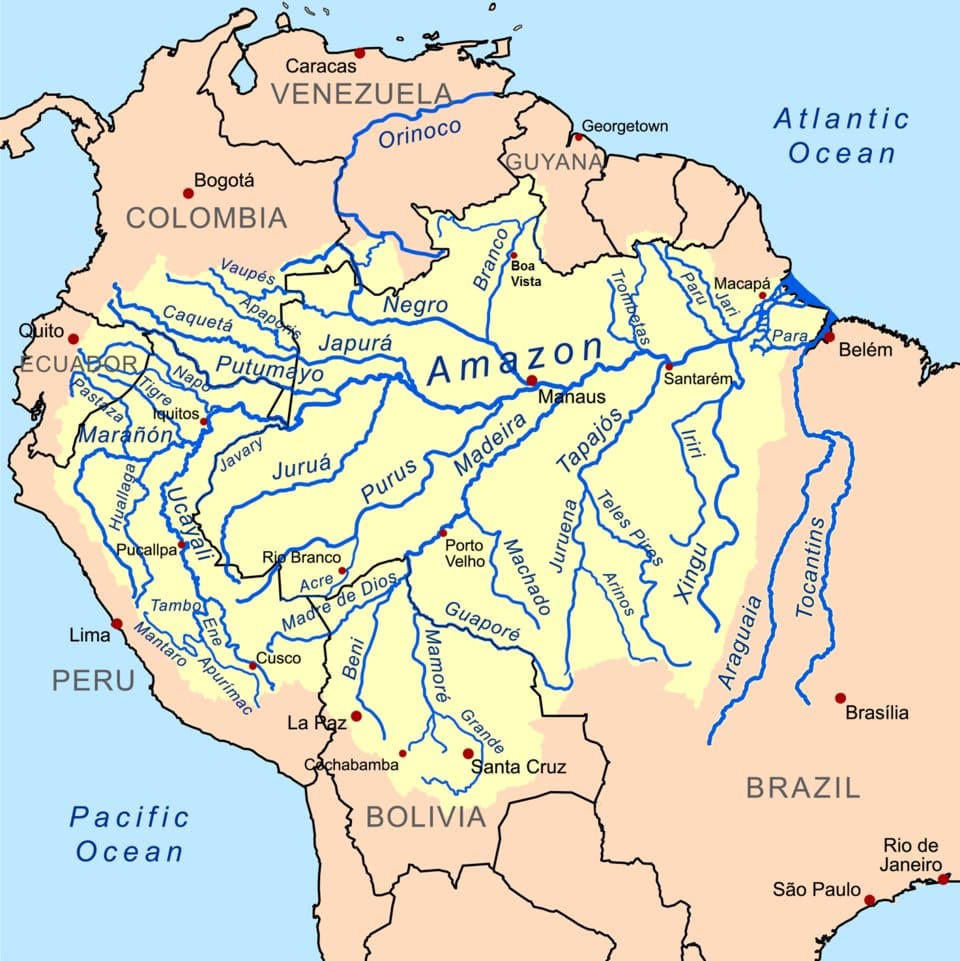
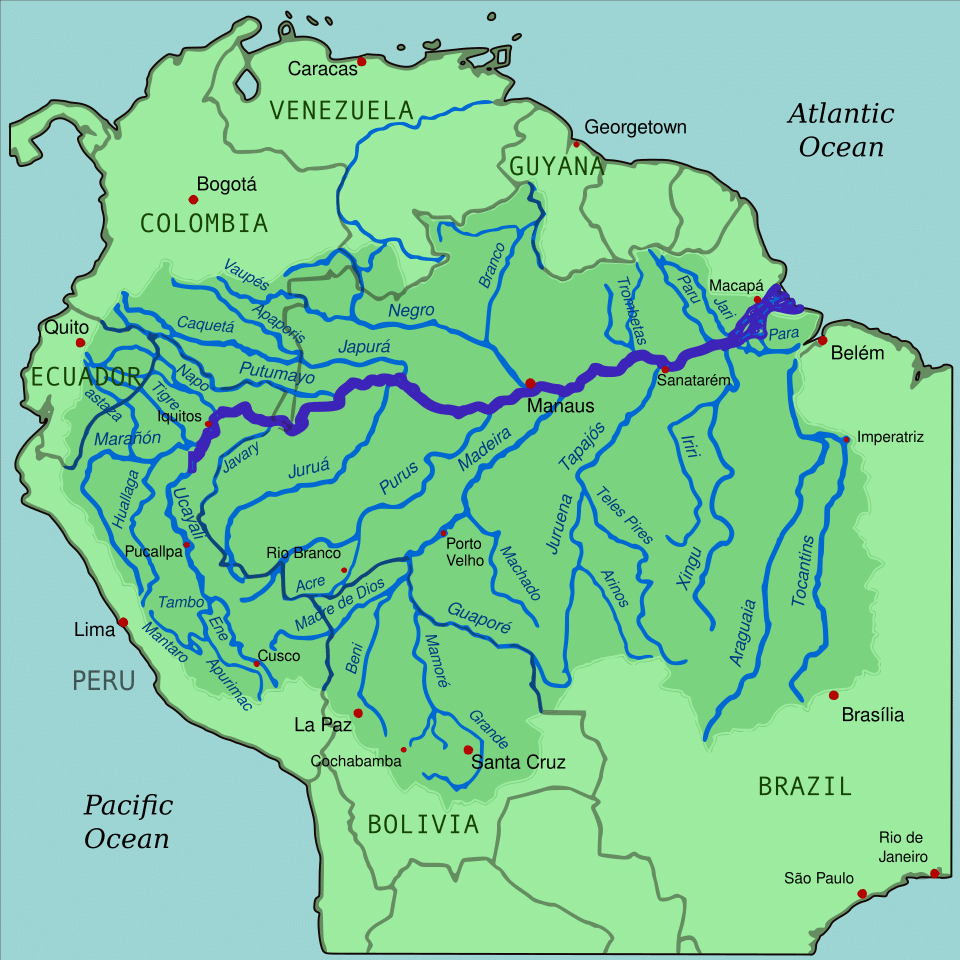
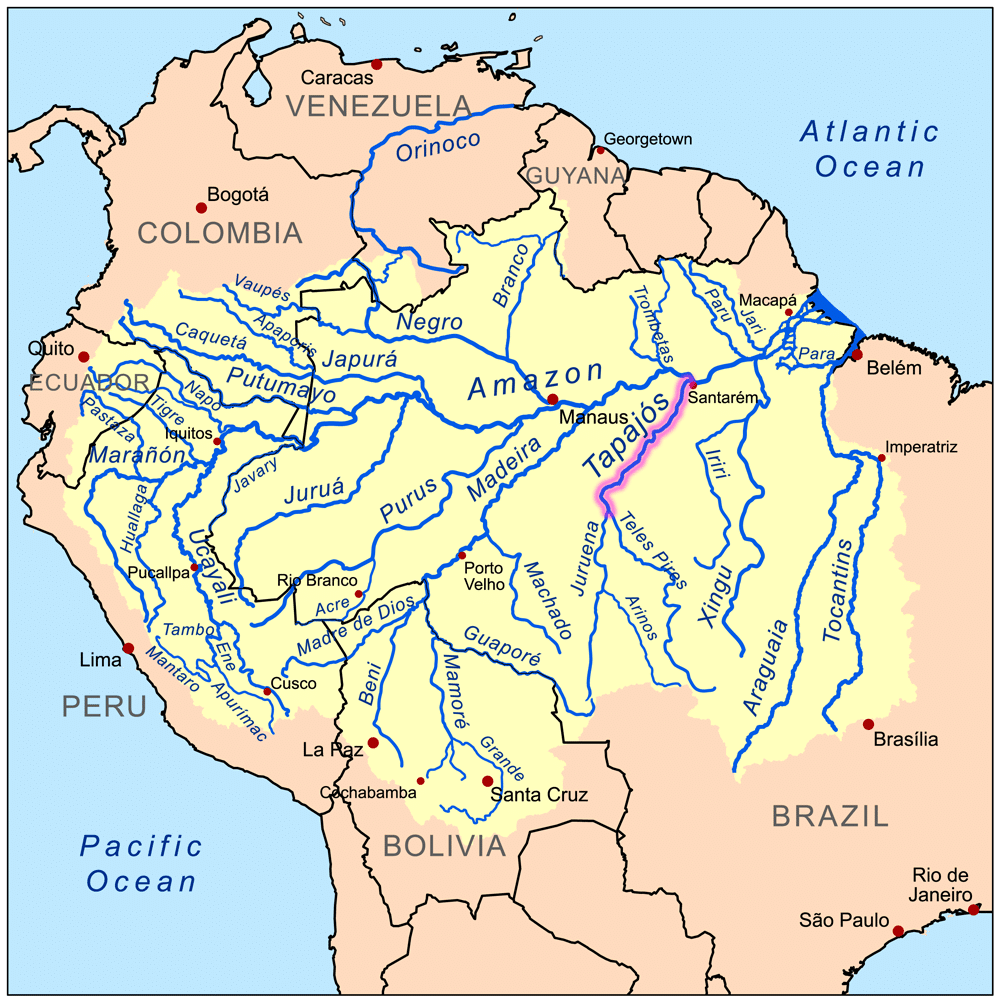
    Map showing the Amazon River Basin in South America
    Map by Kmusser, CC BY-SA 3.0, via Wikimedia Commons

    Species Overview

    FieldDetails
    Scientific NameHemigrammus erythrozonus
    Common NamesGlowlight Tetra, Glo-Lite Tetra, Fire Neon
    FamilyAcestrorhamphidae
    OriginEssequibo River basin, Guyana
    Care LevelEasy
    TemperamentPeaceful
    DietOmnivore
    Tank LevelMid to Bottom
    Maximum Size1.6 inches (4 cm)
    Minimum Tank Size15 gallons (57 liters)
    Temperature75. 82ยฐF (24. 28ยฐC)
    pH5.5. 7.5
    Hardness2. 15 dGH
    Lifespan3. 5 years in captivity
    BreedingEgg scatterer
    Breeding DifficultyEasy to Moderate
    CompatibilityCommunity
    OK for Planted Tanks?Yes

    Classification

    Taxonomic LevelClassification
    OrderCharaciformes
    FamilyAcestrorhamphidae (reclassified from Characidae, Melo et al. 2024)
    SubfamilyPristellinae
    GenusHemigrammus
    SpeciesH. Erythrozonus (Durbin, 1909)

    The genus Hemigrammus currently contains over 70 species of small characins, and its taxonomy is considered Incertae Sedis (uncertain placement). Most experts agree a full revision is needed, which results in many species being moved to new or different genera. For now, the glowlight tetra remains firmly in Hemigrammus alongside other popular aquarium species.

    Note on reclassification: In 2024, a major phylogenomic study (Melo et al.) split the traditional family Characidae into four separate families. The genus Hemigrammus was moved into the newly erected family Acestrorhamphidae under the subfamily Pristellinae. Some older references still list this species under Characidae.

    Origin & Natural Habitat

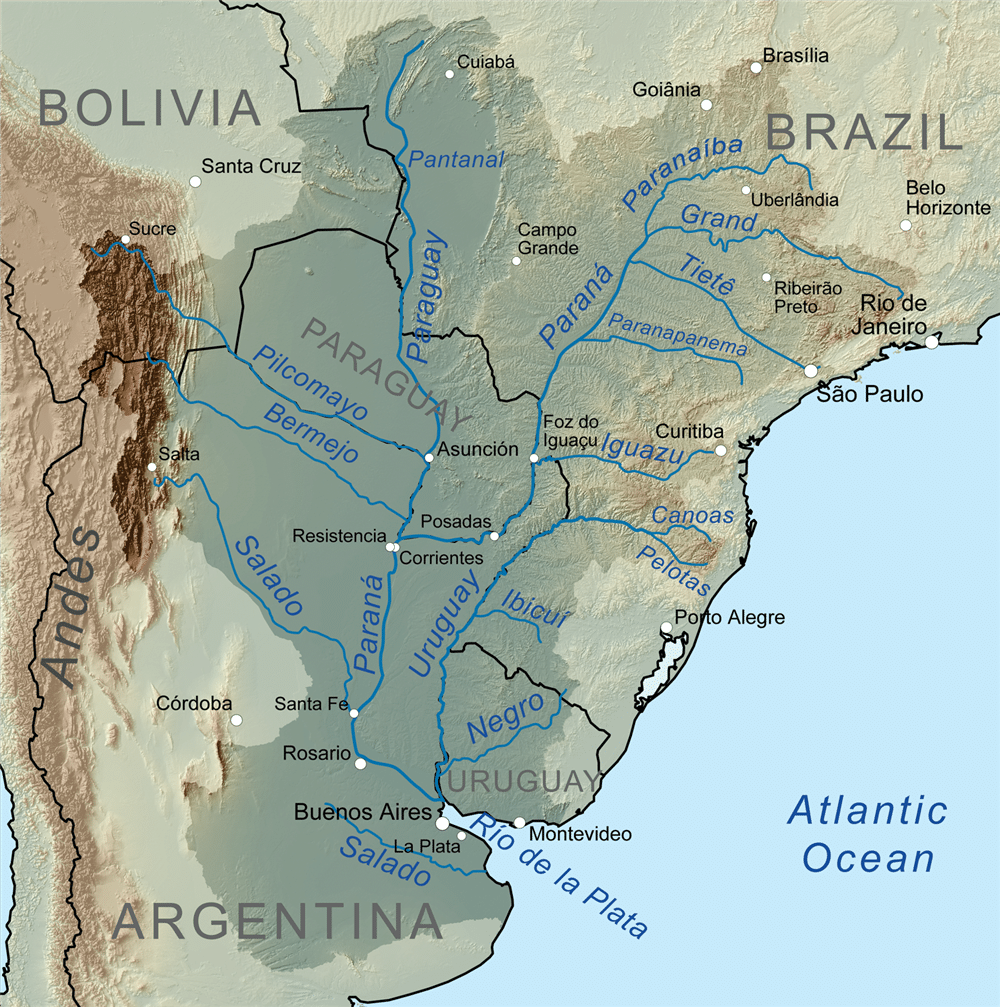
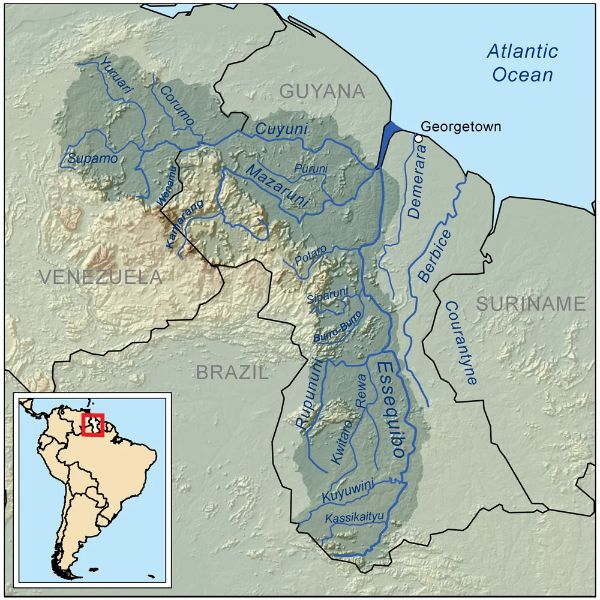
    Map of the Essequibo River drainage basin in Guyana, South America. Native habitat of the glowlight tetra
    Map of the Essequibo River basin, Guyana. Native range of the glowlight tetra. Image by Kmusser, CC BY-SA 3.0, via Wikimedia Commons.

    The glowlight tetra comes from a single river system. The Essequibo River in Guyana, the longest river in the country. They were first exported to Europe in the 1930s and quickly became a staple in the hobby.

    In the wild, glowlights stick to forested tributaries rather than the main river channel. These small streams flow through dense jungle, where the canopy blocks most sunlight. The water is stained dark brown by tannins from decomposing leaves and wood. Classic blackwater conditions. It’s soft, acidic, and low in dissolved minerals.

    The bottom of these streams is littered with fallen branches, tree roots, and layers of leaf litter. There isn’t much aquatic vegetation in the deepest blackwater areas, but the structure from all that wood and debris provides plenty of cover. Understanding this habitat explains why glowlights look their best in dimly lit tanks with dark substrates and tannin-stained water. That’s their home.

    Virtually every glowlight tetra you’ll find for sale is commercially bred. Wild-caught specimens are essentially nonexistent in the trade, with most stock coming from farms in Eastern Europe and Asia.

    Appearance & Identification

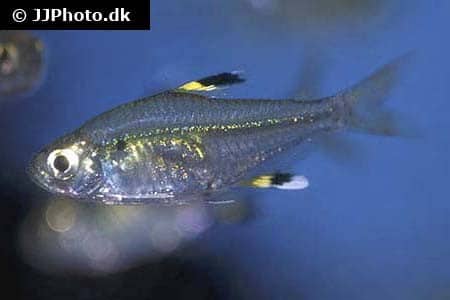
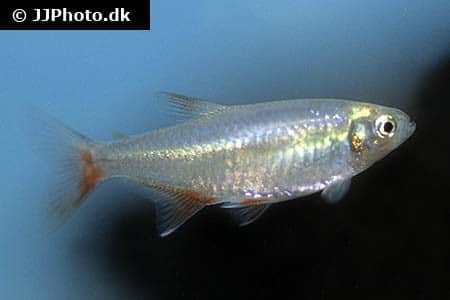
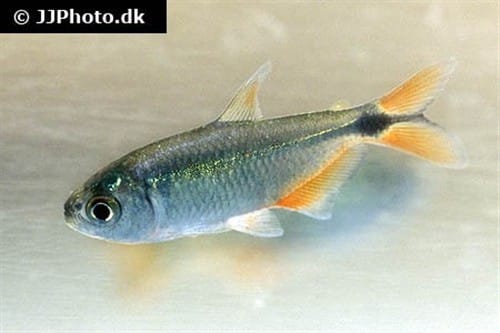
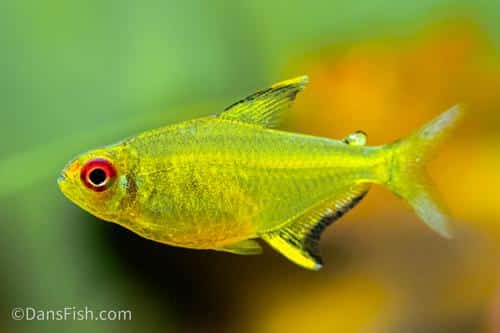
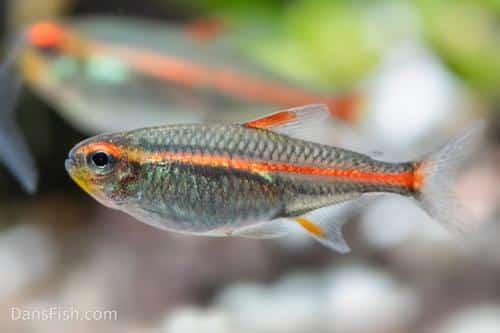
    Glowlight tetra (Hemigrammus erythrozonus) showing the glowing orange-red lateral stripe
    Glowlight tetra. Photo: Dan’s Fish

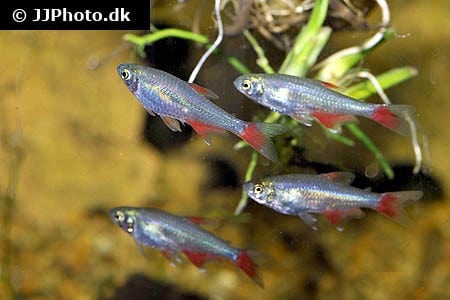
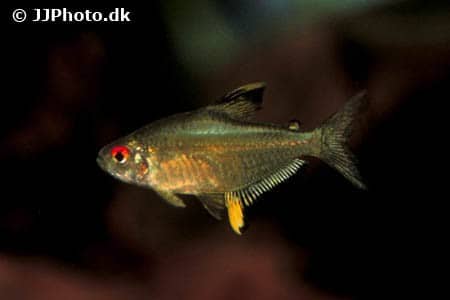
    The glowlight tetra has a slender, torpedo-shaped body with a translucent silver-peach base color. The star of the show is the brilliant iridescent stripe that runs the entire length of the body from snout to tail. This stripe starts as a soft pinkish tone near the head and intensifies to a vivid neon orange-red toward the tail. The effect is genuinely striking under the right lighting.

    The leading edge of the dorsal fin carries the same glowing orange-red as the body stripe, which is a nice detail that catches your eye when the fish swims. All other fins are mostly transparent with a slight silvery sheen. The belly area has a subtle silver coloring.

    Interestingly, the red-orange iridescence in glowlights is fairly unusual among fish. Most iridescent species reflect blue or green light, so the warm tones in the glowlight make it genuinely unique. Under dim lighting against a dark background, the stripe does glow from within. Hence the name.

    There is a selectively bred albino variety that lacks the dark body pigment but retains the orange stripe. It’s becoming more common in stores and requires identical care.

    Male vs. Female

    Sexing glowlights isn’t easy until they’re fully mature, but there are a couple of reliable tells. Females grow slightly larger and develop a noticeably rounder belly, especially when carrying eggs. Males are slimmer with a slightly more streamlined profile and may show marginally more intense coloration along the lateral stripe. There are no dramatic color differences between the sexes like you’d see in some other fish.

    Average Size & Lifespan

    Adult glowlight tetras reach about 1.5 inches (3.5. 4 cm) in total length. They’re a small species, which makes them well suited for tanks in the 15. 30 gallon (57. 114 liter) range.

    In captivity, you can expect a lifespan of 3 to 5 years with proper care. In my experience, aquarists report them living longer in ideal conditions, but that 3. 5 year range is realistic for most setups. Because all commercial stock is captive bred, genetic quality is consistent, though buying from reputable sellers always helps.

    Care Guide

    Tank Size

    A 15-gallon tank is the minimum for a school of 6 glowlight tetras, but I’d strongly recommend going with a 20-gallon long if you can. The extra swimming length lets them school naturally, and the visual effect of 10 or more glowlights moving together in a longer tank is something a smaller setup just can’t replicate.

    These fish spend most of their time in the lower to middle water column, so a tank with more horizontal footprint matters more than height.

    Water Parameters

    ParameterIdeal Range
    Temperature75. 82ยฐF (24. 28ยฐC)
    pH6.0. 7.5
    Hardness2. 12 dGH
    KH1. 8 dKH

    One of the best things about glowlight tetras is their adaptability. While they come from soft, acidic blackwater in the wild, commercially bred specimens handle a much wider range of conditions than their wild ancestors would tolerate. They’ll do fine in moderately hard water around neutral pH. Something neon tetras are less forgiving about.

    That said, they show their best coloration in softer, slightly acidic water. If you want that stripe to really pop, aim for the lower end of the pH and hardness ranges. And as always, consistency matters more than perfection. Stable parameters beat “ideal” numbers that fluctuate.

    Filtration & Water Flow

    Gentle flow is the key here. Glowlights come from slow-moving forest streams, and strong currents will stress them out. A sponge filter is ideal for smaller setups. It provides biological filtration without creating much current, and it’s safe for fry if you ever try breeding. For larger tanks, a hang-on-back or canister filter with a spray bar works well as long as you keep the output diffused.

    Weekly water changes of 20. 25% will keep things stable. These fish aren’t particularly messy, but they are sensitive to sudden shifts in water chemistry, so regular small changes are better than infrequent large ones.

    Lighting

    This is a fish that genuinely transforms depending on your lighting. Under bright, harsh lights, glowlights look washed out and unimpressive. You’ll wonder what the fuss is about. Dial the lighting down or add floating plants to create shaded areas, and that orange-red stripe starts glowing like a hot ember. The difference is night and day.

    If you’re running a planted tank with stronger lighting, floating plants like Amazon frogbit, salvinia, or red root floaters will create the dappled shade glowlights prefer. They’ll naturally gravitate to the shaded zones.

    Plants & Decorations

    A planted tank is where glowlight tetras really shine. Literally. Java fern, Anubias, Cryptocoryne species, and Java moss all work well and thrive in the same lower-light conditions glowlights prefer. Dense planting along the back and sides with open swimming space in the center is the classic layout that works beautifully.

    Driftwood is a must in my experience. It provides structure, releases tannins that soften the water, and creates the dark backdrop that makes the glowlight stripe pop. Add some dried oak or Indian almond leaves on the substrate for a natural blackwater look. The leaves will slowly decompose and release beneficial tannins while providing microfauna for the fish to pick at.

    Substrate

    Dark substrate is non-negotiable if you want to see these fish at their best. Fine dark sand or a dark planted tank substrate makes the glowlight stripe appear significantly more vivid. On a light-colored gravel, these fish look plain and pale. You’d barely notice them. It’s one of the biggest visual differences I’ve seen substrate color make on any fish.

    Is the Glowlight Tetra Right for You?

    Before you buy, run through this honest checklist. The Glowlight Tetra is a great fish for the right keeper, but it is not for everyone.

    • You want a warm-toned tetra that stands out from the typical blue and red neon look
    • You have a planted tank with moderate to subdued lighting and dark substrate
    • You can keep a school of 10+ for proper schooling behavior and color confidence
    • You want a hardy, peaceful tetra that works with almost any community fish
    • Your tank is 15 gallons or larger with stable, mature water conditions
    • You appreciate subtle beauty that rewards the right lighting and tank setup

    Tank Mates

    Best Tank Mates

    Glowlight tetras are among the most peaceful tetras in the hobby. They’re not fin nippers, which makes them safe with a surprisingly wide range of tank mates. Even long-finned species that most tetras would harass:

    • Corydoras catfish. Ideal bottom-dwelling companions that stay out of the glowlights’ space
    • Neon tetras. Similar size and temperament, beautiful contrast of blue and orange
    • Harlequin rasboras. Peaceful mid-level schoolers that complement glowlights perfectly
    • Ember tetras. Another warm-toned tetra that pairs well visually and temperamentally
    • Dwarf gouramis. A colorful centerpiece fish that won’t bother glowlights
    • Otocinclus catfish. Gentle algae eaters that are completely non-threatening
    • Cherry shrimp. Glowlights are one of the safer tetras to keep with adult shrimp
    • Kuhli loaches. Peaceful bottom dwellers that add interest to the lower tank zone
    • Apistogramma dwarf cichlids. A natural pairing if you’re doing a South American biotope
    • Pencilfish. Gentle, slender fish from similar habitats

    Tank Mates to Avoid

    • Angelfish. They’ll eat glowlights once they grow large enough
    • Tiger barbs. Too nippy and boisterous for peaceful glowlights
    • Large cichlids. Any fish big enough to view a glowlight as food
    • Red tail sharks. Territorial and prone to chasing small tetras
    • Aggressive or fast-moving species. Anything that will outcompete glowlights for food or stress them out

    Food & Diet

    Glowlight tetras are some of the easiest fish to feed. They’re true omnivores that will accept virtually anything you offer. Flake food, micro pellets, freeze-dried options, you name it. In the wild, they eat small worms, crustaceans, and plant matter.

    A high-quality flake or micro pellet makes a good daily staple. To bring out the best color and keep them in peak health, supplement with frozen or live foods a few times per week. Daphnia, brine shrimp, bloodworms, and cyclops are all eagerly accepted and make a real difference in how vibrant that glowlight stripe looks.

    Feeding frequency: Once or twice daily, only what they can finish in about 2 minutes. These are small fish with small stomachs.

    Pro tip: Glowlights are reluctant to chase food that sinks to the bottom. They prefer to eat in the water column, so use slow-sinking foods or feed small pinches at the surface that they can grab on the way down. If you’re keeping them with bottom feeders like corydoras, the cories will happily clean up whatever the glowlights miss.

    Breeding & Reproduction

    Glowlight tetras are one of the easier tetras to breed at home, making them a solid choice if youโ€™re getting into breeding egg scatterers for the first time.

    Breeding Difficulty

    Easy to moderate. Theyโ€™ll breed readily once the conditions are right, and theyโ€™re more forgiving of imperfect setups than many other tetras.

    Spawning Tank Setup

    Youโ€™ll need a separate breeding tank. A 10. 15 gallon (38. 57 liter) tank works well. Keep the lighting very dim or cover the sides of the tank, as both eggs and fry are light-sensitive in the early stages. Add clumps of fine-leaved plants like Java moss or spawning mops to give the fish somewhere to scatter their eggs. Alternatively, cover the bottom with mesh large enough for eggs to fall through but small enough to keep the adults from reaching them. Glowlights will eat their own eggs if given the chance.

    Water Conditions for Breeding

    Soft, acidic water is key. Aim for pH 5.5. 6.5, hardness of 1. 5 dGH, and a temperature around 80. 84ยฐF (27. 29ยฐC). Filtering the water through peat or using RO water helps achieve these conditions. A small air-powered sponge filter bubbling gently is all the filtration you need.

    Conditioning & Spawning

    You can spawn them in a group (6 males and 6 females works well) or in pairs. For pair spawning, condition males and females separately for 1. 2 weeks with plenty of small live foods like daphnia and brine shrimp. When females are visibly plump with eggs and males are showing their brightest colors, transfer the best pair to the spawning tank in the evening. Theyโ€™ll typically spawn the following morning. Interestingly, during the act itself, the pair often turns completely upside down. Itโ€™s a unique behavior among tetras.

    Egg & Fry Care

    Remove the adults immediately after spawning. They will eat every egg they can find. Eggs hatch in 24. 36 hours, and the fry become free-swimming 3. 4 days after that. Feed infusoria or liquid fry food for the first few days, then graduate to microworms and freshly hatched baby brine shrimp (BBS) once theyโ€™re large enough. Keep the tank dark during the early stages, as the eggs and fry are light-sensitive. A healthy female can produce 120. 150 eggs per spawn.

    Glowlight tetras are almost exclusively captive-bred in the hobby. All commercial stock comes from farms in Eastern Europe and Asia. Wild-caught specimens are essentially nonexistent in the trade.

    Common Health Issues

    Glowlight tetras are hardier than many other popular tetras, but they’re not bulletproof. Here are the main health concerns to watch for:

    Neon Tetra Disease (NTD)

    Despite the name, neon tetra disease doesn’t only affect neons. Glowlight tetras are also susceptible. It’s caused by the microsporidian parasite Pleistophora hyphessobryconis, which invades the fish’s muscles. Symptoms include pale patches on the body, loss of color, lethargy, and eventually a curved spine. There is no effective cure. Infected fish should be removed immediately to prevent spreading.

    Ich (White Spot Disease)

    Like most tropical fish, glowlights can pick up ich when stressed. Usually from temperature swings or being added to a new tank. The telltale white spots are easy to identify. Gradually raise the temperature to 82ยฐF (28ยฐC) and treat with a standard ich medication. Glowlights generally tolerate treatment well.

    General Prevention

    The best defense is prevention. Quarantine all new fish for at least two weeks before adding them to your main tank. Maintain stable water parameters and keep up with your water change schedule. Glowlights are particularly sensitive to sudden swings in water chemistry, so consistency is key.

    Common Mistakes to Avoid

    • Bright lighting with no shade. This is the biggest mistake people make with glowlights. Under intense lighting, they look pale and boring. Add floating plants or dim the lights, and they transform into a completely different fish.
    • Light-colored substrate. A white or beige gravel washes out their colors dramatically. Dark sand or substrate is essential for the full glowlight effect.
    • Keeping too few. Groups under 6 lead to stressed, shy fish that hide constantly. Get at least 6, ideally 10+. In small groups, they can even become nippy. Which is out of character for this otherwise gentle species.
    • Sudden parameter changes. Glowlights are adaptable to a wide range of conditions, but they don’t handle rapid shifts well. Acclimate new fish slowly and keep your maintenance routine consistent.

    Where to Buy

    Glowlight tetras are widely available at most local fish stores and chain pet retailers. They’re one of the more common tetras in the trade, typically priced at $2. 4 per fish. You’ll often find discounts on schools of 6 or more.

    For better quality stock, I recommend ordering from Flip Aquatics or Dan’s Fish. Both carry healthy, well-acclimated captive-bred glowlights that will arrive in better condition than big box store fish. All glowlights in the trade are captive bred. Wild-caught specimens from Guyana are essentially nonexistent commercially.

    Frequently Asked Questions

    How many glowlight tetras should be kept together?

    A minimum of 6, but 10 or more is strongly recommended. Glowlight tetras are a shoaling species that become stressed, shy, and can even turn nippy in small groups. In larger schools, they feel secure and display their best behavior and coloration.

    What size tank does a glowlight tetra need?

    A 15-gallon tank is the minimum for a small school of 6. A 20-gallon long is the sweet spot for a proper school of 10+, giving them enough horizontal swimming space to school naturally.

    Are glowlight tetras good for beginners?

    Absolutely. Glowlight tetras are one of the best beginner tetras available. They’re hardier and more adaptable than neon tetras, accept any food, and are peaceful with virtually all community tank mates. Just make sure your tank is cycled before adding them.

    Can glowlight tetras live with bettas?

    Yes. Glowlight tetras are actually one of the safer tetra choices for a betta tank. Unlike some tetras, glowlights are not fin nippers, so they won’t harass a long-finned betta. Use at least a 20-gallon tank with plenty of plants, and monitor the betta’s temperament since some individuals are more aggressive than others.

    How long do glowlight tetras live?

    Glowlight tetras typically live 3 to 5 years in a well-maintained aquarium. In my experience, hobbyists report them reaching the upper end of that range or slightly beyond with optimal water quality and diet.

    Why do my glowlight tetras look pale?

    The most common cause is lighting and substrate. Glowlights look dramatically washed out under bright lights or over light-colored gravel. Switch to a dark substrate, add floating plants to dim the lighting, and you should see a major improvement. Other causes include stress from too few tank mates, poor water quality, or recent introduction to a new tank.

    Are glowlight tetras and neon tetras the same thing?

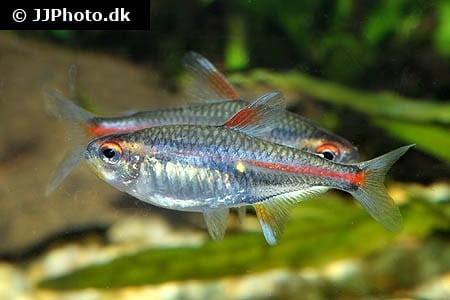
    No. They’re completely different species from different genera. Neon tetras (Paracheirodon innesi) have a blue and red stripe, while glowlight tetras (Hemigrammus erythrozonus) have a single orange-red stripe. They come from different parts of South America (neons from the Amazon basin, glowlights from Guyana). They do make excellent tank mates, though. The blue and orange complement each other beautifully.

    What It Is Actually Like Living With Glowlight Tetra

    A school of 12+ glowlight tetras on a black sand substrate with low to moderate lighting creates a warm, ambient glow effect that is unlike anything else in the hobby. The copper-orange stripes catch the light and pulse softly as they swim.

    They are calm, peaceful swimmers that stay in the mid-water column. There is no aggression, no fin nipping, and virtually no stress behaviors if the tank is set up properly.

    They pair beautifully with other warm-toned species. Ember tetras, corydoras, and small rasboras create a cohesive, natural-looking display.

    Feeding is straightforward. They accept all standard foods and are not picky or competitive. This makes them ideal for community tanks with more timid species.

    How the Glowlight Tetra Compares to Similar Species

    Glowlight Tetra vs. Ember Tetra

    Both are warm-toned nano tetras, but the Ember Tetra is smaller and more intensely orange. The Glowlight Tetra is larger and has a more defined glow stripe. For a nano tank under 15 gallons, the Ember Tetra fits better. For a standard community tank, the Glowlight Tetra has more presence.

    Glowlight Tetra vs. Neon Tetra

    The Neon Tetra has more dramatic blue and red coloring, but the Glowlight Tetra has a warmer, more natural aesthetic. The Glowlight is also slightly hardier and less prone to Neon Tetra Disease. Both are excellent community tetras. The choice comes down to whether you prefer cool blue tones or warm copper tones.

    Closing Thoughts

    The glowlight tetra is an underrated gem in the freshwater hobby. It’s hardy, peaceful, affordable, and absolutely gorgeous in the right setup. Give them a dark substrate, some dim lighting, a few pieces of driftwood, and a proper school, and you’ll have one of the most eye-catching displays in a community tank.

    If you’re looking for other small tetras to keep alongside your glowlights, check out our care guides for ember tetras, cardinal tetras, and black neon tetras.

    Have you kept glowlight tetras? I’d love to hear about your setup. Drop a comment below!

    Check out our tetra tier list video where we rank the most popular tetras in the hobby, including the glowlight tetra:

    References


    ๐ŸŸ This article is part of our Tetras: Complete A-Z Species Directory. Your guide to every tetra species in the hobby.

  • Coffee Bean Tetra Care Guide: Tank Setup, Diet, Tank Mates & More

    Coffee Bean Tetra Care Guide: Tank Setup, Diet, Tank Mates & More

    Table of Contents

    The coffee bean tetra is a small, peaceful schooler named for the distinctive dark spot on its flank. It is not flashy and it is not demanding. But it needs a proper school of 8+ to show natural behavior. Keep fewer and they hide, stress, and lose whatever color they have.

    Coffee bean tetras need numbers. A school of 8+ or nothing.

    The Reality of Keeping Coffee Bean Tetra

    The marking changes with mood. The signature coffee bean marking on the body is not always clearly visible. In stressed, newly purchased, or frightened fish, the mark fades significantly. In comfortable, settled fish under good conditions, it becomes bold and clearly defined. Do not panic if newly purchased fish look different from what you expected.

    Availability is the biggest challenge. Coffee bean tetras are not mass-bred for the general trade. They appear in specialty imports sporadically and sell quickly. If you want them, monitor specialty retailers and be ready to buy when they appear.

    Care is straightforward once you have them. Despite their rarity in the trade, coffee bean tetras are not particularly demanding fish. Standard soft to moderately hard water, appropriate temperature, and quality food keep them healthy. The difficulty is acquiring them, not keeping them.

    Biggest Mistake New Owners Make

    Passing on them when you see healthy stock available, assuming you can buy them later. Availability for this species is unpredictable and specimens sell fast.

    Expert Take

    The coffee bean tetra is a genuine collector’s fish that rewards the keeper who puts in the effort to source it. Once established, it is an easy, rewarding species with a unique look that sets your tank apart.

    Key Takeaways

    • Hardy and adaptable species that does well in a range of water conditions, making it suitable for beginners and experienced keepers alike
    • Named for the distinctive large, dark body spot that resembles a coffee bean, giving it instant visual appeal
    • Peaceful schooling fish that should be kept in groups of 8 or more in a minimum 15-gallon tank
    • Omnivore that accepts a wide variety of foods including flakes, pellets, frozen, and live options
    • Not as commonly available as mainstream tetras, but increasingly stocked by online specialty retailers
    Map showing the Amazon River Basin in South America
    Map by Kmusser, CC BY-SA 3.0, via Wikimedia Commons

    Species Overview

    FieldDetails
    Scientific NameHyphessobrycon takasei
    Common NamesCoffee Bean Tetra
    FamilyAcestrorhamphidae
    OriginLower Amazon basin, Brazil (Tocantins and Guamá river drainages)
    Care LevelEasy to Moderate
    TemperamentPeaceful
    DietOmnivore
    Tank LevelMid
    Maximum Size1.2 inches (3 cm)
    Minimum Tank Size15 gallons (57 liters)
    Temperature72-82°F (22-28°C)
    pH5.5-7.5
    Hardness2-15 dGH
    Lifespan3-5 years
    BreedingEgg scatterer
    Breeding DifficultyModerate
    CompatibilityCommunity
    OK for Planted Tanks?Yes

    Classification

    Taxonomic LevelClassification
    OrderCharaciformes
    FamilyAcestrorhamphidae (reclassified from Characidae, Melo et al. 2024)
    GenusHyphessobrycon
    SpeciesH. Takasei (Géry, 1964)

    This species was originally described by Jacques Géry in 1964, based on specimens collected from the lower Amazon region of Brazil. The specific name takasei honors Mr. Takase, a Japanese collector who was instrumental in bringing South American fish species to scientific attention.

    Note on reclassification: The 2024 phylogenomic study by Melo et al. Moved Hyphessobrycon into the newly erected family Acestrorhamphidae, separate from the traditional Characidae. Some older references and databases may still list this species under Characidae. The genus Hyphessobrycon remains the accepted placement for this species.

    Origin & Natural Habitat

    Map of the Amazon River basin, native range of the Coffee Bean Tetra in the lower Amazon near Belรฉm
    Map of the Amazon River basin. The Coffee Bean Tetra is found in the lower Amazon region near Belém, Brazil. Image by Kmusser, CC BY-SA 3.0, via Wikimedia Commons.

    The Coffee Bean Tetra is native to the lower Amazon basin in Brazil, specifically the Tocantins and Guamá river drainages in the state of Pará, near the city of Belém. This is a region where tropical forest streams and small tributaries feed into the massive Amazon system before it empties into the Atlantic Ocean.

    In the wild, these fish inhabit slow-moving streams, creeks, and flooded forest areas with plenty of vegetation and organic debris. The water is soft to moderately soft, slightly acidic, and stained with tannins from decomposing leaf litter. The substrate in their natural habitat is typically sandy or silty, covered in fallen leaves and decaying plant matter. Overhanging vegetation and dense marginal plants provide shade and cover.

    What makes this species interesting from a habitat perspective is that it comes from a region that experiences significant seasonal flooding. During the rainy season, these fish move into newly flooded areas where food is abundant. This seasonal variability helps explain why the Coffee Bean Tetra is relatively adaptable in captivity compared to some of its more specialized Hyphessobrycon cousins.

    Appearance & Identification

    The Coffee Bean Tetra has a classic, streamlined tetra body shape that’s slightly compressed laterally. The base body color is silvery to translucent, with a subtle olive-green or golden sheen along the upper body when light catches it at the right angle. The fins are mostly clear to slightly yellowish.

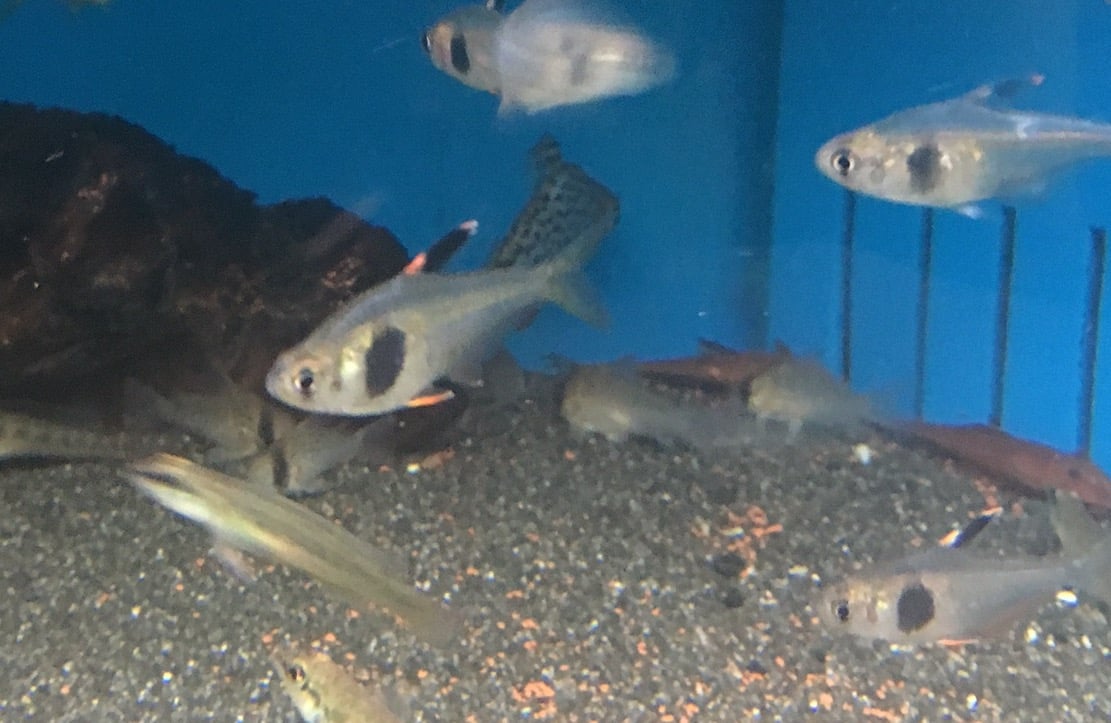
    But the real showstopper is the markings. This species carries two prominent dark spots. First, there’s a dark humeral blotch just behind the gill plate. Then, further back on the flank, there’s a large, oval-shaped dark blotch that gives the fish its common name. This body spot is darker, larger, and more defined than what you see on most spotted tetra species. It genuinely looks like a coffee bean has been stamped onto the side of the fish.

    The combination of these two dark markings on an otherwise silvery body makes the Coffee Bean Tetra easy to identify at a glance. There aren’t many tetras in the trade that share this exact pattern.

    Male vs. Female

    Sexual dimorphism in the Coffee Bean Tetra is subtle but detectable in mature adults. Males are slightly slimmer and a touch more streamlined than females. Females become noticeably rounder and fuller-bodied when carrying eggs, especially when viewed from above. The coloration difference between the sexes is minimal. Both display the same dark body markings, though males may show slightly more intense coloring during breeding condition.

    Average Size & Lifespan

    The Coffee Bean Tetra is a small species, reaching a maximum size of about 1.2 inches (3 cm) in standard length. This puts it on the smaller end of the tetra spectrum, comparable to species like the ember tetra in terms of body size.

    With good care, proper diet, and stable water conditions, expect a lifespan of 3 to 5 years in the home aquarium. As with most small tetras, longevity is directly tied to water quality and stress levels. Fish kept in a well-maintained tank with a proper school size will reach the upper end of that range.

    Care Guide

    Tank Size

    A 15-gallon tank is the minimum for a school of Coffee Bean Tetras. These are active mid-level swimmers that need room to school naturally. While their small body size might tempt you into thinking a 10-gallon would work, a 15-gallon provides better swimming space and more stable water parameters for a group of 8 or more.

    If you’re planning a community setup with other species, step up to a 20 to 30-gallon tank. A longer tank footprint is always better than a tall one for schooling fish. More horizontal space means more room for natural schooling behavior, and that’s when these fish look their best.

    Water Parameters

    ParameterIdeal Range
    Temperature72-82°F (22-28°C)
    pH5.5-7.5
    General Hardness2-15 dGH
    KH1-8 dKH
    Ammonia / Nitrite0 ppm
    NitrateBelow 20 ppm

    One of the best things about the Coffee Bean Tetra is its flexibility with water chemistry. Unlike some Hyphessobrycon species that demand ultra-soft, acidic conditions, this fish handles a fairly broad range. It does best on the softer, slightly acidic side, but captive-bred specimens in particular are forgiving of moderately hard water.

    That said, consistency matters more than hitting a specific number. Sudden swings in pH or temperature are far more dangerous than being slightly outside the ideal range. If your tap water falls anywhere within the ranges listed above, you should be in good shape. Just make sure your tank is fully cycled before adding these fish.

    Filtration & Water Flow

    A gentle to moderate flow works best for Coffee Bean Tetras. In the wild, they come from slow-moving streams and flooded areas, so they don’t appreciate being blasted by a strong current. A sponge filter is an excellent option for smaller tanks. For larger setups, a hang-on-back filter or a canister filter with a spray bar to diffuse the output both work well.

    Aim for weekly water changes of 20-25% to keep nitrates in check. These fish don’t produce a ton of waste individually, but in a school of 8 or more, regular maintenance is important for keeping the water clean and stable.

    Lighting

    Moderate to subdued lighting brings out the best in Coffee Bean Tetras. In nature, they live under shaded canopy in areas with limited direct sunlight. Too much bright light can make them feel exposed and skittish. Floating plants are a simple and effective way to diffuse light while giving the fish a sense of overhead cover.

    Under dimmer conditions, these fish will feel more confident and school more naturally in the open areas of the tank rather than hiding behind decorations.

    Plants & Decorations

    Coffee Bean Tetras look fantastic in a planted tank. They won’t bother your plants at all, and the contrast between their silvery bodies with those dark markings against a green background is striking. Good plant choices include Java fern, Anubias, Amazon sword, Cryptocorynes, and Vallisneria. Floating plants like Amazon frogbit or red root floaters are great for dimming the light.

    For hardscape, driftwood and leaf litter create a natural look that mimics their native habitat. Indian almond leaves are a nice addition. They release tannins that slightly lower pH and add a natural touch to the aquascape. Leave open swimming space in the center and front of the tank so the school has room to move.

    Substrate

    A dark, fine-grained substrate is the way to go. Dark sand or fine gravel makes the Coffee Bean Tetra’s markings stand out more than a light-colored substrate does. It also more closely mimics the natural leaf litter and silty bottoms of their wild habitat. Avoid substrates that significantly buffer pH upward, like crushed coral, unless your water is naturally very soft and you need the extra buffering.

    Is the Coffee Bean Tetra Right for You?

    Before you buy, run through this honest checklist. The Coffee Bean Tetra is a great fish for the right keeper, but it is not for everyone.

    • You want an unusual tetra with a distinctive body marking that most keepers have never seen
    • You can provide stable water parameters in a well-maintained tank
    • You keep a school of 8+ in a 20-gallon or larger planted tank
    • You enjoy collecting less common species that stand out in a community
    • You have dark substrate and moderate lighting to show off the body marking
    • You are willing to pay a premium price for a rarer tetra species

    Tank Mates

    The Coffee Bean Tetra is a peaceful community fish that gets along well with a wide range of similarly tempered species. Their small size and calm disposition make them ideal for a mixed community tank, as long as you avoid anything large enough to see them as food or aggressive enough to bully them.

    Best Tank Mates

    • Ember tetras (similar size, overlapping water needs, great color contrast)
    • Pristella tetras (hardy, peaceful, and similarly sized)
    • Corydoras catfish (peaceful bottom dwellers that stay out of their way)
    • Harlequin rasboras (similar size and temperament, compatible water conditions)
    • Otocinclus catfish (gentle algae grazers that make great tankmates)
    • Dwarf cichlids (Apistogramma species work well in a community)
    • Cherry barbs (peaceful and similarly sized)
    • Small plecos (bristlenose, clown pleco)
    • Amano shrimp and cherry shrimp (safe with these peaceful tetras)
    • Hatchetfish (occupy the top level, no competition for space)

    Tank Mates to Avoid

    • Angelfish (may see small Coffee Bean Tetras as prey)
    • Tiger barbs (notorious fin nippers that will stress them)
    • Large cichlids (too aggressive and territorial)
    • Bettas (can be unpredictable with small schooling fish)
    • Any fish large enough to fit them in its mouth

    Food & Diet

    Coffee Bean Tetras are unfussy omnivores that accept just about anything you offer them. In the wild, they feed on small invertebrates, insect larvae, algae, and organic matter in the water column. Replicating that variety in captivity is the key to keeping them healthy and looking their best.

    • Staple: High-quality micro pellets or crushed flake food
    • Frozen foods: Bloodworms, daphnia, brine shrimp, cyclops
    • Live foods: Baby brine shrimp, daphnia, microworms
    • Supplemental: Freeze-dried tubifex, spirulina-based foods

    Feed two to three times daily in small amounts that is consumed within about two minutes. Because of their small mouths, make sure food particles are sized appropriately. Crush flakes or use micro pellets rather than standard-sized pellets. Regular variety in their diet helps maintain the intensity of their coloring and supports overall health.

    Pro tip: Occasional live food feedings, especially daphnia, will get these fish actively hunting and displaying more natural behavior. It’s also a great way to condition them if you’re thinking about breeding.

    Breeding & Reproduction

    Breeding the Coffee Bean Tetra is achievable for hobbyists with some experience, though it does take a bit of setup and patience. Like most small Hyphessobrycon species, they’re egg scatterers with no parental care.

    Breeding Difficulty

    Moderate. The Coffee Bean Tetra isn’t one of the hardest tetras to breed, but it’s not as straightforward as something like a lemon tetra either. Getting the water conditions right and properly conditioning the adults are the two biggest factors for success.

    Spawning Tank Setup

    • Breeding tank: 10 gallons (38 liters) with dim lighting
    • Decor: Java moss, spawning mops, or other fine-leaved plants for the fish to scatter eggs into
    • Bottom: Bare bottom with a layer of glass marbles or mesh grid to prevent adults from eating the eggs
    • Filtration: Gentle air-driven sponge filter only
    • Cover: Keep the tank dimly lit or covered on the sides to encourage spawning

    Water Conditions for Breeding

    • Temperature: 78-80°F (26-27°C)
    • pH: 5.5-6.5 (softer and slightly more acidic than general care)
    • Hardness: 2-5 dGH
    • Use aged water or RO/DI water blended with tap water to achieve target softness
    • Adding Indian almond leaves or peat extract helps create ideal conditions

    Conditioning & Spawning

    Condition a group of adults (or a well-matched pair) with plenty of high-quality frozen and live foods for two to three weeks before attempting to spawn. Females ready to breed will appear noticeably plumper when viewed from above. Males may show slightly brighter coloring and become more active in pursuing females.

    Spawning typically occurs in the early morning hours. The pair will scatter adhesive eggs among fine-leaved plants or spawning mops. A single spawning can produce anywhere from 50 to 150 eggs depending on the size and condition of the female.

    Egg & Fry Care

    Remove the adults immediately after spawning is complete, as they will readily eat their own eggs if given the chance. The eggs are light-sensitive, so keep the breeding tank in a dark or very dimly lit location until the fry are free-swimming.

    Eggs typically hatch within 24 to 36 hours. The fry will spend another 3 to 4 days absorbing their yolk sac before becoming free-swimming. Start feeding with infusoria or commercially available liquid fry food. After about a week, the fry should be large enough to accept freshly hatched baby brine shrimp. Maintain pristine water quality throughout this period with gentle, frequent water changes.

    Common Health Issues

    Ich (White Spot Disease)

    Ich is the most common ailment you’ll encounter with small tetras, and the Coffee Bean Tetra is no exception. Stress from shipping, tank moves, or sudden temperature drops is the trigger. Gradually raising the tank temperature to 84-86°F (29-30°C) is an effective first line of treatment and is well-tolerated by this species. Medications containing malachite green is used for stubborn cases.

    Fin Rot

    Fin rot is almost always a water quality issue. If you notice frayed, discolored, or receding fins, check your ammonia, nitrite, and nitrate levels immediately. Improving water quality through more frequent water changes often resolves mild cases without medication. For advanced cases, antibacterial treatments may be necessary.

    Neon Tetra Disease

    This parasitic disease (caused by Pleistophora hyphessobryconis) can affect various tetra species, not just neons. There is no effective cure, making prevention critical. Always quarantine new arrivals for at least two weeks, and avoid purchasing fish from tanks where any individuals show faded patches, cysts under the skin, or erratic swimming behavior.

    Common Mistakes to Avoid

    • Keeping too few: Coffee Bean Tetras are schooling fish that need the security of a group. Keeping fewer than 6 leads to stressed, skittish fish that hide constantly. Go for 8 or more, and you’ll see a completely different fish.
    • Adding them to an uncycled tank: Like all small tetras, they’re sensitive to ammonia and nitrite spikes. Always make sure your tank is fully cycled before introducing them.
    • Oversized food: These are small fish with small mouths. Standard-sized pellets are too big. Use micro pellets or crush flakes to an appropriate size so they can actually eat what you offer.
    • Pairing with aggressive or large tankmates: Their small size makes them a target for anything predatory. Stick with similarly sized, peaceful community species.
    • Skipping quarantine: Since this species isn’t as widely bred in captivity as mainstream tetras, wild-caught specimens are still common in the trade. Always quarantine before adding to your main tank.

    Where to Buy

    The Coffee Bean Tetra isn’t a species you’ll typically find at big-box pet stores. It’s gaining popularity, but it still falls into the specialty category. Your best bet for finding them is through online retailers that focus on unusual and less common freshwater species.

    Check availability at these trusted retailers:

    It’s also worth asking your local fish store if they can special-order them through their wholesaler. Because availability is spotty, it pays to check back regularly or set up stock notifications where available. Expect to pay a bit more than you would for common tetras, but they’re still reasonably priced for a specialty species.

    Frequently Asked Questions

    Why is it called the Coffee Bean Tetra?

    The common name comes from the large, dark oval blotch on the fish’s flank that closely resembles a roasted coffee bean. It’s one of those names that makes perfect sense the moment you see the fish. The marking is bold, clearly defined, and positioned prominently on the body, making it the most recognizable feature of this species.

    How many Coffee Bean Tetras should be kept together?

    A minimum of 8 is recommended. While some sources say 6 is the minimum for schooling tetras, Coffee Bean Tetras really show their best behavior and coloring in a slightly larger group. In a school of 8 to 12, they’ll swim in a cohesive group and feel much more confident in the open areas of the tank.

    What size tank does a Coffee Bean Tetra need?

    A 15-gallon tank is the minimum for a school of Coffee Bean Tetras. For a community setup with other species, 20 to 30 gallons is a better starting point. Longer tank footprints are preferable to tall ones because these fish are active horizontal swimmers.

    Are Coffee Bean Tetras easy to care for?

    Yes, they fall in the easy to moderate range. They’re hardy, adaptable to a range of water conditions, and not picky about food. The main things to get right are keeping them in a proper school, maintaining stable water quality, and sizing their food appropriately for their small mouths. They’re a solid choice for a fishkeeper with at least a little bit of experience.

    Can Coffee Bean Tetras live with shrimp?

    Yes, adult cherry shrimp and Amano shrimp are safe with Coffee Bean Tetras. Their small mouth size means they can’t eat adult shrimp. However, like most fish, they may snack on very small shrimplets if given the opportunity. If you’re trying to grow a shrimp colony, providing plenty of plant cover and hiding spots will help baby shrimp survive.

    How long do Coffee Bean Tetras live?

    With proper care, Coffee Bean Tetras live 3 to 5 years in captivity. The keys to reaching the upper end of that range are consistent water quality, a varied diet, and keeping them in a group large enough to reduce stress. Stable conditions and regular maintenance go a long way.

    Are Coffee Bean Tetras fin nippers?

    No, Coffee Bean Tetras are peaceful fish that aren’t known for fin nipping. They’re well-suited for community tanks with other gentle species. As long as they’re kept in a proper school size, they focus their energy on interacting with each other rather than bothering tankmates.

    What It Is Actually Like Living With Coffee Bean Tetra

    The coffee bean marking becomes more defined as the fish settles into your tank over weeks. Watching it develop from faded to bold is satisfying.

    They are peaceful, mid-water schoolers that blend well with other calm community species.

    In a school of 8+, the repeated coffee bean markings create a distinctive visual pattern that no other species offers.

    They are conversation starters because most fishkeepers have never seen one. Be prepared to explain what they are.

    How the Coffee Bean Tetra Compares to Similar Species

    Coffee Bean Tetra vs. Pristella Tetra

    The Pristella is far more commonly available and cheaper, with its own unique see-through body and banded fins. The Coffee Bean Tetra has the distinctive dark marking but is harder to find. Both are peaceful community tetras. The Pristella is the practical choice. The Coffee Bean is the collector choice.

    Coffee Bean Tetra vs. Black Phantom Tetra

    Both have dark body markings, but the Black Phantom has a more dramatic overall dark coloring with flowing fins on males. The Coffee Bean Tetra has a more specific, isolated marking. The Black Phantom is easier to find and has more visual impact in groups.

    Closing Thoughts

    The Coffee Bean Tetra is one of those species that deserves more attention in the hobby. It’s hardy, peaceful, easy to feed, and has a look that’s completely unique among commonly available tetras. That dark, coffee-bean shaped marking on a clean silver body gives it a bold, graphic quality that makes a school of them genuinely eye-catching in a planted tank.

    If you’re looking for something a bit different from the usual neon and cardinal tetra lineup, this is a species worth tracking down. It won’t demand a complicated setup or unusual water chemistry, and it plays well with just about every peaceful community fish out there. For a small tetra, it has a lot of character.

    The nano tetra that actually stays nano.

    Check out our tetra tier list video where we rank the most popular tetras in the hobby, including the Coffee Bean Tetra:

    References

    • Froese, R. And D. Pauly, Eds. FishBase. Hyphessobrycon takasei. Accessed 2025.
    • SeriouslyFish. Hyphessobrycon takasei species profile. Accessed 2025.
    • Géry, J. (1964). Preliminary description of seven new species and two new genera of characoid fishes from the upper Rio Meta in Colombia. Tropical Fish Hobbyist, 13(4), 41-48.
    • Melo, B.F, et al. (2024). Phylogenomics of Characidae. Zoological Journal of the Linnean Society, 202(1), 1-37.

    The Coffee Bean Tetra is just one of dozens of tetra species we cover in our complete species directory. Whether you’re looking for classic community tetras or unusual specialty species, our guide has you covered.

    👉 Tetras: Complete A-Z Species Directory

  • Skunk Cory Care Guide: The Arched-Stripe Corydoras

    Skunk Cory Care Guide: The Arched-Stripe Corydoras

    Table of Contents

    The skunk cory is named for the dark arched stripe that runs along its back, and that subtle marking is a good summary of the fish itself: present, attractive, and never demanding attention. It is a mid-range corydoras that does everything you need from a bottom dweller without any of the fragility or price tag of the more specialized species.

    In a group of at least six on sand substrate, skunk corys are reliable, social, and easy to keep. They will not be the fish people notice first in your tank, but they will be the fish that never causes a problem. This guide covers the simple care they need, because the skunk cory is the reliable one. Not the flashiest, not the rarest, just consistently good.

    Sometimes the best cory for your tank is the one that shows up every day and never gives you a reason to worry.

    What Most Care Guides Get Wrong About the Skunk Cory

    The Skunk Cory gets its name from the arched black stripe running along its back, similar to a skunk. The misconception is that this is a boring, plain species. In a proper group with good lighting, the contrast between the pale body and the dark dorsal stripe is actually elegant. The mistake most keepers make is not giving this species enough cover. Skunk Corys are on the shyer side compared to Bronze or Peppered Corys, and they need driftwood, plants, and hiding spots to feel secure enough to come out and forage actively during the day.

    Beyond the looks, the skunk cory is a solid community fish with a calm temperament and reasonable care requirements. They’re not the easiest corydoras for absolute beginners, but they’re well within reach of anyone who’s kept a few tanks. In my 25+ years in the hobby, this is one of those species I think gets overlooked in favor of more commonly available corys like bronze or peppered, and that’s a shame. They bring real visual impact to the bottom of a community tank. Here’s everything you need to know to keep them thriving.

    This guide is part of our Corydoras: Complete A-Z Species Directory. Browse all corydoras species we have profiled.

    The Reality of Keeping Skunk Cory

    The skunk cory gets its name from the dark arched stripe that runs along its back from the snout to the tail, like the marking on a skunk. It is a small, peaceful species that stays under 2.5 inches and works well in community setups where larger cories would dominate the bottom space.

    This is not an exciting fish. There is no flash of color, no unusual behavior, no dramatic pattern. The skunk cory is a utility player. It does what cories do, sifting substrate, eating leftovers, hovering in a group, and it does it reliably without demanding special attention.

    Availability is inconsistent. The skunk cory shows up at specialty stores and online retailers in batches, then disappears for months. If you want a group, buy them when you see them rather than waiting for a better price.

    Biggest Mistake New Owners Make

    Dismissing it as boring because it lacks the color of a sterbai or the rarity of a julii. The skunk cory is one of the most reliable bottom dwellers in the hobby. Not every fish needs to be the centerpiece. Some fish earn their place by never causing problems.

    Expert Take

    The skunk cory is the fish I recommend when someone says they want a corydoras that just works. It tolerates a wider range of water conditions than most cories, it stays small enough for 15 gallon setups, and its unassuming appearance means it complements flashier tankmates without competing for attention. A group of six on fine sand is the definition of a low-maintenance bottom crew.

    Key Takeaways

    • Instantly identifiable by the bold dark arched stripe running along the dorsal ridge from snout to the base of the tail
    • Peaceful bottom dweller that does well in community setups with other calm, non-aggressive species
    • Keep in groups of 6 or more in at least a 20-gallon tank with fine sand substrate
    • Moderate care difficulty, prefers soft, slightly acidic water in the 72 to 79ยฐF range
    • Obligate air breather that will dash to the surface periodically, which is completely normal and not a sign of distress
    Map showing the Amazon River Basin in South America
    Map by Kmusser, CC BY-SA 3.0, via Wikimedia Commons

    Species Overview

    Field Details
    Scientific Name Corydoras arcuatus
    Common Names Skunk Cory, Arched Cory, Skunk Corydoras
    Family Callichthyidae
    Origin Upper Amazon basin (Ecuador, Peru, Brazil)
    Care Level Moderate
    Temperament Peaceful
    Diet Omnivore
    Tank Level Bottom
    Maximum Size 2 inches (5 cm)
    Minimum Tank Size 20 gallons (76 liters)
    Temperature 72 to 79ยฐF (22 to 26ยฐC)
    pH 6.0 to 7.5
    Hardness 2 to 15 dGH
    Lifespan 5 to 8 years
    Breeding Egg depositor (T-position spawning)
    Breeding Difficulty Moderate
    Compatibility Community
    OK for Planted Tanks? Yes

    Classification

    Taxonomic Level Classification
    Order Siluriformes
    Family Callichthyidae
    Subfamily Corydoradinae
    Genus Corydoras
    Species C. Arcuatus (Elwin, 1938)

    The skunk cory was described by Edgar Elwin in 1938. The species name arcuatus comes from the Latin word for “arched” or “curved,” referring to the distinctive dark stripe that arcs along the dorsal ridge from the snout to the caudal peduncle. It’s one of those cases where the scientific name actually tells you exactly what to look for when identifying the fish.

    Note on taxonomy: Corydoras arcuatus has remained within the genus Corydoras (sensu stricto) following recent phylogenetic revisions. The name you’ll find in stores and online is the currently accepted scientific name. Be aware that some similar-looking species with dorsal stripes are occasionally confused with C. Arcuatus in the trade, particularly C. Narcissus, which has a similar stripe pattern but a longer snout.

    Origin & Natural Habitat

    Map of the Amazon River basin in South America highlighting the upper Amazon where the skunk cory is found
    Map of the Amazon River basin, South America. The skunk cory is native to tributaries across the upper Amazon basin in Ecuador, Peru, and Brazil.

    The skunk cory is found across the upper Amazon basin, with collection records from Ecuador, Peru, and western Brazil. Its range overlaps with several other corydoras species, which is common in the incredibly species-rich Amazonian drainage system. Specific collection localities include tributaries of the Rio Tefe and Rio Jurua in Brazil, as well as drainages in eastern Peru and Ecuador.

    In the wild, skunk corys inhabit slow-moving streams, shallow tributaries, and flooded forest areas with soft, sandy, or silty bottoms. The water is typically soft and slightly acidic, often stained with tannins from decomposing leaves and wood. These are shaded environments with dense leaf litter, fallen branches, and overhanging vegetation providing both cover and a steady food supply of microorganisms, small invertebrates, and organic debris.

    Understanding this natural habitat gives you a clear blueprint for their tank setup. Soft water, gentle flow, leaf litter and driftwood for cover, and a fine sand bottom. You don’t need to perfectly replicate a blackwater biotope, but nudging conditions in that direction will bring out the best behavior and coloration in your fish.

    Appearance & Identification

    Skunk cory showing the distinctive dark arched stripe along the dorsal ridge
    Skunk cory. Photo by Pia Helminen, CC BY 2.5, via Wikimedia Commons

    The skunk cory’s defining feature is impossible to miss: a bold, dark stripe that runs along the top of the body from the tip of the snout, over the head, along the dorsal ridge, and down to the base of the tail. This arched stripe sits right along the spine and is the single most reliable way to identify this species. It resembles the dorsal stripe on a skunk, which is exactly how the common name came about.

    The base body color is a pale cream to light tan, sometimes with a subtle pinkish or silvery sheen. The contrast between this light body and the dark dorsal stripe is what makes the skunk cory so visually striking. The flanks are clean and mostly unmarked, without the heavy spotting or mottling you see on species like julii or sterbai corys. Fins are transparent to lightly tinted, keeping the visual focus on that signature stripe.

    Body shape is typical for the genus: compact, armored with two rows of overlapping bony scutes, a downturned mouth, and two pairs of sensitive barbels used for substrate probing. They’re a relatively streamlined corydoras, not as chunky as a bronze cory but not as dainty as the dwarf species. The overall impression is a clean, elegant fish where one feature dominates the entire look.

    Male vs. Female

    Sexing skunk corys follows the general corydoras pattern, which means it’s not always straightforward until the fish are mature and well-conditioned. Females are slightly larger and noticeably rounder when viewed from above, especially when carrying eggs. Males are typically more slender and slightly smaller overall.

    The dorsal stripe appears on both sexes equally, so that won’t help you tell them apart. The most reliable method is the top-down body shape comparison. When you look at a group from above, the wider, plumper individuals are almost always female. This becomes most obvious when they’re well-fed and in breeding condition. In immature fish, sexing is essentially guesswork, which is another reason to buy a group of 6 or more to ensure you get a mix.

    Average Size & Lifespan

    Skunk corys reach a maximum size of about 2 inches (5 cm), putting them squarely in the standard-sized corydoras range. Most fish sold at retailers are juveniles around 1 to 1.5 inches, so expect a bit of growth after purchase, but nothing dramatic. Males stay slightly smaller than females.

    With proper care, skunk corys can live 5 to 8 years. As with all corydoras, longevity depends on water quality, appropriate substrate, diet variety, and the security of being kept in a proper group. Well-maintained fish in stable conditions routinely hit the upper end of that range. Fish kept alone, on gravel, or in poorly maintained tanks will have significantly shorter lives.

    Care Guide

    Tank Size

    A 20-gallon (76 liter) tank is the minimum for a group of 6 skunk corys. A 20-gallon long is ideal because it maximizes the floor space these bottom dwellers use for foraging. If you’re planning a larger group of 8 to 12, or housing them alongside other bottom-dwelling species, move up to a 30-gallon (114 liter) or bigger to avoid competition for substrate territory.

    Floor space matters more than water column height for corydoras. A wider, shallower tank will always serve them better than a tall, narrow one. That said, skunk corys are obligate air breathers and need unobstructed access to the surface, so don’t pack the tank with so many floating plants that they can’t reach the top easily.

    Water Parameters

    Parameter Recommended Range
    Temperature 72 to 79ยฐF (22 to 26ยฐC)
    pH 6.0 to 7.5
    Hardness 2 to 15 dGH
    Ammonia / Nitrite 0 ppm
    Nitrate Below 20 ppm

    Skunk corys prefer soft, slightly acidic water, which reflects their upper Amazon basin origins. A pH in the 6.0 to 7.0 range with low to moderate hardness is where they’ll look and behave their best. They can tolerate neutral water conditions without issues, but pushing much above pH 7.5 or into very hard water isn’t ideal for long-term health.

    Like all corydoras, the skunk cory is an obligate air breather. You’ll see them periodically rocket to the surface, gulp a mouthful of air, and return to the bottom. This is completely normal behavior and not a sign of low oxygen or distress. It only becomes a concern if the trips to the surface become frantic and constant, which could indicate deteriorating water quality. Keep up with regular water changes, aim for nitrates below 20 ppm, and maintain zero ammonia and nitrite at all times.

    Filtration & Water Flow

    Moderate filtration with gentle to moderate flow is the goal. Skunk corys come from slow-moving waters and don’t appreciate being buffeted by strong currents. A hang-on-back filter or canister filter with the output aimed at the surface provides good oxygenation without blasting the bottom of the tank. Sponge filters are another excellent option, especially in smaller tanks or breeding setups, because they provide biological filtration without creating problematic flow at substrate level.

    Whatever filter you choose, make sure the intake is covered with a sponge pre-filter. Small corys, and especially fry, can be pulled into unprotected filter intakes. This is a basic precaution that applies to all corydoras setups.

    Lighting

    Skunk corys aren’t fussy about lighting, but they come from shaded forest streams, so they’re most comfortable under moderate to subdued lighting. If you’re running a planted tank with higher light levels, provide some shaded areas with floating plants, driftwood overhangs, or broad-leafed plants. These shaded retreats give them places to rest during the day when the lights are brightest. They are more active and visible when lighting isn’t too intense.

    Plants & Decorations

    Skunk corys do well in planted tanks and won’t damage your plants. They’ll weave through stem plants and rest under broad leaves, but they don’t uproot or eat live vegetation. Good plant choices include Java fern, Anubias, Amazon swords, and Cryptocoryne species, all of which provide cover without needing intense lighting.

    Driftwood and smooth rocks add visual structure and create the kind of sheltered areas these fish appreciate. Indian almond leaves or other dried leaf litter are a great addition. They release tannins that soften the water slightly, provide biofilm for the corys to graze on, and replicate the leaf-strewn stream bottoms these fish naturally inhabit. Just replace leaves as they break down, roughly every few weeks.

    Substrate

    Fine, smooth sand is the only appropriate substrate for skunk corys. This is non-negotiable for any corydoras species. These fish spend their lives sifting through substrate with their sensitive barbels, pushing sand through their gills as they search for food. Rough gravel, sharp-edged substrates, or coarse materials will erode and damage their barbels over time, leading to infections and an inability to forage naturally.

    Pool filter sand, play sand (rinsed thoroughly), or aquarium-specific sand products all work well. The lighter the color, the more the skunk cory’s dark dorsal stripe will stand out against it. Keep the sand bed clean with regular light vacuuming to prevent waste buildup, which can lead to bacterial issues right at the level where your corys live.

    Is the Skunk Cory Right for You?

    Before you buy, run through this honest checklist. The Skunk Cory is a great fish for the right keeper, but it is not for everyone.

    • You want a subtle, elegant cory with a distinctive back stripe pattern
    • You can provide plenty of hiding spots with driftwood and plants for a shy species
    • You keep a group of 6+ on sand substrate in a 20-gallon or larger tank
    • Your tank is not overly bright or exposed, which stresses this shy species
    • You enjoy watching fish gain confidence over time as they settle in
    • You want a peaceful cory that works well with other calm community fish

    Tank Mates

    Best Tank Mates

    Skunk corys are peaceful, non-competitive fish that do well with a wide range of calm community species. The best tank mates are fish that occupy different water levels and won’t harass or outcompete your corys for food.

    • Tetras (neons, embers, cardinals, rummy-nose) occupy the mid-water and leave the bottom to the corys
    • Rasboras (harlequins, chili rasboras, lambchop rasboras) are calm, same water parameter preferences
    • Other corydoras species coexist peacefully, and different species will often loosely shoal together
    • Otocinclus share similar gentle temperament and water requirements
    • Small peaceful gouramis (honey gouramis, sparkling gouramis) stay in the upper water column
    • Dwarf shrimp (Amano shrimp, cherry shrimp) are fine companions in a well-planted tank
    • Nerite snails and other peaceful invertebrates

    Tank Mates to Avoid

    • Aggressive cichlids (convicts, Jack Dempseys, large South Americans) will bully and potentially injure corys
    • Large or predatory fish that could see a 2-inch cory as food
    • Highly territorial bottom dwellers (some pleco species, aggressive loaches) that will compete for substrate space
    • Fast, aggressive feeders (tiger barbs in large groups, Buenos Aires tetras) that will snatch all the food before it reaches the bottom
    • Fish requiring very different water parameters (African cichlids, hard water livebearers) since the mismatch in preferred conditions will compromise one group or the other

    Food & Diet

    Skunk corys are omnivores and not picky eaters, but they do need a varied diet to stay healthy. A high-quality sinking pellet or wafer should form the base of their diet, because regular flake food that floats on the surface often gets eaten by mid-water fish before it ever reaches the bottom. Sinking foods ensure your corys actually get to eat.

    Supplement the staple food with frozen or live bloodworms, brine shrimp, daphnia, and tubifex worms. These protein-rich foods promote good condition and are especially important for conditioning fish for breeding. Feed these a few times per week as treats alongside the daily staple.

    Blanched vegetables like zucchini slices or cucumber rounds are also accepted and add variety. Drop them in at night when the corys are most active. Remove uneaten vegetables the next morning to prevent water quality issues.

    Feed once or twice daily, only as much as they can consume within a few minutes. Skunk corys will also constantly graze on biofilm, algae, and microorganisms on surfaces throughout the tank, so some of their diet takes care of itself. Just don’t rely on “they’ll find food on their own” as a feeding strategy. They need dedicated feedings.

    Breeding & Reproduction

    Breeding Difficulty

    Breeding skunk corys is moderately challenging. They’ve been bred in captivity, but they’re not as prolific or cooperative as bronze or peppered corys. Success requires a well-conditioned group, attention to water chemistry, and some patience. If you’ve bred other corydoras species before, the general approach is the same, though skunk corys may take longer to respond to spawning triggers.

    Spawning Tank Setup

    Set up a dedicated breeding tank of 10 to 20 gallons with a bare bottom or a thin layer of fine sand for easy egg collection. Include some smooth surfaces for egg deposition: broad plant leaves (Java fern or Anubias work well), the glass walls of the tank, or a spawning mop. A gentle sponge filter provides biological filtration without risking fry getting sucked into intakes. Keep lighting subdued.

    Water Conditions for Breeding

    Cooler, softer water is the primary spawning trigger for most corydoras, and skunk corys are no exception. Gradually lower the temperature by 3 to 5 degrees (to around 68 to 72ยฐF) and perform a large water change of 50% or more with slightly cooler, soft water. This simulates the onset of the rainy season in their native habitat, which is the natural cue for spawning activity. Dropping the pH slightly toward 6.0 to 6.5 can also help.

    Conditioning & Spawning

    Condition the breeding group with heavy feedings of live and frozen foods for 2 to 3 weeks before attempting to trigger spawning. Bloodworms, brine shrimp, and daphnia are all excellent conditioning foods. Well-conditioned females will become noticeably plumper as they fill with eggs.

    When ready to spawn, corydoras engage in their characteristic T-position mating behavior. The male presents his ventral side to the female, and she forms a T-shape against him, receiving sperm before depositing a small clutch of adhesive eggs on a chosen surface. The process repeats over several hours until the female has deposited all her eggs, typically 50 to 100 or more spread across multiple surfaces.

    Egg & Fry Care

    Once spawning is complete, remove either the adults or the eggs. Corydoras will eat their own eggs if given the chance. If removing eggs, gently roll them off the glass or surface with a finger or credit card and transfer them to a separate container with matching water parameters. Adding a few drops of methylene blue to the egg container helps prevent fungal growth on unfertilized eggs, which can spread to healthy eggs nearby.

    Eggs typically hatch in 3 to 5 days depending on temperature. Newly hatched fry will consume their yolk sacs for the first day or two, then need very small foods. Infusoria, microworms, and vinegar eels are good first foods. As the fry grow, graduate to newly hatched baby brine shrimp and finely crushed sinking foods. Keep the fry tank scrupulously clean with daily partial water changes, as fry are extremely sensitive to water quality issues.

    Common Health Issues

    Barbel Erosion

    This is the most common health problem across all corydoras species, and it’s almost always caused by keeping fish on rough or sharp substrate. Barbel erosion is exactly what it sounds like: the barbels wear down, shorten, and can become infected. Once the barbels are severely damaged, the fish can’t forage effectively. Prevention is simple: use fine, smooth sand and keep it clean. Barbels can partially regrow if conditions are corrected early, but severe damage may be permanent.

    Ich (White Spot Disease)

    Skunk corys can contract ich like any tropical fish. The complication with armored catfish is that they’re more sensitive to many common ich medications, particularly those containing copper or malachite green. The heat treatment method (gradually raising temperature to 86ยฐF and holding it for 10 to 14 days) is the safest approach, though 86ยฐF is above the skunk cory’s preferred range. If using medication, dose at half strength and monitor closely for signs of stress. Increase aeration during any treatment, as warmer water holds less dissolved oxygen.

    Bacterial Infections

    Red blotches on the belly, frayed fins, or cloudy eyes can point to bacterial infections. These are almost always secondary to poor water quality, substrate injuries, or chronic stress. The first step is always improving water conditions through consistent water changes and stable parameters. Mild infections often resolve on their own once conditions improve. Severe cases requires a broad-spectrum antibacterial medication formulated for catfish, dosed carefully.

    General Prevention

    Quarantine all new fish for at least two weeks before adding them to an established tank. Perform weekly water changes of 20% to 30% and keep nitrates below 20 ppm. Use fine sand substrate and keep it clean. Avoid sudden swings in temperature, pH, or hardness. A consistent, well-maintained environment prevents the vast majority of health problems with this species.

    Common Mistakes to Avoid

    • Using gravel substrate. This is the single most common mistake with any corydoras. Gravel damages barbels, period. Use fine, smooth sand. No exceptions, no compromises.
    • Keeping too few. Skunk corys are social fish that need a group of at least 6 to feel secure. Lone individuals or small groups will hide constantly, stress out, and lose their color. Budget for a proper group from the start.
    • Ignoring bottom-level feeding. If all your food is eaten by mid-water fish before it reaches the substrate, your corys are starving. Use dedicated sinking pellets or wafers, and consider feeding after lights out when the corys are most active and competition is lower.
    • Skipping the quarantine. New arrivals can carry ich, parasites, or bacteria that decimate an established tank. Two weeks in a separate quarantine tank is cheap insurance against losing your entire group.
    • Confusing them with similar species. A few other corydoras species have dorsal stripes, including C. Narcissus (longer snout, larger body) and occasionally misidentified wild-caught specimens. This doesn’t affect care, but if you’re trying to breed a specific species, confirm your identification before pairing fish.

    Where to Buy

    Skunk corys are available through specialty aquarium retailers and online fish stores, though they’re not as commonly stocked as bronze, peppered, or sterbai corys. Prices typically fall in the $8 to $15 range per fish depending on size and whether they’re wild-caught or captive-bred. Both types circulate in the trade, with wild-caught specimens sometimes showing more vivid stripe contrast.

    For reliable sourcing and healthy arrivals, check these trusted online retailers:

    • Flip Aquatics. Great selection of corydoras species with careful shipping practices.
    • Dan’s Fish. Known for healthy, well-acclimated livestock and transparent sourcing.

    Always buy a group of at least 6. These social fish do poorly alone, and most specialty retailers offer better per-fish pricing on group orders.

    Frequently Asked Questions

    Why is it called a skunk cory?

    The name comes from the dark stripe running along the dorsal ridge from snout to tail, which resembles the stripe on a skunk’s back. The scientific name arcuatus means “arched,” referring to the curved path of this same stripe. Both common names, “skunk cory” and “arched cory,” describe the same defining feature.

    Are skunk corys good for beginners?

    They’re a moderate difficulty species. Not the hardest corydoras to keep, but not the easiest either. If you’re completely new to fishkeeping, starting with bronze or peppered corys will give you a more forgiving learning experience. If you have some aquarium experience and can maintain stable, slightly soft water conditions, skunk corys are a reasonable next step.

    Can skunk corys live with other corydoras species?

    Absolutely. They coexist peacefully with all other corydoras species. Different species will often loosely shoal together, especially during feeding time. Just make sure the tank is large enough to comfortably house proper groups of each species you’re keeping. Six of one species and six of another means you need space for twelve bottom dwellers.

    How many skunk corys should I keep?

    A minimum of 6, with 8 to 10 being even better. In larger groups they’re bolder, more active, and much more fun to watch as they forage together. Small groups or lone individuals hide and show stress behaviors like color fading and inactivity.

    Why does my skunk cory dash to the surface?

    Corydoras are obligate air breathers that periodically gulp atmospheric air as part of their normal respiration. Occasional trips to the surface are perfectly natural and nothing to worry about. It only becomes a concern if the behavior becomes frantic and constant, which could indicate poor water quality, low dissolved oxygen, or other environmental stress.

    Do skunk corys need sand substrate?

    Yes, without exception. All corydoras species need fine, smooth sand substrate. Their barbels are delicate sensory organs used for foraging, and rough gravel or sharp substrates will damage them over time. Barbel erosion leads to infections, inability to forage, and reduced quality of life. Sand is the only appropriate choice.

    What’s the difference between a skunk cory and Corydoras narcissus?

    Corydoras narcissus is sometimes confused with the skunk cory because both have a dark dorsal stripe. The key differences are that C. Narcissus has a noticeably longer snout, a larger adult size (up to 2.5 inches), and a more elongated body profile. They’re also from slightly different parts of the Amazon basin. Care requirements are very similar for both species, so a misidentification won’t cause husbandry problems, but it’s worth knowing which species you have if breeding is your goal.

    How the Skunk Cory Compares to Similar Species

    Skunk Cory vs. Bandit Cory

    The Bandit Cory has more of a mask pattern, while the Skunk Cory has the arched dorsal stripe. Both are peaceful and similarly sized. The Bandit Cory is slightly bolder in behavior. If you want a more confident cory, the Bandit is the better pick. If you prefer understated elegance, the Skunk Cory delivers.

    Skunk Cory vs. Peppered Cory

    The Peppered Cory is much bolder and more outgoing than the Skunk Cory. If you want constant activity and a fish that is always visible, the Peppered is the better choice. The Skunk Cory is for keepers who enjoy a quieter, more reserved species that rewards patience.

    What It Is Actually Like Living With Skunk Cory

    The skunk cory is background music. It does its job, it does it quietly, and you forget it is there until you sit down and actually watch the tank. Then you notice the group moving together, methodically covering every inch of substrate, and you realize that reliable is not the same as boring.

    They rest in piles during the quieter parts of the day, stacked against the base of a plant or under driftwood. The arched stripe makes them easy to spot even when they are still.

    Feeding is straightforward. Sinking pellets, frozen bloodworms, crushed flake. They are not picky, and they clean up efficiently. The skunk cory will never refuse food and never waste it.

    Closing Thoughts

    The skunk cory does not demand attention. It just works. That is the highest compliment you can give a community tank fish.

    The skunk cory is one of the most visually distinctive corydoras you can keep. That bold arched stripe makes it instantly identifiable and gives it a look that stands out from the more commonly seen spotted and mottled species. It’s the kind of fish that draws your eye to the bottom of the tank, which is exactly what a good corydoras should do.

    Care-wise, there’s nothing exotic or overly demanding about keeping skunk corys. Sand substrate, soft to moderate water, a proper group, and consistent maintenance are the foundations. Get those right and you’ll have an active, attractive group of bottom dwellers that will be a highlight of your community tank for years. They’re one of those species that rewards you for doing the basics well.

    Have you kept skunk corys? I’d love to hear about your experience with this species. Drop a comment below!

    Check out our corydoras tier list video where we rank the most popular corydoras in the hobby, including the skunk cory:

    References

    1. Seriously Fish, Corydoras arcuatus species profile. seriouslyfish.com
    2. FishBase, Corydoras arcuatus (Elwin, 1938). fishbase.se
    3. The Aquarium Wiki, Corydoras arcuatus. theaquariumwiki.com
    4. Practical Fishkeeping, Corydoras species guides. practicalfishkeeping.co.uk
  • Pike Characin Care Guide: Tank Setup, Diet, Tank Mates & More

    Pike Characin Care Guide: Tank Setup, Diet, Tank Mates & More

    Table of Contents

    The pike characin is an ambush predator that will eat any fish it can fit in its mouth. This is not a community fish. This is not a fish that “might” eat tank mates. It will eat them. The only question is how fast. Keep it with appropriately sized tank mates or keep it alone.

    Pike characins eat fish. Not sometimes, not occasionally. Always. Plan your tank with this as a certainty.

    The Reality of Keeping Pike Characin

    It will eat your other fish. The pike characin has a mouth that is disproportionately large for its body size. Fish that appear too big to eat often are not. If a tank mate can fit in the mouth, it will eventually be eaten. Stock accordingly.

    The sit-and-wait behavior is the attraction. Pike characins spend most of their time motionless, hovering in plant cover or near driftwood. They look inert until prey comes within striking distance, then they explode forward with remarkable speed. This ambush behavior is fascinating to observe.

    Feeding is challenging. Many pike characins refuse prepared foods entirely, especially wild-caught specimens. Live and frozen foods are typically necessary, at least initially. Weaning them onto prepared foods takes patience and is not always successful.

    Biggest Mistake New Owners Make

    Adding them to a peaceful community tank with small fish. Pike characins are obligate predators. Small tetras, rasboras, and shrimp are food, not tank mates.

    Expert Take

    The pike characin is one of the most fascinating predatory fish available for home aquariums. It offers genuine hunting behavior in a manageable package. If you respect what it is and stock appropriately, it is a rewarding and unique species to keep.

    Key Takeaways

    • Serious predator that will eat any fish small enough to fit in its mouth, but less aggressive than payara toward similar-sized tankmates
    • 125-gallon minimum with a long tank footprint preferred since these are powerful, fast swimmers
    • Tight-fitting lid is absolutely essential since pike characins are notorious jumpers that will launch themselves out of any gap
    • Surface-oriented ambush hunter that needs dim lighting and minimal disturbance to feel secure
    • Can be kept in groups of 3 or more, which actually helps reduce stress and skittish behavior
    Map showing the Amazon River Basin in South America
    Map by Kmusser, CC BY-SA 3.0, via Wikimedia Commons

    Species Overview

    Field Details
    Scientific Name Boulengerella maculata
    Common Names Pike Characin, Spotted Pike Characin
    Family Ctenoluciidae
    Origin Amazon basin (Brazil, Peru, Colombia, Venezuela, Guyana)
    Care Level Advanced
    Temperament Predatory (can be kept in groups)
    Diet Piscivore (fish eater, trainable to dead foods)
    Tank Level Top to Mid (surface-oriented)
    Maximum Size 14 inches (35 cm)
    Minimum Tank Size 125 gallons (473 liters)
    Temperature 73-82ยฐF (23-28ยฐC)
    pH 5.5-7.5
    Hardness 2-15 dGH
    Lifespan 8-12 years in captivity
    Breeding Not commonly bred in captivity
    Breeding Difficulty Very Difficult
    Compatibility Large, robust tankmates only
    OK for Planted Tanks? Yes (won’t damage plants)

    Classification

    Taxonomic Level Classification
    Order Characiformes
    Family Ctenoluciidae
    Genus Boulengerella
    Species B. Maculata (Valenciennes, 1850)

    The family Ctenoluciidae, commonly known as the pike-characins, is a small family containing just two genera: Boulengerella (five species) and Ctenolucius (two species). These fish are not closely related to true pikes (family Esocidae) but have evolved a remarkably similar body shape through convergent evolution. The genus Boulengerella was named in honor of the Belgian-British zoologist George Albert Boulenger.

    Note on taxonomy: The 2024 phylogenomic study by Melo et al. That reclassified several characiform families did not affect Ctenoluciidae. This family has been consistently recognized as a distinct lineage within Characiformes and remains unchanged.

    Origin & Natural Habitat

    Map of the Amazon River basin, native range of the Pike Characin
    Map of the Amazon River basin. The Pike Characin is found throughout the Amazon drainage system. Image by Kmusser, CC BY-SA 3.0, via Wikimedia Commons.

    The pike characin has a wide distribution across the Amazon basin. It’s found in Brazil, Peru, Colombia, Venezuela, and Guyana, making it one of the more widespread species in its family. That broad range is a good indicator of adaptability, at least in terms of water chemistry.

    In the wild, these fish inhabit slow-moving rivers, tributaries, and flooded forest areas. They’re surface-oriented predators that spend most of their time hovering just below the waterline, often near overhanging vegetation or fallen branches. They use these structures as cover while waiting to ambush smaller fish that swim past.

    The waters they come from are warm, soft, and slightly acidic. Many populations are found in blackwater or clearwater habitats where tannin-stained water and leaf litter create a dimly lit environment. This is an important detail because pike characins are naturally adapted to subdued lighting, and bright aquarium lights will stress them out.

    Appearance & Identification

    Pike Characin (Boulengerella maculata) in an aquarium showing elongated body shape
    Pike Characin showing its elongated, pike-like body shape. Photo by OpenCage, CC BY-SA 2.5, via Wikimedia Commons.

    The pike characin is built for speed and ambush predation. The body is extremely elongated and cylindrical, tapering to a narrow caudal peduncle with a deeply forked tail fin. The head is long and pointed, with an extended snout and a mouth full of small, sharp teeth designed for grabbing fish. The overall silhouette is strikingly similar to a northern pike, which is exactly how it got its common name.

    The base color is silvery to olive-brown, covered with a distinctive spotted or mottled pattern along the flanks. These dark spots and blotches give this species its scientific name (maculata means “spotted”). The pattern serves as camouflage in their natural habitat, helping them blend in with dappled light filtering through overhanging vegetation.

    The fins are mostly transparent with a slight yellowish or reddish tinge in some individuals. The dorsal fin is positioned far back on the body, close to the tail, which is another feature shared with true pikes and adds to their predatory appearance.

    Male vs. Female

    Sexual dimorphism in pike characins is minimal and unreliable for identification. Mature females may appear slightly deeper-bodied when gravid, but there are no consistent color or fin differences between the sexes. Honestly, unless you’re looking at a group of fully mature adults side by side, telling males from females is nearly impossible.

    Average Size & Lifespan

    Pike characins can reach up to 14 inches (35 cm) in captivity, though most aquarium specimens settle in around 10 to 12 inches (25 to 30 cm). This is a substantial fish, and that length combined with the elongated body means they need a good amount of horizontal swimming space.

    With proper care, you can expect a lifespan of 8 to 12 years. Reaching the upper end of that range requires excellent water quality, a varied diet, and a low-stress environment. The biggest killer of pike characins in captivity is physical injury from jumping or darting into the glass when startled, so reducing stress is directly tied to longevity.

    Care Guide

    Tank Size

    The minimum tank size for a pike characin is 125 gallons, and a long tank is strongly preferred over a tall one. These are powerful, fast-moving fish that cruise at the surface and need room to accelerate. A standard 125-gallon (72 inches long) gives a single specimen or a small group adequate horizontal space.

    If you plan to keep a group of 3 or more (which is recommended), a 180-gallon or larger tank is a better choice. A 6-foot tank is the starting point, and an 8-foot tank is ideal. Remember, these fish can hit 14 inches, and they’re built for straight-line speed. A cramped tank leads to nose injuries from hitting the glass.

    Water Parameters

    Parameter Ideal Range
    Temperature 73-82ยฐF (23-28ยฐC)
    pH 5.5-7.5
    General Hardness 2-15 dGH
    KH 1-10 dKH
    Ammonia / Nitrite 0 ppm
    Nitrate Below 20 ppm

    Pike characins prefer soft, slightly acidic water, but they’re adaptable enough to handle a range of conditions. The key is stability. Sudden shifts in pH or temperature will stress them, and a stressed pike characin is a pike characin that’s going to bolt into the glass or jump out of the tank.

    Weekly water changes of 25 to 30 percent are important. These are messy predators that produce a lot of waste, especially if you’re feeding whole fish or large meaty foods. Keep nitrates low, ideally under 20 ppm, since these fish come from relatively pristine water in the wild.

    Filtration & Water Flow

    Strong, efficient filtration is a must. A canister filter rated for your tank size or slightly above is the standard choice. Since pike characins are surface-oriented, position the filter outlet to create a gentle current across the top of the tank. They don’t need a torrential flow, but some movement at the surface mimics their natural river habitat.

    If you’re running a sump, that works even better since it provides excellent biological filtration capacity for a tank with large predatory fish. The extra water volume also helps buffer against parameter swings.

    Lighting

    This is a critical one. Pike characins need dim lighting. In the wild, they live under canopy cover and overhanging vegetation where light levels are low. Bright aquarium lighting makes them nervous, and a nervous pike characin will dart around the tank and injure itself on the glass or decorations.

    Use floating plants like Amazon frogbit, water lettuce, or red root floaters to diffuse the light from above. If you’re running LED fixtures, dim them down or use a timer to create gradual sunrise and sunset effects. The less harsh the lighting, the more confident and active your pike characins will be.

    Plants & Decorations

    Driftwood branches, large pieces of bogwood, and tall plants along the back and sides of the tank create the kind of cover pike characins appreciate. They like to hover near structures, using them as ambush points. Java fern, Anubias, and Vallisneria are all good choices since the fish won’t damage them.

    Leave the center and top of the tank relatively open for swimming. Avoid sharp decorations or anything with rough edges, because when these fish spook, they move fast and can seriously injure themselves on abrasive surfaces. Smooth driftwood and rounded rocks are much safer than jagged stone or rough resin ornaments.

    Substrate

    Sand is the best substrate for a pike characin tank. It’s natural-looking, easy to clean, and won’t scratch the fish if they dart toward the bottom when startled. Dark-colored sand also helps reduce light reflection from below, which contributes to a calmer environment overall.

    Tank Mates

    Pike characins are predators, but they’re not the mindlessly aggressive type. They’re not going to attack a fish that’s too large to swallow. The rule is simple: if it fits in the mouth, it gets eaten. Anything too large to eat is ignored. This makes tankmate selection about size rather than temperament.

    Best Tank Mates

    • Other pike characins – keeping a group of 3 or more reduces skittishness and spreads any minor aggression
    • Silver dollar fish – excellent dither fish that are too deep-bodied to swallow and help pike characins feel more confident
    • Large peaceful cichlids – geophagus, severums, and uaru are all good options that occupy different tank levels
    • Large catfish – plecos, large Corydoras species (like C. Sterbai), and Synodontis work well as bottom-dwelling tankmates
    • Larger characins – silver dollars, larger headstanders, and similar-sized robust tetras
    • Payara (vampire tetra) – another large predatory characin, though payara are significantly more aggressive and require even more space

    Tank Mates to Avoid

    • Any small fish – neon tetras, rasboras, guppies, and anything under about 4 inches (10 cm) will be eaten
    • Slow-moving fish – angelfish, discus, and gouramis are too slow and too tempting as targets
    • Aggressive cichlids – oscars, jack dempseys, and other territorial species will harass the pike characins, causing them to panic and injure themselves
    • Fin nippers – tiger barbs and serpae tetras will stress them out, leading to glass-darting behavior
    • Other surface predators – arowana may view them as competition or food depending on size differences

    Food & Diet

    In the wild, pike characins are strictly piscivorous. They eat fish. That’s essentially their entire diet. They’re ambush hunters that hover motionless near the surface, then strike with explosive speed when a smaller fish passes within range.

    In the aquarium, the biggest challenge is transitioning them from live food to prepared foods. Newly imported pike characins will almost always refuse anything that isn’t alive and swimming. Here’s the typical progression for weaning them onto dead foods:

    • Step 1: Live fish – Start with appropriately sized feeder fish (avoid goldfish, which are nutritionally poor and can carry disease). Guppies, mollies, or small shiners work better.
    • Step 2: Live to dead transition – Offer freshly killed fish using feeding tongs or a turkey baster to create movement. Many pike characins will strike at a dead fish if it’s moving through the water.
    • Step 3: Frozen foods – Silversides, smelt, prawns, and lance fish are all excellent staples. Thaw them first and use tongs to wiggle them near the surface.
    • Step 4: Pellets (optional) – Some pike characins can eventually be trained to accept high-protein carnivore pellets, but this takes patience. Not all individuals will make this transition.

    Feed juvenile pike characins daily. Adults is fed every other day or three times per week. Overfeeding leads to water quality issues, and these fish produce a lot of waste from a high-protein diet. Vary the diet as much as possible to prevent nutritional deficiencies.

    Is the Pike Characin Right for You?

    Before you add a Pike Characin to your tank, here is an honest assessment of what you’re signing up for. I’d rather you know exactly what to expect now than find out the hard way after you’ve already bought one.

    • Experience level: Pike Characins are best suited for intermediate to advanced keepers. They have specific requirements that can overwhelm beginners.
    • Tank size commitment: You’ll need at least 125 gallons, though bigger is always better. Make sure you have room for the tank before buying.
    • Tank mate planning: Pike Characins is territorial, so plan your community carefully. Not every fish will work as a tank mate.
    • Maintenance demands: Expect regular water testing and consistent water changes. Pike Characins are sensitive to parameter fluctuations.
    • Budget reality: Keeping Pike Characins costs more than typical setups. Budget for ongoing costs, not just the initial purchase.
    • Time investment: Beyond daily feeding and weekly maintenance, regular observation is the best way to catch health issues early.
    • Long-term commitment: With proper care, Pike Characins can live up to 12 years. Make sure you’re ready for years of consistent care.

    Breeding & Reproduction

    Pike characins have not been successfully bred with any regularity in home aquariums. There are scattered reports of spawning events, but documented, repeatable captive breeding is essentially nonexistent for this species. Nearly all specimens in the hobby are wild-caught.

    Breeding Difficulty

    Very difficult. The combination of their large adult size, specialized diet, and the apparent need for seasonal environmental triggers makes captive breeding a major challenge. This is not a project for casual hobbyists.

    Spawning Tank Setup

    Any serious breeding attempt would require an extremely large tank (300+ gallons), a well-conditioned group of adults, and the ability to simulate seasonal flooding conditions. Soft, acidic water with gradually increasing temperatures helps trigger spawning behavior.

    Water Conditions for Breeding

    • Temperature: 78-82ยฐF (26-28ยฐC), with gradual increase to simulate wet season
    • pH: 5.5-6.5
    • Hardness: Very soft, 1-5 dGH
    • Large water changes with slightly cooler, soft water to mimic seasonal rains

    Conditioning & Spawning

    If breeding were attempted, conditioning adults on a varied diet of live and fresh fish for several weeks would be the starting point. In the wild, pike characins likely spawn during the wet season when rivers flood into the surrounding forest, creating temporary shallow habitats with abundant food for fry.

    Egg & Fry Care

    Given the lack of documented captive breeding, specific details about egg development and fry care are largely unknown for Boulengerella maculata. Based on related species, the eggs are likely adhesive and deposited among vegetation or submerged roots. Fry would almost certainly require tiny live foods from the start, and rearing them alongside adult pike characins would be impossible since the adults would view the fry as food.

    Common Health Issues

    Pike characins are reasonably hardy once established, but they’re susceptible to a few specific problems that you should be aware of.

    Physical Injuries

    This is by far the most common health issue. Pike characins are extremely skittish, and when startled, they bolt at high speed. They slam into the glass, crash into decorations, and launch themselves out of the water. Nose injuries, split lips, and damaged jaws are all common. Prevention is the best approach: keep the lighting dim, avoid sudden movements near the tank, and make sure there are no sharp decorations. Minor injuries usually heal on their own with clean water, but severe damage can lead to secondary bacterial infections.

    Ich (White Spot Disease)

    Like most freshwater fish, pike characins can develop ich, particularly after shipping or introduction to a new tank. Gradually raising the temperature to 86ยฐF (30ยฐC) and using a standard ich treatment usually resolves it. Be cautious with medications since pike characins is sensitive to some chemical treatments, especially copper-based ones.

    Internal Parasites

    Since virtually all pike characins in the hobby are wild-caught, internal parasites are a real concern. Quarantine all new arrivals for at least two to four weeks and consider prophylactic deworming with praziquantel or a similar antiparasitic. Watch for signs like weight loss despite eating, white stringy feces, or a sunken belly.

    Bacterial Infections

    These typically occur secondary to physical injuries. A pike characin that’s cracked its snout on the glass is vulnerable to bacterial infection at the wound site. Keep water quality pristine and monitor any injuries closely. If you see redness, swelling, or fuzzy growth around a wound, treat with a broad-spectrum antibacterial medication.

    Common Mistakes to Avoid

    • No lid or gaps in the lid: This is the number one mistake and it will cost you the fish. Pike characins are notorious jumpers. They will find any gap, no matter how small, and launch themselves through it. Every opening in the top of the tank needs to be sealed. No exceptions.
    • Bright lighting: These are fish that live under forest canopy in the wild. Blasting them with full-intensity LED lights makes them panicky and leads to glass-darting injuries. Use floating plants and dim the lights.
    • Keeping a single specimen: While it’s possible to keep one alone, pike characins actually do better in groups of 3 or more. A solitary individual is more nervous and spends more time hiding. A small group gives them confidence and creates more natural behavior.
    • Tank too short: A 125-gallon cube-style tank is not the same as a 125-gallon long. These fish need horizontal swimming length, not height. Always choose the longest tank footprint available.
    • Keeping with small fish: This should be obvious, but anything that fits in a pike characin’s mouth is food. Neon tetras, rasboras, and small corydoras will all disappear overnight.
    • Refusing to wean off live food: in my experience, keepers just continue feeding live feeder fish indefinitely. This is nutritionally limited and carries disease risk. Take the time to transition them to frozen silversides and other prepared foods.
    • Sharp decorations: When a pike characin bolts, it’s going to hit things. Jagged rocks, rough resin ornaments, and sharp-edged driftwood all become hazards. Use smooth, rounded decor only.

    Where to Buy

    Pike characins are a specialty fish that you won’t find at most chain pet stores. They show up periodically through importers and specialty online retailers. Since they’re wild-caught, availability is seasonal. Check these trusted online sources:

    When buying pike characins, try to purchase a group of 3 if possible. If you’re ordering online, ask the seller about the fish’s current diet and whether it’s been weaned off live food. A specimen that’s already eating frozen silversides is worth paying a premium for, since it saves you weeks of weaning effort.

    Frequently Asked Questions

    Will a pike characin jump out of my tank?

    Yes. Pike characins are notorious jumpers, and this is not a theoretical risk. They will jump. It’s not a question of if, it’s a question of when. You need a tight-fitting lid with absolutely no gaps. Even small openings around filter intakes or heater cords need to be blocked with foam or mesh. Many experienced keepers have lost pike characins to jumping, often within the first few weeks of ownership.

    Can I keep a pike characin with smaller fish?

    No. A pike characin will eat any fish small enough to fit in its mouth, and that mouth is larger than it looks thanks to the elongated jaw. Neon tetras, guppies, rasboras, and most community fish are all fair game. Stick to tankmates that are at least 4 to 5 inches (10 to 13 cm) and too deep-bodied to swallow.

    How big do pike characins get?

    Pike characins (Boulengerella maculata) can reach up to 14 inches (35 cm), though most aquarium specimens top out around 10 to 12 inches (25 to 30 cm). They grow relatively quickly in the first year and then slow down. Plan your tank size based on the full adult size, not the juvenile you’re bringing home.

    Can pike characins eat pellets?

    Some can, but it takes time and patience. Most pike characins arrive only accepting live fish. The typical progression is live fish, then freshly killed fish, then frozen silversides, and eventually some individuals will accept high-protein carnivore pellets. Not every specimen will complete this transition, so be prepared to maintain a frozen food supply as a staple.

    Are pike characins aggressive?

    They’re predatory rather than aggressive in the traditional sense. They don’t chase or harass fish they can’t eat. If a tankmate is too large to swallow, the pike characin will generally ignore it. They’re actually less aggressive than many commonly kept predatory fish like payara or wolf fish. The main concern is their predatory instinct toward smaller fish, not territorial aggression.

    Do pike characins need to be kept in groups?

    They don’t strictly need to be in groups, but they do much better with companions. A group of 3 or more pike characins is calmer, less skittish, and more visible in the tank. Solitary individuals often hide constantly and are more prone to panicking when disturbed. If your tank size allows it, keeping a small group is the better approach.

    What It Is Actually Like Living With Pike Characin

    In a proper school, pike characin display natural movement patterns that are genuinely engaging to watch. The fish interact with each other, establish subtle hierarchies, and move through the tank with purpose.

    They spend most of their time near the surface, which fills a level of the tank that many other species ignore. This makes them excellent complements to mid-water and bottom-dwelling fish.

    Feeding time is when their personality comes out. They learn your routine quickly and will anticipate feeding before you even open the lid.

    Their color and behavior improve over time as they settle into a stable environment. Fish that have been in the same tank for months look noticeably better than recently added stock.

    They coexist peacefully with virtually every other appropriately-sized community fish. This compatibility makes tank planning straightforward.

    How the Pike Characin Compares to Similar Species

    If you’re considering a Pike Characin, you’ve also looked at the Payara Vampire Tetra. Both fill similar roles, but the differences matter when planning your tank. The Pike Characin has its own distinct personality and care needs. In my experience, the choice often comes down to the specific community you’re building and whether your water parameters favor one over the other.

    The Red Bellied Piranha is worth considering as well. While the Pike Characin and the Red Bellied Piranha share some overlap in care, they bring different energy to a tank. If you have the space, keeping both in separate setups gives you a great chance to compare their behavior firsthand.

    Closing Thoughts

    The pike characin is a fish for experienced aquarists who want something different. It’s not colorful. It’s not flashy. But there’s something genuinely compelling about watching an elongated predator hover motionlessly near the surface, then explode into action when it spots food. It’s one of those fish that reminds you these animals are wild creatures with real hunting instincts, not just decorations for a glass box.

    The keys to success are a large, long tank, a tight-fitting lid (seriously, you cannot overlook this), dim lighting, and the patience to wean them off live food. Get those things right, and a pike characin is a rewarding fish that lives for a decade or more. Just don’t put anything in the tank that you can’t afford to lose.

    Check out our tetra tier list video where we rank the most popular tetras in the hobby, including the Pike Characin:

    References

    • Froese, R. And D. Pauly, Eds. FishBase. Boulengerella maculata. Accessed 2025.
    • SeriouslyFish. Boulengerella maculata species profile. Accessed 2025.
    • Vari, R.P. (1995). The Neotropical fish family Ctenoluciidae (Teleostei: Ostariophysi: Characiformes): supra and intrafamilial phylogenetic relationships, with a revisionary study. Smithsonian Contributions to Zoology, 564, 1-97.
    • Planquette, P, Keith, P. & Le Bail, P.-Y. (1996). Atlas des poissons d’eau douce de Guyane (tome 1). Collection du Patrimoine Naturel, vol. 22.

    The pike characin is just one of the many fascinating characin species we cover in our complete species directory. Whether you’re looking for peaceful schooling tetras or large predatory characins, our guide has you covered.

    Tetras: Complete A-Z Species Directory

  • Schwartz’s Cory Care Guide: The Bold-Striped Beauty from the Amazon

    Schwartz’s Cory Care Guide: The Bold-Striped Beauty from the Amazon

    Table of Contents

    Schwartz’s cory has a bold dark stripe and striking patterning that makes it look like a delicate, specialized species. It is not. It is one of the hardier mid-range corydoras, handling a wider range of conditions than its appearance suggests. It does well in standard community setups as long as you provide sand substrate and keep the water clean.

    In a group of six or more, Schwartz’s corys are active, social, and display a level of personality that makes them easy to watch for hours. This guide covers the straightforward care they need, because Schwartz’s cory has the looks of a delicate species and the constitution of a tank-raised workhorse. That combination is rare and worth appreciating.

    Do not let the striking pattern intimidate you. Schwartz’s cory is easier to keep than it looks.

    What Most Care Guides Get Wrong About the Schwartz’s Cory

    The Schwartz’s Cory has one of the boldest stripe patterns of any corydoras, but the misconception is that its appearance stays consistent. Color and pattern intensity vary significantly based on mood, lighting, and substrate color. On light sand under bright LEDs, the stripes can look washed out. On dark sand with moderate lighting, the black stripe pops dramatically. The other mistake is keeping this species in water that is too warm. It does best at 72 to 77F and can struggle at temperatures above 80F. This is not a cory for discus tanks.

    Despite being a genuinely attractive species, Schwartz’s cory doesn’t get nearly the attention it deserves. It’s not as common in the trade as bronze, peppered, or sterbai cories, so a lot of hobbyists have never even heard of it. That’s a shame, because it’s a solid community fish with all the personality and charm you’d expect from a Corydoras. In my 25+ years in the hobby, I’ve always thought this species was underrated. Let me break down everything you need to know to keep these fish thriving.

    This guide is part of our Corydoras: Complete A-Z Species Directory. Browse all corydoras species we have profiled.

    The Reality of Keeping Schwartz’s Cory

    Schwartz’s cory is one of the more robust corydoras species available, with a bold stripe pattern that makes it easy to identify and hard to confuse with other species. It is bigger than most commonly kept cories, reaching 2.5 to 3 inches, which means it needs more space and produces more waste than the typical dwarf species.

    This is a good intermediate step between starter cories like the bronze and premium species like the Adolfo’s. It is hardy enough for keepers who are still learning corydoras care but interesting enough for experienced hobbyists who want variety in their collection.

    Like all corydoras, sand substrate is mandatory. But the Schwartz’s is a particularly vigorous forager. It pushes substrate around with force, and gravel will damage those barbels faster than in less active species.

    Biggest Mistake New Owners Make

    Underestimating how much waste this species produces. At nearly 3 inches, a group of six Schwartz’s cories has a bioload closer to a group of six medium tetras than a group of six pygmy cories. You need adequate filtration and consistent water changes to keep up.

    Expert Take

    The Schwartz’s cory is the workhorse of the mid-priced corydoras range. It is hardier than Adolfo’s, more interesting than bronze, and its bold stripe pattern looks sharp on dark sand. A group of six in a 20-gallon long with fine sand, moderate flow, and some driftwood is a simple, effective setup that works every time.

    Key Takeaways

    • Bold horizontal stripe sets Schwartz’s cory apart from other corydoras. Cleaner and more defined than the three-line cory’s pattern.
    • Keep in groups of 6 or more in at least a 20-gallon tank. They are social fish that need company to feel secure.
    • Sand substrate is essential. Rough gravel damages their sensitive barbels and prevents natural foraging behavior.
    • Water parameters: temperature 72 to 79ยฐF (22 to 26ยฐC), pH 6.0 to 7.5, hardness 2 to 15 dGH.
    • Moderate care difficulty. Not as beginner-friendly as bronze or peppered cories, but manageable for anyone with some fishkeeping experience.
    • Obligate air breathers that dart to the surface regularly for a gulp of air. This is completely normal Corydoras behavior.
    Map showing the Amazon River Basin in South America
    Map by Kmusser, CC BY-SA 3.0, via Wikimedia Commons

    Species Overview

    Field Details
    Scientific Name Corydoras schwartzi
    Common Names Schwartz’s Cory, Schwartz’s Catfish
    Family Callichthyidae
    Origin Brazil (Rio Purus basin, Amazon tributary)
    Care Level Moderate
    Temperament Peaceful
    Diet Omnivore
    Tank Level Bottom
    Maximum Size 2.5 inches (6 cm)
    Minimum Tank Size 20 gallons (76 liters)
    Temperature 72 to 79ยฐF (22 to 26ยฐC)
    pH 6.0 to 7.5
    Hardness 2 to 15 dGH
    Lifespan 5 to 8 years

    Classification

    Taxonomic Level Classification
    Order Siluriformes
    Family Callichthyidae
    Subfamily Corydoradinae
    Genus Corydoras
    Species C. Schwartzi (Rรถssel, 1963)

    Corydoras schwartzi was described by Ernst Rรถssel in 1963. The species was named in honor of a Mr. Schwartz who collected the original specimens. It belongs to the massive genus Corydoras, which contains over 160 described species and is one of the largest freshwater fish genera in the world. In the 2024 taxonomic revision of armored catfishes, the genus was reorganized, but C. Schwartzi retained its placement within Corydoras. This species is sometimes confused with the three-line cory (C. Trilineatus), but the two are distinct once you know what to look for.

    Origin & Natural Habitat

    Corydoras schwartzi is native to Brazil, specifically the Rio Purus basin, which is a major tributary of the Amazon River. The Rio Purus is one of the longer tributaries in the Amazon system, draining a vast area of western Brazil before joining the main Amazon channel. This gives the species a relatively localized distribution compared to more widespread corydoras like the three-line cory.

    In the wild, Schwartz’s cories inhabit shallow, slow-moving streams and tributaries with soft, sandy bottoms. The water is typically soft and slightly acidic, often darkened by tannins from decomposing leaf litter and submerged wood. They forage in groups along the substrate, picking through sand and organic debris for small invertebrates, insect larvae, and plant matter. Their natural habitats are well-shaded by riparian vegetation, with plenty of driftwood, roots, and fallen leaves providing cover and foraging opportunities.

    Map of the Amazon River basin in South America, native habitat of Schwartz's cory
    Map of the Amazon River basin in South America. Corydoras schwartzi is found in the Rio Purus basin, a major Amazon tributary in Brazil.

    Appearance & Identification

    Schwartz’s cory has the typical armored Corydoras body shape, compact and rounded with overlapping bony scutes instead of traditional scales. The base body color is a pale cream to light tan, and what really makes this species pop is the bold, dark horizontal stripe running along the lateral line from behind the gill plate to the base of the tail. This stripe is thick, cleanly defined, and darker than what you’d see on most other patterned corydoras.

    Above the main lateral stripe, the body is marked with smaller dark spots and blotches, but they don’t overwhelm the clean look of that primary stripe. The dorsal fin has a prominent dark blotch at the leading edge, which is a classic Corydoras feature. The head is lightly spotted with small dark dots. The overall effect is a fish that looks bold and well-defined rather than busy or cluttered.

    People sometimes confuse Schwartz’s cory with the three-line cory (C. Trilineatus), but there are clear differences. Schwartz’s cory has a bolder, cleaner horizontal stripe with less of the maze-like reticulated patterning that defines the three-line cory. The markings on the head of C. Schwartzi are more discrete spots rather than the connected, network-like lines you see on trilineatus. Side by side, the distinction is obvious.

    Schwartz's cory catfish (Corydoras schwartzi) resting on substrate
    Schwartz’s cory. Photo by Thomas Land, public domain, via Wikimedia Commons.

    Male vs. Female

    Sexing Schwartz’s cory follows the same general approach as most Corydoras:

    • Females: Larger and noticeably rounder-bodied than males, especially when carrying eggs. When viewed from above, gravid females are clearly wider through the midsection. They are slightly longer overall.
    • Males: Slimmer and slightly smaller, with a more streamlined body profile when seen from above. Their pectoral fins are often slightly more pointed compared to the rounder fins on females.

    The differences become most apparent in well-conditioned, mature adults. If you keep a group of 6 or more, comparing individuals side by side makes it straightforward to pick out who’s who once they’re fully grown.

    Average Size & Lifespan

    Schwartz’s cory reaches a maximum size of about 2.5 inches (6 cm) in aquarium conditions. That puts it squarely in the medium-sized range for Corydoras, similar in size to the three-line cory and sterbai cory, and noticeably larger than pygmy or dwarf species.

    With good care, expect a lifespan of 5 to 8 years in captivity. The key factors for longevity are the same as any Corydoras: clean water, a proper sand substrate, a varied diet, and the social security of being kept in a proper group. Stressed or poorly kept cories rarely make it past a couple of years, so getting the basics right matters a lot.

    Care Guide

    Tank Size

    A minimum of 20 gallons (76 liters) is recommended for a group of six Schwartz’s cories. These are active bottom foragers that need horizontal swimming space to do their thing, so a 20-gallon long is actually a better pick than a standard 20-gallon tall because of the larger footprint. If you’re planning a community setup with midwater species, bumping up to 30 gallons (114 liters) or more will give everyone plenty of room.

    Water Parameters

    Parameter Ideal Range
    Temperature 72 to 79ยฐF (22 to 26ยฐC)
    pH 6.0 to 7.5
    Hardness 2 to 15 dGH
    KH 1 to 12 dKH

    Schwartz’s cory is reasonably adaptable, but it does best in softer, slightly acidic water that reflects its Amazonian origins. They’ll tolerate moderately hard water and neutral pH without major issues, but pushing them into very hard, alkaline conditions isn’t ideal. Consistency is more important than chasing a perfect number. Keep parameters stable, stay on top of your water change schedule, and they’ll do well.

    Filtration & Water Flow

    A hang-on-back filter or canister filter rated for your tank size is all you need. Target a turnover rate of about 4 to 6 times the tank volume per hour. Corydoras come from calm waters, so keep the flow moderate. If your filter pushes too much current near the bottom, use a spray bar or baffle to spread it out. Sponge filters are also excellent for Corydoras tanks, especially as a primary filter in breeding setups.

    Good oxygenation matters. Even though Schwartz’s cories are obligate air breathers that will visit the surface for atmospheric air, well-oxygenated water reduces how often they need to make those trips and keeps them more comfortable day to day.

    Lighting

    Schwartz’s cories are not picky about lighting, but they are more active and confident under moderate to subdued light levels. This makes sense given their natural habitats are shaded by overhanging vegetation. If you run high-intensity planted tank lights, just make sure there are shaded areas created by floating plants, driftwood overhangs, or dense plant growth where the cories can retreat when they want a break.

    Plants & Decorations

    A well-decorated tank with plenty of cover makes Corydoras feel secure and brings out their natural behavior. Good additions include:

    • Driftwood and bogwood for shelter and natural tannin release
    • Smooth river rocks and small caves for hiding spots
    • Java fern, Anubias, and Amazon swords (attach epiphytes to hardscape so cory foraging doesn’t uproot them)
    • Floating plants like Amazon frogbit or water lettuce for shade
    • Dried leaf litter (Indian almond leaves, oak leaves) to replicate their natural environment and add beneficial tannins

    Leave open areas of sand for foraging. Corydoras spend a huge amount of time sifting through the substrate, and they need clear bottom space to work across. Balance hiding spots with open foraging zones and you’ll have happy fish.

    Substrate

    This is non-negotiable: sand substrate is a must for Corydoras. Schwartz’s cories spend their lives on the bottom, constantly probing the substrate with their barbels as they search for food. Rough gravel, sharp-edged substrates, or coarse materials will erode and damage those delicate barbels over time, leading to infections and making it harder for the fish to find food.

    Fine play sand, pool filter sand, or aquarium-specific sand all work great. If you run an aqua soil in a planted tank, create a dedicated sand zone for the cories. One of the best things about keeping corydoras on sand is watching them take a mouthful, sift it through their gills, and move on to the next spot. It’s endlessly entertaining, and they can only do it properly on sand.

    Is the Schwartz’s Cory Right for You?

    Before you buy, run through this honest checklist. The Schwartz’s Cory is a great fish for the right keeper, but it is not for everyone.

    • You want a corydoras with a bold, distinctive horizontal stripe pattern
    • You keep moderately cool to tropical temperatures (72 to 77F)
    • You can provide dark substrate to bring out the best pattern contrast
    • You are willing to keep a group of 6+ for proper social behavior
    • You have a 20-gallon or larger tank with stable water parameters
    • You want a mid-priced cory that looks more expensive than it is

    Tank Mates

    Schwartz’s cory is a classic peaceful community fish. They occupy the bottom of the tank, mind their own business, and get along with pretty much anything that isn’t big enough to eat them or aggressive enough to harass them.

    Best Tank Mates

    • Tetras: Neons, cardinals, embers, rummy-noses, and other small tetras are ideal companions. They stick to the midwater and leave the bottom to the cories.
    • Rasboras: Harlequin rasboras, chili rasboras, and lambchop rasboras make great midwater partners.
    • Other Corydoras: You can keep multiple Corydoras species together. Each species will shoal with its own kind, so keep 6+ of each species you add.
    • Small gouramis: Honey gouramis and sparkling gouramis are peaceful top-dwellers that pair well with bottom-dwelling cories.
    • Otocinclus: Another peaceful bottom-dwelling species with similar water preferences.
    • Dwarf cichlids: Apistogramma species and German blue rams work well in tanks of 30+ gallons.
    • Shrimp: Amano shrimp, cherry shrimp, and other dwarf shrimp are completely safe with Corydoras.
    • Snails: Nerite snails, mystery snails, and Malaysian trumpet snails are all compatible.

    Tank Mates to Avoid

    • Large cichlids: Oscars, Jack Dempseys, and other predatory cichlids will eat or terrorize cories.
    • Aggressive bottom dwellers: Red-tailed sharks, rainbow sharks, and territorial loaches can bully cories off the bottom.
    • Large catfish: Any species big enough to swallow a 2.5-inch fish is a risk.
    • Fin nippers: Tiger barbs and serpae tetras in small groups can harass cories.

    Worth noting: like all Corydoras, Schwartz’s cory has mildly venomous spines in its dorsal and pectoral fins. The venom is a defense mechanism, not a threat to tankmates under normal circumstances. But it’s another good reason not to house them with predatory fish that might try to eat them.

    Food & Diet

    Schwartz’s cories are omnivores and active bottom feeders, but they absolutely should not be treated as your tank’s “cleanup crew.” Relying on whatever scraps drift down from midwater fish will leave them underfed and unhealthy. They need their own dedicated feeding.

    • Staple: High-quality sinking pellets or wafers formulated for bottom feeders. These should be the foundation of their diet.
    • Frozen foods: Bloodworms, brine shrimp, daphnia, and tubifex worms 2 to 3 times per week. Drop them near the bottom so the cories actually get to them before faster midwater fish grab everything.
    • Live foods: Blackworms, live brine shrimp, and daphnia are excellent for conditioning and bring out intense foraging behavior. Corydoras absolutely love live blackworms.
    • Vegetables: Blanched zucchini, cucumber, or spinach occasionally. They’ll also graze on soft algae film that grows on surfaces.

    Feeding tip: Feed sinking foods in the evening or after lights out. Corydoras are most active during dawn and dusk hours, and evening feeding ensures they get their fair share without competing with faster midwater species. Offer an amount they can finish in about 2 to 3 minutes.

    Breeding & Reproduction

    Breeding Difficulty

    Schwartz’s cory is moderately difficult to breed in captivity. It’s not as straightforward as bronze or peppered cories, which seem to spawn almost on their own. But with proper conditioning and the right triggers, experienced hobbyists have had success. Patience and attention to water quality are key.

    Spawning Tank Setup

    • A dedicated breeding tank of 10 to 20 gallons (38 to 76 liters) works best
    • Bare bottom or a thin layer of fine sand for easy egg management
    • Smooth surfaces for egg deposition: broad-leaved plants like Anubias or Amazon swords, flat rocks, or even the tank glass
    • A gentle sponge filter for filtration without putting eggs or fry at risk
    • Moderate to dim lighting

    Water Conditions for Breeding

    • Temperature: 72 to 75ยฐF (22 to 24ยฐC), slightly cooler than normal maintenance temperature
    • pH: 6.0 to 6.5
    • Hardness: 2 to 8 dGH (softer water encourages spawning)
    • A large, cool water change (50% or more, 2 to 4ยฐF cooler than tank temperature) is the classic Corydoras spawning trigger. This mimics the onset of the rainy season in their Amazon habitat.

    Conditioning & Spawning

    Condition a breeding group with a ratio of 2 to 3 males per female, feeding heavily with protein-rich live and frozen foods for 1 to 2 weeks. Bloodworms, blackworms, and live brine shrimp are all great conditioning foods. Well-conditioned females will visibly round out with eggs.

    Corydoras are well-known for their distinctive T-position spawning behavior. The female presses her mouth against the male’s genital area, forming a T-shape. She receives sperm (the exact fertilization mechanism is still debated among researchers), then swims to a chosen surface and clasps 1 to 4 eggs between her ventral fins before depositing them on glass, leaves, or other smooth surfaces. This process repeats many times over several hours, producing anywhere from 50 to 150+ adhesive eggs scattered around the tank.

    Egg & Fry Care

    Remove the adults after spawning is complete, as they will eat the eggs if given the chance. The adhesive eggs are small, about 1.5 to 2 mm in diameter, and pale white to slightly yellowish. They typically hatch in 3 to 5 days depending on temperature.

    Fungus is the biggest enemy of Corydoras eggs. Adding a few drops of methylene blue to the water or placing an Indian almond leaf in the tank provides antifungal properties. Remove any eggs that turn white and fuzzy immediately, because the fungus will spread to healthy eggs fast.

    Newly hatched fry will absorb their yolk sac over 2 to 3 days before becoming free-swimming. First foods should be microworms, vinegar eels, or freshly hatched brine shrimp (Artemia nauplii). As they grow, gradually introduce crushed sinking pellets and larger frozen foods. Keep the water pristine with small, frequent water changes during the fry-rearing stage.

    Common Health Issues

    Barbel Erosion

    This is the number one health problem in Corydoras across the board, and it’s almost always caused by keeping them on rough or sharp substrates. The barbels gradually shorten, become infected, and eventually make it difficult for the fish to locate food properly.

    Prevention: Keep them on fine sand. It’s that simple. If you notice shortened barbels after switching from gravel to sand, maintain pristine water quality and the barbels will typically regrow over time. Severe cases may not fully recover.

    Ich (White Spot Disease)

    Caused by the protozoan Ichthyophthirius multifiliis, ich shows up as small white spots on the body and fins. Corydoras are particularly vulnerable after transport or when introduced to a new tank, as the stress lowers their immune response.

    Treatment: Use caution with medications. Corydoras are scaleless fish (they have bony scutes rather than traditional scales) and are sensitive to many common treatments, particularly copper-based products. Use half-dose medications and slowly raise the temperature to 82 to 84ยฐF (28 to 29ยฐC). Avoid salt treatments or use only very low concentrations, as cories are salt-sensitive.

    Red Blotch Disease

    Red blotch disease shows up as reddish patches on the belly and is common in Corydoras. It’s usually tied to bacterial infections triggered by poor water quality, high nitrate levels, or dirty substrates.

    Treatment: Start with large water changes and get the water quality back on track. Mild cases often resolve with clean water alone. More severe infections requires antibacterial treatment, but always dose conservatively with Corydoras.

    General Prevention

    • Quarantine all new fish for at least 2 weeks before adding to the main tank
    • Maintain clean water with regular 20 to 25% weekly water changes
    • Keep the substrate clean by gently vacuuming sand during water changes
    • Avoid overcrowding and keep water parameters stable
    • Always use medications at reduced doses for Corydoras

    Common Mistakes to Avoid

    • Using gravel substrate: This is the single biggest care mistake with any Corydoras species. Rough gravel erodes their barbels, causes infections, and prevents their natural sifting behavior. Fine sand is essential.
    • Keeping them alone or in small numbers: Corydoras are social fish. A lone cory or a group of 2 to 3 will be stressed, hide constantly, and have a shorter lifespan. Always keep at least 6.
    • Relying on leftover food: Schwartz’s cories are not a cleanup crew. They need their own dedicated sinking foods, not whatever scraps happen to drift down from midwater feeders.
    • Panicking about surface breathing: New cory keepers often get alarmed when their fish dart to the surface for air. This is completely normal. Corydoras are obligate air breathers that supplement their oxygen through their intestinal lining. They do it every day. However, if the frequency increases dramatically, check your dissolved oxygen levels and aeration.
    • Overdosing medications: Corydoras are sensitive to many common fish medications, especially copper-based products and salt. Always use half-doses and monitor closely during treatment.
    • Confusing them with three-line cories: The two species have different patterning. Schwartz’s cory has a bolder, cleaner horizontal stripe with discrete spots on the head, while the three-line cory has a more reticulated, maze-like pattern with connected markings. Knowing what you have helps you research the right care information.

    Where to Buy

    Schwartz’s cory isn’t as widely available as bronze, peppered, or sterbai cories, but it does show up in the trade periodically. Your best bet for finding healthy specimens is through reputable online retailers rather than waiting for your local fish store to stock them:

    • Flip Aquatics. A reliable source for quality freshwater fish with careful shipping practices.
    • Dan’s Fish. Known for healthy, well-acclimated fish and transparent livestock sourcing.

    Always buy a group of 6 or more. Most online retailers offer better per-fish pricing on larger orders, and your cories will be noticeably happier and more active in a proper group.

    Frequently Asked Questions

    How is Schwartz’s cory different from the three-line cory?

    The easiest way to tell them apart is the patterning. Schwartz’s cory has a bold, clean horizontal stripe along its side with individual, discrete spots on the head. The three-line cory (C. Trilineatus) has a more reticulated, maze-like pattern where the dark markings on the head connect into chains and squiggly lines. Side by side, the difference is obvious. Schwartz’s cory looks cleaner and more “striped,” while the three-line cory looks busier and more “netted.”

    How many Schwartz’s cories should I keep?

    A minimum of 6. Like all Corydoras, they are social fish that need a group to feel secure. In groups of 6 or more, they shoal together, forage actively, and spend much more time out in the open. Lone cories or small groups hide, stress out, and are more prone to health problems.

    Why does my Schwartz’s cory keep swimming to the surface?

    This is completely normal Corydoras behavior. They are obligate air breathers that can absorb oxygen through their intestinal lining. You’ll see them dart to the surface, take a quick gulp of air, and shoot right back down to the bottom. Every healthy cory does this throughout the day. If you notice a significant increase in frequency, it could indicate low dissolved oxygen in the water, so check your aeration and do a water test.

    Is Schwartz’s cory good for beginners?

    It’s a moderate-difficulty species. If you’re a complete beginner, bronze or peppered cories are more forgiving first choices. But if you have some basic fishkeeping experience and can provide a properly set up tank with sand substrate, stable water parameters, and a varied diet, Schwartz’s cory is absolutely manageable. It’s not a difficult fish, just not as bulletproof as the most common species.

    Can I keep Schwartz’s cory with shrimp?

    Absolutely. Corydoras are completely safe with all commonly kept shrimp species, including cherry shrimp, Amano shrimp, and crystal shrimp. They have zero interest in hunting shrimp. The most “aggressive” interaction you’ll see is a cory accidentally bumping into a shrimp while foraging along the bottom.

    Do Schwartz’s cories really need sand substrate?

    Yes. This is one of the most important parts of Corydoras care. They constantly probe the substrate with their barbels, take mouthfuls of sand, and sift it through their gills while searching for food. Rough gravel damages their barbels over time, leading to erosion and infections. Fine sand lets them exhibit their full range of natural behaviors and keeps them healthy long-term. Consider it a requirement, not a suggestion.

    Can I mix Schwartz’s cory with other Corydoras species?

    Yes, different Corydoras species coexist peacefully in the same tank. However, each species prefers to shoal with its own kind. So if you want Schwartz’s cories and sterbai cories in the same tank, for example, you should keep at least 6 of each rather than splitting a group of 6 between two species. They’ll all share the bottom without any territorial issues.

    How the Schwartz’s Cory Compares to Similar Species

    Schwartz’s Cory vs. Three-Line Cory

    Both have prominent stripe patterns, but the Schwartz’s Cory has a cleaner, more defined single horizontal stripe, while the Three-Line Cory has a more complex reticulated pattern. Both are hardy and similarly priced. Choose based on whether you prefer clean lines (Schwartz’s) or intricate patterns (Three-Line).

    Schwartz’s Cory vs. Bandit Cory

    The Bandit Cory has a distinctive eye mask, while the Schwartz’s Cory has a bold body stripe. Both are medium-sized, hardy corys. The Schwartz’s Cory is slightly more commonly available. Both are excellent choices for the keeper who wants a patterned cory without paying premium prices.

    What It Is Actually Like Living With Schwartz’s Cory

    Schwartz’s cories are active all day, not just at feeding time. They work the substrate in coordinated sweeps, pausing to investigate crevices around driftwood and plant bases. The bold dark stripe down their flanks makes them easy to track as they move through the tank.

    They are one of the more vocal corydoras. You will hear clicking sounds during feeding, which is produced by their pectoral fin spines. It is startling the first time, but it becomes one of those ambient tank sounds you learn to enjoy.

    In a group, they display a clear social hierarchy that plays out through body positioning during feeding. The dominant fish eat center stage while subordinates wait on the periphery. No aggression, just order.

    Closing Thoughts

    The Schwartz’s cory is the mid-range corydoras that outperforms its price point. Hardier than Adolfo’s, more interesting than bronze, and it actually looks sharp on dark sand.

    Schwartz’s cory is one of those species that flies under the radar for no good reason. It’s got a sharper look than most patterned corydoras, it’s hardy enough for intermediate keepers, and it brings the same bottom-dwelling charm and personality that makes the entire genus so popular. The bold lateral stripe gives it a clean, distinctive appearance that really stands out in a well-set-up community tank.

    If you can find them in stock, pick up a group of 6 or more, give them a sandy substrate, keep the water clean, and feed them well. They’ll reward you with years of active foraging, entertaining group behavior, and that signature Corydoras personality that makes these little armored catfish some of the most beloved freshwater fish in the hobby.

    Check out our cory catfish tier list video where we rank the most popular corydoras in the hobby, including Schwartz’s cory:

    References

    1. Seriously Fish, Corydoras schwartzi species profile. seriouslyfish.com
    2. FishBase, Corydoras schwartzi (Rรถssel, 1963). fishbase.se
    3. The Aquarium Wiki, Corydoras schwartzi. theaquariumwiki.com
    4. Practical Fishkeeping, Corydoras care and species identification guides. practicalfishkeeping.co.uk
  • Elegant Cory Care Guide: The Mid-Water Swimming Corydoras

    Elegant Cory Care Guide: The Mid-Water Swimming Corydoras

    Table of Contents

    The elegant cory breaks the most basic rule of corydoras keeping: it does not stay on the bottom. This species spends a significant amount of time swimming in the mid-water column, darting up and hovering in a way that no other commonly kept cory does. If you set up a tank expecting a bottom dweller and get a mid-water swimmer, the elegant cory is the reason.

    It still needs sand substrate for when it does forage the bottom, and it still needs a group of at least six. But its mid-water behavior changes how you think about stocking and tank design. This guide covers what makes it different, because the elegant cory does not stay on the bottom. It swims mid-tank like it forgot it was a corydoras.

    Do not buy the elegant cory expecting a normal bottom-dwelling cory. It has other plans.

    What Most Care Guides Get Wrong About the Elegant Cory

    The Elegant Cory (Corydoras elegans) has an unusual behavior that most care guides either miss entirely or understate: it spends a significant amount of time swimming in mid-water, not just on the substrate. This is not stress behavior. It is normal for this species. People see their Elegant Corys hovering mid-tank and assume something is wrong, when the fish is just doing what it does naturally. The other misconception is about group size. Like all corys, they need groups, but the Elegant Cory is particularly social and does poorly in groups smaller than 6. You will see completely different behavior between a group of 3 and a group of 8.

    Beyond the unusual swimming behavior, elegant corys have another trick up their sleeve: pronounced sexual dimorphism. Males and females look noticeably different from each other, which is unusual for corydoras where sexing is typically a body-shape guessing game. Add in variable, attractive patterning and a manageable care level, and you’ve got a species that deserves way more attention than it gets. In my 25+ years in the hobby, this is a fish I think more people should know about. Here’s everything you need to keep them well.

    This guide is part of our Corydoras: Complete A-Z Species Directory. Browse all corydoras species we have profiled.

    The Reality of Keeping Elegant Cory

    The elegant cory is one of the few corydoras that regularly swims in mid-water rather than staying glued to the substrate. This catches new owners off guard. They buy a bottom-dwelling catfish and watch it spend half its time hovering above the sand. This is normal behavior for this species, not a sign of stress.

    It is also one of the larger commonly available corydoras, reaching close to 3 inches. That extra size means it produces more waste than smaller species like the pygmy or habrosus, and it needs more swimming room. A 20 gallon is the starting point for a group, not a 10.

    The elegant cory is less commonly available than bronze, peppered, or sterbai cories, which means prices run higher and you are more likely to receive wild-caught specimens. Wild-caught fish need a quarantine period and gentler acclimation than tank-raised stock.

    Biggest Mistake New Owners Make

    Panicking when they swim in mid-water. The elegant cory is one of the few corydoras species that naturally spends significant time off the bottom. It is not gasping, it is not stressed, and it is not a sign of bad water. It is just what this species does.

    Expert Take

    The elegant cory fills a niche that other corydoras do not. It is big enough to hold its own in a community with medium-sized fish, active enough to be visible throughout the day, and its mid-water swimming habit means it occupies space that other cories leave empty. A group of six in a well-planted 30 gallon gives you bottom and mid-level activity from a single species.

    Key Takeaways

    • Swims mid-water, unlike most corydoras that stay glued to the bottom, making it one of the most behaviorally unique species in the genus
    • Pronounced sexual dimorphism with males and females looking noticeably different in pattern and body shape
    • Variable coloration with a dark lateral band and spotted patterning across a compact 2-inch (5 cm) body
    • Keep in groups of 6 or more in at least a 20-gallon tank with fine sand substrate
    • Moderate care difficulty, more adaptable than blackwater specialists but still benefits from softer, slightly acidic water
    Map showing the Amazon River Basin in South America
    Map by Kmusser, CC BY-SA 3.0, via Wikimedia Commons

    Species Overview

    Field Details
    Scientific Name Corydoras elegans
    Common Names Elegant Cory, Elegant Corydoras
    Family Callichthyidae
    Origin Upper Amazon basin (Peru, Ecuador, Brazil)
    Care Level Moderate
    Temperament Peaceful
    Diet Omnivore
    Tank Level Bottom to Mid-water
    Maximum Size 2 inches (5 cm)
    Minimum Tank Size 20 gallons (76 liters)
    Temperature 72 to 79ยฐF (22 to 26ยฐC)
    pH 6.0 to 7.5
    Hardness 2 to 15 dGH
    Lifespan 5 to 7 years
    Breeding Egg depositor (T-position spawning)
    Breeding Difficulty Moderate
    Compatibility Community
    OK for Planted Tanks? Yes

    Classification

    Taxonomic Level Classification
    Order Siluriformes
    Family Callichthyidae
    Subfamily Corydoradinae
    Genus Corydoras
    Species C. Elegans (Steindachner, 1876)

    The elegant cory was described by Franz Steindachner in 1876, making it one of the earlier corydoras species to be scientifically documented. The specific name “elegans” is Latin for elegant or fine, a fitting description for this attractively patterned catfish.

    Note on taxonomy: Like Corydoras adolfoi, C. Elegans has remained within the genus Corydoras (sensu stricto) following the 2024 Dias et al. Phylogenetic revision. So the name you’ll see in stores and online is still the scientifically current one. However, there’s some complexity here. Several very similar-looking species are sometimes sold under the C. Elegans name, and there may be undescribed species within this complex. If your fish looks slightly different from reference photos, you may have a related but distinct form.

    Origin & Natural Habitat

    Map of the Amazon River basin in South America highlighting the upper Amazon where the elegant cory is found
    Map of the Amazon River basin, South America. The elegant cory is native to tributaries across the upper Amazon basin in Peru, Ecuador, and western Brazil.

    The elegant cory has a wide distribution across the upper Amazon basin, found in Peru, Ecuador, and western Brazil. This broader range is one reason why you see more variation in appearance between different populations compared to species that come from a single river system. Collection sites include tributaries of the Rio Napo, Rio Ucayali, and other upper Amazonian drainages.

    In the wild, elegant corys inhabit slow-moving streams, flooded forest areas, and shallow tributaries with sandy or silty bottoms. The water is typically soft and slightly acidic, often stained with tannins from decomposing vegetation. Leaf litter, submerged wood, and overhanging vegetation provide cover and a constant supply of food. Water temperatures in these habitats stay consistently tropical, generally in the mid-70s Fahrenheit.

    What makes the elegant cory’s habitat behavior stand out is that, even in the wild, this species spends more time in the water column than most corydoras. While they still forage along the bottom, they’re often observed hovering and feeding at mid-water heights, picking food items from the water column and off plant surfaces rather than exclusively sifting substrate. This dual-level foraging strategy is relatively rare in the genus and is one of the things that makes keeping them so interesting.

    Appearance & Identification

    Elegant cory showing variable coloration with dark lateral band and spotted pattern
    Elegant cory. Photo by Kennyannydenny, CC BY-SA 3.0, via Wikimedia Commons

    The elegant cory is a small, attractively patterned species with more visual variety than most corydoras. The base body color ranges from pale tan to olive-gray, depending on the population and individual. A prominent dark lateral stripe runs along the midline of the body from behind the gill plate to the base of the tail. Above and below this stripe, the body is marked with irregular dark spots and mottling that can vary significantly between individuals. Some specimens show bold, well-defined spots, while others have a more diffused, reticulated pattern.

    The head typically features dark markings, and the dorsal fin often has a dark blotch near the base. The rest of the fins are transparent or lightly tinted. The overall impression is of a subtly beautiful fish that reveals more detail the closer you look. They’re not flashy in the way a sterbai or adolfoi is, but there’s a refined complexity to their patterning that the species name captures well.

    Body shape is compact and typical of the genus, with two rows of overlapping bony scutes, a downturned mouth, and two pairs of barbels for substrate probing. They’re on the smaller end for corydoras, with a sleeker profile than the chunkier species like emerald or sterbai corys.

    Male vs. Female

    This is where the elegant cory really stands apart from most corydoras. Sexual dimorphism in this species is more pronounced than in nearly any other commonly kept cory. Males are smaller, more slender, and often show more vivid or contrasting patterning. In many populations, males display a more defined lateral stripe and bolder spotting. Females are larger, rounder (especially when carrying eggs), and may show a more muted pattern.

    The degree of visual difference between the sexes varies by population, but in well-conditioned adults, it’s usually noticeable. This makes sexing elegant corys considerably easier than most species in the genus, where you’re typically squinting at body shape from above and hoping for the best.

    Average Size & Lifespan

    Elegant corys are one of the smaller commonly available corydoras, reaching a maximum size of about 2 inches (5 cm). Males stay a bit smaller than females. Most fish sold at retailers are juveniles around 1 inch, so expect some growth once they settle in, but they won’t get significantly larger than their adult size suggests.

    With good care, elegant corys live 5 to 7 years. Like most corydoras, longevity depends heavily on water quality, appropriate substrate, a varied diet, and the security that comes from being kept in a proper group. Stressed or improperly housed fish will live shorter lives.

    Care Guide

    Tank Size

    A 20-gallon (76 liter) tank is the minimum for a group of 6 elegant corys. Because this species actually uses the mid-water column as well as the bottom, tank height matters a bit more here than with strictly bottom-dwelling corys. A standard 20-gallon high works fine, though a 20-gallon long still gives you nice floor space for foraging. For larger groups of 8 to 12, or if you’re housing them with other mid-water species, bump up to a 30-gallon (114 liter) or more to avoid overcrowding at the middle level.

    Water Parameters

    Parameter Recommended Range
    Temperature 72 to 79ยฐF (22 to 26ยฐC)
    pH 6.0 to 7.5
    Hardness 2 to 15 dGH
    Ammonia / Nitrite 0 ppm
    Nitrate Below 20 ppm

    The elegant cory is more adaptable to a range of water conditions than strict blackwater specialists like Adolfo’s cory. That said, they still prefer the softer, slightly acidic side of things. A pH in the 6.0 to 7.0 range with moderate hardness is where they’ll show the best color and most natural behavior. They can handle neutral to slightly alkaline water, but pushing much above pH 7.5 or into very hard water isn’t ideal.

    Like all corydoras, the elegant cory is an obligate air breather. You’ll see them periodically dash to the surface, take a gulp of atmospheric air, and return to their normal position. This is completely healthy behavior and not a sign of distress. It only becomes a concern if the dashing becomes constant and frantic, which could signal water quality problems or insufficient dissolved oxygen.

    Filtration & Water Flow

    Moderate filtration with gentle to moderate flow works best. Because elegant corys spend time in the mid-water column, strong currents can tire them out more than they would a strictly bottom-dwelling species. A hang-on-back filter or canister filter with the output angled toward the surface provides good oxygenation without creating a blasting current through the middle of the tank. Sponge filters are also an excellent option, especially in breeding setups.

    Weekly water changes of 20% to 30% keep things stable. Match the temperature and chemistry of the new water to the tank to avoid sudden parameter swings. Consistent maintenance is more important than any specific filtration brand or style.

    Lighting

    Elegant corys come from shaded forest streams, so they’re most comfortable under moderate to subdued lighting. They don’t need darkness, but intense overhead lighting with no shade can make them less active and more inclined to hide. Floating plants are the easiest way to create comfortable light levels while still allowing enough light for your other plants to grow. The dappled effect of light filtering through surface plants closely resembles their natural habitat.

    Plants & Decorations

    Elegant corys are completely plant-safe and actually benefit from a well-planted tank more than most corydoras. Because they swim at multiple levels, they’ll use mid-height plants like taller cryptocorynes, amazon swords, and vallisneria as cover and foraging sites. Broad-leaved plants give them surfaces to rest on and pick food from. Low-growing plants like java moss and anubias attached to wood provide excellent bottom-level cover.

    Floating plants are practically mandatory for comfortable lighting. Driftwood, smooth rocks, and coconut caves give them shelter options at the bottom level. Since these fish use the full lower half of the water column, creating a tank with structure at multiple heights will encourage the most natural, active behavior.

    Substrate

    Fine, smooth sand is essential. Even though elegant corys spend more time off the bottom than most corydoras, they still forage in the substrate regularly and need sand to protect their barbels. Play sand, pool filter sand, or aquarium-specific sand all work. Gravel will damage their barbels over time and prevent their natural sifting behavior.

    Adding a scattering of dried leaves (Indian almond leaves, oak leaves, or beech leaves) on top of the sand provides a natural look and slowly releases tannins that gently soften the water. The leaves also encourage the growth of biofilm and microorganisms that the corys graze on between regular feedings.

    Is the Elegant Cory Right for You?

    Before you buy, run through this honest checklist. The Elegant Cory is a great fish for the right keeper, but it is not for everyone.

    • You want a corydoras that is active at multiple tank levels, not just the bottom
    • You appreciate unusual behavior in your fish and do not mind a cory that swims mid-water
    • You can keep a group of 6 to 8+ in a 20-gallon or larger tank with sand substrate
    • Your tank has open swimming space in addition to bottom territory
    • You want a species with subtle but attractive patterning and a unique body shape
    • You keep stable tropical temperatures (73 to 79F) with good water quality

    Tank Mates

    Elegant corys are peaceful, non-aggressive fish that coexist beautifully with a wide range of community species. Because they swim at multiple levels, they interact with mid-water fish more than typical bottom-dwelling corys do. Choose tank mates that are similarly peaceful and won’t outcompete them for food in the water column.

    Best Tank Mates

    • Small tetras (cardinal tetras, ember tetras, green neon tetras, rummy-nose tetras), peaceful schooling fish that share similar water preferences
    • Pencilfish (Nannostomus species), gentle mid-water swimmers that match the elegant cory’s calm demeanor
    • Rasboras (chili rasboras, harlequin rasboras), peaceful and compatible with soft water conditions
    • Apistogramma dwarf cichlids, soft water specialists that mostly occupy the lower tank levels
    • Otocinclus, peaceful algae eaters that won’t compete for the same food sources
    • Hatchetfish, dedicated surface dwellers that won’t interfere with any level the corys use
    • Other peaceful corydoras species, they’ll often loosely associate with other corys in the tank

    Tank Mates to Avoid

    • Large or aggressive cichlids (oscars, jack dempseys, green terrors) that will harass or eat them
    • Aggressive mid-water fish like tiger barbs or serpae tetras that may nip at them, especially since elegant corys spend time at the same level
    • Large, fast-moving fish that will dominate feeding time and stress out the corys
    • Any fish large enough to swallow them, corydoras pectoral spines can injure or choke would-be predators
    • Hard water species (African cichlids, most livebearers) if you’re keeping the water soft to match elegant cory preferences

    Food & Diet

    Elegant corys are omnivores with a feeding style that reflects their mid-water tendencies. While they do forage along the substrate like other corydoras, they’re also happy to grab food as it drifts through the water column. This makes them easier to feed in community setups compared to strictly bottom-dwelling corys, because they’ll intercept sinking food at mid-tank height rather than waiting for everything to hit the bottom.

    A quality sinking pellet or wafer should form the base of their diet. Hikari sinking wafers, Repashy gel foods, and similar products are all readily accepted. Supplement regularly with frozen or live foods: bloodworms, brine shrimp, daphnia, tubifex worms, and microworms are all excellent choices. Because they feed at multiple levels, you can also offer slow-sinking granules that they’ll pick off as the food drifts down.

    Even though they’re better at competing for food than most corys, don’t assume they’re getting enough in a busy community tank. Targeted feedings with sinking foods near their favorite spots, especially after lights out, ensure they’re properly nourished. A varied diet keeps them healthy and brings out the best coloration.

    Breeding & Reproduction

    Breeding elegant corys is moderately challenging. They’re not as easy to spawn as bronze or peppered corys, but they’re more approachable than strict blackwater specialists. Success depends on proper conditioning, appropriate water parameters, and the right environmental triggers.

    Breeding Difficulty

    Moderate. Hobbyists with some corydoras breeding experience have a reasonable chance of success. The pronounced sexual dimorphism actually helps here, since you can more easily identify males and females to set up a proper breeding group.

    Spawning Tank Setup

    A dedicated breeding tank of 10 to 20 gallons is ideal. Use a bare bottom or thin layer of fine sand for easy egg collection. Include smooth surfaces for egg deposition: glass walls, broad plant leaves (anubias or java fern), flat stones, and slate tiles. A sponge filter keeps things clean without risking eggs or fry. Provide some mid-height cover with plants or spawning mops, since these fish may deposit eggs higher up than typical bottom-dwelling corys.

    Water Conditions for Breeding

    Soft, slightly acidic water gives the best results. Aim for a pH of 6.0 to 6.5 and hardness below 8 dGH. The standard corydoras spawning trigger is a large, cool water change that simulates the start of the rainy season. Drop the temperature by 4 to 6ยฐF with a 50% to 70% water change using slightly cooler, fresh water. Repeat over 2 to 3 days if needed. This temperature drop combined with fresh, soft water is usually enough to get conditioned fish going.

    Conditioning & Spawning

    Condition your breeding group (2 males per female is a good ratio) with heavy feedings of protein-rich live and frozen foods for 2 to 3 weeks before attempting to trigger spawning. Bloodworms, blackworms, brine shrimp, and daphnia are all great conditioning foods. Females should be visibly plump with eggs before you initiate cool water changes.

    Spawning follows the classic corydoras T-position. The male positions himself perpendicular to the female, and she cups her pelvic fins to receive a small clutch of eggs. She then swims to a surface and deposits the adhesive eggs, either individually or in small clusters. Elegant corys may place eggs at various heights in the tank, including on plant leaves and glass surfaces at mid-level, reflecting their mid-water tendencies. A typical spawn produces 30 to 80 eggs.

    Egg & Fry Care

    Remove either the eggs or the adults after spawning. Corydoras will eat their own eggs given the opportunity. Carefully scrape adhesive eggs from surfaces with a razor blade or credit card and transfer them to a separate hatching container with matched water parameters. A few drops of methylene blue help prevent fungal growth on the eggs.

    Eggs hatch in 3 to 5 days depending on temperature. Fry absorb their yolk sacs over the next 2 to 3 days before becoming free-swimming. Feed newly free-swimming fry with microworms, vinegar eels, and baby brine shrimp (BBS). Keep the rearing container clean with small daily water changes. Growth is steady, and fry begin developing adult patterning at around 6 to 8 weeks.

    Common Health Issues

    Barbel Erosion

    The number one health issue across all corydoras species, caused by keeping them on rough or sharp substrate. Even though elegant corys spend more time off the bottom than most corys, they still forage in the substrate enough that improper substrate will damage their barbels. Use fine, smooth sand and keep it clean. Barbels can partially regrow if conditions are corrected early, but severe erosion may be permanent.

    Ich (White Spot Disease)

    Elegant corys can contract ich like any tropical fish. As with all armored catfish, they’re more sensitive to common ich medications containing copper or malachite green. The heat treatment method (raising temperature to 86ยฐF for 10 to 14 days) is the safest approach, though 86ยฐF is above the elegant cory’s preferred range. If using medication, dose at half the recommended strength and watch for signs of stress. Increasing aeration during treatment is important since warmer water holds less dissolved oxygen.

    Bacterial Infections

    Red blotches on the belly, frayed fins, or cloudy eyes can indicate bacterial infections. These are typically secondary to poor water quality, injuries from rough substrate, or stress from incompatible tank mates. The fix is almost always improving water quality first. Consistent water changes, clean substrate, and stable parameters resolve most mild infections. Severe cases need broad-spectrum antibacterial treatment formulated for catfish.

    General Prevention

    Quarantine all new fish for at least two weeks before introducing them to an established tank. Perform weekly water changes of 20% to 30% and keep nitrates below 20 ppm. Use fine sand substrate and maintain it clean. Avoid sudden changes in temperature, pH, or hardness. A consistent, well-maintained environment prevents the vast majority of health problems with this species.

    Common Mistakes to Avoid

    • Expecting them to stay on the bottom. New owners are sometimes alarmed when their elegant corys swim at mid-tank height. This is completely normal behavior for this species and not a sign of stress. It’s one of the things that makes them special.
    • Using gravel substrate. Even though they spend less time on the bottom than most corys, they still forage there regularly. Gravel damages barbels. Use fine, smooth sand, no exceptions.
    • Keeping too few. Like all corydoras, elegant corys are social fish that need a group of at least 6. Lone individuals or pairs will hide, stress, and fade in color. Budget for a proper group.
    • Ignoring their mid-water feeding needs. Because they feed at multiple levels, you need to provide both sinking foods and slow-sinking granules. Relying only on bottom-targeted foods means they will not get enough if faster midwater fish intercept everything.
    • Confusing them with similar species. The C. Elegans group includes several closely related forms that are sometimes sold under the same name. This doesn’t affect care (they all need the same conditions), but it’s worth being aware of if you’re aiming to breed a specific population.

    Where to Buy

    Elegant corys are available through specialty aquarium retailers and online fish stores, though they’re not as commonly stocked as species like bronze, peppered, or sterbai corys. Prices are moderate, typically in the $8 to $15 range per fish depending on size and source. Both wild-caught and captive-bred specimens circulate in the trade.

    For reliable sourcing and healthy arrivals, check these trusted online retailers:

    • Flip Aquatics. Great selection of corydoras species with careful shipping practices.
    • Dan’s Fish. Known for healthy, well-acclimated livestock and transparent sourcing.

    Always buy a group of at least 6. These social fish do poorly alone, and most specialty retailers offer better per-fish pricing on group orders.

    Frequently Asked Questions

    Why does my elegant cory swim in the middle of the tank?

    This is completely normal and one of the defining characteristics of the species. Unlike most corydoras that stay glued to the bottom, elegant corys naturally forage and swim at mid-water levels. It’s not a sign of stress, poor water quality, or anything wrong. It’s just what they do, and it’s one of the things that makes them so interesting to keep.

    How can I tell male from female elegant corys?

    Elegant corys have more pronounced sexual dimorphism than most corydoras. Males are smaller, slimmer, and often show more vivid or contrasting patterning. Females are larger, rounder (especially when full of eggs), and may have slightly more muted coloration. In mature, well-conditioned fish, the differences are usually obvious compared to other corydoras species where sexing requires careful examination.

    Are elegant corys good for beginners?

    They’re a moderate difficulty species. While not as demanding as blackwater specialists like Adolfo’s cory, they’re a step up from bronze or peppered corys. If you have some fishkeeping experience and can maintain stable, slightly soft water conditions, elegant corys are a reasonable choice. Complete beginners might want to start with hardier corydoras species first.

    Can elegant corys be kept with other corydoras?

    Absolutely. They coexist peacefully with all other corydoras species and may even loosely shoal with them. Because elegant corys spend more time at mid-water level, they actually compete less with bottom-dwelling corys for substrate space than you might expect. Just make sure the tank is large enough to comfortably house proper groups of each species.

    How many elegant corys should I keep?

    A minimum of 6, with 8 to 10 being even better. In larger groups, they’re more active, more confident, and more likely to display their natural mid-water swimming behavior. Small groups or lone individuals hide and stress.

    Do elegant corys need sand substrate?

    Yes. Even though they spend more time off the bottom than typical corydoras, they still forage in the substrate regularly. Their barbels are just as sensitive as any other cory’s, and rough gravel will damage them over time. Fine, smooth sand is the only appropriate substrate choice for any corydoras species.

    What makes elegant corys different from other corydoras?

    Two main things set them apart. First, they routinely swim and feed at mid-water levels rather than staying strictly on the bottom. Second, they display more pronounced sexual dimorphism than most corydoras, with males and females showing noticeable differences in size, shape, and often patterning. These two traits combined make them one of the most behaviorally interesting species in the genus.

    How the Elegant Cory Compares to Similar Species

    Elegant Cory vs. Hastatus Cory

    Both species spend time in mid-water, but the Hastatus is much smaller (under 1 inch) and schools mid-water more consistently. The Elegant Cory is larger (2.5 inches) and splits time between substrate and mid-water. The Hastatus is the dedicated mid-water schooler. The Elegant Cory is more versatile but less dramatic in its mid-water behavior.

    Elegant Cory vs. Bronze Cory

    The Bronze Cory is the safer, more predictable beginner choice that stays on the substrate. The Elegant Cory offers more interesting behavior but is slightly more demanding. If you want a straightforward bottom dweller, go Bronze. If you want something different, the Elegant Cory delivers.

    What It Is Actually Like Living With Elegant Cory

    The elegant cory is one of the more interactive corydoras. It acknowledges your presence. When you approach the tank, they do not scatter like pygmies or freeze like habrosus. They drift over to investigate, especially around feeding time.

    Their mid-water habit means you see them more than typical bottom dwellers. Where a bronze cory might disappear behind driftwood for hours, the elegant cory hovers in open water, making it one of the more visible corydoras for display tanks.

    Group dynamics are visible. The larger individuals lead and the smaller ones follow. There is a loose hierarchy that plays out during feeding, with the biggest fish getting first access to food that hits the substrate.

    Closing Thoughts

    The elegant cory does not stay on the bottom. If you buy it expecting a standard substrate sitter, you will spend the first week thinking something is wrong.

    The elegant cory is the corydoras that breaks the mold. Where most of its relatives are firmly planted on the substrate, this species treats the lower half of the tank as its territory, drifting between bottom foraging and mid-water cruising in a way that no other commonly kept cory does. It’s the kind of behavior that makes visitors do a double-take and ask “wait, is that corydoras swimming up there?”

    Add in the attractive patterning, the easy-to-spot sexual dimorphism, and a care level that’s challenging enough to be interesting without being frustrating, and you’ve got a species that deserves a lot more attention in the hobby. Give them sand, a proper group, moderate water conditions, and some mid-height cover to explore, and they’ll reward you with behavior you won’t see from any other cory in your collection.

    Have you kept elegant corys? I’d love to hear about your experience with this underrated species. Drop a comment below!

    References

    1. Seriously Fish, Corydoras elegans species profile. seriouslyfish.com
    2. FishBase, Corydoras elegans (Steindachner, 1876). fishbase.se
    3. The Aquarium Wiki, Corydoras elegans. theaquariumwiki.com
    4. Practical Fishkeeping, Corydoras species guides. practicalfishkeeping.co.uk
  • Payara (Vampire Tetra) Care Guide: Tank Setup, Diet & More

    Payara (Vampire Tetra) Care Guide: Tank Setup, Diet & More

    Table of Contents

    The payara is a monster predator that grows over a foot long and needs a tank most hobbyists cannot provide. A 200-gallon minimum. Heavy filtration. Large, frequent water changes. And the understanding that this fish has a poor survival record in home aquariums. This is not a beginner predator. It is not even an intermediate one.

    The payara is the most demanding predatory characin in the hobby. Most die within a year in home tanks. Do not buy this fish unless you have the setup and experience to back it up.

    The Reality of Keeping Payara

    Group size is not a suggestion. The minimum school size for payara is not just a guideline. In small groups, these fish lose color, become stressed, and display abnormal behavior. A proper group of 6 to 8+ is where you start to see natural schooling behavior, full color expression, and the confidence that makes them worth keeping.

    Hardy does not mean indestructible. The payara tolerates a range of conditions, but it still needs basic care. Ammonia spikes, dramatic temperature swings, and neglected water changes will catch up to even the toughest species. The difference is margin of error, not immunity.

    Store appearance is not home appearance. Fish in store tanks are stressed, crowded, and under inappropriate lighting. The payara almost always looks better in a properly set up home aquarium than it does at the store. Dark substrate, live plants, and appropriate lighting bring out colors and behaviors you will never see in a retail environment.

    Biggest Mistake New Owners Make

    Keeping them with fish small enough to eat. This is a predator. It will eat anything it can fit in its mouth. If you stock smaller fish with a payara, you are feeding it expensive live food.

    Expert Take

    Predatory fish are not for everyone, but the payara is one of the more manageable predatory species in the hobby. If you understand the feeding requirements, the tank mate restrictions, and the space needs, it is a genuinely fascinating fish to keep.

    Key Takeaways

    • Expert-only species that requires a minimum of 500 gallons (1,893 liters) and ideally much more
    • Aggressive predator that will eat any fish small enough to fit in its mouth
    • Piscivore that typically requires live feeder fish initially, with some individuals accepting dead fish over time
    • Poor survival rate in captivity due to inadequate housing, feeding challenges, and stress
    • Not bred in home aquaria and all specimens are wild-caught
    Map showing the Amazon River Basin in South America
    Map by Kmusser, CC BY-SA 3.0, via Wikimedia Commons

    Species Overview

    Field Details
    Scientific Name Hydrolycus scomberoides
    Common Names Payara, Vampire Tetra, Vampire Fish, Saber Tooth Tetra
    Family Cynodontidae
    Origin Amazon and Orinoco basins, tropical South America
    Care Level Expert Only
    Temperament Predatory, Aggressive
    Diet Piscivore (fish eater)
    Tank Level Mid to Top
    Maximum Size 46 inches (117 cm) in the wild; 12-24 inches (30-60 cm) in captivity
    Minimum Tank Size 500+ gallons (1,893+ liters)
    Temperature 75-82ยฐF (24-28ยฐC)
    pH 6.0-8.0
    Hardness 2-20 dGH
    Lifespan 6-10+ years (often much shorter in captivity)
    Breeding Not bred in home aquaria
    Breeding Difficulty Not achievable in home aquaria
    Compatibility Large predatory species only
    OK for Planted Tanks? No (will destroy plants with its speed and power)

    Classification

    Taxonomic Level Classification
    Order Characiformes
    Family Cynodontidae
    Genus Hydrolycus
    Species H. Scomberoides (Cuvier, 1819)

    The genus Hydrolycus contains four recognized species of “dog-tooth characins,” with H. Scomberoides being the most commonly encountered in the aquarium trade. The family Cynodontidae is a small group of predatory characins characterized by their large, fang-like teeth. Unlike many other characin families, Cynodontidae was not affected by the 2024 Melo et al. Reclassification that reorganized Characidae. It remains a well-established, separate family within the order Characiformes.

    Origin & Natural Habitat

    Map of the Amazon River basin, native range of the Payara Vampire Tetra
    Map of the Amazon River basin. The Payara is found throughout the Amazon and Orinoco river systems. Image by Kmusser, CC BY-SA 3.0, via Wikimedia Commons.

    The payara has one of the broadest distributions of any predatory characin in South America. It’s found throughout the Amazon and Orinoco river basins, spanning countries including Brazil, Venezuela, Colombia, Peru, Ecuador, and Bolivia. This is a fish that thrives in big water.

    In the wild, payara inhabit fast-flowing sections of large rivers, rapids, and the deep channels below waterfalls. They’re open-water hunters that rely on powerful bursts of speed to ambush prey, so they’re almost always found in areas with significant current. The water in their natural habitat varies from clearwater to whitewater, with moderate to strong flow over rocky and sandy substrates.

    These rivers are typically warm, slightly acidic to neutral, and range from soft to moderately hard depending on the specific location. Payara share their habitat with other large predatory fish, including peacock bass, piranhas, and various large catfish species. Understanding this environment is critical to keeping payara in captivity: they need massive volumes of well-oxygenated, fast-moving water. A still, cramped aquarium is the opposite of what this fish evolved to live in.

    Appearance & Identification

    Payara or Vampire Tetra (Hydrolycus scomberoides) in a planted aquarium showing distinctive large fangs
    The Payara’s signature saber-like fangs are impossible to miss. Photo: OpenCage, CC BY-SA 2.5, via Wikimedia Commons.

    There’s no mistaking a payara for anything else in the aquarium trade. The most obvious feature is the pair of massive, saber-like fangs protruding from the lower jaw. These teeth are so long that they fit into specially evolved sockets in the upper jaw when the mouth is closed. It’s an incredible piece of evolutionary engineering designed for one purpose: grabbing fast-moving prey fish and not letting go.

    The body itself is built for speed. Payara have a deep, laterally compressed body shape with a powerful forked tail fin that generates explosive acceleration. The overall coloration is silver with a subtle blue or green sheen along the flanks. A dark spot is often visible behind the gill cover, and the fins can show hints of yellow or orange, particularly in healthy, well-kept specimens. The eyes are large and positioned for forward-facing binocular vision, which helps them track fast-moving prey.

    Juveniles sold in the trade are typically 3-6 inches (8-15 cm), which makes them look deceptively manageable. Don’t be fooled. That cute little silver fish with the tiny fangs will grow rapidly under good conditions.

    Male vs. Female

    Sexing payara is extremely difficult, and there are no reliable visual differences between males and females in aquarium conditions. In mature wild specimens, females are slightly larger and heavier-bodied than males, particularly when carrying eggs. However, since payara rarely reach full maturity in captivity and breeding has not been achieved in home aquaria, distinguishing the sexes is essentially a non-issue for hobbyists.

    Average Size & Lifespan

    This is where the reality check hits hard. In the wild, payara can reach up to 46 inches (117 cm) in total length and weigh over 35 pounds (16 kg). They’re a legitimate game fish in South America, targeted by sport fishermen for their incredible fighting ability.

    In captivity, most payara reach 12 to 24 inches (30-60 cm), partly because they rarely survive long enough to reach their full potential. The honest truth is that many captive payara die within the first year or two, not because the fish is inherently fragile, but because the vast majority of home aquariums are simply too small and lack the water flow these fish require. In a properly maintained setup of 500 gallons or more with strong current and excellent water quality, payara can live 6 to 10 years or potentially longer. But those setups are the exception, not the rule.

    Care Guide

    Tank Size

    There is no sugarcoating this: you need a minimum of 500 gallons (1,893 liters) for a single payara, and honestly, bigger is always better with this species. Some experienced monster fish keepers recommend 1,000 gallons or more for long-term success. These are open-water predators that can burst across a river in the blink of an eye. Cramming one into a standard 6-foot tank is a recipe for a dead fish.

    The tank should be as long as possible. A payara in a short, deep tank will repeatedly slam into the glass during its high-speed lunges, which causes facial injuries and broken fangs. Custom-built tanks, indoor ponds, or repurposed stock tanks are the most practical options for housing this species. If you don’t have the space or budget for a tank this large, the payara is simply not the fish for you.

    Water Parameters

    Parameter Ideal Range
    Temperature 75-82ยฐF (24-28ยฐC)
    pH 6.0-8.0
    Hardness 2-20 dGH
    KH 2-15 dKH

    The good news is that payara are not particularly demanding about water chemistry. They tolerate a fairly wide range of pH and hardness, which makes sense given their broad distribution across multiple river systems. The critical factors are water quality and oxygenation. Ammonia and nitrite must be at zero, and nitrate should be kept as low as possible, ideally under 20 ppm. These fish produce a lot of waste, so maintaining pristine water quality in a tank this large is an ongoing commitment.

    Since all payara in the trade are wild-caught, they may initially prefer softer, slightly acidic water closer to their native conditions. Once acclimated, they will adapt well to a range of parameters as long as conditions remain stable.

    Filtration & Water Flow

    This is arguably the most important aspect of payara care. These fish come from fast-flowing rivers and rapids, and they need strong water movement in captivity. Multiple large canister filters or a sump system is essential, not just for filtration capacity but to generate the current payara require. Powerheads or wave makers can supplement flow and help create the river-like conditions these fish thrive in.

    Your filtration system needs to turn over the total tank volume at least 6-8 times per hour. For a 500-gallon setup, that means 3,000-4,000 gallons per hour of total filtration capacity. Weekly water changes of 25-30% are a must, and with a tank this size, that means you’re moving 125-150 gallons of water every week. Many experienced keepers set up automated water change systems to make this manageable.

    Lighting

    Payara don’t have strong lighting preferences, but moderate lighting works best. Excessively bright lights can stress them, particularly when they’re first introduced to a new tank. Dim to moderate lighting mimics the conditions in deeper river channels where payara naturally hunt. Standard LED aquarium lights on a timer with a consistent photoperiod of 10-12 hours will work fine.

    Plants & Decorations

    Forget about a beautifully aquascaped planted tank. A payara will destroy plants through sheer force during its rapid movements, and decorations need to be chosen carefully to avoid injury. Large, smooth rocks and heavy driftwood pieces that are securely positioned are the safest options. Avoid anything with sharp edges or small openings where the fish could injure itself during a high-speed turn.

    Honestly, many successful payara keepers run relatively sparse setups with minimal decor. The priority is open swimming space and strong current, not aesthetics. If you do use decorations, make sure they can’t be knocked over by a 20-pound fish moving at full speed.

    Substrate

    Fine sand or smooth gravel works best. A bare-bottom tank is another option that many monster fish keepers prefer because it’s easier to clean and eliminates any risk of the fish ingesting substrate during feeding. If you use sand, keep the layer thin so waste doesn’t accumulate in it. Dark substrate helps reduce stress by minimizing light reflection from below.

    Is the Payara Right for You?

    Before you buy, run through this honest checklist. The Payara is a great fish for the right keeper, but it is not for everyone.

    • You have a 300-gallon or larger tank with extremely powerful filtration and water flow
    • You are an experienced monster fish keeper who understands the commitment required
    • You can source high-quality frozen and live foods and afford the ongoing feeding costs
    • You accept that even with perfect care, captive survival rates are historically poor
    • You have a backup plan if the fish outgrows your setup
    • You are NOT buying this fish because it looks cool in photos. You understand the reality.
    • You have researched this species extensively and spoken with keepers who have maintained one long-term

    Tank Mates

    Let’s be clear: any fish that fits in a payara’s mouth will become food. And with those massive jaws and fangs, the definition of “fits in its mouth” is broader than you will expect. Tank mates must be large enough that the payara can’t swallow them and tough enough to handle living with an apex predator.

    Best Tank Mates

    Only consider tank mates if your tank is large enough to support multiple large predators, which realistically means 1,000 gallons or more:

    • Peacock bass (Cichla species) – large, assertive cichlids that can hold their own
    • Arowana – similar size and temperament, both are open-water predators
    • Red-bellied piranha – another large predatory characin, though keep piranha in groups
    • Large plecostomus (Common pleco, Sailfin pleco) – armored catfish that occupy different tank zones
    • Redtail catfish – massive bottom-dwelling predator (also requires enormous tanks)
    • Bichir (Polypterus species) – armored, bottom-dwelling predators that mostly ignore mid-water fish
    • Silver dollar fish (large species) – in groups, they’re fast enough and deep-bodied enough to avoid predation
    • Datnoid (Tiger perch) – robust predators that occupy similar water columns

    Tank Mates to Avoid

    • Any fish under 8 inches (20 cm) – they will be eaten, period
    • Slow-moving fish – easy prey for a lightning-fast predator
    • Long-finned species – trailing fins trigger a predatory response
    • Other payara – they are territorial and aggressive toward their own kind in confined spaces
    • Delicate or timid species – the sheer presence and speed of a payara will stress them into decline

    Food & Diet

    Feeding is one of the biggest challenges with payara in captivity, and it’s a major contributor to their poor survival rate. These are obligate piscivores in the wild, meaning they eat fish and basically nothing else. Their entire anatomy, from those massive fangs to their burst-speed body shape, is designed for catching and eating live fish.

    Most newly acquired payara will only accept live fish as food. This typically means feeder fish like rosy reds, silversides, or tilapia, depending on the size of your payara. The challenge is that live feeder fish carry a significant risk of introducing parasites and diseases to your tank. If you go this route, quarantine and gut-load your feeders first.

    In my experience, keepers have success weaning payara onto dead fish (frozen silversides, smelt, or shrimp) by offering them on a feeding stick with gentle movement to simulate live prey. This takes patience and doesn’t always work. Some individuals simply refuse anything that isn’t alive and moving.

    Feeding frequency: Juveniles should be fed daily. Adults is fed every 2-3 days, offering prey items roughly one-quarter to one-third of the payara’s body length.

    Pro tip: Never use goldfish as feeders. They’re nutritionally poor and high in thiaminase, which breaks down vitamin B1 and causes long-term health problems. If you must feed live, use gut-loaded guppies, rosy reds, or farm-raised tilapia fry.

    Breeding & Reproduction

    Breeding payara in a home aquarium is not realistically achievable. This isn’t a matter of getting the water parameters right or conditioning the fish properly. The barriers are fundamental to the species’ biology.

    Breeding Difficulty

    Not achievable in home aquaria. There are no confirmed reports of successful payara breeding in private aquariums, and even large public aquariums and commercial fish farms have struggled to reproduce this species in captivity.

    Spawning Tank Setup

    In the wild, payara are believed to undertake upstream spawning migrations in response to seasonal flooding and water level changes. Replicating the scale of these migrations in captivity is simply not possible. The fish likely require the stimulus of flowing river conditions, seasonal environmental cues, and vast amounts of space that no home aquarium can provide.

    Water Conditions for Breeding

    Wild spawning is triggered by the onset of the rainy season, when rivers swell and water chemistry shifts. Temperature increases, rising water levels, and changes in water hardness and turbidity all play a role. While some of these parameters could theoretically be manipulated in captivity, the sheer scale of environmental change required goes well beyond what any home setup can simulate.

    Conditioning & Spawning

    Since captive breeding has not been achieved, there is no established protocol for conditioning payara to spawn. In the wild, they are believed to be group spawners that release eggs and milt in open water during upstream migrations. The eggs are likely scattered in river currents and receive no parental care.

    Egg & Fry Care

    Wild-spawned payara fry develop in river environments where they feed on tiny fish and invertebrates from an early age. Since no captive spawning data exists, fry care protocols remain unknown. All payara in the aquarium trade are wild-caught, and this will remain the case for the foreseeable future.

    Common Health Issues

    The biggest health threat to captive payara isn’t disease in the traditional sense. It’s the chronic stress of being kept in inadequate conditions. Most health problems trace back to tanks that are too small, water flow that’s too weak, or water quality that’s too poor. Address those fundamentals, and many health issues resolve themselves.

    Impact Injuries

    This is the number one health issue in captive payara. These fish are incredibly fast and powerful, and in tanks that are too small, they slam into the glass walls during bursts of speed or when startled. The result is broken fangs, damaged jaws, and facial injuries that can become infected. Broken fangs may or will not regrow depending on the severity. The only real prevention is a tank that’s long enough for the fish to swim and turn without hitting walls.

    Bacterial Infections

    Open wounds from impact injuries, combined with the stress of captivity, make payara vulnerable to secondary bacterial infections. Watch for reddened areas, white fuzzy patches, or fraying fins. Maintaining pristine water quality is the best prevention. If infection sets in, broad-spectrum antibiotics may be necessary, though medicating a 500-gallon tank is expensive and logistically challenging.

    Parasites from Feeder Fish

    Since payara typically require live feeder fish, they’re at elevated risk for parasitic infections picked up from their food. Internal parasites, ich, and other diseases carried by low-quality feeder fish are common problems. Quarantining feeder fish, sourcing them from reputable suppliers, and transitioning to frozen foods when possible all help reduce this risk.

    Stress-Related Decline

    Payara that are kept in cramped conditions or without adequate water flow often enter a slow decline. They stop eating, lose color, become lethargic, and eventually die. This isn’t a specific disease but rather the cumulative effect of chronic environmental stress. A payara that is actively swimming against strong current and eating aggressively is healthy. One that hovers motionless or hides is telling you something is wrong with its environment.

    Common Mistakes to Avoid

    • Impulse buying a juvenile – This is the single biggest mistake in monster fish keeping. Pet stores sell 3-4 inch (8-10 cm) payara juveniles that look totally manageable, and most buyers have no idea they’re purchasing a fish that needs a 500-gallon tank. If you can’t house the adult, don’t buy the juvenile. Period.
    • Tank too small – A 75-gallon tank, a 125-gallon tank, even a 300-gallon tank is not enough. Payara need 500 gallons at an absolute minimum, and bigger is genuinely better. Undersized tanks lead to impact injuries, chronic stress, and premature death.
    • Not enough water flow – A standard aquarium filter on a payara tank is like putting a river fish in a bathtub. These fish need powerful flow from multiple sources. Without it, they become lethargic and decline.
    • Relying on goldfish as feeders – Goldfish are nutritionally deficient and contain thiaminase, which destroys vitamin B1 over time. Use silversides, tilapia fry, or gut-loaded livebearers instead.
    • Expecting it to be a community fish – A payara will eat anything it can fit in its mouth. This is not a fish you add to a mixed community tank. Plan your stocking around the payara, not the other way around.

    Where to Buy

    Payara show up periodically in the aquarium trade, but they’re not a species you’ll find at your average local fish store. They’re typically available through specialty monster fish dealers and occasionally through online retailers. Prices vary significantly based on size, with juveniles starting around $30-50 and larger specimens commanding much higher prices.

    Check with Flip Aquatics and Dan’s Fish for availability, though this is a highly specialized species that will not always be in stock. All payara in the trade are wild-caught, so availability depends on seasonal collection from South American exporters.

    Before you buy, I strongly recommend having your entire setup running and stable before the fish arrives. A payara dropped into a newly set up tank is a payara that’s unlikely to survive. Have the filtration cycled, the flow dialed in, and a reliable source of appropriate food lined up before you bring one home.

    Frequently Asked Questions

    Can I keep a payara in a 75-gallon tank?

    Absolutely not. A 75-gallon tank is completely inadequate for a payara at any stage of life beyond the first few months. Even a juvenile payara will quickly outgrow a tank this size, and the lack of swimming space will lead to impact injuries, broken fangs, chronic stress, and premature death. The minimum recommended tank size is 500 gallons (1,893 liters), and many experienced keepers insist on even larger setups.

    Will a payara eat my other fish?

    Yes. A payara will eat anything that fits in its mouth, and its mouth is larger than most people realize. This is an apex predator with saber-like fangs specifically evolved for catching and consuming other fish. The only safe tank mates are fish that are physically too large to be swallowed, and even then, only in tanks large enough to give everyone space.

    How big do payara get?

    In the wild, payara can reach up to 46 inches (117 cm) in total length, which is nearly four feet. In captivity, they more commonly reach 12-24 inches (30-60 cm), largely because most don’t survive long enough or have adequate space to reach their full potential. Even at 12 inches, this is a large, powerful predatory fish that requires serious infrastructure.

    What do payara eat in captivity?

    Payara are strict piscivores and typically require live feeder fish when first acquired. Some individuals is slowly weaned onto dead fish offered on a feeding stick, but this process takes patience and doesn’t always succeed. Never use goldfish as feeders due to their poor nutritional profile and thiaminase content. Silversides, tilapia fry, and gut-loaded livebearers are better choices.

    Why do payara die so quickly in aquariums?

    The primary reasons are tanks that are too small, insufficient water flow, feeding difficulties, and the general stress of captivity. Payara are built for life in fast-flowing rivers with essentially unlimited swimming space. When confined to a standard aquarium, they suffer from impact injuries, refuse food, and enter a slow decline. The keepers who succeed are those who provide massive tanks with powerful water movement and commit to the demanding feeding requirements.

    Are payara legal to keep?

    In most US states, payara are legal to keep as aquarium fish. However, regulations vary by location, and some states or municipalities restrict the keeping of large predatory fish. Always check your local and state regulations before purchasing. Because of their tropical origin, payara cannot survive in temperate waters, which reduces the invasive species risk that prompts bans on some other large fish.

    Can payara break aquarium glass?

    While a large payara hitting glass at full speed generates significant force, they’re unlikely to actually break standard aquarium glass or acrylic panels of appropriate thickness. However, repeated impacts will injure the fish, breaking fangs and damaging the jaw. This is a much bigger concern than damage to the tank itself. A properly sized tank with enough length for the fish to swim freely prevents these collisions.

    What It Is Actually Like Living With Payara

    In a proper school, payara display natural movement patterns that are genuinely engaging to watch. The fish interact with each other, establish subtle hierarchies, and move through the tank with purpose.

    They occupy the middle water column during active hours, creating movement and visual interest in the zone where most fishkeepers want action.

    Feeding time is when their personality comes out. They learn your routine quickly and will anticipate feeding before you even open the lid.

    Their color and behavior improve over time as they settle into a stable environment. Fish that have been in the same tank for months look noticeably better than recently added stock.

    How the Payara Compares to Similar Species

    Payara vs. Peacock Bass

    The Peacock Bass is a large predator that is far more manageable and longer-lived in captivity. It still needs 200+ gallons but adapts to tank life much better than the Payara. If you want a predatory fish with fangs-level cool factor, the Peacock Bass is the realistic choice. The Payara is for the rare keeper with public-aquarium-level resources.

    Payara vs. Oscar

    The Oscar is the entry-level large predatory fish, manageable in 75+ gallons with a much longer captive lifespan. If the Payara appeals to you but you are being honest about your setup limitations, the Oscar delivers the intelligent predator experience in a package that actually works long-term.

    Closing Thoughts

    The payara is one of the most visually spectacular freshwater fish in the world, and I understand the appeal. Those fangs, that predatory intensity, the raw power of the fish. But keeping a payara successfully requires a level of commitment, space, and resources that puts it firmly in the realm of dedicated monster fish keepers with custom setups. For the vast majority of aquarists, this is a fish better admired in public aquariums or nature documentaries than kept at home.

    If you do have the means and dedication to provide what this fish needs, it is one of the most rewarding predatory fish to keep. Just go in with your eyes open, your tank oversized, and your filtration overkill.

    For more on tetras and characins of all sizes, visit our complete tetras guide.

    Check out our tetra tier list video where we rank the most popular tetras in the hobby, including the Payara:

    References

  • Adolfo’s Cory Care Guide: The Premium Blackwater Corydoras

    Adolfo’s Cory Care Guide: The Premium Blackwater Corydoras

    Table of Contents

    The adolfoi cory is one of the most expensive commonly available corydoras, and it earns that price tag with demanding care requirements. It comes from soft, acidic blackwater habitats and needs those conditions recreated in your tank. Hard, alkaline water stresses it, poor water quality kills it fast, and it is less forgiving than almost any other cory in the hobby.

    In the right setup, with soft water, sand substrate, and a group of at least six, the adolfoi cory is stunning. The bold black band across its head and bright orange crown patch make it one of the most distinctive corydoras species available. This guide covers why it costs more and what it needs to justify that price, because the adolfoi cory costs more because it needs more.

    If you are not willing to maintain soft, acidic water with zero ammonia, save your money. The adolfoi cory does not do second chances.

    What Most Care Guides Get Wrong About the Adolfoi Cory

    The Adolfoi Cory is frequently confused with the Duplicareus Cory, and many guides use photos of the wrong species. The true Adolfoi has a narrower, cleaner orange band behind the head, while the Duplicareus has a wider, more diffuse orange patch. The care misconception is bigger: most guides list this as a standard tropical cory, but the Adolfoi is a warm-water specialist from the Rio Negro that does best at 79 to 84F. Keeping it at 72 to 75F like you would a Panda Cory is a mistake that shortens its lifespan. The other issue is water chemistry. This is a blackwater species that prefers soft, acidic conditions.

    But here’s the catch. Adolfo’s cory isn’t your typical beginner-friendly cory. It comes from Rio Negro blackwater habitats in Brazil, where the water is extremely soft and acidic. That means it needs more specific conditions than a bronze or peppered cory, and it carries a higher price tag to match. In my 25+ years in the hobby, I’ve watched this species go from a rare import to a fish that’s still uncommon enough to turn heads at any fish club meeting. If you’re up for the challenge, here’s everything you need to know to keep them successfully.

    This guide is part of our Corydoras: Complete A-Z Species Directory. Browse all corydoras species we have profiled.

    The Reality of Keeping Adolfo’s Cory

    Adolfo’s cory is a premium species that looks similar to the more common duplicate band cory but costs significantly more. The orange crown patch behind the head is the defining feature, and it only develops its full intensity in soft, acidic water on a dark substrate. Keep this fish in hard, alkaline water on light-colored sand and you get a washed out version of what it should look like.

    Paying premium prices for a cory doesn’t make it a premium survivor. It usually means the opposite.

    This is a blackwater species in the wild, found in soft, acidic, tannin-stained tributaries. Captive-bred specimens are more adaptable, but the best coloration still comes from recreating those conditions. Indian almond leaves, driftwood, and peat filtration are not decorations for this fish. They are care requirements.

    The price point means you want to get the care right the first time. Adolfo’s cories are not the species to learn corydoras keeping on. Start with bronze or peppered cories, learn the substrate and water quality basics, then invest in a group of Adolfo’s when you know what you are doing.

    Biggest Mistake New Owners Make

    Keeping them in hard, alkaline water and wondering why the orange crown patch looks faded. Adolfo’s cories need soft, acidic conditions to show their best color. If your tap water is above 8 dGH and 7.5 pH, you need to modify it or choose a different species.

    Expert Take

    Adolfo’s cory is one of the most beautiful corydoras available, but only when the water chemistry is right. Soft water below 6 dGH, pH around 6.0 to 6.5, tannin-stained from driftwood and leaves, dark substrate. That is the formula for the vibrant orange crown that makes this species worth the premium price. Skip the water chemistry and you are paying extra for a fish that looks ordinary.

    Key Takeaways

    • A premium, higher-priced corydoras from Rio Negro blackwater habitats, best suited for intermediate to advanced keepers
    • Signature black head band and bright orange-gold nape patch make it one of the most striking corydoras species available
    • Prefers soft, acidic water (pH 5.0 to 7.0, hardness 1 to 10 dGH) and does best in blackwater-style setups
    • Keep in groups of 6 or more in at least a 20-gallon tank with fine sand substrate
    • Often confused with Corydoras duplicareus, which has a noticeably wider orange band on the nape
    Map showing the Amazon River Basin in South America
    Map by Kmusser, CC BY-SA 3.0, via Wikimedia Commons

    Species Overview

    Field Details
    Scientific Name Corydoras adolfoi
    Common Names Adolfo’s Cory, Adolfo’s Catfish
    Family Callichthyidae
    Origin Rio Negro basin, Brazil (upper Amazon)
    Care Level Moderate to Difficult
    Temperament Peaceful
    Diet Omnivore
    Tank Level Bottom
    Maximum Size 2.2 inches (5.5 cm)
    Minimum Tank Size 20 gallons (76 liters)
    Temperature 72 to 79ยฐF (22 to 26ยฐC)
    pH 5.0 to 7.0
    Hardness 1 to 10 dGH
    Lifespan 5 to 8 years
    Breeding Egg depositor (T-position spawning)
    Breeding Difficulty Difficult
    Compatibility Community (soft water species)
    OK for Planted Tanks? Yes

    Classification

    Taxonomic Level Classification
    Order Siluriformes
    Family Callichthyidae
    Subfamily Corydoradinae
    Genus Corydoras
    Species C. Adolfoi (Burgess, 1982)

    Adolfo’s cory was described by Warren E. Burgess in 1982. The species is named after Adolfo Schwartz, a Brazilian tropical fish exporter who helped bring this and several other new species to the attention of the scientific community. The fish was collected from tributaries of the Rio Negro, one of the Amazon’s most significant blackwater river systems.

    Note on taxonomy: Unlike many corydoras that were reclassified in the 2024 Dias et al. Phylogenetic revision, Corydoras adolfoi has remained within the genus Corydoras (sensu stricto). So the name you see at the fish store is still the scientifically accepted one.

    Origin & Natural Habitat

    Map of the Amazon River basin in South America highlighting the Rio Negro where Adolfo's cory is found
    Map of the Amazon River basin, South America. Adolfo’s cory is native to the upper Rio Negro drainage in Brazil.

    Adolfo’s cory is endemic to the upper Rio Negro basin in the Amazonas state of Brazil, specifically from tributaries near the town of Sรฃo Gabriel da Cachoeira. The Rio Negro is one of the largest blackwater river systems on the planet, and it’s dramatically different from most Amazonian waterways. The water is stained a deep tea color by tannins released from decomposing leaves and wood, resulting in extremely soft, highly acidic conditions.

    In the wild, these corys inhabit slow-moving tributaries and forest streams with sandy or muddy bottoms covered in leaf litter. The water parameters in their native range are extreme by aquarium standards: pH values often fall between 4.0 and 6.0, general hardness is virtually zero, and the tannin-stained water filters out much of the light. Despite these dark, acidic conditions, the forest floor and stream bottoms teem with insect larvae, worms, and organic debris that the corys sift through constantly.

    Understanding this blackwater origin is the key to keeping Adolfo’s cory successfully. These fish evolved in very specific water chemistry, and while captive-bred specimens are more adaptable than wild-caught ones, they still do their best in soft, acidic conditions. If you’re running a hard, alkaline tap water setup, this probably isn’t the cory for you.

    Appearance & Identification

    Adolfo's cory showing distinctive black head band and bright orange nape patch
    Adolfo’s cory in an aquarium. Photo by Corydoras-adolfoi, CC BY-SA 4.0, via Wikimedia Commons

    Adolfo’s cory is one of the most distinctive corydoras species you’ll come across, and the color pattern is what makes it so memorable. The body is a clean, pale cream to light tan base color. Running across the top of the head from behind the eyes is a thick, jet-black band that extends along the dorsal ridge. Nestled just behind this dark band, right on the nape (the area between the head and the dorsal fin), sits a vibrant orange to golden-yellow patch. This combination of pale body, black band, and bright orange nape creates a striking contrast that makes Adolfo’s cory instantly recognizable.

    The fins are largely transparent or lightly tinted, with no significant markings. The body shape follows the classic corydoras blueprint: compact, laterally compressed, with two rows of overlapping bony scutes along each side. They have the typical downturned mouth with two pairs of barbels used for probing the substrate.

    The most common identification mistake is confusing Adolfo’s cory with Corydoras duplicareus. The two species look remarkably similar, but C. Duplicareus has a noticeably wider and more vivid orange band that extends further along the back. In C. Adolfoi, the orange patch is more compact and contained in the nape area. If the orange band is broad and extends well into the dorsal area, you’re likely looking at C. Duplicareus. Both species come from similar blackwater habitats and require the same care, so a misidentification isn’t a disaster, but it’s good to know which one you actually have.

    Male vs. Female

    Sexing Adolfo’s corys follows the same pattern as most corydoras species. Females are larger and noticeably rounder when viewed from above, especially when carrying eggs. They have a wider body profile, particularly around the belly and pectoral area. Males are slimmer, slightly smaller, and more streamlined. When viewed from the front or above, the difference in girth is usually obvious in mature specimens. Both sexes show identical coloration and patterning, so body shape is the primary way to tell them apart.

    Average Size & Lifespan

    Adolfo’s cory is a small to medium-sized corydoras, reaching a maximum length of about 2.2 inches (5.5 cm). Females are slightly larger than males. Most specimens you’ll find at retailers are juveniles around 1 to 1.5 inches, so they will grow a bit once settled into your tank, but they won’t get much bigger than that.

    With proper care in the right water conditions, Adolfo’s corys can live 5 to 8 years. Reaching the upper end of that range depends on maintaining stable, soft water, providing a varied diet, and keeping them in a stress-free environment with compatible tank mates. Fish kept in water that’s too hard or alkaline for their preferences are more susceptible to health issues over time, which can shorten their lifespan.

    Care Guide

    Tank Size

    A 20-gallon (76 liter) tank is the minimum for a group of 6 Adolfo’s corys. A 20-gallon long is the better choice over a 20-gallon tall because these bottom dwellers benefit from more floor space rather than more vertical height. If you’re planning a larger group of 8 to 10 (which they’ll appreciate), step up to a 30-gallon (114 liter) or bigger. Since they prefer dimmer conditions and stay near the bottom, floor space and shelter are what matter most.

    Water Parameters

    Parameter Recommended Range
    Temperature 72 to 79ยฐF (22 to 26ยฐC)
    pH 5.0 to 7.0
    Hardness 1 to 10 dGH
    Ammonia / Nitrite 0 ppm
    Nitrate Below 20 ppm

    Water chemistry is where Adolfo’s cory separates itself from the “easy” corydoras species. This fish genuinely prefers soft, acidic water, and it does its best when conditions lean toward the blackwater end of the spectrum. A pH in the 5.5 to 6.5 range with very low hardness is ideal. You can keep them in neutral water (pH 7.0) if the hardness is low, but pushing above that isn’t recommended.

    If your tap water is moderately hard or alkaline, you’ll likely need to use RO (reverse osmosis) water remineralized to the appropriate softness. Adding Indian almond leaves, alder cones, or other botanical tannin sources not only helps lower pH naturally but also recreates the kind of environment these fish evolved in. A blackwater setup with tannin-stained water isn’t strictly required, but Adolfo’s corys will show their best color and behavior in those conditions.

    Like all corydoras, Adolfo’s cory is an obligate air breather. You’ll see them dart to the surface periodically to gulp air, which is processed through a modified section of their intestine. This is completely normal. Constant, frantic surface dashing, however, could indicate a water quality problem.

    Filtration & Water Flow

    Gentle to moderate filtration is the way to go. In the wild, these fish come from slow-moving streams and tributaries, not rushing rivers. A sponge filter is an excellent choice because it provides biological filtration without creating strong currents and won’t suck up fry if you happen to get a spawn. Hang-on-back filters work fine too, just make sure the output isn’t blasting the substrate area.

    Keep the water well-filtered and stable. Adolfo’s corys are less tolerant of water quality swings than hardier species like bronze corys. Consistent weekly water changes of 20% to 25% with properly matched water (same temperature, pH, and hardness) will go a long way toward keeping them healthy. Sudden changes in water chemistry can stress blackwater species more than you’d expect.

    Lighting

    Adolfo’s corys come from dimly lit blackwater streams where tannin-stained water and forest canopy filter out most of the light. In the aquarium, they’re most comfortable and active under subdued lighting. Bright overhead LEDs running at full intensity all day will make them hide more and show less color. Floating plants are your best friend here, as they diffuse light naturally and create the kind of dappled shade these fish are accustomed to. If you’re running a higher-tech planted tank, just make sure there are shaded retreat areas.

    Plants & Decorations

    Adolfo’s corys are completely plant-safe. They won’t eat or uproot plants, making them ideal residents for planted tanks. Low-light plants that match their preferred dim conditions work best: java fern, anubias, cryptocorynes, and java moss are all excellent choices. Floating plants like Amazon frogbit, dwarf water lettuce, or red root floaters are practically mandatory for creating comfortable light levels.

    For hardscape, driftwood is the standout choice. It leaches tannins that naturally soften and acidify the water, which is exactly what Adolfo’s corys want. Malaysian driftwood, spider wood, and mopani wood all work well. Dried Indian almond leaves and other botanical litter scattered across the substrate replicate their natural leaf litter habitat beautifully. Smooth rocks and coconut caves provide additional hiding spots. Avoid anything with rough or sharp edges that could damage their barbels.

    Substrate

    Fine, smooth sand is the only appropriate substrate for Adolfo’s corys. This isn’t optional. Like all corydoras, they spend their lives sifting through substrate with their sensitive barbels, and rough or coarse gravel will grind those barbels down to nothing. Play sand, pool filter sand, or dedicated aquarium sand (like CaribSea Super Naturals) all work perfectly.

    One of the most enjoyable things about keeping corys on sand is watching them take mouthfuls of substrate, filter out tiny food particles, and expel the clean sand through their gills. It’s their primary feeding behavior, and you simply can’t see it happen on gravel. For a blackwater-style setup, you can add a layer of dried leaves on top of the sand to really complete the natural look.

    Is the Adolfoi Cory Right for You?

    Before you buy, run through this honest checklist. The Adolfoi Cory is a great fish for the right keeper, but it is not for everyone.

    • You keep a warm-water tank (79 to 84F) or a discus community setup
    • You can provide soft, acidic water (pH 5.5 to 7.0) that mimics Rio Negro conditions
    • You are willing to pay premium prices for a wild-caught or specialty-bred corydoras
    • You can keep a group of 6+ on fine sand substrate
    • You want one of the most elegant looking corydoras with clean black and orange markings
    • You have experience maintaining stable blackwater parameters

    Tank Mates

    Adolfo’s corys are peaceful, non-aggressive fish that completely ignore other species. The main consideration for tank mates is finding fish that also thrive in soft, acidic water. Pairing them with hard water species creates a compromise where nobody is in their ideal conditions.

    Best Tank Mates

    • Cardinal tetras, the quintessential blackwater companion that shares the same Rio Negro habitat
    • Green neon tetras, another Rio Negro native that thrives in identical conditions
    • Rummy-nose tetras, a soft water species that pairs beautifully
    • Pencilfish (Nannostomus species), peaceful, small, and adapted to acidic water
    • Apistogramma dwarf cichlids, soft water specialists that occupy mid to lower tank levels
    • Otocinclus, gentle algae eaters that do well in softer water
    • Hatchetfish, top-dwelling fish that stay completely out of the corys’ way
    • Other blackwater corydoras, species like C. Duplicareus or C. Burgessi from similar habitats

    Tank Mates to Avoid

    • Hard water species (African cichlids, livebearers like mollies and platies) that need alkaline conditions
    • Large or aggressive cichlids (oscars, jack dempseys) that will harass or eat them
    • Aggressive bottom dwellers that compete for territory on the substrate
    • Any fish large enough to swallow them, corydoras have lockable pectoral spines that can injure or choke predators
    • Boisterous, fast-moving fish that will outcompete them for food and stress them out

    Food & Diet

    Adolfo’s corys are omnivores that forage constantly along the substrate. In the wild, their diet consists of insect larvae, worms, small crustaceans, and organic debris sifted from sandy bottoms. In the aquarium, they’re not particularly fussy eaters, which is a nice contrast to their pickier water chemistry requirements.

    A high-quality sinking pellet or wafer should be the foundation of their diet. Hikari sinking wafers, Repashy gel foods (Bottom Scratcher and Soilent Green are both good options), and similar products work well. Supplement regularly with frozen or live foods: bloodworms, brine shrimp, daphnia, tubifex worms, and blackworms are all eagerly accepted. Protein-rich live foods are especially important for conditioning breeding groups.

    The biggest feeding mistake in community tanks is assuming your corys are eating enough just because you’re feeding the tank. Midwater fish are almost always faster to the food. Drop sinking pellets after lights out, or target-feed by placing wafers right near where your corys like to hang out. Watching a group of Adolfo’s corys mob a freshly dropped wafer is one of the more entertaining sights in the hobby.

    Breeding & Reproduction

    Breeding Adolfo’s cory is considered difficult, and it’s one of the more challenging corydoras species to spawn in captivity. The main hurdle is water chemistry. These fish need very soft, acidic water to trigger spawning behavior, and even then, success isn’t guaranteed. That said, hobbyists who specialize in blackwater fish have managed it, so it’s far from impossible if you’re dedicated.

    Breeding Difficulty

    Difficult. The water chemistry requirements for spawning are more specific than most corydoras species, and the fry can be sensitive during early development. This is not a species for your first corydoras breeding attempt. Start with bronze or peppered corys to learn the basics, then work your way up to blackwater specialists like Adolfo’s cory.

    Spawning Tank Setup

    Set up a dedicated breeding tank of 10 to 20 gallons. Use a bare bottom or a very thin layer of fine sand to make egg collection easier. Include smooth surfaces for egg deposition: glass walls, broad plant leaves (anubias or java fern), and flat stones or slate tiles. Run a sponge filter for gentle filtration that won’t endanger eggs or fry. Keep lighting dim and provide some cover with floating plants or driftwood.

    Water Conditions for Breeding

    This is where things get specific. Breeding water should be very soft (1 to 4 dGH) and acidic (pH 5.5 to 6.5). Using RO water with minimal remineralization is often necessary to achieve these parameters. The classic corydoras spawning trigger is a large, cool water change that simulates the onset of the rainy season. Drop the temperature by 4 to 6ยฐF with a 50% to 70% cooler water change. Some breeders repeat this over several consecutive days to mimic the natural seasonal transition.

    Conditioning & Spawning

    Condition your breeding group (aim for 2 males per female) with heavy feedings of live and frozen protein-rich foods for 2 to 4 weeks before attempting to trigger spawning. Bloodworms, blackworms, daphnia, and live brine shrimp are all excellent choices. You want the females visibly plump with eggs before initiating the cool water changes.

    When spawning occurs, Adolfo’s corys follow the standard corydoras T-position behavior. The male positions himself perpendicular to the female, who cups her pelvic fins to receive a small batch of eggs. She then swims to a chosen surface and carefully deposits the adhesive eggs, either individually or in small clusters. A single spawning event may produce 20 to 60 eggs, which is on the smaller side compared to more prolific species like bronze corys.

    Egg & Fry Care

    Remove either the eggs or the adults after spawning, since corydoras will eat their own eggs. Carefully scrape the adhesive eggs from surfaces using a razor blade or credit card and transfer them to a separate hatching container with matching water parameters. Add a few drops of methylene blue to prevent fungal growth, which is a common issue in the very soft water these eggs require.

    Eggs typically hatch in 3 to 5 days depending on temperature. Fry absorb their yolk sacs over the next 2 to 3 days, after which they become free-swimming. Feed newly free-swimming fry with microworms, vinegar eels, and baby brine shrimp (BBS). Keep the rearing container impeccably clean with small daily water changes using matched water. Growth is relatively slow, and the fry can be sensitive to water quality swings during the first few weeks.

    Common Health Issues

    Barbel Erosion

    The most common problem across all corydoras species, and it’s almost always caused by improper substrate. Sharp gravel, crushed coral, or even rough sand will wear down the sensitive barbels over time, eventually making it difficult for the fish to locate food. The only fix is prevention: use fine, smooth sand from the start. If you notice barbel damage, switch substrates immediately. Barbels can partially regrow in clean conditions, but badly eroded barbels may never fully recover.

    Ich (White Spot Disease)

    Adolfo’s corys can contract ich, and like all scaleless or armored catfish, they’re more sensitive to common ich medications containing copper or malachite green. If ich appears, the heat treatment method (raising temperature to 86ยฐF for 10 to 14 days) is the safest approach, though be aware that 86ยฐF is at the upper end of this species’ comfort zone. If you use medication, dose at half the recommended strength and monitor the fish closely for signs of stress.

    Stress-Related Issues

    Because Adolfo’s corys are more sensitive to water chemistry than common corydoras, they’re more prone to stress-related problems when kept outside their preferred parameters. Symptoms include loss of color, reduced appetite, excessive hiding, and increased susceptibility to bacterial infections. Maintaining stable, soft, acidic water is the best preventive measure. Sudden pH swings, hardness changes, or temperature fluctuations hit blackwater species harder than more adaptable fish.

    General Prevention

    Quarantine all new fish for at least two weeks before adding them to an established tank. Perform consistent weekly water changes with properly matched water. Keep nitrates below 20 ppm, and ideally below 10 ppm for this species. Avoid sudden changes in temperature, pH, or hardness. A stable environment is far more important than hitting a perfect number on any one parameter.

    Common Mistakes to Avoid

    • Keeping them in hard, alkaline water. Adolfo’s cory is not a “fits any tank” species. They need soft, acidic conditions and will slowly decline in hard, high-pH water. If your tap water is above 10 dGH or pH 7.5, you’ll need to use RO water or choose a different cory species.
    • Using gravel instead of sand. This applies to every corydoras species, but it bears repeating. Gravel destroys barbels and prevents their natural sifting behavior. Fine, smooth sand only.
    • Buying just one or two. Adolfo’s corys are social fish that need a group of at least 6 to feel secure. Yes, they’re expensive. But a lone cory hiding behind a rock all day isn’t really keeping the species. Budget for a proper group or wait until you can.
    • Neglecting targeted feeding. In a community tank, faster fish eat everything before it reaches the bottom. Your corys need dedicated sinking foods dropped near their territory, ideally after lights out.
    • Confusing them with C. Duplicareus and not caring. Both species need the same care, so a mix-up doesn’t affect husbandry. But if you’re trying to breed them, you need to know exactly which species you have to avoid hybridization.

    Where to Buy

    Adolfo’s cory is not a fish you’ll find at most chain pet stores. It’s a specialty species that’s typically available through online retailers, dedicated aquarium shops, or hobbyist breeders. Prices will run higher than common corydoras, often $15 to $30+ per fish depending on size and source. Wild-caught specimens are still imported periodically, and some captive-bred stock is available from specialty breeders.

    For the best selection and healthiest stock, check these trusted online retailers:

    • Flip Aquatics. Great selection of specialty corydoras with reliable shipping and healthy arrivals.
    • Dan’s Fish. Known for quality livestock and transparent sourcing on their fish.

    Because of their higher price point, buying a group of 6 can feel like a significant investment. Look for bundle pricing or group discounts, as many specialty retailers offer better per-fish pricing when you buy a full shoal.

    Frequently Asked Questions

    What is the difference between Corydoras adolfoi and Corydoras duplicareus?

    The most reliable difference is the width of the orange nape band. In C. Adolfoi, the orange patch is relatively narrow and confined to the nape area between the head and dorsal fin. In C. Duplicareus, the orange band is noticeably wider and extends further along the back. Both species come from similar blackwater habitats and need the same care, so the distinction matters most for breeding purposes and accurate identification.

    Are Adolfo’s corys good for beginners?

    Not really. Their need for soft, acidic water makes them more demanding than common corydoras species like bronze, peppered, or sterbai corys. If you’re new to corydoras, start with one of those hardier species to learn the basics. Once you’re comfortable with corydoras care and potentially have experience with blackwater setups, Adolfo’s cory is a great next step.

    How many Adolfo’s corys should I keep?

    A minimum of 6, and more is always better. In larger groups of 8 to 10+, they’re more active, more confident, and show better coloration. Keeping fewer than 6 usually results in stressed, hiding fish that never really settle in.

    Can Adolfo’s corys live in a community tank?

    Yes, as long as the other fish also thrive in soft, acidic water. They pair perfectly with cardinal tetras, pencilfish, Apistogramma cichlids, and other blackwater species. The challenge is that many popular community fish prefer harder, more neutral water, which limits your tank mate options somewhat.

    Why are Adolfo’s corys so expensive?

    Several factors drive the price. They’re found in a relatively remote area of the Rio Negro basin, making wild collection costly. They’re harder to breed in captivity than many other corydoras due to their specific water chemistry needs, which limits captive-bred supply. And demand for this strikingly colored species stays consistently high among serious hobbyists. All of that adds up to a premium price tag.

    Do Adolfo’s corys need blackwater conditions?

    They don’t strictly require tannin-stained blackwater, but they definitely do best in it. The key requirements are soft water (under 10 dGH, ideally under 5) and acidic pH (5.5 to 6.5). You can achieve those parameters without tannins, but adding Indian almond leaves and driftwood naturally creates the right chemistry and gives the fish a more natural environment. Captive-bred specimens are a bit more flexible than wild-caught fish.

    Why does my Adolfo’s cory keep darting to the surface?

    This is normal corydoras behavior. All corydoras are obligate air breathers that regularly gulp air from the surface, processing it through a modified section of their intestine. Occasional trips to the surface throughout the day are perfectly healthy. If the behavior becomes constant and frantic, that’s a sign to check your water quality and oxygen levels.

    How the Adolfoi Cory Compares to Similar Species

    Adolfoi Cory vs. Sterbai Cory

    Both are warm-water corys that work in discus tanks. The Sterbai is more widely available, cheaper, and slightly more tolerant of harder water. The Adolfoi has a cleaner, more elegant appearance but needs softer, more acidic conditions. For most warm-water setups, the Sterbai is the more practical choice. The Adolfoi is for the keeper who wants something more refined.

    Adolfoi Cory vs. Panda Cory

    These are opposite-end corys in terms of temperature preference. The Panda does best in cooler water (68 to 77F), while the Adolfoi thrives in warm water (79 to 84F). Never keep them together. Choose based on your tank temperature.

    What It Is Actually Like Living With Adolfo’s Cory

    Adolfo’s cories are calm, deliberate foragers. They do not have the frenetic energy of pygmy cories or the mid-water antics of hastatus. They work the substrate methodically, and the orange crown patch catches the light as they move, creating flashes of color against a dark bottom.

    In a blackwater setup with tannin-stained water, Indian almond leaves, and dim lighting, a group of Adolfo’s cories is one of the most visually striking bottom-dwelling displays in the hobby. The contrast between the dark water, the leaf litter, and those orange crowns is hard to beat.

    They are quieter than bronze cories but more visible than habrosus. A good middle ground species that earns its keep through aesthetics rather than activity level.

    Closing Thoughts

    Adolfo’s cory is one of those fish that rewards you for putting in the extra effort. The combination of that jet-black head band and luminous orange nape patch makes it genuinely one of the most beautiful corydoras species available, and seeing a group of them foraging together across a sandy, leaf-littered bottom is the kind of sight that makes all the water chemistry fussing worth it.

    This isn’t a fish for every tank or every keeper, and that’s perfectly fine. If you’ve got the soft, acidic water conditions dialed in (or you’re willing to set up a dedicated blackwater system), Adolfo’s cory will be one of the most visually stunning and rewarding bottom dwellers you’ll ever keep. Just give them sand, soft water, a proper group, and targeted feedings, and they’ll reward you with years of that unmistakable flash of orange and black gliding across the bottom of your tank.

    Have you kept Adolfo’s corys? I’d love to hear about your experience with these beautiful catfish. Drop a comment below!

    References

    1. Seriously Fish, Corydoras adolfoi species profile. seriouslyfish.com
    2. FishBase, Corydoras adolfoi (Burgess, 1982). fishbase.se
    3. The Aquarium Wiki, Corydoras adolfoi. theaquariumwiki.com
    4. Practical Fishkeeping, Corydoras species guides. practicalfishkeeping.co.uk
  • Hastatus Cory Care Guide: The Smallest Corydoras That Schools Like a Tetra

    Hastatus Cory Care Guide: The Smallest Corydoras That Schools Like a Tetra

    Table of Contents

    The hastatus cory is the smallest commonly available corydoras, and it behaves nothing like a typical cory. It spends most of its time hovering in the mid-water column, schooling with a tight formation that looks more like a group of tiny tetras than a group of catfish. If you expect it to forage along the bottom like a bronze cory, you will be confused. It hovers. That is what it does.

    At barely three-quarters of an inch, it needs a nano-appropriate setup with gentle filtration, no large tank mates, and a group of at least ten to display its schooling behavior. This guide covers its unique mid-water lifestyle, because the hastatus cory is a corydoras that forgot it was supposed to stay on the bottom.

    Do not buy the hastatus cory as a bottom dweller. It is a mid-water schooler in a catfish body, and you need to stock around that.

    What Most Care Guides Get Wrong About the Hastatus Cory

    The Hastatus Cory breaks the most fundamental rule people expect from corydoras: it does not stay on the bottom. This tiny species (barely reaching 1 inch) actively mid-water schools like a tetra, hovering in the water column for much of the day. People buy it expecting typical cory bottom-feeding behavior and get confused when it swims in open water. The other misconception is about tank mates. At under 1 inch, this fish is prey for anything with a mouth big enough. Standard community fish that are perfectly safe with larger corys will eat Hastatus. You need to plan tank mates very carefully.

    The hastatus cory is one of the three “dwarf corys” alongside the pygmy corydoras (Corydoras pygmaeus) and Corydoras habrosus. Of those three, hastatus is the smallest, and it’s the one that most fully commits to mid-water schooling. If you’re looking for a nano fish with real personality and a fascinating backstory, this little catfish delivers in ways you wouldn’t expect from something this tiny.

    This guide is part of our Corydoras: Complete A-Z Species Directory. Browse all corydoras species we have profiled.

    The Reality of Keeping Hastatus Cory

    The hastatus cory breaks every rule about what a corydoras is supposed to do. It does not sit on the bottom. It does not forage through substrate all day. It hovers in the mid-water column and schools like a tetra. If you buy this fish expecting a bottom dweller, you bought the wrong cory.

    At barely three-quarters of an inch fully grown, the hastatus is one of the smallest catfish in the hobby. That size makes it vulnerable to everything. Tankmates that ignore larger cories will eat a hastatus. Filter intakes that pose no threat to a bronze cory will trap a hastatus. Even feeding requires extra care because the food needs to be small enough for a mouth that measures in millimeters.

    Group size matters more here than with any other corydoras. A group of four hastatus hides constantly and shows zero interesting behavior. A group of twelve transforms into a hovering cloud that moves through the tank in synchronized formation. The difference is not subtle.

    Biggest Mistake New Owners Make

    Keeping them in groups too small to school. Four or five hastatus will spend their entire lives hiding behind a plant and you will wonder why you bought them. Get twelve or more. That is when the mid-water schooling behavior that makes this species unique actually starts.

    Expert Take

    The hastatus is not a traditional corydoras. Think of it as a nano schooling fish that happens to be a catfish. A group of 12 to 15 in a mature planted nano tank with gentle flow creates one of the most unique displays in freshwater aquariums. No other cory does what this fish does. But it needs numbers to do it.

    Key Takeaways

    • The smallest corydoras species at just 1 inch (2.5 cm), making it a true nano fish
    • Schools in mid-water unlike typical corys, hovering in tight groups like a tetra rather than staying on the bottom
    • Needs large groups of 10 or more to feel secure and display natural schooling behavior
    • Distinctive black tail spot at the base of the caudal fin is the easiest identification feature
    • Obligate air breather that darts to the surface periodically to gulp atmospheric air
    Map showing the Amazon River Basin in South America
    Map by Kmusser, CC BY-SA 3.0, via Wikimedia Commons

    Species Overview

    Field Details
    Scientific Name Corydoras hastatus (Eigenmann & Eigenmann, 1888)
    Common Names Hastatus Cory, Dwarf Cory, Tail-spot Pygmy Cory, Micro Catfish
    Family Callichthyidae
    Origin Brazil and Paraguay (Amazon and Paraguay river basins)
    Care Level Moderate
    Temperament Peaceful
    Diet Omnivore
    Tank Level Mid-water (unusual for corydoras)
    Maximum Size 1 inch (2.5 cm)
    Minimum Tank Size 10 gallons (38 liters)
    Temperature 72 to 79ยฐF (22 to 26ยฐC)
    pH 6.0 to 7.5
    Hardness 2 to 15 dGH
    Lifespan 3 to 4 years
    Breeding Egg depositor (T-position)
    Breeding Difficulty Moderate to Difficult
    Compatibility Nano community
    OK for Planted Tanks? Yes

    Classification

    Taxonomic Level Classification
    Order Siluriformes
    Family Callichthyidae
    Subfamily Corydoradinae
    Genus Corydoras
    Species C. Hastatus (Eigenmann & Eigenmann, 1888)

    Corydoras hastatus was described by Carl H. Eigenmann and Rosa Smith Eigenmann in 1888 from specimens collected in the Mato Grosso region of Brazil. It belongs to the subfamily Corydoradinae within the armored catfish family Callichthyidae. The species name “hastatus” comes from the Latin word for “spear,” referencing the distinctive spear-shaped marking at the base of the tail.

    Note on naming: Don’t confuse hastatus with its two dwarf cousins. Corydoras pygmaeus (the pygmy corydoras) has a horizontal black stripe along the body, while Corydoras habrosus (the salt and pepper cory) has a more mottled, spotted pattern. The hastatus cory’s clean body with just the tail spot makes it the easiest of the three to identify.

    Origin & Natural Habitat

    Map of the Amazon River basin in South America, native habitat of the hastatus cory
    Map of the Amazon River basin. The hastatus cory is found in tributaries throughout the Amazon drainage in Brazil.
    Map of the Paraguay River basin in South America, native habitat of the hastatus cory
    Map of the Paraguay River basin. Hastatus corys are also native to the Paraguay drainage system.

    The hastatus cory is native to Brazil and Paraguay, with populations found across both the Amazon and Paraguay river basins. The type locality is in the Mato Grosso region of Brazil, which sits right at the intersection of these two major drainages. They’ve been collected from various tributary streams and floodplain habitats throughout this range.

    In the wild, hastatus corys inhabit shallow, slow-moving streams and flooded areas with dense vegetation. Unlike their larger cousins that stick to the bottom, these tiny catfish are frequently found hovering among aquatic plants in the mid-water column. The substrate in their natural habitat is typically soft sand or fine silt covered with decomposing leaf litter.

    The water in their native range is warm, soft, and slightly acidic, often stained brown with tannins from decaying organic material. They’re found in areas with abundant plant growth that provides cover from predators, which makes sense given their extremely small size. In the wild, they’ve been observed schooling with similarly sized and patterned characins, likely as a form of mimicry for predator protection. That mid-water schooling behavior isn’t just a quirk. It’s a survival strategy.

    Most hastatus corys in the aquarium trade are wild-caught from Brazil. Captive-bred specimens do show up from specialty breeders, but they’re not mass-produced like bronze or peppered corys.

    Appearance & Identification

    Hastatus cory (Corydoras hastatus) showing distinctive tail spot marking
    Hastatus cory. Photo by AquariaNR, CC BY-SA 3.0, via Wikimedia Commons

    The hastatus cory is a tiny, streamlined catfish that looks almost nothing like the chunky, armored body you’d expect from a corydoras. The body is elongated and compressed, much more so than larger cory species. The overall coloration is a translucent silvery-gray to pale olive, often with a subtle iridescent sheen along the flanks.

    The defining identification feature is the black diamond-shaped or arrowhead-shaped spot at the base of the caudal fin. This tail spot is bordered by lighter coloring and is clearly visible from a distance. It’s where the common name “tail-spot pygmy cory” comes from, and it’s the easiest way to tell hastatus apart from the other two dwarf cory species.

    Like all corydoras, the body is covered in two rows of overlapping bony plates (scutes) instead of scales, and they have the characteristic short barbels around the mouth. The pectoral fin spines are present but tiny, so netting issues are less of a concern compared to larger species. That said, still be careful when handling them. Use a cup or container for transfers instead of a fine mesh net whenever possible.

    Interestingly, the tail spot pattern of the hastatus cory closely resembles the coloration of certain small characins (tetras) that share the same habitat. This is believed to be a form of Batesian mimicry, where the small, vulnerable catfish gains protection by schooling with similarly marked tetras, making it harder for predators to single them out.

    Male vs. Female

    Sexing hastatus corys follows the same general pattern as other corydoras species, though the differences are subtle given their tiny size:

    • Females: Slightly larger and noticeably rounder when viewed from above, especially when carrying eggs. Mature females have a wider belly profile.
    • Males: Slightly smaller and more slender than females. When viewed from above, they appear more streamlined through the body.

    Honestly, at this size, telling males from females is tough unless you have a group of mature fish and can compare them side by side. The easiest time to differentiate is when females are gravid, as their bellies become visibly plumper with eggs.

    Average Size & Lifespan

    The hastatus cory maxes out at about 1 inch (2.5 cm), making it the smallest species in the entire Corydoras genus. To put that in perspective, it’s roughly half the size of a pygmy cory (C. Pygmaeus), which reaches about 1.2 inches. This is a genuinely tiny fish. When you see one in person for the first time, you’ll be surprised at just how small they really are.

    With proper care, hastatus corys typically live 3 to 4 years in captivity. That’s a shorter lifespan than larger corydoras species, which is common with very small fish. Clean water, stable parameters, a good diet, and the security of a large group are the biggest factors in helping them reach the upper end of that range.

    Care Guide

    Tank Size

    A minimum of 10 gallons (38 liters) is recommended for a group of hastatus corys. While their tiny size might tempt you to try a 5-gallon setup, these fish need space for their mid-water schooling behavior. They swim around more than you’d expect from a corydoras, and cramming them into a tiny tank means they never get to form those beautiful, coordinated schools.

    A 10-gallon tank works well for a dedicated group of 10 to 15 fish. If you’re building a nano community with other small species, bump up to 15 or 20 gallons (57 to 76 liters) to give everyone enough room. Unlike most corys where floor space is the priority, hastatus corys actually use the vertical space in the tank, so a standard-height tank works fine.

    Water Parameters

    Parameter Ideal Range
    Temperature 72 to 79ยฐF (22 to 26ยฐC)
    pH 6.0 to 7.5
    Hardness 2 to 15 dGH
    KH 1 to 10 dKH

    Hastatus corys prefer soft, slightly acidic water, but they’re reasonably adaptable as long as conditions stay stable. The key word there is stable. At this size, even small parameter swings can be stressful. Consistency in temperature and pH matters more than hitting a perfect number.

    Like all corydoras, they’re sensitive to elevated nitrate levels. Keep nitrates below 20 ppm with regular water changes. Their small body mass means they have less tolerance for poor water quality than their larger cousins. If you’re running a nano tank, stay on top of your water change schedule because small volumes can deteriorate quickly.

    Filtration & Water Flow

    A gentle sponge filter is the best option for hastatus corys. These tiny fish come from calm, slow-moving waters, and a powerful filter will push them around the tank. Sponge filters provide excellent biological filtration, gentle water movement, and zero risk of the fish getting sucked into an intake. For a 10-gallon hastatus tank, a single sponge filter is all you need.

    If you’re using a hang-on-back filter, make sure the intake is covered with a fine sponge pre-filter. At 1 inch, these fish (and especially their fry) can easily get pulled into unprotected filter intakes. Keep the flow gentle. You want enough water movement for good oxygenation without creating a current that forces them to fight against it.

    Lighting

    Moderate to subdued lighting works best for hastatus corys. They come from habitats with overhanging vegetation and stained water, so bright, intense lighting can make them feel exposed and stressed. If you’re running a planted tank with higher light levels, floating plants are your best friend here. They’ll diffuse the light and create the shaded conditions these little catfish prefer.

    Under the right lighting, you’ll notice a subtle iridescent sheen on their flanks that’s easy to miss in harsh, overhead light. Moderate, angled lighting brings out the best in their appearance.

    Plants & Decorations

    A densely planted tank is the ideal setup for hastatus corys. Unlike larger corys that need wide open floor space, hastatus actually benefit from having plants throughout the water column because that’s where they spend most of their time. Good choices include:

    • Java moss, Christmas moss, and other fine-textured mosses for cover and biofilm growth
    • Java fern and Anubias attached to driftwood for mid-level structure
    • Cryptocoryne species for lower-level planting
    • Floating plants like Amazon frogbit, salvinia, or red root floaters to diffuse light and create security
    • Small pieces of driftwood and smooth stones for hiding spots on the bottom

    Indian almond leaves or other dried botanical leaves on the bottom add a natural touch, provide tannins that soften the water, and grow biofilm that the fish will graze on. Just make sure there’s still some open swimming space in the mid-water for the school to move around in. You want a balance between cover and open water.

    Substrate

    Fine sand substrate is the way to go. Even though hastatus corys spend less time on the bottom than other species, they still descend to forage regularly. Their delicate barbels are even more fragile than those of larger corydoras, and rough gravel will damage them. Fine-grain sand (pool filter sand, play sand, or aquarium-specific sand) lets them sift naturally without risk of injury.

    A thin layer of sand topped with scattered dried leaves creates a very natural look that mimics their wild habitat. Dark sand can help bring out the subtle coloring of these fish and makes the black tail spot more visible against the background.

    Is the Hastatus Cory Right for You?

    Before you buy, run through this honest checklist. The Hastatus Cory is a great fish for the right keeper, but it is not for everyone.

    • You want a corydoras that breaks the mold by mid-water schooling like a tetra
    • You have a dedicated nano tank (10+ gallons) with no fish large enough to eat a 1-inch adult
    • You can keep a group of 10 to 12+ for visible schooling behavior
    • You use sponge filtration or intake guards to prevent these tiny fish from getting trapped
    • You enjoy watching unusual behavior that challenges expectations
    • Your tank is planted with open swimming areas for mid-water schooling

    Tank Mates

    Choosing tank mates for hastatus corys requires one simple rule: everything in the tank needs to be small and peaceful. At 1 inch, these fish are bite-sized for a lot of species that you might normally consider “community safe.” Any fish large enough to fit a hastatus in its mouth will eventually try.

    Best Tank Mates

    • Other dwarf corys: Pygmy corydoras (C. Pygmaeus) and salt and pepper corys (C. Habrosus) are perfect companions and may even loosely school together.
    • Small rasboras: Chili rasboras, exclamation point rasboras, strawberry rasboras, and other micro rasboras are ideal mid-water companions.
    • Small tetras: Ember tetras, green neon tetras, and similar nano tetras share the same water preferences.
    • Otocinclus: Peaceful, small algae eaters that occupy different feeding niches.
    • Dwarf shrimp: Cherry shrimp, Amano shrimp, and other small shrimp species coexist peacefully. Hastatus corys won’t bother adult shrimp.
    • Small snails: Nerite snails, mystery snails, and ramshorn snails make good cleanup companions.

    Tank Mates to Avoid

    • Any fish over 2 to 3 inches: Even peaceful species like angelfish, standard-sized gouramis, or larger tetras can view hastatus corys as a snack.
    • Aggressive or territorial species: Bettas (some individuals may harass them), dwarf cichlids, and anything that guards territory on the bottom.
    • Fast, competitive feeders: Fish that will outcompete these tiny catfish for food at every feeding, leaving them hungry and stressed.
    • Large catfish or loaches: Even peaceful bottom dwellers like bristlenose plecos are too big and may intimidate or accidentally injure them.

    The best hastatus cory tank is a dedicated nano community with other micro-sized species. That’s where they really shine.

    Food & Diet

    Feeding hastatus corys requires thinking small. Their mouths are tiny, so standard-sized sinking pellets and wafers that work for larger corys are simply too big. You need food that fits their miniature proportions.

    • Staple: Crushed high-quality flakes or micro pellets designed for small fish. Anything that sinks slowly works well since these fish feed in the mid-water column as much as on the bottom.
    • Frozen foods: Baby brine shrimp, daphnia, cyclops, and micro bloodworms. These are eagerly accepted and provide excellent nutrition. Daphnia and cyclops are the perfect size for their tiny mouths.
    • Live foods: Freshly hatched brine shrimp (Artemia nauplii), micro worms, grindal worms, and vinegar eels. Live foods bring out the most active feeding behavior and are especially important for conditioning breeders.
    • Biofilm: Hastatus corys naturally graze on biofilm growing on plant surfaces, driftwood, and dried leaves. Indian almond leaves and alder cones encourage biofilm growth, providing a constant supplemental food source.

    Feeding tip: Feed small amounts 2 to 3 times daily rather than one large feeding. Their tiny stomachs can’t hold much at once, and frequent small feedings better mimics their natural grazing behavior. In a community tank, make sure food is reaching them. Because they feed in the mid-water, they may actually miss food that sinks quickly to the bottom and food that floats on the surface. Slow-sinking foods are ideal.

    Breeding & Reproduction

    Breeding Difficulty

    Breeding hastatus corys is moderate to difficult. It’s definitely possible for dedicated hobbyists, and it’s been done successfully many times, but it requires more attention to detail than breeding common species like bronze or peppered corys. The fish are small, the eggs are tiny, and the fry are absolutely minuscule. Everything about breeding this species happens on a miniature scale.

    Spawning Tank Setup

    • A separate breeding tank of 5 to 10 gallons (19 to 38 liters) works well given their small size
    • Use a bare bottom or very thin layer of fine sand for easy egg visibility
    • Include clumps of java moss, which is a preferred egg deposition site
    • Fine-leaved plants like Cabomba or water sprite provide additional spawning surfaces
    • A gentle sponge filter for filtration is essential because anything stronger will harm the eggs and fry

    Water Conditions for Breeding

    • pH: 6.0 to 6.8
    • Hardness: 2 to 8 dGH (soft water helps trigger spawning)
    • Temperature: A large cool water change (dropping temperature by 3 to 5ยฐF) simulates the rainy season and is the most reliable spawning trigger
    • Use aged, slightly acidic water. Adding Indian almond leaves or alder cones can help create the right conditions.

    Conditioning & Spawning

    Condition your breeding group with frequent feedings of live and frozen foods, especially baby brine shrimp and daphnia, for at least 2 weeks before attempting to spawn. A group of 6 to 8 fish (more males than females) gives you the best odds. Spawning is usually triggered by a significant cool water change that drops the temperature a few degrees, mimicking the arrival of fresh rainwater in their natural habitat.

    Hastatus corys follow the classic corydoras T-position mating behavior. The female holds 1 to 2 eggs at a time between her pelvic fins while the male fertilizes them. She then deposits the adhesive eggs on plant leaves, java moss, or the tank glass. The clutch sizes are small compared to larger corydoras, typically 30 to 50 eggs total, laid over the course of several hours.

    Egg & Fry Care

    Remove the adults after spawning, as they will eat the eggs. The eggs are very small, about 1 mm in diameter, and hatch in 3 to 5 days depending on temperature. Adding a few drops of methylene blue can help prevent fungal growth, which is a common problem with eggs this tiny.

    The fry are extremely small when they become free-swimming, usually 2 to 3 days after hatching. They need microscopic first foods like infusoria, vinegar eels, or paramecium for the first week. After that, they can graduate to freshly hatched brine shrimp nauplii and micro worms. Growth is slow, and it can take 3 to 4 months before the fry start looking like miniature adults. Keep the water pristine during this period with frequent small water changes.

    Common Health Issues

    Barbel Erosion

    Even though hastatus corys spend less time on the bottom than other species, barbel erosion from rough substrate or poor water quality is still a concern. Their barbels are even more delicate than those of larger corydoras, and once damaged, they’re slower to regenerate in fish this small.

    Prevention: Use fine sand substrate and keep water quality high. If you notice shortened or reddened barbels, check your water parameters immediately and do a water change.

    Ich (White Spot Disease)

    Ich is caused by the protozoan Ichthyophthirius multifiliis and shows up as small white spots on the body and fins. Hastatus corys are particularly vulnerable after shipping or introduction to a new tank when their immune systems are compromised.

    Treatment: Raise the temperature gradually to 82ยฐF (28ยฐC) and treat with a half-dose of a copper-free ich medication. Corydoras are sensitive to many medications, and at this body size, the margin for error with dosing is very thin. Always start with half the recommended dose and monitor closely. Salt treatments should be used cautiously, as corydoras don’t tolerate high salt concentrations well.

    Stress-Related Issues

    Small group size is one of the biggest health risks for hastatus corys, even though it doesn’t seem like a “disease.” When kept in groups smaller than 6, these fish become chronically stressed, spending most of their time hiding rather than schooling. Chronic stress suppresses their immune system and makes them vulnerable to infections they’d normally fight off.

    Prevention: Keep them in groups of 10 or more. A large school of hastatus corys is a healthy school. If you can only get 3 or 4, wait until more are available rather than adding a small group that will spend its life hiding behind the filter.

    General Prevention

    • Quarantine all new fish for at least 2 weeks before adding to your main tank
    • Maintain stable water parameters with regular 20 to 25% weekly water changes
    • Use sand substrate to protect barbels
    • Keep them in groups of 10 or more to reduce stress
    • Never use copper-based medications at full dose with catfish
    • Avoid sudden temperature or pH swings, which are especially dangerous for nano-sized fish

    Common Mistakes to Avoid

    • Keeping too few: This is the number one mistake with hastatus corys. A group of 3 or 4 will hide constantly and never display their incredible mid-water schooling behavior. You need at least 10 to see what these fish are really about. In bigger groups, they form tight, coordinated schools that hover in the water column like a cloud of tiny silver darts. It’s mesmerizing.
    • Housing with fish that are too large: Just because a fish is labeled “peaceful community” doesn’t mean it’s safe with a 1-inch catfish. Anything over 2 to 3 inches is a potential predator. Keep your hastatus with other nano species only.
    • Expecting them to act like regular corys: If you buy hastatus corys expecting them to waddle around the bottom like bronze or peppered corys, you’ll be confused. These fish swim in the mid-water column. That’s normal. That’s what they do. They’ll descend to the substrate to feed and forage, but their home base is mid-water.
    • Feeding food that’s too large: Standard sinking wafers and pellets are simply too big. You need micro-sized foods: crushed flakes, baby brine shrimp, daphnia, cyclops. If the food doesn’t fit in their mouth, they can’t eat it.
    • Blocking surface access: Like all corydoras, hastatus are obligate air breathers that need to dart to the surface to gulp atmospheric air. Dense floating plant coverage with no gaps will prevent this. Always leave some open surface area.
    • Using strong filtration: A powerful canister filter or hang-on-back with high flow will push these tiny fish around the tank. Gentle sponge filtration is ideal. If using other filter types, baffle the output and cover the intake.
    • Confusing them with pygmy corys: Hastatus and pygmy corys look similar at first glance but they’re different species with different markings. The hastatus has a distinct black spot at the tail base, while the pygmy has a horizontal black stripe along the body. Make sure you’re buying the right one.

    Where to Buy

    Hastatus corys are not a species you’ll typically find at chain pet stores. They’re a specialty fish that requires seeking out dedicated online retailers or local stores that focus on nano and unusual species. When you do find them, buy a proper group. Don’t settle for 2 or 3 just because that’s all they have in stock.

    • Flip Aquatics. A reliable source for quality freshwater fish, including nano species, with careful shipping practices.
    • Dan’s Fish. Known for healthy, well-acclimated fish and transparent livestock sourcing.

    Always buy a group of at least 10 when purchasing hastatus corys. These fish need a large school to thrive and display their natural mid-water schooling behavior. Most online retailers offer quantity discounts on nano fish, so buying a proper group is often more affordable than you’d expect.

    Frequently Asked Questions

    What is the smallest corydoras species?

    Corydoras hastatus is the smallest corydoras species commonly available in the hobby, reaching a maximum size of just 1 inch (2.5 cm). It’s even smaller than the pygmy cory (C. Pygmaeus), which reaches about 1.2 inches, and the salt and pepper cory (C. Habrosus), which reaches about 1.4 inches. Together, these three species are known as the “dwarf trio” of corydoras.

    Why does my hastatus cory swim in the middle of the tank?

    This is completely normal and actually one of the most fascinating things about this species. Unlike nearly all other corydoras that are strict bottom dwellers, hastatus corys naturally school in the mid-water column. In the wild, they school with similarly sized and patterned tetras as a form of protective mimicry. If your hastatus are hovering in mid-water, they’re doing exactly what they’re supposed to do.

    How many hastatus corys should I keep together?

    A minimum of 10 is strongly recommended. While most corydoras species do okay in groups of 6, hastatus corys really need larger groups to feel secure enough to come out and school in the open. In groups smaller than 8 to 10, they hide behind plants and decorations rather than displaying their natural mid-water behavior. Bigger groups of 15 to 20 or more are even better.

    Can hastatus corys live with pygmy corys?

    Absolutely. Hastatus corys and pygmy corydoras are excellent tank mates and will sometimes loosely school together. They share the same water parameter preferences and both appreciate densely planted tanks. Just make sure you have enough of each species (10+ of each) so they can form their own schools as well.

    Why does my hastatus cory dart to the surface?

    Like all corydoras, hastatus corys are obligate air breathers. They periodically dart to the surface to gulp atmospheric air, absorbing oxygen through a specialized section of their intestine. Occasional trips to the surface throughout the day are perfectly normal. If they’re doing it constantly and frantically, check your water quality and oxygenation levels, as excessive surface breathing can indicate poor dissolved oxygen or elevated ammonia/nitrite.

    What’s the difference between hastatus and pygmy corys?

    The easiest way to tell them apart is the markings. Hastatus corys have a clean silvery body with a distinctive black diamond-shaped spot at the base of the tail. Pygmy corydoras have a prominent black horizontal stripe running along the length of the body from snout to tail. Hastatus are also slightly smaller (1 inch vs. 1.2 inches) and spend even more time in the mid-water column than pygmy corys do.

    Do hastatus corys eat algae?

    They’ll graze on biofilm and soft surface algae opportunistically, but they’re not effective algae cleaners. Their diet is primarily small invertebrates, micro-organisms, and whatever small food particles they can find in the water column and on surfaces. Don’t count on them for algae control. If you need algae management in a hastatus tank, otocinclus or nerite snails are better options.

    How the Hastatus Cory Compares to Similar Species

    Hastatus Cory vs. Pygmy Corydoras

    The Pygmy Corydoras is the middle ground of the dwarf trio. It hovers near the bottom and occasionally mid-water schools, but not as dramatically as the Hastatus. The Pygmy is slightly easier to find and a bit more forgiving. If you want the full mid-water schooling experience, the Hastatus is more dramatic. For a more typical nano cory, the Pygmy is easier.

    Hastatus Cory vs. Habrosus Cory

    The Habrosus stays on the substrate foraging, while the Hastatus actively schools mid-water. They are opposite ends of the dwarf cory spectrum. Some keepers combine both species in a nano tank to fill different zones, which works well if the tank is large enough (15+ gallons).

    What It Is Actually Like Living With Hastatus Cory

    Living with hastatus cories means looking for them. Seriously. At less than an inch, they are easy to lose track of, even in a nano tank. Then you spot the school hovering together near a clump of moss and it clicks. This is a fish that is better as a group than as an individual.

    They perch on leaves. This is something that no other corydoras does regularly. A hastatus will land on an anubias leaf or a piece of driftwood and sit there, tail dangling, like a bird on a branch. It is bizarre and charming.

    The most surprising thing about keeping hastatus is how much personality they pack into three-quarters of an inch. They interact with each other constantly, hovering, drifting apart, regrouping. There is always motion in the school, but it is gentle motion. Nothing frantic. Nothing stressful to watch.

    Closing Thoughts

    The hastatus cory is not a bottom dweller. It schools mid-water like a tetra, and if you treat it like a regular cory, you will miss the entire point.

    The hastatus cory is one of those species that completely redefines what you think a corydoras can be. It’s the smallest, it schools in mid-water like a tetra, and it has that intriguing mimicry relationship with wild characins. This isn’t a fish you get because you want a bottom cleaner. You get it because you want a tiny, fascinating schooling fish with a behavior that’s unlike anything else in the cory family.

    The care isn’t complicated, but it does require thinking differently. Give them a planted nano tank, soft sand substrate, gentle filtration, and a big school of at least 10. Pair them with other nano species that won’t see them as food. Feed micro-sized foods multiple times a day. Do that, and you’ll be rewarded with one of the most entertaining and unusual displays in the freshwater hobby. Watching a cloud of 15 to 20 hastatus corys hovering in formation in mid-water, occasionally darting to the surface for a gulp of air, is something you won’t forget.

    Check out our corydoras tier list video where we rank the most popular corydoras species in the hobby, including the hastatus cory:

    References

    1. Seriously Fish, Corydoras hastatus species profile. seriouslyfish.com
    2. FishBase, Corydoras hastatus (Eigenmann & Eigenmann, 1888). fishbase.se
    3. The Aquarium Wiki, Corydoras hastatus. theaquariumwiki.com
    4. Practical Fishkeeping, Dwarf corydoras care and identification. practicalfishkeeping.co.uk
  • Dwarf Pencilfish Care Guide: Tank Setup, Diet, Tank Mates & More

    Dwarf Pencilfish Care Guide: Tank Setup, Diet, Tank Mates & More

    Table of Contents

    The dwarf pencilfish is one of the smallest aquarium fish available and one of the most demanding. It needs pristine water quality, tiny food, and a tank free of aggressive feeders. Any competition for food and it loses. Any ammonia spike and it dies. This is a nano specialist for experienced keepers only.

    Dwarf pencilfish are not beginners’ fish. They are tiny, fragile, and unforgiving.

    The Reality of Keeping Dwarf Pencilfish

    Group size is not a suggestion. The minimum school size for dwarf pencilfish is not just a guideline. In small groups, these fish lose color, become stressed, and display abnormal behavior. A proper group of 6 to 8+ is where you start to see natural schooling behavior, full color expression, and the confidence that makes them worth keeping.

    Tank mate selection requires thought. The dwarf pencilfish is not aggressive in the traditional sense, but it is assertive enough to cause problems with the wrong companions. Slow-moving, long-finned species are targets. Fast, short-finned fish of similar size are fine. Plan your community around this reality.

    Store appearance is not home appearance. Fish in store tanks are stressed, crowded, and under inappropriate lighting. The dwarf pencilfish almost always looks better in a properly set up home aquarium than it does at the store. Dark substrate, live plants, and appropriate lighting bring out colors and behaviors you will never see in a retail environment.

    Biggest Mistake New Owners Make

    Keeping them with fish small enough to eat. This is a predator. It will eat anything it can fit in its mouth. If you stock smaller fish with a dwarf pencilfish, you are feeding it expensive live food.

    Expert Take

    Predatory fish are not for everyone, but the dwarf pencilfish is one of the more manageable predatory species in the hobby. If you understand the feeding requirements, the tank mate restrictions, and the space needs, it is a genuinely fascinating fish to keep.

    Key Takeaways

    • One of the smallest pencilfish species at only 1.4 inches (3.5 cm), perfect for nano tanks of 10+ gallons
    • Three bold black stripes with red patches between them create a striking pattern for such a tiny fish
    • Soft, acidic water is essential for long-term health and vibrant coloration
    • Not a tight schooler but does best in groups of 8 or more for natural behavior
    • Micropredator that thrives on live and frozen foods like baby brine shrimp and daphnia
    • Nocturnal color change is normal: stripes fade and spots appear when the lights go off
    Map showing the Amazon River Basin in South America
    Map by Kmusser, CC BY-SA 3.0, via Wikimedia Commons

    Species Overview

    FieldDetails
    Scientific NameNannostomus marginatus
    Common NamesDwarf Pencilfish, Marginated Pencilfish
    FamilyLebiasinidae
    OriginGuyana, Suriname, French Guiana, Amazon tributaries in Brazil
    Care LevelModerate
    TemperamentPeaceful
    DietOmnivore (micropredator)
    Tank LevelMid
    Maximum Size1.4 inches (3.5 cm)
    Minimum Tank Size10 gallons (38 liters)
    Temperature73-82ยฐF (23-28ยฐC)
    pH4.0-7.0
    Hardness1-10 dGH
    Lifespan3-5 years in captivity
    BreedingEgg scatterer
    Breeding DifficultyModerate
    CompatibilityPeaceful community
    OK for Planted Tanks?Yes

    Classification

    Taxonomic LevelClassification
    OrderCharaciformes
    FamilyLebiasinidae
    SubfamilyPyrrhulininae
    GenusNannostomus
    SpeciesN. marginatus (Eigenmann, 1909)

    This species was described by Carl H. Eigenmann in 1909. The genus name Nannostomus comes from the Greek “nanos” (small) and “stomus” (mouth), which is an apt description for these tiny-mouthed fish.

    Note on family placement: Pencilfish belong to Lebiasinidae, which is separate from Characidae. This family was not affected by the 2024 Melo et al. revision that reclassified parts of Characidae. Lebiasinidae has been taxonomically stable, and Nannostomus is universally recognized as the pencilfish genus.

    Origin & Natural Habitat

    The dwarf pencilfish has one of the wider distributions among pencilfish species. It’s found across Guyana, Suriname, French Guiana, and in Amazon basin tributaries in Brazil. This broad range means wild populations are in relatively good shape compared to more restricted species like the coral red pencilfish, which is limited to a single river system in Peru.

    In the wild, dwarf pencilfish inhabit slow-moving streams, swamps, and flooded forest areas with dense vegetation. The water is typically soft, acidic, and stained dark with tannins from decomposing leaves and wood. The substrate is covered in leaf litter, and the water moves slowly or is nearly still. These are heavily shaded environments where direct sunlight rarely reaches the water surface.

    Understanding this natural habitat is key to getting the best out of them in an aquarium. They come from environments with very little mineral content, dim lighting, and an abundance of cover. Replicating even some of these conditions in your tank will make a noticeable difference in their behavior and coloration.

    Map of the Amazon River Basin and South American river systems
    Map of South American freshwater habitats. Via Wikimedia Commons.

    Appearance & Identification

    The dwarf pencilfish has an elongated, streamlined body typical of the Nannostomus genus. Its most distinctive feature is the three bold black horizontal stripes that run the length of the body. Between those stripes sit vivid red patches that, in well-conditioned fish, can glow with real intensity. The overall effect is a fish that looks carefully hand-painted.

    Like all pencilfish, N. marginatus often holds itself at a slightly oblique angle in the water, tilted head-up. This is completely normal pencilfish behavior and not a sign of swim bladder issues or illness. It’s just how they rest and hover.

    One of the more interesting traits of this species is its nocturnal color change. When the lights go off, the bold black stripes fade and are replaced by a pattern of dark spots or blotches. If you flip the lights on at night and see your pencilfish looking completely different, don’t panic. It’s normal, and the daytime pattern returns within minutes of the lights coming back on.

    Male vs. Female

    Sexing dwarf pencilfish takes a careful eye. Males are typically more intensely colored, with deeper reds and crisper black stripes. They also are slightly slimmer in body shape. Females are a bit rounder, especially when carrying eggs, and their coloration is more muted. The anal fin is another useful indicator: in males, it’s more rounded and may show more color, while in females, it’s more straight-edged.

    Average Size & Lifespan

    The dwarf pencilfish is one of the smallest species in the Nannostomus genus, reaching a maximum of about 1.4 inches (3.5 cm). Most individuals in the aquarium stay closer to 1.2 inches (3 cm). That tiny size makes them excellent candidates for nano tanks, though they still need a group to feel comfortable.

    With proper care, expect a lifespan of 3 to 5 years. Soft, acidic water, a varied diet rich in live foods, and a well-planted tank are the keys to reaching the upper end of that range. Fish kept in hard water or stressful conditions typically won’t live as long or color up as well.

    Care Guide

    Tank Size

    A 10-gallon tank is the minimum for a group of 8 to 10 dwarf pencilfish. For a larger group with tank mates, a 20-gallon long is a better choice. The long footprint gives them more horizontal swimming space, which suits their behavior. These fish don’t need tall tanks since they primarily occupy the middle water column.

    Water Parameters

    ParameterIdeal Range
    Temperature73-82ยฐF (23-28ยฐC)
    pH4.0-7.0 (prefers acidic)
    General Hardness1-10 dGH
    KH0-4 dKH
    Ammonia / Nitrite0 ppm
    NitrateBelow 15 ppm

    Soft, acidic water is really important for this species. While they can survive in neutral water, you won’t see their best coloration or behavior unless the pH is on the acidic side and the hardness is low. If your tap water is hard and alkaline, RO/DI water remineralized to target parameters is the most reliable approach.

    Indian almond leaves, alder cones, and driftwood all help lower pH naturally while releasing beneficial tannins that these fish encounter in the wild. The tinted water also does put them at ease and encourages more natural behavior.

    Filtration & Water Flow

    A gentle sponge filter or a hang-on-back filter with a reduced flow rate works best. Dwarf pencilfish come from still or very slow-moving water, and strong currents will stress them out and push them into corners. If you’re using a canister or HOB filter, baffle the output or aim it at the glass to break up the flow.

    Water quality needs to be excellent. These fish are sensitive to elevated nitrates and organic waste buildup. Small, frequent water changes (15 to 20 percent twice weekly) are better than large weekly changes for maintaining stability in a soft-water setup.

    Lighting

    Keep lighting subdued. In the wild, these fish live under heavy forest canopy where very little direct light reaches the water. Bright lighting will wash out their colors and make them shy. Floating plants are one of the best tools for diffusing light naturally while adding cover that makes the fish feel secure.

    Plants & Decorations

    A well-planted tank is ideal. Dense planting gives dwarf pencilfish cover and helps define different areas of the tank. Great plant choices include:

    • Floating plants: Amazon frogbit, salvinia, red root floaters for light diffusion
    • Mid-level: Java fern, Anubias, Cryptocoryne species
    • Background: Vallisneria, stem plants
    • Ground cover: Java moss, Christmas moss

    Driftwood and leaf litter round out the setup. Dried Indian almond leaves scattered across the substrate add a natural look and release tannins that benefit the fish. Replace the leaves as they decompose.

    Substrate

    A dark substrate is the best choice. Black sand or fine dark gravel brings out the fish’s colors and mimics the dark, leaf-littered bottoms of their natural habitat. Avoid bright white or light-colored substrates, which can make the fish appear washed out and stressed.

    Tank Mates

    Dwarf pencilfish are genuinely peaceful and won’t bother anything they can’t fit in their tiny mouths. The bigger concern is choosing tank mates that won’t outcompete them for food or stress them with boisterous activity. Think small, calm, and compatible with soft, acidic water.

    Best Tank Mates

    • Ember tetras
    • Green neon tetras
    • Other Nannostomus species like the coral red pencilfish or three-lined pencilfish (avoid keeping species that look too similar to prevent hybridization)
    • Pygmy corydoras (Corydoras pygmaeus), habrosus corydoras
    • Otocinclus
    • Small rasboras (chili rasboras, strawberry rasboras)
    • Dwarf Apistogramma species
    • Cherry shrimp (adults are safe)

    Tank Mates to Avoid

    • Active, fast-moving species that would outcompete them for food (tiger barbs, danios)
    • Large or aggressive fish
    • Species requiring hard, alkaline water (African cichlids, livebearers)
    • Nippy species that might target their small fins

    Food & Diet

    Dwarf pencilfish are micropredators in the wild, feeding on tiny invertebrates, insect larvae, worms, and zooplankton. They have very small mouths, so food size matters a lot. Standard-sized pellets or whole bloodworms are simply too big for them.

    • Best foods: Live baby brine shrimp, daphnia, grindal worms, microworms, vinegar eels
    • Frozen foods: Cyclops, baby brine shrimp, daphnia
    • Dry foods: High-quality micro pellets, crushed flake food (accepted by most individuals, but live and frozen should still make up the bulk of the diet)

    Feed small amounts two to three times daily rather than one large feeding. These fish graze continuously in the wild, so multiple small meals better match their natural feeding pattern. A diet heavy in live and frozen foods brings out the most vivid red coloration.

    One thing to watch for: in a community tank, dwarf pencilfish are slow, deliberate feeders. Faster tank mates can easily eat all the food before the pencilfish get a chance. Target feeding with a pipette or turkey baster helps make sure they get their share.

    Is the Dwarf Pencilfish Right for You?

    Before you add a Dwarf Pencilfish to your tank, here is an honest assessment of what you’re signing up for. I’d rather you know exactly what to expect now than find out the hard way after you’ve already bought one.

    • Experience level: Dwarf Pencilfishs are best suited for intermediate to advanced keepers. They have specific requirements that can overwhelm beginners.
    • Tank size commitment: You’ll need at least 10 gallons, though bigger is always better. Make sure you have room for the tank before buying.
    • Tank mate planning: Dwarf Pencilfishs is territorial, so plan your community carefully. Not every fish will work as a tank mate.
    • Maintenance demands: Expect regular water testing and consistent water changes. Dwarf Pencilfishs are sensitive to parameter fluctuations.
    • Budget reality: Keeping Dwarf Pencilfishs costs more than typical setups. Budget for ongoing costs, not just the initial purchase.
    • Time investment: Beyond daily feeding and weekly maintenance, regular observation is the best way to catch health issues early.
    • Long-term commitment: With proper care, Dwarf Pencilfishs can live up to 5 years. Make sure you’re ready for years of consistent care.

    Breeding & Reproduction

    Breeding dwarf pencilfish is achievable for hobbyists willing to put in the effort. It’s not as straightforward as breeding something like a livebearer, but it’s within reach for anyone with some experience.

    Breeding Difficulty

    Moderate. Getting healthy adults to spawn isn’t the hard part. The challenge is raising the tiny fry, which need extremely small food and pristine water conditions to survive.

    Spawning Tank Setup

    • Breeding tank: 5 to 10 gallons with very dim lighting
    • Decor: Dense clumps of Java moss, fine-leaved plants, or spawning mops
    • Filtration: Gentle sponge filter only
    • Substrate: Bare bottom or a mesh screen to protect fallen eggs from being eaten

    Water Conditions for Breeding

    • Temperature: 79 to 82ยฐF (26 to 28ยฐC), slightly warmer than normal
    • pH: 5.0 to 6.0
    • Hardness: Near zero, very soft
    • Use RO/DI water to achieve these conditions reliably

    Conditioning & Spawning

    Condition breeding pairs or small groups with plenty of live foods for two to three weeks before moving them to the spawning tank. Males will court females with subtle body displays. Spawning usually occurs among fine-leaved plants, with the female depositing a few eggs at a time over the course of several days.

    Adults will eat their own eggs if they find them, so dense plant cover is essential for protecting at least some of the spawn. Some breeders remove the adults after spawning activity is observed.

    Egg & Fry Care

    Eggs hatch in approximately 24 to 36 hours, and the fry are extremely tiny. They absorb their yolk sac over the next day or two, after which they need microscopic first foods.

    • First foods: Infusoria, paramecium, green water
    • After 7 to 10 days: Newly hatched baby brine shrimp, vinegar eels, microworms
    • Water changes: Very small, frequent changes to maintain quality without shocking the fry

    Growth is slow. Expect several months before the fry start showing adult coloration and reach a size where they can join the main tank safely.

    Common Health Issues

    Ich (White Spot Disease)

    Ich can appear during acclimation or after sudden temperature drops. Slowly raising the temperature to 82ยฐF (28ยฐC) and using a half dose of ich medication is the safest treatment approach for these small fish. They is sensitive to full-strength medications, so go easy.

    Velvet Disease

    Velvet (Oodinium) presents as a fine gold or rust-colored dust on the skin. It is hard to spot on these small fish until it’s advanced. Dimming the lights and looking at the fish from an angle helps you catch it early. Treatment involves raising temperature, darkening the tank, and using copper-based medication at reduced doses.

    Water Chemistry Stress

    This is arguably the most common issue with dwarf pencilfish. Keeping them in hard, alkaline water leads to washed-out coloring, chronic stress, and increased susceptibility to infections. If your fish look perpetually pale and hide constantly, check your water hardness and pH before anything else.

    Starvation

    Their tiny mouths mean they physically can’t eat many common aquarium foods. In community tanks with faster feeders, pencilfish can slowly waste away even when food is being added to the tank. Watch for a sunken belly and make sure they’re actually eating at feeding time.

    Common Mistakes to Avoid

    • Hard, alkaline water: The single biggest mistake. These fish need soft, acidic conditions to thrive. Neutral-to-alkaline water means dull colors, stressed fish, and a shorter lifespan.
    • Keeping too few: Dwarf pencilfish aren’t tight schoolers, but they need the security of a group. Keep 8 or more. Small groups of 3 or 4 are shy and hide constantly.
    • Food too large: Standard pellets and whole frozen bloodworms are too big. Use micro-sized foods and crush flakes into fine particles.
    • Bright lighting with no cover: These fish come from shaded forest streams. Bright, open tanks stress them out and bleach their colors. Add floating plants.
    • Strong water flow: They come from nearly still water. A powerful filter will push them around and exhaust them.
    • Keeping with aggressive feeders: Pencilfish are slow, cautious feeders. Pair them with species that won’t eat all the food first.

    Where to Buy

    Dwarf pencilfish are available from specialty online retailers. You’re unlikely to find them at big-box pet stores, but these trusted sources regularly stock them:

    When purchasing, look for active fish with clear eyes and bold coloring. Avoid any that appear sunken or washed out. Ask the seller about water parameters the fish have been kept in so you can match them during acclimation.

    Frequently Asked Questions

    What’s the difference between Dwarf Pencilfish and other pencilfish?

    The dwarf pencilfish (N. marginatus) is one of the smallest species in the genus. Compared to the coral red pencilfish (N. mortenthaleri), the dwarf has a more muted red coloration and less intense territorial behavior. The three-lined pencilfish (N. trifasciatus) is noticeably larger and has a different color pattern with more prominent red in the fins. The dwarf pencilfish is the easiest of the three to keep in a community setting because of its calm, non-territorial nature.

    How many Dwarf Pencilfish should I keep together?

    A minimum of 8 is recommended, and more is better. While they don’t school tightly like neon tetras, they feel much more secure in a group and will display more natural behavior. In groups of fewer than 6, they will hide and stay pale. A group of 10 to 12 in a well-planted tank is where you really get to see them at their best.

    Why do my Dwarf Pencilfish change color at night?

    This is completely normal. All Nannostomus species display a nocturnal color pattern where the bold daytime stripes fade and are replaced by spots or blotches. It’s thought to be a camouflage response. The regular pattern returns within minutes of the lights coming on. If you see this during the day, however, it could indicate stress or illness.

    Can I keep Dwarf Pencilfish in a planted nano tank?

    Absolutely. A planted 10-gallon tank is a great setup for a group of 8 to 10 dwarf pencilfish. The main challenge is maintaining soft, acidic water chemistry in a smaller volume, since small tanks are more prone to parameter swings. Regular water changes and consistent use of RO/DI water help keep things stable.

    Do Dwarf Pencilfish eat shrimp?

    Adult cherry shrimp and amano shrimp are safe with dwarf pencilfish. Their mouths are too small to eat adult shrimp. However, newborn baby shrimp will almost certainly be eaten, so if you’re trying to breed shrimp in the same tank, expect some losses among the shrimplets.

    Why are my Dwarf Pencilfish so pale?

    The most likely cause is water that’s too hard or alkaline. Check your GH and pH first. Other factors that wash out coloring include bright lighting, stress from boisterous tank mates, not enough cover in the tank, and a diet lacking in live or frozen foods. Fix the water chemistry and add some floating plants, and you should see improvement within a couple of weeks.

    What It Is Actually Like Living With Dwarf Pencilfish

    In a proper school, dwarf pencilfish display natural movement patterns that are genuinely engaging to watch. The fish interact with each other, establish subtle hierarchies, and move through the tank with purpose.

    They spend most of their time near the surface, which fills a level of the tank that many other species ignore. This makes them excellent complements to mid-water and bottom-dwelling fish.

    Feeding time is when their personality comes out. They learn your routine quickly and will anticipate feeding before you even open the lid.

    Their color and behavior improve over time as they settle into a stable environment. Fish that have been in the same tank for months look noticeably better than recently added stock.

    They coexist peacefully with virtually every other appropriately-sized community fish. This compatibility makes tank planning straightforward.

    How the Dwarf Pencilfish Compares to Similar Species

    If you’re considering a Dwarf Pencilfish, you’ve also looked at the Beckford’s Pencilfish. Both fill similar roles, but the differences matter when planning your tank. The Dwarf Pencilfish has its own distinct personality and care needs. In my experience, the choice often comes down to the specific community you’re building and whether your water parameters favor one over the other.

    The Ember Tetra is worth considering as well. While the Dwarf Pencilfish and the Ember Tetra share some overlap in care, they bring different energy to a tank. If you have the space, keeping both in separate setups gives you a great chance to compare their behavior firsthand.

    Closing Thoughts

    The dwarf pencilfish is one of those fish that rewards the keeper who takes the time to set things up right. In hard, bright, bare tanks, they’re forgettable. In a dimly lit blackwater tank with soft, acidic water and plenty of plants, they transform into something genuinely beautiful. The way a group of them hovers at their characteristic oblique angle, red patches glowing against dark water, is the kind of thing that makes you stop and watch every time you pass the tank.

    They’re not demanding fish, but they do have specific needs. Soft water, small foods, dim lighting, and a group of at least 8. Meet those requirements, and they’ll reward you with years of subtle, elegant beauty. If you’re looking for a nano fish that’s a step beyond the usual choices, the dwarf pencilfish deserves serious consideration.

    Check out our tetra tier list video where we rank the most popular tetras in the hobby, including the Dwarf Pencilfish:

    References

    • Froese, R. and D. Pauly, Eds. FishBase. Nannostomus marginatus. Accessed 2025.
    • SeriouslyFish. Nannostomus marginatus species profile. Accessed 2025.
    • Weitzman, S.H. and J.S. Cobb (1975). A revision of the South American fishes of the genus Nannostomus. Smithsonian Contributions to Zoology, 186, 1-36.
    • Eigenmann, C.H. (1909). Reports on the expedition to British Guiana. Annals of the Carnegie Museum, 6(1), 1-54.

    The dwarf pencilfish is just one of dozens of characin species we cover in our complete species directory. Whether you’re into vibrant nano fish or classic community species, our guide has you covered.

    ๐Ÿ‘‰ Tetras: Complete A-Z Species Directory

  • Habrosus Cory Care Guide: The Tiny Bottom-Dweller of the Dwarf Trio

    Habrosus Cory Care Guide: The Tiny Bottom-Dweller of the Dwarf Trio

    Table of Contents

    The habrosus cory is one of the three dwarf corydoras species, and it is the one that behaves most like a full-sized cory. It actually stays on the bottom, forages through sand, and schools along the substrate the way people expect a corydoras to behave. The other two dwarfs, pygmaeus and hastatus, spend more time in the water column. Habrosus stays grounded.

    At barely an inch long, it needs a gentle setup: fine sand, no aggressive tank mates, mature water, and a group of at least eight. This guide covers the specific needs of this tiny bottom dweller, because the habrosus cory is the dwarf cory that acts like a regular cory. It just does it at half the size, and that changes the care requirements.

    If you want a cory for a nano tank that actually behaves like a cory, the habrosus is your only real option.

    What Most Care Guides Get Wrong About the Habrosus Cory

    The Habrosus Cory is one of the three dwarf corydoras species, and the misconception is that all three dwarfs are interchangeable. They are not. The Habrosus is a true bottom dweller that stays on the substrate, unlike the Hastatus which mid-water schools, and unlike the Pygmy which hovers above the bottom. The other mistake is keeping too few. Because they are small (about 1.3 inches), people think a group of 4 is fine. It is not. These fish are visibly more confident and active in groups of 8 to 10+. A small group just hides all day.

    Also called the salt and pepper cory for its speckled patterning, this little fish packs a lot of personality into a very small package. In my 25+ years in the hobby, I’ve seen these become increasingly popular as nano tanks have taken off, and for good reason. They bring all the classic corydoras charm to tanks where standard-sized corys would feel cramped. Here’s everything you need to know about keeping them happy and healthy.

    This guide is part of our Corydoras: Complete A-Z Species Directory. Browse all corydoras species we have profiled.

    The Reality of Keeping Habrosus Cory

    The habrosus cory is the only true bottom-dwelling dwarf cory. The pygmy schools mid-water. The hastatus hovers near the top. The habrosus stays on the substrate where a cory belongs. That makes it the best nano cory for people who actually want a bottom dweller.

    At less than an inch long, every grain of gravel is a potential injury to this fish’s face.

    At just over an inch, these fish are fragile in ways that larger cories are not. A single ammonia spike that a bronze cory barely notices will kill a habrosus. Water quality is not a suggestion with this species. It is the entire game.

    They need a mature tank. Do not add habrosus to a newly cycled setup. Wait at least three months. The biofilm and microfauna that develop in a seasoned tank provide supplemental food that these tiny fish rely on between feedings.

    Biggest Mistake New Owners Make

    Adding them to a new tank. Habrosus cories need an established, mature aquarium with stable water chemistry and developed biofilm. A tank that has been running for less than three months does not have the microbial stability these fish need. They are not starter fish for a new setup.

    Expert Take

    The habrosus is the dwarf cory I recommend most often for nano planted tanks. It stays on the substrate, it stays small, and it does not compete with mid-water fish for space. A group of eight to ten in a well-established 10 gallon with sand, gentle filtration, and live plants is one of the most satisfying nano setups in the hobby. Just do not rush the tank maturation process.

    Key Takeaways

    • One of the “dwarf trio” of corydoras species, maxing out at just 1.4 inches (3.5 cm), perfect for nano tanks of 10 gallons or more
    • True bottom dweller, unlike the pygmy cory which swims midwater, habrosus stays on the substrate where corys belong
    • Keep in groups of 8 or more for confident, natural behavior. Larger groups bring out their best social interactions
    • Sand substrate is essential for their delicate barbels and natural foraging behavior. Gravel is never acceptable
    • Obligate air breather, occasional darts to the surface are completely normal and not a sign of distress
    Map showing the Amazon River Basin in South America
    Map by Kmusser, CC BY-SA 3.0, via Wikimedia Commons

    Species Overview

    Field Details
    Scientific Name Corydoras habrosus
    Common Names Habrosus Cory, Salt and Pepper Cory, Venezuelan Pygmy Cory
    Family Callichthyidae
    Origin Venezuela and Colombia (Orinoco basin tributaries)
    Care Level Easy
    Temperament Peaceful
    Diet Omnivore
    Tank Level Bottom
    Maximum Size 1.4 inches (3.5 cm)
    Minimum Tank Size 10 gallons (38 liters)
    Temperature 72 to 79ยฐF (22 to 26ยฐC)
    pH 6.0 to 7.5
    Hardness 2 to 15 dGH
    Lifespan 3 to 5 years
    Breeding Egg depositor (T-position spawning)
    Breeding Difficulty Moderate
    Compatibility Community (nano-peaceful)
    OK for Planted Tanks? Yes

    Classification

    Taxonomic Level Classification
    Order Siluriformes
    Family Callichthyidae
    Subfamily Corydoradinae
    Genus Corydoras
    Species C. Habrosus (Weitzman, 1960)

    The habrosus cory was described by Stanley Weitzman in 1960. The species name “habrosus” comes from the Greek word meaning “graceful” or “delicate,” which is a fitting description for this dainty little catfish. Unlike several other popular corydoras that were reclassified in the 2024 Dias revision (moving to Hoplisoma or other new genera), Corydoras habrosus has retained its placement in the original Corydoras genus. So when you see “Corydoras habrosus” on a retailer’s website, that name is taxonomically current.

    Note on taxonomy: The 2024 phylogenetic revision by Dias et al. Reorganized many corydoras species into new genera, but the habrosus cory remains within the true Corydoras lineage. This is the same group that includes the other two members of the dwarf trio, Corydoras pygmaeus and Corydoras hastatus.

    Origin & Natural Habitat

    Map of the Orinoco River basin in South America highlighting the native range of the habrosus cory in Venezuela and Colombia
    Map of the Orinoco River basin, South America. The habrosus cory is native to tributaries within this drainage system in Venezuela and Colombia.

    The habrosus cory is native to Venezuela and Colombia, specifically found in tributaries of the Orinoco River basin. This is a different region from many popular corydoras species, which will come from the Amazon drainage. The Orinoco basin covers a vast area of northern South America, and habrosus have been collected from slow-moving streams and shallow waterways in this system.

    In the wild, these little catfish inhabit clear to slightly tannin-stained waters with sandy or muddy bottoms covered in leaf litter. The streams they call home are typically shallow, slow-moving, and heavily shaded by overhanging vegetation. The substrate is soft and fine, perfect for their foraging habits. Water conditions are slightly acidic and soft, with temperatures staying in the mid to upper 70sยฐF year-round.

    Like other corydoras, habrosus are found in groups, often mixed in with other small fish species. They spend their time sifting through the sandy bottom for tiny invertebrates, organic matter, and biofilm. This social, bottom-focused lifestyle is exactly what you want to replicate in your aquarium.

    Appearance & Identification

    Habrosus cory catfish resting on a green leaf showing its salt and pepper speckled pattern
    Habrosus cory resting on a leaf. Photo by D.W., CC0, via Wikimedia Commons

    The habrosus cory has a distinctive appearance that sets it apart from the other two dwarf corydoras species. The base body color is a pale, silvery to light tan, overlaid with an irregular pattern of dark spots, blotches, and speckles. This “salt and pepper” pattern is where the common name comes from. There’s also a prominent dark lateral stripe that runs along the midline of the body from behind the gill plate to the base of the tail, though this stripe is broken up and uneven rather than a clean, solid line.

    One of the easiest ways to distinguish habrosus from the other dwarf corys is this broken, blotchy patterning. The pygmy cory (Corydoras pygmaeus) has a much cleaner, thinner horizontal stripe along its side, while Corydoras hastatus has a distinct dark spot at the base of the tail. Habrosus looks more “messy” in comparison, like someone flicked a paintbrush of dark pigment across a light body. It’s charming in a scruffy sort of way.

    The body shape is the classic corydoras form, compact and slightly rounded with two rows of overlapping bony scutes along each side. The head is broad and flat with two pairs of short barbels. Fins are mostly transparent with subtle spotting. Overall, they look like a miniaturized version of a standard corydoras, just with that distinctive speckled pattern.

    Male vs. Female

    Sexing habrosus corys follows the same general rules as other corydoras species, but it can be trickier due to their tiny size. Mature females are noticeably rounder and wider when viewed from above, especially when carrying eggs. Males are slimmer and slightly smaller overall. The difference becomes most obvious when you compare fish side by side in a group. Both sexes share the same coloration and patterning, so body shape is your primary indicator. You’ll probably need a well-established group of adults before the differences become clear.

    Average Size & Lifespan

    Habrosus corys reach a maximum size of about 1.4 inches (3.5 cm) in total length. That’s roughly the size of a large neon tetra. Females are slightly bigger and rounder than males, but even the largest female won’t break the 1.5 inch mark. Most fish you see in stores are juveniles at around 0.75 to 1 inch, so they still have a bit of growing to do.

    With proper care, habrosus corys live 3 to 5 years in the aquarium. That’s a respectable lifespan for such a small fish. Reaching the upper end depends on stable water quality, a varied diet, and low stress. Keeping them in appropriate group sizes goes a long way toward reducing stress and supporting longevity. A single habrosus hiding in the corner of a tank isn’t going to live as long as one that’s part of a confident, active school.

    Care Guide

    Tank Size

    A 10-gallon (38 liter) tank is the minimum for a group of habrosus corys, and honestly, they’re one of the few corydoras species where a 10-gallon actually works well. Their small size means they don’t need the floor space that bigger species like sterbai or bronze corys demand. A 10-gallon long is ideal because it maximizes bottom surface area, which is what matters for these dedicated bottom dwellers.

    If you’re keeping a larger group of 12 or more, or you want to build a community around them with other nano fish, a 15 to 20-gallon (57 to 76 liter) tank gives everyone more breathing room. More floor space means less competition for foraging spots and more natural behavior overall.

    Water Parameters

    Parameter Recommended Range
    Temperature 72 to 79ยฐF (22 to 26ยฐC)
    pH 6.0 to 7.5
    Hardness 2 to 15 dGH
    Ammonia / Nitrite 0 ppm
    Nitrate Below 20 ppm

    Habrosus corys prefer the cooler side of the tropical range. They’re not warm water corys like sterbai, so don’t pair them with discus or other fish that need temperatures in the 80s. The sweet spot is somewhere around 74 to 76ยฐF (23 to 24ยฐC), which lines up nicely with most standard community tank temperatures.

    Like all corydoras, they’re obligate air breathers. You’ll see them periodically zoom to the surface, grab a gulp of air, and head right back to the bottom. This is perfectly normal behavior and not a sign of oxygen issues. However, if you notice them doing it constantly, every few seconds rather than every few minutes, check your water quality. That kind of frantic surface breathing usually points to elevated ammonia, nitrite, or low dissolved oxygen.

    Filtration & Water Flow

    Gentle filtration is the name of the game for habrosus corys. These are tiny fish that can be pushed around by strong currents, so avoid high-powered hang-on-back filters or canister filters with aggressive output. A sponge filter is honestly the perfect choice for a habrosus tank. It provides solid biological filtration, creates virtually no current at the substrate level, and won’t suck up baby corys if you’re lucky enough to get some spawning.

    If you’re using a hang-on-back or canister filter, baffle the output or angle it toward the surface so the flow doesn’t blast the bottom of the tank. A gentle ripple on the surface is all you need for gas exchange.

    Lighting

    Habrosus corys don’t have strong lighting preferences, but they’re most active under subdued to moderate light. In their natural habitat, overhanging vegetation creates dappled shade, so replicating that feel helps them feel secure. Floating plants are your best friend here. A layer of Amazon frogbit, red root floaters, or salvinia across the surface softens the light and gives these little corys the confidence to spend more time out in the open.

    Plants & Decorations

    Habrosus corys are completely plant-safe. They’re too small to uproot anything and have zero interest in eating plant tissue. Low-light plants like java fern, anubias, and java moss are great choices. Cryptocorynes work well too and create nice ground-level hiding spots among their leaves. Floating plants, as mentioned, help diffuse light and make the fish more comfortable.

    For hardscape, small pieces of driftwood and smooth stones provide resting spots and visual barriers. Leaf litter (Indian almond leaves, oak leaves) is a fantastic addition that mimics their natural habitat, provides grazing surfaces for biofilm, and gently tints the water with beneficial tannins. Just make sure nothing has sharp edges that could damage their tiny barbels.

    Substrate

    This point cannot be overstated: sand substrate is mandatory for habrosus corys. Fine, smooth sand (play sand, pool filter sand, or aquarium-specific sand) is the only acceptable option. These fish spend every waking moment sifting through the substrate with their sensitive barbels, and even moderately coarse gravel will wear those barbels down to stumps.

    For a fish this small, barbel damage is especially concerning because it directly impacts their ability to find food. Habrosus are already tiny and don’t have a lot of energy reserves to spare. If their barbels are damaged and they can’t forage effectively, they decline fast. A thin layer of fine sand, maybe half an inch to an inch deep, is all you need. Watching a group of habrosus sift through sand together is one of those simple joys of the hobby.

    Is the Habrosus Cory Right for You?

    Before you buy, run through this honest checklist. The Habrosus Cory is a great fish for the right keeper, but it is not for everyone.

    • You want a true bottom-dwelling dwarf cory that actually stays on the substrate
    • You have a 10-gallon or larger tank dedicated to small, peaceful species
    • You can keep a group of 8 to 10+ for confident foraging behavior
    • You use sand substrate (essential for their tiny barbels)
    • You want the most patterned of the three dwarf corydoras species
    • Your tank has gentle filtration that will not overpower these tiny fish

    Tank Mates

    Choosing tank mates for habrosus corys is all about size. At just over an inch, these fish can become snacks for anything with a big enough mouth. Stick with other small, peaceful species that won’t outcompete them for food or stress them out with aggressive behavior.

    Best Tank Mates

    • Ember tetras, a perfect nano pairing that occupies the middle to upper water column
    • Celestial pearl danios (galaxy rasboras), small, peaceful, and visually stunning alongside habrosus
    • Chili rasboras and other small rasbora species that stay under an inch
    • Neon tetras and green neon tetras, classic community fish that leave bottom dwellers alone
    • Otocinclus, peaceful algae eaters that coexist beautifully with small corys
    • Cherry shrimp and other dwarf shrimp, they share the bottom peacefully and habrosus won’t bother adult shrimp
    • Other habrosus corys, bigger groups are always better, so add more of the same species first

    Tank Mates to Avoid

    • Any fish over 3 inches, even peaceful larger fish can accidentally eat something this small
    • Aggressive or territorial species (cichlids, bettas with aggressive temperaments, tiger barbs) that will harass or stress them
    • Large bottom dwellers like standard-sized corydoras, larger loaches, or plecos that will outcompete them for food and space
    • Fast, aggressive feeders that will consume all the food before it reaches the bottom

    Food & Diet

    Habrosus corys are omnivores that eat the same types of food as larger corydoras, just in smaller portions. In the wild, they forage through sandy substrate for tiny invertebrates, biofilm, algae, and organic detritus. In the aquarium, they’re not picky at all, but the food needs to be small enough for their tiny mouths.

    Crushed sinking pellets or micro-sized wafers should form the staple diet. Full-sized Hikari algae wafers or large cory pellets are too big for habrosus to eat efficiently. Break them up or use products specifically designed for nano fish. Repashy gel foods are also excellent because you can spread a thin layer on a dish or flat rock, and the corys will graze on it over time.

    Supplement regularly with frozen or live foods. Baby brine shrimp, micro worms, daphnia, and finely chopped frozen bloodworms are all great options. These protein-rich foods help maintain condition and are especially important if you want to see breeding behavior. Feed small amounts once or twice daily, and make sure the food actually reaches the bottom. In a community tank, target feeding near their favorite resting spots works best.

    Breeding & Reproduction

    Breeding habrosus corys is moderately challenging but absolutely doable for dedicated hobbyists. They follow the same general corydoras breeding pattern, with T-position spawning and adhesive eggs deposited on flat surfaces. The challenge is mostly in raising the incredibly small fry.

    Breeding Difficulty

    Moderate. Triggering spawning isn’t terribly difficult once you have a well-conditioned group, but the fry are extremely tiny and require appropriately sized first foods. They’re not as easy to raise as larger corydoras species simply because of the scale involved.

    Spawning Tank Setup

    A dedicated breeding tank of 5 to 10 gallons works well for habrosus. Keep the setup simple with a bare bottom or very thin layer of fine sand. Include smooth surfaces for egg deposition like glass walls, broad plant leaves (anubias is great for this), or small slate tiles. Use a sponge filter to provide gentle filtration without any risk of sucking up the tiny fry. Keep the tank dimly lit with a few hiding spots to reduce stress on the adults.

    Water Conditions for Breeding

    The classic corydoras breeding trigger works here: a large, cool water change simulating the start of the rainy season. Drop the temperature by 3 to 5ยฐF using fresh, cooler water. Soft, slightly acidic conditions (pH around 6.5, hardness below 8 dGH) will produce the best results. Some breeders perform 50% water changes with cooler, soft water over several consecutive days to get things started.

    Conditioning & Spawning

    Condition your breeding group with heavy feedings of protein-rich live and frozen foods for 2 to 3 weeks before attempting to trigger spawning. Baby brine shrimp, micro worms, and finely chopped bloodworms are excellent choices. A ratio of 2 males to each female will work best.

    When ready, habrosus corys spawn using the classic corydoras T-position. The male positions himself at a right angle to the female, who cups a small number of eggs in her pelvic fins. She then swims to a chosen surface and deposits the adhesive eggs. The eggs are small, even for corydoras standards. A single spawning typically produces 30 to 60 eggs scattered across various surfaces in the tank.

    Egg & Fry Care

    Remove the adults or transfer the eggs after spawning, because habrosus will eat their own eggs if given the chance. The eggs are tiny and adhesive, so carefully scraping them off surfaces with a fingertip or soft tool works, though it takes patience. A few drops of methylene blue in the hatching container helps prevent fungal growth.

    Eggs hatch in 3 to 5 days depending on temperature. The fry are incredibly small, among the tiniest of any commonly bred corydoras. After absorbing their yolk sacs over 2 to 3 days, they need infusoria, vinegar eels, or extremely fine powdered fry food as a first food. Graduate to baby brine shrimp and micro worms as they grow. Keep the rearing tank spotlessly clean with gentle daily water changes. Growth is slow, and it takes several months for fry to reach a size where they look like miniature adults.

    Common Health Issues

    Barbel Erosion

    The number one health concern for any corydoras, and especially these tiny ones. Rough substrate grinds down their delicate barbels, making it progressively harder for them to locate food. For a fish this small, barbel damage is a serious threat because they simply can’t afford to miss meals. The prevention is simple and absolute: use fine, smooth sand. If you notice shortened or missing barbels, switch substrates immediately. Partial regrowth is possible in clean conditions, but prevention is always better than treatment.

    Ich (White Spot Disease)

    Habrosus corys can contract ich, and treating it requires caution. Like all corydoras, they’re sensitive to many common medications, especially those containing copper or malachite green. The heat treatment method (raising temperature to 86ยฐF) is problematic for habrosus because their preferred range tops out at 79ยฐF, and pushing much beyond that stresses them significantly. If you need to treat ich, use half-strength medication formulated for scaleless fish and monitor closely. Prevention through quarantining new arrivals is always the safest approach.

    Bacterial Infections

    Red patches on the belly, cloudy eyes, or frayed fins can indicate bacterial infections. These are almost always secondary to poor water quality or injuries from inappropriate substrate. Small fish like habrosus are particularly vulnerable because they have less body mass to fight off infections. Maintaining clean water with low nitrates and pristine substrate conditions is your best defense. Mild infections often clear up with consistent water changes alone.

    General Prevention

    Quarantine all new fish for at least two weeks before adding them to an established tank. Perform weekly water changes of 25% to 30%, and keep nitrates below 20 ppm. Make sure these small corys are actually getting enough food in a community setting, as starvation and stress from underfeeding is a real risk with nano fish that compete poorly against faster species. A healthy, well-fed habrosus cory in clean water on sand substrate is a remarkably trouble-free little fish.

    Common Mistakes to Avoid

    • Using gravel instead of sand, this is the biggest mistake people make with any corydoras. It’s even more critical with habrosus because their tiny barbels are incredibly delicate. Always use fine, smooth sand.
    • Keeping too few, habrosus corys need a minimum group of 8, and they really start showing their best behavior in groups of 10 to 12 or more. Smaller groups hide constantly and you’ll rarely see them.
    • Mixing with fish that are too large, at 1.4 inches, habrosus are small enough to be swallowed by many common community fish. Size-match your tank mates carefully.
    • Confusing them with pygmy corys, the pygmy cory (Corydoras pygmaeus) is a midwater swimmer, while habrosus is a bottom dweller. They have different behaviors and should be chosen based on what role you want filled in the tank.
    • Assuming they eat leftovers, these fish need dedicated feedings with appropriately sized sinking foods. They can’t survive on whatever drifts down from midwater feeders.
    • Not providing enough cover, habrosus are more timid than larger corys. Without plants, leaf litter, and hiding spots, they’ll spend most of their time stressed and hidden instead of actively foraging.

    Where to Buy

    Habrosus corys are increasingly popular in the nano fish hobby, but they’re not as common as pygmy corys at your typical local fish store. Chain pet stores rarely carry them. Your best bet is a specialty aquarium shop, or better yet, a reputable online retailer that specializes in healthy, well-conditioned fish.

    I’d recommend checking Flip Aquatics or Dan’s Fish for availability. Online specialty retailers will ship healthier stock than what you’ll find at big box stores, and they understand the importance of proper packaging for small, delicate fish like habrosus. Expect to pay around $4 to $8 per fish, with discounts often available when you buy groups of 8 or more.

    Frequently Asked Questions

    What is the difference between habrosus and pygmy corydoras?

    The biggest difference is behavior. The pygmy cory (Corydoras pygmaeus) is a midwater swimmer that hovers and schools in the water column, behaving more like a tetra than a traditional cory. The habrosus cory is a true bottom dweller that stays on or near the substrate, sifting through sand exactly the way larger corydoras species do. In terms of appearance, pygmaeus has a cleaner, thinner horizontal stripe, while habrosus has a more irregular, speckled “salt and pepper” pattern. Choose pygmaeus if you want a midwater schooler. Choose habrosus if you want a nano bottom dweller.

    How many habrosus corys should I keep together?

    A minimum of 8, but 10 to 12 is better. In larger groups, they become noticeably bolder and more active, foraging together across the substrate rather than hiding individually. A small group of 3 or 4 will spend most of their time tucked behind decorations, and you’ll miss out on the social behavior that makes these fish so enjoyable to watch.

    Can habrosus corys live in a 5-gallon tank?

    A 10-gallon tank is the recommended minimum. While habrosus are tiny, they need to be kept in groups of 8 or more, and a 5-gallon simply doesn’t provide enough floor space or water volume to support a group that size comfortably. A 10-gallon, especially a 10-gallon long, gives them the room they need to forage and behave naturally.

    Do habrosus corys need sand substrate?

    Yes, absolutely. Sand isn’t optional for any corydoras species, and it’s especially important for habrosus because their barbels are so small and delicate. Gravel will damage them quickly and impair their ability to find food. Fine play sand, pool filter sand, or dedicated aquarium sand all work perfectly.

    Why does my habrosus cory keep swimming to the surface?

    This is completely normal. All corydoras are obligate air breathers and regularly dart to the surface to gulp air, which they process through a modified section of their intestine. Occasional trips are healthy behavior. If it’s happening constantly (every few seconds), check your water quality and dissolved oxygen levels because excessive surface breathing can indicate a problem.

    Can I keep habrosus corys with shrimp?

    Yes, habrosus corys are one of the best fish for shrimp tanks. They’re small enough that adult cherry shrimp and other dwarf shrimp are completely safe around them. They may eat the occasional newborn shrimplet, but they won’t actively hunt shrimp. Many nano tank keepers successfully maintain habrosus alongside thriving shrimp colonies.

    Are habrosus corys good for beginners?

    Yes, with a couple of caveats. They’re hardy and easy to care for as long as you provide sand substrate and keep them in proper group sizes. The main beginner pitfall is not realizing how important these two factors are. If you start with the right setup (sand, group of 8+, gentle filtration, stable water quality), habrosus are very forgiving and straightforward to keep.

    How the Habrosus Cory Compares to Similar Species

    Habrosus Cory vs. Pygmy Corydoras

    The Pygmy Corydoras hovers slightly above the substrate and mid-water schools more than the Habrosus, which is a dedicated bottom forager. The Pygmy is slightly smaller and more commonly available. Both need groups of 8+. Choose the Habrosus if you want a true substrate dweller, or the Pygmy if you want more mid-water activity.

    Habrosus Cory vs. Hastatus Cory

    The Hastatus Cory is the most unusual of the three dwarfs because it actively mid-water schools like a tetra. The Habrosus stays firmly on the bottom. If you want a tiny cory that forages on substrate, pick the Habrosus. If you want one that schools in open water, the Hastatus is your fish.

    What It Is Actually Like Living With Habrosus Cory

    Habrosus cories are the quietest fish in your tank. Not quiet as in inactive. Quiet as in they go about their business without drama. No chasing, no territorial disputes, no frantic swimming. Just a steady rotation of foraging, resting, and the occasional lazy drift across the substrate.

    They rest together. This is one of the most endearing behaviors. A group of habrosus will pile into a shaded corner of the tank and sit motionless for stretches, touching sides like they are conserving heat. It looks like something is wrong the first time you see it. It is not.

    Feeding requires thought. Standard sinking pellets are too large for their mouths. Crush wafers into powder, use Hikari Micro Pellets, or rely on frozen baby brine shrimp. Watch their tiny mouths work on a fragment of bloodworm and you will understand why portion size matters at this scale.

    Closing Thoughts

    The habrosus cory fills a niche in the hobby that not many fish can. It’s a true bottom-dwelling corydoras that actually fits in a nano tank. If you want the full corydoras experience, the sand sifting, the social schooling, the adorable little barbels, but you’re working with a 10-gallon tank, habrosus is your fish. Compared to the pygmy cory that drifts around the midwater, habrosus gives you that classic bottom-dweller behavior in a miniature package.

    Give them sand, keep them in a big group, make sure they’re actually getting fed, and add some leaf litter and hiding spots. That’s really all there is to it. They’ll reward you with hours of watching tiny little catfish do exactly what catfish do best, just on a smaller scale.

    Have you kept habrosus corys? I’d love to hear about your experience, drop a comment below!

    Check out our corydoras tier list video where we rank the most popular corydoras species in the hobby, including the habrosus cory:

    References

  • Julii Cory Care Guide: The Rare Spotted Cory Most People Have Never Owned

    Julii Cory Care Guide: The Rare Spotted Cory Most People Have Never Owned

    Table of Contents

    The true julii cory is one of the most misidentified fish in the hobby. What most pet stores sell as “julii” is actually Corydoras trilineatus, the three-line cory. The real julii has isolated spots that do not connect into lines, and it rarely appears in commercial trade. If you actually have one, you are in a very small minority of hobbyists.

    The true julii cory is slightly more delicate than the three-line cory, needs pristine water, and benefits from soft, acidic conditions. This guide covers the real species, not the mislabeled one, because if you have a genuine julii cory, you need to know it is not the same fish as the one everyone else is keeping.

    Check your fish’s markings. If the spots connect into lines, you have a three-line cory, not a julii. Both are great fish, but they are not the same animal.

    What Most Care Guides Get Wrong About the Julii Cory

    The biggest misconception about the Julii Cory is that you probably do not own one. Over 90% of fish sold as Corydoras julii in the hobby are actually Corydoras trilineatus (the Three-Line Cory). The real Julii has isolated, distinct spots on its head and body that do not connect into lines or reticulated patterns. If the spots on your fish connect into maze-like lines, you have a Three-Line Cory. The true Julii is a rare, wild-caught species from northeast Brazil with limited availability. The care is essentially identical, but the identity confusion runs deep in the hobby.

    So what makes the real deal different? It all comes down to the spots. A true julii has isolated, individual dots on its head and body that never connect into lines or chains. The three-line cory has markings that link together into a maze-like, reticulated pattern. Once you know what to look for, the difference is actually pretty obvious. This article is specifically about the genuine Corydoras julii, a beautiful little catfish from the coastal rivers of northeastern Brazil. In my 25+ years in the hobby, I’ve always found Corydoras to be some of the most rewarding bottom dwellers you can keep, and the true julii is a real gem if you can find one.

    This guide is part of our Corydoras: Complete A-Z Species Directory. Browse all corydoras species we have profiled.

    The Reality of Keeping Julii Cory

    The julii cory is a collector’s fish, not a pet store fish. If you actually have a genuine Corydoras julii, you paid more than the average cory buyer and you are keeping a species that most hobbyists will never see in person. That rarity comes with a responsibility to get the care right.

    Wild-caught juliis are more sensitive to water quality swings than captive-bred trilineatus. They come from relatively clean, soft-water environments in northeastern Brazil and do not tolerate the hard, alkaline tap water that bronze and peppered cories shrug off. If your water is above 10 dGH, you need to cut it with RO or rainwater.

    Sand substrate is the baseline requirement. Every corydoras needs it, but the julii is especially active in its foraging behavior. Watch a healthy group work the substrate and you will see constant sifting, which is impossible on gravel without damaging their barbels.

    Biggest Mistake New Owners Make

    Assuming the fish they bought as a julii is actually a julii. If the spots connect into lines on the head, it is a three-line cory. The care is similar, but if you are paying julii prices for a trilineatus, you are overpaying. And if you do have a real julii, you need softer water than most guides recommend.

    Expert Take

    The true julii cory is one of the most consistently misidentified fish in the hobby. If you have one, you know it. The spots are isolated and clean, never connecting into lines. Keep them in groups of six or more on fine sand, in soft water below 8 dGH, and they will reward you with some of the most intricate spotted patterning of any corydoras. They are not hard to keep once you get the water right. But you have to get the water right.

    Key Takeaways

    • The true julii cory is rare in the aquarium trade. Almost every fish sold as “julii” is actually Corydoras trilineatus (three-line cory). The real julii has isolated spots that never connect into lines.
    • Native to northeastern Brazil’s Parnaiba River drainage, not the main Amazon basin like most Corydoras species.
    • Needs a minimum 20-gallon (76-liter) tank with sand substrate (non-negotiable) and a group of 6 or more.
    • Water parameters: temperature 73 to 79ยฐF (23 to 26ยฐC), pH 6.0 to 7.5, hardness 2 to 12 dGH.
    • Obligate air breathers that regularly dart to the surface for a gulp of atmospheric air. This is completely normal and not a sign of distress.
    Map showing the Amazon River Basin in South America
    Map by Kmusser, CC BY-SA 3.0, via Wikimedia Commons

    Species Overview

    Field Details
    Scientific Name Corydoras julii
    Common Names Julii Cory, Julii Catfish, Leopard Cory
    Family Callichthyidae
    Origin Northeastern Brazil (Parnaiba River drainage)
    Care Level Easy
    Temperament Peaceful
    Diet Omnivore
    Tank Level Bottom
    Maximum Size 2.5 inches (5 to 6 cm)
    Minimum Tank Size 20 gallons (76 liters)
    Temperature 73 to 79ยฐF (23 to 26ยฐC)
    pH 6.0 to 7.5
    Hardness 2 to 12 dGH
    Lifespan 5 to 8 years

    Classification

    Taxonomic Level Classification
    Order Siluriformes
    Family Callichthyidae
    Subfamily Corydoradinae
    Genus Corydoras
    Species C. Julii (Steindachner, 1906)

    The genus Corydoras is one of the largest genera of freshwater fish, containing well over 160 described species with many more awaiting formal description. C. Julii was originally described by Franz Steindachner in 1906 from specimens collected in the lower Amazon coastal drainages of Brazil. In the 2024 taxonomic revision of armored catfishes, C. Julii remained in Corydoras sensu stricto. Despite its fame as one of the most recognizable Corydoras names in the hobby, the actual fish behind that name is seldom the one hobbyists encounter.

    Origin & Natural Habitat

    Corydoras julii is native to northeastern Brazil, specifically the coastal river systems of the Parnaiba River drainage and nearby tributaries. This is a much more restricted range than most popular Corydoras species. While the three-line cory (C. Trilineatus) is found across the upper Amazon basin in Peru, Ecuador, Colombia, and western Brazil, the true julii is limited to these coastal waterways in the states of Maranhao and Piaui. This restricted distribution is a big reason why it’s so rare in the aquarium trade.

    In its natural habitat, the julii cory lives in shallow, slow-moving streams and tributaries with sandy or muddy bottoms. The water is typically soft and slightly acidic, flowing through forested lowland areas. These habitats have plenty of submerged leaf litter, fallen branches, and organic debris on the substrate, which the cories pick through in search of small invertebrates, worms, and other food items. Like all Corydoras, they are found in groups, foraging together across the bottom.

    Map of northeastern Brazil and the Amazon River basin, native habitat of the julii cory
    Map of the Amazon River basin region. Corydoras julii is found in the coastal drainages of northeastern Brazil, specifically the Parnaiba River system.

    Appearance & Identification

    The julii cory has the classic Corydoras body shape: a compact, armored frame covered in overlapping bony scutes instead of traditional scales. The base body color is a clean silvery-white to light cream, adorned with a pattern of small, dark spots scattered across the head, body, and flanks. A dark horizontal stripe runs along the lateral line, and the dorsal fin features a prominent dark blotch near the front.

    Here’s the key identification feature that separates it from virtually every “julii” you’ll see in a fish store: the spots on the true C. Julii are isolated individual dots. Each spot stands on its own with clear space between it and the next one. They never merge, never connect, and never form lines or chains. The overall impression is a clean, elegant scattering of distinct dots on a pale background. Compare that to the three-line cory, where those dark markings link together into a busy, reticulated maze pattern, especially on the head and snout. The difference is striking once you know what to look for.

    Like all Corydoras, julii cories have a pair of barbels on each side of the mouth that they use constantly to probe the substrate for food. These barbels are sensitive and can be damaged by rough substrates, which is why sand is so important.

    Julii cory catfish (Corydoras julii) showing isolated spot pattern
    Julii cory in an aquarium. Photo by Merlin Senger, CC BY-SA 3.0, via Wikimedia Commons.

    Male vs. Female

    Sexing julii cories follows the same general principles as other Corydoras species:

    • Females: Noticeably larger and rounder-bodied than males, especially when viewed from above. Gravid females carrying eggs will look significantly wider through the midsection. They are slightly longer overall.
    • Males: Slimmer and more streamlined in body profile. Their pectoral fins are often slightly more pointed compared to the rounder pectoral fins of females.

    Sexing is easiest with mature, well-conditioned fish. If you keep a group of 6 or more, the size and shape differences become pretty obvious when you compare them side by side.

    Average Size & Lifespan

    Julii cories reach a maximum size of about 2.5 inches (5 to 6 cm). They’re a medium-sized Corydoras, comparable to species like peppered cories and bronze cories, but smaller than the larger emerald cory or brochis types.

    With proper care, they typically live 5 to 8 years in captivity. Good water quality, a sand substrate, a varied diet, and keeping them in a proper group are the biggest factors in reaching the upper end of that range. Hobbyists have reported Corydoras living even longer in well-maintained, stable setups.

    Care Guide

    Tank Size

    A minimum of 20 gallons (76 liters) is recommended for a group of six julii cories. While they’re small individually, they need to be kept in groups and are active bottom foragers that need horizontal swimming space. A 20-gallon long is actually a better choice than a standard 20-gallon tall because of the larger bottom footprint. If you’re building a community tank with midwater species as well, aim for 30 gallons (114 liters) or more so everyone has room.

    Water Parameters

    Parameter Ideal Range
    Temperature 73 to 79ยฐF (23 to 26ยฐC)
    pH 6.0 to 7.5
    Hardness 2 to 12 dGH
    KH 1 to 10 dKH

    Julii cories do best in soft, slightly acidic to neutral water that reflects their natural habitat. They can adapt to a range of conditions as long as parameters stay stable. Consistency is more important than hitting an exact number. Avoid sudden swings in temperature or pH, and keep up with regular water changes.

    Filtration & Water Flow

    A good hang-on-back filter or canister filter rated for your tank size works great. Aim for a turnover rate of about 4 to 6 times the tank volume per hour. Corydoras come from calm waters, so avoid strong currents near the bottom. If your filter output is too powerful, use a spray bar or baffle to diffuse the flow. A sponge filter is also an excellent option, especially for breeding setups, since it provides gentle filtration without any risk to eggs or fry.

    Good oxygenation is important even though julii cories are obligate air breathers that supplement their oxygen by gulping air at the surface. Well-oxygenated water reduces how often they need to make those surface trips and keeps them more comfortable.

    Lighting

    Julii cories are not picky about lighting. They are more active under moderate to subdued light, which makes sense given their shaded natural habitats. If you’re running high-intensity planted tank lights, provide shaded areas with floating plants, driftwood overhangs, or dense plant growth where the cories can retreat. They’ll spend more time out in the open if they know they have dark spots to duck into.

    Plants & Decorations

    A well-decorated tank with plenty of hiding spots keeps Corydoras feeling secure and encourages natural behavior. Good choices include:

    • Driftwood and bogwood for shelter and tannin release
    • Smooth river rocks and small caves for hiding
    • Java fern, Anubias, and Amazon swords (attach epiphytes to hardscape to avoid root disturbance from foraging cories)
    • Floating plants like Amazon frogbit or water lettuce to create shaded areas
    • Dried leaf litter (Indian almond leaves, oak leaves) to replicate their natural environment and provide beneficial tannins

    Leave open areas of sand for foraging. Corydoras spend a huge amount of time sifting through the substrate, and they need clear bottom space to do that.

    Substrate

    This is non-negotiable: sand substrate is essential for Corydoras. Julii cories spend their lives on the bottom, constantly probing the substrate with their barbels as they search for food. Rough gravel, sharp-edged substrates, or coarse materials will damage those delicate barbels over time, leading to erosion, infections, and reduced ability to find food.

    Fine play sand, pool filter sand, or aquarium-specific sand all work well. If you prefer a planted tank substrate like aqua soil, consider creating a sand-only zone in part of the tank for the cories. Watching them bury their snouts in the sand, take a mouthful, and sift it through their gills while hunting for food is one of the best parts of keeping Corydoras, and they can only do that properly on sand.

    Is the Julii Cory Right for You?

    Before you buy, run through this honest checklist. The Julii Cory is a great fish for the right keeper, but it is not for everyone.

    • You specifically want a true Julii Cory and can verify identification before purchase
    • You are willing to pay a premium price for a rare, wild-caught corydoras species
    • You can provide sand substrate and a group of 6+ in a 20-gallon or larger tank
    • You understand that most sellers mislabel Three-Line Corys as Juliis
    • You keep stable water parameters in the 73 to 79F range
    • You want a collector species with real hobby credibility

    Tank Mates

    Julii cories are among the most peaceful fish you can keep. They mind their own business at the bottom and get along with virtually any non-aggressive community fish. The main thing is avoiding anything large enough to eat them or aggressive enough to harass them.

    Best Tank Mates

    • Tetras: Neons, cardinals, embers, rummy-noses, and most other small tetras are perfect companions. They occupy the midwater while the cories handle the bottom.
    • Rasboras: Harlequin rasboras, chili rasboras, and lambchop rasboras make excellent midwater companions.
    • Other Corydoras: You can keep different Corydoras species together, though each species will shoal with its own kind. Keep at least 6 of each species you stock.
    • Small gouramis: Honey gouramis and sparkling gouramis are peaceful top-dwellers that pair well with bottom-dwelling cories.
    • Otocinclus: Fellow peaceful bottom feeders that share similar water preferences.
    • Dwarf cichlids: Apistogramma species and German blue rams work well in larger tanks (30+ gallons).
    • Shrimp: Amano shrimp, cherry shrimp, and other dwarf shrimp are completely safe with Corydoras.
    • Snails: Nerite snails, mystery snails, and Malaysian trumpet snails are all compatible.

    Tank Mates to Avoid

    • Large cichlids: Oscars, Jack Dempseys, green terrors, and other predatory cichlids will eat or harass Corydoras.
    • Aggressive bottom dwellers: Red-tailed sharks, rainbow sharks, and aggressive loaches can bully cories off the bottom.
    • Large catfish: Anything big enough to swallow a 2.5-inch fish should be avoided.
    • Fin nippers: Tiger barbs and serpae tetras in small groups can pester cories.

    Worth noting: Corydoras have venomous spines in their dorsal and pectoral fins. The venom is mild and mainly a defense against predators, but it can cause a painful sting if a larger fish tries to swallow one. This is yet another reason to avoid housing them with predatory species.

    Food & Diet

    Julii cories are omnivores and enthusiastic bottom feeders. One thing I always stress to people: do not treat them as a “cleanup crew.” They need their own dedicated feeding, not just whatever scraps drift down from the midwater fish.

    • Staple: High-quality sinking pellets or wafers formulated for bottom feeders. These should be the foundation of their diet.
    • Frozen foods: Bloodworms, brine shrimp, daphnia, and tubifex worms 2 to 3 times per week. Drop frozen foods near the bottom so the cories can get to them before midwater fish intercept everything.
    • Live foods: Blackworms, live brine shrimp, and daphnia are excellent for conditioning and trigger fantastic natural foraging behavior. Corydoras absolutely love live blackworms.
    • Vegetables: Blanched zucchini, cucumber, or spinach occasionally. They’ll also graze on soft algae growth.

    Feeding tip: Feed sinking foods in the evening or after lights out. Corydoras are most active at dawn and dusk, and evening feeding ensures they get their fair share without competition from faster midwater fish. Feed an amount they can finish in about 2 to 3 minutes.

    Breeding & Reproduction

    Breeding Difficulty

    Breeding julii cories is moderately difficult. They are not as readily bred in captivity as bronze or peppered cories, partly because true C. Julii are uncommon to begin with. Getting a confirmed group of genuine julii cories is often the hardest part. Once you have them established, the spawning process follows the typical Corydoras pattern.

    Spawning Tank Setup

    • A dedicated breeding tank of 10 to 20 gallons (38 to 76 liters) works best
    • Bare bottom or a thin layer of fine sand for easy egg management
    • Smooth surfaces for egg deposition: broad-leaved plants (Anubias, Amazon swords), flat rocks, or the tank glass itself
    • A gentle sponge filter for filtration without risking eggs or fry
    • Moderate to dim lighting

    Water Conditions for Breeding

    • Temperature: 72 to 75ยฐF (22 to 24ยฐC), slightly cooler than normal maintenance temperature
    • pH: 6.0 to 6.5
    • Hardness: 2 to 8 dGH (softer water encourages spawning)
    • A large, cool water change (50% or more, 2 to 4ยฐF cooler than tank temperature) is the classic Corydoras spawning trigger. This simulates the onset of the rainy season in their natural habitat.

    Conditioning & Spawning

    Condition a breeding group (2 to 3 males per female is a good ratio) with heavy feedings of protein-rich live and frozen foods for 1 to 2 weeks. Bloodworms, blackworms, and live brine shrimp are all excellent conditioning foods. Well-conditioned females will visibly plump up with eggs.

    Corydoras are famous for their unique T-position spawning behavior. The female presses her mouth against the male’s genital area, forming a T-shape. She takes sperm into her mouth (the exact mechanism of fertilization is still debated among researchers), then swims to a chosen surface, clasps 1 to 4 eggs between her ventral fins, and deposits them on the glass, leaves, or other smooth surfaces. This process repeats many times over several hours, resulting in anywhere from 50 to 200 or more eggs scattered around the tank.

    Egg & Fry Care

    Remove the adults after spawning is complete to prevent egg predation. The adhesive eggs are about 1.5 to 2 mm in diameter and pale white to slightly yellowish. They typically hatch in 3 to 5 days depending on temperature.

    Fungus is the biggest threat to Corydoras eggs. Adding a few drops of methylene blue to the water or placing an Indian almond leaf in the tank helps prevent fungal growth. Remove any eggs that turn white and fuzzy, as the fungus will spread to healthy eggs nearby.

    Newly hatched fry will absorb their yolk sac over 2 to 3 days before becoming free-swimming. First foods should be microworms, vinegar eels, or freshly hatched brine shrimp (Artemia nauplii). As they grow, gradually transition to crushed sinking pellets and larger frozen foods.

    Common Health Issues

    Barbel Erosion

    This is the most common health problem in Corydoras, and it’s almost always caused by keeping them on rough or sharp substrates. The barbels gradually wear down, shorten, and can become infected. Once barbels are damaged, the fish has difficulty finding food properly.

    Prevention: Keep them on fine sand substrate. It’s really that simple. If your cories already have shortened barbels, switching to sand and maintaining pristine water can allow regrowth over time, though severe cases may not fully recover.

    Ich (White Spot Disease)

    Ich is caused by the protozoan Ichthyophthirius multifiliis and shows up as white spots on the body and fins. Corydoras are susceptible, particularly when stressed from transport or introduction to a new tank.

    Treatment: Be cautious with medications. Corydoras have bony scutes rather than true scales and are sensitive to many common treatments, especially copper-based products. Use half-dose medications and gradually raise the temperature to 82 to 84ยฐF (28 to 29ยฐC). Avoid salt treatments or use them only at very low concentrations, as cories are salt-sensitive.

    Red Blotch Disease

    Red blotch disease shows up as reddish patches on the belly and is common in Corydoras. It’s typically a bacterial infection triggered by poor water quality, high nitrates, or dirty substrates.

    Treatment: Improve water quality immediately with large water changes. Mild cases often resolve with pristine conditions alone. More severe cases need antibacterial treatment, but always use medications at reduced doses with Corydoras.

    General Prevention

    • Quarantine all new fish for at least 2 weeks before adding them to your main tank
    • Maintain clean water with regular 20 to 25% weekly water changes
    • Keep the substrate clean by gently vacuuming sand during water changes
    • Avoid overcrowding and maintain stable water parameters
    • Always use medications at reduced doses for Corydoras

    Common Mistakes to Avoid

    • Assuming you have a julii: This is the big one. If you bought a “julii cory” at a fish store, look closely at the head markings. Do the spots connect into lines or a maze pattern? Then you have a three-line cory (C. Trilineatus). Only if every spot is clearly isolated and separated do you have a true julii. The care is the same either way, but it’s good to know what you actually have.
    • Using gravel substrate: This is the single biggest care mistake with any Corydoras species. Rough gravel erodes their barbels, causes infections, and prevents natural foraging behavior. Always use fine sand.
    • Keeping them alone or in pairs: Corydoras are social fish that need a group of at least 6 to feel secure. A lone cory will be stressed, hide constantly, and likely have a shorter lifespan.
    • Treating them as cleanup crew: Relying on leftover food to sustain your cories is a recipe for underfed, unhealthy fish. They need their own dedicated sinking foods.
    • Panicking about surface breathing: New cory owners often worry when they see their fish dart to the surface for a gulp of air. This is completely normal. Corydoras are obligate air breathers that supplement their oxygen intake through their intestine. They’ll do this regularly regardless of water quality, though increased frequency can indicate low dissolved oxygen.
    • Overdosing medications: Corydoras are sensitive to many common fish medications. Always use half-doses and avoid copper-based treatments and salt when possible.

    Where to Buy

    Finding true Corydoras julii is the real challenge here. Most fish sold as “julii cory” in local fish stores and even many online retailers are actually C. Trilineatus. If you’re specifically looking for the genuine julii, you’ll want to source from specialty retailers who can confirm the species identity. Look for that telltale pattern of isolated, non-connecting spots.

    • Flip Aquatics. A reliable source for quality freshwater fish with careful shipping practices.
    • Dan’s Fish. Known for healthy, well-acclimated fish and transparent livestock sourcing.

    When purchasing, always buy a group of 6 or more. Most retailers offer better per-fish pricing on larger orders, and your cories will be noticeably happier and more active in a proper group. Ask the seller to confirm they are true C. Julii and not trilineatus.

    Frequently Asked Questions

    How do I tell a true julii cory from a three-line cory?

    Look at the markings on the head and snout area. On a true Corydoras julii, the dark spots are completely isolated from each other with clear space between them. They never connect into lines. On the three-line cory (C. Trilineatus), those markings link together into a connected, maze-like pattern. If the spots merge into squiggly lines or chains, you have trilineatus. If every spot stands alone, you may have a genuine julii.

    Are julii cories good for beginners?

    Yes, their care requirements are straightforward and similar to other Corydoras. They’re hardy, peaceful, and tolerant of a range of water conditions. The only tricky part for beginners is actually finding genuine julii cories, since most fish sold under that name are C. Trilineatus. Either species makes an excellent beginner bottom dweller as long as you provide sand substrate and keep them in groups.

    How many julii cories should I keep together?

    A minimum of 6, and more is always better. In groups of 6 or more, they feel secure, display natural shoaling behavior, and spend much more time out in the open foraging. Kept alone or in small groups, they become stressed, hide frequently, and are more susceptible to health problems.

    Why does my julii cory keep darting to the surface?

    That’s completely normal. Corydoras are obligate air breathers, meaning they can absorb oxygen through their intestinal lining. They’ll dart to the surface, take a quick gulp of atmospheric air, and zip right back down to the bottom. Every cory does this throughout the day. If the frequency increases significantly, though, check your aeration and dissolved oxygen levels.

    Can I keep julii cories with shrimp?

    Absolutely. Corydoras are completely safe with all commonly kept shrimp, including cherry shrimp, Amano shrimp, and crystal shrimp. They won’t hunt or bother shrimp at all. They might bump into a shrimp occasionally while foraging, but that’s about as confrontational as it gets.

    Do julii cories need sand substrate?

    Yes, sand should be considered a requirement, not a preference. Corydoras naturally sift through sand with their barbels, taking mouthfuls of substrate and filtering it through their gills to find food. Rough gravel damages their barbels over time, causing erosion and infections. Fine sand lets them perform their full range of natural behaviors and stays healthy long-term.

    Can I mix julii cories with other Corydoras species?

    Yes, different Corydoras species coexist peacefully. However, each species will shoal primarily with its own kind. If you want to keep julii cories alongside panda cories, for example, you should have at least 6 of each species rather than splitting a smaller total. They’ll all share the bottom peacefully, but each species does best with its own group.

    How the Julii Cory Compares to Similar Species

    Julii Cory vs. Three-Line Cory

    The Three-Line Cory is what you almost certainly own if you bought a fish labeled Julii. The care is identical. The only difference is the spot pattern (connected reticulated lines vs isolated spots) and the price. For practical purposes, the Three-Line Cory is the same experience at a lower cost.

    Julii Cory vs. Sterbai Cory

    The Sterbai Cory is another premium patterned cory, but it is much easier to find and verify identity. It also handles warmer water better. If you want a visually striking cory without the identification headache, the Sterbai is the more practical premium choice.

    What It Is Actually Like Living With Julii Cory

    Living with julii cories is like having a team of tiny metal detectors sweeping your substrate all day. They move methodically, sifting through sand, pausing, then moving on. A group of six develops a loose formation where they forage in the same general area but spread out enough to cover ground efficiently.

    Feeding time is predictable. Drop a sinking wafer or a few frozen bloodworms and the entire group converges within seconds. They are not aggressive feeders, but they are thorough. Nothing edible stays on the substrate for long.

    The darting to the surface for air is constant and completely normal. New keepers panic the first time they see it. Do not. Every corydoras does this. It is a supplemental breathing strategy, not a sign of low oxygen.

    Closing Thoughts

    If your store sells “julii corys” for $6, you do not have a julii. You have a three-line cory. The real julii is rare, expensive, and almost never in stock.

    The true julii cory is one of those fish that carries a lot of name recognition in the hobby, even though most hobbyists have never actually kept the genuine article. It’s a beautiful catfish with that clean, spotted pattern that sets it apart from its much more common lookalike. If you manage to track down confirmed C. Julii, you’ve got something genuinely special in your tank.

    That said, the care is essentially the same as any Corydoras. Give them sand, keep them in a proper group, feed them well, and maintain clean water. They’ll reward you with years of personality, constant activity on the bottom, and that entertaining Corydoras behavior that makes them some of the most popular catfish in the hobby. Whether you end up with a true julii or a three-line cory, you really can’t go wrong with these little armored catfish.

    Check out our cory tier list video where we rank the most popular Corydoras species in the hobby, including the julii cory:

    References

    1. Seriously Fish, Corydoras julii species profile. seriouslyfish.com
    2. FishBase, Corydoras julii (Steindachner, 1906). fishbase.se
    3. The Aquarium Wiki, Corydoras julii. theaquariumwiki.com
    4. Practical Fishkeeping, Corydoras care and species identification guides. practicalfishkeeping.co.uk