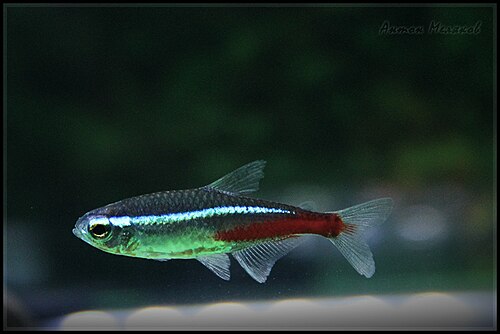
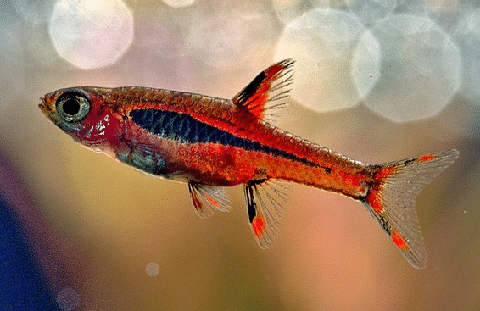
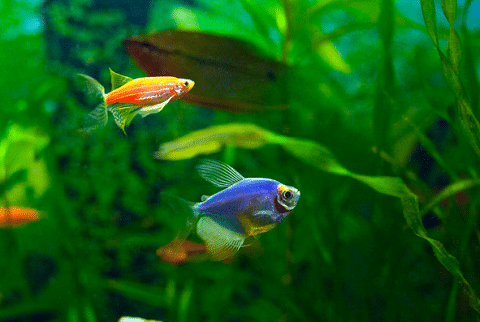
Tetras are among the most popular freshwater aquarium fish in the hobby, and for good reason. These small, colorful characins bring life and movement to any community tank with their tight schooling behavior and vibrant colors. From the iconic neon tetra to the dramatic congo tetra, there are over 1,000 known tetra species, with dozens readily available to hobbyists.
This A-Z directory covers every tetra species we have profiled at Aquarium Store Depot. Use the alphabet links below to jump to any section, and click on any species name to read its full care guide. At the bottom, you will also find our Rare and Specialist Species Directory covering species that are seldom seen in the hobby.
A | B | C | D | E | F | G | H | I | J | K | L | M | N | O | P | Q | R | S | T | U | V | W | X | Y | Z
B
Beckford’s Pencilfish (Nannostomus beckfordi). Slender, peaceful pencilfish with a golden body and red fin accents
Black Darter Tetra (Poecilocharax weitzmani). Small, dark predatory tetra that perches and darts from cover
Black Line Tetra (Hyphessobrycon scholzei). Silver-bodied tetra with a bold black horizontal line from head to tail
Black Neon Tetra (Hyphessobrycon herbertaxelrodi). Subtle beauty with a dark horizontal stripe and iridescent green-blue line
Black Phantom Tetra (Hyphessobrycon megalopterus). Dark, elegant tetra where males display dramatic fin-spreading displays
Black Skirt Tetra (Gymnocorymbus ternetzi). Hardy, beginner-friendly tetra with flowing black fins and a compressed silver body
Bleeding Heart Tetra (Hyphessobrycon erythrostigma). Stunning tetra with a vivid red spot on its chest and large flowing fins
Blind Cave Tetra (Astyanax mexicanus). Eyeless cave-adapted tetra. a fascinating example of evolution in action
Bloodfin Tetra (Aphyocharax anisitsi). Hardy, long-lived tetra with a silver body and blood-red fins
Blue Emperor Tetra (Inpaichthys kerri). Deep blue-purple tetra with a striking horizontal stripe, great for planted tanks
Blue Tetra (Cochu’s Blue Tetra) (Boehlkea fredcochui). Shimmering blue-bodied tetra from the Amazon, active and eye-catching
Bucktooth Tetra (Exodon paradoxus). Aggressive scale-eating predator. unique among tetras, not community-safe
Buenos Aires Tetra (Hyphessobrycon anisitsi). Robust, active tetra that thrives in cooler water and planted tanks
C
Cardinal Tetra (Paracheirodon axelrodi). Iconic neon-blue and red tetra from the Amazon blackwater rivers
Coffee Bean Tetra (Hyphessobrycon takasei). Small tetra with two dark oval spots resembling coffee beans on its flanks
Colombian Tetra (Hyphessobrycon columbianus). Flashy tetra with brilliant blue-silver scales and red fins
Congo Tetra (Phenacogrammus interruptus). Large, iridescent African tetra with flowing rainbow-hued fins
Coral Red Pencilfish (Nannostomus mortenthaleri). Stunning deep red pencilfish, one of the most colorful Nannostomus species
Costello Tetra (Hemigrammus hyanuary). Also known as the January tetra, with a green lateral stripe and red eye
D
Dash-Dot Tetra (Hemigrammus bellottii). Small, subtle tetra with a thin horizontal line and caudal spot
Diamond Tetra (Moenkhausia pittieri). Sparkling, diamond-scaled tetra from Venezuela with long, elegant finnage
Ornate Tetra (Hyphessobrycon bentosi). Elegant pinkish tetra closely related to the rosy tetra with ornate finnage
P
Payara (Vampire Tetra) (Hydrolycus scomberoides). Dramatic predatory fish with large fangs, a challenging species for experts
Penguin Tetra (Thayeria boehlkei). Active swimmer with a bold black stripe that extends into the lower tail fin
Phoenix Tetra (Hemigrammus filamentosus). Fiery orange-red tetra with extended dorsal filaments in males
Pike Characin (Boulengerella maculata). Elongated, pike-shaped predator from South American rivers
Pink-Tailed Chalceus (Chalceus macrolepidotus). Large, active characin with a vivid pink tail and silver body
Pristella Tetra (X-Ray Tetra) (Pristella maxillaris). Also called the X-ray tetra for its translucent body with yellow, black, and white fin tips
R
Red Eye Tetra (Moenkhausia sanctaefilomenae). Active schooling tetra named for its distinctive red-rimmed eyes
Red Hook Silver Dollar (Myloplus rubripinnis). Large, red-finned silver dollar with a distinctive hook-shaped anal fin
Red Phantom Tetra (Hyphessobrycon sweglesi). Translucent red tetra with a dark shoulder spot, cousin to the black phantom
Red-Base Tetra (Hemigrammus stictus). Silver tetra with a vivid red patch at the base of its tail
Red-Bellied Piranha (Pygocentrus nattereri). The most well-known piranha species, requiring specialized care and large tanks
Rosy Tetra (Hyphessobrycon rosaceus). Delicate pink-hued tetra with white-tipped fins, perfect for community tanks
Ruby Tetra (Axelrodia riesei). Tiny, jewel-red nano tetra perfect for small planted aquariums
Rummy Nose Tetra (Petitella georgiae). Tight-schooling tetra prized for its bright red nose and striped tail
S
Sailfin Tetra (Crenuchus spilurus). Rare, territorial tetra where males display an impressive sail-like dorsal fin
Serpae Tetra (Hyphessobrycon eques). Vibrant red-orange tetra with a bold black shoulder spot
Short-stripe Penguin Tetra (Thayeria obliqua). Similar to the penguin tetra but with a shorter, less extended stripe
Silver Dollar Fish (Metynnis argenteus). Large, peaceful herbivore with a round, silver coin-shaped body
Silver Tetra (Ctenobrycon spilurus). Robust, silver-bodied tetra that’s hardy and adaptable to many tank setups
Silvertip Tetra (Hasemania nana). Lively schooler with shimmering silver-tipped fins and a golden body
Socolof’s Tetra (Hyphessobrycon socolofi). Subtle, silver-blue tetra from the Rio Negro region of Brazil
Splash Tetra (Copella arnoldi). Famous for its remarkable breeding behavior of jumping to lay eggs on overhanging leaves
T
Three-Lined Pencilfish (Nannostomus trifasciatus). Elegant pencilfish with three distinct horizontal stripes
True Rummy Nose Tetra (Hemigrammus rhodostomus). The original rummy nose species, distinguished by its head pattern details
U
Ulrey’s Tetra (Hemigrammus ulreyi). Understated silver tetra with a faint horizontal stripe and yellow finnage
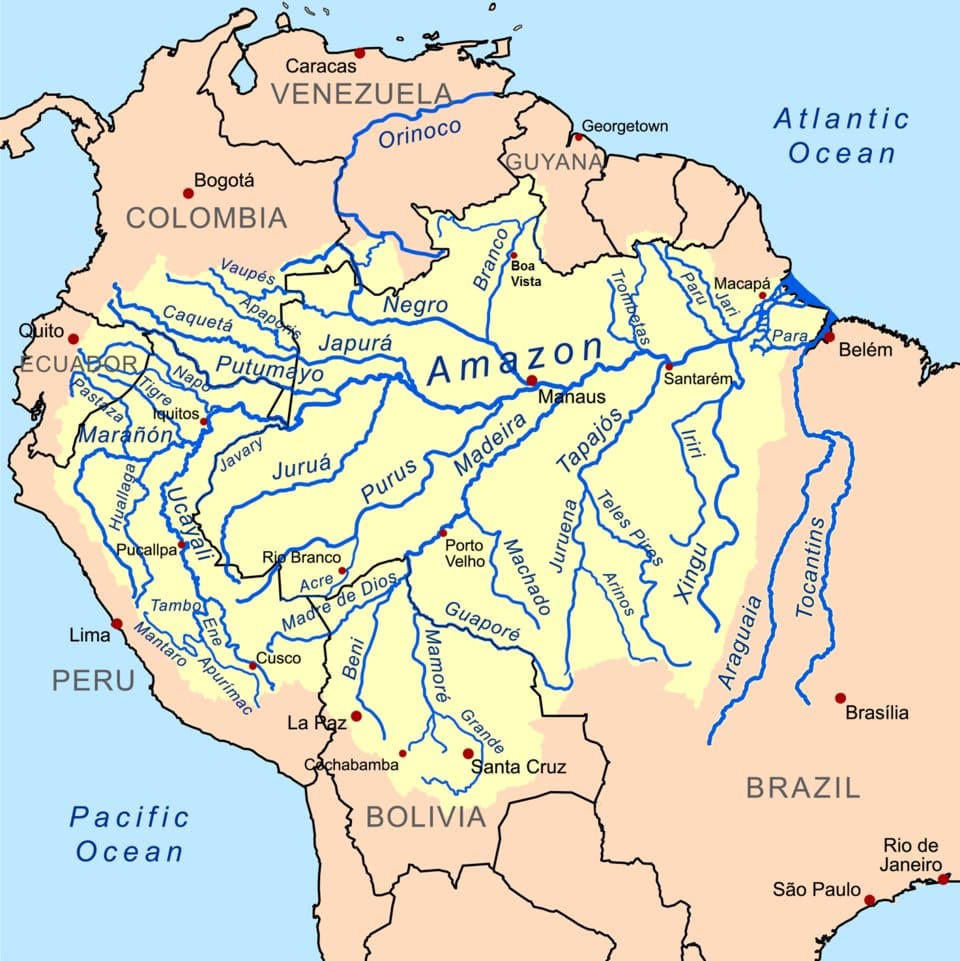
Map of South American freshwater habitats. Via Wikimedia Commons.
Y
Yellow Congo Tetra (Alestopetersius caudalis). Golden-yellow African tetra, less common but stunning cousin of the Congo tetra
Yellow Tetra (Hyphessobrycon bifasciatus). Bright yellow-bodied tetra from southeastern Brazil
Rare & Specialist Species Directory
The species listed below are rarely seen in the aquarium hobby. Most are seldom imported, difficult to source, or kept only by dedicated specialists and breeders. We include them here to complete our tetra directory. For detailed taxonomic and distribution data on these species, we recommend FishBase as a primary reference.
Adonis Tetra (Lepidarchus adonis). Miniature African tetra, one of the smallest characins in the hobby. FishBase
Blue Diamond Congo Tetra (Alestopetersius smykalai). Brilliant blue African tetra, a rare and sought-after species. FishBase
Calypso Tetra (Hyphessobrycon axelrodi). Reddish-brown tetra with subtle beauty, named after the orchid genus. FishBase
Candy Cane Tetra (HY511) (Hyphessobrycon sp. HY511). Red and white striped tetra also known as HY511, popular in planted setups
Dragonfin Tetra (Pseudocorynopoma doriae). Unusual tetra where males have elongated, dragon-like fin extensions. FishBase
False Black Tetra (Gymnocorymbus thayeri). Close relative of the black skirt tetra with a more subdued appearance. FishBase
Featherfin Tetra (Hemigrammus unilineatus). Silver tetra with a distinctive elongated white tip on its dorsal fin. FishBase
Flag Tetra (Hyphessobrycon heterorhabdus). Tri-colored horizontal striped tetra resembling a flag. FishBase
Glass Tetra (Moenkhausia oligolepis). Large-scaled, semi-transparent tetra with a dark shoulder spot. FishBase
King Emperor Tetra (Nematobrycon amphiloxus). Dark variant of the emperor tetra with deep black-blue coloration. FishBase
Lipstick Tetra (Moenkhausia cosmops). Brazilian tetra with a dark body and contrasting bright red lips. FishBase
Panda Tetra (Dawn Tetra) (Aphyocharax paraguayensis). Black-and-white marked tetra also known as the dawn tetra. FishBase
Platinum Tetra (Hemigrammus vorderwinkleri). Shimmering silver-white tetra with a metallic platinum sheen. FishBase
Purple Tetra (Meta Tetra) (Hyphessobrycon metae). Subtle purple-gray tetra with a distinctive dark lateral band. FishBase
Rainbow Tetra (Nematobrycon lacortei). Colorful relative of the emperor tetra with red, blue, and yellow hues. FishBase
Red Arc Tetra (Hyphessobrycon sp. red arc). Newer to the hobby, featuring a distinctive red arc marking along its body
Red-Spotted Tetra (Copeina guttata). Larger characin with rows of red spots along its silver flanks. FishBase
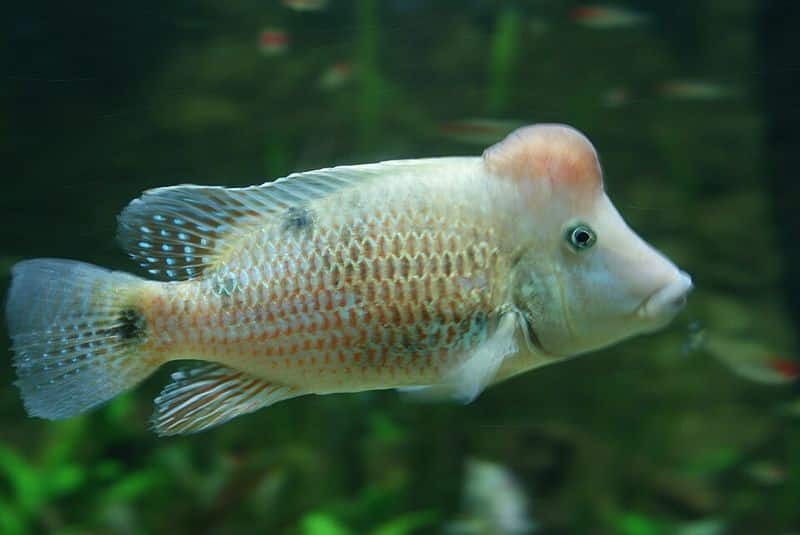
Crenicichla regani is the exception that breaks every assumption people have about the pike cichlid genus. The genus Crenicichla has a reputation for aggression, size, and demanding setups. The dwarf pike cichlid challenges all three. Staying at just 3-4 inches (7-10 cm), remaining peaceful enough for a well-planned community tank, and thriving in a planted aquarium, it offers all the predatory charisma and torpedo-body elegance of a pike cichlid without the 100-gallon commitment that usually comes with it.
This is a fish for keepers who want something different. Not a beginner fish, the live food requirement and water quality standards rule that out, but not an expert-only species either. Get the setup right and the dwarf pike cichlid will be one of the most interesting, most watchable fish you’ve ever kept.
Key Takeaways
The most peaceful pike cichlid.Crenicichla regani is the gentle outlier in a genus known for aggression. Community-compatible with appropriately sized fish.
True dwarf species. Males reach only 3-4 inches (7-10 cm), making it one of the smallest pike cichlids in the hobby.
Plant-safe. Unlike most cichlids, dwarf pikes don’t dig or destroy plants. A planted tank is actually the ideal setup for this species.
Strict carnivore. Requires a diet of live and frozen meaty foods. Many individuals refuse prepared foods entirely.
Expert jumper. A tight-fitting, gap-free lid is the single most important piece of equipment for this fish. Non-negotiable.
Cave spawner. Breeds readily in captivity given proper conditions and is one of the easier pike cichlids to spawn.
ASD Difficulty Rating
Moderate | 5/10
The 30-gallon minimum and community-compatible temperament make the dwarf pike cichlid more accessible than most predatory cichlids. What pushes it past beginner territory is the requirement for live and frozen foods, the water quality needs, and the absolute lid requirement. Intermediate keepers with experience keeping soft-water fish and feeding frozen foods will find this species manageable and extremely rewarding.
Semi-aggressive (mildly territorial; peaceful toward non-prey tank mates)
Diet
Carnivore (live and frozen meaty foods)
Tank Level
Bottom to Middle
Maximum Size
4 inches (10 cm) males; 3 inches (7 cm) females
Minimum Tank Size
30 gallons (114 liters)
Temperature
76 to 82°F (24 to 28°C)
pH
5.5 to 7.0
Hardness
3 to 10 dGH
Lifespan
4 to 6 years
Breeding
Cave spawner (biparental)
Breeding Difficulty
Moderate
OK for Planted Tanks?
Yes, excellent choice for planted setups
Classification
Taxonomic Level
Classification
Order
Cichliformes
Family
Cichlidae
Subfamily
Cichlinae
Tribe
Crenicichlini
Genus
Crenicichla
Species
C. regani Ploeg, 1989
Crenicichla regani was described by Alex Ploeg in 1989. The genus Crenicichla is one of the most species-rich cichlid genera, with over 100 described species ranging from dwarf fish like C. regani to large predators exceeding 12 inches. The common name “pike cichlid” comes from the elongated body shape that resembles the unrelated northern pike (family Esocidae). Recent molecular studies place the genus in the tribe Crenicichlini within subfamily Cichlinae. C. regani belongs to the “regani group” of smaller, more docile Crenicichla species that are more suitable for aquarium keeping than the larger members of the genus.
Origin & Natural Habitat
The dwarf pike cichlid is documented from the Amazon River basin in Brazil, specifically from the Rio Trombetas at Cachoeira Porteira. It inhabits clearwater rivers and streams near shorelines where rocks, roots, and submerged vegetation provide dense cover. Water in these habitats is warm, soft, and slightly acidic, typical of Amazonian blackwater tributaries.
In the wild, C. regani is a secretive ambush predator. It lives among rock crevices, root tangles, and dense vegetation near the riverbank, waiting in cover and darting out to capture small invertebrates and tiny fish that move within striking distance. This behavioral context explains the care requirements: these fish need structure, plenty of hiding places, and a sense of security to express their natural behavior and leave cover regularly.
Expert Take (Mark Valderrama, AquariumStoreDepot)
After 25+ years in the hobby, I’ve watched a lot of fishkeepers pass on dwarf pike cichlids because of the Crenicichla reputation. Understandable, the genus has some real terrors. But C. regani is the exception. It’s the pike cichlid that actually works in a community setup with the right companions. What surprises most people is how well it does in a planted tank. It won’t dig up your aquascape or eat your plants, which puts it ahead of most cichlids for planted setups. The lid requirement isn’t optional though. I’ve heard too many stories about losing these fish to overnight jumps before a proper cover was in place. Sort out the lid first, then add the fish.
Appearance & Identification
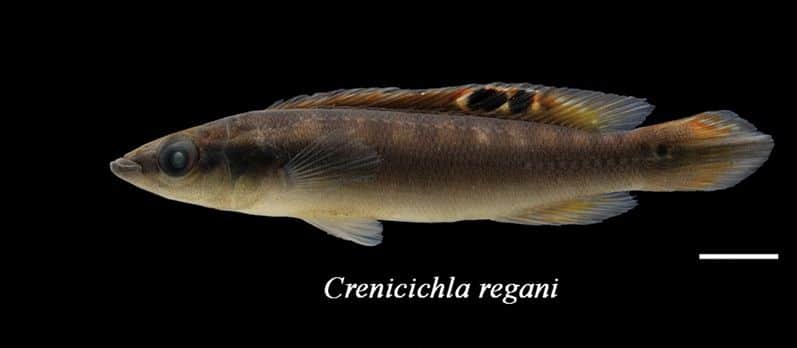
The dwarf pike cichlid has the characteristic elongated, torpedo-shaped body of the Crenicichla genus: large head, upturned mouth, and streamlined profile built for ambush hunting. Base coloration is brownish to olive-green with a dark lateral stripe running from the snout through the eye to the caudal peduncle. Multiple dark vertical bars appear along the body, varying in intensity with mood and condition.
Under good conditions, the body develops subtle iridescent highlights, and the fins may show reddish or yellowish tones in well-conditioned specimens. A dark ocellus is typically present on the upper portion of the caudal peduncle. The overall appearance is subtle rather than flashy, but the predatory body shape and the watchful, alert energy this fish carries give it a charisma that raw color can’t replicate.
Male vs. Female
C. regani is one of the easier pike cichlids to sex. The female’s dorsal fin has distinct black spots that are absent in males, this difference is visible in captive-bred specimens as early as three months of age.
Feature
Male
Female
Body Size
Up to 4 inches (10 cm)
Up to 3 inches (7 cm)
Dorsal Fin
No spots
Distinct black spots (key sexing indicator)
Belly Color
More uniform
May show reddish tones, especially in breeding condition
Body Shape
Slightly more elongated
Slightly deeper-bodied when mature
Average Size & Lifespan
Males in aquariums typically reach 3-4 inches (7-10 cm). Females stay smaller at 2-3 inches (5-7 cm). Growth is rapid, sexual maturity can be reached as early as 3-4 months in captive-bred fish, which makes this species one of the faster-developing cichlids in the hobby relative to its adult size.
Lifespan is typically 4-6 years with proper care. Some sources suggest C. regani may have a naturally shorter lifespan in the wild compared to many other cichlid species. In aquarium conditions with consistent feeding, clean water, and stable parameters, they reliably reach the upper end of that range.
Care Guide
Tank Size
A 30-gallon (114-liter) tank is the minimum for a pair. For a small group or a community setup, 40-55 gallons gives more room for territory establishment and reduces the chance of aggressive encounters. The tank should be at least 36 inches (90 cm) long and 18 inches (45 cm) wide. Footprint matters more than height for these bottom-oriented fish.
In larger groups of 10 or more, a 75-gallon or larger tank with dense structure allows the social hierarchy to stabilize and individual territories to become less rigidly defended. Groups work better than pairs in setups with adequate space and hiding spots.
Water Parameters
Parameter
Recommended Range
Temperature
76 to 82°F (24 to 28°C)
pH
5.5 to 7.0
General Hardness
3 to 10 dGH
Ammonia
0 ppm
Nitrite
0 ppm
Nitrate
Below 20 ppm
Hard Rule: Your lid needs to be escape-proof before this fish enters the tank.
Not “a lid with a small gap.” Not “covered except for the feeding hole.” Every gap is an exit. Dwarf pike cichlids are expert jumpers that locate openings other fish ignore entirely. A pike cichlid on the floor doesn’t usually survive. The lid goes on before the fish go in, and it stays on.
Soft, slightly acidic water mimics their natural Amazonian habitat and brings out the best behavior. If your tap water is hard and alkaline, blending with RO water or using peat filtration helps achieve suitable parameters. Driftwood and Indian almond leaves naturally acidify while providing a more natural environment.
Filtration & Water Flow
Strong biological filtration with gentle output. A quality canister or hang-on-back filter provides the necessary biological capacity. Water flow should be gentle to moderate, these fish inhabit calm shoreline areas in the wild and don’t appreciate strong current. Use a spray bar or pre-filter sponge on the output to diffuse flow across the tank. Regular 25-30% weekly water changes maintain the water quality this species needs.
Lighting
Low to moderate lighting. Bright, exposed conditions make dwarf pike cichlids shy and reluctant to leave cover. Floating plants naturally reduce overhead light and create shaded zones that encourage the fish to come out and be visible. This pairs perfectly with the planted tank approach that works so well for this species.
Plants & Decorations
This is where dwarf pike cichlids genuinely surprise people. They don’t dig. They don’t eat plants. They don’t rearrange your aquascape. A densely planted tank with java fern, anubias, cryptocorynes, and stem plants is the ideal environment for C. regani, providing the structured, cover-rich habitat these fish thrive in.
Driftwood tangles, rocky crevices, and small caves are essential alongside the plants. These ambush predators need spots to retreat to, hide in, and hunt from. Coconut shells, small terracotta pots, and stacked rock formations all provide the hideaways dwarf pikes favor. Each territory needs at least one sheltered area the fish can claim as its own.
Substrate
Fine sand is preferred for the natural look and the gentle bottom surface, but it’s not as critical as it is for eartheater species since dwarf pikes don’t sift substrate for food. Fine gravel also works. The key is providing a smooth substrate that won’t abrade the fish’s body, since pike cichlids spend time resting near the bottom.
Tank Mates
C. regani is the most peaceful pike cichlid, but it’s still a small predator. Fish small enough to fit in its mouth will eventually be eaten, though at 3-4 inches, the mouth is small, which limits the at-risk list considerably. Many common community fish are too large to be prey.
Best Tank Mates
Angelfish, compatible temperament and water parameters; too large to be prey
Keyhole cichlids, peaceful, similarly sized cichlids with shared soft-water preferences
Medium-sized tetras (bleeding heart, Colombian, emperor), large enough to avoid predation
Small corydoras, coexist well in structured tanks with adequate hiding spots
Other dwarf pike cichlids, groups work in larger tanks with dense structure
Tank Mates to Avoid
Very small fish, neon tetras, ember tetras, small rasboras, and similar nano fish are potential prey
Aggressive cichlids, larger territorial cichlids will bully and stress dwarf pikes
Dwarf shrimp, will be hunted and eaten
Large, boisterous fish, active, pushy species intimidate these relatively shy predators and reduce visibility
Food & Diet
Dwarf pike cichlids are strict carnivores. Frozen foods should form the foundation of their diet: bloodworms, white mosquito larvae, vitamin-enriched brine shrimp, daphnia, and mysis shrimp are all eagerly accepted. Live blackworms, daphnia, and baby brine shrimp bring out the best hunting behavior and help maintain condition. These are exactly the foods that make this species most active and interesting to watch.
Getting dwarf pikes to accept prepared pellets can be challenging and is not reliable across individuals. Some fish will learn to take sinking pellets or granules, but many won’t. Even those that accept prepared foods need frozen and live supplements. If you’re not willing to feed frozen bloodworms regularly, this isn’t the right fish for your setup.
Feed small amounts 2-3 times daily. These fish have small stomachs and do better with frequent, modest meals. Use sinking foods that reach the bottom where they feed, or target-feed directly to the territory. Upper-water feeders can intercept food before it reaches the pike’s level.
Breeding & Reproduction
Breeding Difficulty
Moderate. C. regani is one of the easier pike cichlids to spawn and has been bred regularly in home aquariums. Sexual maturity arrives quickly in captive-bred fish, sometimes as young as 3-4 months of age, which makes breeding attempts realistic in a well-managed setup.
Spawning Tank Setup
A 20-30 gallon breeding tank works well. Provide fine sand substrate, small caves with tight openings (barely large enough for the fish to enter), and some driftwood or plants for cover. The caves are critical, these are cave spawners, and the female needs an appropriate site to deposit eggs. Coconut shells, small terracotta pots, and commercially available cichlid caves all work well.
Water Conditions for Breeding
Soft, acidic water at pH 5.0-6.0, hardness below 5 dGH, temperature 79-84°F (26-29°C). Slightly decreasing pH and hardness while raising temperature and adding tannins through botanicals (Indian almond leaves, catappa bark) often stimulates breeding activity. Pristine water quality with frequent changes is essential.
Conditioning & Spawning
Condition breeders with generous portions of live food. Live blackworms, daphnia, and brine shrimp are excellent conditioning foods. When ready, the female selects a cave and deposits eggs on the ceiling or walls of the cavity. Both parents guard the territory, with the female providing primary egg care inside the cave. Spawning can occur at 3-4 months of age in aquarium-bred specimens, making this one of the faster-breeding cichlid species in the hobby.
Egg & Fry Care
The female guards eggs inside the cave, fanning them and removing any that develop fungus. Eggs hatch in approximately 3-4 days depending on temperature. Free-swimming fry are relatively large and accept baby brine shrimp as a first food immediately. Growth is rapid with frequent feeding and clean water. Separate fry by size as they develop to prevent cannibalism from larger siblings.
Common Health Issues
Bacterial Infections
Bacterial infections occur when water quality slips or the fish sustains injuries from territorial disputes or sharp decorations. Symptoms include fin erosion, cloudy eyes, and body sores. Good water quality is the primary prevention. Broad-spectrum antibiotics are generally effective when treatment begins early.
Ich (White Spot Disease)
Stress from shipping, new tank introductions, or temperature swings can trigger ich. Gradually raise the temperature to 84-86°F (29-30°C) and treat with a quality ich medication. The warm water preferences of this species work in your favor during treatment.
Internal Parasites
Wild-caught specimens carry a higher parasite risk than tank-raised fish, but aquarium-bred individuals can still be affected. White, stringy feces and unexplained weight loss are warning signs. Metronidazole treats protozoan parasites; praziquantel targets worms. Quarantine all new fish, especially wild-caught specimens, before introduction to an established tank.
Jumping Injuries
Dwarf pike cichlids jump, and they’re good at finding openings. Fish that make it to the floor may survive if found immediately, but often sustain injuries to fins, scales, or internal organs. Prevention is the only reliable approach: a tight-fitting lid with no gaps, every time, from day one. Coverslide glass, acrylic lids, and mesh covers all work as long as they’re truly secure with no openings the fish can exploit.
What People Get Wrong
The Crenicichla genus reputation creates specific, predictable misconceptions about this species:
“It’s a pike cichlid, so it must be aggressive.” The genus contains some genuinely problematic species, but C. regani is the gentle outlier. It’s specifically the mellow member of an aggressive family. The name creates expectations this particular species consistently contradicts.
“It’ll destroy my planted tank.” Most cichlids dig and uproot plants. This one doesn’t. A well-planted tank is the ideal environment for C. regani, better than most non-cichlid community fish, because the plants and caves together create exactly the structured habitat this ambush predator needs.
“I can feed it pellets and supplement occasionally with frozen.” This is backwards. Frozen foods and live foods are the diet, with pellets as the occasional supplement if the fish accepts them at all. Many individuals never take prepared foods. If frozen bloodworms aren’t already part of your routine, address that before getting this species.
“I’ll get the lid sorted later.” The lid goes on before the fish go in. Not after. Not “tomorrow.” Dwarf pike cichlids are not like most fish where a loose lid is a minor risk. They actively locate and exploit gaps. The tank is not ready for this fish until the lid is escape-proof.
Common Mistakes to Avoid
Not covering the tank properly. The single most important requirement. Tight-fitting lid, no gaps, before the fish arrives.
Feeding only prepared foods. Dwarf pikes need frozen and live foods. Prepared foods alone won’t sustain them long-term.
Keeping with tiny fish. Even with this peaceful species, anything small enough to swallow will eventually be eaten.
Bright, open lighting without shade. Makes dwarf pikes shy and stressed. Provide floating plants and subdued conditions.
Insufficient hiding spots. Without caves and structure, these fish feel permanently exposed. More cover means bolder, more visible fish.
Keeping only a pair without escape routes. If the pair becomes aggressive with each other, the subordinate fish needs somewhere to go. Dense structure with multiple hiding areas is essential.
Should You Get This Fish?
The dwarf pike cichlid is a rewarding, unusual fish that fits a specific keeper profile. Here’s the honest breakdown:
Good fit if:
You have a 30-gallon or larger with soft, slightly acidic water
You already feed frozen foods or are willing to start
You have a tight-fitting, gap-free lid or can build one
You want a predatory fish with a planted tank aesthetic
You have some experience keeping soft-water tropical fish
You’re drawn to the ambush predator personality and torpedo body shape
Think twice if:
You want a fish that lives primarily on pellets
You have nano fish (neons, embers, small rasboras) you want to protect
Your tank has gaps in the lid or you’re not able to add a proper cover
You’ve never kept carnivorous fish before and aren’t sure about the feeding commitment
You have dwarf shrimp you want to keep
What It Is Actually Like Living With a Dwarf Pike Cichlid
This is the part the care guides skip. Here is what actually happens when you keep this species long-term.
It does not look like a predator until the moment it eats. The dwarf pike cichlid spends most of its time motionless or drifting near cover, which reads as peaceful until you watch it ambush a small fish. The speed of the strike is the first thing that surprises new keepers. The second is how fast a fish that fits in its mouth disappears. This is a predator that uses patience as its hunting strategy – everything before the strike looks like calm.
The camouflage behavior is constant and deliberate. Dwarf pike cichlids orient to match background elements – driftwood, plant stems, substrate edges. In a well-planted tank with natural decor, you will regularly lose track of this fish. In a bare or sparsely decorated tank, it will look exposed and stressed, and the behavior shifts from confident ambush predator to a fish that cannot settle. The decoration is not optional – it is what turns this fish on.
Personality develops over months. Fish that arrive shy and reclusive become progressively bolder as they map the tank and recognize the keeper. After a few months, a well-settled dwarf pike will emerge at feeding time and track movement at the glass. It will not beg the way an oscar does, but it registers your presence. The transition from hiding fish to confident predator is one of the more satisfying things to watch in a cichlid tank.
Color is the readout. A settled, healthy dwarf pike in the right conditions shows rich patterning with the lateral stripe sharp and the body color fully saturated. Stress, poor water quality, or temperature drift produce a washed-out fish that holds position near the bottom and barely moves. If your dwarf pike looks faded and inactive, something is wrong – check water parameters before anything else.
Dwarf Pike Cichlid vs. Similar Species
If you’re deciding between the dwarf pike cichlid and other small South American cichlids, here’s what actually matters for ownership:
Dwarf Pike Cichlid vs. Apistogramma (Dwarf Cichlids) Apistos are more colorful, more widely available, and more forgiving on diet (most accept pellets readily). They’re the beginner-accessible entry point into small South American cichlids. The dwarf pike offers what apistos don’t: the predatory body shape, the ambush hunting behavior, and the torpedo silhouette that makes watching these fish genuinely different. Choose an apisto if color and breeding behavior are the priority. Choose the dwarf pike if you want the predator experience in a planted tank.
Dwarf Pike Cichlid vs. Keyhole Cichlid (Cleithracara maronii) The keyhole cichlid is one of the most peaceful cichlids in the hobby and is genuinely beginner-accessible. It accepts pellets, is compatible with a wide range of tank mates, and has almost no aggression. The keyhole has personality without the predatory edge. Choose keyhole if you want maximum community compatibility and ease of care. Choose dwarf pike if you want the hunting behavior, the ambush personality, and the torpedo shape of a true predatory cichlid in a manageable size.
Where to Buy
Dwarf pike cichlids are a specialty item not commonly found at typical local fish stores. Online retailers and specialty cichlid dealers are the most reliable sources. Flip Aquatics carries unique South American species and is worth checking, and Dan’s Fish is another reliable source for less common cichlids.
When purchasing, look for active, alert fish with good body condition and intact fins. Ask what the fish has been eating, knowing their current food preferences directly affects how easy the transition to your tank will be. Note that fish sold as “dwarf pike cichlid” may include several Crenicichla species from the regani group; confirm the species identification if possible, particularly if you plan to breed.
Frequently Asked Questions
Are dwarf pike cichlids good for beginners?
Intermediate keepers with some experience, not true beginners. The feeding requirements, regular live and frozen foods, and water quality standards put this fish above entry level. If you’ve successfully kept soft-water community fish and already feed frozen foods regularly, C. regani is approachable. If this would be your first foray into carnivorous fish, build that experience first.
Can dwarf pikes live in a community tank?
Yes, with the right companions. Fish too large to swallow and that don’t crowd the bottom territory are safe. Angelfish, keyhole cichlids, and medium-sized tetras all work. The critical factor is providing enough structure and hiding spots so the pike feels secure and doesn’t become stressed by tank mates.
Will dwarf pikes eat pellets?
Some individuals accept sinking pellets and granules, but many don’t, and you can’t count on it. Even fish that take prepared foods need frozen and live foods as a regular part of their diet. If you’re not prepared to provide frozen bloodworms and similar foods consistently, this is the wrong species for your setup. The diet requirement is not negotiable.
Can I keep dwarf pikes in a planted tank?
Yes, and a planted tank is actually the ideal setup. Unlike most cichlids, dwarf pikes don’t dig or eat plants. Dense planting with java fern, anubias, cryptocorynes, and stem plants creates exactly the structured, cover-rich habitat these fish thrive in. A planted setup with driftwood and caves is far superior to a sparse tank.
How do I sex dwarf pike cichlids?
Look at the dorsal fin. Females have distinct black spots on the dorsal; males don’t. This is visible in captive-bred fish as early as three months of age, making it one of the easier dwarf cichlids to sex. Males are also slightly larger and may show less belly color variation than females.
Why is the lid such a big deal with this species?
Dwarf pike cichlids are exceptionally good at finding and exploiting gaps in aquarium covers. They’re jumpers by nature, and unlike some fish where a loose lid is a minor hazard, a pike cichlid that gets out typically doesn’t survive. This isn’t theoretical, it’s a commonly reported experience among keepers who underestimated the lid requirement. Sort the lid before the fish arrive, not after.
Closing Thoughts
The dwarf pike cichlid offers something rare in the aquarium hobby: the predatory edge and torpedo elegance of a pike cichlid in a package that actually fits in a standard home aquarium. C. regani proves that you don’t need 100 gallons to enjoy the hunting behavior, the alert intelligence, and the distinctive body shape that make pike cichlids so compelling.
Set up a planted tank with soft water, plenty of caves and driftwood, and a secure lid. Feed a carnivorous diet heavy on frozen and live foods. Add a pair or small group and let them settle in. You’ll have a fish that combines the predatory personality of a pike cichlid with a size and temperament that opens it up to a whole range of keepers who’ve been on the wrong side of the genus reputation for too long.
The gold zebra loach is a warm-toned, active botia that needs the same things every botia needs: a group of at least five, sand substrate, and a tank large enough to handle the social dynamics. It reaches about 4 inches, has a semi-aggressive temperament, and will harass other bottom dwellers if understocked or bored.
In a properly set up tank with the right group size, gold zebra loaches are active, beautifully colored, and endlessly entertaining to watch. This guide covers the real requirements, because a single gold zebra loach is a stressed gold zebra loach. Group size is not optional with botias.
Buy five or do not buy any. That is the rule with every botia, and the gold zebra is no exception.
The Reality of Keeping Gold Zebra Loach
The gold zebra loach is a color variant of the standard zebra loach with warmer, golden-toned banding. The care requirements are identical to the standard form. Everything that applies to zebra loaches applies here, including the need for groups, sand substrate, and half-dose medications.
One gold zebra loach isn’t a pet. It’s a prisoner pacing its cell.
Availability is more limited than standard zebra loaches, and prices are slightly higher. The golden coloration is more visible on dark substrate than the standard silver-and-black pattern, making it a more striking display fish.
A group of five or more is essential. The social behavior, feeding confidence, and visible activity levels all depend on adequate group size. Solitary gold zebra loaches hide and stress.
Biggest Mistake New Owners Make
Treating it differently from a standard zebra loach because of the color. Same fish. Same care. Same group requirements. Same medication sensitivity. The gold coloring is aesthetic, not a different species with different needs.
ASD Difficulty Rating: Tier 1 – Beginner
Gold zebra loaches are an attractively striped loach species suitable for community tanks with peaceful, active fish. They are social, active, and appreciate groups of 5 or more.
Expert Take (Mark Valderrama, AquariumStoreDepot)
The gold zebra loach is the premium version of an already underrated species. A group of five on dark sand with driftwood and moderate planting creates a warm-toned bottom display that the standard silver zebra loach cannot replicate. Same behavior, same hardiness, better visual impact in the right setup.
Hard Rule: Gold zebra loaches need a group of at least 5 and soft substrate. Like all loaches, solitary keeping produces a stressed, reclusive fish – and gravel substrate damages the sensitive barbels they use to forage.
Key Takeaways
One of the more peaceful botia loaches, making it a solid choice for community tanks with appropriately sized tank mates
Keep in groups of 5 or more to reduce stress and encourage natural social behavior, including their characteristic “loach dance”
Excellent snail control. Gold zebra loaches will actively hunt and eat pest snails, making them a natural solution for snail infestations
Requires a minimum 30-gallon (114 liter) tank with plenty of hiding spots, smooth substrate, and moderate to strong water flow
Long-lived commitment. With proper care, expect 8 to 12 years, so plan accordingly before bringing them home
Myanmar (Irrawaddy, Salween, and Sittang river drainages)
Care Level
Moderate
Temperament
Peaceful to Semi-Aggressive
Diet
Omnivore
Tank Level
Bottom to Middle
Maximum Size
5 inches (13 cm)
Minimum Tank Size
30 gallons (114 liters)
Temperature
72 to 82°F (22 to 28°C)
pH
6.0 to 7.5
Hardness
2 to 12 dGH
Lifespan
8 to 12 years
Breeding
Egg scatterer (not bred in home aquaria)
Breeding Difficulty
Very Difficult / Not Achieved
Compatibility
Community (with appropriate tank mates)
OK for Planted Tanks?
Yes
Classification
Taxonomic Level
Classification
Order
Cypriniformes
Family
Botiidae (separated from Cobitidae)
Subfamily
Botiinae
Genus
Botia
Species
B. Histrionica (Blyth, 1860)
This species was originally described by Edward Blyth in 1860 from specimens collected in Myanmar (then Burma). The family Botiidae was formerly included within Cobitidae (the true loaches), but taxonomic revisions separated the botia-type loaches into their own distinct family. The genus Botia is much smaller than it used to be, with many former members reassigned to Yasuhikotakia, Ambastaia, and other genera. Botia histrionica remains firmly within Botia proper.
The specific epithet histrionica comes from the Latin word for “theatrical” or “actor,” likely a reference to the species’ bold, dramatic stripe pattern. It’s a fitting name for a fish that definitely knows how to put on a show.
Origin & Natural Habitat
The gold zebra loach is endemic to Myanmar, where it’s found in several major river systems including the Irrawaddy, Salween, and Sittang drainages. These rivers flow through a range of habitats from highland streams to lowland floodplains, and the gold zebra loach will occupy the mid-elevation stretches where the water is clear, moderately flowing, and well-oxygenated.
In their natural environment, these loaches inhabit rocky substrates with cobbles, gravel, and sand, along with submerged roots and driftwood that provide shelter. The water is soft to moderately hard with a slightly acidic to neutral pH. During the monsoon season, water levels and flow rates increase dramatically, and the fish are well adapted to handling seasonal changes in their environment.
Like most botiid loaches, gold zebras are found in groups in the wild. They use crevices between rocks and tangles of submerged wood as daytime hiding spots, becoming more active during dawn and dusk. Understanding this natural behavior is key to setting up a proper home aquarium. They need structure, flow, and the security of a group to feel comfortable.
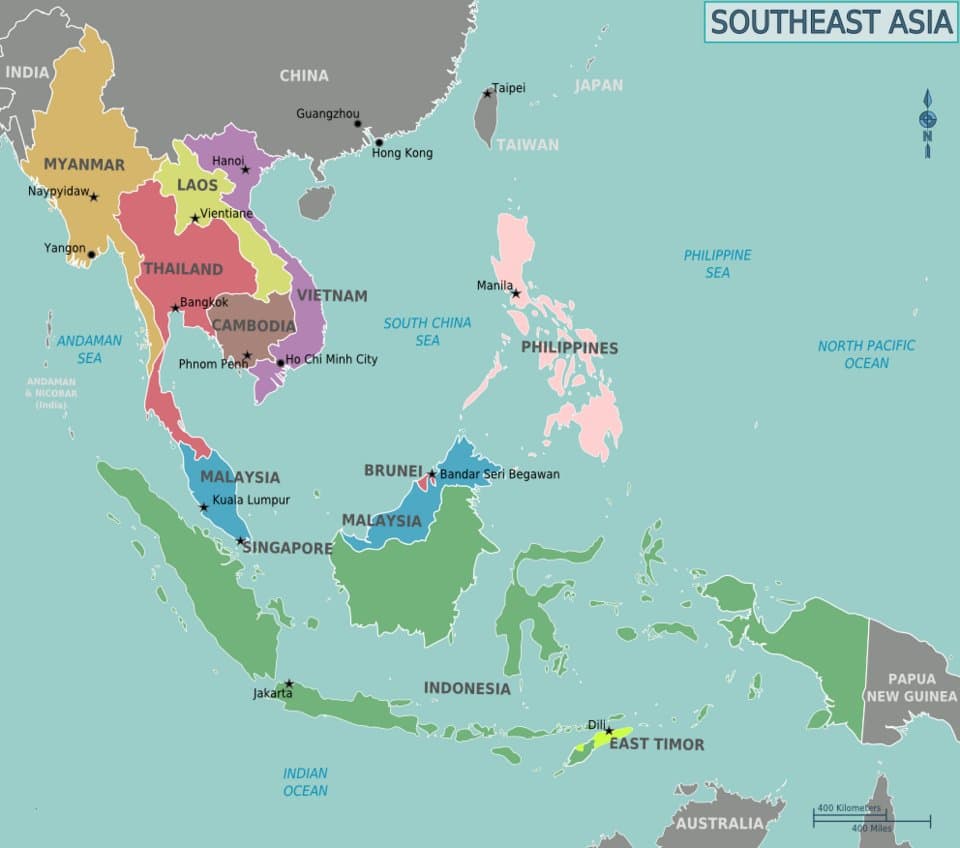
Map of Southeast Asian freshwater habitats. Via Wikimedia Commons.
Appearance & Identification
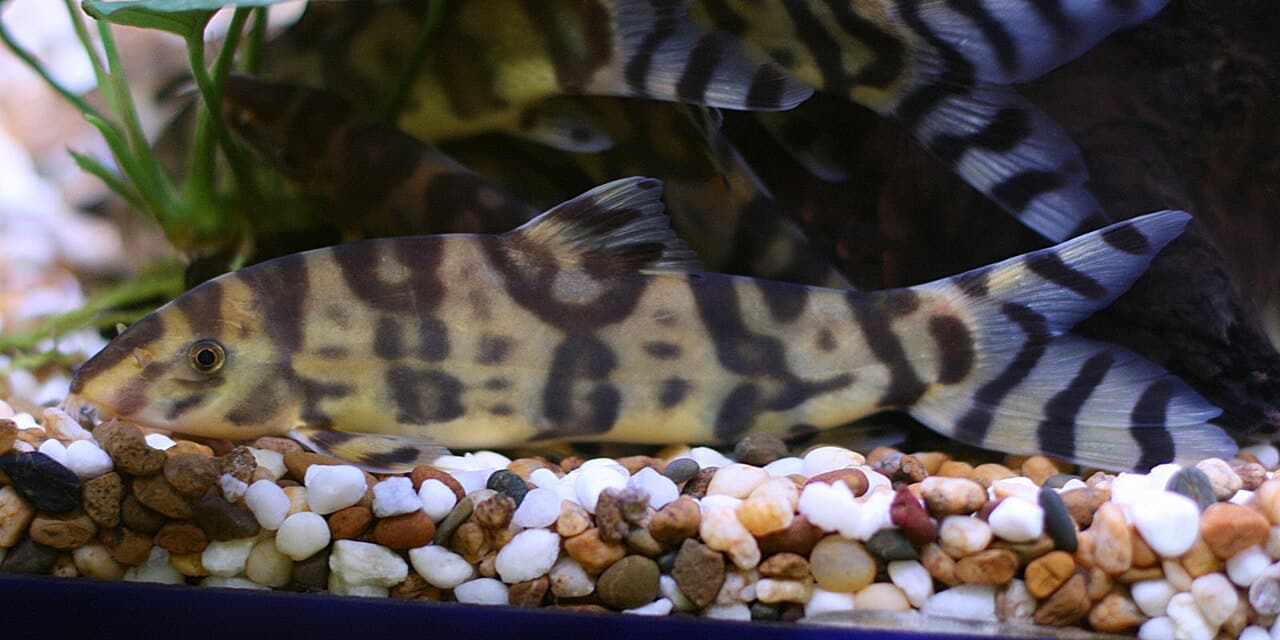
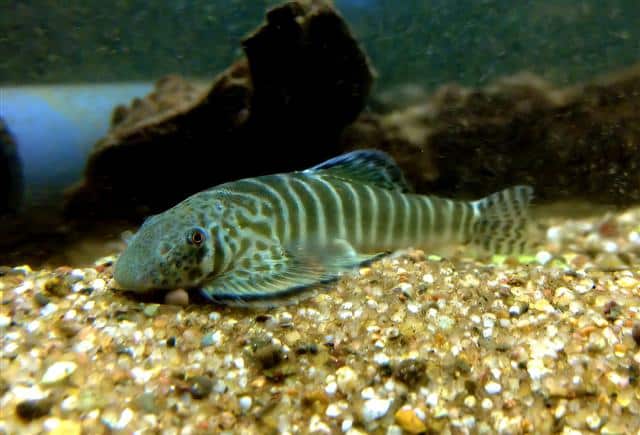
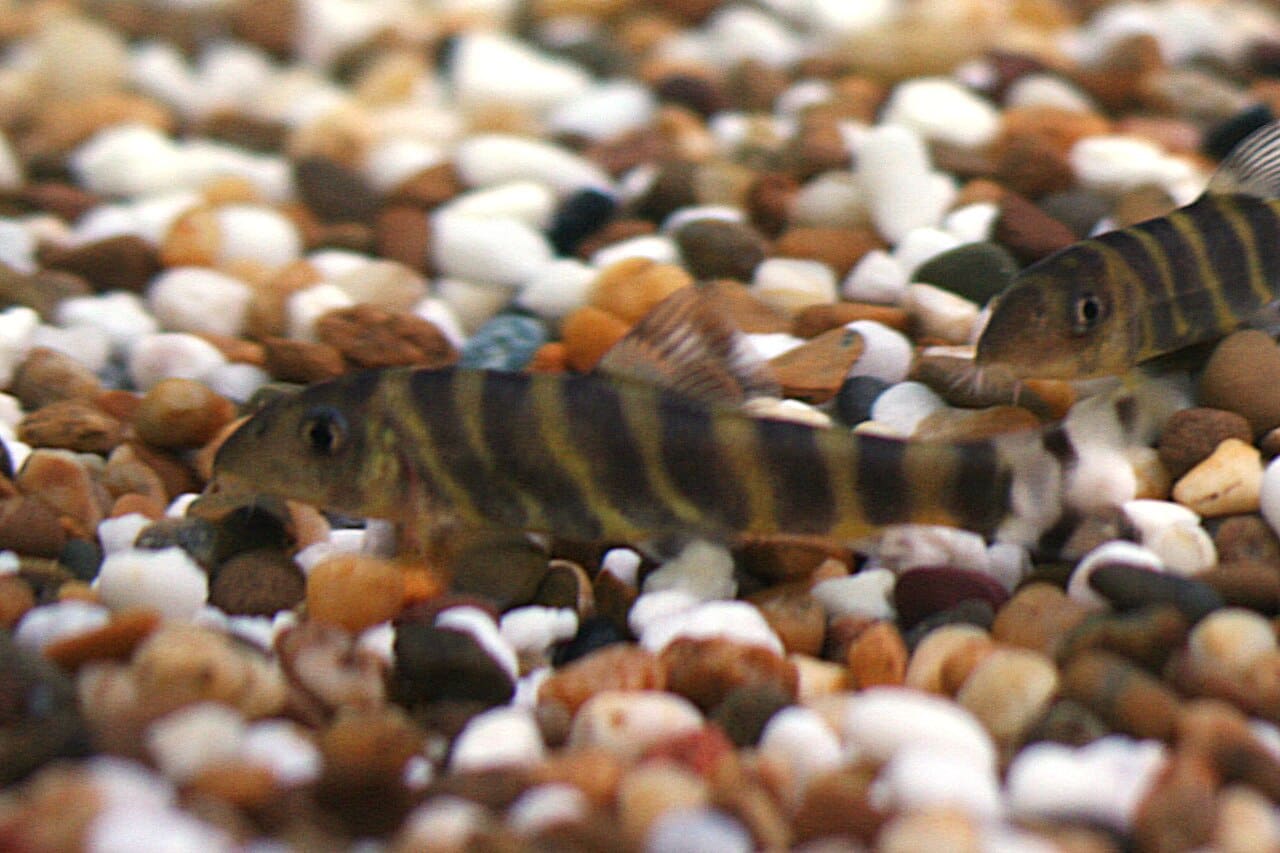
The gold zebra loach is a genuinely attractive fish. The base body color ranges from warm golden-yellow to a creamy silver-gold, and it’s overlaid with a series of prominent dark brown to black vertical bands. These bands vary in width and spacing between individuals, giving each fish a unique pattern. Some specimens have bands that fork or branch, adding to the visual complexity.
The fins are mostly clear to slightly yellowish, and the caudal (tail) fin often shows banding that extends from the body pattern. The head features a characteristic dark stripe running through the eye, which is a common trait in the Botia genus. Like all botiid loaches, they have a bifid (two-pronged) suborbital spine beneath each eye that can be erected when the fish is stressed or threatened. Be careful when netting them. These spines can get tangled in mesh.
Their body shape is typical of botias: laterally compressed with a slightly arched back and a flat underside suited for bottom-dwelling. They have four pairs of barbels around the mouth that they use to probe the substrate for food.
Male vs. Female
Feature
Male
Female
Body Shape
Slightly slimmer and more streamlined
Fuller, rounder body, especially when mature
Size
Is slightly smaller
Often slightly larger at maturity
Coloration
May show slightly more intense coloring
Similar coloring, sometimes slightly muted
Belly Profile
Flat to slightly concave
Rounded, especially when carrying eggs
Sexing gold zebra loaches isn’t easy, especially in juveniles. The differences are subtle at best and really only become apparent in mature adults. Females are a bit fuller-bodied than males, particularly when viewed from above, but without a side-by-side comparison of known specimens, it’s more guesswork than science. Since these fish haven’t been successfully bred in home aquaria, sexing them is more of an academic exercise than a practical concern for most hobbyists.
Average Size & Lifespan
Gold zebra loaches typically reach about 4 to 5 inches (10 to 13 cm) in the aquarium. Most specimens sold in stores are juveniles in the 1.5 to 2.5 inch (4 to 6 cm) range, so they do need room to grow. They’re not massive fish, but they’re not small either, especially when you factor in that you should be keeping a group.
With proper care, these loaches live 8 to 12 years in captivity. Hobbyists have reported specimens living even longer. This is a genuine long-term commitment, and it’s worth considering before you bring a group home. A lot of fishkeepers underestimate how long loaches live, and these are no exception.
Care Guide
Tank Size
A 30-gallon (114 liter) tank is the minimum for a small group of gold zebra loaches, but bigger is always better with active bottom-dwellers like these. If you’re keeping a group of 5 to 6, a 40 to 55-gallon (151 to 208 liter) tank gives them much more room to establish territories and explore. These are active fish that use the full footprint of the tank, so prioritize length and width over height. A standard 55-gallon long is ideal.
Give them plenty of hiding spots. Stacked rocks with gaps, driftwood caves, PVC pipe sections, and dense plant groupings all work well. Gold zebra loaches like to wedge themselves into tight spaces, so make sure there are retreat options throughout the tank. Without adequate hiding spots, they’ll be stressed and you’ll rarely see them.
Water Parameters
Parameter
Recommended Range
Temperature
72 to 82°F (22 to 28°C)
pH
6.0 to 7.5
Hardness (GH)
2 to 12 dGH
Ammonia
0 ppm
Nitrite
0 ppm
Nitrate
Below 20 ppm
Gold zebra loaches are moderately adaptable when it comes to water chemistry, but they do best in soft to moderately hard water with a slightly acidic to neutral pH. Consistency matters more than hitting an exact number. What they absolutely cannot tolerate is poor water quality. Like most loaches, they’re sensitive to elevated ammonia and nitrite levels, and they’re often among the first fish in a tank to show signs of stress when water quality slips.
Weekly water changes of 25 to 30% are a good baseline. If your tank is heavily stocked, bump that up. These fish come from flowing waters with good oxygen levels, so don’t let things get stagnant.
Filtration & Water Flow
Good filtration is non-negotiable. A canister filter or a quality hang-on-back filter rated for your tank size (or slightly above) is the way to go. Gold zebra loaches appreciate moderate to strong water flow, which mirrors the moving streams they come from in the wild. A powerhead or spray bar can help create directional current, and you’ll often see them play in the flow.
Oxygenation is important too. An air stone or surface agitation from the filter output keeps dissolved oxygen levels high, which these loaches prefer. Stagnant, low-oxygen conditions will stress them out over time.
Lighting
Gold zebra loaches aren’t fussy about lighting, but they do prefer subdued to moderate light levels. Bright, unshaded tanks will make them shy and they’ll spend most of their time hiding. Floating plants, driftwood overhangs, and areas of shadow give them the confidence to come out and explore. If you’re running strong lights for a planted tank, just make sure there are shaded zones where they can retreat.
Plants & Decorations
Live plants work well with gold zebra loaches, and they generally leave plants alone. Hardy species like Java fern, Anubias, Vallisneria, and Cryptocoryne are all good choices. Floating plants like Amazon frogbit or water lettuce help dim the light and make the loaches feel more secure.
Decorations should focus on providing hiding spots. Stacked rocks (make sure they’re stable and can’t topple), driftwood with crevices, and ceramic caves are all appreciated. These loaches will investigate every gap and hollow in the tank, and they sometimes squeeze into spaces that look impossibly tight. That’s normal behavior. Just make sure nothing can shift and trap them.
Substrate
Smooth sand or fine rounded gravel is the best choice. Gold zebra loaches spend a lot of time on the bottom, sifting through substrate and probing with their barbels. Sharp or rough substrates can damage those sensitive barbels over time. A fine sand substrate is ideal and mimics their natural habitat. If you prefer gravel, choose a smooth, rounded variety and avoid anything with jagged edges.
Is the Gold Zebra Loach Right for You?
Before you buy, run through this honest checklist. The Gold Zebra Loach is a great fish for the right keeper, but it is not for everyone.
You have a 30-gallon or larger established tank with strong filtration
You can maintain consistently low nitrates and high water quality
You want an eye-catching loach with bold gold and dark banding
You can keep a group of at least 5 for social stability
You are experienced enough to avoid copper-based medications
Your tank has a sandy or smooth substrate that will not damage their barbels
Tank Mates
Gold zebra loaches are one of the more peaceful botia species, which gives you some solid options for community setups. That said, they’re still loaches. They is nippy with each other (which is normal social behavior in a group), and very slow-moving or long-finned fish will get pestered. The key is choosing tank mates that occupy different levels of the tank and can handle a little bit of loach energy.
Best Tank Mates
Barbs. Cherry barbs, tiger barbs, and other medium barbs are active enough to hold their own
Rasboras. Harlequin rasboras, scissortail rasboras, and similar mid-dwellers work well
Tetras. Larger tetras like Congo tetras, emperor tetras, and bleeding heart tetras are good matches
Corydoras catfish. Peaceful bottom dwellers that occupy similar space but don’t compete aggressively
Bristlenose plecos. Calm, stay out of the loaches’ way, and help with algae
Danios. Zebra danios and giant danios are fast and hardy enough to coexist
Gouramis. Pearl gouramis and other medium-sized gouramis work well as upper-level tank mates
Other loaches. Kuhli loaches and other peaceful loach species can coexist, though monitor closely
Tank Mates to Avoid
Long-finned or slow-moving fish. Bettas, fancy guppies, and angelfish with flowing fins can be targeted
Very small fish. Tiny species like microrasboras or endlers may be stressed by the loaches’ activity
Large aggressive cichlids. Oscar, Jack Dempsey, and similar aggressive species will bully loaches
Ornamental snails. Mystery snails, nerite snails, and other pet snails will likely become lunch
Shrimp. Small shrimp like cherry shrimp and Amano shrimp are at risk of being eaten or harassed
One important note on snails: if you’re keeping ornamental snails like mystery snails or nerites, gold zebra loaches are probably not for you. These fish are dedicated snail hunters. That’s actually a major selling point if you have a pest snail problem, but it means any snails you want to keep will be on the menu.
Food & Diet
Gold zebra loaches are omnivores with a hearty appetite. In the wild, they feed on insect larvae, worms, small crustaceans, snails, and plant matter. In the aquarium, they’re not picky eaters, which makes feeding them straightforward.
A good staple diet should include high-quality sinking pellets or wafers, since these bottom-dwellers won’t usually chase food at the surface. Supplement that with frozen or live foods like bloodworms, brine shrimp, daphnia, and tubifex worms. They go absolutely crazy for live blackworms if you can find them. Blanched vegetables like zucchini, cucumber, and spinach are also accepted and help round out their nutrition.
And then there are snails. Gold zebra loaches are natural snail predators and will actively hunt down pest snails like Malaysian trumpet snails, pond snails, and ramshorn snails. If you’ve got a snail infestation in another tank, dropping a few in with your loaches is like giving them a live buffet. They’ll crack the shells with their pharyngeal teeth and slurp out the contents.
Feed once or twice a day, offering only what they can consume within a few minutes. Since they’re most active in the evening and early morning, an evening feeding often gets the best response.
Breeding & Reproduction
Let’s be straightforward here: gold zebra loaches have not been successfully bred in home aquaria with any regularity. The vast majority of specimens available in the hobby are wild-caught from Myanmar. This is unfortunately common with botiid loaches. Most species in the family are extremely difficult to breed outside of their natural environment.
Breeding Difficulty
Very difficult. There are virtually no documented cases of hobbyists successfully spawning this species at home. Some commercial breeders in Southeast Asia have reportedly used hormonal injections to induce spawning in related botia species, but this isn’t practical or accessible for home aquarists.
What We Know About Their Reproduction
In the wild, gold zebra loaches are believed to be seasonal spawners that migrate upstream to spawn during the monsoon season. They’re egg scatterers, releasing eggs over rocky or gravel substrates in flowing water. The eggs are left unguarded and hatch on their own.
The seasonal migration and specific environmental triggers. Changes in water chemistry, temperature, flow rate, and photoperiod. Are likely key to reproductive behavior, and replicating all of those conditions simultaneously in a home tank is extremely challenging.
If You Want to Try
If you’re determined to attempt breeding, start with a large group of at least 8 to 10 well-conditioned adults in a spacious tank. Provide excellent water quality, a varied high-protein diet, and try simulating seasonal changes by gradually lowering the temperature and then raising it while increasing water flow. Large, cool water changes will trigger spawning attempts in botia species. But realistically, your chances of success are very slim. Don’t be discouraged. Even expert breeders struggle with this one.
Common Health Issues
Gold zebra loaches are hardy once established, but they do have some vulnerabilities that are common across botiid loaches. Being aware of these will help you catch problems early.
Ich (White Spot Disease)
Loaches in general are particularly susceptible to ich, and gold zebras are no exception. Those small white spots on the body and fins are unmistakable. The tricky part is that loaches are also more sensitive to many common ich medications, particularly those containing copper or malachite green. If you need to treat, use a half-dose approach or choose ich treatments specifically labeled as safe for scaleless fish. Raising the temperature to 86°F (30°C) gradually while adding aquarium salt at a low dose is often the safest first response.
Skinny Disease
Wild-caught loaches sometimes arrive with internal parasites that cause them to eat normally but lose weight. Hence the name “skinny disease.” If your gold zebra loach is eating well but looking increasingly thin, internal parasites are the likely culprit. A course of anti-parasitic food or medication containing praziquantel or levamisole can address this. Quarantining new arrivals and treating prophylactically is a smart move with any wild-caught loach.
Bacterial Infections
Poor water quality can lead to bacterial infections that show up as reddened areas on the body, fin erosion, or cloudy eyes. Prevention through consistent maintenance and good water quality is the best approach. If infections do occur, broad-spectrum antibacterial medications can help, but again, use loach-safe formulations and dose conservatively.
Stress-Related Issues
Gold zebra loaches kept alone or in too-small groups are chronically stressed, and stressed fish get sick. Faded coloring, excessive hiding, loss of appetite, and erratic swimming can all signal stress. The solution is usually environmental: more hiding spots, more companions, better water quality, or less aggressive tank mates. Address the stress and the symptoms usually resolve.
Common Mistakes to Avoid
Keeping them alone or in pairs. Gold zebra loaches are social fish that need a group of at least 5. Keeping fewer leads to chronic stress, aggression toward other species, and a fish that hides all day.
Skipping the quarantine period. Since most are wild-caught, quarantining for 2 to 4 weeks and treating prophylactically for internal parasites is strongly recommended.
Using sharp substrate. Rough gravel or crushed coral can damage their barbels and underside. Smooth sand or rounded gravel only.
Not enough hiding spots. Without caves, crevices, and cover, these loaches will be permanently stressed and you’ll never see their natural behavior.
Medicating at full dose. Loaches are sensitive to many medications, especially copper-based treatments. Always use half doses or loach-safe formulations.
Adding them to uncycled tanks. They’re sensitive to ammonia and nitrite spikes. Only add them to fully cycled, established aquariums.
Expecting them to coexist with ornamental snails. They will eat your mystery snails and nerites. It’s what they do.
Underestimating their lifespan. 8 to 12 years is a real commitment. Make sure you’re ready for it.
Where to Buy
Gold zebra loaches aren’t always the easiest fish to find, but they do show up periodically at specialty fish stores and online retailers. Since most are wild-caught, availability can be seasonal and dependent on export conditions from Myanmar.
Here are two reputable online sources worth checking:
Flip Aquatics. Great selection of freshwater fish with a focus on quality. Check their loach inventory for availability.
Dan’s Fish. Another solid source for healthy freshwater fish shipped directly to your door.
When purchasing, look for active fish with clear eyes, full bodies, and intact fins. Avoid any specimens that look thin or lethargic. Remember, skinny disease is a concern with wild-caught loaches. Buying from a reputable seller who quarantines their fish reduces the risk of bringing home sick animals.
Frequently Asked Questions
How many gold zebra loaches should I keep together?
A minimum of 5 is recommended. These are social fish that establish a hierarchy within their group. Keeping fewer than 5 often results in the dominant fish bullying the others, or the loaches redirecting their social behavior toward other species in the tank. A group of 5 to 8 is ideal for most setups.
Will gold zebra loaches eat all my snails?
Most likely, yes. Gold zebra loaches are enthusiastic snail eaters and will hunt down pest snails like ramshorns, pond snails, and Malaysian trumpet snails. If you’re keeping them to control a snail population, they’re very effective. But if you have ornamental snails you want to keep, gold zebra loaches are not the right choice for that tank.
Are gold zebra loaches aggressive?
By botia standards, no. They’re one of the more peaceful species in the family. However, they do engage in normal loach social behavior that can look alarming if you’re not used to it. Chasing, play-fighting, and “loach dancing” are all normal within a group. They can occasionally bother slow-moving or long-finned fish, but in a properly sized tank with appropriate tank mates, aggression toward other species is uncommon.
Why does my gold zebra loach make clicking sounds?
Many botiid loaches produce audible clicking or snapping sounds, especially during feeding or social interactions. This is normal behavior and nothing to worry about. The sounds are produced by their pharyngeal teeth or by the movement of their suborbital spines. It’s actually one of the more endearing quirks of keeping botia loaches.
Can gold zebra loaches live with shrimp?
It’s not recommended. Small shrimp like cherry shrimp and Amano shrimp are likely to be eaten or at least harassed by gold zebra loaches. If you want both loaches and shrimp, keep them in separate tanks. Larger shrimp species might fare slightly better, but the risk is always there with any loach species.
Why is my gold zebra loach lying on its side?
Don’t panic. This is actually normal loach behavior. Many botiid loaches rest on their sides, wedge themselves into odd positions, or lie flat on the substrate. It can look alarming the first time you see it, but as long as the fish is eating normally, has good coloration, and is active during its usual times, it’s just being a loach. If it’s combined with other symptoms like loss of appetite or faded color, then investigate further.
How the Gold Zebra Loach Compares to Similar Species
Both are attractive, medium-sized botiids, but the Bengal Loach grows larger (6+ inches vs 4-5 inches) and needs a bigger tank. The Gold Zebra Loach is slightly easier to manage in a 30-gallon setup, while the Bengal Loach really needs 55 gallons minimum. Both are sensitive to water quality and need groups.
The Polka Dot Loach (Angelicus Botia) grows larger and is more aggressive than the Gold Zebra Loach. If you want a striking pattern but a slightly calmer fish, the Gold Zebra Loach is the better option. The Polka Dot Loach demands more tank space and tougher tank mates.
What It Is Actually Like Living With Gold Zebra Loach
Gold zebra loaches bring warmth to the bottom level of a tank in a way that standard zebra loaches do not. The golden banding catches light differently, creating a subtle glow against dark substrate that complements the green tones of live plants.
Behavior is identical to standard zebra loaches. Active, curious, social. They investigate, forage, and rest in groups. The only difference is the aesthetic impact of the warmer color palette.
Mixing gold and standard zebra loaches in the same group works without issues. They school together and interact normally. The visual contrast between gold and silver banding in a mixed group adds variety without any behavioral complications.
Closing Thoughts
The gold zebra loach is one of those fish that rewards you for doing things right. Give them a proper group, good water quality, plenty of hiding spots, and appropriate tank mates, and they’ll reward you with years of entertaining, active behavior. They’re curious, they’re social, and they’re genuinely beautiful fish that deserve more attention in the hobby.
They’re not quite a beginner fish. The group requirements, sensitivity to water quality, and medication concerns mean you should have some experience under your belt before taking them on. But for anyone who’s kept a community tank successfully and wants something with more personality at the bottom of the tank, the gold zebra loach is hard to beat. Just don’t get too attached to your pest snails.
Recommended Video
References
Seriously Fish. Botia histrionica species profile. seriouslyfish.com
The rosy loach is one of the smallest loaches in the hobby at barely over an inch, and it fills a niche almost nothing else does: a true nano loach that thrives in a 10-gallon planted tank, stays visible during the day, and develops coloration that genuinely turns heads. Males flush warm rosy pink when they’re competing or displaying – in a well-conditioned group, that color is something you have to see in person.
What trips people up is the word “loach.” Rosy loaches don’t come from the rocky, fast-flowing streams where most loach species live. They come from shallow, sun-drenched, vegetated grasslands in Myanmar – gently flowing water, heavy plant cover, and plenty of open space to socialize. This is a schooling fish that happens to be a loach, not a bottom-hugging recluse that hides all day.
At barely an inch long, they shouldn’t be this interesting. In a planted nano tank built for them, they always are.
ASD Difficulty Rating: Easy to Intermediate. Manageable for a patient beginner, but only in the right setup. Requirements: mature tank (at least 2 months cycled), fine sand substrate, group of 8 to 10 minimum, and a diet that includes live or frozen micro foods. Add them to a new tank or buy too few and you’ll lose them. Get the setup right first.
What People Get Wrong
Rosy loaches are sold as easy nano fish, and they can be – but only if you avoid the three things that sink most first-time keepers.
Buying too few. The rosy loach social hierarchy needs at least 8 fish to spread aggression across the group. In a group of 3 or 4, dominant fish fixate on specific individuals and stress them to death. This isn’t an exaggeration – it’s what happens. A group of 10 looks completely different from a group of 4. Same species, but one setup works and one doesn’t.
Adding them to a new tank. Rosy loaches need a biologically mature aquarium. Ammonia and nitrite swings that a larger fish tolerates will kill fish this small within days. A tank that’s been running for at least two months, with established biofilm and stable parameters, is what this species requires. They’re not a fish you add during the cycling process.
Assuming sand is optional. Their barbels – the sensory organs around the mouth – are their primary foraging tools. Rosy loaches sift through substrate constantly looking for food. Coarse gravel damages those barbels over time, and once damaged, they can’t forage properly. Fine sand is not an aesthetic preference. It’s what keeps these fish functioning correctly.
The Reality of Keeping Rosy Loach
Rosy loaches are technically nemacheilid loaches, not “true loaches,” and their behavior reflects that. They’re not going to burrow into your substrate or hide in a cave all day. In a group of 8 or more, they’re active, visible, and constantly interacting – jockeying for social position, chasing each other in harmless displays, and darting through the bottom and mid portions of the tank. Feeding time is genuinely entertaining. Males in peak condition flush that distinctive pink, and social activity ramps up around it.
The water quality requirement is real. At barely an inch, any parameter fluctuation hits harder than it would with a 4-inch fish. An ammonia spike that a yoyo loach shrugs off can wipe out a group of rosy loaches over a weekend. This is not a species that forgives a new tank or an inattentive water change schedule.
Group size is the other non-negotiable. Eight or more brings out the coloration, the social behavior, and the confidence that makes this species worth keeping. Fewer than 6 and they become pale, nervous, and hidden. You won’t understand why people are enthusiastic about them until you see the right group size in the right setup.
Biggest Mistake New Owners Make
Keeping them in a new, unstable tank. Rosy loaches need a mature setup with stable chemistry and established biofilm. A tank that’s been running for less than two months doesn’t have the biological stability this tiny species requires. The loss rate in brand-new tanks is high – and once they start declining, they’re very difficult to recover.
Expert Take (Mark Valderrama, AquariumStoreDepot) When rosy loaches started showing up more regularly in the trade, the most common mistake I saw at the store counter was customers buying pairs or trios because they were nervous about the cost of buying 8 to 10 at once. Those same customers would come back weeks later confused about why their fish were pale and hiding. Group size for this species isn’t a suggestion – it’s the difference between keeping them and displaying them. If you can’t budget for 8 right now, wait until you can.
Hard Rule: Eight rosy loaches minimum. Not four, not six, not “I’ll add more later.” A group of four doesn’t function – one or two fish absorb all the aggression and decline from stress. Buy the right number at the start or wait until you can.
Key Takeaways
One of the smallest loaches at only 1 to 1.2 inches (2.5 to 3 cm), purpose-built for nano and planted aquariums
Keep in groups of 8 to 10 or more – the social hierarchy requires it; smaller groups stress fish and wash out their color
Males develop vibrant orange-pink coloration when conditioned and displaying – remarkable for a fish this size
Mature tank required – stable, established water chemistry with biofilm; not suitable for new setups
Fine sand substrate is essential – their sensory barbels need soft substrate to forage correctly
Omnivorous micropredator – needs live and frozen micro foods alongside quality dry foods; all-flake diets are not sufficient
Species Overview
Field
Details
Scientific Name
Petruichthys sp. ‘rosy’
Common Names
Rosy Loach, Rosy Botia
Family
Nemacheilidae
Origin
Shan State, eastern Myanmar
Care Level
Easy to Moderate
Temperament
Peaceful (mildly competitive within groups)
Diet
Omnivore / Micropredator
Tank Level
Bottom to Mid
Maximum Size
1.2 inches (3 cm)
Minimum Tank Size
10 gallons (38 liters)
Temperature
68 to 78°F (20 to 26°C)
pH
6.5 to 7.5
Hardness
5 to 12 dGH
Lifespan
5 to 7 years
Classification
Taxonomic Level
Classification
Order
Cypriniformes
Family
Nemacheilidae
Subfamily
– (no formal subfamilies recognized under current usage)
Genus
Petruichthys
Species
Petruichthys sp. ‘rosy’ (undescribed; genus established by Kottelat, 2012)
The taxonomy of this species has been a genuine rollercoaster. When it entered the trade around 2006, it was sold under the fictitious name Tuberoschistura arakanensis – a name never formally described. It was later traded as Yunnanilus sp. ‘rosy’ before ichthyologist Maurice Kottelat placed it in the new genus Petruichthys in 2012. More recently, some authorities have assigned it to Physoschistura mango. The species itself remains formally undescribed – unusual for a fish this commercially available. You’ll see all of these names used by different retailers and databases, but they all refer to the same fish.
Origin & Natural Habitat
Rosy loaches originate from Shan State in eastern Myanmar, where they inhabit shallow, flooded grasslands fed by natural springs. The water is clear, warm, and typically no deeper than about 12 inches (30 cm), with abundant aquatic vegetation throughout.
This environment is fundamentally different from the rocky, fast-flowing mountain streams most loaches call home. Rosy loaches live among dense plant cover in gently flowing, sun-drenched shallows. They share these habitats with Danio margaritatus (the celestial pearl danio) – which tells you exactly what kind of environment to recreate, and explains why these two species pair so naturally in a planted nano tank.
When you set up a densely planted 10-gallon with gentle flow and fine sand, you’re essentially recreating their native habitat. That’s why they do so well in these setups – it’s not a compromise, it’s exactly where they came from.
Southeast Asian freshwater habitats including Myanmar’s Shan State, native range of the rosy loach. Via Wikimedia Commons.
Appearance & Identification
For such a tiny fish, the rosy loach has remarkable coloration. The body is elongated and slightly compressed, with a pointed snout and small barbels around the mouth characteristic of nemacheilid loaches. They have a subtle stripe along the midline and scattered dark markings – but the real visual impact is the sex-linked color difference, which is among the most dramatic of any nano fish in the hobby.
Males in breeding condition develop an intense orange-pink to rosy hue across their entire body. This coloration deepens when males compete or display for females, and it turns heads even among more expensive fish. Females have a more subdued brownish base with irregular dark spots – attractive in their own quieter way, but nothing like a conditioned male at full color.
One of the most entertaining aspects of this species is the constant social posturing – brief chases, fin flares, and lateral displays that are completely harmless but endlessly watchable. It’s cichlid behavior at 1/20th the scale.
Male vs. Female
Feature
Male
Female
Body Color
Pale orange base, intensifying to rosy-pink when displaying
Brownish base with irregular dark spots
Size
Slightly smaller and slimmer
Noticeably larger and rounder-bellied
Body Shape
Slim, streamlined
Fuller, deeper body when carrying eggs
Behavior
More active, frequently displays and competes
Generally calmer, less showy
Sexing rosy loaches is straightforward once they’re mature. Color alone makes males and females easy to tell apart. Males are the smaller, slimmer, brighter fish; females are larger, rounder, and muted. A mixed-sex group brings out the most natural behavior and the most vivid male coloration.
Average Size & Lifespan
Rosy loaches max out at 1 to 1.2 inches (2.5 to 3 cm), making them one of the smallest loach species in the hobby. Their size is central to their appeal for nano setups, but don’t mistake small for simple. These fish are active, always moving, and pack more personality per inch than almost anything else you can keep in a 10-gallon.
With proper care, a varied diet, and stable water conditions, rosy loaches live 5 to 7 years. That’s a meaningful commitment for a fish this small – longer than most nano species people casually add to community tanks.
Care Guide
Tank Size
A minimum of 10 gallons (38 liters) works for a proper group of rosy loaches. Some sources suggest 6 gallons, but the extra volume of a 10-gallon provides meaningfully more stable water parameters and enough footprint for 8 to 10 fish. Since these fish are most active along the bottom and lower mid-water, a longer, shallower aquarium is better than a tall one.
If you’re building a fuller nano community with multiple species, step up to 15 or 20 gallons (57 to 76 liters). More volume means more stability – and stability is what rosy loaches need most.
Water Parameters
Parameter
Ideal Range
Temperature
68 to 78°F (20 to 26°C)
pH
6.5 to 7.5
GH
5 to 12 dGH
KH
3 to 6 dKH
Ammonia
0 ppm
Nitrite
0 ppm
Nitrate
Under 30 ppm
Consistency matters more than hitting an exact number within the range. Rosy loaches adapt well across these parameters but don’t tolerate sudden swings. Keep dissolved oxygen levels high, particularly at the warmer end of their range. Weekly water changes of 25 to 30% are the most reliable way to maintain the clean, stable conditions they need.
Filtration & Flow
Unlike most loaches, rosy loaches come from gently flowing water. A sponge filter or small hang-on-back filter is appropriate – avoid powerheads or anything creating strong current. The priority is clean water, not high flow. A sponge filter is ideal: gentle circulation, excellent biological filtration, and no intake suction risk for tiny fish. If you use a HOB or canister, fit the intake with a pre-filter sponge.
Lighting
Moderate lighting suits rosy loaches well, particularly in a planted setup. They come from sun-drenched shallows and aren’t bothered by bright tanks – just provide shaded areas through plant cover so fish can move in and out of light as they choose. A standard planted tank light on an 8 to 10-hour cycle is all you need.
Plants & Decorations
Dense planting isn’t optional – it replicates their natural habitat and brings out the best behavior. Fine-leaved plants like Java moss, Christmas moss, Pearlweed, and Rotala species provide cover, egg deposition sites, and surfaces for microorganisms to colonize. Floating plants help diffuse light and give fish a sense of security overhead.
A heavily planted tank is where rosy loaches feel genuinely at home. They’re more secure, display more vivid colors, and are far more likely to breed in dense vegetation than in an open setup.
Substrate
Fine sand is the right substrate. Rosy loaches use their barbels to sift through the bottom while foraging, and coarse gravel damages those barbels over time – impairing their ability to find food. Pool filter sand, play sand, or dedicated aquarium sand all work well. Aim for 1 to 2 inches (2.5 to 5 cm) depth.
Should You Get This Fish?
The rosy loach is excellent in the right setup – and genuinely unsuitable in the wrong one. Be honest with yourself before you buy.
Good Fit If:
You have a mature planted tank (10+ gallons, running at least 2 months)
You can commit to a group of 8 to 10 or more from day one
You already feed live or frozen micro foods, or are willing to start
You want a bottom-to-mid dweller that complements nano mid-water species
You enjoy watching complex social behavior in small fish
You have a planted shrimp tank and want a loach-type fish that won’t decimate your colony
Avoid If:
Your tank is new or still cycling – rosy loaches don’t survive parameter instability
You want to start with a pair and “see how it goes” – small groups don’t work for this species
Your tank includes fish over 2 inches that may view a 1-inch fish as a snack
You’re counting on them to control algae – they don’t
You have a gravel substrate and aren’t willing to change it
You want a fish that stays on the bottom and out of sight – rosy loaches are social and visible
Tank Mates
Size is the primary concern. Anything large enough to eat a 1-inch fish is off the table. Beyond that, avoid boisterous feeders that outcompete rosy loaches at mealtimes – these small fish need calm, similarly-sized tank mates to thrive.
Best Tank Mates
Celestial pearl danios (Danio margaritatus) – natural habitat companion from the same Myanmar grasslands
Chili rasboras and other Boraras species
Ember tetras
Dwarf rasboras (Boraras maculatus)
Pygmy corydoras
Neocaridina shrimp (cherry shrimp, blue dream, and similar)
Small snails (nerite, ramshorn)
Endler’s livebearers
Tank Mates to Avoid
Any fish over 2 inches (5 cm) that might view them as food
Bettas and cichlids – too aggressive for fish this small
Fast, aggressive feeders that outcompete them at mealtimes
Large loaches like clown or yoyo loaches – size mismatch and flow requirements differ
Territorial bottom dwellers that claim the same zone
Food & Diet
Rosy loaches are omnivorous micropredators. In the wild, they feed on tiny invertebrates, insect larvae, and microorganisms. Quality dry foods are accepted, but an all-flake or all-pellet diet is not sufficient – color fades and condition declines without regular live and frozen foods.
Dry: Crushed high-quality flakes, micro pellets, powdered foods designed for small fish
Feed small amounts two to three times daily. Their mouths are tiny – crush flakes or select nano-sized foods. In a well-planted, established tank, they graze on biofilm between feedings, which is part of why tank maturity matters for long-term condition.
Breeding & Reproduction
Breeding Difficulty
Rosy loaches are one of the more accessible loach species for home aquarium breeding. Successful spawning is well-documented among dedicated hobbyists. Not as straightforward as livebearers, but a keeper with the right setup can achieve consistent results.
Spawning Tank Setup
A mature, densely planted tank is the foundation. Fine-leaved plants like Java moss, Weeping moss, or spawning mops provide the egg deposition sites these fish prefer. The tank needs stable parameters and a healthy group of at least 8 to 10 individuals with both sexes represented.
Water Conditions for Breeding
No dramatic parameter manipulation required. Maintaining clean, stable conditions within their normal range – 68 to 78°F (20 to 26°C), pH 6.5 to 7.5 – is sufficient. Frequent feedings of live and frozen foods condition adults and trigger spawning readiness on their own.
Conditioning & Spawning
Males intensify their rosy coloration and become more active in displays as they approach spawning condition. Spawning occurs among fine-leaved plants, where females deposit small, slightly sticky eggs that adhere to plant surfaces. The eggs are tiny and very difficult to spot.
Egg & Fry Care
Remove adults after spawning – they eat the eggs. Eggs hatch in approximately 24 to 36 hours depending on temperature, with fry becoming free-swimming within another day or two. The fry are extremely small and require infusoria or powdered fry food for the first one to two weeks before graduating to freshly hatched baby brine shrimp. Growth is slow but steady, with sex-linked coloration appearing after a few months.
Common Health Issues
Ich (White Spot Disease)
Rosy loaches can contract ich like any freshwater fish – tiny white spots on body and fins. At this size, even a mild case is serious. Treat with half-dose medications appropriate for small or scaleless fish. Gradually raising temperature to 82°F (28°C) can accelerate the parasite’s life cycle, but watch dissolved oxygen levels carefully at higher temperatures.
Wasting Disease (Skinny Disease)
Shows as a sunken belly and progressive weight loss even in fish that appear to eat. Often linked to internal parasites or bacterial infection. Newly imported fish are particularly susceptible. Quarantine new arrivals, feed a varied protein-rich diet, and isolate any fish showing wasting symptoms for targeted treatment.
Stress-Related Issues
Rosy loaches kept in groups smaller than 6 develop chronic stress, suppressing immune function and opening the door to infections. You’ll see it as color loss, hiding, and reduced appetite. There’s no medication for inadequate social structure – the fix is group size. Maintain 8 to 10 individuals minimum and the stress-related health problems largely resolve themselves.
Common Mistakes to Avoid
Keeping too few. 3 or 4 fish is not a group – it’s a stress experiment. You need 8 to 10 minimum to see natural behavior and prevent chronic bullying of subdominant fish.
Using gravel substrate. Damages barbels, impairs foraging. Fine sand only.
Adding them to a new tank. They need a mature, biologically stable setup. A freshly cycled tank will lose them.
Feeding only dry food. They’re micropredators. Live and frozen foods are part of the baseline diet, not occasional treats.
Keeping them with large fish. Anything over 2 inches may eat them or outcompete them at feeding time.
Skimping on plants. Dense planting is what makes them secure enough to display natural behavior. A sparse or bare tank produces hiding, stressed fish that never show their best color.
Where to Buy
Rosy loaches are becoming more available as nano fishkeeping grows in popularity, but they’re still inconsistently stocked at local fish stores. Your best bet is ordering from online vendors who specialize in quality freshwater fish and have experience shipping small, delicate species safely:
Flip Aquatics – Excellent source for nano fish; experienced with packaging small, delicate species for transit
Dan’s Fish – Reliable selection of uncommon loaches and nano species with live arrival guarantees
When ordering, buy 8 to 10 at once. Don’t try to save money by buying 4 with plans to add more later – the stress from an undersized group will cost you more in losses. Look for active fish with rounded bellies in seller photos. Thin or lethargic fish are a red flag; these tiny loaches are very difficult to bring back once they’ve declined.
Frequently Asked Questions
Are rosy loaches good for nano tanks?
They’re one of the best nano tank choices available. Small size, diurnal activity, complex social behavior, and remarkable male coloration make them ideal for planted tanks of 10 gallons or more. They occupy bottom to lower mid-water, which pairs perfectly with top-dwelling and mid-water nano species.
Can I keep rosy loaches with shrimp?
Yes – rosy loaches are one of the few loach-type fish that work in shrimp tanks. They’re too small to threaten adult Neocaridina shrimp and generally ignore them. They may eat newborn shrimplets, but in a planted tank enough will survive to maintain the colony.
How many rosy loaches should I keep?
At least 8 to 10. In smaller groups, dominant fish fixate on specific individuals and stress them chronically. A larger group spreads the social pressure, allows the natural hierarchy to form, and brings out the male coloration and competitive displays that make this species worth keeping. This is not negotiable.
Do rosy loaches eat algae?
They graze on biofilm and microorganisms, but they’re not algae eaters. Don’t expect meaningful algae control from rosy loaches. For a nano tank, nerite snails or Amano shrimp are the better tools for that job.
Are rosy loaches the same as celestial pearl danios?
No – completely different families. Celestial pearl danios are cyprinids; rosy loaches are nemacheilid loaches. They share the same Myanmar grassland habitat and make excellent tank mates, but they are not related and have different behavior (CPDs are mid-water; rosy loaches occupy bottom to lower mid).
Why do my rosy loaches keep chasing each other?
Normal social behavior. Rosy loaches have a complex hierarchy and constantly jockey for position within the group. Males chase and display at each other regularly. As long as no fish are being physically injured or driven into permanent hiding, this is healthy – it’s exactly what you want to see in a proper-sized group.
How the Rosy Loach Compares to Similar Species
Rosy Loach vs. Kuhli Loach
The kuhli loach is the most common “small loach” recommendation, but it behaves very differently. Kuhli loaches are secretive, primarily nocturnal, and rarely visible during daylight – you’ll know they’re in there, but you won’t see much of them. Rosy loaches are the opposite: diurnal, visible, and actively social during the day. If you want a loach you can actually watch, choose the rosy loach. If you want a substrate-lurking, snake-like fish that cleans up after dark, the kuhli loach is your pick. They can be kept together in a larger nano setup, but expect completely different behavior from each species.
The Dwarf Chain Loach is bigger, bolder, and more active. It thrives in larger community tanks (20+ gallons) with moderate flow and does real work on pest snail populations. The rosy loach is smaller and specifically suited to planted nano setups of 10 gallons. If you want a loach for a general community tank, the Dwarf Chain Loach is the better pick. For a planted nano where size and gentleness matter, the rosy loach wins.
These two are completely unrelated but occupy similar territory in the nano tank world. Emerald dwarf rasboras are mid-water schoolers with striking green and red coloration; rosy loaches are bottom-to-lower-mid dwellers with that distinctive male pink flush. Both need groups, both need calm tank mates, and they can be kept together – covering different tank levels for a complete nano community. Choose based on tank level: mid-water goes to the emerald dwarf rasbora, bottom goes to the rosy loach.
What It’s Actually Like Living With Rosy Loach
Rosy loaches add a layer of activity to nano tanks that shrimp and snails simply can’t provide. They dart through the lower third of the tank, briefly resting on substrate or plant surfaces before zipping to a new position. The movement is constant but not frantic – it reads more like purposeful exploration than nervous energy.
Male coloration is the reward for good care. In a mature tank with clean water and a varied diet, males develop that rosy pink flush that deepens during displays. It’s subtle in photos and genuinely impressive in person – the kind of color that makes visitors stop and ask what that tiny fish is.
They coexist with shrimp, which is not something you can say about most loach species. Rosy loaches are simply too small to threaten adult cherry shrimp, and they generally ignore them. This makes them one of very few loach-type fish that actually works in a planted shrimp tank without constant worry.
Closing Thoughts
The rosy loach is one of the hobby’s genuinely underrated fish. It’s the only loach species that truly fits a 10-gallon planted tank, it stays visible during the day, and the male coloration – in a properly conditioned group – surprises people every time. If you’re building a planted nano and want a bottom-to-mid dweller that complements your mid-water schoolers, this is the fish.
Get the group size right, give them a mature planted tank with fine sand, feed varied foods, and they’ll reward you with years of complex social behavior and color that punches well above its size class. The requirements are real, but none of them are difficult. Get the setup right and there’s very little that can go wrong.
The panda loach is one of the most expensive and demanding loaches in the hobby. It needs cold, fast-flowing, highly oxygenated water with near-zero ammonia and nitrate. It comes from pristine mountain streams in China, and it expects those conditions in your tank. Compromise on water quality and it dies. There is no middle ground with this species.
For the keepers willing to build a dedicated hillstream setup, the panda loach is a stunning fish with bold black and white patterning that rivals any marine species for visual impact. This guide covers what it actually takes to keep one alive, because a panda loach is not a fish you buy on impulse. It is a fish you build an entire tank for.
If your water quality is not immaculate, the panda loach will be the most expensive lesson you have ever learned in this hobby.
The Reality of Keeping Panda Loach
The panda loach is a rare, expensive hillstream species with dramatic black and white banding that fades as the fish matures. Juveniles are strikingly patterned. Adults are more muted. If you are buying this fish for the coloring, know that the high-contrast juvenile appearance does not last.
It needs the same coolwater, high-flow setup as other hillstream loaches. Temperatures between 65 and 75F, strong current, oxygen-rich water, and mature biofilm-covered surfaces. This is a specialist fish that costs specialist money and needs specialist care.
Availability is limited and prices are high. A single panda loach often costs more than a group of five common loach species. That price tag means getting the setup right before buying the fish, not after.
Biggest Mistake New Owners Make
Buying it for the juvenile coloration without knowing it fades. Adult panda loaches retain the banding pattern but with significantly reduced contrast. If the striking black-and-white juvenile look is the reason you want this fish, you will be disappointed within a year.
ASD Difficulty Rating: Tier 3 – Advanced
Panda loaches (Yaoshania pachychilus) are a rare, specialized loach from fast-flowing, cold-water streams in China. They require cold water (65-72°F/18-22°C), very high oxygenation, and are not suitable for standard tropical tanks.
Expert Take (Mark Valderrama, AquariumStoreDepot)
The panda loach is the premium hillstream species. Beautiful, rare, and demanding. A dedicated coolwater hillstream setup with strong flow, mature biofilm, and temperatures around 68 to 72F is mandatory. Do not buy this fish until the setup has been running for at least two months. The price of the fish should reflect the investment in the setup, not precede it.
Hard Rule: Panda loaches cannot survive in standard tropical tanks. Their natural habitat is cold, fast-flowing streams at altitude – at tropical temperatures above 74°F (23°C) they suffer chronic heat stress.
Key Takeaways
Cool water specialist. Requires temperatures between 68 to 75°F (20 to 24°C), making it incompatible with most tropical community tanks
High flow and oxygen are non-negotiable. Aim for water turnover of 15 to 20 times per hour with heavy aeration
Striking juvenile pattern fades with age. The bold black and white panda bands in young fish gradually shift to a more mottled, network-like pattern in adults
Keep in groups of 4 or more in a minimum 20-gallon (76 liter) tank with a long footprint for adequate surface area
Rare and expensive. Expect to pay $30 to $60+ per fish, with limited availability from specialty retailers
Not yet bred in captivity. All specimens in the trade are wild-caught from a very limited range in China
Specialized community (cool, high-flow species only)
OK for Planted Tanks?
Yes (rheophytic plants only)
Classification
Taxonomic Level
Classification
Order
Cypriniformes
Family
Gastromyzontidae (split from Balitoridae)
Subfamily
.
Genus
Yaoshania (reclassified from Protomyzon)
Species
Y. Pachychilus (Chen, 1980)
This species was originally described by Chen in 1980 under the genus Protomyzon, and you’ll still find it listed as Protomyzon pachychilus in many hobby references and online retailers. The fish was later moved to its own monotypic genus, Yaoshania, named after the Dayao Mountain range where it was discovered. Similarly, the family was reclassified from Balitoridae to Gastromyzontidae as ichthyologists split the hillstream loaches into more precisely defined groups. You’ll see both names floating around. They refer to the same fish.
Origin & Natural Habitat
The panda loach is endemic to an extremely small range in southern China. It’s found only in headwater tributaries draining Dayao Mountain (Dayaoshan) in Jinxiu County, within the Guangxi Zhuang Autonomous Region. The confirmed collection sites are limited to a few streams within the Liu River and Gui River drainages. That’s it. This is not a widespread species by any stretch.
In the wild, they live in clear, shallow, fast-flowing mountain streams with rocky bottoms. Cold water rushing over smooth stones and cobbles coated in biofilm and algae. There’s minimal vegetation in the main flow areas, and the substrate is gravel, pebbles, and water-worn rocks with little fine sediment. Sunlight promotes diatom and algae growth that these loaches depend on for food. The key takeaway: this is a habitat defined by flow, oxygen, and cleanliness. Not warmth and plant cover.
Map of Southeast Asian freshwater habitats. Via Wikimedia Commons.
Appearance & Identification
There’s a reason this fish has “panda” in its name. Juvenile panda loaches display bold, alternating bands of black (or very dark brown) and white that run vertically across the body. The contrast is striking and immediately sets them apart from every other hillstream loach in the trade. It’s one of the few freshwater fish where the pattern genuinely justifies the hype.
Here’s what a lot of buyers don’t realize, though: that dramatic juvenile coloration changes as the fish matures. Adult panda loaches develop a more variable pattern. The clean vertical bands give way to lateral stripe arrangements and a network-like, reticulated pattern across the body, often organized in three loose rows. Adults are still attractive fish, but they look quite different from the juveniles that drew you in at the store. Most specimens in the trade are young fish specifically because the juvenile pattern is what sells.
Structurally, the panda loach has the classic hillstream body plan. Dorsoventrally flattened with paired fins forming a suction-cup disc underneath. This lets them cling to rocks in powerful current that would sweep other fish downstream. They don’t really “swim”. They crawl and hop across surfaces, gripping and releasing as they go. The mouth sits on the underside with an enlarged lip structure for scraping biofilm off hard surfaces.
Male vs. Female
Feature
Male
Female
Body shape
Slimmer, more streamlined
Fuller, rounder body when mature
Size
Slightly smaller on average
Slightly larger, heavier-bodied
Coloration
No known reliable difference
No known reliable difference
Difficulty to sex
Very difficult. No external sexual dimorphism is well-documented
Telling males from females is nearly impossible outside of comparing body shape in mature specimens. Females are assumed to be the heavier-bodied individuals, but that’s about all anyone can say with confidence.
Average Size & Lifespan
Panda loaches reach a maximum size of about 2 to 2.3 inches (5 to 6 cm) in standard length. These are small fish. Don’t let that fool you into thinking they’re suited for nano tanks, though. Their need for flow, territory, and pristine water quality means they require more space than their body size alone would suggest.
With proper care, panda loaches can live 6 to 8 years in captivity. Hobbyists report even longer lifespans when water quality is consistently maintained and the diet is rich in natural biofilm. Conversely, in poorly suited setups. Warm water, low flow, poor oxygenation. They often decline within months. Lifespan with this species is directly tied to how closely you replicate their natural conditions.
Care Guide
These aren’t fish you add to an existing tropical community. They need a setup built around their requirements. The good news is that once you understand what they need, it’s not complicated. Just different.
Tank Size
A minimum of 20 gallons (76 liters) is appropriate for a small group of 4 to 6 panda loaches. More important than volume is the tank footprint. A longer, shallower tank with maximum surface area for gas exchange is far better than a tall, narrow one. A 20-gallon long (30 x 12 inches / 76 x 30 cm base) is the starting point. If you plan on keeping a larger group or adding compatible tank mates, step up to a 30-gallon (114 liters) or larger.
Despite their small size, panda loaches do establish loose territories around preferred grazing spots. Cramming too many into a small tank leads to competition and stress, even though they’re generally peaceful.
Water Parameters
Parameter
Recommended Range
Temperature
68 to 75°F (20 to 24°C)
pH
6.5 to 7.5
General Hardness (GH)
2 to 15 dGH
KH
2 to 10 dKH
Ammonia / Nitrite
0 ppm
Nitrate
Below 20 ppm (lower is better)
Dissolved Oxygen
High. Heavy aeration required
The temperature range is the first thing most hobbyists trip over. Standard tropical tank temps of 78 to 82°F (26 to 28°C) are too warm. If your home stays in the low to mid 70s, you may not even need a heater. Which is actually ideal. In warmer climates, a chiller or fan-based cooling system may be necessary during summer.
Water quality needs to be impeccable. Ammonia and nitrite at zero, nitrate as low as possible. Weekly water changes of 25 to 50% are a good baseline.
Filtration & Water Flow
This is the single most important aspect of panda loach care. These fish need strong water flow. Their entire body morphology is built for clinging to rocks in fast-moving water, and they don’t do well in calm, slow-moving conditions.
Target a total water turnover of 15 to 20 times per hour. For a 20-gallon tank, that means 300 to 400 gallons per hour combined. An oversized canister filter is the backbone, but you’ll need supplemental powerheads or wavemakers too. Position the flow to sweep across the rocks where the loaches graze.
Aeration is equally critical. Add an airstone or spray bar at the surface to maximize gas exchange. High dissolved oxygen is not optional with this species.
Lighting
Moderate to strong lighting is actually beneficial here. Light promotes the growth of diatoms and soft green algae on rocks, which is the primary food source. A standard LED on a 10 to 12-hour photoperiod encourages a healthy biofilm layer. Just make sure it doesn’t drive tank temperatures up.
Plants & Decorations
Smooth, water-worn rocks and cobbles should dominate the hardscape. They provide grazing surfaces, territory markers, and grip points. Avoid sharp-edged or rough volcanic stone that could damage the loaches’ undersides.
For plants, stick with species that handle strong current and attach to hardscape: Anubias, Java fern (Microsorum pteropus), aquatic mosses, and Crinum. Stem plants will struggle in high flow. The goal is a riverine biotope. Rocks, epiphytic plants, maybe some driftwood.
Use a tight-fitting lid. Panda loaches can and will climb the glass. An uncovered tank is an invitation for an escape.
Substrate
A mix of fine gravel and sand works well, mimicking the natural streambed. Scatter smooth pebbles and rounded stones across the substrate to create a natural-looking riverbed with plenty of surfaces for biofilm growth. Avoid fine sand alone, as it can compact and create anaerobic pockets in high-flow setups. The substrate should allow water to move across it freely.
Is the Panda Loach Right for You?
Before you buy, run through this honest checklist. The Panda Loach is a great fish for the right keeper, but it is not for everyone.
You can maintain water temperatures of 64-72°F – this is a cool water species
Your tank has strong water flow and high oxygen levels
You have an established tank producing natural biofilm and algae
You are willing to invest in a premium species – Panda Loaches are not cheap
You can keep a group of at least 3-4 in a 20-gallon or larger tank
You understand this is NOT a standard tropical community fish
You enjoy the challenge of keeping a specialist species that rewards proper care
Tank Mates
Whatever you keep with panda loaches has to thrive in cool, fast-flowing water. Which eliminates most tropical community fish. Here’s what works and what doesn’t.
Best Tank Mates
Other hillstream loaches. Species like Sewellia, Beaufortia, and Gastromyzon share identical habitat requirements and make natural companions
White Cloud Mountain minnows. One of the best matches, as they also prefer cool, well-oxygenated water
Danios. Zebra danios and pearl danios are active, current-loving fish that do well in cooler temperatures
Stiphodon gobies. Another biofilm grazer from fast-flowing habitats, though watch for territorial overlap on grazing surfaces
Rhinogobius gobies. Cool-water gobies that occupy similar habitats naturally
Garra species. Many Garra are rheophilic and tolerant of the same temperature range
Dojo loaches. Compatible temperature-wise, though they get much larger and prefer a sandier setup
Tank Mates to Avoid
Most tropical community fish. Tetras, gouramis, angelfish, rams, and other species that need 76°F+ (24°C+) water are incompatible
Plecos and other large suckermouth catfish. They’ll outcompete panda loaches for grazing territory and can bully them at night
Aggressive or territorial bottom dwellers. Cichlids, large loaches like clown loaches, or aggressive catfish
Slow-water species. Bettas, most barbs, and other fish that prefer calm conditions will be stressed by the flow levels panda loaches need
Large predatory fish. Anything big enough to eat a 2-inch (5 cm) fish
Food & Diet
In the wild, panda loaches are primarily biofilm grazers. They spend their days scraping diatoms, soft green algae, and the microorganisms living within that biofilm off of rock surfaces. This is their natural diet, and replicating it in the aquarium should be your first priority.
A mature tank with strong lighting and algae-covered rocks is the foundation of feeding these fish. If you set up their tank and immediately add panda loaches before biofilm has established, they can starve. Let the tank mature for at least 2 to 3 months before introducing them, or rotate in pre-seasoned rocks from an established aquarium.
Beyond natural grazing, panda loaches will accept supplemental foods:
Algae wafers and spirulina-based sinking foods. Choose high-quality brands with spirulina as a primary ingredient
Blanched vegetables. Zucchini, cucumber, and spinach placed on the bottom
Repashy gel foods. Soilent Green and other algae-based Repashy formulas are excellent, as they can be smeared on rocks to mimic natural biofilm
Frozen foods. Bloodworms, daphnia, and brine shrimp as occasional protein supplements
Homemade gel food. Gelatin-bound recipes with pureed vegetables and spirulina powder, pressed onto flat stones
Avoid flake foods and floating pellets. Panda loaches are bottom feeders with downward-facing mouths designed for surface grazing. They won’t chase food in the water column. Sinking foods placed directly on their grazing surfaces are the way to go.
Breeding & Reproduction
Let me be straightforward here: panda loach breeding has not been successfully achieved in captivity. There are no documented, reproducible reports of captive spawning. Everything available in the aquarium trade is wild-caught.
Breeding Difficulty
Extremely difficult. This ranks among the hardest freshwater fish to breed, alongside many other hillstream loach species. The combination of unknown spawning triggers, difficulty sexing the fish, their narrow environmental requirements, and limited availability of breeding stock makes captive reproduction a serious challenge.
Spawning Tank Setup
Any setup recommendations here are speculative. Based on related hillstream species, a breeding attempt would require a dedicated tank with fast flow, heavy oxygenation, abundant rock crevices, and possibly seasonal temperature fluctuations as spawning triggers.
Water Conditions for Breeding
Unknown definitively. If attempting to breed, simulating a seasonal cycle with a gradual temperature drop to the lower end of their range (64 to 66°F / 18 to 19°C) followed by a slow increase to 73 to 75°F (23 to 24°C) can trigger reproductive behavior. Increased flow and pristine water quality would be essential.
Conditioning & Spawning
Related hillstream species are egg depositors that lay small clutches under rocks or in crevices. Panda loaches likely follow a similar strategy, but this is all educated guessing at this point.
Egg & Fry Care
No data on egg development or fry care exists. Fry of related species are extremely small and likely feed on microorganisms and biofilm from birth. Anyone who succeeds in breeding panda loaches would make a significant contribution. Their limited wild range makes captive breeding an important conservation goal.
Common Health Issues
Starvation & Wasting
This is the number one killer of panda loaches in captivity. These fish need a constant supply of biofilm and algae, and a tank that doesn’t provide it will slowly starve them. Sunken bellies, lethargy, and a loss of color are early warning signs. If you notice a fish looking thin, increase supplemental feeding immediately with gel foods smeared on rocks and blanched vegetables.
Oxygen Deprivation
Panda loaches come from highly oxygenated water. In tanks with insufficient surface agitation or flow, they can suffer from chronic low oxygen levels. Symptoms include gasping near the water surface (unusual behavior for a bottom-dwelling species), reduced activity, and loss of appetite. Increasing aeration and flow usually resolves the issue quickly.
Thermal Stress
Keeping panda loaches at temperatures above 77°F (25°C) for extended periods leads to chronic stress, immune suppression, and increased susceptibility to disease. During summer heat waves, monitor tank temperatures closely and consider adding fans or a chiller. Even a few degrees above their comfort range can have long-term health consequences.
Ich (White Spot Disease)
Panda loaches are susceptible to ich when stressed by poor conditions or temperature swings. Hillstream loaches can be sensitive to copper-based treatments, so half-dose approaches with increased aeration are safer. Avoid salt treatments entirely.
Bacterial Infections
Redness, fin erosion, or ulceration can occur in tanks with poor water quality. Prevention through pristine conditions and regular water changes is far easier than treatment. A broad-spectrum antibiotic is the standard remedy if infections appear.
Common Mistakes to Avoid
Adding them to a standard tropical community tank. This is the most common mistake and it’s almost always fatal long-term. They need cool, high-flow water that’s fundamentally different from a typical 78°F community setup.
Putting them in an immature tank. A brand new tank lacks the biofilm these fish depend on. Let the tank mature for at least 2 to 3 months before introducing panda loaches.
Insufficient water flow. A standard hang-on-back filter isn’t enough. You need 15 to 20x turnover with supplemental powerheads. If the water looks calm, it’s not enough.
Keeping them alone. Panda loaches live in loose aggregations in the wild. A single specimen will be stressed and reclusive. Keep at least 4 together.
Expecting the juvenile pattern to last. Those gorgeous black and white panda bands will gradually shift as the fish matures. If you buy juveniles, understand that adult coloration is more subdued.
Leaving the tank uncovered. These loaches can climb glass. A tight-fitting lid is essential to prevent escapes.
Relying solely on commercial prepared foods. While supplemental foods are important, natural biofilm growth should be the primary food source. No amount of algae wafers fully replaces a well-established biofilm.
Where to Buy
Panda loaches are not something you’ll find at your local chain pet store. They’re a specialty species with limited, seasonal availability. When they do show up, expect to pay $30 to $60 per fish or more depending on size, coloration, and the vendor. Juveniles with strong banding command higher prices.
Your best options for finding healthy, well-acclimated panda loaches include:
Flip Aquatics. A reliable source for specialty freshwater fish with a focus on quality and healthy stock
Dan’s Fish. Another excellent option for rare and hard-to-find species, with a good reputation for fish health
Specialty importers and hobbyist groups. Online fishkeeping forums and Facebook groups focused on hillstream loaches and oddball species often have leads on availability
When purchasing, look for clear eyes, full bellies, good coloration, and active behavior. Avoid lethargic or thin specimens. Since all panda loaches are wild-caught, quarantine new arrivals for 2 to 4 weeks before adding them to your display.
Frequently Asked Questions
Are panda loaches good for beginners?
No. The cool temperature requirement, high flow rates, need for mature biofilm, and sensitivity to water quality make this an advanced-level species. If you’re new to the hobby, start with other hillstream species or cool-water fish first.
Can panda loaches live in a heated tropical tank?
Not long-term. At 68 to 75°F (20 to 24°C), they’re incompatible with standard 78 to 82°F (26 to 28°C) tropical setups. You need to build a tank around their temperature needs, not try to fit them into an existing community.
How many panda loaches should I keep together?
A minimum of 4 is recommended. In the wild, they exist in loose aggregations, and keeping them in groups reduces stress and encourages natural behavior. A group of 4 to 6 is ideal for a 20-gallon (76 liter) tank. If you have a larger setup, more is better.
Do panda loaches eat algae?
Yes, but it’s more accurate to say they eat biofilm. The thin layer of algae, diatoms, bacteria, and microorganisms that coats submerged surfaces. They won’t clean your tank of hair algae or green spot algae the way a pleco or a Siamese algae eater might. Their grazing is more targeted toward soft biofilm on rocks and glass.
Why is my panda loach losing its color pattern?
If you have a juvenile, the fading of bold bands into a mottled adult pattern is completely normal. However, sudden paleness or washed-out contrast could indicate stress from poor water quality, high temperatures, or inadequate nutrition.
Can panda loaches live with shrimp?
Generally yes. Amano shrimp (Caridina multidentata) are a great match for the cooler, high-flow conditions. Neocaridina can also work, though strong current may challenge smaller shrimp. Panda loaches pose no threat to adult shrimp.
What It Is Actually Like Living With Panda Loach
Panda loaches are hillstream specialists with a collector’s price tag. Watching one navigate strong current while grazing biofilm is satisfying in the way that any specialized animal doing what it evolved to do is satisfying. The suction-cup body design works flawlessly against smooth rocks.
The color change from juvenile to adult is gradual. Over six to twelve months, the sharp black-and-white contrast softens into a more muted pattern. Some keepers find this disappointing. Others appreciate the mature look as elegant rather than flashy.
They are territorial with their own species in small tanks. A group of three or more in a 30-gallon hillstream setup works well, but two panda loaches will often spar over prime grazing territory. Provide enough rock surface area for each fish to claim its own territory.
Closing Thoughts
The panda loach is one of those fish that separates casual hobbyists from dedicated enthusiasts. It’s not hard to keep alive if you understand what it needs. But what it needs is fundamentally different from the standard tropical aquarium. Cool water, extreme flow, pristine quality, and a steady supply of natural biofilm. That’s the deal.
If you’re willing to build a dedicated hillstream setup and maintain those conditions, panda loaches are incredibly rewarding. Watching them hop across rocks, grip surfaces, and graze through biofilm is unlike anything else in freshwater. Just go in with realistic expectations about the setup, the cost, and the fact that juveniles will change as they mature. For those up for the challenge, this fish is worth every bit of extra effort.
Recommended Video
Check out this video for more on panda loach care and what makes these hillstream species so special:
References
Seriously Fish. Yaoshania pachychilus species profile. seriouslyfish.com
“Cool” in fishkeeping means different things to different people. After 25 years in this hobby, working in fish stores and keeping tanks at home, here is my honest breakdown: cool can mean visually stunning (betta, discus, flowerhorn), behaviorally fascinating (pea puffer, archer fish, black ghost knifefish), rare and exotic (rope fish, motoro stingray), or just the perfect small-tank showpiece (chili rasbora, celestial pearl danio). The best fish is the one you actually have the setup to keep properly. This list covers all angles with honest difficulty framing for each one.
I’ve spent 25 years in this hobby, keeping bettas, angelfish, pea puffers, neon tetras, guppies, and dozens of others. I also worked in local fish stores, which gave me hands-on time with nearly every freshwater species you can imagine. This list is my personal take on 21 of the coolest freshwater fish you can actually keep. Not just a pretty list, but what makes each one genuinely special, and where beginners sometimes get caught off guard.
If you’re newer to the hobby, I’ve also included everything you need to know before you buy: tank size, temperament, water parameters, and the honest warnings you won’t always find in a basic care guide.
Key Takeaways
Research your favorite fish’s needs before adding them to your tank. Each species is different.
Choose peaceful community fish if you want more than one species. Your tank will be a much more harmonious place if you avoid aggressive fish.
Use the best equipment you can afford and keep up with regular maintenance to keep your fish healthy.
The coolest fish is not always the easiest fish. Know the difference before you buy.
Avoid If
You are choosing a fish based on looks alone without researching adult size. A flowerhorn cichlid that fits in your hand at the store needs a 75-gallon (284 L) tank as an adult.
You want a pea puffer in a community tank with slow, long-finned fish. It will destroy their fins.
You are adding discus to a new tank. They need soft, warm, pristine water in a mature system.
You are putting an archer fish in a freshwater tank without confirming you have a freshwater species. Most archerfish are brackish.
You are adding a flowerhorn to any tank with other fish. They are a solo fish. Period.
How To Choose
One of the biggest challenges when picking out new aquarium fish is selecting the perfect fit for your tank. Walking into a big fish store and being surrounded by all the beautiful exotic fish can be overwhelming, especially when you do not know exactly how big they will grow and how much space they need.
Do your research at home before you go out and buy. That is what this article is all about.
Tank Size
Size matters when you are choosing a freshwater fish tank. Consider how much space you have for an aquarium. If you already have a tank set up at home, consider what fish can actually live in it. Read up on adult size and minimum tank size. Starting with a big enough tank saves a lot of trouble later.
Care Level
Some aquarium fish are much easier to keep than others. Care level depends on diet (can it eat prepared foods or does it need live foods?), water quality sensitivity (how much margin for error?), and tank environment requirements (specialized substrate, flow, temperature?). Beginners should always start with fish that have easy care requirements and work up from there.
Temperament
Temperament is very important when choosing an aquarium fish. Some semi-aggressive species like betta fish can make great beginner fish; it is just important to keep them alone or choose their tank mates carefully. Peaceful fish are always the safest bet when putting together a community tank.
Water Parameters
Water parameters are the chemical conditions in your aquarium water. Different fish prefer different parameters, and some have very specific needs (discus, German blue rams). Test your water before you buy fish. Choose fish that will be comfortable in the water you can actually provide, not the water you wish you had.
Difficulty Tiers | ASD Coolness vs. Difficulty Rating
Intermediate Cool Fish: Angelfish, dwarf gouramis (DGIV risk), pea puffer (species-only tank), rainbowfish, African cichlids (need the right setup), chili rasboras (nano tank required), glass catfish (school of 6+)
Advanced or Specialist Cool Fish: Discus (82-86°F/28-30°C, pristine water, daily care commitment), archer fish (brackish specialist), flowerhorn cichlid (solo tank, aggressive), black ghost knifefish (electric organ, carnivore, needs hiding spots, gets 20 inches/50 cm)
21 Of The Coolest Freshwater Aquarium Fish
Now that you know what to look for when choosing aquarium fish, here are 21 awesome freshwater aquarium fish to choose from. For each species, I cover the most important care requirements and what makes them genuinely special.
Temperament: Aggressive (toward other bettas and some tank mates)
Swimming Level: Mid/top levels
Diet: Carnivorous. Provide flakes/pellets, live/frozen foods
Water Temperature: 75-80°F (24-27°C)
pH: 6.5-8
The betta fish is my number one pick on this entire list, and I do not say that lightly. Bettas are beautiful, aggressive, and surprisingly intelligent. They recognize you. They respond to you. In a properly sized tank with appropriate tank mates, they thrive in ways you just do not see when they are crammed into a tiny bowl. The variety of color forms and fin types available today is staggering. If you have not explored bettas beyond the basic crowntail at the pet store, you are missing out. Keep one male per tank. Males will fight to the death.
2. Freshwater Angelfish
Scientific Name: Pterophyllum scalare
Origin: Tropical South America
Care Level: Easy
Max Size: 6 inches (15 cm)
Minimum Tank Size: 30 gallons (114 L)
Temperament: Peaceful, semi-aggressive when breeding
Swimming Level: Top/mid-levels
Diet: Omnivorous. Provide flakes/pellets, live/frozen foods
Water Temperature: 78-84°F (26-29°C)
pH: 6.5-7.2
Angelfish are unique cichlids from South America available in many breeds with awesome colors and patterns. Their bodies are taller than they are long, which makes them look spectacular in a tall planted tank. They are easy to care for but need a big enough tank. What most care guides skip: angelfish turn territorial and surprisingly aggressive when they pair up and breed. Even mild-mannered fish get pushy during spawning. They will also eat small fish. Do not mix with neon tetras.
3. Dwarf Gourami
Scientific Name: Trichogaster lalius
Origin: Pakistan, Bangladesh, India
Care Level: Moderate
Max Size: 2.5-3 inches (6-7.5 cm)
Minimum Tank Size: 10 gallons (38 L)
Temperament: Semi-aggressive
Swimming Level: Mid/top levels
Diet: Omnivorous. Provide dried, frozen, and live foods
Water Temperature: 72-82°F (22-28°C)
pH: 6-7.5
The dwarf gourami is a beautiful labyrinth fish related to the betta, but significantly more peaceful. They come in powder blue, flame, and honey varieties. Honest warning: dwarf gouramis have become increasingly fragile due to Dwarf Gourami Iridovirus (DGIV), which is widespread in the hobby and notoriously difficult to treat. Buy from a reputable source, quarantine new arrivals, and watch them closely. A healthy dwarf gourami is a beautiful fish; they are just no longer bulletproof.
4. Rainbowfish
Scientific Name: Various
Origin: Australia, Southeast Asia, etc.
Care Level: Easy to moderate
Max Size: 1.5-6 inches (4-15 cm)
Minimum Tank Size: 30-55 gallons (114-208 L)
Temperament: Peaceful
Swimming Level: Mid/top levels
Diet: Omnivorous. Feed dried, frozen/live foods, and vegetable matter
Water Temperature: Varies by species
pH: Varies by species
Rainbowfish are not a single species but a group from the Melanotaeniidae family, mostly from Australia and Southeast Asia. These colorful, active swimmers need plenty of space. Most rainbowfish make excellent community fish. The Boesemani rainbowfish is the standout species: two-toned coloration with a blue head and orange-yellow rear. Research individual species needs before buying.
5. Dwarf Cichlids
Scientific Name: Various
Origin: Africa, Asia, South America
Care Level: Easy to advanced
Max Size: 1-5 inches (2.5-12.5 cm)
Minimum Tank Size: 10-20 gallons (38-76 L)
Temperament: Peaceful to semi-aggressive
Swimming Level: Bottom/mid-levels
Diet: Various
Water Temperature: Varies
pH: Varies
Dwarf cichlids are the smaller species in the cichlid family. They are amazing for aquarists who do not have space for larger species but still want cichlid personality. The German blue ram is the showpiece species: electric blue and gold with a distinctive black spot. They are fragile fish that need warm, soft, mature water. Not for beginners.
6. Pea Puffer
Scientific Name: Carinotetradon travancoricus
Origin: India
Care Level: Moderate
Adult Size: 1 inch (2.5 cm)
Minimum Tank Size: 10 gallons (38 L)
Temperament: Aggressive
Swimming Level: Top/mid-levels
Diet: Carnivorous. Provide live and frozen foods
Water Temperature: 72-82°F (22-28°C)
pH: 7-8
The pea puffer is a tiny fish with an enormous personality. One inch of pure predator brain. They are genuinely one of my personal favorites on this list. They are endlessly entertaining to watch, will hunt snails with focus and determination, and every one I have kept has had its own quirks. Do not let the small size fool you: they will fin-nip fish much larger than themselves. Best kept in a species-only tank or with very fast, short-finned tank mates. They eat live and frozen foods and need a heavily planted tank.
Diet: Omnivorous. Provide flakes/pellets, live/frozen foods
Water Temperature: 72-81°F (22-27°C)
pH: 6-7.5
The honey gourami is one of the most underrated fish on this list. Beautiful yellow-to-orange coloration, peaceful nature, and easy care make it a top-tier community fish. Males color up dramatically when courting. They are from the same family as the betta and dwarf gourami, but without the aggression concerns. If you want a colorful, small, low-drama fish, the honey gourami delivers.
8. Wagtail Platies
Scientific Name: Xiphophorus maculatus
Origin: Central America
Care Level: Easy
Adult Size: 2-3 inches (5-7.5 cm)
Minimum Tank Size: 15 gallons (57 L)
Temperament: Peaceful
Swimming Level: Mid/top levels
Diet: Omnivorous. Provide pellets, flakes, dried and frozen foods
Water Temperature: 64-78°F (18-26°C)
pH: 7-8
The Wagtail platy is one of the coolest platy breeds. These fish have bright red bodies with contrasting black fins and tail. Easy to care for, easy to breed, and genuinely colorful. A good starter fish that does not look like a starter fish.
9. Sailfin Mollies
Scientific Name: Poecilia latipinna
Origin: Southern United States and Mexico
Care Level: Easy
Adult Size: 5 inches (12.5 cm)
Minimum Tank Size: 30 gallons (114 L)
Temperament: Peaceful
Swimming Level: Mid/top levels
Diet: Omnivorous. Provide pellets, flakes, dried and frozen foods
Water Temperature: 70-79°F (21-26°C)
pH: 7-8.5
Sailfin mollies are large livebearers with a dramatic dorsal fin that fans out like a sail when displaying. The males are showier than the females. They grow pretty large (5 inches/12.5 cm), so they need at least 30 gallons (114 L). Easy to breed, hardy, and a lot of presence in the tank for a livebearer.
Diet: Carnivorous. Provide flakes, live, and frozen foods
Water Temperature: 68-82°F (20-28°C)
pH: 4-7
Chili rasboras are one of the smallest fish in the aquarium trade and one of the most visually impactful in a well-planted nano tank. Their neon red bodies against dark substrate and green plants are stunning. They are shy around larger species, so keep them in a species-only tank or with other tiny peaceful fish. Groups of 10 or more are where they really shine.
11. Glass Catfish
Scientific Name: Kryptopterus vitreolus
Origin: Thailand
Care Level: Moderate
Adult Size: 4 inches (10 cm)
Minimum Tank Size: 30 gallons (114 L)
Temperament: Peaceful
Swimming Level: Mid-level
Diet: Carnivorous. Provide dried, frozen and live foods
Water Temperature: 72-82°F (22-28°C)
pH: 6.5-7.5
Glass catfish are completely transparent. You can see every bone in their body. They hold their bodies at an angle in mid-water, hovering and quivering slightly, which looks almost otherworldly in a planted tank. They need to be kept in schools of at least 6. Solo glass catfish stop eating and decline. In a group, they are calm, interesting, and unlike anything else you can keep.
12. African Cichlids
Scientific Name: Varied
Origin: Africa
Care Level: Moderate to advanced
Adult Size: 2-12+ inches (5-30+ cm)
Minimum Tank Size: 30 gallons (114 L)
Temperament: Semi-aggressive to aggressive
Swimming Level: All levels
Diet: Varied. Including pellets, live/frozen foods, vegetables, and algae
Water Temperature: 74-80°F (23-27°C)
pH: Varies, usually 7.5+
African cichlids are some of the most colorful freshwater fish in the hobby. A proper African cichlid tank with the right rockwork can look like a saltwater reef. From my time working in fish stores, I can tell you African cichlids were consistently the most active, most interactive, and most visually impressive freshwater fish we had. They come right up to the glass, they recognize feeding time, and they are constantly doing something. They require research because their aggression and care needs vary widely by species and lake of origin, but a well-set-up African cichlid tank is one of the most rewarding freshwater setups you can build.
Diet: Omnivorous. Provide dried and frozen/live foods
Water Temperature: 68-78°F (20-26°C)
pH: 6.5-7.5
The celestial pearl danio is also known as the galaxy rasbora. A tiny fish that punches way above its weight visually. Males have turquoise spots on a dark body with orange and red fin accents. They need a mature, planted tank and a group of 8 or more. These are showcase fish for a nano planted setup.
14. Discus
Scientific Name: Symphysodon aequifasciatus
Origin: South America
Care Level: Advanced
Adult Size: 6-9 inches (15-23 cm)
Minimum Tank Size: 75 gallons (284 L)
Temperament: Peaceful
Swimming Level: Mid-level
Diet: Omnivorous. Provide pellets, flakes, vegetables, and live/frozen foods
Water Temperature: 82-86°F (28-30°C)
pH: 6-6.5
The discus is one of the most sought-after freshwater fish in the world. They are also the most demanding. Discus do not tolerate mistakes. They need soft, warm, pristine water in a mature tank, and they need daily attention. Captive-bred strains are more forgiving than wild-caught, but they are still not beginner fish. When you see a healthy, well-kept discus display tank, it is one of the most impressive things in the freshwater hobby. Getting there takes real commitment.
Diet: Carnivorous. Provide dried and frozen/live foods
Water Temperature: 70-79°F (21-26°C)
pH: 6-7
Common does not mean care-proof. Neon tetras are sensitive to water quality and should never go into a new uncycled tank. They are also small enough to be eaten by angelfish, large gouramis, and anything with a mouth wide enough to fit them. In a mature tank with compatible tank mates, they are one of the most beautiful schooling fish available. Keep them in groups of at least 10 for tight schooling behavior. The neon tetra is the smaller cousin of the cardinal tetra, which has more red coloration.
16. Archer Fish
Scientific Name: Toxotes spp.
Origin: Asia and Australia
Care Level: Advanced
Adult Size: up to 12 inches (30 cm)
Minimum Tank Size: 110 gallons (416 L)
Temperament: Aggressive
Swimming Level: Top level
Diet: Carnivorous
Water Temperature: 77-88°F (25-31°C)
pH: 6-8
Archer fish hunt insects above the waterline by spitting water at them with remarkable accuracy. They are one of the most behaviorally fascinating fish in the hobby. Most archerfish are actually brackish water fish, so confirm you have a freshwater species before setting up a freshwater tank for them. They are not safe with smaller fish.
17. Gold Barbs
Scientific Name: Barbodes semifasciolatus
Origin: Vietnam, Laos, Taiwan, China
Care Level: Easy
Adult Size: 2.5-3 inches (6-7.5 cm)
Minimum Tank Size: 20 gallons (76 L)
Temperament: Peaceful
Swimming Level: Mid/bottom levels
Diet: Omnivorous. Provide dried frozen/live foods and algae
Water Temperature: 61-75°F (16-24°C)
pH: 6-8
The gold barb is a stunning little schooling fish that should be kept in groups of 5 or more. Originally green, these fish have been selectively bred for a bright golden color with shimmering scales. Breeding males develop bright red fins. They can live in an unheated aquarium (61-75°F/16-24°C) and are genuinely easy to care for.
Diet: Omnivorous. Provide dried and frozen/live foods
Water Temperature: 63-82°F (17-28°C)
pH: 7-8.5
Fancy guppies are regular guppies selectively bred for specific colors, patterns, and fin types. The range is extraordinary: delta tails, lyretails, swordtails, moscow blue, neon, and dozens more. They are hardy, easy to breed, and available in forms that rival much more difficult fish visually. One of the best beginner fish that does not look like a beginner fish.
19. Fancy Goldfish
Scientific Name: Carassius auratus
Origin: East Asia
Care Level: Moderate
Adult Size: 6-8 inches (15-20 cm)
Minimum Tank Size: 20-30 gallons (76-114 L)
Temperament: Semi-aggressive
Swimming Level: All levels
Diet: Omnivorous. Provide dried foods, live/frozen foods, vegetables
Water Temperature: 68-74°F (20-23°C)
pH: 7-8
Fancy goldfish are not the bowl fish most people think they are. They are large, messy, cold-water fish that need 20-30 gallons (76-114 L) minimum, strong filtration, and regular water changes. The ryukin, oranda, telescope, and ranchu varieties are visually spectacular. If you take their care seriously, they can live 10-15 years. Most people do not take their care seriously and wonder why their goldfish died in a year.
20. Flowerhorn Cichlid
Scientific Name: Hybrid cichlid
Origin: Captive hybrid
Care Level: Moderate
Adult Size: 12-15 inches (30-38 cm)
Minimum Tank Size: 75 gallons (284 L)
Temperament: Aggressive
Swimming Level: All levels
Diet: Omnivorous. Provide pellets, live/frozen foods, vegetables
Water Temperature: 75-86°F (24-30°C)
pH: 6.5-8
The flowerhorn cichlid is one of the most visually striking fish you can keep. The large nuchal hump on the top of their head, combined with extraordinary color patterns, makes them unlike anything else in the hobby. Be clear-eyed about this: flowerhorns are not community fish. They are genuinely aggressive and territorial. You almost always need to keep them alone. They own every inch of their tank. That is part of what makes them compelling. This fish will define the tank it is in.
21. Glofish
Scientific Name: Various
Origin: Various (captive-modified)
Care Level: Easy to moderate
Adult Size: 2-6 inches (5-15 cm)
Minimum Tank Size: 5-55 gallons (19-208 L)
Temperament: Peaceful to aggressive (varies by species)
Swimming Level: Mid/top levels
Diet: Omnivorous. Provide flakes, pellets, live and frozen foods
Water Temperature: Varies by species
pH: Varies by species
Glofish are genetically modified fish that glow under blue LED lighting in shades like cosmic blue, electric green, and starfire red. The tetras and danios in the Glofish lineup are peaceful and easy to keep. The barbs and bettas are more aggressive. Each Glofish species has different care needs, so research your specific type before buying. They are a fun, high-visual-impact option especially in a tank with blue LED accent lighting.
Mark’s Pick | My Personal Top 5
If I had to narrow it down after 25 years in the hobby:
Betta (solo tank) for personality and variety
Pea Puffer for behavioral fascination in a small package
African Cichlids for the full experience of a reef-like freshwater display
Flowerhorn Cichlid for sheer presence as a solo showpiece fish
Chili Rasboras for the best nano planted tank visual impact
The coolest fish is always the one you have the right setup to keep well.
Quick Comparison: Cool Fish at a Glance
Fish
Cool Factor
Difficulty
Min Tank
Community Safe?
Betta
Personality + color
Moderate
5 gal / 19 L
Carefully
Pea Puffer
Behavior/hunting
Moderate
10 gal / 38 L
No
Glass Catfish
Transparent body
Moderate
30 gal / 114 L
Yes
Discus
Visual + prestige
Advanced
75 gal / 284 L
With discus-only
Flowerhorn
Showpiece
Moderate
75 gal / 284 L
No
Chili Rasbora
Nano planted impact
Easy
5 gal / 19 L
Nano only
African Cichlids
Color + activity
Moderate
30 gal / 114 L
Same-lake species
Archer Fish
Hunting behavior
Advanced
110 gal / 416 L
No
Preparing For Your Freshwater Fish
Before you buy fish, you need a great tank for them. Have you chosen your favorite freshwater aquarium fish? Here is what to set up first.
Tank Setup Checklist
Tank sized correctly for adult fish, not juvenile size
Filter rated for the tank size or larger
Heater if keeping tropical species
Substrate appropriate for species (fine sand for bottom-dwellers, gravel for others)
Hiding spots and decor relevant to species behavior
Tank cycled before adding fish
Test kit on hand before fish arrive
Cycling Your Tank
Before adding fish, cycle your tank to establish beneficial bacteria that break down waste through the nitrogen cycle. A fresh tank has no beneficial bacteria, meaning ammonia will spike quickly and kill fish. Use a product like Fritz Turbo Start to accelerate the cycling process.
Fritz Turbo Start is known in the industry as the fastest acting nitrifying bacteria you can purchase. This 700 version is specialized for freshwater tank and has my highest recommendation
Quarantine new fish for 4 weeks before adding them to your main display tank. You never know if a new fish is sick, and introducing illness to an established tank can wipe out fish you have had for years. A small quarantine tank is one of the best investments you can make in this hobby.
Acclimating Your Fish
Float the bag your fish came in at the surface of your aquarium. Leave it 15-20 minutes to equalize temperature. Then add small amounts of your tank water to the bag every 10-15 minutes until the bag water is mostly your tank water. Net the fish out and add them to the tank. Discard the bag water.
Caring For Your Fish
Feeding
Most aquarium fish thrive on a high-quality dried food as a daily base with frozen or live food supplements 2-3 times per week. Feed once or twice a day, only as much as fish can finish in two minutes. Uneaten food degrades water quality fast. Different species have different dietary needs; carnivores like pea puffers need live or frozen protein, not flakes.
Regular partial water changes are the single most important maintenance task. Test your water weekly. Perform water changes every 1-2 weeks to keep nitrate levels in check. Siphon debris from the substrate, clean algae off the glass, and rinse filter media in tank water (not tap water, which kills beneficial bacteria).
Treating Sick Fish
Keep a small hospital tank ready for sick fish. Separate sick fish from the main tank immediately. The biggest cause of illness is stress from poor water quality, incorrect parameters, or injury from tank mates. Fix the cause first, then treat the symptom. Aquarium salt and Ich-X treat many common freshwater illnesses.
Where To Buy
Most of the fish in this article are common species available at your local fish store. For the best selection and healthy fish, I highly recommend these online sources:
Founded in 2010. Robert and his team at Flip Aquatics have set the standard for conditioned freshwater fish. One of the best selections of freshwater shrimp and nano fish on the internet
Also check: Dan’s Fish (dansfish.com) for great variety and healthy fish.
FAQs
What is the most behaviorally interesting freshwater fish?
The pea puffer is my pick for the most behaviorally interesting nano fish. It hunts, it stalks, it has individual personality. For larger tanks, the archer fish (which shoots water to knock insects off overhanging surfaces) is one of the most unique behavioral fish in the entire hobby.
Which freshwater fish is the smartest?
Oscar cichlids and flowerhorns are widely regarded as the most intelligent freshwater aquarium fish. They recognize their owners, learn feeding routines, and can be trained to do simple behaviors. Even bettas show surprisingly intelligent behavior for a small fish.
What is the most exotic freshwater fish you can keep?
Discus fish and freshwater motoro stingrays are among the most exotic freshwater fish available in the hobby. Both require advanced care and large systems. Discus are more accessible; freshwater stingrays need very large setups (200+ gallons/757+ L) and are a serious commitment.
Final Thoughts
The incredible variety of freshwater fish is what makes this hobby endlessly rewarding. There is a cool fish for every tank size, every budget, and every experience level. The key is matching the fish to the setup you can actually provide, not the one you wish you had. Start with what you can handle well, do it right, and the hobby will reward you for it.
The coolest fish is always the one you are keeping in the right conditions.
Ready to find your next fish? Shop through our trusted partners:
Flip Aquatics (flipaquatics.com), use promo code ASDFLIPPROMO
📘 Want to learn more? This article is part of our complete Freshwater Fish Guide. your ultimate resource for freshwater species, care tips, tank setup, and more.
The hovering zebra loach is unlike any loach most people have kept. It does not sit on the substrate. It hovers in the mid-water column, swimming with a distinctive bobbing motion that looks nothing like typical loach behavior. It stays tiny, around 2 to 3 inches, and needs a group to display its natural schooling behavior.
In the right setup, a group of these fish is genuinely mesmerizing. They hover together, drift in formation, and create a visual effect you will not get from any other species. This guide covers how to keep them properly, because the hovering zebra loach does not act like a loach, does not sit on the bottom like a loach, and needs different care than what most loach keepers expect.
If you want a loach that actually swims in the open, this is the only one that does it full time. Plan the tank around that.
The Reality of Keeping Hovering Zebra Loach
The hovering zebra loach breaks the loach mold by spending most of its time suspended in mid-water rather than on the substrate. It hovers, drifts, and perches on plant leaves in a way that resembles a tiny helicopter more than a bottom-dwelling fish. This behavior surprises everyone who buys it expecting a typical loach.
At under 2 inches, it is one of the smallest loaches available. That size makes it suitable for nano tanks starting at 15 gallons, but it also makes it vulnerable to larger tankmates and strong filtration intakes.
It is scaleless and requires half-dose medications like all loaches. The small size makes it even more sensitive to chemical treatments than larger loach species. Prevention is especially important with this fish.
Biggest Mistake New Owners Make
Expecting it to stay on the bottom. The hovering zebra loach is a mid-water fish that happens to be a loach. If you want a bottom dweller, get a kuhli or a corydoras. If you want a unique nano fish that defies expectations, the hovering zebra is exactly that.
ASD Difficulty Rating: Tier 2 – Intermediate
Hovering zebra loaches (Yunnanilus cruciatus) are a small, peaceful loach species that midwater-swim more than most loaches. They are social and need to be kept in groups of 6 or more.
Expert Take (Mark Valderrama, AquariumStoreDepot)
The hovering zebra loach is the most unusual small loach in the hobby. A group of six in a well-planted 15-gallon nano tank with gentle flow creates a display that no other loach species can replicate. They hover between plant stems, perch on leaves, and drift in loose schools mid-tank. It is one of those fish that makes visitors ask what it is. That reaction alone makes it worth keeping.
Hard Rule: Hovering zebra loaches must be kept in groups of 6 or more. Unlike bottom-dwelling loaches that can tolerate smaller groups, this midwater-swimming species shows clear stress behaviors when kept in small numbers.
Key Takeaways
Not your typical bottom dweller. This loach hovers in midwater and swims at a 45-degree angle, making it one of the most behaviorally unique loaches in the hobby
Tiny adult size of 1.5 inches (3.8 cm) makes it suitable for nano tanks of 15 gallons (57 liters) or more
Must be kept in groups of 8 to 10 or more. They’re highly social fish that become stressed and reclusive when kept in small numbers
Needs a mature, densely planted tank with stable water chemistry. Do not add them to a newly cycled aquarium
Peaceful and community-safe but best paired with other small, calm species like microrasboras, small tetras, and dwarf corydoras
Known jumpers. A tight-fitting lid or lowered water level is essential
Hovering Zebra Loach, Vietnamese Multi Banded Zebra Loach
Family
Nemacheilidae
Origin
Coastal rivers of central Vietnam
Care Level
Easy to Moderate
Temperament
Peaceful
Diet
Omnivore (micropredator)
Tank Level
Middle to Bottom
Maximum Size
1.5 inches (3.8 cm)
Minimum Tank Size
15 gallons (57 liters)
Temperature
64 to 79°F (18 to 26°C)
pH
6.0 to 7.5
Hardness
2 to 12 dGH
Lifespan
3 to 5 years
Breeding
Egg scatterer
Breeding Difficulty
Difficult (rarely bred in captivity)
Compatibility
Peaceful community
OK for Planted Tanks?
Yes. Excellent choice
Classification
Taxonomic Level
Classification
Order
Cypriniformes
Family
Nemacheilidae (Stone loaches)
Subfamily
.
Genus
Yunnanilus (sometimes placed in Micronemacheilus)
Species
Y. Cruciatus (Rendahl, 1944)
This species was first described by Hialmar Rendahl in 1944. The species name cruciatus comes from the Latin word crux, meaning “cross,” which refers to the fish’s color pattern of a dark lateral stripe crossed by numerous vertical bars. There’s been some taxonomic back-and-forth on the genus placement. Kottelat (2012) proposed moving this species into its own genus, Micronemacheilus, as the sole representative. You’ll see both Yunnanilus cruciatus and Micronemacheilus cruciatus used in the hobby and in scientific literature, and both refer to the same fish.
Origin & Natural Habitat
The hovering zebra loach is endemic to Vietnam, specifically the coastal rivers of central Vietnam. Its range extends from the An Lao River in Binh Dinh Province northward to the Phong Nha River in Quang Binh Province. The type specimen was collected at Thua Luu, approximately 50 kilometers south of the city of Hue.
In its native habitat, this species inhabits shallow, slow-moving sections of rivers and streams with dense aquatic vegetation. The riverbeds are predominantly sandy and muddy, with floating plants overhead creating dappled, diffused lighting conditions. These are not fast-flowing mountain streams. The hovering zebra loach prefers calm, well-vegetated areas where it can drift through the water column picking off tiny invertebrates. This calm-water preference is a big part of why they hover rather than cling to rocks like many other nemacheilid loaches.
Understanding this habitat is key to success with these fish. They come from warm, soft, slightly acidic to neutral water that’s rich in organic matter and biological diversity. A mature, well-planted aquarium mimics these conditions far better than a bare, freshly cycled tank ever could.
Map of Southeast Asian freshwater habitats. Via Wikimedia Commons.
Appearance & Identification
The hovering zebra loach has a slender, elongated body with a translucent base color that ranges from silvery pink to a subtle yellow iridescence depending on lighting and mood. Running along the body are 14 to 18 dark black vertical bars that start between the eyes and extend back through the caudal peduncle. These bars give the fish its “zebra” common name, and they’re strikingly defined against the lighter body.
The belly is pearlescent white, and all the fins are transparent. Which adds to the hovering effect since you mostly notice the striped body floating in the water column. They have the typical loach body plan with a slightly flattened underside, small barbels around the mouth, and a subtly rounded caudal fin. When healthy and settled in, the contrast between the dark bars and translucent body is eye-catching, especially in a group.
One behavioral note worth mentioning here: these fish commonly orient themselves at a 45-degree angle, head pointed downward, as they scan the substrate and water column for food. This is completely normal and not a sign of distress. It’s actually one of their most distinctive traits.
Male vs. Female
Feature
Male
Female
Body Shape
Slimmer, more streamlined
Rounder, fuller belly (especially when mature)
Size
Slightly smaller
Slightly larger
Coloration
Generally similar
Generally similar
Best Way to ID
Lean body profile viewed from above
Noticeably plumper when gravid
Sexing hovering zebra loaches is not easy, especially in younger fish. The most reliable method is comparing body shape in mature specimens. Females are visibly rounder when viewed from above, particularly when carrying eggs. Outside of breeding condition, the differences are subtle enough that buying a group of 8 to 10 and letting nature sort things out is the most practical approach.
Average Size & Lifespan
The hovering zebra loach maxes out at approximately 1.3 to 1.5 inches (3.4 to 3.8 cm) in standard length. This makes it one of the smallest loaches commercially available in the hobby. Most specimens you’ll find for sale are even smaller, usually around 0.75 to 1 inch (2 to 2.5 cm).
In a well-maintained aquarium with stable water quality and a proper diet, hovering zebra loaches typically live 3 to 5 years. Reaching the upper end of that range requires consistent care. Clean water, varied food, and a stress-free environment with plenty of companions. There isn’t reliable data on wild lifespan, but captive longevity in this range is typical for small nemacheilid loaches.
Care Guide
Tank Size
A minimum tank size of 15 gallons (57 liters) works for a group of 8 to 10 hovering zebra loaches. If you’re planning a community setup with other small species, bump that up to 20 gallons (76 liters) or more. The footprint of the tank matters more than height since these fish use the middle and lower portions of the water column. A standard 20 gallon long is an excellent choice because it provides plenty of horizontal swimming space.
Despite their small size, these loaches are active swimmers and appreciate room to move. Cramped tanks often lead to increased hiding behavior and stress, which defeats the purpose of keeping a fish known for its open-water hovering.
Water Parameters
Parameter
Recommended Range
Temperature
64 to 79°F (18 to 26°C)
pH
6.0 to 7.5
Hardness (GH)
2 to 12 dGH
KH
1 to 10 dKH
Ammonia / Nitrite
0 ppm
Nitrate
Below 20 ppm
The temperature range on these fish is broader than many people expect. They can handle conditions from the low 60s to the upper 70s Fahrenheit, which makes them surprisingly versatile. That said, the sweet spot is around 72 to 76°F (22 to 24°C). They prefer soft to moderately hard water on the slightly acidic to neutral side.
The single most important factor is stability. Hovering zebra loaches are known to be sensitive to sudden swings in water chemistry, particularly when newly imported. This is why a mature aquarium with an established biological filter is non-negotiable. Regular partial water changes of 20 to 25% weekly will keep parameters stable and nitrates in check.
Filtration & Water Flow
Good filtration and well-oxygenated water are important, but strong current is not what these fish want. In their native habitat, they live in slow-moving, heavily vegetated sections of rivers. A hang-on-back filter or a gentle sponge filter works well. If you’re using a canister filter, consider adding a spray bar or lily pipe to diffuse the output and reduce direct flow.
Sponge filters are actually an excellent choice for a hovering zebra loach tank. They provide gentle water movement, biological filtration, and a surface for biofilm growth. Which is a supplemental food source these fish will graze on throughout the day.
Lighting
Moderate to low lighting suits this species best. In the wild, they live under the shade of floating plants and dense vegetation. Bright, unshaded lighting can make them feel exposed and encourage hiding behavior. If you’re running a planted tank with stronger lights for plant growth, floating plants like water lettuce, Amazon frogbit, or red root floaters will create shaded areas that help these loaches feel secure enough to come out and hover.
Plants & Decorations
Dense planting is strongly recommended. This species is one of the best loaches for a planted aquarium because they won’t uproot or damage plants. Java fern, anubias, crypts, and various stem plants all work well. Driftwood and leaf litter add additional natural cover and contribute to the slightly acidic, tannin-rich conditions these fish appreciate.
The key is creating zones. You want open swimming areas in the middle of the tank where the loaches can hover and display their natural behavior, surrounded by dense plantings and cover where they can retreat when they want to. A tank that’s all open space or all dense jungle won’t bring out the best behavior.
Substrate
Fine sand is the ideal substrate for hovering zebra loaches. They have delicate sensory barbels around their mouths that can be damaged by sharp or coarse gravel. A soft sand substrate also supports their natural foraging behavior. You’ll see them sifting through it head-down, searching for tiny food particles.
Pool filter sand, play sand (thoroughly rinsed), or commercial aquarium sands all work well. Dark-colored substrates will bring out better coloration in these fish and make their striped pattern pop visually.
Is the Hovering Zebra Loach Right for You?
Before you buy, run through this honest checklist. The Hovering Zebra Loach is a great fish for the right keeper, but it is not for everyone.
You want a loach that actually swims in the open rather than hiding under rocks all day
You have a 20-gallon long or larger tank with good water flow
You can commit to a group of at least 6 for natural schooling behavior
Your tank has a mix of open swimming space and planted cover
You keep peaceful community fish that will not outcompete them for food
You enjoy watching unique swimming behavior. This species genuinely hovers in place
Tank Mates
The hovering zebra loach is a peaceful, non-aggressive fish that does best with equally calm tank mates. Because of their small size, you want to avoid anything large enough to view them as food or boisterous enough to outcompete them at feeding time. Think small and peaceful.
Best Tank Mates
Boraras species (chili rasboras, phoenix rasboras). Similarly sized, peaceful, and occupy the same calm water niche
Microdevario and Microrasbora species. Tiny, gentle fish that won’t compete aggressively for food
Celestial pearl danios. Great match in size and temperament for planted setups
Ember tetras. Peaceful, small, and colorful enough to create a visually balanced community
Pygmy corydoras (Corydoras pygmaeus, C. Hastatus). Another small schooler that stays near the bottom and lower midwater
Otocinclus catfish. Gentle algae eaters that mind their own business
Small peaceful shrimp (cherry shrimp, amano shrimp). Safe companions, though very young shrimplets will be picked at
Nerite or small mystery snails. Completely ignored by the loaches
Tank Mates to Avoid
Cichlids (even small ones like rams can be too pushy during feeding)
Large barbs (tiger barbs, tinfoil barbs). Too aggressive and fast
Betta fish. The hovering behavior and striped pattern can trigger aggression in bettas
Large loaches (clown loaches, yoyo loaches). Far too large and active
Aggressive or territorial species of any kind
Any fish large enough to eat them. At 1.5 inches, that’s a surprisingly long list
Food & Diet
In the wild, hovering zebra loaches are micropredators that feed primarily on small insects, worms, crustaceans, and other tiny invertebrates. In the aquarium, they accept a range of foods but do best with a varied diet that includes both live or frozen options and high-quality prepared foods.
Live foods: Baby brine shrimp, vinegar eels, microworms, grindal worms. These really bring out natural foraging behavior
Prepared foods: High-quality sinking pellets and granules designed for small bottom feeders, crushed flakes, and small algae wafers
Feed small amounts two to three times daily rather than one large feeding. These are small fish with small stomachs, and they do better with frequent, modest meals. Make sure food reaches the middle and lower portions of the water column where they feed. Surface-only foods won’t work well. Sinking granules and frozen foods that disperse through the water are your best bet.
Breeding & Reproduction
Breeding Difficulty
Breeding hovering zebra loaches in the home aquarium is considered difficult, and documented successful spawnings are rare. This isn’t a fish you buy specifically to breed. That said, there are reports of fry appearing spontaneously in mature, densely planted tanks where a healthy group is being kept long-term. The fish are egg scatterers that show no parental care, so it’s possible for spawning to happen without the keeper even noticing.
Spawning Tank Setup
If you want to give breeding a shot, start with a mature, densely planted tank with fine-leaved plants like java moss, riccia, or subwassertang. These provide surfaces for eggs to land on and cover for newly hatched fry. The tank should be well-established with a healthy biofilm layer and microfauna population, as newly hatched fry will need access to infusoria-sized food immediately.
Water Conditions for Breeding
Slightly softer, more acidic water may encourage spawning behavior. Aim for a pH around 6.0 to 6.5, temperature around 75 to 77°F (24 to 25°C), and GH under 6. Some breeders report that simulating a rainy season trigger. A cooler water change followed by a gradual temperature increase. Can help induce spawning in loach species, though this isn’t well documented for this particular species.
Conditioning & Spawning
Condition the fish with frequent feedings of live and frozen foods for several weeks before attempting to breed. Well-fed females will become visibly plumper as they fill with eggs. The fish are egg scatterers, so spawning events are brief and easy to miss. Eggs are deposited among plants and receive no further attention from the parents.
Egg & Fry Care
If spawning occurs, the adults will eat any eggs they find, so dense plant coverage is essential for egg survival. Alternatively, you can remove the adults after spawning is suspected. Eggs are tiny and hatch within a few days. The fry are extremely small and will initially feed on biofilm, infusoria, and microorganisms present in a mature tank. Once they’re large enough, introduce vinegar eels and freshly hatched baby brine shrimp. Growth is slow, and losses can be high without excellent water quality and abundant microscopic food sources.
Common Health Issues
Skinny Disease (Wasting)
Newly imported hovering zebra loaches are particularly susceptible to wasting or “skinny disease,” where they gradually lose weight despite eating. This is often caused by internal parasites picked up during the wild collection and import process. Quarantining new arrivals and treating with a broad-spectrum antiparasitic medication is a good preventive measure. Look for sunken bellies and loss of body mass as early signs.
Ich (White Spot Disease)
Like all freshwater fish, hovering zebra loaches are vulnerable to ich, especially when stressed by shipping, poor water quality, or sudden temperature changes. Because these fish are scaleless (or have very reduced scales), they can be more sensitive to certain medications. When treating ich, use half-strength doses of copper-based medications, or better yet, opt for heat treatment (gradually raising the temperature to 82 to 86°F / 28 to 30°C for 10 to 14 days) combined with increased aeration.
Sensitivity to New Tank Syndrome
This is probably the single biggest issue keepers run into with hovering zebra loaches. Adding them to a newly cycled or immature aquarium is a recipe for problems. They’re sensitive to ammonia spikes, nitrite, and unstable water chemistry. Always add them to a tank that has been running and stable for at least two to three months.
Common Mistakes to Avoid
Keeping too few. A pair or trio will hide constantly and stress out. These are highly social fish that need a group of at least 8 to 10 to feel secure and display natural behavior.
Adding them to a new tank. A freshly cycled tank lacks the biological maturity these loaches need. Wait at least 2 to 3 months after cycling before adding them.
No lid on the tank. Hovering zebra loaches are surprisingly good jumpers. A tight-fitting lid or lowered water level is essential. Gaps around filter intakes and cords are common escape routes.
Using sharp gravel substrate. Coarse or jagged substrate will damage their delicate barbels over time. Stick with fine sand.
Pairing with aggressive or large tank mates. Their tiny size and peaceful nature make them easy targets. Keep them with similarly sized, gentle species.
Overfeeding in one big meal. Small fish, small stomachs. Multiple small feedings per day work much better than dumping a bunch of food in once.
Expecting them to clean the bottom. Despite being loaches, these fish aren’t dedicated bottom feeders. They hover and pick at food throughout the water column. You still need to maintain the substrate.
Where to Buy
Hovering zebra loaches aren’t as commonly stocked as kuhli loaches or yoyo loaches, but they show up regularly at specialty retailers and online fish stores. Because they’re wild-caught from Vietnam, availability can be seasonal. Here are some reliable places to look:
Flip Aquatics. Carries a great selection of nano fish and loaches, with reliable shipping and healthy stock
Dan’s Fish. Another excellent source for less common species, known for quality and fair pricing
Local fish stores (LFS). Ask your local shop to special order them if they don’t carry them regularly. Many wholesalers stock them
When purchasing, look for active fish with full, rounded bellies. Avoid individuals that appear thin or lethargic, as these may already be dealing with internal parasites or stress from shipping. Buying a group of 8 to 10 at once from the same source is ideal so they’ve already established social dynamics before hitting your tank.
Frequently Asked Questions
How many hovering zebra loaches should I keep together?
A minimum of 8 to 10 is strongly recommended. These are highly gregarious fish that become stressed, shy, and reclusive when kept in small numbers. In a proper group, they’re far more active and spend much more time hovering in the open where you can actually see them. More is always better with this species.
Are hovering zebra loaches good for nano tanks?
Yes, with a caveat. Their tiny adult size makes them physically suited for nano setups, but you still need enough space for a proper group. A 15 gallon (57 liter) tank is the practical minimum for a species-only group. Anything smaller won’t provide adequate swimming room for 8 to 10 fish. They’re one of the few loaches where a nano tank is actually appropriate, though.
Do hovering zebra loaches eat shrimp?
Adult cherry shrimp and amano shrimp are safe with hovering zebra loaches. However, very young shrimplets can be eaten, as these loaches are micropredators that naturally feed on tiny invertebrates. If breeding shrimp is a priority, providing dense moss and plant cover will help shrimplets survive.
Why is my hovering zebra loach hiding all the time?
The most common reasons are keeping too few of them, an immature tank environment, overly bright lighting, or aggressive tank mates. Start by increasing the group size to at least 8, adding more plants and floating cover, and dimming the lights. Also note that older individuals naturally become more reclusive. Juveniles are far more active and outgoing than mature adults.
Can hovering zebra loaches live with bettas?
This combination is risky and generally not recommended. The hovering behavior and striped pattern of the loaches can trigger territorial aggression in bettas. The loaches’ small size also puts them at a physical disadvantage. While some people have made it work with a particularly mellow betta, there are better tank mate options for both species.
Why do hovering zebra loaches swim at an angle?
Swimming at a 45-degree angle with the head pointed downward is completely normal behavior for this species. They do this while scanning for food in the water column and along the substrate. It’s not a sign of illness or swim bladder problems. This quirky posture is actually one of the species’ most charming traits and part of what makes them so entertaining to watch.
How the Hovering Zebra Loach Compares to Similar Species
Both are small, social loaches that need groups, but they occupy very different parts of the tank. The Hovering Zebra Loach swims mid-water and hovers in the current, while the Dwarf Chain Loach is more of a classic bottom dweller that explores the substrate. If you want a loach that adds activity to the middle of your tank, the Hovering Zebra Loach is the clear winner. For substrate-level activity and snail control, the Dwarf Chain Loach is the better pick.
The Java Loach is another peaceful small loach, but it is a true bottom dweller that prefers to hide during the day. The Hovering Zebra Loach is far more visible and active, making it a much better choice if you actually want to see your fish. The Java Loach is hardier and more forgiving of beginner mistakes, but you will spend a lot of time wondering where it went.
What It Is Actually Like Living With Hovering Zebra Loach
Hovering zebra loaches float. That is the first thing you notice and the thing that never gets old. They hang motionless in mid-water, tail slightly lower than head, maintaining position with imperceptible fin movements. It is hypnotic.
They perch on everything. Anubias leaves, driftwood edges, filter intake sponges. Any horizontal surface at mid-tank level becomes a resting spot. This behavior is unique among loaches and adds vertical interest to planted tanks.
Group dynamics are subtle. There is no obvious chasing or hierarchy like in larger loach species. Instead, hovering zebras maintain loose proximity to each other, drifting together and apart in a pattern that resembles a murmuration more than a school.
Closing Thoughts
Most loaches hide on the bottom. This one hovers in the open and dares you to explain how it is a loach at all.
The hovering zebra loach is one of those fish that genuinely surprises people. A loach that hovers in midwater, stays tiny, works in planted tanks, and plays well with other nano fish? It checks a lot of boxes that most loaches don’t. They’re not the flashiest fish in the hobby, but watching a group of them drift through a planted aquarium, tilting and hovering in that distinctive 45-degree angle, is genuinely captivating.
The keys to success are simple: keep them in a proper group, give them a mature tank with stable water, and pair them with similarly peaceful species. Get those fundamentals right, and hovering zebra loaches are hardy, engaging fish that you’ll enjoy watching for years. They’re proof that sometimes the most interesting fish come in the smallest packages.
Recommended Video
Check out this video to learn more about keeping loaches and other fascinating bottom-dwelling species:
References
Seriously Fish. Micronemacheilus cruciatus species profile. seriouslyfish.com
Freyhof, J. And D.V. Serov, 2001. Nemacheiline loaches from Central Vietnam with descriptions of a new genus and 14 new species. Ichthyological Exploration of Freshwaters, 12(2):133-191.
Loaches Online. Yunnanilus cruciatus species index. loaches.com
Kottelat, M., 2012. Conspectus cobitidum: an inventory of the loaches of the world. Raffles Bulletin of Zoology, Supplement 26:1-199.
The Chinese hillstream loach needs cooler water, high flow, and high oxygen levels. Put it in a standard heated tropical tank at 78F with low flow and it will slowly decline. Most of the deaths with this species come from people treating it like a regular tropical fish. It is not. It is a coolwater species that evolved in fast-moving, oxygen-rich streams.
Get the setup right and it is a fascinating algae grazer that clings to rocks and glass, barely looks like a fish, and keeps surfaces clean better than most plecos. This guide focuses on what actually kills them and how to avoid it, because the care is not hard once you understand that this fish needs different conditions than everything else in a typical community tank.
A hillstream loach in a standard tropical tank is not thriving. It is slowly overheating. That is the number one mistake people make with this species.
The Reality of Keeping Chinese Hillstream Loach
The Chinese hillstream loach needs the same high-flow, coolwater setup as the standard hillstream loach. Temperatures between 65 and 75F, strong current from a powerhead or river manifold, and mature rocks covered in biofilm and algae. Standard tropical community tank parameters will stress and eventually kill this fish.
Added to warm, slow-flow tanks as an algae eater, it stops feeding, loses grip on surfaces, and slowly starves in oxygen-poor water.
If your tank water looks calm, it’s not a hillstream loach tank.
It is smaller and more commonly available than the Sewellia species, which makes it more tempting as a community tank addition. Resist that temptation. Just because it is common does not mean it fits in a standard setup. The temperature and flow requirements are non-negotiable.
Biofilm is the primary food source. A new tank with clean rocks and no algae growth does not support a hillstream loach. The tank needs to be mature with established biofilm before adding this species.
Biggest Mistake New Owners Make
Treating it as a regular community fish because it is small and commonly available. The Chinese hillstream loach has the same specialized requirements as any hillstream species. Cool water, strong flow, biofilm-covered surfaces. Size and availability do not change the care requirements.
ASD Difficulty Rating: Tier 2 – Intermediate
Chinese hillstream loaches (Sewellia lineolata) are specialized fish adapted to fast-flowing, highly oxygenated water. They need strong flow, high oxygen, and smooth rocks to graze on – not a standard community setup.
Expert Take (Mark Valderrama, AquariumStoreDepot)
The Chinese hillstream loach is the most accessible entry point to hillstream fishkeeping. It is more affordable and more available than Sewellia species, and it thrives in the same setup. A 20-gallon long with a powerhead, smooth river rocks, temperatures around 70F, and established biofilm growth is a simple but specialized setup that works perfectly for this species.
Hard Rule: Chinese hillstream loaches require powerful filtration and very high water flow. They are adapted to torrential hillstream conditions – standard aquarium flow rates do not meet their oxygen and current requirements.
Key Takeaways
High flow is non-negotiable. This species needs water turnover of 10 to 15 times per hour and well-oxygenated, cool water between 61 and 75°F (16 to 24°C)
Not a typical tropical fish. They prefer cooler temperatures than most community species, which limits compatible tank mates
Algae grazers by nature, spending most of their time suctioned to rocks and glass surfaces scraping biofilm and microorganisms
Keep in groups of 6 or more to reduce territorial behavior and encourage natural social interactions
Breeding in captivity is extremely rare. There are virtually no confirmed reports of successful aquarium spawning
Cover your tank. These loaches have been known to climb out of the water
Species Overview
Field
Details
Scientific Name
Beaufortia kweichowensis
Common Names
Chinese Hillstream Loach, Butterfly Loach, Butterfly Pleco, Hong Kong Pleco
Family
Gastromyzontidae
Origin
Southern China
Care Level
Moderate
Temperament
Peaceful (semi-territorial with own species)
Diet
Omnivore (primarily herbivore)
Tank Level
Bottom
Maximum Size
3 inches (7 to 8 cm)
Minimum Tank Size
20 gallons (76 liters)
Temperature
61 to 75°F (16 to 24°C)
pH
6.5 to 7.5
Hardness
2 to 15 dGH
Lifespan
3 to 6 years
Breeding
Egg layer (extremely rare in captivity)
Breeding Difficulty
Very Difficult
Compatibility
Cool water community
OK for Planted Tanks?
Yes (with hardy plants)
Classification
Taxonomic Level
Classification
Order
Cypriniformes
Family
Gastromyzontidae (Hillstream loaches)
Subfamily
.
Genus
Beaufortia
Species
B. Kweichowensis (Fang, 1931)
This species was originally described by P.W. Fang in 1931. Despite the common name “butterfly pleco” or “Hong Kong pleco,” this fish is not a plecostomus and isn’t even closely related to catfish. It’s a cypriniform. More closely related to barbs and danios than to any pleco you’ve ever kept. The genus Beaufortia contains several hillstream loach species from southern China and northern Vietnam, but B. Kweichowensis is by far the most commonly available in the trade.
Origin & Natural Habitat
The Chinese hillstream loach is native to shallow, fast-flowing headwater streams in southern China, primarily in the Guizhou and Guangxi provinces. The species name “kweichowensis” references Kweichow (now Guizhou), the province where it was first collected.
In the wild, these loaches inhabit rocky mountain streams where the water is cool, clear, and highly oxygenated. The substrate is almost entirely smooth rocks and boulders coated in biofilm and algae. There’s very little aquatic vegetation because the current is simply too strong for most plants. Water depth is typically shallow, sometimes just a few inches, with strong flow over flat rock surfaces. The key takeaway for aquarists is that this fish evolved in an environment with constant motion, pristine water quality, and cool temperatures. Treating it like a stagnant jungle stream fish is the fastest way to lose it.
Map of Southeast Asian freshwater habitats. Via Wikimedia Commons.
Appearance & Identification
The Chinese hillstream loach has one of the most distinctive body shapes in the freshwater hobby. Viewed from above, it looks almost like a small stingray or butterfly, with a broadly flattened body and pectoral and pelvic fins that spread out horizontally to form a wide, disc-like shape. This isn’t just for show. Those fused fins create a suction cup effect that allows the fish to anchor itself to rocks in powerful currents that would sweep other fish downstream.
The body coloration is typically olive-brown to yellowish-brown with darker spots and mottling across the dorsal surface, mimicking algae-covered rocks. The underside is pale cream or white, and the tail fin is slightly forked with the same spotted patterning. They also have a specialized downward-facing mouth that forms a sucker disc, working with their flattened body to grip surfaces. You’ll often see them plastered to the glass or anchored to a rock, methodically scraping away at biofilm. Overall, they’re subtle rather than flashy. The appeal is in the body shape and behavior, not vivid colors.
Male vs. Female
Feature
Male
Female
Body Shape
Slimmer, more streamlined
Broader and heavier-bodied
Head/Snout
Squarer, more angular snout
More rounded snout
Size
Slightly smaller
Slightly larger when mature
Behavior
More territorial and bolder
Less aggressive, more reclusive
Coloration
May show slightly more vivid markings
Subdued, especially when gravid
Sexing Chinese hillstream loaches is genuinely difficult, especially in juveniles. The differences listed above become more apparent in mature adults, but even then, it takes a trained eye to reliably tell them apart. The most consistent indicator is body shape when viewed from above. Females carrying eggs will appear noticeably wider through the midsection.
Average Size & Lifespan
Chinese hillstream loaches reach a maximum size of about 3 inches (7 to 8 cm) in total length, though most specimens in the aquarium trade stay closer to 2.5 inches (6 cm). They grow slowly, so don’t expect a recently purchased juvenile to reach full size anytime soon.
With proper care, these loaches can live 3 to 6 years in captivity. The biggest factors affecting lifespan are water temperature and oxygen levels. Fish kept in water that’s too warm or without adequate flow will have significantly shorter lifespans. Those kept in optimized setups with cool, well-oxygenated water and a consistent food supply will reach the upper end of that range.
Care Guide
Tank Size
A 20-gallon (76-liter) tank is the minimum for a small group of Chinese hillstream loaches. That said, a longer tank is far more useful than a tall one. These fish live their entire lives on horizontal surfaces, so what matters most is floor space and surface area for grazing. A standard 20-gallon long (30 x 12 inches / 76 x 30 cm footprint) works well as a starting point for a group of 4 to 6.
If you plan to keep a larger group or want to house them with other species, step up to a 30 or 40-gallon (114 to 151-liter) tank. More surface area means more grazing territory, which reduces territorial disputes between males. It also gives you more room to create varied flow zones, which becomes important when setting up the filtration.
Water Parameters
Parameter
Ideal Range
Temperature
61 to 75°F (16 to 24°C)
pH
6.5 to 7.5
General Hardness (GH)
2 to 15 dGH
KH
2 to 10 dKH
Ammonia
0 ppm
Nitrite
0 ppm
Nitrate
Below 20 ppm
Temperature is the single most critical parameter for this species. The Chinese hillstream loach is a cool water fish, not a tropical one. Keeping them above 75°F (24°C) for extended periods stresses the fish and reduces dissolved oxygen levels, both of which lead to health problems and shortened lifespans. In warmer climates, you need to use a fan or chiller to keep the tank cool during summer months.
Water quality needs to be pristine. These fish come from clean mountain streams, and they have zero tolerance for ammonia, nitrite, or elevated nitrate. Weekly water changes of 25 to 30% are the minimum. Many successful keepers go higher. The tank should be fully cycled and mature before adding hillstream loaches, as they also need established biofilm to graze on.
Filtration & Water Flow
This is where keeping Chinese hillstream loaches gets unique. Standard filtration isn’t enough. You need serious water movement. The general recommendation is a filter turnover rate of 10 to 15 times the tank volume per hour. For a 20-gallon tank, that means a filter or pump combination rated at 200 to 300 gallons per hour.
A canister filter paired with an additional powerhead or wavemaker is a common approach. The goal is strong, unidirectional flow across flat rock surfaces. Additional airstones can help boost dissolved oxygen levels, which is just as important as the flow itself. That said, create some calmer zones using strategic rock placement so the loaches can rest and food won’t immediately get swept away.
Lighting
Moderate to strong lighting is actually beneficial for Chinese hillstream loaches. Not for the fish directly, but because it encourages algae and biofilm growth on rock surfaces. This natural grazing material is a crucial part of their diet. A standard LED fixture on a 10 to 12 hour photoperiod works well. If your tank isn’t growing much biofilm, you can extend the light cycle slightly or use a warmer-spectrum light to promote growth.
Plants & Decorations
In their natural habitat, aquatic plants are scarce due to the extreme current. However, several hardy plant species can work in a hillstream loach setup. Anubias attached to rocks, java fern, and various mosses like java moss or Christmas moss are excellent choices. These plants tolerate high flow, attach to hardscape rather than needing substrate, and their surfaces provide additional grazing area for the loaches.
Rocks are the most important decoration. Smooth river stones, flat slate pieces, and cobbles should make up the majority of the hardscape. Stack them to create crevices and overhangs where the loaches can shelter. Driftwood is fine to include but shouldn’t dominate the layout. These fish need open, current-swept rock surfaces more than anything else.
Substrate
Fine gravel or sand works well as a base substrate, but the focus should really be on the rocks above it. Chinese hillstream loaches spend the vast majority of their time attached to vertical and horizontal hard surfaces, not on the substrate itself. A thin layer of fine gravel or sand beneath your rock arrangements is all you need.
Avoid sharp or jagged substrates that could injure the loach’s delicate ventral surface. If you go with sand, choose a neutral-colored variety that won’t compact too tightly and restrict flow through the substrate bed.
Is the Chinese Hillstream Loach Right for You?
Before you buy, run through this honest checklist. The Chinese Hillstream Loach is a great fish for the right keeper, but it is not for everyone.
You can maintain temperatures of 65-75°F. This is not a standard tropical fish
Your tank has strong water flow from a powerhead or high-output filter
You have smooth rocks and surfaces where biofilm can establish
You want a fascinating fish that clings to glass and rocks like a suction cup
You are willing to set up a tank around this species rather than adding it as an afterthought
You enjoy watching natural grazing behavior that looks unlike any other freshwater fish
Tank Mates
Choosing tank mates for the Chinese hillstream loach comes down to one unavoidable requirement: temperature compatibility. Since these loaches need cool water between 61 and 75°F (16 to 24°C), you’re immediately ruling out most tropical species that prefer 76 to 82°F. The sweet spot for a hillstream loach community tank is around 68 to 72°F (20 to 22°C), which opens up a decent selection of compatible species.
Best Tank Mates
White Cloud Mountain minnows. One of the best matches, thriving in the same cool, well-oxygenated conditions
Zebra danios. Active, hardy, and comfortable in cooler water with strong flow
Gold ring danios. Another subtropical danio that pairs well with hillstream setups
Rosy barbs. Tolerant of cooler temperatures and active enough to handle the current
Dojo loaches (weather loaches). Peaceful bottom dwellers that prefer similar cool water conditions
Stiphodon gobies. Share similar habitat requirements with high flow and algae grazing
Rhinogobius species. Small stream-dwelling gobies that occupy similar ecological niches
Garra species. Another group of algae-grazing fish from fast-flowing Asian streams
Amano shrimp. Tough enough to handle the current and won’t bother the loaches
Nerite snails. Great algae cleanup crew that thrives in the same well-oxygenated water
Tank Mates to Avoid
Tropical fish requiring 78°F+. Discus, angelfish, rams, cardinal tetras, and most South American species won’t tolerate the cool water these loaches need
Large or aggressive cichlids. These will harass or eat hillstream loaches
Slow-moving fish with long fins. Bettas and fancy goldfish can’t handle the high flow and may get stressed
Plecos (most species). Aside from temperature incompatibility, larger plecos can be territorial over grazing surfaces
Large catfish. Anything big enough to swallow a 3-inch loach is a risk
Food & Diet
In the wild, Chinese hillstream loaches are primarily grazers. They spend their days methodically scraping biofilm, diatoms, green algae, and microorganisms off rock surfaces. This constant grazing behavior is essential to understand. You’re not dealing with a fish that eats a meal and walks away. These loaches are built to eat small amounts continuously throughout the day.
In the aquarium, a mature tank with algae-covered rocks is the single best food source. Strong lighting and the right conditions will naturally produce the biofilm these loaches crave. But natural algae growth alone usually isn’t enough to sustain a group, especially in a clean, well-maintained tank. Supplement with:
Algae wafers. The staple supplemental food for most keepers
Blanched vegetables. Zucchini, cucumber, and spinach are all accepted
Sinking pellets. High-quality herbivore or bottom-feeder formulas
Spirulina-based foods. Tablets or wafers with a high plant-matter content
Frozen or live foods (occasionally). Bloodworms, daphnia, and brine shrimp provide protein variety
Feed once or twice daily in amounts the fish can consume within a few hours. Drop algae wafers near their preferred grazing spots in the evening, as they are more active during lower-light periods. If you notice your loaches looking thin or lethargic, the first thing to evaluate is whether they’re getting enough to eat. Insufficient food is one of the most common problems keepers run into with this species.
Breeding & Reproduction
Breeding Difficulty
Breeding the Chinese hillstream loach in captivity is extremely difficult, and there are virtually no confirmed, well-documented cases of successful aquarium spawning. Most specimens in the trade are wild-caught. This is one of those species where even experienced breeders are still figuring out the triggers, and the odds of accidental breeding in a home aquarium are close to zero.
Spawning Tank Setup
If you want to attempt breeding, the setup should closely replicate natural conditions: a mature tank with very strong flow, an abundance of smooth rocks and cobbles, and excellent water quality. A dedicated breeding tank of at least 20 gallons (76 liters) with a long, shallow footprint is ideal. The tank should be well-established with plenty of biofilm on surfaces, as this provides food for both adults and any potential fry.
Water Conditions for Breeding
Based on what little information exists, seasonal changes are likely a key trigger. In the wild, breeding probably coincides with the rainy season when water temperatures drop and flow increases. Gradually lowering the temperature to 61 to 64°F (16 to 18°C) and simultaneously increasing the flow rate may help simulate these natural cues. Large water changes with slightly cooler water can also be tried as a trigger.
Conditioning & Spawning
Condition adults with a varied, high-quality diet including plenty of protein-rich foods alongside their normal algae-based fare. Bloodworms, daphnia, and high-protein sinking pellets can help bring females into breeding condition. Gravid females will appear noticeably wider when viewed from above.
The actual spawning behavior in Beaufortia species is poorly documented. Based on observations of related hillstream loach genera, eggs are likely deposited on the undersides of flat rocks or in crevices where they’re protected from the current. Males may guard the eggs, though this is speculative for this particular species.
Egg & Fry Care
Because so few aquarium spawnings have been documented, specific information on egg incubation time and fry development is limited. In related species, eggs typically hatch within several days at cooler temperatures. Fry would be extremely small and likely require microscopic foods such as infusoria or biofilm before transitioning to powdered algae-based foods. Maintaining pristine water quality and gentle flow would be critical during the early stages, while still providing enough oxygenation for the developing fry.
Common Health Issues
Oxygen Deprivation
This is the number one killer of Chinese hillstream loaches in captivity. These fish have a higher oxygen requirement than most freshwater species, and they come from environments where dissolved oxygen levels are consistently high. In a poorly oxygenated tank, you’ll see the loaches become lethargic, lose color, and begin gasping or resting near the surface. Inadequate flow, warm water temperatures, and overstocking all reduce available oxygen. The fix is straightforward. Increase flow, add airstones, lower the water temperature, and reduce the bioload.
Starvation
Chinese hillstream loaches are constant grazers, and they slowly waste away if they don’t have enough to eat. This is especially common in newer tanks that haven’t developed sufficient biofilm, or in setups where the loaches are outcompeted for food by faster tank mates. Symptoms include a sunken belly and increasingly thin, gaunt appearance. Ensure the tank is mature with established algae growth, supplement regularly with algae wafers, and make sure food is reaching the bottom where these loaches feed.
Ich (White Spot Disease)
Like all freshwater fish, Chinese hillstream loaches are susceptible to ich, particularly when stressed by poor water quality or temperature fluctuations. The white salt-grain-sized spots are easy to identify. Treatment is complicated by the fact that many ich medications can be harsh on scaleless or thin-skinned fish. Use half-dose treatments and slowly raise the temperature to the upper end of their range. Around 75°F (24°C). To speed up the parasite’s life cycle. Increased salt concentration (1 tablespoon per 5 gallons) is sometimes used, but this species doesn’t tolerate salt well, so proceed with caution.
Bacterial Infections
Redness on the ventral surface, fin erosion, or cloudy patches on the skin can indicate bacterial infections. These typically result from poor water quality. High nitrates, insufficient water changes, or inadequate filtration. Improving water conditions is the first line of defense. In more severe cases, a broad-spectrum antibacterial treatment may be necessary. Always quarantine new additions to prevent introducing pathogens to an established tank.
Common Mistakes to Avoid
Keeping them in tropical temperatures. This is the most common and most damaging mistake. Water above 78°F (26°C) is a death sentence for hillstream loaches. They need cool water, period.
Insufficient water flow. A standard hang-on-back filter doesn’t cut it. You need powerheads, strong canister filters, or purpose-built river-tank setups to provide the flow these fish require.
Adding them to new tanks. A newly cycled tank with bare, clean surfaces means there’s nothing for the loaches to eat. Wait until the tank is mature and biofilm has established on rock surfaces before adding them.
Not covering the tank. These loaches can and will climb above the waterline and out of the tank. A tight-fitting lid is essential.
Keeping them alone. While they can be semi-territorial, they do better in groups of 6 or more where aggression is spread out and natural behaviors are more visible.
Relying solely on tank algae for food. Even in a well-established tank, natural algae growth usually isn’t sufficient. Supplement with algae wafers and blanched vegetables regularly.
Choosing incompatible tank mates. Pairing them with tropical species that need 78°F+ means someone’s going to be in the wrong temperature range. Plan the community around the loach’s needs, not the other way around.
Where to Buy
Chinese hillstream loaches are moderately available in the aquarium trade, though they can be harder to find than more common loach species. Most specimens are wild-caught, so availability can be seasonal. Here are two reputable online sources:
Flip Aquatics. A well-regarded online retailer with a strong reputation for healthy, well-acclimated fish. Check their stock regularly, as specialty species like hillstream loaches sell out quickly.
Dan’s Fish. Another excellent source for freshwater fish, known for quality livestock and careful shipping practices. They frequently carry loach species that are harder to find at local stores.
When purchasing online or in-store, look for active individuals that are firmly attached to surfaces. Avoid any fish that appear thin, lethargic, or have discolored patches on their body. Since most are wild-caught, quarantining new arrivals for at least two weeks is strongly recommended before introducing them to your main tank.
Frequently Asked Questions
Are Chinese hillstream loaches the same as regular hillstream loaches?
Not exactly. “Hillstream loach” is a broad term that covers dozens of species across several genera in the family Gastromyzontidae. The Chinese hillstream loach specifically refers to Beaufortia kweichowensis. Other commonly sold hillstream loaches include Sewellia lineolata (the reticulated hillstream loach) and Gastromyzon species. They share similar care requirements, but they are different fish from different parts of Asia.
Can I keep a Chinese hillstream loach in a tropical community tank?
Not if the tank stays above 75°F (24°C). These are cool water fish that need temperatures between 61 and 75°F (16 to 24°C). Keeping them in warm tropical conditions reduces dissolved oxygen, increases stress, and shortens their lifespan significantly. They need to be housed with species that share their preference for cooler water.
Do Chinese hillstream loaches eat algae?
Yes, they are natural algae grazers and spend most of their time scraping biofilm and algae off hard surfaces. However, they shouldn’t be thought of as an “algae cleanup crew” for your tank. They eat what they need for nutrition, not to keep your glass spotless. They’re fish with dietary needs, not cleaning tools.
How many Chinese hillstream loaches should I keep together?
A group of 6 or more is ideal. While males can be territorial and compete for prime grazing spots, keeping a larger group spreads out this aggression so no single individual gets bullied. A solo loach will survive, but you’ll miss out on their natural social interactions. Make sure the tank has enough surface area to support the group. Roughly 3 to 4 gallons of tank space per loach as a minimum.
Why does my Chinese hillstream loach keep climbing out of the water?
This is a known behavior in hillstream loaches. In the wild, they sometimes move between pools by climbing over wet rocks. In the aquarium, they may climb above the waterline or even out of the tank entirely if given the chance. This is why a secure, tight-fitting lid is absolutely essential. If you notice frequent attempts to leave the water, it could also be a sign that something is wrong with the water quality. Test your parameters and make sure oxygen levels are adequate.
Can Chinese hillstream loaches live with shrimp?
Yes, they’re generally safe with most freshwater shrimp. Amano shrimp are particularly good companions since they’re large enough not to be bothered and enjoy similar water conditions. Smaller shrimp like cherry shrimp can also work, though very tiny shrimplets will be eaten. The cool water requirement is the main limiting factor. Most Neocaridina and Caridina shrimp species are fine in the 65 to 72°F (18 to 22°C) range that suits these loaches.
How the Chinese Hillstream Loach Compares to Similar Species
The Panda Loach is rarer, more expensive, and more demanding, but has showpiece-level coloring. The Chinese Hillstream Loach is the practical entry point into hillstream keeping. More available, more affordable, and slightly more forgiving. If you have never kept hillstream fish, start here.
Both are hillstream loaches with similar care needs. The Reticulated Hillstream Loach has more intricate patterning, while the Chinese Hillstream Loach is more widely available and typically less expensive. Care requirements are nearly identical, so your choice comes down to aesthetics and budget.
What It Is Actually Like Living With Chinese Hillstream Loach
Chinese hillstream loaches are grazing machines. They move across rock surfaces methodically, rasping biofilm with their specialized mouthparts. The clean trails they leave on algae-covered surfaces are visible proof that the fish is feeding properly.
They suction to glass. Watching a hillstream loach climb the front glass against strong current is mesmerizing. The suction-cup body design allows them to hold position on smooth surfaces that other fish would slide off immediately.
Temperature monitoring becomes a daily habit with this species. Summer heat waves are the biggest threat. A tank that creeps above 78F needs immediate intervention. Fans, chillers, or floating frozen water bottles in an emergency. Hillstream keepers learn to think about temperature in a way that tropical fishkeepers do not.
Closing Thoughts
The Chinese hillstream loach is one of the most unique freshwater fish you can keep. But only if you’re willing to build a setup around its needs. This isn’t a fish that adapts to your tank. You adapt the tank to the fish. Cool water, powerful flow, high oxygen, and established biofilm are the non-negotiables, and cutting corners on any of them leads to a short-lived, stressed-out loach.
If you’re the kind of fishkeeper who enjoys a challenge and the idea of a dedicated river-style biotope sounds exciting rather than intimidating, this species is absolutely worth the effort. Watching a group of hillstream loaches navigate a current-swept rockscape, suctioning from surface to surface and methodically grazing, is unlike anything else in the hobby. Just do the homework, set up the tank right, and these fascinating little fish will reward you with years of enjoyment.
Recommended Video
Check out our video on hillstream loach care and what makes these incredible fish so unique in the freshwater hobby:
References
Seriously Fish. Beaufortia kweichowensis species profile. seriouslyfish.com
The blue botia gets big, gets aggressive, and gets there faster than most people expect. It can reach 8 to 10 inches, needs a group to spread aggression, and will dominate every other bottom dweller in the tank. This is not a peaceful loach. It is a large, opinionated fish that requires serious planning.
But for keepers who are ready for it, the blue botia is one of the most rewarding loaches in the hobby. The color, the behavior, and the sheer presence of a group in a large tank is hard to match. This guide covers what you actually need to know before bringing one home, because the blue botia is not a community fish. It is a personality in a tank that happens to eat snails.
If you are not prepared for a large, semi-aggressive loach that needs 75+ gallons, the blue botia will teach you why preparation matters.
The cute snail hunter you bought at two inches will be an eight-inch tank boss within two years.
The Reality of Keeping Blue Botia
The blue botia reaches 8 to 10 inches and has the personality of a fish twice its price. It is assertive, territorial, and will dominate any tank it is in. This is not a community fish in the traditional sense. It is a centerpiece bottom dweller that requires tankmates chosen specifically to coexist with its attitude.
A 75-gallon tank is the minimum for a group, and keeping them in groups of five or more is essential. Solitary blue botias become aggressively territorial. A group spreads the dominance behavior across multiple interactions instead of concentrating it on tankmates.
Half-dose all medications. The blue botia is scaleless and will die from standard ich treatments applied at full concentration. Copper-based medications are especially dangerous. Prevention through quarantine and water quality management is the only safe strategy.
Biggest Mistake New Owners Make
Keeping one in a small community tank. A single blue botia in a 30-gallon tank will terrorize everything on the bottom. It needs space, it needs a group, and it needs tankmates that can hold their own. This is a big, bold loach that requires planning, not impulse buying.
ASD Difficulty Rating: Tier 2 – Intermediate
Blue botia (Yasuhikotakia modesta) are a medium-to-large loach species reaching 10 inches (25 cm). They are active, semi-aggressive, and need spacious tanks with bold tank mates that can handle their personality.
Expert Take (Mark Valderrama, AquariumStoreDepot)
The blue botia is the serious loach keeper’s fish. A group of five in a 75-gallon tank with sand, large caves, and moderate flow creates a dynamic bottom-level display that rivals cichlid setups for entertainment value. The blue coloration under proper lighting is subtle but real. This is not a beginner fish and it is not for small tanks. But for keepers ready for a large, interactive loach, it delivers.
Hard Rule: Blue botia grow to 10 inches (25 cm) – this is not a community fish for a 40-gallon tank. At full size they need 75+ gallons, strong filtration, and tank mates large enough to avoid being bullied.
Key Takeaways
Large loach that needs a large tank. Adults reach 8 to 10 inches (20 to 25 cm) and need a minimum of 75 gallons (284 liters)
Must be kept in groups of 5 or more to distribute aggression and reduce stress; solitary specimens become territorial and reclusive
Semi-aggressive temperament. Not a good fit for timid or slow-moving tank mates, but manageable with the right companions
Long-lived species reaching 12 to 15 years or more in captivity, so this is a serious commitment
Not bred in home aquariums. Commercial production relies on hormone injections, and no reliable method exists for hobbyist breeding
Species Overview
Field
Details
Scientific Name
Yasuhikotakia modesta
Common Names
Blue Botia, Redtail Botia, Red-Finned Loach
Family
Botiidae
Origin
Southeast Asia (Mekong, Chao Phraya, and Mae Klong basins)
Care Level
Moderate
Temperament
Semi-Aggressive
Diet
Omnivore (primarily carnivorous)
Tank Level
Bottom to Middle
Maximum Size
8 to 10 inches (20 to 25 cm)
Minimum Tank Size
75 gallons (284 liters)
Temperature
73 to 82°F (23 to 28°C)
pH
6.0 to 7.5
Hardness
2 to 12 dGH
Lifespan
12 to 15 years
Breeding
Egg scatterer (migratory spawner in the wild)
Breeding Difficulty
Not achieved in home aquariums
Compatibility
Semi-aggressive community with robust tank mates
OK for Planted Tanks?
Yes, with sturdy plants
Classification
Taxonomic Level
Classification
Order
Cypriniformes
Family
Botiidae
Subfamily
Botiinae
Genus
Yasuhikotakia
Species
Y. Modesta (Bleeker, 1864)
This species was originally described by Pieter Bleeker in 1864. For years, it was classified under the genus Botia, and you’ll still see it sold as Botia modesta at most fish stores and online retailers. The genus Yasuhikotakia was established by Nalbant in 2002 to separate several Southeast Asian species from the true Botia loaches. The genus name honors Dr. Yasuhiko Taki, a Japanese ichthyologist who contributed significantly to the study of Southeast Asian freshwater fishes.
Origin & Natural Habitat
The blue botia is native to mainland Southeast Asia, with a wide distribution across the Mekong River basin in Thailand, Laos, Cambodia, and Vietnam. It’s also found in the Chao Phraya and Mae Klong drainages in central and western Thailand. This is a fish with a large natural range, which partly explains why it’s been so commonly available in the aquarium trade for decades.
In the wild, blue botias inhabit large, flowing rivers with muddy or sandy substrates. They’re found in main river channels as well as floodplain areas, and they move into flooded fields during the wet season. These are migratory fish. They travel upstream during the dry season (roughly November through March) and spawn during the rainy season when water levels rise and conditions trigger reproductive behavior. This migratory spawning pattern is one of the main reasons they haven’t been successfully bred in home aquariums.
Their habitats typically have moderate to strong current, turbid water, and abundant cover in the form of submerged logs, rocks, and root tangles along riverbanks. Understanding this environment is key to setting up a tank that keeps them healthy and comfortable.
Map of Southeast Asian freshwater habitats. Via Wikimedia Commons.
Appearance & Identification
Adult blue botias have a solid blue-gray to slate-blue body that’s sleek and laterally compressed. The real visual punch comes from their fins, which range from bright orange to deep red, creating a striking contrast against the muted body color. There’s typically a dark vertical bar at the base of the caudal fin, which is one of the identifying features of the species.
Juveniles look quite different from adults. Young blue botias often display an iridescent green coloration with numerous narrow dark vertical bars along the body. As they mature, these bars fade and the body color transitions to the characteristic blue-gray that gives the species its common name. This color change can take a year or more, and it catches a lot of new owners off guard when their banded little loach slowly turns into a solid-colored adult.
Like all botiid loaches, blue botias have a suborbital spine beneath each eye that can be erected as a defensive mechanism. This spine can get tangled in nets, so always use a container rather than a net when moving these fish. They also have four pairs of barbels around the mouth, which they use to sift through substrate in search of food.
Male vs. Female
Feature
Male
Female
Body Shape
Slightly more slender and streamlined
Fuller-bodied, especially when gravid
Size
Slightly smaller at maturity
Slightly larger overall
Coloration
No reliable color difference
No reliable color difference
Nose Shape
May have a slightly more pointed snout
Slightly rounder snout
Sexing blue botias is genuinely difficult outside of breeding condition. The most reliable indicator is body shape. Mature females are noticeably fuller and rounder when viewed from above, particularly when carrying eggs. Beyond that, there are no consistent external differences in color or fin shape between males and females. Don’t let anyone tell you they can reliably sex juvenile blue botias. It’s essentially impossible until they reach sexual maturity.
Average Size & Lifespan
Blue botias are a large loach species. In the aquarium, they typically reach 8 to 10 inches (20 to 25 cm) in standard length, though wild specimens can occasionally exceed that. They’re not as massive as clown loaches, but they’re still a substantial fish that needs real estate.
Growth rate is moderate. You can expect juveniles to reach about half their adult size within the first year or two, with growth slowing considerably after that. They won’t outgrow their tank overnight, but they will get there eventually, and you need to plan for their adult size from the start.
Lifespan is impressive. With proper care, blue botias routinely live 12 to 15 years in captivity, and there are reports of individuals exceeding 20 years. This is a long-term commitment. More comparable to keeping a dog than to keeping a typical community fish. Make sure you’re prepared for that before bringing a group home.
Care Guide
Tank Size
A minimum of 75 gallons (284 liters) is necessary for a group of blue botias, and honestly, bigger is always better with this species. A standard 75-gallon (roughly 48 x 18 x 21 inches) gives an adequate footprint, but a 6-foot tank of 125 gallons (473 liters) or larger is ideal, especially if you’re keeping a larger group or housing them with other sizable tank mates.
These are active swimmers that use the full length of the tank, particularly during dawn and dusk when they’re most active. A longer tank is always preferable to a taller one. If you’re starting with juveniles, you can begin in a smaller tank, but have a plan to upgrade within the first year or two as they grow.
Water Parameters
Parameter
Ideal Range
Temperature
75 to 82°F (24 to 28°C)
pH
6.5 to 7.5
General Hardness (GH)
2 to 12 dGH
Carbonate Hardness (KH)
2 to 10 dKH
Ammonia
0 ppm
Nitrite
0 ppm
Nitrate
Below 20 ppm
Blue botias are reasonably adaptable when it comes to water chemistry, but they do best in slightly soft to moderately hard water with a near-neutral pH. They’re more sensitive to poor water quality than they are to specific pH or hardness numbers. High nitrate levels and accumulated organic waste will stress them out quickly, so consistent water changes are non-negotiable.
Aim for weekly water changes of 30 to 50% to keep things clean. These are messy eaters and produce a fair amount of waste for their size, so don’t skimp on maintenance.
Filtration & Water Flow
Strong filtration is essential. You want a filter rated for at least 4 to 5 times the tank volume per hour. A canister filter is the best choice for a tank this size. Something like a Fluval FX4 or FX6 works well for a 75 to 125 gallon setup. If your tank is on the larger side, consider running two canister filters or supplementing with a powerhead.
Blue botias come from rivers with moderate to strong current, so they appreciate good water movement. Position your filter outflow to create a directional current across the length of the tank. They’ll often swim into the flow, which is natural behavior. Just make sure there are calmer areas behind decorations where they can rest when they want to.
Well-oxygenated water is important for this species. The combination of good flow and surface agitation from your filter return should handle this, but an airstone doesn’t hurt as a backup, especially in warmer months when dissolved oxygen levels naturally drop.
Lighting
Blue botias are naturally most active during dawn, dusk, and nighttime. They don’t need. Or particularly enjoy. Intense lighting. A standard LED light on a timer with a gradual ramp-up and ramp-down is ideal. Bright, unshaded lighting will keep them hiding in their caves all day.
If you’re keeping live plants (which is totally fine), go with moderate lighting and choose shade-tolerant species. Floating plants are a great addition because they diffuse the light and make the fish feel more secure, which means you’ll actually see them out and about more often.
Plants & Decorations
Caves, caves, and more caves. Blue botias are obsessed with hiding spots, and each fish in the group will want its own. Use a mix of driftwood, smooth river rocks, PVC pipes, and ceramic caves to create plenty of shelter. Stack rocks securely. These are strong fish that can dislodge poorly placed decorations.
Avoid anything with sharp edges. Like all botiid loaches, blue botias are scaleless (or more accurately, have very small embedded scales), which makes them more susceptible to cuts and abrasions. Smooth, water-worn rocks and rounded driftwood are the safest choices.
Live plants can work, but stick with hardy, well-rooted species like java fern, anubias, and vallisneria. Blue botias won’t deliberately destroy plants, but their size and activity level can uproot anything that isn’t firmly anchored. Attaching plants to driftwood or rocks rather than planting in substrate is a smart strategy.
A tight-fitting lid is mandatory. Blue botias are jumpers, especially when startled or stressed, and they will find any gap in your tank cover.
Substrate
Sand or fine, smooth gravel is the way to go. Blue botias spend a lot of time sifting through substrate with their barbels, and rough or sharp gravel can damage these sensitive structures. A natural sand substrate in a tan or brown color mimics their wild habitat and looks great in a loach tank.
Pool filter sand and play sand are both affordable options that work well. If you prefer gravel, choose a smooth, rounded variety with no jagged edges. Avoid crushed coral or sharp-edged substrates entirely.
Is the Blue Botia Right for You?
Before you buy, run through this honest checklist. The Blue Botia is a great fish for the right keeper, but it is not for everyone.
You have a 75-gallon or larger tank and can plan for an 8-10 inch adult fish
You want a loach with dramatic blue-gray coloring and serious personality
You can keep a group of 5+ to manage social dynamics
Your tank does not include small or timid bottom dwellers
You are comfortable managing a long-lived species (15+ years)
You appreciate a fish that becomes a genuine centerpiece over time
You understand this is a multi-year commitment to a large, assertive fish
Tank Mates
Choosing tank mates for blue botias requires some thought. They’re not outright aggressive like cichlids, but they’re definitely not peaceful community fish either. They can be fin nippers, and they’ll bully slow-moving or timid species. The key is to pick tank mates that are robust enough to hold their own and fast enough to stay out of trouble.
Best Tank Mates
Large barbs. Tiger barbs, tinfoil barbs, and denison barbs are active and fast enough to coexist well
Medium to large rainbowfish. Boesemani, turquoise, and Melanotaenia species add color and activity to the upper levels
Large, robust tetras. Congo tetras and Buenos Aires tetras work in bigger setups
Other botiid loaches. Clown loaches, YoYo loaches, and other Yasuhikotakia species can work in very large tanks
Medium to large gouramis. Pearl gouramis and moonlight gouramis can hold their own
Larger catfish. Synodontis species, larger plecos, and pictus catfish are good bottom-dwelling companions
Semi-aggressive cichlids. Severums and firemouths can coexist in tanks of 125 gallons or larger
Tank Mates to Avoid
Small, slow fish. Neon tetras, guppies, and endlers will be harassed or eaten
Long-finned species. Bettas, angelfish, and fancy guppies are fin-nipping targets
Shrimp and snails. Blue botias are natural invertebrate predators and will eat both enthusiastically
Very aggressive cichlids. Oscars, Jack Dempseys, and other large, territorial cichlids can cause serious stress
Other bottom dwellers that are too small. Small corydoras and dwarf plecos may be bullied off food and hiding spots
Food & Diet
Blue botias are enthusiastic eaters that lean toward the carnivorous side of the omnivore spectrum. In the wild, their diet consists primarily of aquatic snails, insects, worms, crustaceans, and other invertebrates. They’ll also consume some plant matter, but protein-rich foods should make up the bulk of their diet in captivity.
A good feeding routine looks something like this:
Staple foods: High-quality sinking pellets or wafers designed for bottom feeders. Feed daily
Frozen foods: Bloodworms, brine shrimp, mysis shrimp, and daphnia. Offer 2 to 3 times per week
Live foods: Earthworms (chopped for smaller specimens), blackworms, and live snails. Excellent enrichment when available
Vegetables: Blanched zucchini, cucumber, spinach, and shelled peas. Offer 1 to 2 times per week
Speaking of snails, blue botias are one of the best natural snail control options in the hobby. If you have a pest snail problem in a large tank, a group of blue botias will demolish the population in short order. They crush snail shells with their pharyngeal teeth and are remarkably efficient at it. Just be aware that this means you can’t keep ornamental snails like nerites or mystery snails in the same tank.
Feed once or twice daily, offering only what they can consume within a few minutes. These fish are prone to overeating, and obesity can become a real health issue over their long lifespan. Keep portions moderate and skip a feeding day once a week.
Breeding & Reproduction
Breeding Difficulty
Let’s be straightforward here: blue botias have not been successfully bred in home aquariums. All commercially available specimens are either wild-caught or produced in fish farms using hormone injections to induce spawning. This isn’t a species where you can set up a breeding tank and hope for the best.
Spawning Tank Setup
Since natural aquarium breeding hasn’t been documented, there’s no proven spawning tank setup for hobbyists. In the wild, these fish are seasonal migratory spawners that travel upstream during the dry season and spawn when monsoon rains raise water levels and trigger hormonal changes. Replicating these large-scale environmental shifts in a home aquarium simply isn’t feasible.
Water Conditions for Breeding
Wild spawning is closely tied to the monsoon cycle. Fish migrate upstream from November through March, and egg production has been documented from February through July, with peak spawning activity in May and June. The triggers appear to be a combination of increased water flow, rising water levels, temperature changes, and other environmental cues associated with the wet season.
Conditioning & Spawning
Commercial breeders in Southeast Asia use hormone injections (typically HCG or pituitary extract) to artificially induce spawning. The fish are conditioned with high-protein diets before injection, and spawning typically occurs within 6 to 12 hours of hormone administration. This is not something that should be attempted by hobbyists without professional training and veterinary guidance.
Egg & Fry Care
In commercial operations, fertilized eggs are collected and incubated separately. Blue botias are egg scatterers with no parental care. Adults will readily consume their own eggs if given the opportunity. Eggs are small, adhesive, and hatch within approximately 18 to 24 hours at tropical temperatures. Fry are tiny at first and are initially fed infusoria or liquid fry food before graduating to newly hatched brine shrimp.
If you’re interested in breeding loaches, other species like the kuhli loach or zebra loach are more realistic options for the home aquarium, though none of the botiid loaches are considered easy breeders.
Common Health Issues
Blue botias are hardy fish when kept in clean water with proper conditions, but like all loaches, they have some specific health vulnerabilities you should be aware of.
Ich (White Spot Disease)
Loaches are notoriously susceptible to ich, and blue botias are no exception. They’re often the first fish in a tank to show symptoms when an outbreak occurs. The problem is compounded by the fact that loaches are also more sensitive to many ich medications, particularly those containing copper or malachite green. When treating ich in a tank with blue botias, use half the recommended dose of medication and extend the treatment period. Heat treatment (gradually raising the temperature to 86°F / 30°C) combined with increased aeration is often the safest first-line approach.
Skinny Disease
This condition, often caused by internal parasites or Mycobacterium infections, shows up as a fish that eats normally but loses weight and becomes emaciated. It’s more common in wild-caught specimens. Quarantine new fish for at least 2 to 4 weeks before adding them to your main tank, and consider a preventive course of praziquantel-based dewormer during the quarantine period. Once skinny disease becomes advanced, it’s very difficult to treat successfully.
Bacterial Infections
Red streaks on the body or fins, cloudy eyes, and ulcerations can indicate bacterial infections, which typically arise from poor water quality or physical injuries from sharp decorations. Prevention is the best medicine here. Keep your water clean, use smooth decor, and address any injuries promptly. If treatment is needed, broad-spectrum antibiotics like kanamycin or nitrofurazone are safe for loaches at standard doses.
Fungal Infections
Cotton-like white growths on the body or fins usually indicate fungal infection, which often develops secondary to a wound or as a consequence of poor water quality. Methylene blue baths and antifungal medications like API Pimafix can help, but again, fix the underlying water quality issue first or you’ll be treating symptoms endlessly.
Common Mistakes to Avoid
Keeping them alone or in pairs. Blue botias need a group of at least 5, ideally more. Solitary specimens become reclusive, stressed, and often redirect their social frustration toward other tank mates through aggression.
Underestimating their adult size. That 2-inch juvenile at the fish store will eventually become an 8 to 10 inch adult. Plan your tank size for their full-grown dimensions, not their purchase size.
Using sharp-edged decorations. Their small embedded scales offer minimal protection. Always choose smooth rocks and driftwood to prevent cuts that can lead to secondary infections.
Netting them. Their suborbital spines will get tangled in standard aquarium nets, potentially injuring the fish. Always use a container or cup to move blue botias.
Using full-strength medications. Loaches are sensitive to many common fish medications, especially copper-based treatments. Start at half dose unless the medication is specifically labeled as loach-safe.
Neglecting water changes. These are large, messy fish that demand pristine water quality. Skipping regular maintenance is one of the fastest ways to run into health problems.
Leaving gaps in the tank cover. Blue botias will jump, especially when startled. Make sure every opening in your lid is sealed.
Where to Buy
Blue botias are a common species in the aquarium trade and can be found at many local fish stores, particularly those with a good freshwater selection. Online retailers are another solid option, especially if you’re looking for healthy, well-conditioned specimens. Here are two reputable online sources I recommend:
Flip Aquatics. Great selection of freshwater fish with solid customer service and healthy stock
Dan’s Fish. Another reliable online retailer known for quality freshwater species
When purchasing blue botias, try to buy a group of at least 5 at once from the same source. This lets the group establish a social hierarchy from the start, which reduces aggression compared to adding individuals one at a time. Look for active, well-colored specimens with clear eyes and intact fins. Avoid any fish with clamped fins, visible spots, or a pinched belly. These are red flags for stress or disease.
Frequently Asked Questions
Are blue botias aggressive?
They’re semi-aggressive. Blue botias aren’t predatory in the way cichlids are, but they can be pushy, territorial, and will nip fins on slow-moving tank mates. Keeping them in a proper-sized group (5 or more) and providing plenty of hiding spots significantly reduces problematic behavior. Most aggression issues stem from keeping them in groups that are too small or in tanks that are too cramped.
Can I keep a single blue botia?
You can, but you shouldn’t. A solitary blue botia will typically become reclusive, stressed, and may redirect its social instincts into aggression toward other species. These are social fish that establish hierarchies within their group, and without conspecifics to interact with, they don’t thrive. If you can’t accommodate a group of 5 or more, this probably isn’t the right species for your setup.
Do blue botias eat snails?
Absolutely. Blue botias are one of the most effective snail-eating fish in the hobby. They actively hunt and consume pest snails like ramshorn, bladder, and Malaysian trumpet snails. If you have a snail infestation in a large tank, a group of blue botias will clean it up efficiently. The flip side is that you can’t keep any ornamental snails in the same tank. They’ll eat those too.
How big do blue botias get?
Adults typically reach 8 to 10 inches (20 to 25 cm) in aquarium conditions. They grow at a moderate rate, usually reaching half their adult size within the first 1 to 2 years. Plan your tank around their full adult size, not their size at purchase.
Can blue botias live with clown loaches?
Yes, in a sufficiently large tank. Both species are botiid loaches with similar care requirements, and they can coexist well in tanks of 125 gallons (473 liters) or larger. Keep adequate numbers of each species (5+ of each) and provide plenty of hiding spots to minimize territorial disputes. The two species generally establish separate social groups and stay out of each other’s way.
Why is my blue botia clicking?
Blue botias (and other botiid loaches) produce audible clicking sounds using their pharyngeal teeth or suborbital spine mechanism. This is completely normal behavior and is thought to be a form of communication, particularly during feeding or social interactions. Some keepers also report clicking sounds when the fish are excited, such as during feeding time. It’s not a sign of distress. It’s just part of being a loach.
The Bengal Loach is smaller (6 inches vs 8-10 inches) and slightly less aggressive. Both are bold botiids that need groups and big tanks, but the Blue Botia is the larger commitment in every way. Bigger tank, longer lifespan, more attitude. The Bengal Loach is the better choice for most hobbyists; the Blue Botia is for the dedicated loach enthusiast.
Both are large, assertive botiids, but the Polka Dot Loach has more dramatic patterning while the Blue Botia grows larger. The Blue Botia is the bigger long-term commitment. If tank size is a limiting factor, the Polka Dot Loach is slightly more manageable.
What It Is Actually Like Living With Blue Botia
Blue botias run your tank’s bottom level. They decide who eats where, who hides where, and who gets pushed aside. Tankmates either learn to coexist above the substrate or they learn to dodge. There is no ignoring a blue botia.
The group dynamics are fascinating. The alpha fish patrols actively, checking hiding spots and confronting subordinates that move into its territory. The subordinates develop strategies. Some become evasive. Others become bold enough to challenge. The social structure shifts over months.
They are surprisingly gentle with fish that are clearly not competitors. A blue botia that dominates other bottom dwellers will completely ignore tetras and rasboras swimming above. The aggression is targeted and contextual, not random.
Closing Thoughts
The blue botia is a genuinely rewarding fish for keepers who can provide what it needs. A big tank, a proper group, strong filtration, and a long-term commitment. The combination of that beautiful blue-gray body with fiery red fins makes them one of the most attractive loach species available, and their active, social behavior gives you something to watch every day.
But this isn’t a beginner fish, and it isn’t a fish you should impulse-buy because a juvenile looked cute at the pet store. Do the planning first. Make sure you have the tank space, the filtration capacity, and the willingness to keep up with maintenance on a large tank for the next decade or more. If you can check those boxes, a group of blue botias will be one of the most engaging additions you’ve ever made to a freshwater aquarium.
Recommended Video
Check out this video for more on blue botia care and what to expect from these impressive loaches:
References
Seriously Fish. Yasuhikotakia modesta species profile. seriouslyfish.com
Nalbant, T.T. (2002). “Sixty Million Years of Evolution. Part One: Family Botiidae.” Travaux du Museum National d’Histoire Naturelle “Grigore Antipa”, 44: 309-333.
The black kuhli loach has the same care requirements as the standard kuhli loach, and people get them wrong just as often. Sand substrate, a group of six or more, and plenty of hiding spots are non-negotiable. The only real difference is the solid dark coloration, which ironically makes them even harder to spot in a planted tank. You will spend more time wondering where they went than watching them.
If you already know kuhli loach care, you know this fish. If you do not, this guide covers everything that matters, because the black kuhli loach is not a different fish. It is the same ghost that hides behind your filter, just harder to spot when it does come out.
Everything that applies to the standard kuhli loach applies here. Do not let the color variant fool you into thinking the care is different.
The Reality of Keeping Black Kuhli Loach
The black kuhli loach is essentially a darker version of the standard kuhli loach with identical care requirements. The solid dark brown to black coloration makes it harder to spot in tanks with dark substrate, which is both a feature and a frustration depending on your expectations.
Everything that applies to kuhli loaches applies here. Scaleless, medication-sensitive, nocturnal unless kept in large groups, and an escape artist that will find any gap in your tank lid. The only real difference is the coloring.
Group size matters just as much as with standard kuhlis. Six is the minimum, ten is better. A group of ten black kuhli loaches in a tank with light-colored sand actually makes their dark coloration more visible and dramatic. This is one of the few cases where lighter substrate works better for a loach.
Biggest Mistake New Owners Make
Putting them on dark substrate where they become completely invisible. The entire point of the black kuhli is the solid dark coloration, and it only works visually when contrasted against lighter sand. Dark substrate makes them disappear. Light sand makes them striking.
ASD Difficulty Rating: Tier 1/2 – Beginner-Intermediate
Black kuhli loaches are eel-like bottom-dwellers that are nocturnal and spend much of the day hidden. They need soft substrate, hiding spots, and a group to feel secure enough to emerge regularly.
Expert Take (Mark Valderrama, AquariumStoreDepot)
The black kuhli loach on light sand is the visual inverse of a standard kuhli on dark substrate, and it works beautifully. A group of ten on fine white or cream-colored sand with green plants creates a dramatic contrast that standard kuhlis cannot replicate. Same care requirements, same behavior, same medication sensitivity. The only difference is picking your substrate color to complement the fish rather than match it.
Hard Rule: Black kuhli loaches need fine sand and dense hiding spots – not just decorations. Without enough cover (dense plants, PVC tubes, leaf litter), they stay hidden 95% of the time and you will barely see them.
Key Takeaways
Keep them in groups of 5-6 or more. Black Kuhli Loaches are social fish that feel more secure and are more active when kept with their own kind
Sand substrate is non-negotiable. These loaches spend a lot of time burrowing and sifting through the substrate, and rough gravel can damage their sensitive skin and barbels
Medication sensitivity. Like all Kuhli Loaches, they have small, widely spaced scales that leave much of their skin exposed, so always dose medications at half strength
Peaceful and community-friendly. They get along with virtually any non-aggressive tank mate and are ideal for planted community setups
Secure your lid. Black Kuhli Loaches are known escape artists, especially when first introduced to a new tank or during barometric pressure changes
Species Overview
Property
Details
Scientific Name
Pangio oblonga (Valenciennes, 1846)
Common Names
Black Kuhli Loach, Java Loach, Chocolate Kuhli Loach
Family
Cobitidae
Origin
Southeast Asia (Java, Sumatra, Borneo, Peninsular Malaysia, Thailand)
Care Level
Easy to Moderate
Temperament
Peaceful
Diet
Omnivore (micropredator)
Tank Level
Bottom
Maximum Size
3.2 inches (8 cm)
Minimum Tank Size
20 gallons (76 liters)
Temperature
70. 79°F (21. 26°C)
pH
5.5. 7.0
Hardness
0. 8 dGH
Lifespan
8. 12 years
Breeding
Egg scatterer
Breeding Difficulty
Difficult
Compatibility
Peaceful community fish
OK for Planted Tanks?
Yes
Classification
Rank
Name
Order
Cypriniformes
Family
Cobitidae
Subfamily
Cobitinae
Genus
Pangio
Species
P. Oblonga (Valenciennes, 1846)
The Black Kuhli Loach was originally described by Achille Valenciennes in 1846. It is closely related to the more commonly seen Kuhli Loach (Pangio kuhlii) and shares the same genus. The key difference is that P. Oblonga lacks the distinctive banding pattern. Instead displaying a uniform dark brown to black coloration. In the aquarium trade, it is sometimes sold simply as “Black Kuhli” or confused with juvenile Pangio kuhlii that have not yet developed full banding. True P. Oblonga never develops bands regardless of age.
Origin & Natural Habitat
Black Kuhli Loaches are found across a wide range of Southeast Asia, including Java, Sumatra, Borneo, Peninsular Malaysia, and Thailand. Their range also extend into Vietnam, Laos, and Cambodia. They inhabit shallow, slow-moving sections of forest streams and calm habitats like peat swamps, where the water is typically stained dark with tannins from decomposing leaf litter.
The substrate in these habitats is typically soft mud, peat, or fine sand. Thick layers of fallen leaves and submerged wood provide both shelter and a food source in the form of insect larvae, small crustaceans, and biofilm. The water is warm, soft, and acidic. Often with a pH well below 6.0 and minimal mineral content. Light penetration is low thanks to the dense forest canopy overhead and the tannin-stained water.
In the wild, Black Kuhli Loaches are found in aggregations and are primarily nocturnal. They spend the day buried in the substrate or hidden among leaf litter, emerging at dusk to forage along the bottom. Understanding this natural behavior is the key to keeping them successfully in the aquarium. They need soft substrate, plenty of cover, and subdued lighting to feel at home.
Map of Southeast Asian freshwater habitats. Via Wikimedia Commons.
Appearance & Identification
The Black Kuhli Loach has the same elongated, eel-like body shape as other Pangio species. What sets it apart is its coloration. A uniform dark brown to nearly black body without any banding or stripes. The belly may be slightly lighter, ranging from dark tan to grayish, but the overall impression is of a solid dark fish. This plain coloration is actually what gives it an alternative common name, the “Chocolate Kuhli Loach.”
Like all Kuhli Loaches, P. Oblonga has four pairs of barbels around the mouth that it uses to probe the substrate for food. A small suborbital spine sits just below each eye and can become erect when the fish feels threatened. Be careful when netting these fish, as the spine can snag in fine mesh. Better to scoop them with a cup or container instead.
Their scales are small and widely spaced, leaving much of the skin exposed. This is not the same as being “scaleless,” but the practical effect is similar. They absorb chemicals and medications more readily than fully scaled fish. Their eyes are small and covered by a transparent layer of skin, which is typical of the genus.
Male vs. Female
Sexing Black Kuhli Loaches is difficult, especially in younger fish. The differences become more visible in mature adults, but even then it takes a trained eye.
Feature
Male
Female
Body Shape
Slimmer and more streamlined
Heavier-bodied with rounder abdomen
Size
Slightly smaller
Slightly larger overall
Pectoral Fins
First pectoral-fin ray is thickened and branched
Normal, unmodified pectoral-fin rays
When Gravid
No visible change
Abdomen noticeably swollen; greenish eggs may be visible through the skin
Average Size & Lifespan
Black Kuhli Loaches typically reach about 3 inches (7. 8 cm) in the aquarium, though some specimens may grow slightly larger. FishBase records a maximum total length of 3.2 inches (8 cm). They are slow growers and may take over a year to reach their full adult size.
With proper care, Black Kuhli Loaches can live 8. 12 years in captivity. Hobbyists report even longer lifespans. Their longevity makes them a long-term commitment, so it pays to set up their tank correctly from the start. These are fish that reward patience. They become more bold and active the longer they are established in an aquarium.
Care Guide
Tank Size
A 20-gallon (76-liter) tank is the minimum for a group of Black Kuhli Loaches. Since you should be keeping at least 5. 6 together, you need enough floor space for them to set up hiding spots and forage without feeling crowded. A longer, more horizontal tank is always better than a tall one for these strictly bottom-dwelling fish. If you want a larger group of 8. 10 (which is even better), step up to a 30-gallon (114-liter) or larger.
Water Parameters
Parameter
Recommended Range
Temperature
70. 79°F (21. 26°C)
pH
5.5. 7.0
Hardness
0. 8 dGH
Ammonia
0 ppm
Nitrite
0 ppm
Nitrate
<20 ppm
Black Kuhli Loaches come from soft, acidic water and will do best when you replicate those conditions. They are more tolerant of neutral pH than some sources suggest, but they will not thrive in hard, alkaline water. Stability matters more than hitting an exact number. Sudden swings in temperature or pH cause far more problems than water that is slightly outside the ideal range. Perform weekly water changes of 25. 30% to keep nitrates low and water quality high.
Filtration & Water Flow
Choose a filter rated at 4. 5 times the tank volume per hour. Black Kuhli Loaches come from slow-moving waters and do not appreciate strong currents. A sponge filter is an excellent choice. It provides gentle flow, good biological filtration, and eliminates the risk of these slender fish getting sucked into an intake. If you are using a hang-on-back or canister filter, always cover the intake with a pre-filter sponge. This is not optional. These fish are thin enough to get pulled into standard intakes, especially younger or smaller specimens.
Lighting
Dim lighting is preferred. Black Kuhli Loaches are naturally nocturnal, and bright lighting will keep them hidden for most of the day. If you are running a planted tank that requires moderate to high light, add floating plants like Amazon Frogbit, Salvinia, or Red Root Floaters to create shaded areas along the bottom. You will see your loaches out and about far more often when the lighting is subdued or broken up by plant cover.
Plants & Decorations
Plenty of hiding places are essential. Black Kuhli Loaches will spend most of their time tucked into crevices, caves, driftwood tangles, and dense plant growth. Coconut caves, PVC pipe sections, rock formations, and driftwood with lots of nooks and crannies all work great. Low-light plants like Java Fern, Anubias, Java Moss, and Cryptocorynes create naturalistic cover that mimics their forest stream habitat.
Adding dried leaf litter. Indian almond leaves or dried oak leaves. Is one of the best things you can do for these fish. The leaves replicate their natural environment, provide surfaces for biofilm growth that the loaches graze on, and release tannins that naturally soften the water and lower pH. Do not be surprised when you find your entire group of Black Kuhli Loaches piled into a single hiding spot. They are communal fish and genuinely seem to prefer stacking up together.
Substrate
Sand substrate is the single most important element of a Black Kuhli Loach setup. These fish love to burrow. They will partially or completely bury themselves in the substrate. They also use their sensitive barbels to sift through the bottom looking for food. Rough gravel will damage their barbels and exposed skin over time, leading to infections and stress. Fine sand like pool filter sand or aquarium-specific sand is ideal. If you are using a nutrient-rich planted substrate, cap it with a layer of fine sand in the areas where your loaches spend the most time.
Is the Black Kuhli Loach Right for You?
Before you buy, run through this honest checklist. The Black Kuhli Loach is a great fish for the right keeper, but it is not for everyone.
You have a tank with fine sand substrate. Gravel is a deal-breaker for this species
You can keep a group of at least 6 for them to feel secure and come out of hiding
You want a unique eel-shaped fish that adds interest to the bottom of your tank
Your tank has plenty of hiding spots. Driftwood, plant roots, PVC pipes
You do not expect a fish that is always visible. They are most active at dusk and dawn
You have a peaceful community without aggressive or large bottom dwellers
Tank Mates
Black Kuhli Loaches are among the most peaceful bottom dwellers you will find. They completely ignore other fish and are too small and docile to cause trouble. The only real concern is making sure their tank mates will not harass, outcompete, or eat them.
Best Tank Mates
Small tetras. Neon Tetras, Ember Tetras, Cardinal Tetras, Rummy-Nose Tetras
Rasboras. Harlequin Rasboras, Chili Rasboras, Lambchop Rasboras
Small gouramis. Honey Gouramis, Sparkling Gouramis
Corydoras catfish. Another peaceful bottom dweller that coexists perfectly with Kuhli Loaches
Otocinclus catfish. Gentle algae eaters with the same peaceful temperament
Guppies and Endlers
Dwarf shrimp. Cherry Shrimp, Amano Shrimp (Kuhlis may eat very small shrimplets)
Snails. Nerite Snails, Mystery Snails
Tank Mates to Avoid
Cichlids. Most cichlids are too aggressive or territorial for these gentle loaches
Large catfish. Pictus Catfish, large Plecos, or Raphael Catfish may prey on or intimidate them
Aggressive barbs. Tiger Barbs and similar nippy species will harass slow-moving loaches
Bettas (with caution). Some Bettas coexist fine, but aggressive individuals may target loaches on the bottom
Large predatory fish. Anything big enough to eat a slender, eel-shaped fish should be avoided
Crayfish. They will catch and eat Kuhli Loaches, especially at night when both are active
Food & Diet
In the wild, Black Kuhli Loaches are primarily micropredators, feeding on insect larvae, small crustaceans, and other tiny invertebrates they find in the substrate. In the aquarium, they are easy to feed as long as you make sure food is actually reaching the bottom.
Sinking pellets and wafers should be the staple of their diet. High-quality sinking foods designed for bottom feeders work well. Supplement with frozen or live foods like bloodworms, brine shrimp, daphnia, tubifex worms, micro worms, and grindal worms. These protein-rich foods help keep them in good condition and encourage more active behavior.
Feed after the lights go out or at least during the dimmer evening hours. Since Black Kuhli Loaches are nocturnal, they are most active at night, and feeding at this time ensures they actually get to the food before more aggressive daytime feeders clean it up. A varied diet with a mix of sinking pellets, frozen foods, and the occasional live food will keep them healthy and well-nourished.
Breeding & Reproduction
Breeding Difficulty
Breeding Black Kuhli Loaches in captivity is considered difficult. There are very few documented accounts of successful breeding in home aquariums, and most Black Kuhli Loaches available in the trade are wild-caught. When breeding does occur, it is often accidental rather than intentional. Hobbyists discover fry in a well-established tank without ever observing spawning behavior.
Spawning Tank Setup
If you want to attempt breeding, set up a dedicated spawning tank of at least 20 gallons (76 liters) with very dim lighting. Use a mature sponge filter to avoid trapping eggs or fry. Provide dense clumps of Java Moss or spawning mops that can catch scattered eggs. The substrate should be fine sand, and the tank should have plenty of cover. Driftwood, leaf litter, and low-light plants to make the adults feel secure.
Water Conditions for Breeding
Breeding is most likely to occur in soft, acidic water. Aim for a pH of 5.5. 6.5, hardness below 3 dGH, and a temperature around 77. 79°F (25. 26°C). Adding Indian almond leaves or peat filtration to darken the water and lower pH can help simulate the rainy season conditions that are believed to trigger spawning in the wild. A partial water change with slightly cooler, softer water also act as a spawning trigger.
Conditioning & Spawning
Condition breeding adults with a high-protein diet of live or frozen foods for several weeks before attempting to breed. Bloodworms, daphnia, and brine shrimp are all excellent conditioning foods. Females in breeding condition will appear noticeably plumper, and you may be able to see greenish eggs through their translucent belly skin.
Spawning behavior in Pangio species is rarely observed. In the few documented cases, eggs were found scattered among the substrate and plant matter without the hobbyist witnessing the actual spawning event. It is believed that spawning may occur during the night and that the adults may release eggs near the water surface, allowing them to sink and settle into the substrate or plant cover below.
Egg & Fry Care
If you are fortunate enough to find eggs, remove the adults to prevent them from eating the eggs. The small, greenish eggs typically hatch within 24. 48 hours. Newly hatched fry are tiny and will initially feed on their yolk sac before transitioning to infusoria and other microscopic foods. After a few days, you can introduce micro worms and baby brine shrimp (Artemia nauplii). Keep the water very clean with gentle filtration and minimal water movement. Fry are extremely small and fragile, and survival rates in captivity are low.
Common Health Issues
Black Kuhli Loaches are reasonably hardy once established, but their reduced scalation makes them more vulnerable to certain diseases and particularly sensitive to medications. Here are the most common health issues to watch for.
Ich (White Spot Disease)
Ich is one of the most common diseases in freshwater fish, and Black Kuhli Loaches are particularly susceptible because of their exposed skin. You will see small white spots on the body and fins, along with flashing (rubbing against objects). The critical thing to remember is that you should dose ich medications at half the recommended strength for these fish. Their reduced scalation means they absorb chemicals much faster than fully scaled species. Alternatively, raising the temperature gradually to 86°F (30°C) and adding aquarium salt at very low doses can treat ich without harsh medications.
Skinny Disease (Wasting)
This is common in newly imported Black Kuhli Loaches. The fish appears thin and does not gain weight despite eating. Internal parasites are usually the cause, picked up during collection or transport. A veterinary-grade dewormer containing praziquantel or levamisole, dosed carefully at reduced strength, can treat this effectively. Quarantine new arrivals and watch for signs of wasting during the first few weeks.
Bacterial Infections
Damaged barbels or skin abrasions from rough substrate are the most common entry point for bacterial infections in Black Kuhli Loaches. Symptoms include redness, ulcers, frayed fins, or a fuzzy appearance on the skin. Prevention is the best approach. Use fine sand substrate, maintain excellent water quality, and avoid overcrowding. If treatment is needed, broad-spectrum antibacterial medications dosed at half strength are the safest option.
Stress-Related Issues
Black Kuhli Loaches are sensitive to stress from poor water quality, lack of hiding places, or being kept alone. Stressed loaches will stay hidden constantly, refuse to eat, and become more susceptible to disease. The best prevention is proper husbandry. Keep them in groups, provide plenty of cover, maintain stable water parameters, and avoid housing them with aggressive tank mates.
Common Mistakes to Avoid
Using gravel substrate. This is the single most common mistake. Rough gravel damages their barbels and skin, leading to infections. Always use fine sand.
Keeping them alone or in pairs. Black Kuhli Loaches need a group of at least 5. 6 to feel secure. A lone Kuhli will hide constantly and you may never see it.
Not covering filter intakes. Their slender body allows them to get pulled into unprotected filter intakes. Always use a pre-filter sponge.
Dosing medications at full strength. Their reduced scalation means they absorb medications faster. Always use half-dose or less when treating these fish.
No lid or gaps in the lid. Black Kuhli Loaches can and will escape through surprisingly small openings, especially when new to a tank.
Adding them to an uncycled tank. These fish are sensitive to ammonia and nitrite spikes. Only add them to a fully cycled, mature aquarium.
Not feeding at night. If you only feed during the day, your faster daytime fish will eat everything before the nocturnal loaches even come out. Drop sinking foods in after lights-out.
Where to Buy
Black Kuhli Loaches are moderately available in the aquarium trade, though they are less commonly stocked than the standard banded Kuhli Loach. Your best bet for healthy, well-acclimated specimens is to order from a reputable online retailer that specializes in freshwater fish.
Two sources I recommend are Flip Aquatics and Dan’s Fish. Both are well-known in the hobby for shipping healthy fish with good packaging and customer support. Check their current stock, as loach availability can vary seasonally since most are wild-caught.
When buying, look for specimens that are active (for a loach. Meaning they respond to disturbance and are not lethargic), have no visible sores or lesions, and are not abnormally thin. Buying in a group of 5. 6 at once is ideal so they can be quarantined and acclimated together.
FAQ
What is the difference between a Black Kuhli Loach and a regular Kuhli Loach?
The main difference is coloration. The standard Kuhli Loach (Pangio kuhlii) has alternating dark brown and yellowish-orange bands, while the Black Kuhli Loach (Pangio oblonga) has a uniform dark brown to black body without any banding. They are different species, not color variants. Care requirements are essentially the same, and they can be kept together without any issues.
How many Black Kuhli Loaches should I keep together?
Keep a minimum of 5. 6 Black Kuhli Loaches together. They are social fish that feel more secure in groups and will be significantly more active and visible when kept in appropriate numbers. A single Kuhli Loach will hide constantly and you will rarely see it. Groups of 8. 10 or more are even better if your tank can support them.
Can Black Kuhli Loaches live with shrimp?
Yes, Black Kuhli Loaches can coexist with most dwarf shrimp species like Cherry Shrimp and Amano Shrimp. However, they may eat very small shrimplets if they come across them while foraging. Adult shrimp are safe. If you are breeding shrimp, provide plenty of moss and dense plant cover where shrimplets can hide.
Are Black Kuhli Loaches nocturnal?
Yes, they are naturally nocturnal. In the wild, they spend the day buried in substrate or hidden under leaf litter and come out at dusk to forage. In the aquarium, they can be trained to come out during the day for feeding, especially if the lighting is subdued and they feel secure in a large group with plenty of hiding places. Over time, established groups become bolder and more visible during daytime hours.
Do Black Kuhli Loaches eat snails?
Black Kuhli Loaches are not effective snail predators. While they will eat a very small snail or snail egg that they encounter while sifting through the substrate, they should not be relied on for snail control. If you have a pest snail problem, look at Assassin Snails or manual removal instead.
Why is my Black Kuhli Loach always hiding?
Constant hiding is usually caused by one of three things. The group is too small (fewer than 5), the tank lacks sufficient cover (which paradoxically makes them hide more, not less), or the lighting is too bright. Adding more loaches, more hiding places, and floating plants to diffuse light will typically bring them out. New Black Kuhli Loaches also take several weeks to settle in before they feel comfortable enough to explore openly.
How the Black Kuhli Loach Compares to Similar Species
The Java Loach is a close relative but is more robust and forgiving. It has visible banding rather than the solid dark coloring of the Black Kuhli. For beginners, the Java Loach is the easier keeper. The Black Kuhli Loach has more visual impact with its jet-black body.
Both love sand substrates, but they use it differently. The Horseface Loach buries itself completely, while the Black Kuhli Loach wedges under and between decorations. The Horseface Loach grows much larger and needs more tank space. The Black Kuhli is better for smaller community setups.
What It Is Actually Like Living With Black Kuhli Loach
Black kuhli loaches behave identically to standard kuhlis. The noodle piles, the nocturnal emergence, the escape artistry. The only difference is aesthetic. On the right substrate, they look like living pieces of calligraphy against a blank page.
Feeding is the same after-dark routine. Lights off, food in, wait. Within minutes, dark shapes emerge from everywhere and converge on the food. It is eerie and beautiful in dim lighting.
The substrate choice decision is the single most important aesthetic call you make with this species. Light sand turns them into a showpiece. Dark substrate turns them into ghosts. Choose accordingly.
Closing Thoughts
Put black kuhli loaches on black substrate and you have paid for fish you will never see. Light sand turns them into the most dramatic loach in your tank.
Black Kuhli Loaches are one of those fish that quietly wins you over. They are not flashy, they are not always visible, and they will not be the centerpiece of your tank. But once you see a pile of them emerge from the sand at feeding time or catch them weaving through driftwood in the evening, you will understand why so many hobbyists are hooked on them. They bring a different kind of life to the bottom of the tank. One that feels natural and endlessly entertaining.
Get the basics right. Sand substrate, a group of at least 5. 6, stable soft water, and plenty of hiding places. And these loaches will reward you with years of quirky behavior and reliable bottom-dwelling cleanup. They are not demanding fish. They just need the right foundation to thrive.
Recommended Video
Check out this video for more on Kuhli Loach care and what makes these loaches such a great addition to community tanks:
Kottelat, M. & Widjanarti, E. (2005). The fishes of Danau Sentarum National Park and the Kapuas Lakes area, Kalimantan Barat, Indonesia. Raffles Bulletin of Zoology, Supplement 13: 139-173.
What It Is Actually Like Living With a Redhump Eartheater
This is the part the care guides skip. Here is what actually happens when you keep this species long-term.
The sand never stops moving. Redhump eartheaters sift sand constantly throughout the day. They take a mouthful, filter it through their gills, spit out the sand, and move on. In a tank with fine sand, this is mesmerizing to watch. In a tank with gravel, this doesn’t happen – and the fish look stressed because they can’t express a behavior that is hardwired into them. The substrate is not optional.
The nuchal hump is a live health dashboard. A dominant male in good condition has a pronounced, vividly red hump. When water quality drops, when the male is stressed, or when tank conditions slip, that hump fades and flattens within days. You don’t need a test kit to know something is wrong – you look at the hump. Experienced redhump keepers check the hump the way other keepers check nitrate readings.
The mouthbrooding female is the most compelling fish in the tank for three weeks at a time. During the brooding period she refuses food, holds her mouth slightly open and extended, and becomes more visibly protective than at any other point in her life. When she finally releases the fry, the event happens fast and the fry are large and capable. Watching a redhump female release 40 to 60 fully-formed fry and immediately herd them as a group is one of the more memorable things you can observe in a South American cichlid tank.
The social hierarchy is constant and visible. In a proper harem setup – one male, two or three females – the male courts continuously, the females establish a pecking order, and the interactions are never random. Once you know what you’re watching, the tank reads like a story with recurring characters. This is the behavioral complexity that makes the redhump eartheater worth the extra maintenance effort.
Redhump vs. Other South American Cichlids
If you are deciding between South American cichlids for a medium-sized setup, here is how the redhump eartheater compares on what actually matters for ownership.
Redhump Eartheater vs. Pearl Cichlid (Geophagus brasiliensis): Choose the Pearl Cichlid if you want a larger, more forgiving eartheater that tolerates cooler temperatures and less frequent water changes – the pearl cichlid is more beginner-accessible and doesn’t require a harem structure. Choose the Redhump Eartheater if you specifically want the mouthbrooding behavior, the active social dynamics of a harem group, and the dramatic nuchal hump visual indicator – the keeping experience is fundamentally different from a substrate-spawning eartheater.
Redhump Eartheater vs. Blue Acara (Andinoacara pulcher): Choose the Blue Acara if you want a more community-compatible, colorful cichlid that doesn’t require sand-sifting substrate or strict harem management – the blue acara is more forgiving of water quality variation and works in a wider range of setups. Choose the Redhump Eartheater if you want the eartheater sand-sifting behavior and the mouthbrooding theater that the blue acara simply does not offer – these are completely different behavioral experiences despite similar size ranges.
Expert Take (Mark Valderrama, AquariumStoreDepot)
After 25+ years in this hobby, the redhump eartheater is one of the species I consistently see capture people who think eartheaters are complicated. The mouthbrooding behavior is the hook – once someone watches a female release fry for the first time, they’re invested in this fish in a different way. The water quality requirement is real and non-negotiable for this species, but it’s not complicated. Weekly water changes and good filtration. Nail those two things and the redhump eartheater rewards you with one of the more engaging behavioral displays in South American cichlid keeping. The nuchal hump on a dominant male in prime condition is something you really have to see in person. Photos don’t do it justice.
Where to Buy
Redhump eartheaters are available through online retailers and specialty cichlid shops, though they’re not a staple at every local fish store. For the healthiest stock, check Flip Aquatics or Dan’s Fish. Online specialty retailers consistently ship better-conditioned fish than chain pet stores for eartheater species.
When buying, look for active fish with good body condition and vibrant coloration. Males should show at least the beginnings of the red forehead hump if they’re subadult or larger. Avoid fish with sunken bellies, clamped fins, or visible pitting on the head. Purchasing a small group of juveniles and letting them grow up together is the best way to end up with a compatible, naturally established harem.
Frequently Asked Questions
When do males develop the red hump?
The nuchal hump typically becomes noticeable as males reach 3 to 4 inches (7 to 10 cm), but it continues to grow and intensify throughout the fish’s life. Dominant males kept in good conditions with a proper diet develop the most impressive humps. A subordinate male or one under stress may have a smaller, less colorful hump — watch for changes in hump size and color as a health indicator.
How can I tell if my female is holding eggs?
A mouthbrooding female has a visibly distended throat and lower jaw area. She stops eating entirely and makes subtle chewing or turning motions with her mouth. She becomes more reclusive, retreating to quiet areas of the tank away from other fish. This is all completely normal. Don’t separate her or try to intervene — just give her space and let the process complete.
What’s the best male-to-female ratio?
One male to 2 to 3 females is the ideal ratio. This species is polygamous, and a single male will court multiple females. Keeping only one female with a male results in excessive harassment. In larger tanks (125+ gallons), two males with 5 to 6 females can work if the tank has clearly separated territorial zones with visual barriers.
Is this a true Geophagus?
Technically, not quite. G. steindachneri belongs to a lineage that shares some features with true Geophagus but differs in significant ways, especially its immediate mouthbrooding reproductive strategy. Taxonomists generally agree it will eventually be moved to a different genus. In scientific literature, you’ll see the genus name in quotes: ‘Geophagus‘ steindachneri. For hobbyist purposes, it’s sold and kept as a Geophagus eartheater and the care is treated accordingly.
Can redhump eartheaters live in a community tank?
Yes, as long as tank mates are chosen carefully. Avoid very small fish that will be eaten and very aggressive cichlids that will dominate the eartheaters. Medium-sized, peaceful to semi-aggressive fish from similar South American habitats make the best companions. The tank needs to be large enough that breeding behavior and territorial displays don’t disrupt the entire community.
Closing Thoughts
The redhump eartheater offers something genuinely rare in the eartheater world: mouthbrooding behavior combined with manageable size and accessible care requirements. Watching a male display his growing red hump to court females, and then observing a female carry her brood for weeks until tiny, fully formed fry emerge ready to sift the sand — that’s fishkeeping at its most engaging. This isn’t a fish you just observe. It’s a fish you follow.
Give them clean water with consistent weekly changes, a sandy bottom, the right harem social structure, and a varied diet. In return, you’ll get one of the most behaviorally fascinating South American cichlids in regular availability — with a lifespan long enough to become a real anchor in your fishroom.
The redhump eartheater isn’t the flashiest fish on the shelf at the store. Give it a few months in a proper setup, though, and the transformation is notable. Males develop a prominent red nuchal hump, vivid red coloration around the mouth and gill area, and an iridescence across the body that makes them genuinely impressive. The red hump doesn’t lie — a dominant male in good condition is one of the more visually striking medium cichlids you can keep.
You don’t just watch the redhump eartheater. You follow the story.
What sets Geophagus steindachneri apart from most eartheaters is the mouthbrooding behavior. This is a maternal mouthbrooder in a genus better known for substrate spawners and delayed mouthbrooders. Watching a female pick up her eggs immediately after spawning and carry them in her mouth for two to three weeks — refusing food the entire time — is one of the more compelling behaviors you’ll observe in South American cichlid keeping. In 25+ years in this hobby, the redhump eartheater is one of the few fish that I consistently see capture the attention of people who think cichlids are too complicated. The behavior sells itself.
Key Takeaways
Maternal mouthbrooder: unlike most eartheaters, the female immediately picks up eggs after spawning and broods them in her mouth for 15 to 20 days
Males develop a prominent red nuchal hump that intensifies with maturity, dominance, and breeding readiness — a genuine visual indicator of fish health and condition
Moderate adult size (6 inches / 15 cm for males): manageable in a 50-gallon with the right social structure
Harem setup is the right social structure: one male with 2 to 3 females reduces harassment and supports natural behavior
More sensitive to water quality than pearl cichlid: weekly 25 to 30% water changes are not optional for this species
Taxonomic note: scientists place this species’ genus name in quotes (‘Geophagus’) due to its distinct lineage — a reclassification is likely in coming years
ASD Difficulty Rating
Moderate | 5/10
The redhump eartheater rewards consistent water maintenance. The mouthbrooding behavior is accessible and the social dynamics are fascinating. The challenge is water quality sensitivity – this species does not tolerate chronic high nitrates the way a pearl cichlid or blue acara might. Get the maintenance routine right and keep the harem structure correct, and this fish is manageable for intermediate cichlid keepers.
Species Overview
Field
Details
Scientific Name
‘Geophagus’ steindachneri
Common Names
Redhump Eartheater, Red Hump Geophagus, Redhump Geo
Family
Cichlidae
Origin
Colombia (Magdalena, Cauca, Sinu River basins) and Venezuela (Maracaibo basin)
Care Level
Moderate
Temperament
Semi-aggressive (territorial when breeding)
Diet
Omnivore
Tank Level
Bottom to Middle
Maximum Size
6 inches (15 cm) males; 5 inches (13 cm) females
Minimum Tank Size
50 gallons (189 liters)
Temperature
73 to 81°F (23 to 27°C)
pH
6.0 to 7.0
Hardness
5 to 15 dGH
Lifespan
10 to 12 years
Breeding
Substrate-spawning mouthbrooder (maternal)
Breeding Difficulty
Easy to Moderate
Compatibility
Community with similar-sized fish
OK for Planted Tanks?
With caution (will dig and uproot rooted plants)
Classification
Taxonomic Level
Classification
Order
Cichliformes
Family
Cichlidae
Subfamily
Geophaginae
Genus
‘Geophagus’ (placement pending reclassification)
Species
G. steindachneri Eigenmann & Hildebrand, 1922
Geophagus steindachneri was described by Eigenmann and Hildebrand in 1922, with the species name honoring Austrian zoologist Franz Steindachner. Despite its current placement in Geophagus, this species doesn’t share all the diagnostic features of true eartheaters in that genus. Taxonomists have long noted that the ‘Geophagus’ steindachneri group represents a distinct lineage — its mouthbrooding behavior alone sets it apart from most of the genus. A comprehensive genus-level revision will likely move this fish to a different genus. In scientific literature, you’ll often see the genus name in quotes as ‘Geophagus‘ steindachneri to flag this uncertainty.
Origin & Natural Habitat
The redhump eartheater is native to northwestern South America: specifically the Rio Magdalena, Rio Cauca, and Rio Sinu drainages in Colombia, and tributaries of the Lake Maracaibo basin in Venezuela. This is a relatively restricted range compared to many other eartheater species. The Rio Magdalena is Colombia’s primary river system, flowing northward through a broad valley before reaching the Caribbean.
In the wild, G. steindachneri inhabits forested streams, tributaries, and backwaters with sandy substrates. These are typically clear to slightly turbid waterways shaded by overhanging vegetation. Like other eartheaters, they spend most of their time at the bottom, sifting through sand for small invertebrates, insect larvae, and organic material. Water in their native range tends to be soft and slightly acidic with moderate, stable temperatures.
Appearance & Identification
The redhump eartheater has a compact, oval body with iridescent scales that shimmer in greens, golds, and blues under aquarium lighting. The base color is silvery-green to olive, becoming more intense in older, dominant fish. The most distinctive feature is the bright red coloration that develops around the mouth, lower jaw, and throat area, intensifying in dominant males and during breeding displays.
The namesake red nuchal hump is the feature that separates mature males from every other eartheater in common availability. This fatty deposit on the forehead becomes prominent in dominant, well-fed males and can grow quite large relative to the fish’s head size. The hump is typically red to reddish-orange. It serves as a signal of dominance and breeding fitness — and a quick health indicator for experienced keepers. A flat, pale hump on a male that used to have a full one is worth investigating.
Male vs. Female
Sexing adult redhump eartheaters is straightforward once the fish mature. Males develop several unmistakable features.
Feature
Male
Female
Body Size
Up to 6 inches (15 cm)
Up to 5 inches (13 cm)
Nuchal Hump
Large, prominent red hump on forehead
Absent or very small
Coloration
More vivid, especially red around mouth and gill area
Less intense coloration
Fins
Longer, more pointed dorsal and anal fins
Shorter, more rounded fins
Body Shape
Deeper bodied, more robust
Slightly smaller and more streamlined
Average Size & Lifespan
Males typically reach 5 to 6 inches (13 to 15 cm) in home aquariums, with females slightly smaller at 4 to 5 inches (10 to 13 cm). Wild specimens can reportedly grow somewhat larger, but aquarium-raised fish rarely exceed 6 inches. Growth is moderate, with fish reaching sexual maturity at around 3 inches (7 cm) — at which point the males will begin showing the first signs of the nuchal hump.
With good care, redhump eartheaters live 10 to 12 years in captivity. Water quality is the biggest variable in longevity. Fish kept with chronic high nitrates or inconsistent water changes will have notably shorter lives. Get the maintenance routine right and this is a fish that becomes a long-term fixture.
Care Guide
Tank Size
A 50-gallon (189 liter) tank is the minimum for a single male with a small group of females. For a community setup with other species, 75 gallons (284 liters) or more provides the space needed to manage territorial behavior during breeding. The tank needs a minimum footprint of 48 x 18 inches (120 x 45 cm) to give bottom-dwelling fish adequate territory. If you’re keeping multiple males, plan for 125 gallons (473 liters) minimum — and only with plenty of visual barriers that create genuinely separate territories.
Water Parameters
Parameter
Recommended Range
Temperature
73 to 81°F (23 to 27°C)
pH
6.0 to 7.0
General Hardness
5 to 15 dGH
Ammonia
0 ppm
Nitrite
0 ppm
Nitrate
Below 20 ppm
The redhump eartheater is more sensitive to water quality than many other eartheaters. Chronic high nitrate levels are the most common cause of hole in the head disease in this species. Weekly 25 to 30% water changes are the baseline — not a recommendation, a requirement. In heavily stocked setups, twice-weekly changes may be necessary. Consistency matters more than hitting a specific chemistry number. Focus on stable parameters through regular maintenance.
Slightly acidic to neutral pH is preferred, matching the soft, slightly acidic streams of their native Colombian and Venezuelan range. Avoid hard alkaline water long-term. Soft to moderately hard water works well.
Hard Rule: One male per tank. The subordinate always loses.
One male per tank unless the setup is 125+ gallons with clearly separated territories. Keeping two males in a 50 or 75-gallon tank is asking for a dead or chronically stressed subordinate fish. Redhump males fight. The subordinate loses – every time.
Filtration & Water Flow
Efficient filtration is non-negotiable for this species. A quality canister filter is the best choice, providing strong biological, mechanical, and chemical filtration. Target a turnover rate of at least 6 to 8 times the tank volume per hour. The constant sand-sifting behavior kicks up particulate matter, so good mechanical filtration with fine filter floss or polishing pads keeps the water clear and reduces the organic load that drives nitrate accumulation.
Water flow should be moderate with calmer areas available. Distribute the filter output evenly using a spray bar rather than directing a single strong current across the tank. Provide resting spots away from the highest flow areas.
Lighting
Moderate lighting shows off this species well. The iridescent scales look best under moderate, slightly warm-toned lighting. Very bright overhead lights stress these fish and wash out their coloration. Standard plant-growth lighting works well if you’re running a planted tank. Adding floating plants that diffuse surface light provides natural shading and helps the fish feel secure.
Plants & Decorations
Like all eartheaters, redhump eartheaters dig. Plants rooted directly in the substrate are at high risk of being uprooted. Your best options are epiphytic plants (anubias, java fern) attached firmly to driftwood or rocks. These stay in place regardless of how much the fish rearranges the sand bed below.
Provide driftwood tangles, rocky caves, and clear visual barriers. These create the territorial zones that manage aggression, especially in a harem setup with multiple females. Smooth stones and flat slate pieces serve as territorial markers and can function as spawning surfaces. Leave open sandy areas for natural sifting behavior. Open sand is functional habitat for this fish, not empty space.
Substrate
Fine sand is essential. Redhump eartheaters are dedicated substrate sifters that pick up mouthfuls of sand, extract edible particles, and expel the rest through their gills. Gravel or coarse substrates prevent this natural behavior and can damage gill rakers over time. Pool filter sand or fine aquarium sand provides the ideal texture for healthy sifting behavior.
What People Get Wrong
“Keep a pair.” This is the most common mistake with redhump eartheaters. A single male with a single female creates a situation where the male’s courtship behavior becomes harassment. With only one female, the male’s attention is entirely focused on her, which is relentless and stressful. One male with 2 to 3 females distributes that attention and is the correct social structure. If you can only keep a pair, provide more hiding spots than you think are necessary and watch closely for stress.
“The hump is just a physical feature.” The nuchal hump is a live health indicator. A dominant male in good condition with a full, vivid red hump is one thing. A male whose hump is shrinking or losing color is a sign something is wrong — water quality, stress from a rival, or illness. If you keep this species, learn to read the hump. It tells you a lot.
“Water quality is like any other cichlid.” Redhump eartheaters are specifically sensitive to nitrate accumulation. More sensitive than pearl cichlids or blue acaras. Hobbyists who do water changes every two or three weeks for their other cichlids often find that schedule is not sufficient for this species. Weekly changes are the minimum. Chronic high nitrates lead directly to hole in the head disease in this fish.
“The brooding female needs intervention.” A female holding eggs will stop eating for up to three weeks. This is completely normal. Her throat and lower jaw will look swollen. She’ll be reclusive and refuse food. Don’t try to force-feed her, separate her unnecessarily, or strip the eggs. Trust the behavior. Interfering with mouthbrooding females is a common way to lose a spawn.
Tank Mates
Redhump eartheaters are generally peaceful outside of breeding periods but can become territorial when a male is courting or a female is holding eggs. Tank mate selection should focus on species robust enough to handle occasional cichlid aggression without being so aggressive they stress the eartheaters.
Best Tank Mates
Blue acaras: similar size and temperament, a natural pairing in a South American community
Larger tetras (silver dollars, Buenos Aires tetras): too big to eat and fast enough to avoid trouble
Bristlenose and medium-sized plecos: armored bottom dwellers that hold their own
Large corydoras or Brochis species: peaceful bottom companions in spacious setups
Rainbowfish: active mid-water swimmers that add movement without causing territorial conflicts at the substrate level
Tank Mates to Avoid
Small fish: neon tetras, rasboras, and similar species will be eaten
Highly aggressive cichlids: red devils, Jack Dempseys, and similar species will dominate and stress the eartheaters
Multiple redhump males in small tanks: only in 125+ gallons with clearly separated territories
Delicate or slow-moving species: discus, fancy guppies, and similar sensitive fish are poor matches for any active cichlid community
Food & Diet
Redhump eartheaters are omnivorous and accept a wide variety of foods in captivity. A quality sinking pellet or granule should serve as the staple, since these are primarily bottom feeders and won’t readily compete for floating food. Supplement regularly with frozen bloodworms, brine shrimp, mysis shrimp, and daphnia for protein variety.
Vegetable matter is important for long-term health and helps prevent nutritional deficiency that contributes to hole in the head disease. Blanched spinach, shelled peas, zucchini slices, and spirulina-based foods provide essential fiber and trace nutrients. Feed 2 to 3 times daily in amounts the fish can consume within a few minutes. Sinking foods ensure the bottom-dwelling eartheaters actually get fed, rather than losing food to midwater species.
Reality of Keeping
The daily social dynamics in a redhump eartheater harem are genuinely interesting to observe. The dominant male is constantly signaling, displaying, and positioning himself relative to the females. You’ll see him open his mouth and shake his jaw in courtship displays — a behavior that looks dramatic and almost aggressive but is actually ritualized courtship. The females assess, respond, or retreat. The social hierarchy is active and visible in a way that most fish simply aren’t.
The mouthbrooding is the main event. When a female is holding, she retreats to quieter areas of the tank with a visibly swollen lower jaw. She makes subtle chewing motions as she rotates the eggs. She refuses food for 15 to 20 days. The fry emerging from her mouth for the first time — small, fully formed, immediately beginning to sift the sand — is one of those fishkeeping moments that stays with you. It’s immediate, visible, and genuinely compelling in a way that substrate spawning often isn’t.
The sand-sifting behavior is constant and satisfying to watch. The fish methodically work the substrate, picking up mouthfuls and expelling clean sand through their gill plates. Your tank will be rearranged regularly. Sand gets pushed into mounds near driftwood, hollows get excavated near flat rocks. Design the tank to accommodate this behavior from the start rather than fighting it.
The water change discipline is the real daily reality. More than with most medium cichlids, this species requires consistent weekly maintenance. If your schedule is monthly water changes, this is not your fish. If you can commit to weekly 25 to 30% changes and keep nitrates below 20 ppm, you’ll have healthy, active fish that display consistently and breed regularly.
Breeding & Reproduction
Breeding Difficulty
Easy to moderate. G. steindachneri breeds readily in captivity once you have a healthy male with receptive females and consistent water quality. The mouthbrooding behavior is one of the most rewarding aspects of keeping this species. Sexual maturity is reached at around 3 inches (7 cm).
Spawning Tank Setup
A 50-gallon (189 liter) tank works for a breeding setup with one male and 2 to 3 females. Provide sand substrate, flat rocks as spawning surfaces, and driftwood for visual barriers. Having a separate tank available for brooding females is ideal, since males can become aggressive toward females immediately after spawning. A sponge filter provides gentle filtration that won’t endanger fry.
Water Conditions for Breeding
Slightly soft, acidic water (pH 6.0 to 6.5, 5 to 10 dGH) at 77 to 80°F (25 to 27°C) creates ideal breeding conditions. Clean water with minimal nitrates is critical. Regular water changes frequently trigger spawning behavior. The species doesn’t require extreme soft-water conditions to breed, but soft, clean water improves egg viability and brooding success.
Conditioning & Spawning
Condition breeders with a varied, protein-rich diet for 1 to 2 weeks before attempting to trigger spawning. When ready, the male’s nuchal hump becomes more vivid and he begins elaborate courtship displays, opening his mouth and shaking his jaw at receptive females. The courtship can last several hours. The female deposits 30 to 150 bright yellow eggs on a cleaned stone, then immediately scoops them into her mouth along with the male’s milt for fertilization. The pickup happens fast — blink and you miss it.
Egg & Fry Care
The female mouthbroods the eggs for 15 to 20 days, during which she refuses food. This is normal and expected. Her lower jaw will appear swollen and she’ll make subtle chewing motions as she rotates the developing eggs. The eggs hatch within about 2 days, but the fry remain in the mother’s mouth until free-swimming at around 7 days post-hatch.
After release, feed the fry with finely crushed flake food and freshly hatched baby brine shrimp. Growth is rapid with generous feedings and frequent water changes in the rearing tank. By three weeks, young fish begin showing characteristic earth-eating sifting behavior. Sexual dimorphism becomes visible at around 14 weeks.
Common Health Issues
Hole in the Head (HITH)
Eartheaters are specifically prone to HITH, and redhump eartheaters are among the most susceptible in the genus. The condition causes pitting and erosion around the head and lateral line and is directly linked to chronic high nitrate levels and nutritional deficiency. Prevention is straightforward: regular large water changes, a varied diet including vegetable matter, and keeping nitrates consistently below 20 ppm. Once HITH develops, improving water quality and diet can halt progression, but existing pitting may not fully heal. Don’t let it develop in the first place.
Ich (White Spot Disease)
Stress from temperature fluctuations or poor water quality can trigger ich outbreaks. The small white spots are easy to identify. Gradually raise the temperature to 84°F (29°C) and treat with a commercial ich medication. Redhump eartheaters handle most standard treatments well, though avoid copper-based medications at full strength with sensitive fish.
Lateral Line Erosion
Related to HITH but affecting the lateral line system along the body, this condition manifests as small pits or grooves along the fish’s sides. It’s almost always a water quality issue. Keeping nitrates consistently below 20 ppm, maintaining a varied diet, and ensuring adequate mineral content in the water are the best preventive measures.
Bloat
Abdominal swelling can indicate bloat from internal parasites or bacterial infection. This is a serious condition requiring prompt treatment. Metronidazole is the standard medication for cichlid bloat. Avoid overfeeding protein-heavy foods and ensure the diet includes adequate fiber from vegetable matter. Don’t confuse a brooding female’s swollen throat with bloat — they look different and the location is different.
Common Mistakes to Avoid
Keeping only a pair: one male with one female leads to relentless harassment. The correct social structure is one male with 2 to 3 females.
Neglecting water changes: this species is more sensitive to nitrate accumulation than many other cichlids. Weekly 25 to 30% changes are the minimum.
Using gravel substrate: fine sand is essential for natural eartheater feeding behavior. Gravel prevents sifting and risks gill raker damage.
Intervening during mouthbrooding: the female refusing food for 2 to 3 weeks is completely normal. Don’t separate her, strip eggs, or attempt to force-feed. Trust the behavior.
Not providing enough hiding spots: brooding females need retreat options away from the male. Multiple caves and visual barriers reduce stress significantly.
Feeding only one type of food: dietary variety directly prevents HITH and keeps the fish in peak condition. Rotate pellets, frozen foods, and vegetable matter regularly.
Should You Get This Fish
Good fit if:
You want an eartheater with genuinely fascinating breeding behavior (mouthbrooding) rather than typical substrate spawning
You can commit to weekly 25 to 30% water changes
You have a 50-gallon (189 liter) or larger tank with sand substrate
You’re prepared to keep the proper harem social structure (1 male, 2 to 3 females)
You want a fish that gives you something to watch every day through its social behavior
Think twice if:
Your water change schedule is biweekly or monthly — this fish demands weekly maintenance
You can only keep a single pair (harassment risk)
Your tank is under 50 gallons
You’re keeping small fish that will be eaten
You want a more forgiving, lower-maintenance cichlid — choose the pearl cichlid instead
What It Is Actually Like Living With a Redhump Eartheater
This is the part the care guides skip. Here is what actually happens when you keep this species long-term.
The sand never stops moving. Redhump eartheaters sift sand constantly throughout the day. They take a mouthful, filter it through their gills, spit out the sand, and move on. In a tank with fine sand, this is mesmerizing to watch. In a tank with gravel, this doesn’t happen – and the fish look stressed because they can’t express a behavior that is hardwired into them. The substrate is not optional.
The nuchal hump is a live health dashboard. A dominant male in good condition has a pronounced, vividly red hump. When water quality drops, when the male is stressed, or when tank conditions slip, that hump fades and flattens within days. You don’t need a test kit to know something is wrong – you look at the hump. Experienced redhump keepers check the hump the way other keepers check nitrate readings.
The mouthbrooding female is the most compelling fish in the tank for three weeks at a time. During the brooding period she refuses food, holds her mouth slightly open and extended, and becomes more visibly protective than at any other point in her life. When she finally releases the fry, the event happens fast and the fry are large and capable. Watching a redhump female release 40 to 60 fully-formed fry and immediately herd them as a group is one of the more memorable things you can observe in a South American cichlid tank.
The social hierarchy is constant and visible. In a proper harem setup – one male, two or three females – the male courts continuously, the females establish a pecking order, and the interactions are never random. Once you know what you’re watching, the tank reads like a story with recurring characters. This is the behavioral complexity that makes the redhump eartheater worth the extra maintenance effort.
Redhump vs. Other South American Cichlids
If you are deciding between South American cichlids for a medium-sized setup, here is how the redhump eartheater compares on what actually matters for ownership.
Redhump Eartheater vs. Pearl Cichlid (Geophagus brasiliensis): Choose the Pearl Cichlid if you want a larger, more forgiving eartheater that tolerates cooler temperatures and less frequent water changes – the pearl cichlid is more beginner-accessible and doesn’t require a harem structure. Choose the Redhump Eartheater if you specifically want the mouthbrooding behavior, the active social dynamics of a harem group, and the dramatic nuchal hump visual indicator – the keeping experience is fundamentally different from a substrate-spawning eartheater.
Redhump Eartheater vs. Blue Acara (Andinoacara pulcher): Choose the Blue Acara if you want a more community-compatible, colorful cichlid that doesn’t require sand-sifting substrate or strict harem management – the blue acara is more forgiving of water quality variation and works in a wider range of setups. Choose the Redhump Eartheater if you want the eartheater sand-sifting behavior and the mouthbrooding theater that the blue acara simply does not offer – these are completely different behavioral experiences despite similar size ranges.
Expert Take (Mark Valderrama, AquariumStoreDepot)
After 25+ years in this hobby, the redhump eartheater is one of the species I consistently see capture people who think eartheaters are complicated. The mouthbrooding behavior is the hook – once someone watches a female release fry for the first time, they’re invested in this fish in a different way. The water quality requirement is real and non-negotiable for this species, but it’s not complicated. Weekly water changes and good filtration. Nail those two things and the redhump eartheater rewards you with one of the more engaging behavioral displays in South American cichlid keeping. The nuchal hump on a dominant male in prime condition is something you really have to see in person. Photos don’t do it justice.
Where to Buy
Redhump eartheaters are available through online retailers and specialty cichlid shops, though they’re not a staple at every local fish store. For the healthiest stock, check Flip Aquatics or Dan’s Fish. Online specialty retailers consistently ship better-conditioned fish than chain pet stores for eartheater species.
When buying, look for active fish with good body condition and vibrant coloration. Males should show at least the beginnings of the red forehead hump if they’re subadult or larger. Avoid fish with sunken bellies, clamped fins, or visible pitting on the head. Purchasing a small group of juveniles and letting them grow up together is the best way to end up with a compatible, naturally established harem.
Frequently Asked Questions
When do males develop the red hump?
The nuchal hump typically becomes noticeable as males reach 3 to 4 inches (7 to 10 cm), but it continues to grow and intensify throughout the fish’s life. Dominant males kept in good conditions with a proper diet develop the most impressive humps. A subordinate male or one under stress may have a smaller, less colorful hump — watch for changes in hump size and color as a health indicator.
How can I tell if my female is holding eggs?
A mouthbrooding female has a visibly distended throat and lower jaw area. She stops eating entirely and makes subtle chewing or turning motions with her mouth. She becomes more reclusive, retreating to quiet areas of the tank away from other fish. This is all completely normal. Don’t separate her or try to intervene — just give her space and let the process complete.
What’s the best male-to-female ratio?
One male to 2 to 3 females is the ideal ratio. This species is polygamous, and a single male will court multiple females. Keeping only one female with a male results in excessive harassment. In larger tanks (125+ gallons), two males with 5 to 6 females can work if the tank has clearly separated territorial zones with visual barriers.
Is this a true Geophagus?
Technically, not quite. G. steindachneri belongs to a lineage that shares some features with true Geophagus but differs in significant ways, especially its immediate mouthbrooding reproductive strategy. Taxonomists generally agree it will eventually be moved to a different genus. In scientific literature, you’ll see the genus name in quotes: ‘Geophagus‘ steindachneri. For hobbyist purposes, it’s sold and kept as a Geophagus eartheater and the care is treated accordingly.
Can redhump eartheaters live in a community tank?
Yes, as long as tank mates are chosen carefully. Avoid very small fish that will be eaten and very aggressive cichlids that will dominate the eartheaters. Medium-sized, peaceful to semi-aggressive fish from similar South American habitats make the best companions. The tank needs to be large enough that breeding behavior and territorial displays don’t disrupt the entire community.
Closing Thoughts
The redhump eartheater offers something genuinely rare in the eartheater world: mouthbrooding behavior combined with manageable size and accessible care requirements. Watching a male display his growing red hump to court females, and then observing a female carry her brood for weeks until tiny, fully formed fry emerge ready to sift the sand — that’s fishkeeping at its most engaging. This isn’t a fish you just observe. It’s a fish you follow.
Give them clean water with consistent weekly changes, a sandy bottom, the right harem social structure, and a varied diet. In return, you’ll get one of the most behaviorally fascinating South American cichlids in regular availability — with a lifespan long enough to become a real anchor in your fishroom.
The Bengal loach is one of the most active and boldly patterned loaches in the hobby, and it has zero patience for a stagnant tank. It needs strong water flow, a group of at least five, and enough space to patrol. Keep it in a small, low-flow setup and you will see stress stripes, aggression, and a fish that looks nothing like the one you bought.
In the right tank, Bengal loaches are constantly on the move, displaying vivid banding and genuine social behavior within their group. They are not shy, they are not fragile, and they are not background fish. This guide covers what it takes to give them what they need, because this species rewards effort and punishes shortcuts.
Bengal loaches do not hide like kuhlis. They patrol the tank like they are on a mission. Give them the flow and space to do it.
The Reality of Keeping Bengal Loach
The Bengal loach is a larger, more assertive botia that reaches 6 inches and needs a group of five or more. Solitary Bengal loaches become territorial and aggressive toward other bottom dwellers. In a proper group, the aggression stays internal and follows a predictable hierarchy.
This is not a beginner loach. It needs a 55-gallon minimum, strong filtration, and regular water changes. The bioload from five 6-inch loaches is significant, and water quality drops faster than you expect if you skip maintenance.
Half-dose medication protocols are mandatory. The Bengal loach is scaleless and sensitive to copper, malachite green, and most standard ich treatments at full concentration.
Biggest Mistake New Owners Make
Keeping one or two in a community tank. Bengal loaches in small numbers become bullies. They need five or more to establish a social hierarchy that keeps the sparring among themselves. Underpopulated Bengal loaches redirect their energy onto anything nearby.
ASD Difficulty Rating: Tier 2 – Intermediate
Bengal loaches (Botia dario) are active, social loaches from fast-flowing Indian rivers. They need strong oxygenation, good filtration, and a group of at least 5 to show their natural behavior.
Expert Take (Mark Valderrama, AquariumStoreDepot)
The Bengal loach is the middle ground between the massive clown loach and the small kuhli loach. It has genuine personality, bold patterning, and interactive behavior, but in a 6-inch package that fits a 55-gallon tank. A group of five with sand substrate, multiple caves, and moderate current is the formula. It is more manageable than clown loaches and more visible than kuhlis.
Hard Rule: Bengal loaches need high oxygen and water flow – they originate from fast-flowing streams and will languish in still water. A powerhead or spray bar return is not optional for this species.
Key Takeaways
Group fish that need company: Bengal Loaches must be kept in groups of at least 5, with 10 or more being ideal. Solitary individuals often become withdrawn or aggressive toward tank mates.
Need a mature, well-filtered aquarium: These loaches are intolerant of poor water quality and organic waste buildup. Never add them to a newly cycled tank.
Natural snail controllers: Bengal Loaches will eagerly eat pest snails, making them a useful addition to tanks battling snail outbreaks. However, they shouldn’t be purchased solely for this purpose.
Jumpers that need a tight lid: Like most botiids, Bengal Loaches are accomplished jumpers. A well-fitting aquarium cover is non-negotiable.
Striking appearance that changes with age: Juveniles display crisp golden-and-dark banding, but the pattern becomes more complex and subdued as they mature.
Species Overview
Property
Details
Scientific Name
Botia dario
Common Names
Bengal Loach, Queen Loach, Geto Loach, Scarf Botia, Indian Loach
Family
Botiidae
Origin
India, Bangladesh, Bhutan
Care Level
Intermediate
Temperament
Semi-aggressive, social
Diet
Omnivore
Tank Level
Bottom
Maximum Size
6 inches (15 cm)
Minimum Tank Size
55 gallons (210 liters)
Temperature
73 – 79°F (23 – 26°C)
pH
6.0 – 7.5
Hardness
1 – 10 dGH
Lifespan
8 – 12 years
Breeding
Egg scatterer (unconfirmed in home aquaria)
Breeding Difficulty
Extremely difficult
Compatibility
Semi-aggressive community
OK for Planted Tanks?
Yes
Classification
Taxonomic Rank
Classification
Order
Cypriniformes
Family
Botiidae
Subfamily
Botiinae
Genus
Botia
Species
B. Dario (Hamilton, 1822)
The Bengal Loach was first described by Francis Hamilton in 1822 as Cobitis dario. It has also appeared in older literature under the synonym Cobitis geto. The species was eventually moved into the genus Botia, where it remains today within the family Botiidae. Unlike some botiid genera that have undergone recent reclassification, Botia dario has stayed relatively stable taxonomically. It’s one of the smaller members of its genus, though it’s still considerably larger than the popular Dwarf Chain Loach (Ambastaia sidthimunki).
Origin & Natural Habitat
The Bengal Loach is native to the Ganges and Brahmaputra river drainages across northern India and Bangladesh, with additional populations recorded in the Gaylegphug River basin of Bhutan. These are fish of the foothills, found in clear mountain streams and tributaries rather than the sluggish, muddy lowland rivers that many people associate with the Indian subcontinent.
In the wild, Bengal Loaches inhabit well-oxygenated streams with moderate current over substrates of sand, gravel, and smooth river stones. Their habitats are typically shaded by overhanging vegetation and feature submerged roots, fallen branches, and scattered rocks that create a maze of hiding spots. The water in these streams is slightly acidic to neutral, soft to moderately hard, and stays relatively cool compared to lowland tropical habitats. Understanding these natural conditions is key to replicating a healthy environment in your home aquarium.
Map of Southeast Asian freshwater habitats. Via Wikimedia Commons.
Appearance & Identification
The Bengal Loach is a genuinely striking fish. Its base color ranges from golden yellow to warm olive, overlaid with 7 to 9 bold vertical bands that can appear blue, green, grey, or black depending on the fish’s mood, health, and lighting. In healthy, well-kept specimens, the contrast between the golden body and dark banding is absolutely gorgeous. The bands sometimes connect or break apart in a process called anastomosis, giving each individual a unique pattern.
As Bengal Loaches mature, the banding becomes wider and more numerous, and the overall coloration can become more muted compared to the vivid contrast seen in juveniles. They have a slightly curved, downturned snout equipped with four pairs of sensitive barbels used for foraging in the substrate. Like all botiids, they possess a sharp, erectile suborbital spine beneath each eye. This spine is a defense mechanism, but it also means you need to be careful when netting them, as it can get tangled in mesh. Use a container or cup instead of a net whenever possible.
Male vs. Female
Feature
Male
Female
Body Shape
Slimmer, more streamlined
Fuller, rounder belly when mature
Size
Slightly smaller at maturity
Slightly larger at maturity
Coloration
Often slightly more vivid banding
Similar coloration, less contrast when gravid
Honestly, sexing Bengal Loaches visually is very difficult, especially in younger fish. The most reliable indicator is body shape in fully mature specimens, where females are noticeably fuller-bodied than males. There are no reliable color or finnage differences between the sexes, so unless you have a large group of mature adults to compare side by side, telling males from females is largely guesswork.
Average Size & Lifespan
Bengal Loaches typically reach 4 to 5 inches (10 to 13 cm) in the home aquarium, though the maximum recorded size is around 6 inches (15 cm). Most specimens you’ll find at your local fish store will be juveniles in the 1.5 to 2 inch (4 to 5 cm) range, so keep in mind they’ll grow considerably from the size you purchase them at. This isn’t a nano tank fish by any stretch.
With proper care, Bengal Loaches can live 8 to 12 years in captivity. Hobbyists report even longer lifespans when conditions are consistently maintained. The keys to longevity are excellent water quality, a varied diet, and appropriate social housing. A stressed Bengal Loach kept alone in a suboptimal setup will rarely reach its full lifespan potential.
Care Guide
Tank Size
I recommend a minimum of 55 gallons (210 liters) for a group of Bengal Loaches. Seriously Fish recommends a base footprint of at least 48 x 18 inches (120 x 45 cm), which aligns with a standard 55- or 75-gallon tank. Given that these fish grow to 4 to 6 inches and need to be kept in groups of at least 5, they need serious swimming room. A longer tank is always better than a taller one for bottom-dwelling species like this.
If you plan to keep a larger group of 10 or more, which they truly prefer, a 75-gallon (285-liter) or larger tank would be a much better choice. These are active, social fish that establish hierarchies within their group, and a cramped tank leads to stress, aggression, and poor health outcomes.
Water Parameters
Parameter
Recommended Range
Temperature
73 – 79°F (23 – 26°C)
pH
6.0 – 7.5
General Hardness (GH)
1 – 10 dGH
KH
2 – 8 dKH
Ammonia
0 ppm
Nitrite
0 ppm
Nitrate
< 20 ppm
Stability is the name of the game with Bengal Loaches. These fish are far more sensitive to parameter swings than they are to being at one end of the range versus the other. They absolutely cannot tolerate ammonia or nitrite, and elevated nitrates will quickly lead to health problems. Weekly water changes of 30 to 50 percent are not optional with this species; they’re a requirement. Only introduce Bengal Loaches to a fully cycled, biologically mature aquarium that has been running for at least a couple of months.
Filtration & Water Flow
Bengal Loaches come from well-oxygenated streams, so your filtration should turn over the tank volume at least 4 to 5 times per hour. A quality canister filter is ideal for a tank this size, though a large hang-on-back filter can also work. The goal is clean, well-oxygenated water with moderate flow. An additional powerhead or air stone can help supplement oxygenation, especially in warmer months when dissolved oxygen levels naturally drop.
These fish do not handle stagnant water or organic waste buildup. If you notice your Bengal Loaches becoming pale, lethargic, or losing their appetite, poor water quality is always the first thing to investigate. A sponge prefilter on your intake tube is a good idea to prevent smaller individuals from getting drawn in.
Lighting
Bengal Loaches prefer subdued lighting that mimics the shaded streams they come from in the wild. Standard aquarium lighting is fine, but provide shaded retreats using floating plants, driftwood overhangs, or rock formations. They will show their best coloration and most natural behavior under moderate lighting with plenty of shaded areas to retreat to. Harsh, direct lighting can make them feel exposed and stressed.
Plants & Decorations
Decorations are where you can really make your Bengal Loach tank shine. Think of it as building an underwater obstacle course. Use smooth, water-worn rocks and pebbles of varying sizes, along with driftwood roots and branches to create a network of caves, gaps, and hiding spots. These loaches are naturally curious and love squeezing into tight spaces to explore and rest.
Plants are welcome and Bengal Loaches won’t typically damage them. Java Fern, Anubias, and Vallisneria are all solid choices that can handle the moderate flow these fish prefer. Floating plants like Water Lettuce or Amazon Frogbit are excellent for diffusing light and adding a sense of security. Just make sure there are no sharp edges on any decorations, and fill in any gaps where a curious loach could get wedged and trapped. And absolutely, positively, use a tightly-fitting lid. Bengal Loaches are notorious jumpers.
Substrate
Sand or fine, smooth gravel is the way to go. Bengal Loaches spend a lot of time on and in the substrate, sifting through it with their sensitive barbels as they forage for food. Coarse or sharp-edged gravel can damage their barbels and lead to infections. A natural sand substrate also looks fantastic with the golden coloration of these fish. If you use gravel, make sure it’s smooth-edged and rounded.
Is the Bengal Loach Right for You?
Before you buy, run through this honest checklist. The Bengal Loach is a great fish for the right keeper, but it is not for everyone.
You have a 55-gallon or larger tank that can handle a group of active 6-inch loaches
You want a bold, striped loach with real presence and personality
You can maintain excellent water quality with robust filtration
Your tank includes other medium-sized, confident fish that can hold their own
You can provide a varied diet of frozen, live, and sinking prepared foods
You do not mind a semi-aggressive bottom dweller that claims territory
Tank Mates
Best Tank Mates
Bengal Loaches do best with active, similarly-sized, peaceful to semi-aggressive tank mates. Good companions include:
Barbs (Tiger Barbs, Cherry Barbs, Rosy Barbs) – active schoolers that can hold their own
Larger Rasboras (Scissortail Rasboras, Brilliant Rasboras) – fast-moving, peaceful open water fish
Rainbowfish (Boesemani, Turquoise) – similarly sized, active community fish
Other Botia species – they often coexist well with other botiid loaches in large enough tanks
Medium-sized Corydoras – peaceful bottom-dwellers, though the Bengal Loaches will dominate the substrate
Larger Tetras (Congo Tetras, Colombian Tetras) – too large to be bullied and occupy different water levels
Medium Plecos (Bristlenose, Clown Pleco) – occupy different niches and are armored enough to coexist
Tank Mates to Avoid
Small fish (Neon Tetras, Endlers, small Rasboras) – may be harassed or outcompeted for food
Slow-moving, long-finned species (Bettas, Fancy Guppies, Angelfish) – their flowing fins make them targets for nipping
Dwarf Shrimp (Cherry Shrimp, Amano Shrimp) – Bengal Loaches will eat small shrimp
Ornamental Snails (Nerites, Mystery Snails) – Bengal Loaches are dedicated snail eaters and may damage even larger snail species
Aggressive Cichlids – territorial conflict, especially over bottom space
Very timid species (Otocinclus, Pygmy Corydoras) – will be stressed and outcompeted by the Bengal Loaches’ boisterous behavior
Food & Diet
Bengal Loaches are omnivores with a strong carnivorous lean. In the wild, they feed primarily on small invertebrates, insect larvae, and worms, with some vegetable matter mixed in opportunistically. In the aquarium, variety is the key to keeping them healthy and showing their best coloration.
A good base diet of high-quality sinking pellets or wafers should be supplemented regularly with live or frozen foods like bloodworms, brine shrimp, tubifex worms, and daphnia. Fresh vegetables such as blanched zucchini, cucumber slices, blanched spinach, and even melon are appreciated and help round out their nutrition. Feed once or twice daily, offering only what they can consume in a few minutes.
Bengal Loaches are well-known snail eaters. They’ll enthusiastically crack open pest snails like Malaysian Trumpet Snails, Ramshorn Snails, and Bladder Snails. This makes them a natural biocontrol option for hobbyists dealing with snail explosions. However, don’t buy Bengal Loaches solely as a snail cleanup crew. They’re a long-term commitment that needs proper care regardless of whether you have a snail problem or not.
Breeding & Reproduction
Breeding Difficulty
Breeding Bengal Loaches in the home aquarium is essentially unachievable with current hobbyist methods. There are no confirmed reports of successful aquarium breeding under normal conditions. Commercially available specimens are either wild-caught or produced in breeding facilities using hormonal induction techniques that aren’t practical for home aquarists. Some hybrids with other Botia species have also appeared in the trade in recent years.
Spawning Tank Setup
Because natural breeding hasn’t been documented in home aquaria, there’s no established protocol for a spawning tank setup. In commercial operations, large breeding tanks with soft, acidic water and plenty of cover are typically used alongside hormonal treatments. If you’re interested in attempting to breed them, a separate 40-gallon or larger tank with soft water, abundant hiding spots, and excellent filtration would be the starting point.
Water Conditions for Breeding
Based on the limited information available from commercial breeding operations, breeding conditions likely involve:
Soft, slightly acidic water (pH 6.0 to 6.5)
Temperature slightly elevated to 77 to 79°F (25 to 26°C)
Very low hardness (1 to 3 dGH)
Pristine water quality with frequent water changes
Conditioning & Spawning
If natural spawning were to occur, the fish would likely need extensive conditioning with high-quality live and frozen foods over several weeks to months. In commercial operations, hormonal induction is used to trigger spawning because the fish don’t seem to spawn naturally in captivity. Without these hormones, even well-conditioned, mature fish in ideal water conditions rarely show spawning behavior. This remains one of the great challenges in botiid breeding across the hobby.
Egg & Fry Care
Very little is documented about egg and fry development in Bengal Loaches. Based on related Botia species, eggs are likely small, adhesive, and scattered among rocks and substrate. Fry would be extremely tiny and require infusoria or commercially prepared liquid fry foods initially, transitioning to newly hatched brine shrimp as they grow. Given the near-impossibility of home breeding, detailed fry rearing protocols remain the domain of professional breeders.
Common Health Issues
Ich (White Spot Disease)
Like all scaleless and thin-scaled fish, Bengal Loaches are highly susceptible to ich. The tiny white spots usually appear first on the fins before spreading across the body. The tricky part is that many standard ich medications contain copper or formalin, which can be dangerous to loaches at full dosage. If you need to treat, use half-strength dosing of malachite green-based treatments, or better yet, raise the temperature gradually to 86°F (30°C) combined with aquarium salt at 1 tablespoon per 5 gallons. Always research loach-safe medications before treating.
Skinny Disease
Skinny disease, often caused by internal parasites like Camallanus worms or flagellates, is a common issue with wild-caught Bengal Loaches. Affected fish eat normally but gradually lose weight, becoming visibly emaciated despite a healthy appetite. Treatment typically involves anti-parasitic medications like levamisole or praziquantel. Quarantining new arrivals for 2 to 4 weeks and prophylactically treating for internal parasites is strongly recommended.
Bacterial Infections
Red streaks on the body or fins, cloudy eyes, frayed fins, and lethargy can all indicate bacterial infections. These almost always stem from poor water quality or stress from inappropriate social conditions. Prevention is far better than cure here. Maintain pristine water quality, avoid overstocking, and keep your Bengal Loaches in proper groups. If treatment is needed, broad-spectrum antibiotics like Kanaplex or Furan-2 can be effective, but check that they’re safe for scaleless fish at the dosage you’re using.
Fungal Infections
Cotton-like white growths on the body or fins typically indicate a fungal infection. These often appear secondary to an injury or in fish already weakened by stress or poor water conditions. Treatment with methylene blue or antifungal medications designed for sensitive fish is effective. Address the root cause (usually water quality or an injury from sharp decorations) to prevent recurrence.
Common Mistakes to Avoid
Keeping them alone or in pairs: This is the single most common mistake. Bengal Loaches are gregarious and need a group of at least 5. Solo fish become stressed, withdrawn, or aggressively territorial.
Adding them to a new tank: Bengal Loaches should only be introduced to a biologically mature aquarium that has been fully cycled for at least 2 months. A new setup with unstable parameters is a recipe for disaster.
Underestimating their size: They’re usually sold as small juveniles, but they grow to 4 to 6 inches. A 20-gallon tank is not going to cut it for adult fish.
Using sharp substrate or decorations: Their sensitive barbels are easily damaged by rough gravel or sharp-edged decor, leading to infections.
Medicating at full strength: Bengal Loaches are sensitive to many common aquarium medications, especially those containing copper. Always use reduced dosages and research loach-safe treatments.
Forgetting the lid: These fish are jumpers. An open-top tank or one with gaps around equipment is an escape route waiting to happen.
Skipping quarantine: Wild-caught Bengal Loaches frequently carry internal parasites. A 2 to 4 week quarantine with prophylactic deworming can save you a lot of headaches.
Where to Buy
Bengal Loaches aren’t always available at big box pet stores, but they show up regularly through specialty online retailers. Here are two reputable sources I recommend:
Flip Aquatics – A great source for healthy freshwater fish with a strong reputation in the hobby community. They carry a rotating selection of loach species and ship safely.
Dan’s Fish – Another excellent online retailer known for quality livestock and reliable shipping. Check their stock regularly as Bengal Loaches will sell quickly when available.
When purchasing Bengal Loaches, look for active fish with vibrant coloration, clear eyes, and intact barbels. Avoid any that appear lethargic, pale, or emaciated, as these may already be dealing with health issues. Buying in groups of 5 or more from the same batch is ideal, since these fish establish social bonds and introducing new individuals later will be problematic.
FAQ
How many Bengal Loaches should I keep together?
A minimum of 5, with 10 or more being ideal. Bengal Loaches are highly social fish that establish a pecking order within their group. In groups that are too small, dominant individuals may bully weaker ones relentlessly. Larger groups spread out aggression and result in more natural, confident behavior from all members.
Will Bengal Loaches eat my snails?
Yes, absolutely. Bengal Loaches are enthusiastic snail eaters and will make short work of pest snails like Bladder Snails, Ramshorn Snails, and Malaysian Trumpet Snails. However, they also damage or kill ornamental snails like Nerites and Mystery Snails, so consider this before adding them to a tank with snails you want to keep.
Are Bengal Loaches aggressive?
They’re best described as semi-aggressive. Within their own group, they establish a hierarchy that involves chasing and posturing, but this is normal social behavior. They generally leave appropriately-sized tank mates alone, but they can harass small, slow-moving, or long-finned fish. Keeping them in a proper group and providing plenty of hiding spots minimizes any aggression toward other species.
Can Bengal Loaches live with shrimp?
Small dwarf shrimp like Cherry Shrimp and Crystal Red Shrimp will almost certainly become expensive snacks for Bengal Loaches. Larger shrimp like Amano Shrimp have a better chance of coexisting, especially in a heavily planted tank with lots of cover, but there are no guarantees. If you’re serious about a shrimp colony, Bengal Loaches aren’t the right tank mate.
Do Bengal Loaches need a heater?
In most home environments, yes. Bengal Loaches need stable temperatures in the 73 to 79°F (23 to 26°C) range. Unless your room temperature stays consistently in that range year-round, a reliable heater is necessary. Temperature fluctuations stress these fish and make them more susceptible to disease.
Why is my Bengal Loach lying on its side?
Don’t panic. Many botiid loaches, including Bengal Loaches, rest in unusual positions that can look alarming to keepers who aren’t used to loach behavior. Lying on their side, wedging into crevices, and resting on top of each other in a pile are all perfectly normal behaviors. However, if the fish is also showing signs of illness like faded color, rapid breathing, or loss of appetite, investigate your water parameters immediately.
The Gold Zebra Loach stays smaller (4-5 inches vs 6+ inches) and works in smaller tanks. Both are attractive botiids, but the Bengal Loach needs more space and has a bolder personality. For tanks under 55 gallons, the Gold Zebra Loach is the better-fitting choice.
The Skunk Loach is smaller and more affordable, but similarly assertive. The Bengal Loach has more visual impact with its striking banding. Both need groups and structured tank environments. The Skunk Loach fits in a 30-gallon; the Bengal Loach really needs 55+.
What It Is Actually Like Living With Bengal Loach
Bengal loaches are the most boisterous fish in any tank they occupy. They chase each other constantly, jockey for position at feeding time, and produce audible clicks during social interactions. Quiet is not a word that applies to this species.
The pecking order is visible every day. The dominant fish eats first, claims the best hiding spot, and pushes subordinates aside without hesitation. It is not subtle. But it is also not dangerous. The subordinates learn their place and the group functions smoothly once the hierarchy settles.
Feeding is a full-contact event. Drop a sinking wafer and every Bengal in the tank converges on it simultaneously. The resulting scrum is chaotic, brief, and over in seconds. Slow feeders in the same tank will go hungry unless you feed at multiple points.
Closing Thoughts
A single Bengal loach in a community tank will not settle in. It will take over the bottom and make every other fish pay rent.
The Bengal Loach is one of those species that rewards the aquarist who does their homework. They’re not a fish you toss into a new tank and forget about. They need clean water, a mature setup, the right group size, and a thoughtfully decorated environment. But when you get it right, the payoff is a group of stunningly beautiful, endlessly entertaining fish that will be a centerpiece of your aquarium for years to come.
If you’re ready for an intermediate-level challenge and you have the tank space to house a proper group, the Bengal Loach is absolutely worth the effort. Just remember the fundamentals: mature tank, strong filtration, sand substrate, lots of hiding spots, and always keep them with friends. Get those basics right, and these golden-banded beauties will thrive.
Recommended Video
Check out this video for more on keeping Bengal Loaches and other loach species in your aquarium: